LIFE SKILLS DEFINITION
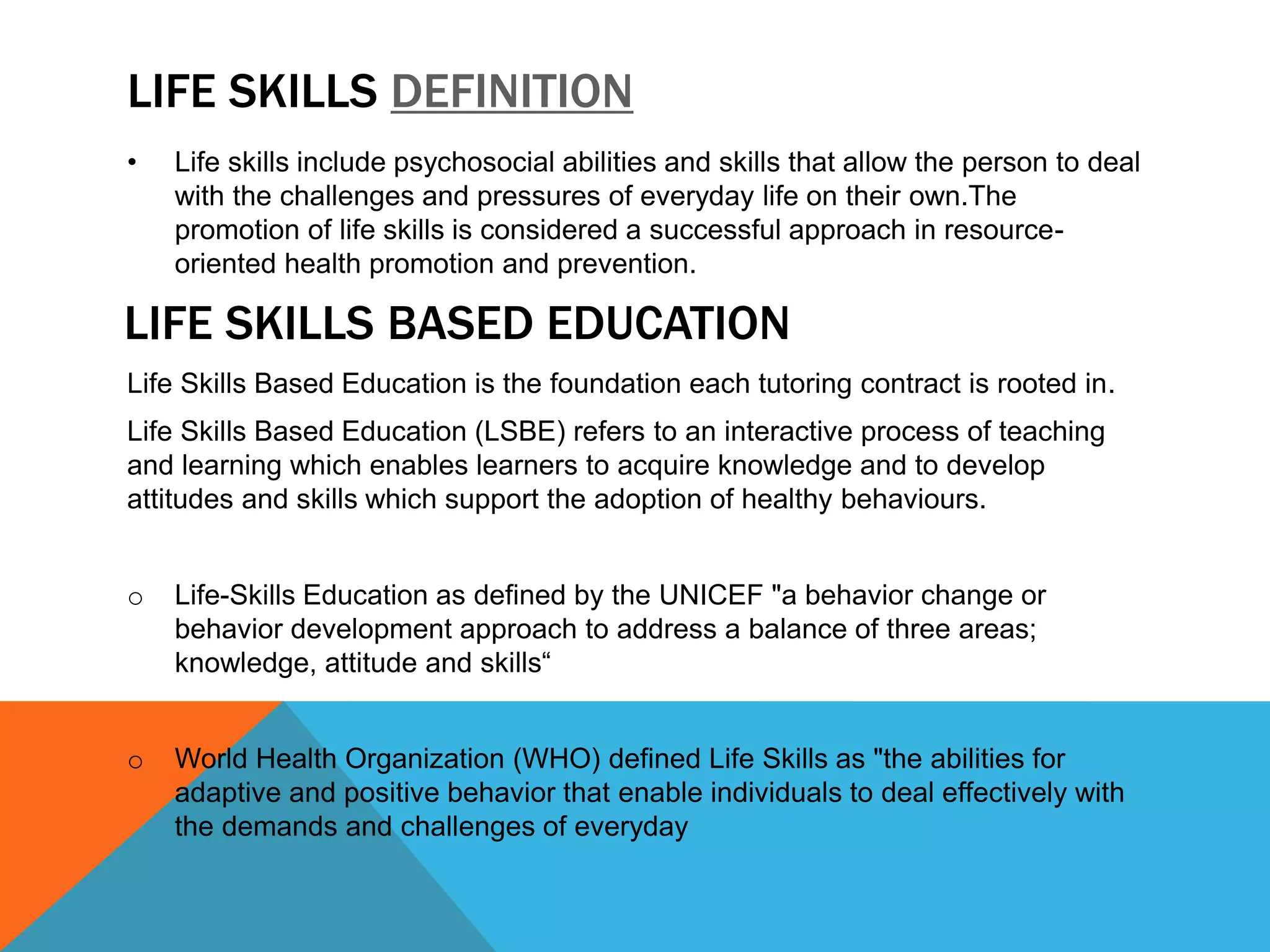
• Life skills include psychosocial abilities and skills that allow the person to deal
with the challenges and pressures of everyday life on their own.The
promotion of life skills is considered a successful approach in resource-
oriented health promotion and prevention.
Life Skills Based Education is the foundation each tutoring contract is rooted in.
Life Skills Based Education (LSBE) refers to an interactive process of teaching
and learning which enables learners to acquire knowledge and to develop
attitudes and skills which support the adoption of healthy behaviours.
o Life-Skills Education as defined by the UNICEF "a behavior change or
behavior development approach to address a balance of three areas;
knowledge, attitude and skills“
o World Health Organization (WHO) defined Life Skills as "the abilities for
adaptive and positive behavior that enable individuals to deal effectively with
the demands and challenges of everyday
LIFE SKILLS BASED EDUCATION
MEANING OF LIFE SKILLS EDUCATION
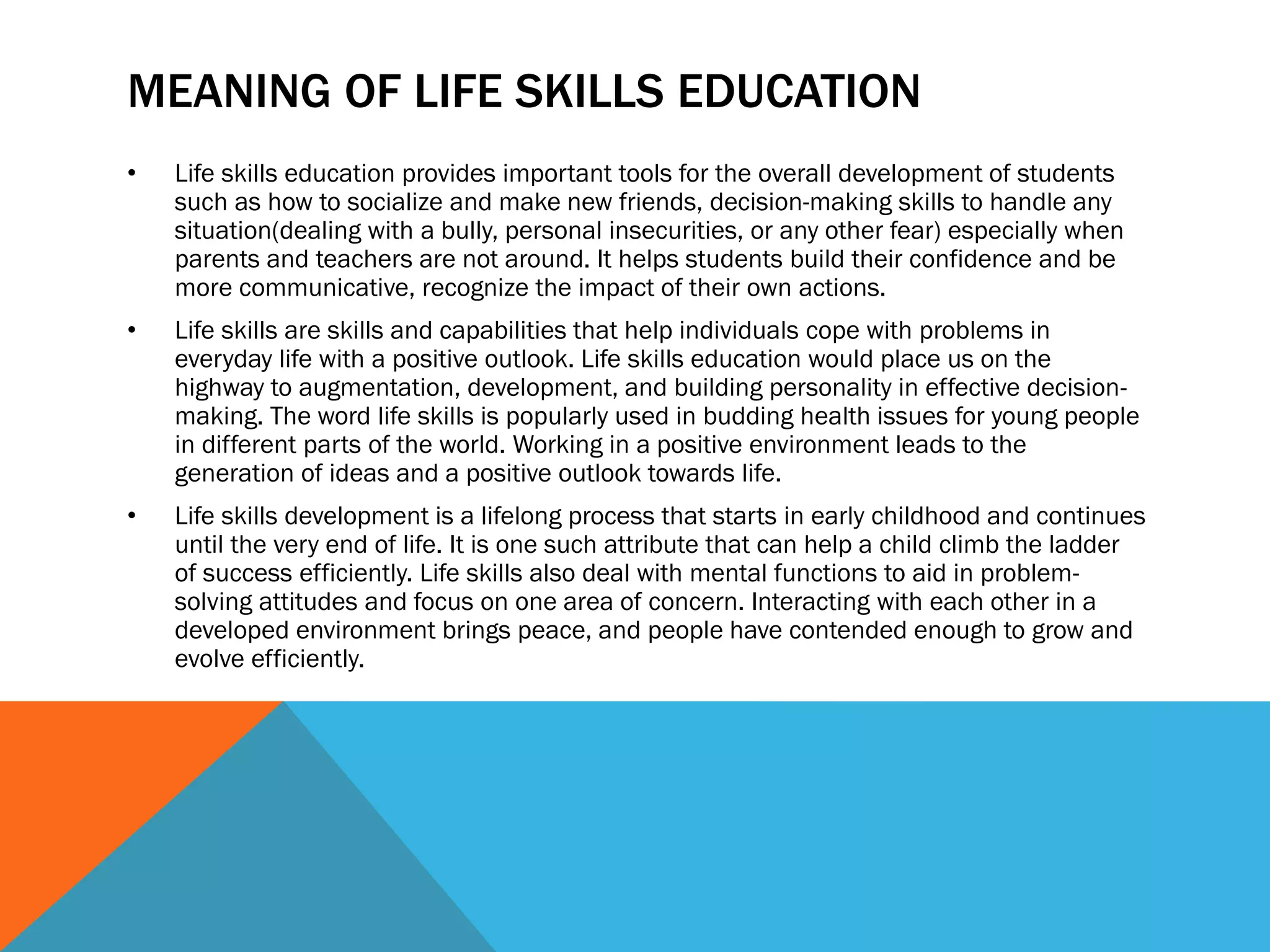
• Life skills education provides important tools for the overall development of students
such as how to socialize and make new friends, decision-making skills to handle any
situation(dealing with a bully, personal insecurities, or any other fear) especially when
parents and teachers are not around. It helps students build their confidence and be
more communicative, recognize the impact of their own actions.
• Life skills are skills and capabilities that help individuals cope with problems in
everyday life with a positive outlook. Life skills education would place us on the
highway to augmentation, development, and building personality in effective decision-
making. The word life skills is popularly used in budding health issues for young people
in different parts of the world. Working in a positive environment leads to the
generation of ideas and a positive outlook towards life.
• Life skills development is a lifelong process that starts in early childhood and continues
until the very end of life. It is one such attribute that can help a child climb the ladder
of success efficiently. Life skills also deal with mental functions to aid in problem-
solving attitudes and focus on one area of concern. Interacting with each other in a
developed environment brings peace, and people have contended enough to grow and
evolve efficiently.
LIST OF IMPORTANT LIFE SKILLS
• Skills that promote mental well-being and build competency in the young
generation as they endeavour new life challenges are termed life skills. Many
developmental areas and professionals involved agree that life skills build up the
character and personality of every individual and are generally applied in the
context of health and social events. Therefore, life skills can be used in various
content areas like health, social, politics, academics, sports, ethical principles,
etc.
• Life skills meaning extends to other parts of environmental education, consumer
education, basic livelihood, counselling sessions, career choices, and many more.
Generally, life skills empower the young generation to act wisely to take positive
approaches towards life to better health outcomes and positive social
relationships.
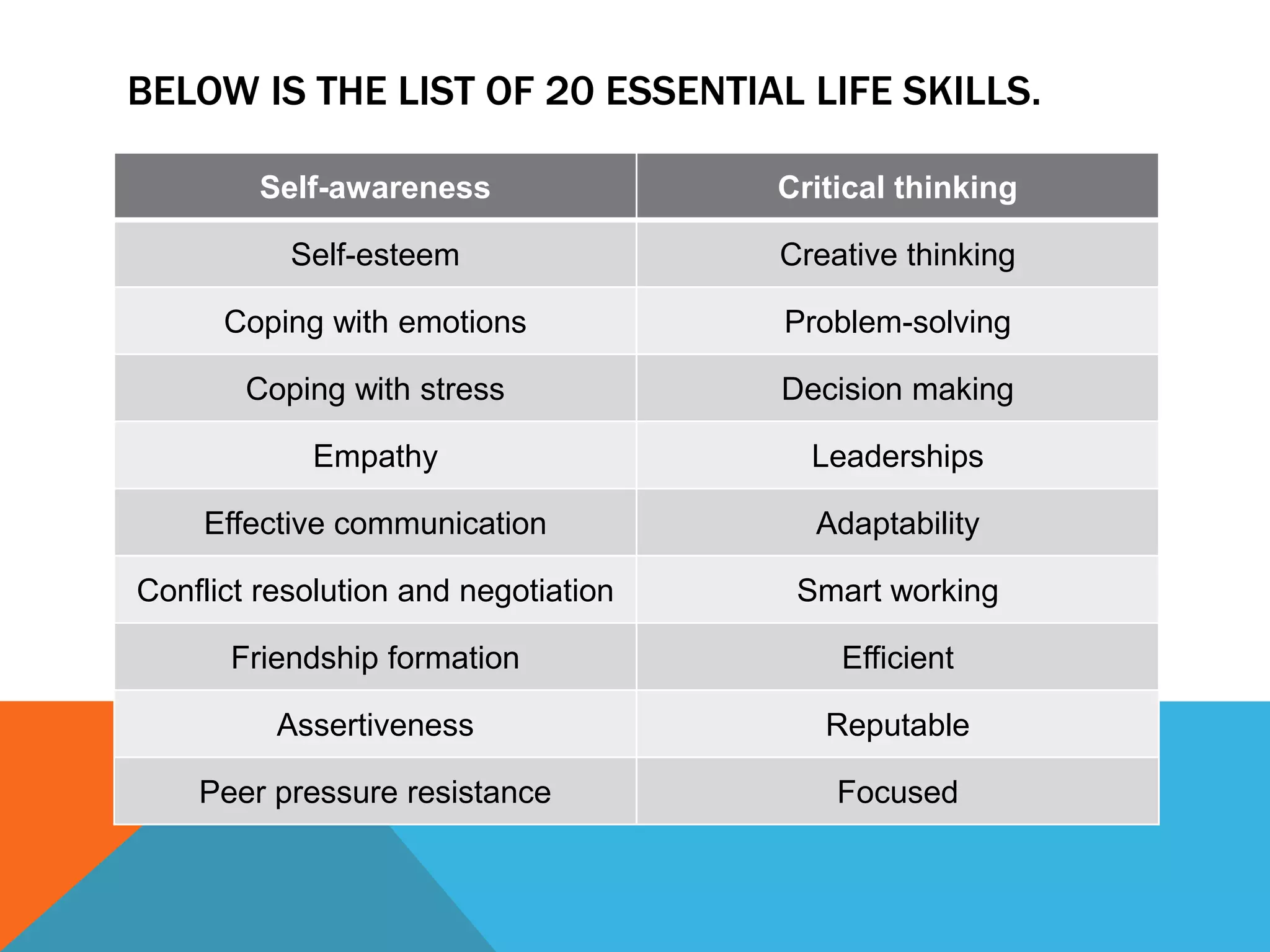
BELOW IS THE LIST OF 20 ESSENTIAL LIFE SKILLS.
Self-awareness Critical thinking
Self-esteem Creative thinking
Coping with emotions Problem-solving
Coping with stress Decision making
Empathy Leaderships
Effective communication Adaptability
Conflict resolution and negotiation Smart working
Friendship formation Efficient
Assertiveness Reputable
Peer pressure resistance Focused
IMPORTANCE OF LIFE SKILLS EDUCATION
Significantly, people should be taught to access information and activate prior
knowledge for better understanding. Mentors should support students in
making personal connections by incorporating life skills learning they already
know. Assisting the transfer of knowledge and skills to real-life situations is
imperative. Finally, people should be optimistic to think and ask questions if
they cannot understand something.
Below are the importance of life skills education.
• Teaching and instilling the value of routines, schedules, and the importance of
following them helps them bring discipline in life; assisting them in building
development goals boosts their confidence.
• Teaching students to work willingly to reflect on their classroom experiences
and share them with peers' teachers and parents leads to increased morals
and confidence.
• Giving responsibilities to students makes them manage time and learn
various values that are important for sustaining a contented life.
• These responsibilities are majorly leadership roles in school, student voice,
higher-level thinking skills, and academic goal setting. To facilitate students
with life skills, schools should deem in a "growth mindset."
• Practicing these values regularly turns out to be a practical approach towards
the betterment of morality.
• It helps them attain success in any vicinity as they grow and evolve. The
students don't hesitate to ask for assistance; they will be ready to put in the
effort and prefer new challenges. It helps children not to be more frightened of
failures and view mistakes as opportunities to learn and evolve.
• People, as individuals, are required to make decisions regarding their morals.
• The decision-making procedure involves recognizing the issue, gathering
data, generating possible courses of action, appraising alternatives, and
making a thoughtful decision based on the information accessible.
• Students should be actively involved in decision-making situations regularly
as they progress through their education.
OBJECTIVES OF LIFE SKILLS
Someone living in a rural society might put driving a car as an essential skill. By
learning new skills, we equip ourselves to live a more creative and satisfying life,
finding ways to cope with the challenges that life, unavoidably, throws at us. In
addition, life skills tend to build better personality traits.
Below are a few objectives of life skills.
• Thoughts, feelings, notions, and ideas should be clearly expressed.
• Disagreements should be settled without hindering anyone's feelings.
• Activities should be concerned with flourishing physical health and contribute to
well-being.
• Stress should be managed positively.
• Build team working habits.
• Keep personal goals reachable.
• Be comfortable with what you are becoming.
• Learn to accept things according to the situation.
• Start challenging yourself and try to discover yourself.
• Stay true to your values.
ADVANTAGES OF LIFE SKILLS EDUCATION
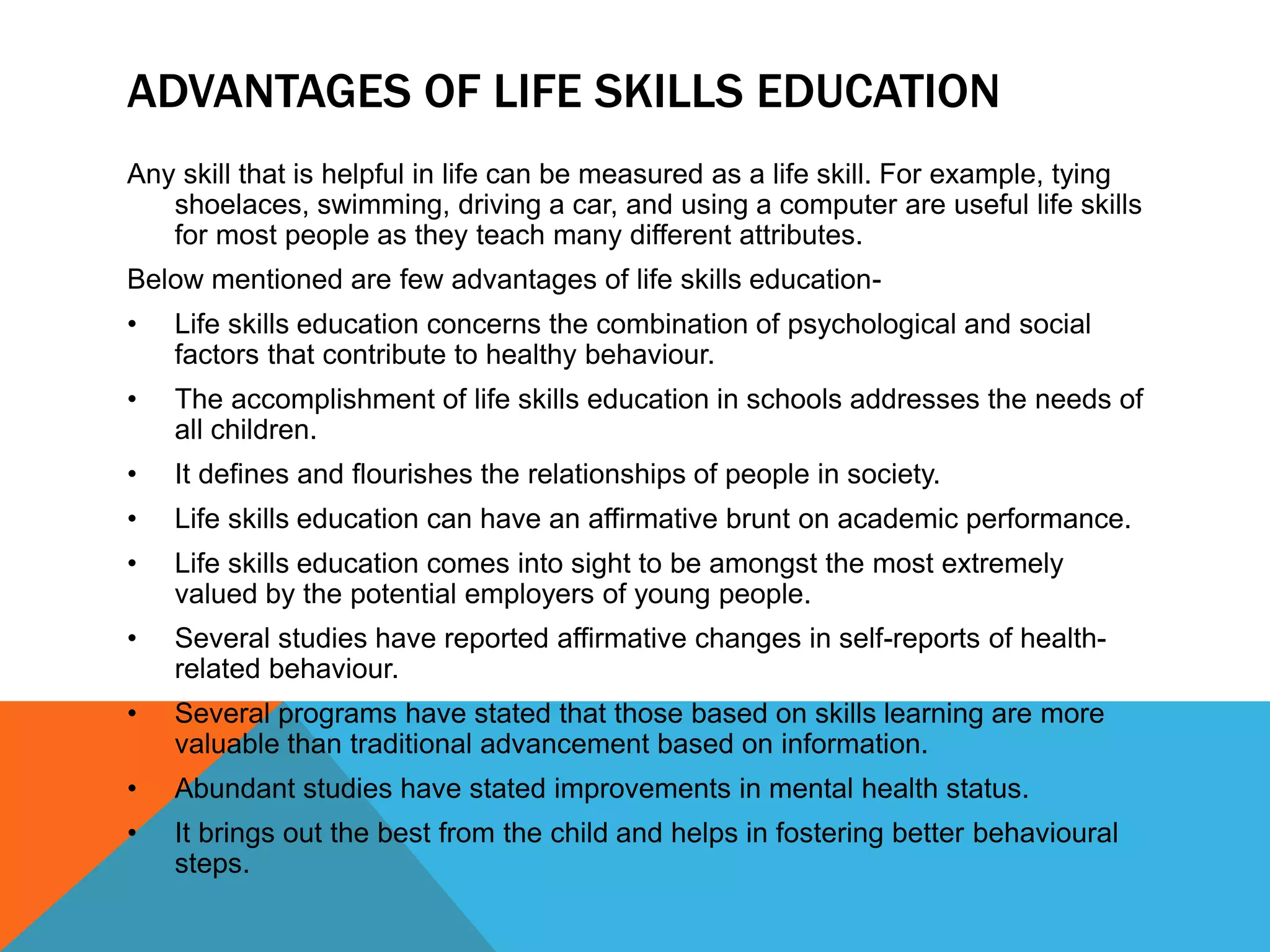
Any skill that is helpful in life can be measured as a life skill. For example, tying
shoelaces, swimming, driving a car, and using a computer are useful life skills
for most people as they teach many different attributes.
Below mentioned are few advantages of life skills education-
• Life skills education concerns the combination of psychological and social
factors that contribute to healthy behaviour.
• The accomplishment of life skills education in schools addresses the needs of
all children.
• It defines and flourishes the relationships of people in society.
• Life skills education can have an affirmative brunt on academic performance.
• Life skills education comes into sight to be amongst the most extremely
valued by the potential employers of young people.
• Several studies have reported affirmative changes in self-reports of health-
related behaviour.
• Several programs have stated that those based on skills learning are more
valuable than traditional advancement based on information.
• Abundant studies have stated improvements in mental health status.
• It brings out the best from the child and helps in fostering better behavioural
steps.
BOOKS FOR LIFE SKILLS EDUCATION
People can refer to various books to have in-depth knowledge about life skills.
Below are few books to refer to,
• Life Skill Activities By Darlene Mannix
• Life Skill Education Through Lifelong Learning By Dr A.R. Saravana Kumar
• Life Skills Education And Curriculum By Gracious Thomas
• Helping Your Pupil To Ask Questions By Jeni Wilson.
• Social Skills Activities By Darlene Mannix
• I Just Don't Like The Sound of NO! By Julia Cook
• A Step to Career Education: A Functional Life Skills Approach By Donn. E.
Brolin
• The Toddler Brain By Laura A. Jana
• Fall Again, Rise Again By Sandeep Aggarwal
• Rescript your life By Reeta Gupta

Life Skills.pdf

  • 2.
    LIFE SKILLS DEFINITION •Life skills include psychosocial abilities and skills that allow the person to deal with the challenges and pressures of everyday life on their own.The promotion of life skills is considered a successful approach in resource- oriented health promotion and prevention. Life Skills Based Education is the foundation each tutoring contract is rooted in. Life Skills Based Education (LSBE) refers to an interactive process of teaching and learning which enables learners to acquire knowledge and to develop attitudes and skills which support the adoption of healthy behaviours. o Life-Skills Education as defined by the UNICEF "a behavior change or behavior development approach to address a balance of three areas; knowledge, attitude and skills“ o World Health Organization (WHO) defined Life Skills as "the abilities for adaptive and positive behavior that enable individuals to deal effectively with the demands and challenges of everyday LIFE SKILLS BASED EDUCATION
  • 3.
    MEANING OF LIFESKILLS EDUCATION • Life skills education provides important tools for the overall development of students such as how to socialize and make new friends, decision-making skills to handle any situation(dealing with a bully, personal insecurities, or any other fear) especially when parents and teachers are not around. It helps students build their confidence and be more communicative, recognize the impact of their own actions. • Life skills are skills and capabilities that help individuals cope with problems in everyday life with a positive outlook. Life skills education would place us on the highway to augmentation, development, and building personality in effective decision- making. The word life skills is popularly used in budding health issues for young people in different parts of the world. Working in a positive environment leads to the generation of ideas and a positive outlook towards life. • Life skills development is a lifelong process that starts in early childhood and continues until the very end of life. It is one such attribute that can help a child climb the ladder of success efficiently. Life skills also deal with mental functions to aid in problem- solving attitudes and focus on one area of concern. Interacting with each other in a developed environment brings peace, and people have contended enough to grow and evolve efficiently.
  • 4.
    LIST OF IMPORTANTLIFE SKILLS • Skills that promote mental well-being and build competency in the young generation as they endeavour new life challenges are termed life skills. Many developmental areas and professionals involved agree that life skills build up the character and personality of every individual and are generally applied in the context of health and social events. Therefore, life skills can be used in various content areas like health, social, politics, academics, sports, ethical principles, etc. • Life skills meaning extends to other parts of environmental education, consumer education, basic livelihood, counselling sessions, career choices, and many more. Generally, life skills empower the young generation to act wisely to take positive approaches towards life to better health outcomes and positive social relationships.
  • 5.
    BELOW IS THELIST OF 20 ESSENTIAL LIFE SKILLS. Self-awareness Critical thinking Self-esteem Creative thinking Coping with emotions Problem-solving Coping with stress Decision making Empathy Leaderships Effective communication Adaptability Conflict resolution and negotiation Smart working Friendship formation Efficient Assertiveness Reputable Peer pressure resistance Focused
  • 7.
    IMPORTANCE OF LIFESKILLS EDUCATION Significantly, people should be taught to access information and activate prior knowledge for better understanding. Mentors should support students in making personal connections by incorporating life skills learning they already know. Assisting the transfer of knowledge and skills to real-life situations is imperative. Finally, people should be optimistic to think and ask questions if they cannot understand something. Below are the importance of life skills education. • Teaching and instilling the value of routines, schedules, and the importance of following them helps them bring discipline in life; assisting them in building development goals boosts their confidence. • Teaching students to work willingly to reflect on their classroom experiences and share them with peers' teachers and parents leads to increased morals and confidence.
  • 8.
    • Giving responsibilitiesto students makes them manage time and learn various values that are important for sustaining a contented life. • These responsibilities are majorly leadership roles in school, student voice, higher-level thinking skills, and academic goal setting. To facilitate students with life skills, schools should deem in a "growth mindset." • Practicing these values regularly turns out to be a practical approach towards the betterment of morality. • It helps them attain success in any vicinity as they grow and evolve. The students don't hesitate to ask for assistance; they will be ready to put in the effort and prefer new challenges. It helps children not to be more frightened of failures and view mistakes as opportunities to learn and evolve. • People, as individuals, are required to make decisions regarding their morals. • The decision-making procedure involves recognizing the issue, gathering data, generating possible courses of action, appraising alternatives, and making a thoughtful decision based on the information accessible. • Students should be actively involved in decision-making situations regularly as they progress through their education.
  • 9.
    OBJECTIVES OF LIFESKILLS Someone living in a rural society might put driving a car as an essential skill. By learning new skills, we equip ourselves to live a more creative and satisfying life, finding ways to cope with the challenges that life, unavoidably, throws at us. In addition, life skills tend to build better personality traits. Below are a few objectives of life skills. • Thoughts, feelings, notions, and ideas should be clearly expressed. • Disagreements should be settled without hindering anyone's feelings. • Activities should be concerned with flourishing physical health and contribute to well-being. • Stress should be managed positively. • Build team working habits. • Keep personal goals reachable. • Be comfortable with what you are becoming. • Learn to accept things according to the situation. • Start challenging yourself and try to discover yourself. • Stay true to your values.
  • 10.
    ADVANTAGES OF LIFESKILLS EDUCATION Any skill that is helpful in life can be measured as a life skill. For example, tying shoelaces, swimming, driving a car, and using a computer are useful life skills for most people as they teach many different attributes. Below mentioned are few advantages of life skills education- • Life skills education concerns the combination of psychological and social factors that contribute to healthy behaviour. • The accomplishment of life skills education in schools addresses the needs of all children. • It defines and flourishes the relationships of people in society. • Life skills education can have an affirmative brunt on academic performance. • Life skills education comes into sight to be amongst the most extremely valued by the potential employers of young people. • Several studies have reported affirmative changes in self-reports of health- related behaviour. • Several programs have stated that those based on skills learning are more valuable than traditional advancement based on information. • Abundant studies have stated improvements in mental health status. • It brings out the best from the child and helps in fostering better behavioural steps.
  • 11.
    BOOKS FOR LIFESKILLS EDUCATION People can refer to various books to have in-depth knowledge about life skills. Below are few books to refer to, • Life Skill Activities By Darlene Mannix • Life Skill Education Through Lifelong Learning By Dr A.R. Saravana Kumar • Life Skills Education And Curriculum By Gracious Thomas • Helping Your Pupil To Ask Questions By Jeni Wilson. • Social Skills Activities By Darlene Mannix • I Just Don't Like The Sound of NO! By Julia Cook • A Step to Career Education: A Functional Life Skills Approach By Donn. E. Brolin • The Toddler Brain By Laura A. Jana • Fall Again, Rise Again By Sandeep Aggarwal • Rescript your life By Reeta Gupta