






@PeterHilton
http://hilton.org.uk/
Beautiful code:
code with better type
Not type as in 

type system, but 

type as in…
steve lodefink / CC BY 2.0
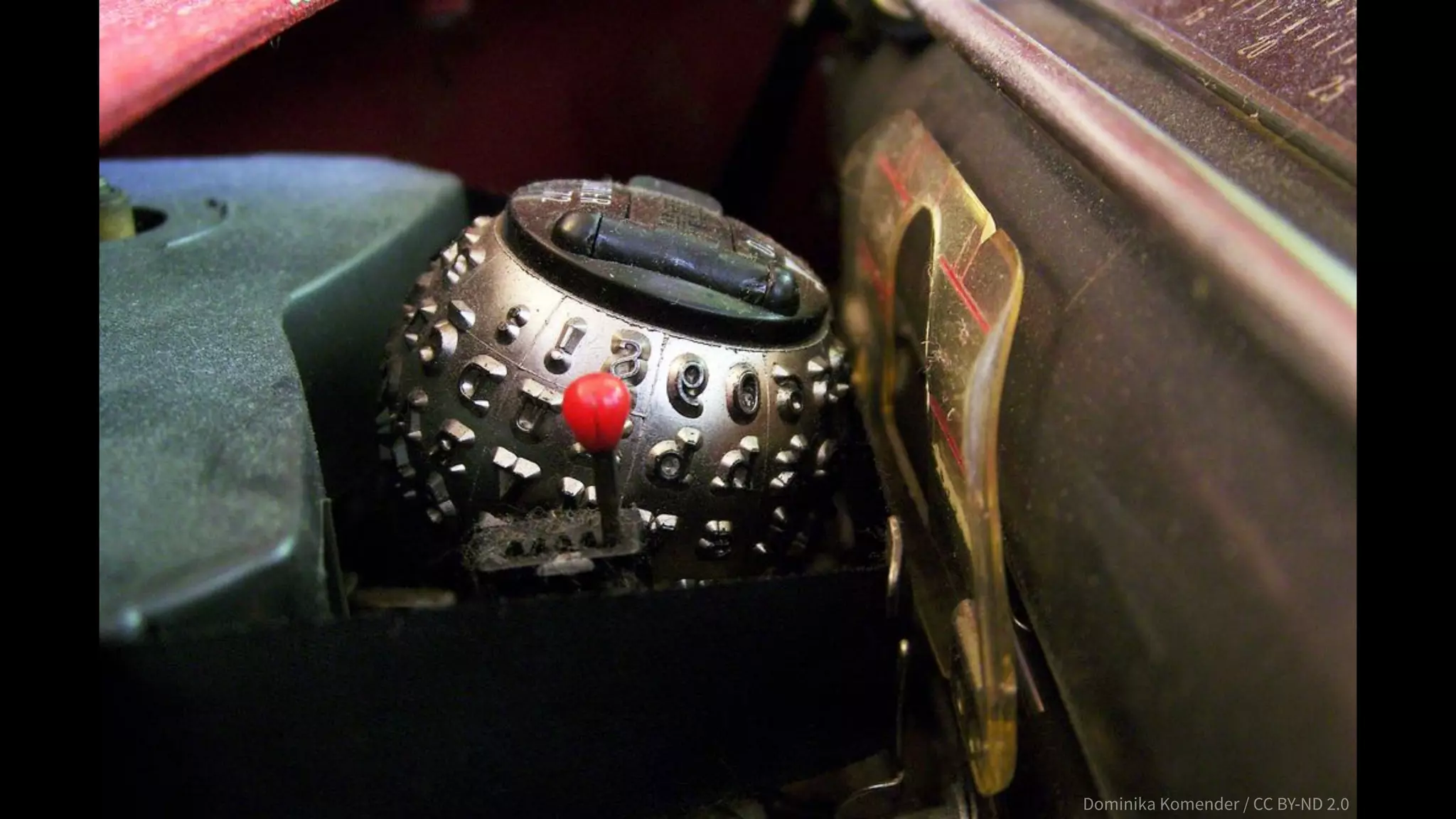
1961 IBM Selectric had a
choice of 45 typefaces
including Courier
Dominika Komender / CC BY-ND 2.0
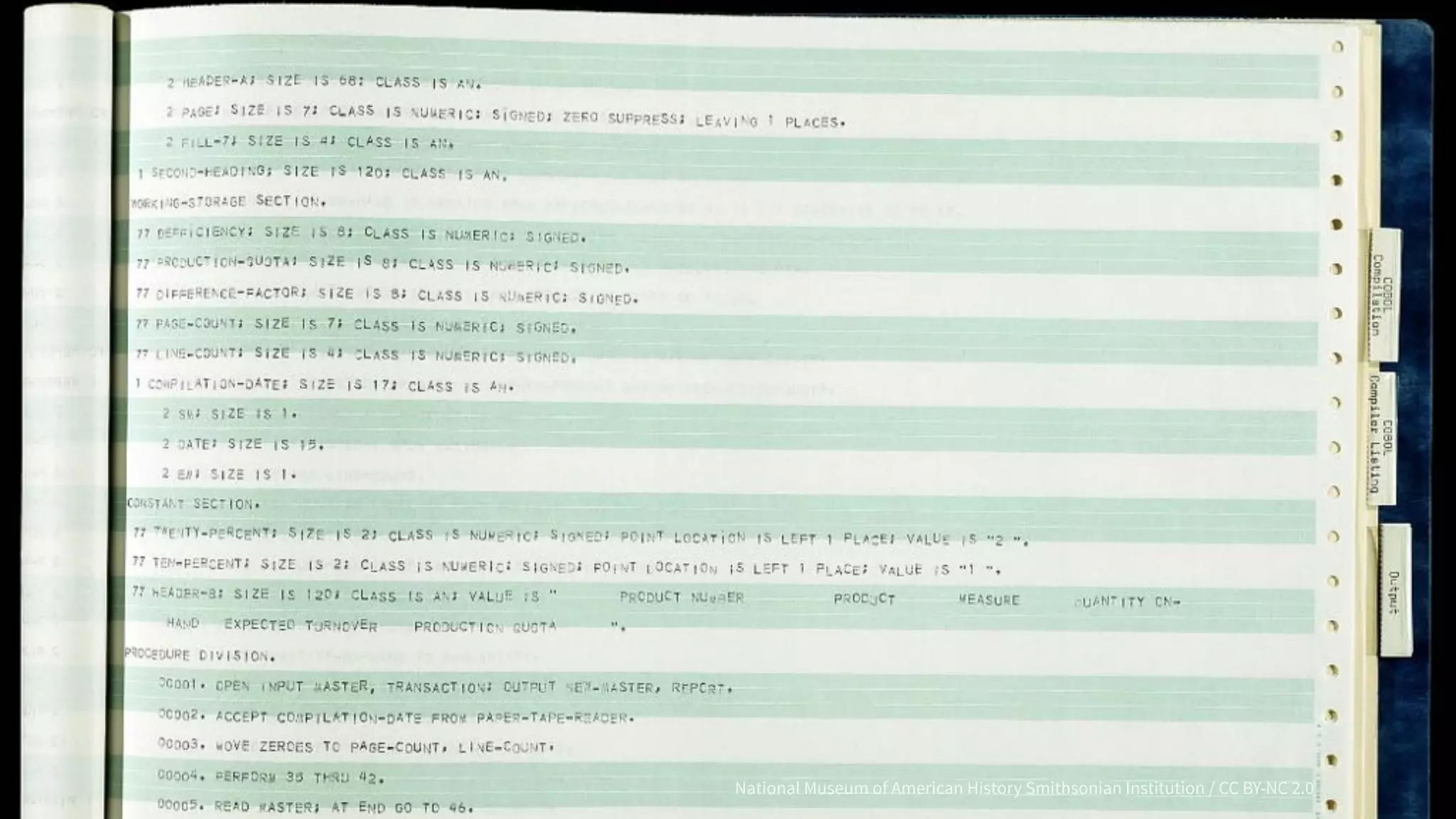
Before Courier became
widespread, we printed
COBOL on line printers…
National Museum of American History Smithsonian Institution / CC BY-NC 2.0
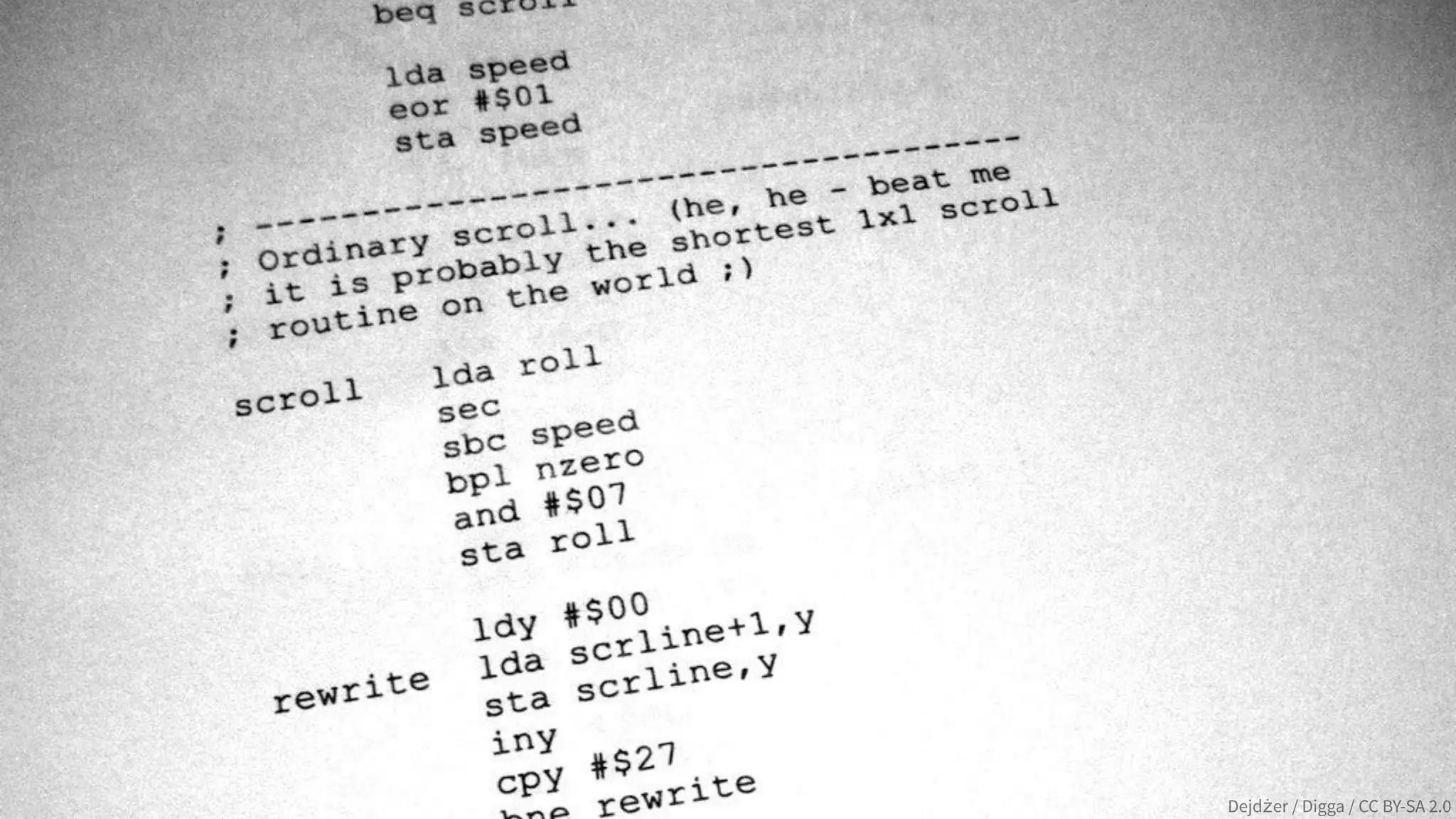
Windows 3.1 introduced
Courier New, still widely
used for source code…
Dejdżer / Digga / CC BY-SA 2.0
Source code typography
innovation hasn’t been
limited to new typefaces
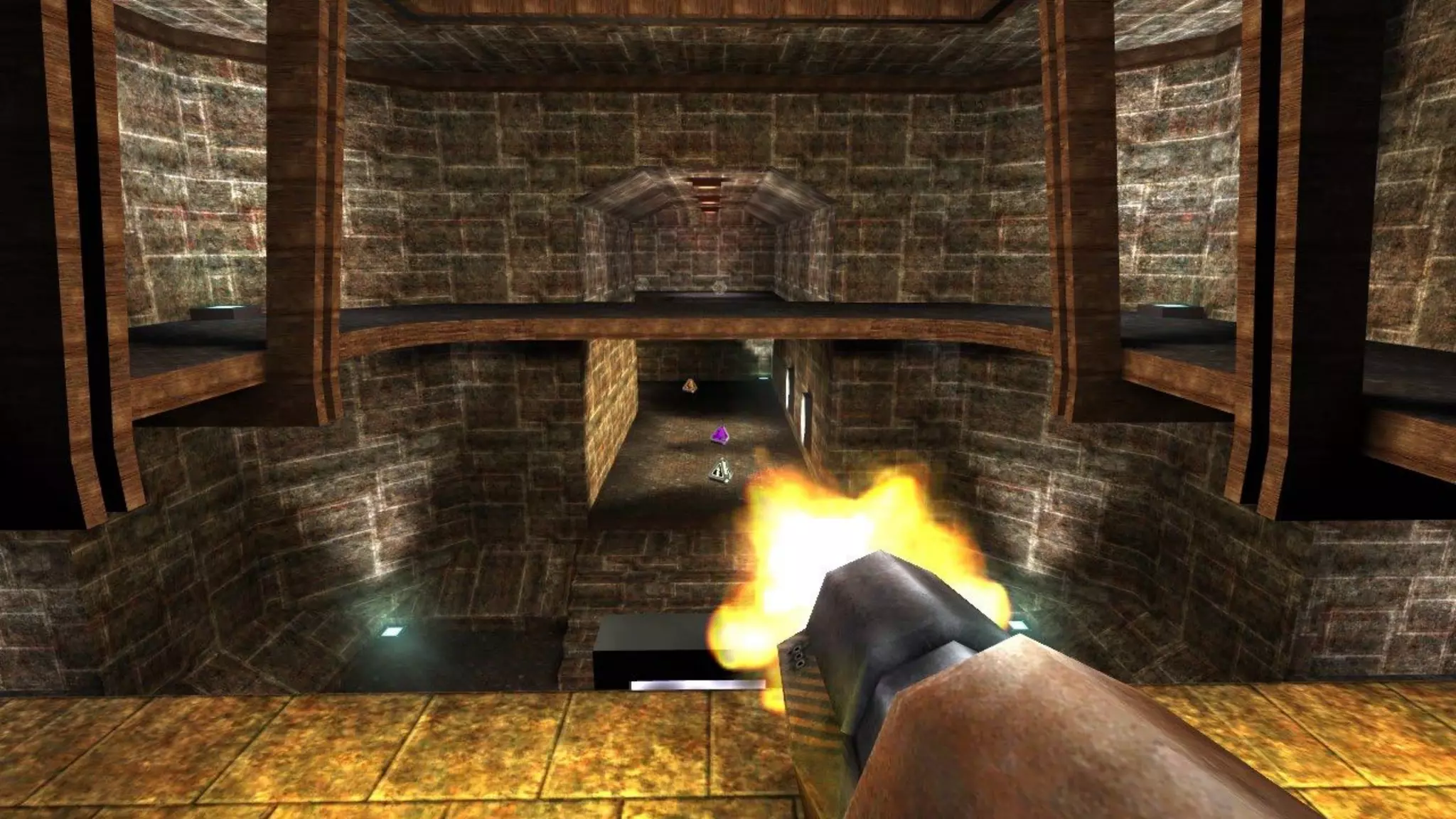
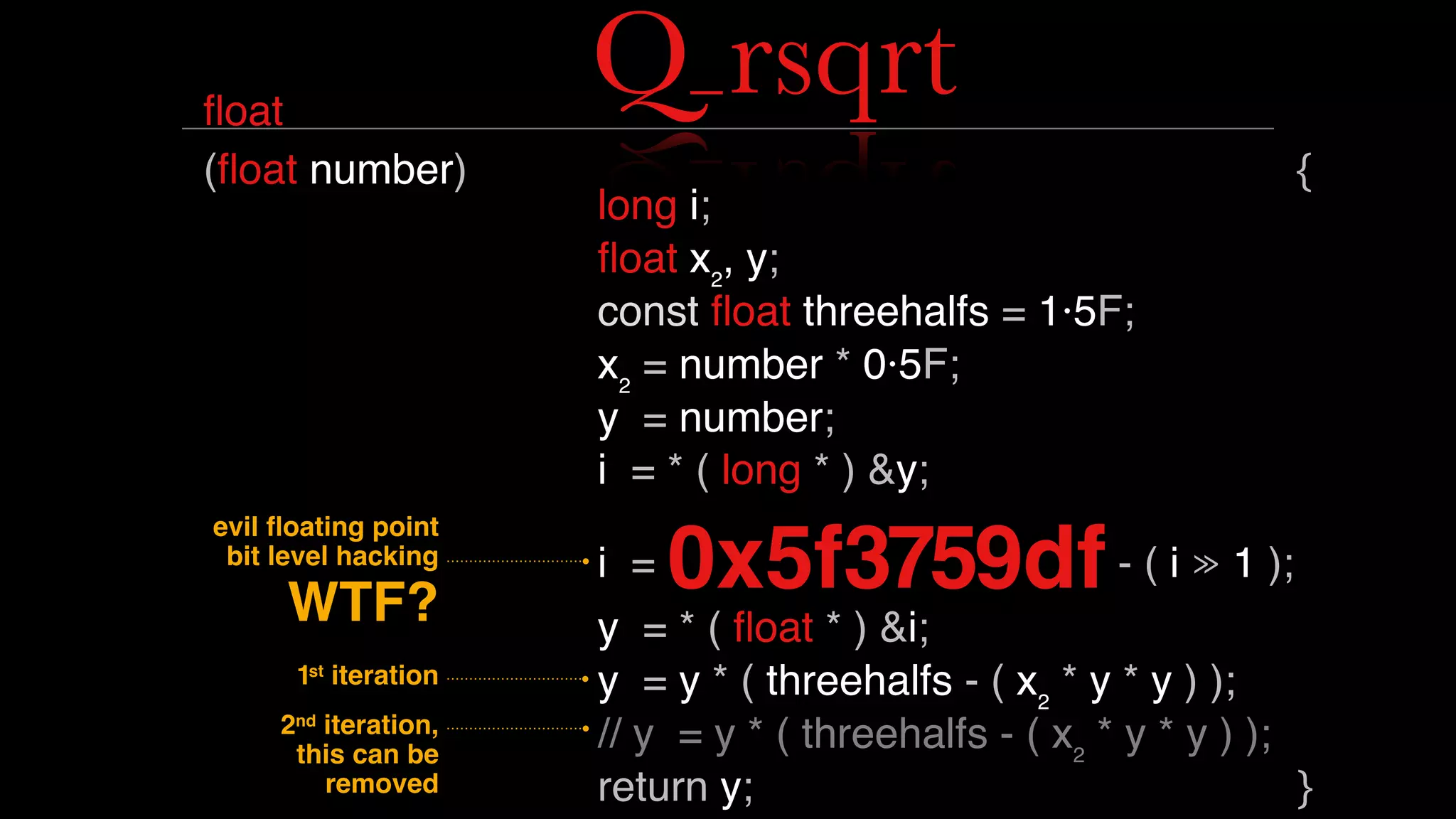
Fast inverse square root
algorithm, with syntax
colour, bold, italic, and 

a new typeface…
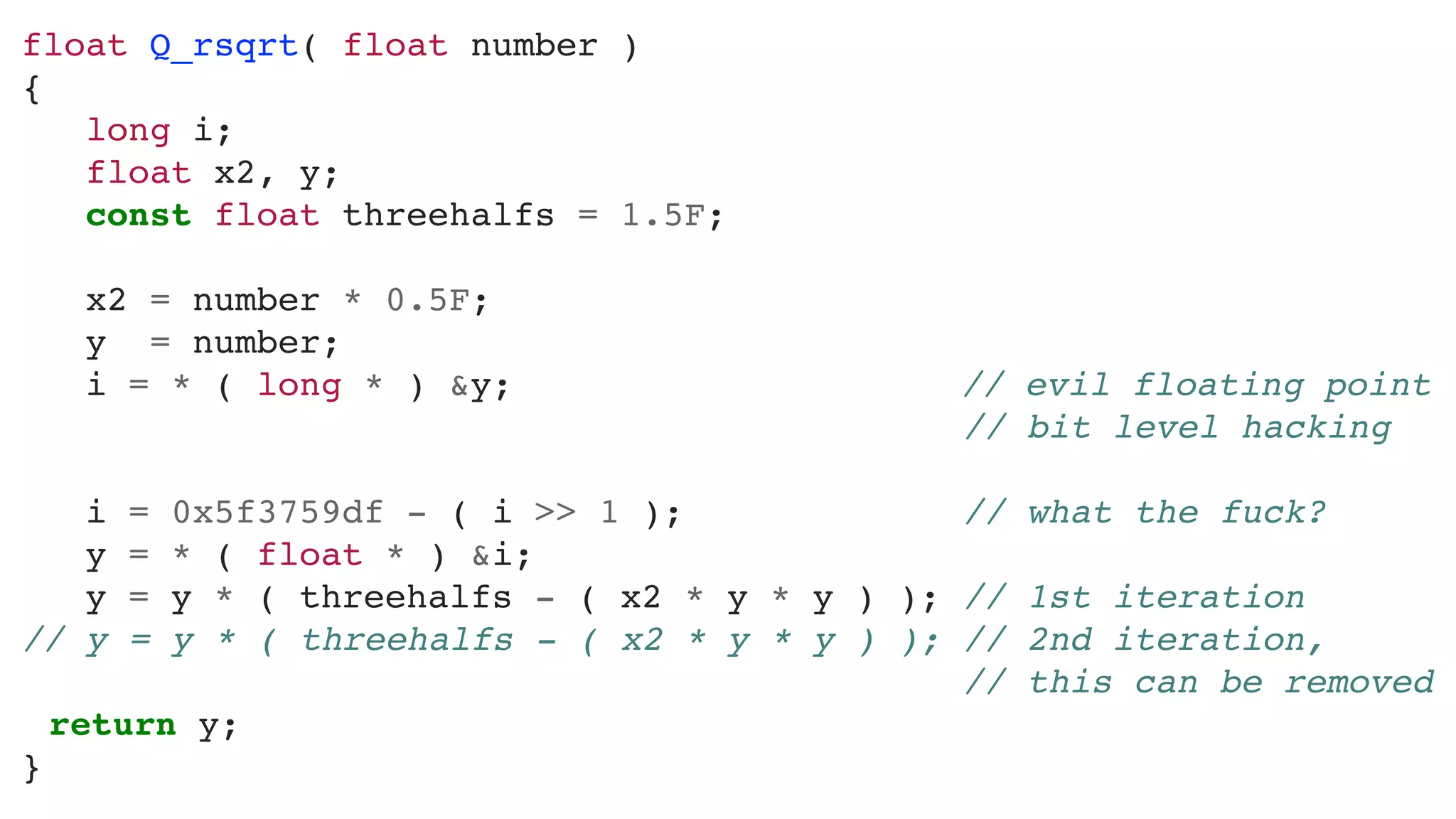
float	Q_rsqrt(	float	number	)	
{	
			long	i;	
			float	x2,	y;	
			const	float	threehalfs	=	1.5F;	
			x2	=	number	*	0.5F;	
			y		=	number;	
			i	=	*	(	long	*	)	&y;																						//	evil	floating	point	
																																													//	bit	level	hacking	
			i	=	0x5f3759df	-	(	i	>>	1	);														//	what	the	fuck?	
			y	=	*	(	float	*	)	&i;	
			y	=	y	*	(	threehalfs	-	(	x2	*	y	*	y	)	);		//	1st	iteration	
//	y	=	y	*	(	threehalfs	-	(	x2	*	y	*	y	)	);		//	2nd	iteration,	

																																													//	this	can	be	removed	
	 return	y;	
}
The most recent
innovation in source
code is as old as
typography itself
Ligatures combine letter
combinations
T h ~ Th, f j ~ fj
Source Code Pro
Hasklig
https://www.hanselman.com/blog/MonospacedProgrammingFontsWithLigatures.aspx
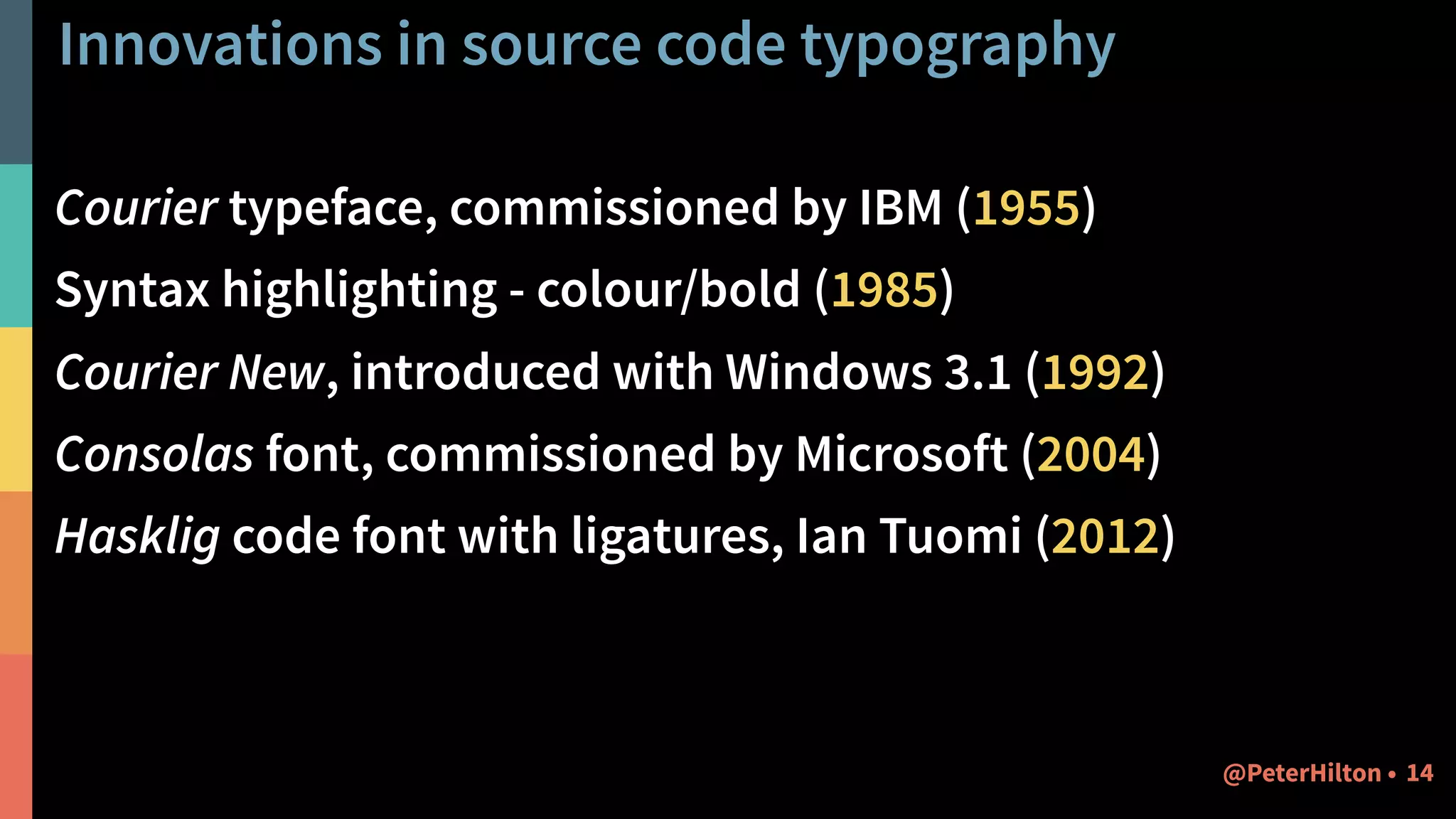
Innovations in source code typography
Courier typeface, commissioned by IBM (1955)
Syntax highlighting - colour/bold (1985)
Courier New, introduced with Windows 3.1 (1992)
Consolas font, commissioned by Microsoft (2004)
Hasklig code font with ligatures, Ian Tuomi (2012)
18@PeterHilton •
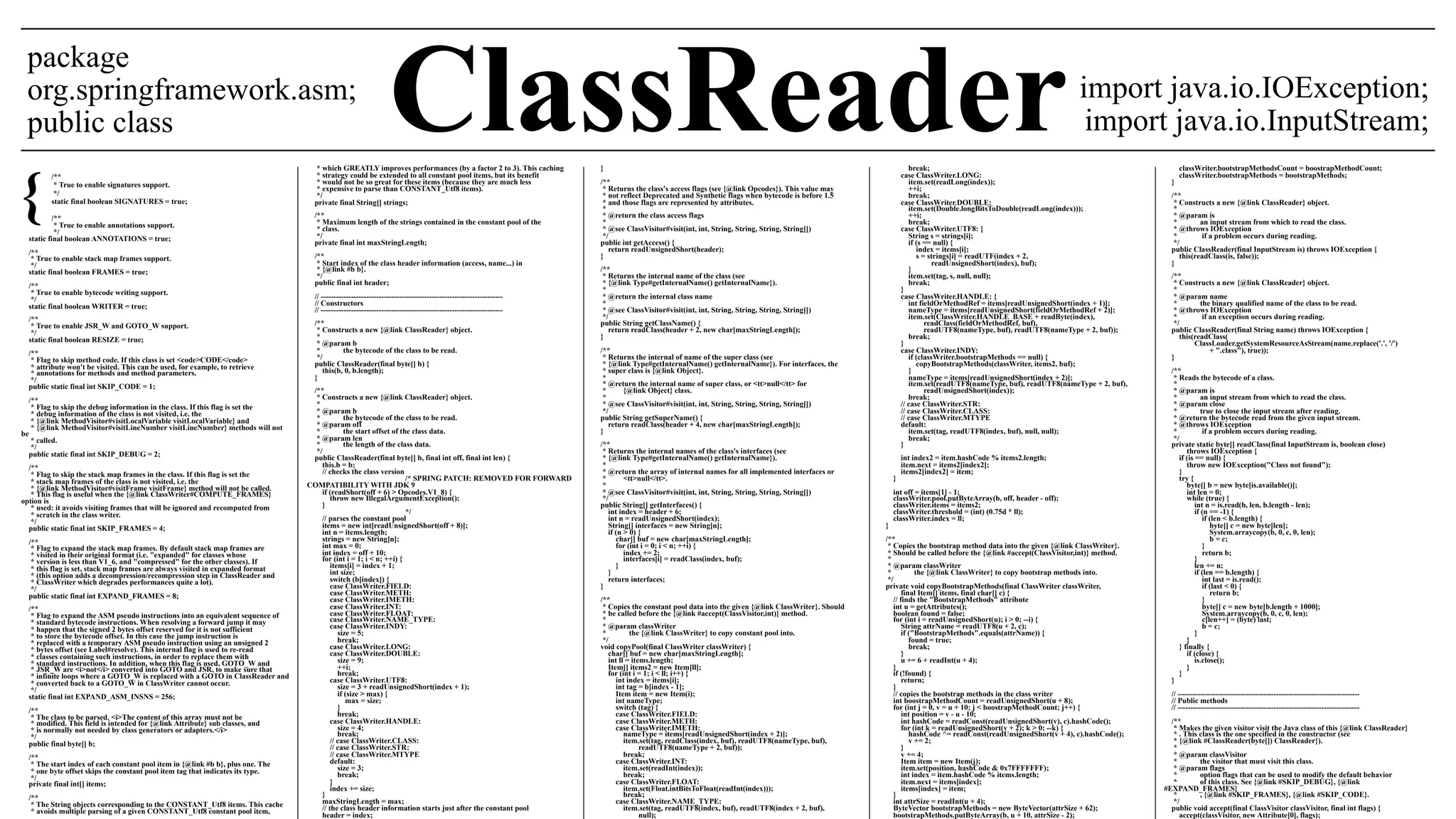
Multiple wide monitors
don’t help with long
Java classes…
package org.springframework.beans.factory.support;
import org.springframework.beans.*;
import org.springframework.beans.factory.*;
import org.springframework.beans.factory.config.*;
import org.springframework.core.*;
import org.springframework.core.convert.ConversionService;
import org.springframework.lang.Nullable;
import org.springframework.util.*;
public abstract class AbstractBeanFactory extends FactoryBeanRegistrySupport implements
ConfigurableBeanFactory {
/** Parent bean factory, for bean inheritance support */
@Nullable
private BeanFactory parentBeanFactory;
/** ClassLoader to resolve bean class names with, if necessary */
@Nullable
private ClassLoader beanClassLoader = ClassUtils.getDefaultClassLoader();
/** ClassLoader to temporarily resolve bean class names with, if necessary */
@Nullable
private ClassLoader tempClassLoader;
/** Whether to cache bean metadata or rather reobtain it for every access */
private boolean cacheBeanMetadata = true;
/** Resolution strategy for expressions in bean definition values */
@Nullable
private BeanExpressionResolver beanExpressionResolver;
/** Spring ConversionService to use instead of PropertyEditors */
@Nullable
private ConversionService conversionService;
/** Custom PropertyEditorRegistrars to apply to the beans of this factory */
private final Set<PropertyEditorRegistrar> propertyEditorRegistrars = new
LinkedHashSet<>(4);
/** Custom PropertyEditors to apply to the beans of this factory */
private final Map<Class<?>, Class<? extends PropertyEditor>> customEditors = new
HashMap<>(4);
/** A custom TypeConverter to use, overriding the default PropertyEditor mechanism */
@Nullable
private TypeConverter typeConverter;
/** String resolvers to apply e.g. to annotation attribute values */
private final List<StringValueResolver> embeddedValueResolvers = new LinkedList<>();
/** BeanPostProcessors to apply in createBean */
private final List<BeanPostProcessor> beanPostProcessors = new ArrayList<>();
/** Indicates whether any InstantiationAwareBeanPostProcessors have been registered */
private boolean hasInstantiationAwareBeanPostProcessors;
/** Indicates whether any DestructionAwareBeanPostProcessors have been registered */
private boolean hasDestructionAwareBeanPostProcessors;
/** Map from scope identifier String to corresponding Scope */
private final Map<String, Scope> scopes = new LinkedHashMap<>(8);
/** Security context used when running with a SecurityManager */
@Nullable
private SecurityContextProvider securityContextProvider;
/** Map from bean name to merged RootBeanDefinition */
private final Map<String, RootBeanDefinition> mergedBeanDefinitions = new
ConcurrentHashMap<>(256);
/** Names of beans that have already been created at least once */
private final Set<String> alreadyCreated = Collections.newSetFromMap(new
ConcurrentHashMap<>(256));
/** Names of beans that are currently in creation */
private final ThreadLocal<Object> prototypesCurrentlyInCreation =
new NamedThreadLocal<>("Prototype beans currently in creation");
/**
* Create a new AbstractBeanFactory.
*/
public AbstractBeanFactory() {
}
/**
* Create a new AbstractBeanFactory with the given parent.
* @param parentBeanFactory parent bean factory, or {@code null} if none
* @see #getBean
*/
public AbstractBeanFactory(@Nullable BeanFactory
parentBeanFactory) {
this.parentBeanFactory = parentBeanFactory;
}
// Implementation of BeanFactory interface
@Override
public Object getBean(String name) throws BeansException {
return doGetBean(name, null, null, false);
}
@Override
public <T> T getBean(String name, @Nullable Class<T> requiredType) throws BeansException
{
return doGetBean(name, requiredType, null, false);
}
@Override
public Object getBean(String name, Object... args) throws
BeansException {
return doGetBean(name, null, args, false);
}
/**
* Return an instance, which may be shared or independent, of the specified bean.
* @param name the name of the bean to retrieve
* @param requiredType the required type of the bean to retrieve
* @param args arguments to use when creating a bean instance using explicit
* arguments (only applied when creating a new instance)
* @return an instance of the bean
* @throws BeansException if the bean could not be created
*/
public <T> T getBean(String name, @Nullable Class<T>
requiredType, @Nullable Object... args) throws BeansException {
return doGetBean(name, requiredType, args, false);
}
/**
* Return an instance, which may be shared or independent, of the specified bean.
* @param name the name of the bean to retrieve
* @param requiredType the required type of the bean to retrieve
* @param args arguments to use when creating a bean instance using explicit
* arguments (only applied when creating a new instance)
* @param typeCheckOnly whether the instance is obtained for a type check,
* not for actual use
* @return an instance of the bean
* @throws BeansException if the bean could not be created
*/
@SuppressWarnings("unchecked")
protected <T> T doGetBean(final String name,
@Nullable final Class<T> requiredType, @Nullable final Object[] args, boolean
typeCheckOnly) throws BeansException {
final String beanName = transformedBeanName(name);
Object bean;
// Eagerly check singleton cache for manually registered singletons.
Object sharedInstance = getSingleton(beanName);
if (sharedInstance != null && args == null) {
if (logger.isDebugEnabled()) {
if (isSingletonCurrentlyInCreation(beanName)) {
logger.debug("Returning eagerly cached instance of singleton bean '" +
beanName + "' that is not fully initialized yet - circular reference");
}
else {
logger.debug("Returning cached instance of bean '" + beanName + "'");
}
}
bean = getObjectForBeanInstance(sharedInstance, name, beanName, null);
}
else {
// Fail if we're already creating this bean instance:
// We're assumably within a circular reference.
if (isPrototypeCurrentlyInCreation(beanName)) {
throw new BeanCurrentlyInCreationException(beanName);
}
// Check if bean definition exists in this factory.
BeanFactory parentBeanFactory = getParentBeanFactory();
if (parentBeanFactory != null && !containsBeanDefinition(beanName)) {
// Not found m> check parent.
String nameToLookup = originalBeanName(name);
if (parentBeanFactory instanceof AbstractBeanFactory) {
return ((AbstractBeanFactory) parentBeanFactory).doGetBean(
nameToLookup, requiredType, args, typeCheckOnly);
}
else if (args != null) {
// Delegation to parent with explicit args.
return (T) parentBeanFactory.getBean(nameToLookup, args);
}
else {
// No args m> delegate to standard getBean method.
return parentBeanFactory.getBean(nameToLookup, requiredType);
}
}
if (!typeCheckOnly) {
markBeanAsCreated(beanName);
}
try {
final RootBeanDefinition mbd = getMergedLocalBeanDefinition(beanName);
checkMergedBeanDefinition(mbd, beanName, args);
// Guarantee initialization of beans that the current bean depends on.
String[] dependsOn = mbd.getDependsOn();
if (dependsOn != null) {
for (String dep : dependsOn) {
if (isDependent(beanName, dep)) {
throw new BeanCreationException(mbd.getResourceDescription(), beanName,
"Circular relationship between '" + beanName + "' and '" + dep + "'");
}
registerDependentBean(dep, beanName);
getBean(dep);
}
}
// Create bean instance.
if (mbd.isSingleton()) {
sharedInstance = getSingleton(beanName, () m> {
try {
return createBean(beanName, mbd, args);
}
catch (BeansException ex) {
// Explicitly remove instance from singleton cache: It might have been put
// there eagerly by the creation process, to allow for circular reference
// resolution. Also remove any beans that received a temporary reference to
// the bean.
destroySingleton(beanName);
throw ex;
}
});
bean = getObjectForBeanInstance(sharedInstance, name, beanName, mbd);
}
else if (mbd.isPrototype()) {
// It's a prototype m> create a new instance.
Object prototypeInstance = null;
try {
beforePrototypeCreation(beanName);
prototypeInstance = createBean(beanName, mbd, args);
}
finally {
afterPrototypeCreation(beanName);
}
bean = getObjectForBeanInstance(prototypeInstance, name, beanName, mbd);
}
else {
String scopeName = mbd.getScope();
final Scope scope = this.scopes.get(scopeName);
if (scope == null) {
throw new IllegalStateException("No Scope for '" + scopeName + "'");
}
try {
Object scopedInstance = scope.get(beanName, () m> {
beforePrototypeCreation(beanName);
try {
return createBean(beanName, mbd, args);
}
finally {
afterPrototypeCreation(beanName);
}
});
bean = getObjectForBeanInstance(scopedInstance, name, beanName, mbd);
}
catch (IllegalStateException ex) {
throw new BeanCreationException(beanName,
"Scope '" + scopeName + "' is not active for the current thread; " +
"define a scoped proxy for this bean to refer to it from a singleton", ex);
}
}
}
catch (BeansException ex) {
cleanupAfterBeanCreationFailure(beanName);
throw ex;
}
}
// Check if required type matches the type of the actual bean instance.
// Note that the following return declarations are technically violating the
// non-null policy for the getBean methods: However, these will only result
// in null under very specific circumstances: such as a user-declared factory
// method returning null or a user-provided FactoryBean.getObject() returning
// null, without any custom post-processing of such null values. We will pass
// them on as null to corresponding injection points in that exceptional case
// but do not expect user-level getBean callers to deal with such null values.
// In the end, regular getBean callers should be able to assign the outcome
// to non-null variables/arguments without being compromised by rather esoteric
// corner cases, in particular in functional configuration and Kotlin scenarios.
// A future Spring generation might eventually forbid null values completely
// and throw IllegalStateExceptions instead of leniently passing them through.
if (requiredType != null && bean != null && !requiredType.isInstance(bean)) {
try {
return getTypeConverter().convertIfNecessary(bean, requiredType);
}
catch (TypeMismatchException ex) {
if (logger.isDebugEnabled()) {
logger.debug("Failed to convert bean '" + name + "' to required type '" +
ClassUtils.getQualifiedName(requiredType) + "'", ex);
}
throw new BeanNotOfRequiredTypeException(name, requiredType, bean.getClass());
}
}
// For the nullability warning, see the elaboration in the comment above;
// in short: This is never going to be null unless user-declared code enforces null.
return (T) bean;
}
@Override
public boolean containsBean(String name) {
String beanName = transformedBeanName(name);
if (containsSingleton(beanName) || containsBeanDefinition(beanName)) {
return (!BeanFactoryUtils.isFactoryDereference(name) || isFactoryBean(name));
}
// Not found m> check parent.
BeanFactory parentBeanFactory = getParentBeanFactory();
return (parentBeanFactory != null && parentBeanFactory.
containsBean(originalBeanName(name)));
}
@Override
public boolean isSingleton(String name) throws
NoSuchBeanDefinitionException {
String beanName = transformedBeanName(name);
Object beanInstance = getSingleton(beanName, false);
if (beanInstance != null) {
if (beanInstance instanceof FactoryBean) {
return (BeanFactoryUtils.isFactoryDereference(name) ||
((FactoryBean<?>) beanInstance).isSingleton());
}
else {
return !BeanFactoryUtils.isFactoryDereference(name);
}
}
else if (containsSingleton(beanName)) {
return true;
}
// No singleton instance found m> check bean definition.
BeanFactory parentBeanFactory = getParentBeanFactory();
if (parentBeanFactory != null && !containsBeanDefinition(beanName)) {
// No bean definition found in this factory m> delegate to parent.
return parentBeanFactory.isSingleton(originalBeanName(name));
}
RootBeanDefinition mbd = getMergedLocalBeanDefinition(beanName);
// In case of FactoryBean, return singleton status of created object if not a dereference.
if (mbd.isSingleton()) {
if (isFactoryBean(beanName, mbd)) {
if (BeanFactoryUtils.isFactoryDereference(name)) {
return true;
}
FactoryBean<?> factoryBean =
(FactoryBean<?>) getBean(FACTORY_BEAN_PREFIX + beanName);
return factoryBean.isSingleton();
}
else {
return !BeanFactoryUtils.isFactoryDereference(name);
}
}
else {
return false;
}
}
@Override
public boolean isPrototype(String name) throws
NoSuchBeanDefinitionException {
String beanName = transformedBeanName(name);
BeanFactory parentBeanFactory = getParentBeanFactory();
if (parentBeanFactory != null && !containsBeanDefinition(beanName)) {
// No bean definition found in this factory m> delegate to parent.
return parentBeanFactory.isPrototype(originalBeanName(name));
}
RootBeanDefinition mbd = getMergedLocalBeanDefinition(beanName);
if (mbd.isPrototype()) {
// In case of FactoryBean, return singleton status of created object if not a
// dereference.
return (!BeanFactoryUtils.isFactoryDereference(name) ||
isFactoryBean(beanName, mbd));
}
// Singleton or scoped - not a prototype.
// However, FactoryBean may still produce a prototype object...
if (BeanFactoryUtils.isFactoryDereference(name)) {
return false;
}
if (isFactoryBean(beanName, mbd)) {
final FactoryBean<?> fb =
(FactoryBean<?>) getBean(FACTORY_BEAN_PREFIX + beanName);
if (System.getSecurityManager() != null) {
return AccessController.doPrivileged((PrivilegedAction<Boolean>) () m>
((fb instanceof SmartFactoryBean && ((SmartFactoryBean<?>) fb).isPrototype())
|| !fb.isSingleton()),
getAccessControlContext());
}
else {
return ((fb instanceof SmartFactoryBean && ((SmartFactoryBean<?>) fb).isPrototype()) ||
!fb.isSingleton());
}
}
else {
return false;
}
}
@Override
public boolean isTypeMatch(String name, ResolvableType
typeToMatch) throws NoSuchBeanDefinitionException {
String beanName = transformedBeanName(name);
// Check manually registered singletons.
Object beanInstance = getSingleton(beanName, false);
if (beanInstance != null) {
if (beanInstance instanceof FactoryBean) {
if (!BeanFactoryUtils.isFactoryDereference(name)) {
Class<?> type = getTypeForFactoryBean((FactoryBean<?>) beanInstance);
return (type != null && typeToMatch.isAssignableFrom(type));
}
else {
return typeToMatch.isInstance(beanInstance);
}
}
else if (!BeanFactoryUtils.isFactoryDereference(name)) {
if (typeToMatch.isInstance(beanInstance)) {
// Direct match for exposed instance?
return true;
}
else if (typeToMatch.hasGenerics() && containsBeanDefinition(beanName)) {
// Generics potentially only match on the target class, not on the proxy...
RootBeanDefinition mbd = getMergedLocalBeanDefinition(beanName);
Class<?> targetType = mbd.getTargetType();
if (targetType != null && targetType != ClassUtils.getUserClass(beanInstance)
&& typeToMatch.isAssignableFrom(targetType)) {
// Check raw class match as well, making sure it's exposed on the proxy.
Class<?> classToMatch = typeToMatch.resolve();
return (classToMatch == null || classToMatch.isInstance(beanInstance));
}
}
}
return false;
}
else if (containsSingleton(beanName) && !containsBeanDefinition(beanName)) {
// null instance registered
return false;
}
// No singleton instance found m> check bean definition.
BeanFactory parentBeanFactory = getParentBeanFactory();
if (parentBeanFactory != null && !containsBeanDefinition(beanName)) {
// No bean definition found in this factory m> delegate to parent.
return parentBeanFactory.isTypeMatch(originalBeanName(name), typeToMatch);
}
// Retrieve corresponding bean definition.
RootBeanDefinition mbd = getMergedLocalBeanDefinition(beanName);
Class<?> classToMatch = typeToMatch.resolve();
if (classToMatch == null) {
classToMatch = FactoryBean.class;
}
Class<?>[] typesToMatch = (FactoryBean.class == classToMatch ?
new Class<?>[] {classToMatch} : new Class<?>[] {FactoryBean.class, classToMatch});
// Check decorated bean definition, if any: We assume it'll be easier
// to determine the decorated bean's type than the proxy's type.
BeanDefinitionHolder dbd = mbd.getDecoratedDefinition();
if (dbd != null && !BeanFactoryUtils.isFactoryDereference(name)) {
RootBeanDefinition tbd = getMergedBeanDefinition(dbd.getBeanName(),
dbd.getBeanDefinition(), mbd);
Class<?> targetClass = predictBeanType(dbd.getBeanName(), tbd, typesToMatch);
if (targetClass != null && !FactoryBean.class.isAssignableFrom(targetClass)) {
return typeToMatch.isAssignableFrom(targetClass);
}
}
Class<?> beanType = predictBeanType(beanName, mbd, typesToMatch);
if (beanType == null) {
return false;
}
// Check bean class whether we're dealing with a FactoryBean.
if (FactoryBean.class.isAssignableFrom(beanType)) {
if (!BeanFactoryUtils.isFactoryDereference(name)) {
// If it's a FactoryBean, we want to look at what it creates, not the factory class.
beanType = getTypeForFactoryBean(beanName, mbd);
if (beanType == null) {
return false;
}
}
}
else if (BeanFactoryUtils.isFactoryDereference(name)) {
// Special case: A SmartInstantiationAwareBeanPostProcessor returned a non-FactoryBean
// type but we nevertheless are being asked to dereference a FactoryBean...
// Let's check the original bean class and proceed with it if it is a FactoryBean.
beanType = predictBeanType(beanName, mbd, FactoryBean.class);
if (beanType == null || !FactoryBean.class.isAssignableFrom(beanType)) {
return false;
}
}
ResolvableType resolvableType = mbd.targetType;
if (resolvableType == null) {
resolvableType = mbd.factoryMethodReturnType;
}
if (resolvableType != null && resolvableType.resolve() == beanType) {
return typeToMatch.isAssignableFrom(resolvableType);
}
return typeToMatch.isAssignableFrom(beanType);
}
@Override
public boolean isTypeMatch(String name, @Nullable
Class<?> typeToMatch) throws NoSuchBeanDefinitionException {
return isTypeMatch(name, ResolvableType.forRawClass(typeToMatch));
}
@Override
public Class<?> getType(String name) throws NoSuchBeanDefinitionException {
String beanName = transformedBeanName(name);
// Check manually registered singletons.
Object beanInstance = getSingleton(beanName, false);
if (beanInstance != null) {
if (beanInstance instanceof FactoryBean && !BeanFactoryUtils.isFactoryDereference(name)) {
return getTypeForFactoryBean((FactoryBean<?>) beanInstance);
}
else {
package org.springframework.beans.factory.support;
import org.springframework.beans.*;
import org.springframework.beans.factory.*;
import org.springframework.beans.factory.config.*;
import org.springframework.core.*;
import org.springframework.core.convert.ConversionService;
import org.springframework.lang.Nullable;
import org.springframework.util.*;
public abstract class AbstractBeanFactory extends FactoryBeanRegistrySupport
implements ConfigurableBeanFactory {
/** Parent bean factory, for bean inheritance support */
@Nullable
private BeanFactory parentBeanFactory;
/** ClassLoader to resolve bean class names with, if necessary */
@Nullable
private ClassLoader beanClassLoader = ClassUtils.getDefaultClassLoader();
/** ClassLoader to temporarily resolve bean class names with, if necessary */
@Nullable
private ClassLoader tempClassLoader;
/** Whether to cache bean metadata or rather reobtain it for every access */
private boolean cacheBeanMetadata = true;
/** Resolution strategy for expressions in bean definition values */
@Nullable
private BeanExpressionResolver beanExpressionResolver;
/** Spring ConversionService to use instead of PropertyEditors */
@Nullable
private ConversionService conversionService;
/** Custom PropertyEditorRegistrars to apply to the beans of this factory */
private final Set<PropertyEditorRegistrar> propertyEditorRegistrars = new
LinkedHashSet<>(4);
/** Custom PropertyEditors to apply to the beans of this factory */
private final Map<Class<?>, Class<? extends PropertyEditor>> customEditors = new
HashMap<>(4);
/** A custom TypeConverter to use, overriding the default PropertyEditor mechanism
*/
@Nullable
private TypeConverter typeConverter;
/** String resolvers to apply e.g. to annotation attribute values */
private final List<StringValueResolver> embeddedValueResolvers = new
LinkedList<>();
/** BeanPostProcessors to apply in createBean */
private final List<BeanPostProcessor> beanPostProcessors = new ArrayList<>();
/** Indicates whether any InstantiationAwareBeanPostProcessors have been
registered */
private boolean hasInstantiationAwareBeanPostProcessors;
/** Indicates whether any DestructionAwareBeanPostProcessors have been registered
*/
private boolean hasDestructionAwareBeanPostProcessors;
/** Map from scope identifier String to corresponding Scope */
private final Map<String, Scope> scopes = new LinkedHashMap<>(8);
/** Security context used when running with a SecurityManager */
@Nullable
private SecurityContextProvider securityContextProvider;
/** Map from bean name to merged RootBeanDefinition */
private final Map<String, RootBeanDefinition> mergedBeanDefinitions = new
ConcurrentHashMap<>(256);
/** Names of beans that have already been created at least once */
private final Set<String> alreadyCreated = Collections.newSetFromMap(new
ConcurrentHashMap<>(256));
/** Names of beans that are currently in creation */
private final ThreadLocal<Object> prototypesCurrentlyInCreation =
new NamedThreadLocal<>("Prototype beans currently in creation");
/**
* Create a new AbstractBeanFactory.
*/
public AbstractBeanFactory() {
}
/**
* Create a new AbstractBeanFactory with the given parent.
* @param parentBeanFactory parent bean factory, or {@code null} if none
* @see #getBean
*/
public AbstractBeanFactory(@Nullable BeanFactory
parentBeanFactory) {
this.parentBeanFactory = parentBeanFactory;
}
// Implementation of BeanFactory interface
@Override
public Object getBean(String name) throws BeansException {
return doGetBean(name, null, null, false);
}
@Override
public <T> T getBean(String name, @Nullable Class<T> requiredType) throws
BeansException {
return doGetBean(name, requiredType, null, false);
}
@Override
public Object getBean(String name, Object... args) throws
BeansException {
return doGetBean(name, null, args, false);
}
/**
* Return an instance, which may be shared or independent, of the specified bean.
* @param name the name of the bean to retrieve
* @param requiredType the required type of the bean to retrieve
* @param args arguments to use when creating a bean instance using explicit
* arguments (only applied when creating a new instance)
* @return an instance of the bean
* @throws BeansException if the bean could not be created
*/
public <T> T getBean(String name, @Nullable Class<T>
requiredType, @Nullable Object... args) throws BeansException {
return doGetBean(name, requiredType, args, false);
}
/**
* Return an instance, which may be shared or independent, of the specified bean.
* @param name the name of the bean to retrieve
* @param requiredType the required type of the bean to retrieve
* @param args arguments to use when creating a bean instance using explicit
* arguments (only applied when creating a new instance)
* @param typeCheckOnly whether the instance is obtained for a type check,
* not for actual use
* @return an instance of the bean
* @throws BeansException if the bean could not be created
*/
@SuppressWarnings("unchecked")
protected <T> T doGetBean(final String name,
@Nullable final Class<T> requiredType, @Nullable final Object[] args, boolean
typeCheckOnly) throws BeansException {
final String beanName = transformedBeanName(name);
Object bean;
// Eagerly check singleton cache for manually registered singletons.
Object sharedInstance = getSingleton(beanName);
if (sharedInstance != null && args == null) {
if (logger.isDebugEnabled()) {
if (isSingletonCurrentlyInCreation(beanName)) {
logger.debug("Returning eagerly cached instance of singleton bean '" +
beanName + "' that is not fully initialized yet - circular reference");
}
else {
logger.debug("Returning cached instance of bean '" + beanName + "'");
}
}
bean = getObjectForBeanInstance(sharedInstance, name, beanName, null);
}
else {
// Fail if we're already creating this bean instance:
// We're assumably within a circular reference.
if (isPrototypeCurrentlyInCreation(beanName)) {
throw new BeanCurrentlyInCreationException(beanName);
}
// Check if bean definition exists in this factory.
BeanFactory parentBeanFactory = getParentBeanFactory();
if (parentBeanFactory != null && !containsBeanDefinition(beanName)) {
// Not found -> check parent.
String nameToLookup = originalBeanName(name);
if (parentBeanFactory instanceof AbstractBeanFactory) {
return ((AbstractBeanFactory) parentBeanFactory).doGetBean(
nameToLookup, requiredType, args, typeCheckOnly);
}
else if (args != null) {
// Delegation to parent with explicit args.
return (T) parentBeanFactory.getBean(nameToLookup, args);
}
else {
// No args -> delegate to standard getBean method.
return parentBeanFactory.getBean(nameToLookup, requiredType);
}
}
if (!typeCheckOnly) {
markBeanAsCreated(beanName);
}
try {
final RootBeanDefinition mbd = getMergedLocalBeanDefinition(beanName);
checkMergedBeanDefinition(mbd, beanName, args);
// Guarantee initialization of beans that the current bean depends on.
String[] dependsOn = mbd.getDependsOn();
if (dependsOn != null) {
for (String dep : dependsOn) {
if (isDependent(beanName, dep)) {
throw new BeanCreationException(mbd.getResourceDescription(), beanName,
"Circular relationship between '" + beanName + "' and '" + dep + "'");
}
registerDependentBean(dep, beanName);
getBean(dep);
}
}
// Create bean instance.
if (mbd.isSingleton()) {
sharedInstance = getSingleton(beanName, () -> {
try {
return createBean(beanName, mbd, args);
}
catch (BeansException ex) {
// Explicitly remove instance from singleton cache: It might have been put
// there eagerly by the creation process, to allow for circular reference
// resolution. Also remove any beans that received a temporary reference to
// the bean.
destroySingleton(beanName);
throw ex;
}
});
bean = getObjectForBeanInstance(sharedInstance, name, beanName, mbd);
}
else if (mbd.isPrototype()) {
// It's a prototype -> create a new instance.
Object prototypeInstance = null;
try {
beforePrototypeCreation(beanName);
prototypeInstance = createBean(beanName, mbd, args);
}
finally {
afterPrototypeCreation(beanName);
}
bean = getObjectForBeanInstance(prototypeInstance, name, beanName, mbd);
}
else {
String scopeName = mbd.getScope();
final Scope scope = this.scopes.get(scopeName);
if (scope == null) {
throw new IllegalStateException("No Scope for '" + scopeName + "'");
}
try {
Object scopedInstance = scope.get(beanName, () -> {
beforePrototypeCreation(beanName);
try {
return createBean(beanName, mbd, args);
}
finally {
afterPrototypeCreation(beanName);
}
});
bean = getObjectForBeanInstance(scopedInstance, name, beanName, mbd);
}
catch (IllegalStateException ex) {
throw new BeanCreationException(beanName,
"Scope '" + scopeName + "' is not active for the current thread; " +
"define a scoped proxy for this bean to refer to it from a singleton", ex);
}
}
}
catch (BeansException ex) {
cleanupAfterBeanCreationFailure(beanName);
throw ex;
}
}
// Check if required type matches the type of the actual bean instance.
// Note that the following return declarations are technically violating the
// non-null policy for the getBean methods: However, these will only result
// in null under very specific circumstances: such as a user-declared factory
// method returning null or a user-provided FactoryBean.getObject() returning
// null, without any custom post-processing of such null values. We will pass
// them on as null to corresponding injection points in that exceptional case
// but do not expect user-level getBean callers to deal with such null values.
// In the end, regular getBean callers should be able to assign the outcome
// to non-null variables/arguments without being compromised by rather esoteric
// corner cases, in particular in functional configuration and Kotlin scenarios.
// A future Spring generation might eventually forbid null values completely
// and throw IllegalStateExceptions instead of leniently passing them through.
if (requiredType != null && bean != null && !requiredType.isInstance(bean)) {
try {
return getTypeConverter().convertIfNecessary(bean, requiredType);
}
catch (TypeMismatchException ex) {
if (logger.isDebugEnabled()) {
logger.debug("Failed to convert bean '" + name + "' to required type '" +
ClassUtils.getQualifiedName(requiredType) + "'", ex);
}
throw new BeanNotOfRequiredTypeException(name, requiredType, bean.getClass());
}
}
// For the nullability warning, see the elaboration in the comment above;
// in short: This is never going to be null unless user-declared code enforces
null.
return (T) bean;
}
@Override
public boolean containsBean(String name) {
String beanName = transformedBeanName(name);
if (containsSingleton(beanName) || containsBeanDefinition(beanName)) {
return (!BeanFactoryUtils.isFactoryDereference(name) || isFactoryBean(name));
}
// Not found -> check parent.
BeanFactory parentBeanFactory = getParentBeanFactory();
return (parentBeanFactory != null && parentBeanFactory.
containsBean(originalBeanName(name)));
}
@Override
public boolean isSingleton(String name) throws
NoSuchBeanDefinitionException {
String beanName = transformedBeanName(name);
Object beanInstance = getSingleton(beanName, false);
if (beanInstance != null) {
if (beanInstance instanceof FactoryBean) {
return (BeanFactoryUtils.isFactoryDereference(name) ||
((FactoryBean<?>) beanInstance).isSingleton());
}
else {
return !BeanFactoryUtils.isFactoryDereference(name);
}
}
else if (containsSingleton(beanName)) {
return true;
}
// No singleton instance found -> check bean definition.
BeanFactory parentBeanFactory = getParentBeanFactory();
if (parentBeanFactory != null && !containsBeanDefinition(beanName)) {
// No bean definition found in this factory -> delegate to parent.
return parentBeanFactory.isSingleton(originalBeanName(name));
}
RootBeanDefinition mbd = getMergedLocalBeanDefinition(beanName);
// In case of FactoryBean, return singleton status of created object if not a
dereference.
if (mbd.isSingleton()) {
if (isFactoryBean(beanName, mbd)) {
if (BeanFactoryUtils.isFactoryDereference(name)) {
return true;
}
FactoryBean<?> factoryBean =
(FactoryBean<?>) getBean(FACTORY_BEAN_PREFIX + beanName);
return factoryBean.isSingleton();
}
else {
return !BeanFactoryUtils.isFactoryDereference(name);
}
}
else {
return false;
}
}
@Override
public boolean isPrototype(String name) throws
NoSuchBeanDefinitionException {
String beanName = transformedBeanName(name);
BeanFactory parentBeanFactory = getParentBeanFactory();
if (parentBeanFactory != null && !containsBeanDefinition(beanName)) {
// No bean definition found in this factory -> delegate to parent.
return parentBeanFactory.isPrototype(originalBeanName(name));
}
RootBeanDefinition mbd = getMergedLocalBeanDefinition(beanName);
if (mbd.isPrototype()) {
// In case of FactoryBean, return singleton status of created object if not a
// dereference.
return (!BeanFactoryUtils.isFactoryDereference(name) ||
isFactoryBean(beanName, mbd));
}
// Singleton or scoped - not a prototype.
// However, FactoryBean may still produce a prototype object...
if (BeanFactoryUtils.isFactoryDereference(name)) {
return false;
}
if (isFactoryBean(beanName, mbd)) {
final FactoryBean<?> fb =
(FactoryBean<?>) getBean(FACTORY_BEAN_PREFIX + beanName);
if (System.getSecurityManager() != null) {
return AccessController.doPrivileged((PrivilegedAction<Boolean>) () ->
((fb instanceof SmartFactoryBean && ((SmartFactoryBean<?>) fb).isPrototype())
|| !fb.isSingleton()),
getAccessControlContext());
}
else {
return ((fb instanceof SmartFactoryBean && ((SmartFactoryBean<?>) fb).isProto-
type()) ||
!fb.isSingleton());
}
}
else {
return false;
}
}
@Override
public boolean isTypeMatch(String name, ResolvableType
typeToMatch) throws NoSuchBeanDefinitionException {
String beanName = transformedBeanName(name);
// Check manually registered singletons.
Object beanInstance = getSingleton(beanName, false);
if (beanInstance != null) {
if (beanInstance instanceof FactoryBean) {
if (!BeanFactoryUtils.isFactoryDereference(name)) {
Class<?> type = getTypeForFactoryBean((FactoryBean<?>) beanInstance);
return (type != null && typeToMatch.isAssignableFrom(type));
}
else {
return typeToMatch.isInstance(beanInstance);
}
}
else if (!BeanFactoryUtils.isFactoryDereference(name)) {
if (typeToMatch.isInstance(beanInstance)) {
// Direct match for exposed instance?
return true;
}
else if (typeToMatch.hasGenerics() && containsBeanDefinition(beanName)) {
// Generics potentially only match on the target class, not on the proxy...
RootBeanDefinition mbd = getMergedLocalBeanDefinition(beanName);
Class<?> targetType = mbd.getTargetType();
if (targetType != null && targetType != ClassUtils.getUserClass(beanInstance)
&& typeToMatch.isAssignableFrom(targetType)) {
// Check raw class match as well, making sure it's exposed on the proxy.
Class<?> classToMatch = typeToMatch.resolve();
return (classToMatch == null || classToMatch.isInstance(beanInstance));
}
}
}
return false;
}
else if (containsSingleton(beanName) && !containsBeanDefinition(beanName)) {
// null instance registered
return false;
}
// No singleton instance found -> check bean definition.
BeanFactory parentBeanFactory = getParentBeanFactory();
if (parentBeanFactory != null && !containsBeanDefinition(beanName)) {
// No bean definition found in this factory -> delegate to parent.
return parentBeanFactory.isTypeMatch(originalBeanName(name), typeToMatch);
}
// Retrieve corresponding bean definition.
RootBeanDefinition mbd = getMergedLocalBeanDefinition(beanName);
Class<?> classToMatch = typeToMatch.resolve();
if (classToMatch == null) {
classToMatch = FactoryBean.class;
}
Class<?>[] typesToMatch = (FactoryBean.class == classToMatch ?
new Class<?>[] {classToMatch} : new Class<?>[] {FactoryBean.class, classToM-
atch});
// Check decorated bean definition, if any: We assume it'll be easier
// to determine the decorated bean's type than the proxy's type.
BeanDefinitionHolder dbd = mbd.getDecoratedDefinition();
if (dbd != null && !BeanFactoryUtils.isFactoryDereference(name)) {
RootBeanDefinition tbd = getMergedBeanDefinition(dbd.getBeanName(), dbd.getBean-
Definition(), mbd);
Class<?> targetClass = predictBeanType(dbd.getBeanName(), tbd, typesToMatch);
if (targetClass != null && !FactoryBean.class.isAssignableFrom(targetClass)) {
return typeToMatch.isAssignableFrom(targetClass);
}
}
Class<?> beanType = predictBeanType(beanName, mbd, typesToMatch);
if (beanType == null) {
return false;
}
// Check bean class whether we're dealing with a FactoryBean.
if (FactoryBean.class.isAssignableFrom(beanType)) {
if (!BeanFactoryUtils.isFactoryDereference(name)) {
// If it's a FactoryBean, we want to look at what it creates, not the factory
class.
beanType = getTypeForFactoryBean(beanName, mbd);
if (beanType == null) {
return false;
}
}
}
else if (BeanFactoryUtils.isFactoryDereference(name)) {
// Special case: A SmartInstantiationAwareBeanPostProcessor returned a non-Fac-
toryBean
// type but we nevertheless are being asked to dereference a FactoryBean...
// Let's check the original bean class and proceed with it if it is a Factory-
Bean.
beanType = predictBeanType(beanName, mbd, FactoryBean.class);
if (beanType == null || !FactoryBean.class.isAssignableFrom(beanType)) {
return false;
}
}
ResolvableType resolvableType = mbd.targetType;
if (resolvableType == null) {
resolvableType = mbd.factoryMethodReturnType;
}
if (resolvableType != null && resolvableType.resolve() == beanType) {
return typeToMatch.isAssignableFrom(resolvableType);
}
return typeToMatch.isAssignableFrom(beanType);
}
@Override
public boolean isTypeMatch(String name, @Nullable
Class<?> typeToMatch) throws NoSuchBeanDefinitionException {
return isTypeMatch(name, ResolvableType.forRawClass(typeToMatch));
}
@Override
public Class<?> getType(String name) throws NoSuchBeanDefinitionException {
String beanName = transformedBeanName(name);
// Check manually registered singletons.
Object beanInstance = getSingleton(beanName, false);
if (beanInstance != null) {
if (beanInstance instanceof FactoryBean && !BeanFactoryUtils.
isFactoryDereference(name)) {
return getTypeForFactoryBean((FactoryBean<?>) beanInstance);
}
else {
return beanInstance.getClass();
}
}
else if (containsSingleton(beanName) && !containsBeanDefinition(beanName)) {
// null instance registered
return null;
}
// No singleton instance found -> check bean definition.
BeanFactory parentBeanFactory = getParentBeanFactory();
if (parentBeanFactory != null && !containsBeanDefinition(beanName)) {
// No bean definition found in this factory -> delegate to parent.
return parentBeanFactory.getType(originalBeanName(name));
}
RootBeanDefinition mbd = getMergedLocalBeanDefinition(beanName);
// Check decorated bean definition, if any: We assume it'll be easier
// to determine the decorated bean's type than the proxy's type.
BeanDefinitionHolder dbd = mbd.getDecoratedDefinition();
if (dbd != null && !BeanFactoryUtils.isFactoryDereference(name)) {
RootBeanDefinition tbd = getMergedBeanDefinition(dbd.getBeanName(), dbd.
getBeanDefinition(), mbd);
Class<?> targetClass = predictBeanType(dbd.getBeanName(), tbd);
if (targetClass != null && !FactoryBean.class.isAssignableFrom(targetClass)) {
return targetClass;
}
}
{ /** Parent bean factory, for bean inheritance support */
@Nullable
private BeanFactory parentBeanFactory;
/** ClassLoader to resolve bean class names with, if necessary */
@Nullable
private ClassLoader beanClassLoader = ClassUtils.getDefaultClassLoader();
/** ClassLoader to temporarily resolve bean class names with, if necessary */
@Nullable
private ClassLoader tempClassLoader;
/** Whether to cache bean metadata or rather reobtain it for every access */
private boolean cacheBeanMetadata = true;
/** Resolution strategy for expressions in bean definition values */
@Nullable
private BeanExpressionResolver beanExpressionResolver;
/** Spring ConversionService to use instead of PropertyEditors */
@Nullable
private ConversionService conversionService;
/** Custom PropertyEditorRegistrars to apply to the beans of this factory */
private final Set<PropertyEditorRegistrar> propertyEditorRegistrars = new
LinkedHashSet<>(4);
/** Custom PropertyEditors to apply to the beans of this factory */
private final Map<Class<?>, Class<? extends PropertyEditor>> customEditors = new
HashMap<>(4);
/** A custom TypeConverter to use, overriding the default PropertyEditor mechanism
*/
@Nullable
private TypeConverter typeConverter;
/** String resolvers to apply e.g. to annotation attribute values */
private final List<StringValueResolver> embeddedValueResolvers = new
LinkedList<>();
/** BeanPostProcessors to apply in createBean */
private final List<BeanPostProcessor> beanPostProcessors = new ArrayList<>();
/** Indicates whether any InstantiationAwareBeanPostProcessors have been
registered */
private boolean hasInstantiationAwareBeanPostProcessors;
/** Indicates whether any DestructionAwareBeanPostProcessors have been registered
*/
private boolean hasDestructionAwareBeanPostProcessors;
/** Map from scope identifier String to corresponding Scope */
private final Map<String, Scope> scopes = new LinkedHashMap<>(8);
/** Security context used when running with a SecurityManager */
@Nullable
private SecurityContextProvider securityContextProvider;
/** Map from bean name to merged RootBeanDefinition */
private final Map<String, RootBeanDefinition> mergedBeanDefinitions = new
ConcurrentHashMap<>(256);
/** Names of beans that have already been created at least once */
private final Set<String> alreadyCreated = Collections.newSetFromMap(new
ConcurrentHashMap<>(256));
/** Names of beans that are currently in creation */
private final ThreadLocal<Object> prototypesCurrentlyInCreation =
new NamedThreadLocal<>("Prototype beans currently in creation");
/**
* Create a new AbstractBeanFactory.
*/
public AbstractBeanFactory() {
}
/**
* Create a new AbstractBeanFactory with the given parent.
* @param parentBeanFactory parent bean factory, or {@code null} if none
* @see #getBean
*/
public AbstractBeanFactory(@Nullable BeanFactory parentBeanFactory) {
this.parentBeanFactory = parentBeanFactory;
}
// Implementation of BeanFactory interface
@Override
public Object getBean(String name) throws BeansException {
return doGetBean(name, null, null, false);
}
@Override
public <T> T getBean(String name, @Nullable Class<T> requiredType) throws BeansException {
return doGetBean(name, requiredType, null, false);
}
@Override
public Object getBean
(String name, Object... args) throws BeansException {
return doGetBean(name, null, args, false);
}
/**
* Return an instance, which may be shared or independent, of the specified bean.
* @param name the name of the bean to retrieve
* @param requiredType the required type of the bean to retrieve
* @param args arguments to use when creating a bean instance using explicit
* arguments (only applied when creating a new instance)
* @return an instance of the bean
* @throws BeansException if the bean could not be created
*/
public <T> T getBean(String name, @Nullable Class<T> requiredType, @Nullable Object... args)
throws BeansException {
return doGetBean(name, requiredType, args, false);
}
/**
* Return an instance, which may be shared or independent, of the specified bean.
* @param name the name of the bean to retrieve
* @param requiredType the required type of the bean to retrieve
* @param args arguments to use when creating a bean instance using explicit
* arguments (only applied when creating a new instance)
* @param typeCheckOnly whether the instance is obtained for a type check,
* not for actual use
* @return an instance of the bean
* @throws BeansException if the bean could not be created
*/
@SuppressWarnings("unchecked")
protected <T> T doGetBean(final String name, @Nullable final Class<T> requiredType,
@Nullable final Object[] args, boolean typeCheckOnly) throws BeansException {
final String beanName = transformedBeanName(name);
Object bean;
// Eagerly check singleton cache for manually registered singletons.
Object sharedInstance = getSingleton(beanName);
if (sharedInstance != null && args == null) {
if (logger.isDebugEnabled()) {
if (isSingletonCurrentlyInCreation(beanName)) {
logger.debug("Returning eagerly cached instance of singleton bean '" +
beanName + "' that is not fully initialized yet - circular reference");
}
else {
logger.debug("Returning cached instance of bean '" + beanName + "'");
}
}
bean = getObjectForBeanInstance(sharedInstance, name, beanName, null);
}
else {
// Fail if we're already creating this bean instance:
// We're assumably within a circular reference.
if (isPrototypeCurrentlyInCreation(beanName)) {
throw new BeanCurrentlyInCreationException(beanName);
}
// Check if bean definition exists in this factory.
BeanFactory parentBeanFactory = getParentBeanFactory();
if (parentBeanFactory != null && !containsBeanDefinition(beanName)) {
// Not found -> check parent.
String nameToLookup = originalBeanName(name);
if (parentBeanFactory instanceof AbstractBeanFactory) {
return ((AbstractBeanFactory) parentBeanFactory).doGetBean(
nameToLookup, requiredType, args, typeCheckOnly);
}
else if (args != null) {
// Delegation to parent with explicit args.
return (T) parentBeanFactory.getBean(nameToLookup, args);
}
else {
// No args -> delegate to standard getBean method.
return parentBeanFactory.getBean(nameToLookup, requiredType);
}
}
if (!typeCheckOnly) {
markBeanAsCreated(beanName);
}
try {
final RootBeanDefinition mbd = getMergedLocalBeanDefinition(beanName);
checkMergedBeanDefinition(mbd, beanName, args);
// Guarantee initialization of beans that the current bean depends on.
String[] dependsOn = mbd.getDependsOn();
if (dependsOn != null) {
for (String dep : dependsOn) {
if (isDependent(beanName, dep)) {
throw new BeanCreationException(mbd.getResourceDescription(), beanName,
"Circular relationship between '" + beanName + "' and '" + dep + "'");
}
registerDependentBean(dep, beanName);
getBean(dep);
}
}
// Create bean instance.
if (mbd.isSingleton()) {
sharedInstance = getSingleton(beanName, () -> {
try {
return createBean(beanName, mbd, args);
}
catch (BeansException ex) {
// Explicitly remove instance from singleton cache: It might have been put
// there eagerly by the creation process, to allow for circular reference
// resolution. Also remove any beans that received a temporary reference to
// the bean.
destroySingleton(beanName);
throw ex;
}
});
bean = getObjectForBeanInstance(sharedInstance, name, beanName, mbd);
}
else if (mbd.isPrototype()) {
// It's a prototype -> create a new instance.
Object prototypeInstance = null;
try {
beforePrototypeCreation(beanName);
prototypeInstance = createBean(beanName, mbd, args);
}
finally {
afterPrototypeCreation(beanName);
}
bean = getObjectForBeanInstance(prototypeInstance, name, beanName, mbd);
}
else {
String scopeName = mbd.getScope();
final Scope scope = this.scopes.get(scopeName);
if (scope == null) {
throw new IllegalStateException("No Scope for '" + scopeName + "'");
}
try {
Object scopedInstance = scope.get(beanName, () -> {
beforePrototypeCreation(beanName);
try {
return createBean(beanName, mbd, args);
}
finally {
afterPrototypeCreation(beanName);
}
});
bean = getObjectForBeanInstance(scopedInstance, name, beanName, mbd);
}
catch (IllegalStateException ex) {
throw new BeanCreationException(beanName,
"Scope '" + scopeName + "' is not active for the current thread; " +
"define a scoped proxy for this bean to refer to it from a singleton", ex);
}
}
}
catch (BeansException ex) {
cleanupAfterBeanCreationFailure(beanName);
throw ex;
}
}
//
Check if required type matches the type of the actual bean instance. Note that the following
return declarations are technically violating the non-null policy for the getBean methods:
However, these will only result in null under very specific circumstances: such as a user-declared
factory method returning null or a user-provided FactoryBean.getObject() returning null, without
any custom post-processing of such null values.We will pass them on as null to corresponding
injection points in that exceptional case but do not expect user-level getBean callers to deal with
such null values. In the end, regular getBean callers should be able to assign the outcome to non-null
variables/arguments without being compromised by rather esoteric corner cases, in particular in
functional configuration and Kotlin scenarios.A future Spring generation might eventually forbid
null values completely and throw IllegalStateExceptions instead of leniently passing them through.
if (requiredType != null && bean != null && !requiredType.isInstance(bean)) {
try {
return getTypeConverter().convertIfNecessary(bean, requiredType);
}
catch (TypeMismatchException ex) {
if (logger.isDebugEnabled()) {
logger.debug("Failed to convert bean '" + name + "' to required type '" +
ClassUtils.getQualifiedName(requiredType) + "'", ex);
}
throw new BeanNotOfRequiredTypeException(name, requiredType, bean.getClass());
}
}
// For the nullability warning, see the elaboration in the comment above;
// in short: This is never going to be null unless user-declared code enforces
null.
return (T) bean;
}
@Override
public boolean containsBean(String name) {
String beanName = transformedBeanName(name);
if (containsSingleton(beanName) || containsBeanDefinition(beanName)) {
return (!BeanFactoryUtils.isFactoryDereference(name) || isFactoryBean(name));
}
// Not found -> check parent.
BeanFactory parentBeanFactory = getParentBeanFactory();
return (parentBeanFactory != null && parentBeanFactory.
containsBean(originalBeanName(name)));
}
@Override
public boolean isSingleton(String name) throws NoSuchBeanDefinitionException {
String beanName = transformedBeanName(name);
Object beanInstance = getSingleton(beanName, false);
if (beanInstance != null) {
if (beanInstance instanceof FactoryBean) {
return (BeanFactoryUtils.isFactoryDereference(name) ||
((FactoryBean<?>) beanInstance).isSingleton());
}
else {
return !BeanFactoryUtils.isFactoryDereference(name);
}
}
else if (containsSingleton(beanName)) {
return true;
}
// No singleton instance found -> check bean definition.
BeanFactory parentBeanFactory = getParentBeanFactory();
if (parentBeanFactory != null && !containsBeanDefinition(beanName)) {
// No bean definition found in this factory -> delegate to parent.
return parentBeanFactory.isSingleton(originalBeanName(name));
}
RootBeanDefinition mbd = getMergedLocalBeanDefinition(beanName);
// In case of FactoryBean, return singleton status of created object if not a
dereference.
if (mbd.isSingleton()) {
if (isFactoryBean(beanName, mbd)) {
if (BeanFactoryUtils.isFactoryDereference(name)) {
return true;
}
FactoryBean<?> factoryBean =
(FactoryBean<?>) getBean(FACTORY_BEAN_PREFIX + beanName);
return factoryBean.isSingleton();
}
else {
return !BeanFactoryUtils.isFactoryDereference(name);
}
}
else {
return false;
}
}
@Override
public boolean isPrototype(String name) throws NoSuchBeanDefinitionException {
String beanName = transformedBeanName(name);
BeanFactory parentBeanFactory = getParentBeanFactory();
if (parentBeanFactory != null && !containsBeanDefinition(beanName)) {
// No bean definition found in this factory -> delegate to parent.
return parentBeanFactory.isPrototype(originalBeanName(name));
}
RootBeanDefinition mbd = getMergedLocalBeanDefinition(beanName);
if (mbd.isPrototype()) {
// In case of FactoryBean, return singleton status of created object if not a
// dereference.
return (!BeanFactoryUtils.isFactoryDereference(name) ||
isFactoryBean(beanName, mbd));
}
// Singleton or scoped - not a prototype.
// However, FactoryBean may still produce a prototype object...
if (BeanFactoryUtils.isFactoryDereference(name)) {
return false;
}
if (isFactoryBean(beanName, mbd)) {
final FactoryBean<?> fb =
(FactoryBean<?>) getBean(FACTORY_BEAN_PREFIX + beanName);
if (System.getSecurityManager() != null) {
return AccessController.doPrivileged((PrivilegedAction<Boolean>) () ->
((fb instanceof SmartFactoryBean && ((SmartFactoryBean<?>) fb).isPrototype())
|| !fb.isSingleton()),
getAccessControlContext());
}
else {
return ((fb instanceof SmartFactoryBean && ((SmartFactoryBean<?>) fb).
isPrototype()) ||
!fb.isSingleton());
}
}
else {
return false;
}
}
@Override
public boolean isTypeMatch(String name, ResolvableType typeToMatch)
throws NoSuchBeanDefinitionException {
String beanName = transformedBeanName(name);
// Check manually registered singletons.
Object beanInstance = getSingleton(beanName, false);
if (beanInstance != null) {
if (beanInstance instanceof FactoryBean) {
if (!BeanFactoryUtils.isFactoryDereference(name)) {
Class<?> type = getTypeForFactoryBean((FactoryBean<?>) beanInstance);
return (type != null && typeToMatch.isAssignableFrom(type));
}
else {
return typeToMatch.isInstance(beanInstance);
}
}
else if (!BeanFactoryUtils.isFactoryDereference(name)) {
if (typeToMatch.isInstance(beanInstance)) {
// Direct match for exposed instance?
return true;
}
else if (typeToMatch.hasGenerics() && containsBeanDefinition(beanName)) {
// Generics potentially only match on the target class, not on the proxy...
RootBeanDefinition mbd = getMergedLocalBeanDefinition(beanName);
Class<?> targetType = mbd.getTargetType();
if (targetType != null && targetType != ClassUtils.getUserClass(beanInstance)
&& typeToMatch.isAssignableFrom(targetType)) {
// Check raw class match as well, making sure it's exposed on the proxy.
Class<?> classToMatch = typeToMatch.resolve();
return (classToMatch == null || classToMatch.isInstance(beanInstance));
}
}
}
return false;
}
else if (containsSingleton(beanName) && !containsBeanDefinition(beanName)) {
// null instance registered
return false;
}
// No singleton instance found -> check bean definition.
BeanFactory parentBeanFactory = getParentBeanFactory();
if (parentBeanFactory != null && !containsBeanDefinition(beanName)) {
// No bean definition found in this factory -> delegate to parent.
return parentBeanFactory.isTypeMatch(originalBeanName(name), typeToMatch);
}
// Retrieve corresponding bean definition.
RootBeanDefinition mbd = getMergedLocalBeanDefinition(beanName);
Class<?> classToMatch = typeToMatch.resolve();
if (classToMatch == null) {
classToMatch = FactoryBean.class;
}
Class<?>[] typesToMatch = (FactoryBean.class == classToMatch ?
new Class<?>[] {classToMatch} : new Class<?>[] {FactoryBean.class,
classToMatch});
// Check decorated bean definition, if any: We assume it'll be easier
// to determine the decorated bean's type than the proxy's type.
BeanDefinitionHolder dbd = mbd.getDecoratedDefinition();
if (dbd != null && !BeanFactoryUtils.isFactoryDereference(name)) {
RootBeanDefinition tbd = getMergedBeanDefinition(dbd.getBeanName(), dbd.
getBeanDefinition(), mbd);
Class<?> targetClass = predictBeanType(dbd.getBeanName(), tbd, typesToMatch);
if (targetClass != null && !FactoryBean.class.isAssignableFrom(targetClass)) {
return typeToMatch.isAssignableFrom(targetClass);
}
}
Class<?> beanType = predictBeanType(beanName, mbd, typesToMatch);
if (beanType == null) {
return false;
}
// Check bean class whether we're dealing with a FactoryBean.
if (FactoryBean.class.isAssignableFrom(beanType)) {
if (!BeanFactoryUtils.isFactoryDereference(name)) {
// If it's a FactoryBean, we want to look at what it creates, not the factory
class.
beanType = getTypeForFactoryBean(beanName, mbd);
if (beanType == null) {
return false;
}
}
}
else if (BeanFactoryUtils.isFactoryDereference(name)) {
// Special case: A SmartInstantiationAwareBeanPostProcessor returned a non-
FactoryBean
// type but we nevertheless are being asked to dereference a FactoryBean...
// Let's check the original bean class and proceed with it if it is a
FactoryBean.
beanType = predictBeanType(beanName, mbd, FactoryBean.class);
if (beanType == null || !FactoryBean.class.isAssignableFrom(beanType)) {
return false;
}
}
ResolvableType resolvableType = mbd.targetType;
if (resolvableType == null) {
resolvableType = mbd.factoryMethodReturnType;
}
if (resolvableType != null && resolvableType.resolve() == beanType) {
return typeToMatch.isAssignableFrom(resolvableType);
}
return typeToMatch.isAssignableFrom(beanType);
}
@Override
public boolean isTypeMatch(String name, @Nullable Class<?> typeToMatch) throws
NoSuchBeanDefinitionException {
return isTypeMatch(name, ResolvableType.forRawClass(typeToMatch));
}
@Override
public Class<?> getType(String name) throws NoSuchBeanDefinitionException {
String beanName = transformedBeanName(name);
// Check manually registered singletons.
Object beanInstance = getSingleton(beanName, false);
if (beanInstance != null) {
if (beanInstance instanceof FactoryBean && !BeanFactoryUtils.
isFactoryDereference(name)) {
return getTypeForFactoryBean((FactoryBean<?>) beanInstance);
}
else {
return beanInstance.getClass();
}
}
else if (containsSingleton(beanName) && !containsBeanDefinition(beanName)) {
// null instance registered
return null;
}
// No singleton instance found -> check bean definition.
BeanFactory parentBeanFactory = getParentBeanFactory();
if (parentBeanFactory != null && !containsBeanDefinition(beanName)) {
// No bean definition found in this factory -> delegate to parent.
return parentBeanFactory.getType(originalBeanName(name));
}
RootBeanDefinition mbd = getMergedLocalBeanDefinition(beanName);
// Check decorated bean definition, if any: We assume it'll be easier
// to determine the decorated bean's type than the proxy's type.
{ /** Parent bean factory, for bean inheritance support */
@Nullable
private BeanFactory parentBeanFactory;
/** ClassLoader to resolve bean class names with, if necessary */
@Nullable
private ClassLoader beanClassLoader = ClassUtils.getDefaultClassLoader();
/** ClassLoader to temporarily resolve bean class names with, if necessary */
@Nullable
private ClassLoader tempClassLoader;
/** Whether to cache bean metadata or rather reobtain it for every access */
private boolean cacheBeanMetadata = true;
/** Resolution strategy for expressions in bean definition values */
@Nullable
private BeanExpressionResolver beanExpressionResolver;
/** Spring ConversionService to use instead of PropertyEditors */
@Nullable
private ConversionService conversionService;
/** Custom PropertyEditorRegistrars to apply to the beans of this factory */
private final Set<PropertyEditorRegistrar> propertyEditorRegistrars = new
LinkedHashSet<>(4);
/** Custom PropertyEditors to apply to the beans of this factory */
private final Map<Class<?>, Class<? extends PropertyEditor>> customEditors = new
HashMap<>(4);
/** A custom TypeConverter to use, overriding the default PropertyEditor mechanism
*/
@Nullable
private TypeConverter typeConverter;
/** String resolvers to apply e.g. to annotation attribute values */
private final List<StringValueResolver> embeddedValueResolvers = new
LinkedList<>();
/** BeanPostProcessors to apply in createBean */
private final List<BeanPostProcessor> beanPostProcessors = new ArrayList<>();
/** Indicates whether any InstantiationAwareBeanPostProcessors have been
registered */
private boolean hasInstantiationAwareBeanPostProcessors;
/** Indicates whether any DestructionAwareBeanPostProcessors have been registered
*/
private boolean hasDestructionAwareBeanPostProcessors;
/** Map from scope identifier String to corresponding Scope */
private final Map<String, Scope> scopes = new LinkedHashMap<>(8);
/** Security context used when running with a SecurityManager */
@Nullable
private SecurityContextProvider securityContextProvider;
/** Map from bean name to merged RootBeanDefinition */
private final Map<String, RootBeanDefinition> mergedBeanDefinitions = new
ConcurrentHashMap<>(256);
/** Names of beans that have already been created at least once */
private final Set<String> alreadyCreated = Collections.newSetFromMap(new
ConcurrentHashMap<>(256));
/** Names of beans that are currently in creation */
private final ThreadLocal<Object> prototypesCurrentlyInCreation =
new NamedThreadLocal<>("Prototype beans currently in creation");
/**
* Create a new AbstractBeanFactory.
*/
public AbstractBeanFactory() {
}
/**
* Create a new AbstractBeanFactory with the given parent.
* @param parentBeanFactory parent bean factory, or {@code null} if none
* @see #getBean
*/
public AbstractBeanFactory(@Nullable BeanFactory parentBeanFactory) {
this.parentBeanFactory = parentBeanFactory;
}
// Implementation of BeanFactory interface
@Override
public Object getBean(String name) throws BeansException {
return doGetBean(name, null, null, false);
}
@Override
public <T> T getBean(String name, @Nullable Class<T> requiredType) throws BeansException {
return doGetBean(name, requiredType, null, false);
}
@Override
public Object getBean(String name, Object... args) throws BeansException {
return doGetBean(name, null, args, false);
}
/**
* Return an instance, which may be shared or independent, of the specified bean.
* @param name the name of the bean to retrieve
* @param requiredType the required type of the bean to retrieve
* @param args arguments to use when creating a bean instance using explicit
* arguments (only applied when creating a new instance)
* @return an instance of the bean
* @throws BeansException if the bean could not be created
*/
public <T> T getBean(String name, @Nullable Class<T> requiredType, @Nullable Object... args)
throws BeansException {
return doGetBean(name, requiredType, args, false);
}
/**
* Return an instance, which may be shared or independent, of the specified bean.
* @param name the name of the bean to retrieve
* @param requiredType the required type of the bean to retrieve
* @param args arguments to use when creating a bean instance using explicit
* arguments (only applied when creating a new instance)
* @param typeCheckOnly whether the instance is obtained for a type check,
* not for actual use
* @return an instance of the bean
* @throws BeansException if the bean could not be created
*/
@SuppressWarnings("unchecked")
protected <T> T doGetBean(final String name, @Nullable final Class<T> requiredType,
@Nullable final Object[] args, boolean typeCheckOnly) throws BeansException {
final String beanName = transformedBeanName(name);
Object bean;
// Eagerly check singleton cache for manually registered singletons.
Object sharedInstance = getSingleton(beanName);
if (sharedInstance != null && args == null) {
if (logger.isDebugEnabled()) {
if (isSingletonCurrentlyInCreation(beanName)) {
logger.debug("Returning eagerly cached instance of singleton bean '" +
beanName + "' that is not fully initialized yet - circular reference");
}
else {
logger.debug("Returning cached instance of bean '" + beanName + "'");
}
}
bean = getObjectForBeanInstance(sharedInstance, name, beanName, null);
}
else {
// Fail if we're already creating this bean instance:
// We're assumably within a circular reference.
if (isPrototypeCurrentlyInCreation(beanName)) {
throw new BeanCurrentlyInCreationException(beanName);
}
// Check if bean definition exists in this factory.
BeanFactory parentBeanFactory = getParentBeanFactory();
if (parentBeanFactory != null && !containsBeanDefinition(beanName)) {
// Not found -> check parent.
String nameToLookup = originalBeanName(name);
if (parentBeanFactory instanceof AbstractBeanFactory) {
return ((AbstractBeanFactory) parentBeanFactory).doGetBean(
nameToLookup, requiredType, args, typeCheckOnly);
}
else if (args != null) {
// Delegation to parent with explicit args.
return (T) parentBeanFactory.getBean(nameToLookup, args);
}
else {
// No args -> delegate to standard getBean method.
return parentBeanFactory.getBean(nameToLookup, requiredType);
}
}
if (!typeCheckOnly) {
markBeanAsCreated(beanName);
}
try {
final RootBeanDefinition mbd = getMergedLocalBeanDefinition(beanName);
checkMergedBeanDefinition(mbd, beanName, args);
// Guarantee initialization of beans that the current bean depends on.
String[] dependsOn = mbd.getDependsOn();
if (dependsOn != null) {
for (String dep : dependsOn) {
if (isDependent(beanName, dep)) {
throw new BeanCreationException(mbd.getResourceDescription(), beanName,
"Circular relationship between '" + beanName + "' and '" + dep + "'");
}
registerDependentBean(dep, beanName);
getBean(dep);
}
}
// Create bean instance.
if (mbd.isSingleton()) {
sharedInstance = getSingleton(beanName, () -> {
try {
return createBean(beanName, mbd, args);
}
catch (BeansException ex) {
// Explicitly remove instance from singleton cache: It might have been put
// there eagerly by the creation process, to allow for circular reference
// resolution. Also remove any beans that received a temporary reference to
// the bean.
destroySingleton(beanName);
throw ex;
}
});
bean = getObjectForBeanInstance(sharedInstance, name, beanName, mbd);
}
else if (mbd.isPrototype()) {
// It's a prototype -> create a new instance.
Object prototypeInstance = null;
try {
beforePrototypeCreation(beanName);
prototypeInstance = createBean(beanName, mbd, args);
}
finally {
afterPrototypeCreation(beanName);
}
bean = getObjectForBeanInstance(prototypeInstance, name, beanName, mbd);
}
else {
String scopeName = mbd.getScope();
final Scope scope = this.scopes.get(scopeName);
if (scope == null) {
throw new IllegalStateException("No Scope for '" + scopeName + "'");
}
try {
Object scopedInstance = scope.get(beanName, () -> {
beforePrototypeCreation(beanName);
try {
return createBean(beanName, mbd, args);
}
finally {
afterPrototypeCreation(beanName);
}
});
bean = getObjectForBeanInstance(scopedInstance, name, beanName, mbd);
}
catch (IllegalStateException ex) {
throw new BeanCreationException(beanName,
"Scope '" + scopeName + "' is not active for the current thread; " +
"define a scoped proxy for this bean to refer to it from a singleton", ex);
}
}
}
catch (BeansException ex) {
cleanupAfterBeanCreationFailure(beanName);
throw ex;
}
}
//
Check if required type matches the type of the actual bean instance. Note that the following
return declarations are technically violating the non-null policy for the getBean methods:
However, these will only result in null under very specific circumstances: such as a user-declared
factory method returning null or a user-provided FactoryBean.getObject() returning null, without
any custom post-processing of such null values.We will pass them on as null to corresponding
injection points in that exceptional case but do not expect user-level getBean callers to deal with
such null values. In the end, regular getBean callers should be able to assign the outcome to non-null
variables/arguments without being compromised by rather esoteric corner cases, in particular in
functional configuration and Kotlin scenarios.A future Spring generation might eventually forbid
null values completely and throw IllegalStateExceptions instead of leniently passing them through.
if (requiredType != null && bean != null && !requiredType.isInstance(bean)) {
try {
return getTypeConverter().convertIfNecessary(bean, requiredType);
}
catch (TypeMismatchException ex) {
if (logger.isDebugEnabled()) {
logger.debug("Failed to convert bean '" + name + "' to required type '" +
ClassUtils.getQualifiedName(requiredType) + "'", ex);
}
throw new BeanNotOfRequiredTypeException(name, requiredType, bean.getClass());
}
}
// For the nullability warning, see the elaboration in the comment above;
// in short: This is never going to be null unless user-declared code enforces
null.
return (T) bean;
}
@Override
public boolean containsBean(String name) {
String beanName = transformedBeanName(name);
if (containsSingleton(beanName) || containsBeanDefinition(beanName)) {
return (!BeanFactoryUtils.isFactoryDereference(name) || isFactoryBean(name));
}
// Not found -> check parent.
BeanFactory parentBeanFactory = getParentBeanFactory();
return (parentBeanFactory != null && parentBeanFactory.
containsBean(originalBeanName(name)));
}
@Override
public boolean isSingleton(String name) throws NoSuchBeanDefinitionException {
String beanName = transformedBeanName(name);
Object beanInstance = getSingleton(beanName, false);
if (beanInstance != null) {
if (beanInstance instanceof FactoryBean) {
return (BeanFactoryUtils.isFactoryDereference(name) ||
((FactoryBean<?>) beanInstance).isSingleton());
}
else {
return !BeanFactoryUtils.isFactoryDereference(name);
}
}
else if (containsSingleton(beanName)) {
return true;
}
// No singleton instance found -> check bean definition.
BeanFactory parentBeanFactory = getParentBeanFactory();
if (parentBeanFactory != null && !containsBeanDefinition(beanName)) {
// No bean definition found in this factory -> delegate to parent.
return parentBeanFactory.isSingleton(originalBeanName(name));
}
RootBeanDefinition mbd = getMergedLocalBeanDefinition(beanName);
// In case of FactoryBean, return singleton status of created object if not a
dereference.
if (mbd.isSingleton()) {
if (isFactoryBean(beanName, mbd)) {
if (BeanFactoryUtils.isFactoryDereference(name)) {
return true;
}
FactoryBean<?> factoryBean =
(FactoryBean<?>) getBean(FACTORY_BEAN_PREFIX + beanName);
return factoryBean.isSingleton();
}
else {
return !BeanFactoryUtils.isFactoryDereference(name);
}
}
else {
return false;
}
}
@Override
public boolean isPrototype(String name) throws NoSuchBeanDefinitionException {
String beanName = transformedBeanName(name);
BeanFactory parentBeanFactory = getParentBeanFactory();
if (parentBeanFactory != null && !containsBeanDefinition(beanName)) {
// No bean definition found in this factory -> delegate to parent.
return parentBeanFactory.isPrototype(originalBeanName(name));
}
RootBeanDefinition mbd = getMergedLocalBeanDefinition(beanName);
if (mbd.isPrototype()) {
// In case of FactoryBean, return singleton status of created object if not a
// dereference.
return (!BeanFactoryUtils.isFactoryDereference(name) ||
isFactoryBean(beanName, mbd));
}
// Singleton or scoped - not a prototype.
// However, FactoryBean may still produce a prototype object...
if (BeanFactoryUtils.isFactoryDereference(name)) {
return false;
}
if (isFactoryBean(beanName, mbd)) {
final FactoryBean<?> fb =
(FactoryBean<?>) getBean(FACTORY_BEAN_PREFIX + beanName);
if (System.getSecurityManager() != null) {
return AccessController.doPrivileged((PrivilegedAction<Boolean>) () ->
((fb instanceof SmartFactoryBean && ((SmartFactoryBean<?>) fb).isPrototype())
|| !fb.isSingleton()),
getAccessControlContext());
}
else {
return ((fb instanceof SmartFactoryBean && ((SmartFactoryBean<?>) fb).
isPrototype()) ||
!fb.isSingleton());
}
}
else {
return false;
}
}
@Override
public boolean isTypeMatch(String name, ResolvableType typeToMatch)
throws NoSuchBeanDefinitionException {
String beanName = transformedBeanName(name);
// Check manually registered singletons.
Object beanInstance = getSingleton(beanName, false);
if (beanInstance != null) {
if (beanInstance instanceof FactoryBean) {
if (!BeanFactoryUtils.isFactoryDereference(name)) {
Class<?> type = getTypeForFactoryBean((FactoryBean<?>) beanInstance);
return (type != null && typeToMatch.isAssignableFrom(type));
}
else {
return typeToMatch.isInstance(beanInstance);
}
}
else if (!BeanFactoryUtils.isFactoryDereference(name)) {
if (typeToMatch.isInstance(beanInstance)) {
// Direct match for exposed instance?
return true;
}
else if (typeToMatch.hasGenerics() && containsBeanDefinition(beanName)) {
// Generics potentially only match on the target class, not on the proxy...
RootBeanDefinition mbd = getMergedLocalBeanDefinition(beanName);
Class<?> targetType = mbd.getTargetType();
if (targetType != null && targetType != ClassUtils.getUserClass(beanInstance)
&& typeToMatch.isAssignableFrom(targetType)) {
// Check raw class match as well, making sure it's exposed on the proxy.
Class<?> classToMatch = typeToMatch.resolve();
return (classToMatch == null || classToMatch.isInstance(beanInstance));
}
}
}
return false;
}
else if (containsSingleton(beanName) && !containsBeanDefinition(beanName)) {
// null instance registered
return false;
}
// No singleton instance found -> check bean definition.
BeanFactory parentBeanFactory = getParentBeanFactory();
if (parentBeanFactory != null && !containsBeanDefinition(beanName)) {
// No bean definition found in this factory -> delegate to parent.
return parentBeanFactory.isTypeMatch(originalBeanName(name), typeToMatch);
}
// Retrieve corresponding bean definition.
RootBeanDefinition mbd = getMergedLocalBeanDefinition(beanName);
Class<?> classToMatch = typeToMatch.resolve();
if (classToMatch == null) {
classToMatch = FactoryBean.class;
}
Class<?>[] typesToMatch = (FactoryBean.class == classToMatch ?
new Class<?>[] {classToMatch} : new Class<?>[] {FactoryBean.class,
classToMatch});
// Check decorated bean definition, if any: We assume it'll be easier
// to determine the decorated bean's type than the proxy's type.
BeanDefinitionHolder dbd = mbd.getDecoratedDefinition();
if (dbd != null && !BeanFactoryUtils.isFactoryDereference(name)) {
RootBeanDefinition tbd = getMergedBeanDefinition(dbd.getBeanName(), dbd.
getBeanDefinition(), mbd);
Class<?> targetClass = predictBeanType(dbd.getBeanName(), tbd, typesToMatch);
if (targetClass != null && !FactoryBean.class.isAssignableFrom(targetClass)) {
return typeToMatch.isAssignableFrom(targetClass);
}
}
Class<?> beanType = predictBeanType(beanName, mbd, typesToMatch);
if (beanType == null) {
return false;
}
// Check bean class whether we're dealing with a FactoryBean.
if (FactoryBean.class.isAssignableFrom(beanType)) {
if (!BeanFactoryUtils.isFactoryDereference(name)) {
// If it's a FactoryBean, we want to look at what it creates, not the factory
class.
beanType = getTypeForFactoryBean(beanName, mbd);
if (beanType == null) {
return false;
}
}
}
else if (BeanFactoryUtils.isFactoryDereference(name)) {
// Special case: A SmartInstantiationAwareBeanPostProcessor returned a non-
FactoryBean
// type but we nevertheless are being asked to dereference a FactoryBean...
// Let's check the original bean class and proceed with it if it is a
FactoryBean.
beanType = predictBeanType(beanName, mbd, FactoryBean.class);
if (beanType == null || !FactoryBean.class.isAssignableFrom(beanType)) {
return false;
}
}
ResolvableType resolvableType = mbd.targetType;
if (resolvableType == null) {
resolvableType = mbd.factoryMethodReturnType;
}
if (resolvableType != null && resolvableType.resolve() == beanType) {
return typeToMatch.isAssignableFrom(resolvableType);
}
return typeToMatch.isAssignableFrom(beanType);
}
@Override
public boolean isTypeMatch(String name, @Nullable Class<?> typeToMatch) throws
NoSuchBeanDefinitionException {
return isTypeMatch(name, ResolvableType.forRawClass(typeToMatch));
}
@Override
public Class<?> getType(String name) throws NoSuchBeanDefinitionException {
String beanName = transformedBeanName(name);
// Check manually registered singletons.
Object beanInstance = getSingleton(beanName, false);
if (beanInstance != null) {
if (beanInstance instanceof FactoryBean && !BeanFactoryUtils.
isFactoryDereference(name)) {
return getTypeForFactoryBean((FactoryBean<?>) beanInstance);
}
else {
return beanInstance.getClass();
}
}
else if (containsSingleton(beanName) && !containsBeanDefinition(beanName)) {
// null instance registered
return null;
}
// No singleton instance found -> check bean definition.
BeanFactory parentBeanFactory = getParentBeanFactory();
if (parentBeanFactory != null && !containsBeanDefinition(beanName)) {
// No bean definition found in this factory -> delegate to parent.
return parentBeanFactory.getType(originalBeanName(name));
}
RootBeanDefinition mbd = getMergedLocalBeanDefinition(beanName);
{
/** Parent bean factory, for bean inheritance support */
@Nullable
private BeanFactory parentBeanFactory;
/** ClassLoader to resolve bean class names with, if necessary */
@Nullable
private ClassLoader beanClassLoader = ClassUtils.getDefaultClassLoader();
/** ClassLoader to temporarily resolve bean class names with, if necessary */
@Nullable
private ClassLoader tempClassLoader;
/** Whether to cache bean metadata or rather reobtain it for every access */
private boolean cacheBeanMetadata = true;
/** Resolution strategy for expressions in bean definition values */
@Nullable
private BeanExpressionResolver beanExpressionResolver;
/** Spring ConversionService to use instead of PropertyEditors */
@Nullable
private ConversionService conversionService;
/** Custom PropertyEditorRegistrars to apply to the beans of this factory */
private final Set<PropertyEditorRegistrar> propertyEditorRegistrars = new
LinkedHashSet<>(4);
/** Custom PropertyEditors to apply to the beans of this factory */
private final Map<Class<?>, Class<? extends PropertyEditor>> customEditors = new
HashMap<>(4);
/** A custom TypeConverter to use, overriding the default PropertyEditor mechanism
*/
@Nullable
private TypeConverter typeConverter;
/** String resolvers to apply e.g. to annotation attribute values */
private final List<StringValueResolver> embeddedValueResolvers = new
LinkedList<>();
/** BeanPostProcessors to apply in createBean */
private final List<BeanPostProcessor> beanPostProcessors = new ArrayList<>();
/** Indicates whether any InstantiationAwareBeanPostProcessors have been
registered */
private boolean hasInstantiationAwareBeanPostProcessors;
/** Indicates whether any DestructionAwareBeanPostProcessors have been registered
*/
private boolean hasDestructionAwareBeanPostProcessors;
/** Map from scope identifier String to corresponding Scope */
private final Map<String, Scope> scopes = new LinkedHashMap<>(8);
/** Security context used when running with a SecurityManager */
@Nullable
private SecurityContextProvider securityContextProvider;
/** Map from bean name to merged RootBeanDefinition */
private final Map<String, RootBeanDefinition> mergedBeanDefinitions = new
ConcurrentHashMap<>(256);
/** Names of beans that have already been created at least once */
private final Set<String> alreadyCreated = Collections.newSetFromMap(new
ConcurrentHashMap<>(256));
/** Names of beans that are currently in creation */
private final ThreadLocal<Object> prototypesCurrentlyInCreation =
new NamedThreadLocal<>("Prototype beans currently in creation");
/**
* Create a new AbstractBeanFactory.
*/
public AbstractBeanFactory() {
}
/**
* Create a new AbstractBeanFactory with the given parent.
* @param parentBeanFactory parent bean factory, or {@code null} if none
* @see #getBean
*/
public AbstractBeanFactory(@Nullable BeanFactory parentBeanFactory) {
this.parentBeanFactory = parentBeanFactory;
}
// Implementation of BeanFactory interface
@Override
public Object getBean(String name) throws BeansException {
return doGetBean(name, null, null, false);
}
@Override
public <T> T getBean(String name, @Nullable Class<T> requiredType) throws BeansException {
return doGetBean(name, requiredType, null, false);
}
@Override
public Object getBean(String name, Object... args) throws BeansException {
return doGetBean(name, null, args, false);
}
/**
* Return an instance, which may be shared or independent, of the specified bean.
* @param name the name of the bean to retrieve
* @param requiredType the required type of the bean to retrieve
* @param args arguments to use when creating a bean instance using explicit
* arguments (only applied when creating a new instance)
* @return an instance of the bean
* @throws BeansException if the bean could not be created
*/
public <T> T getBean(String name, @Nullable Class<T> requiredType, @Nullable Object... args)
throws BeansException {
return doGetBean(name, requiredType, args, false);
}
/**
* Return an instance, which may be shared or independent, of the specified bean.
* @param name the name of the bean to retrieve
* @param requiredType the required type of the bean to retrieve
* @param args arguments to use when creating a bean instance using explicit
* arguments (only applied when creating a new instance)
* @param typeCheckOnly whether the instance is obtained for a type check,
* not for actual use
* @return an instance of the bean
* @throws BeansException if the bean could not be created
*/
@SuppressWarnings("unchecked")
protected <T> T doGetBean(final String name, @Nullable final Class<T> requiredType,
@Nullable final Object[] args, boolean typeCheckOnly) throws BeansException {
final String beanName = transformedBeanName(name);
Object bean;
// Eagerly check singleton cache for manually registered singletons.
Object sharedInstance = getSingleton(beanName);
if (sharedInstance != null && args == null) {
if (logger.isDebugEnabled()) {
if (isSingletonCurrentlyInCreation(beanName)) {
logger.debug("Returning eagerly cached instance of singleton bean '" +
beanName + "' that is not fully initialized yet - circular reference");
}
else {
logger.debug("Returning cached instance of bean '" + beanName + "'");
}
}
bean = getObjectForBeanInstance(sharedInstance, name, beanName, null);
}
else {
// Fail if we're already creating this bean instance:
// We're assumably within a circular reference.
if (isPrototypeCurrentlyInCreation(beanName)) {
throw new BeanCurrentlyInCreationException(beanName);
}
// Check if bean definition exists in this factory.
BeanFactory parentBeanFactory = getParentBeanFactory();
if (parentBeanFactory != null && !containsBeanDefinition(beanName)) {
// Not found -> check parent.
String nameToLookup = originalBeanName(name);
if (parentBeanFactory instanceof AbstractBeanFactory) {
return ((AbstractBeanFactory) parentBeanFactory).doGetBean(
nameToLookup, requiredType, args, typeCheckOnly);
}
else if (args != null) {
// Delegation to parent with explicit args.
return (T) parentBeanFactory.getBean(nameToLookup, args);
}
else {
// No args -> delegate to standard getBean method.
return parentBeanFactory.getBean(nameToLookup, requiredType);
}
}
if (!typeCheckOnly) {
markBeanAsCreated(beanName);
}
try {
final RootBeanDefinition mbd = getMergedLocalBeanDefinition(beanName);
checkMergedBeanDefinition(mbd, beanName, args);
// Guarantee initialization of beans that the current bean depends on.
String[] dependsOn = mbd.getDependsOn();
if (dependsOn != null) {
for (String dep : dependsOn) {
if (isDependent(beanName, dep)) {
throw new BeanCreationException(mbd.getResourceDescription(), beanName,
"Circular relationship between '" + beanName + "' and '" + dep + "'");
}
registerDependentBean(dep, beanName);
getBean(dep);
}
}
// Create bean instance.
if (mbd.isSingleton()) {
sharedInstance = getSingleton(beanName, () -> {
try {
return createBean(beanName, mbd, args);
}
catch (BeansException ex) {
// Explicitly remove instance from singleton cache: It might have been put
// there eagerly by the creation process, to allow for circular reference
// resolution. Also remove any beans that received a temporary reference to
// the bean.
destroySingleton(beanName);
throw ex;
}
});
bean = getObjectForBeanInstance(sharedInstance, name, beanName, mbd);
}
else if (mbd.isPrototype()) {
// It's a prototype -> create a new instance.
Object prototypeInstance = null;
try {
beforePrototypeCreation(beanName);
prototypeInstance = createBean(beanName, mbd, args);
}
finally {
afterPrototypeCreation(beanName);
}
bean = getObjectForBeanInstance(prototypeInstance, name, beanName, mbd);
}
else {
String scopeName = mbd.getScope();
final Scope scope = this.scopes.get(scopeName);
if (scope == null) {
throw new IllegalStateException("No Scope for '" + scopeName + "'");
}
try {
Object scopedInstance = scope.get(beanName, () -> {
beforePrototypeCreation(beanName);
try {
return createBean(beanName, mbd, args);
}
finally {
afterPrototypeCreation(beanName);
}
});
bean = getObjectForBeanInstance(scopedInstance, name, beanName, mbd);
}
catch (IllegalStateException ex) {
throw new BeanCreationException(beanName,
"Scope '" + scopeName + "' is not active for the current thread; " +
"define a scoped proxy for this bean to refer to it from a singleton", ex);
}
}
}
catch (BeansException ex) {
cleanupAfterBeanCreationFailure(beanName);
throw ex;
}
}
//
Check if required type matches the type of the actual bean instance. Note that the following
return declarations are technically violating the non-null policy for the getBean methods:
However, these will only result in null under very specific circumstances: such as a user-declared
factory method returning null or a user-provided FactoryBean.getObject() returning null, without
any custom post-processing of such null values.We will pass them on as null to corresponding
injection points in that exceptional case but do not expect user-level getBean callers to deal with
such null values. In the end, regular getBean callers should be able to assign the outcome to non-null
variables/arguments without being compromised by rather esoteric corner cases, in particular in
functional configuration and Kotlin scenarios.A future Spring generation might eventually forbid
null values completely and throw IllegalStateExceptions instead of leniently passing them through.
if (requiredType != null && bean != null && !requiredType.isInstance(bean)) {
try {
return getTypeConverter().convertIfNecessary(bean, requiredType);
}
catch (TypeMismatchException ex) {
if (logger.isDebugEnabled()) {
logger.debug("Failed to convert bean '" + name + "' to required type '" +
ClassUtils.getQualifiedName(requiredType) + "'", ex);
}
throw new BeanNotOfRequiredTypeException(name, requiredType, bean.getClass());
}
}
// For the nullability warning, see the elaboration in the comment above;
// in short: This is never going to be null unless user-declared code enforces
null.
return (T) bean;
}
@Override
public boolean containsBean(String name) {
String beanName = transformedBeanName(name);
if (containsSingleton(beanName) || containsBeanDefinition(beanName)) {
return (!BeanFactoryUtils.isFactoryDereference(name) || isFactoryBean(name));
}
// Not found -> check parent.
BeanFactory parentBeanFactory = getParentBeanFactory();
return (parentBeanFactory != null && parentBeanFactory.
containsBean(originalBeanName(name)));
}
@Override
public boolean isSingleton(String name) throws NoSuchBeanDefinitionException {
String beanName = transformedBeanName(name);
Object beanInstance = getSingleton(beanName, false);
if (beanInstance != null) {
if (beanInstance instanceof FactoryBean) {
return (BeanFactoryUtils.isFactoryDereference(name) ||
((FactoryBean<?>) beanInstance).isSingleton());
}
else {
return !BeanFactoryUtils.isFactoryDereference(name);
}
}
else if (containsSingleton(beanName)) {
return true;
}
// No singleton instance found -> check bean definition.
BeanFactory parentBeanFactory = getParentBeanFactory();
if (parentBeanFactory != null && !containsBeanDefinition(beanName)) {
// No bean definition found in this factory -> delegate to parent.
return parentBeanFactory.isSingleton(originalBeanName(name));
}
RootBeanDefinition mbd = getMergedLocalBeanDefinition(beanName);
// In case of FactoryBean, return singleton status of created object if not a
dereference.
if (mbd.isSingleton()) {
if (isFactoryBean(beanName, mbd)) {
if (BeanFactoryUtils.isFactoryDereference(name)) {
return true;
}
FactoryBean<?> factoryBean =
(FactoryBean<?>) getBean(FACTORY_BEAN_PREFIX + beanName);
return factoryBean.isSingleton();
}
else {
return !BeanFactoryUtils.isFactoryDereference(name);
}
}
else {
return false;
}
}
@Override
public boolean isPrototype(String name) throws NoSuchBeanDefinitionException {
String beanName = transformedBeanName(name);
BeanFactory parentBeanFactory = getParentBeanFactory();
if (parentBeanFactory != null && !containsBeanDefinition(beanName)) {
// No bean definition found in this factory -> delegate to parent.
return parentBeanFactory.isPrototype(originalBeanName(name));
}
RootBeanDefinition mbd = getMergedLocalBeanDefinition(beanName);
if (mbd.isPrototype()) {
// In case of FactoryBean, return singleton status of created object if not a
// dereference.
return (!BeanFactoryUtils.isFactoryDereference(name) ||
isFactoryBean(beanName, mbd));
}
// Singleton or scoped - not a prototype.
// However, FactoryBean may still produce a prototype object...
if (BeanFactoryUtils.isFactoryDereference(name)) {
return false;
}
if (isFactoryBean(beanName, mbd)) {
final FactoryBean<?> fb =
(FactoryBean<?>) getBean(FACTORY_BEAN_PREFIX + beanName);
if (System.getSecurityManager() != null) {
return AccessController.doPrivileged((PrivilegedAction<Boolean>) () ->
((fb instanceof SmartFactoryBean && ((SmartFactoryBean<?>) fb).isPrototype())
|| !fb.isSingleton()),
getAccessControlContext());
}
else {
return ((fb instanceof SmartFactoryBean && ((SmartFactoryBean<?>) fb).
isPrototype()) ||
!fb.isSingleton());
}
}
else {
return false;
}
}
@Override
public boolean isTypeMatch(String name, ResolvableType typeToMatch)
throws NoSuchBeanDefinitionException {
String beanName = transformedBeanName(name);
// Check manually registered singletons.
Object beanInstance = getSingleton(beanName, false);
if (beanInstance != null) {
if (beanInstance instanceof FactoryBean) {
if (!BeanFactoryUtils.isFactoryDereference(name)) {
Class<?> type = getTypeForFactoryBean((FactoryBean<?>) beanInstance);
return (type != null && typeToMatch.isAssignableFrom(type));
}
else {
return typeToMatch.isInstance(beanInstance);
}
}
else if (!BeanFactoryUtils.isFactoryDereference(name)) {
if (typeToMatch.isInstance(beanInstance)) {
// Direct match for exposed instance?
return true;
}
else if (typeToMatch.hasGenerics() && containsBeanDefinition(beanName)) {
// Generics potentially only match on the target class, not on the proxy...
RootBeanDefinition mbd = getMergedLocalBeanDefinition(beanName);
Class<?> targetType = mbd.getTargetType();
if (targetType != null && targetType != ClassUtils.getUserClass(beanInstance)
&& typeToMatch.isAssignableFrom(targetType)) {
// Check raw class match as well, making sure it's exposed on the proxy.
Class<?> classToMatch = typeToMatch.resolve();
return (classToMatch == null || classToMatch.isInstance(beanInstance));
}
}
}
return false;
}
else if (containsSingleton(beanName) && !containsBeanDefinition(beanName)) {
// null instance registered
return false;
}
// No singleton instance found -> check bean definition.
BeanFactory parentBeanFactory = getParentBeanFactory();
if (parentBeanFactory != null && !containsBeanDefinition(beanName)) {
// No bean definition found in this factory -> delegate to parent.
return parentBeanFactory.isTypeMatch(originalBeanName(name), typeToMatch);
}
// Retrieve corresponding bean definition.
RootBeanDefinition mbd = getMergedLocalBeanDefinition(beanName);
Class<?> classToMatch = typeToMatch.resolve();
AbstractBeanFactorypublic
abstract class
package org.springframework.beans.factory.support extends FactoryBeanRegistrySupport implements ConfigurableBeanFactory
The Gazette - Open Government Licence v3.0
Game source code
deserves stylish layout
& typography
float	Q_rsqrt(	float	number	)	
{	
			long	i;	
			float	x2,	y;	
			const	float	threehalfs	=	1.5F;	
			x2	=	number	*	0.5F;	
			y		=	number;	
			i	=	*	(	long	*	)	&y;																						//	evil	floating	point	
																																													//	bit	level	hacking	
			i	=	0x5f3759df	-	(	i	>>	1	);														//	what	the	fuck?	
			y	=	*	(	float	*	)	&i;	
			y	=	y	*	(	threehalfs	-	(	x2	*	y	*	y	)	);		//	1st	iteration	
//	y	=	y	*	(	threehalfs	-	(	x2	*	y	*	y	)	);		//	2nd	iteration,	

																																													//	this	can	be	removed	
	 return	y;	
}
Improvements
1. Modern typeface
2. Colour scheme more appropriate for game code
3. Header style for function name
4. Two-column layout
5. Pull-out code comments
6. Magic number highlight and abbreviate to ‘WTF’
7. Special characters, superscripts and subscripts
8. Tighten up magic number kerning 28@PeterHilton •
float
(float number) {
long i;
float x₂, y;
const float threehalfs = 1·5F;
x₂ = number * 0·5F;
y = number;
i = * ( long * ) &y;
i = 0x5f3759df- ( i ≫ 1 );
y = * ( float * ) &i;
y = y * ( threehalfs - ( x₂ * y * y ) );
// y = y * ( threehalfs - ( x₂ * y * y ) );
return y; }
evil floating point
bit level hacking
WTF?
1st iteration
2nd iteration,
this can be
removed
Q_rsqrt
Corporate Code
org.springframework.beans.factory.FactoryBean that sets up a java.util.concurrent.ScheduledEx-
ecutorService (by default: a java.util.concurrent.ScheduledThreadPoolExecutor) and exposes it for
bean references.
Allows for registration of ScheduledExecutorTask ScheduledExecutorTasks, automatically starting
the ScheduledExecutorService on initialization and cancelling it on destruction of the context. In
scenarios that only require static registration of tasks at startup, there is no need to access the
ScheduledExecutorService instance itself in application code at all; ScheduledExecutorFactoryBean is
then just being used for lifecycle integration.
For an alternative, you may set up a ScheduledThreadPoolExecutor instance directly using construc-
tor injection, or use a factory method definition that points to the java.util.concurrent.Executors
package org.springframework.scheduling.concurrent
@author Juergen Hoeller
@since 2.0
@see #setPoolSize
@see #setRemoveOnCancelPolicy
@see #setThreadFactory
@see ScheduledExecutorTask
@see java.util.concurrent.ScheduledExecutorService
@see java.util.concurrent.ScheduledThreadPoolExecutor
Scheduled Executor Factory Bean
org.springframework.beans.factory.FactoryBean that sets up a java.util.concurrent.ScheduledExecu-
torService (by default: a java.util.concurrent.ScheduledThreadPoolExecutor) and exposes it for bean
references.
Allows for registration of ScheduledExecutorTask ScheduledExecutorTasks, automatically starting the
ScheduledExecutorService on initialization and cancelling it on destruction of the context. In scenar-
ios that only require static registration of tasks at startup, there is no need to access the Schedule-
dExecutorService instance itself in application code at all; ScheduledExecutorFactoryBean is then just
being used for lifecycle integration.
For an alternative, you may set up a ScheduledThreadPoolExecutor instance directly using construc-
tor injection, or use a factory method definition that points to the java.util.concurrent.Executors
class. This is strongly recommended in particular for common @Bean methods in configuration
classes, where this FactoryBean variant would force you to return the FactoryBean type instead of
ScheduledExecutorService.
Note that java.util.concurrent.ScheduledExecutorService uses a Runnable instance that is shared be-
tween repeated executions, in contrast to Quartz which instantiates a new Job for each execution.
WARNING: Runnable Runnables submitted via a native ScheduledExecutorService are removed from
the execution schedule once they throw an exception. If you would prefer to continue execution
after such an exception, switch this FactoryBean's continueScheduledExecutionAfterException prop-
erty to true.
@SuppressWarnings("serial") public class
ScheduledExecutorFactoryBean
extends ExecutorConfigurationSupport implements FactoryBean<ScheduledExecutorService> {
private int poolSize = 1;
@Nullable
private ScheduledExecutorTask[] scheduledExecutorTasks;
private boolean removeOnCancelPolicy = false;
private boolean continueScheduledExecutionAfterException = false;
private boolean exposeUnconfigurableExecutor = false;
@Nullable
private ScheduledExecutorService exposedExecutor;
public void
setPoolSize
(int poolSize) {
Assert.isTrue(poolSize > 0, "'poolSize' must be 1 or higher");
this.poolSize = poolSize;
}
package org.springframework.scheduling.concurrent
@author Juergen Hoeller
@since 2.0
@see #setPoolSize
@see #setRemoveOnCancelPolicy
@see #setThreadFactory
@see ScheduledExecutorTask
@see java.util.concurrent.ScheduledExecutorService
@see java.util.concurrent.ScheduledThreadPoolExecutor
License
Copyright 2002-2017 the original author or authors. Licensed un-
der the Apache License, Version 2.0 (the “License”); you may not
use this file except in compliance with the License. You may obtain a copy
of the License at http://www.apache.org/licenses/LICENSE-2.0
Unless required by applicable law or agreed to in writing, soft-
ware distributed under the License is distributed on an “AS IS”
BASIS, WITHOUT WARRANTIES OR CONDITIONS OF ANY KIND, ei-
ther express or implied. See the License for the specific language
governing permissions and limitations under the License.
Scheduled Executor Factory Bean
Set the ScheduledExecutorService's pool size. Default is 1.
Import
java.util.concurrent.ExecutorService
java.util.concurrent.Executors
java.util.concurrent.RejectedExecutionHandler
java.util.concurrent.ScheduledExecutorService
java.util.concurrent.ScheduledThreadPoolExecutor
java.util.concurrent.ThreadFactory
org.springframework.beans.factory.FactoryBean
org.springframework.lang.Nullable
org.springframework.scheduling.support.
DelegatingErrorHandlingRunnable
org.springframework.scheduling.support.TaskUtils
org.springframework.util.Assert
org.springframework.util.ObjectUtils
public void
setScheduledExecutorTasks
(ScheduledExecutorTask... scheduledExecutorTasks) {
this.scheduledExecutorTasks = scheduledExecutorTasks;
}
public void
setRemoveOnCancelPolicy
(boolean removeOnCancelPolicy) {
this.removeOnCancelPolicy = removeOnCancelPolicy;
}
public void
setContinueScheduledExecutionAfterException
(boolean continueScheduledExecutionAfterException) {
this.continueScheduledExecutionAfterException = continueScheduledExecutionAfterException;
}
public void
setExposeUnconfigurableExecutor
(boolean exposeUnconfigurableExecutor) {
this.exposeUnconfigurableExecutor = exposeUnconfigurableExecutor;
}
@Override
protected ExecutorService
initializeExecutor
(ThreadFactory threadFactory, RejectedExecutionHandler rejectedExecutionHandler) {
ScheduledExecutorService executor = createExecutor(this.poolSize, threadFactory, rejectedExecutionHandler);
if (this.removeOnCancelPolicy) {
if (executor instanceof ScheduledThreadPoolExecutor) {
((ScheduledThreadPoolExecutor) executor).setRemoveOnCancelPolicy(true);
}
else {
logger.info("Could not apply remove-on-cancel policy - not a Java 7+ ScheduledThreadPoolExecutor");
}
}
if (!ObjectUtils.isEmpty(this.scheduledExecutorTasks)) {
registerTasks(this.scheduledExecutorTasks, executor);
}
this.exposedExecutor = (this.exposeUnconfigurableExecutor ?
Executors.unconfigurableScheduledExecutorService(executor) : executor);
return executor;
}
protected ScheduledExecutorService
createExecutor
(int poolSize, ThreadFactory threadFactory, RejectedExecutionHandler rejectedExecutionHandler) {
return new ScheduledThreadPoolExecutor(poolSize, threadFactory, rejectedExecutionHandler);
}
protected void
registerTasks
(ScheduledExecutorTask[] tasks, ScheduledExecutorService executor) {
for (ScheduledExecutorTask task : tasks) {
Runnable runnable = getRunnableToSchedule(task);
if (task.isOneTimeTask()) {
executor.schedule(runnable, task.getDelay(), task.getTimeUnit());
}
else {
if (task.isFixedRate()) {
executor.scheduleAtFixedRate(runnable, task.getDelay(), task.getPeriod(), task.getTimeUnit());
}
else {
Register a list of ScheduledExecutorTask objects with the
ScheduledExecutorService that this FactoryBean creates. De-
pending on each ScheduledExecutorTask's settings, it will be
registered via one of ScheduledExecutorService's schedule
methods.
Register specified
ScheduledExecutorTasks,
if necessary.
Wrap executor with an un-
configurable decorator.
Create a new ScheduledExecutorService instance. The default
implementation creates a ScheduledThreadPoolExecutor.
Can be overridden in subclasses to provide custom
ScheduledExecutorService instances.
@param poolSize the specified pool size
@param threadFactory the ThreadFactory to use
@return a new ScheduledExecutorService instance
Set the remove-on-cancel mode on
ScheduledThreadPoolExecutor (JDK 7+). Default is false. If set to
true, the target executor will be switched into remove-on-cancel
mode (if possible, with a soft fallback otherwise).
Specify whether to continue the execution of a scheduled task
after it threw an exception. Default is false, matching the native
behavior of a java.util.concurrent.ScheduledExecutorService.
Switch this flag to true for exception-proof execution of each
task, continuing scheduled execution as in the case of successful
execution.
Specify whether this FactoryBean should expose an unconfigu-
rable decorator for the created executor. Default is false, expos-
ing the raw executor as bean reference. Switch this flag to true to
strictly prevent clients from modifying the executor's configura-
tion.
Register the specified ScheduledExecutorTasks on the given
ScheduledExecutorService.
@param tasks the specified ScheduledExecutorTasks (never
empty)
@param executor the ScheduledExecutorService to register the
tasks on.
@Override
protected ExecutorService
initializeExecutor
(ThreadFactory threadFactory, RejectedExecutionHandler rejectedExecutionHandler) {
ScheduledExecutorService executor = createExecutor(this.poolSize, threadFactory, re
if (this.removeOnCancelPolicy) {
if (executor instanceof ScheduledThreadPoolExecutor) {
((ScheduledThreadPoolExecutor) executor).setRemoveOnCancelPolicy(true);
}
else {
logger.info("Could not apply remove-on-cancel policy - not a Java 7+ Scheduled
}
}
We no longer need
fixed-width typefaces
now that we have
high-res monitors
34@PeterHilton •
Interesting code
deserves infographic-
style design, and
belongs on A0 posters
35@PeterHilton •
Every development team
should have a designer
who does the layout and
typography for the code
36@PeterHilton •
@PeterHilton
http://hilton.org.uk/http://hilton.org.uk/presentations/beautiful-code

Beautiful code

  • 1.
  • 2.
    Not type asin 
 type system, but 
 type as in…
  • 3.
  • 4.
    1961 IBM Selectrichad a choice of 45 typefaces including Courier
  • 5.
    Dominika Komender /CC BY-ND 2.0
  • 6.
    Before Courier became widespread,we printed COBOL on line printers…
  • 7.
    National Museum ofAmerican History Smithsonian Institution / CC BY-NC 2.0
  • 8.
    Windows 3.1 introduced CourierNew, still widely used for source code…
  • 9.
    Dejdżer / Digga/ CC BY-SA 2.0
  • 10.
    Source code typography innovationhasn’t been limited to new typefaces
  • 12.
    Fast inverse squareroot algorithm, with syntax colour, bold, italic, and 
 a new typeface…
  • 13.
  • 14.
    The most recent innovationin source code is as old as typography itself
  • 15.
  • 16.
  • 17.
  • 18.
    Innovations in sourcecode typography Courier typeface, commissioned by IBM (1955) Syntax highlighting - colour/bold (1985) Courier New, introduced with Windows 3.1 (1992) Consolas font, commissioned by Microsoft (2004) Hasklig code font with ligatures, Ian Tuomi (2012) 18@PeterHilton •
  • 19.
    Multiple wide monitors don’thelp with long Java classes…
  • 20.
    package org.springframework.beans.factory.support; import org.springframework.beans.*; importorg.springframework.beans.factory.*; import org.springframework.beans.factory.config.*; import org.springframework.core.*; import org.springframework.core.convert.ConversionService; import org.springframework.lang.Nullable; import org.springframework.util.*; public abstract class AbstractBeanFactory extends FactoryBeanRegistrySupport implements ConfigurableBeanFactory { /** Parent bean factory, for bean inheritance support */ @Nullable private BeanFactory parentBeanFactory; /** ClassLoader to resolve bean class names with, if necessary */ @Nullable private ClassLoader beanClassLoader = ClassUtils.getDefaultClassLoader(); /** ClassLoader to temporarily resolve bean class names with, if necessary */ @Nullable private ClassLoader tempClassLoader; /** Whether to cache bean metadata or rather reobtain it for every access */ private boolean cacheBeanMetadata = true; /** Resolution strategy for expressions in bean definition values */ @Nullable private BeanExpressionResolver beanExpressionResolver; /** Spring ConversionService to use instead of PropertyEditors */ @Nullable private ConversionService conversionService; /** Custom PropertyEditorRegistrars to apply to the beans of this factory */ private final Set<PropertyEditorRegistrar> propertyEditorRegistrars = new LinkedHashSet<>(4); /** Custom PropertyEditors to apply to the beans of this factory */ private final Map<Class<?>, Class<? extends PropertyEditor>> customEditors = new HashMap<>(4); /** A custom TypeConverter to use, overriding the default PropertyEditor mechanism */ @Nullable private TypeConverter typeConverter; /** String resolvers to apply e.g. to annotation attribute values */ private final List<StringValueResolver> embeddedValueResolvers = new LinkedList<>(); /** BeanPostProcessors to apply in createBean */ private final List<BeanPostProcessor> beanPostProcessors = new ArrayList<>(); /** Indicates whether any InstantiationAwareBeanPostProcessors have been registered */ private boolean hasInstantiationAwareBeanPostProcessors; /** Indicates whether any DestructionAwareBeanPostProcessors have been registered */ private boolean hasDestructionAwareBeanPostProcessors; /** Map from scope identifier String to corresponding Scope */ private final Map<String, Scope> scopes = new LinkedHashMap<>(8); /** Security context used when running with a SecurityManager */ @Nullable private SecurityContextProvider securityContextProvider; /** Map from bean name to merged RootBeanDefinition */ private final Map<String, RootBeanDefinition> mergedBeanDefinitions = new ConcurrentHashMap<>(256); /** Names of beans that have already been created at least once */ private final Set<String> alreadyCreated = Collections.newSetFromMap(new ConcurrentHashMap<>(256)); /** Names of beans that are currently in creation */ private final ThreadLocal<Object> prototypesCurrentlyInCreation = new NamedThreadLocal<>("Prototype beans currently in creation"); /** * Create a new AbstractBeanFactory. */ public AbstractBeanFactory() { } /** * Create a new AbstractBeanFactory with the given parent. * @param parentBeanFactory parent bean factory, or {@code null} if none * @see #getBean */ public AbstractBeanFactory(@Nullable BeanFactory parentBeanFactory) { this.parentBeanFactory = parentBeanFactory; } // Implementation of BeanFactory interface @Override public Object getBean(String name) throws BeansException { return doGetBean(name, null, null, false); } @Override public <T> T getBean(String name, @Nullable Class<T> requiredType) throws BeansException { return doGetBean(name, requiredType, null, false); } @Override public Object getBean(String name, Object... args) throws BeansException { return doGetBean(name, null, args, false); } /** * Return an instance, which may be shared or independent, of the specified bean. * @param name the name of the bean to retrieve * @param requiredType the required type of the bean to retrieve * @param args arguments to use when creating a bean instance using explicit * arguments (only applied when creating a new instance) * @return an instance of the bean * @throws BeansException if the bean could not be created */ public <T> T getBean(String name, @Nullable Class<T> requiredType, @Nullable Object... args) throws BeansException { return doGetBean(name, requiredType, args, false); } /** * Return an instance, which may be shared or independent, of the specified bean. * @param name the name of the bean to retrieve * @param requiredType the required type of the bean to retrieve * @param args arguments to use when creating a bean instance using explicit * arguments (only applied when creating a new instance) * @param typeCheckOnly whether the instance is obtained for a type check, * not for actual use * @return an instance of the bean * @throws BeansException if the bean could not be created */ @SuppressWarnings("unchecked") protected <T> T doGetBean(final String name, @Nullable final Class<T> requiredType, @Nullable final Object[] args, boolean typeCheckOnly) throws BeansException { final String beanName = transformedBeanName(name); Object bean; // Eagerly check singleton cache for manually registered singletons. Object sharedInstance = getSingleton(beanName); if (sharedInstance != null && args == null) { if (logger.isDebugEnabled()) { if (isSingletonCurrentlyInCreation(beanName)) { logger.debug("Returning eagerly cached instance of singleton bean '" + beanName + "' that is not fully initialized yet - circular reference"); } else { logger.debug("Returning cached instance of bean '" + beanName + "'"); } } bean = getObjectForBeanInstance(sharedInstance, name, beanName, null); } else { // Fail if we're already creating this bean instance: // We're assumably within a circular reference. if (isPrototypeCurrentlyInCreation(beanName)) { throw new BeanCurrentlyInCreationException(beanName); } // Check if bean definition exists in this factory. BeanFactory parentBeanFactory = getParentBeanFactory(); if (parentBeanFactory != null && !containsBeanDefinition(beanName)) { // Not found m> check parent. String nameToLookup = originalBeanName(name); if (parentBeanFactory instanceof AbstractBeanFactory) { return ((AbstractBeanFactory) parentBeanFactory).doGetBean( nameToLookup, requiredType, args, typeCheckOnly); } else if (args != null) { // Delegation to parent with explicit args. return (T) parentBeanFactory.getBean(nameToLookup, args); } else { // No args m> delegate to standard getBean method. return parentBeanFactory.getBean(nameToLookup, requiredType); } } if (!typeCheckOnly) { markBeanAsCreated(beanName); } try { final RootBeanDefinition mbd = getMergedLocalBeanDefinition(beanName); checkMergedBeanDefinition(mbd, beanName, args); // Guarantee initialization of beans that the current bean depends on. String[] dependsOn = mbd.getDependsOn(); if (dependsOn != null) { for (String dep : dependsOn) { if (isDependent(beanName, dep)) { throw new BeanCreationException(mbd.getResourceDescription(), beanName, "Circular relationship between '" + beanName + "' and '" + dep + "'"); } registerDependentBean(dep, beanName); getBean(dep); } } // Create bean instance. if (mbd.isSingleton()) { sharedInstance = getSingleton(beanName, () m> { try { return createBean(beanName, mbd, args); } catch (BeansException ex) { // Explicitly remove instance from singleton cache: It might have been put // there eagerly by the creation process, to allow for circular reference // resolution. Also remove any beans that received a temporary reference to // the bean. destroySingleton(beanName); throw ex; } }); bean = getObjectForBeanInstance(sharedInstance, name, beanName, mbd); } else if (mbd.isPrototype()) { // It's a prototype m> create a new instance. Object prototypeInstance = null; try { beforePrototypeCreation(beanName); prototypeInstance = createBean(beanName, mbd, args); } finally { afterPrototypeCreation(beanName); } bean = getObjectForBeanInstance(prototypeInstance, name, beanName, mbd); } else { String scopeName = mbd.getScope(); final Scope scope = this.scopes.get(scopeName); if (scope == null) { throw new IllegalStateException("No Scope for '" + scopeName + "'"); } try { Object scopedInstance = scope.get(beanName, () m> { beforePrototypeCreation(beanName); try { return createBean(beanName, mbd, args); } finally { afterPrototypeCreation(beanName); } }); bean = getObjectForBeanInstance(scopedInstance, name, beanName, mbd); } catch (IllegalStateException ex) { throw new BeanCreationException(beanName, "Scope '" + scopeName + "' is not active for the current thread; " + "define a scoped proxy for this bean to refer to it from a singleton", ex); } } } catch (BeansException ex) { cleanupAfterBeanCreationFailure(beanName); throw ex; } } // Check if required type matches the type of the actual bean instance. // Note that the following return declarations are technically violating the // non-null policy for the getBean methods: However, these will only result // in null under very specific circumstances: such as a user-declared factory // method returning null or a user-provided FactoryBean.getObject() returning // null, without any custom post-processing of such null values. We will pass // them on as null to corresponding injection points in that exceptional case // but do not expect user-level getBean callers to deal with such null values. // In the end, regular getBean callers should be able to assign the outcome // to non-null variables/arguments without being compromised by rather esoteric // corner cases, in particular in functional configuration and Kotlin scenarios. // A future Spring generation might eventually forbid null values completely // and throw IllegalStateExceptions instead of leniently passing them through. if (requiredType != null && bean != null && !requiredType.isInstance(bean)) { try { return getTypeConverter().convertIfNecessary(bean, requiredType); } catch (TypeMismatchException ex) { if (logger.isDebugEnabled()) { logger.debug("Failed to convert bean '" + name + "' to required type '" + ClassUtils.getQualifiedName(requiredType) + "'", ex); } throw new BeanNotOfRequiredTypeException(name, requiredType, bean.getClass()); } } // For the nullability warning, see the elaboration in the comment above; // in short: This is never going to be null unless user-declared code enforces null. return (T) bean; } @Override public boolean containsBean(String name) { String beanName = transformedBeanName(name); if (containsSingleton(beanName) || containsBeanDefinition(beanName)) { return (!BeanFactoryUtils.isFactoryDereference(name) || isFactoryBean(name)); } // Not found m> check parent. BeanFactory parentBeanFactory = getParentBeanFactory(); return (parentBeanFactory != null && parentBeanFactory. containsBean(originalBeanName(name))); } @Override public boolean isSingleton(String name) throws NoSuchBeanDefinitionException { String beanName = transformedBeanName(name); Object beanInstance = getSingleton(beanName, false); if (beanInstance != null) { if (beanInstance instanceof FactoryBean) { return (BeanFactoryUtils.isFactoryDereference(name) || ((FactoryBean<?>) beanInstance).isSingleton()); } else { return !BeanFactoryUtils.isFactoryDereference(name); } } else if (containsSingleton(beanName)) { return true; } // No singleton instance found m> check bean definition. BeanFactory parentBeanFactory = getParentBeanFactory(); if (parentBeanFactory != null && !containsBeanDefinition(beanName)) { // No bean definition found in this factory m> delegate to parent. return parentBeanFactory.isSingleton(originalBeanName(name)); } RootBeanDefinition mbd = getMergedLocalBeanDefinition(beanName); // In case of FactoryBean, return singleton status of created object if not a dereference. if (mbd.isSingleton()) { if (isFactoryBean(beanName, mbd)) { if (BeanFactoryUtils.isFactoryDereference(name)) { return true; } FactoryBean<?> factoryBean = (FactoryBean<?>) getBean(FACTORY_BEAN_PREFIX + beanName); return factoryBean.isSingleton(); } else { return !BeanFactoryUtils.isFactoryDereference(name); } } else { return false; } } @Override public boolean isPrototype(String name) throws NoSuchBeanDefinitionException { String beanName = transformedBeanName(name); BeanFactory parentBeanFactory = getParentBeanFactory(); if (parentBeanFactory != null && !containsBeanDefinition(beanName)) { // No bean definition found in this factory m> delegate to parent. return parentBeanFactory.isPrototype(originalBeanName(name)); } RootBeanDefinition mbd = getMergedLocalBeanDefinition(beanName); if (mbd.isPrototype()) { // In case of FactoryBean, return singleton status of created object if not a // dereference. return (!BeanFactoryUtils.isFactoryDereference(name) || isFactoryBean(beanName, mbd)); } // Singleton or scoped - not a prototype. // However, FactoryBean may still produce a prototype object... if (BeanFactoryUtils.isFactoryDereference(name)) { return false; } if (isFactoryBean(beanName, mbd)) { final FactoryBean<?> fb = (FactoryBean<?>) getBean(FACTORY_BEAN_PREFIX + beanName); if (System.getSecurityManager() != null) { return AccessController.doPrivileged((PrivilegedAction<Boolean>) () m> ((fb instanceof SmartFactoryBean && ((SmartFactoryBean<?>) fb).isPrototype()) || !fb.isSingleton()), getAccessControlContext()); } else { return ((fb instanceof SmartFactoryBean && ((SmartFactoryBean<?>) fb).isPrototype()) || !fb.isSingleton()); } } else { return false; } } @Override public boolean isTypeMatch(String name, ResolvableType typeToMatch) throws NoSuchBeanDefinitionException { String beanName = transformedBeanName(name); // Check manually registered singletons. Object beanInstance = getSingleton(beanName, false); if (beanInstance != null) { if (beanInstance instanceof FactoryBean) { if (!BeanFactoryUtils.isFactoryDereference(name)) { Class<?> type = getTypeForFactoryBean((FactoryBean<?>) beanInstance); return (type != null && typeToMatch.isAssignableFrom(type)); } else { return typeToMatch.isInstance(beanInstance); } } else if (!BeanFactoryUtils.isFactoryDereference(name)) { if (typeToMatch.isInstance(beanInstance)) { // Direct match for exposed instance? return true; } else if (typeToMatch.hasGenerics() && containsBeanDefinition(beanName)) { // Generics potentially only match on the target class, not on the proxy... RootBeanDefinition mbd = getMergedLocalBeanDefinition(beanName); Class<?> targetType = mbd.getTargetType(); if (targetType != null && targetType != ClassUtils.getUserClass(beanInstance) && typeToMatch.isAssignableFrom(targetType)) { // Check raw class match as well, making sure it's exposed on the proxy. Class<?> classToMatch = typeToMatch.resolve(); return (classToMatch == null || classToMatch.isInstance(beanInstance)); } } } return false; } else if (containsSingleton(beanName) && !containsBeanDefinition(beanName)) { // null instance registered return false; } // No singleton instance found m> check bean definition. BeanFactory parentBeanFactory = getParentBeanFactory(); if (parentBeanFactory != null && !containsBeanDefinition(beanName)) { // No bean definition found in this factory m> delegate to parent. return parentBeanFactory.isTypeMatch(originalBeanName(name), typeToMatch); } // Retrieve corresponding bean definition. RootBeanDefinition mbd = getMergedLocalBeanDefinition(beanName); Class<?> classToMatch = typeToMatch.resolve(); if (classToMatch == null) { classToMatch = FactoryBean.class; } Class<?>[] typesToMatch = (FactoryBean.class == classToMatch ? new Class<?>[] {classToMatch} : new Class<?>[] {FactoryBean.class, classToMatch}); // Check decorated bean definition, if any: We assume it'll be easier // to determine the decorated bean's type than the proxy's type. BeanDefinitionHolder dbd = mbd.getDecoratedDefinition(); if (dbd != null && !BeanFactoryUtils.isFactoryDereference(name)) { RootBeanDefinition tbd = getMergedBeanDefinition(dbd.getBeanName(), dbd.getBeanDefinition(), mbd); Class<?> targetClass = predictBeanType(dbd.getBeanName(), tbd, typesToMatch); if (targetClass != null && !FactoryBean.class.isAssignableFrom(targetClass)) { return typeToMatch.isAssignableFrom(targetClass); } } Class<?> beanType = predictBeanType(beanName, mbd, typesToMatch); if (beanType == null) { return false; } // Check bean class whether we're dealing with a FactoryBean. if (FactoryBean.class.isAssignableFrom(beanType)) { if (!BeanFactoryUtils.isFactoryDereference(name)) { // If it's a FactoryBean, we want to look at what it creates, not the factory class. beanType = getTypeForFactoryBean(beanName, mbd); if (beanType == null) { return false; } } } else if (BeanFactoryUtils.isFactoryDereference(name)) { // Special case: A SmartInstantiationAwareBeanPostProcessor returned a non-FactoryBean // type but we nevertheless are being asked to dereference a FactoryBean... // Let's check the original bean class and proceed with it if it is a FactoryBean. beanType = predictBeanType(beanName, mbd, FactoryBean.class); if (beanType == null || !FactoryBean.class.isAssignableFrom(beanType)) { return false; } } ResolvableType resolvableType = mbd.targetType; if (resolvableType == null) { resolvableType = mbd.factoryMethodReturnType; } if (resolvableType != null && resolvableType.resolve() == beanType) { return typeToMatch.isAssignableFrom(resolvableType); } return typeToMatch.isAssignableFrom(beanType); } @Override public boolean isTypeMatch(String name, @Nullable Class<?> typeToMatch) throws NoSuchBeanDefinitionException { return isTypeMatch(name, ResolvableType.forRawClass(typeToMatch)); } @Override public Class<?> getType(String name) throws NoSuchBeanDefinitionException { String beanName = transformedBeanName(name); // Check manually registered singletons. Object beanInstance = getSingleton(beanName, false); if (beanInstance != null) { if (beanInstance instanceof FactoryBean && !BeanFactoryUtils.isFactoryDereference(name)) { return getTypeForFactoryBean((FactoryBean<?>) beanInstance); } else {
  • 21.
    package org.springframework.beans.factory.support; import org.springframework.beans.*; importorg.springframework.beans.factory.*; import org.springframework.beans.factory.config.*; import org.springframework.core.*; import org.springframework.core.convert.ConversionService; import org.springframework.lang.Nullable; import org.springframework.util.*; public abstract class AbstractBeanFactory extends FactoryBeanRegistrySupport implements ConfigurableBeanFactory { /** Parent bean factory, for bean inheritance support */ @Nullable private BeanFactory parentBeanFactory; /** ClassLoader to resolve bean class names with, if necessary */ @Nullable private ClassLoader beanClassLoader = ClassUtils.getDefaultClassLoader(); /** ClassLoader to temporarily resolve bean class names with, if necessary */ @Nullable private ClassLoader tempClassLoader; /** Whether to cache bean metadata or rather reobtain it for every access */ private boolean cacheBeanMetadata = true; /** Resolution strategy for expressions in bean definition values */ @Nullable private BeanExpressionResolver beanExpressionResolver; /** Spring ConversionService to use instead of PropertyEditors */ @Nullable private ConversionService conversionService; /** Custom PropertyEditorRegistrars to apply to the beans of this factory */ private final Set<PropertyEditorRegistrar> propertyEditorRegistrars = new LinkedHashSet<>(4); /** Custom PropertyEditors to apply to the beans of this factory */ private final Map<Class<?>, Class<? extends PropertyEditor>> customEditors = new HashMap<>(4); /** A custom TypeConverter to use, overriding the default PropertyEditor mechanism */ @Nullable private TypeConverter typeConverter; /** String resolvers to apply e.g. to annotation attribute values */ private final List<StringValueResolver> embeddedValueResolvers = new LinkedList<>(); /** BeanPostProcessors to apply in createBean */ private final List<BeanPostProcessor> beanPostProcessors = new ArrayList<>(); /** Indicates whether any InstantiationAwareBeanPostProcessors have been registered */ private boolean hasInstantiationAwareBeanPostProcessors; /** Indicates whether any DestructionAwareBeanPostProcessors have been registered */ private boolean hasDestructionAwareBeanPostProcessors; /** Map from scope identifier String to corresponding Scope */ private final Map<String, Scope> scopes = new LinkedHashMap<>(8); /** Security context used when running with a SecurityManager */ @Nullable private SecurityContextProvider securityContextProvider; /** Map from bean name to merged RootBeanDefinition */ private final Map<String, RootBeanDefinition> mergedBeanDefinitions = new ConcurrentHashMap<>(256); /** Names of beans that have already been created at least once */ private final Set<String> alreadyCreated = Collections.newSetFromMap(new ConcurrentHashMap<>(256)); /** Names of beans that are currently in creation */ private final ThreadLocal<Object> prototypesCurrentlyInCreation = new NamedThreadLocal<>("Prototype beans currently in creation"); /** * Create a new AbstractBeanFactory. */ public AbstractBeanFactory() { } /** * Create a new AbstractBeanFactory with the given parent. * @param parentBeanFactory parent bean factory, or {@code null} if none * @see #getBean */ public AbstractBeanFactory(@Nullable BeanFactory parentBeanFactory) { this.parentBeanFactory = parentBeanFactory; } // Implementation of BeanFactory interface @Override public Object getBean(String name) throws BeansException { return doGetBean(name, null, null, false); } @Override public <T> T getBean(String name, @Nullable Class<T> requiredType) throws BeansException { return doGetBean(name, requiredType, null, false); } @Override public Object getBean(String name, Object... args) throws BeansException { return doGetBean(name, null, args, false); } /** * Return an instance, which may be shared or independent, of the specified bean. * @param name the name of the bean to retrieve * @param requiredType the required type of the bean to retrieve * @param args arguments to use when creating a bean instance using explicit * arguments (only applied when creating a new instance) * @return an instance of the bean * @throws BeansException if the bean could not be created */ public <T> T getBean(String name, @Nullable Class<T> requiredType, @Nullable Object... args) throws BeansException { return doGetBean(name, requiredType, args, false); } /** * Return an instance, which may be shared or independent, of the specified bean. * @param name the name of the bean to retrieve * @param requiredType the required type of the bean to retrieve * @param args arguments to use when creating a bean instance using explicit * arguments (only applied when creating a new instance) * @param typeCheckOnly whether the instance is obtained for a type check, * not for actual use * @return an instance of the bean * @throws BeansException if the bean could not be created */ @SuppressWarnings("unchecked") protected <T> T doGetBean(final String name, @Nullable final Class<T> requiredType, @Nullable final Object[] args, boolean typeCheckOnly) throws BeansException { final String beanName = transformedBeanName(name); Object bean; // Eagerly check singleton cache for manually registered singletons. Object sharedInstance = getSingleton(beanName); if (sharedInstance != null && args == null) { if (logger.isDebugEnabled()) { if (isSingletonCurrentlyInCreation(beanName)) { logger.debug("Returning eagerly cached instance of singleton bean '" + beanName + "' that is not fully initialized yet - circular reference"); } else { logger.debug("Returning cached instance of bean '" + beanName + "'"); } } bean = getObjectForBeanInstance(sharedInstance, name, beanName, null); } else { // Fail if we're already creating this bean instance: // We're assumably within a circular reference. if (isPrototypeCurrentlyInCreation(beanName)) { throw new BeanCurrentlyInCreationException(beanName); } // Check if bean definition exists in this factory. BeanFactory parentBeanFactory = getParentBeanFactory(); if (parentBeanFactory != null && !containsBeanDefinition(beanName)) { // Not found -> check parent. String nameToLookup = originalBeanName(name); if (parentBeanFactory instanceof AbstractBeanFactory) { return ((AbstractBeanFactory) parentBeanFactory).doGetBean( nameToLookup, requiredType, args, typeCheckOnly); } else if (args != null) { // Delegation to parent with explicit args. return (T) parentBeanFactory.getBean(nameToLookup, args); } else { // No args -> delegate to standard getBean method. return parentBeanFactory.getBean(nameToLookup, requiredType); } } if (!typeCheckOnly) { markBeanAsCreated(beanName); } try { final RootBeanDefinition mbd = getMergedLocalBeanDefinition(beanName); checkMergedBeanDefinition(mbd, beanName, args); // Guarantee initialization of beans that the current bean depends on. String[] dependsOn = mbd.getDependsOn(); if (dependsOn != null) { for (String dep : dependsOn) { if (isDependent(beanName, dep)) { throw new BeanCreationException(mbd.getResourceDescription(), beanName, "Circular relationship between '" + beanName + "' and '" + dep + "'"); } registerDependentBean(dep, beanName); getBean(dep); } } // Create bean instance. if (mbd.isSingleton()) { sharedInstance = getSingleton(beanName, () -> { try { return createBean(beanName, mbd, args); } catch (BeansException ex) { // Explicitly remove instance from singleton cache: It might have been put // there eagerly by the creation process, to allow for circular reference // resolution. Also remove any beans that received a temporary reference to // the bean. destroySingleton(beanName); throw ex; } }); bean = getObjectForBeanInstance(sharedInstance, name, beanName, mbd); } else if (mbd.isPrototype()) { // It's a prototype -> create a new instance. Object prototypeInstance = null; try { beforePrototypeCreation(beanName); prototypeInstance = createBean(beanName, mbd, args); } finally { afterPrototypeCreation(beanName); } bean = getObjectForBeanInstance(prototypeInstance, name, beanName, mbd); } else { String scopeName = mbd.getScope(); final Scope scope = this.scopes.get(scopeName); if (scope == null) { throw new IllegalStateException("No Scope for '" + scopeName + "'"); } try { Object scopedInstance = scope.get(beanName, () -> { beforePrototypeCreation(beanName); try { return createBean(beanName, mbd, args); } finally { afterPrototypeCreation(beanName); } }); bean = getObjectForBeanInstance(scopedInstance, name, beanName, mbd); } catch (IllegalStateException ex) { throw new BeanCreationException(beanName, "Scope '" + scopeName + "' is not active for the current thread; " + "define a scoped proxy for this bean to refer to it from a singleton", ex); } } } catch (BeansException ex) { cleanupAfterBeanCreationFailure(beanName); throw ex; } } // Check if required type matches the type of the actual bean instance. // Note that the following return declarations are technically violating the // non-null policy for the getBean methods: However, these will only result // in null under very specific circumstances: such as a user-declared factory // method returning null or a user-provided FactoryBean.getObject() returning // null, without any custom post-processing of such null values. We will pass // them on as null to corresponding injection points in that exceptional case // but do not expect user-level getBean callers to deal with such null values. // In the end, regular getBean callers should be able to assign the outcome // to non-null variables/arguments without being compromised by rather esoteric // corner cases, in particular in functional configuration and Kotlin scenarios. // A future Spring generation might eventually forbid null values completely // and throw IllegalStateExceptions instead of leniently passing them through. if (requiredType != null && bean != null && !requiredType.isInstance(bean)) { try { return getTypeConverter().convertIfNecessary(bean, requiredType); } catch (TypeMismatchException ex) { if (logger.isDebugEnabled()) { logger.debug("Failed to convert bean '" + name + "' to required type '" + ClassUtils.getQualifiedName(requiredType) + "'", ex); } throw new BeanNotOfRequiredTypeException(name, requiredType, bean.getClass()); } } // For the nullability warning, see the elaboration in the comment above; // in short: This is never going to be null unless user-declared code enforces null. return (T) bean; } @Override public boolean containsBean(String name) { String beanName = transformedBeanName(name); if (containsSingleton(beanName) || containsBeanDefinition(beanName)) { return (!BeanFactoryUtils.isFactoryDereference(name) || isFactoryBean(name)); } // Not found -> check parent. BeanFactory parentBeanFactory = getParentBeanFactory(); return (parentBeanFactory != null && parentBeanFactory. containsBean(originalBeanName(name))); } @Override public boolean isSingleton(String name) throws NoSuchBeanDefinitionException { String beanName = transformedBeanName(name); Object beanInstance = getSingleton(beanName, false); if (beanInstance != null) { if (beanInstance instanceof FactoryBean) { return (BeanFactoryUtils.isFactoryDereference(name) || ((FactoryBean<?>) beanInstance).isSingleton()); } else { return !BeanFactoryUtils.isFactoryDereference(name); } } else if (containsSingleton(beanName)) { return true; } // No singleton instance found -> check bean definition. BeanFactory parentBeanFactory = getParentBeanFactory(); if (parentBeanFactory != null && !containsBeanDefinition(beanName)) { // No bean definition found in this factory -> delegate to parent. return parentBeanFactory.isSingleton(originalBeanName(name)); } RootBeanDefinition mbd = getMergedLocalBeanDefinition(beanName); // In case of FactoryBean, return singleton status of created object if not a dereference. if (mbd.isSingleton()) { if (isFactoryBean(beanName, mbd)) { if (BeanFactoryUtils.isFactoryDereference(name)) { return true; } FactoryBean<?> factoryBean = (FactoryBean<?>) getBean(FACTORY_BEAN_PREFIX + beanName); return factoryBean.isSingleton(); } else { return !BeanFactoryUtils.isFactoryDereference(name); } } else { return false; } } @Override public boolean isPrototype(String name) throws NoSuchBeanDefinitionException { String beanName = transformedBeanName(name); BeanFactory parentBeanFactory = getParentBeanFactory(); if (parentBeanFactory != null && !containsBeanDefinition(beanName)) { // No bean definition found in this factory -> delegate to parent. return parentBeanFactory.isPrototype(originalBeanName(name)); } RootBeanDefinition mbd = getMergedLocalBeanDefinition(beanName); if (mbd.isPrototype()) { // In case of FactoryBean, return singleton status of created object if not a // dereference. return (!BeanFactoryUtils.isFactoryDereference(name) || isFactoryBean(beanName, mbd)); } // Singleton or scoped - not a prototype. // However, FactoryBean may still produce a prototype object... if (BeanFactoryUtils.isFactoryDereference(name)) { return false; } if (isFactoryBean(beanName, mbd)) { final FactoryBean<?> fb = (FactoryBean<?>) getBean(FACTORY_BEAN_PREFIX + beanName); if (System.getSecurityManager() != null) { return AccessController.doPrivileged((PrivilegedAction<Boolean>) () -> ((fb instanceof SmartFactoryBean && ((SmartFactoryBean<?>) fb).isPrototype()) || !fb.isSingleton()), getAccessControlContext()); } else { return ((fb instanceof SmartFactoryBean && ((SmartFactoryBean<?>) fb).isProto- type()) || !fb.isSingleton()); } } else { return false; } } @Override public boolean isTypeMatch(String name, ResolvableType typeToMatch) throws NoSuchBeanDefinitionException { String beanName = transformedBeanName(name); // Check manually registered singletons. Object beanInstance = getSingleton(beanName, false); if (beanInstance != null) { if (beanInstance instanceof FactoryBean) { if (!BeanFactoryUtils.isFactoryDereference(name)) { Class<?> type = getTypeForFactoryBean((FactoryBean<?>) beanInstance); return (type != null && typeToMatch.isAssignableFrom(type)); } else { return typeToMatch.isInstance(beanInstance); } } else if (!BeanFactoryUtils.isFactoryDereference(name)) { if (typeToMatch.isInstance(beanInstance)) { // Direct match for exposed instance? return true; } else if (typeToMatch.hasGenerics() && containsBeanDefinition(beanName)) { // Generics potentially only match on the target class, not on the proxy... RootBeanDefinition mbd = getMergedLocalBeanDefinition(beanName); Class<?> targetType = mbd.getTargetType(); if (targetType != null && targetType != ClassUtils.getUserClass(beanInstance) && typeToMatch.isAssignableFrom(targetType)) { // Check raw class match as well, making sure it's exposed on the proxy. Class<?> classToMatch = typeToMatch.resolve(); return (classToMatch == null || classToMatch.isInstance(beanInstance)); } } } return false; } else if (containsSingleton(beanName) && !containsBeanDefinition(beanName)) { // null instance registered return false; } // No singleton instance found -> check bean definition. BeanFactory parentBeanFactory = getParentBeanFactory(); if (parentBeanFactory != null && !containsBeanDefinition(beanName)) { // No bean definition found in this factory -> delegate to parent. return parentBeanFactory.isTypeMatch(originalBeanName(name), typeToMatch); } // Retrieve corresponding bean definition. RootBeanDefinition mbd = getMergedLocalBeanDefinition(beanName); Class<?> classToMatch = typeToMatch.resolve(); if (classToMatch == null) { classToMatch = FactoryBean.class; } Class<?>[] typesToMatch = (FactoryBean.class == classToMatch ? new Class<?>[] {classToMatch} : new Class<?>[] {FactoryBean.class, classToM- atch}); // Check decorated bean definition, if any: We assume it'll be easier // to determine the decorated bean's type than the proxy's type. BeanDefinitionHolder dbd = mbd.getDecoratedDefinition(); if (dbd != null && !BeanFactoryUtils.isFactoryDereference(name)) { RootBeanDefinition tbd = getMergedBeanDefinition(dbd.getBeanName(), dbd.getBean- Definition(), mbd); Class<?> targetClass = predictBeanType(dbd.getBeanName(), tbd, typesToMatch); if (targetClass != null && !FactoryBean.class.isAssignableFrom(targetClass)) { return typeToMatch.isAssignableFrom(targetClass); } } Class<?> beanType = predictBeanType(beanName, mbd, typesToMatch); if (beanType == null) { return false; } // Check bean class whether we're dealing with a FactoryBean. if (FactoryBean.class.isAssignableFrom(beanType)) { if (!BeanFactoryUtils.isFactoryDereference(name)) { // If it's a FactoryBean, we want to look at what it creates, not the factory class. beanType = getTypeForFactoryBean(beanName, mbd); if (beanType == null) { return false; } } } else if (BeanFactoryUtils.isFactoryDereference(name)) { // Special case: A SmartInstantiationAwareBeanPostProcessor returned a non-Fac- toryBean // type but we nevertheless are being asked to dereference a FactoryBean... // Let's check the original bean class and proceed with it if it is a Factory- Bean. beanType = predictBeanType(beanName, mbd, FactoryBean.class); if (beanType == null || !FactoryBean.class.isAssignableFrom(beanType)) { return false; } } ResolvableType resolvableType = mbd.targetType; if (resolvableType == null) { resolvableType = mbd.factoryMethodReturnType; } if (resolvableType != null && resolvableType.resolve() == beanType) { return typeToMatch.isAssignableFrom(resolvableType); } return typeToMatch.isAssignableFrom(beanType); } @Override public boolean isTypeMatch(String name, @Nullable Class<?> typeToMatch) throws NoSuchBeanDefinitionException { return isTypeMatch(name, ResolvableType.forRawClass(typeToMatch)); } @Override public Class<?> getType(String name) throws NoSuchBeanDefinitionException { String beanName = transformedBeanName(name); // Check manually registered singletons. Object beanInstance = getSingleton(beanName, false); if (beanInstance != null) { if (beanInstance instanceof FactoryBean && !BeanFactoryUtils. isFactoryDereference(name)) { return getTypeForFactoryBean((FactoryBean<?>) beanInstance); } else { return beanInstance.getClass(); } } else if (containsSingleton(beanName) && !containsBeanDefinition(beanName)) { // null instance registered return null; } // No singleton instance found -> check bean definition. BeanFactory parentBeanFactory = getParentBeanFactory(); if (parentBeanFactory != null && !containsBeanDefinition(beanName)) { // No bean definition found in this factory -> delegate to parent. return parentBeanFactory.getType(originalBeanName(name)); } RootBeanDefinition mbd = getMergedLocalBeanDefinition(beanName); // Check decorated bean definition, if any: We assume it'll be easier // to determine the decorated bean's type than the proxy's type. BeanDefinitionHolder dbd = mbd.getDecoratedDefinition(); if (dbd != null && !BeanFactoryUtils.isFactoryDereference(name)) { RootBeanDefinition tbd = getMergedBeanDefinition(dbd.getBeanName(), dbd. getBeanDefinition(), mbd); Class<?> targetClass = predictBeanType(dbd.getBeanName(), tbd); if (targetClass != null && !FactoryBean.class.isAssignableFrom(targetClass)) { return targetClass; } }
  • 22.
    { /** Parentbean factory, for bean inheritance support */ @Nullable private BeanFactory parentBeanFactory; /** ClassLoader to resolve bean class names with, if necessary */ @Nullable private ClassLoader beanClassLoader = ClassUtils.getDefaultClassLoader(); /** ClassLoader to temporarily resolve bean class names with, if necessary */ @Nullable private ClassLoader tempClassLoader; /** Whether to cache bean metadata or rather reobtain it for every access */ private boolean cacheBeanMetadata = true; /** Resolution strategy for expressions in bean definition values */ @Nullable private BeanExpressionResolver beanExpressionResolver; /** Spring ConversionService to use instead of PropertyEditors */ @Nullable private ConversionService conversionService; /** Custom PropertyEditorRegistrars to apply to the beans of this factory */ private final Set<PropertyEditorRegistrar> propertyEditorRegistrars = new LinkedHashSet<>(4); /** Custom PropertyEditors to apply to the beans of this factory */ private final Map<Class<?>, Class<? extends PropertyEditor>> customEditors = new HashMap<>(4); /** A custom TypeConverter to use, overriding the default PropertyEditor mechanism */ @Nullable private TypeConverter typeConverter; /** String resolvers to apply e.g. to annotation attribute values */ private final List<StringValueResolver> embeddedValueResolvers = new LinkedList<>(); /** BeanPostProcessors to apply in createBean */ private final List<BeanPostProcessor> beanPostProcessors = new ArrayList<>(); /** Indicates whether any InstantiationAwareBeanPostProcessors have been registered */ private boolean hasInstantiationAwareBeanPostProcessors; /** Indicates whether any DestructionAwareBeanPostProcessors have been registered */ private boolean hasDestructionAwareBeanPostProcessors; /** Map from scope identifier String to corresponding Scope */ private final Map<String, Scope> scopes = new LinkedHashMap<>(8); /** Security context used when running with a SecurityManager */ @Nullable private SecurityContextProvider securityContextProvider; /** Map from bean name to merged RootBeanDefinition */ private final Map<String, RootBeanDefinition> mergedBeanDefinitions = new ConcurrentHashMap<>(256); /** Names of beans that have already been created at least once */ private final Set<String> alreadyCreated = Collections.newSetFromMap(new ConcurrentHashMap<>(256)); /** Names of beans that are currently in creation */ private final ThreadLocal<Object> prototypesCurrentlyInCreation = new NamedThreadLocal<>("Prototype beans currently in creation"); /** * Create a new AbstractBeanFactory. */ public AbstractBeanFactory() { } /** * Create a new AbstractBeanFactory with the given parent. * @param parentBeanFactory parent bean factory, or {@code null} if none * @see #getBean */ public AbstractBeanFactory(@Nullable BeanFactory parentBeanFactory) { this.parentBeanFactory = parentBeanFactory; } // Implementation of BeanFactory interface @Override public Object getBean(String name) throws BeansException { return doGetBean(name, null, null, false); } @Override public <T> T getBean(String name, @Nullable Class<T> requiredType) throws BeansException { return doGetBean(name, requiredType, null, false); } @Override public Object getBean (String name, Object... args) throws BeansException { return doGetBean(name, null, args, false); } /** * Return an instance, which may be shared or independent, of the specified bean. * @param name the name of the bean to retrieve * @param requiredType the required type of the bean to retrieve * @param args arguments to use when creating a bean instance using explicit * arguments (only applied when creating a new instance) * @return an instance of the bean * @throws BeansException if the bean could not be created */ public <T> T getBean(String name, @Nullable Class<T> requiredType, @Nullable Object... args) throws BeansException { return doGetBean(name, requiredType, args, false); } /** * Return an instance, which may be shared or independent, of the specified bean. * @param name the name of the bean to retrieve * @param requiredType the required type of the bean to retrieve * @param args arguments to use when creating a bean instance using explicit * arguments (only applied when creating a new instance) * @param typeCheckOnly whether the instance is obtained for a type check, * not for actual use * @return an instance of the bean * @throws BeansException if the bean could not be created */ @SuppressWarnings("unchecked") protected <T> T doGetBean(final String name, @Nullable final Class<T> requiredType, @Nullable final Object[] args, boolean typeCheckOnly) throws BeansException { final String beanName = transformedBeanName(name); Object bean; // Eagerly check singleton cache for manually registered singletons. Object sharedInstance = getSingleton(beanName); if (sharedInstance != null && args == null) { if (logger.isDebugEnabled()) { if (isSingletonCurrentlyInCreation(beanName)) { logger.debug("Returning eagerly cached instance of singleton bean '" + beanName + "' that is not fully initialized yet - circular reference"); } else { logger.debug("Returning cached instance of bean '" + beanName + "'"); } } bean = getObjectForBeanInstance(sharedInstance, name, beanName, null); } else { // Fail if we're already creating this bean instance: // We're assumably within a circular reference. if (isPrototypeCurrentlyInCreation(beanName)) { throw new BeanCurrentlyInCreationException(beanName); } // Check if bean definition exists in this factory. BeanFactory parentBeanFactory = getParentBeanFactory(); if (parentBeanFactory != null && !containsBeanDefinition(beanName)) { // Not found -> check parent. String nameToLookup = originalBeanName(name); if (parentBeanFactory instanceof AbstractBeanFactory) { return ((AbstractBeanFactory) parentBeanFactory).doGetBean( nameToLookup, requiredType, args, typeCheckOnly); } else if (args != null) { // Delegation to parent with explicit args. return (T) parentBeanFactory.getBean(nameToLookup, args); } else { // No args -> delegate to standard getBean method. return parentBeanFactory.getBean(nameToLookup, requiredType); } } if (!typeCheckOnly) { markBeanAsCreated(beanName); } try { final RootBeanDefinition mbd = getMergedLocalBeanDefinition(beanName); checkMergedBeanDefinition(mbd, beanName, args); // Guarantee initialization of beans that the current bean depends on. String[] dependsOn = mbd.getDependsOn(); if (dependsOn != null) { for (String dep : dependsOn) { if (isDependent(beanName, dep)) { throw new BeanCreationException(mbd.getResourceDescription(), beanName, "Circular relationship between '" + beanName + "' and '" + dep + "'"); } registerDependentBean(dep, beanName); getBean(dep); } } // Create bean instance. if (mbd.isSingleton()) { sharedInstance = getSingleton(beanName, () -> { try { return createBean(beanName, mbd, args); } catch (BeansException ex) { // Explicitly remove instance from singleton cache: It might have been put // there eagerly by the creation process, to allow for circular reference // resolution. Also remove any beans that received a temporary reference to // the bean. destroySingleton(beanName); throw ex; } }); bean = getObjectForBeanInstance(sharedInstance, name, beanName, mbd); } else if (mbd.isPrototype()) { // It's a prototype -> create a new instance. Object prototypeInstance = null; try { beforePrototypeCreation(beanName); prototypeInstance = createBean(beanName, mbd, args); } finally { afterPrototypeCreation(beanName); } bean = getObjectForBeanInstance(prototypeInstance, name, beanName, mbd); } else { String scopeName = mbd.getScope(); final Scope scope = this.scopes.get(scopeName); if (scope == null) { throw new IllegalStateException("No Scope for '" + scopeName + "'"); } try { Object scopedInstance = scope.get(beanName, () -> { beforePrototypeCreation(beanName); try { return createBean(beanName, mbd, args); } finally { afterPrototypeCreation(beanName); } }); bean = getObjectForBeanInstance(scopedInstance, name, beanName, mbd); } catch (IllegalStateException ex) { throw new BeanCreationException(beanName, "Scope '" + scopeName + "' is not active for the current thread; " + "define a scoped proxy for this bean to refer to it from a singleton", ex); } } } catch (BeansException ex) { cleanupAfterBeanCreationFailure(beanName); throw ex; } } // Check if required type matches the type of the actual bean instance. Note that the following return declarations are technically violating the non-null policy for the getBean methods: However, these will only result in null under very specific circumstances: such as a user-declared factory method returning null or a user-provided FactoryBean.getObject() returning null, without any custom post-processing of such null values.We will pass them on as null to corresponding injection points in that exceptional case but do not expect user-level getBean callers to deal with such null values. In the end, regular getBean callers should be able to assign the outcome to non-null variables/arguments without being compromised by rather esoteric corner cases, in particular in functional configuration and Kotlin scenarios.A future Spring generation might eventually forbid null values completely and throw IllegalStateExceptions instead of leniently passing them through. if (requiredType != null && bean != null && !requiredType.isInstance(bean)) { try { return getTypeConverter().convertIfNecessary(bean, requiredType); } catch (TypeMismatchException ex) { if (logger.isDebugEnabled()) { logger.debug("Failed to convert bean '" + name + "' to required type '" + ClassUtils.getQualifiedName(requiredType) + "'", ex); } throw new BeanNotOfRequiredTypeException(name, requiredType, bean.getClass()); } } // For the nullability warning, see the elaboration in the comment above; // in short: This is never going to be null unless user-declared code enforces null. return (T) bean; } @Override public boolean containsBean(String name) { String beanName = transformedBeanName(name); if (containsSingleton(beanName) || containsBeanDefinition(beanName)) { return (!BeanFactoryUtils.isFactoryDereference(name) || isFactoryBean(name)); } // Not found -> check parent. BeanFactory parentBeanFactory = getParentBeanFactory(); return (parentBeanFactory != null && parentBeanFactory. containsBean(originalBeanName(name))); } @Override public boolean isSingleton(String name) throws NoSuchBeanDefinitionException { String beanName = transformedBeanName(name); Object beanInstance = getSingleton(beanName, false); if (beanInstance != null) { if (beanInstance instanceof FactoryBean) { return (BeanFactoryUtils.isFactoryDereference(name) || ((FactoryBean<?>) beanInstance).isSingleton()); } else { return !BeanFactoryUtils.isFactoryDereference(name); } } else if (containsSingleton(beanName)) { return true; } // No singleton instance found -> check bean definition. BeanFactory parentBeanFactory = getParentBeanFactory(); if (parentBeanFactory != null && !containsBeanDefinition(beanName)) { // No bean definition found in this factory -> delegate to parent. return parentBeanFactory.isSingleton(originalBeanName(name)); } RootBeanDefinition mbd = getMergedLocalBeanDefinition(beanName); // In case of FactoryBean, return singleton status of created object if not a dereference. if (mbd.isSingleton()) { if (isFactoryBean(beanName, mbd)) { if (BeanFactoryUtils.isFactoryDereference(name)) { return true; } FactoryBean<?> factoryBean = (FactoryBean<?>) getBean(FACTORY_BEAN_PREFIX + beanName); return factoryBean.isSingleton(); } else { return !BeanFactoryUtils.isFactoryDereference(name); } } else { return false; } } @Override public boolean isPrototype(String name) throws NoSuchBeanDefinitionException { String beanName = transformedBeanName(name); BeanFactory parentBeanFactory = getParentBeanFactory(); if (parentBeanFactory != null && !containsBeanDefinition(beanName)) { // No bean definition found in this factory -> delegate to parent. return parentBeanFactory.isPrototype(originalBeanName(name)); } RootBeanDefinition mbd = getMergedLocalBeanDefinition(beanName); if (mbd.isPrototype()) { // In case of FactoryBean, return singleton status of created object if not a // dereference. return (!BeanFactoryUtils.isFactoryDereference(name) || isFactoryBean(beanName, mbd)); } // Singleton or scoped - not a prototype. // However, FactoryBean may still produce a prototype object... if (BeanFactoryUtils.isFactoryDereference(name)) { return false; } if (isFactoryBean(beanName, mbd)) { final FactoryBean<?> fb = (FactoryBean<?>) getBean(FACTORY_BEAN_PREFIX + beanName); if (System.getSecurityManager() != null) { return AccessController.doPrivileged((PrivilegedAction<Boolean>) () -> ((fb instanceof SmartFactoryBean && ((SmartFactoryBean<?>) fb).isPrototype()) || !fb.isSingleton()), getAccessControlContext()); } else { return ((fb instanceof SmartFactoryBean && ((SmartFactoryBean<?>) fb). isPrototype()) || !fb.isSingleton()); } } else { return false; } } @Override public boolean isTypeMatch(String name, ResolvableType typeToMatch) throws NoSuchBeanDefinitionException { String beanName = transformedBeanName(name); // Check manually registered singletons. Object beanInstance = getSingleton(beanName, false); if (beanInstance != null) { if (beanInstance instanceof FactoryBean) { if (!BeanFactoryUtils.isFactoryDereference(name)) { Class<?> type = getTypeForFactoryBean((FactoryBean<?>) beanInstance); return (type != null && typeToMatch.isAssignableFrom(type)); } else { return typeToMatch.isInstance(beanInstance); } } else if (!BeanFactoryUtils.isFactoryDereference(name)) { if (typeToMatch.isInstance(beanInstance)) { // Direct match for exposed instance? return true; } else if (typeToMatch.hasGenerics() && containsBeanDefinition(beanName)) { // Generics potentially only match on the target class, not on the proxy... RootBeanDefinition mbd = getMergedLocalBeanDefinition(beanName); Class<?> targetType = mbd.getTargetType(); if (targetType != null && targetType != ClassUtils.getUserClass(beanInstance) && typeToMatch.isAssignableFrom(targetType)) { // Check raw class match as well, making sure it's exposed on the proxy. Class<?> classToMatch = typeToMatch.resolve(); return (classToMatch == null || classToMatch.isInstance(beanInstance)); } } } return false; } else if (containsSingleton(beanName) && !containsBeanDefinition(beanName)) { // null instance registered return false; } // No singleton instance found -> check bean definition. BeanFactory parentBeanFactory = getParentBeanFactory(); if (parentBeanFactory != null && !containsBeanDefinition(beanName)) { // No bean definition found in this factory -> delegate to parent. return parentBeanFactory.isTypeMatch(originalBeanName(name), typeToMatch); } // Retrieve corresponding bean definition. RootBeanDefinition mbd = getMergedLocalBeanDefinition(beanName); Class<?> classToMatch = typeToMatch.resolve(); if (classToMatch == null) { classToMatch = FactoryBean.class; } Class<?>[] typesToMatch = (FactoryBean.class == classToMatch ? new Class<?>[] {classToMatch} : new Class<?>[] {FactoryBean.class, classToMatch}); // Check decorated bean definition, if any: We assume it'll be easier // to determine the decorated bean's type than the proxy's type. BeanDefinitionHolder dbd = mbd.getDecoratedDefinition(); if (dbd != null && !BeanFactoryUtils.isFactoryDereference(name)) { RootBeanDefinition tbd = getMergedBeanDefinition(dbd.getBeanName(), dbd. getBeanDefinition(), mbd); Class<?> targetClass = predictBeanType(dbd.getBeanName(), tbd, typesToMatch); if (targetClass != null && !FactoryBean.class.isAssignableFrom(targetClass)) { return typeToMatch.isAssignableFrom(targetClass); } } Class<?> beanType = predictBeanType(beanName, mbd, typesToMatch); if (beanType == null) { return false; } // Check bean class whether we're dealing with a FactoryBean. if (FactoryBean.class.isAssignableFrom(beanType)) { if (!BeanFactoryUtils.isFactoryDereference(name)) { // If it's a FactoryBean, we want to look at what it creates, not the factory class. beanType = getTypeForFactoryBean(beanName, mbd); if (beanType == null) { return false; } } } else if (BeanFactoryUtils.isFactoryDereference(name)) { // Special case: A SmartInstantiationAwareBeanPostProcessor returned a non- FactoryBean // type but we nevertheless are being asked to dereference a FactoryBean... // Let's check the original bean class and proceed with it if it is a FactoryBean. beanType = predictBeanType(beanName, mbd, FactoryBean.class); if (beanType == null || !FactoryBean.class.isAssignableFrom(beanType)) { return false; } } ResolvableType resolvableType = mbd.targetType; if (resolvableType == null) { resolvableType = mbd.factoryMethodReturnType; } if (resolvableType != null && resolvableType.resolve() == beanType) { return typeToMatch.isAssignableFrom(resolvableType); } return typeToMatch.isAssignableFrom(beanType); } @Override public boolean isTypeMatch(String name, @Nullable Class<?> typeToMatch) throws NoSuchBeanDefinitionException { return isTypeMatch(name, ResolvableType.forRawClass(typeToMatch)); } @Override public Class<?> getType(String name) throws NoSuchBeanDefinitionException { String beanName = transformedBeanName(name); // Check manually registered singletons. Object beanInstance = getSingleton(beanName, false); if (beanInstance != null) { if (beanInstance instanceof FactoryBean && !BeanFactoryUtils. isFactoryDereference(name)) { return getTypeForFactoryBean((FactoryBean<?>) beanInstance); } else { return beanInstance.getClass(); } } else if (containsSingleton(beanName) && !containsBeanDefinition(beanName)) { // null instance registered return null; } // No singleton instance found -> check bean definition. BeanFactory parentBeanFactory = getParentBeanFactory(); if (parentBeanFactory != null && !containsBeanDefinition(beanName)) { // No bean definition found in this factory -> delegate to parent. return parentBeanFactory.getType(originalBeanName(name)); } RootBeanDefinition mbd = getMergedLocalBeanDefinition(beanName); // Check decorated bean definition, if any: We assume it'll be easier // to determine the decorated bean's type than the proxy's type.
  • 23.
    { /** Parentbean factory, for bean inheritance support */ @Nullable private BeanFactory parentBeanFactory; /** ClassLoader to resolve bean class names with, if necessary */ @Nullable private ClassLoader beanClassLoader = ClassUtils.getDefaultClassLoader(); /** ClassLoader to temporarily resolve bean class names with, if necessary */ @Nullable private ClassLoader tempClassLoader; /** Whether to cache bean metadata or rather reobtain it for every access */ private boolean cacheBeanMetadata = true; /** Resolution strategy for expressions in bean definition values */ @Nullable private BeanExpressionResolver beanExpressionResolver; /** Spring ConversionService to use instead of PropertyEditors */ @Nullable private ConversionService conversionService; /** Custom PropertyEditorRegistrars to apply to the beans of this factory */ private final Set<PropertyEditorRegistrar> propertyEditorRegistrars = new LinkedHashSet<>(4); /** Custom PropertyEditors to apply to the beans of this factory */ private final Map<Class<?>, Class<? extends PropertyEditor>> customEditors = new HashMap<>(4); /** A custom TypeConverter to use, overriding the default PropertyEditor mechanism */ @Nullable private TypeConverter typeConverter; /** String resolvers to apply e.g. to annotation attribute values */ private final List<StringValueResolver> embeddedValueResolvers = new LinkedList<>(); /** BeanPostProcessors to apply in createBean */ private final List<BeanPostProcessor> beanPostProcessors = new ArrayList<>(); /** Indicates whether any InstantiationAwareBeanPostProcessors have been registered */ private boolean hasInstantiationAwareBeanPostProcessors; /** Indicates whether any DestructionAwareBeanPostProcessors have been registered */ private boolean hasDestructionAwareBeanPostProcessors; /** Map from scope identifier String to corresponding Scope */ private final Map<String, Scope> scopes = new LinkedHashMap<>(8); /** Security context used when running with a SecurityManager */ @Nullable private SecurityContextProvider securityContextProvider; /** Map from bean name to merged RootBeanDefinition */ private final Map<String, RootBeanDefinition> mergedBeanDefinitions = new ConcurrentHashMap<>(256); /** Names of beans that have already been created at least once */ private final Set<String> alreadyCreated = Collections.newSetFromMap(new ConcurrentHashMap<>(256)); /** Names of beans that are currently in creation */ private final ThreadLocal<Object> prototypesCurrentlyInCreation = new NamedThreadLocal<>("Prototype beans currently in creation"); /** * Create a new AbstractBeanFactory. */ public AbstractBeanFactory() { } /** * Create a new AbstractBeanFactory with the given parent. * @param parentBeanFactory parent bean factory, or {@code null} if none * @see #getBean */ public AbstractBeanFactory(@Nullable BeanFactory parentBeanFactory) { this.parentBeanFactory = parentBeanFactory; } // Implementation of BeanFactory interface @Override public Object getBean(String name) throws BeansException { return doGetBean(name, null, null, false); } @Override public <T> T getBean(String name, @Nullable Class<T> requiredType) throws BeansException { return doGetBean(name, requiredType, null, false); } @Override public Object getBean(String name, Object... args) throws BeansException { return doGetBean(name, null, args, false); } /** * Return an instance, which may be shared or independent, of the specified bean. * @param name the name of the bean to retrieve * @param requiredType the required type of the bean to retrieve * @param args arguments to use when creating a bean instance using explicit * arguments (only applied when creating a new instance) * @return an instance of the bean * @throws BeansException if the bean could not be created */ public <T> T getBean(String name, @Nullable Class<T> requiredType, @Nullable Object... args) throws BeansException { return doGetBean(name, requiredType, args, false); } /** * Return an instance, which may be shared or independent, of the specified bean. * @param name the name of the bean to retrieve * @param requiredType the required type of the bean to retrieve * @param args arguments to use when creating a bean instance using explicit * arguments (only applied when creating a new instance) * @param typeCheckOnly whether the instance is obtained for a type check, * not for actual use * @return an instance of the bean * @throws BeansException if the bean could not be created */ @SuppressWarnings("unchecked") protected <T> T doGetBean(final String name, @Nullable final Class<T> requiredType, @Nullable final Object[] args, boolean typeCheckOnly) throws BeansException { final String beanName = transformedBeanName(name); Object bean; // Eagerly check singleton cache for manually registered singletons. Object sharedInstance = getSingleton(beanName); if (sharedInstance != null && args == null) { if (logger.isDebugEnabled()) { if (isSingletonCurrentlyInCreation(beanName)) { logger.debug("Returning eagerly cached instance of singleton bean '" + beanName + "' that is not fully initialized yet - circular reference"); } else { logger.debug("Returning cached instance of bean '" + beanName + "'"); } } bean = getObjectForBeanInstance(sharedInstance, name, beanName, null); } else { // Fail if we're already creating this bean instance: // We're assumably within a circular reference. if (isPrototypeCurrentlyInCreation(beanName)) { throw new BeanCurrentlyInCreationException(beanName); } // Check if bean definition exists in this factory. BeanFactory parentBeanFactory = getParentBeanFactory(); if (parentBeanFactory != null && !containsBeanDefinition(beanName)) { // Not found -> check parent. String nameToLookup = originalBeanName(name); if (parentBeanFactory instanceof AbstractBeanFactory) { return ((AbstractBeanFactory) parentBeanFactory).doGetBean( nameToLookup, requiredType, args, typeCheckOnly); } else if (args != null) { // Delegation to parent with explicit args. return (T) parentBeanFactory.getBean(nameToLookup, args); } else { // No args -> delegate to standard getBean method. return parentBeanFactory.getBean(nameToLookup, requiredType); } } if (!typeCheckOnly) { markBeanAsCreated(beanName); } try { final RootBeanDefinition mbd = getMergedLocalBeanDefinition(beanName); checkMergedBeanDefinition(mbd, beanName, args); // Guarantee initialization of beans that the current bean depends on. String[] dependsOn = mbd.getDependsOn(); if (dependsOn != null) { for (String dep : dependsOn) { if (isDependent(beanName, dep)) { throw new BeanCreationException(mbd.getResourceDescription(), beanName, "Circular relationship between '" + beanName + "' and '" + dep + "'"); } registerDependentBean(dep, beanName); getBean(dep); } } // Create bean instance. if (mbd.isSingleton()) { sharedInstance = getSingleton(beanName, () -> { try { return createBean(beanName, mbd, args); } catch (BeansException ex) { // Explicitly remove instance from singleton cache: It might have been put // there eagerly by the creation process, to allow for circular reference // resolution. Also remove any beans that received a temporary reference to // the bean. destroySingleton(beanName); throw ex; } }); bean = getObjectForBeanInstance(sharedInstance, name, beanName, mbd); } else if (mbd.isPrototype()) { // It's a prototype -> create a new instance. Object prototypeInstance = null; try { beforePrototypeCreation(beanName); prototypeInstance = createBean(beanName, mbd, args); } finally { afterPrototypeCreation(beanName); } bean = getObjectForBeanInstance(prototypeInstance, name, beanName, mbd); } else { String scopeName = mbd.getScope(); final Scope scope = this.scopes.get(scopeName); if (scope == null) { throw new IllegalStateException("No Scope for '" + scopeName + "'"); } try { Object scopedInstance = scope.get(beanName, () -> { beforePrototypeCreation(beanName); try { return createBean(beanName, mbd, args); } finally { afterPrototypeCreation(beanName); } }); bean = getObjectForBeanInstance(scopedInstance, name, beanName, mbd); } catch (IllegalStateException ex) { throw new BeanCreationException(beanName, "Scope '" + scopeName + "' is not active for the current thread; " + "define a scoped proxy for this bean to refer to it from a singleton", ex); } } } catch (BeansException ex) { cleanupAfterBeanCreationFailure(beanName); throw ex; } } // Check if required type matches the type of the actual bean instance. Note that the following return declarations are technically violating the non-null policy for the getBean methods: However, these will only result in null under very specific circumstances: such as a user-declared factory method returning null or a user-provided FactoryBean.getObject() returning null, without any custom post-processing of such null values.We will pass them on as null to corresponding injection points in that exceptional case but do not expect user-level getBean callers to deal with such null values. In the end, regular getBean callers should be able to assign the outcome to non-null variables/arguments without being compromised by rather esoteric corner cases, in particular in functional configuration and Kotlin scenarios.A future Spring generation might eventually forbid null values completely and throw IllegalStateExceptions instead of leniently passing them through. if (requiredType != null && bean != null && !requiredType.isInstance(bean)) { try { return getTypeConverter().convertIfNecessary(bean, requiredType); } catch (TypeMismatchException ex) { if (logger.isDebugEnabled()) { logger.debug("Failed to convert bean '" + name + "' to required type '" + ClassUtils.getQualifiedName(requiredType) + "'", ex); } throw new BeanNotOfRequiredTypeException(name, requiredType, bean.getClass()); } } // For the nullability warning, see the elaboration in the comment above; // in short: This is never going to be null unless user-declared code enforces null. return (T) bean; } @Override public boolean containsBean(String name) { String beanName = transformedBeanName(name); if (containsSingleton(beanName) || containsBeanDefinition(beanName)) { return (!BeanFactoryUtils.isFactoryDereference(name) || isFactoryBean(name)); } // Not found -> check parent. BeanFactory parentBeanFactory = getParentBeanFactory(); return (parentBeanFactory != null && parentBeanFactory. containsBean(originalBeanName(name))); } @Override public boolean isSingleton(String name) throws NoSuchBeanDefinitionException { String beanName = transformedBeanName(name); Object beanInstance = getSingleton(beanName, false); if (beanInstance != null) { if (beanInstance instanceof FactoryBean) { return (BeanFactoryUtils.isFactoryDereference(name) || ((FactoryBean<?>) beanInstance).isSingleton()); } else { return !BeanFactoryUtils.isFactoryDereference(name); } } else if (containsSingleton(beanName)) { return true; } // No singleton instance found -> check bean definition. BeanFactory parentBeanFactory = getParentBeanFactory(); if (parentBeanFactory != null && !containsBeanDefinition(beanName)) { // No bean definition found in this factory -> delegate to parent. return parentBeanFactory.isSingleton(originalBeanName(name)); } RootBeanDefinition mbd = getMergedLocalBeanDefinition(beanName); // In case of FactoryBean, return singleton status of created object if not a dereference. if (mbd.isSingleton()) { if (isFactoryBean(beanName, mbd)) { if (BeanFactoryUtils.isFactoryDereference(name)) { return true; } FactoryBean<?> factoryBean = (FactoryBean<?>) getBean(FACTORY_BEAN_PREFIX + beanName); return factoryBean.isSingleton(); } else { return !BeanFactoryUtils.isFactoryDereference(name); } } else { return false; } } @Override public boolean isPrototype(String name) throws NoSuchBeanDefinitionException { String beanName = transformedBeanName(name); BeanFactory parentBeanFactory = getParentBeanFactory(); if (parentBeanFactory != null && !containsBeanDefinition(beanName)) { // No bean definition found in this factory -> delegate to parent. return parentBeanFactory.isPrototype(originalBeanName(name)); } RootBeanDefinition mbd = getMergedLocalBeanDefinition(beanName); if (mbd.isPrototype()) { // In case of FactoryBean, return singleton status of created object if not a // dereference. return (!BeanFactoryUtils.isFactoryDereference(name) || isFactoryBean(beanName, mbd)); } // Singleton or scoped - not a prototype. // However, FactoryBean may still produce a prototype object... if (BeanFactoryUtils.isFactoryDereference(name)) { return false; } if (isFactoryBean(beanName, mbd)) { final FactoryBean<?> fb = (FactoryBean<?>) getBean(FACTORY_BEAN_PREFIX + beanName); if (System.getSecurityManager() != null) { return AccessController.doPrivileged((PrivilegedAction<Boolean>) () -> ((fb instanceof SmartFactoryBean && ((SmartFactoryBean<?>) fb).isPrototype()) || !fb.isSingleton()), getAccessControlContext()); } else { return ((fb instanceof SmartFactoryBean && ((SmartFactoryBean<?>) fb). isPrototype()) || !fb.isSingleton()); } } else { return false; } } @Override public boolean isTypeMatch(String name, ResolvableType typeToMatch) throws NoSuchBeanDefinitionException { String beanName = transformedBeanName(name); // Check manually registered singletons. Object beanInstance = getSingleton(beanName, false); if (beanInstance != null) { if (beanInstance instanceof FactoryBean) { if (!BeanFactoryUtils.isFactoryDereference(name)) { Class<?> type = getTypeForFactoryBean((FactoryBean<?>) beanInstance); return (type != null && typeToMatch.isAssignableFrom(type)); } else { return typeToMatch.isInstance(beanInstance); } } else if (!BeanFactoryUtils.isFactoryDereference(name)) { if (typeToMatch.isInstance(beanInstance)) { // Direct match for exposed instance? return true; } else if (typeToMatch.hasGenerics() && containsBeanDefinition(beanName)) { // Generics potentially only match on the target class, not on the proxy... RootBeanDefinition mbd = getMergedLocalBeanDefinition(beanName); Class<?> targetType = mbd.getTargetType(); if (targetType != null && targetType != ClassUtils.getUserClass(beanInstance) && typeToMatch.isAssignableFrom(targetType)) { // Check raw class match as well, making sure it's exposed on the proxy. Class<?> classToMatch = typeToMatch.resolve(); return (classToMatch == null || classToMatch.isInstance(beanInstance)); } } } return false; } else if (containsSingleton(beanName) && !containsBeanDefinition(beanName)) { // null instance registered return false; } // No singleton instance found -> check bean definition. BeanFactory parentBeanFactory = getParentBeanFactory(); if (parentBeanFactory != null && !containsBeanDefinition(beanName)) { // No bean definition found in this factory -> delegate to parent. return parentBeanFactory.isTypeMatch(originalBeanName(name), typeToMatch); } // Retrieve corresponding bean definition. RootBeanDefinition mbd = getMergedLocalBeanDefinition(beanName); Class<?> classToMatch = typeToMatch.resolve(); if (classToMatch == null) { classToMatch = FactoryBean.class; } Class<?>[] typesToMatch = (FactoryBean.class == classToMatch ? new Class<?>[] {classToMatch} : new Class<?>[] {FactoryBean.class, classToMatch}); // Check decorated bean definition, if any: We assume it'll be easier // to determine the decorated bean's type than the proxy's type. BeanDefinitionHolder dbd = mbd.getDecoratedDefinition(); if (dbd != null && !BeanFactoryUtils.isFactoryDereference(name)) { RootBeanDefinition tbd = getMergedBeanDefinition(dbd.getBeanName(), dbd. getBeanDefinition(), mbd); Class<?> targetClass = predictBeanType(dbd.getBeanName(), tbd, typesToMatch); if (targetClass != null && !FactoryBean.class.isAssignableFrom(targetClass)) { return typeToMatch.isAssignableFrom(targetClass); } } Class<?> beanType = predictBeanType(beanName, mbd, typesToMatch); if (beanType == null) { return false; } // Check bean class whether we're dealing with a FactoryBean. if (FactoryBean.class.isAssignableFrom(beanType)) { if (!BeanFactoryUtils.isFactoryDereference(name)) { // If it's a FactoryBean, we want to look at what it creates, not the factory class. beanType = getTypeForFactoryBean(beanName, mbd); if (beanType == null) { return false; } } } else if (BeanFactoryUtils.isFactoryDereference(name)) { // Special case: A SmartInstantiationAwareBeanPostProcessor returned a non- FactoryBean // type but we nevertheless are being asked to dereference a FactoryBean... // Let's check the original bean class and proceed with it if it is a FactoryBean. beanType = predictBeanType(beanName, mbd, FactoryBean.class); if (beanType == null || !FactoryBean.class.isAssignableFrom(beanType)) { return false; } } ResolvableType resolvableType = mbd.targetType; if (resolvableType == null) { resolvableType = mbd.factoryMethodReturnType; } if (resolvableType != null && resolvableType.resolve() == beanType) { return typeToMatch.isAssignableFrom(resolvableType); } return typeToMatch.isAssignableFrom(beanType); } @Override public boolean isTypeMatch(String name, @Nullable Class<?> typeToMatch) throws NoSuchBeanDefinitionException { return isTypeMatch(name, ResolvableType.forRawClass(typeToMatch)); } @Override public Class<?> getType(String name) throws NoSuchBeanDefinitionException { String beanName = transformedBeanName(name); // Check manually registered singletons. Object beanInstance = getSingleton(beanName, false); if (beanInstance != null) { if (beanInstance instanceof FactoryBean && !BeanFactoryUtils. isFactoryDereference(name)) { return getTypeForFactoryBean((FactoryBean<?>) beanInstance); } else { return beanInstance.getClass(); } } else if (containsSingleton(beanName) && !containsBeanDefinition(beanName)) { // null instance registered return null; } // No singleton instance found -> check bean definition. BeanFactory parentBeanFactory = getParentBeanFactory(); if (parentBeanFactory != null && !containsBeanDefinition(beanName)) { // No bean definition found in this factory -> delegate to parent. return parentBeanFactory.getType(originalBeanName(name)); } RootBeanDefinition mbd = getMergedLocalBeanDefinition(beanName);
  • 24.
    { /** Parent beanfactory, for bean inheritance support */ @Nullable private BeanFactory parentBeanFactory; /** ClassLoader to resolve bean class names with, if necessary */ @Nullable private ClassLoader beanClassLoader = ClassUtils.getDefaultClassLoader(); /** ClassLoader to temporarily resolve bean class names with, if necessary */ @Nullable private ClassLoader tempClassLoader; /** Whether to cache bean metadata or rather reobtain it for every access */ private boolean cacheBeanMetadata = true; /** Resolution strategy for expressions in bean definition values */ @Nullable private BeanExpressionResolver beanExpressionResolver; /** Spring ConversionService to use instead of PropertyEditors */ @Nullable private ConversionService conversionService; /** Custom PropertyEditorRegistrars to apply to the beans of this factory */ private final Set<PropertyEditorRegistrar> propertyEditorRegistrars = new LinkedHashSet<>(4); /** Custom PropertyEditors to apply to the beans of this factory */ private final Map<Class<?>, Class<? extends PropertyEditor>> customEditors = new HashMap<>(4); /** A custom TypeConverter to use, overriding the default PropertyEditor mechanism */ @Nullable private TypeConverter typeConverter; /** String resolvers to apply e.g. to annotation attribute values */ private final List<StringValueResolver> embeddedValueResolvers = new LinkedList<>(); /** BeanPostProcessors to apply in createBean */ private final List<BeanPostProcessor> beanPostProcessors = new ArrayList<>(); /** Indicates whether any InstantiationAwareBeanPostProcessors have been registered */ private boolean hasInstantiationAwareBeanPostProcessors; /** Indicates whether any DestructionAwareBeanPostProcessors have been registered */ private boolean hasDestructionAwareBeanPostProcessors; /** Map from scope identifier String to corresponding Scope */ private final Map<String, Scope> scopes = new LinkedHashMap<>(8); /** Security context used when running with a SecurityManager */ @Nullable private SecurityContextProvider securityContextProvider; /** Map from bean name to merged RootBeanDefinition */ private final Map<String, RootBeanDefinition> mergedBeanDefinitions = new ConcurrentHashMap<>(256); /** Names of beans that have already been created at least once */ private final Set<String> alreadyCreated = Collections.newSetFromMap(new ConcurrentHashMap<>(256)); /** Names of beans that are currently in creation */ private final ThreadLocal<Object> prototypesCurrentlyInCreation = new NamedThreadLocal<>("Prototype beans currently in creation"); /** * Create a new AbstractBeanFactory. */ public AbstractBeanFactory() { } /** * Create a new AbstractBeanFactory with the given parent. * @param parentBeanFactory parent bean factory, or {@code null} if none * @see #getBean */ public AbstractBeanFactory(@Nullable BeanFactory parentBeanFactory) { this.parentBeanFactory = parentBeanFactory; } // Implementation of BeanFactory interface @Override public Object getBean(String name) throws BeansException { return doGetBean(name, null, null, false); } @Override public <T> T getBean(String name, @Nullable Class<T> requiredType) throws BeansException { return doGetBean(name, requiredType, null, false); } @Override public Object getBean(String name, Object... args) throws BeansException { return doGetBean(name, null, args, false); } /** * Return an instance, which may be shared or independent, of the specified bean. * @param name the name of the bean to retrieve * @param requiredType the required type of the bean to retrieve * @param args arguments to use when creating a bean instance using explicit * arguments (only applied when creating a new instance) * @return an instance of the bean * @throws BeansException if the bean could not be created */ public <T> T getBean(String name, @Nullable Class<T> requiredType, @Nullable Object... args) throws BeansException { return doGetBean(name, requiredType, args, false); } /** * Return an instance, which may be shared or independent, of the specified bean. * @param name the name of the bean to retrieve * @param requiredType the required type of the bean to retrieve * @param args arguments to use when creating a bean instance using explicit * arguments (only applied when creating a new instance) * @param typeCheckOnly whether the instance is obtained for a type check, * not for actual use * @return an instance of the bean * @throws BeansException if the bean could not be created */ @SuppressWarnings("unchecked") protected <T> T doGetBean(final String name, @Nullable final Class<T> requiredType, @Nullable final Object[] args, boolean typeCheckOnly) throws BeansException { final String beanName = transformedBeanName(name); Object bean; // Eagerly check singleton cache for manually registered singletons. Object sharedInstance = getSingleton(beanName); if (sharedInstance != null && args == null) { if (logger.isDebugEnabled()) { if (isSingletonCurrentlyInCreation(beanName)) { logger.debug("Returning eagerly cached instance of singleton bean '" + beanName + "' that is not fully initialized yet - circular reference"); } else { logger.debug("Returning cached instance of bean '" + beanName + "'"); } } bean = getObjectForBeanInstance(sharedInstance, name, beanName, null); } else { // Fail if we're already creating this bean instance: // We're assumably within a circular reference. if (isPrototypeCurrentlyInCreation(beanName)) { throw new BeanCurrentlyInCreationException(beanName); } // Check if bean definition exists in this factory. BeanFactory parentBeanFactory = getParentBeanFactory(); if (parentBeanFactory != null && !containsBeanDefinition(beanName)) { // Not found -> check parent. String nameToLookup = originalBeanName(name); if (parentBeanFactory instanceof AbstractBeanFactory) { return ((AbstractBeanFactory) parentBeanFactory).doGetBean( nameToLookup, requiredType, args, typeCheckOnly); } else if (args != null) { // Delegation to parent with explicit args. return (T) parentBeanFactory.getBean(nameToLookup, args); } else { // No args -> delegate to standard getBean method. return parentBeanFactory.getBean(nameToLookup, requiredType); } } if (!typeCheckOnly) { markBeanAsCreated(beanName); } try { final RootBeanDefinition mbd = getMergedLocalBeanDefinition(beanName); checkMergedBeanDefinition(mbd, beanName, args); // Guarantee initialization of beans that the current bean depends on. String[] dependsOn = mbd.getDependsOn(); if (dependsOn != null) { for (String dep : dependsOn) { if (isDependent(beanName, dep)) { throw new BeanCreationException(mbd.getResourceDescription(), beanName, "Circular relationship between '" + beanName + "' and '" + dep + "'"); } registerDependentBean(dep, beanName); getBean(dep); } } // Create bean instance. if (mbd.isSingleton()) { sharedInstance = getSingleton(beanName, () -> { try { return createBean(beanName, mbd, args); } catch (BeansException ex) { // Explicitly remove instance from singleton cache: It might have been put // there eagerly by the creation process, to allow for circular reference // resolution. Also remove any beans that received a temporary reference to // the bean. destroySingleton(beanName); throw ex; } }); bean = getObjectForBeanInstance(sharedInstance, name, beanName, mbd); } else if (mbd.isPrototype()) { // It's a prototype -> create a new instance. Object prototypeInstance = null; try { beforePrototypeCreation(beanName); prototypeInstance = createBean(beanName, mbd, args); } finally { afterPrototypeCreation(beanName); } bean = getObjectForBeanInstance(prototypeInstance, name, beanName, mbd); } else { String scopeName = mbd.getScope(); final Scope scope = this.scopes.get(scopeName); if (scope == null) { throw new IllegalStateException("No Scope for '" + scopeName + "'"); } try { Object scopedInstance = scope.get(beanName, () -> { beforePrototypeCreation(beanName); try { return createBean(beanName, mbd, args); } finally { afterPrototypeCreation(beanName); } }); bean = getObjectForBeanInstance(scopedInstance, name, beanName, mbd); } catch (IllegalStateException ex) { throw new BeanCreationException(beanName, "Scope '" + scopeName + "' is not active for the current thread; " + "define a scoped proxy for this bean to refer to it from a singleton", ex); } } } catch (BeansException ex) { cleanupAfterBeanCreationFailure(beanName); throw ex; } } // Check if required type matches the type of the actual bean instance. Note that the following return declarations are technically violating the non-null policy for the getBean methods: However, these will only result in null under very specific circumstances: such as a user-declared factory method returning null or a user-provided FactoryBean.getObject() returning null, without any custom post-processing of such null values.We will pass them on as null to corresponding injection points in that exceptional case but do not expect user-level getBean callers to deal with such null values. In the end, regular getBean callers should be able to assign the outcome to non-null variables/arguments without being compromised by rather esoteric corner cases, in particular in functional configuration and Kotlin scenarios.A future Spring generation might eventually forbid null values completely and throw IllegalStateExceptions instead of leniently passing them through. if (requiredType != null && bean != null && !requiredType.isInstance(bean)) { try { return getTypeConverter().convertIfNecessary(bean, requiredType); } catch (TypeMismatchException ex) { if (logger.isDebugEnabled()) { logger.debug("Failed to convert bean '" + name + "' to required type '" + ClassUtils.getQualifiedName(requiredType) + "'", ex); } throw new BeanNotOfRequiredTypeException(name, requiredType, bean.getClass()); } } // For the nullability warning, see the elaboration in the comment above; // in short: This is never going to be null unless user-declared code enforces null. return (T) bean; } @Override public boolean containsBean(String name) { String beanName = transformedBeanName(name); if (containsSingleton(beanName) || containsBeanDefinition(beanName)) { return (!BeanFactoryUtils.isFactoryDereference(name) || isFactoryBean(name)); } // Not found -> check parent. BeanFactory parentBeanFactory = getParentBeanFactory(); return (parentBeanFactory != null && parentBeanFactory. containsBean(originalBeanName(name))); } @Override public boolean isSingleton(String name) throws NoSuchBeanDefinitionException { String beanName = transformedBeanName(name); Object beanInstance = getSingleton(beanName, false); if (beanInstance != null) { if (beanInstance instanceof FactoryBean) { return (BeanFactoryUtils.isFactoryDereference(name) || ((FactoryBean<?>) beanInstance).isSingleton()); } else { return !BeanFactoryUtils.isFactoryDereference(name); } } else if (containsSingleton(beanName)) { return true; } // No singleton instance found -> check bean definition. BeanFactory parentBeanFactory = getParentBeanFactory(); if (parentBeanFactory != null && !containsBeanDefinition(beanName)) { // No bean definition found in this factory -> delegate to parent. return parentBeanFactory.isSingleton(originalBeanName(name)); } RootBeanDefinition mbd = getMergedLocalBeanDefinition(beanName); // In case of FactoryBean, return singleton status of created object if not a dereference. if (mbd.isSingleton()) { if (isFactoryBean(beanName, mbd)) { if (BeanFactoryUtils.isFactoryDereference(name)) { return true; } FactoryBean<?> factoryBean = (FactoryBean<?>) getBean(FACTORY_BEAN_PREFIX + beanName); return factoryBean.isSingleton(); } else { return !BeanFactoryUtils.isFactoryDereference(name); } } else { return false; } } @Override public boolean isPrototype(String name) throws NoSuchBeanDefinitionException { String beanName = transformedBeanName(name); BeanFactory parentBeanFactory = getParentBeanFactory(); if (parentBeanFactory != null && !containsBeanDefinition(beanName)) { // No bean definition found in this factory -> delegate to parent. return parentBeanFactory.isPrototype(originalBeanName(name)); } RootBeanDefinition mbd = getMergedLocalBeanDefinition(beanName); if (mbd.isPrototype()) { // In case of FactoryBean, return singleton status of created object if not a // dereference. return (!BeanFactoryUtils.isFactoryDereference(name) || isFactoryBean(beanName, mbd)); } // Singleton or scoped - not a prototype. // However, FactoryBean may still produce a prototype object... if (BeanFactoryUtils.isFactoryDereference(name)) { return false; } if (isFactoryBean(beanName, mbd)) { final FactoryBean<?> fb = (FactoryBean<?>) getBean(FACTORY_BEAN_PREFIX + beanName); if (System.getSecurityManager() != null) { return AccessController.doPrivileged((PrivilegedAction<Boolean>) () -> ((fb instanceof SmartFactoryBean && ((SmartFactoryBean<?>) fb).isPrototype()) || !fb.isSingleton()), getAccessControlContext()); } else { return ((fb instanceof SmartFactoryBean && ((SmartFactoryBean<?>) fb). isPrototype()) || !fb.isSingleton()); } } else { return false; } } @Override public boolean isTypeMatch(String name, ResolvableType typeToMatch) throws NoSuchBeanDefinitionException { String beanName = transformedBeanName(name); // Check manually registered singletons. Object beanInstance = getSingleton(beanName, false); if (beanInstance != null) { if (beanInstance instanceof FactoryBean) { if (!BeanFactoryUtils.isFactoryDereference(name)) { Class<?> type = getTypeForFactoryBean((FactoryBean<?>) beanInstance); return (type != null && typeToMatch.isAssignableFrom(type)); } else { return typeToMatch.isInstance(beanInstance); } } else if (!BeanFactoryUtils.isFactoryDereference(name)) { if (typeToMatch.isInstance(beanInstance)) { // Direct match for exposed instance? return true; } else if (typeToMatch.hasGenerics() && containsBeanDefinition(beanName)) { // Generics potentially only match on the target class, not on the proxy... RootBeanDefinition mbd = getMergedLocalBeanDefinition(beanName); Class<?> targetType = mbd.getTargetType(); if (targetType != null && targetType != ClassUtils.getUserClass(beanInstance) && typeToMatch.isAssignableFrom(targetType)) { // Check raw class match as well, making sure it's exposed on the proxy. Class<?> classToMatch = typeToMatch.resolve(); return (classToMatch == null || classToMatch.isInstance(beanInstance)); } } } return false; } else if (containsSingleton(beanName) && !containsBeanDefinition(beanName)) { // null instance registered return false; } // No singleton instance found -> check bean definition. BeanFactory parentBeanFactory = getParentBeanFactory(); if (parentBeanFactory != null && !containsBeanDefinition(beanName)) { // No bean definition found in this factory -> delegate to parent. return parentBeanFactory.isTypeMatch(originalBeanName(name), typeToMatch); } // Retrieve corresponding bean definition. RootBeanDefinition mbd = getMergedLocalBeanDefinition(beanName); Class<?> classToMatch = typeToMatch.resolve(); AbstractBeanFactorypublic abstract class package org.springframework.beans.factory.support extends FactoryBeanRegistrySupport implements ConfigurableBeanFactory
  • 25.
    The Gazette -Open Government Licence v3.0
  • 26.
    Game source code deservesstylish layout & typography
  • 27.
  • 28.
    Improvements 1. Modern typeface 2.Colour scheme more appropriate for game code 3. Header style for function name 4. Two-column layout 5. Pull-out code comments 6. Magic number highlight and abbreviate to ‘WTF’ 7. Special characters, superscripts and subscripts 8. Tighten up magic number kerning 28@PeterHilton •
  • 29.
    float (float number) { longi; float x₂, y; const float threehalfs = 1·5F; x₂ = number * 0·5F; y = number; i = * ( long * ) &y; i = 0x5f3759df- ( i ≫ 1 ); y = * ( float * ) &i; y = y * ( threehalfs - ( x₂ * y * y ) ); // y = y * ( threehalfs - ( x₂ * y * y ) ); return y; } evil floating point bit level hacking WTF? 1st iteration 2nd iteration, this can be removed Q_rsqrt
  • 30.
  • 31.
    org.springframework.beans.factory.FactoryBean that setsup a java.util.concurrent.ScheduledEx- ecutorService (by default: a java.util.concurrent.ScheduledThreadPoolExecutor) and exposes it for bean references. Allows for registration of ScheduledExecutorTask ScheduledExecutorTasks, automatically starting the ScheduledExecutorService on initialization and cancelling it on destruction of the context. In scenarios that only require static registration of tasks at startup, there is no need to access the ScheduledExecutorService instance itself in application code at all; ScheduledExecutorFactoryBean is then just being used for lifecycle integration. For an alternative, you may set up a ScheduledThreadPoolExecutor instance directly using construc- tor injection, or use a factory method definition that points to the java.util.concurrent.Executors package org.springframework.scheduling.concurrent @author Juergen Hoeller @since 2.0 @see #setPoolSize @see #setRemoveOnCancelPolicy @see #setThreadFactory @see ScheduledExecutorTask @see java.util.concurrent.ScheduledExecutorService @see java.util.concurrent.ScheduledThreadPoolExecutor Scheduled Executor Factory Bean
  • 32.
    org.springframework.beans.factory.FactoryBean that setsup a java.util.concurrent.ScheduledExecu- torService (by default: a java.util.concurrent.ScheduledThreadPoolExecutor) and exposes it for bean references. Allows for registration of ScheduledExecutorTask ScheduledExecutorTasks, automatically starting the ScheduledExecutorService on initialization and cancelling it on destruction of the context. In scenar- ios that only require static registration of tasks at startup, there is no need to access the Schedule- dExecutorService instance itself in application code at all; ScheduledExecutorFactoryBean is then just being used for lifecycle integration. For an alternative, you may set up a ScheduledThreadPoolExecutor instance directly using construc- tor injection, or use a factory method definition that points to the java.util.concurrent.Executors class. This is strongly recommended in particular for common @Bean methods in configuration classes, where this FactoryBean variant would force you to return the FactoryBean type instead of ScheduledExecutorService. Note that java.util.concurrent.ScheduledExecutorService uses a Runnable instance that is shared be- tween repeated executions, in contrast to Quartz which instantiates a new Job for each execution. WARNING: Runnable Runnables submitted via a native ScheduledExecutorService are removed from the execution schedule once they throw an exception. If you would prefer to continue execution after such an exception, switch this FactoryBean's continueScheduledExecutionAfterException prop- erty to true. @SuppressWarnings("serial") public class ScheduledExecutorFactoryBean extends ExecutorConfigurationSupport implements FactoryBean<ScheduledExecutorService> { private int poolSize = 1; @Nullable private ScheduledExecutorTask[] scheduledExecutorTasks; private boolean removeOnCancelPolicy = false; private boolean continueScheduledExecutionAfterException = false; private boolean exposeUnconfigurableExecutor = false; @Nullable private ScheduledExecutorService exposedExecutor; public void setPoolSize (int poolSize) { Assert.isTrue(poolSize > 0, "'poolSize' must be 1 or higher"); this.poolSize = poolSize; } package org.springframework.scheduling.concurrent @author Juergen Hoeller @since 2.0 @see #setPoolSize @see #setRemoveOnCancelPolicy @see #setThreadFactory @see ScheduledExecutorTask @see java.util.concurrent.ScheduledExecutorService @see java.util.concurrent.ScheduledThreadPoolExecutor License Copyright 2002-2017 the original author or authors. Licensed un- der the Apache License, Version 2.0 (the “License”); you may not use this file except in compliance with the License. You may obtain a copy of the License at http://www.apache.org/licenses/LICENSE-2.0 Unless required by applicable law or agreed to in writing, soft- ware distributed under the License is distributed on an “AS IS” BASIS, WITHOUT WARRANTIES OR CONDITIONS OF ANY KIND, ei- ther express or implied. See the License for the specific language governing permissions and limitations under the License. Scheduled Executor Factory Bean Set the ScheduledExecutorService's pool size. Default is 1. Import java.util.concurrent.ExecutorService java.util.concurrent.Executors java.util.concurrent.RejectedExecutionHandler java.util.concurrent.ScheduledExecutorService java.util.concurrent.ScheduledThreadPoolExecutor java.util.concurrent.ThreadFactory org.springframework.beans.factory.FactoryBean org.springframework.lang.Nullable org.springframework.scheduling.support. DelegatingErrorHandlingRunnable org.springframework.scheduling.support.TaskUtils org.springframework.util.Assert org.springframework.util.ObjectUtils public void setScheduledExecutorTasks (ScheduledExecutorTask... scheduledExecutorTasks) { this.scheduledExecutorTasks = scheduledExecutorTasks; } public void setRemoveOnCancelPolicy (boolean removeOnCancelPolicy) { this.removeOnCancelPolicy = removeOnCancelPolicy; } public void setContinueScheduledExecutionAfterException (boolean continueScheduledExecutionAfterException) { this.continueScheduledExecutionAfterException = continueScheduledExecutionAfterException; } public void setExposeUnconfigurableExecutor (boolean exposeUnconfigurableExecutor) { this.exposeUnconfigurableExecutor = exposeUnconfigurableExecutor; } @Override protected ExecutorService initializeExecutor (ThreadFactory threadFactory, RejectedExecutionHandler rejectedExecutionHandler) { ScheduledExecutorService executor = createExecutor(this.poolSize, threadFactory, rejectedExecutionHandler); if (this.removeOnCancelPolicy) { if (executor instanceof ScheduledThreadPoolExecutor) { ((ScheduledThreadPoolExecutor) executor).setRemoveOnCancelPolicy(true); } else { logger.info("Could not apply remove-on-cancel policy - not a Java 7+ ScheduledThreadPoolExecutor"); } } if (!ObjectUtils.isEmpty(this.scheduledExecutorTasks)) { registerTasks(this.scheduledExecutorTasks, executor); } this.exposedExecutor = (this.exposeUnconfigurableExecutor ? Executors.unconfigurableScheduledExecutorService(executor) : executor); return executor; } protected ScheduledExecutorService createExecutor (int poolSize, ThreadFactory threadFactory, RejectedExecutionHandler rejectedExecutionHandler) { return new ScheduledThreadPoolExecutor(poolSize, threadFactory, rejectedExecutionHandler); } protected void registerTasks (ScheduledExecutorTask[] tasks, ScheduledExecutorService executor) { for (ScheduledExecutorTask task : tasks) { Runnable runnable = getRunnableToSchedule(task); if (task.isOneTimeTask()) { executor.schedule(runnable, task.getDelay(), task.getTimeUnit()); } else { if (task.isFixedRate()) { executor.scheduleAtFixedRate(runnable, task.getDelay(), task.getPeriod(), task.getTimeUnit()); } else { Register a list of ScheduledExecutorTask objects with the ScheduledExecutorService that this FactoryBean creates. De- pending on each ScheduledExecutorTask's settings, it will be registered via one of ScheduledExecutorService's schedule methods. Register specified ScheduledExecutorTasks, if necessary. Wrap executor with an un- configurable decorator. Create a new ScheduledExecutorService instance. The default implementation creates a ScheduledThreadPoolExecutor. Can be overridden in subclasses to provide custom ScheduledExecutorService instances. @param poolSize the specified pool size @param threadFactory the ThreadFactory to use @return a new ScheduledExecutorService instance Set the remove-on-cancel mode on ScheduledThreadPoolExecutor (JDK 7+). Default is false. If set to true, the target executor will be switched into remove-on-cancel mode (if possible, with a soft fallback otherwise). Specify whether to continue the execution of a scheduled task after it threw an exception. Default is false, matching the native behavior of a java.util.concurrent.ScheduledExecutorService. Switch this flag to true for exception-proof execution of each task, continuing scheduled execution as in the case of successful execution. Specify whether this FactoryBean should expose an unconfigu- rable decorator for the created executor. Default is false, expos- ing the raw executor as bean reference. Switch this flag to true to strictly prevent clients from modifying the executor's configura- tion. Register the specified ScheduledExecutorTasks on the given ScheduledExecutorService. @param tasks the specified ScheduledExecutorTasks (never empty) @param executor the ScheduledExecutorService to register the tasks on.
  • 33.
    @Override protected ExecutorService initializeExecutor (ThreadFactory threadFactory,RejectedExecutionHandler rejectedExecutionHandler) { ScheduledExecutorService executor = createExecutor(this.poolSize, threadFactory, re if (this.removeOnCancelPolicy) { if (executor instanceof ScheduledThreadPoolExecutor) { ((ScheduledThreadPoolExecutor) executor).setRemoveOnCancelPolicy(true); } else { logger.info("Could not apply remove-on-cancel policy - not a Java 7+ Scheduled } }
  • 34.
    We no longerneed fixed-width typefaces now that we have high-res monitors 34@PeterHilton •
  • 35.
    Interesting code deserves infographic- styledesign, and belongs on A0 posters 35@PeterHilton •
  • 36.
    Every development team shouldhave a designer who does the layout and typography for the code 36@PeterHilton •
  • 37.