Outline of Talk
DNA Geometry
1D, 2D, 3D
Circular DNA Topology
Writhe, Twist and Linking
The NAB package
C language extension
DNA Energy Model
Torsion and Curvature
Twist, Tilt, and Roll
Writhing DNA with NAB
Mechanisms
Pictures
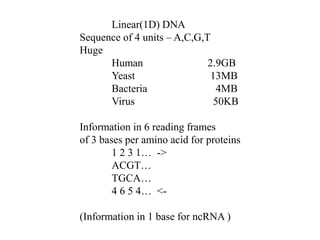
Linear(1D) DNA
Sequence of 4 units – A,C,G,T
Huge
Human 2.9GB
Yeast 13MB
Bacteria 4MB
Virus 50KB
Information in 6 reading frames
of 3 bases per amino acid for proteins
1 2 3 1… ->
ACGT…
TGCA…
4 6 5 4… <-
(Information in 1 base for ncRNA )
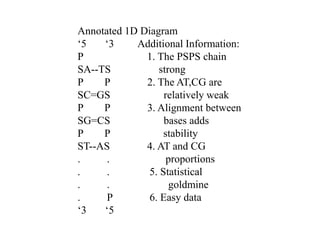
Annotated 1D Diagram
‘5 ‘3 Additional Information:
P 1. The PSPS chain
SA--TS strong
P P 2. The AT,CG are
SC=GS relatively weak
P P 3. Alignment between
SG=CS bases adds
P P stability
ST--AS 4. AT and CG
. . proportions
. . 5. Statistical
. . goldmine
. P 6. Easy data
‘3 ‘5
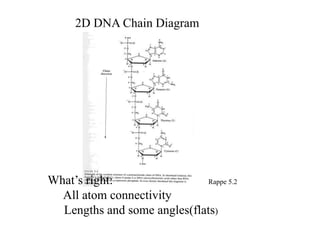
2D DNA Chain Diagram
What’s right: Rappe 5.2
All atom connectivity
Lengths and some angles(flats)
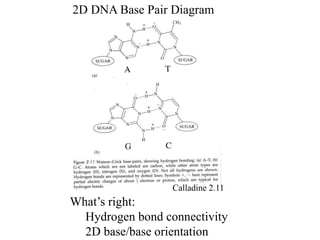
2D DNA Base Pair Diagram
Calladine 2.11
What’s right:
Hydrogen bond connectivity
2D base/base orientation
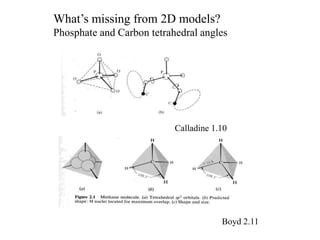
What’s missing from 2D models?
Phosphate and Carbon tetrahedral angles
Calladine 1.10
Boyd 2.11
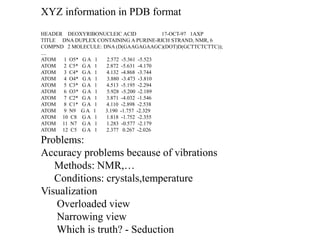
XYZ information in PDB format
HEADER DEOXYRIBONUCLEIC ACID 17-OCT-97 1AXP
TITLE DNA DUPLEX CONTAINING A PURINE-RICH STRAND, NMR, 6
COMPND 2 MOLECULE: DNA (D(GAAGAGAAGC)(DOT)D(GCTTCTCTTC));
....
ATOM 1 O5* G A 1 2.572 -5.361 -5.523
ATOM 2 C5* G A 1 2.872 -5.631 -4.170
ATOM 3 C4* G A 1 4.132 -4.868 -3.744
ATOM 4 O4* G A 1 3.880 -3.473 -3.810
ATOM 5 C3* G A 1 4.513 -5.195 -2.294
ATOM 6 O3* G A 1 5.928 -5.200 -2.189
ATOM 7 C2* G A 1 3.871 -4.032 -1.546
ATOM 8 C1* G A 1 4.110 -2.898 -2.538
ATOM 9 N9 G A 1 3.190 -1.757 -2.329
ATOM 10 C8 G A 1 1.818 -1.752 -2.355
ATOM 11 N7 G A 1 1.283 -0.577 -2.179
ATOM 12 C5 G A 1 2.377 0.267 -2.026
Problems:
Accuracy problems because of vibrations
Methods: NMR,…
Conditions: crystals,temperature
Visualization
Overloaded view
Narrowing view
Which is truth? - Seduction
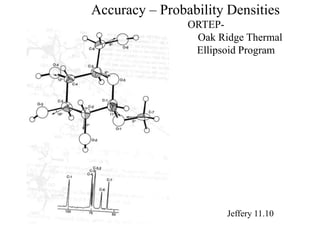
Accuracy – Probability Densities
ORTEP-
Oak Ridge Thermal
Ellipsoid Program
Jeffery 11.10
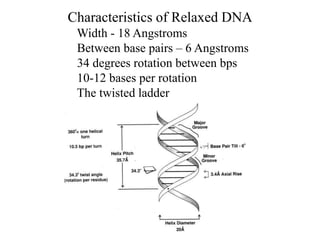
Characteristics of Relaxed DNA
Width - 18 Angstroms
Between base pairs – 6 Angstroms
34 degrees rotation between bps
10-12 bases per rotation
The twisted ladder
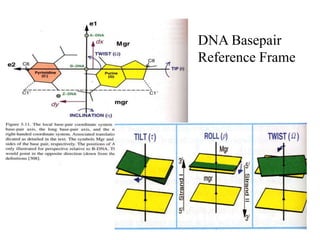
DNA Basepair
Reference Frame
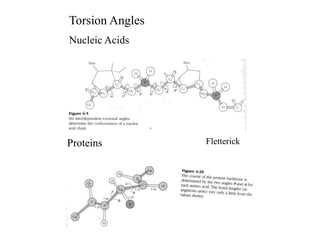
Torsion Angles
Nucleic Acids
Proteins Fletterick
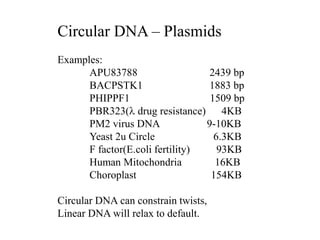
Circular DNA – Plasmids
Examples:
APU83788 2439 bp
BACPSTK1 1883 bp
PHIPPF1 1509 bp
PBR323( drug resistance) 4KB
PM2 virus DNA 9-10KB
Yeast 2u Circle 6.3KB
F factor(E.coli fertility) 93KB
Human Mitochondria 16KB
Choroplast 154KB
Circular DNA can constrain twists,
Linear DNA will relax to default.
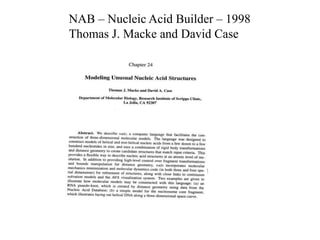
NAB – Nucleic Acid Builder – 1998
Thomas J. Macke and David Case
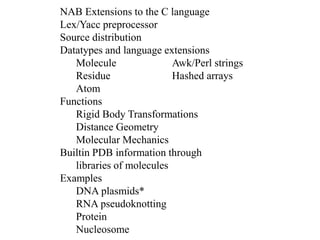
NAB Extensions to the C language
Lex/Yacc preprocessor
Source distribution
Datatypes and language extensions
Molecule Awk/Perl strings
Residue Hashed arrays
Atom
Functions
Rigid Body Transformations
Distance Geometry
Molecular Mechanics
Builtin PDB information through
libraries of molecules
Examples
DNA plasmids*
RNA pseudoknotting
Protein
Nucleosome
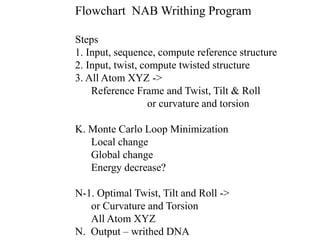
Flowchart NAB Writhing Program
Steps
1. Input, sequence, compute reference structure
2. Input, twist, compute twisted structure
3. All Atom XYZ ->
Reference Frame and Twist, Tilt  Roll
or curvature and torsion
K. Monte Carlo Loop Minimization
Local change
Global change
Energy decrease?
N-1. Optimal Twist, Tilt and Roll ->
or Curvature and Torsion
All Atom XYZ
N. Output – writhed DNA
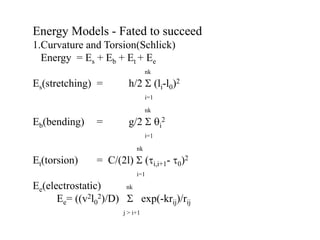
Energy Models - Fated to succeed
1.Curvature and Torsion(Schlick)
Energy = Es + Eb + Et + Ee
nk
Es(stretching) = h/2  (li-l0)2
i=1
nk
Eb(bending) = g/2  i
2
i=1
nk
Et(torsion) = C/(2l)  (i,i+1- 0)2
i=1
Ee(electrostatic) nk
Ee= ((v2l0
2)/D)  exp(-krij)/rij
j > i+1
. Twist, Tilt and Roll
E= .5kBT  [ k1 [k0(Twi-Tw0) + (Roi-Ro0)]2
+k2 [k0(Twi-Tw0) - (Roi-Ro0)]2
+k3 [ (Tli-Tl0) ]2 ]
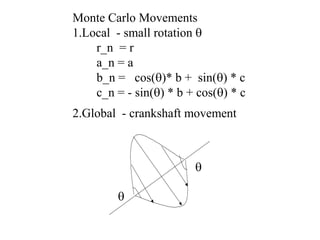
Monte Carlo Movements
1.Local - small rotation 
r_n = r
a_n = a
b_n = cos()* b + sin() * c
c_n = - sin() * b + cos() * c
2.Global - crankshaft movement


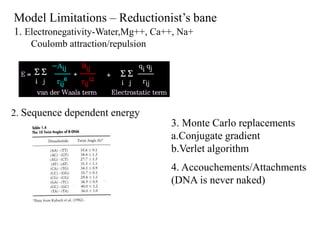
Model Limitations – Reductionist’s bane
1. Electronegativity-Water,Mg++, Ca++, Na+
Coulomb attraction/repulsion
2. Sequence dependent energy
3. Monte Carlo replacements
a.Conjugate gradient
b.Verlet algorithm
4. Accouchements/Attachments
(DNA is never naked)
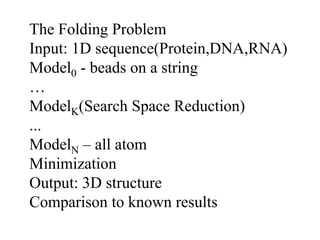
The Folding Problem
Input: 1D sequence(Protein,DNA,RNA)
Model0 - beads on a string
…
ModelK(Search Space Reduction)
...
ModelN – all atom
Minimization
Output: 3D structure
Comparison to known results
Credits
Hong Qian
– for suggesting this problem
Dan Beard
– for starting for this as an
Chem575 exercise
David Case and Thomas Mack
– for removing a lot of the
programming details

beard1.ppt

  • 1.
    Outline of Talk DNAGeometry 1D, 2D, 3D Circular DNA Topology Writhe, Twist and Linking The NAB package C language extension DNA Energy Model Torsion and Curvature Twist, Tilt, and Roll Writhing DNA with NAB Mechanisms Pictures
  • 2.
    Linear(1D) DNA Sequence of4 units – A,C,G,T Huge Human 2.9GB Yeast 13MB Bacteria 4MB Virus 50KB Information in 6 reading frames of 3 bases per amino acid for proteins 1 2 3 1… -> ACGT… TGCA… 4 6 5 4… <- (Information in 1 base for ncRNA )
  • 3.
    Annotated 1D Diagram ‘5‘3 Additional Information: P 1. The PSPS chain SA--TS strong P P 2. The AT,CG are SC=GS relatively weak P P 3. Alignment between SG=CS bases adds P P stability ST--AS 4. AT and CG . . proportions . . 5. Statistical . . goldmine . P 6. Easy data ‘3 ‘5
  • 4.
    2D DNA ChainDiagram What’s right: Rappe 5.2 All atom connectivity Lengths and some angles(flats)
  • 5.
    2D DNA BasePair Diagram Calladine 2.11 What’s right: Hydrogen bond connectivity 2D base/base orientation
  • 6.
    What’s missing from2D models? Phosphate and Carbon tetrahedral angles Calladine 1.10 Boyd 2.11
  • 7.
    XYZ information inPDB format HEADER DEOXYRIBONUCLEIC ACID 17-OCT-97 1AXP TITLE DNA DUPLEX CONTAINING A PURINE-RICH STRAND, NMR, 6 COMPND 2 MOLECULE: DNA (D(GAAGAGAAGC)(DOT)D(GCTTCTCTTC)); .... ATOM 1 O5* G A 1 2.572 -5.361 -5.523 ATOM 2 C5* G A 1 2.872 -5.631 -4.170 ATOM 3 C4* G A 1 4.132 -4.868 -3.744 ATOM 4 O4* G A 1 3.880 -3.473 -3.810 ATOM 5 C3* G A 1 4.513 -5.195 -2.294 ATOM 6 O3* G A 1 5.928 -5.200 -2.189 ATOM 7 C2* G A 1 3.871 -4.032 -1.546 ATOM 8 C1* G A 1 4.110 -2.898 -2.538 ATOM 9 N9 G A 1 3.190 -1.757 -2.329 ATOM 10 C8 G A 1 1.818 -1.752 -2.355 ATOM 11 N7 G A 1 1.283 -0.577 -2.179 ATOM 12 C5 G A 1 2.377 0.267 -2.026 Problems: Accuracy problems because of vibrations Methods: NMR,… Conditions: crystals,temperature Visualization Overloaded view Narrowing view Which is truth? - Seduction
  • 8.
    Accuracy – ProbabilityDensities ORTEP- Oak Ridge Thermal Ellipsoid Program Jeffery 11.10
  • 9.
    Characteristics of RelaxedDNA Width - 18 Angstroms Between base pairs – 6 Angstroms 34 degrees rotation between bps 10-12 bases per rotation The twisted ladder
  • 10.
  • 11.
  • 12.
    Circular DNA –Plasmids Examples: APU83788 2439 bp BACPSTK1 1883 bp PHIPPF1 1509 bp PBR323( drug resistance) 4KB PM2 virus DNA 9-10KB Yeast 2u Circle 6.3KB F factor(E.coli fertility) 93KB Human Mitochondria 16KB Choroplast 154KB Circular DNA can constrain twists, Linear DNA will relax to default.
  • 13.
    NAB – NucleicAcid Builder – 1998 Thomas J. Macke and David Case
  • 14.
    NAB Extensions tothe C language Lex/Yacc preprocessor Source distribution Datatypes and language extensions Molecule Awk/Perl strings Residue Hashed arrays Atom Functions Rigid Body Transformations Distance Geometry Molecular Mechanics Builtin PDB information through libraries of molecules Examples DNA plasmids* RNA pseudoknotting Protein Nucleosome
  • 15.
    Flowchart NAB WrithingProgram Steps 1. Input, sequence, compute reference structure 2. Input, twist, compute twisted structure 3. All Atom XYZ -> Reference Frame and Twist, Tilt  Roll or curvature and torsion K. Monte Carlo Loop Minimization Local change Global change Energy decrease? N-1. Optimal Twist, Tilt and Roll -> or Curvature and Torsion All Atom XYZ N. Output – writhed DNA
  • 16.
    Energy Models -Fated to succeed 1.Curvature and Torsion(Schlick) Energy = Es + Eb + Et + Ee nk Es(stretching) = h/2  (li-l0)2 i=1 nk Eb(bending) = g/2  i 2 i=1 nk Et(torsion) = C/(2l)  (i,i+1- 0)2 i=1 Ee(electrostatic) nk Ee= ((v2l0 2)/D)  exp(-krij)/rij j > i+1
  • 17.
    . Twist, Tiltand Roll E= .5kBT  [ k1 [k0(Twi-Tw0) + (Roi-Ro0)]2 +k2 [k0(Twi-Tw0) - (Roi-Ro0)]2 +k3 [ (Tli-Tl0) ]2 ]
  • 18.
    Monte Carlo Movements 1.Local- small rotation  r_n = r a_n = a b_n = cos()* b + sin() * c c_n = - sin() * b + cos() * c 2.Global - crankshaft movement  
  • 19.
    Model Limitations –Reductionist’s bane 1. Electronegativity-Water,Mg++, Ca++, Na+ Coulomb attraction/repulsion 2. Sequence dependent energy 3. Monte Carlo replacements a.Conjugate gradient b.Verlet algorithm 4. Accouchements/Attachments (DNA is never naked)
  • 20.
    The Folding Problem Input:1D sequence(Protein,DNA,RNA) Model0 - beads on a string … ModelK(Search Space Reduction) ... ModelN – all atom Minimization Output: 3D structure Comparison to known results
  • 21.
    Credits Hong Qian – forsuggesting this problem Dan Beard – for starting for this as an Chem575 exercise David Case and Thomas Mack – for removing a lot of the programming details