BEAMing Your Research
Shannon Kealey
Santa Clara University Library
January 24, 2018
Lesson adapted from Woodward & Ganski, University of Wisconsin
Milwaukee; Engaging Ideas by John C. Bean, and Joseph Bizup, Boston
University. Image citation: Spacetime by Alan Chan is licensed under
CC BY 2.0. Source: Flickr creative commons
Objectives
• Plan & execute a search strategy
• Evaluate sources for relevance & purpose
• Discuss potential value of sources
• Select sources for purposes of your
assignment
Ways of Categorizing Sources
• Scholarly -------------------------- Popular
• Primary --------------------------- Secondary
• Good -------------------------------- Bad
Bizup’s “BEAM”
• Background
• Exhibit/Evidence
• Argument
• Method
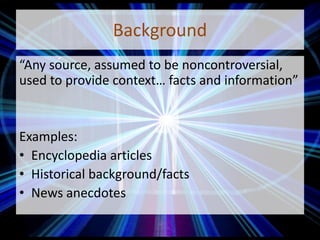
Background
“Any source, assumed to be noncontroversial,
used to provide context… facts and information”
Examples:
• Encyclopedia articles
• Historical background/facts
• News anecdotes
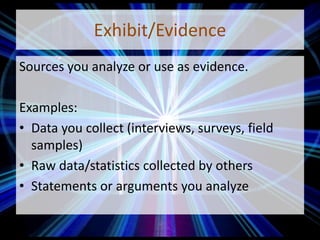
Exhibit/Evidence
Sources you analyze or use as evidence.
Examples:
• Data you collect (interviews, surveys, field
samples)
• Raw data/statistics collected by others
• Statements or arguments you analyze
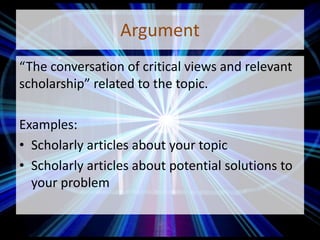
Argument
“The conversation of critical views and relevant
scholarship” related to the topic.
Examples:
• Scholarly articles about your topic
• Scholarly articles about potential solutions to
your problem
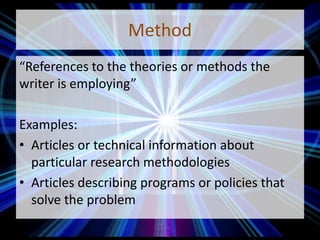
Method
“References to the theories or methods the
writer is employing”
Examples:
• Articles or technical information about
particular research methodologies
• Articles describing programs or policies that
solve the problem
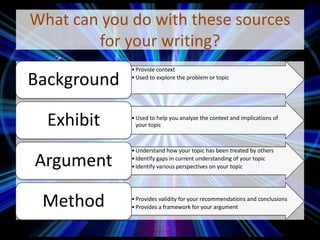
What can you do with these sources
for your writing?
•Provide context
•Used to explore the problem or topic
Background
•Used to help you analyze the context and implications of
your topicExhibit
•Understand how your topic has been treated by others
•Identify gaps in current understanding of your topic
•Identify various perspectives on your topicArgument
•Provides validity for your recommendations and conclusions
•Provides a framework for your argumentMethod
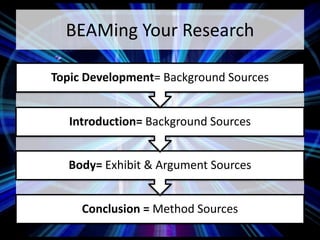
BEAMing Your Research
Conclusion = Method Sources
Body= Exhibit & Argument Sources
Introduction= Background Sources
Topic Development= Background Sources
BEAM Your Research Topic
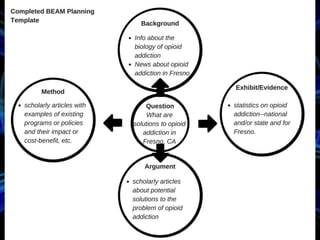
• Use the mind map to brainstorm topics and
sources for each BEAM element
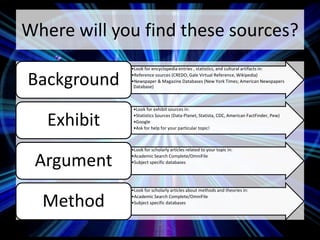
Where will you find these sources?
•Look for encyclopedia entries , statistics, and cultural artifacts in:
•Reference sources (CREDO, Gale Virtual Reference, Wikipedia)
•Newspaper & Magazine Databases (New York Times; American Newspapers
Database)
Background
•Look for exhibit sources in:
•Statistics Sources (Data-Planet, Statista, CDC, American FactFinder, Pew)
•Google
•Ask for help for your particular topic!
Exhibit
•Look for scholarly articles related to your topic in:
•Academic Search Complete/OmniFile
•Subject specific databasesArgument
•Look for scholarly articles about methods and theories in:
•Academic Search Complete/OmniFile
•Subject specific databasesMethod
Find Sources
• Go to the research guide for this class
• Using the suggested databases, find sources
for your topic
• Find three different BEAM sources – one must
be Peer Reviewed/Scholarly/Academic!
• Complete the form
• Send a copy to yourself
Questions?
Shannon Kealey
skealey@scu.edu
x7021

Beam conard ctw2 - winter 2018

  • 1.
    BEAMing Your Research ShannonKealey Santa Clara University Library January 24, 2018 Lesson adapted from Woodward & Ganski, University of Wisconsin Milwaukee; Engaging Ideas by John C. Bean, and Joseph Bizup, Boston University. Image citation: Spacetime by Alan Chan is licensed under CC BY 2.0. Source: Flickr creative commons
  • 2.
    Objectives • Plan &execute a search strategy • Evaluate sources for relevance & purpose • Discuss potential value of sources • Select sources for purposes of your assignment
  • 3.
    Ways of CategorizingSources • Scholarly -------------------------- Popular • Primary --------------------------- Secondary • Good -------------------------------- Bad
  • 4.
    Bizup’s “BEAM” • Background •Exhibit/Evidence • Argument • Method
  • 5.
    Background “Any source, assumedto be noncontroversial, used to provide context… facts and information” Examples: • Encyclopedia articles • Historical background/facts • News anecdotes
  • 6.
    Exhibit/Evidence Sources you analyzeor use as evidence. Examples: • Data you collect (interviews, surveys, field samples) • Raw data/statistics collected by others • Statements or arguments you analyze
  • 7.
    Argument “The conversation ofcritical views and relevant scholarship” related to the topic. Examples: • Scholarly articles about your topic • Scholarly articles about potential solutions to your problem
  • 8.
    Method “References to thetheories or methods the writer is employing” Examples: • Articles or technical information about particular research methodologies • Articles describing programs or policies that solve the problem
  • 9.
    What can youdo with these sources for your writing? •Provide context •Used to explore the problem or topic Background •Used to help you analyze the context and implications of your topicExhibit •Understand how your topic has been treated by others •Identify gaps in current understanding of your topic •Identify various perspectives on your topicArgument •Provides validity for your recommendations and conclusions •Provides a framework for your argumentMethod
  • 10.
    BEAMing Your Research Conclusion= Method Sources Body= Exhibit & Argument Sources Introduction= Background Sources Topic Development= Background Sources
  • 11.
    BEAM Your ResearchTopic • Use the mind map to brainstorm topics and sources for each BEAM element
  • 13.
    Where will youfind these sources? •Look for encyclopedia entries , statistics, and cultural artifacts in: •Reference sources (CREDO, Gale Virtual Reference, Wikipedia) •Newspaper & Magazine Databases (New York Times; American Newspapers Database) Background •Look for exhibit sources in: •Statistics Sources (Data-Planet, Statista, CDC, American FactFinder, Pew) •Google •Ask for help for your particular topic! Exhibit •Look for scholarly articles related to your topic in: •Academic Search Complete/OmniFile •Subject specific databasesArgument •Look for scholarly articles about methods and theories in: •Academic Search Complete/OmniFile •Subject specific databasesMethod
  • 14.
    Find Sources • Goto the research guide for this class • Using the suggested databases, find sources for your topic • Find three different BEAM sources – one must be Peer Reviewed/Scholarly/Academic! • Complete the form • Send a copy to yourself
  • 15.