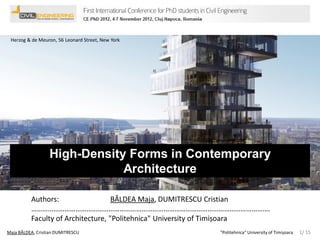
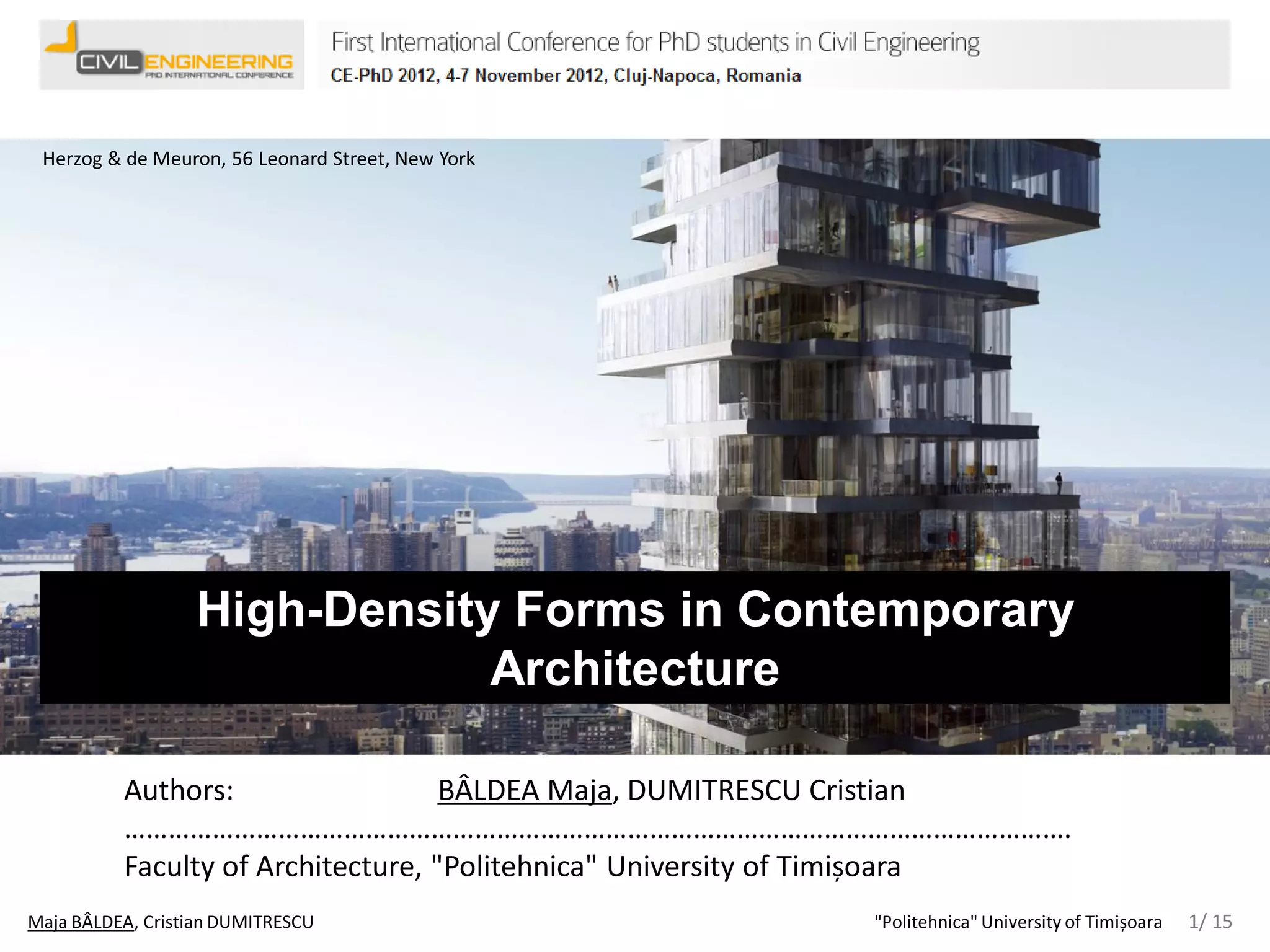
Herzog & de Meuron, 56 Leonard Street, New York

High-Density Forms in Contemporary
Architecture
Authors:
BÂLDEA Maja, DUMITRESCU Cristian
………………………………………………………………………………………………………………….
Faculty of Architecture, "Politehnica" University of Timișoara
Maja BÂLDEA, Cristian DUMITRESCU

"Politehnica" University of Timișoara

1/ 15
CE-PhD 2012, 4-7 November 2012, Cluj-Napoca, Romania

Content
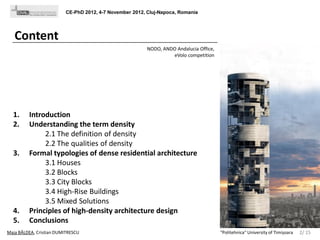
NODO, ANDO Andalucia Office,
eVolo competition

1.
2.

3.

4.
5.

Introduction
Understanding the term density
2.1 The definition of density
2.2 The qualities of density
Formal typologies of dense residential architecture
3.1 Houses
3.2 Blocks
3.3 City Blocks
3.4 High-Rise Buildings
3.5 Mixed Solutions
Principles of high-density architecture design
Conclusions

Maja BÂLDEA, Cristian DUMITRESCU

"Politehnica" University of Timișoara

2/ 15
CE-PhD 2012, 4-7 November 2012, Cluj-Napoca, Romania

1 Introduction

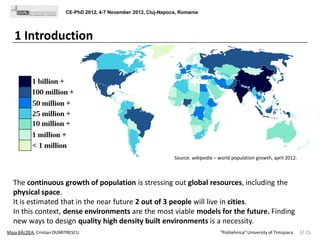
Source: wikipedia – world population growth, april 2012.

The continuous growth of population is stressing out global resources, including the
physical space.
It is estimated that in the near future 2 out of 3 people will live in cities.
In this context, dense environments are the most viable models for the future. Finding
new ways to design quality high density built environments is a necessity.
Maja BÂLDEA, Cristian DUMITRESCU

"Politehnica" University of Timișoara

3/ 15
CE-PhD 2012, 4-7 November 2012, Cluj-Napoca, Romania

2 Understanding the term density

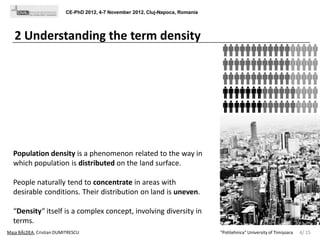
Population density is a phenomenon related to the way in
which population is distributed on the land surface.
People naturally tend to concentrate in areas with
desirable conditions. Their distribution on land is uneven.
“Density“ itself is a complex concept, involving diversity in
terms.
Maja BÂLDEA, Cristian DUMITRESCU

"Politehnica" University of Timișoara

4/ 15
CE-PhD 2012, 4-7 November 2012, Cluj-Napoca, Romania

2 Understanding the term density
2.1. The definition of density

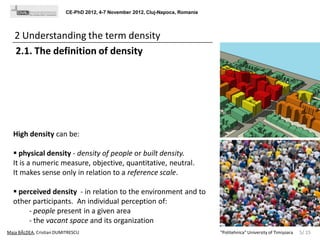
High density can be:
 physical density - density of people or built density.
It is a numeric measure, objective, quantitative, neutral.
It makes sense only in relation to a reference scale.

 perceived density - in relation to the environment and to
other participants. An individual perception of:
- people present in a given area
- the vacant space and its organization
Maja BÂLDEA, Cristian DUMITRESCU

"Politehnica" University of Timișoara

5/ 15
CE-PhD 2012, 4-7 November 2012, Cluj-Napoca, Romania

2 Understanding the term density
2.1. The definition of density

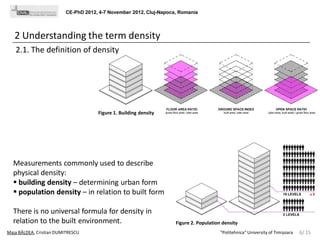
Figure 1. Building density

Measurements commonly used to describe
physical density:
 building density – determining urban form
 population density – in relation to built form
There is no universal formula for density in
relation to the built environment.
Maja BÂLDEA, Cristian DUMITRESCU

Figure 2. Population density
"Politehnica" University of Timișoara

6/ 15
CE-PhD 2012, 4-7 November 2012, Cluj-Napoca, Romania

2 Understanding the term density
2.1. The definition of density

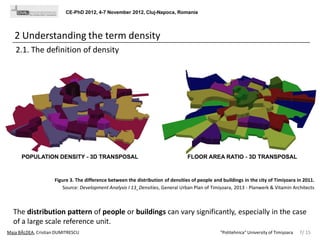
Figure 3. The difference between the distribution of densities of people and buildings in the city of Timișoara in 2011.
Source: Development Analysis I 13_Densities, General Urban Plan of Timișoara, 2013 - Planwerk & Vitamin Architects

The distribution pattern of people or buildings can vary significantly, especially in the case
of a large scale reference unit.
Maja BÂLDEA, Cristian DUMITRESCU

"Politehnica" University of Timișoara

7/ 15
CE-PhD 2012, 4-7 November 2012, Cluj-Napoca, Romania

2 Understanding the term density
2.1. The definition of density

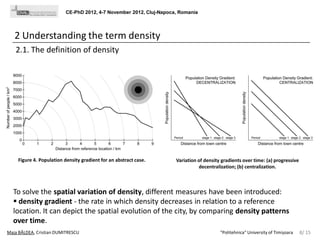
Figure 4. Population density gradient for an abstract case.

Variation of density gradients over time: (a) progressive
decentralization; (b) centralization.

To solve the spatial variation of density, different measures have been introduced:
 density gradient - the rate in which density decreases in relation to a reference
location. It can depict the spatial evolution of the city, by comparing density patterns
over time.
Maja BÂLDEA, Cristian DUMITRESCU

"Politehnica" University of Timișoara

8/ 15
CE-PhD 2012, 4-7 November 2012, Cluj-Napoca, Romania

2 Understanding the term density
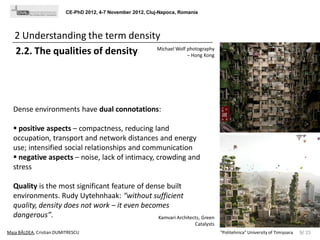
Michael Wolf photography
2.2. The qualities of density
– Hong Kong

Dense environments have dual connotations:
 positive aspects – compactness, reducing land
occupation, transport and network distances and energy
use; intensified social relationships and communication
 negative aspects – noise, lack of intimacy, crowding and
stress
Quality is the most significant feature of dense built
environments. Rudy Uytehnhaak: “without sufficient
quality, density does not work – it even becomes
dangerous”.
Kamvari Architects, Green
Catalysts
Maja BÂLDEA, Cristian DUMITRESCU

"Politehnica" University of Timișoara

9/ 15
CE-PhD 2012, 4-7 November 2012, Cluj-Napoca, Romania

3 Formal typologies of dense residential architecture

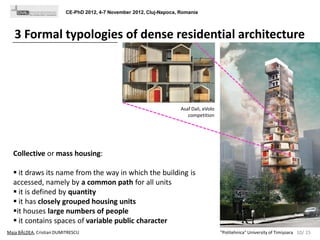
Asaf Dali, eVolo
competition

Collective or mass housing:
 it draws its name from the way in which the building is
accessed, namely by a common path for all units
 it is defined by quantity
 it has closely grouped housing units
it houses large numbers of people
 it contains spaces of variable public character
Maja BÂLDEA, Cristian DUMITRESCU

"Politehnica" University of Timișoara 10/ 15
CE-PhD 2012, 4-7 November 2012, Cluj-Napoca, Romania

3 Formal typologies of dense residential architecture
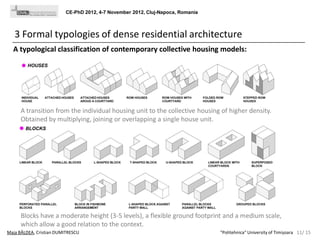
A typological classification of contemporary collective housing models:

3.2. Blocks

A transition from the individual housing unit to the collective housing of higher density.
Obtained by multiplying, joining or overlapping a single house unit.

Blocks have a moderate height (3-5 levels), a flexible ground footprint and a medium scale,
which allow a good relation to the context.
Maja BÂLDEA, Cristian DUMITRESCU

"Politehnica" University of Timișoara 11/ 15
CE-PhD 2012, 4-7 November 2012, Cluj-Napoca, Romania

3.3. City blocks

3 Formal typologies of dense residential architecture

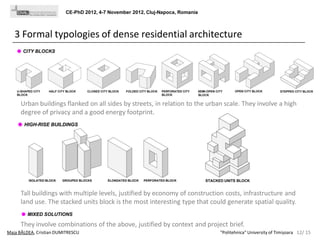
Urban buildings flanked on all sides by streets, in relation to the urban scale. They involve a high
degree of privacy and a good energy footprint.

Tall buildings with multiple levels, justified by economy of construction costs, infrastructure and
land use. The stacked units block is the most interesting type that could generate spatial quality.

They involve combinations of the above, justified by context and project brief.
Maja BÂLDEA, Cristian DUMITRESCU

"Politehnica" University of Timișoara 12/ 15
CE-PhD 2012, 4-7 November 2012, Cluj-Napoca, Romania

4 Principles of high density architecture design
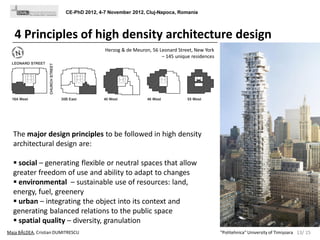
Herzog & de Meuron, 56 Leonard Street, New York
– 145 unique residences

The major design principles to be followed in high density
architectural design are:

 social – generating flexible or neutral spaces that allow
greater freedom of use and ability to adapt to changes
 environmental – sustainable use of resources: land,
energy, fuel, greenery
 urban – integrating the object into its context and
generating balanced relations to the public space
 spatial quality – diversity, granulation
Maja BÂLDEA, Cristian DUMITRESCU

"Politehnica" University of Timișoara 13/ 15
CE-PhD 2012, 4-7 November 2012, Cluj-Napoca, Romania

5 Conclusions
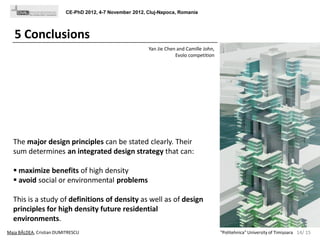
Yan Jie Chen and Camille John,
Evolo competition

The major design principles can be stated clearly. Their
sum determines an integrated design strategy that can:

 maximize benefits of high density
 avoid social or environmental problems
This is a study of definitions of density as well as of design
principles for high density future residential
environments.
Maja BÂLDEA, Cristian DUMITRESCU

"Politehnica" University of Timișoara 14/ 15
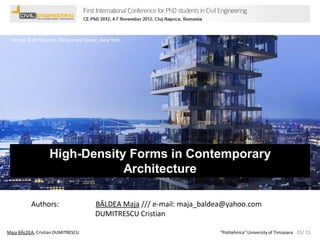
Herzog & de Meuron, 56 Leonard Street, New York

High-Density Forms in Contemporary
Architecture
Authors:

Maja BÂLDEA, Cristian DUMITRESCU

BÂLDEA Maja /// e-mail: maja_baldea@yahoo.com
DUMITRESCU Cristian
"Politehnica" University of Timișoara 15/ 15

high density forms in contemporary architecture

  • 1.
    Herzog & deMeuron, 56 Leonard Street, New York High-Density Forms in Contemporary Architecture Authors: BÂLDEA Maja, DUMITRESCU Cristian …………………………………………………………………………………………………………………. Faculty of Architecture, "Politehnica" University of Timișoara Maja BÂLDEA, Cristian DUMITRESCU "Politehnica" University of Timișoara 1/ 15
  • 2.
    CE-PhD 2012, 4-7November 2012, Cluj-Napoca, Romania Content NODO, ANDO Andalucia Office, eVolo competition 1. 2. 3. 4. 5. Introduction Understanding the term density 2.1 The definition of density 2.2 The qualities of density Formal typologies of dense residential architecture 3.1 Houses 3.2 Blocks 3.3 City Blocks 3.4 High-Rise Buildings 3.5 Mixed Solutions Principles of high-density architecture design Conclusions Maja BÂLDEA, Cristian DUMITRESCU "Politehnica" University of Timișoara 2/ 15
  • 3.
    CE-PhD 2012, 4-7November 2012, Cluj-Napoca, Romania 1 Introduction Source: wikipedia – world population growth, april 2012. The continuous growth of population is stressing out global resources, including the physical space. It is estimated that in the near future 2 out of 3 people will live in cities. In this context, dense environments are the most viable models for the future. Finding new ways to design quality high density built environments is a necessity. Maja BÂLDEA, Cristian DUMITRESCU "Politehnica" University of Timișoara 3/ 15
  • 4.
    CE-PhD 2012, 4-7November 2012, Cluj-Napoca, Romania 2 Understanding the term density Population density is a phenomenon related to the way in which population is distributed on the land surface. People naturally tend to concentrate in areas with desirable conditions. Their distribution on land is uneven. “Density“ itself is a complex concept, involving diversity in terms. Maja BÂLDEA, Cristian DUMITRESCU "Politehnica" University of Timișoara 4/ 15
  • 5.
    CE-PhD 2012, 4-7November 2012, Cluj-Napoca, Romania 2 Understanding the term density 2.1. The definition of density High density can be:  physical density - density of people or built density. It is a numeric measure, objective, quantitative, neutral. It makes sense only in relation to a reference scale.  perceived density - in relation to the environment and to other participants. An individual perception of: - people present in a given area - the vacant space and its organization Maja BÂLDEA, Cristian DUMITRESCU "Politehnica" University of Timișoara 5/ 15
  • 6.
    CE-PhD 2012, 4-7November 2012, Cluj-Napoca, Romania 2 Understanding the term density 2.1. The definition of density Figure 1. Building density Measurements commonly used to describe physical density:  building density – determining urban form  population density – in relation to built form There is no universal formula for density in relation to the built environment. Maja BÂLDEA, Cristian DUMITRESCU Figure 2. Population density "Politehnica" University of Timișoara 6/ 15
  • 7.
    CE-PhD 2012, 4-7November 2012, Cluj-Napoca, Romania 2 Understanding the term density 2.1. The definition of density Figure 3. The difference between the distribution of densities of people and buildings in the city of Timișoara in 2011. Source: Development Analysis I 13_Densities, General Urban Plan of Timișoara, 2013 - Planwerk & Vitamin Architects The distribution pattern of people or buildings can vary significantly, especially in the case of a large scale reference unit. Maja BÂLDEA, Cristian DUMITRESCU "Politehnica" University of Timișoara 7/ 15
  • 8.
    CE-PhD 2012, 4-7November 2012, Cluj-Napoca, Romania 2 Understanding the term density 2.1. The definition of density Figure 4. Population density gradient for an abstract case. Variation of density gradients over time: (a) progressive decentralization; (b) centralization. To solve the spatial variation of density, different measures have been introduced:  density gradient - the rate in which density decreases in relation to a reference location. It can depict the spatial evolution of the city, by comparing density patterns over time. Maja BÂLDEA, Cristian DUMITRESCU "Politehnica" University of Timișoara 8/ 15
  • 9.
    CE-PhD 2012, 4-7November 2012, Cluj-Napoca, Romania 2 Understanding the term density Michael Wolf photography 2.2. The qualities of density – Hong Kong Dense environments have dual connotations:  positive aspects – compactness, reducing land occupation, transport and network distances and energy use; intensified social relationships and communication  negative aspects – noise, lack of intimacy, crowding and stress Quality is the most significant feature of dense built environments. Rudy Uytehnhaak: “without sufficient quality, density does not work – it even becomes dangerous”. Kamvari Architects, Green Catalysts Maja BÂLDEA, Cristian DUMITRESCU "Politehnica" University of Timișoara 9/ 15
  • 10.
    CE-PhD 2012, 4-7November 2012, Cluj-Napoca, Romania 3 Formal typologies of dense residential architecture Asaf Dali, eVolo competition Collective or mass housing:  it draws its name from the way in which the building is accessed, namely by a common path for all units  it is defined by quantity  it has closely grouped housing units it houses large numbers of people  it contains spaces of variable public character Maja BÂLDEA, Cristian DUMITRESCU "Politehnica" University of Timișoara 10/ 15
  • 11.
    CE-PhD 2012, 4-7November 2012, Cluj-Napoca, Romania 3 Formal typologies of dense residential architecture A typological classification of contemporary collective housing models: 3.2. Blocks A transition from the individual housing unit to the collective housing of higher density. Obtained by multiplying, joining or overlapping a single house unit. Blocks have a moderate height (3-5 levels), a flexible ground footprint and a medium scale, which allow a good relation to the context. Maja BÂLDEA, Cristian DUMITRESCU "Politehnica" University of Timișoara 11/ 15
  • 12.
    CE-PhD 2012, 4-7November 2012, Cluj-Napoca, Romania 3.3. City blocks 3 Formal typologies of dense residential architecture Urban buildings flanked on all sides by streets, in relation to the urban scale. They involve a high degree of privacy and a good energy footprint. Tall buildings with multiple levels, justified by economy of construction costs, infrastructure and land use. The stacked units block is the most interesting type that could generate spatial quality. They involve combinations of the above, justified by context and project brief. Maja BÂLDEA, Cristian DUMITRESCU "Politehnica" University of Timișoara 12/ 15
  • 13.
    CE-PhD 2012, 4-7November 2012, Cluj-Napoca, Romania 4 Principles of high density architecture design Herzog & de Meuron, 56 Leonard Street, New York – 145 unique residences The major design principles to be followed in high density architectural design are:  social – generating flexible or neutral spaces that allow greater freedom of use and ability to adapt to changes  environmental – sustainable use of resources: land, energy, fuel, greenery  urban – integrating the object into its context and generating balanced relations to the public space  spatial quality – diversity, granulation Maja BÂLDEA, Cristian DUMITRESCU "Politehnica" University of Timișoara 13/ 15
  • 14.
    CE-PhD 2012, 4-7November 2012, Cluj-Napoca, Romania 5 Conclusions Yan Jie Chen and Camille John, Evolo competition The major design principles can be stated clearly. Their sum determines an integrated design strategy that can:  maximize benefits of high density  avoid social or environmental problems This is a study of definitions of density as well as of design principles for high density future residential environments. Maja BÂLDEA, Cristian DUMITRESCU "Politehnica" University of Timișoara 14/ 15
  • 15.
    Herzog & deMeuron, 56 Leonard Street, New York High-Density Forms in Contemporary Architecture Authors: Maja BÂLDEA, Cristian DUMITRESCU BÂLDEA Maja /// e-mail: maja_baldea@yahoo.com DUMITRESCU Cristian "Politehnica" University of Timișoara 15/ 15