Zero Carbon Manchester 2038
Global and UK Context
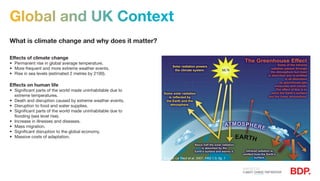
What is climate change and why does it matter?
Effects of climate change
•	 Permanent rise in global average temperature.
•	 More frequent and more extreme weather events.
•	 Rise in sea levels (estimated 2 metres by 2100).
Effects on human life
•	 Significant parts of the world made uninhabitable due to
extreme temperatures.
•	 Death and disruption caused by extreme weather events.
•	 Disruption to food and water supplies.
•	 Significant parts of the world made uninhabitable due to
flooding (sea level rise).
•	 Increase in illnesses and diseases.
•	 Mass migration.
•	 Significant disruption to the global economy.
•	 Massive costs of adaptation.
Source: Le Treut et al. 2007, FAQ 1.3, fig. 1
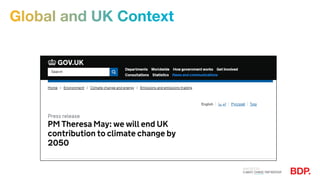
Global and UK Context
Paris Climate Accord 2015
© Arnaud Bouissou - MEDDE / SG COP21
Global and UK Context
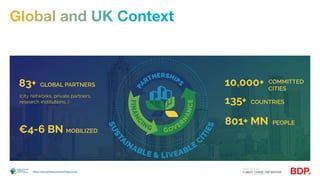
https://www.globalcovenantofmayors.org
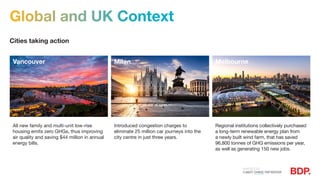
Vancouver Milan Melbourne
All new family and multi-unit low-rise
housing emits zero GHGs, thus improving
air quality and saving $44 million in annual
energy bills.
Introduced congestion charges to
eliminate 25 million car journeys into the
city centre in just three years.
Regional institutions collectively purchased
a long-term renewable energy plan from
a newly built wind farm, that has saved
96,800 tonnes of GHG emissions per year,
as well as generating 150 new jobs.
Cities taking action
Global and UK Context
AdobeStock
A new era of activism
Global and UK Context
PenguinRandomHouseUK
FrederickFlorin/AFPviaGettyImages
ManchesterEveningNews
Manchester’s
Zero Carbon Commitments
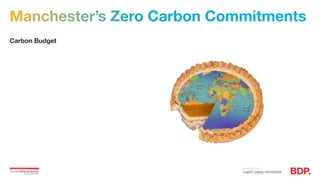
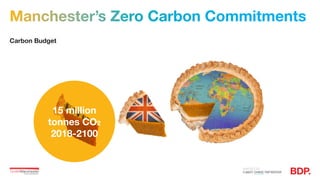
Manchester’s Zero Carbon Commitments
Carbon Budget
Carbon Budget
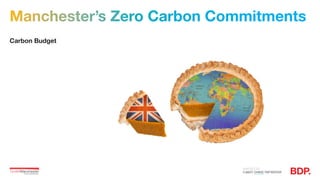
Manchester’s Zero Carbon Commitments
Carbon Budget
15 million
tonnes CO2
2018-2100
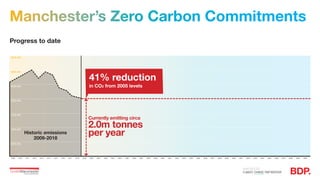
Manchester’s Zero Carbon Commitments
3500.000
3000.000
2500.000
2000.000
1500.000
1000.000
5000.000
2009	 2010	 2011	 2012	 2013	 2014	 2015	 2016	 2017	 2018	 2019	 2020	 2021	 2022	 2023	 2024	 2025	 2026	 2027	 2028	 2029	 2030	 2031	 2032	 2033	 2034	 2035	 2036	 2037	 2038	 2039	 2040	 2041	 2042	 2043	 2044	 2045	 2046	 2047	 2048	 2049	 2050	
Historic emissions
2009-2018
Currently emitting circa
2.0m tonnes
per year
Progress to date
41% reduction
in CO2 from 2005 levels
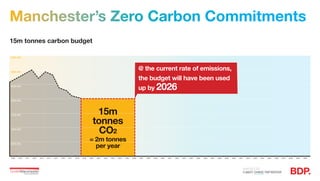
Manchester’s Zero Carbon Commitments
3500.000
3000.000
2500.000
2000.000
1500.000
1000.000
5000.000
2009	 2010	 2011	 2012	 2013	 2014	 2015	 2016	 2017	 2018	 2019	 2020	 2021	 2022	 2023	 2024	 2025	 2026	 2027	 2028	 2029	 2030	 2031	 2032	 2033	 2034	 2035	 2036	 2037	 2038	 2039	 2040	 2041	 2042	 2043	 2044	 2045	 2046	 2047	 2048	 2049	 2050	
15m tonnes carbon budget
15m
tonnes
CO2
= 2m tonnes
per year
@ the current rate of emissions,
the budget will have been used
up by 2026
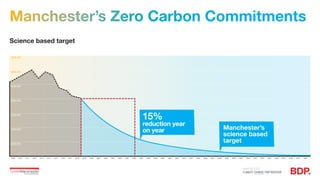
Manchester’s Zero Carbon Commitments
3500.000
3000.000
2500.000
2000.000
1500.000
1000.000
5000.000
2009	 2010	 2011	 2012	 2013	 2014	 2015	 2016	 2017	 2018	 2019	 2020	 2021	 2022	 2023	 2024	 2025	 2026	 2027	 2028	 2029	 2030	 2031	 2032	 2033	 2034	 2035	 2036	 2037	 2038	 2039	 2040	 2041	 2042	 2043	 2044	 2045	 2046	 2047	 2048	 2049	 2050	
Science based target
Manchester’s
science based
target
15%
reduction year
on year
Manchester’s Zero Carbon Commitments
3500.000
3000.000
2500.000
2000.000
1500.000
1000.000
5000.000
2009	 2010	 2011	 2012	 2013	 2014	 2015	 2016	 2017	 2018	 2019	 2020	 2021	 2022	 2023	 2024	 2025	 2026	 2027	 2028	 2029	 2030	 2031	 2032	 2033	 2034	 2035	 2036	 2037	 2038	 2039	 2040	 2041	 2042	 2043	 2044	 2045	 2046	 2047	 2048	 2049	 2050	
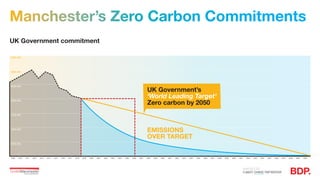
UK Government commitment
UK Government’s
‘World Leading Target’
Zero carbon by 2050
EMISSIONS
OVER TARGET
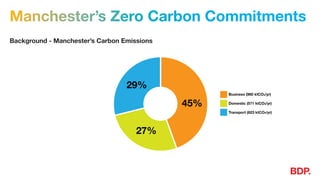
Background - Manchester’s Carbon Emissions
Manchester’s Zero Carbon Commitments
20502020 2025 2030 2035 2040 2045
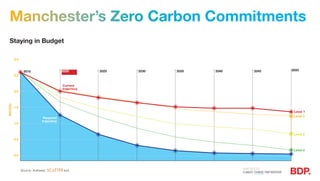
Staying in Budget
Manchester’s Zero Carbon Commitments
2015
3.0
2.5
2.0
1.5
1.0
0.5
0.0
MtCO2e
Level 1
Current
trajectory
Required
trajectory
Level 2
Level 3
Level 4
Source: Anthesis’ tool
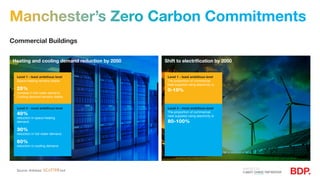
Shift to electrification by 2050Heating and cooling demand reduction by 2050
Commercial Buildings
Manchester’s Zero Carbon Commitments
Level 4 - most ambitious level
40%
reduction in space heating
demand.
30%
reduction in hot water demand.
60%
reduction in cooling demand.
Level 4 - most ambitious level
The proportion of commercial
heat supplied using electricity is
80-100%
Level 1 - least ambitious level
Space heating remains stable.
25%
increase in hot water demand.
Cooling demand remains stable.
Level 1 - least ambitious level
The proportion of commercial
heat supplied using electricity is
0-10%
Source: Anthesis’ tool
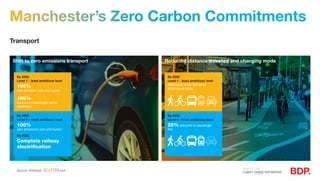
Shift to zero emissions transport Reducing distance travelled and changing mode
Transport
By 2035
Level 4 - most ambitious level
25% reduction in passenger
Km.
Manchester’s Zero Carbon Commitments
By 2050
Level 1 - least ambitious level
Individuals travel the same
distance as today.
By 2035
Level 4 - most ambitious level
100%
zero emissions cars and buses.
By 2025
Complete railway
electrification
By 2050
Level 1 - least ambitious level
100%
zero emission cars and buses.
100%
buses and passenger trains
electrified.
Source: Anthesis’ tool
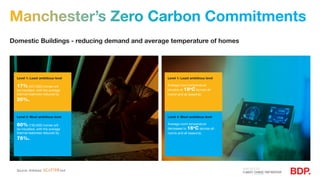
Domestic Buildings - reducing demand and average temperature of homes
Manchester’s Zero Carbon Commitments
Level 4: Most ambitious level
Average room temperature
decreases to 16o
C (across all
rooms and all seasons).
Level 1: Least ambitious level
Average room temperature
remains at 18o
C (across all
rooms and all seasons).
Level 4: Most ambitious level
60% (130,000) homes will
be insulated, with the average
thermal leakiness reduced by
75%.
Level 1: Least ambitious level
17% (337,000) homes will
be insulated, with the average
thermal leakiness reduced by
20%.
Source: Anthesis’ tool
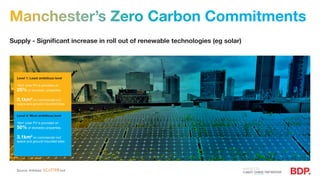
Supply - Significant increase in roll out of renewable technologies (eg solar)
Manchester’s Zero Carbon Commitments
Level 4: Most ambitious level
16m2
solar PV is provided on
50% of domestic properties.
3.1km2
on commercial roof
space and ground mounted sites.
Level 1: Least ambitious level
16m2
solar PV is provided on
25% of domestic properties.
0.1km2
on commercial roof
space and ground mounted sites.
Source: Anthesis’ tool
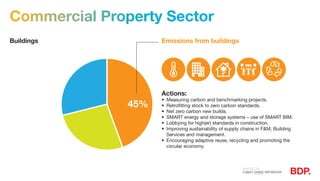
Commercial Property Sector
Buildings
Actions:
•	 Measuring carbon and benchmarking projects.
•	 Retrofitting stock to zero carbon standards.
•	 Net zero carbon new builds.
•	 SMART energy and storage systems – use of SMART BIM.
•	 Lobbying for high(er) standards in construction.
•	 Improving sustainability of supply chains in F&M, Building
Services and management.
•	 Encouraging adaptive reuse, recycling and promoting the
circular economy.
Emissions from buildings
45%
Transport
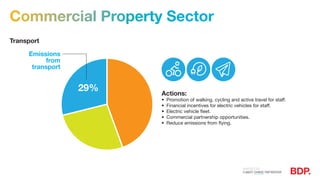
Actions:
•	 Promotion of walking, cycling and active travel for staff.
•	 Financial incentives for electric vehicles for staff.
•	 Electric vehicle fleet.
•	 Commercial partnership opportunities.
•	 Reduce emissions from flying.
Commercial Property Sector
29%
Emissions
from
transport
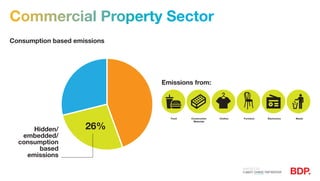
Consumption based emissions
Emissions from:
Hidden/
embedded/
consumption
based
emissions
Food Construction
Materials
Clothes Furniture Electronics Waste
Commercial Property Sector
26%
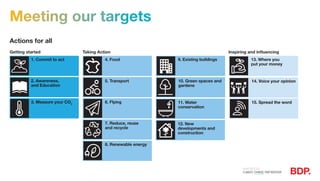
Meeting our targets
Actions for all
Getting started Taking Action Inspiring and influencing
14. Voice your opinion
15. Spread the word
1. Commit to act 9. Existing buildings4. Food
6. Flying
5. Transport2. Awareness,
and Education
3. Measure your CO2
10. Green spaces and
gardens
13. Where you
put your money
11. Water
conservation
7. Reduce, reuse
and recycle
8. Renewable energy
12. New
developments and
construction
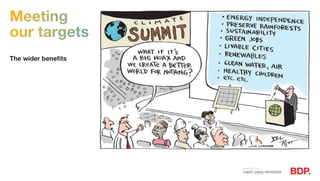
Meeting
our targets
The wider benefits
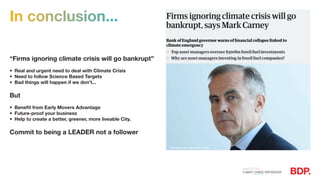
In conclusion...
“Firms ignoring climate crisis will go bankrupt”
•	 Real and urgent need to deal with Climate Crisis
•	 Need to follow Science Based Targets
•	 Bad things will happen if we don’t...
But
•	 Benefit from Early Movers Advantage
•	 Future-proof your business
•	 Help to create a better, greener, more liveable City.
Commit to being a LEADER not a follower
Photograph: Leon Neal/Getty Images
Zero Carbon Manchester 2038

BDP Manchester Net Zero Carbon Summit - BDP

  • 1.
  • 2.
  • 3.
    Global and UKContext What is climate change and why does it matter? Effects of climate change • Permanent rise in global average temperature. • More frequent and more extreme weather events. • Rise in sea levels (estimated 2 metres by 2100). Effects on human life • Significant parts of the world made uninhabitable due to extreme temperatures. • Death and disruption caused by extreme weather events. • Disruption to food and water supplies. • Significant parts of the world made uninhabitable due to flooding (sea level rise). • Increase in illnesses and diseases. • Mass migration. • Significant disruption to the global economy. • Massive costs of adaptation. Source: Le Treut et al. 2007, FAQ 1.3, fig. 1
  • 4.
    Global and UKContext Paris Climate Accord 2015 © Arnaud Bouissou - MEDDE / SG COP21
  • 5.
  • 6.
    Global and UKContext https://www.globalcovenantofmayors.org
  • 7.
    Vancouver Milan Melbourne Allnew family and multi-unit low-rise housing emits zero GHGs, thus improving air quality and saving $44 million in annual energy bills. Introduced congestion charges to eliminate 25 million car journeys into the city centre in just three years. Regional institutions collectively purchased a long-term renewable energy plan from a newly built wind farm, that has saved 96,800 tonnes of GHG emissions per year, as well as generating 150 new jobs. Cities taking action Global and UK Context AdobeStock
  • 8.
    A new eraof activism Global and UK Context PenguinRandomHouseUK FrederickFlorin/AFPviaGettyImages ManchesterEveningNews
  • 9.
  • 10.
    Manchester’s Zero CarbonCommitments Carbon Budget
  • 11.
  • 12.
    Carbon Budget 15 million tonnesCO2 2018-2100 Manchester’s Zero Carbon Commitments
  • 13.
    Manchester’s Zero CarbonCommitments 3500.000 3000.000 2500.000 2000.000 1500.000 1000.000 5000.000 2009 2010 2011 2012 2013 2014 2015 2016 2017 2018 2019 2020 2021 2022 2023 2024 2025 2026 2027 2028 2029 2030 2031 2032 2033 2034 2035 2036 2037 2038 2039 2040 2041 2042 2043 2044 2045 2046 2047 2048 2049 2050 Historic emissions 2009-2018 Currently emitting circa 2.0m tonnes per year Progress to date 41% reduction in CO2 from 2005 levels
  • 14.
    Manchester’s Zero CarbonCommitments 3500.000 3000.000 2500.000 2000.000 1500.000 1000.000 5000.000 2009 2010 2011 2012 2013 2014 2015 2016 2017 2018 2019 2020 2021 2022 2023 2024 2025 2026 2027 2028 2029 2030 2031 2032 2033 2034 2035 2036 2037 2038 2039 2040 2041 2042 2043 2044 2045 2046 2047 2048 2049 2050 15m tonnes carbon budget 15m tonnes CO2 = 2m tonnes per year @ the current rate of emissions, the budget will have been used up by 2026
  • 15.
    Manchester’s Zero CarbonCommitments 3500.000 3000.000 2500.000 2000.000 1500.000 1000.000 5000.000 2009 2010 2011 2012 2013 2014 2015 2016 2017 2018 2019 2020 2021 2022 2023 2024 2025 2026 2027 2028 2029 2030 2031 2032 2033 2034 2035 2036 2037 2038 2039 2040 2041 2042 2043 2044 2045 2046 2047 2048 2049 2050 Science based target Manchester’s science based target 15% reduction year on year
  • 16.
    Manchester’s Zero CarbonCommitments 3500.000 3000.000 2500.000 2000.000 1500.000 1000.000 5000.000 2009 2010 2011 2012 2013 2014 2015 2016 2017 2018 2019 2020 2021 2022 2023 2024 2025 2026 2027 2028 2029 2030 2031 2032 2033 2034 2035 2036 2037 2038 2039 2040 2041 2042 2043 2044 2045 2046 2047 2048 2049 2050 UK Government commitment UK Government’s ‘World Leading Target’ Zero carbon by 2050 EMISSIONS OVER TARGET
  • 17.
    Background - Manchester’sCarbon Emissions Manchester’s Zero Carbon Commitments
  • 18.
    20502020 2025 20302035 2040 2045 Staying in Budget Manchester’s Zero Carbon Commitments 2015 3.0 2.5 2.0 1.5 1.0 0.5 0.0 MtCO2e Level 1 Current trajectory Required trajectory Level 2 Level 3 Level 4 Source: Anthesis’ tool
  • 19.
    Shift to electrificationby 2050Heating and cooling demand reduction by 2050 Commercial Buildings Manchester’s Zero Carbon Commitments Level 4 - most ambitious level 40% reduction in space heating demand. 30% reduction in hot water demand. 60% reduction in cooling demand. Level 4 - most ambitious level The proportion of commercial heat supplied using electricity is 80-100% Level 1 - least ambitious level Space heating remains stable. 25% increase in hot water demand. Cooling demand remains stable. Level 1 - least ambitious level The proportion of commercial heat supplied using electricity is 0-10% Source: Anthesis’ tool
  • 20.
    Shift to zeroemissions transport Reducing distance travelled and changing mode Transport By 2035 Level 4 - most ambitious level 25% reduction in passenger Km. Manchester’s Zero Carbon Commitments By 2050 Level 1 - least ambitious level Individuals travel the same distance as today. By 2035 Level 4 - most ambitious level 100% zero emissions cars and buses. By 2025 Complete railway electrification By 2050 Level 1 - least ambitious level 100% zero emission cars and buses. 100% buses and passenger trains electrified. Source: Anthesis’ tool
  • 21.
    Domestic Buildings -reducing demand and average temperature of homes Manchester’s Zero Carbon Commitments Level 4: Most ambitious level Average room temperature decreases to 16o C (across all rooms and all seasons). Level 1: Least ambitious level Average room temperature remains at 18o C (across all rooms and all seasons). Level 4: Most ambitious level 60% (130,000) homes will be insulated, with the average thermal leakiness reduced by 75%. Level 1: Least ambitious level 17% (337,000) homes will be insulated, with the average thermal leakiness reduced by 20%. Source: Anthesis’ tool
  • 22.
    Supply - Significantincrease in roll out of renewable technologies (eg solar) Manchester’s Zero Carbon Commitments Level 4: Most ambitious level 16m2 solar PV is provided on 50% of domestic properties. 3.1km2 on commercial roof space and ground mounted sites. Level 1: Least ambitious level 16m2 solar PV is provided on 25% of domestic properties. 0.1km2 on commercial roof space and ground mounted sites. Source: Anthesis’ tool
  • 23.
  • 24.
    Commercial Property Sector Buildings Actions: • Measuring carbon and benchmarking projects. • Retrofitting stock to zero carbon standards. • Net zero carbon new builds. • SMART energy and storage systems – use of SMART BIM. • Lobbying for high(er) standards in construction. • Improving sustainability of supply chains in F&M, Building Services and management. • Encouraging adaptive reuse, recycling and promoting the circular economy. Emissions from buildings 45%
  • 25.
    Transport Actions: • Promotion ofwalking, cycling and active travel for staff. • Financial incentives for electric vehicles for staff. • Electric vehicle fleet. • Commercial partnership opportunities. • Reduce emissions from flying. Commercial Property Sector 29% Emissions from transport
  • 26.
    Consumption based emissions Emissionsfrom: Hidden/ embedded/ consumption based emissions Food Construction Materials Clothes Furniture Electronics Waste Commercial Property Sector 26%
  • 27.
    Meeting our targets Actionsfor all Getting started Taking Action Inspiring and influencing 14. Voice your opinion 15. Spread the word 1. Commit to act 9. Existing buildings4. Food 6. Flying 5. Transport2. Awareness, and Education 3. Measure your CO2 10. Green spaces and gardens 13. Where you put your money 11. Water conservation 7. Reduce, reuse and recycle 8. Renewable energy 12. New developments and construction
  • 28.
  • 29.
    In conclusion... “Firms ignoringclimate crisis will go bankrupt” • Real and urgent need to deal with Climate Crisis • Need to follow Science Based Targets • Bad things will happen if we don’t... But • Benefit from Early Movers Advantage • Future-proof your business • Help to create a better, greener, more liveable City. Commit to being a LEADER not a follower Photograph: Leon Neal/Getty Images
  • 30.