Last week’s exercise Data harvesting and storage Storing data Next meetings
Big Data and Automated Content Analysis
Week 3 – Monday
ÂťData harvesting and storageÂŤ
Damian Trilling
d.c.trilling@uva.nl
@damian0604
www.damiantrilling.net
Afdeling Communicatiewetenschap
Universiteit van Amsterdam
11 April 2016
Big Data and Automated Content Analysis Damian Trilling
Last week’s exercise Data harvesting and storage Storing data Next meetings
Today
1 Last week’s exercise
Step by step
Concluding remarks
2 Data harvesting and storage
APIs
RSS feeds
Scraping and crawling
Parsing text les
3 Storing data
CSV tables
JSON and XML
4 Next meetings
Big Data and Automated Content Analysis Damian Trilling
Last week’s exercise
Discussing the code
Last week’s exercise Data harvesting and storage Storing data Next meetings
Step by step
Reading a JSON le into a dict, looping over the dict
Task 1: Print all titles of all videos
1 import json
2
3 with open("/home/damian/pornexercise/xhamster.json") as fi:
4 data=json.load(fi)
5
6 for item in data:
7 print (data[item]["title"])
Big Data and Automated Content Analysis Damian Trilling
Last week’s exercise Data harvesting and storage Storing data Next meetings
Step by step
Reading a JSON le into a dict, looping over the dict
Task 1: Print all titles of all videos
1 import json
2
3 with open("/home/damian/pornexercise/xhamster.json") as fi:
4 data=json.load(fi)
5
6 for item in data:
7 print (data[item]["title"])
NB: You have to know (e.g., by reading the documentation of the dataset)
that the key is called title
Big Data and Automated Content Analysis Damian Trilling
Last week’s exercise Data harvesting and storage Storing data Next meetings
Step by step
Reading a JSON le into a dict, looping over the dict
Task 1: Print all titles of all videos
1 import json
2
3 with open("/home/damian/pornexercise/xhamster.json") as fi:
4 data=json.load(fi)
5
6 for item in data:
7 print (data[item]["title"])
NB: You have to know (e.g., by reading the documentation of the dataset)
that the key is called title
NB: data is in fact a dict of dicts, such that data[item] is another dict.
For each of these dicts, we retrieve the value that corresponds to the key title
Big Data and Automated Content Analysis Damian Trilling
Last week’s exercise Data harvesting and storage Storing data Next meetings
Step by step
Initializing variables, merging two lists, using a counter
Task 2: Average tags per video and most frequently used tags
1 from collections import Counter
2
3 alltags=[]
4 i=0
5 for item in data:
6 i+=1
7 alltags+=data[item]["channels"]
8
9 print(len(alltags),"tags are describing",i,"different videos")
10 print("Thus, we have an average of",len(alltags)/i,"tags per video")
11
12 c=Counter(alltags)
13 print (c.most_common(100))
(there are other, more ecient ways of doing this)
Big Data and Automated Content Analysis Damian Trilling
Last week’s exercise Data harvesting and storage Storing data Next meetings
Step by step
Nesting blocks, using a defaultdict to count, error handling
Task 3: What porn category is most frequently commented on?
1 from collections import defaultdict
2
3 commentspercat=defaultdict(int)
4 for item in data:
5 for tag in data[item]["channels"]:
6 try:
7 commentspercat[tag]+=int(data[item]["nb_comments"])
8 except:
9 pass
10 print(commentspercat)
11 # if you want to print in a fancy way, you can do it like this:
12 for tag in sorted(commentspercat, key=commentspercat.get, reverse=True):
13 print( tag,"t", commentspercat[tag])
A defaultdict is a normal dict, with the difference that the type of each value is
pre-defined and it doesn’t give an error if you look up a non-existing key
Big Data and Automated Content Analysis Damian Trilling
Last week’s exercise Data harvesting and storage Storing data Next meetings
Step by step
Nesting blocks, using a defaultdict to count, error handling
Task 3: What porn category is most frequently commented on?
1 from collections import defaultdict
2
3 commentspercat=defaultdict(int)
4 for item in data:
5 for tag in data[item]["channels"]:
6 try:
7 commentspercat[tag]+=int(data[item]["nb_comments"])
8 except:
9 pass
10 print(commentspercat)
11 # if you want to print in a fancy way, you can do it like this:
12 for tag in sorted(commentspercat, key=commentspercat.get, reverse=True):
13 print( tag,"t", commentspercat[tag])
A defaultdict is a normal dict, with the difference that the type of each value is
pre-defined and it doesn’t give an error if you look up a non-existing key
NB: In line 7, we assume the value to be an int, but the datasets sometimes contains
the string “NA” instead of a string representing an int. That’s why we need the
try/except construction
Big Data and Automated Content Analysis Damian Trilling
Last week’s exercise Data harvesting and storage Storing data Next meetings
Step by step
Adding elements to a list, sum() and len()
Task 4: Average length of descriptions
1 length=[]
2 for item in data:
3 length.append(len(data[item]["description"]))
4
5 print ("Average length",sum(length)/len(length))
Big Data and Automated Content Analysis Damian Trilling
Last week’s exercise Data harvesting and storage Storing data Next meetings
Step by step
Tokenizing with .split()
Task 5: Most frequently used words
1 allwords=[]
2 for item in data:
3 allwords+=data[item]["description"].split()
4 c2=Counter(allwords)
5 print(c2.most_common(100))
.split() changes a string to a list of words.
"This is cool”.split()
results in
["This", "is", "cool"]
Big Data and Automated Content Analysis Damian Trilling
Last week’s exercise Data harvesting and storage Storing data Next meetings
Concluding remarks
Concluding remarks
Make sure you fully understand the code!
Re-read the corresponding chapters
PLAY AROUND!!!
Big Data and Automated Content Analysis Damian Trilling
Data harvesting and storage
An overview of APIs, scrapers, crawlers, RSS-feeds, and different
le formats
Last week’s exercise Data harvesting and storage Storing data Next meetings
APIs
Collecting data:
APIs
Big Data and Automated Content Analysis Damian Trilling
Last week’s exercise Data harvesting and storage Storing data Next meetings
APIs
APIs
Big Data and Automated Content Analysis Damian Trilling
Last week’s exercise Data harvesting and storage Storing data Next meetings
APIs
Querying an API
1 # contact the Twitter API
2 auth = OAuth(access_key, access_secret, consumer_key, consumer_secret)
3 twitter = Twitter(auth = auth)
4
5 # get all info about the user ’username’)
6 tweepinfo=twitter.users.show(screen_name=username)
7
8 # save his bio statement to the variable bio
9 bio=tweepinfo["description"])
10
11 # save his location to the variable location
12 location=tweepinfo["location"]
(abbreviated Python example of how to query the Twitter REST API)
Big Data and Automated Content Analysis Damian Trilling
Last week’s exercise Data harvesting and storage Storing data Next meetings
APIs
Who offers APIs?
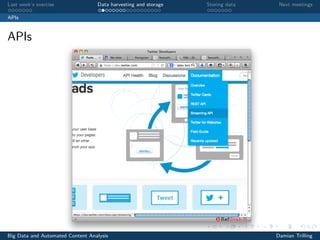
The usual suspects: Twitter, Facebook, Google – but also Reddit,
Youtube, . . .
Big Data and Automated Content Analysis Damian Trilling
Last week’s exercise Data harvesting and storage Storing data Next meetings
APIs
Who offers APIs?
The usual suspects: Twitter, Facebook, Google – but also Reddit,
Youtube, . . .
If you ever leave your bag on a bus on Chicago
Big Data and Automated Content Analysis Damian Trilling
Last week’s exercise Data harvesting and storage Storing data Next meetings
APIs
Who offers APIs?
The usual suspects: Twitter, Facebook, Google – but also Reddit,
Youtube, . . .
If you ever leave your bag on a bus on Chicago
. . . but do have Python on your laptop, watch this:
https://www.youtube.com/watch?v=RrPZza_vZ3w.
That guy queries the Chicago bus company’s API to calculate
when exactly the vehicle with his bag arrives the next time at the
bus stop in front of his oce.
(Yes, he tried calling the help desk before, but they didn’t know. He got his bag back.)
Big Data and Automated Content Analysis Damian Trilling
Last week’s exercise Data harvesting and storage Storing data Next meetings
APIs
APIs
Pro
• Structured data
• Easy to process automatically
• Can be directy embedded in your script
Morstatter, F., Pfeffer, J., Liu, H., & Carley, K. M. (2013). Is the sample good enough? Comparing data from
Twitter’s Streaming API with Twitter’s Firehose. International AAAI Conference on Weblogs and Social Media.
Big Data and Automated Content Analysis Damian Trilling
Last week’s exercise Data harvesting and storage Storing data Next meetings
APIs
APIs
Pro
• Structured data
• Easy to process automatically
• Can be directy embedded in your script
Con
• Often limitations (requests per minute, sampling, . . . )
• You have to trust the provider that he delivers the right
content (⇒ Morstatter e.a., 2013)
• Some APIs won’t allow you to go back in time!
Morstatter, F., Pfeffer, J., Liu, H., & Carley, K. M. (2013). Is the sample good enough? Comparing data from
Twitter’s Streaming API with Twitter’s Firehose. International AAAI Conference on Weblogs and Social Media.
Big Data and Automated Content Analysis Damian Trilling
Last week’s exercise Data harvesting and storage Storing data Next meetings
APIs
So we have learned that we can access an API directly.
But what if we have to do so 24/7?
Big Data and Automated Content Analysis Damian Trilling
Last week’s exercise Data harvesting and storage Storing data Next meetings
APIs
So we have learned that we can access an API directly.
But what if we have to do so 24/7?
Collecting tweets with a tool running on a server that does query
the API 24/7.
Big Data and Automated Content Analysis Damian Trilling
Last week’s exercise Data harvesting and storage Storing data Next meetings
APIs
So we have learned that we can access an API directly.
But what if we have to do so 24/7?
Collecting tweets with a tool running on a server that does query
the API 24/7.
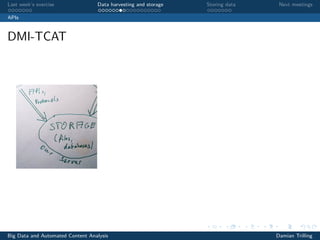
For example, we are running DMI-TCAT (Borra & Rieder, 2014) on
http://datacollection3.followthenews-uva.cloudlet.sara.nl
Borra, E., & Rieder, B. (2014). Programmed method: Developing a toolset for capturing and analyzing tweets.
Aslib Journal of Information Management, 66(3), 262–278. doi:10.1108/AJIM-09-2013-0094
Big Data and Automated Content Analysis Damian Trilling
Last week’s exercise Data harvesting and storage Storing data Next meetings
APIs
DMI-TCAT
Big Data and Automated Content Analysis Damian Trilling
Last week’s exercise Data harvesting and storage Storing data Next meetings
APIs
DMI-TCAT
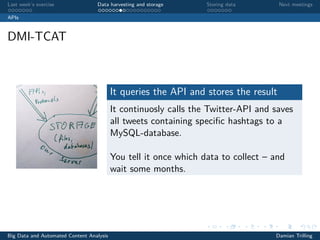
It queries the API and stores the result
It continuosly calls the Twitter-API and saves
all tweets containing specic hashtags to a
MySQL-database.
You tell it once which data to collect – and
wait some months.
Big Data and Automated Content Analysis Damian Trilling
Last week’s exercise Data harvesting and storage Storing data Next meetings
APIs
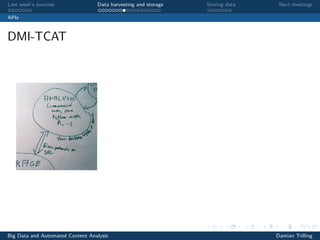
DMI-TCAT
Big Data and Automated Content Analysis Damian Trilling
Last week’s exercise Data harvesting and storage Storing data Next meetings
APIs
DMI-TCAT
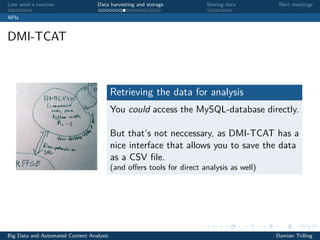
Retrieving the data for analysis
You could access the MySQL-database directly.
But that’s not neccessary, as DMI-TCAT has a
nice interface that allows you to save the data
as a CSV le.
(and offers tools for direct analysis as well)
Big Data and Automated Content Analysis Damian Trilling
Last week’s exercise Data harvesting and storage Storing data Next meetings
RSS feeds
Collecting data:
RSS feeds
Big Data and Automated Content Analysis Damian Trilling
Last week’s exercise Data harvesting and storage Storing data Next meetings
RSS feeds
RSS feeds
What’s that?
• A structured (XML) format in which for example news sites
and blogs offer their content
Big Data and Automated Content Analysis Damian Trilling
Last week’s exercise Data harvesting and storage Storing data Next meetings
RSS feeds
RSS feeds
What’s that?
• A structured (XML) format in which for example news sites
and blogs offer their content
• You get only the new news items (and that’s great!)
Big Data and Automated Content Analysis Damian Trilling
Last week’s exercise Data harvesting and storage Storing data Next meetings
RSS feeds
RSS feeds
What’s that?
• A structured (XML) format in which for example news sites
and blogs offer their content
• You get only the new news items (and that’s great!)
• Title, teaser (or full text), date and time, link
Big Data and Automated Content Analysis Damian Trilling
Last week’s exercise Data harvesting and storage Storing data Next meetings
RSS feeds
RSS feeds
What’s that?
• A structured (XML) format in which for example news sites
and blogs offer their content
• You get only the new news items (and that’s great!)
• Title, teaser (or full text), date and time, link
http://www.nu.nl/rss
http://datacollection3.followthenews-uva.cloudlet.sara.nl/rsshond
Big Data and Automated Content Analysis Damian Trilling
Last week’s exercise Data harvesting and storage Storing data Next meetings
RSS feeds
RSS feeds
Pro
• One protocol for all services
• Easy to use
Con
• Full text often not included, you have to download the link
separately (⇒ Problems associated with scraping)
• You can’t go back in time! But we have archived a lot of RSS
feeds
Big Data and Automated Content Analysis Damian Trilling
Last week’s exercise Data harvesting and storage Storing data Next meetings
Scraping and crawling
Collecting data:
Scraping and crawling
Big Data and Automated Content Analysis Damian Trilling
Last week’s exercise Data harvesting and storage Storing data Next meetings
Scraping and crawling
If you have no chance of getting already structured data via
one of the approaches above
Big Data and Automated Content Analysis Damian Trilling
Last week’s exercise Data harvesting and storage Storing data Next meetings
Scraping and crawling
If you have no chance of getting already structured data via
one of the approaches above
• Download web pages, try to identify the structure yourself
• You have to parse the data
Big Data and Automated Content Analysis Damian Trilling
Last week’s exercise Data harvesting and storage Storing data Next meetings
Scraping and crawling
If you have no chance of getting already structured data via
one of the approaches above
• Download web pages, try to identify the structure yourself
• You have to parse the data
• Can get very complicated (depending on the specific task),
especially if the structure of the web pages changes
Further reading:
http://scrapy.org
https:
//github.com/anthonydb/python-get-started/blob/master/5-web-scraping.py
Big Data and Automated Content Analysis Damian Trilling
Last week’s exercise Data harvesting and storage Storing data Next meetings
Parsing text les
Collecting data:
Parsing text les
Big Data and Automated Content Analysis Damian Trilling
Last week’s exercise Data harvesting and storage Storing data Next meetings
Parsing text les
For messy input data or for semi-structured data
Guiding question: Can we identify some kind of pattern?
Big Data and Automated Content Analysis Damian Trilling
Last week’s exercise Data harvesting and storage Storing data Next meetings
Parsing text les
For messy input data or for semi-structured data
Guiding question: Can we identify some kind of pattern?
Examples
• Lewis, Zamith, & Hermida (2013) had a corrupt CSV-file
Lewis, S. C., Zamith, R., & Hermida, A. (2013). Content analysis in an era of Big Data: A hybrid approach to
computational and manual methods. Journal of Broadcasting & Electronic Media, 57(1), 34–52.
doi:10.1080/08838151.2012.761702
Big Data and Automated Content Analysis Damian Trilling
Last week’s exercise Data harvesting and storage Storing data Next meetings
Parsing text les
For messy input data or for semi-structured data
Guiding question: Can we identify some kind of pattern?
Examples
• Lewis, Zamith, & Hermida (2013) had a corrupt CSV-file
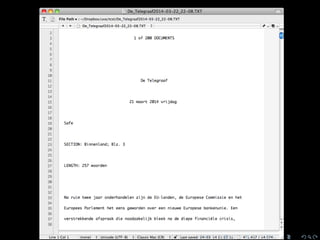
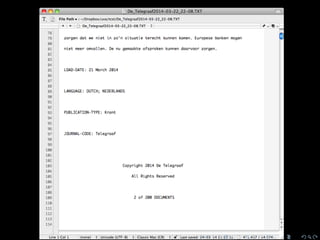
• LexisNexis gives you a chunk of text (rather than, e.g., a
structured JSON or XML object)
Big Data and Automated Content Analysis Damian Trilling
Last week’s exercise Data harvesting and storage Storing data Next meetings
Parsing text les
For messy input data or for semi-structured data
Guiding question: Can we identify some kind of pattern?
Examples
• Lewis, Zamith, & Hermida (2013) had a corrupt CSV-file
• LexisNexis gives you a chunk of text (rather than, e.g., a
structured JSON or XML object)
But in both cases, as long as you can nd any pattern or structure
in it, you can try to write a Python script to parse the data.
Big Data and Automated Content Analysis Damian Trilling
1 with open(bestandsnaam) as f:
2 for line in f:
3 line=line.replace("r","")
4 if line=="n":
5 continue
6 matchObj=re.match(r"s+(d+) of (d+) DOCUMENTS",line)
7 if matchObj:
8 artikel= int(matchObj.group(1))
9 tekst[artikel]=""
10 continue
11 if line.startswith("SECTION"):
12 section[artikel]=line.replace("SECTION: ","").rstrip("n")
13 elif line.startswith("LENGTH"):
14 length[artikel]=line.replace("LENGTH: ","").rstrip("n")
15 ...
16 ...
17 ...
18
19 else:
20 tekst[artikel]=tekst[artikel]+line
Last week’s exercise Data harvesting and storage Storing data Next meetings
CSV tables
Storing data:
CSV tables
Big Data and Automated Content Analysis Damian Trilling
Last week’s exercise Data harvesting and storage Storing data Next meetings
CSV tables
CSV-les
Always a good choice
• All programs can read it
• Even human-readable in a simple text editor:
• Plain text, with a comma (or a semicolon) denoting column
breaks
• No limits regarging the size
Big Data and Automated Content Analysis Damian Trilling
Last week’s exercise Data harvesting and storage Storing data Next meetings
CSV tables
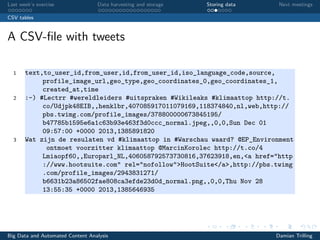
A CSV-le with tweets
1 text,to_user_id,from_user,id,from_user_id,iso_language_code,source,
profile_image_url,geo_type,geo_coordinates_0,geo_coordinates_1,
created_at,time
2 :-) #Lectrr #wereldleiders #uitspraken #Wikileaks #klimaattop http://t.
co/Udjpk48EIB,,henklbr,407085917011079169,118374840,nl,web,http://
pbs.twimg.com/profile_images/378800000673845195/
b47785b1595e6a1c63b93e463f3d0ccc_normal.jpeg,,0,0,Sun Dec 01
09:57:00 +0000 2013,1385891820
3 Wat zijn de resulaten vd #klimaattop in #Warschau waard? @EP_Environment
ontmoet voorzitter klimaattop @MarcinKorolec http://t.co/4
Lmiaopf60,,Europarl_NL,406058792573730816,37623918,en,<a href="http
://www.hootsuite.com" rel="nofollow">HootSuite</a>,http://pbs.twimg
.com/profile_images/2943831271/
b6631b23a86502fae808ca3efde23d0d_normal.png,,0,0,Thu Nov 28
13:55:35 +0000 2013,1385646935
Big Data and Automated Content Analysis Damian Trilling
Last week’s exercise Data harvesting and storage Storing data Next meetings
JSON and XML
Storing data:
JSON and XML
Big Data and Automated Content Analysis Damian Trilling
Last week’s exercise Data harvesting and storage Storing data Next meetings
JSON and XML
JSON and XML
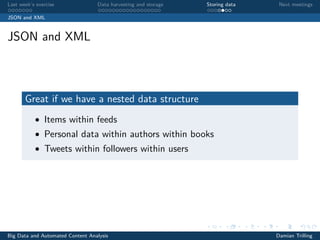
Great if we have a nested data structure
Big Data and Automated Content Analysis Damian Trilling
Last week’s exercise Data harvesting and storage Storing data Next meetings
JSON and XML
JSON and XML
Great if we have a nested data structure
• Items within feeds
Big Data and Automated Content Analysis Damian Trilling
Last week’s exercise Data harvesting and storage Storing data Next meetings
JSON and XML
JSON and XML
Great if we have a nested data structure
• Items within feeds
• Personal data within authors within books
Big Data and Automated Content Analysis Damian Trilling
Last week’s exercise Data harvesting and storage Storing data Next meetings
JSON and XML
JSON and XML
Great if we have a nested data structure
• Items within feeds
• Personal data within authors within books
• Tweets within followers within users
Big Data and Automated Content Analysis Damian Trilling
Last week’s exercise Data harvesting and storage Storing data Next meetings
JSON and XML
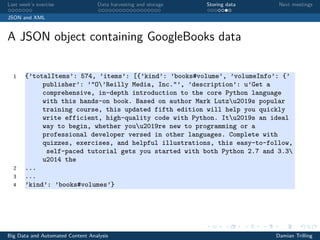
A JSON object containing GoogleBooks data
1 {’totalItems’: 574, ’items’: [{’kind’: ’books#volume’, ’volumeInfo’: {’
publisher’: ’"O’Reilly Media, Inc."’, ’description’: u’Get a
comprehensive, in-depth introduction to the core Python language
with this hands-on book. Based on author Mark Lutzu2019s popular
training course, this updated fifth edition will help you quickly
write efficient, high-quality code with Python. Itu2019s an ideal
way to begin, whether youu2019re new to programming or a
professional developer versed in other languages. Complete with
quizzes, exercises, and helpful illustrations, this easy-to-follow,
self-paced tutorial gets you started with both Python 2.7 and 3.3
u2014 the
2 ...
3 ...
4 ’kind’: ’books#volumes’}
Big Data and Automated Content Analysis Damian Trilling
Last week’s exercise Data harvesting and storage Storing data Next meetings
JSON and XML
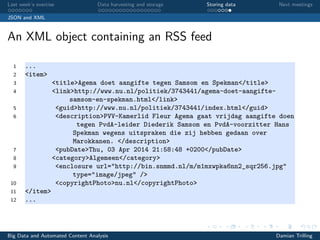
An XML object containing an RSS feed
1 ...
2 <item>
3 <title>Agema doet aangifte tegen Samsom en Spekman</title>
4 <link>http://www.nu.nl/politiek/3743441/agema-doet-aangifte-
samsom-en-spekman.html</link>
5 <guid>http://www.nu.nl/politiek/3743441/index.html</guid>
6 <description>PVV-Kamerlid Fleur Agema gaat vrijdag aangifte doen
tegen PvdA-leider Diederik Samsom en PvdA-voorzitter Hans
Spekman wegens uitspraken die zij hebben gedaan over
Marokkanen. </description>
7 <pubDate>Thu, 03 Apr 2014 21:58:48 +0200</pubDate>
8 <category>Algemeen</category>
9 <enclosure url="http://bin.snmmd.nl/m/m1mxwpka6nn2_sqr256.jpg"
type="image/jpeg" />
10 <copyrightPhoto>nu.nl</copyrightPhoto>
11 </item>
12 ...
Big Data and Automated Content Analysis Damian Trilling
Last week’s exercise Data harvesting and storage Storing data Next meetings
Next meetings
Big Data and Automated Content Analysis Damian Trilling
Last week’s exercise Data harvesting and storage Storing data Next meetings
Next meetings
Wednesday, 15–4
Writing some rst data collection scripts
Big Data and Automated Content Analysis Damian Trilling

BDACA1516s2 - Lecture3

  • 1.
    Last week’s exerciseData harvesting and storage Storing data Next meetings Big Data and Automated Content Analysis Week 3 – Monday »Data harvesting and storage« Damian Trilling d.c.trilling@uva.nl @damian0604 www.damiantrilling.net Afdeling Communicatiewetenschap Universiteit van Amsterdam 11 April 2016 Big Data and Automated Content Analysis Damian Trilling
  • 2.
    Last week’s exerciseData harvesting and storage Storing data Next meetings Today 1 Last week’s exercise Step by step Concluding remarks 2 Data harvesting and storage APIs RSS feeds Scraping and crawling Parsing text files 3 Storing data CSV tables JSON and XML 4 Next meetings Big Data and Automated Content Analysis Damian Trilling
  • 3.
  • 4.
    Last week’s exerciseData harvesting and storage Storing data Next meetings Step by step Reading a JSON file into a dict, looping over the dict Task 1: Print all titles of all videos 1 import json 2 3 with open("/home/damian/pornexercise/xhamster.json") as fi: 4 data=json.load(fi) 5 6 for item in data: 7 print (data[item]["title"]) Big Data and Automated Content Analysis Damian Trilling
  • 5.
    Last week’s exerciseData harvesting and storage Storing data Next meetings Step by step Reading a JSON file into a dict, looping over the dict Task 1: Print all titles of all videos 1 import json 2 3 with open("/home/damian/pornexercise/xhamster.json") as fi: 4 data=json.load(fi) 5 6 for item in data: 7 print (data[item]["title"]) NB: You have to know (e.g., by reading the documentation of the dataset) that the key is called title Big Data and Automated Content Analysis Damian Trilling
  • 6.
    Last week’s exerciseData harvesting and storage Storing data Next meetings Step by step Reading a JSON file into a dict, looping over the dict Task 1: Print all titles of all videos 1 import json 2 3 with open("/home/damian/pornexercise/xhamster.json") as fi: 4 data=json.load(fi) 5 6 for item in data: 7 print (data[item]["title"]) NB: You have to know (e.g., by reading the documentation of the dataset) that the key is called title NB: data is in fact a dict of dicts, such that data[item] is another dict. For each of these dicts, we retrieve the value that corresponds to the key title Big Data and Automated Content Analysis Damian Trilling
  • 7.
    Last week’s exerciseData harvesting and storage Storing data Next meetings Step by step Initializing variables, merging two lists, using a counter Task 2: Average tags per video and most frequently used tags 1 from collections import Counter 2 3 alltags=[] 4 i=0 5 for item in data: 6 i+=1 7 alltags+=data[item]["channels"] 8 9 print(len(alltags),"tags are describing",i,"different videos") 10 print("Thus, we have an average of",len(alltags)/i,"tags per video") 11 12 c=Counter(alltags) 13 print (c.most_common(100)) (there are other, more efficient ways of doing this) Big Data and Automated Content Analysis Damian Trilling
  • 8.
    Last week’s exerciseData harvesting and storage Storing data Next meetings Step by step Nesting blocks, using a defaultdict to count, error handling Task 3: What porn category is most frequently commented on? 1 from collections import defaultdict 2 3 commentspercat=defaultdict(int) 4 for item in data: 5 for tag in data[item]["channels"]: 6 try: 7 commentspercat[tag]+=int(data[item]["nb_comments"]) 8 except: 9 pass 10 print(commentspercat) 11 # if you want to print in a fancy way, you can do it like this: 12 for tag in sorted(commentspercat, key=commentspercat.get, reverse=True): 13 print( tag,"t", commentspercat[tag]) A defaultdict is a normal dict, with the difference that the type of each value is pre-defined and it doesn’t give an error if you look up a non-existing key Big Data and Automated Content Analysis Damian Trilling
  • 9.
    Last week’s exerciseData harvesting and storage Storing data Next meetings Step by step Nesting blocks, using a defaultdict to count, error handling Task 3: What porn category is most frequently commented on? 1 from collections import defaultdict 2 3 commentspercat=defaultdict(int) 4 for item in data: 5 for tag in data[item]["channels"]: 6 try: 7 commentspercat[tag]+=int(data[item]["nb_comments"]) 8 except: 9 pass 10 print(commentspercat) 11 # if you want to print in a fancy way, you can do it like this: 12 for tag in sorted(commentspercat, key=commentspercat.get, reverse=True): 13 print( tag,"t", commentspercat[tag]) A defaultdict is a normal dict, with the difference that the type of each value is pre-defined and it doesn’t give an error if you look up a non-existing key NB: In line 7, we assume the value to be an int, but the datasets sometimes contains the string “NA” instead of a string representing an int. That’s why we need the try/except construction Big Data and Automated Content Analysis Damian Trilling
  • 10.
    Last week’s exerciseData harvesting and storage Storing data Next meetings Step by step Adding elements to a list, sum() and len() Task 4: Average length of descriptions 1 length=[] 2 for item in data: 3 length.append(len(data[item]["description"])) 4 5 print ("Average length",sum(length)/len(length)) Big Data and Automated Content Analysis Damian Trilling
  • 11.
    Last week’s exerciseData harvesting and storage Storing data Next meetings Step by step Tokenizing with .split() Task 5: Most frequently used words 1 allwords=[] 2 for item in data: 3 allwords+=data[item]["description"].split() 4 c2=Counter(allwords) 5 print(c2.most_common(100)) .split() changes a string to a list of words. "This is cool”.split() results in ["This", "is", "cool"] Big Data and Automated Content Analysis Damian Trilling
  • 12.
    Last week’s exerciseData harvesting and storage Storing data Next meetings Concluding remarks Concluding remarks Make sure you fully understand the code! Re-read the corresponding chapters PLAY AROUND!!! Big Data and Automated Content Analysis Damian Trilling
  • 13.
    Data harvesting andstorage An overview of APIs, scrapers, crawlers, RSS-feeds, and different file formats
  • 14.
    Last week’s exerciseData harvesting and storage Storing data Next meetings APIs Collecting data: APIs Big Data and Automated Content Analysis Damian Trilling
  • 15.
    Last week’s exerciseData harvesting and storage Storing data Next meetings APIs APIs Big Data and Automated Content Analysis Damian Trilling
  • 16.
    Last week’s exerciseData harvesting and storage Storing data Next meetings APIs Querying an API 1 # contact the Twitter API 2 auth = OAuth(access_key, access_secret, consumer_key, consumer_secret) 3 twitter = Twitter(auth = auth) 4 5 # get all info about the user ’username’) 6 tweepinfo=twitter.users.show(screen_name=username) 7 8 # save his bio statement to the variable bio 9 bio=tweepinfo["description"]) 10 11 # save his location to the variable location 12 location=tweepinfo["location"] (abbreviated Python example of how to query the Twitter REST API) Big Data and Automated Content Analysis Damian Trilling
  • 17.
    Last week’s exerciseData harvesting and storage Storing data Next meetings APIs Who offers APIs? The usual suspects: Twitter, Facebook, Google – but also Reddit, Youtube, . . . Big Data and Automated Content Analysis Damian Trilling
  • 18.
    Last week’s exerciseData harvesting and storage Storing data Next meetings APIs Who offers APIs? The usual suspects: Twitter, Facebook, Google – but also Reddit, Youtube, . . . If you ever leave your bag on a bus on Chicago Big Data and Automated Content Analysis Damian Trilling
  • 19.
    Last week’s exerciseData harvesting and storage Storing data Next meetings APIs Who offers APIs? The usual suspects: Twitter, Facebook, Google – but also Reddit, Youtube, . . . If you ever leave your bag on a bus on Chicago . . . but do have Python on your laptop, watch this: https://www.youtube.com/watch?v=RrPZza_vZ3w. That guy queries the Chicago bus company’s API to calculate when exactly the vehicle with his bag arrives the next time at the bus stop in front of his office. (Yes, he tried calling the help desk before, but they didn’t know. He got his bag back.) Big Data and Automated Content Analysis Damian Trilling
  • 20.
    Last week’s exerciseData harvesting and storage Storing data Next meetings APIs APIs Pro • Structured data • Easy to process automatically • Can be directy embedded in your script Morstatter, F., Pfeffer, J., Liu, H., & Carley, K. M. (2013). Is the sample good enough? Comparing data from Twitter’s Streaming API with Twitter’s Firehose. International AAAI Conference on Weblogs and Social Media. Big Data and Automated Content Analysis Damian Trilling
  • 21.
    Last week’s exerciseData harvesting and storage Storing data Next meetings APIs APIs Pro • Structured data • Easy to process automatically • Can be directy embedded in your script Con • Often limitations (requests per minute, sampling, . . . ) • You have to trust the provider that he delivers the right content (⇒ Morstatter e.a., 2013) • Some APIs won’t allow you to go back in time! Morstatter, F., Pfeffer, J., Liu, H., & Carley, K. M. (2013). Is the sample good enough? Comparing data from Twitter’s Streaming API with Twitter’s Firehose. International AAAI Conference on Weblogs and Social Media. Big Data and Automated Content Analysis Damian Trilling
  • 22.
    Last week’s exerciseData harvesting and storage Storing data Next meetings APIs So we have learned that we can access an API directly. But what if we have to do so 24/7? Big Data and Automated Content Analysis Damian Trilling
  • 23.
    Last week’s exerciseData harvesting and storage Storing data Next meetings APIs So we have learned that we can access an API directly. But what if we have to do so 24/7? Collecting tweets with a tool running on a server that does query the API 24/7. Big Data and Automated Content Analysis Damian Trilling
  • 24.
    Last week’s exerciseData harvesting and storage Storing data Next meetings APIs So we have learned that we can access an API directly. But what if we have to do so 24/7? Collecting tweets with a tool running on a server that does query the API 24/7. For example, we are running DMI-TCAT (Borra & Rieder, 2014) on http://datacollection3.followthenews-uva.cloudlet.sara.nl Borra, E., & Rieder, B. (2014). Programmed method: Developing a toolset for capturing and analyzing tweets. Aslib Journal of Information Management, 66(3), 262–278. doi:10.1108/AJIM-09-2013-0094 Big Data and Automated Content Analysis Damian Trilling
  • 25.
    Last week’s exerciseData harvesting and storage Storing data Next meetings APIs DMI-TCAT Big Data and Automated Content Analysis Damian Trilling
  • 26.
    Last week’s exerciseData harvesting and storage Storing data Next meetings APIs DMI-TCAT It queries the API and stores the result It continuosly calls the Twitter-API and saves all tweets containing specific hashtags to a MySQL-database. You tell it once which data to collect – and wait some months. Big Data and Automated Content Analysis Damian Trilling
  • 27.
    Last week’s exerciseData harvesting and storage Storing data Next meetings APIs DMI-TCAT Big Data and Automated Content Analysis Damian Trilling
  • 28.
    Last week’s exerciseData harvesting and storage Storing data Next meetings APIs DMI-TCAT Retrieving the data for analysis You could access the MySQL-database directly. But that’s not neccessary, as DMI-TCAT has a nice interface that allows you to save the data as a CSV file. (and offers tools for direct analysis as well) Big Data and Automated Content Analysis Damian Trilling
  • 29.
    Last week’s exerciseData harvesting and storage Storing data Next meetings RSS feeds Collecting data: RSS feeds Big Data and Automated Content Analysis Damian Trilling
  • 30.
    Last week’s exerciseData harvesting and storage Storing data Next meetings RSS feeds RSS feeds What’s that? • A structured (XML) format in which for example news sites and blogs offer their content Big Data and Automated Content Analysis Damian Trilling
  • 31.
    Last week’s exerciseData harvesting and storage Storing data Next meetings RSS feeds RSS feeds What’s that? • A structured (XML) format in which for example news sites and blogs offer their content • You get only the new news items (and that’s great!) Big Data and Automated Content Analysis Damian Trilling
  • 32.
    Last week’s exerciseData harvesting and storage Storing data Next meetings RSS feeds RSS feeds What’s that? • A structured (XML) format in which for example news sites and blogs offer their content • You get only the new news items (and that’s great!) • Title, teaser (or full text), date and time, link Big Data and Automated Content Analysis Damian Trilling
  • 33.
    Last week’s exerciseData harvesting and storage Storing data Next meetings RSS feeds RSS feeds What’s that? • A structured (XML) format in which for example news sites and blogs offer their content • You get only the new news items (and that’s great!) • Title, teaser (or full text), date and time, link http://www.nu.nl/rss http://datacollection3.followthenews-uva.cloudlet.sara.nl/rsshond Big Data and Automated Content Analysis Damian Trilling
  • 34.
    Last week’s exerciseData harvesting and storage Storing data Next meetings RSS feeds RSS feeds Pro • One protocol for all services • Easy to use Con • Full text often not included, you have to download the link separately (⇒ Problems associated with scraping) • You can’t go back in time! But we have archived a lot of RSS feeds Big Data and Automated Content Analysis Damian Trilling
  • 35.
    Last week’s exerciseData harvesting and storage Storing data Next meetings Scraping and crawling Collecting data: Scraping and crawling Big Data and Automated Content Analysis Damian Trilling
  • 36.
    Last week’s exerciseData harvesting and storage Storing data Next meetings Scraping and crawling Scraping and crawling If you have no chance of getting already structured data via one of the approaches above Big Data and Automated Content Analysis Damian Trilling
  • 37.
    Last week’s exerciseData harvesting and storage Storing data Next meetings Scraping and crawling Scraping and crawling If you have no chance of getting already structured data via one of the approaches above • Download web pages, try to identify the structure yourself • You have to parse the data Big Data and Automated Content Analysis Damian Trilling
  • 38.
    Last week’s exerciseData harvesting and storage Storing data Next meetings Scraping and crawling Scraping and crawling If you have no chance of getting already structured data via one of the approaches above • Download web pages, try to identify the structure yourself • You have to parse the data • Can get very complicated (depending on the specific task), especially if the structure of the web pages changes Further reading: http://scrapy.org https: //github.com/anthonydb/python-get-started/blob/master/5-web-scraping.py Big Data and Automated Content Analysis Damian Trilling
  • 39.
    Last week’s exerciseData harvesting and storage Storing data Next meetings Parsing text files Collecting data: Parsing text files Big Data and Automated Content Analysis Damian Trilling
  • 40.
    Last week’s exerciseData harvesting and storage Storing data Next meetings Parsing text files For messy input data or for semi-structured data Guiding question: Can we identify some kind of pattern? Big Data and Automated Content Analysis Damian Trilling
  • 41.
    Last week’s exerciseData harvesting and storage Storing data Next meetings Parsing text files For messy input data or for semi-structured data Guiding question: Can we identify some kind of pattern? Examples • Lewis, Zamith, & Hermida (2013) had a corrupt CSV-file Lewis, S. C., Zamith, R., & Hermida, A. (2013). Content analysis in an era of Big Data: A hybrid approach to computational and manual methods. Journal of Broadcasting & Electronic Media, 57(1), 34–52. doi:10.1080/08838151.2012.761702 Big Data and Automated Content Analysis Damian Trilling
  • 42.
    Last week’s exerciseData harvesting and storage Storing data Next meetings Parsing text files For messy input data or for semi-structured data Guiding question: Can we identify some kind of pattern? Examples • Lewis, Zamith, & Hermida (2013) had a corrupt CSV-file • LexisNexis gives you a chunk of text (rather than, e.g., a structured JSON or XML object) Big Data and Automated Content Analysis Damian Trilling
  • 43.
    Last week’s exerciseData harvesting and storage Storing data Next meetings Parsing text files For messy input data or for semi-structured data Guiding question: Can we identify some kind of pattern? Examples • Lewis, Zamith, & Hermida (2013) had a corrupt CSV-file • LexisNexis gives you a chunk of text (rather than, e.g., a structured JSON or XML object) But in both cases, as long as you can find any pattern or structure in it, you can try to write a Python script to parse the data. Big Data and Automated Content Analysis Damian Trilling
  • 46.
    1 with open(bestandsnaam)as f: 2 for line in f: 3 line=line.replace("r","") 4 if line=="n": 5 continue 6 matchObj=re.match(r"s+(d+) of (d+) DOCUMENTS",line) 7 if matchObj: 8 artikel= int(matchObj.group(1)) 9 tekst[artikel]="" 10 continue 11 if line.startswith("SECTION"): 12 section[artikel]=line.replace("SECTION: ","").rstrip("n") 13 elif line.startswith("LENGTH"): 14 length[artikel]=line.replace("LENGTH: ","").rstrip("n") 15 ... 16 ... 17 ... 18 19 else: 20 tekst[artikel]=tekst[artikel]+line
  • 47.
    Last week’s exerciseData harvesting and storage Storing data Next meetings CSV tables Storing data: CSV tables Big Data and Automated Content Analysis Damian Trilling
  • 48.
    Last week’s exerciseData harvesting and storage Storing data Next meetings CSV tables CSV-files Always a good choice • All programs can read it • Even human-readable in a simple text editor: • Plain text, with a comma (or a semicolon) denoting column breaks • No limits regarging the size Big Data and Automated Content Analysis Damian Trilling
  • 49.
    Last week’s exerciseData harvesting and storage Storing data Next meetings CSV tables A CSV-file with tweets 1 text,to_user_id,from_user,id,from_user_id,iso_language_code,source, profile_image_url,geo_type,geo_coordinates_0,geo_coordinates_1, created_at,time 2 :-) #Lectrr #wereldleiders #uitspraken #Wikileaks #klimaattop http://t. co/Udjpk48EIB,,henklbr,407085917011079169,118374840,nl,web,http:// pbs.twimg.com/profile_images/378800000673845195/ b47785b1595e6a1c63b93e463f3d0ccc_normal.jpeg,,0,0,Sun Dec 01 09:57:00 +0000 2013,1385891820 3 Wat zijn de resulaten vd #klimaattop in #Warschau waard? @EP_Environment ontmoet voorzitter klimaattop @MarcinKorolec http://t.co/4 Lmiaopf60,,Europarl_NL,406058792573730816,37623918,en,<a href="http ://www.hootsuite.com" rel="nofollow">HootSuite</a>,http://pbs.twimg .com/profile_images/2943831271/ b6631b23a86502fae808ca3efde23d0d_normal.png,,0,0,Thu Nov 28 13:55:35 +0000 2013,1385646935 Big Data and Automated Content Analysis Damian Trilling
  • 50.
    Last week’s exerciseData harvesting and storage Storing data Next meetings JSON and XML Storing data: JSON and XML Big Data and Automated Content Analysis Damian Trilling
  • 51.
    Last week’s exerciseData harvesting and storage Storing data Next meetings JSON and XML JSON and XML Great if we have a nested data structure Big Data and Automated Content Analysis Damian Trilling
  • 52.
    Last week’s exerciseData harvesting and storage Storing data Next meetings JSON and XML JSON and XML Great if we have a nested data structure • Items within feeds Big Data and Automated Content Analysis Damian Trilling
  • 53.
    Last week’s exerciseData harvesting and storage Storing data Next meetings JSON and XML JSON and XML Great if we have a nested data structure • Items within feeds • Personal data within authors within books Big Data and Automated Content Analysis Damian Trilling
  • 54.
    Last week’s exerciseData harvesting and storage Storing data Next meetings JSON and XML JSON and XML Great if we have a nested data structure • Items within feeds • Personal data within authors within books • Tweets within followers within users Big Data and Automated Content Analysis Damian Trilling
  • 55.
    Last week’s exerciseData harvesting and storage Storing data Next meetings JSON and XML A JSON object containing GoogleBooks data 1 {’totalItems’: 574, ’items’: [{’kind’: ’books#volume’, ’volumeInfo’: {’ publisher’: ’"O’Reilly Media, Inc."’, ’description’: u’Get a comprehensive, in-depth introduction to the core Python language with this hands-on book. Based on author Mark Lutzu2019s popular training course, this updated fifth edition will help you quickly write efficient, high-quality code with Python. Itu2019s an ideal way to begin, whether youu2019re new to programming or a professional developer versed in other languages. Complete with quizzes, exercises, and helpful illustrations, this easy-to-follow, self-paced tutorial gets you started with both Python 2.7 and 3.3 u2014 the 2 ... 3 ... 4 ’kind’: ’books#volumes’} Big Data and Automated Content Analysis Damian Trilling
  • 56.
    Last week’s exerciseData harvesting and storage Storing data Next meetings JSON and XML An XML object containing an RSS feed 1 ... 2 <item> 3 <title>Agema doet aangifte tegen Samsom en Spekman</title> 4 <link>http://www.nu.nl/politiek/3743441/agema-doet-aangifte- samsom-en-spekman.html</link> 5 <guid>http://www.nu.nl/politiek/3743441/index.html</guid> 6 <description>PVV-Kamerlid Fleur Agema gaat vrijdag aangifte doen tegen PvdA-leider Diederik Samsom en PvdA-voorzitter Hans Spekman wegens uitspraken die zij hebben gedaan over Marokkanen. </description> 7 <pubDate>Thu, 03 Apr 2014 21:58:48 +0200</pubDate> 8 <category>Algemeen</category> 9 <enclosure url="http://bin.snmmd.nl/m/m1mxwpka6nn2_sqr256.jpg" type="image/jpeg" /> 10 <copyrightPhoto>nu.nl</copyrightPhoto> 11 </item> 12 ... Big Data and Automated Content Analysis Damian Trilling
  • 57.
    Last week’s exerciseData harvesting and storage Storing data Next meetings Next meetings Big Data and Automated Content Analysis Damian Trilling
  • 58.
    Last week’s exerciseData harvesting and storage Storing data Next meetings Next meetings Wednesday, 15–4 Writing some first data collection scripts Big Data and Automated Content Analysis Damian Trilling