Sharing Australian Natural Heritage
Buddhist Council of NSW
Serving community with open arms
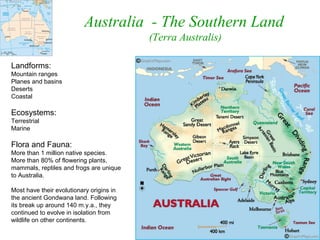
Australia - The Southern Land
(Terra Australis)
Landforms:
Mountain ranges
Planes and basins
Deserts
Coastal
Ecosystems:
Terrestrial
Marine
Flora and Fauna:
More than 1 million native species.
More than 80% of flowering plants,
mammals, reptiles and frogs are unique
to Australia.
Most have their evolutionary origins in
the ancient Gondwana land. Following
its break up around 140 m.y.a., they
continued to evolve in isolation from
wildlife on other continents.
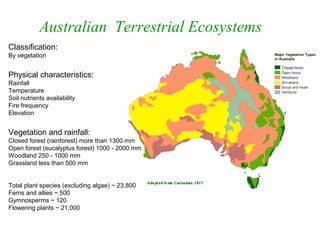
Australian Terrestrial Ecosystems
Classification:
By vegetation
Physical characteristics:
Rainfall
Temperature
Soil nutrients availability
Fire frequency
Elevation
Vegetation and rainfall:
Closed forest (rainforest) more than 1300 mm
Open forest (eucalyptus forest) 1000 - 2000 mm
Woodland 250 - 1000 mm
Grassland less than 500 mm
Total plant species (excluding algae) ~ 23,800
Ferns and allies ~ 500
Gymnosperms ~ 120
Flowering plants ~ 21,000
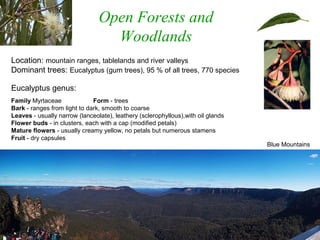
Open Forests and
Woodlands
Blue Mountains
Location: mountain ranges, tablelands and river valleys
Dominant trees: Eucalyptus (gum trees), 95 % of all trees, 770 species
Eucalyptus genus:
Family Myrtaceae Form - trees
Bark - ranges from light to dark, smooth to coarse
Leaves - usually narrow (lanceolate), leathery (sclerophyllous),with oil glands
Flower buds - in clusters, each with a cap (modified petals)
Mature flowers - usually creamy yellow, no petals but numerous stamens
Fruit - dry capsules
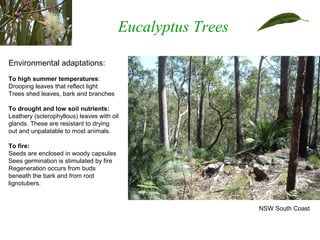
Eucalyptus Trees
NSW South Coast
Environmental adaptations:
To high summer temperatures:
Drooping leaves that reflect light
Trees shed leaves, bark and branches
To drought and low soil nutrients:
Leathery (sclerophyllous) leaves with oil
glands. These are resistant to drying
out and unpalatable to most animals.
To fire:
Seeds are enclosed in woody capsules
Sees germination is stimulated by fire
Regeneration occurs from buds
beneath the bark and from root
lignotubers.
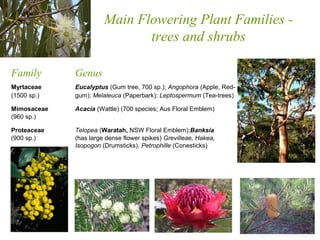
Main Flowering Plant Families -
trees and shrubs
Family Genus
Myrtaceae Eucalyptus (Gum tree, 700 sp.); Angophora (Apple, Red-
(1500 sp.) gum); Melaleuca (Paperbark); Leptospermum (Tea-trees)
Mimosaceae Acacia (Wattle) (700 species; Aus Floral Emblem)
(960 sp.)
Proteaceae Telopea (Waratah, NSW Floral Emblem);Banksia
(900 sp.) (has large dense flower spikes) Grevilleae, Hakea,
Isopogon (Drumsticks), Petrophille (Conesticks)
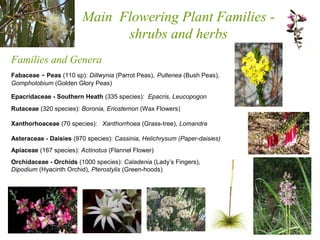
Main Flowering Plant Families -
shrubs and herbs
Families and Genera
Fabaceae - Peas (110 sp): Dillwynia (Parrot Peas), Pultenea (Bush Peas),
Gompholobium (Golden Glory Peas)
Epacridaceae - Southern Heath (335 species): Epacris, Leucopogon
Rutaceae (320 species): Boronia, Eriostemon (Wax Flowers)
Xanthorhoaceae (70 species): Xanthorrhoea (Grass-tree), Lomandra
Asteraceae - Daisies (970 species): Cassinia, Helichrysum (Paper-daisies)
Apiaceae (167 species): Actinotus (Flannel Flower)
Orchidaceae - Orchids (1000 species): Caladenia (Lady’s Fingers),
Dipodium (Hyacinth Orchid), Pterostylis (Green-hoods)
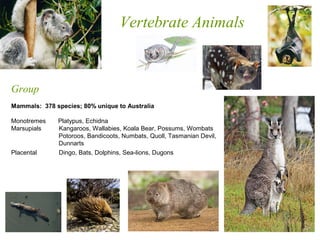
Vertebrate Animals
Group
Mammals: 378 species; 80% unique to Australia
Monotremes Platypus, Echidna
Marsupials Kangaroos, Wallabies, Koala Bear, Possums, Wombats
Potoroos, Bandicoots, Numbats, Quoll, Tasmanian Devil,
Dunnarts
Placental Dingo, Bats, Dolphins, Sea-lions, Dugons
Vertebrate Animals
Group
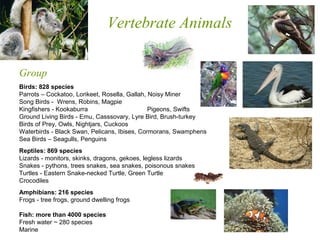
Birds: 828 species
Parrots – Cockatoo, Lorikeet, Rosella, Gallah, Noisy Miner
Song Birds - Wrens, Robins, Magpie
Kingfishers - Kookaburra Pigeons, Swifts
Ground Living Birds - Emu, Casssovary, Lyre Bird, Brush-turkey
Birds of Prey, Owls, Nightjars, Cuckoos
Waterbirds - Black Swan, Pelicans, Ibises, Cormorans, Swamphens
Sea Birds – Seagulls, Penguins
Reptiles: 869 species
Lizards - monitors, skinks, dragons, gekoes, legless lizards
Snakes - pythons, trees snakes, sea snakes, poisonous snakes
Turtles - Eastern Snake-necked Turtle, Green Turtle
Crocodiles
Amphibians: 216 species
Frogs - tree frogs, ground dwelling frogs
Fish: more than 4000 species
Fresh water ~ 280 species
Marine
www.santifm.org
Australian
Threatened
Species
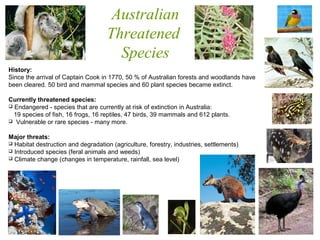
History:
Since the arrival of Captain Cook in 1770, 50 % of Australian forests and woodlands have
been cleared. 50 bird and mammal species and 60 plant species became extinct.
Currently threatened species:
 Endangered - species that are currently at risk of extinction in Australia:
19 species of fish, 16 frogs, 16 reptiles, 47 birds, 39 mammals and 612 plants.
 Vulnerable or rare species - many more.
Major threats:
 Habitat destruction and degradation (agriculture, forestry, industries, settlements)
 Introduced species (feral animals and weeds)
 Climate change (changes in temperature, rainfall, sea level)
Protecting our
Wildlife

Nationally - by protecting natural habitats and education:

Network of national parks and reserves

Environmental laws

School and community education.

Personally - by living eco-sustainably:

Reducing one’s eco-footprint

Helping one’s family and friends to live more eco-sustainably

Supporting eco-sustainability initiatives at work and community.
Caring for our environment, for other species we share this world with and for future generations,
is not separate from our practice of morality and other aspects of the Middle Way of life, the
Noble Eight-fold Path, taught by the Buddha. Rather it is an expression of our more holistic and
mature understanding and practice of it, that includes but goes beyond mere wishes.
EPA Ecological Footprint Calculators: www.epa.vic.gov.au/ecologicalfootprint
Global Eco-Footprint Calculator: http://myfootprint.org/en
Buddhist Council
Eco-living Project
What is
Eco-living?
What are our
project aims?
Eco-living means eco-sustainable living, or living in harmony with people and our
environment in the long-term. It is based on understanding of the interdependence
of all life on Earth and respect for all species we share this planet with.
This Buddhist Council project has been established to assist Buddhist groups and
individuals to live more eco-sustainably and to share their knowledge and skills with
a wider community. Our key objectives are to:
 Help Buddhist individuals and groups learn about eco-living and how to put it
into action through responding to their enquiries and providing information about
the community environmental education and funding.
 Represent the Buddhist community in environmental dialogues, particularly
interfaith.
 Facilitate exchange of information and resources between Buddhist
communities about eco-sustainable living.
 Showcase and celebrate success stories of environmental projects in the
Buddhist community (e.g. solar energy, water conservation, recycling, organic
gardening inative gardens and bush care).
 Focus our project on eco-living activities where there is interest and resources.
Dedication
To help protect our precious wildlife
International Decade on Biodiversity 2011-2020: www.cbd.int/2011-2020
“We have a brief window of opportunity to take action, to preserve humanity from imminent disaster and to
assist the survival of the many diverse and beautiful forms of life on Earth. Future generations, and the
other species that share the biosphere with us, have no voice to ask for our compassion, wisdom, and
leadership. We must listen to their silence. We must be their voice, too, and act on their behalf.”
A Buddhist Declaration on Climate Change: www.ecobuddhism.org
References
Australian Government - Biodiversity: www.environment.gov.au/biodiversity
Australian Government - Australia’s Environment at a Glance:
http://www.dfat.gov.au/facts/env_glance.html
Australian Botanical Gardens: www.anbg.gov.au
NSW Department of Environment: www.environment.nsw.gov.au
Great Eastern Ranges Conservation Corridor: www.greateasternranges.org.au
It’s a Living Thing: www.livingthing.net.au
Buddhist Council of NSW: www.buddhistcouncil.org
Ecological Buddhism: www.ecobuddhism.org
Wikipedia: www.wikipedia.org
References
Australian Government Department of Foreign Affairs and Trade, 2008. About Australia – Flora and Fauna.
http://www.dfat.gov.au/facts/flora_and_fauna.html
Baker M, Corringham R and Dark J, 1986. Native Plants of Sydney Region. A Three Sisters Productions,
Sydney, NSW.
Cronin L, 2008. Cronin’s Key Guide. Australian Wildlife. Jacana Books, an Imprint of Allen & Unwin. Crows
Nest, NSW, Australia
Haddon F, 1992. Environmental Field Guide to Flora and Fauna - Australia’s Seashores. Simon & Schuster,
Australia.
Hope C and Parish S, 2008. Amazing Facts about Australian Native Plants. Steve Parish Publishing.
Australia. www.steveparish.com.au
Parish S and Slater P, 2000. Encyclopedia of Australian Wildlife. Steve Parish Publishing, Australia.
www.steveparish.com.au
Robinson L, 1991. Field Guide to the Native Plants of Sydney. Kangaroo Press, Kenthurst, NSW.
Simpson K and Day N, 1989. Field Guide to the Birds of Australia. Viking O’Neil, Ringwood, VIC.