Software Testing and  BCC Software Test Engineer Certification Program  © Copyright 2010 tom wilk – for Exceed Technical Training
BCC Software Test Engineer Certification Program   SEE:  http://continuingeducation.bellevuecollege.edu/computers/swt/index.asp
Training for IT Professionals Excerpt from comment about Community Colleges: "Many people…who want to be prepared to work in the technical community are finding that the community colleges… have become the training ground for IT professionals.” Craig Mundie,  Microsoft chief research and strategy officer   Interview with the Seattle Times, 3/25/09
Lifetime Learning What d’ya know? We toss out this casual greeting all the time, not really inviting a serious response. When it comes to America’s economic future, though, no question carries greater weight. How we answer it holds the key to good jobs and higher pay. What d’ya know? Not enough.  We can never know enough in the modern workplace. A good education serves as the foundation for productive work. Job experience and training build on it.  Lifetime learning offers a well-marked path to success .  It’s up to us to follow it.   Source: FEDERAL RESERVE BANK OF DALLAS -   2004 ANNUAL REPORT http://www.dallasfed.org/fed/annual/2004/ar04.pdf
Introduction –  Tom Wilk – adjunct faculty My background Test Instructor & Consultant Test Manager & Test Solutions Architect – VMC Consulting STE/SDET - MICROSOFT (9 yrs) Prior to MSFT (Dev, PM, Support, Analyst, Accountant) Total about 17 years in Software Industry Lifetime member of the Assoc for Software Test (AST) http://www.associationforsoftwaretesting.org/drupal/ http://en.wikipedia.org/wiki/Association_for_Software_Testing Member of the Context-Driven “school” of thought for how to approach software test tasks, issues, and problems. http://www.context-driven-testing.com/ [email_address]
My Goals for this session Provide you with information you’re looking for about: Business and Work of Software Test  BC CE Certificate Program for Software Test/QA Answer your questions and share my experience Goal is to cover this material in a manner that best helps you understand it & put it to good use. NO SELLING – I’m not here to sell you anything… Create a safe environment for you to ask questions NO guarantee about jobs/hiring…
Introductions & Your Goals Please share your goals and expectations  Software Experience? Software Test Experience? If you’re working:   - what do you do? What type of firm?  Expectations for this session? Most important info you want from this session?
Formal Classes vs Web Content With so much good data on the web, why do you need formal course instruction?
A word about Certifications… CERTIFICATION  !=  Immediate Job STE Classes  ! = Immediate Pay Raise  Not Equal To Operator (C#) The  not equal to  operator compares two operands and returns true if the two values do not match exactly. The operator provides the opposite functionality to the  equal to  operator mentioned above. The operator symbol for  not equal to  is an exclamation mark and an equals signs (!=). Example: result = (a != b);  // result = true
  STE Certification Program  Instructors/Faculty: SEE Link for ONLINE data Courses – break-down into 2 categories: Methodology How to test/what to test Provide you some hands-on experiences  How to Test  deep , for the most important things  Programming/Database Programming Fundamentals for any language C# and VBScript & MS T-SQL
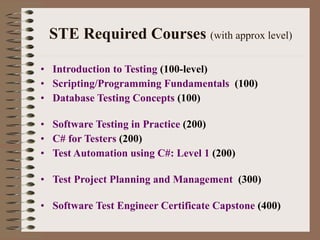
STE Required Courses  (with approx level) Introduction to Testing  (100-level)  Scripting/Programming Fundamentals   (100)  Database Testing Concepts  (100) Software Testing in Practice  (200) C# for Testers  (200) Test Automation using C#: Level 1  (200)  Test Project Planning and Management   (300) Software Test Engineer Certificate Capstone  (400)
Software Test Engineer Certification Program If you are new to Software Test, with little experience, start with a 100-level class: Intro to Testing Programming Fundamentals   Database Testing  In My Opinion:  Complete these fully & put the concepts, vocabulary, and techniques to use. Add some experience(s) before you rush to take additional classes. Build a “solid foundation” so all the added classes are meaningful.
  Software Test Engineer Certification Program Courses – break-down into 2 categories: Methodology Programming/Database In My Opinion:  Take  only 1 class from each group at a time. If you are eager to take 2 classes simultaneously, take a Methodology & a Programming class. If you are eager to progress and hungry to learn, dive-deeper into the few classes you are attending, rather than attending too many classes.
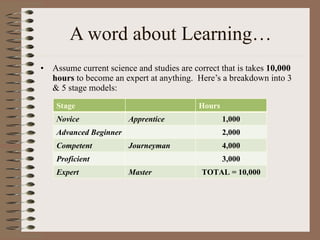
A word about Learning… Assume current science and studies are correct that is takes  10,000 hours  to become an expert at anything.  Here’s a breakdown into 3 & 5 stage models: Stage Hours Novice Apprentice 1,000 Advanced Beginner 2,000 Competent Journeyman 4,000 Proficient 3,000 Expert Master TOTAL = 10,000
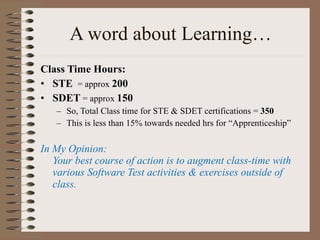
A word about Learning… Class Time Hours: STE  = approx  200 SDET  = approx  150 So, Total Class time for STE & SDET certifications =  350  This is less than 15% towards needed hrs for “Apprenticeship” In My Opinion:  Your best course of action is to augment class-time with various Software Test activities & exercises outside of class.
What is Software Testing? Classic view of the Software Development process Requirements Analysis Design Code Test  Maintenance SEE:  http://en.wikipedia.org/wiki/Software_testing
C.S./Programming vs Software Test Typical CS degree holder gets less than 40 hours of exposure to topics related to software test. Generally CS student is lucky to get reasonable exposure to  Debugging  &  Unit Testing -  generally Developer tasks on real-world projects Rarely any discussion of Integration or System Testing Software Test is a separate “science”  or “discipline” with a unique set of skills & vocabulary Verification & Validation Attacking Software Understanding the various components of Quality
History of the Profession As a “profession” the starting place might be considered as 1979, with the publishing of “ The Art of Software Testing ” by Glenford Myers (IBM) Since the mid-80’s, places like Microsoft (and engineers like Whittaker, Bach, Kaner, Black, etc…) have advanced the discipline to drive quality-improvements within their products or test services.  To date, almost everyone in this profession has learned thru a combination of Continuing Education and real-world work experience.  Most “theory” comes from  LESSONS LEARNED
TESTING  as  Discovery Testing is a means of discovering the quality level of a software system, not a means of assuring software quality. Software Project Survival Guide  - Chapter 9, pg 135  by :  Steve McConnell
James Whittaker article (IEEE):   What Is Software Testing & Why is it so hard Approach: Model the Software Environment Create appropriate test scenarios & strategies Run/Evaluate “best” tests Report Findings & progress
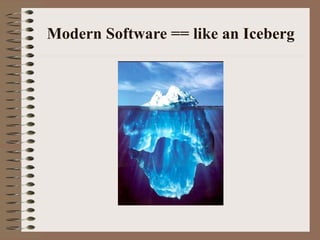
James Whittaker article:   What Is Software Testing & Why is it so hard Obvious… Human Interface (UI) Looking beyond the obvious…. Software Interfaces (APIs) File System/Data Interfaces Communications Interface Source Code  Consider: much like an ICEBERG
Modern Software == like an Iceberg
Key Factors for being good… To be good, must become a student of: Software  – how does it work & how is it built Software Faults  – how can it be wrong Software Failure  –  how to effectively expose faults in software, generally for the benefit of the project. Boiled-down to its essence, the role is all about:   Finding & Reporting those Failures == BUGS and contributing to successful software projects.
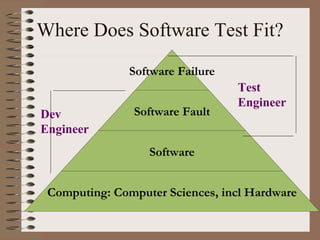
Where Does Software Test Fit? Dev Engineer Test Engineer Software Failure Software Fault Software Computing: Computer Sciences, incl Hardware
Key Factors for being good… “ Right/Correct”?? _ By who’s standards? STE must become familiar with various standards for proper software behavior. These include: Legal standards Engineering standards Behaviors specified by Designers Behaviors required for market success Good Test Engineers apply the proper Test Oracle(s) when evaluating the results of every test…
Key Factors for being good… “ Jack of all trades… master of few…” STE is generally expected to contribute to project success in various ways – both Technical & Non-Technical, including: PC/Systems basics  Advocate for various types of users FAST ramp-up on any new topic Translator between Technical & Non-Technical  Fair & Honest “Umpire”
So, What’s so hard…? Need for proper combination of  Soft  (interpersonal) &  Hard  (technical) skills IMO - Best work is  Context-driven …  which means you can’t decide on the best practices or strategies until you clearly understand the context to the test mission/problems/issues . Have to start with fundamentals, including how to “ think like a tester ” and prioritize your coverage/attacks
Changing Profession Software Test Engineering is a dynamic, ever-changing profession, with changes driven by: Technology Complexity of evolving apps/systems Lessons Learned Globalization & Commoditization Tools/Automation (software to test software) Latest trends Move to MOBILE platforms & Apps
Changing Roles & Jobs Changing Roles: By  Job Titles & Tasks STE SDET By  How Software Gets Built Agile Development Commoditization throughout the disciplines  Technical complexity Globalization and Distributed Teams
Current data about the discipline Salary Data: http://www.cbsalary.com/national-salary-chart.aspx?specialty=Software+Quality+Assurance+Tester&kw=Software+Quality+Assurance+Tester&jn=jn008&tid=105999 Search: “ How to find a job in QA - software testing” According to the U.S. Bureau of Labor Statistics for 2007, there were  349,140  people in the US doing these jobs.  **
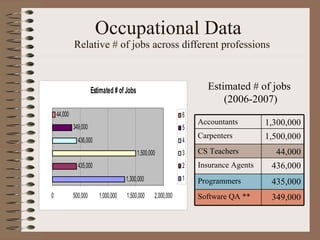
Occupational Data   Relative # of jobs across different professions Estimated # of jobs  (2006-2007) Accountants 1,300,000 Carpenters 1,500,000 CS Teachers 44,000 Insurance Agents 436,000 Programmers 435,000 Software QA ** 349,000
Occupational Data    Software Engineers (2006 data) Software Engineers: Applications = 507,000 Systems = 350,000 Employment change -  Employment of computer software engineers is projected to increase by 38 percent over the 2006 to 2016 period, which is  much faster than the average  for all occupations.  http://www.bls.gov/oco/ocos267.htm
So, What’s so hard…? Need for proper combination of  Soft  (interpersonal) &  Hard  (technical) skills Best work is  Context-driven …  which means you can’t decide on the best practices or strategies until you clearly understand the context to the test problems . Have to start with fundamentals, including how to “ think like a tester ” and prioritize your coverage/attacks
Sample of Resources  about the profession http://www.aptest.com/resources.html http://satisfice.com/ http://www.testingfaqs.org/ http://www.stickyminds.com/BetterSoftware/magazine.asp http://www.softwareqatest.com/ Profile of a Software Test Engineer: http://jobsearchtech.about.com/od/careersintechnology/p/SWTest.htm 3 reasons to consider being a Test Developer at MSFT http://blogs.msdn.com/steverowe/archive/2005/01/19/356361.aspx With so much good data on the web, why do you need formal course instruction?
Sample of Resources  about the profession Books Testing Computer Software  –  Kaner  (text) Lessons Learned in Software Test   – Bach, Kaner, Pettichord How to Break Software  -  Whittaker How to Break Web Software   – Andrews, Whittaker Perfect Software  and other illusions about testing  -  Weinberg
Occupational Data    SDET’s at MSFT   (5/09 estimates) SDET’s at MSFT - Redmond (May 09): Open Positions posted internally = 181 Rough guess - % open positions = 10% Estimated total SDET’s in Redmond = 1,800 MSFT Career Site:  http://members.microsoft.com/careers/careerpath/technical/softwaretesting.mspx
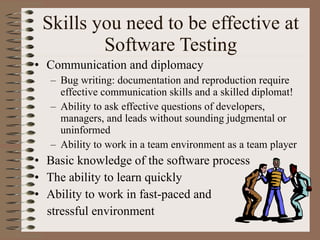
Skills you need to be effective at Software Testing Communication and diplomacy Bug writing: documentation and reproduction require effective communication skills and a skilled diplomat! Ability to ask effective questions of developers, managers, and leads without sounding judgmental or uninformed Ability to work in a team environment as a team player Basic knowledge of the software process The ability to learn quickly Ability to work in fast-paced and  stressful environment
Personality traits you need to be effective at Software Testing Creativity, inventiveness Willingness to dig deeper Tolerance, patience, etc. Love to learn new things
Advantages to Software Testing careers Great for those who like the “hunt” Diagnostician skills are important. Similar skills to a detective or a physician who is skilled in diagnosis. A lot of personal satisfaction in helping to produce quality software Learn a lot about a variety of topics in software. Access to all kinds of platforms and software Opportunities for advancement Within testing Within the software industry
Now for the downside Long hours (same as devs) Stressful work, especially around deadlines (same as devs) Work can be tedious  Perhaps a bit more so than devs Politics
The Software Testing Certificate program at BCC Finding qualified software testers is a challenge for many technology industry employers.  Testers are typically creative, detail-oriented individuals who are motivated to solve problems. Learning to find, report, and test bugs in software are excellent skills to gain for today's technology industry, and qualified individuals often find software testing to be a logical entry point to the IT field.  Course content is designed with input from area companies.  Skills sought by employers in hiring testers include computer basics, knowledge of programming fundamentals, ability to communicate effectively and work in teams, test planning, and test automation experience which includes the ability to find software bugs and write logical, concise bug reports.  BCC partners with a leading software testing consulting and training firm to offer a series of courses designed to give testers the skills needed for testing in a variety of environments.
FAQs "Do I Really Have to Take This Class?"  answer is almost always 'yes' "What if I Already Know This?"  If student already has experience with one of the required classes then it can be swapped for another class of the same amount of hours  with instructor permission . “ How long does it take to complete a certificate?”  Depends on the amount of hours students wish to take and what electives, but all classes are offered at least once per quarter - thus  technically  it could be done in a quarter - but most don't get it that soon Series vs. Certification. “ Series” are available only to achieve a price break on multiple courses taken. They are not the same as certification.
Final Notes We do not have hard statistics on placement, but we do know from students that they are finding jobs, and both Volt and Excell Data whom we work with have stated there are lots of entry level jobs at MS to be filled. Volt has indicated that besides primary testing skills database (SQL, XML) and C# skills are practically a requirement now.  Most companies are requiring their testers to be programming literate.
Q&A What are your questions????
Resources Continuing Education Regular and online catalog  Call 564-4000 Brochure for Software Testing Certificate Program – updated regularly Dan Hodge: Program director:  [email_address] SASQAG (Seattle Area Software Quality Group) www.sasqag.org

Bcc exceed ste_cert

  • 1.
    Software Testing and BCC Software Test Engineer Certification Program © Copyright 2010 tom wilk – for Exceed Technical Training
  • 2.
    BCC Software TestEngineer Certification Program SEE: http://continuingeducation.bellevuecollege.edu/computers/swt/index.asp
  • 3.
    Training for ITProfessionals Excerpt from comment about Community Colleges: "Many people…who want to be prepared to work in the technical community are finding that the community colleges… have become the training ground for IT professionals.” Craig Mundie, Microsoft chief research and strategy officer Interview with the Seattle Times, 3/25/09
  • 4.
    Lifetime Learning Whatd’ya know? We toss out this casual greeting all the time, not really inviting a serious response. When it comes to America’s economic future, though, no question carries greater weight. How we answer it holds the key to good jobs and higher pay. What d’ya know? Not enough. We can never know enough in the modern workplace. A good education serves as the foundation for productive work. Job experience and training build on it. Lifetime learning offers a well-marked path to success . It’s up to us to follow it. Source: FEDERAL RESERVE BANK OF DALLAS - 2004 ANNUAL REPORT http://www.dallasfed.org/fed/annual/2004/ar04.pdf
  • 5.
    Introduction – Tom Wilk – adjunct faculty My background Test Instructor & Consultant Test Manager & Test Solutions Architect – VMC Consulting STE/SDET - MICROSOFT (9 yrs) Prior to MSFT (Dev, PM, Support, Analyst, Accountant) Total about 17 years in Software Industry Lifetime member of the Assoc for Software Test (AST) http://www.associationforsoftwaretesting.org/drupal/ http://en.wikipedia.org/wiki/Association_for_Software_Testing Member of the Context-Driven “school” of thought for how to approach software test tasks, issues, and problems. http://www.context-driven-testing.com/ [email_address]
  • 6.
    My Goals forthis session Provide you with information you’re looking for about: Business and Work of Software Test BC CE Certificate Program for Software Test/QA Answer your questions and share my experience Goal is to cover this material in a manner that best helps you understand it & put it to good use. NO SELLING – I’m not here to sell you anything… Create a safe environment for you to ask questions NO guarantee about jobs/hiring…
  • 7.
    Introductions & YourGoals Please share your goals and expectations Software Experience? Software Test Experience? If you’re working: - what do you do? What type of firm? Expectations for this session? Most important info you want from this session?
  • 8.
    Formal Classes vsWeb Content With so much good data on the web, why do you need formal course instruction?
  • 9.
    A word aboutCertifications… CERTIFICATION != Immediate Job STE Classes ! = Immediate Pay Raise Not Equal To Operator (C#) The not equal to operator compares two operands and returns true if the two values do not match exactly. The operator provides the opposite functionality to the equal to operator mentioned above. The operator symbol for not equal to is an exclamation mark and an equals signs (!=). Example: result = (a != b); // result = true
  • 10.
    STECertification Program Instructors/Faculty: SEE Link for ONLINE data Courses – break-down into 2 categories: Methodology How to test/what to test Provide you some hands-on experiences How to Test deep , for the most important things Programming/Database Programming Fundamentals for any language C# and VBScript & MS T-SQL
  • 11.
    STE Required Courses (with approx level) Introduction to Testing (100-level) Scripting/Programming Fundamentals (100) Database Testing Concepts (100) Software Testing in Practice (200) C# for Testers (200) Test Automation using C#: Level 1 (200) Test Project Planning and Management (300) Software Test Engineer Certificate Capstone (400)
  • 12.
    Software Test EngineerCertification Program If you are new to Software Test, with little experience, start with a 100-level class: Intro to Testing Programming Fundamentals Database Testing In My Opinion: Complete these fully & put the concepts, vocabulary, and techniques to use. Add some experience(s) before you rush to take additional classes. Build a “solid foundation” so all the added classes are meaningful.
  • 13.
    SoftwareTest Engineer Certification Program Courses – break-down into 2 categories: Methodology Programming/Database In My Opinion: Take only 1 class from each group at a time. If you are eager to take 2 classes simultaneously, take a Methodology & a Programming class. If you are eager to progress and hungry to learn, dive-deeper into the few classes you are attending, rather than attending too many classes.
  • 14.
    A word aboutLearning… Assume current science and studies are correct that is takes 10,000 hours to become an expert at anything. Here’s a breakdown into 3 & 5 stage models: Stage Hours Novice Apprentice 1,000 Advanced Beginner 2,000 Competent Journeyman 4,000 Proficient 3,000 Expert Master TOTAL = 10,000
  • 15.
    A word aboutLearning… Class Time Hours: STE = approx 200 SDET = approx 150 So, Total Class time for STE & SDET certifications = 350 This is less than 15% towards needed hrs for “Apprenticeship” In My Opinion: Your best course of action is to augment class-time with various Software Test activities & exercises outside of class.
  • 16.
    What is SoftwareTesting? Classic view of the Software Development process Requirements Analysis Design Code Test Maintenance SEE: http://en.wikipedia.org/wiki/Software_testing
  • 17.
    C.S./Programming vs SoftwareTest Typical CS degree holder gets less than 40 hours of exposure to topics related to software test. Generally CS student is lucky to get reasonable exposure to Debugging & Unit Testing - generally Developer tasks on real-world projects Rarely any discussion of Integration or System Testing Software Test is a separate “science” or “discipline” with a unique set of skills & vocabulary Verification & Validation Attacking Software Understanding the various components of Quality
  • 18.
    History of theProfession As a “profession” the starting place might be considered as 1979, with the publishing of “ The Art of Software Testing ” by Glenford Myers (IBM) Since the mid-80’s, places like Microsoft (and engineers like Whittaker, Bach, Kaner, Black, etc…) have advanced the discipline to drive quality-improvements within their products or test services. To date, almost everyone in this profession has learned thru a combination of Continuing Education and real-world work experience. Most “theory” comes from LESSONS LEARNED
  • 19.
    TESTING as Discovery Testing is a means of discovering the quality level of a software system, not a means of assuring software quality. Software Project Survival Guide - Chapter 9, pg 135 by : Steve McConnell
  • 20.
    James Whittaker article(IEEE): What Is Software Testing & Why is it so hard Approach: Model the Software Environment Create appropriate test scenarios & strategies Run/Evaluate “best” tests Report Findings & progress
  • 21.
    James Whittaker article: What Is Software Testing & Why is it so hard Obvious… Human Interface (UI) Looking beyond the obvious…. Software Interfaces (APIs) File System/Data Interfaces Communications Interface Source Code Consider: much like an ICEBERG
  • 22.
    Modern Software ==like an Iceberg
  • 23.
    Key Factors forbeing good… To be good, must become a student of: Software – how does it work & how is it built Software Faults – how can it be wrong Software Failure – how to effectively expose faults in software, generally for the benefit of the project. Boiled-down to its essence, the role is all about: Finding & Reporting those Failures == BUGS and contributing to successful software projects.
  • 24.
    Where Does SoftwareTest Fit? Dev Engineer Test Engineer Software Failure Software Fault Software Computing: Computer Sciences, incl Hardware
  • 25.
    Key Factors forbeing good… “ Right/Correct”?? _ By who’s standards? STE must become familiar with various standards for proper software behavior. These include: Legal standards Engineering standards Behaviors specified by Designers Behaviors required for market success Good Test Engineers apply the proper Test Oracle(s) when evaluating the results of every test…
  • 26.
    Key Factors forbeing good… “ Jack of all trades… master of few…” STE is generally expected to contribute to project success in various ways – both Technical & Non-Technical, including: PC/Systems basics Advocate for various types of users FAST ramp-up on any new topic Translator between Technical & Non-Technical Fair & Honest “Umpire”
  • 27.
    So, What’s sohard…? Need for proper combination of Soft (interpersonal) & Hard (technical) skills IMO - Best work is Context-driven … which means you can’t decide on the best practices or strategies until you clearly understand the context to the test mission/problems/issues . Have to start with fundamentals, including how to “ think like a tester ” and prioritize your coverage/attacks
  • 28.
    So, What’s sohard…? Need for proper combination of Soft (interpersonal) & Hard (technical) skills IMO - Best work is Context-driven … which means you can’t decide on the best practices or strategies until you clearly understand the context to the test mission/problems/issues . Have to start with fundamentals, including how to “ think like a tester ” and prioritize your coverage/attacks
  • 29.
    Changing Profession SoftwareTest Engineering is a dynamic, ever-changing profession, with changes driven by: Technology Complexity of evolving apps/systems Lessons Learned Globalization & Commoditization Tools/Automation (software to test software) Latest trends Move to MOBILE platforms & Apps
  • 30.
    Changing Roles &Jobs Changing Roles: By Job Titles & Tasks STE SDET By How Software Gets Built Agile Development Commoditization throughout the disciplines Technical complexity Globalization and Distributed Teams
  • 31.
    Current data aboutthe discipline Salary Data: http://www.cbsalary.com/national-salary-chart.aspx?specialty=Software+Quality+Assurance+Tester&kw=Software+Quality+Assurance+Tester&jn=jn008&tid=105999 Search: “ How to find a job in QA - software testing” According to the U.S. Bureau of Labor Statistics for 2007, there were 349,140 people in the US doing these jobs. **
  • 32.
    Occupational Data Relative # of jobs across different professions Estimated # of jobs (2006-2007) Accountants 1,300,000 Carpenters 1,500,000 CS Teachers 44,000 Insurance Agents 436,000 Programmers 435,000 Software QA ** 349,000
  • 33.
    Occupational Data Software Engineers (2006 data) Software Engineers: Applications = 507,000 Systems = 350,000 Employment change - Employment of computer software engineers is projected to increase by 38 percent over the 2006 to 2016 period, which is much faster than the average for all occupations. http://www.bls.gov/oco/ocos267.htm
  • 34.
    So, What’s sohard…? Need for proper combination of Soft (interpersonal) & Hard (technical) skills Best work is Context-driven … which means you can’t decide on the best practices or strategies until you clearly understand the context to the test problems . Have to start with fundamentals, including how to “ think like a tester ” and prioritize your coverage/attacks
  • 35.
    Sample of Resources about the profession http://www.aptest.com/resources.html http://satisfice.com/ http://www.testingfaqs.org/ http://www.stickyminds.com/BetterSoftware/magazine.asp http://www.softwareqatest.com/ Profile of a Software Test Engineer: http://jobsearchtech.about.com/od/careersintechnology/p/SWTest.htm 3 reasons to consider being a Test Developer at MSFT http://blogs.msdn.com/steverowe/archive/2005/01/19/356361.aspx With so much good data on the web, why do you need formal course instruction?
  • 36.
    Sample of Resources about the profession Books Testing Computer Software – Kaner (text) Lessons Learned in Software Test – Bach, Kaner, Pettichord How to Break Software - Whittaker How to Break Web Software – Andrews, Whittaker Perfect Software and other illusions about testing - Weinberg
  • 37.
    Occupational Data SDET’s at MSFT (5/09 estimates) SDET’s at MSFT - Redmond (May 09): Open Positions posted internally = 181 Rough guess - % open positions = 10% Estimated total SDET’s in Redmond = 1,800 MSFT Career Site: http://members.microsoft.com/careers/careerpath/technical/softwaretesting.mspx
  • 38.
    Skills you needto be effective at Software Testing Communication and diplomacy Bug writing: documentation and reproduction require effective communication skills and a skilled diplomat! Ability to ask effective questions of developers, managers, and leads without sounding judgmental or uninformed Ability to work in a team environment as a team player Basic knowledge of the software process The ability to learn quickly Ability to work in fast-paced and stressful environment
  • 39.
    Personality traits youneed to be effective at Software Testing Creativity, inventiveness Willingness to dig deeper Tolerance, patience, etc. Love to learn new things
  • 40.
    Advantages to SoftwareTesting careers Great for those who like the “hunt” Diagnostician skills are important. Similar skills to a detective or a physician who is skilled in diagnosis. A lot of personal satisfaction in helping to produce quality software Learn a lot about a variety of topics in software. Access to all kinds of platforms and software Opportunities for advancement Within testing Within the software industry
  • 41.
    Now for thedownside Long hours (same as devs) Stressful work, especially around deadlines (same as devs) Work can be tedious Perhaps a bit more so than devs Politics
  • 42.
    The Software TestingCertificate program at BCC Finding qualified software testers is a challenge for many technology industry employers. Testers are typically creative, detail-oriented individuals who are motivated to solve problems. Learning to find, report, and test bugs in software are excellent skills to gain for today's technology industry, and qualified individuals often find software testing to be a logical entry point to the IT field. Course content is designed with input from area companies. Skills sought by employers in hiring testers include computer basics, knowledge of programming fundamentals, ability to communicate effectively and work in teams, test planning, and test automation experience which includes the ability to find software bugs and write logical, concise bug reports. BCC partners with a leading software testing consulting and training firm to offer a series of courses designed to give testers the skills needed for testing in a variety of environments.
  • 43.
    FAQs "Do IReally Have to Take This Class?" answer is almost always 'yes' "What if I Already Know This?" If student already has experience with one of the required classes then it can be swapped for another class of the same amount of hours with instructor permission . “ How long does it take to complete a certificate?” Depends on the amount of hours students wish to take and what electives, but all classes are offered at least once per quarter - thus technically it could be done in a quarter - but most don't get it that soon Series vs. Certification. “ Series” are available only to achieve a price break on multiple courses taken. They are not the same as certification.
  • 44.
    Final Notes Wedo not have hard statistics on placement, but we do know from students that they are finding jobs, and both Volt and Excell Data whom we work with have stated there are lots of entry level jobs at MS to be filled. Volt has indicated that besides primary testing skills database (SQL, XML) and C# skills are practically a requirement now. Most companies are requiring their testers to be programming literate.
  • 45.
    Q&A What areyour questions????
  • 46.
    Resources Continuing EducationRegular and online catalog Call 564-4000 Brochure for Software Testing Certificate Program – updated regularly Dan Hodge: Program director: [email_address] SASQAG (Seattle Area Software Quality Group) www.sasqag.org

Editor's Notes

  • #2 Content edits and customization by TomWilk – for the Certificate Info Sessions (2010)
  • #4 From Seattle Times, 3/25/09 Link = http://blog.seattletimes.nwsource.com/techtracks/2009/03/25/qa_microsoft_chief_strategist_craig_mundie_on_glob.html March 25, 2009 6:26 PM Q&A: Microsoft chief strategist Craig Mundie on global competition, government IT Craig Mundie, Microsoft chief research and strategy officer, said Americans seeking to update their technology skills should look to the nation's community colleges for training. Excerpt from comment about Community Colleges: " Many people…who want to be prepared to work in the technical community are finding that the community colleges…have become the training ground for IT professionals ."
  • #12 Classification has been done in accordance with the classic undergraduate class model and the description of each level is listed below. 100 level: Is an introduction to the topic or overview; assumes little or no expertise with the topic being covered. 200 level: Assumes 100-level knowledge and a fairly complete understanding of the features. The 200-level course may cover a breadth of common scenarios or explain how to use more advanced features. 300 level: Assumes 200-level knowledge and an in-depth understanding of product features in a real-world environment. 400 level: Assumes the deepest level of technical knowledge we expect a student to have.
  • #21 See James Whittaker article: The Art, Craft, and Discipline of Software Test
  • #22 See James Whittaker article: The Art, Craft, and Discipline of Software Test
  • #24 See James Whittaker article: The Art, Craft, and Discipline of Software Test
  • #32 ** this is still just a rough estimate… as highly-reference-able data is hard to find…
  • #33 Source: US Bureau of Labor Statistics research on the web – mostly 2006 data ** Software QA is very rough
  • #34 Source: US Bureau of Labor Statistics research on the web – mostly 2006 data ** Software QA is very rough
  • #38 Source: MSFT Careers Center search (Internal) External site generally has less positions posted. ** Software QA is very rough