Course Name :
BACHELOR OF BUSINESS ADMINISTRATION
Mayang Plaza, Block A, No.1,
Jalan SS26/2,TamanMayang Jaya,
47301, Petaling Jaya,
Selangor Darul Ehsan,
Kuala Lumpur, Malaysia
Tel : 603-78063478 Fax : 603-78063479
www.lincoln.edu.my
E-mail : info@lincoln.edu.my
ABOUT LINCOLN UNIVERSITY COLLEGE
Lincoln University College (LUC), Petaling Jaya, established in 2002 as Lincoln College (LC) and upgraded on 16th
August 2011. Lincoln University College is one of the premier private institutions of higher education approved by the
Ministry of Higher Education and Malaysian Qualifying Agency (MQA). The University College is situated in the
cosmopolitan town of Petaling Jaya which is 10 kilometers West of the capital city, Kuala Lumpur.
Lincoln University College is craving to be a distinguished educational institution that provides world class education
for the global market and a center of educational excellence that facilitates the unprecedented amassing of
knowledge. Aiming to ensure success for all students not only in the exams but also in future life, this university
provides quality teaching with dedicated lecturers and exceptional faculties and programmes that are beneficial for
future career.
The founders and administrators of Lincoln University College are true academicians who are committed to helping
the students to achieve their potential in the education, research and employment world of this exciting new
millennium. They bring together almost fifty years of higher education, post secondary education and language
teaching experience. Their backgrounds include teaching, research and professional training. Lincoln University
College’s focus is student-centered and student-directed. Our philosophy is that everyone has a claim to education in
order to better their life, advance their career and reach their desired level of personal success.
Datuk Dr. Hjh. Bibi Florina binti Abdullah, the Pro-Chancellor of Lincoln University College, was First Director and
Registrar of Nursing Board Ministry of Health, Malaysia. She has the greatest passion in changing the whole face of
the nursing profession. During her involvement with the government sector, she was the driving force behind the
transformation of Malaysia as the country that produced between 5 to 10 thousand nurses per year compared to only
a few hundred nurses in the previous years. As the country’s Chief Nurse, she was instrumental in professionalized
Nursing as a profession from the diploma to the degree level. Undoubtedly, her passion in nursing field has been
continually transformed to Lincoln University College.
The founder and Vice-Chancellor of Lincoln University College is Dr. Amiya Bhaumik, who is purely from field of
education. He is Executive Vice President of the International Education Consulting Group, St Louis, USA since
1999. Dr. Amiya Bhaumik was Research Fellow of UNESCO, Paris during this tenure, Dr. Bhaumik has traveled
extensively to Europe, Africa, Asia and Latin America. He has served as professor of Business Administration in
University of Lucknow, India and in University of Malaya and many other countries.
Another significant individual who contributes to the success of this University College is Prof. Datuk Dr. Abdul Gani
Bin Mohammed Din, who is the Deputy Vice Chancellor (Academic). Previously he was the Deputy Director General,
Ministry of Health, Malaysia. He has contributed his entire careers to make Malaysia more developed and more
competitive country in health management field. As the Head of Academic, Datuk Gani ensures that the courses
offered are more practical and holistic. Thus, the knowledge that the students gain from the University College has a
great value and can be practiced in the real world.
Lincoln University College is an ideal learning institution to career shifters, second degree students, and high school
seniors who are considered getting a diploma, under-graduate or post-graduate degree, will open many door of
career opportunities. For those working adults pursuing second careers or acquiring new skills, this University
College offers the occupational and professional training they need, to go ahead in today’s competitive marketplace.
LINCOLN UNIVERSITY COLLEGE MISSION AND VISION
MISSION
Lincoln University College, is a multilingual, diverse, multicultural institution of higher education that ensures the
intellectual, professional advancement, be free (from all types of limitations, all bondages, all littleness), manifestation
of latent power of every human being through morality based on strength and synthesis for reverential ethical, social
unity, integrity and holistic. Lincoln maintains a proud tradition of research and scholarly activity and prepares its
graduates for career opportunities in a highly competitive, technological and rapidly changing world.
VISION
To be acclaimed institution of higher learning that is able to cater to the global community.
To be distinguished educational institution that provides world class education for the global market.
To be center of educational excellence that facilitates the unprecedented amassing of knowledge.
PROGRAMME DESCRIPTION
The bachelor program in the Faculty of Business at the LUC is designed to give students the academic and technical
skills to become independent managers. LUC strive to provide each graduate student with broad knowledge in
business and in-depth knowledge in their subject area thereby make them more adjustable with their future
workplace.
LEARNING OUTCOMES
1. To give elementary knowledge about the fundamental business principles
2. The student can built the skill and think critically
3. Analyze ethical issues that impact business decisions from economic, political, legal, and
social perspectives.
4. To enable students to operate in both national and global workforce challenges with professionalism.
5. Evaluate the application of technology as a strategy for competitive advantage in business
communication, leadership and team building skill.
6. Able to analyse and solve business problems in a real-world context
7. Conduct basic research using scholarly sources to acquire new knowledge in the business domain.
8. Describe the ways in which diversity influences a company’s ability to achieve its goals.
PROGRAMME AIM
The aims for the proposed programme are as follows:
Ability to acquire knowledge in business and economics that creates and develops well-rounded
managers and executives to enable them to compete at the global level;
to produce proactive graduates who are knowledgeable and keep abreast with current issues of
business and economics;
to produce graduates with capability to integrate and apply the latest technology in organisational
management;
to contribute to the country's development by producing graduates that fulfils requirements of both
private and public sectors;
to share their knowledge of business and economics to students of other schools in this university
college in order to produce well-rounded graduates
Capability to develop a healthy body and mind and become a disciplined individual.
ENTRY REQUIREMENT
a) Pass Foundation programs in Business & Computing Foundation; or
b) Pass STPM; or secured at least second division in the 10+2,, PCL or equivalent program equivalent
c) Pass A level with 5 credit (English & 4 other subjects); or
d) Diploma; or
e) professional certificate such as CIMA, CFC, CFA; or
Accreditation of Prior Learning based on minimum age, working experience, school level of education & skills
certificates.
PROGRAMME FACTS
DURATION: 4 years
INTAKE: 1 (October/November)
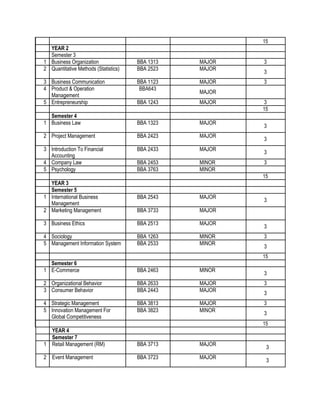
SUBJECTS OFFERED
NO SUBJECT NAME SUBJECT CODE
SUBJECT CREDIT
STATUS HOURS
YEAR 1
Semester 1
1 Business English I BBA 1113 MINOR 3
2 Principles of Management BBA 1133 MAJOR 3
3 Microeconomics BBA 2413 MAJOR 3
4 Introduction to Accounting BBA 1143 MAJOR 3
5 Fundamental of Computer BBA 1153
MAJOR 3
Principles & Programming
15
Semester 2
1 Human Resources management BBA 1213 MAJOR 3
2 Principles of Marketing BBA 1223 MAJOR 3
3 Internet Fundamental & BBA 1233
MAJOR 3
Applications
4 Macroeconomics BBA 2553 MAJOR 3
5 Business English II BBA1253 MINOR 3
15
YEAR 2
Semester 3
1 Business Organization BBA 1313 MAJOR 3
2 Quantitative Methods (Statistics) BBA 2523 MAJOR
3
3 Business Communication BBA 1123 MAJOR 3
4 Product & Operation BBA643
MAJOR
Management
5 Entrepreneurship BBA 1243 MAJOR 3
15
Semester 4
1 Business Law BBA 1323 MAJOR
3
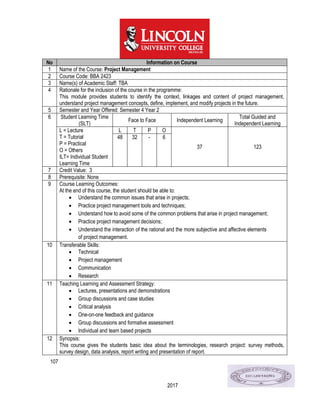
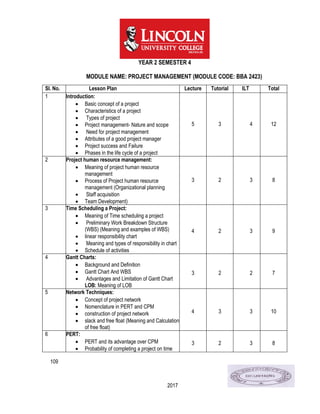
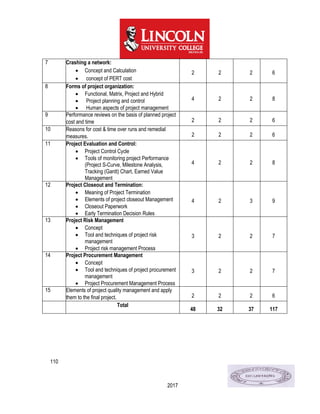
2 Project Management BBA 2423 MAJOR
3
3 Introduction To Financial BBA 2433 MAJOR
3
Accounting
4 Company Law BBA 2453 MINOR 3
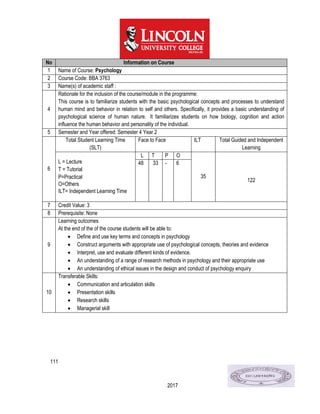
5 Psychology BBA 3763 MINOR
15
YEAR 3
Semester 5
1 International Business BBA 2543 MAJOR
3
Management
2 Marketing Management BBA 3733 MAJOR
3 Business Ethics BBA 2513 MAJOR
3
4 Sociology BBA 1263 MINOR 3
5 Management Information System BBA 2533 MINOR
3
15
Semester 6
1 E-Commerce BBA 2463 MINOR
3
2 Organizational Behavior BBA 2633 MAJOR 3
3 Consumer Behavior BBA 2443 MAJOR
3
4 Strategic Management BBA 3813 MAJOR 3
5 Innovation Management For BBA 3823 MINOR
3
Global Competitiveness
15
YEAR 4
Semester 7
1 Retail Management (RM) BBA 3713 MAJOR
3
2 Event Management BBA 3723 MAJOR
3
3 Business Environment BBA 3755 MINOR
3
4 Business Research Methods BBA 3843 MAJOR
3
5 Business Finance BBA 3766 MAJOR
3
15
Semester 8
Specialization :Option 1
(Marketing Group)
1 Marketing Research BBA 3853 MAJOR 3
2 Multinational Enterprise BBA 3863 MINOR
3
3 Logistics and Supply Chain BBA 3743 MINOR
3
Management (LSCM)
4 Bachelor’s Thesis on Internship BBA 3913
MAJOR 6
(Internship Project)
15
Semester 8 :
Specialization : Option 2
(Finance Group )
1 Banking and Insurance BBA 3855 MAJOR 3
2 Taxation and Auditing BBA3866 MAJOR 3
3 Financial Management BBA3877 MAJOR 3
4 Bachelor’s Thesis on Internship
MAJOR 6
(Internship Project) BBA3913
15
Total credit hours in 4 years 120
ASSESSMENT METHODS AND TYPES
The examination will be conducted and monitored by Lincoln University College, in presence of the representative
from Lincoln University College. To successfully complete a subject/ module, the student has to achieve Pass
marks in both internal assessments as well as final examination.
Type of Assessment Components of Assessment Weightings of
Components (%)
Coursework Two Assignments 20
Attendance/Tutorial/ Quiz 10
Midterm 20
Examination Final 50
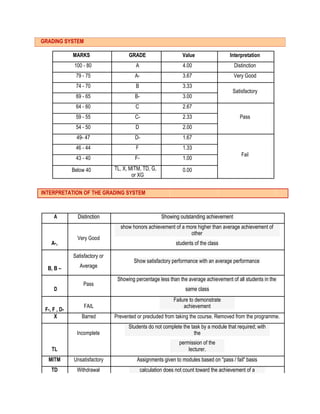
GRADING SYSTEM
MARKS GRADE Value Interpretation
100 - 80 A 4.00 Distinction
79 - 75 A- 3.67 Very Good
74 - 70 B 3.33
Satisfactory
69 - 65 B- 3.00
64 - 60 C 2.67
59 - 55 C- 2.33 Pass
54 - 50 D 2.00
49- 47 D- 1.67
46 - 44 F 1.33
Fail
43 - 40 F- 1.00
Below 40 TL, X, MITM, TD, G, 0.00
or XG
INTERPRETATION OF THE GRADING SYSTEM
A Distinction Showing outstanding achievement
Very Good
show honors achievement of a more higher than average achievement of
other
A-, students of the class
Satisfactory or
Show satisfactory performance with an average performance
Average
B, B –
Pass
Showing percentage less than the average achievement of all students in the
D same class
F-, F , D-
FAIL
Failure to demonstrate
achievement
X Barred Prevented or precluded from taking the course. Removed from the programme.
Incomplete
Students do not complete the task by a module that required; with
the
TL
permission of the
lecturer.
MITM Unsatisfactory Assignments given to modules based on "pass / fail" basis
TD Withdrawal calculation does not count toward the achievement of a
semester
G
Drop out from the
drop the course grade with the permission of the Faculty Lecturer week 4
to
course week 10 ahead before the semester ends
Given the symbol "XG" is not given a grade point. Not more than one semester
XG Continuing is completed. Neither fail nor incomplete. No notice given but still sitting for the
next semester.
MODE OF PAYMENT
The Lincoln University College will collect the University College registration, service, examination fee etc, directly
from the affiliated centres.
GRADUATION CERTIFICATE
After successful completion of the course the Lincoln University College will provide the graduation certificate to the
students. Only the students who will garner the cumulative grade point average of 2.0 will be eligible for graduation.
Students who cannot achieve the benchmarked summative assessment will be given a chance to repeat the
specified items.
COURSE/MODULE STRUCTURE
1st Semester
No Information on Course
1. Name of Course: Introduction to Accounting
2. Course Code: BBA 1143
3. Name(s) of Academic Staff:
4. Rationale for the inclusion of the course/ module in the Programme:
This course provides students with an understanding of the concepts, tools and techniques of accounting
and their application in managerial decision making.
5. Semester and Year offered: Semester 1 Year 1
6.
Student Learning Time
(SLT)
Face to Face Independent Learning
Total Guided and
Independent Learning
L=Lecture
T=Tutorial
P=Practical
O=Others
ILT= Individual
Student Learning
Time
L T P O
45 121
48 22 - 6
7 Credit Value: 3
8 Prerequisite: None
9 Course Learning Outcomes:
At the end of this course, the students will be able to:
 Define the basic concept and importance of accounting.
 Identify problems through the use of cost variance analysis.
 Know the preparation of budget for manufacturing and non-manufacturing concern as per learning
throughout the life.
10 Transferable Skills:
 Critical thinking and problem solving skills
 Information management and lifelong learning
11 Teaching-learning and assessment strategy:
 Lectures, presentations and demonstrations
 Class based group discussions, critique sessions and case studies
 One-on-one feedback and guidance
 Individual reading and research
 Individual/ team based projects
 Group discussion and formative assessment
12 Synopsis:
This course provides an overview on accounting with its advantages and limitations. It also helps to identify
the overall differences between financial accounting, management accounting and cost accounting. It
includes Cost concept and its classification, Accounting for material and inventory, Accounting for Overhead
Cost and Cost Volume profit analysis.
13 Mode of delivery:
Lecture, tutorial.
14 Mapping of the course/module to the program aims:
It provides an introduction to the theory and practice of financial and management accounting in different
national settings and organizational contexts.
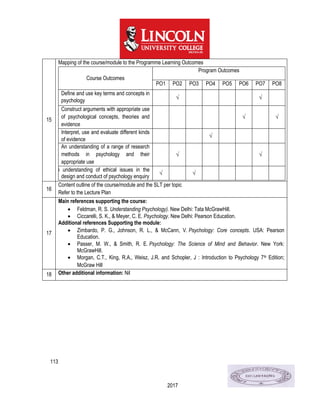
15 Mapping of the course/module to the program Learning Outcomes:
Course Outcomes
Program Outcomes
PO1 PO2 PO3 PO4 PO5 PO6 PO7 PO8
Define the basic concept and
importance of accounting.
Identify problems through the use of
cost variance analysis.
Know the preparation of budget for
manufacturing and non-manufacturing
concern as per learning throughout the
life.
16 Content outline of the course/module and the SLT per topic:
Please refer to the course syllabus.
17
Main references supporting the course:
 Colin Drury (2012). Management and Cost Accounting. Eighth Edition. Cengage Learning.
Additional references supporting the course:
 Ronald W. Hilton, and David E. Platt Managerial Accounting, MCgraw Hill, Irwin.
 Charles T. Horngren, Srikant M. Datar and George foster, Cost Accounting , A managerial
Emphasis, Pearson Education
 T. Lucy, Cost Accounting, Tata McGraw Hill Co., New Delhi.
 M.R. Koirala, and et.al, Cost and Management Accounting, Buddha Academy Publication House,
Kathmandu.
 Yamesh man Singh, Khagendra P. Ojha, Chiranjibi Acharya, Cost and Management Accounting,
Buddha Academic Publishers and Distributors Pvt.Ltd.
 R.M. Dangol and et.al, Cost and Management Accounting, Taleju Publishing House, Kathmandu
 Koirala, Y.R. and et.al, Cost and Management Accounting, Ashmita Publication, Kathmandu.
18. Other additional information: NIL
YEAR 1 SEMESTER 1
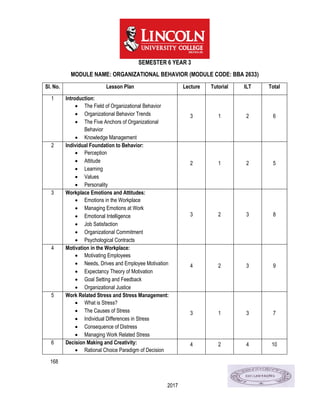
MODULE NAME: INTRODUCTION TO ACCOUNTING (MODULE CODE: BBA 1143)
Sl. No. Lesson Plan Lecture Tutorial ILT Total
1
Conceptual Foundation
 Accounting:
 Meaning
 Objectives
 Importance
 advantages and limitations
 Differences between financial
accounting, management
accounting and cost accounting
 Cost concept and its classification:
 Direct and indirect costs
 Period and product costs
 Cost behavior
 Relevant and irrelevant costs and
revenues
 Avoidable and unavoidable costs
 Sunk costs
 Opportunity costs
 Incremental and marginal costs
 Methods of cost segregation:
 Two point method
 Least square method
 Estimation of cost
5 3 7 15
2
Accounting for material and inventory:
 Materials/Inventory:
 Concept
 Reasons and objectives for holding
material / inventory
 Inventory Control:
 Meaning
 Importance and techniques
 Economic order quantity with and
without discount
 Re-order
 Maximum, minimum, danger and
average stock levels under the
condition of certainty
5 2 5 12
3
Accounting for Overhead Cost:
 Overhead cost:
 Meaning
 Classification
 Importance
 Accounting and distribution of overhead cost:
 Allocation
 Apportionment and absorption of
overhead cost
4 2 3 9
4
Accounting for Profit Planning:
 Absorption costing:
 Concept
 Importance
 Income statement under absorption
costing technique
 Limitations
 Variable costing:
 Concept
 Importance
 Income statement under variable
costing technique
 Reconciliation statement between
absorption and variable costing
techniques showing the causes of
difference.
5 3 5 13
5
Cost Volume profit analysis:
 Meaning
 Importance
 Contribution margin analysis
 Assumptions of CVP analysis and its
limitations
 Break-even- analysis
 Under constant and the following underlying
situations:
 Changes on selling price
 Fixed cost and variable cost
 Under step fixed cost
 Break-even-analysis of multi-
products firms
6 3 5 14
6
Standard costing:
 Concept
 Preliminaries to establish standard costing
system
2 2 2 6
 Difference between standard costing and
budgetary control
 Advantages and limitations
7
Variance analysis:
 Material variance:
 Concept and calculation of cost
 Price, usage, mix and yield
variances
 Labour variance:
 Concept and calculation of cost
 Efficiency, rate, mix, idle time and
yield variances
 Overhead cost variance:
 Concept and calculation of capacity
 Efficiency and spending variances
5 2 5 12
8
Flexible budgeting:
 Limitations of static budget
 Concept
 Importance of flexible budget
 Flexible budgeting for overhead cost control
 Flexible budget in different level of activity
4 2 3 9
9
Budgeting and Profit Planning:
 Concept and objectives of budget
 Preparation of budget for manufacturing and
non-manufacturing concern:
 Sales budget
 Production budget
 Purchase budget
 Direct labour and overhead cost
budget
 Cash collection and disbursement budget
 Budgeted income statement
 Budgeted balance sheet
12 3 10 25
Total 48 22 45 115
No Information on Course
1. Name of Course: Business English I
2. Course Code: BBA1113
3. Name(s) of Academic Staff:
4. Rationale for the inclusion of the course/ module in the programme:
This module helps to gain the basic language skills to the students and teach them concepts in reading,
writing and grammar. The course will also introduce students to new vocabulary and writing styles.
5. Semester and Year offered: Semester 1 Year 1
6.
Student Learning Time
(SLT)
Face to Face Independent Learning
Total Guided and
Independent Learning
L=Lecture
T=Tutorial
P=Practical
O=Others
ILT= Individual
Student Learning
Time
L T P O
41
121
48 26 - 6
7 Credit Value: 3
8 Prerequisite: None
9 Course Learning Outcomes:
At the end of this course, the students will be able to:
 Identify the writers purpose, point of view, and intended meaning
 Analyze the relationship among ideas in written material
 Use critical reasoning skills to evaluate what they are reading
 Apply study skills to reading assignments.
 Write an essay that adequately organizes and sequences material at and within the
 Essay, within paragraphs
 Observe standard mechanical conventions such as spelling and punctuation.
10 Transferable Skills:
Skills and how they are developed and assessed, Project and practical experience and Internship.
11 Teaching-learning and assessment strategy:
The students will be engaged in the English language through in class exercises and homework which will
challenge them to the best of their abilities.
12 Synopsis:
Through the use of literature this course will give the students a greater understanding of the English
language. There will be a focus on paragraph writing and light research topics.
13 Mode of delivery:
Lecture, tutorial, workshop, seminar.
14 Mapping of the course/module to the program aims:
Provides students with the skills to use English to communicate effectively through the mediums of speech
and writing.
15 Mapping of the course/module to the program Learning Outcomes:
Course Outcomes
Program Outcomes
PO1 PO2 PO3 PO4 PO5 PO6 PO7 PO8
Identify the writers purpose, point of
view, and intended meaning
√ √
Analyze the relationship among ideas
in written material
√ √
Use critical reasoning skills to evaluate
what they are reading
√ √
Apply study skills to reading
assignments.
√ √
Write an essay that adequately
organizes and sequences material at
and within the essay, within
paragraphs
√ √
Observe standard mechanical
conventions such as spelling and
punctuation.
√ √ √
16 Content outline of the course/module and the SLT per topic:
Please refer to the course syllabus.
17
Main references supporting the course:
 Barton, Laurie, Sardinas Carolyn D. (2009) North Star Reading and Writing (Level 3)3rd Edition.
Pearson Education Press, White Plains NY ISBN : 978-0136133681
Additional references supporting the course:
 Schmidt, Jennifer P.L., Solorzano, Helen S. (2009) North Star Listening and Speaking (Level 3) 3rd
Edition. Pearson Education Press, White Plains NY ISBN : 978-013613313
18 Other additional information: NIL
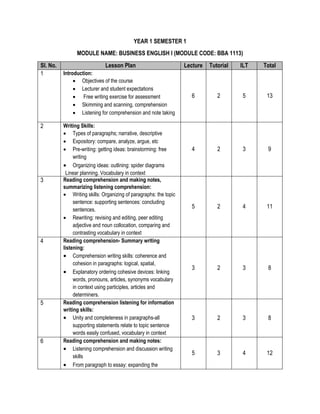
YEAR 1 SEMESTER 1
MODULE NAME: BUSINESS ENGLISH I (MODULE CODE: BBA 1113)
Sl. No. Lesson Plan Lecture Tutorial ILT Total
1 Introduction:
 Objectives of the course
 Lecturer and student expectations
 Free writing exercise for assessment
 Skimming and scanning, comprehension
 Listening for comprehension and note taking
6 2 5 13
2 Writing Skills:
 Types of paragraphs; narrative, descriptive
 Expository: compare, analyze, argue, etc
 Pre-writing: getting ideas: brainstorming: free
writing
 Organizing ideas: outlining: spider diagrams
Linear planning. Vocabulary in context
4 2 3 9
3 Reading comprehension and making notes,
summarizing listening comprehension:
 Writing skills: Organizing of paragraphs: the topic
sentence: supporting sentences: concluding
sentences.
 Rewriting: revising and editing, peer editing
adjective and noun collocation, comparing and
contrasting vocabulary in context
5 2 4 11
4 Reading comprehension- Summary writing
listening:
 Comprehension writing skills: coherence and
cohesion in paragraphs: logical, spatial,
 Explanatory ordering cohesive devices: linking
words, pronouns, articles, synonyms vocabulary
in context using participles, articles and
determiners.
3 2 3 8
5 Reading comprehension listening for information
writing skills:
 Unity and completeness in paragraphs-all
supporting statements relate to topic sentence
words easily confused, vocabulary in context
3 2 3 8
6 Reading comprehension and making notes:
 Listening comprehension and discussion writing
skills
 From paragraph to essay: expanding the
5 3 4 12
paragraph, vocabulary in context reporting
 Reading comprehension writing skills: the thesis
statement
7 Summary writing, punctuation, vocabulary in
context/opposites using inversion for emphasis:
 Reading comprehension: listening comprehension
 Writing skills: the introductory paragraph,
describing people and objects vocabulary in
context
4 2 3 9
8 Reading comprehension recognizing voice
listening comprehension writing skills:
 The concluding paragraph
2 2 2 6
9 Summary of restatement fanning adjectives:
 Vocabulary in context participles and infinitives
oral presentations: Choosing a topic, how to
prepare
3 2 3 8
10 Library research listening comprehension writing
skills:
 Body paragraphs: sufficient and support for the
thesis appropriate vocabulary in context oral
presentations: preparation and presentation skills
3 1 3 7
11 Reading comprehension, listening
comprehension:
 Revision and practice-timed essays the passive
voice
2 1 2 5
12 Reading comprehension: listening
comprehension:
 Essay writing – revision and practice making
notes, describing a process, adjectives and
principles
3 2 2 7
13 Reading comprehension listening comprehension:
 Essay writing – revision and practice adverbs of
degree, vocabulary in context using the future
3 2 2 7
14 Reading comprehension, summarizing listening
comprehension:
 Essay writing: revision and practice
2 1 2 5
Total 48 26 41 115
No Information on Course
1. Name of Course: Principles of Management
2. Course Code: BBA1133
3. Name(s) of Academic Staff:
4. Rationale for the inclusion of the course/ module in the programme:
This course is a study of management theories, emphasizing the management functions of planning,
decision making, organizing, leading, and controlling. It aims at introducing the student to the fundamental
principles of management and organization theory.
5. Semester and Year offered: Semester 1 Year 1
6.
Student Learning Time
(SLT)
Face to Face Independent Learning
Total Guided and
Independent Learning
L=Lecture
T=Tutorial
P=Practical
O=Others
ILT= Individual
Student Learning
Time
L T P O
45
120
48 21 - 6
7 Credit Value: 3
8 Prerequisite: None
9 Course Learning Outcomes:
At the end of this course, the students will be able to:
 Explain the role of planning, organizing, staffing, leading and controlling in management
 Recognize the role of management in modern organizations
 Understand the importance of organizational goal setting
 Understand the types of decisions made in business, and be familiar with the steps in the decision-
making process.
 Be familiar with the human resource management activities involved in attracting, developing, and
maintaining an effective work force.
 Understand the importance of effective leadership for the success of the organization.
10 Transferable Skills:
 Project management
 Communication skills
 Professional and managerial skills
 Problem solving skills
11 Teaching-learning and assessment strategy:
 Lectures, presentations and demonstrations
 Class based group discussions, critique sessions and case studies
 One-on-one feedback and guidance
 Individual reading and research
 Individual/ team based projects
 Group discussion and formative assessment
12 Synopsis:
This course is designed to provide students of all academic disciplines a broad overview of contemporary
management practices as they relate to the four functions that all managers must perform: planning,
organizing, leading and controlling (monitoring and correcting) and also the theories of management of
change.
13 Mode of delivery:
Lecture, Tutorial, Workshop, Seminar.
14 Mapping of the course/module to the program aims:
Provides instruction in principles of management that have general applicability to all types of enterprises;
basic management philosophy and decision making; principles involved in planning, organizing, leading,
and controlling; and recent concepts in management.
15 Mapping of the course/module to the program Learning Outcomes:
Course Outcomes
Program Outcomes
PO1 PO2 PO3 PO4 PO5 PO6 PO7 PO8
Explain the role of planning, organizing,
staffing, leading and controlling in
management
√ √
Recognize the role of management in
modern organizations
√ √
Understand the importance of
organizational goal setting √ √
Be familiar with the human resource
management activities involved in
attracting, developing, and maintaining
an effective work force.
√ √
Understand the importance of effective
leadership for the success of the
organization.
√ √
16 Content outline of the course/module and the SLT per topic:
Please refer to the course syllabus.
17
Main references supporting the course:
 Koontz – Principles of Management (Tata McGrew Hill, 1st Edition 2008)
Additional references supporting the course:
 Stoner James A. F., Freeman R. Edward, and Gilbert, Jr. Daniel R. (2003). Management (New
Delhi: Prentice-Hall of India), Sixth Edition
 Robbins, S.P. & Coulter, M. (2003). Management, 8thEd. Upper Saddle River, NJ: Prentice Hall.
18. Other additional information: NIL
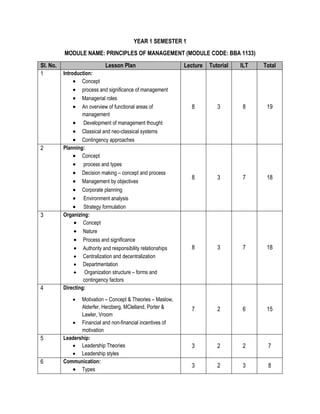
YEAR 1 SEMESTER 1
MODULE NAME: PRINCIPLES OF MANAGEMENT (MODULE CODE: BBA 1133)
Sl. No. Lesson Plan Lecture Tutorial ILT Total
1 Introduction:
 Concept
 process and significance of management
 Managerial roles
 An overview of functional areas of
management
 Development of management thought
 Classical and neo-classical systems
 Contingency approaches
8 3 8 19
2 Planning:
 Concept
 process and types
 Decision making – concept and process
 Management by objectives
 Corporate planning
 Environment analysis
 Strategy formulation
8 3 7 18
3 Organizing:
 Concept
 Nature
 Process and significance
 Authority and responsibility relationships
 Centralization and decentralization
 Departmentation
 Organization structure – forms and
contingency factors
8 3 7 18
4 Directing:
 Motivation – Concept & Theories – Maslow,
Alderfer, Herzberg, MClelland, Porter &
Lawler, Vroom
 Financial and non-financial incentives of
motivation
7 2 6 15
5 Leadership:
 Leadership Theories
 Leadership styles
3 2 2 7
6 Communication:
 Types
3 2 3 8
 Process
 Barriers to communication
7 Controlling:
 Concept and process
 Effective control system
 Techniques of control
5 3 5 13
8 Management of Change:
 Concept
 nature and process of planned change
 Resistance to change
 Management in a changing environment
6 3 7 16
Total 48 21 45 114
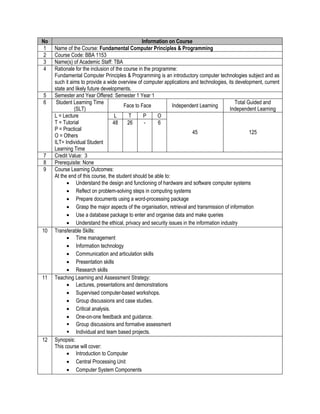
No Information on Course
1 Name of the Course: Fundamental Computer Principles & Programming
2 Course Code: BBA 1153
3 Name(s) of Academic Staff: TBA
4 Rationale for the inclusion of the course in the programme:
Fundamental Computer Principles & Programming is an introductory computer technologies subject and as
such it aims to provide a wide overview of computer applications and technologies, its development, current
state and likely future developments.
5 Semester and Year Offered: Semester 1 Year 1
6 Student Learning Time
(SLT)
Face to Face Independent Learning
Total Guided and
Independent Learning
L = Lecture
T = Tutorial
P = Practical
O = Others
ILT= Individual Student
Learning Time
L T P O
45 125
48 26 - 6
7 Credit Value: 3
8 Prerequisite: None
9 Course Learning Outcomes:
At the end of this course, the student should be able to:
 Understand the design and functioning of hardware and software computer systems
 Reflect on problem-solving steps in computing systems
 Prepare documents using a word-processing package
 Grasp the major aspects of the organisation, retrieval and transmission of information
 Use a database package to enter and organise data and make queries
 Understand the ethical, privacy and security issues in the information industry
10 Transferable Skills:
 Time management
 Information technology
 Communication and articulation skills
 Presentation skills
 Research skills
11 Teaching Learning and Assessment Strategy:
 Lectures, presentations and demonstrations
 Supervised computer-based workshops.
 Group discussions and case studies.
 Critical analysis.
 One-on-one feedback and guidance.
 Group discussions and formative assessment
 Individual and team based projects.
12 Synopsis:
This course will cover:
 Introduction to Computer
 Central Processing Unit
 Computer System Components
 Microsoft Word
 Microsoft PowerPoint
 Networking
 Internet
 E-Commerce
 System Development Life Cycle
 Programming Concepts
 Database Systems
 Computer Virus
 Computer Security and Risks
13 Mode of Delivery:
Lecture, tutorial, workshop, seminar, etc.
14 Mapping of the course/module to the program aims:
Providing a wide fundamental overview of computer applications and its technologies, development, current
state and likely future developments.
15 Mapping of the course/module to the program Learning Outcomes:
Course Outcomes
Program Outcomes
PO1 PO2 PO3 PO4 PO5 PO6 PO7 PO8
Understand the design and functioning of
hardware and software computer
systems;
√
√
Reflect on problem-solving steps in
computing systems;
√
√
Prepare documents using a word-
processing package;
√
√
Grasp the major aspects of the
organisation, retrieval and transmission
of information;
√ √
Use a database package to enter and
organise data and make queries;
√ √ √
Understand the ethical, privacy and
security issues in the information
industry;
√
√
16 Content outline of the course/module and the SLT per topic:
Please refer to the course syllabus.
17 Main references supporting the course:
 Discovering Computers 2010, Living in A Digital World –Shelly Cashman Series, Course
Technology, CENGAGE Learning (2010) ISBN -10: 0-495-80681-1
Additional references supporting the course:
 New Perspectives on Computer Concepts by June Parsons and Dan Oja, Course Technology, 10th
Edition (2007) ISBN-10: 1423906101
 Discovering Computers 2006, A Gateway to Information –Web Enhanced. Shelley, Gary B.,
Cashman, Thomas J,Vermaat, Misty E. Thompson Course Technology, (2005) ISBN 0-619-
25546-3
18 Other additional information: Nil
YEAR 1 SEMESTER 1
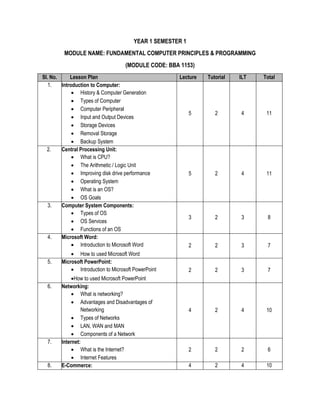
MODULE NAME: FUNDAMENTAL COMPUTER PRINCIPLES & PROGRAMMING
(MODULE CODE: BBA 1153)
SI. No. Lesson Plan Lecture Tutorial ILT Total
1. Introduction to Computer:
 History & Computer Generation
 Types of Computer
 Computer Peripheral
 Input and Output Devices
 Storage Devices
 Removal Storage
 Backup System
5 2 4 11
2. Central Processing Unit:
 What is CPU?
 The Arithmetic / Logic Unit
 Improving disk drive performance
 Operating System
 What is an OS?
 OS Goals
5 2 4 11
3. Computer System Components:
 Types of OS
 OS Services
 Functions of an OS
3 2 3 8
4. Microsoft Word:
 Introduction to Microsoft Word
 How to used Microsoft Word
2 2 3 7
5. Microsoft PowerPoint:
 Introduction to Microsoft PowerPoint
How to used Microsoft PowerPoint
2 2 3 7
6. Networking:
 What is networking?
 Advantages and Disadvantages of
Networking
 Types of Networks
 LAN, WAN and MAN
 Components of a Network
4 2 4 10
7. Internet:
 What is the Internet?
 Internet Features
2 2 2 6
8. E-Commerce: 4 2 4 10
 Definition and Concepts
 Infrastructure
 Support Area
 Types of Transactions
 Benefit / Limitation of E-Commerce
 Online Advertising Methods
9. System Development Life Cycle:
 Traditional waterfall/cascade approach
 Early Stages
 Feasibility Study
 System Analysis
 Design Phase
 Testing
 Implementation
 Maintenance and Review
5 2 4 11
10. Programming Concepts:
 High-Level Language Characteristics
 High-Level Language Programming
 Programming Features
 Translation Software
3 2 3 8
11. Database Systems:
 Database Management System
 Database Administrator
 Data Dictionary
 Database Languages
 Data Modeling
 Relational Database
 Normalization
5 2 4 11
12. Computer Virus:
 What are Computer Viruses
 Types of Viruses
 Symptoms
 Steps to Safeguard
 Anti-Virus
3 2 3 8
13. Computer Security and Risks:
 Computer Crime
 Software Sabotages
 Hacking and Electronic Trespassing
 Reducing Risks
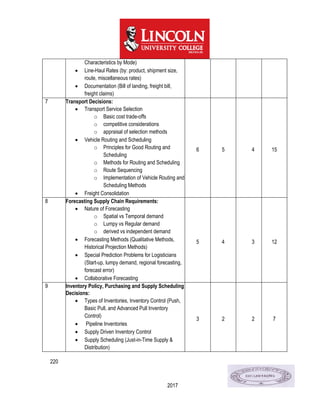
 Firewall, Encryption and Audits
 Backup and Other Precautions
5 2 4 11
 Human Security Controls: Law, Management
and Ethics
Total 48 26 45 119
No Information on Course
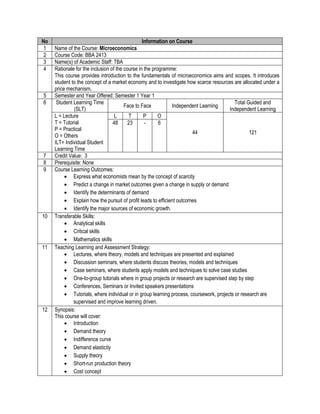
1 Name of the Course: Microeconomics
2 Course Code: BBA 2413
3 Name(s) of Academic Staff: TBA
4 Rationale for the inclusion of the course in the programme:
This course provides introduction to the fundamentals of microeconomics aims and scopes. It introduces
student to the concept of a market economy and to investigate how scarce resources are allocated under a
price mechanism.
5 Semester and Year Offered: Semester 1 Year 1
6 Student Learning Time
(SLT)
Face to Face Independent Learning
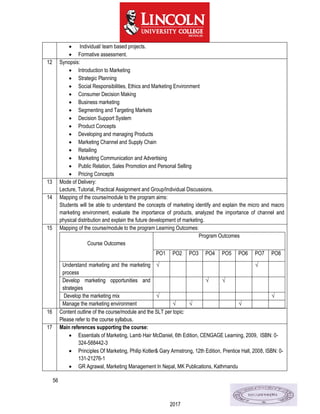
Total Guided and
Independent Learning
L = Lecture
T = Tutorial
P = Practical
O = Others
ILT= Individual Student
Learning Time
L T P O
44 121
48 23 - 6
7 Credit Value: 3
8 Prerequisite: None
9 Course Learning Outcomes:
 Express what economists mean by the concept of scarcity
 Predict a change in market outcomes given a change in supply or demand
 Identify the determinants of demand
 Explain how the pursuit of profit leads to efficient outcomes
 Identify the major sources of economic growth.
10 Transferable Skills:
 Analytical skills
 Critical skills
 Mathematics skills
11 Teaching Learning and Assessment Strategy:
 Lectures, where theory, models and techniques are presented and explained
 Discussion seminars, where students discuss theories, models and techniques
 Case seminars, where students apply models and techniques to solve case studies
 One-to-group tutorials where in group projects or research are supervised step by step
 Conferences, Seminars or Invited speakers presentations
 Tutorials, where individual or in group learning process, coursework, projects or research are
supervised and improve learning driven.
12 Synopsis:
This course will cover:
 Introduction
 Demand theory
 Indifference curve
 Demand elasticity
 Supply theory
 Short-run production theory
 Cost concept
 Long-run Production theory
 Types of Market
 Monopolistic competition
 Monopoly
 Oligopoly
 Various resource market
 Market failure and externalities
13 Mode of Delivery:
Lecture, tutorial, workshop, seminar, etc.
14 Mapping of the course/module to the Program Aims:
This module is concerned with fundamental and applied aspects of microeconomic theory. This will involve
introducing new microeconomic concepts and returning to concepts with which students should be familiar
from the first year, but examining them in greater depth.
15 Mapping of the course/module to the Program Learning Outcomes:
Course Outcomes
Program Outcomes
PO1 PO2 PO3 PO4 PO5 PO6 PO7 PO8
Express what economists mean by the
concept of scarcity
√ √ √
Predict a change in market outcomes
given a change in supply or demand
√
√
Identify the determinants of demand
√
√
Explain how the pursuit of profit leads to
efficient outcomes
√
Identify the major sources of economic
growth.
√ √
16 Content outline of the course/module and the SLT per topic:
Please refer to the course syllabus.
17 Main references supporting the course:
 Gregory Mankiw, Principles of Microeconomics, 5th Edition South-Western College, 2008
ISBN-10 : 0324589980
 William J. Baumol/ Alan S. Blinder, Microeconomics Principles and Policy, 1st Edition, Thomson
South Western, 2006 ISBN : 0-324-32345-X
18 Other additional information: Nil
YEAR 1 SEMESTER 1
MODULE NAME: MICROECONOMICS (MODULE CODE: BBA 2413)
SI. No. Lesson Plan Lecture Tutorial ILT Total
1.
Introduction:
 Fundamentals of microeconomics aim and
scope
 Various types of microeconomics problems
 Illustrate using the production possibilities
curve
 Details on market systems advantages and
disadvantages
4 2 3 9
2.
Demand theory:
 Fundamental concept
 Utility theory concept
 Total utility, marginal utility, law of
diminishing marginal utility, basis of demand
in utility theory, equilibrium, derivation of
demand from equilibrium consumer surplus
6 3 5 14
3. Indifference curve:
 Indifference curve analysis, indifference
curve, budget line, equilibrium
2 2 3 7
4. Demand elasticity:
 Function, aim and scope, price elasticity of
demand
 Price elasticity and total expenditure Various
factors in influencing price cross elasticity of
demand, income elasticity and interpretation
of elasticity coefficients
 Income and substitution effects of a change in
price
5 2 5 12
5.
Supply theory:
 Functions, aim and scope of basic supply
concept and theory of the firm
Short-run production theory:
 Product concepts, total product marginal
product, average product, product curves, the
law of diminishing marginal product
4 2 5 11
6.
Cost concept:
Total cost marginal cost, fixed cost, variable cost,
cost curves
Relationship between short-run cost and
productivity concepts
5 2 5 12
Long-run Production theory:
Economies of scale, diseconomies of scale,
constant return to scale
7.
Types of Market:
 Perfect competition-assumption, revenue-
conditions, supply curve, behavior of
competitive firm, shot-run equilibrium, short
run profits, long-run equilibrium, implications
of long-run equilibrium
5 2 4 11
8.
Monopolistic competition:
 Assumptions, revenue conditions, behavior of
competitive firm, shot-run equilibrium,
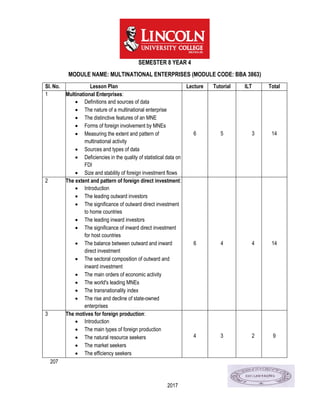
monopolistic industry, long-run equilibrium,
implications of long-run equilibrium
5 2 4 11
9.
Monopoly:
 Assumption, revenue condition, shot-run
equilibrium, long-run equilibrium, monopoly
profit
Oligopoly:
 Assumption, causes measurement,
competition, co-operation, kinked demand
curve
6 2 4 12
10.
Various resource market:
 Concept of derived demand curve, shifts in
demand
 Supply of resources, resources pricing in
perfectly competitive market, wage rates,
economic rent
3 2 3 8
11.
Market failure and externalities:3
 External cost, external benefits, social cost,
social benefits, free-rider concept, and
government intervention
3 2 3 8
Total 48 23 44 115
34
2017
2nd Semester
35
2017
No Information on Course
1 Name of the Course: Business English II
2 Course Code: BBA1253
3 Name(s) of Academic Staff:
4 Rationale for the inclusion of the course in the programme:
Business English 2 is a module to build upon the basic language skills of the students and teach them
concepts in reading, writing and grammar. The course will also introduce students to new vocabulary and
writing styles.
5 Semester and Year Offered: Semester 2 Year1
6 Student Learning Time (SLT) Face to Face Independent Learning Total Guided and
Independent Learning
L = Lecture
T = Tutorial
P = Practical
O = Others
ILT= Individual Student
Learning Time
L T P O
39 120
48 27 - 6
7 Credit Value: 3
8 Prerequisite: Successful completion of English 1
9 Course Learning Outcomes:
At the end of this course, the student should be able to:
 To write a well thought out and organized essay.
 They will also have improved fluency in the stylistic options in writing a research paper.
10 Transferable Skills:
 Skills and how they are developed and assessed
 Project and practical experience and Internship
11 Teaching Learning and Assessment Strategy:
The students will be engaged in the English language through in class exercises and homework which will
challenge them to the best of their abilities.
12 Synopsis:
Through the use of literature this course will give the students a greater understanding of the English
language. There will be a focus on research essay writing.
13 Mode of Delivery:
Lecture, Tutorial, Workshop, Seminar, etc.
14 Mapping of the course/module to the program aims:
Provides students with the skills to use English to communicate effectively through the mediums of speech
and writing
15 Mapping of the course/module to the program Learning Outcomes:
Course Outcomes
Program Outcomes
PO1 PO2 PO3 PO4 PO5 PO6 PO7 PO8
To write a well thought out and organized
essay
√ √ √
36
2017
They will also have improved fluency in
the stylistic options in writing a research
paper.
√ √
16 Content outline of the course/module and the SLT per topic:
Please refer to the course syllabus.
17 Main references supporting the course:
Barton, Laurie, Sardinas Carolyn D. (2009) North Star Reading and Writing (Level4)
3
rd
edition. Pearson Education Press, White Plains NY; ISBN :978-0136133681
Additional references supporting the course
Schmidt, Jennifer P.L., Solorzano, Helen S. (2009) North Star Listening and Speaking (Level
3) 3rdEdition. Pearson Education Press, White Plains NY; ISBN :978-013613313
 O’ donnell, Teresa D. and Pavia, Judith L., 2004. Independent Writing (4
th
ed.) Heinle publishers.
Boston, Massachusetts.
18 Other additional information: Nil
37
2017
YEAR 1 SEMESTER 2: BUSINESS ENGLISH II
MODULE NAME: BUSINESS ENGLISH II (MODULE CODE: BBA1253)
Sl. No.
Lesson Plan Lecture Tutorial ILT Total
1 Introduction:
 Reading for comprehension, listening for
comprehension and discussion.
 Writing skills: Summarizing a
discussion, describing a process,
purpose, audience and structure in
writing, chronological linking
4 2 3 9
2  Reading / comprehension /
advertisement analysis and reaction.
Listening comprehension and
reaction compound nouns /
vocabulary in context, uses of the ‘ …
ing’ verb form,
 Writing skills: summarizing,
describing a process sentences,
fragments, coherence writing the first
draft, brainstorming, outlining.
 Conclusive Paragraph
4 2 3 9
3  Reading comprehension:
advertisement analysis and reaction
listening comprehension vocabulary
in context prepositions
 writing skill: editing and revising
paragraphing: topic sentence and
supporting sentences
4 2 3 9
4  Reading comprehension listening
and note taking vocabulary in
context and prefixes modal verbs
 Writing skills: classification,
categories thesis statement oral
presentation: choosing a topic
3 2 3 8
5  Reading comprehension and
summarizing listening for specific
information vocabulary in context
using ‘There ….’ direct and indirect
sentence
 Writing skills: classification essays,
introduction paragraphs, supporting
paragraphs, linking words, using
commas
4 2 3 9
6  Reading for comprehension, reaction
and summarizing listening for
comprehension, vocabulary in context.
 Abstract writing skills: recognizing point
4 2 3 9
38
2017
of view, classification practice drafting,
rewriting, peer editing
7  Reading for comprehension / listening
for comprehension vocabulary in
context / abstract nouns
 Writing skills: making notes for essay
comparison and contrast linking
device comma splices and run-ons
reporting
4 2 3 9
8  Reading for gist and comprehension,
listening for comprehension
vocabulary in context, different styles
conditional sentences,
 Writing skills: co-operative writing
similarities and differences peer
editing summarizing
4 2 3 9
9  Reading for comprehension and
reaction, listening for comprehension
vocabulary in context usage and
meaning of past tenses verbs and
idioms
 Writing skills: exemplification thesis
statement and supporting statements
linking words sharing ideas and making
notes
4 3 3 10
10  Read literature: To concentrate on
writing in response to literature in the
form of short essays, reading for
understanding and response.
3 2 3 8
11  Reading for understanding response,
empathy and structure / listening for
comprehension
 Writing skills: pre-reading writing a
response summarizing describing
from memory
3 2 3 8
12  Reading for understanding, response
and empathy.
 Writing skills: pre-reading writing a
response analyzing the organization
and structure of a piece of writing
planning and writing an essay
4 2 3 9
13  Reading for comprehension writing
skills: answering questions, word
definitions, essay writing: revision and
practice
3 2 3 8
Total 48 27 39 114
39
2017
No Information on Course
1 Name of the Course: Human Resource Management
2 Course Code: BBA 1213
3 Name(s) of Academic Staff: TBA
4 Rationale for the inclusion of the course in the programme:
Human Resource Management is a module that provides the basic knowledge of policies and
implementation of human resources development. This module will help the students to understand the
various fundamental issues relating to human resources development.
5 Semester and Year Offered: Semester 2 Year1
6 Student Learning Time (SLT) Face to Face Independent Learning Total Guided and
Independent Learning
L = Lecture
T = Tutorial
P = Practical
O = Others
ILT= Individual Student
Learning Time
L T P O
35 122
48 33 - 6
7 Credit Value: 3
8 Prerequisite: None
9 Course Learning Outcomes:
At the end of this course, the student should be able to:
 Know the basic of human resource knowledge
 Organize effective interview
 Plan job recruitment and recruitment planning and able to write the job description
 Knowledge about the employee testing
 Look after the employee safety and health
10 Transferable Skills:
 Time management
 Information technology
 Communication and articulation skills
 Presentation skills
 Research skills
11 Teaching Learning and Assessment Strategy:
 Lectures, presentations and demonstrations.
 Supervised computer-based workshops.
 Group discussions and case studies.
 Critical analysis.
 One-on-one feedback and guidance.
 Group discussions and formative assessment.
 Individual and team based projects.
12 Synopsis:
 Personnel/Human Resource Management
 Job Analysis
40
2017
 Writing Job Descriptions
 Personnel Planning and Recruiting
 Recruiting Job Candidates
 Employee Testing and Selection
 Types of Tests
 Interviewing Candidates and Building A Total Selection Program
 The Effective Interview
 Orientation and Training
 Appraising Performance
 Establishing Pay Plans
 Employee Safety and Health
 Employee Health: Problem and Remedies
13 Mode of Delivery:
Lecture, Tutorial, Lab Sessions and training.
14 Mapping of the course/module to the program aims:
Providing a wide fundamental overview of human resource applications and its technologies, development,
current state and likely future developments in handling the Human Resource area.
15 Mapping of the course/module to the program Learning Outcomes:
Course Outcomes
Program Outcomes
PO1 PO2 PO3 PO4 PO5 PO6 PO7 PO8
Know the basic of human resource
knowledge
√ √
To organize effective interview √ √
Able to plan job recruitment and
recruitment planning and able to write the
job description
√ √ √
Knowledge about the employee testing √ √ √
Look after the employee safety and health √ √
16 Content outline of the course/module and the SLT per topic:
Please refer to the course syllabus.
17 Main references supporting the course:
 Gary Dessler , Human Resource Management , 11th Edition, Pearson Prentice Hall, 2008 ISBN :
978-0-13-515311-6
 GR Agrawal, HRM in Nepal, MK Publications, Kathmandu
Other references supporting the course:
 Maimunah Aminuddin, Human Resource Management Principles and Practices , 1st Edition,
Oxford University Press, 2008 ISBN : 978-983-45000-2-3
 Aswathappa , Human Resource Management McGraw-Hill Education (India) Pvt Ltd, Edition: 6 ;
ISBN: 0070682135
18 Other additional information: Nil
41
2017
YEAR 1 SEMESTER 2
MODULE NAME: HUMAN RESOURCE MANAGEMENT (MODULE CODE: BBA 1213)
Sl. No. Lesson Plan Lecture Tutorial ILT Total
1 Personal / Human Management:
 Concept ,characteristic, importance
o f Human resource management
 Component / function of human resource
management
 What is personnel management vs human
resource management
 HR Manager Responsibilities
3 2 2 7
2 Job Analysis:
 Concept, Nature, Uses, Steps of collecting
job analysis information
 Method of collecting job analysis information
o The interview, questionnaires,
Observation participant, Log/Diary,
technical conference method
3 2 2 7
3 Job Descriptions and job specification:
 Writing job descriptions and responsibilities,
Authority, Standard of performance, working
condition and physical environment, job
description Guidelines, relation with other
jobs and machine ,tools and materials
 Writing job Specification: Physical
characteristics, psychological characteristics,
ability to take responsibilities, other
demographic features
4 3 3 10
4 Personal Planning and forecasting:
 Concept ,importance of HR planning,
forecasting Requirement
 Factor (affecting) in HR/personnel
forecasting
 Forecasting supply of inside and outside
candidates, internal sources of candidates
3 2 2 7
5 Employee recruitment:
 Concept of recruitment
 Recruitment Source of candidates
o Advertising, Employment, Executive
Recruiters, college recruiting ,
referrals and walk Ins ,older worker,
3 2 3 8
42
2017
 Purpose of Application forms
 Using application forms to predict job
performance
6 Employee Testing and selection:
 Concept, Importance, process of selection
 Basic Testing concept, Testing guidelines
 Ethical and legal question in testing
 Why the selection process is important
 Basic Testing Concepts
o Validity
o Reliability
o Testing Guidelines
 Ethical and Legal Question in Testing
4 3 3 10
7 Types of Tests:
 Types of Tests
 Tests of Cognitive Abilities
 Measuring Personnel and Interests
 Test of Motor and Physical Abilities
 Achievement Tests
 Work Samples and Simulations
 Works Sampling for Employee Selection
 Management Assessment Centers
 Other Selection Techniques
 Background Investigations and Reference
 Complying with the Immigration Law
4 3 3 10
8 Interviewing Candidates and Building A Total
Selection Program:
 Types of Interviews
 Common Interviewing Mistakes
 Snap Judgments
 Negative Emphasis
 Not Knowing the Job
 Pressure to Hire
 Candidates Order Error
 Nonverbal Behavior
3 2 3 8
9 The Effective Interview:
 Steps in the Interview
 Summary of Interviewing Guidelines
 The Structured Interview
 Develop behavioral Specifications
 Specific Factors to probe in the interview
 Using on Interview Plan
4 3 3 10
43
2017
 Match candidates on the job
 Building Employee Commitment:
(A total selection program)
( Guidelines for interviewees)
10 Orientation and Training:
 The basic training process
 Assessing Training Needs
- Tasks Analysis: Assessing the
training needs of new employees
- Performance Analysis: Determining
the training needs of current
employees
 Setting Training Objectives
 Training and Training Techniques
- On the Job Training
- Job Instruction Training
 Evaluating the Training Effort
 Controlled Experimentation
 What Training Effects to Measure
5 3 3 11
11 Appraising Performance:
 Why should you appraise performance?
 Steps in Appraising Performance
 Performance appraisal problems
 Clarify what performance you expect
 The Appraisal Interview
3 2 2 7
12 Establishing Pay Plans:
 Basic Aspects of Compensation
 Bases for Determining Pay
 Basic Considerations in Determining Pay
rates
 Establishing Pay Rates
2 2 2 6
13 Employee Safety and Health:
 Basic Facts about the Occupational Safety
Law
 Top Management Commitment
 The Three Basic Causes of Accidents
 How to Prevent Accident
 Basic Approaches to Preventing Accidents
 Problem and Remedies
 Alcoholism and Substance Abuse
 The Problem of Job Stress and Burnout
3 2 2 7
44
2017
 Workplace Smoking
14 Labor Relations Management:
 Concept, Purposes, Process & Actors of
Labor Relations
 Concept & Types of Trade Union
 Major Provisions of Trade Union and Labor
Act of Nepal
Dispute Settlement:
 Sources of Grievances
 Grievances Procedure
 Guidelines for Handling Grievances
 Dispute Settlement Mechanism
Collective Bargaining:
 Concept of Collective Bargaining Process
 Types of Collective Bargaining
 Requisites of Successful Collective
Bargaining
 Emerging Issues in Collective Bargaining in
Nepal
4 2 2 8
TOTAL
48 33 35 116
45
2017
No Information on Course
1 Name of the Course: Internet Fundamentals & Applications
2 Course Code: BBA 1233
3 Name(s) of Academic Staff: TBA
4 Rationale for the inclusion of the course in the programme:
The major rationale of this course is to know how to use internet in the business. At the end of the course
students would have a thorough understanding of Internet navigation. They will discover how to implement
internet standards to develop any type internet application in the area of their business.
5 Semester and Year Offered: Semester 2 Year1
6 Student Learning Time (SLT) Face to Face Independent Learning Total Guided and
Independent Learning
L = Lecture
T = Tutorial
P = Practical
O = Others
ILT= Individual Student
Learning Time
L T P O
36 121
48 31 - 6
7 Credit Value: 3
8 Prerequisite: None
9 Course Learning Outcomes:
At the end of this course, the student should be able to:
 Relate effectively to web development supervisors, coworkers, and clients.
 Perform simple database queries to retrieve data.
 Monitor internet application security by applying appropriate techniques and strategies.
10 Transferable Skills:
 Internet skill
 Communication and articulation skills
 Presentation skills
11 Teaching Learning and Assessment Strategy:
 Lectures, presentations and demonstrations.
 Supervised computer-based workshops.
 Class based group discussions, critique sessions and case studies.
 Application and adaptation internet applications through practical assignments.
 Critical analysis and reflection.
 One-on-one feedback and guidance.
 Individual reading and research.
 Individual/ team based projects.
 Formative assessment.
12 Synopsis:
Internet service concepts; Introduction to Information Services; Building an Internet, Security building etc.
13 Mode of Delivery:
Lecture, Tutorial, Practical Assignment and Group/Individual Discussions.
14 Mapping of the course/module to the program aims:
46
2017
The course will cover practical aspects of internet and the development of e-mail. FTP, Gopher, UseNet
newsreader applications. It will also cover TCP/IP and Winsock
15 Mapping of the course/module to the program Learning Outcomes:
Course Outcomes
Program Outcomes
PO1 PO2 PO3 PO4 PO5 PO6 PO7 PO8
Relate effectively to web development
supervisors, coworkers, and clients.
√ √
Perform simple database queries to
retrieve data.
√ √
Monitor internet application security by
applying appropriate techniques and
strategies.
√ √
16 Content outline of the course/module and the SLT per topic:
Please refer to the course syllabus.
17 Main references supporting the course:
 Alexis Leon, Mathews Leon, "Fundamentals of Information Technology".
 Janiee Reynolds, RoyaMofazal, The complete E-commerce Book: Design, Build & Maintain
a successful web-based Business
 Neil Jenkins and Stan Schatt: Understanding Local Area Networks, PHI
 W. Richard Stevens. "Unix Network Programming. Vol.-I. (Networking API).
18 Other additional information: Nil
47
2017
YEAR 1 SEMESTER 2
MODULE NAME: INTERNET FUNDAMENTALS & APPLICATIONS (MODULE CODE: BBA 1233)
SI. No. Lesson Plan Lecture Tutorial ILT Total
1. Background study and revision of computer
Network, Internet and e-mail:
 A brief history of origin of Internet.
 Introduction and necessity of computer
Networking
 Different types of multiplexing: Simplex,
Duplex, Half Duplex
 Modulation ant its types
 Internet and its use in business, emails
6 4 4 14
2. Internet, World Wide Web , Internet Search, e-mail
and computer Network:
 Various applications of Internet such as e-mail,
information gathering, retailing
 Understanding of World Wide Web, Web
Browser, Using Search Engine,
 Internet and Business: how can the business
take advantage of the Internet
6 3 4 13
3. Brief Introduction to LAN:
 Definition
 Need and use of LAN
 Prospect of LAN
 History and Development of LAN,
 Types of Network
o LAN, WAN, MAN, Extra-Net, Intra-
Net, Inter-Net
 IP Address
 Classification of IP's
 Uses of IP Address
 Needs of LAN System in Business.
6 4 5 15
4. Network Architecture:
 Network Topologies, Star, Clustered Star, Bus,
Ring, Logical and Physical, Client Server
Network Model, Peer-to-peer Network
Architecture model, comparison of various
models.
4 3 3 10
5. Architecture of Internet:
 Review of Internet Concepts, Web Server,
Protocols used in Internet, Client/Server
connection via Internet, Domain names and its
hierarchy, Issues of Domain Name
Registration, DNS Concepts, Internet service
concepts: What is Internet? How is Internet
service structure? What is TCP/IP Protocols?
5 4 5 14
48
2017
6. Security Considerations:
 Principle of Cryptography, Authentication,
Encryption/ Decryption, Digital Certificates,
Digital Signature, Secure Socket Layer, VPN
4 3 3 10
7. Electronic Payment:
 Electronic Cash, Credit Card Processing,
Electronic Check Processing, Gift and Prepaid
Certificate, Payer Authentication, Smart
Authorization, Electronic Payment Gateways,
Threats in E-transaction
5 3 4 12
8. Role of Information and Communication
Technologies in Economic Development:
 Economic dimensions, Social dimensions,
Impacts of IT in business, Authentication of
Messages, Examples including most
successful companies
4 3 3 10
9. Data Storage and Legal Issues in Internet:
 Concept of Cloud Computing,
 Data backup and Recovery
 Security and Privacy: Data Privacy Threats,
Physical Security, Managerial Controls
 Logical Security; Encryption, Data mining,
Data Processing, Data warehousing, On-Line
Transaction Processing, On-Line Application
Processing
8 4 5 17
TOTAL 48 31 36 115
49
2017
No Information on Course
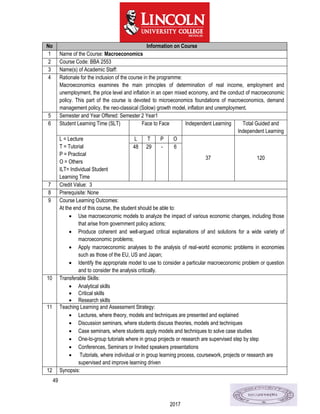
1 Name of the Course: Macroeconomics
2 Course Code: BBA 2553
3 Name(s) of Academic Staff:
4 Rationale for the inclusion of the course in the programme:
Macroeconomics examines the main principles of determination of real income, employment and
unemployment, the price level and inflation in an open mixed economy, and the conduct of macroeconomic
policy. This part of the course is devoted to microeconomics foundations of macroeconomics, demand
management policy, the neo-classical (Solow) growth model, inflation and unemployment.
5 Semester and Year Offered: Semester 2 Year1
6 Student Learning Time (SLT) Face to Face Independent Learning Total Guided and
Independent Learning
L = Lecture
T = Tutorial
P = Practical
O = Others
ILT= Individual Student
Learning Time
L T P O
37 120
48 29 - 6
7 Credit Value: 3
8 Prerequisite: None
9 Course Learning Outcomes:
At the end of this course, the student should be able to:
 Use macroeconomic models to analyze the impact of various economic changes, including those
that arise from government policy actions;
 Produce coherent and well-argued critical explanations of and solutions for a wide variety of
macroeconomic problems;
 Apply macroeconomic analyses to the analysis of real-world economic problems in economies
such as those of the EU, US and Japan;
 Identify the appropriate model to use to consider a particular macroeconomic problem or question
and to consider the analysis critically.
10 Transferable Skills:
 Analytical skills
 Critical skills
 Research skills
11 Teaching Learning and Assessment Strategy:
 Lectures, where theory, models and techniques are presented and explained
 Discussion seminars, where students discuss theories, models and techniques
 Case seminars, where students apply models and techniques to solve case studies
 One-to-group tutorials where in group projects or research are supervised step by step
 Conferences, Seminars or Invited speakers presentations
 Tutorials, where individual or in group learning process, coursework, projects or research are
supervised and improve learning driven
12 Synopsis:
50
2017
 Introduction of Macroeconomics
 National Income and Product
 Effect of inflation
 Demand side of National income and Product
 Planned investment
 National Income and Product
 Monetary Economies
 Creation of bank credits
 Inflation
 Unemployment
 Issues pertaining to International economic
 Balance of payments
 Balance of trade
13 Mode of Delivery:
Lecture, Tutorial, Seminar.
14 Mapping of the course/module to the program aims:
The aim of the macroeconomic course is to introduce the student to the theories of macroeconomics. The
student also has to understand and apply the national accounting concepts, describe well the meaning of
monetary and fiscal policy, and what benefits as well disadvantages the policies has.
15 Mapping of the course/module to the program Learning Outcomes:
Course Outcomes
Program Outcomes
PO1 PO2 PO3 PO4 PO5 PO6 PO7 PO8
Use macroeconomic models to analyze
the impact of various economic changes,
including those that arise from
government policy actions;
√ √
Produce coherent and well-argued critical
explanations of and solutions for a wide
variety of macroeconomic problems;
√ √
Apply macroeconomic analyses to the
analysis of real-world economic problems
in economies such as those of the EU,
US and Japan;
√ √ √
Identify the appropriate model to use to
consider a particular macroeconomic
problem or question and to consider the
analysis critically.
√ √
16 Content outline of the course/module and the SLT per topic:
Please refer to the course syllabus.
17 Main references supporting the course:
 Michael Parkin, Macroeconomics, 8th Edition, Pearson International Edition. 2008, ISBN :
51
2017
9780321416568
 Gregory Mankiw, Principles of Macroeconomics, 5th Edition, South-Western CENCAGE Learning.
2009 ISBN : 978-0324236958
Other references supporting the course:
18 Other additional information: Nil
52
2017
YEAR 1 SEMESTER 2
MODULE NAME: MACROECONOMICS (MODULE CODE: BBA 1223)
Sl. No. Lesson Plan Lecture Tutorial ILT Total
1 Introduction:
 Meaning, scope, uses of
macroeconomics
 Types of macroeconomics -
static, comparative and dynamic
 Macroeconomic public goals
 Fundamentals of
macroeconomics
 Various types of macroeconomics
problems
5 3 3 11
2 National income and product:
 Introduction of national income
and product
 Fundamental issues
 Measurement of national income
 Various Concept of nation
income Gross Domestic Product /
output / income, Gross National
Product / Output / Income, Net
Domestic / National Product,
GDP/GNP/NNP at market price,
GDP/GNP/NNP at factor cost,
Real and Nominal
GDP/GNP/NNP
 Methods of computing/measuring
GDP/GNP/NNP: Income method,
Expenditure method, Value
added method, Personal income,
Disposable Income, and Per
Capita Income, GNP, NNP, II, PI,
DI, PCI
 Difficulties in measurement of
national income
 Numerical exercise
9 5 5 19
3 Circular flow of income and expenditure:
 Circular flow with saving and
investment, Circular flow in a
three-sector closed economy,
Adding foreign sector: Circular
3 2 2 7
53
2017
flow in a four-sector open
economy, Importance of the
circular flow
4 Demand side of National income and
Product:
 Determination of equilibrium level
of employment and output-
classical model
 Criticism of classical model
 Keynes theory employment:
principle of effective demand
 Consumption function: concept,
psychological law of
consumption, MPC, APC
 Saving function- concept, MPS,
APS, paradox of thrift
 Income and output determination
in two, three & four section model
6 4 5 14
5 Investment function:
 Meaning of capital and
investment
 Types of investment
 Determinants of investment
 Marginal efficiency of capital
 Marginal efficiency of investment
 Investment demand curve
6 3 4 13
6 Multiplier:
 Concept
 Types- Simple investment
multiplier, government spending
multiplier, tax multiplier, export
multiplier and import multiplier
balanced budget & open economy
multiplier
 Determination of multiplier in two-,
three- and four-sector economy
 Leakages of multiplier
 Importance of multiplier
5 3 4 12
7 Fiscal policy and monetary policy
 Fiscal policy: Concept, types,
objectives and Instruments of
fiscal policy
3 2 4 9
54
2017
 Current and Future Demand
 Monetary policy: Concept, types,
objectives &instruments of
monetary policy
8 Monetary economics:
 Money and its function ,
quantity& fiscal's theory of money
 Demand for money and its
determinant
 Supply of money and its
determinant
 Credit instruments- check,
promissory notes, bills of
exchange
 Creation of bank credit, limitations
to credit creation, quality theory of
money
 Exchange rate- Determination of
exchange rate under fixed &
flexible rate system
6 3 4 13
9 Inflation:
 Concept, causes, types, effects
 Control of inflation- monetary,
fiscal, direct control
2 2 3 7
10 Business cycle:
 Concept, types & characteristics
of business cycle
 Phases of business cycle
 Measures to control business
cycle
3 2 3 8
TOTAL 48 29 37 114
55
2017
No. Information on Course
1 Name of the Course: Principles of Marketing
2 Course Code: BBA 1223
3 Name(s) of Academic Staff: TBA
4 Rationale for the inclusion of the course in the programme:
Principle of Marketing is a module that deals with the study and analysis of the basic principles, theories,
problems, and practices of marketing in our modern ever changing economic environment. Emphasis is
placed on the marketing functions, planning and the distribution of goods and services from the producer to
the ultimate consumer.
5 Semester and Year Offered: Semester 2 Year1
6 Student Learning Time (SLT) Face to Face Independent Learning Total Guided and
Independent Learning
L = Lecture
T = Tutorial
P = Practical
O = Others
ILT= Individual Student
Learning Time
L T P O
39 122
48 29 - 6
7 Credit Value: 3
8 Prerequisite: None
9 Course Learning Outcomes:
At the end of this course, the student should be able to:
 Understand marketing and the marketing process
 Develop marketing opportunities and strategies
 Develop the marketing mix
 Manage the marketing environment
10 Transferable Skills:
 Time management
 Sales and Marketing skills
 Communication and articulation skills
 Presentation skills
 Independence/autonomy
 Research skills
11 Teaching Learning and Assessment Strategy:
 Lectures, presentations and demonstrations.
 Supervised computer-based workshops.
 Class based group discussions, critique sessions and case studies.
 Application and adaptation internet applications through practical assignments.
 Critical analysis and reflection.
 One-on-one feedback and guidance.
 Individual reading and research.
56
2017
 Individual/ team based projects.
 Formative assessment.
12 Synopsis:
 Introduction to Marketing
 Strategic Planning
 Social Responsibilities, Ethics and Marketing Environment
 Consumer Decision Making
 Business marketing
 Segmenting and Targeting Markets
 Decision Support System
 Product Concepts
 Developing and managing Products
 Marketing Channel and Supply Chain
 Retailing
 Marketing Communication and Advertising
 Public Relation, Sales Promotion and Personal Selling
 Pricing Concepts
13 Mode of Delivery:
Lecture, Tutorial, Practical Assignment and Group/Individual Discussions.
14 Mapping of the course/module to the program aims:
Students will be able to understand the concepts of marketing identify and explain the micro and macro
marketing environment, evaluate the importance of products, analyzed the importance of channel and
physical distribution and explain the future development of marketing.
15 Mapping of the course/module to the program Learning Outcomes:
Course Outcomes
Program Outcomes
PO1 PO2 PO3 PO4 PO5 PO6 PO7 PO8
Understand marketing and the marketing
process
√ √
Develop marketing opportunities and
strategies
√ √
Develop the marketing mix √ √
Manage the marketing environment √ √ √
16 Content outline of the course/module and the SLT per topic:
Please refer to the course syllabus.
17 Main references supporting the course:
 Essentials of Marketing, Lamb Hair McDaniel, 6th Edition, CENGAGE Learning, 2009, ISBN: 0-
324-588442-3
 Principles Of Marketing, Philip Kotler& Gary Armstrong, 12th Edition, Prentice Hall, 2008, ISBN: 0-
131-21276-1
 GR Agrawal, Marketing Management In Nepal, MK Publications, Kathmandu
57
2017
Other references supporting the course:
 Marketing, Charles W. Lamb, Joseph F. Hair & Carl McDaniel, 7th edition, Thomson South-
Western, 2004
18 Other additional information: Nil
58
2017
SEMESTER 2 YEAR 1
MODULE NAME: PRINCIPLE OF MARKETING (MODULE CODE: BBA 1223)
Sl. No. Lesson Plan Lecture Tutorial ILT Total
1 Introduction to Marketing Management:
 Meaning and Definition of Marketing
 Importance of Marketing (Understanding
the Critical Role of Marketing in
Organizations and Society)
 The Core Concept of Marketing
 The Marketing Process
 Understanding Customer needs, wants,
and demands
 Customer and Value Satisfaction through
quality and service
 Customer Loyalty
 Designing Customer Driven Marketing
strategy (Company Orientations towards
the Marketplace.)
 Selecting the customer to serve
 Marketing Management orientations
6 2 4 12
2 Corporate Strategic Planning. Business
Strategic Planning:
 Defining the corporate mission
 Setting company objectives and goals
 Marketing Analysis, Goal Formulation,
Market Planning, Implementation,
Feedback and Control
 Designing the business portfolio
 Marketing strategy and marketing mix
 Customer Driven Marketing Strategy
 Developing a Integrated Marketing Mix
 Managing the Marketing Effort
5 2 4 11
3 The Marketing Process:
 The Nature and Contents of a Marketing
Plan
 Analyzing Marketing Opportunities
 The Company Micro Environment
o The Company
o The Existing Competitors
o Suppliers
o Marketing Intermediaries
o (Customer ,Public )
 The Macro environment.
o Future Competitors
o Demographic Environment
o Economic Environment
o Natural Environment
5 2 4 11
59
2017
o Technological Environment
o Political Environment
o Cultural Environment
 Responding to the Marketing Environment
4 Analyzing Industries and Competitors:
 Identifying the Company’s Competitors
 Market Concepts of Competition
 Identifying the Competitors
 Strategies and Objectives.
2 2 2 6
5 Marketing Information Systems :
 Marketing Information and Customer
Insights
 The Marketing Information System
 Assessing the Information Need
 Developing Information
 Marketing Intelligence
2 2 2 6
6 Marketing Research:
 Defining the Problem and Research
Objectives , International Marketing
Research , Marketing Research in Smaller
Organizations
 Developing a Research Plan
 Implementing Research Plan
 Interpreting and reporting the findings
3 2 2 7
7 A Model of Consumer Behaviour:
 Major Factors Influencing Buyer Behavior
(Cultural factors , Social factors , Personal
factors , Psychological factors )
The Buying Decision Process :
 Need Recognition, Information Search,
Evaluation of Alternatives, Purchase
Decision , Post Purchase Behaviour
4 2 3 9
8 Market Segmentation:
 Market
Market segmentation
Geographic Segmentation
Demographic Segmentation
 Gender
Psychological Segmentation
Behavioural Segmentation:
 Requirements for Effective Segmentation.
 Market Targeting.
 Evaluating Market Segment
 Selecting Marketing Segments
 Choosing a Market Coverage Strategy
 Market Positioning
 Positioning Strategies
6 3 4 13
60
2017
 Choosing and Implementing a Positioning
strategy
 Communicating and delivering the chosen
position
 Product Differentiation
9 The New Product Development Dilemma:
 Effective Organizational Arrangements Idea
 Idea Generation
 Idea Screening
 Concept Developing and Testing
 Marketing Strategy Development Business
Analysis.
 Product Development
 Market Testing.
 Commercialization.
 The Consumer Adoption Process
4 2 3 9
10 Product life cycle:
 Introduction
 Stage of product life cycle
 Managing Product Life Cycles & Strategies.
2 3 3 8
11 Designing Pricing Strategies and Programs:
 Price (meaning , concept and definition)
 Factors to be taken into consideration while
setting prices
o Internal Factors
o External Factors
 Competitors Prices and Offering
 General pricing Approach
o Cost Based Pricing
o Breakeven Analysis and Target
Profit Pricing
o Value based Pricing
o Competitors based Pricing
o Psychological Pricing
 New Product Pricing Strategy
 Existing Products Pricing Strategy
 Initiating Price Change
 Responding to Price Change
5 3 4 12
12 The Nature of Marketing Channels:
 Channels Design Decisions
 Channels Management Decisions
 Retailing, Wholesaling. Physical
Distribution
2 2 2 6
13 Designing Communication and Promotion-Mix
Strategies:
 The Communication Process
 Steps in Developing Effective
Communications
2 2 2 6
61
2017
 Designing Effective Advertising Programs
 Setting the Advertising Objectives & Budget
TOTAL 48 29 39 116
62
2017
3rd Semester
63
2017
No Information on Course
1 Name of Course: Business Communication
2 Course Code: BBA 1123
3 Name(s) of Academic Staff:
4 Rationale for the inclusion of the course/ module in the programme:
This module is designed to cover necessary written and oral communications skills to enable student to
relate to others on computing and non-computing matters. The students would also develop skills of
conducting interview and selection process.
5 Semester and Year offered: Semester 3 Year 2
6
Student Learning Time
(SLT)
Face to Face Independent Learning
Total Guided and
Independent Learning
L=Lecture
T=Tutorial
P=Practical
O=Others
ILT= Individual
Student Learning
Time
L T P O
42 121
48 25 - 6
7 Credit Value: 3
8 Prerequisite: None
9 Course Learning Outcomes:
At the end of this course, the students will be able to:
 Describe basic concepts of organizational structure and communications.
 Identify the different barriers to cross-culture communication.
 Explain about employment-process communication with a proper presentation.
 Find relevant information on writing special letters as per lifelong learning process.
10 Transferable Skills:
 Communication skills
 Information management and lifelong learning skills
 Critical thinking and problem solving skills
11 Teaching-learning and assessment strategy:
 Lectures, presentations and demonstrations
 Class based group discussions, critique sessions and case studies
 One-on-one feedback and guidance
 Individual reading and research
 Individual/ team based projects
 Group discussion and formative assessment
64
2017
12 Synopsis:
This course provides knowledge on organizational setting for Business communication. It also helps to gain
knowledge on Organizational Structure and Communications. It covers the topics like Interpersonal
Communication and Listening, Public Speaking and Oral Reporting, Intercultural Communication
Opportunities, Communication technology and Using Words Effectively.
13 Mode of delivery:
Lecture, tutorial, workshop, seminar.
14 Mapping of the course/module to the program:
This course will emphasize communication in real-world business situations and enable students to begin
developing their ability to write and speak effectively in the workplace.
15 Mapping of the course/module to the program Learning Outcomes:
Course Outcomes
Program Outcomes
PO1 PO2 PO3 PO4 PO5 PO6 PO7 PO8
Describe basic concepts of
organizational structure and
communications.
Identify the different barriers to cross-
culture communication.
Explain about employment-process
communication with a proper
presentation.
Find relevant information on writing
special letters as per lifelong learning
process.
16 Content outline of the course/module and the SLT per topic:
Please refer to the course syllabus.
17
Main references supporting the course:
 Business Communications Today, Courtland L. Bovee/ John V. Thill, Pearson Prentice Hall, 9th
Edition, 2008 ISBN : 978-0-13-206470-5
Additional references supporting the course:
 Business Communication and Personality Development, Biswajit Das/ IpseetaSatpathy, Excel
Books, 1st Edition, 2007 ISBN : 81-7446-504-9
18. Other additional information: NIL
65
2017
YEAR 2 SEMESTER 3
MODULE NAME: BUSINESS COMMUNICATION (MODULE CODE: BBA 1123)
Sl. No. Lesson Plan Lecture Tutorial ILT Total
1
Introduction:
 Organizational Setting for Business
communication
 Four levels of Communication
 Communicating in Group
 Characteristics of Formal Organizations
 Organizational Structure and
Communications
 External and Internal Systems
 Communication Flow in Organizations
- Downward Communication
- Upward Communication
 Horizontal or Lateral Communication
5 1 5 11
2
Interpersonal Communication and Listening:
 The Human Communication Process:
- The sender encodes the message
- The sender selects an appropriate
channel and transmits the message
- The receiver decodes a message
- The receiver encodes a message to
clarify any misunderstandings
- Interferences hinder the process
 Some Behavioral Factors in Communication
 Word and Non-word Messages
 listening as an interpersonal skills
 Bad Listening Habits and Practices
 Listening for Positive Results
 Suggestions for Effective Listening
5 1 5 11
3
Public Speaking and Oral Reporting:
 Controlling Speech Qualities
 Phonation, Articulation, Pronunciation
 Knowing Your Audience
 Selecting a Topic
 Planning Your Speech
3 2 2 7
66
2017
 Delivering Your Speech
 Using Style in Speeches
 Making an Oral Report
 Keeping Within Time Limits
4
Intercultural Communication Opportunities:
 International business activities at home and
aboard
 The foreign firm’s American employee
 Multiculturalism and demographic trends
 Nature of Culture:
- Elements of culture
- manifestations of culture
 Barriers to Cross-Culture Communication:
- Stereotypes, times and space as
language
- Body language
- Translation problems
 Guides to Good Cross-Cultural
Communication:
- General principles
- Written communication
- Oral communication
4 2 4 10
5
Communication technology:
 Electronic Communication Technology
 Manipulating Data
 Presenting Data
 Printing
 Desktop Publishing
 Graphics Programs
 Sharing Data
 E-mail
 Teleconferencing
3 2 2 7
6
Using Words Effectively:
 Self-Check
 Word Choice
 Preciseness
 Simplicity and Formality
 Parallelism Tone
3 2 3 8
67
2017
 Bias-Free Language
 Word Categories
 Word That Label
 Word That Replace
 Word That Join
 Word That Show Relationships
7
Using The Techniques of Style:
 Analyzing Writing Style
 Self-Check Phrases
 Certainties
 Clichés, Conciseness, Surprise, Doubt and
Judgment Sentences
 Active and Passive Voices
 Subjunctive Mood
 Emphasis Punctuation
3 2 3 8
8
Improving writing techniques:
 Paragraph
 Topic Sentence
 Coherence
 Readability
 Variety
 Emphasis
 Compositions Unity
 Sequence
 Transition
 Emphasis Editing and Rewriting
 Content
 Organization and Style Grammar
 Format and Layout
5 2 4 11
9
Writing about the Routine and Pleasant Empathy:
 Cultivating a “Your” Attitude
 Using Your Knowledge Receiver
 Communication Mentor
Organization:
 Why Organization is Essential?
 How to Organize Letters and Memorandums?
 Business Letters
3 2 3 8
68
2017
 Routine Letter about Credit / Orders
 Letters about Routine Requests
Memorandums
 Good News Memorandums
 Routine Memorandums
10
Initiating Communication About Unpleasant
Special Problems in Writing About the Unpleasant
First Paragraph:
 Communication Mentor
 Bad-News Sentences
 Last Paragraph, Writing to Persuade
 Sales Letter
 Introducing the Product
 Convince the Readers with Evidence
 Motivating the Reader to Action
 Writing a Complete Sales Latter
 Printing and Mailing
3 1 2 6
11
Writing Special Letters:
 Writing Congratulations
 Replaying to Congratulations
 Condolences Invitations
 Writing Invitations
 Replaying to Invitations
 News Releases
 Seasonal Messages
 Welcomes and Farewells
 Evaluations
 Positive Qualities
 Negative Qualities
 Regret
3 2 2 7
12
Preparing Resumes and Application Letter:
 Setting Goals and Planning
 Getting Essential Information
 Self-Analysis
 Career Analysis
 Interview with a Career Person
 Summary of Achievements
3 2 3 8
69
2017
 Qualifications
 Personal Information
 References
 Finding Prospective Employers
 Career Services
13
Communication and organization:
 Employer’s Offices
 Employment Agencies and Contractors
 Professional Organizations
 Application Letters
 Communication Mentor
2 2 2 6
14
Employment-Process Communication:
 Job Interviews
 Employment Message
 Performance Appraisals
 Types of Interviews
 Types of Employment Interviews
 Job Interview’s Role
 Preparing for the Interview
3 2 2 7
Total 48 25 42 115
70
2017
No Information on Course
1. Name of Course: Business Organization
2. Course Code: BBA 1313
3. Name(s) of Academic Staff:
4. Rationale for the inclusion of the course/ module in the programme:
The Business Organizations course provides the student with an understanding of various forms of
business organization including their formation, dissolution and tax consequences of choosing a particular
form of organization.
5. Semester and Year offered: Semester 3 Year 2
6.
Student Learning Time
(SLT)
Face to Face Independent Learning
Total Guided and
Independent Learning
L=Lecture
T=Tutorial
P=Practical
O=Others
ILT= Individual
Student Learning
Time
L T P O
51
122
48 17 - 6
7 Credit Value: 3
8 Prerequisite: None
9 Course Learning Outcomes:
At the end of this course, the students will be able to:
 Define basic forms of ownership in business organization.
 Find a creative way to reduce the risk of factors affecting the site decision in production
management.
 Collect necessary information about product & pricing strategies as useful for future.
10 Transferable Skills:
 Critical thinking and problem solving skills
 Information management and lifelong learning skills
 Managerial skills
11 Teaching-learning and assessment strategy:
 Lectures, presentations and demonstrations
 Class based group discussions, critique sessions and case studies
 One-on-one feedback and guidance
 Individual reading and research
 Individual/ team based projects
71
2017
 Group discussion and formative assessment
12 Synopsis:
This course provides an overview of business organization. It also provides partnership and corporation
definition of business. Moreover it helps to know the overall organizational birth, growth, decline and death.
13 Mode of delivery:
Lecture, tutorial, workshop, seminar.
14 Mapping of the course/module to the program aims:
It helps to identify various types of business ownership in a diverse global environment.
15 Mapping of the course/module to the program Learning Outcomes:
Course Outcomes
Program Outcomes
PO1 PO2 PO3 PO4 PO5 PO6 PO7 PO8
Define basic forms of ownership in
business organization.
Find a creative way to reduce the risk
of factors affecting the site decision in
production management.
Collect necessary information about
product & pricing strategies as useful
for future.
16 Content outline of the course/module and the SLT per topic:
Please refer to the course syllabus.
17
Main references supporting the course:
 Business Organisation Lawrence Robert DickseeNabu Press; ISBN : 1177143542, 2010.
Additional references supporting the course:
 Business Organisation and Management; Basu, C ; Tata McGraw-Hill ISBN : 0074620843
 Business Organization and Corporate Law Neal R. Bevans, Thomson Delmar Learning 2007 ISBN
: 978-1-4018-7083-6
18. Other additional information: NIL
72
2017
YEAR 2 SEMESTER 3
MODULE NAME: BUSINESS ORGANIZATION (MODULE CODE: BBA 1313)
Sl. No. Lesson Plan Lecture Tutorial ILT Total
1
Introduction of Business:
 What is business?
 Businesses profit
 Basic form of ownership
 Business classification
 Sole proprietorships
 Partnership and corporation definition
 Process for Registration of Sole
Proprietorship, Partnership and Corporations
 Issues when considering Incorporation
 Comparison of the major forms of business
 Basic concept of Non-profit organizations
5 2 6 13
2
Organization of a Business:
 The Interaction among participants
 Key functions of business
 Common business decisions
 Steps for creating a business idea
management
 The key components
 Level of management
 Functions of managers
 How planning functions are related
3 2 4 9
3
Managerial Skills:
 Business Plan
 Managers 4 types of skills
 Steps for decision making
 How manager manage time
 Steps to Ethical Decision Making
Business Ethics and Social Responsibility:
 Responsibility to Customers
 Responsibility to Employees
 Responsibility to Stockholders
 Responsibility to Creditors
6 2 6 14
73
2017
 Responsibility to Environment
 Responsibility to the Community
4
Organizational Structure:
 Chain of Command
 Authority of the Board of Directors
 Monitoring by Institutional Investors
 Span of Control
 Organizational Height
 Centralization
 Decentralization
 Line vs. Staff Positions
 Creating a Structure that Allows more
employee input
 Informal Organizational Structure
 Methods of Departmentalizing Tasks
 Designing Organizational Structure:
 Functional Structure
 Divisional Structure
 Matrix Structure
 Network Structure and the Boundary
less Organization
 Organizational culture and ethics
9 3 9 21
5
Production Management:
 Resources used for the production process
 Human resources
 Materials and other resources
 Selecting a site:
 Factors affecting the site decision
 Evaluating possible sites
 Selecting The Design & Layout: factors
affecting design and layout
 Reducing the layout space
 Production Control:
 Purchasing materials
 Inventory control
 Routing
 Scheduling
9 3 9 21
74
2017
 Quality control
 Improving Production Quality and Efficiency:
 Improving Production Quality with
Total Quality Management (TQM)
 Methods to Improve Production Efficiency
 Business Environment and its impact on
Business
 Managing the New Technological
Environment:
 Advanced manufacturing
Technology
 Advanced Information Technology
6
Organizational Birth, Growth, Decline and Death:
 The Organizational Life Cycle
 A Population Ecology Model of
Organizational Birth
 Organizational Decline and Death
Managing Employees:
 Motivating Employees:
 Theories on motivation
 Job satisfaction and motivation
 Designing a motivating work environment
 Hiring, Training and Evaluating Employees:
 Human Resources Planning
 compensation packages that firm’s
offer
 developing skills of employees
 evaluation of employee performance
 Labor Unions:
 Background
 Negotiations between unions and
management
 Conflicts between unions and
management
8 2 9 19
7
Organizational Conflict, Power and Politics:
 Managing Conflict
 Sources of Organizational Power
8 3 8 19
75
2017
 Organizational Politics
 Product & Pricing Strategies:
 Background on Products
 Identifying a Target Market
 Creating New Products
 Product Differentiation
 Product Life Cycle
 Pricing Strategies
 Pricing Decisions
 Distribution Strategies:
 Channels of Distribution
 Selecting the degree of Market
Coverage
 Selecting the Transportation
 How to Accelerate the Distribution
Process
 Retailers and Wholesalers
 Organization of wholesale & retail trade -
recent trends in wholesale & retailing.
 E-commerce & On-line trading
 Competitive Advantage
Total 48 17 51 116
76
2017
No Information on Course
1 Name of the Course: Entrepreneurship
2 Course Code: BBA 1243
3 Name(s) of Academic Staff: TBA
4 Rationale for the inclusion of the course in the programme:
Entrepreneurship subject will provide the students with a pragmatic understanding of what it takes to start a
business. After initial review of entrepreneurship, leadership, future business competitive scenario, the
student will develop a business plan. The student will analyze different cases and firms and understand the
details of obtaining of capital to finance the venture. The students will evaluate and analyze real business
situations.
5 Semester and Year Offered: Semester 3 Year 2
6 Student Learning Time
(SLT)
Face to Face Independent Learning
Total Guided and
Independent Learning
L = Lecture
T = Tutorial
P = Practical
O = Others
ILT= Individual Student
Learning Time
L T P O
48 128
48 26 - 6
7 Credit Value: 3
8 Prerequisite: None
9 Course Learning Outcomes:
At the end of this course, the student should be able to:
 Know the basic knowledge about entrepreneur and entrepreneurship.
 Explain the important of entrepreneur activities to economies of the countries.
 Explain why entrepreneurship can be viewed as arising out of the intersection of enterprising
people and opportunities.
 Describe several issues and questions about entrepreneurship that currently receiving greater
attention in the field.
10 Transferable Skills:
 Critical thinking
 Information management
 Communication skill
11 Teaching Learning and Assessment Strategy:
 Lectures, presentations and demonstrations
 Class based group discussions, critique sessions and case studies
 One-on-one feedback and guidance
 Individual reading and research
 Individual/ team based projects
 Group discussion and formative assessment
12 Synopsis:
77
2017
This course will cover:
 Introduction
 A framework for Financial decision making
 Financial (accounting) statements and their interpretation
 Sources of long-term Finance
 Capital market efficiency
 Corporate restructuring
 International aspects of business Finance
 Small businesses
13 Mode of Delivery:
Lecture, tutorial, workshop, seminar, etc.
14 Mapping of the course/module to the program aims:
The Entrepreneurship course will provide the students with a pragmatic understanding of what it takes to
start a business. The course will cover entrepreneurship, leadership, future business competitive scenario;
the student will develop a business plan. The student will analyze different cases and firms and understand
the details of obtaining of capital to finance the venture. The students will evaluate and analyze real
business situations and develop a realistic Business Plan.
15 Mapping of the course/module to the program Learning Outcomes:
Course Outcomes
Program Outcomes
PO1 PO2 PO3 PO4 PO5 PO6 PO7 PO8
Know the basic knowledge about
entrepreneur and entrepreneurship.
Explain the important of entrepreneur
activities to economies of the countries.
Explain why entrepreneurship can be
viewed as arising out of the intersection
of enterprising people and opportunities.
16 Content outline of the course/module and the SLT per topic:
Please refer to the course syllabus.
17 Main references supporting the course:
 Entrepreneurship, A Process Perspective. Robert A.Paron and Scott A.Shane 2nd Edition, 2008;
Thomson South Western, ISBN : 978-0-324-53969-1
Additional references supporting the course:
 Entrepreneurship, Successfully Launching New Ventures; Barringer R. Bruce & Ireland R. Duane;
2nd Edition, 2008; Pearson Education; ISBN: 0131579444
 Entrepreneurship; Hisrich, Peters and Shepherd; 7th Edition, 2008; Mc Graw Hill; ISBN : 978-007-
125953-1
18 Other additional information: Nil
78
2017
YEAR 2 SEMESTER 3
MODULE NAME: ENTREPRENEURSHIP (MODULE CODE: BBA 1243)
SI. No. Lesson Plan Lecture Tutorial ILT Total
1.
Entrepreneurs and Entrepreneurship:
 The Entrepreneur ‘Personality’
 The Challenges and Rewards of Entrepreneurial
Venture
 What is Entrepreneurship?
 Women Entrepreneurship
 Tourism Entrepreneurship
 Rural Entrepreneurship
 E- Entrepreneurship
 Creation – Economic Organization – Risk and
uncertainty
 Concepts of Institutional Support to
Entrepreneurship
 The Challenges and Rewards of Entrepreneurial
Venture
2 2 3 7
2.
The Context of Entrepreneurship:
 Driving forces of the new economy
 Importance of Competitive Advantage
 Dimensions of Entrepreneurship
o New venture creation – Resource,
capabilities and strategies
o Individuals Environment
Organizations
2 2 2 6
3.
Creation of Venture:
 Start up Issues and Feasibility Studies
 Researching the Financing Options
 Identifying Attributes of Strategic Resources
 Valuable resources – Rare resources – Hard
to copy
 Resources – No-substitutable resources
 Resources Types
o Physical resources – Reputation
resources – Organizational
3 2 3 8
79
2017
Resources – Financial resources –
Intellectual and human resources
 Technological resources
4.
Planning the Venture:
 Values-Based Management
 Developing the Business Plans
 The environment for Entrepreneurship
 Schematic of the New Venture’s Environment
 Processes of Business Environment Analysis
o Scanning – Monitoring – Forecasting
– Assessing
 Political and Governmental Analysis
o Stakeholder Analysis – Global and
International Issues –National issues
– State, regional and local issues
 Macroeconomic Analysis
 Structural change – Cyclical change
 Technological Analysis
 Pure invention – Process innovation
 Demographics and Social trends Analysis
 Ecological Analysis
4 2 4 10
5.
Sources of Opportunity:
 The unexpected – The incongruous – The
process need Industry and market structures
– Demographics – Changes in perception –
New knowledge – Competitive Analysis
 Industry Analysis
 Buyer Power, Supplier Power
 The Threat of Substitutes
 Entry Barriers
o Structural barriers to entry –
Retaliatory barriers to entry –Price
cutting – Legal challenges to new
ventures
 Rivalry between Firms
 Competitor Analysis
o Identifying the competition
4 2 4 10
80
2017
o Ranking competitors
6.
Entrepreneurship and Strategy:
 Entry Wedges
o Major Wedges – Minor Wedges
 Resources Based Strategies
o Rent-seeking strategies
 Isolating Mechanisms and First-Mover
Advantage
o Types of isolating mechanisms –
Sources of first mover advantages –
Growth strategies – Quality as a
strategy
3 2 3 8
7.
Strategy and Industry Environments:
 Emerging industries
o Transitional industries –
Maturing industries – Declining industries -
Fragmented industries
 Global Industries
o Sources of global momentum –
Impediments to Globalization
 Evaluating Strategy and Entrepreneurial
Opportunities
2 2 2 6
8.
The Business Plan:
 Why Write a Business Plan?
 Elements of the Business Plan
 Critiquing the plan: Questions likely to be
asked?
 Format and Presentation
4 2 3 9
9.
Marketing the New Venture:
 The Marketing and Entrepreneurship
Interface
 Marketing Concepts and Orientation
 Customer orientation – Marketing research
 Marketing Strategy
 Selection of markets and segments –
Marketing activities
 Sales Forecasting
3 2 3 8
10. Foundations of New Venture Finance: 5 2 5 12
81
2017
 Determining Financial Needs
o Working capital and cash flow
management
o Across the venture’s life cycle
o Start-up financing
 Sources of Financing
o Equity-based financing
o Debt-based financing
 New Ventures Valuation
o Asset-based valuation
o Earnings-based valuation
 Discounted cash flow models
 Organizing the Venture
 Legal Forms of Business Organizations
 Structuring the Entrepreneurial Firms
11.
Securing Investors and Structuring the Deal :
 Approaching Investors
o The Ideal Investor
o The ideal entrepreneur and new
venture
o Investor processes
o Structuring the Deal
o Segmentation the investor market
o Risk sharing
o Staged financing
 The option to abandon
 Warrants
 Pitfalls and problems to avoid
 Legal and Tax Issues
 Legal forms of organizations in the United
States
 Private placements under U.S securities laws
 U.S Bankruptcy laws
6 2 6 14
12.
Creating the Organizations:
 The top management team
o Creating the top management team
o Maintaining top management teams
5 2 5 12
82
2017
 The entrepreneurship as personal leader
 Three Approaches to Leadership
 Benefits and pitfalls of TMT’s
 The board of directors
 Guidelines for successful boards
 The Organization’s Boundaries
 The virtual organization
 Traditional organizational structure
 The entrepreneurial Workplace
 The entrepreneurial culture
 Entrepreneurial ethics
 Most successful human resource practices
13.
Corporate Venturing, Networking and Franchising:
 Intrapreneurship
o The need for Intrapreneurship
o Comparison with entrepreneurship
o The process of Intrapreneurship
o Opportunities and barriers to
Intrapreneurship
o Guidelines for success
 Networking and Alliances
o Benefits and motivations for
networking
o Types of networks
o Alliance behaviors
o Partner selection criteria
o Processes of reciprocity
 The Franchising Alternative
o Theoretical foundations
5 2 5 12
Total 48 26 48 122
83
2017
No Information on Course
1 Name of the Course: Product and Operation Management
2 Course Code: BBA643
3 Name(s) of Academic Staff: TBA
4 Rationale for the inclusion of the course in the programme:
This course aims to impart the basic knowledge, tools and techniques of operations management to
students. The Production and Operation Management course provides the student with the understanding
of theories, concepts and practice of production and operation management.
5 Semester and Year Offered: Semester 3 Year 2
6 Student Learning Time
(SLT)
Face to Face Independent Learning
Total Guided and
Independent Learning
L = Lecture
T = Tutorial
P = Practical
O = Others
ILT= Individual Student
Learning Time
L T P O
45 120
48 21 - 6
7 Credit Value: 3
8 Prerequisite: None
9 Course Learning Outcomes:
At the end of this course, the student should be able to:
 Explain the concepts of forecasting and aggregate production principles of supply chain.
 Analyze the production and material requirements for dispatching.
 Manage information on recent trends in operations management as lifelong learning process.
10 Transferable Skills:
 Critical thinking
 Problem solving skills
 Information management
 Communication skill
11 Teaching Learning and Assessment Strategy:
 Lectures, presentations and demonstrations
 Class based group discussions, critique sessions and case studies
 One-on-one feedback and guidance
 Individual reading and research
 Individual/ team based projects
 Group discussion and formative assessment
12 Synopsis:
This course will cover Introduction, Operations strategy, Designing products, process & services, Facility
location and layout planning, Aggregate planning and scheduling, Inventory system, Linear programming
problem, The quality system.
13 Mode of Delivery:
84
2017
Lecture, tutorial, workshop, seminar, etc.
14 Mapping of the course/module to the program aims:
Production and Operations Management is a subject that is built in line with producing products of reliability.
The individual will be equipped with skills in managing operations. This course prepares students to be
operation managers. Students will be able to understand the theory and practical aspects of production and
operation.
15 Mapping of the course/module to the program Learning Outcomes:
Course Outcomes
Program Outcomes
PO1 PO2 PO3 PO4 PO5 PO6 PO7 PO8
Explain the concepts of forecasting and
aggregate production principles of supply
chain.
Analyze the production and material
requirements for dispatching.
Manage information on recent trends in
operations management as lifelong
learning process.
16 Content outline of the course/module and the SLT per topic:
Please refer to the course syllabus.
17 Main references supporting the course:
 Operations Management: Creating Value along the Supply Chain by Roberta (Robin) Russell and
Bernard W. Taylor (2010). Publisher: Wiley; 7th edition.
Additional references supporting the course:

18 Other additional information: Nil
85
2017
YEAR 2 SEMESTER 3
MODULE NAME: PRODUCT AND OPERATION MANAGEMENT (MODULE CODE: BBA 643)
SI. No. Lesson Plan Lecture Tutorial ILT Total
1.
Introduction:
Meaning, Definition and Objectives, Transformation
Process, Differences between production and service
operations, Scope of Operations Management, Role
of the operations manager, Historical development of
Operations management, Production system:
Intermittent and Continuous, Productivity: Concept,
Types, Measurement and Factors affecting
productivity, Ethics and Social Responsibility, concept
on green productivity; Supply chain management
(concept only).
6 4 7 17
2.
Operations Strategy:
Introduction to operations strategy; Operations
strategy as a competitive weapon; Linkage between
corporate, business and operations strategy;
Components of operations strategy; Manufacturing
strategies; Service strategies.
4 2 3 9
3.
Designing products, process & services:
Concept of Product design, factors determining the
design of product, product development process,
Difference between product and service design, Issues
for Product Design, Quality Function Deployment,
Concept of Service Design, Service process
technologies, Waiting line theory (Single channel only).
6 3 7 16
4.
Facility location and layout planning:
Location Decision, Importance of Location Decisions,
Factors influencing location decision, Stages in
location selection, Qualitative Models & techniques for
selecting locations, layout decision, considering
factors, objectives and importance of layout, factors
influencing plant layout, Types of Layout: Advantages
& Disadvantages.
5 3 7 15
5.
Aggregate planning and scheduling:
Definition and concept, Aggregate Planning Options,
Concept of Operation Scheduling, Scheduling Issues,
Loading jobs: (Input-Output Control, Gantt Chart and
Assignment Model), Sequencing jobs: Priority Rules,
8 3 7 18
86
2017
Critical Ratio and Johnson’s Rule (Numerical).
6.
Inventory system:
Introduction, Importance of inventory, inventory cost,
independent & dependent demand, Inventory types,
Inventory system concepts, types of inventory system,
Material requirement planning, Enterprise resource
planning, Material handling, Basic EOQ model (with
and without discount), ABC Classification.
5 2 6 13
7.
Linear programming problem:
Introduction, Applications of linear programming,
structure of linear programming formulation, graphical
methods, limitation of LPP, Simplex method,
Assignment model (only minimization case);
Transportation model (Only minimization case:
excluding loop formation), Concept of duality and
sensitivity analysis by using solver.
9 2 4 15
8.
The quality system:
Introduction and Definition to Quality; Philosophy,
Principles, and Concepts of Total Quality
Management; Cost of Quality; Statistical Process
Control: Control charts for variable and attributes; JIT
and Six-sigma, ISO 9000 series; 7 Tools for quality.
5 2 4 11
Total 48 21 45 114
87
2017
No Information on Course
1 Name of the Course: Quantitative Methods (Statistics)
2 Course Code: BBA 2523
3 Name(s) of Academic Staff: TBA
4 Rationale for the inclusion of the course in the programme:
This course provides an elementary introduction to probability and statistics with applications. It helps
student to be familiar with descriptive statistics it is useful to summarize group of data using a combination
of tabulated description (i.e., tables), graphical description (i.e., graphs and charts) and statistical
commentary (i.e., a discussion of the results).
5 Semester and Year Offered: Semester 3 Year 2
6 Student Learning Time
(SLT)
Face to Face Independent Learning
Total Guided and
Independent Learning
L = Lecture
T = Tutorial
P = Practical
O = Others
ILT= Individual Student
Learning Time
L T P O
42 120
48 24 - 6
7 Credit Value: 3
8 Prerequisite: None
9 Course Learning Outcomes:
At the end of this course, the student should be able to:
 Explain the basic terminology used in probability.
 Acquire knowledge on quantitative methods which can be utilized in decision making process.
 Construct and use graphs, charts and diagram for presentation.
 Apply discrete and continuous probability distributions to various business problems.
10 Transferable Skills:
 Critical thinking
 Problem solving
 Presentation skill
 Information management
 Communication skill
11 Teaching Learning and Assessment Strategy:
 Lectures, presentations and demonstrations
 Class based group discussions, critique sessions and case studies
 One-on-one feedback and guidance
 Individual reading and research
 Individual/ team based projects
 Group discussion and formative assessment
12 Synopsis:
This course will cover:
 Measure of change
88
2017
 Index numbers
 Equations
 Growth and decay
 Data analysis
 Presentation of data
 Measurement of location
 Measure of dispersion
 Pearson’s measure of skewness
 Probability
 Additive and multiplicative laws
 Distributions
 Sampling and sampling distributions
 Testing sample mean, sample proportion and difference between means
 Distribution of mean and proportion
 Significance testing
 Simple Linear Models
13 Mode of Delivery:
Lecture, tutorial, workshop, seminar, etc.
14 Mapping of the course/module to the program aims:
This subject aims to introduce students to some fundamental principles and knowledge of statistics.
Studying this subject also helps develop students’ ability to compile statistical data, carry out simple
statistical calculation and understand the elements of probability and probability distributions.
15 Mapping of the course/module to the program Learning Outcomes:
Course Outcomes
Program Outcomes
PO1 PO2 PO3 PO4 PO5 PO6 PO7 PO8
Explain the basic terminology used in
probability.
Acquire knowledge on quantitative
methods which can be utilized in decision
making process.
Construct and use graphs, charts and
diagram for presentation.
Apply discrete and continuous probability
distributions to various business
problems.
16 Content outline of the course/module and the SLT per topic:
Please refer to the course syllabus.
17 Main references supporting the course:
 Quantitative Methods C.B Gupta Asian Books Private Limited 2007 ISBN : 81-8412-032-X
Additional references supporting the course:
89
2017

18 Other additional information: Nil
90
2017
YEAR 2 SEMESTER 3
MODULE NAME: QUANTITATIVE METHODS (STATISTICS)(MODULE CODE:BBA 2523)
SI. No. Lesson Plan Lecture Tutorial ILT Total
1.
Measure of change:
 Ratios, percentages
Index numbers:
 Unweighted and weighted price index
4 3 4 11
2.
Equations:
 linear and simultaneous, cost and revenue
functions
Growth and decay:
 Simple and compound interest, present values
4 2 3 9
3.
Data analysis:
 Collection and classification of data
 Frequency distribution
Presentation of data :
 Bar chart, histogram and Ogive
5 2 4 11
4.
Measurement of location:
 Mean, median, mode
Measure of dispersion:
 Quartile deviation, standards deviation
Karl Pearson’s measure of skewness
5 3 5 13
5.
Probability:
 Terminology and definitions, independent and
mutual exclusive events
3 2 3 8
6.
Additive and multiplicative laws
 Conditional Methods probability – Bayes
theorem
 Permutation and combination
4 2 3 9
7.
Distributions:
 Discrete random variable, expectation,
variance
 Probability distribution, normal and normal
approximation to the Binomial distribution
4 2 4 10
8.
Sampling and sampling distributions:
 Random sampling
Testing sample mean, sample proportion and
difference between means
5 2 4 11
9. Distribution of mean and proportion 4 2 3 9
91
2017
 Standard error
 Confidence interval for mean and proportions
10.
Significance testing:
 Null and alternative hypotheses
 Critical regions and critical values, one tailed
and two tailed test
6 2 6 14
11.
Simple Linear Models:
 linear regression, product moment correlation
coefficient and determination
4 2 3 9
Total 48 24 42 114
92
2017
4th Semester
93
2017
No Information on Course
1. Name of Course: Business Law
2. Course Code: BBA 1323
3. Name(s) of Academic Staff: ----
4. Rationale for the inclusion of the course/ module in the programme:
Business Law is a module that focuses on a study of the Uniform Commercial Code as it applies to
negotiable instruments and secured transactions. The course will cover agency law, business
organizations, employment law, creditor’s right, bankruptcy, property law (real and personal) and estates.
5. Semester and Year offered: Semester 4 Year 2
6.
Student Learning Time
(SLT)
Face to Face Independent Learning
Total Guided and
Independent Learning
L=Lecture
T=Tutorial
P=Practical
O=Others
ILT= Individual
Student Learning
Time
L T P O
47
120
48 19 - 6
7 Credit Value: 3
8 Prerequisite: None
9 Learning Outcomes:
At the end of the semester students will be able to:
 Know the applicability of the Uniform Commercial Code to negotiable instruments and secured
transactions.
 Compare the advantages and disadvantages of various types of business organizations.
 Describe elements of property law and estates.
 Apply employment law to various business situations.
 Explain the impact of creditor’s right and bankruptcy on business organizations.
10 Transferable Skills:
 Communication skills
 Problem solving skills
 Information management
 Presentation
 Team work
94
2017
11 Teaching-learning and assessment strategy:
 Lectures, presentations and demonstrations.
 Class based group discussions, critique sessions and case studies.
 One-on-one feedback and guidance.
 Individual reading and research.
 Individual/ team based projects.
 Group discussion and formative assessment.
12 Synopsis:
 The nature of Law
 Contract Law
 Communication and termination of an offer acceptance
 Consideration
 Contractual capacity
 Illegal contract
 Terms of contract
 Performance, breach and discharge
 Remedies in a contract
 Nature of torts negligence
 Agency
 Remedies for breach of sales contract
 Performance of the sale contract general
 Contract of sales
13 Mode of delivery:
Lecture, Tutorial, Group/Individual Assignment and Discussions.
14 Mapping of the course/module to the program aims:
The aims of this syllabus are to enable candidates to develop an understanding of the impact of the legal
environment to the field of business. Student will identify legal issues that arise in management. Apply the
basic tenets of business law to a business scenario and deduce a logical management decision.
95
2017
16 Mapping of the course/module to the program Learning Outcomes:
Course Outcomes
Program Outcomes
PO1 PO2 PO3 PO4 PO5 PO6 PO7 PO8
Know the applicability of the Uniform
Commercial Code to negotiable
instruments and secured transactions.
√ √
Compare the advantages and
disadvantages of various types of
business organizations.
√ √
Describe elements of property law and
estates. √ √
Apply employment law to various
business situations. √ √
Explain the impact of creditor’s right
and bankruptcy on business
organizations.
√ √
17 Content outline of the course/module and the SLT per topic:
Please refer to the course syllabus.
18
Main references supporting the course:
 Richard A. Damn/ Barry S. Roberts, Business Law, 14th Edition, South-Western CENGAGE
Learning, 2009 ISBN : 978-0-324-65551-4
Additional references supporting the course:
 Andy Gibson/ Douglas Fraser, Business Law, 3rd Edition, Pearson Prentice Hall, 2007
ISBN : 978-0-7339-8101-2
19. Other additional information: NIL
96
2017
YEAR2 SEMESTER 4
MODULE NAME: BUSINESS LAW (MODULE CODE: BBA 1323)
Sl. No. Lesson Plan Lecture Tutorial ILT Total
1 The nature of law:
 Sources of Business Law
 Functions of law
 Categories of law
 Court Structure (federal and state)
5 2 5 12
2 Contract Law:
 Fundamentals of contract law
 Nature of contracts classification of contracts
 Quasi contracts
 Offer and invitation to treat
6 2 7 15
3 Consideration:
 Executed and executors
 Promissory estoppels
 Premises without consideration
4 2 4 10
4 Contractual capacity:
 Minor and other class of persons
 Illegal contracts
 Contracts forbidden by statues
 Contracts contrary to public policy
5 2 5 12
5 Terms of a contract:
 Conditions and warranties
 Statue of frauds
 Parole evidence rule
 Misrepresentation Performance
 Breach and discharge
5 2 6 13
6 Remedies in a contract:
 Nature of torts negligence
 Business torts
 Liability without fault
4 2 3 9
7 Agency:
 Contracts made by agent for principal
 Obligation of principals
 Agent and third party
4 2 3 9
8 Contract of sales: 7 2 7 16
97
2017
 Key concepts
 Distribution of goods
 Transfer of title and risk
 Purchaser in good faith
9 Performance of the sale contract general:
 Concepts seller’s obligation to deliver
 Buyer’s obligation to accept and buy
 Excuse for non-performance or substituted
performance
 Remedies for breach of sales contract
 Remedies of seller and buyer
 Agreements concerning and limitation of
remedies
8 3 7 18
Total 48 19 47 114
98
2017
No Information on Course
1 Name of the Course: Company Law
2 Course Code: BBA 2453
3 Name(s) of Academic Staff: -----
4 Rationale for the inclusion of the course/module in the programme:
This course develops students’ knowledge and understanding of the main concepts, principles, and rules of
Company Law, bearing in mind the contribution of Partnership Law. The course will explore the economic
and political context of Company Law and in particular the way in which the law seeks to strike a balance
between the interests of companies, shareholders, creditors, and the public.
5 Semester/Year : Semester 4 Year 2
6
Student Learning Time
(SLT)
Face to Face Independent Learning
Total Guided and
Independent Learning
L=Lecture
T=Tutorial
P=Practical
O=Others
ILT= Individual Student
Learning Time
L T P O
45
120
48 21 - 6
7 Credit Value: 3
8 Prerequisite: None
9 Course Learning Outcomes:
At the end of this course, student will be able to:
 Gain the ability to explain legal theories and concepts related to Company Law.
 Critically assess the main concepts of Company Law within the context of real-life business
scenarios.
 Demonstrate the inter-relationship of members, directors, creditors, the public, and the registered
company, and analyze the role, powers and duties of such persons.
 Sharpen critical thinking skills to discern legal issues and create appropriate solutions to legal
problems.
10 Transferable Skills:
 Research & Analysis
 Communication skills
 Idea generation & creative thinking
 Networking
 Leadership
 Negotiation
 Information Management
11 Teaching-Learning and Assessment Strategy:
99
2017
 Lectures, presentations and demonstrations.
 Class based group discussions, critique sessions and case studies.
 One-on-one feedback and guidance.
 Individual reading and research.
 Individual/ team based projects.
12 Synopsis:
This course introduce students to three different units of Company Law; 1. Introduction 2. Membership,
Corporate Power & Management of a Company 3. Corporate Finance, Structure & Collapse.
13 Mode of Delivery:
Lecture, tutorial
14 Mapping of the course/module to the Programme Aims
This course is to make students understand how the company law came into existence, their formation,
classification and differences of companies, its importance of company constitution. The importance of
meeting, Powers and duties of directors and other officer, Member’s rights and remedies
15 Mapping of the course/module to the Program Learning Outcomes
Course Outcomes
Program Outcomes
PO1 PO2 PO3 PO4 PO5 PO6 PO7 PO8
Gain the ability to explain legal theories
and concepts related to Company Law
√ √
Critically assess the main concepts of
Company Law within the context of real-
life business scenarios.
√ √
Demonstrate the inter-relationship of
members, directors, creditors, the public,
and the registered company, and
analyze the role powers and duties of
such persons.
√ √
Sharpen critical thinking skills to discern
legal issues and create appropriate
solutions to legal problems.
√ √
16 Content outline of the course/module and the SLT per topic : Refer to Lecture Plan
17 Main references supporting the course :
Business Law, Robert W. Emerson, 4th Edition, Barrons, 2004; ISBN: 0764119842
Others references supporting the course:
Company Law, ChitraLatha Ramalingham, 3rd Edition, Open University Malaysia (OUM), 2005 ISBN:
9833491669
18 Other additional information: Nil
100
2017
YEAR 2 SEMESTER 4
MODULE NAME: COMPANY LAW (MODULE CODE: BBA 2453)
Sl. No. Lesson Plan Lecture Tutorial ILT Total
1
Introduction to Company Law:
 Definition of a ‘Company’
 Business Entities in Malaysia
 Fundamental Distinctions between the
Common Forms of Organization
 Classifications and the Changing Status of
Companies
 Effects of the Corporate Veil
 Lifting the Veil of Incorporation
 The Agency Relationship
 Promoter and Pre-incorporation Contracts
8 3 7 18
2
The Memorandum of Association:
 The Characteristics and Content of the
Memorandum of Association
 Corporate Capacity
 The Alteration of the Memorandum of
Association
4 2 3 9
3
Articles of Association:
 The Characteristics of Article of Association
 The Legal Effect of the Corporate
Constitution
 Alteration of Articles
 Enforceable Obligations which are Outside
the Scope of a Company’s Article
5 2 4 11
4
Legal Incidents of Membership:
 Definition of Member and Restrictions on
Membership
 Distinction between a Member and
Shareholder
 The Relationship between Members and the
Board of Directors
4 2 3 9
5 Directors:
 Definition of Director
5 2 5 12
101
2017
 Appointment and Qualification of a Director
 Retirement, Resignation, Vacation and
Removal of Directors
 Board of Directors
 Duties of Directors
 Remedies for Breach
6
Meetings:
 What Constitutes a Meeting
 Types of Meeting
 Meeting Procedures
 Power of the Courts to Order Meeting
 Quorum, Chairman and Voting
 Memberships Rights in Meetings
 Resolutions
 Accounts
 Penalty
7 2 8 17
7
Corporate Finance (I):
Capital, Dividend and Share-
 Capital
 Dividends
 Shares
3 2 3 8
8
Corporate Finance (II):
 Financial Assistance
 Debenture
 Charges
 Capital Maintenance
 Reduction of Capital
5 2 5 12
9
Corporate Reconstructions, Mergers and
Takeovers and Arrangements:
 Introduction
 Reconstruction
 Receivers and Administrative Receiver
 Administrative Orders and Voluntary
Arrangements
5 2 5 12
10
Liquidation:
 Voluntary Winding Up
 Compulsory Winding Up
2 2 2 6
102
2017
Total 48 21 45 114
103
2017
No Information on Course
1 Name of the Course: Introduction to Financial Accounting
2 Course Code: BBA 2433
3 Name(s) of Academic Staff: TBA
4 Rationale for the inclusion of the course in the programme:
Introduction to financial accounting is a module of a basic accounting to develop students understanding of
accounting process and appreciation. Besides, this module is also provides the conceptual framework for
the same, in order to create their abilities to apply such concepts and principles in preparing accounts and
relevant financial accounting statement. This is the course on accounting offered to students for having a
grasp over some of the special ways of maintaining accounts for certain specific issues and items.
5 Semester and Year Offered: Semester 4 Year 2
6 Student Learning Time (SLT) Face to Face Independent Learning Total Guided and
Independent Learning
L = Lecture
T = Tutorial
P = Practical
O = Others
ILT= Individual Student
Learning Time
L T P O
48 126
48 24 - 6
7 Credit Value: 3
8 Prerequisite: None
9 Course Learning Outcomes:
At the end of this course, the student should be able to:
 Understand the accounting process
 Prepare financial reports to enable preparation of cash flow forecasts and budget reports
 Use simple financial ratios
 Undertake and document costing procedures
 Explain the compliance requirements for accounting record keeping
 Draft financial forecasts and budgets
10 Transferable Skills:
 Time management
 Mathematical skills
 Information technology skills and practical
 Presentation skills
 Research skills
11 Teaching Learning and Assessment Strategy:
 Lectures, presentations and demonstrations
 Class based group discussion, critique sessions and case studies
 One-on-one feedback and guidance
 Individual reading and research
 Individual and team based projects
12 Synopsis:
This course is an introduction to the basic concepts and standards underlying financial accounting systems.
104
2017
The course emphasizes Inventories and Cost of Goods Sold, Receivables, Property, Plant and Equipment,
Current Liabilities and Non-current Liabilities, Stockholders' Equity and Dividends, Cash Flow Statements,
Financial Statement Analysis.
13 Mode of Delivery:
Lecture, Tutorial, Group/Individual Assignment and Discussions.
14 Mapping of the course/module to the program Learning Outcomes:
Course Outcomes
Program Outcomes
PO1 PO2 PO3 PO4 PO5 PO6 PO7 PO8
Understand the accounting process √ √
Prepare financial reports to enable
preparation of cash flow forecasts and
budget reports
√ √
Use simple financial ratios √ √
Undertake and document costing
procedures
√ √
Explain the compliance requirements for
accounting record keeping
√ √
Financial Statement Analysis √ √
15 Content outline of the course/module and the SLT per topic:
Please refer to the course syllabus.
16 Main references supporting the course:
 Norton, C. L., & Porter, G. A. (2013). Introduction to Financial Accounting (8thed.). Delhi, India:
Cengage Learning India Private Limited.
17 Other additional information: Nil
105
2017
YEAR 2 SEMESTER 4
MODULE NAME: INTRODUCTION TO FINANCIAL ACCOUNTING (MODULE CODE: BBA 2433)
Sl. No. Lesson Plan Lecture Tutorial ILT Total
1 Inventories and Cost of Goods Sold:
The nature of inventory; cost of goods sold;
perpetual and periodic inventory accounting system,
inventory valuation and income measurement;
inventory costing methods: FIFO, and weighted
average; choice of a method; methods of inventory
estimation; effect of inventory valuation method on
the cost of goods sold; disclosure in the financial
statements
7 4 7 17
2 Receivables:
Accounts receivables: accounts receivable & notes
receivables; recognizing accounts receivables,
valuation of accounts receivables, methods of
accounting for doubtful and uncollectible debt,
balance sheet presentation
Notes receivables: interest bearing notes, non-
interest bearing notes, presentation of the notes
receivable and related aspects in the financial
statements; Ratios relating to account receivables
8 4 8 20
3 Property, Plant and Equipment:
Nature of operating assets (property, plant and
equipment); acquisition costs of operating assets;
concepts of capital and revenue expenditure; the
capitalization process; depreciation: concepts,
methods and accounting (straight line method,
diminishing balance method, double declining
balance method and units of production method)
8 4 8 17
4 Current Liabilities and Non-current Liabilities:
Accounts payable; notes payable, tax payable,
current portion of long term liabilities, contingent
liabilities and other current liabilities; accounting
procedures and balance sheet presentation; Ratios
relating to current liabilities
Bonds payable: issuance of bonds, characteristics
of bonds, factors affecting bond price, premium or
discount on issuance of bonds, redemption of bonds
8 3 8 13
106
2017
at and before maturity, disclosure in financial
statements.
5 Stockholders' Equity:
Components of the stockholders' equity section of
the balance sheet; types of stocks: common and
preferred, types of preferred stocks, issuance of
stock, stock issued for cash and non-cash
consideration and on a subscription basis,
retirement of preferred stocks; accounting for
treasury stock: purchase and sale, presentation in
the financial statements;
6 3 6 12
6 Cash Flow Statements:
Cash flows and accrual accounting; purpose of the
statement of cash flows; financing, investing and
operating activities; formats of statement of cash
flows; preparation of cash flow statement using
direct method
6 3 6 14
7 Financial Statement Analysis:
Precautions in Statement Analysis
Analysis of Comparative Statements: Horizontal
Analysis and Vertical Analysis
Liquidity, Solvency, and Profitability Ratio Analysis
5 3 5 7
Total
48 24 48 120
107
2017
No Information on Course
1 Name of the Course: Project Management
2 Course Code: BBA 2423
3 Name(s) of Academic Staff: TBA
4 Rationale for the inclusion of the course in the programme:
This module provides students to identify the context, linkages and content of project management,
understand project management concepts, define, implement, and modify projects in the future.
5 Semester and Year Offered: Semester 4 Year 2
6 Student Learning Time
(SLT)
Face to Face Independent Learning
Total Guided and
Independent Learning
L = Lecture
T = Tutorial
P = Practical
O = Others
ILT= Individual Student
Learning Time
L T P O
37 123
48 32 - 6
7 Credit Value: 3
8 Prerequisite: None
9 Course Learning Outcomes:
At the end of this course, the student should be able to:
 Understand the common issues that arise in projects;
 Practice project management tools and techniques;
 Understand how to avoid some of the common problems that arise in project management;
 Practice project management decisions;
 Understand the interaction of the rational and the more subjective and affective elements
of project management.
10 Transferable Skills:
 Technical
 Project management
 Communication
 Research
11 Teaching Learning and Assessment Strategy:
 Lectures, presentations and demonstrations
 Group discussions and case studies
 Critical analysis
 One-on-one feedback and guidance
 Group discussions and formative assessment
 Individual and team based projects
12 Synopsis:
This course gives the students basic idea about the terminologies, research project: survey methods,
survey design, data analysis, report writing and presentation of report.
108
2017
13 Mode of Delivery:
Lecture, tutorial, workshop, seminar, etc.
14 Mapping of the course/module to the Programme Aims:
The aims of this course is to provide a systematic method for identifying the risks that can result in cost
overruns, delayed schedules, or failure to meet performance standards.
15 Mapping of the course/module to the program Learning Outcomes:
Course Outcomes
Program Outcomes
PO1 PO2 PO3 PO4 PO5 PO6 PO7 PO8
Use understand the common issues that
arise in projects
√ √
Practice project management tools and √ √
Understand how to avoid some of the
common
√ √
Practice project management decisions √ √
Understand the interaction of the rational
and the more subjective and affective
elements of project management
√ √
16 Content outline of the course/module and the SLT per topic:
Please refer to the course syllabus.
17 Main references supporting the course:
 Kathrin Koster: International Project Management, Sage Publication, New Delhi,2010
 ShivathanuPillay: Project Management, University Press, New Delhi, 2009
 K.Nagarajan: Project Management, New Age International , New Delhi,2010
Other references supporting the course:
 Rajeev Roy: Entrepreneurship, Oxford University Press, New Delhi,2010
 V.Gangadhar, Narsimha Chary: Entreprenuership Development, Kalyani Publishers, New Delhi,
2007
 H.Nandan: Fundamentals of Entreprenuership, PHI Learning, New Delhi, 2009
 Prasanna Chandra: Projects, TMH, New Delhi, 2009.
 Jack R Meredith: Project Management, Wiley India Publishers, New Delhi,2010
18 Other additional information: Nil
109
2017
YEAR 2 SEMESTER 4
MODULE NAME: PROJECT MANAGEMENT (MODULE CODE: BBA 2423)
Sl. No. Lesson Plan Lecture Tutorial ILT Total
1 Introduction:
 Basic concept of a project
 Characteristics of a project
 Types of project
 Project management- Nature and scope
 Need for project management
 Attributes of a good project manager
 Project success and Failure
 Phases in the life cycle of a project
5 3 4 12
2 Project human resource management:
 Meaning of project human resource
management
 Process of Project human resource
management (Organizational planning
 Staff acquisition
 Team Development)
3 2 3 8
3 Time Scheduling a Project:
 Meaning of Time scheduling a project
 Preliminary Work Breakdown Structure
(WBS) (Meaning and examples of WBS)
 linear responsibility chart
 Meaning and types of responsibility in chart
 Schedule of activities
4 2 3 9
4 Gantt Charts:
 Background and Definition
 Gantt Chart And WBS
 Advantages and Limitation of Gantt Chart
LOB: Meaning of LOB
3 2 2 7
5 Network Techniques:
 Concept of project network
 Nomenclature in PERT and CPM
 construction of project network
 slack and free float (Meaning and Calculation
of free float)
4 3 3 10
6 PERT:
 PERT and its advantage over CPM
 Probability of completing a project on time
3 2 3 8
110
2017
7 Crashing a network:
 Concept and Calculation
 concept of PERT cost
2 2 2 6
8 Forms of project organization:
 Functional, Matrix, Project and Hybrid
 Project planning and control
 Human aspects of project management
4 2 2 8
9 Performance reviews on the basis of planned project
cost and time 2 2 2 6
10 Reasons for cost & time over runs and remedial
measures. 2 2 2 6
11 Project Evaluation and Control:
 Project Control Cycle
 Tools of monitoring project Performance
(Project S-Curve, Milestone Analysis,
Tracking (Gantt) Chart, Earned Value
Management
4 2 2 8
12 Project Closeout and Termination:
 Meaning of Project Termination
 Elements of project closeout Management
 Closeout Paperwork
 Early Termination Decision Rules
4 2 3 9
13 Project Risk Management
 Concept
 Tool and techniques of project risk
management
 Project risk management Process
3 2 2 7
14 Project Procurement Management
 Concept
 Tool and techniques of project procurement
management
 Project Procurement Management Process
3 2 2 7
15 Elements of project quality management and apply
them to the final project. 2 2 2 6
Total
48 32 37 117
111
2017
No Information on Course
1 Name of Course: Psychology
2 Course Code: BBA 3763
3 Name(s) of academic staff :
4
Rationale for the inclusion of the course/module in the programme:
This course is to familiarize students with the basic psychological concepts and processes to understand
human mind and behavior in relation to self and others. Specifically, it provides a basic understanding of
psychological science of human nature. It familiarizes students on how biology, cognition and action
influence the human behavior and personality of the individual.
5 Semester and Year offered: Semester 4 Year 2
6
Total Student Learning Time
(SLT)
Face to Face ILT Total Guided and Independent
Learning
L = Lecture
T = Tutorial
P=Practical
O=Others
ILT= Independent Learning Time
L T P O
35
122
48 33 - 6
7 Credit Value: 3
8 Prerequisite: None
9
Learning outcomes
At the end of the of the course students will be able to:
 Define and use key terms and concepts in psychology
 Construct arguments with appropriate use of psychological concepts, theories and evidence
 Interpret, use and evaluate different kinds of evidence.
 An understanding of a range of research methods in psychology and their appropriate use
 An understanding of ethical issues in the design and conduct of psychology enquiry
10
Transferable Skills:
 Communication and articulation skills
 Presentation skills
 Research skills
 Managerial skill
112
2017
11
Teaching-learning and assessment strategy:
 Lectures, presentations and demonstrations
 Supervised computer based workshops
 Group discussions and case studies
 Critical analysis
 One-on-one feedback guidance
 Group discussions and formative assessments
 Individual and team based projects
12
Synopsis:
 Introduction to Psychology
 Biological Basis of Behavior
 Sensation
 Perception
 Learning
 Memory
 Cognition (Thinking)
 Cognition (Intelligence)
 Motivation
 Emotion and Stress
 Personality
13
Mode of Delivery
Lecture, Tutorial, Workshop and Seminar.
14
Mapping of the course/module to the Programme Aims:
This course is a survey of the scientific study of behavior and mental processes, with consideration of the
nature and scope of psychology as a science and a profession.
113
2017
15
Mapping of the course/module to the Programme Learning Outcomes
Course Outcomes
Program Outcomes
PO1 PO2 PO3 PO4 PO5 PO6 PO7 PO8
Define and use key terms and concepts in
psychology
√ √
Construct arguments with appropriate use
of psychological concepts, theories and
evidence
√ √
Interpret, use and evaluate different kinds
of evidence
√
An understanding of a range of research
methods in psychology and their
appropriate use
√ √
An understanding of ethical issues in the
design and conduct of psychology enquiry
√ √
16
Content outline of the course/module and the SLT per topic
Refer to the Lecture Plan
17
Main references supporting the course:
 Feldman, R. S. Understanding Psychology). New Delhi: Tata McGrawHill.
 Ciccarelli, S. K., & Meyer, C. E. Psychology. New Delhi: Pearson Education.
Additional references Supporting the module:
 Zimbardo, P. G., Johnson, R. L., & McCann, V. Psychology: Core concepts. USA: Pearson
Education.
 Passer, M. W., & Smith, R. E. Psychology: The Science of Mind and Behavior. New York:
McGrawHill.
 Morgan, C.T., King, R.A., Weisz, J.R. and Schopler, J : Introduction to Psychology 7th Edition;
McGraw Hill
18 Other additional information: Nil
114
2017
YEAR 2 SEMESTER 4
MODULE NAME: PSYCHOLOGY (MODULE CODE: BBA 3763)
Sl. No. Lesson Plan Lecture Tutorial ILT Total
1 Introduction to Psychology:
 Nature and modern history of Psychology
 Common sense and psychology
 Similarities and differences with other social sciences;
Perspectives of psychology (Biological perspective,
cognitive perspective, behavioral perspective,
Psychodynamic and humanistic perspective, Socio-
cultural perspective and evolutionary perspective)
 Scientific method and psychological research
4 3 3 10
2 Biological Basis of Behavior:
 Importance of Biology in psychological understanding
of behavior, Neurons, nervous system, structure and
functions of central nervous system, Endocrine
system and its importance.
4 3 3 10
3 Sensation:
 Meaning, importance, sensory threshold, habituation
and adaptation
 Types of sensory experiences, structure and functions
of Visual and auditory sensation
3 3 3 8
4 Perception:
 Definition and characteristics
 Perceptual processes (Pathways in Brain and top-
down and bottom-up processing), subliminal and
extrasensory perception, Theoretical explanation of
perceptual organization (Gestalt principles),
Perceptual ambiguity and distortion. Social cognition
and behavior: process of social cognition, attitude,
social influence, prejudice and discrimination
6 3 4 13
5 Learning:
 Nature of learning (Behavioral vs. cognitive, instinct,
and complex forms of learning) Classical condition
learning and its application; Operant conditioning
learning and behavior modification and shaping,
Cognitive learning (cognitive map, insight and
observational learning)
4 3 3 10
6 Memory:
 Memory phenomenon and basic processes
5 3 3 11
115
2017
(encoding, storage and retrieval)
 Models of memory; Parallel Distributed Processing
Model and Information Processing Model, Retrieval
(cues, recall, recognition, reconstruction, and
automatic encoding)
 Forgetting: nature and causes of forgetting, memory
and the brain, amnesia and false memories.
7 Cognition (Thinking):
 Definition and nature, component of thought (mental
images, concepts, prototypes) and reasoning, thought
and brain
 Problem solving and decision making (preparation,
production and judgment): obstacles in problem
solving thinking and decision making
 Creativity
3 3 3 9
8 Cognition (Intelligence):
 Nature, types, and determinants of intelligence,
Intelligence tests and concept of IQ
 Individual differences in intelligence
3 3 3 9
9 Motivation:
 Nature and characteristics of motivation, Instinct,
drive-reduction approach, arousal approach, incentive
approach of motivation, cognitive approach to
motivation
 Physiological need and motivations (Hunger and sex),
Socio-psychological motivation (need for achievement
and power)
5 3 4 12
10 Emotion and Stress:
 Emotion: nature and types and functions of emotion;
James-Lange, Cannon-Bard, and Schachter-Singer
theories of emotion. Emotion and Health;
 Stress: stressor and the cost of stress, general
adaptation syndrome model, psychoneuro
immunology of stress; Coping stress, style and
learned helplessness, social support;
5 3 3 11
11 Personality:
 Nature and determinants of personality
 Theories of personality: Freud’s theory;Trait theory
(Allport and Cattel’ theory); Big five personality traits,
evaluation; Bandura’s social cognitive theory,
evaluation; Humanistic approach
 Measurement of Personality
 Self-report
6 3 3 11
116
2017
 Projective tests
 Behavioral assessment
TOTAL 48 33 35 116
117
2017
5th Semester
118
2017
No
Information on Course
1. Name of Course: Sociology
2. Course Code: BBA 1263
3. Name(s) of Academic Staff:
4. Rationale for the inclusion of the course/ module in the Programme:
This subject offers an introduction to the basic nature of society and the relationship between society and
individual. This help student to understand the various aspects of sociology like society, organization,
gender, groups and organization, deviance and aging.
5. Semester and Year offered: Semester 5 Year 3
6.
Student Learning Time
(SLT)
Face to Face Independent Learning
Total Guided and
Independent Learning
L=Lecture
T=Tutorial
P=Practical
O=Others
ILT= Individual
Student Learning
Time
L T P O
44 120
48 22 - 6
7 Credit Value: 3
8 Prerequisite: None
9 Course Learning Outcomes:
At the end of this course, the students will be able to:
 Explain the basic concept of stratification and technology.
 Analyze various social institutions like family, religion, education, health and medicine.
 Evaluate society and culture using sociological theories.
 Describe the relationship between Gender and Socialization
10 Transferable Skills:
 Communication skills
 Presentation skills
 Critical thinking and problem solving
 Managerial skill
11 Teaching-learning and assessment strategy:
 Lectures, presentations and demonstrations
 Supervised computer based workshops
 Group discussions and case studies
 Critical analysis
 One-on-one feedback guidance
119
2017
 Group discussions and formative assessments
 Individual and team based projects
12 Synopsis:
This course will cover:
 The Foundations of Sociology
 Culture
 Society
 Socialization
 Social Interaction in Everyday Life
 Groups and organization
 Deviance and aging
 Stratification
 Social Institutions
 Globalization and Social Change
13 Mode of delivery:
Lecture, tutorial, workshop, seminar.
14 Mapping of the course/module to the program aims:
To facilitate the student to understand the meaning, definition and importance of sociology to provide basic
knowledge to clear the concepts of sociology and its relevance to the business studies.
15 Mapping of the course/module to the program Learning Outcomes:
Course Outcomes
Program Outcomes
PO1 PO2 PO3 PO4 PO5 PO6 PO7 PO8
Explain the basic concept of
stratification and technology.
Analyze various social institutions like
family, religion, education, health and
medicine.
Evaluate society and culture using
sociological theories.
Describe the relationship between
gender and socialization.
16 Content outline of the course/module and the SLT per topic:
Please refer to the course syllabus.
17
Main references supporting the course:
 John J. Macionis, (2008). Sociology (Twelfth Edition). Pearson International Edition.
Additional references supporting the course:
 Weiten, W., & McCann, D. (2007). Psychology: Themes and variations (First Canadian Edition).
120
2017
Toronto: Thomson Nelson.
 Aronson, E., Wilson, T. D., &Akert, R. M. (2010). Social Psychology (7th ed.). Upper Saddle River,
NJ: Prentice Hall.
 Baron, R. A., Branscombe, N. R., & Byrne, D. (2009). Social Psychology (12th ed.). Boston, MA:
Pearson/Allyn and Bacon.
 Morgan, C.T., King, R.A., Weisz, J.R. and Schopler, J : Introduction to Psychology 7th Edition;
McGraw Hill
18. Other additional information: NIL
121
2017
YEAR 3 SEMESTER 5
MODULE NAME: SOCIOLOGY (MODULE CODE: BBA 1263)
Sl. No. Lesson Plan Lecture Tutorial ILT Total
1
The Foundations of Sociology:
 The Sociological Perspective
 The Importance of a Global Perspective
 Applying the Sociological Perspective
 The Origins of Sociology
 Sociological Theory
 Sociological Investigation
 Power, Status and Authority
 Sociological Methods
 General Sociological Theory
6 3 5 14
2
Culture:
 Introduction
 Elements of culture
 Cultural Diversity: Many Ways of Life in One
World
 Theoretical Analysis of Culture
 Culture and Human Freedom
4 2 3 9
3
Society:
 Gerhard Lenski: Society and Technology
 Karl Marx: Society and Conflict
 Max Weber: The Rationalization of Society
 Emile Durkheim: Society and Function
 Critical Review: Four Visions of Society
3 2 3 8
4
Socialization :
 Social Experience: The Key to Our Humanity
 Understanding Socialization
 Agents of Socialization
 Resocialization: Total Institutions
Social Interaction in Everyday Life:
 Social Structure: A Guide to Everyday Living
status
 Role
 The Social Construction of Reality
 Interaction in Everyday Life: Three
Applications
8 3 7 18
5
Groups and organization:
 Social Groups
3 2 3 8
122
2017
 Formal Organizations
 The Evolution of Formal Organizations
 The Future of Organizations
 Opposing Trends
6
Deviance and aging:
 Concepts of deviance and stratification
 The Functions of Deviance: Structural-
Functional Analysis
 Labeling Deviance: Symbolic-Interaction
Analysis
 Deviance and Inequality: Social-Conflict
Analysis
 Deviance, Race, and Gender
 Crime
 Growing Old: Biology and Culture
 Transitions and Challenges of Aging
 Theoretical Analysis of Aging
 Death and Dying
5 2 4 11
7
Stratification:
 Stratification and Technology: A Global
Perspective
 Social stratification
o Caste and Class Systems
o The Functions of Social Stratification
o Stratification and Conflict
o Stratification and Interaction
 Gender stratification
o Gender and Inequality
o Gender and Socialization
o Gender and Social Stratification
o Theoretical Analysis of Gender
o Feminism
o Gender: Looking Ahead
 Global stratification
o Global Stratification: An Overview
o Global Wealth and Poverty
o Global Stratification: Theoretical
Analysis
o Global Stratification: Looking Ahead
10 4 10 24
8
Social Institutions:
 Economy
 Education
10 4 10 24
123
2017
 Family
o Families: Basic Concepts
o Families: Global Variations
o Theoretical Analysis of Families
o Stages of Family Life
 Religion
o Religion: Basic Concepts
o Theoretical Analysis of Religion
o Religion and Social Change
o Types of Religious Organizations
o Religion in a Changing Society
 Health and medicine
o What Is Health?
o Health: A Global Survey
o Theoretical Analysis of Health and
Medicine
o Health and Medicine: Looking
Ahead
9
Globalization and Social Change:
 Collective Behavior and Social Movements
o Social Movements
o Dispersed Collectivities: Mass
Behavior
o Localized Collectivities: Crowds
 Social changes, Traditional, Modern, and
Postmodern
 Population Urbanization and Environment
4 2 3 9
Total 48 22 44 114
124
2017
No Information on Course
1. Name of Course: Business Ethics
2. Course Code: BBA 2513
3. Name(s) of Academic Staff:
4. Rationale for the inclusion of the course/ module in the Programme:
This course provides knowledge on understanding the socio-ethical context of management. This course
focus on identifying and solving real world ethical dilemmas present in everyday life
5. Semester and Year offered: Semester 5 Year 3
6.
Student Learning Time
(SLT)
Face to Face Independent Learning
Total Guided and
Independent Learning
L=Lecture
T=Tutorial
P=Practical
O=Others
ILT= Individual
Student Learning
Time
L T P O
51
121
48 16 - 6
7 Credit Value: 3
8 Prerequisite: None
9 Course Learning Outcomes:
At the end of this course, the students will be able to:
 Describe the basic concepts of socio-ethical context of management.
 Identify the cultural diversity, social control and gender issues.
 Develop Societal Analysis Skills in students.
 Foster ethical behavior in the future managers and infuse the spirit of corporate social
responsibility in them.
10 Transferable Skills:
 Communication skills
 Information management skills
 Problem solving skills
 Critical thinking skills
11 Teaching-learning and assessment strategy:
 Lectures, presentations and demonstrations
 Class based group discussions, critique sessions and case studies
 One-on-one feedback and guidance
125
2017
 Individual reading and research
 Individual/ team based projects
 Group discussion and formative assessment
12 Synopsis:
This course module deals with an overview of corporate governance and also with the theory and practice
of corporate governance. This course covers the topics like culture, societal analysis, corporate ethics and
handmaid of ethics.
13 Mode of delivery:
Lecture, tutorial, workshop, seminar.
14 Mapping of the course/module to the program aims:
Provides conceptual clarity among students on social and ethical aspects of management.
15 Mapping of the course/module to the program Learning Outcomes:
Course Outcomes
Program Outcomes
PO1 PO2 PO3 PO4 PO5 PO6 PO7 PO8
Describe the basic concepts of socio-
ethical context of management.
√
Identify the cultural diversity, social
control and gender issues.
√ √
Develop Societal Analysis Skills in
students.
√ √
Foster ethical behavior in the future
managers and infuse the spirit of
corporate social responsibility in them.
√ √
16 Content outline of the course/module and the SLT per topic:
Please refer to the course syllabus.
17
Main references supporting the course:
 Laura P. Hartman, Business Ethics, Tata McGraw-Hill, New Delhi, 2004.
 G.S.V. Murthy, Business Ethics, Himalaya Publishing House, Mumbai, 2007.
Additional references supporting the course:
 A.C .Fernando: Business Ethics, Pearson Education, New Delhi, 2009
 Manuel G. Velasquez: Business Ethics, PHI Learning, New Delhi, 2010
 Daniel Albuquerque: Business Ethics, Oxford University Press, New Delhi, 2010
 S. Prabakaran: Business Ethics and Corporate Governance, Excel Books, New Delhi, 2010
 R.C. Shekhar: Ethical Choices in Business, Sage Publishers, New Delhi,2009
 Bob Tricker: Corporate Governance, Oxford University, New Delhi,2010
126
2017
 Subash Chandra Das: Corporate Governance in India, PHI Learning, New Delhi 2009
 David Martin: Corporate Governance, Viva Books, New Delhi, 2010
 JayasreeSuresh,B.S.Ragavan: Human Values in Professional Ethics, Sultan Chand, New
Delhi,2009
18. Other additional information: NIL
127
2017
YEAR 3 SEMESTER 5
MODULE NAME: BUSINESS ETHICS (MODULE CODE: BBA 2513)
Sl. No. Lesson Plan Lecture Tutorial ILT Total
1
Understanding the Socio-ethical Context of
Management:
 Basic Concepts:
 Society
 Community
 Social Groups
 Institutions & Institution Building Process
 Role of Norms
 Values & ethics
8 2 8 18
2
Culture:
 Concept
 Regionalism
 Multiculturalism
 National culture
 Culture and Communication
7 2 7 16
3
Societal Analysis:
 Participation Analysis
 Stakeholder Analysis
 Social Capital Analysis
 Social Risk Analysis
 Human Rights and Gender Issues
7 2 8 17
4
Ethical Perspective:
 Sources, Types, Ethics and Law
 Justification for Ethics
 Theories of Ethics
 Application of Theories
 Ethical Principles in Business
 Ethics of Consumer Protection
 Environmental Ethics
 Marketing Ethics
 Ethical Issues in Human Resource
Management
10 3 12 25
5 Corporate Ethics: 2 2 2 6
128
2017
 Investors Rights
 Privileges, Problems and Protection
6
Handmaid of Ethics:
 Corporate Social Responsibility
 Globalization and Business Ethics
2 2 2 6
7
Corporate Governance:
 An Overview
 The Theory and Practice of Corporate
Governance
 Landmarks in the Emergence of Corporate
 Board of Directors:
 A powerful instrument in governance
 Role
 Duties and responsibilities of auditors
 Monopoly
 Competition and corporate governance
 The role of the government in ensuring
corporate governance
 Corporate governance in developing and
transition economies
12 3 12 27
Total 48 16 51 115
129
2017
No Information on Course
1. Name of Course: International Business Management
2. Course Code: BBA 2543
3. Name(s) of Academic Staff:
4. Rationale for the inclusion of the course/ module in the programme:
This course provides an insight into business from global perspective. It emphasizes on how governments
intervene in markets and suggests alternatives for working with governments to achieve corporate goals.
5. Semester and Year offered: Semester 5 Year 3
6.
Student Learning Time
(SLT)
Face to Face Independent Learning
Total Guided and
Independent Learning
L=Lecture
T=Tutorial
P=Practical
O=Others
ILT= Individual
Student Learning
Time
L T P O
46 122
48 22 - 6
7 Credit Value: 3
8 Prerequisite: None
9 Course Learning Outcomes:
At the end of this course, the students will be able to:
 Suggest ways in which international businesses can act as change agents in diverse cultural
environments in which they operate
 Understand how international financial markets function
 Identify concerns that must be considered when dealing with emerging market economies
 Prepare a strategic plan for international business development
10 Transferable Skills:
 Entrepreneurial skills
 Professional and managerial skills
 Critical thinking and problem solving skills
11 Teaching-learning and assessment strategy:
 Lectures, presentations and demonstrations.
 Class based group discussions, critique sessions and case studies.
 One-on-one feedback and guidance.
 Individual reading and research.
 Individual/ team based projects.
12 Synopsis:
130
2017
This course module provides basic knowledge on internal business. It also helps to provide knowledge on
globalization and with its markets and products. It includes the topics like globalization, cultural differences,
political economy of international trade and international trade theory.
13 Mode of delivery:
Lecture, Tutorial, Workshop, Seminar.
14 Mapping of the course/module to the program aims:
Provides an insight into business from global perspective.
15 Mapping of the course/module to the program Learning Outcomes:
Course Outcomes
Program Outcomes
PO1 PO2 PO3 PO4 PO5 PO6 PO7 PO8
Suggest ways in which international
businesses can act as change agents
in diverse cultural environments in
which they operate
√ √ √
Understand how international financial
markets function.
√ √
Identify concerns that must be
considered when dealing with
emerging market economies
√ √
Prepare a strategic plan for
international business development
√ √ √
16 Content outline of the course/module and the SLT per topic:
Please refer to the course syllabus.
17
Main references supporting the course:
 Charles W. L. Hill,“International Business: Competeing in Global Marketplace”, 8th Edition, McGraw
Hill.
Additional references supporting the course:
 Czinkota, Ronkainen, Moffet,“International Business”, 8th Edition, Clengage Learning.
18. Other additional information: NIL
131
2017
YEAR 3 SEMESTER 5
MODULE NAME: INTERNATIONAL BUSINESS MANAGEMENT (MODULE CODE: BBA 2543)
Sl. No. Lesson Plan Lecture Tutorial ILT Total
1
Globalization
Introduction:
 What is Globalization?
 Globalization of Markets and Products
 Rise of Global Institutions
 Drivers of Globalization
 Demographical change of Global Economy
 Globalization Debate (Anti-globalization vs.
Globalization)
 Managing in Global Market Place
5 2 5 12
2
Cultural Differences:
 What is Culture?
 Values and Norms, Culture, Society, and the
Nation-Side
 Determinants of Culture
 Social Culture:
 Individuals and Groups, Social
Stratification
 Religious and Ethical Systems
(Hinduism, Islam and Christianity)
 Language (Spoken and Unspoken)
 Education
 Culture in Workplace
 Cultural Change and its implication
for managers
5 2 5 12
3
National Differences in Political Economy
Political Systems (Collectivism & Individualism;
Democracy & Totalitarianism):
 Economic Systems (Market, Command &
Mixed)
 Legal Systems (Different Legal Systems,
Differences in Contract Law, Property Rights
and Corruption)
5 2 4 11
132
2017
 Determinants of Economic Development
 New World Order
 Global Terrorism
 Spread of Market-Based Systems;
Deregulation
 Privatization
4
International Trade Theory:
 Benefits of Trade
 Pattern of International Trade
 Trade Theory and Government Policy
 Mercantilism
 Absolute Advantage Theory
 Comparative Advantage Theory
 Heckscher-Ohlin Theory
 Leontief Paradox
 Product Life-Cycle Theory
 New Trade Theory
 National Competitive Advantage:
 Porter’s Diamond
5 2 5 12
5
Political Economy of International Trade
Instruments of Trade Policy:
 Tariffs and Subsidies
 Import Quotas and Voluntary Export
Restraints
 Local Content Requirements
 Administrative Policies
 Antidumping Policies
 Intervention
 Retaliation and Trade Wars
 Development of the World Trading System
(From Smith to Great Depression, 1947-
1979: GATT, Trade liberalization and
economic growth, 1980-1993: Protectionist
trend; WTO)
5 3 5 13
6
Foreign Direct Investment:
FDI in world Economy:
 Trends and Direction
 Forms of FDI
6 3 6 15
133
2017
 Acquisition VS Greenfield Investments
 Shift to Services
 Why FDI?
 Pattern of FDI
 Eclectic Paradigm
 Political Ideology and FDI ( Radical View,
Free Market View, Shifting Ideology)
 Benefits and Costs of FDI (host-country and
home country)
 International Trade Theory and FDI
 Government Policy Instruments and FDI (
Home and Host Country Policies)
 International Institutions and Liberalization of
FDI
7
Regional Economic Integration:
 Levels of Economic Integration
 The case for Regional Integration;
 The case against Regional Integration
 Regional Economic Integration (EU, SAARC,
ASEAN, NAFTA)
2 2 2 6
8
International Monetary System:
 Gold Standard
 The Bretton Woods System
 Collapse of Fixed Exchange Rate System
 The Floating Exchange Rate Regime
 Fixed VS Floating Exchange Rate
 Which exchange rate is better?
 Exchange rates in practice (pegged and
currency bonds)
 IMF and its crisis Management (Financial
Crises in post-bretton woods era, the Asian
Crisis, Evaluating IMF’s Policy)
5 2 5 12
9
Strategy of International Business:
 Strategy and Firm (Value Creation, Strategic
Positioning, Operations: The Firm a Value
Chain)
 Global expansion, Profitability, and Profit
Growth (Expanding the Markets, Location
5 2 4 11
134
2017
Economies, Experience Effects, Leveraging
subsidiary skills)
 Pressures of Cost Reduction and Local
Responsiveness
 Global Standardization Strategies;
 Localization Strategy
 Transnational Strategy
 International Strategy
 Evolution of Strategy
10
Entry Strategy and Strategic Alliances:
 Entry Decision (Location and Timing)
 Scale of Entry and Strategic Commitment
 Entry Modes (Exporting; Turnkey Projects,
Licensing, Francizing, Joint Ventures, Wholly
owned subsidiaries)
 Selecting Entry Mode (Core Competencies
and Entry Mode, Pressures of Cost
Reductions and Entry Mode)
 Greenfield VS Acquisition (Pros and Cons)
 Strategic Alliances (Advantages and
Disadvantages)
 Issuing of Letter of Credit
 Countertrade (Types and Pros-Cons)
5 2 5 12
Total 48 22 46 116
135
2017
No Information on Course
1 Name of the Course: Marketing Management
2 Course Code: BBA 3733
3 Name(s) of Academic Staff: TBA
4 Rationale for the inclusion of the course in the programme:
The objective of the course is to develop understanding on basics of marketing for correct marketing
decisions. This course is designed to promote understanding of concepts, philosophies, processes and
techniques of managing market operation and to develop a feel of the market place.
5 Semester and Year Offered: Semester 5 Year 3
6 Student Learning Time
(SLT)
Face to Face Independent Learning
Total Guided and
Independent Learning
L = Lecture
T = Tutorial
P = Practical
O = Others
ILT= Individual Student
Learning Time
L T P O
42 128
48 32 - 6
7 Credit Value: 3
8 Prerequisite: None
9 Course Learning Outcomes:
At the end of this course, the student should be able to:
 Understand the concept and practice of marketing
 Appreciate the impact of factors such as global economy, social, cultural, legal, political and
regulatory environment towards marketing planning and strategies
 Promote market and Company’s product as well as services.
10 Transferable Skills:
 Teamwork
 Project Management
 Communication
 Marketing
11 Teaching Learning and Assessment Strategy:
 Project
 Lecture
 Tutorials
 Research
 Dissertation
 Coursework
12 Synopsis:
This course will cover:
 Introduction: Defining Marketing
 Creating Customer Value, Satisfaction and Loyalty
 Situation analysis: Scanning the Environment
 Market segmentation & target market planning: Analyzing Consumer Markets
136
2017
 Analyzing Business Markets
 Identifying Market Segments and Targets
 Developing Marketing Strategies and Plans
 Market information system and demand forecasting: Gathering Information
 Competitive analysis: Dealing with Competition
 Implementation of marketing program: Creating Brand Equity
 Crafting the Brand Positioning
 Setting Product Strategy
 Developing Pricing Strategies and Programs
 Designing and Managing Value Networks and Channels
 Designing and Managing Integrated Marketing Communications
 Managing a Holistic Marketing Organization
 Marketing evaluation and control: Marketing Evaluation and Control
13 Mode of Delivery:
Lecture, tutorial, workshop, seminar, etc.
14 Mapping of the course/module to the program aims:
The course aims to develop understanding on important marketing concepts, tools, frameworks, and
issues.
15 Mapping of the course/module to the program Learning Outcomes:
Course Outcomes
Program Outcomes
PO1 PO2 PO3 PO4 PO5 PO6 PO7 PO8
Understand the concept and practice of
marketing √ √
Appreciate the impact of factors such
as global economy, social, cultural,
legal, political and regulatory
environment towards marketing
planning and strategies.
√ √ √
Promote market and company’s product
as well as services √ √ √
16 Content outline of the course/module and the SLT per topic:
Please refer to the course syllabus.
17 Main references supporting the course:
 Philip Kotler and Kevin Lane Keller (2006), Marketing Management,12th Edition, Pearson
Education.
Additional references supporting the course:
 Aaker, David, Strategic Market Management, John Wiley & Sons, SingaporeKotler, Keller, Koshy
and Jha
137
2017
 Marketing Management: A South Asian Perspective, Pearson/Prentice Hall of India.
18 Other additional information: Nil
138
2017
YEAR 3 SEMESTER 5
MODULE NAME: MARKETING MANAGEMENT (MODULE CODE: BBA 3733)
SI. No. Lesson Plan Lecture Tutorial ILT Total
1.
Introduction: Defining Marketing:
 The Importance of Marketing, The Scope of
Marketing
 Fundamental Marketing Concepts
 Trends and Tasks
 Marketing and Marketing Management
 Management Orientation Concepts in Marketing
 Implementation of Marketing Management
Orientation Concepts
3 2 3 8
2. Creating Customer Value, Satisfaction and Loyalty:
 Building Customer Value
 Satisfaction and Loyalty
 Maximizing Customer Lifetime Value
 Cultivating Customer Relationships
 Customer Databases and Database Marketing
2 2 2 6
3. Situation analysis: Scanning the Environment:
 Concept and Scope of Situational Analysis
 Organizational Internal and External Analysis
 Process of Internal Analysis
 Environment Analysis, SWOT Analysis
 Techniques of Identifying Market Opportunities:
SBU Model, BCG Model, GE Model
3 2 3 8
4.
Market segmentation & target market planning:
Analyzing Consumer Markets
 Factor Influences Consumer Behavior
 Key Psychological Processes
 The Buying Decision Process: The Five-Stage
Model
2 2 2 6
139
2017
5.
Analyzing Business Markets:
 What is Organizational Buying?
 Participants in the Business Buying Process
 The Purchasing/Procurement Process
 Stages in the Buying Process
 Managing Business-to-Business Customer
Relationships
 Institutional and Government Markets
3 2 2 7
6.
Identifying Market Segments and Targets:
 Levels of Market Segmentation
 Process of Market Segmentation
 Identifying Market Segments and Selecting
Target Market
 Consumer Market vs. Business Market
 Developing Positioning Strategies
3 2 2 7
7.
Developing Marketing Strategies and Plans:
 Marketing and Customer Value
 Corporate and Division Strategic Planning
 Business Unit.
 Strategic Planning
 Product Planning
 Developing Marketing Plan and Program
 Managerial Framework and Marketing
Objectives and Performance
3 2 3 8
140
2017
8.
Market information system and demand forecasting:
Gathering Information
 Components of a Modern Marketing Information
System
 Internal Records
 Marketing Research System and Marketing
Intelligence
 Role of Marketing Information in Marketing
Decision Making
 Demand Forecasting – Current and Future
Market Demand
 Trends in Marketing Information Technology in
Local and Global Markets
 Marketing Information System Practices.
4 3 3 10
9.
Competitive analysis: Dealing with Competition:
 Concept and Types of Competition
 Key Competitor Analysis
 Competitive Forces
 Identifying Competitors
 Analyzing Competitors
 Competitive Strategies for Market Leaders
 Other Competitive Strategies
 Balancing Customer and Competitor
Orientations
 Strategic Response to Competition
4 3 3 10
10.
Implementation of marketing program: Creating
Brand Equity
 What is Brand Equity?
 Building Brand Equity
 Measuring Brand Equity
 Managing Brand Equity
 Devising a Branding Strategy
2 2 2 6
141
2017
11.
Crafting the Brand Positioning:
 Developing and Communicating a Positioning
Strategy
 Differentiation Strategies
 Product Life-Cycle Marketing Strategies
 Repositioning the product in the Market through
Product Life-Cycle Analysis
 Market Evolution
3 2 3 8
12.
Setting Product Strategy:
 Product Characteristics and Classifications
 Differentiation
 Product and Brand Relationships
 Packaging, Labeling, Warranties, and
Guarantees.
Developing Pricing Strategies and Programs:
 Understanding Pricing
 Setting the Price
 Adapting the Price
 Initiating and Responding to Price Changes
5 2 4 11
13.
Designing and Managing Value Networks and
Channels:
 Marketing Channels and Value Networks
 The Role of Marketing Channels
 Channel Design Decisions
 Channel Management Decisions
 Channel Integration and Systems
 Conflict, Cooperation, and Competition
 E-Commerce Marketing Practices
4 2 3 9
142
2017
14.
Designing and Managing Integrated Marketing
Communications:
 The Role of Marketing Communications
 Developing Effective Communications
 Deciding on the Marketing Communication Mix
 Managing the Integrated Marketing
Communications Process.
Managing a Holistic Marketing Organization:
 Internal Marketing, Socially Responsible
Marketing
4 2 4 10
15.
Marketing evaluation and control: Marketing
Evaluation and Control
 Concept of Marketing Evaluation and Control
 Evaluation and Feedback System in Marketing
Decision Making
 Requirements for Effective Evaluation of
Marketing Program
 Concept of Marketing Control
3 2 3 8
Total 48 32 42 122
143
2017
No Information on Course
1 Name of the Course: Management Information System
2 Course Code: BBA 2533
3 Name(s) of Academic Staff: TBA
4 Rationale for the inclusion of the course in the programme:
Management Information System is a module that comprises an introduction to the foundations, technology
and applications of Management Information System (MIS). The course emphasizes ‘Systems Thinking’;
the conceptualization if Information System as structured configurations of elements behaving collectively to
serve the information needs of an organization.
5 Semester and Year Offered: Semester 5 Year 3
6 Student Learning Time
(SLT)
Face to Face Independent Learning
Total Guided and
Independent Learning
L = Lecture
T = Tutorial
P = Practical
O = Others
ILT= Individual Student
Learning Time
L T P O
39 121
48 28 - 6
7 Credit Value: 3
8 Prerequisite: None
9 Course Learning Outcomes:
At the end of this course, the student should be able to:
 Make relationships among management, information, and systems.
 Maintain relationship between a manager’s need for information and his/her position in the
organization
 Understand how the hardware, software, data and procedures are combined to form an
information system
 Know how information technology can be used by a business organization to gain a competitive
advantages
10 Transferable Skills:
 Time management
 Information technology
 Communication and articulation skills
 Presentation skills
11 Teaching Learning and Assessment Strategy:
 Lectures, presentations and demonstrations
 Supervised computer-based workshops
 Group discussions and case studies
 Critical analysis
 One-on-one feedback and guidance
 Group discussions and formative assessment
144
2017
 Individual and team based projects
12 Synopsis:
This course will cover:
 Managing the Digital Firm
 Information Systems in the Enterprise
 Information Systems, Organizations, Management and Strategy
 The Digital Firm: Electronic Business and Electronic Commerce
 Ethical and Social Issue in the Digital Firm
 Managing Hardware and Software Assets
 Managing Data Resources
 Telecommunications and Networks
 The Internet and the New Information Technology Infrastructure
 Knowledge Management for The Digital Firm
 Enhancing Management Decision making for the Digital Firm
 Redesigning the Organization with Information Systems
 Understanding the Business Value of Systems and Managing Change
 Information Systems Security and Control
13 Mode of Delivery:
Lecture, tutorial, workshop, seminar, etc.
14 Mapping of the course/module to the program aims:
The goal of this course is to help students learn how to use and manage information technologies of
revitalize business processes, improve business decision making, and gain competitive advantage. It
places a major emphasis on up-to-date coverage of the essential role of internet technologies in providing a
platform for business, commerce, and collaboration processes among all business stakeholders in today’s
networked enterprises and global markets.
15 Mapping of the course/module to the program Learning Outcomes:
Course Outcomes
Program Outcomes
PO1 PO2 PO3 PO4 PO5 PO6 PO7 PO8
Make relationships among management,
information, and systems.
√
√
Maintain relationship between a
manager’s need for information and
his/her position in the organization
√
√
Understand how the hardware, software,
data and procedures are combined to
form an information system
√ √
Know how information technology can be
used by a business organization to gain a
competitive advantages
√
√
145
2017
16 Content outline of the course/module and the SLT per topic:
Please refer to the course syllabus.
17 Main references supporting the course:
 Laudon & Laudon, “Management Information Systems: Managing the Digital Firm”, 13th Edition
 Stephen Haag/ Maeve Cummings, Management Information Systems for the Information Age, 7th
Edition, McGraw-Hill Irwin, 2008 ISBN : 978-0-07-128796-8
Additional references supporting the course:
 Dharminder Kumar/ Sangeta Gupta, Management Information Systems, 1st Edition, Excel Books,
2006
18 Other additional information: Nil
146
2017
YEAR 3 SEMESTER 5
MODULE NAME: MANAGEMENT INFORMATION SYSTEM (MODULE CODE: BBA 2533)
SI. No. Lesson Plan Lecture Tutorial ILT Total
1.
Managing the Digital Firm:
 Why Information Systems
 Contemporary Approaches to Information
Systems
 New Role of Information Systems in
Organizations
 Learning to use Information Systems: New
Technologies
4 2 3 9
2.
Information Systems in the Enterprise:
 Major Types of Systems in Organizations
 Systems from a Functional Perspective
 Enterprise Applications: Enterprise Systems
and Systems for Supply Chain Management,
Customer Relationship Management and
Knowledge Management
4 2 3 9
3.
Information Systems, Organizations, Management
and Strategy:
 Organizations and Information Systems
 The Changing Role of Information Systems in
Organizations
 Managers, Decision Making and Information
Systems
 information Systems and Business Strategy
4 2 3 9
4.
The Digital Firm: Electronic Business and
Electronic Commerce:
 Electronic Business, Electronic Commerce
and the Emerging Digital Form
 Management Challenges and Opportunities
2 2 2 6
5.
Ethical and Social Issue in the Digital Firm:
 Understanding ethical and social issues
related to systems
 Ethics in Information Society
 Moral Dimensions of Information Systems
2 2 2 6
6.
Managing Hardware and Software Assets:
 Computer Hardware and Information
Technology Infrastructure
 Categories of Computers and Computer
3 2 2 7
147
2017
Systems
 Types of Software
 Managing Hardware and Software Assets
7.
Managing Data Resources:
 Organizing data in a traditional file
environment
 Database Approach to Data Management
 Creating a Database Environment
 Database Trends
4 2 3 9
8.
Telecommunications and Networks:
 Components and functions of a
telecommunications systems
 Communications Networks
 Electronic Business and Electronic
Commerce Technologies
3 2 3 8
9.
The Internet and the New Information Technology
Infrastructure:
 The new information technology (IT)
infrastructure for digital firm
 The Internet
 The World Wide Web
 Support Technology for E-Commerce and E-
Business
 Management Issues and Decision
5 2 4 11
10.
Knowledge Management for The Digital Firm:
 Knowledge Management in the Organization
 Information and Knowledge Work Systems
 Artificial Intelligence
 Other Intelligence Techniques
4 2 3 9
11.
Enhancing Management Decision making for the
Digital Firm:
 Decision Support System (DSS)
 Group Decision-Support Systems (GDSS)
 Executive Support in the Enterprise
2 2 2 6
12.
Redesigning the Organization with Information
Systems:
 Systems as Planned Organizational Change
 Business Process Reengineering and
Process improvement
 Overview of System Development
5 2 4 11
148
2017
 Alternative System-Building Approaches
 Applications Development for the Digital Firm
13.
Understanding the Business Value of Systems and
Managing Change:
 Understanding the Business Value of
Information Systems
 The importance of Change Management in
Information System Success and Failure
 Managing Implementation
4 2 3 9
14
Information Systems Security and Control:
 Systems vulnerability and abuse
 Creating a control environment
 Ensuring System Quality
2 2 2 6
Total 48 28 39 115
149
2017
6th Semester
150
2017
1. Name of Course/Module: Consumer Behavior
2. Course Code: BBA2443
3. Name of Academic Staff:
4. Rationale for the inclusion of the course/ module in the program:
Study of the theory and practice of changing consumer behaviour through marketing programmes. The
course critically evaluates traditional cognitive models of consumer behaviour and alternative behaviorist
approaches.
5. Semester and Year offered: Semester 6 Year 3
6. Total student learning Time
(SLT)
Face to Face ILT Total Guided and
Independent Learning
L=Lecture
T=Tutorial
P=Practical
O=Others
ILT= Individual Student Learning Time
L T P O
37
120
48 29 - 6
7 Credit Value: 3
8 Prerequisite (If any): None
9 Learning Outcomes:
At the end of the semester students will be able to :
 To recognize factors that influence the way consumers behave.
 To explain and predict buyer behavior
 To equip students with a range of behavioral perspectives within which the impact of marketing
mix decisions may be anticipated
 To develop a critical appraisal of the cultural impact of marketing activities via study of the various
interest groups and regulatory imperatives
 To develop the ability to discern the underlying logic of the marketing activities encountered daily.
10 Transferable Skills:
 Communication
 Idea generation & creative thinking
 Negotiation
 Management
11 Teaching-learning and assessment strategy:
 Lectures, presentations and demonstrations.
 Class based group discussions.
 One-on-one feedback and guidance.
 Individual/ team based projects.
151
2017
12 Synopsis of this course :
 An introduction to consumer behavior
 Perception
 Motivation, values and involvement
 Attitudes
 Individual decision-making
 Shopping, buying, evaluating and disposing
 Group influence and opinion leadership
 Asian family structures and household decision-making
 Income and social class
 Culture and consumer behaviour
 New times, new consumers
13 Mode of delivery:
Lecture
 Tutorial
14 Mapping of the course/module to the program aims:
The course will provide outline on Group influences on consumer behavior, group communication,
Household consumption behavior, Internal and external influences on consumer behavior, Lifestyle,
personality, self-concept, attitudes and influencing attitude which supports the programme aims.
15 Mapping of the course/module to the program Learning Outcomes:
Course Outcomes
Program Outcomes
PO1 PO2 PO3 PO4 PO5 PO6 PO7 PO8
To recognize factors that influence the
way consumers behave.
√ √
To explain and predict buyer behavior √ √
To equip students with a range of
behavioral perspectives within which the
impact of marketing mix decisions may
be anticipated
√ √
To develop a critical appraisal of the
cultural impact of marketing activities via
study of the various interest groups and
regulatory imperatives
√ √
To develop the ability to discern the
underlying logic of the marketing
activities encountered daily.
√ √
16 Content outline of the course/module and the SLT per topic:
Please refer to the course outline.
152
2017
17
Main references supporting the course:
 Solomon, M., Bamoss, G. Askegaard, S., & Hogg, M.K. Consumer Behaviour (Latest ed.). Essex
CM20 2JE, England: Prentice-Hall, Inc.
 Consumer Behaviour; Building Marketing Strategy; Hawkins, Mothersbaugh and Best. Mc Graw
Hill/Irwin11th Edition, 2010 ISBN: 978-07-017100-8
Additional references supporting the course:
 Consumer Behaviour, 2nd Ed. 2010 Michael R. Solomon(Author), Gary Bamossy(Author), Soren
Askegaard(Author), Printice Hall
18 Other additional information: NIL
153
2017
SEMESTER 6 YEAR 3
MODULE NAME: CONSUMER BEHAVIOR (MODULE CODE: BBA 2443)
SI. No. Lesson Plan Lecture Tutorial ILT Total
1
An introduction to consumer behaviour
 Consumption in Asia? The Asian consumer?
 Consumers’ impact on marketing strategy
 Marketing’s impact on consumers
 Do marketers manipulate consumers?
 Consumer behaviour as a field of study
5 3 3 11
2
Perception
 Introduction
 The perceptual process
 Sensory systems
 Sensory thresholds
 Perceptual selection
 Interpretation: deciding what things mean
5 3 4 12
3
Motivation, values and involvement:
 Introduction
 The motivation process: a psychological
perspective
 Motivational strength, direction & conflicts
 Classifying consumer needs
 Hidden motives: the psychoanalytical
perspective
 Consumer desire
 Values
 The means–end chain model
 Materialism: the ultimate ‘why’ of
consumption?
8 4 5 17
4
Attitudes:
 The power of attitudes
 The content of attitudes
 Forming attitudes
 Attitude models
 Using attitudes to predict behaviour
3 2 3 8
5
Individual decision-making:
 Consumers as problem-solvers
 Problem recognition
 Information search
 Evaluation of alternatives
 Product choice: selecting among alternatives
4 3 3 10
154
2017
6
Shopping, buying, evaluating and disposing:
 Introduction
 Antecedent states
 Social and physical surroundings
 Shopping: motivations and experiences
 E-commerce: clicks vs. bricks
 Services capes: retailing as theatre
 Post-purchase satisfaction
 Product disposal
7 4 4 15
7
Group influence and opinion leadership:
 Introduction
 Reference groups
 Conformity
 Word-of-mouth communication
 Opinion leadership
3 2 3 8
8
Asian family structures and household decision-
making:
 Introduction
 The family
 The intimate corporation: family decision-
making
 Children as decision-makers: consumers-in-
training
4 2 3 9
9
Income and social class:
 Consumer spending and economic
behaviour
 Social class
 How social class affects purchase decisions
 Status symbols
3 2 3 8
10
Culture and consumer behavior:
 Culture and consumption
 Myths and rituals
 Sacred and profane consumption
 Consumer society – material culture
3 2 3 8
11
New times, new consumers:
 Introduction
 Environmentalism: saving the planet with a
shopping basket
 Global marketing and culture
 Postmodernism?
3 2 3 8
TOTAL 48 29 37
155
2017
1. Name of Course/Module: E-Commerce
2. Course Code: BBA 2463
3. Name of Academic Staff:
4. Rationale for the inclusion of the course/ module in the program:
Students will be able to understand the basic tools on internet based business in today’s economy.
5. Semester and Year offered: Semester 6Year 3
6. Total student learning Time (SLT) Face to Face ILT Total Guided and
Independent Learning
L=Lecture
T=Tutorial
P=Practical
O=Others (Examination)
ILT= Individual Student Learning Time
L T P O
34
120
48 32 - 6
7 Credit Value: 3
8 Prerequisite (If any): None
9 Learning Outcomes:
At the end of the semester students will be able to :
 Explain business technologies, standards and processes involved in implementing e-commerce
 Apply advance modes on usage of information technology in business activities, new opportunities
developed from the usage of Internet among its users.
 Develop simple e-commerce applications for specific areas of business that had potential
commercialization values.
10 Transferable Skills:
 Critical thinking
 Information management
 Communication skill
11 Teaching-learning and assessment strategy:
 Lectures, presentations and demonstrations.
 Class based group discussions, critique sessions and case studies.
 One-on-one feedback and guidance.
 Individual reading and research.
 Individual/ team based projects.
 Group discussion and formative assessment.
156
2017
12 Synopsis this course will cover:
History of e-Commerce; Website design Stock and price control, Security; Law and e-commerce; Data
mining, mobile commerce.
13 Mode of delivery:
Lecture, Tutorial, Group/Individual Assignment and Discussions.
14 Mapping of the course/module to the program aims:
The aims of this syllabus are to enable candidates to develop :
 The Online Communities.
 E-Commerce strategies that managers use for competitive advantage.
 Legal, Ethical and Tax Issues.
 Hardware, Software and Security Issues.
15 Mapping of the course/module to the program Learning Outcomes:
Course Outcomes
Program Outcomes
PO1 PO2 PO3 PO4 PO5 PO6 PO7 PO8
Explain business technologies, standards
and processes involved in implementing
e-commerce
√ √
Apply advance modes on usage of
information technology in business
activities, new opportunities developed
from the usage of Internet among its
users
√ √
Develop simple e-commerce applications
for specific areas of business that had
potential commercialization values
√
√ √
16 Content outline of the course/module and the SLT per topic:
Please refer to the course outline.
17 Main references supporting the course:
 Electronic Commerce: A Manager Guide, Ravi Kalakota&Wainston A. B, Addison Wesley, 1999
Additional references supporting the course:
 Paul Timmers, 2000 Electronic Commerce, Wiley, ISBN: 0471720291
 Whiteley, David. 2000. E-Commerce Strategy, Technologies and Applications McGraw-Hill
International Editions.
 Rayport, Jeffrey F. 2001. Rayport, Bernad J. Jaworski, E-Commerce, McGraw-Hill
InternationalEditions.
 P.T. Joseph, "E-Commerce A Managerial Perspective", PHI 2002, ISBN 81-203-2089-1
 Dave Chaffey, “E-business and E-commerce Management”, Fourth Edition or Higher, Prentice
Hall,
157
2017
18 Other additional information: NIL
158
2017
SEMESTER 6 YEAR 3
MODULE NAME: E-COMMERCE (MODULE CODE: BBA2463)
Sl. No. Lesson Plan Lecture Tutorial ILT Total
1 Introduction:
 Concept of ecommerce
 E-Commerce Terminologies and
Fundamentals
 Advantage and disadvantages of
Ecommerce
 Types of ecommerce
 Environment of ecommerce
 Benefits and Limitation of E- Commerce,
m-commerce
5 3 3 11
2 History of e-Commerce:
 Development of telegraph, mail orders, call
centres, EDI, web businesses, network
economy, real and virtual network
 Economy scale offer vs. demand,
Metcalfe’s Law, dominant enterprise model
and cost model
3 3 3 9
3. Electronic Data Interchange (EDI) :
 Basic Concepts
 Type of Data to be interchanged
 EDI Vs. E-mail,
 EDI Benefits
 How EDI works
 EDI Application in various field
 Security and Privacy issues of EDI
 EDI for E-Commerce
5 3 3 11
4 The Network Infrastructure for E-Commerce :
 Introduction to Information Superhighway
(I-Way)
 Components of the I-Way
 Internet as a network infrastructure,
Intranet, Extranet, Software Agents (Static
7 4 4 15
159
2017
and Dynamic), ADSL, Wi-Fi, Wide Area
Wireless, UMTS (3G),LTE (4G), Bluetooth
5 Network Security :
 Introduction
 Data and message Security
 Reasons for data and message security
 Firewalls and its Types, Antivirus, Data and
Message Security (Secret Key
Cryptography, Public Key Cryptography),
Digital Signature, Digital Certificate,
Certificate Authority, Third Party
Authentication, SSL, VPN, SET.
7 4 4 15
6 Electronic payment system:
 Types of electronic payment systems
 Digital token based E-payment systems
 Smart Cards & E-Payment systems
 Credit card based payment systems
 Risk factor in electronic payment system
4 3 3 10
7 E-marketing:
 Introduction
 Traditional Marketing
 Online Marketing
 Internet Marketing (online) versus offline
Marketing
 Tools for online Marketing
 E-advertisement
 Browsing Behavior
 Model of an Online Video Store
4 3 4 7
8 Consumer oriented e-commerce :
 Consumer oriented applications
 Mercantile process and models
 Mercantile models from the viewpoint of
producer and consumer perspective
 Consumer relationship Management and
Solutions (ECRM- Solution)
 Converting clicks to customers
 The customer retention goal
6 4 4 14
160
2017
9 Law and e-commerce:
 Contract and tort; copyright; binding effect;
liability and improvement. Regulation:
Register IP
 Data protection EU Command about
distance selling, digital signatures
4 3 3 10
10 E-commerce in practice:
 Traffic analysis, Analysis traffic; search
engine; dynamic price model. Traditional
media integration. Problems in network
marketing. Selling internationally.
3 2 3 8
TOTAL 48 32 34 114
161
2017
No Information on Course
1 Name of Course: Innovation Management for Global Competitiveness
2 Course Code: BBA 3823
3 Name(s) of academic staff :
4
Rationale for the inclusion of the course/module in the programme:
Innovation Management for Global Competitiveness exposing the students with knowledge including
theories, formulas, formats and practical to be applied in specific fields as well as professions in studies and
career. Whilst, providing any necessary exposures for students so that they will be equipped to go for any
tasks and projects.
5 Semester and Year offered: Semester 6 Year 3
6
Total Student Learning Time (SLT) Face to Face ILT Total Guided and Independent
Learning
L = Lecture
T = Tutorial
P=Practical
O=Others
ILT= Independent Learning Time
L T P O
33
120
48 33 - 6
7 Credit Value: 3
8 Prerequisite: None
9
Learning outcomes
At the end of the of the course students will be able to:
 Understands the need of continuous product, service and process innovations in order to succeed
and develop demanding B-to-B customer relationships on a global level
 Designs and conducts concept tests in authentic business situation
 Has skills to prepare commercialization plans for new product and service concepts
 Knows how to legally protect innovations
10
Transferable Skills:
 Time management
 Personal development skills
 Independence/autonomy
 Research skills
 Knowledge of the course
11
Teaching-learning and assessment strategy:
 Contact lessons
 Practice oriented team work
 Learning diaries
 Individual and team learning contracts
162
2017
12
Synopsis:
 Fuzzy front end of innovation process
 Seeking, identifying and selecting marketing opportunities
 Understanding the customer’s business
 B-to-B service concept creation and planning
 Risks, resources and networking
 Commercialization planning
 Qualitative research methods
 Patents and other legal instruments for innovations
13
Mode of Delivery
Lecture, Tutorial, Lab Sessions and training.
14
Mapping of the course/module to the Programme Aims:
The module includes materials on the development and skills of the subject. This module focus on preparing
knowledge and skills related to deal either in business area, corporate area and other associated area.
15
Mapping of the course/module to the Programme Learning Outcomes
Course Outcomes
Program Outcomes
PO1 PO2 PO3 PO4 PO5 PO6 PO7 PO8
Understands the need of continuous
product, service and process innovations
in order to succeed and develop
demanding B-to-B customer relationships
on a global level
√ √
Designs and conducts concept tests in
authentic business situation
√ √
has skills to prepare commercialization
plans for new product and service
concepts
√ √
knows how to legally protect innovations √ √ √
16
Content outline of the course/module and the SLT per topic
Refer to the Lecture Plan
17
Main references supporting the course:
 Lovelock, C.H.&Wirtz, J. 2011. Services Marketing: Global Edition. Prentice Hall.
 Hollensen, S. 2011. Global Marketing: A Decision Making Approach. Prentice Hall.
Additional references Supporting the module:

18 Other additional information: Nil
163
2017
SEMESTER 6 YEAR 3
MODULE NAME: INNOVATION MANAGEMENT FOR GLOBAL COMPETITIVENESS (MODULE
CODE: BBA 3823)
Sl. No. Lesson Plan Lecture Tutorial ILT Total
1 Fuzzy front end of innovation process:
 What is fuzzy front end of innovation- the stage gate
process-different types of innovation –Incremental,
Radical, Market etc.
4 3 2 9
2 Fundamentals of Innovation:
 Product innovation
 Process innovation
 Service innovation
5 4 5 14
3 Seeking marketing opportunities:
 Identifying marketing opportunities- and Selecting
marketing opportunities- Introduction, internal
company records, six steps to improving quality MIS
 China Luxury reports- findings and what factors aid
in the market selection-Marketing decision support
system, an overview of forecasting and demand
measurement. The international Market selection
process, Building a model for International market
Selection
8 4 4 16
4 Understanding the customer’s business:
 How well do you understand your customer
business- Mr Dave Brock from ‘Making a
Difference-thoughts, observations and opinions-
what are the essential things that you must
understand to know your customers’ business
4 3 3 10
5 B-to-B service concept creation – and B-to-B service
planning:
 The pitfalls of service concept creation and how to
avoid the—Key steps in service planning (matching
opportunities to resources)-Service Design-
matching marketing concepts with Operation
Concept (Lovelock &Wirtz), Core and
Supplementary Services- Flowers of services (
Lovelock and Wirtz) – Flow charts of people
processing, information processing, possession
8 4 4 16
164
2017
processing, and Mental stimulus processing.
Branding Service products.
6 Risks-and Resources:
 Introduction, types of resources and associated
risks, The resource based view of Global
businesses and strategic alliance, Risk
Assessment, Business Impact Analysis, and risk
Mitigation
4 3 3 10
7 Networking:
 Introduction and special focus on manufacturing
networking- Global perspective
4 3 3 10
8 Commercialization planning-
 Commercialization Vs. Business Plan- Some
contents based on Dawn beaker Press Article
4 3 3 10
9 Research methods:
 Qualitative methods
 Quantitative methods
3 3 3 6
10 Patents:
 Importance of Patents as tools of Innovation as well
as Risk aversion in the business.
4 3 3 10
TOTAL 48 33 33 114
165
2017
1 Name of Course/ Module: Organizational Behavior
2 Course Code : BBA2633
3 Name of Academic Staff : ------
4 Rationale for the inclusion of the course/module in the programme:
At the end of the course students will be able to acquire knowledge about organizational behavior,
organization interaction. It will help them in real life situation to interact in various organizational situations.
5 Semester/Year: Semester 6 Year 3
6.
Total Student Learning Time (SLT) Face to Face ILT
Total Guided and
Independent Learning
L=Lecture
T=Tutorial
P=Practical
O=Others (Examination)
ILT= Individual Student Learning Time
L T P O
121
48 25 - 6 42
7. Credit Value: 3
8 Prerequisite: NIL
9 Learning Outcomes:
At the end of this course, student will be able to:
 Explain the value of the systematic study of organizational behavior
 Identify the contributions made to organizational behavior by major behavior science disciplines
 Explain the factors that determine an individual’s personality
 Understand the communication process
10 Transferable Skills :
 Technical
 Project Management
 Communication
11.
Teaching-learning and assessment strategy:
 Lectures, presentations and demonstrations.
 Class based group discussions, critique sessions and case studies.
 One-on-one feedback and guidance.
 Individual reading and research.
 Individual/ team based projects.
12. Synopsis:
This course will covers:
 Introduction
 Individual Behavior and Processes
 Workplace Emotions and Attitudes
 Motivation in the Workplace
166
2017
 Work Related Stress and Stress Management
 Decision Making and Creativity
 Foundations of Team Dynamics
 Communicating in Teams and Organizations
 Leadership in Organizational Settings
 Conflict and Negotiation in The Workplace
 Power and Influence in the Workplace
 Organizational Structure
 Organizational Culture
 Organizational Change
13 Mode of Delivery
 Lecture
 Tutorial
 Assignments
 Projects
 Case Studies
14 Mapping of the course/module to the Programme Aims:
Student exposure to key ideas and issues in OB that influence the way people behave in organizational
setting. Hence, by the end of the course, the students should be able to describe and explain how
behavior differs on individual basis, how behavior changes in groups and how organizational structure
affects and influences behaviors.
15 Mapping of the Course to Program Outcomes:
COURSE LEARNING OUTCOME
Program Outcomes
PO1 PO2 PO3 PO4 PO5 PO6 PO7 PO8
Explain the value of the systematic study of
organizational behavior
√ √
Identify the contributions made to
organizational behavior by major behavior
science disciplines
√ √
Explain the factors that determine an
individual’s personality
√
√
Understand the communication process
√ √
16 Content outline of the course/module and the SLT per topic
Refer to Course outline
167
2017
17 Main reference supporting the course:
Robbins, Stephen P. (2007) Organizational Behavior (12th ed) Prentice Hall, Inc., New Jersey.
Additional references supporting the course:
Organizational Behavior: Human Behavior at Work; John W. Newstrom, 12th Edition, McGraw, 2007; ISBN:
0071254307
Organizational Behavior, McShane& Von Glinow 4th Edition, McGraw, 2007;ISBN: 9780071101042
18 Other additional information: Nil
168
2017
SEMESTER 6 YEAR 3
MODULE NAME: ORGANIZATIONAL BEHAVIOR (MODULE CODE: BBA 2633)
Sl. No. Lesson Plan Lecture Tutorial ILT Total
1 Introduction:
 The Field of Organizational Behavior
 Organizational Behavior Trends
 The Five Anchors of Organizational
Behavior
 Knowledge Management
3 1 2 6
2 Individual Foundation to Behavior:
 Perception
 Attitude
 Learning
 Values
 Personality
2 1 2 5
3 Workplace Emotions and Attitudes:
 Emotions in the Workplace
 Managing Emotions at Work
 Emotional Intelligence
 Job Satisfaction
 Organizational Commitment
 Psychological Contracts
3 2 3 8
4 Motivation in the Workplace:
 Motivating Employees
 Needs, Drives and Employee Motivation
 Expectancy Theory of Motivation
 Goal Setting and Feedback
 Organizational Justice
4 2 3 9
5 Work Related Stress and Stress Management:
 What is Stress?
 The Causes of Stress
 Individual Differences in Stress
 Consequence of Distress
 Managing Work Related Stress
3 1 3 7
6 Decision Making and Creativity:
 Rational Choice Paradigm of Decision
4 2 4 10
169
2017
Making
 Identifying Problems and Opportunities
 Evaluating and Choosing Alternatives
 Evaluating Decision Outcomes
 Employee Involvement in Decision Making
 Creativity
7 Foundations of Team Dynamics:
 Team and Groups
 A Model of Team Effectiveness
 Organizational and Team Environment
 Team Design Features
 Team Processes
 The Trouble with Teams
4 2 3 9
8 Communicating in Teams and Organizations:
 Communication Channels
 Choosing the Best Communication
Channels
 Communication Barriers
 Cross-Cultural and Cross-Gender
Communication
 Improving Interpersonal Communication
 Communicating in Organizational
Hierarchies
 Communicating through the Grapevine
5 2 4 11
9 Power and Influence in the Workplace:
 The Meaning of Power
 Sources of Power in Organizations
 Contingencies of Power
 Influencing Others
 Influence Tactics and Organizational
Politics
3 2 2 7
10 Conflict and Negotiation in the Workplace:
 The Conflict Process
 Sources of Conflict in Organizations
 Interpersonal Conflict Management Styles
 Structural Approaches to Conflict
Management
 Resolving Conflict through Negotiation
3 2 3 8
170
2017
11 Leadership in Organizational Settings:
 What is Leadership?
 Perspectives of Leadership
 Competency Perspective of Leadership
 Behavioral Perspective of Leadership
 Part-Goal Theory of Leadership
 Other Contingency Theories
 Transformational Perspective of
Leadership
 Implicit Leadership Perspective
 Cross-Cultural and Gender Issues in
Leadership
5 2 4 11
12 Organizational Structure:
 Division of Labor and Coordination
 Elements of Organizational Structure
 Forms of Departmentalization
 Contingencies of Organizational Design
 Models of the Process of Organizational
Behavior
2 2 2 6
13 Organizational Culture:
 Elements of Organizational Culture
 Deciphering Organizational Culture
through Artifacts
 Is Organizational Culture Important?
 Merging Organizational Cultures
 Changing and Strengthening
Organizational Culture
 Organizational Socialization
4 2 4 10
14 Organizational Change/Development:
 Unfreezing, Changing and Refreezing
 Strategic Visions, Change Agents and
Diffusing Change
 Three Approaches to Organizational
Change
 Cross-cultural and Ethical Issues in
Organizational Change
3 2 3 8
Total 48 25 42 115
171
2017
1 Name of Course/Module: Strategic Management
2 Course Code: BBA 3813
3 Status: Core
4 Name(s) of academic staff: ----
5
Rationale for the inclusion of the course/module in the programme:
This course helps students to develop an understanding of the wide range of theories and research
available in strategic management from competitive strategy and industry analysis to environmental trends
and ethics.
6 Semester and Year offered: Semester 6Year 3
7
Total Student Learning Time (SLT) Face to Face ILT Total Guided and Independent
Learning
L = Lecture
T = Tutorial
P = Practical
O= Others (Examination)
ILT= Independent Learning Time
L T P O
42
121
48 25 0 6
8 Credit Value:3
9 Prerequisite (if any): None
10
Learning outcomes:
At the end of the course, students should be able to:
 Appreciate the importance of environmental and industry analysis in formulating strategy
 Generate and evaluate strategic alternatives
 Construct strategy-implementation plans
 Identify and evaluate the role of leadership, organizational structure and change-management in
strategy-implementation
 Analyze the role of marketing, accounting and finance, operations management and human
resource management in developing strategy
11
Transferable Skills:
 Technical
 Project Management
 Communication
 Research
172
2017
12
Synopsis
The course deals with the set of managerial decisions and actions that determines the long – run
performance of a business. It includes environmental scanning, both external and internal; strategy
formulation, strategic or long – range; strategy implementation; evaluation; and control. Strategic
management incorporates the integrative concerns of business policy with a heavier environmental and
strategic emphasis.
13
Mode of Delivery
Lecture, Tutorial, Workshop, Seminar, etc.
14
Mapping of the course/module to the Programme Aims:
This course introduces the key concepts, tools, and principles of strategy formulation and competitive
analysis. The course is intended to provide the students with a pragmatic approach that will guide the
formulation and implementation of corporate, business, and functional strategies.
15
Mapping of the Course to Program Outcomes:
Course Outcomes
Program Outcomes
PO1 PO2 PO3 PO4 PO5 PO6 PO7 PO8
Appreciate the importance of environmental
and industry analysis in formulating strategy
√ √
Generate and evaluate strategic alternatives √ √
Identify and evaluate the role of leadership,
organizational structure and change-
management in strategy-implementation
√ √
Analyze the role of marketing, accounting and
finance, and human resource management in
developing strategy
√ √
Construct strategy-implementation plan √ √
16
Content outline of the course/module and the SLT per topic
Refer to the Lecture Plan
173
2017
17
Main references supporting the course:
 Strategic Management and Business Policy, 12 edition, Wheelan T.L and J.D. Hunger. Prentice
Hall; 2009,
Additional References:
 Strategic Management : Concepts and Cases, 10thEd,Thompson A.A and A.J. Strickland , Irwin,
Chicago, 2006
 Strategic Management in the Asian Context, Luis Calingo, John Wiley & Sons, Singapore, 2007.
 Strategic Management : A Methodological Approach, 5th Ed.., Rowe, Mason, Dickel, Mann
&Mockler, Addison – Wesley, Reading Massachusetts, 2001
18 Other additional information: NIL
174
2017
SEMESTER 6 YEAR 3
MODULE NAME: STRATEGIC MANAGEMENT (MODULE CODE: BBA 3813)
Sl. No. Lesson Plan Lecture Tutorial ILT Total
1
Basic Concepts of Strategic
Management :
 Phases of strategic management
 Globalization
 Basic model of strategic
management
 Strategic decisions making
6 3 5 14
2
Corporate Governance:
 Role of Board of Directors
 Role of top management
4 2 3 9
3
Social Responsibility:
 Social responsibilities of strategic
decision makers
 Ethical decision making
5 2 4 11
4
Scanning the Environment :
 Environmental scanning
 Industry analysis
 Synthesis of external factors
 Internal scanning
 Organizational Analysis, Value-
Chain Analysis, Strategic Audit
7 3 7 17
5
Strategy formulation:
 Situation analysis and business
strategy
3 2 3 8
6 Situational analysis; SWOT 2 2 2 6
7
Generating alternative start using a
Tows Matrix
Competitive business strategies
4 2 3 9
8
Strategy formulation: Corporate
Strategy
 Directional strategy- growth,
5 3 4 12
175
2017
 International entry options
 Stability strategy
9
 Portfolio analysis
 Corporate parenting
4 2 3 9
10
Strategy formulation:
Functional strategy and strategic choice
 Functional strategy- core
competencies, marketing, financial
strategies, R&D, HRM strategies
5 2 5 12
11
Strategic choice:
 Selection of best strategy
3 2 3 8
Total 48 25 42 115
176
2017
7th Semester
177
2017
No Information on Course
1. Name of Course: Business Environment
2. Course Code: BBA 3755
3. Name(s) of Academic Staff:
4. Rationale for the inclusion of the course/ module in the programme:
This course helps to enable students to identify, understand and evaluate the environmental forces causing
change in business performance and future strategic options.
5. Semester and Year offered: Semester 7 Year 4
6.
Student Learning Time
(SLT)
Face to Face Independent Learning
Total Guided and
Independent Learning
L=Lecture
T=Tutorial
P=Practical
O=Others
ILT= Individual
Student Learning
Time
L T P O
50 122
48 18 - 6
7 Credit Value: 3
8 Prerequisite: None
9 Course Learning Outcomes:
At the end of this course, the students will be able to:
 Describe basic concepts on business and its environment.
 Analyze the major problems and challenges facing Nepalese economy.
 Identify the socio-cultural changes and their effects on business as learning throughout the life.
10 Transferable Skills:
 Critical thinking and problem solving skills
 Information management and lifelong learning skills
 Managerial skills
11 Teaching-learning and assessment strategy:
 Lectures, presentations and demonstrations
 Class based group discussions, critique sessions and case studies
 One-on-one feedback and guidance
 Individual reading and research
 Individual/ team based projects
 Group discussion and formative assessment
178
2017
12 Synopsis:
This course module provides introduction to the business and its environment along with its various types.
The course intends to provide students with an overview of the environmental forces within which business
must operate, and an understanding of the analytical tools that managers use to solve business and
economic problems.
13 Mode of delivery:
Lecture, tutorial, workshop, seminar.
14 Mapping of the course/module to the program aims:
It examines the economic, social, political, and legal interfaces between the business institution (especially
the corporation) and the environment.
15 Mapping of the course/module to the program Learning Outcomes:
Course Outcomes
Program Outcomes
PO1 PO2 PO3 PO4 PO5 PO6 PO7 PO8
Describe basic concepts on business
and its environment.
Analyze the major problems and
challenges facing Nepalese economy.
Identify the socio-cultural changes and
their effects on business as learning
throughout the life.
16 Content outline of the course/module and the SLT per topic:
Please refer to the course syllabus.
17
Main references supporting the course:
 David Campbell and Tom Craig (2005), Organisations and the Business Environment, 2nd Edition,
ISBN 0 7506 5829 0, British Library Cataloguing in Publication Data
 Alasdair Blair and David Hitchcock (2001), Environment and Business, ISBN 0-415-20830-0 (hbk),
Library of Congress Cataloging in Publication Data
 Ian Worthington and Chris Britton, (2006), The Business Environment, 5th Edition, Pearson
Education Limited
 Other references can be used if required
18 Other additional information: NIL
179
2017
YEAR 4 SEMESTER 7
MODULE NAME: BUSINESS ENVIRONMENT (MODULE CODE: BBA 3755)
Sl. No. Lesson Plan Lecture Tutorial ILT Total
1 Introduction:
 Business and its environment
 Types of business environment
 Environmental analysis - process and
techniques
 Scanning methods
 Use of environmental analysis in strategic
management
7 3 7 17
2 Micro and Macroeconomic Environment:
 Definition and types of micro environment
 Task and General
 Dimensions of the economy
 Major problems and challenges facing
Nepalese economy
 Employment trends and labor market issues
 Migration and foreign employment
 Economic development plans
 Industry and agricultural sectors -
performance and emerging challenges
 Economic policies and reforms - industrial
policy
 Privatization policy
 Trade policy
 Tourism policy and monetary policy
 Liberalization of the Nepalese economy and
capital market reforms
 Macroeconomic factors influencing
competitive environment in Nepal/ Malaysia
12 5 12 29
3 Political -Legal Environment:
 Political structure in Nepal
 An overview of Nepalese constitution and
business legislation
 Government and its branches
 Business- government relations
7 3 8 18
180
2017
 Risks involved with Nepalese political
environment and the emerging issues
 Legislations relating to labour
 Finance, investment, intellectual property, e-
business, and consumer protection
4 Socio- cultural Environment:
 Components of socio-cultural environment
 Family structure and social organizations
 Class structure and classification
 Socio-cultural changes and their effects on
business
 Social conflict and its impact on the business
environment
7 2 7 16
5 Technology and Energy Management :
 Business and technology
 Current status of technology
 Technology transfer issues
 IT policy of Nepal
 Natural environmental issues
 Energy situation in Nepal
 Environment and energy management issues
in Nepal
8 3 9 20
6 Global Business Environment:
 Concept of globalization - trends and issues,
 Regional grouping of nations
 Regional trade agreement inSouth Asia -
SAARC, SAPTA, SAFTA and BIMSTEC
 Foreign direct investment in Nepal
 WTO and Nepal
7 2 7 16
Total 48 18 50 116
181
2017
No Information on Course
1 Name of the Course: Business Finance
2 Course Code: BBA 3766
3 Name(s) of Academic Staff: TBA
4 Rationale for the inclusion of the course in the programme:
The objective of this course is to create an understanding of the basic concepts, principles and techniques
of business finance. It also aims to enable them to apply this knowledge in real-life situations and take
appropriate financial decisions.
5 Semester and Year Offered: Semester 7 Year 4
6 Student Learning Time
(SLT)
Face to Face Independent Learning
Total Guided and
Independent Learning
L = Lecture
T = Tutorial
P = Practical
O = Others
ILT= Individual Student
Learning Time
L T P O
42 120
48 24 - 6
7 Credit Value: 3
8 Prerequisite: None
9 Course Learning Outcomes:
At the end of this course, the student should be able to:
 Explain the concept of long-term financing of companies, liquidation, derivatives and private equity
funds
 Analyze the sources of long term financing and methods of raising additional equity finance
 Manage information on risks of internationalization, management of those risks and portfolio
theory for future use
10 Transferable Skills:
 Critical thinking
 Information management
 Communication skill
11 Teaching Learning and Assessment Strategy:
 Lectures, presentations and demonstrations
 Class based group discussions, critique sessions and case studies
 One-on-one feedback and guidance
 Individual reading and research
 Individual/ team based projects
 Group discussion and formative assessment
12 Synopsis:
This course will cover:
 Introduction
 A framework for Financial decision making
 Financial (accounting) statements and their interpretation
182
2017
 Sources of long-term Finance
 Capital market efficiency
 Corporate restructuring
 International aspects of business Finance
 Small businesses
13 Mode of Delivery:
Lecture, tutorial, workshop, seminar, etc.
14 Mapping of the course/module to the program aims:
The objective of the course is to introduce concepts and techniques of finance. This course builds the
foundation for all subsequent finance courses and provides basic tools every business student needs for
success in their career.
15 Mapping of the course/module to the program Learning Outcomes:
Course Outcomes
Program Outcomes
PO1 PO2 PO3 PO4 PO5 PO6 PO7 PO8
Explain the concept of long-term
financing of companies, liquidation,
derivatives and private equity funds
Analyze the sources of long term
financing and methods of raising
additional equity finance
Manage information on risks of
internationalization, management of those
risks and portfolio theory for future use
16 Content outline of the course/module and the SLT per topic:
Please refer to the course syllabus.
17 Main references supporting the course:
 Mc Laney, E. (2009). Business Finance Theory and Practice (8th ed.). England: Pearson
Education Limited.
Additional references supporting the course:
 Ross, Stephen A., et al. (2013). Corporate Finance (10th ed.). New York, NY, McGraw-Hill
Education.
18 Other additional information: Nil
183
2017
YEAR 4 SEMESTER 7
MODULE NAME: BUSINESS FINANCE (MODULE CODE: BBA 3766)
SI. No. Lesson Plan Lecture Tutorial ILT Total
1.
Introduction:
 The role of business Finance
 Risk and business Finance
 The relationship between business Finance
and accounting
 The organization of businesses – the limited
company
 Corporate governance and the role of
directors
 Long-term Financing of companies
 Liquidation
 Derivatives
 Private equity funds
7 4 6 17
2.
A framework for Financial decision making:
 Financial decision making
 Business objectives
 Conflicts of interest: shareholders versus
managers – the ‘agency’ problem
 Financing, investment and separation
 Theory and practice
5 2 4 11
3.
Financial (accounting) statements and their
interpretation:
 Introduction
 The financial statements
 Definitions and conventions of accounting
 Problems with using accounting information
for decision making
 Creative accounting
 Ratio analysis
 Using accounting ratios to predict Financial
failure
6 3 5 14
4.
Sources of long-term Finance:
 Introduction
 Ordinary (equity) capital
8 4 8 20
184
2017
 Methods of raising additional equity Finance
 Preference shares
 Loan notes and debentures
 Convertible loan notes
 Warrants
 Term loans
 Asset-backed Finance (securitization)
 Leasing
 Grants from public funds
 Conclusions on long-term Finance
5.
Capital market efficiency:
 Introduction
 The Nepal Stock Exchange
 Capital market efficiency
 Tests of capital market efficiency
 The efficient market paradox
 Conclusions on, and implications of, capital
market efficiency
5 3 4 12
6.
Corporate restructuring:
 Introduction
 Takeovers and mergers
 Mergers: the practicalities
 Divestments
4 2 3 9
7.
International aspects of business Finance:
 Introduction
 Foreign exchange
 Problems of internationalization
 International investment appraisal
 Risks of internationalization, management of
those risks and portfolio theory
5 3 4 12
8.
Small businesses:
 Introduction
 Corporate objectives
 Organization of small businesses
 Taxation of small businesses
 Investment decisions
 Risk and the discount rate
 Sources of Finance
8 3 8 19
185
2017
 Valuation of small businesses
 Gearing
 Dividends
 Working capital and small businesses
Total 48 24 42 114
186
2017
No Information on Course
1. Name of Course: Business Research Methods
2. Course Code: BBA 3843
3. Name(s) of Academic Staff:
4. Rationale for the inclusion of the course/ module in the programme:
Business Research Methods provides the theoretical and practical base for a straightforward research
project. In this course the students will gain an understanding of relevant approaches and elements of
undertaking a research enquiry specifically to provide insights to solving a relevant problem.
5. Semester and Year offered: Semester 7 Year 4
6.
Student Learning Time
(SLT)
Face to Face Independent Learning
Total Guided and
Independent Learning
L=Lecture
T=Tutorial
P=Practical
O=Others
ILT= Individual
Student Learning
Time
L T P O
41
122
48 27 - 6
7 Credit Value: 3
8 Prerequisite: None
9 Course Learning Outcomes:
At the end of this course, the students will be able to:
 Define the basic concepts of research and it types.
 Apply critical thinking skills to minimize the different types of errors affecting research design.
 Explain research process with a proper presentation.
 Identify the various data collection methods as per lifelong learning process.
10 Transferable Skills:
 Critical thinking and problem solving skills
 Communication skills
 Information management and lifelong learning skills
11 Teaching-learning and assessment strategy:
 Lectures, presentations and demonstrations
 Class based group discussions, critique sessions and case studies
 One-on-one feedback and guidance
 Individual reading and research
 Individual/ team based projects
187
2017
 Group discussion and formative assessment
12 Synopsis:
This course is designed to provide students with the necessary skills and knowledge to determine the
information necessary to address an identified research problem (basic or applied) and using this
understanding, develop and use an actionable research proposal. It also includes introduction, business
research design, business research, descriptive research and data collection.
13 Mode of delivery:
Lecture, tutorial, workshop, seminar.
14 Mapping of the course/module to the program aims:
The purpose of the course is to provide students with a firm foundation and understanding of business
research methods and the research process. Instruction will be provided which will enable students to
perform effective literature reviews.
15 Mapping of the course/module to the program Learning Outcomes:
Course Outcomes
Program Outcomes
PO1 PO2 PO3 PO4 PO5 PO6 PO7 PO8
Define the basic concepts of research
and it types.
Apply critical thinking skills to minimize
the different types of errors affecting
research design.
Explain research process with a proper
presentation.
Identify the various data collection
methods as per lifelong learning
process.
16 Content outline of the course/module and the SLT per topic:
Please refer to the course syllabus.
17
Main references supporting the course:
 Business Research Methods- S.N.Murthy/U.Bhojanna- Excel Books/2e/2007.
 Business Research Methods–Donald R. Cooper & Pamela S Schindler,TMH,/9e/2007.
 Marketing research: Text and cases- RajendraNargundkar – TMH 2/e, 2004.
 Business Research Methods – Alan Bryman& Emma Bell, 2e/Oxford/2007.
Additional references supporting the course:
 Research Methodology- C R Kothari- VishwaPrakashan, 2002.
 Business Research Methods – William G Zikmund- Thomson, 7/e,2003.
 Research Methods – William M C Trochim-Biztantra,2/e, 2007.
188
2017
 Marketing Research – A Parasuraman, Dhruv Grewal – Biztantra, 2004.
 Business Research Projects – Jimme Keizer, Piet Kempen, 2006.
 Methodology of Research in Social Sciences – O R Krishnaswami, M Ranganatham, HPH, 2007.
18 Other additional information: NIL
189
2017
YEAR 4 SEMESTER 7
MODULE NAME: BUSINESS RESEARCH METHODS (MODULE CODE:BBA 3843)
Sl. No. Lesson Plan Lecture Tutorial ILT Total
1 Introduction:
 Research – Meaning
 Types
 Criteria of good research
 Marketing research
 Scientific approach to research in physical
and management science
 Limitations of applying scientific methods in
business research problems
 Ethical issues in business research
6 2 5 13
2 Business Research:
 An overview - Research process
 Problem formulation
 Management problem v/s. research problem,
 Steps involved in preparing business
research plan/proposal
3 3 2 8
3 Business Research Design:
 Exploratory, Descriptive, & Causal research
 Exploratory research: Meaning, suitability,
collection, hypothesis formulation
2 2 2 6
4 Descriptive research:
 Basic concepts
 Meaning
 Types of descriptive studies
 Data collection
 Methods Causal research:
 Meaning
 Various types of experimental
designs
 Types of errors affecting research
design
5 2 4 11
5 Data collection:
 Primary and Secondary data – Sources –
advantages/disadvantages
4 2 4 10
190
2017
 Data collection Methods:
 Observations
 Survey
 Interview and Questionnaire design
 Qualitative Techniques of data
collection
6 Measurement & Scaling Techniques:
 Nominal Scale
 Ordinal Scale
 Interval Scale
 Rating Scale
 Criteria for good measurement
 Attitude measurement:
 Likert’s Scale
 Semantic Differential Scale
 Thurstone-equal appearing interval
scale
 MDS – Multi Dimensional Scaling
5 3 5 13
8 Hypothesis:
 Meaning
 Types
 Characteristics
 Sources
 Formulation of Hypothesis
 Errors in hypothesis testing
 Parametric and Nonparametric test
 T-test, Z-test, F-test, U-test, Rank-Sum test,
K-W test. (Theory only).
6 2 5 13
10 Sampling:
 Meaning
 Steps in Sampling process
 Types of Sampling -Probability and non
probability Sampling Techniques
 Errors in sampling
3 3 2 8
11 Data Analysis:
 Editing
 Coding
 Classification
 Tabulation
 Analysis and interpretation
3 2 3 8
12 Statistical Analysis of Business Research:
 Bivariate Analysis (Chi-square only)
5 3 4 12
191
2017
 Multivariate Analysis - Factor Analysis
 Discriminant Analysis
 Cluster Analysis
 Conjoint Analysis
 ANOVA – One-way & Two-way classification
13 Research report:
 Oral report
 Written reports
 Types &Advantages/Disadvantages of oral
and written reports
 Components of written research report
 Likert’s Scale
 Semantic Differential Scale
 Thurstone-equal appearing interval scale
 MDS – Multi Dimensional Scaling
6 3 5 14
Total 48 27 41 116
192
2017
No Information on Course
1 Name of the Course: Event management
2 Course Code: BBA 3723
3 Name(s) of Academic Staff: TBA
4 Rationale for the inclusion of the course in the programme:
This course brings together the theoretical and practical applications of event planning. This course
provides a synthesis of all planning, execution and post-event analysis.
5 Semester and Year Offered: Semester 7 Year 4
6 Student Learning Time
(SLT)
Face to Face Independent Learning
Total Guided and
Independent Learning
L = Lecture
T = Tutorial
P = Practical
O = Others
ILT= Individual Student
Learning Time
L T P O
44 122
48 24 - 6
7 Credit Value: 3
8 Prerequisite: None
9 Course Learning Outcomes:
At the end of this course, the student should be able to:
 Explain the concept development and design of event management.
 Analyze the progress management and role of post event evaluation with effective evaluation
methods.
 Differentiate the sport events with celebrity & arts events.
 Identify and plan for potential risks inherent in an event.
10 Transferable Skills:
 Communication skills
 Problem solving skills
 Manage information and lifelong learning
11 Teaching Learning and Assessment Strategy:
 Lectures, presentations and demonstrations
 Class based group discussions, critique sessions and case studies
 One-on-one feedback and guidance
 Individual reading and research
 Individual/ team based projects
 Group discussion and formative assessment
12 Synopsis:
This course will cover:
 Concept Development and Design
 Financial Planning and Budgets
 Legal Aspects
 Management
193
2017
 Event Evaluation
 Practical Applications
 Sporting Events
 Celebrity and Arts Events
 Government and Civic Events
 Conferencing
 Charity Events
 PR Events and Launches
 Marketing and Sales Promotion Events
 Public Relations
13 Mode of Delivery:
Lecture, tutorial, workshop, seminar, etc.
14 Mapping of the course/module to the program aims:
This course will provide student with the practical skills and knowledge required to successfully plan,
implement, organize, manage, monitor and evaluate events.
15 Mapping of the course/module to the program Learning Outcomes:
Course Outcomes
Program Outcomes
PO1 PO2 PO3 PO4 PO5 PO6 PO7 PO8
Explain the concept development and
design of event management.
Analyze the progress management and
role of post event evaluation with effective
evaluation methods.
Differentiate the sport events with
celebrity & arts events.
Identify and plan for potential risks
inherent in an event.
16 Content outline of the course/module and the SLT per topic:
Please refer to the course syllabus.
17 Main references supporting the course:
 Glenn Bowdin, Conrad Lashley, Ian McDonnell, Johnny Allen, William O'Toole 2011Events
Management, 3rd edition , Elsevier.
Additional references supporting the course:
 Van Riel, C. &Fombrun C.2007. Essentials of Corporate Communication: Implementing Practices
for Effective Reputation Management. Routledge. Abingdon
18 Other additional information: Nil
194
2017
YEAR 4 SEMESTER 7
MODULE NAME: EVENT MANAGEMENT (MODULE CODE: BBA 3723)
SI. No. Lesson Plan Lecture Tutorial ILT Total
1.
Concept Development and Design:
 Market research
 Audience identification and targeting
 Business plan creation
 Key task planning and Gantt charts
 Progress evaluation
 Post event evaluation
 Brochures and printing
 Venue selection
4 2 4 10
2.
Financial Planning and Budgets:
 Event costing analysis
 Budget creation
 Contingency planning
 Managing event costs
2 2 2 6
3.
Legal Aspects:
 Risk and safety assessment
 Licensing
 Working with governing bodies
 Insurance and public liability
 Crowd safety and control, hire contracts
3 2 3 8
4.
Management:
 Managing staff and volunteers
 Effective delegation
 Supplier relations
 Consumer relations
3 2 2 7
5.
Event Evaluation:
 Progress management
 Role of post event evaluation
 Evaluation methods
2 2 2 6
6.
Practical Applications:
 Audio/visual requirements and setup
 Catering
 Media briefing
4 2 3 9
195
2017
 Presentation skills
 Etiquette and protocol for events
 Venue layout
 Infrastructure considerations
7.
Sporting Events:
 International sporting events
 Annual tournaments
 Compliance and protocol
 Staffing
 Venue selection
 Admissions management
 Award ceremony management
 Media briefing and management
 Organising corporate hospitality
4 2 4 10
8.
Celebrity and Arts Events:
 Art exhibitions
 Award ceremonies
 Festivals
 Fashion events
 Televised ceremonies
 Galas
 Concerts
 Film events and premiers
 Managing celebrities
 Dealing with celebrity agents
 Handling celebrity wish lists
 Open air events
5 2 4 11
9.
Government and Civic Events:
 Hosting international personalities
 Managing VIP’s
 International etiquette
 Security planning for major political events
 Media management and interviews
 Press conferences
4 2 3 9
10.
Conferencing:
 Conference planning for small to large scale
events
 Venue selection
5 2 5 12
196
2017
 Additional amenities
 Corporate conferencing as a motivator
 Conference promotion and marketing
 Budgeting and profitability
 Conference evaluation
 Venue layout and setup
 Technical and IT requirements
 Brochures and printing
11.
Charity Events:
 Fundraising events
 Initiative launches
 Audience communication
 Gaining media interest
 Managing VIP patrons or sponsors
 Formal and themed events
3 2 3 8
12.
PR Events and Launches:
 Press conferences
 Media announcements
 Interviews
 AGM’s and annual reports
 Photo calls
 Seminars
3 2 3 8
13.
Marketing and Sales Promotion Events:
 Product launches
 Album and book launches
 Promotional activities
 Customer loyalty schemes
3 2 3 8
14.
Public Relations:
 The role of public relations
 Ethical and legal issues
 Strategic process in public relations
3 2 3 8
Total 48 24 44 116
197
2017
No Information on Course
1 Name of the Course: Retail Management
2 Course Code: BBA 3713
3 Name(s) of Academic Staff: TBA
4 Rationale for the inclusion of the course in the programme:
This course provides the student with a comprehensive view of retailing, an analysis of the retail
environment and exposure to issues and developments in the industry. To familiarize students with the
decisions involved in running a retail firm and the concepts and principles for making those decisions.
5 Semester and Year Offered: Semester 7 Year 4
6 Student Learning Time
(SLT)
Face to Face Independent Learning
Total Guided and
Independent Learning
L = Lecture
T = Tutorial
P = Practical
O = Others
ILT= Individual Student
Learning Time
L T P O
42 121
48 25 - 6
7 Credit Value: 3
8 Prerequisite: None
9 Course Learning Outcomes:
At the end of this course, the student should be able to:
 Demonstrate an understanding of how retailers develop a retail mix to build a sustainable
competitive advantage.
 Explain the factors influencing the retail consumer.
 Analyze the retailing process, the environment within which it operates, and the institutions and
functions that are performed.
 Explain how retailers use marketing communications to build a brand image and customer loyalty.
10 Transferable Skills:
 Communication skills
 Problem solving
 Team work
11 Teaching Learning and Assessment Strategy:
 Lectures, presentations and demonstrations
 Class based group discussions, critique sessions and case studies
 One-on-one feedback and guidance
 Individual reading and research
 Individual/ team based projects
 Group discussion and formative assessment
12 Synopsis:
This course will cover:
 Introduction
198
2017
 Retail Consumer
 Retail Marketing Mix, the Retail Product and Retail Brand
 Retail purchasing and pricing: Purchase management
 Retail Location Selection
 Retail Communication and Promotion
 Merchandise Management
 Retail Distribution and Supply Chain Management
 Retail Space Management and Marketing
 Emerging trends in retailing
13 Mode of Delivery:
Lecture, tutorial, workshop, seminar, etc.
14 Mapping of the course/module to the program aims:
While the course focuses on the retail industry including retailers of consumer services, the content of the
course is useful for students interested in working for companies that interface with retailers such as
manufacturers of consumer products or for students with a general management or entrepreneurial interest.
15 Mapping of the course/module to the program Learning Outcomes:
Course Outcomes
Program Outcomes
PO1 PO2 PO3 PO4 PO5 PO6 PO7 PO8
Demonstrate an understanding of how
retailers develop a retail mix to build a
sustainable competitive advantage.
Explain the factors influencing the retail
consumer.
Analyze the retailing process, the
environment within which it operates, and
the institutions and functions that are
performed.
Explain how retailers use marketing
communications to build a brand image
and customer loyalty.
16 Content outline of the course/module and the SLT per topic:
Please refer to the course syllabus.
17 Main references supporting the course:
 Gibson G. Vedamani, Retail Management, Jaico Publishing House, 2003.
 David Gilbert, Retail Marketing Management, Pearson Education, India Reprint, 2003.
Additional references supporting the course:
 A.C. Nielson Asia Pacific Retail Shopper Trends 2004, Report.
199
2017
 David A. Aaker, V. Kumar, and George S. Day, Marketing Research, 6th edition, John Wiley &
Sons, Singapore, 2001.
 Levy, Micheal, Weitz, A. Barton, Retailing Management, Tata McGraw-Hill, Delhi, 2003
 Daly L. John, Pricing for Profitability: Activity-Based Pricing for Competitive Advantage, John Wiley
& Sons, New York, October, 2001.
 Dr. Brassington, Frances, Dr. Pettitt Stephen, Principles of Marketing, Pitman Publishing, London
1997.
18 Other additional information: Nil
200
2017
YEAR 4 SEMESTER 7
MODULE NAME: RETAIL MANAGEMENT (MODULE CODE: BBA 3713)
SI. No. Lesson Plan Lecture Tutorial ILT Total
1.
Introduction:
 Concept of retailing
 Functions of retailing
 Terms & Definition
 Retail formats and types
 Retailing Channels
 Retail Industry
 Importance of retailing
 Changing trends in retailing
6 3 5 14
2.
Retail Consumer:
 Retail consumer behavior
 Factors influencing the Retail consumer
 Customer decision making process
 Types of decision making
 Market research for understanding retail
consumer
4 2 3 9
3.
Retail Marketing Mix, the Retail Product and Retail
Brand:
 Concept of retail marketing mix
 Marketing mix for retail services
 Retail products and its break down
 Concept of retail brand, role of branding in
retail business, retail brand positioning, brand
loyalty, brand personality, consumers’
concept of self image, brand proposition,
managing brands over their life cycles, brand
updating, brand extension
6 3 5 14
4.
Retail purchasing and pricing: Purchase
management:
 Merchandise purchasing, open to buy, open
to buy planning, analyzing the merchandise
performance
 Pricing strategies:-every day pricing,
competitive based pricing, price skimming,
market-oriented pricing, marginal cost pricing.
6 3 5 14
201
2017
 Retail price strategies: - mark-up pricing,
vendor pricing, competitive pricing,
psychological pricing
5.
Retail Location Selection:
 Importance of Retail locations
 Types of retail locations
 Factors determining the location decision
 Steps involved in choosing a retail locations
 Measurement of success of location
4 2 4 10
6.
Retail Communication and Promotion:
 Objectives of retail promotion
 Promotional budget approaches
communication effects
 Advertising, sales promotion, retail marketing
and loyalty schemes, design
 Implementation of relationship marketing
scheme, s personal selling, public relations
5 3 4 12
7.
Merchandise Management:
 Meaning of Merchandising
 Factors influencing Merchandising
 Functions of Merchandising Manager
 Merchandise planning
 Merchandise buying
 Analysing Merchandise performance
4 2 4 10
8.
Retail Distribution and Supply Chain Management:
 Channels and channel flows
 Supply channel
 Growth of channel relationship and
partnership
 Distribution logistics and stock control
 Retail logistics: the cost structure; Retail
marketing practices in Nepal;
5 3 5 13
9.
Retail Space Management and Marketing:
 Definition of Space Management
 Store layout and Design
 Visual Merchandising
 Promotions Strategy
 Relationship Marketing Strategies, CRM,
4 2 4 10
202
2017
Retail Marketing Mix, Retail Communication
Mix, POP Displays
10
Emerging trends in retailing:
 Changing nature of retailing
 Organized retailing
 Modern retail formats
 E-tailing
 Challenges faced by the retail sector
4 2 3 9
Total 48 25 42 115
203
2017
8th Semester (Note:
Students can choose either Marketing Specialization Subjects or Finance Specialization subjects in Semester
Eight. So, colleges are strictly instructed to provide the either Option 1: Specialization in Marketing or Option 2:
Specialization in Finance.)
204
2017
Option 1:
Specialization in
Marketing
205
2017
No
Information on Course
1 Name of the Course: Multinational Enterprise
2 Course Code: BBA 3863
3 Name(s) of Academic Staff: TBA
4 Rationale for the inclusion of the course in the programme:
This course aims to enable students to better identify, understand, analyze, and critically assess the
strategic and operational challenges facing firms that seek to exploit international corporate innovation
networks to build or maintain their competitive advantage.
5 Semester and Year Offered: Semester 8 Year 4
6 Student Learning Time (SLT) Face to Face Independent Learning Total Guided and
Independent Learning
L = Lecture
T = Tutorial
P = Practical
O = Others
ILT= Individual Student
Learning Time
L T P O
29 120
48 37 - 6
7 Credit Value: 3
8 Prerequisite: None
9 Course Learning Outcomes:
At the end of this course, the student should be able to:
 Stimulates a real business situation.
 Familiarize with macro-environmental forces affecting business operations in the context of Nepal.
 Emphasizes on the review and analysis of major environmental forces.
 Provide students with concepts and dynamics of how these forces operate and affect the operations of
Nepalese business.
10 Transferable Skills:
 Technical
 Project management
 Communication
 Research
11 Teaching Learning and Assessment Strategy:
 Lectures, presentations and demonstrations
 Group discussions and case studies
 Critical analysis
 One-on-one feedback and guidance
 Group discussions and formative assessment
206
2017
 Individual and team based projects
12 Synopsis:
This course provides an overview of the development and contemporary vicissitudes of these key players
on the international economic stage: their geographical dispersal, organisation, management and relations
with governments and inter-governmental agencies.
13 Mode of Delivery:
Lecture, Tutorial, workshop, seminar, etc.
14 Mapping of the course/module to the program aims:
It will allow students to better engage in managerial and decision-making processes related to international
business and innovation and prepare for careers in a global environment of firms that compete on
innovation in products, services, and business models.
15 Mapping of the course/module to the program Learning Outcomes:
Course Outcomes
Program Outcomes
PO
1
PO
2
PO
3
PO
4
PO
5
PO
6
PO
7
PO
8
Stimulates a real business situation. √ √
Familiarize with macro-environmental forces affecting
business operations in the context of Nepal. √ √
Emphasizes on the review and analysis of major
environmental forces. √ √
Provide students with concepts and dynamics of how
these forces operate and affect the operations of
Nepalese business.
√ √
16 Content outline of the course/module and the SLT per topic:
Please refer to the course syllabus.
17 Main references supporting the course:
 John H. Dunning, Sarianna M. Lundan, “Multinational Enterprises and the Global Economy”, Edward
Elgar Publishing Ltd; 2Rev Ed edition (30 May 2008).
 Peter J. Buckley, Mark Casson,”The future of the multinational enterprise”, Macmillan, 1976.
Other references supporting the course: Nil
18 Other additional information: Nil
207
2017
SEMESTER 8 YEAR 4
MODULE NAME: MULTINATIONAL ENTERPRISES (MODULE CODE: BBA 3863)
Sl. No. Lesson Plan Lecture Tutorial ILT Total
1 Multinational Enterprises:
 Definitions and sources of data
 The nature of a multinational enterprise
 The distinctive features of an MNE
 Forms of foreign involvement by MNEs
 Measuring the extent and pattern of
multinational activity
 Sources and types of data
 Deficiencies in the quality of statistical data on
FDI
 Size and stability of foreign investment flows
6 5 3 14
2 The extent and pattern of foreign direct investment:
 Introduction
 The leading outward investors
 The significance of outward direct investment
to home countries
 The leading inward investors
 The significance of inward direct investment
for host countries
 The balance between outward and inward
direct investment
 The sectoral composition of outward and
inward investment
 The main orders of economic activity
 The world's leading MNEs
 The transnationality index
 The rise and decline of state-owned
enterprises
6 4 4 14
3 The motives for foreign production:
 Introduction
 The main types of foreign production
 The natural resource seekers
 The market seekers
 The efficiency seekers
4 3 2 9
208
2017
 The strategic asset seekers
 Other motives for MNE activity
 The political economy of outward FDI The market seekers, T
4 Theories of foreign direct investment:
 Introduction
 Theories of the MNE and MNE activity 1960-
76
 Prior to the 1960s
 The contribution of Hymer
 The product cycle
 Follow-up developments
 Other theoretical contributions:
o a selected view
o General explanations of MNE activity
o Internalization theory
 Eclectic or OLI paradigm
 A macroeconomic approach to understanding
MNE activity
 A note on an evolutionary approach to
explaining MNE activity
 Issues resolved and unresolved by received
theory
7 5 4 16
5 The determinants of MNE activity:
 The OL1 paradigm revisited
 Introduction
 New theoretical perspectives
 Cooperative relationships and I advantages
 The resource-based view and dynamic O
advantages
 The knowledge-based theory of the firm and
dynamic O advantages
 Institutions in international business
 Why focus on institutions?
 Institutions in the international business
literature
 Incorporating institutions into the OLI paradigm
 Institutions defined
 Ownership
6 5 4 15
209
2017
 specific advantages
 Locational factors
 Internalization factors
 Propositions regarding institutional transfer and
change
6 Entry and expansion strategies of MNEs:
 Introduction
 The concept of business strategy
 The value-added chain
 Some general principles
 Value-added networks and MNE activity
 Analysis of the internationalization process
 Learning in the internationalization process
 A network approach to the multinational firm
 Phase 1: exports and foreign sourcing
 Phase 2: investment in marketing and
distribution
 Phase 3: foreign production of intermediate
goods and services
 Phase 4: deepening and widening of the
value-added network
 Phase 5: the integrated network multinational
7 5 4 16
7 FDI, growth and development:
 Introduction
 A new paradigm of development
 Institutions and economic growth
 Formal institutions
 Informal institutions and social capital
 Institutional quality and the ability to attract I
DI
 Good governance
 Bad governance
 Economic growth and inbound FDI
 Empirical evidence
 The OLI paradigm revisited
 O-specific advantages
 L-specific advantages
6 5 4 15
210
2017
 I-related advantages
 The investment development path
 Stages of the IDP
 Institutions and the IDP
8 FDI, growth and development:
 Introduction
 A new paradigm of development
 Institutions and economic growth
 Formal institutions
 Informal institutions and social capital
 Institutional quality and the ability to attract I
DI
 Good governance
 Bad governance
 Economic growth and inbound FDI
 Empirical evidence
 The OLI paradigm revisited
 O-specific advantages
 L-specific advantages
 I-related advantages
 The investment development path
 Stages of the IDP
 Institutions and the IDP
6 5 4 15
Total
48 37 29 114
211
2017
No Information on Course
1 Name of the Course: Marketing Research
2 Course Code: BBA 3853
3 Name(s) of Academic Staff: TBA
4 Rationale for the inclusion of the course in the programme:
Marketing Research introduces the concepts and applications of market research through the marketing
management approach.
5 Semester and Year Offered: Semester 8 Year 4
6 Student Learning Time
(SLT)
Face to Face Independent Learning Total Guided and
Independent Learning
L = Lecture
T = Tutorial
P = Practical
O = Others
ILT= Individual Student
Learning Time
L T P O
34 126
48 38 - 6
7 Credit Value: 3
8 Prerequisite: None
9 Course Learning Outcomes:
At the end of this course, the student should be able to:
 Understand the evolution of marketing research.
 Know the basic methodologies of marketing research.
 Know the specific applications for marketing research.
 Understand the relationship between market research and decision making.
 Learn the processes used in formulating and conducting market research projects
10 Transferable Skills:
 Technical
 Project management
 Communication
 Research
11 Teaching Learning and Assessment Strategy:
 Lectures, presentations and demonstrations
 Group discussions and case studies
 Critical analysis
 One-on-one feedback and guidance
 Group discussions and formative assessment
 Individual and team based projects
12 Synopsis:
This course is intended to make students a well-informed user of state-of-the-art marketing research who
212
2017
can formulate and structure marketing problems, recommend the marketing research that should be
undertaken, appreciate knowledge from marketing research, gather and analyze quantitative marketing
data, and make effective decisions based on those data. The module covers Marketing Research in
Practice, The Sources of Research Data, and Questionnaire Design.
13 Mode of Delivery:
Lecture, Tutorial, workshop, seminar, etc.
14 Mapping of the course/module to the program aims:
This course emphasizes the basic methodologies, as well as introduces a variety of techniques, and
demonstrates how research applies to strategy, including marketing, advertising, sales and product design
and development
15 Mapping of the course/module to the program Learning Outcomes:
Course Outcomes
Program Outcomes
PO
1
PO
2
PO
3
PO
4
PO
5
PO
6
PO
7
PO
8
Understand the evolution of marketing research. √ √
Know the basic methodologies of marketing research. √ √
Know the specific applications for marketing research.√ √
Understand the relationship between market research
and decision making.
√ √
Learn the processes used in formulating and
conducting market research projects
√ √
16 Content outline of the course/module and the SLT per topic:
Please refer to the course syllabus.
17 Main references supporting the course:
 Donald S. Tull& Hawkins, “Marketing Research: Measurement & Methods”, PHI Learning Private
Limited, Sixth Edition or Latest edition, 1993.
 Naval Bajpai, “Business Research Methods”, Pearson 1st edition, 2011.
Other references supporting the course: Nil
18 Other additional information: Nil
213
2017
SEMESTER 8 YEAR 4
MODULE NAME: MARKETING RESEARCH (MODULE CODE: BBA 3853)
Sl. No. Lesson Plan Lecture Tutorial ILT Total
1 Marketing Research in Practice:
 Introduction
 Function
 Information and decision making
 The research industry
 Marketing Information System
 Marketing decision support system.
4 3 3 10
2 Research Process & Design:
 Nature of design
 Steps in design process
 Multinational research design
 Potential errors affecting research design.
4 3 3 10
3 The Sources of Research Data:
 Introduction
 Types of source of research data
 Importance of source
 Nature of secondary data
 Internal & External secondary data
4 3 3 10
4 Experimentation:
 Nature of Experimentation
 Types of Errors affecting experimental results
 Experimental design
 Laboratory experiments
 Field experiments
 Test Marketing.
5 4 3 12
5 Measurement in Marketing Research:
 The concept of Measurement
 Scales of measurement
 Components of Measurements
 Measurement accuracy
 Measurement development
3 3 2 8
6 Questionnaire Design:
 Introduction 4 3 3 10
214
2017
 Nature of questionnaire design
 Preliminary decisions
 Decisions about question:
o content
o phrasing
o response format & sequence
 Characteristic of questionnaire
 Decision about the pre-test
7 Sampling Process & Size determination:
 Introduction
 Census Vs Sample
 Sampling process
 Application of sampling
 Methods of determining sample size
 Sampling distribution
 Traditional statistical methods of determining
sample size
 Sample size
 Incidence and Nonresponsive
6 5 4 15
8 Data Reduction & Estimation:
 Introduction
 Importance of data reduction & estimation
 An example involving new product research
 Data reduction
 Statistical estimation
6 4 4 14
9 Univariate Hypothesis Tests:
 Hypothesis tests requiring interval data,
hypothesis tests using
 Ordinal Data & Nominal Data
4 4 3 11
10 Sales forecasting:
 Judgmental and casual method of forecasting
 Time series analysis and projection
 Error costs and the value of forecasts
 Choice of forecasting model
5 3 3 11
11 Marketing research Reports:
 Preparing the written research report
 Contents of Research report
 Preparing Oral presentations
3 3 3 9
215
2017
Total
48 38 34 120
216
2017
No Information on Course
1 Name of the Course: Logistic and supply chain management (LSCM)
2 Course Code: BBA 3743
3 Name(s) of Academic Staff: TBA
4 Rationale for the inclusion of the course in the programme:
This course is aimed at creating awareness on the desirability of logistics and supply chain management
(LSCM) concepts for the Industry. The focus will be on integrated supply chain management systems. The
focus is on planning, purchasing, warehousing, materials handling, packaging, customer service standards,
and product scheduling.
5 Semester and Year Offered: Semester 8 Year 4
6 Student Learning Time (SLT) Face to Face Independent Learning Total Guided and
Independent Learning
L = Lecture
T = Tutorial
P = Practical
O = Others
ILT= Individual Student
Learning Time
L T P O
28 120
48 38 - 6
7 Credit Value: 3
8 Prerequisite: None
9 Course Learning Outcomes:
At the end of this course, the student should be able to:
 Understand and explain different views of Logistics and Logistics Management.
 Understand and explain the role of the Logistics function in the wider context.
 Explain the major aims and objectives of Logistics Management and apply appropriate.
 Measures to judge the degree to which these aims are achieved in specific situations.
 Apply different strategies in Logistics Management.
10 Transferable Skills:
 Technical
 Project management
 Communication
 Research
11 Teaching Learning and Assessment Strategy:
 Lectures, presentations and demonstrations
 Group discussions and case studies
 Critical analysis
 One-on-one feedback and guidance
 Group discussions and formative assessment
 Individual and team based projects
217
2017
12 Synopsis:
This module deals with Introduction to Supply Chain Management, Designing the Supply Chain Network,
Demand Management and Customer Service, Order Processing and Information System, Location Strategy
in a Supply Chain, Transportation Strategy in a Supply Chain, Co-ordination and Information Technology in
a Supply Chain, Supply Chain Performance Management, Current Issues in Supply Chain Management.
13 Mode of Delivery:
Lecture, Tutorial, workshop, seminar, etc.
14 Mapping of the course/module to the program aims:
The course is designed to solve actual industrial problems. The course aims to provide the basic decision
making tools and concepts used for calculating cost reduction and strategic opportunities.
15 Mapping of the course/module to the program Learning Outcomes:
Course Outcomes
Program Outcomes
PO1 PO2 PO3 PO4 PO5 PO6 PO7 PO8
Understand and explain different views of
Logistics and Logistics Management √ √
Understand and explain the role of the
Logistics function in the wider context √ √
Explain the major aims and objectives of
Logistics Management and apply
appropriate measures to judge the degree
to which these aims are achieved in
specific situations
√ √
Apply different strategies in Logistics
Management √ √
16 Content outline of the course/module and the SLT per topic:
Please refer to the course syllabus.
17 Main references supporting the course:
 Ronald H. Ballou& Samir K. Srivastava, “Business Logistics/Supply Chain Management”, Fifth
Edition, Pearson.
 Martin Christopher, “Logistics and Supply Chain Management- Strategies for Reducing Cost and
Improving Service”, Pearson Education.
 As according to country aspect.
Other references supporting the course: Nil
18 Other additional information: Nil
218
2017
SEMESTER 8 YEAR 4
MODULE NAME: LOGISTICS AND SUPPLY CHAIN MANAGEMENT (LSCM)
MODULE CODE: BBA 3743
Sl. No. Lesson Plan Lecture Tutorial ILT Total
1 Business Logistics/Supply Chain:
 Introduction
 Business logistics definition
 The Supply Chain
 The Activity Mix
 Importance of Logistics/Supply Chain (related
to cost, customer, distribution line, strategy,
customer value, in service industry, military and
environment)
 Business logistics/ SC in the firm
 Objectives of Business Logistics/ SC
5 3 3 11
2 Logistics and competitive strategy Logistics/SC
Planning:
 Competitive advantage (the three C’s) including
advantage of productivity and value
 Gaining competitive advantage through logistics
 The supply chain and competitive performance
 The changing logistics environment (customer,
time, globalization, organizational)
 Levels of Planning
 Major Planning Areas
 Conceptualizing the Logistics/SC planning
problem
 When to plan
 guidelines for strategy formulation
 Selection of proper Channel Strategy
 Measuring Strategy performance (Cash flow,
savings, ROI)
6 4 3 13
3 Logistic/SC Product and Service:
 Classification of Product
 The product life cycle
 The 80-20 curve
5 5 3 13
219
2017
 Product Characteristics (weight-bulk ratio,
value-weight ratio, substitutability, risk
characteristics)
 Customer Service Elements
 Importance of Service Elements
 Order Cycle Time
 Modeling the Sales-Service Relationship (Two-
Points Method, Before-After Experiments,
Game Playing, Buyer Surveys)
 Measuring Service
 Service Contingencies (System Breakdown,
Product Recall)
4 Benchmarking the supply chain:
 What to benchmark?
 Benchmarking the logistics process
 Mapping supply chain process,
 Supplier and Distributor benchmarking,
 Setting benchmarking priorities,
 Identifying logistics performance indicators.
3 2 2 7
5 Order Processing and Information Systems:
 Defining Order Processing (preparation,
transmittal, entry, filling, status reporting)
 Example of Customer and Industrial Order
Processing
 The logistics information system (function and
shipment consolidation)
 Information system example of vendor-
managed inventory
3 3 2 8
6 Transport Fundamentals:
 Importance of an Effective Transportation
System (Greater Competition, Economies of
Scale, Reduced Prices)
 Single Service Choices (Rail, Truck, Air, Water,
Pipeline)
 Agencies and Small Shipment Services
(Agents, Small-Shipment Services)
 Transport Cost Characteristics (Variable and
Fixed Costs, Common or Joint Costs, Cost
6 5 4 15
220
2017
Characteristics by Mode)
 Line-Haul Rates (by: product, shipment size,
route, miscellaneous rates)
 Documentation (Bill of landing, freight bill,
freight claims)
7 Transport Decisions:
 Transport Service Selection
o Basic cost trade-offs
o competitive considerations
o appraisal of selection methods
 Vehicle Routing and Scheduling
o Principles for Good Routing and
Scheduling
o Methods for Routing and Scheduling
o Route Sequencing
o Implementation of Vehicle Routing and
Scheduling Methods
 Freight Consolidation
6 5 4 15
8 Forecasting Supply Chain Requirements:
 Nature of Forecasting
o Spatial vs Temporal demand
o Lumpy vs Regular demand
o derived vs independent demand
 Forecasting Methods (Qualitative Methods,
Historical Projection Methods)
 Special Prediction Problems for Logisticians
(Start-up, lumpy demand, regional forecasting,
forecast error)
 Collaborative Forecasting
5 4 3 12
9 Inventory Policy, Purchasing and Supply Scheduling
Decisions:
 Types of Inventories, Inventory Control (Push,
Basic Pull, and Advanced Pull Inventory
Control)
 Pipeline Inventories
 Supply Driven Inventory Control
 Supply Scheduling (Just-in-Time Supply &
Distribution)
3 2 2 7
221
2017
 Purchasing (Order Quantities and Timing,
Terms of Sale and Channel Management)
10 Storage and Handling System and Decisions:
 Reasons for Storage System (Transportation-
Production Cost Reduction, Coordination of
Supply and Demand, Production Needs,
Marketing Considerations)
 Storage Alternatives (Space Ownership,
Rented Space, Leased Space, Storage in
Transit)
 Storage System Costs and Rates (Public
Warehousing, Leased Warehousing, .Manual
Handling, Private Warehousing, Pallet and
Forklift Truck Handling, Private Warehousing,
Automated Handling)
6 5 4 15
Total
48 38 28 114
222
2017
Option 2:
Specialization in
Finance
223
2017
No Information on Course
1 Name of the Course: Banking and Insurance
2 Course Code: BBA 3855
3 Name(s) of Academic Staff: TBA
4 Rationale for the inclusion of the course in the programme:
This course introduces the general activities of a financial institution with focus on the bank’s role as a
financial intermediary and notion of insurances as it is considered by its different stakeholders.
5 Semester and Year Offered: Semester 8 Year 4
6 Student Learning Time (SLT) Face to Face Independent Learning Total Guided and
Independent Learning
L = Lecture
T = Tutorial
P = Practical
O = Others
ILT= Individual Student
Learning Time
L T P O
29 122
48 39 - 6
7 Credit Value: 3
8 Prerequisite: None
9 Course Learning Outcomes:
At the end of this course, the student should be able to:
 Identify a global understanding of bank and insurance-related concepts.
 Practices banking and insurance services.
 Develop student’s analytical and deductive skills to get a critical assessment of the situation and
activities of a financial institution.
10 Transferable Skills:
 Technical
 Project management
 Communication
 Research
11 Teaching Learning and Assessment Strategy:
 Lectures, presentations and demonstrations
 Group discussions and case studies
 Critical analysis
 One-on-one feedback and guidance
 Group discussions and formative assessment
 Individual and team based projects
12 Synopsis:
The course is designed to expose students to the understanding of theoretical and policy isues in finance,
banking and insurance. This course includes introduction to banking, banking trends and technology (brief
224
2017
overview), banking products, introduction to Insurance, non-life insurance.
13 Mode of Delivery:
Lecture, Tutorial, workshop, seminar, etc.
14 Mapping of the course/module to the program aims:
This course will provide the students, a greater in-depth knowledge of different aspects of Banking
,Insurance and other financial services.
15 Mapping of the course/module to the program Learning Outcomes:
Course Outcomes
Program Outcomes
PO
1
PO
2
PO
3
PO
4
PO
5
PO
6
PO
7
PO
8
Identify a global understanding of bank and
insurance-related concepts. √ √
Practices banking and insurance services. √ √
Develop student’s analytical and deductive
skills to get a critical assessment of the
situation and activities of a financial institution.
√ √ √
16 Content outline of the course/module and the SLT per topic:
Please refer to the course syllabus.
17 Main references supporting the course:
 Banking Theory, Law and practice - Sunderaram and Varshney, Sultan Chand & Sons, New Delhi
 Banking System, Frauds and Legal Control – R.P. Namita
 Theory & Practice of Treasury & Risk management in Banks - IIBF
 Foreign Exchange and Risk Management, C. Jeevanandam , Sultan Chand
 Legal and Regulatory Aspects of Banking Operations – IIBF, 2/e, Macmillan, New Delhi
 Insurance: Theory & Practice - NaliniTripathi&Prabir Pal, PHI, 2010
 Insurance Principles and Practice, Mishra, M. N., S. Chand & Co. Ltd., New Delhi
Other references supporting the course:
 Rose. Peter S., “Commercial Bank Management”, Irwin McGraw Hill.
 Rejda, George E., “Principles of Risk Management and Insurance”, Pearson Education.
 As according to country aspect.
 HridayBir Singh, “Banking & Insurance”, Asia Publications.
 E. Gordon & P.K. Gupta, “Banking and Insurance”, Himalaya Publishing House.
 As according to country aspect.
18 Other additional information: Nil
225
2017
SEMESTER 8 YEAR 4
MODULE NAME: BANKING AND INSURANCE
MODULE CODE: BBA 3855
Sl. No. Lesson Plan Lecture Tutorial ILT Total
1 Introduction to Banking:
 Meaning
 Nature
 Purpose and need
 Types of BANKS
 Banking terminology
 The Nepalese banking system and
structure
 Development of banking in Nepal
 Role of Nepal Rastra Bank
3 2 2 7
2 Banking Trends and Technology (brief
overview):
 Islamic Banking
 Home/Private Banking
 Branchless Banking
 Micro financing
 ATMs
 Internet banking
 Mobile banking
 Core banking solutions
 Basel II and III
 Debit
 Credit
 Smart Cards
 EFD
 RTGS
 ECC
5 4 4 13
3 Banking Products:
 Meaning
 Deposits products
 Principles of lending
 Types of lending
7 5 4 16
226
2017
 Credit cards
 Consortium and Syndication
 Micro finance
 Documentary credit
 Financing exporters and importers
 Documentation for deposits
 Process and documentation of lending
 Primary and Collateral Securities
 Modes of creating charges on securities
 Hypothecation
 ledge
 Mortgage
 Lien and Assignment
4 Banking Services:
 Demand draft
 Travelers‘ cheques
 Managers’ cheque
 Mail transfer
 Telegraphic transfer
 MICR
 Payments
 ABBS
 Swift code
3 3 2 8
5 Introduction to Insurance:
 Meaning
 Nature
 Purpose and Need
 Principles of Insurance
 Indemnity
 Utmost good faith
 Subrogation
 Insurable interest
 Proximate clause
 Features of insurance contracts
 Nomination
 Assignment
 Lapse and Revivals
7 5 4 16
227
2017
 Assignment and foreclosure of Insurance
Policy
 Players in Life and Non-Life Insurance,
 Evolution of insurance industry in Nepal
 Roles of Beema Samiti
6 Life Insurance:
 Meaning
 Importance
 Type of plans
 Underwriting
 Pricing
 Distribution channels
 Policy servicing
 Claim settlement
 Understanding annual report of a Life
Insurance Company
5 4 2 11
7 Non-Life Insurance:
 Meaning
 Importance
 Types
 Underwriting
 Pricing
 Claims - Investigation and Assessment
 Surveyors and Loss Assessors
 Documentation
 Arbitration
 Limitation
 Settlement and post settlement,
 Understanding annual report of a Non-
life Insurance Company
5 4 2 11
8 Life Insurance Products:
 Elements of life insurance
 Features of term insurance
 Features of endowment assurance
 Role of term and endowment in product
designing
 Types of life insurance policies
5 4 3 12
228
2017
 Annuity & Pension Policies
 Whole life policies
 Money back policies
 Other Types of Policies
9 Non-Life Insurance Products:
 Fire and Earthquake, Motor Vehicles,
Marine, Cargo and Hull, Liability, Health
Insurance:
o Need
o Factors to be considered for
premium fixing
 Rural & Social Insurance:
o Rural insurance policies
o Project insurance
o Social insurance
o Old Age
o Survivors & disability insurance
o Types of benefits
o Unemployment Insurance
o Workers compensation policy
 Miscellaneous Insurance Products:
o Burglary
o Jewellers’ block insurance
o Baggage insurance
o Banker's indemnity insurance
o Aviation insurance
o Fidelity guarantee insurance
o Public liability insurance
o Bank assurance
6 6 4 16
10 Re-Insurance:
 Meaning
 Nature of Re-Insurance risk
2 2 2 6
Total
48 39 29 116
229
2017
No Information on Course
1 Name of the Course: Taxation and Auditing
2 Course Code: BBA 3866
3 Name(s) of Academic Staff: TBA
4 Rationale for the inclusion of the course in the programme:
This module introduces to both audit and taxation enabling students to understand basic theory, practice of
taxation and assessment of income, corporate and value added tax.
5 Semester and Year Offered: Semester 8 Year 4
6 Student Learning Time (SLT) Face to Face Independent Learning Total Guided and
Independent Learning
L = Lecture
T = Tutorial
P = Practical
O = Others
ILT= Individual Student
Learning Time
L T P O
29 120
48 37 - 6
7 Credit Value: 3
8 Prerequisite: None
9 Course Learning Outcomes:
At the end of this course, the student should be able to:
 Develop knowledge on audit and taxation applications.
 Identify tax issues through their understanding and application of research methods and database.
 Apply tax principles, statues, in computing simple tax liabilities for individuals and corporations.
 Solve tax problems using tax accounting rules and regulation.
10 Transferable Skills:
 Technical
 Project management
 Communication
 Research
11 Teaching Learning and Assessment Strategy:
 Lectures, presentations and demonstrations
 Group discussions and case studies
 Critical analysis
 One-on-one feedback and guidance
 Group discussions and formative assessment
 Individual and team based projects
12 Synopsis:
230
2017
This course provides an understanding of the systems approach to auditing and to internal audit, moreover
the course explore the understanding of the principles underlying the design of an effective tax systems, an
appreciation of the current policy issues in taxation and the principles of personal and business taxation.
This module includes Concept and definition of tax, Difference between Tax, duty, charge and fee, History
of income tax law in Nepal, Assessment of taxable income.
13 Mode of Delivery:
Lecture, Tutorial, workshop, seminar, etc.
14 Mapping of the course/module to the program aims:
It helps student to be knowledgeable on various types of tax and also provide knowledge on impact of direct
and indirect tax on economy.
15 Mapping of the course/module to the program Learning Outcomes:
Course Outcomes
Program Outcomes
PO1 PO2 PO3 PO4 PO5 PO6 PO7 PO8
Develop knowledge on audit and taxation
applications. √ √
Identify tax issues through their understanding
and application of research methods and
database.
√ √
Apply tax principles, statues, in computing simple
tax liabilities for individuals and corporations. √ √ √
Solve tax problems using tax accounting
rules and regulation.
√ √
16 Content outline of the course/module and the SLT per topic:
Please refer to the course syllabus.
17 Main references supporting the course:
 As according to country aspect.
 Income Tax Act 2058 HMG Ministry of Law Parliamentary Affairs
 Income Tax Rules: HMG Inland Revenue Department 2059, Excise Act and Rules
 Rup Khadka, The Nepalese Tax System 2001, SajhaPrakashan, Katmandu
 Customs Act and Rules
 Value Added Tax Act, 2052: HMG Ministry of Law & Parliament Affairs
 Value Added Tax Rules: HMG Inland Revenue Department, 2053
 BidyaDharMallik , NepalkoAdhunikAayakarPrauali, 2060
 Pushpa Raj Kandel, NeplakoBartaman Kay Byabstha: Buddha Academic Enterprises Pvt Ltd
Kathmandu,2060
231
2017
Other references supporting the course:
 Pushpa Raj Kandel, TaxLaws& Tax Planning In Nepal,Buddha Academic Enterprise
PvtLtd.Kathmandu, 2004 2nd Edition
 T.R. Sharma, Auditing: SahityaBhawan, Agra
 Walter W. Bigg, Practical Auditing, Allied Publisher Ltd, New Delhi
 Finance Acts: Current year, HMG
 Nepal Company Act 2053: HMG Ministry of Law & Parliamentary Affairs
18 Other additional information: Nil
232
2017
SEMESTER 8 YEAR 4
MODULE NAME: TAXATION AND AUDITING (MODULE CODE: BBA 3866)
Sl. No. Lesson Plan Lecture Tutorial ILT Total
1 Concept and definition of tax:
 Difference between Tax
 duty
 Charge and fee
 Direct tax
 Tax on income
 Tax on capital (Tax on land, land transfer,
motor vehicle)
 Indirect Tax
 VAT (Tax on goods and services)
 Customs, Excise, Services
 Impact of direct and indirect tax on economy
6 5 3 14
2 History of income tax law for Nepali Business:
 Profit and Remuneration Tax Act 2017,
 Nepal income Tax Act 2019
 Income Tax Act 2031
 Income tax Act 2058
 Definitions of important terms
o Resident
o Temporary resident and nonresident
6 4 4 14
3 Natural person, Family:
 Entity (Corporation, Company, Cooperative,
Partnership, Joint venture any Formal or
Informal Association of Individuals)
 Income chargeable to tax
 Addition in income and deduction of
expenditure
4 3 2 9
4 Assessment of taxable income:
 Of Natural person and family
 entity (Corporation, Company)
 Cooperative (Partnership, Joint venture and
Formal or Informal Association of Individuate)
 Types of assessment
o Self-assessment by tax payer
7 5 4 16
233
2017
o Official assessment by tax officer
(Jeopardy or ex party)
5 Payment of tax (Pay as you earn):
 Withholding tax by the payers of income
 Installments payment by the tax payer on
Current year income,
 Other enforced collection
 Appeals and revision
o Arithmetical error
o Tax audit
o Appeal to Internal Revenue
Department or Revenue Tribunal
6 5 4 15
6 (a) Double tax avoidance as per treaty concept and
practice in Nepal
(b) Fine and Penalty
3 3 2 16
7 Value added tax concept definition and types:
 VAT in Nepal general legal provisions.
 Tax rates,
 Main rates,
 Zero rates and Exemptions
 Registration and exit
6 5 4 15
8 Submission of return and assessment:
 Revisions and assessment by tax officer
 Jeopardy assessment by tax officer
 Payment of tax
 Fine and Penalty
 Excise and custom
4 3 4 15
9 Origin, nature and scope of auditing:
 Advantage of an audit
 Accounting
 auditing and investigation
 Evolution of auditing in Nepal
 Classification of audits
 Private audit
 Government audit
 Internal audit
 Statuary or compulsory audit
 Partial audit balance sheet audit
7 6 3 16
234
2017
 Cost audit
 Management audit
 Operational audit
 Interim audit cash audit
Total
48 37 29 114
235
2017
No Information on Course
1 Name of the Course: Financial Management
2 Course Code: BBA 3877
3 Name(s) of Academic Staff: TBA
4 Rationale for the inclusion of the course in the programme:
This module introduces the basic concepts, principles and techniques of financial management among
students. It also aims to enable them to apply this knowledge in real-life situations and take appropriate
financial decisions.
5 Semester and Year Offered: Semester 8 Year 4
6 Student Learning Time (SLT) Face to Face Independent Learning Total Guided and
Independent Learning
L = Lecture
T = Tutorial
P = Practical
O = Others
ILT= Individual Student
Learning Time
L T P O
31 120
48 35 - 6
7 Credit Value: 3
8 Prerequisite: None
9 Course Learning Outcomes:
At the end of this course, the student should be able to:
 Understand financial institutions and markets.
 Identify the basic type of financial management decisions and the role of the financial manager.
 Identify tools used by finance professionals in making financial decisions.
10 Transferable Skills:
 Technical
 Project management
 Communication
 Research
11 Teaching Learning and Assessment Strategy:
 Lectures, presentations and demonstrations
 Group discussions and case studies
 Critical analysis
 One-on-one feedback and guidance
 Group discussions and formative assessment
 Individual and team based projects
12 Synopsis:
This module introduces the fundamentals of financial management in an international context. It focuses on
the financial objectives which deal with investment, financial and dividend decisions. It cover Meanings and
236
2017
Definitions of Financial Management, Time Value of Money, Working Capital Management, and Dividend
Decisions.
13 Mode of Delivery:
Lecture, Tutorial, workshop, seminar, etc.
14 Mapping of the course/module to the program aims:
This course introduces the fundamental issues in financial management. It helps to develop basic
understanding of business finance which deals with how organization effectively manage their operating
and fixed assets.
15 Mapping of the course/module to the program Learning Outcomes:
Course Outcomes
Program Outcomes
PO
1
PO
2
PO
3
PO
4
PO
5
PO
6
PO
7
PO
8
Understand financial institutions and markets. √ √
Identify the basic type of financial management
decisions and the role of the financial manager.
√ √
Identify tools used by finance professionals in making
financial decisions.
√ √ √
16 Content outline of the course/module and the SLT per topic:
Please refer to the course syllabus.
17 Main references supporting the course:
 Gitman, Lawrence J., Principles of Managerial Finance, Harper Collins Publishers,
 Brigham, E.F. and J. F. Houston, Fundamentals of Financial Management, Harcourt Asia Pte.
Ltd.,Singapore
 Van Horne, James C., and John M. Wachowicz, Fundamentals of Financial Management,
Pearson Education, New Delhi
 Ross, Stephan A., R. W. Westerfield, and J. D. Bradford, Fundamentals of Corporate Finance,
McGraw-
Other references supporting the course: Nil
18 Other additional information: Nil
237
2017
SEMESTER 8 YEAR 4
MODULE NAME: FINANCIAL MANAGEMENT (MODULE CODE: BBA 3877)
Sl. No. Lesson Plan Lecture Tutorial ILT Total
1 Financial Management:
 Introduction
 Meanings and Definitions
 Goals of Financial Management
 Finance Functions
 Interface between Finance
 Other Business Functions
4 3 3 10
2 Financial Planning:
 Introduction
 Objectives
 Benefits
 Guidelines
 Steps in Financial Planning
 Factors Affecting Financial Planning
 Estimation of Financial
 Requirements of a Firm
 Capitalization
5 3 3 11
3 Time Value of Money:
 Introduction
 Rationale
 Future Value
 Present Value
3 3 2 8
4 Valuation of Bonds and Shares:
 Introduction
 intrinsic value
 book value
 Valuation of Bonds
 Valuation of Shares
4 4 3 11
5 Cost of Capital:
 Introduction
 Meaning of Cost of Capital
 Cost of Different Sources of Finance
 Weighted Average Cost of Capital
4 3 3 10
238
2017
6 Leverage:
 Introduction
 Operating Leverage
 Application of operating leverage
 Financial Leverage
 Combined Leverage
3 3 2 8
7 Capital Structure:
 Introduction
 Features of an Ideal Capital Structure
 Factors Affecting Capital Structure
 Theories of Capital Structure
3 2 2 7
8 Capital Budgeting:
 Introduction
 Importance of Capital Budgeting
 Complexities Involved in Capital Budgeting
Decisions
 Phases of Capital Expenditure Decisions
 Identification of Investment Opportunities
 Rationale of Capital Budgeting Proposals
 Capital Budgeting Process
 Investment Evaluation
 Appraisal Criteria
6 4 4 14
9 Working Capital Management :
 Introduction
 Components of Current Assets and Current
Liabilities
 Concepts of Working Capital
 Objective of Working Capital Management
 Need for Working Capital
 Operating Cycle
 Determinants of Working Capital
 Approaches for Working Capital Management
 Estimation of Working Capital
6 4 3 13
10 Inventory Management:
 Introduction
 Role of Inventory in Working Capital
 Characteristics of inventory
6 3 3 12
239
2017
 Purpose of Inventory
 Costs Associated with Inventories
 Inventory Management
 Techniques
 Importance of Inventory Management Systems
11 Dividend Decisions:
 Introduction
 Traditional Approach
 Dividend Relevance Model
 Miller and Modigliani Model
 Stability of Dividends
 Forms of Dividends
 Stock Split
4 3 3 10
Total
48 35 31 114

BBA_Syllabus2017 (1).pdf

  • 1.
    Course Name : BACHELOROF BUSINESS ADMINISTRATION Mayang Plaza, Block A, No.1, Jalan SS26/2,TamanMayang Jaya, 47301, Petaling Jaya, Selangor Darul Ehsan, Kuala Lumpur, Malaysia Tel : 603-78063478 Fax : 603-78063479 www.lincoln.edu.my E-mail : info@lincoln.edu.my
  • 2.
    ABOUT LINCOLN UNIVERSITYCOLLEGE Lincoln University College (LUC), Petaling Jaya, established in 2002 as Lincoln College (LC) and upgraded on 16th August 2011. Lincoln University College is one of the premier private institutions of higher education approved by the Ministry of Higher Education and Malaysian Qualifying Agency (MQA). The University College is situated in the cosmopolitan town of Petaling Jaya which is 10 kilometers West of the capital city, Kuala Lumpur. Lincoln University College is craving to be a distinguished educational institution that provides world class education for the global market and a center of educational excellence that facilitates the unprecedented amassing of knowledge. Aiming to ensure success for all students not only in the exams but also in future life, this university provides quality teaching with dedicated lecturers and exceptional faculties and programmes that are beneficial for future career. The founders and administrators of Lincoln University College are true academicians who are committed to helping the students to achieve their potential in the education, research and employment world of this exciting new millennium. They bring together almost fifty years of higher education, post secondary education and language teaching experience. Their backgrounds include teaching, research and professional training. Lincoln University College’s focus is student-centered and student-directed. Our philosophy is that everyone has a claim to education in order to better their life, advance their career and reach their desired level of personal success. Datuk Dr. Hjh. Bibi Florina binti Abdullah, the Pro-Chancellor of Lincoln University College, was First Director and Registrar of Nursing Board Ministry of Health, Malaysia. She has the greatest passion in changing the whole face of the nursing profession. During her involvement with the government sector, she was the driving force behind the transformation of Malaysia as the country that produced between 5 to 10 thousand nurses per year compared to only a few hundred nurses in the previous years. As the country’s Chief Nurse, she was instrumental in professionalized Nursing as a profession from the diploma to the degree level. Undoubtedly, her passion in nursing field has been continually transformed to Lincoln University College. The founder and Vice-Chancellor of Lincoln University College is Dr. Amiya Bhaumik, who is purely from field of education. He is Executive Vice President of the International Education Consulting Group, St Louis, USA since 1999. Dr. Amiya Bhaumik was Research Fellow of UNESCO, Paris during this tenure, Dr. Bhaumik has traveled extensively to Europe, Africa, Asia and Latin America. He has served as professor of Business Administration in University of Lucknow, India and in University of Malaya and many other countries. Another significant individual who contributes to the success of this University College is Prof. Datuk Dr. Abdul Gani Bin Mohammed Din, who is the Deputy Vice Chancellor (Academic). Previously he was the Deputy Director General, Ministry of Health, Malaysia. He has contributed his entire careers to make Malaysia more developed and more competitive country in health management field. As the Head of Academic, Datuk Gani ensures that the courses offered are more practical and holistic. Thus, the knowledge that the students gain from the University College has a great value and can be practiced in the real world. Lincoln University College is an ideal learning institution to career shifters, second degree students, and high school seniors who are considered getting a diploma, under-graduate or post-graduate degree, will open many door of career opportunities. For those working adults pursuing second careers or acquiring new skills, this University College offers the occupational and professional training they need, to go ahead in today’s competitive marketplace.
  • 3.
    LINCOLN UNIVERSITY COLLEGEMISSION AND VISION MISSION Lincoln University College, is a multilingual, diverse, multicultural institution of higher education that ensures the intellectual, professional advancement, be free (from all types of limitations, all bondages, all littleness), manifestation of latent power of every human being through morality based on strength and synthesis for reverential ethical, social unity, integrity and holistic. Lincoln maintains a proud tradition of research and scholarly activity and prepares its graduates for career opportunities in a highly competitive, technological and rapidly changing world. VISION To be acclaimed institution of higher learning that is able to cater to the global community. To be distinguished educational institution that provides world class education for the global market. To be center of educational excellence that facilitates the unprecedented amassing of knowledge. PROGRAMME DESCRIPTION The bachelor program in the Faculty of Business at the LUC is designed to give students the academic and technical skills to become independent managers. LUC strive to provide each graduate student with broad knowledge in business and in-depth knowledge in their subject area thereby make them more adjustable with their future workplace. LEARNING OUTCOMES 1. To give elementary knowledge about the fundamental business principles 2. The student can built the skill and think critically 3. Analyze ethical issues that impact business decisions from economic, political, legal, and social perspectives. 4. To enable students to operate in both national and global workforce challenges with professionalism. 5. Evaluate the application of technology as a strategy for competitive advantage in business communication, leadership and team building skill. 6. Able to analyse and solve business problems in a real-world context 7. Conduct basic research using scholarly sources to acquire new knowledge in the business domain. 8. Describe the ways in which diversity influences a company’s ability to achieve its goals. PROGRAMME AIM The aims for the proposed programme are as follows: Ability to acquire knowledge in business and economics that creates and develops well-rounded managers and executives to enable them to compete at the global level; to produce proactive graduates who are knowledgeable and keep abreast with current issues of business and economics;
  • 4.
    to produce graduateswith capability to integrate and apply the latest technology in organisational management; to contribute to the country's development by producing graduates that fulfils requirements of both private and public sectors; to share their knowledge of business and economics to students of other schools in this university college in order to produce well-rounded graduates Capability to develop a healthy body and mind and become a disciplined individual. ENTRY REQUIREMENT a) Pass Foundation programs in Business & Computing Foundation; or b) Pass STPM; or secured at least second division in the 10+2,, PCL or equivalent program equivalent c) Pass A level with 5 credit (English & 4 other subjects); or d) Diploma; or e) professional certificate such as CIMA, CFC, CFA; or Accreditation of Prior Learning based on minimum age, working experience, school level of education & skills certificates. PROGRAMME FACTS DURATION: 4 years INTAKE: 1 (October/November) SUBJECTS OFFERED NO SUBJECT NAME SUBJECT CODE SUBJECT CREDIT STATUS HOURS YEAR 1 Semester 1 1 Business English I BBA 1113 MINOR 3 2 Principles of Management BBA 1133 MAJOR 3 3 Microeconomics BBA 2413 MAJOR 3 4 Introduction to Accounting BBA 1143 MAJOR 3 5 Fundamental of Computer BBA 1153 MAJOR 3 Principles & Programming 15 Semester 2 1 Human Resources management BBA 1213 MAJOR 3 2 Principles of Marketing BBA 1223 MAJOR 3 3 Internet Fundamental & BBA 1233 MAJOR 3 Applications 4 Macroeconomics BBA 2553 MAJOR 3 5 Business English II BBA1253 MINOR 3
  • 5.
    15 YEAR 2 Semester 3 1Business Organization BBA 1313 MAJOR 3 2 Quantitative Methods (Statistics) BBA 2523 MAJOR 3 3 Business Communication BBA 1123 MAJOR 3 4 Product & Operation BBA643 MAJOR Management 5 Entrepreneurship BBA 1243 MAJOR 3 15 Semester 4 1 Business Law BBA 1323 MAJOR 3 2 Project Management BBA 2423 MAJOR 3 3 Introduction To Financial BBA 2433 MAJOR 3 Accounting 4 Company Law BBA 2453 MINOR 3 5 Psychology BBA 3763 MINOR 15 YEAR 3 Semester 5 1 International Business BBA 2543 MAJOR 3 Management 2 Marketing Management BBA 3733 MAJOR 3 Business Ethics BBA 2513 MAJOR 3 4 Sociology BBA 1263 MINOR 3 5 Management Information System BBA 2533 MINOR 3 15 Semester 6 1 E-Commerce BBA 2463 MINOR 3 2 Organizational Behavior BBA 2633 MAJOR 3 3 Consumer Behavior BBA 2443 MAJOR 3 4 Strategic Management BBA 3813 MAJOR 3 5 Innovation Management For BBA 3823 MINOR 3 Global Competitiveness 15 YEAR 4 Semester 7 1 Retail Management (RM) BBA 3713 MAJOR 3 2 Event Management BBA 3723 MAJOR 3
  • 6.
    3 Business EnvironmentBBA 3755 MINOR 3 4 Business Research Methods BBA 3843 MAJOR 3 5 Business Finance BBA 3766 MAJOR 3 15 Semester 8 Specialization :Option 1 (Marketing Group) 1 Marketing Research BBA 3853 MAJOR 3 2 Multinational Enterprise BBA 3863 MINOR 3 3 Logistics and Supply Chain BBA 3743 MINOR 3 Management (LSCM) 4 Bachelor’s Thesis on Internship BBA 3913 MAJOR 6 (Internship Project) 15 Semester 8 : Specialization : Option 2 (Finance Group ) 1 Banking and Insurance BBA 3855 MAJOR 3 2 Taxation and Auditing BBA3866 MAJOR 3 3 Financial Management BBA3877 MAJOR 3 4 Bachelor’s Thesis on Internship MAJOR 6 (Internship Project) BBA3913 15 Total credit hours in 4 years 120 ASSESSMENT METHODS AND TYPES The examination will be conducted and monitored by Lincoln University College, in presence of the representative from Lincoln University College. To successfully complete a subject/ module, the student has to achieve Pass marks in both internal assessments as well as final examination. Type of Assessment Components of Assessment Weightings of Components (%) Coursework Two Assignments 20 Attendance/Tutorial/ Quiz 10 Midterm 20 Examination Final 50
  • 7.
    GRADING SYSTEM MARKS GRADEValue Interpretation 100 - 80 A 4.00 Distinction 79 - 75 A- 3.67 Very Good 74 - 70 B 3.33 Satisfactory 69 - 65 B- 3.00 64 - 60 C 2.67 59 - 55 C- 2.33 Pass 54 - 50 D 2.00 49- 47 D- 1.67 46 - 44 F 1.33 Fail 43 - 40 F- 1.00 Below 40 TL, X, MITM, TD, G, 0.00 or XG INTERPRETATION OF THE GRADING SYSTEM A Distinction Showing outstanding achievement Very Good show honors achievement of a more higher than average achievement of other A-, students of the class Satisfactory or Show satisfactory performance with an average performance Average B, B – Pass Showing percentage less than the average achievement of all students in the D same class F-, F , D- FAIL Failure to demonstrate achievement X Barred Prevented or precluded from taking the course. Removed from the programme. Incomplete Students do not complete the task by a module that required; with the TL permission of the lecturer. MITM Unsatisfactory Assignments given to modules based on "pass / fail" basis TD Withdrawal calculation does not count toward the achievement of a
  • 8.
    semester G Drop out fromthe drop the course grade with the permission of the Faculty Lecturer week 4 to course week 10 ahead before the semester ends Given the symbol "XG" is not given a grade point. Not more than one semester XG Continuing is completed. Neither fail nor incomplete. No notice given but still sitting for the next semester. MODE OF PAYMENT The Lincoln University College will collect the University College registration, service, examination fee etc, directly from the affiliated centres. GRADUATION CERTIFICATE After successful completion of the course the Lincoln University College will provide the graduation certificate to the students. Only the students who will garner the cumulative grade point average of 2.0 will be eligible for graduation. Students who cannot achieve the benchmarked summative assessment will be given a chance to repeat the specified items.
  • 9.
  • 10.
  • 11.
    No Information onCourse 1. Name of Course: Introduction to Accounting 2. Course Code: BBA 1143 3. Name(s) of Academic Staff: 4. Rationale for the inclusion of the course/ module in the Programme: This course provides students with an understanding of the concepts, tools and techniques of accounting and their application in managerial decision making. 5. Semester and Year offered: Semester 1 Year 1 6. Student Learning Time (SLT) Face to Face Independent Learning Total Guided and Independent Learning L=Lecture T=Tutorial P=Practical O=Others ILT= Individual Student Learning Time L T P O 45 121 48 22 - 6 7 Credit Value: 3 8 Prerequisite: None 9 Course Learning Outcomes: At the end of this course, the students will be able to:  Define the basic concept and importance of accounting.  Identify problems through the use of cost variance analysis.  Know the preparation of budget for manufacturing and non-manufacturing concern as per learning throughout the life. 10 Transferable Skills:  Critical thinking and problem solving skills  Information management and lifelong learning 11 Teaching-learning and assessment strategy:  Lectures, presentations and demonstrations  Class based group discussions, critique sessions and case studies  One-on-one feedback and guidance  Individual reading and research  Individual/ team based projects  Group discussion and formative assessment 12 Synopsis: This course provides an overview on accounting with its advantages and limitations. It also helps to identify the overall differences between financial accounting, management accounting and cost accounting. It includes Cost concept and its classification, Accounting for material and inventory, Accounting for Overhead Cost and Cost Volume profit analysis.
  • 12.
    13 Mode ofdelivery: Lecture, tutorial. 14 Mapping of the course/module to the program aims: It provides an introduction to the theory and practice of financial and management accounting in different national settings and organizational contexts. 15 Mapping of the course/module to the program Learning Outcomes: Course Outcomes Program Outcomes PO1 PO2 PO3 PO4 PO5 PO6 PO7 PO8 Define the basic concept and importance of accounting. Identify problems through the use of cost variance analysis. Know the preparation of budget for manufacturing and non-manufacturing concern as per learning throughout the life. 16 Content outline of the course/module and the SLT per topic: Please refer to the course syllabus. 17 Main references supporting the course:  Colin Drury (2012). Management and Cost Accounting. Eighth Edition. Cengage Learning. Additional references supporting the course:  Ronald W. Hilton, and David E. Platt Managerial Accounting, MCgraw Hill, Irwin.  Charles T. Horngren, Srikant M. Datar and George foster, Cost Accounting , A managerial Emphasis, Pearson Education  T. Lucy, Cost Accounting, Tata McGraw Hill Co., New Delhi.  M.R. Koirala, and et.al, Cost and Management Accounting, Buddha Academy Publication House, Kathmandu.  Yamesh man Singh, Khagendra P. Ojha, Chiranjibi Acharya, Cost and Management Accounting, Buddha Academic Publishers and Distributors Pvt.Ltd.  R.M. Dangol and et.al, Cost and Management Accounting, Taleju Publishing House, Kathmandu  Koirala, Y.R. and et.al, Cost and Management Accounting, Ashmita Publication, Kathmandu. 18. Other additional information: NIL
  • 13.
    YEAR 1 SEMESTER1 MODULE NAME: INTRODUCTION TO ACCOUNTING (MODULE CODE: BBA 1143) Sl. No. Lesson Plan Lecture Tutorial ILT Total 1 Conceptual Foundation  Accounting:  Meaning  Objectives  Importance  advantages and limitations  Differences between financial accounting, management accounting and cost accounting  Cost concept and its classification:  Direct and indirect costs  Period and product costs  Cost behavior  Relevant and irrelevant costs and revenues  Avoidable and unavoidable costs  Sunk costs  Opportunity costs  Incremental and marginal costs  Methods of cost segregation:  Two point method  Least square method  Estimation of cost 5 3 7 15 2 Accounting for material and inventory:  Materials/Inventory:  Concept  Reasons and objectives for holding material / inventory  Inventory Control:  Meaning  Importance and techniques  Economic order quantity with and without discount  Re-order  Maximum, minimum, danger and average stock levels under the condition of certainty 5 2 5 12
  • 14.
    3 Accounting for OverheadCost:  Overhead cost:  Meaning  Classification  Importance  Accounting and distribution of overhead cost:  Allocation  Apportionment and absorption of overhead cost 4 2 3 9 4 Accounting for Profit Planning:  Absorption costing:  Concept  Importance  Income statement under absorption costing technique  Limitations  Variable costing:  Concept  Importance  Income statement under variable costing technique  Reconciliation statement between absorption and variable costing techniques showing the causes of difference. 5 3 5 13 5 Cost Volume profit analysis:  Meaning  Importance  Contribution margin analysis  Assumptions of CVP analysis and its limitations  Break-even- analysis  Under constant and the following underlying situations:  Changes on selling price  Fixed cost and variable cost  Under step fixed cost  Break-even-analysis of multi- products firms 6 3 5 14 6 Standard costing:  Concept  Preliminaries to establish standard costing system 2 2 2 6
  • 15.
     Difference betweenstandard costing and budgetary control  Advantages and limitations 7 Variance analysis:  Material variance:  Concept and calculation of cost  Price, usage, mix and yield variances  Labour variance:  Concept and calculation of cost  Efficiency, rate, mix, idle time and yield variances  Overhead cost variance:  Concept and calculation of capacity  Efficiency and spending variances 5 2 5 12 8 Flexible budgeting:  Limitations of static budget  Concept  Importance of flexible budget  Flexible budgeting for overhead cost control  Flexible budget in different level of activity 4 2 3 9 9 Budgeting and Profit Planning:  Concept and objectives of budget  Preparation of budget for manufacturing and non-manufacturing concern:  Sales budget  Production budget  Purchase budget  Direct labour and overhead cost budget  Cash collection and disbursement budget  Budgeted income statement  Budgeted balance sheet 12 3 10 25 Total 48 22 45 115
  • 16.
    No Information onCourse 1. Name of Course: Business English I 2. Course Code: BBA1113 3. Name(s) of Academic Staff: 4. Rationale for the inclusion of the course/ module in the programme: This module helps to gain the basic language skills to the students and teach them concepts in reading, writing and grammar. The course will also introduce students to new vocabulary and writing styles. 5. Semester and Year offered: Semester 1 Year 1 6. Student Learning Time (SLT) Face to Face Independent Learning Total Guided and Independent Learning L=Lecture T=Tutorial P=Practical O=Others ILT= Individual Student Learning Time L T P O 41 121 48 26 - 6 7 Credit Value: 3 8 Prerequisite: None 9 Course Learning Outcomes: At the end of this course, the students will be able to:  Identify the writers purpose, point of view, and intended meaning  Analyze the relationship among ideas in written material  Use critical reasoning skills to evaluate what they are reading  Apply study skills to reading assignments.  Write an essay that adequately organizes and sequences material at and within the  Essay, within paragraphs  Observe standard mechanical conventions such as spelling and punctuation. 10 Transferable Skills: Skills and how they are developed and assessed, Project and practical experience and Internship. 11 Teaching-learning and assessment strategy: The students will be engaged in the English language through in class exercises and homework which will challenge them to the best of their abilities. 12 Synopsis: Through the use of literature this course will give the students a greater understanding of the English language. There will be a focus on paragraph writing and light research topics. 13 Mode of delivery: Lecture, tutorial, workshop, seminar.
  • 17.
    14 Mapping ofthe course/module to the program aims: Provides students with the skills to use English to communicate effectively through the mediums of speech and writing. 15 Mapping of the course/module to the program Learning Outcomes: Course Outcomes Program Outcomes PO1 PO2 PO3 PO4 PO5 PO6 PO7 PO8 Identify the writers purpose, point of view, and intended meaning √ √ Analyze the relationship among ideas in written material √ √ Use critical reasoning skills to evaluate what they are reading √ √ Apply study skills to reading assignments. √ √ Write an essay that adequately organizes and sequences material at and within the essay, within paragraphs √ √ Observe standard mechanical conventions such as spelling and punctuation. √ √ √ 16 Content outline of the course/module and the SLT per topic: Please refer to the course syllabus. 17 Main references supporting the course:  Barton, Laurie, Sardinas Carolyn D. (2009) North Star Reading and Writing (Level 3)3rd Edition. Pearson Education Press, White Plains NY ISBN : 978-0136133681 Additional references supporting the course:  Schmidt, Jennifer P.L., Solorzano, Helen S. (2009) North Star Listening and Speaking (Level 3) 3rd Edition. Pearson Education Press, White Plains NY ISBN : 978-013613313 18 Other additional information: NIL
  • 18.
    YEAR 1 SEMESTER1 MODULE NAME: BUSINESS ENGLISH I (MODULE CODE: BBA 1113) Sl. No. Lesson Plan Lecture Tutorial ILT Total 1 Introduction:  Objectives of the course  Lecturer and student expectations  Free writing exercise for assessment  Skimming and scanning, comprehension  Listening for comprehension and note taking 6 2 5 13 2 Writing Skills:  Types of paragraphs; narrative, descriptive  Expository: compare, analyze, argue, etc  Pre-writing: getting ideas: brainstorming: free writing  Organizing ideas: outlining: spider diagrams Linear planning. Vocabulary in context 4 2 3 9 3 Reading comprehension and making notes, summarizing listening comprehension:  Writing skills: Organizing of paragraphs: the topic sentence: supporting sentences: concluding sentences.  Rewriting: revising and editing, peer editing adjective and noun collocation, comparing and contrasting vocabulary in context 5 2 4 11 4 Reading comprehension- Summary writing listening:  Comprehension writing skills: coherence and cohesion in paragraphs: logical, spatial,  Explanatory ordering cohesive devices: linking words, pronouns, articles, synonyms vocabulary in context using participles, articles and determiners. 3 2 3 8 5 Reading comprehension listening for information writing skills:  Unity and completeness in paragraphs-all supporting statements relate to topic sentence words easily confused, vocabulary in context 3 2 3 8 6 Reading comprehension and making notes:  Listening comprehension and discussion writing skills  From paragraph to essay: expanding the 5 3 4 12
  • 19.
    paragraph, vocabulary incontext reporting  Reading comprehension writing skills: the thesis statement 7 Summary writing, punctuation, vocabulary in context/opposites using inversion for emphasis:  Reading comprehension: listening comprehension  Writing skills: the introductory paragraph, describing people and objects vocabulary in context 4 2 3 9 8 Reading comprehension recognizing voice listening comprehension writing skills:  The concluding paragraph 2 2 2 6 9 Summary of restatement fanning adjectives:  Vocabulary in context participles and infinitives oral presentations: Choosing a topic, how to prepare 3 2 3 8 10 Library research listening comprehension writing skills:  Body paragraphs: sufficient and support for the thesis appropriate vocabulary in context oral presentations: preparation and presentation skills 3 1 3 7 11 Reading comprehension, listening comprehension:  Revision and practice-timed essays the passive voice 2 1 2 5 12 Reading comprehension: listening comprehension:  Essay writing – revision and practice making notes, describing a process, adjectives and principles 3 2 2 7 13 Reading comprehension listening comprehension:  Essay writing – revision and practice adverbs of degree, vocabulary in context using the future 3 2 2 7 14 Reading comprehension, summarizing listening comprehension:  Essay writing: revision and practice 2 1 2 5 Total 48 26 41 115
  • 20.
    No Information onCourse 1. Name of Course: Principles of Management 2. Course Code: BBA1133 3. Name(s) of Academic Staff: 4. Rationale for the inclusion of the course/ module in the programme: This course is a study of management theories, emphasizing the management functions of planning, decision making, organizing, leading, and controlling. It aims at introducing the student to the fundamental principles of management and organization theory. 5. Semester and Year offered: Semester 1 Year 1 6. Student Learning Time (SLT) Face to Face Independent Learning Total Guided and Independent Learning L=Lecture T=Tutorial P=Practical O=Others ILT= Individual Student Learning Time L T P O 45 120 48 21 - 6 7 Credit Value: 3 8 Prerequisite: None 9 Course Learning Outcomes: At the end of this course, the students will be able to:  Explain the role of planning, organizing, staffing, leading and controlling in management  Recognize the role of management in modern organizations  Understand the importance of organizational goal setting  Understand the types of decisions made in business, and be familiar with the steps in the decision- making process.  Be familiar with the human resource management activities involved in attracting, developing, and maintaining an effective work force.  Understand the importance of effective leadership for the success of the organization. 10 Transferable Skills:  Project management  Communication skills  Professional and managerial skills  Problem solving skills 11 Teaching-learning and assessment strategy:  Lectures, presentations and demonstrations  Class based group discussions, critique sessions and case studies  One-on-one feedback and guidance  Individual reading and research  Individual/ team based projects  Group discussion and formative assessment
  • 21.
    12 Synopsis: This courseis designed to provide students of all academic disciplines a broad overview of contemporary management practices as they relate to the four functions that all managers must perform: planning, organizing, leading and controlling (monitoring and correcting) and also the theories of management of change. 13 Mode of delivery: Lecture, Tutorial, Workshop, Seminar. 14 Mapping of the course/module to the program aims: Provides instruction in principles of management that have general applicability to all types of enterprises; basic management philosophy and decision making; principles involved in planning, organizing, leading, and controlling; and recent concepts in management. 15 Mapping of the course/module to the program Learning Outcomes: Course Outcomes Program Outcomes PO1 PO2 PO3 PO4 PO5 PO6 PO7 PO8 Explain the role of planning, organizing, staffing, leading and controlling in management √ √ Recognize the role of management in modern organizations √ √ Understand the importance of organizational goal setting √ √ Be familiar with the human resource management activities involved in attracting, developing, and maintaining an effective work force. √ √ Understand the importance of effective leadership for the success of the organization. √ √ 16 Content outline of the course/module and the SLT per topic: Please refer to the course syllabus. 17 Main references supporting the course:  Koontz – Principles of Management (Tata McGrew Hill, 1st Edition 2008) Additional references supporting the course:  Stoner James A. F., Freeman R. Edward, and Gilbert, Jr. Daniel R. (2003). Management (New Delhi: Prentice-Hall of India), Sixth Edition  Robbins, S.P. & Coulter, M. (2003). Management, 8thEd. Upper Saddle River, NJ: Prentice Hall. 18. Other additional information: NIL
  • 22.
    YEAR 1 SEMESTER1 MODULE NAME: PRINCIPLES OF MANAGEMENT (MODULE CODE: BBA 1133) Sl. No. Lesson Plan Lecture Tutorial ILT Total 1 Introduction:  Concept  process and significance of management  Managerial roles  An overview of functional areas of management  Development of management thought  Classical and neo-classical systems  Contingency approaches 8 3 8 19 2 Planning:  Concept  process and types  Decision making – concept and process  Management by objectives  Corporate planning  Environment analysis  Strategy formulation 8 3 7 18 3 Organizing:  Concept  Nature  Process and significance  Authority and responsibility relationships  Centralization and decentralization  Departmentation  Organization structure – forms and contingency factors 8 3 7 18 4 Directing:  Motivation – Concept & Theories – Maslow, Alderfer, Herzberg, MClelland, Porter & Lawler, Vroom  Financial and non-financial incentives of motivation 7 2 6 15 5 Leadership:  Leadership Theories  Leadership styles 3 2 2 7 6 Communication:  Types 3 2 3 8
  • 23.
     Process  Barriersto communication 7 Controlling:  Concept and process  Effective control system  Techniques of control 5 3 5 13 8 Management of Change:  Concept  nature and process of planned change  Resistance to change  Management in a changing environment 6 3 7 16 Total 48 21 45 114
  • 24.
    No Information onCourse 1 Name of the Course: Fundamental Computer Principles & Programming 2 Course Code: BBA 1153 3 Name(s) of Academic Staff: TBA 4 Rationale for the inclusion of the course in the programme: Fundamental Computer Principles & Programming is an introductory computer technologies subject and as such it aims to provide a wide overview of computer applications and technologies, its development, current state and likely future developments. 5 Semester and Year Offered: Semester 1 Year 1 6 Student Learning Time (SLT) Face to Face Independent Learning Total Guided and Independent Learning L = Lecture T = Tutorial P = Practical O = Others ILT= Individual Student Learning Time L T P O 45 125 48 26 - 6 7 Credit Value: 3 8 Prerequisite: None 9 Course Learning Outcomes: At the end of this course, the student should be able to:  Understand the design and functioning of hardware and software computer systems  Reflect on problem-solving steps in computing systems  Prepare documents using a word-processing package  Grasp the major aspects of the organisation, retrieval and transmission of information  Use a database package to enter and organise data and make queries  Understand the ethical, privacy and security issues in the information industry 10 Transferable Skills:  Time management  Information technology  Communication and articulation skills  Presentation skills  Research skills 11 Teaching Learning and Assessment Strategy:  Lectures, presentations and demonstrations  Supervised computer-based workshops.  Group discussions and case studies.  Critical analysis.  One-on-one feedback and guidance.  Group discussions and formative assessment  Individual and team based projects. 12 Synopsis: This course will cover:  Introduction to Computer  Central Processing Unit  Computer System Components
  • 25.
     Microsoft Word Microsoft PowerPoint  Networking  Internet  E-Commerce  System Development Life Cycle  Programming Concepts  Database Systems  Computer Virus  Computer Security and Risks 13 Mode of Delivery: Lecture, tutorial, workshop, seminar, etc. 14 Mapping of the course/module to the program aims: Providing a wide fundamental overview of computer applications and its technologies, development, current state and likely future developments. 15 Mapping of the course/module to the program Learning Outcomes: Course Outcomes Program Outcomes PO1 PO2 PO3 PO4 PO5 PO6 PO7 PO8 Understand the design and functioning of hardware and software computer systems; √ √ Reflect on problem-solving steps in computing systems; √ √ Prepare documents using a word- processing package; √ √ Grasp the major aspects of the organisation, retrieval and transmission of information; √ √ Use a database package to enter and organise data and make queries; √ √ √ Understand the ethical, privacy and security issues in the information industry; √ √ 16 Content outline of the course/module and the SLT per topic: Please refer to the course syllabus. 17 Main references supporting the course:  Discovering Computers 2010, Living in A Digital World –Shelly Cashman Series, Course Technology, CENGAGE Learning (2010) ISBN -10: 0-495-80681-1 Additional references supporting the course:  New Perspectives on Computer Concepts by June Parsons and Dan Oja, Course Technology, 10th Edition (2007) ISBN-10: 1423906101  Discovering Computers 2006, A Gateway to Information –Web Enhanced. Shelley, Gary B.,
  • 26.
    Cashman, Thomas J,Vermaat,Misty E. Thompson Course Technology, (2005) ISBN 0-619- 25546-3 18 Other additional information: Nil
  • 27.
    YEAR 1 SEMESTER1 MODULE NAME: FUNDAMENTAL COMPUTER PRINCIPLES & PROGRAMMING (MODULE CODE: BBA 1153) SI. No. Lesson Plan Lecture Tutorial ILT Total 1. Introduction to Computer:  History & Computer Generation  Types of Computer  Computer Peripheral  Input and Output Devices  Storage Devices  Removal Storage  Backup System 5 2 4 11 2. Central Processing Unit:  What is CPU?  The Arithmetic / Logic Unit  Improving disk drive performance  Operating System  What is an OS?  OS Goals 5 2 4 11 3. Computer System Components:  Types of OS  OS Services  Functions of an OS 3 2 3 8 4. Microsoft Word:  Introduction to Microsoft Word  How to used Microsoft Word 2 2 3 7 5. Microsoft PowerPoint:  Introduction to Microsoft PowerPoint How to used Microsoft PowerPoint 2 2 3 7 6. Networking:  What is networking?  Advantages and Disadvantages of Networking  Types of Networks  LAN, WAN and MAN  Components of a Network 4 2 4 10 7. Internet:  What is the Internet?  Internet Features 2 2 2 6 8. E-Commerce: 4 2 4 10
  • 28.
     Definition andConcepts  Infrastructure  Support Area  Types of Transactions  Benefit / Limitation of E-Commerce  Online Advertising Methods 9. System Development Life Cycle:  Traditional waterfall/cascade approach  Early Stages  Feasibility Study  System Analysis  Design Phase  Testing  Implementation  Maintenance and Review 5 2 4 11 10. Programming Concepts:  High-Level Language Characteristics  High-Level Language Programming  Programming Features  Translation Software 3 2 3 8 11. Database Systems:  Database Management System  Database Administrator  Data Dictionary  Database Languages  Data Modeling  Relational Database  Normalization 5 2 4 11 12. Computer Virus:  What are Computer Viruses  Types of Viruses  Symptoms  Steps to Safeguard  Anti-Virus 3 2 3 8 13. Computer Security and Risks:  Computer Crime  Software Sabotages  Hacking and Electronic Trespassing  Reducing Risks  Firewall, Encryption and Audits  Backup and Other Precautions 5 2 4 11
  • 29.
     Human SecurityControls: Law, Management and Ethics Total 48 26 45 119
  • 30.
    No Information onCourse 1 Name of the Course: Microeconomics 2 Course Code: BBA 2413 3 Name(s) of Academic Staff: TBA 4 Rationale for the inclusion of the course in the programme: This course provides introduction to the fundamentals of microeconomics aims and scopes. It introduces student to the concept of a market economy and to investigate how scarce resources are allocated under a price mechanism. 5 Semester and Year Offered: Semester 1 Year 1 6 Student Learning Time (SLT) Face to Face Independent Learning Total Guided and Independent Learning L = Lecture T = Tutorial P = Practical O = Others ILT= Individual Student Learning Time L T P O 44 121 48 23 - 6 7 Credit Value: 3 8 Prerequisite: None 9 Course Learning Outcomes:  Express what economists mean by the concept of scarcity  Predict a change in market outcomes given a change in supply or demand  Identify the determinants of demand  Explain how the pursuit of profit leads to efficient outcomes  Identify the major sources of economic growth. 10 Transferable Skills:  Analytical skills  Critical skills  Mathematics skills 11 Teaching Learning and Assessment Strategy:  Lectures, where theory, models and techniques are presented and explained  Discussion seminars, where students discuss theories, models and techniques  Case seminars, where students apply models and techniques to solve case studies  One-to-group tutorials where in group projects or research are supervised step by step  Conferences, Seminars or Invited speakers presentations  Tutorials, where individual or in group learning process, coursework, projects or research are supervised and improve learning driven. 12 Synopsis: This course will cover:  Introduction  Demand theory  Indifference curve  Demand elasticity  Supply theory  Short-run production theory  Cost concept
  • 31.
     Long-run Productiontheory  Types of Market  Monopolistic competition  Monopoly  Oligopoly  Various resource market  Market failure and externalities 13 Mode of Delivery: Lecture, tutorial, workshop, seminar, etc. 14 Mapping of the course/module to the Program Aims: This module is concerned with fundamental and applied aspects of microeconomic theory. This will involve introducing new microeconomic concepts and returning to concepts with which students should be familiar from the first year, but examining them in greater depth. 15 Mapping of the course/module to the Program Learning Outcomes: Course Outcomes Program Outcomes PO1 PO2 PO3 PO4 PO5 PO6 PO7 PO8 Express what economists mean by the concept of scarcity √ √ √ Predict a change in market outcomes given a change in supply or demand √ √ Identify the determinants of demand √ √ Explain how the pursuit of profit leads to efficient outcomes √ Identify the major sources of economic growth. √ √ 16 Content outline of the course/module and the SLT per topic: Please refer to the course syllabus. 17 Main references supporting the course:  Gregory Mankiw, Principles of Microeconomics, 5th Edition South-Western College, 2008 ISBN-10 : 0324589980  William J. Baumol/ Alan S. Blinder, Microeconomics Principles and Policy, 1st Edition, Thomson South Western, 2006 ISBN : 0-324-32345-X 18 Other additional information: Nil
  • 32.
    YEAR 1 SEMESTER1 MODULE NAME: MICROECONOMICS (MODULE CODE: BBA 2413) SI. No. Lesson Plan Lecture Tutorial ILT Total 1. Introduction:  Fundamentals of microeconomics aim and scope  Various types of microeconomics problems  Illustrate using the production possibilities curve  Details on market systems advantages and disadvantages 4 2 3 9 2. Demand theory:  Fundamental concept  Utility theory concept  Total utility, marginal utility, law of diminishing marginal utility, basis of demand in utility theory, equilibrium, derivation of demand from equilibrium consumer surplus 6 3 5 14 3. Indifference curve:  Indifference curve analysis, indifference curve, budget line, equilibrium 2 2 3 7 4. Demand elasticity:  Function, aim and scope, price elasticity of demand  Price elasticity and total expenditure Various factors in influencing price cross elasticity of demand, income elasticity and interpretation of elasticity coefficients  Income and substitution effects of a change in price 5 2 5 12 5. Supply theory:  Functions, aim and scope of basic supply concept and theory of the firm Short-run production theory:  Product concepts, total product marginal product, average product, product curves, the law of diminishing marginal product 4 2 5 11 6. Cost concept: Total cost marginal cost, fixed cost, variable cost, cost curves Relationship between short-run cost and productivity concepts 5 2 5 12
  • 33.
    Long-run Production theory: Economiesof scale, diseconomies of scale, constant return to scale 7. Types of Market:  Perfect competition-assumption, revenue- conditions, supply curve, behavior of competitive firm, shot-run equilibrium, short run profits, long-run equilibrium, implications of long-run equilibrium 5 2 4 11 8. Monopolistic competition:  Assumptions, revenue conditions, behavior of competitive firm, shot-run equilibrium, monopolistic industry, long-run equilibrium, implications of long-run equilibrium 5 2 4 11 9. Monopoly:  Assumption, revenue condition, shot-run equilibrium, long-run equilibrium, monopoly profit Oligopoly:  Assumption, causes measurement, competition, co-operation, kinked demand curve 6 2 4 12 10. Various resource market:  Concept of derived demand curve, shifts in demand  Supply of resources, resources pricing in perfectly competitive market, wage rates, economic rent 3 2 3 8 11. Market failure and externalities:3  External cost, external benefits, social cost, social benefits, free-rider concept, and government intervention 3 2 3 8 Total 48 23 44 115
  • 34.
  • 35.
    35 2017 No Information onCourse 1 Name of the Course: Business English II 2 Course Code: BBA1253 3 Name(s) of Academic Staff: 4 Rationale for the inclusion of the course in the programme: Business English 2 is a module to build upon the basic language skills of the students and teach them concepts in reading, writing and grammar. The course will also introduce students to new vocabulary and writing styles. 5 Semester and Year Offered: Semester 2 Year1 6 Student Learning Time (SLT) Face to Face Independent Learning Total Guided and Independent Learning L = Lecture T = Tutorial P = Practical O = Others ILT= Individual Student Learning Time L T P O 39 120 48 27 - 6 7 Credit Value: 3 8 Prerequisite: Successful completion of English 1 9 Course Learning Outcomes: At the end of this course, the student should be able to:  To write a well thought out and organized essay.  They will also have improved fluency in the stylistic options in writing a research paper. 10 Transferable Skills:  Skills and how they are developed and assessed  Project and practical experience and Internship 11 Teaching Learning and Assessment Strategy: The students will be engaged in the English language through in class exercises and homework which will challenge them to the best of their abilities. 12 Synopsis: Through the use of literature this course will give the students a greater understanding of the English language. There will be a focus on research essay writing. 13 Mode of Delivery: Lecture, Tutorial, Workshop, Seminar, etc. 14 Mapping of the course/module to the program aims: Provides students with the skills to use English to communicate effectively through the mediums of speech and writing 15 Mapping of the course/module to the program Learning Outcomes: Course Outcomes Program Outcomes PO1 PO2 PO3 PO4 PO5 PO6 PO7 PO8 To write a well thought out and organized essay √ √ √
  • 36.
    36 2017 They will alsohave improved fluency in the stylistic options in writing a research paper. √ √ 16 Content outline of the course/module and the SLT per topic: Please refer to the course syllabus. 17 Main references supporting the course: Barton, Laurie, Sardinas Carolyn D. (2009) North Star Reading and Writing (Level4) 3 rd edition. Pearson Education Press, White Plains NY; ISBN :978-0136133681 Additional references supporting the course Schmidt, Jennifer P.L., Solorzano, Helen S. (2009) North Star Listening and Speaking (Level 3) 3rdEdition. Pearson Education Press, White Plains NY; ISBN :978-013613313  O’ donnell, Teresa D. and Pavia, Judith L., 2004. Independent Writing (4 th ed.) Heinle publishers. Boston, Massachusetts. 18 Other additional information: Nil
  • 37.
    37 2017 YEAR 1 SEMESTER2: BUSINESS ENGLISH II MODULE NAME: BUSINESS ENGLISH II (MODULE CODE: BBA1253) Sl. No. Lesson Plan Lecture Tutorial ILT Total 1 Introduction:  Reading for comprehension, listening for comprehension and discussion.  Writing skills: Summarizing a discussion, describing a process, purpose, audience and structure in writing, chronological linking 4 2 3 9 2  Reading / comprehension / advertisement analysis and reaction. Listening comprehension and reaction compound nouns / vocabulary in context, uses of the ‘ … ing’ verb form,  Writing skills: summarizing, describing a process sentences, fragments, coherence writing the first draft, brainstorming, outlining.  Conclusive Paragraph 4 2 3 9 3  Reading comprehension: advertisement analysis and reaction listening comprehension vocabulary in context prepositions  writing skill: editing and revising paragraphing: topic sentence and supporting sentences 4 2 3 9 4  Reading comprehension listening and note taking vocabulary in context and prefixes modal verbs  Writing skills: classification, categories thesis statement oral presentation: choosing a topic 3 2 3 8 5  Reading comprehension and summarizing listening for specific information vocabulary in context using ‘There ….’ direct and indirect sentence  Writing skills: classification essays, introduction paragraphs, supporting paragraphs, linking words, using commas 4 2 3 9 6  Reading for comprehension, reaction and summarizing listening for comprehension, vocabulary in context.  Abstract writing skills: recognizing point 4 2 3 9
  • 38.
    38 2017 of view, classificationpractice drafting, rewriting, peer editing 7  Reading for comprehension / listening for comprehension vocabulary in context / abstract nouns  Writing skills: making notes for essay comparison and contrast linking device comma splices and run-ons reporting 4 2 3 9 8  Reading for gist and comprehension, listening for comprehension vocabulary in context, different styles conditional sentences,  Writing skills: co-operative writing similarities and differences peer editing summarizing 4 2 3 9 9  Reading for comprehension and reaction, listening for comprehension vocabulary in context usage and meaning of past tenses verbs and idioms  Writing skills: exemplification thesis statement and supporting statements linking words sharing ideas and making notes 4 3 3 10 10  Read literature: To concentrate on writing in response to literature in the form of short essays, reading for understanding and response. 3 2 3 8 11  Reading for understanding response, empathy and structure / listening for comprehension  Writing skills: pre-reading writing a response summarizing describing from memory 3 2 3 8 12  Reading for understanding, response and empathy.  Writing skills: pre-reading writing a response analyzing the organization and structure of a piece of writing planning and writing an essay 4 2 3 9 13  Reading for comprehension writing skills: answering questions, word definitions, essay writing: revision and practice 3 2 3 8 Total 48 27 39 114
  • 39.
    39 2017 No Information onCourse 1 Name of the Course: Human Resource Management 2 Course Code: BBA 1213 3 Name(s) of Academic Staff: TBA 4 Rationale for the inclusion of the course in the programme: Human Resource Management is a module that provides the basic knowledge of policies and implementation of human resources development. This module will help the students to understand the various fundamental issues relating to human resources development. 5 Semester and Year Offered: Semester 2 Year1 6 Student Learning Time (SLT) Face to Face Independent Learning Total Guided and Independent Learning L = Lecture T = Tutorial P = Practical O = Others ILT= Individual Student Learning Time L T P O 35 122 48 33 - 6 7 Credit Value: 3 8 Prerequisite: None 9 Course Learning Outcomes: At the end of this course, the student should be able to:  Know the basic of human resource knowledge  Organize effective interview  Plan job recruitment and recruitment planning and able to write the job description  Knowledge about the employee testing  Look after the employee safety and health 10 Transferable Skills:  Time management  Information technology  Communication and articulation skills  Presentation skills  Research skills 11 Teaching Learning and Assessment Strategy:  Lectures, presentations and demonstrations.  Supervised computer-based workshops.  Group discussions and case studies.  Critical analysis.  One-on-one feedback and guidance.  Group discussions and formative assessment.  Individual and team based projects. 12 Synopsis:  Personnel/Human Resource Management  Job Analysis
  • 40.
    40 2017  Writing JobDescriptions  Personnel Planning and Recruiting  Recruiting Job Candidates  Employee Testing and Selection  Types of Tests  Interviewing Candidates and Building A Total Selection Program  The Effective Interview  Orientation and Training  Appraising Performance  Establishing Pay Plans  Employee Safety and Health  Employee Health: Problem and Remedies 13 Mode of Delivery: Lecture, Tutorial, Lab Sessions and training. 14 Mapping of the course/module to the program aims: Providing a wide fundamental overview of human resource applications and its technologies, development, current state and likely future developments in handling the Human Resource area. 15 Mapping of the course/module to the program Learning Outcomes: Course Outcomes Program Outcomes PO1 PO2 PO3 PO4 PO5 PO6 PO7 PO8 Know the basic of human resource knowledge √ √ To organize effective interview √ √ Able to plan job recruitment and recruitment planning and able to write the job description √ √ √ Knowledge about the employee testing √ √ √ Look after the employee safety and health √ √ 16 Content outline of the course/module and the SLT per topic: Please refer to the course syllabus. 17 Main references supporting the course:  Gary Dessler , Human Resource Management , 11th Edition, Pearson Prentice Hall, 2008 ISBN : 978-0-13-515311-6  GR Agrawal, HRM in Nepal, MK Publications, Kathmandu Other references supporting the course:  Maimunah Aminuddin, Human Resource Management Principles and Practices , 1st Edition, Oxford University Press, 2008 ISBN : 978-983-45000-2-3  Aswathappa , Human Resource Management McGraw-Hill Education (India) Pvt Ltd, Edition: 6 ; ISBN: 0070682135 18 Other additional information: Nil
  • 41.
    41 2017 YEAR 1 SEMESTER2 MODULE NAME: HUMAN RESOURCE MANAGEMENT (MODULE CODE: BBA 1213) Sl. No. Lesson Plan Lecture Tutorial ILT Total 1 Personal / Human Management:  Concept ,characteristic, importance o f Human resource management  Component / function of human resource management  What is personnel management vs human resource management  HR Manager Responsibilities 3 2 2 7 2 Job Analysis:  Concept, Nature, Uses, Steps of collecting job analysis information  Method of collecting job analysis information o The interview, questionnaires, Observation participant, Log/Diary, technical conference method 3 2 2 7 3 Job Descriptions and job specification:  Writing job descriptions and responsibilities, Authority, Standard of performance, working condition and physical environment, job description Guidelines, relation with other jobs and machine ,tools and materials  Writing job Specification: Physical characteristics, psychological characteristics, ability to take responsibilities, other demographic features 4 3 3 10 4 Personal Planning and forecasting:  Concept ,importance of HR planning, forecasting Requirement  Factor (affecting) in HR/personnel forecasting  Forecasting supply of inside and outside candidates, internal sources of candidates 3 2 2 7 5 Employee recruitment:  Concept of recruitment  Recruitment Source of candidates o Advertising, Employment, Executive Recruiters, college recruiting , referrals and walk Ins ,older worker, 3 2 3 8
  • 42.
    42 2017  Purpose ofApplication forms  Using application forms to predict job performance 6 Employee Testing and selection:  Concept, Importance, process of selection  Basic Testing concept, Testing guidelines  Ethical and legal question in testing  Why the selection process is important  Basic Testing Concepts o Validity o Reliability o Testing Guidelines  Ethical and Legal Question in Testing 4 3 3 10 7 Types of Tests:  Types of Tests  Tests of Cognitive Abilities  Measuring Personnel and Interests  Test of Motor and Physical Abilities  Achievement Tests  Work Samples and Simulations  Works Sampling for Employee Selection  Management Assessment Centers  Other Selection Techniques  Background Investigations and Reference  Complying with the Immigration Law 4 3 3 10 8 Interviewing Candidates and Building A Total Selection Program:  Types of Interviews  Common Interviewing Mistakes  Snap Judgments  Negative Emphasis  Not Knowing the Job  Pressure to Hire  Candidates Order Error  Nonverbal Behavior 3 2 3 8 9 The Effective Interview:  Steps in the Interview  Summary of Interviewing Guidelines  The Structured Interview  Develop behavioral Specifications  Specific Factors to probe in the interview  Using on Interview Plan 4 3 3 10
  • 43.
    43 2017  Match candidateson the job  Building Employee Commitment: (A total selection program) ( Guidelines for interviewees) 10 Orientation and Training:  The basic training process  Assessing Training Needs - Tasks Analysis: Assessing the training needs of new employees - Performance Analysis: Determining the training needs of current employees  Setting Training Objectives  Training and Training Techniques - On the Job Training - Job Instruction Training  Evaluating the Training Effort  Controlled Experimentation  What Training Effects to Measure 5 3 3 11 11 Appraising Performance:  Why should you appraise performance?  Steps in Appraising Performance  Performance appraisal problems  Clarify what performance you expect  The Appraisal Interview 3 2 2 7 12 Establishing Pay Plans:  Basic Aspects of Compensation  Bases for Determining Pay  Basic Considerations in Determining Pay rates  Establishing Pay Rates 2 2 2 6 13 Employee Safety and Health:  Basic Facts about the Occupational Safety Law  Top Management Commitment  The Three Basic Causes of Accidents  How to Prevent Accident  Basic Approaches to Preventing Accidents  Problem and Remedies  Alcoholism and Substance Abuse  The Problem of Job Stress and Burnout 3 2 2 7
  • 44.
    44 2017  Workplace Smoking 14Labor Relations Management:  Concept, Purposes, Process & Actors of Labor Relations  Concept & Types of Trade Union  Major Provisions of Trade Union and Labor Act of Nepal Dispute Settlement:  Sources of Grievances  Grievances Procedure  Guidelines for Handling Grievances  Dispute Settlement Mechanism Collective Bargaining:  Concept of Collective Bargaining Process  Types of Collective Bargaining  Requisites of Successful Collective Bargaining  Emerging Issues in Collective Bargaining in Nepal 4 2 2 8 TOTAL 48 33 35 116
  • 45.
    45 2017 No Information onCourse 1 Name of the Course: Internet Fundamentals & Applications 2 Course Code: BBA 1233 3 Name(s) of Academic Staff: TBA 4 Rationale for the inclusion of the course in the programme: The major rationale of this course is to know how to use internet in the business. At the end of the course students would have a thorough understanding of Internet navigation. They will discover how to implement internet standards to develop any type internet application in the area of their business. 5 Semester and Year Offered: Semester 2 Year1 6 Student Learning Time (SLT) Face to Face Independent Learning Total Guided and Independent Learning L = Lecture T = Tutorial P = Practical O = Others ILT= Individual Student Learning Time L T P O 36 121 48 31 - 6 7 Credit Value: 3 8 Prerequisite: None 9 Course Learning Outcomes: At the end of this course, the student should be able to:  Relate effectively to web development supervisors, coworkers, and clients.  Perform simple database queries to retrieve data.  Monitor internet application security by applying appropriate techniques and strategies. 10 Transferable Skills:  Internet skill  Communication and articulation skills  Presentation skills 11 Teaching Learning and Assessment Strategy:  Lectures, presentations and demonstrations.  Supervised computer-based workshops.  Class based group discussions, critique sessions and case studies.  Application and adaptation internet applications through practical assignments.  Critical analysis and reflection.  One-on-one feedback and guidance.  Individual reading and research.  Individual/ team based projects.  Formative assessment. 12 Synopsis: Internet service concepts; Introduction to Information Services; Building an Internet, Security building etc. 13 Mode of Delivery: Lecture, Tutorial, Practical Assignment and Group/Individual Discussions. 14 Mapping of the course/module to the program aims:
  • 46.
    46 2017 The course willcover practical aspects of internet and the development of e-mail. FTP, Gopher, UseNet newsreader applications. It will also cover TCP/IP and Winsock 15 Mapping of the course/module to the program Learning Outcomes: Course Outcomes Program Outcomes PO1 PO2 PO3 PO4 PO5 PO6 PO7 PO8 Relate effectively to web development supervisors, coworkers, and clients. √ √ Perform simple database queries to retrieve data. √ √ Monitor internet application security by applying appropriate techniques and strategies. √ √ 16 Content outline of the course/module and the SLT per topic: Please refer to the course syllabus. 17 Main references supporting the course:  Alexis Leon, Mathews Leon, "Fundamentals of Information Technology".  Janiee Reynolds, RoyaMofazal, The complete E-commerce Book: Design, Build & Maintain a successful web-based Business  Neil Jenkins and Stan Schatt: Understanding Local Area Networks, PHI  W. Richard Stevens. "Unix Network Programming. Vol.-I. (Networking API). 18 Other additional information: Nil
  • 47.
    47 2017 YEAR 1 SEMESTER2 MODULE NAME: INTERNET FUNDAMENTALS & APPLICATIONS (MODULE CODE: BBA 1233) SI. No. Lesson Plan Lecture Tutorial ILT Total 1. Background study and revision of computer Network, Internet and e-mail:  A brief history of origin of Internet.  Introduction and necessity of computer Networking  Different types of multiplexing: Simplex, Duplex, Half Duplex  Modulation ant its types  Internet and its use in business, emails 6 4 4 14 2. Internet, World Wide Web , Internet Search, e-mail and computer Network:  Various applications of Internet such as e-mail, information gathering, retailing  Understanding of World Wide Web, Web Browser, Using Search Engine,  Internet and Business: how can the business take advantage of the Internet 6 3 4 13 3. Brief Introduction to LAN:  Definition  Need and use of LAN  Prospect of LAN  History and Development of LAN,  Types of Network o LAN, WAN, MAN, Extra-Net, Intra- Net, Inter-Net  IP Address  Classification of IP's  Uses of IP Address  Needs of LAN System in Business. 6 4 5 15 4. Network Architecture:  Network Topologies, Star, Clustered Star, Bus, Ring, Logical and Physical, Client Server Network Model, Peer-to-peer Network Architecture model, comparison of various models. 4 3 3 10 5. Architecture of Internet:  Review of Internet Concepts, Web Server, Protocols used in Internet, Client/Server connection via Internet, Domain names and its hierarchy, Issues of Domain Name Registration, DNS Concepts, Internet service concepts: What is Internet? How is Internet service structure? What is TCP/IP Protocols? 5 4 5 14
  • 48.
    48 2017 6. Security Considerations: Principle of Cryptography, Authentication, Encryption/ Decryption, Digital Certificates, Digital Signature, Secure Socket Layer, VPN 4 3 3 10 7. Electronic Payment:  Electronic Cash, Credit Card Processing, Electronic Check Processing, Gift and Prepaid Certificate, Payer Authentication, Smart Authorization, Electronic Payment Gateways, Threats in E-transaction 5 3 4 12 8. Role of Information and Communication Technologies in Economic Development:  Economic dimensions, Social dimensions, Impacts of IT in business, Authentication of Messages, Examples including most successful companies 4 3 3 10 9. Data Storage and Legal Issues in Internet:  Concept of Cloud Computing,  Data backup and Recovery  Security and Privacy: Data Privacy Threats, Physical Security, Managerial Controls  Logical Security; Encryption, Data mining, Data Processing, Data warehousing, On-Line Transaction Processing, On-Line Application Processing 8 4 5 17 TOTAL 48 31 36 115
  • 49.
    49 2017 No Information onCourse 1 Name of the Course: Macroeconomics 2 Course Code: BBA 2553 3 Name(s) of Academic Staff: 4 Rationale for the inclusion of the course in the programme: Macroeconomics examines the main principles of determination of real income, employment and unemployment, the price level and inflation in an open mixed economy, and the conduct of macroeconomic policy. This part of the course is devoted to microeconomics foundations of macroeconomics, demand management policy, the neo-classical (Solow) growth model, inflation and unemployment. 5 Semester and Year Offered: Semester 2 Year1 6 Student Learning Time (SLT) Face to Face Independent Learning Total Guided and Independent Learning L = Lecture T = Tutorial P = Practical O = Others ILT= Individual Student Learning Time L T P O 37 120 48 29 - 6 7 Credit Value: 3 8 Prerequisite: None 9 Course Learning Outcomes: At the end of this course, the student should be able to:  Use macroeconomic models to analyze the impact of various economic changes, including those that arise from government policy actions;  Produce coherent and well-argued critical explanations of and solutions for a wide variety of macroeconomic problems;  Apply macroeconomic analyses to the analysis of real-world economic problems in economies such as those of the EU, US and Japan;  Identify the appropriate model to use to consider a particular macroeconomic problem or question and to consider the analysis critically. 10 Transferable Skills:  Analytical skills  Critical skills  Research skills 11 Teaching Learning and Assessment Strategy:  Lectures, where theory, models and techniques are presented and explained  Discussion seminars, where students discuss theories, models and techniques  Case seminars, where students apply models and techniques to solve case studies  One-to-group tutorials where in group projects or research are supervised step by step  Conferences, Seminars or Invited speakers presentations  Tutorials, where individual or in group learning process, coursework, projects or research are supervised and improve learning driven 12 Synopsis:
  • 50.
    50 2017  Introduction ofMacroeconomics  National Income and Product  Effect of inflation  Demand side of National income and Product  Planned investment  National Income and Product  Monetary Economies  Creation of bank credits  Inflation  Unemployment  Issues pertaining to International economic  Balance of payments  Balance of trade 13 Mode of Delivery: Lecture, Tutorial, Seminar. 14 Mapping of the course/module to the program aims: The aim of the macroeconomic course is to introduce the student to the theories of macroeconomics. The student also has to understand and apply the national accounting concepts, describe well the meaning of monetary and fiscal policy, and what benefits as well disadvantages the policies has. 15 Mapping of the course/module to the program Learning Outcomes: Course Outcomes Program Outcomes PO1 PO2 PO3 PO4 PO5 PO6 PO7 PO8 Use macroeconomic models to analyze the impact of various economic changes, including those that arise from government policy actions; √ √ Produce coherent and well-argued critical explanations of and solutions for a wide variety of macroeconomic problems; √ √ Apply macroeconomic analyses to the analysis of real-world economic problems in economies such as those of the EU, US and Japan; √ √ √ Identify the appropriate model to use to consider a particular macroeconomic problem or question and to consider the analysis critically. √ √ 16 Content outline of the course/module and the SLT per topic: Please refer to the course syllabus. 17 Main references supporting the course:  Michael Parkin, Macroeconomics, 8th Edition, Pearson International Edition. 2008, ISBN :
  • 51.
    51 2017 9780321416568  Gregory Mankiw,Principles of Macroeconomics, 5th Edition, South-Western CENCAGE Learning. 2009 ISBN : 978-0324236958 Other references supporting the course: 18 Other additional information: Nil
  • 52.
    52 2017 YEAR 1 SEMESTER2 MODULE NAME: MACROECONOMICS (MODULE CODE: BBA 1223) Sl. No. Lesson Plan Lecture Tutorial ILT Total 1 Introduction:  Meaning, scope, uses of macroeconomics  Types of macroeconomics - static, comparative and dynamic  Macroeconomic public goals  Fundamentals of macroeconomics  Various types of macroeconomics problems 5 3 3 11 2 National income and product:  Introduction of national income and product  Fundamental issues  Measurement of national income  Various Concept of nation income Gross Domestic Product / output / income, Gross National Product / Output / Income, Net Domestic / National Product, GDP/GNP/NNP at market price, GDP/GNP/NNP at factor cost, Real and Nominal GDP/GNP/NNP  Methods of computing/measuring GDP/GNP/NNP: Income method, Expenditure method, Value added method, Personal income, Disposable Income, and Per Capita Income, GNP, NNP, II, PI, DI, PCI  Difficulties in measurement of national income  Numerical exercise 9 5 5 19 3 Circular flow of income and expenditure:  Circular flow with saving and investment, Circular flow in a three-sector closed economy, Adding foreign sector: Circular 3 2 2 7
  • 53.
    53 2017 flow in afour-sector open economy, Importance of the circular flow 4 Demand side of National income and Product:  Determination of equilibrium level of employment and output- classical model  Criticism of classical model  Keynes theory employment: principle of effective demand  Consumption function: concept, psychological law of consumption, MPC, APC  Saving function- concept, MPS, APS, paradox of thrift  Income and output determination in two, three & four section model 6 4 5 14 5 Investment function:  Meaning of capital and investment  Types of investment  Determinants of investment  Marginal efficiency of capital  Marginal efficiency of investment  Investment demand curve 6 3 4 13 6 Multiplier:  Concept  Types- Simple investment multiplier, government spending multiplier, tax multiplier, export multiplier and import multiplier balanced budget & open economy multiplier  Determination of multiplier in two-, three- and four-sector economy  Leakages of multiplier  Importance of multiplier 5 3 4 12 7 Fiscal policy and monetary policy  Fiscal policy: Concept, types, objectives and Instruments of fiscal policy 3 2 4 9
  • 54.
    54 2017  Current andFuture Demand  Monetary policy: Concept, types, objectives &instruments of monetary policy 8 Monetary economics:  Money and its function , quantity& fiscal's theory of money  Demand for money and its determinant  Supply of money and its determinant  Credit instruments- check, promissory notes, bills of exchange  Creation of bank credit, limitations to credit creation, quality theory of money  Exchange rate- Determination of exchange rate under fixed & flexible rate system 6 3 4 13 9 Inflation:  Concept, causes, types, effects  Control of inflation- monetary, fiscal, direct control 2 2 3 7 10 Business cycle:  Concept, types & characteristics of business cycle  Phases of business cycle  Measures to control business cycle 3 2 3 8 TOTAL 48 29 37 114
  • 55.
    55 2017 No. Information onCourse 1 Name of the Course: Principles of Marketing 2 Course Code: BBA 1223 3 Name(s) of Academic Staff: TBA 4 Rationale for the inclusion of the course in the programme: Principle of Marketing is a module that deals with the study and analysis of the basic principles, theories, problems, and practices of marketing in our modern ever changing economic environment. Emphasis is placed on the marketing functions, planning and the distribution of goods and services from the producer to the ultimate consumer. 5 Semester and Year Offered: Semester 2 Year1 6 Student Learning Time (SLT) Face to Face Independent Learning Total Guided and Independent Learning L = Lecture T = Tutorial P = Practical O = Others ILT= Individual Student Learning Time L T P O 39 122 48 29 - 6 7 Credit Value: 3 8 Prerequisite: None 9 Course Learning Outcomes: At the end of this course, the student should be able to:  Understand marketing and the marketing process  Develop marketing opportunities and strategies  Develop the marketing mix  Manage the marketing environment 10 Transferable Skills:  Time management  Sales and Marketing skills  Communication and articulation skills  Presentation skills  Independence/autonomy  Research skills 11 Teaching Learning and Assessment Strategy:  Lectures, presentations and demonstrations.  Supervised computer-based workshops.  Class based group discussions, critique sessions and case studies.  Application and adaptation internet applications through practical assignments.  Critical analysis and reflection.  One-on-one feedback and guidance.  Individual reading and research.
  • 56.
    56 2017  Individual/ teambased projects.  Formative assessment. 12 Synopsis:  Introduction to Marketing  Strategic Planning  Social Responsibilities, Ethics and Marketing Environment  Consumer Decision Making  Business marketing  Segmenting and Targeting Markets  Decision Support System  Product Concepts  Developing and managing Products  Marketing Channel and Supply Chain  Retailing  Marketing Communication and Advertising  Public Relation, Sales Promotion and Personal Selling  Pricing Concepts 13 Mode of Delivery: Lecture, Tutorial, Practical Assignment and Group/Individual Discussions. 14 Mapping of the course/module to the program aims: Students will be able to understand the concepts of marketing identify and explain the micro and macro marketing environment, evaluate the importance of products, analyzed the importance of channel and physical distribution and explain the future development of marketing. 15 Mapping of the course/module to the program Learning Outcomes: Course Outcomes Program Outcomes PO1 PO2 PO3 PO4 PO5 PO6 PO7 PO8 Understand marketing and the marketing process √ √ Develop marketing opportunities and strategies √ √ Develop the marketing mix √ √ Manage the marketing environment √ √ √ 16 Content outline of the course/module and the SLT per topic: Please refer to the course syllabus. 17 Main references supporting the course:  Essentials of Marketing, Lamb Hair McDaniel, 6th Edition, CENGAGE Learning, 2009, ISBN: 0- 324-588442-3  Principles Of Marketing, Philip Kotler& Gary Armstrong, 12th Edition, Prentice Hall, 2008, ISBN: 0- 131-21276-1  GR Agrawal, Marketing Management In Nepal, MK Publications, Kathmandu
  • 57.
    57 2017 Other references supportingthe course:  Marketing, Charles W. Lamb, Joseph F. Hair & Carl McDaniel, 7th edition, Thomson South- Western, 2004 18 Other additional information: Nil
  • 58.
    58 2017 SEMESTER 2 YEAR1 MODULE NAME: PRINCIPLE OF MARKETING (MODULE CODE: BBA 1223) Sl. No. Lesson Plan Lecture Tutorial ILT Total 1 Introduction to Marketing Management:  Meaning and Definition of Marketing  Importance of Marketing (Understanding the Critical Role of Marketing in Organizations and Society)  The Core Concept of Marketing  The Marketing Process  Understanding Customer needs, wants, and demands  Customer and Value Satisfaction through quality and service  Customer Loyalty  Designing Customer Driven Marketing strategy (Company Orientations towards the Marketplace.)  Selecting the customer to serve  Marketing Management orientations 6 2 4 12 2 Corporate Strategic Planning. Business Strategic Planning:  Defining the corporate mission  Setting company objectives and goals  Marketing Analysis, Goal Formulation, Market Planning, Implementation, Feedback and Control  Designing the business portfolio  Marketing strategy and marketing mix  Customer Driven Marketing Strategy  Developing a Integrated Marketing Mix  Managing the Marketing Effort 5 2 4 11 3 The Marketing Process:  The Nature and Contents of a Marketing Plan  Analyzing Marketing Opportunities  The Company Micro Environment o The Company o The Existing Competitors o Suppliers o Marketing Intermediaries o (Customer ,Public )  The Macro environment. o Future Competitors o Demographic Environment o Economic Environment o Natural Environment 5 2 4 11
  • 59.
    59 2017 o Technological Environment oPolitical Environment o Cultural Environment  Responding to the Marketing Environment 4 Analyzing Industries and Competitors:  Identifying the Company’s Competitors  Market Concepts of Competition  Identifying the Competitors  Strategies and Objectives. 2 2 2 6 5 Marketing Information Systems :  Marketing Information and Customer Insights  The Marketing Information System  Assessing the Information Need  Developing Information  Marketing Intelligence 2 2 2 6 6 Marketing Research:  Defining the Problem and Research Objectives , International Marketing Research , Marketing Research in Smaller Organizations  Developing a Research Plan  Implementing Research Plan  Interpreting and reporting the findings 3 2 2 7 7 A Model of Consumer Behaviour:  Major Factors Influencing Buyer Behavior (Cultural factors , Social factors , Personal factors , Psychological factors ) The Buying Decision Process :  Need Recognition, Information Search, Evaluation of Alternatives, Purchase Decision , Post Purchase Behaviour 4 2 3 9 8 Market Segmentation:  Market Market segmentation Geographic Segmentation Demographic Segmentation  Gender Psychological Segmentation Behavioural Segmentation:  Requirements for Effective Segmentation.  Market Targeting.  Evaluating Market Segment  Selecting Marketing Segments  Choosing a Market Coverage Strategy  Market Positioning  Positioning Strategies 6 3 4 13
  • 60.
    60 2017  Choosing andImplementing a Positioning strategy  Communicating and delivering the chosen position  Product Differentiation 9 The New Product Development Dilemma:  Effective Organizational Arrangements Idea  Idea Generation  Idea Screening  Concept Developing and Testing  Marketing Strategy Development Business Analysis.  Product Development  Market Testing.  Commercialization.  The Consumer Adoption Process 4 2 3 9 10 Product life cycle:  Introduction  Stage of product life cycle  Managing Product Life Cycles & Strategies. 2 3 3 8 11 Designing Pricing Strategies and Programs:  Price (meaning , concept and definition)  Factors to be taken into consideration while setting prices o Internal Factors o External Factors  Competitors Prices and Offering  General pricing Approach o Cost Based Pricing o Breakeven Analysis and Target Profit Pricing o Value based Pricing o Competitors based Pricing o Psychological Pricing  New Product Pricing Strategy  Existing Products Pricing Strategy  Initiating Price Change  Responding to Price Change 5 3 4 12 12 The Nature of Marketing Channels:  Channels Design Decisions  Channels Management Decisions  Retailing, Wholesaling. Physical Distribution 2 2 2 6 13 Designing Communication and Promotion-Mix Strategies:  The Communication Process  Steps in Developing Effective Communications 2 2 2 6
  • 61.
    61 2017  Designing EffectiveAdvertising Programs  Setting the Advertising Objectives & Budget TOTAL 48 29 39 116
  • 62.
  • 63.
    63 2017 No Information onCourse 1 Name of Course: Business Communication 2 Course Code: BBA 1123 3 Name(s) of Academic Staff: 4 Rationale for the inclusion of the course/ module in the programme: This module is designed to cover necessary written and oral communications skills to enable student to relate to others on computing and non-computing matters. The students would also develop skills of conducting interview and selection process. 5 Semester and Year offered: Semester 3 Year 2 6 Student Learning Time (SLT) Face to Face Independent Learning Total Guided and Independent Learning L=Lecture T=Tutorial P=Practical O=Others ILT= Individual Student Learning Time L T P O 42 121 48 25 - 6 7 Credit Value: 3 8 Prerequisite: None 9 Course Learning Outcomes: At the end of this course, the students will be able to:  Describe basic concepts of organizational structure and communications.  Identify the different barriers to cross-culture communication.  Explain about employment-process communication with a proper presentation.  Find relevant information on writing special letters as per lifelong learning process. 10 Transferable Skills:  Communication skills  Information management and lifelong learning skills  Critical thinking and problem solving skills 11 Teaching-learning and assessment strategy:  Lectures, presentations and demonstrations  Class based group discussions, critique sessions and case studies  One-on-one feedback and guidance  Individual reading and research  Individual/ team based projects  Group discussion and formative assessment
  • 64.
    64 2017 12 Synopsis: This courseprovides knowledge on organizational setting for Business communication. It also helps to gain knowledge on Organizational Structure and Communications. It covers the topics like Interpersonal Communication and Listening, Public Speaking and Oral Reporting, Intercultural Communication Opportunities, Communication technology and Using Words Effectively. 13 Mode of delivery: Lecture, tutorial, workshop, seminar. 14 Mapping of the course/module to the program: This course will emphasize communication in real-world business situations and enable students to begin developing their ability to write and speak effectively in the workplace. 15 Mapping of the course/module to the program Learning Outcomes: Course Outcomes Program Outcomes PO1 PO2 PO3 PO4 PO5 PO6 PO7 PO8 Describe basic concepts of organizational structure and communications. Identify the different barriers to cross- culture communication. Explain about employment-process communication with a proper presentation. Find relevant information on writing special letters as per lifelong learning process. 16 Content outline of the course/module and the SLT per topic: Please refer to the course syllabus. 17 Main references supporting the course:  Business Communications Today, Courtland L. Bovee/ John V. Thill, Pearson Prentice Hall, 9th Edition, 2008 ISBN : 978-0-13-206470-5 Additional references supporting the course:  Business Communication and Personality Development, Biswajit Das/ IpseetaSatpathy, Excel Books, 1st Edition, 2007 ISBN : 81-7446-504-9 18. Other additional information: NIL
  • 65.
    65 2017 YEAR 2 SEMESTER3 MODULE NAME: BUSINESS COMMUNICATION (MODULE CODE: BBA 1123) Sl. No. Lesson Plan Lecture Tutorial ILT Total 1 Introduction:  Organizational Setting for Business communication  Four levels of Communication  Communicating in Group  Characteristics of Formal Organizations  Organizational Structure and Communications  External and Internal Systems  Communication Flow in Organizations - Downward Communication - Upward Communication  Horizontal or Lateral Communication 5 1 5 11 2 Interpersonal Communication and Listening:  The Human Communication Process: - The sender encodes the message - The sender selects an appropriate channel and transmits the message - The receiver decodes a message - The receiver encodes a message to clarify any misunderstandings - Interferences hinder the process  Some Behavioral Factors in Communication  Word and Non-word Messages  listening as an interpersonal skills  Bad Listening Habits and Practices  Listening for Positive Results  Suggestions for Effective Listening 5 1 5 11 3 Public Speaking and Oral Reporting:  Controlling Speech Qualities  Phonation, Articulation, Pronunciation  Knowing Your Audience  Selecting a Topic  Planning Your Speech 3 2 2 7
  • 66.
    66 2017  Delivering YourSpeech  Using Style in Speeches  Making an Oral Report  Keeping Within Time Limits 4 Intercultural Communication Opportunities:  International business activities at home and aboard  The foreign firm’s American employee  Multiculturalism and demographic trends  Nature of Culture: - Elements of culture - manifestations of culture  Barriers to Cross-Culture Communication: - Stereotypes, times and space as language - Body language - Translation problems  Guides to Good Cross-Cultural Communication: - General principles - Written communication - Oral communication 4 2 4 10 5 Communication technology:  Electronic Communication Technology  Manipulating Data  Presenting Data  Printing  Desktop Publishing  Graphics Programs  Sharing Data  E-mail  Teleconferencing 3 2 2 7 6 Using Words Effectively:  Self-Check  Word Choice  Preciseness  Simplicity and Formality  Parallelism Tone 3 2 3 8
  • 67.
    67 2017  Bias-Free Language Word Categories  Word That Label  Word That Replace  Word That Join  Word That Show Relationships 7 Using The Techniques of Style:  Analyzing Writing Style  Self-Check Phrases  Certainties  Clichés, Conciseness, Surprise, Doubt and Judgment Sentences  Active and Passive Voices  Subjunctive Mood  Emphasis Punctuation 3 2 3 8 8 Improving writing techniques:  Paragraph  Topic Sentence  Coherence  Readability  Variety  Emphasis  Compositions Unity  Sequence  Transition  Emphasis Editing and Rewriting  Content  Organization and Style Grammar  Format and Layout 5 2 4 11 9 Writing about the Routine and Pleasant Empathy:  Cultivating a “Your” Attitude  Using Your Knowledge Receiver  Communication Mentor Organization:  Why Organization is Essential?  How to Organize Letters and Memorandums?  Business Letters 3 2 3 8
  • 68.
    68 2017  Routine Letterabout Credit / Orders  Letters about Routine Requests Memorandums  Good News Memorandums  Routine Memorandums 10 Initiating Communication About Unpleasant Special Problems in Writing About the Unpleasant First Paragraph:  Communication Mentor  Bad-News Sentences  Last Paragraph, Writing to Persuade  Sales Letter  Introducing the Product  Convince the Readers with Evidence  Motivating the Reader to Action  Writing a Complete Sales Latter  Printing and Mailing 3 1 2 6 11 Writing Special Letters:  Writing Congratulations  Replaying to Congratulations  Condolences Invitations  Writing Invitations  Replaying to Invitations  News Releases  Seasonal Messages  Welcomes and Farewells  Evaluations  Positive Qualities  Negative Qualities  Regret 3 2 2 7 12 Preparing Resumes and Application Letter:  Setting Goals and Planning  Getting Essential Information  Self-Analysis  Career Analysis  Interview with a Career Person  Summary of Achievements 3 2 3 8
  • 69.
    69 2017  Qualifications  PersonalInformation  References  Finding Prospective Employers  Career Services 13 Communication and organization:  Employer’s Offices  Employment Agencies and Contractors  Professional Organizations  Application Letters  Communication Mentor 2 2 2 6 14 Employment-Process Communication:  Job Interviews  Employment Message  Performance Appraisals  Types of Interviews  Types of Employment Interviews  Job Interview’s Role  Preparing for the Interview 3 2 2 7 Total 48 25 42 115
  • 70.
    70 2017 No Information onCourse 1. Name of Course: Business Organization 2. Course Code: BBA 1313 3. Name(s) of Academic Staff: 4. Rationale for the inclusion of the course/ module in the programme: The Business Organizations course provides the student with an understanding of various forms of business organization including their formation, dissolution and tax consequences of choosing a particular form of organization. 5. Semester and Year offered: Semester 3 Year 2 6. Student Learning Time (SLT) Face to Face Independent Learning Total Guided and Independent Learning L=Lecture T=Tutorial P=Practical O=Others ILT= Individual Student Learning Time L T P O 51 122 48 17 - 6 7 Credit Value: 3 8 Prerequisite: None 9 Course Learning Outcomes: At the end of this course, the students will be able to:  Define basic forms of ownership in business organization.  Find a creative way to reduce the risk of factors affecting the site decision in production management.  Collect necessary information about product & pricing strategies as useful for future. 10 Transferable Skills:  Critical thinking and problem solving skills  Information management and lifelong learning skills  Managerial skills 11 Teaching-learning and assessment strategy:  Lectures, presentations and demonstrations  Class based group discussions, critique sessions and case studies  One-on-one feedback and guidance  Individual reading and research  Individual/ team based projects
  • 71.
    71 2017  Group discussionand formative assessment 12 Synopsis: This course provides an overview of business organization. It also provides partnership and corporation definition of business. Moreover it helps to know the overall organizational birth, growth, decline and death. 13 Mode of delivery: Lecture, tutorial, workshop, seminar. 14 Mapping of the course/module to the program aims: It helps to identify various types of business ownership in a diverse global environment. 15 Mapping of the course/module to the program Learning Outcomes: Course Outcomes Program Outcomes PO1 PO2 PO3 PO4 PO5 PO6 PO7 PO8 Define basic forms of ownership in business organization. Find a creative way to reduce the risk of factors affecting the site decision in production management. Collect necessary information about product & pricing strategies as useful for future. 16 Content outline of the course/module and the SLT per topic: Please refer to the course syllabus. 17 Main references supporting the course:  Business Organisation Lawrence Robert DickseeNabu Press; ISBN : 1177143542, 2010. Additional references supporting the course:  Business Organisation and Management; Basu, C ; Tata McGraw-Hill ISBN : 0074620843  Business Organization and Corporate Law Neal R. Bevans, Thomson Delmar Learning 2007 ISBN : 978-1-4018-7083-6 18. Other additional information: NIL
  • 72.
    72 2017 YEAR 2 SEMESTER3 MODULE NAME: BUSINESS ORGANIZATION (MODULE CODE: BBA 1313) Sl. No. Lesson Plan Lecture Tutorial ILT Total 1 Introduction of Business:  What is business?  Businesses profit  Basic form of ownership  Business classification  Sole proprietorships  Partnership and corporation definition  Process for Registration of Sole Proprietorship, Partnership and Corporations  Issues when considering Incorporation  Comparison of the major forms of business  Basic concept of Non-profit organizations 5 2 6 13 2 Organization of a Business:  The Interaction among participants  Key functions of business  Common business decisions  Steps for creating a business idea management  The key components  Level of management  Functions of managers  How planning functions are related 3 2 4 9 3 Managerial Skills:  Business Plan  Managers 4 types of skills  Steps for decision making  How manager manage time  Steps to Ethical Decision Making Business Ethics and Social Responsibility:  Responsibility to Customers  Responsibility to Employees  Responsibility to Stockholders  Responsibility to Creditors 6 2 6 14
  • 73.
    73 2017  Responsibility toEnvironment  Responsibility to the Community 4 Organizational Structure:  Chain of Command  Authority of the Board of Directors  Monitoring by Institutional Investors  Span of Control  Organizational Height  Centralization  Decentralization  Line vs. Staff Positions  Creating a Structure that Allows more employee input  Informal Organizational Structure  Methods of Departmentalizing Tasks  Designing Organizational Structure:  Functional Structure  Divisional Structure  Matrix Structure  Network Structure and the Boundary less Organization  Organizational culture and ethics 9 3 9 21 5 Production Management:  Resources used for the production process  Human resources  Materials and other resources  Selecting a site:  Factors affecting the site decision  Evaluating possible sites  Selecting The Design & Layout: factors affecting design and layout  Reducing the layout space  Production Control:  Purchasing materials  Inventory control  Routing  Scheduling 9 3 9 21
  • 74.
    74 2017  Quality control Improving Production Quality and Efficiency:  Improving Production Quality with Total Quality Management (TQM)  Methods to Improve Production Efficiency  Business Environment and its impact on Business  Managing the New Technological Environment:  Advanced manufacturing Technology  Advanced Information Technology 6 Organizational Birth, Growth, Decline and Death:  The Organizational Life Cycle  A Population Ecology Model of Organizational Birth  Organizational Decline and Death Managing Employees:  Motivating Employees:  Theories on motivation  Job satisfaction and motivation  Designing a motivating work environment  Hiring, Training and Evaluating Employees:  Human Resources Planning  compensation packages that firm’s offer  developing skills of employees  evaluation of employee performance  Labor Unions:  Background  Negotiations between unions and management  Conflicts between unions and management 8 2 9 19 7 Organizational Conflict, Power and Politics:  Managing Conflict  Sources of Organizational Power 8 3 8 19
  • 75.
    75 2017  Organizational Politics Product & Pricing Strategies:  Background on Products  Identifying a Target Market  Creating New Products  Product Differentiation  Product Life Cycle  Pricing Strategies  Pricing Decisions  Distribution Strategies:  Channels of Distribution  Selecting the degree of Market Coverage  Selecting the Transportation  How to Accelerate the Distribution Process  Retailers and Wholesalers  Organization of wholesale & retail trade - recent trends in wholesale & retailing.  E-commerce & On-line trading  Competitive Advantage Total 48 17 51 116
  • 76.
    76 2017 No Information onCourse 1 Name of the Course: Entrepreneurship 2 Course Code: BBA 1243 3 Name(s) of Academic Staff: TBA 4 Rationale for the inclusion of the course in the programme: Entrepreneurship subject will provide the students with a pragmatic understanding of what it takes to start a business. After initial review of entrepreneurship, leadership, future business competitive scenario, the student will develop a business plan. The student will analyze different cases and firms and understand the details of obtaining of capital to finance the venture. The students will evaluate and analyze real business situations. 5 Semester and Year Offered: Semester 3 Year 2 6 Student Learning Time (SLT) Face to Face Independent Learning Total Guided and Independent Learning L = Lecture T = Tutorial P = Practical O = Others ILT= Individual Student Learning Time L T P O 48 128 48 26 - 6 7 Credit Value: 3 8 Prerequisite: None 9 Course Learning Outcomes: At the end of this course, the student should be able to:  Know the basic knowledge about entrepreneur and entrepreneurship.  Explain the important of entrepreneur activities to economies of the countries.  Explain why entrepreneurship can be viewed as arising out of the intersection of enterprising people and opportunities.  Describe several issues and questions about entrepreneurship that currently receiving greater attention in the field. 10 Transferable Skills:  Critical thinking  Information management  Communication skill 11 Teaching Learning and Assessment Strategy:  Lectures, presentations and demonstrations  Class based group discussions, critique sessions and case studies  One-on-one feedback and guidance  Individual reading and research  Individual/ team based projects  Group discussion and formative assessment 12 Synopsis:
  • 77.
    77 2017 This course willcover:  Introduction  A framework for Financial decision making  Financial (accounting) statements and their interpretation  Sources of long-term Finance  Capital market efficiency  Corporate restructuring  International aspects of business Finance  Small businesses 13 Mode of Delivery: Lecture, tutorial, workshop, seminar, etc. 14 Mapping of the course/module to the program aims: The Entrepreneurship course will provide the students with a pragmatic understanding of what it takes to start a business. The course will cover entrepreneurship, leadership, future business competitive scenario; the student will develop a business plan. The student will analyze different cases and firms and understand the details of obtaining of capital to finance the venture. The students will evaluate and analyze real business situations and develop a realistic Business Plan. 15 Mapping of the course/module to the program Learning Outcomes: Course Outcomes Program Outcomes PO1 PO2 PO3 PO4 PO5 PO6 PO7 PO8 Know the basic knowledge about entrepreneur and entrepreneurship. Explain the important of entrepreneur activities to economies of the countries. Explain why entrepreneurship can be viewed as arising out of the intersection of enterprising people and opportunities. 16 Content outline of the course/module and the SLT per topic: Please refer to the course syllabus. 17 Main references supporting the course:  Entrepreneurship, A Process Perspective. Robert A.Paron and Scott A.Shane 2nd Edition, 2008; Thomson South Western, ISBN : 978-0-324-53969-1 Additional references supporting the course:  Entrepreneurship, Successfully Launching New Ventures; Barringer R. Bruce & Ireland R. Duane; 2nd Edition, 2008; Pearson Education; ISBN: 0131579444  Entrepreneurship; Hisrich, Peters and Shepherd; 7th Edition, 2008; Mc Graw Hill; ISBN : 978-007- 125953-1 18 Other additional information: Nil
  • 78.
    78 2017 YEAR 2 SEMESTER3 MODULE NAME: ENTREPRENEURSHIP (MODULE CODE: BBA 1243) SI. No. Lesson Plan Lecture Tutorial ILT Total 1. Entrepreneurs and Entrepreneurship:  The Entrepreneur ‘Personality’  The Challenges and Rewards of Entrepreneurial Venture  What is Entrepreneurship?  Women Entrepreneurship  Tourism Entrepreneurship  Rural Entrepreneurship  E- Entrepreneurship  Creation – Economic Organization – Risk and uncertainty  Concepts of Institutional Support to Entrepreneurship  The Challenges and Rewards of Entrepreneurial Venture 2 2 3 7 2. The Context of Entrepreneurship:  Driving forces of the new economy  Importance of Competitive Advantage  Dimensions of Entrepreneurship o New venture creation – Resource, capabilities and strategies o Individuals Environment Organizations 2 2 2 6 3. Creation of Venture:  Start up Issues and Feasibility Studies  Researching the Financing Options  Identifying Attributes of Strategic Resources  Valuable resources – Rare resources – Hard to copy  Resources – No-substitutable resources  Resources Types o Physical resources – Reputation resources – Organizational 3 2 3 8
  • 79.
    79 2017 Resources – Financialresources – Intellectual and human resources  Technological resources 4. Planning the Venture:  Values-Based Management  Developing the Business Plans  The environment for Entrepreneurship  Schematic of the New Venture’s Environment  Processes of Business Environment Analysis o Scanning – Monitoring – Forecasting – Assessing  Political and Governmental Analysis o Stakeholder Analysis – Global and International Issues –National issues – State, regional and local issues  Macroeconomic Analysis  Structural change – Cyclical change  Technological Analysis  Pure invention – Process innovation  Demographics and Social trends Analysis  Ecological Analysis 4 2 4 10 5. Sources of Opportunity:  The unexpected – The incongruous – The process need Industry and market structures – Demographics – Changes in perception – New knowledge – Competitive Analysis  Industry Analysis  Buyer Power, Supplier Power  The Threat of Substitutes  Entry Barriers o Structural barriers to entry – Retaliatory barriers to entry –Price cutting – Legal challenges to new ventures  Rivalry between Firms  Competitor Analysis o Identifying the competition 4 2 4 10
  • 80.
    80 2017 o Ranking competitors 6. Entrepreneurshipand Strategy:  Entry Wedges o Major Wedges – Minor Wedges  Resources Based Strategies o Rent-seeking strategies  Isolating Mechanisms and First-Mover Advantage o Types of isolating mechanisms – Sources of first mover advantages – Growth strategies – Quality as a strategy 3 2 3 8 7. Strategy and Industry Environments:  Emerging industries o Transitional industries – Maturing industries – Declining industries - Fragmented industries  Global Industries o Sources of global momentum – Impediments to Globalization  Evaluating Strategy and Entrepreneurial Opportunities 2 2 2 6 8. The Business Plan:  Why Write a Business Plan?  Elements of the Business Plan  Critiquing the plan: Questions likely to be asked?  Format and Presentation 4 2 3 9 9. Marketing the New Venture:  The Marketing and Entrepreneurship Interface  Marketing Concepts and Orientation  Customer orientation – Marketing research  Marketing Strategy  Selection of markets and segments – Marketing activities  Sales Forecasting 3 2 3 8 10. Foundations of New Venture Finance: 5 2 5 12
  • 81.
    81 2017  Determining FinancialNeeds o Working capital and cash flow management o Across the venture’s life cycle o Start-up financing  Sources of Financing o Equity-based financing o Debt-based financing  New Ventures Valuation o Asset-based valuation o Earnings-based valuation  Discounted cash flow models  Organizing the Venture  Legal Forms of Business Organizations  Structuring the Entrepreneurial Firms 11. Securing Investors and Structuring the Deal :  Approaching Investors o The Ideal Investor o The ideal entrepreneur and new venture o Investor processes o Structuring the Deal o Segmentation the investor market o Risk sharing o Staged financing  The option to abandon  Warrants  Pitfalls and problems to avoid  Legal and Tax Issues  Legal forms of organizations in the United States  Private placements under U.S securities laws  U.S Bankruptcy laws 6 2 6 14 12. Creating the Organizations:  The top management team o Creating the top management team o Maintaining top management teams 5 2 5 12
  • 82.
    82 2017  The entrepreneurshipas personal leader  Three Approaches to Leadership  Benefits and pitfalls of TMT’s  The board of directors  Guidelines for successful boards  The Organization’s Boundaries  The virtual organization  Traditional organizational structure  The entrepreneurial Workplace  The entrepreneurial culture  Entrepreneurial ethics  Most successful human resource practices 13. Corporate Venturing, Networking and Franchising:  Intrapreneurship o The need for Intrapreneurship o Comparison with entrepreneurship o The process of Intrapreneurship o Opportunities and barriers to Intrapreneurship o Guidelines for success  Networking and Alliances o Benefits and motivations for networking o Types of networks o Alliance behaviors o Partner selection criteria o Processes of reciprocity  The Franchising Alternative o Theoretical foundations 5 2 5 12 Total 48 26 48 122
  • 83.
    83 2017 No Information onCourse 1 Name of the Course: Product and Operation Management 2 Course Code: BBA643 3 Name(s) of Academic Staff: TBA 4 Rationale for the inclusion of the course in the programme: This course aims to impart the basic knowledge, tools and techniques of operations management to students. The Production and Operation Management course provides the student with the understanding of theories, concepts and practice of production and operation management. 5 Semester and Year Offered: Semester 3 Year 2 6 Student Learning Time (SLT) Face to Face Independent Learning Total Guided and Independent Learning L = Lecture T = Tutorial P = Practical O = Others ILT= Individual Student Learning Time L T P O 45 120 48 21 - 6 7 Credit Value: 3 8 Prerequisite: None 9 Course Learning Outcomes: At the end of this course, the student should be able to:  Explain the concepts of forecasting and aggregate production principles of supply chain.  Analyze the production and material requirements for dispatching.  Manage information on recent trends in operations management as lifelong learning process. 10 Transferable Skills:  Critical thinking  Problem solving skills  Information management  Communication skill 11 Teaching Learning and Assessment Strategy:  Lectures, presentations and demonstrations  Class based group discussions, critique sessions and case studies  One-on-one feedback and guidance  Individual reading and research  Individual/ team based projects  Group discussion and formative assessment 12 Synopsis: This course will cover Introduction, Operations strategy, Designing products, process & services, Facility location and layout planning, Aggregate planning and scheduling, Inventory system, Linear programming problem, The quality system. 13 Mode of Delivery:
  • 84.
    84 2017 Lecture, tutorial, workshop,seminar, etc. 14 Mapping of the course/module to the program aims: Production and Operations Management is a subject that is built in line with producing products of reliability. The individual will be equipped with skills in managing operations. This course prepares students to be operation managers. Students will be able to understand the theory and practical aspects of production and operation. 15 Mapping of the course/module to the program Learning Outcomes: Course Outcomes Program Outcomes PO1 PO2 PO3 PO4 PO5 PO6 PO7 PO8 Explain the concepts of forecasting and aggregate production principles of supply chain. Analyze the production and material requirements for dispatching. Manage information on recent trends in operations management as lifelong learning process. 16 Content outline of the course/module and the SLT per topic: Please refer to the course syllabus. 17 Main references supporting the course:  Operations Management: Creating Value along the Supply Chain by Roberta (Robin) Russell and Bernard W. Taylor (2010). Publisher: Wiley; 7th edition. Additional references supporting the course:  18 Other additional information: Nil
  • 85.
    85 2017 YEAR 2 SEMESTER3 MODULE NAME: PRODUCT AND OPERATION MANAGEMENT (MODULE CODE: BBA 643) SI. No. Lesson Plan Lecture Tutorial ILT Total 1. Introduction: Meaning, Definition and Objectives, Transformation Process, Differences between production and service operations, Scope of Operations Management, Role of the operations manager, Historical development of Operations management, Production system: Intermittent and Continuous, Productivity: Concept, Types, Measurement and Factors affecting productivity, Ethics and Social Responsibility, concept on green productivity; Supply chain management (concept only). 6 4 7 17 2. Operations Strategy: Introduction to operations strategy; Operations strategy as a competitive weapon; Linkage between corporate, business and operations strategy; Components of operations strategy; Manufacturing strategies; Service strategies. 4 2 3 9 3. Designing products, process & services: Concept of Product design, factors determining the design of product, product development process, Difference between product and service design, Issues for Product Design, Quality Function Deployment, Concept of Service Design, Service process technologies, Waiting line theory (Single channel only). 6 3 7 16 4. Facility location and layout planning: Location Decision, Importance of Location Decisions, Factors influencing location decision, Stages in location selection, Qualitative Models & techniques for selecting locations, layout decision, considering factors, objectives and importance of layout, factors influencing plant layout, Types of Layout: Advantages & Disadvantages. 5 3 7 15 5. Aggregate planning and scheduling: Definition and concept, Aggregate Planning Options, Concept of Operation Scheduling, Scheduling Issues, Loading jobs: (Input-Output Control, Gantt Chart and Assignment Model), Sequencing jobs: Priority Rules, 8 3 7 18
  • 86.
    86 2017 Critical Ratio andJohnson’s Rule (Numerical). 6. Inventory system: Introduction, Importance of inventory, inventory cost, independent & dependent demand, Inventory types, Inventory system concepts, types of inventory system, Material requirement planning, Enterprise resource planning, Material handling, Basic EOQ model (with and without discount), ABC Classification. 5 2 6 13 7. Linear programming problem: Introduction, Applications of linear programming, structure of linear programming formulation, graphical methods, limitation of LPP, Simplex method, Assignment model (only minimization case); Transportation model (Only minimization case: excluding loop formation), Concept of duality and sensitivity analysis by using solver. 9 2 4 15 8. The quality system: Introduction and Definition to Quality; Philosophy, Principles, and Concepts of Total Quality Management; Cost of Quality; Statistical Process Control: Control charts for variable and attributes; JIT and Six-sigma, ISO 9000 series; 7 Tools for quality. 5 2 4 11 Total 48 21 45 114
  • 87.
    87 2017 No Information onCourse 1 Name of the Course: Quantitative Methods (Statistics) 2 Course Code: BBA 2523 3 Name(s) of Academic Staff: TBA 4 Rationale for the inclusion of the course in the programme: This course provides an elementary introduction to probability and statistics with applications. It helps student to be familiar with descriptive statistics it is useful to summarize group of data using a combination of tabulated description (i.e., tables), graphical description (i.e., graphs and charts) and statistical commentary (i.e., a discussion of the results). 5 Semester and Year Offered: Semester 3 Year 2 6 Student Learning Time (SLT) Face to Face Independent Learning Total Guided and Independent Learning L = Lecture T = Tutorial P = Practical O = Others ILT= Individual Student Learning Time L T P O 42 120 48 24 - 6 7 Credit Value: 3 8 Prerequisite: None 9 Course Learning Outcomes: At the end of this course, the student should be able to:  Explain the basic terminology used in probability.  Acquire knowledge on quantitative methods which can be utilized in decision making process.  Construct and use graphs, charts and diagram for presentation.  Apply discrete and continuous probability distributions to various business problems. 10 Transferable Skills:  Critical thinking  Problem solving  Presentation skill  Information management  Communication skill 11 Teaching Learning and Assessment Strategy:  Lectures, presentations and demonstrations  Class based group discussions, critique sessions and case studies  One-on-one feedback and guidance  Individual reading and research  Individual/ team based projects  Group discussion and formative assessment 12 Synopsis: This course will cover:  Measure of change
  • 88.
    88 2017  Index numbers Equations  Growth and decay  Data analysis  Presentation of data  Measurement of location  Measure of dispersion  Pearson’s measure of skewness  Probability  Additive and multiplicative laws  Distributions  Sampling and sampling distributions  Testing sample mean, sample proportion and difference between means  Distribution of mean and proportion  Significance testing  Simple Linear Models 13 Mode of Delivery: Lecture, tutorial, workshop, seminar, etc. 14 Mapping of the course/module to the program aims: This subject aims to introduce students to some fundamental principles and knowledge of statistics. Studying this subject also helps develop students’ ability to compile statistical data, carry out simple statistical calculation and understand the elements of probability and probability distributions. 15 Mapping of the course/module to the program Learning Outcomes: Course Outcomes Program Outcomes PO1 PO2 PO3 PO4 PO5 PO6 PO7 PO8 Explain the basic terminology used in probability. Acquire knowledge on quantitative methods which can be utilized in decision making process. Construct and use graphs, charts and diagram for presentation. Apply discrete and continuous probability distributions to various business problems. 16 Content outline of the course/module and the SLT per topic: Please refer to the course syllabus. 17 Main references supporting the course:  Quantitative Methods C.B Gupta Asian Books Private Limited 2007 ISBN : 81-8412-032-X Additional references supporting the course:
  • 89.
  • 90.
    90 2017 YEAR 2 SEMESTER3 MODULE NAME: QUANTITATIVE METHODS (STATISTICS)(MODULE CODE:BBA 2523) SI. No. Lesson Plan Lecture Tutorial ILT Total 1. Measure of change:  Ratios, percentages Index numbers:  Unweighted and weighted price index 4 3 4 11 2. Equations:  linear and simultaneous, cost and revenue functions Growth and decay:  Simple and compound interest, present values 4 2 3 9 3. Data analysis:  Collection and classification of data  Frequency distribution Presentation of data :  Bar chart, histogram and Ogive 5 2 4 11 4. Measurement of location:  Mean, median, mode Measure of dispersion:  Quartile deviation, standards deviation Karl Pearson’s measure of skewness 5 3 5 13 5. Probability:  Terminology and definitions, independent and mutual exclusive events 3 2 3 8 6. Additive and multiplicative laws  Conditional Methods probability – Bayes theorem  Permutation and combination 4 2 3 9 7. Distributions:  Discrete random variable, expectation, variance  Probability distribution, normal and normal approximation to the Binomial distribution 4 2 4 10 8. Sampling and sampling distributions:  Random sampling Testing sample mean, sample proportion and difference between means 5 2 4 11 9. Distribution of mean and proportion 4 2 3 9
  • 91.
    91 2017  Standard error Confidence interval for mean and proportions 10. Significance testing:  Null and alternative hypotheses  Critical regions and critical values, one tailed and two tailed test 6 2 6 14 11. Simple Linear Models:  linear regression, product moment correlation coefficient and determination 4 2 3 9 Total 48 24 42 114
  • 92.
  • 93.
    93 2017 No Information onCourse 1. Name of Course: Business Law 2. Course Code: BBA 1323 3. Name(s) of Academic Staff: ---- 4. Rationale for the inclusion of the course/ module in the programme: Business Law is a module that focuses on a study of the Uniform Commercial Code as it applies to negotiable instruments and secured transactions. The course will cover agency law, business organizations, employment law, creditor’s right, bankruptcy, property law (real and personal) and estates. 5. Semester and Year offered: Semester 4 Year 2 6. Student Learning Time (SLT) Face to Face Independent Learning Total Guided and Independent Learning L=Lecture T=Tutorial P=Practical O=Others ILT= Individual Student Learning Time L T P O 47 120 48 19 - 6 7 Credit Value: 3 8 Prerequisite: None 9 Learning Outcomes: At the end of the semester students will be able to:  Know the applicability of the Uniform Commercial Code to negotiable instruments and secured transactions.  Compare the advantages and disadvantages of various types of business organizations.  Describe elements of property law and estates.  Apply employment law to various business situations.  Explain the impact of creditor’s right and bankruptcy on business organizations. 10 Transferable Skills:  Communication skills  Problem solving skills  Information management  Presentation  Team work
  • 94.
    94 2017 11 Teaching-learning andassessment strategy:  Lectures, presentations and demonstrations.  Class based group discussions, critique sessions and case studies.  One-on-one feedback and guidance.  Individual reading and research.  Individual/ team based projects.  Group discussion and formative assessment. 12 Synopsis:  The nature of Law  Contract Law  Communication and termination of an offer acceptance  Consideration  Contractual capacity  Illegal contract  Terms of contract  Performance, breach and discharge  Remedies in a contract  Nature of torts negligence  Agency  Remedies for breach of sales contract  Performance of the sale contract general  Contract of sales 13 Mode of delivery: Lecture, Tutorial, Group/Individual Assignment and Discussions. 14 Mapping of the course/module to the program aims: The aims of this syllabus are to enable candidates to develop an understanding of the impact of the legal environment to the field of business. Student will identify legal issues that arise in management. Apply the basic tenets of business law to a business scenario and deduce a logical management decision.
  • 95.
    95 2017 16 Mapping ofthe course/module to the program Learning Outcomes: Course Outcomes Program Outcomes PO1 PO2 PO3 PO4 PO5 PO6 PO7 PO8 Know the applicability of the Uniform Commercial Code to negotiable instruments and secured transactions. √ √ Compare the advantages and disadvantages of various types of business organizations. √ √ Describe elements of property law and estates. √ √ Apply employment law to various business situations. √ √ Explain the impact of creditor’s right and bankruptcy on business organizations. √ √ 17 Content outline of the course/module and the SLT per topic: Please refer to the course syllabus. 18 Main references supporting the course:  Richard A. Damn/ Barry S. Roberts, Business Law, 14th Edition, South-Western CENGAGE Learning, 2009 ISBN : 978-0-324-65551-4 Additional references supporting the course:  Andy Gibson/ Douglas Fraser, Business Law, 3rd Edition, Pearson Prentice Hall, 2007 ISBN : 978-0-7339-8101-2 19. Other additional information: NIL
  • 96.
    96 2017 YEAR2 SEMESTER 4 MODULENAME: BUSINESS LAW (MODULE CODE: BBA 1323) Sl. No. Lesson Plan Lecture Tutorial ILT Total 1 The nature of law:  Sources of Business Law  Functions of law  Categories of law  Court Structure (federal and state) 5 2 5 12 2 Contract Law:  Fundamentals of contract law  Nature of contracts classification of contracts  Quasi contracts  Offer and invitation to treat 6 2 7 15 3 Consideration:  Executed and executors  Promissory estoppels  Premises without consideration 4 2 4 10 4 Contractual capacity:  Minor and other class of persons  Illegal contracts  Contracts forbidden by statues  Contracts contrary to public policy 5 2 5 12 5 Terms of a contract:  Conditions and warranties  Statue of frauds  Parole evidence rule  Misrepresentation Performance  Breach and discharge 5 2 6 13 6 Remedies in a contract:  Nature of torts negligence  Business torts  Liability without fault 4 2 3 9 7 Agency:  Contracts made by agent for principal  Obligation of principals  Agent and third party 4 2 3 9 8 Contract of sales: 7 2 7 16
  • 97.
    97 2017  Key concepts Distribution of goods  Transfer of title and risk  Purchaser in good faith 9 Performance of the sale contract general:  Concepts seller’s obligation to deliver  Buyer’s obligation to accept and buy  Excuse for non-performance or substituted performance  Remedies for breach of sales contract  Remedies of seller and buyer  Agreements concerning and limitation of remedies 8 3 7 18 Total 48 19 47 114
  • 98.
    98 2017 No Information onCourse 1 Name of the Course: Company Law 2 Course Code: BBA 2453 3 Name(s) of Academic Staff: ----- 4 Rationale for the inclusion of the course/module in the programme: This course develops students’ knowledge and understanding of the main concepts, principles, and rules of Company Law, bearing in mind the contribution of Partnership Law. The course will explore the economic and political context of Company Law and in particular the way in which the law seeks to strike a balance between the interests of companies, shareholders, creditors, and the public. 5 Semester/Year : Semester 4 Year 2 6 Student Learning Time (SLT) Face to Face Independent Learning Total Guided and Independent Learning L=Lecture T=Tutorial P=Practical O=Others ILT= Individual Student Learning Time L T P O 45 120 48 21 - 6 7 Credit Value: 3 8 Prerequisite: None 9 Course Learning Outcomes: At the end of this course, student will be able to:  Gain the ability to explain legal theories and concepts related to Company Law.  Critically assess the main concepts of Company Law within the context of real-life business scenarios.  Demonstrate the inter-relationship of members, directors, creditors, the public, and the registered company, and analyze the role, powers and duties of such persons.  Sharpen critical thinking skills to discern legal issues and create appropriate solutions to legal problems. 10 Transferable Skills:  Research & Analysis  Communication skills  Idea generation & creative thinking  Networking  Leadership  Negotiation  Information Management 11 Teaching-Learning and Assessment Strategy:
  • 99.
    99 2017  Lectures, presentationsand demonstrations.  Class based group discussions, critique sessions and case studies.  One-on-one feedback and guidance.  Individual reading and research.  Individual/ team based projects. 12 Synopsis: This course introduce students to three different units of Company Law; 1. Introduction 2. Membership, Corporate Power & Management of a Company 3. Corporate Finance, Structure & Collapse. 13 Mode of Delivery: Lecture, tutorial 14 Mapping of the course/module to the Programme Aims This course is to make students understand how the company law came into existence, their formation, classification and differences of companies, its importance of company constitution. The importance of meeting, Powers and duties of directors and other officer, Member’s rights and remedies 15 Mapping of the course/module to the Program Learning Outcomes Course Outcomes Program Outcomes PO1 PO2 PO3 PO4 PO5 PO6 PO7 PO8 Gain the ability to explain legal theories and concepts related to Company Law √ √ Critically assess the main concepts of Company Law within the context of real- life business scenarios. √ √ Demonstrate the inter-relationship of members, directors, creditors, the public, and the registered company, and analyze the role powers and duties of such persons. √ √ Sharpen critical thinking skills to discern legal issues and create appropriate solutions to legal problems. √ √ 16 Content outline of the course/module and the SLT per topic : Refer to Lecture Plan 17 Main references supporting the course : Business Law, Robert W. Emerson, 4th Edition, Barrons, 2004; ISBN: 0764119842 Others references supporting the course: Company Law, ChitraLatha Ramalingham, 3rd Edition, Open University Malaysia (OUM), 2005 ISBN: 9833491669 18 Other additional information: Nil
  • 100.
    100 2017 YEAR 2 SEMESTER4 MODULE NAME: COMPANY LAW (MODULE CODE: BBA 2453) Sl. No. Lesson Plan Lecture Tutorial ILT Total 1 Introduction to Company Law:  Definition of a ‘Company’  Business Entities in Malaysia  Fundamental Distinctions between the Common Forms of Organization  Classifications and the Changing Status of Companies  Effects of the Corporate Veil  Lifting the Veil of Incorporation  The Agency Relationship  Promoter and Pre-incorporation Contracts 8 3 7 18 2 The Memorandum of Association:  The Characteristics and Content of the Memorandum of Association  Corporate Capacity  The Alteration of the Memorandum of Association 4 2 3 9 3 Articles of Association:  The Characteristics of Article of Association  The Legal Effect of the Corporate Constitution  Alteration of Articles  Enforceable Obligations which are Outside the Scope of a Company’s Article 5 2 4 11 4 Legal Incidents of Membership:  Definition of Member and Restrictions on Membership  Distinction between a Member and Shareholder  The Relationship between Members and the Board of Directors 4 2 3 9 5 Directors:  Definition of Director 5 2 5 12
  • 101.
    101 2017  Appointment andQualification of a Director  Retirement, Resignation, Vacation and Removal of Directors  Board of Directors  Duties of Directors  Remedies for Breach 6 Meetings:  What Constitutes a Meeting  Types of Meeting  Meeting Procedures  Power of the Courts to Order Meeting  Quorum, Chairman and Voting  Memberships Rights in Meetings  Resolutions  Accounts  Penalty 7 2 8 17 7 Corporate Finance (I): Capital, Dividend and Share-  Capital  Dividends  Shares 3 2 3 8 8 Corporate Finance (II):  Financial Assistance  Debenture  Charges  Capital Maintenance  Reduction of Capital 5 2 5 12 9 Corporate Reconstructions, Mergers and Takeovers and Arrangements:  Introduction  Reconstruction  Receivers and Administrative Receiver  Administrative Orders and Voluntary Arrangements 5 2 5 12 10 Liquidation:  Voluntary Winding Up  Compulsory Winding Up 2 2 2 6
  • 102.
  • 103.
    103 2017 No Information onCourse 1 Name of the Course: Introduction to Financial Accounting 2 Course Code: BBA 2433 3 Name(s) of Academic Staff: TBA 4 Rationale for the inclusion of the course in the programme: Introduction to financial accounting is a module of a basic accounting to develop students understanding of accounting process and appreciation. Besides, this module is also provides the conceptual framework for the same, in order to create their abilities to apply such concepts and principles in preparing accounts and relevant financial accounting statement. This is the course on accounting offered to students for having a grasp over some of the special ways of maintaining accounts for certain specific issues and items. 5 Semester and Year Offered: Semester 4 Year 2 6 Student Learning Time (SLT) Face to Face Independent Learning Total Guided and Independent Learning L = Lecture T = Tutorial P = Practical O = Others ILT= Individual Student Learning Time L T P O 48 126 48 24 - 6 7 Credit Value: 3 8 Prerequisite: None 9 Course Learning Outcomes: At the end of this course, the student should be able to:  Understand the accounting process  Prepare financial reports to enable preparation of cash flow forecasts and budget reports  Use simple financial ratios  Undertake and document costing procedures  Explain the compliance requirements for accounting record keeping  Draft financial forecasts and budgets 10 Transferable Skills:  Time management  Mathematical skills  Information technology skills and practical  Presentation skills  Research skills 11 Teaching Learning and Assessment Strategy:  Lectures, presentations and demonstrations  Class based group discussion, critique sessions and case studies  One-on-one feedback and guidance  Individual reading and research  Individual and team based projects 12 Synopsis: This course is an introduction to the basic concepts and standards underlying financial accounting systems.
  • 104.
    104 2017 The course emphasizesInventories and Cost of Goods Sold, Receivables, Property, Plant and Equipment, Current Liabilities and Non-current Liabilities, Stockholders' Equity and Dividends, Cash Flow Statements, Financial Statement Analysis. 13 Mode of Delivery: Lecture, Tutorial, Group/Individual Assignment and Discussions. 14 Mapping of the course/module to the program Learning Outcomes: Course Outcomes Program Outcomes PO1 PO2 PO3 PO4 PO5 PO6 PO7 PO8 Understand the accounting process √ √ Prepare financial reports to enable preparation of cash flow forecasts and budget reports √ √ Use simple financial ratios √ √ Undertake and document costing procedures √ √ Explain the compliance requirements for accounting record keeping √ √ Financial Statement Analysis √ √ 15 Content outline of the course/module and the SLT per topic: Please refer to the course syllabus. 16 Main references supporting the course:  Norton, C. L., & Porter, G. A. (2013). Introduction to Financial Accounting (8thed.). Delhi, India: Cengage Learning India Private Limited. 17 Other additional information: Nil
  • 105.
    105 2017 YEAR 2 SEMESTER4 MODULE NAME: INTRODUCTION TO FINANCIAL ACCOUNTING (MODULE CODE: BBA 2433) Sl. No. Lesson Plan Lecture Tutorial ILT Total 1 Inventories and Cost of Goods Sold: The nature of inventory; cost of goods sold; perpetual and periodic inventory accounting system, inventory valuation and income measurement; inventory costing methods: FIFO, and weighted average; choice of a method; methods of inventory estimation; effect of inventory valuation method on the cost of goods sold; disclosure in the financial statements 7 4 7 17 2 Receivables: Accounts receivables: accounts receivable & notes receivables; recognizing accounts receivables, valuation of accounts receivables, methods of accounting for doubtful and uncollectible debt, balance sheet presentation Notes receivables: interest bearing notes, non- interest bearing notes, presentation of the notes receivable and related aspects in the financial statements; Ratios relating to account receivables 8 4 8 20 3 Property, Plant and Equipment: Nature of operating assets (property, plant and equipment); acquisition costs of operating assets; concepts of capital and revenue expenditure; the capitalization process; depreciation: concepts, methods and accounting (straight line method, diminishing balance method, double declining balance method and units of production method) 8 4 8 17 4 Current Liabilities and Non-current Liabilities: Accounts payable; notes payable, tax payable, current portion of long term liabilities, contingent liabilities and other current liabilities; accounting procedures and balance sheet presentation; Ratios relating to current liabilities Bonds payable: issuance of bonds, characteristics of bonds, factors affecting bond price, premium or discount on issuance of bonds, redemption of bonds 8 3 8 13
  • 106.
    106 2017 at and beforematurity, disclosure in financial statements. 5 Stockholders' Equity: Components of the stockholders' equity section of the balance sheet; types of stocks: common and preferred, types of preferred stocks, issuance of stock, stock issued for cash and non-cash consideration and on a subscription basis, retirement of preferred stocks; accounting for treasury stock: purchase and sale, presentation in the financial statements; 6 3 6 12 6 Cash Flow Statements: Cash flows and accrual accounting; purpose of the statement of cash flows; financing, investing and operating activities; formats of statement of cash flows; preparation of cash flow statement using direct method 6 3 6 14 7 Financial Statement Analysis: Precautions in Statement Analysis Analysis of Comparative Statements: Horizontal Analysis and Vertical Analysis Liquidity, Solvency, and Profitability Ratio Analysis 5 3 5 7 Total 48 24 48 120
  • 107.
    107 2017 No Information onCourse 1 Name of the Course: Project Management 2 Course Code: BBA 2423 3 Name(s) of Academic Staff: TBA 4 Rationale for the inclusion of the course in the programme: This module provides students to identify the context, linkages and content of project management, understand project management concepts, define, implement, and modify projects in the future. 5 Semester and Year Offered: Semester 4 Year 2 6 Student Learning Time (SLT) Face to Face Independent Learning Total Guided and Independent Learning L = Lecture T = Tutorial P = Practical O = Others ILT= Individual Student Learning Time L T P O 37 123 48 32 - 6 7 Credit Value: 3 8 Prerequisite: None 9 Course Learning Outcomes: At the end of this course, the student should be able to:  Understand the common issues that arise in projects;  Practice project management tools and techniques;  Understand how to avoid some of the common problems that arise in project management;  Practice project management decisions;  Understand the interaction of the rational and the more subjective and affective elements of project management. 10 Transferable Skills:  Technical  Project management  Communication  Research 11 Teaching Learning and Assessment Strategy:  Lectures, presentations and demonstrations  Group discussions and case studies  Critical analysis  One-on-one feedback and guidance  Group discussions and formative assessment  Individual and team based projects 12 Synopsis: This course gives the students basic idea about the terminologies, research project: survey methods, survey design, data analysis, report writing and presentation of report.
  • 108.
    108 2017 13 Mode ofDelivery: Lecture, tutorial, workshop, seminar, etc. 14 Mapping of the course/module to the Programme Aims: The aims of this course is to provide a systematic method for identifying the risks that can result in cost overruns, delayed schedules, or failure to meet performance standards. 15 Mapping of the course/module to the program Learning Outcomes: Course Outcomes Program Outcomes PO1 PO2 PO3 PO4 PO5 PO6 PO7 PO8 Use understand the common issues that arise in projects √ √ Practice project management tools and √ √ Understand how to avoid some of the common √ √ Practice project management decisions √ √ Understand the interaction of the rational and the more subjective and affective elements of project management √ √ 16 Content outline of the course/module and the SLT per topic: Please refer to the course syllabus. 17 Main references supporting the course:  Kathrin Koster: International Project Management, Sage Publication, New Delhi,2010  ShivathanuPillay: Project Management, University Press, New Delhi, 2009  K.Nagarajan: Project Management, New Age International , New Delhi,2010 Other references supporting the course:  Rajeev Roy: Entrepreneurship, Oxford University Press, New Delhi,2010  V.Gangadhar, Narsimha Chary: Entreprenuership Development, Kalyani Publishers, New Delhi, 2007  H.Nandan: Fundamentals of Entreprenuership, PHI Learning, New Delhi, 2009  Prasanna Chandra: Projects, TMH, New Delhi, 2009.  Jack R Meredith: Project Management, Wiley India Publishers, New Delhi,2010 18 Other additional information: Nil
  • 109.
    109 2017 YEAR 2 SEMESTER4 MODULE NAME: PROJECT MANAGEMENT (MODULE CODE: BBA 2423) Sl. No. Lesson Plan Lecture Tutorial ILT Total 1 Introduction:  Basic concept of a project  Characteristics of a project  Types of project  Project management- Nature and scope  Need for project management  Attributes of a good project manager  Project success and Failure  Phases in the life cycle of a project 5 3 4 12 2 Project human resource management:  Meaning of project human resource management  Process of Project human resource management (Organizational planning  Staff acquisition  Team Development) 3 2 3 8 3 Time Scheduling a Project:  Meaning of Time scheduling a project  Preliminary Work Breakdown Structure (WBS) (Meaning and examples of WBS)  linear responsibility chart  Meaning and types of responsibility in chart  Schedule of activities 4 2 3 9 4 Gantt Charts:  Background and Definition  Gantt Chart And WBS  Advantages and Limitation of Gantt Chart LOB: Meaning of LOB 3 2 2 7 5 Network Techniques:  Concept of project network  Nomenclature in PERT and CPM  construction of project network  slack and free float (Meaning and Calculation of free float) 4 3 3 10 6 PERT:  PERT and its advantage over CPM  Probability of completing a project on time 3 2 3 8
  • 110.
    110 2017 7 Crashing anetwork:  Concept and Calculation  concept of PERT cost 2 2 2 6 8 Forms of project organization:  Functional, Matrix, Project and Hybrid  Project planning and control  Human aspects of project management 4 2 2 8 9 Performance reviews on the basis of planned project cost and time 2 2 2 6 10 Reasons for cost & time over runs and remedial measures. 2 2 2 6 11 Project Evaluation and Control:  Project Control Cycle  Tools of monitoring project Performance (Project S-Curve, Milestone Analysis, Tracking (Gantt) Chart, Earned Value Management 4 2 2 8 12 Project Closeout and Termination:  Meaning of Project Termination  Elements of project closeout Management  Closeout Paperwork  Early Termination Decision Rules 4 2 3 9 13 Project Risk Management  Concept  Tool and techniques of project risk management  Project risk management Process 3 2 2 7 14 Project Procurement Management  Concept  Tool and techniques of project procurement management  Project Procurement Management Process 3 2 2 7 15 Elements of project quality management and apply them to the final project. 2 2 2 6 Total 48 32 37 117
  • 111.
    111 2017 No Information onCourse 1 Name of Course: Psychology 2 Course Code: BBA 3763 3 Name(s) of academic staff : 4 Rationale for the inclusion of the course/module in the programme: This course is to familiarize students with the basic psychological concepts and processes to understand human mind and behavior in relation to self and others. Specifically, it provides a basic understanding of psychological science of human nature. It familiarizes students on how biology, cognition and action influence the human behavior and personality of the individual. 5 Semester and Year offered: Semester 4 Year 2 6 Total Student Learning Time (SLT) Face to Face ILT Total Guided and Independent Learning L = Lecture T = Tutorial P=Practical O=Others ILT= Independent Learning Time L T P O 35 122 48 33 - 6 7 Credit Value: 3 8 Prerequisite: None 9 Learning outcomes At the end of the of the course students will be able to:  Define and use key terms and concepts in psychology  Construct arguments with appropriate use of psychological concepts, theories and evidence  Interpret, use and evaluate different kinds of evidence.  An understanding of a range of research methods in psychology and their appropriate use  An understanding of ethical issues in the design and conduct of psychology enquiry 10 Transferable Skills:  Communication and articulation skills  Presentation skills  Research skills  Managerial skill
  • 112.
    112 2017 11 Teaching-learning and assessmentstrategy:  Lectures, presentations and demonstrations  Supervised computer based workshops  Group discussions and case studies  Critical analysis  One-on-one feedback guidance  Group discussions and formative assessments  Individual and team based projects 12 Synopsis:  Introduction to Psychology  Biological Basis of Behavior  Sensation  Perception  Learning  Memory  Cognition (Thinking)  Cognition (Intelligence)  Motivation  Emotion and Stress  Personality 13 Mode of Delivery Lecture, Tutorial, Workshop and Seminar. 14 Mapping of the course/module to the Programme Aims: This course is a survey of the scientific study of behavior and mental processes, with consideration of the nature and scope of psychology as a science and a profession.
  • 113.
    113 2017 15 Mapping of thecourse/module to the Programme Learning Outcomes Course Outcomes Program Outcomes PO1 PO2 PO3 PO4 PO5 PO6 PO7 PO8 Define and use key terms and concepts in psychology √ √ Construct arguments with appropriate use of psychological concepts, theories and evidence √ √ Interpret, use and evaluate different kinds of evidence √ An understanding of a range of research methods in psychology and their appropriate use √ √ An understanding of ethical issues in the design and conduct of psychology enquiry √ √ 16 Content outline of the course/module and the SLT per topic Refer to the Lecture Plan 17 Main references supporting the course:  Feldman, R. S. Understanding Psychology). New Delhi: Tata McGrawHill.  Ciccarelli, S. K., & Meyer, C. E. Psychology. New Delhi: Pearson Education. Additional references Supporting the module:  Zimbardo, P. G., Johnson, R. L., & McCann, V. Psychology: Core concepts. USA: Pearson Education.  Passer, M. W., & Smith, R. E. Psychology: The Science of Mind and Behavior. New York: McGrawHill.  Morgan, C.T., King, R.A., Weisz, J.R. and Schopler, J : Introduction to Psychology 7th Edition; McGraw Hill 18 Other additional information: Nil
  • 114.
    114 2017 YEAR 2 SEMESTER4 MODULE NAME: PSYCHOLOGY (MODULE CODE: BBA 3763) Sl. No. Lesson Plan Lecture Tutorial ILT Total 1 Introduction to Psychology:  Nature and modern history of Psychology  Common sense and psychology  Similarities and differences with other social sciences; Perspectives of psychology (Biological perspective, cognitive perspective, behavioral perspective, Psychodynamic and humanistic perspective, Socio- cultural perspective and evolutionary perspective)  Scientific method and psychological research 4 3 3 10 2 Biological Basis of Behavior:  Importance of Biology in psychological understanding of behavior, Neurons, nervous system, structure and functions of central nervous system, Endocrine system and its importance. 4 3 3 10 3 Sensation:  Meaning, importance, sensory threshold, habituation and adaptation  Types of sensory experiences, structure and functions of Visual and auditory sensation 3 3 3 8 4 Perception:  Definition and characteristics  Perceptual processes (Pathways in Brain and top- down and bottom-up processing), subliminal and extrasensory perception, Theoretical explanation of perceptual organization (Gestalt principles), Perceptual ambiguity and distortion. Social cognition and behavior: process of social cognition, attitude, social influence, prejudice and discrimination 6 3 4 13 5 Learning:  Nature of learning (Behavioral vs. cognitive, instinct, and complex forms of learning) Classical condition learning and its application; Operant conditioning learning and behavior modification and shaping, Cognitive learning (cognitive map, insight and observational learning) 4 3 3 10 6 Memory:  Memory phenomenon and basic processes 5 3 3 11
  • 115.
    115 2017 (encoding, storage andretrieval)  Models of memory; Parallel Distributed Processing Model and Information Processing Model, Retrieval (cues, recall, recognition, reconstruction, and automatic encoding)  Forgetting: nature and causes of forgetting, memory and the brain, amnesia and false memories. 7 Cognition (Thinking):  Definition and nature, component of thought (mental images, concepts, prototypes) and reasoning, thought and brain  Problem solving and decision making (preparation, production and judgment): obstacles in problem solving thinking and decision making  Creativity 3 3 3 9 8 Cognition (Intelligence):  Nature, types, and determinants of intelligence, Intelligence tests and concept of IQ  Individual differences in intelligence 3 3 3 9 9 Motivation:  Nature and characteristics of motivation, Instinct, drive-reduction approach, arousal approach, incentive approach of motivation, cognitive approach to motivation  Physiological need and motivations (Hunger and sex), Socio-psychological motivation (need for achievement and power) 5 3 4 12 10 Emotion and Stress:  Emotion: nature and types and functions of emotion; James-Lange, Cannon-Bard, and Schachter-Singer theories of emotion. Emotion and Health;  Stress: stressor and the cost of stress, general adaptation syndrome model, psychoneuro immunology of stress; Coping stress, style and learned helplessness, social support; 5 3 3 11 11 Personality:  Nature and determinants of personality  Theories of personality: Freud’s theory;Trait theory (Allport and Cattel’ theory); Big five personality traits, evaluation; Bandura’s social cognitive theory, evaluation; Humanistic approach  Measurement of Personality  Self-report 6 3 3 11
  • 116.
    116 2017  Projective tests Behavioral assessment TOTAL 48 33 35 116
  • 117.
  • 118.
    118 2017 No Information on Course 1.Name of Course: Sociology 2. Course Code: BBA 1263 3. Name(s) of Academic Staff: 4. Rationale for the inclusion of the course/ module in the Programme: This subject offers an introduction to the basic nature of society and the relationship between society and individual. This help student to understand the various aspects of sociology like society, organization, gender, groups and organization, deviance and aging. 5. Semester and Year offered: Semester 5 Year 3 6. Student Learning Time (SLT) Face to Face Independent Learning Total Guided and Independent Learning L=Lecture T=Tutorial P=Practical O=Others ILT= Individual Student Learning Time L T P O 44 120 48 22 - 6 7 Credit Value: 3 8 Prerequisite: None 9 Course Learning Outcomes: At the end of this course, the students will be able to:  Explain the basic concept of stratification and technology.  Analyze various social institutions like family, religion, education, health and medicine.  Evaluate society and culture using sociological theories.  Describe the relationship between Gender and Socialization 10 Transferable Skills:  Communication skills  Presentation skills  Critical thinking and problem solving  Managerial skill 11 Teaching-learning and assessment strategy:  Lectures, presentations and demonstrations  Supervised computer based workshops  Group discussions and case studies  Critical analysis  One-on-one feedback guidance
  • 119.
    119 2017  Group discussionsand formative assessments  Individual and team based projects 12 Synopsis: This course will cover:  The Foundations of Sociology  Culture  Society  Socialization  Social Interaction in Everyday Life  Groups and organization  Deviance and aging  Stratification  Social Institutions  Globalization and Social Change 13 Mode of delivery: Lecture, tutorial, workshop, seminar. 14 Mapping of the course/module to the program aims: To facilitate the student to understand the meaning, definition and importance of sociology to provide basic knowledge to clear the concepts of sociology and its relevance to the business studies. 15 Mapping of the course/module to the program Learning Outcomes: Course Outcomes Program Outcomes PO1 PO2 PO3 PO4 PO5 PO6 PO7 PO8 Explain the basic concept of stratification and technology. Analyze various social institutions like family, religion, education, health and medicine. Evaluate society and culture using sociological theories. Describe the relationship between gender and socialization. 16 Content outline of the course/module and the SLT per topic: Please refer to the course syllabus. 17 Main references supporting the course:  John J. Macionis, (2008). Sociology (Twelfth Edition). Pearson International Edition. Additional references supporting the course:  Weiten, W., & McCann, D. (2007). Psychology: Themes and variations (First Canadian Edition).
  • 120.
    120 2017 Toronto: Thomson Nelson. Aronson, E., Wilson, T. D., &Akert, R. M. (2010). Social Psychology (7th ed.). Upper Saddle River, NJ: Prentice Hall.  Baron, R. A., Branscombe, N. R., & Byrne, D. (2009). Social Psychology (12th ed.). Boston, MA: Pearson/Allyn and Bacon.  Morgan, C.T., King, R.A., Weisz, J.R. and Schopler, J : Introduction to Psychology 7th Edition; McGraw Hill 18. Other additional information: NIL
  • 121.
    121 2017 YEAR 3 SEMESTER5 MODULE NAME: SOCIOLOGY (MODULE CODE: BBA 1263) Sl. No. Lesson Plan Lecture Tutorial ILT Total 1 The Foundations of Sociology:  The Sociological Perspective  The Importance of a Global Perspective  Applying the Sociological Perspective  The Origins of Sociology  Sociological Theory  Sociological Investigation  Power, Status and Authority  Sociological Methods  General Sociological Theory 6 3 5 14 2 Culture:  Introduction  Elements of culture  Cultural Diversity: Many Ways of Life in One World  Theoretical Analysis of Culture  Culture and Human Freedom 4 2 3 9 3 Society:  Gerhard Lenski: Society and Technology  Karl Marx: Society and Conflict  Max Weber: The Rationalization of Society  Emile Durkheim: Society and Function  Critical Review: Four Visions of Society 3 2 3 8 4 Socialization :  Social Experience: The Key to Our Humanity  Understanding Socialization  Agents of Socialization  Resocialization: Total Institutions Social Interaction in Everyday Life:  Social Structure: A Guide to Everyday Living status  Role  The Social Construction of Reality  Interaction in Everyday Life: Three Applications 8 3 7 18 5 Groups and organization:  Social Groups 3 2 3 8
  • 122.
    122 2017  Formal Organizations The Evolution of Formal Organizations  The Future of Organizations  Opposing Trends 6 Deviance and aging:  Concepts of deviance and stratification  The Functions of Deviance: Structural- Functional Analysis  Labeling Deviance: Symbolic-Interaction Analysis  Deviance and Inequality: Social-Conflict Analysis  Deviance, Race, and Gender  Crime  Growing Old: Biology and Culture  Transitions and Challenges of Aging  Theoretical Analysis of Aging  Death and Dying 5 2 4 11 7 Stratification:  Stratification and Technology: A Global Perspective  Social stratification o Caste and Class Systems o The Functions of Social Stratification o Stratification and Conflict o Stratification and Interaction  Gender stratification o Gender and Inequality o Gender and Socialization o Gender and Social Stratification o Theoretical Analysis of Gender o Feminism o Gender: Looking Ahead  Global stratification o Global Stratification: An Overview o Global Wealth and Poverty o Global Stratification: Theoretical Analysis o Global Stratification: Looking Ahead 10 4 10 24 8 Social Institutions:  Economy  Education 10 4 10 24
  • 123.
    123 2017  Family o Families:Basic Concepts o Families: Global Variations o Theoretical Analysis of Families o Stages of Family Life  Religion o Religion: Basic Concepts o Theoretical Analysis of Religion o Religion and Social Change o Types of Religious Organizations o Religion in a Changing Society  Health and medicine o What Is Health? o Health: A Global Survey o Theoretical Analysis of Health and Medicine o Health and Medicine: Looking Ahead 9 Globalization and Social Change:  Collective Behavior and Social Movements o Social Movements o Dispersed Collectivities: Mass Behavior o Localized Collectivities: Crowds  Social changes, Traditional, Modern, and Postmodern  Population Urbanization and Environment 4 2 3 9 Total 48 22 44 114
  • 124.
    124 2017 No Information onCourse 1. Name of Course: Business Ethics 2. Course Code: BBA 2513 3. Name(s) of Academic Staff: 4. Rationale for the inclusion of the course/ module in the Programme: This course provides knowledge on understanding the socio-ethical context of management. This course focus on identifying and solving real world ethical dilemmas present in everyday life 5. Semester and Year offered: Semester 5 Year 3 6. Student Learning Time (SLT) Face to Face Independent Learning Total Guided and Independent Learning L=Lecture T=Tutorial P=Practical O=Others ILT= Individual Student Learning Time L T P O 51 121 48 16 - 6 7 Credit Value: 3 8 Prerequisite: None 9 Course Learning Outcomes: At the end of this course, the students will be able to:  Describe the basic concepts of socio-ethical context of management.  Identify the cultural diversity, social control and gender issues.  Develop Societal Analysis Skills in students.  Foster ethical behavior in the future managers and infuse the spirit of corporate social responsibility in them. 10 Transferable Skills:  Communication skills  Information management skills  Problem solving skills  Critical thinking skills 11 Teaching-learning and assessment strategy:  Lectures, presentations and demonstrations  Class based group discussions, critique sessions and case studies  One-on-one feedback and guidance
  • 125.
    125 2017  Individual readingand research  Individual/ team based projects  Group discussion and formative assessment 12 Synopsis: This course module deals with an overview of corporate governance and also with the theory and practice of corporate governance. This course covers the topics like culture, societal analysis, corporate ethics and handmaid of ethics. 13 Mode of delivery: Lecture, tutorial, workshop, seminar. 14 Mapping of the course/module to the program aims: Provides conceptual clarity among students on social and ethical aspects of management. 15 Mapping of the course/module to the program Learning Outcomes: Course Outcomes Program Outcomes PO1 PO2 PO3 PO4 PO5 PO6 PO7 PO8 Describe the basic concepts of socio- ethical context of management. √ Identify the cultural diversity, social control and gender issues. √ √ Develop Societal Analysis Skills in students. √ √ Foster ethical behavior in the future managers and infuse the spirit of corporate social responsibility in them. √ √ 16 Content outline of the course/module and the SLT per topic: Please refer to the course syllabus. 17 Main references supporting the course:  Laura P. Hartman, Business Ethics, Tata McGraw-Hill, New Delhi, 2004.  G.S.V. Murthy, Business Ethics, Himalaya Publishing House, Mumbai, 2007. Additional references supporting the course:  A.C .Fernando: Business Ethics, Pearson Education, New Delhi, 2009  Manuel G. Velasquez: Business Ethics, PHI Learning, New Delhi, 2010  Daniel Albuquerque: Business Ethics, Oxford University Press, New Delhi, 2010  S. Prabakaran: Business Ethics and Corporate Governance, Excel Books, New Delhi, 2010  R.C. Shekhar: Ethical Choices in Business, Sage Publishers, New Delhi,2009  Bob Tricker: Corporate Governance, Oxford University, New Delhi,2010
  • 126.
    126 2017  Subash ChandraDas: Corporate Governance in India, PHI Learning, New Delhi 2009  David Martin: Corporate Governance, Viva Books, New Delhi, 2010  JayasreeSuresh,B.S.Ragavan: Human Values in Professional Ethics, Sultan Chand, New Delhi,2009 18. Other additional information: NIL
  • 127.
    127 2017 YEAR 3 SEMESTER5 MODULE NAME: BUSINESS ETHICS (MODULE CODE: BBA 2513) Sl. No. Lesson Plan Lecture Tutorial ILT Total 1 Understanding the Socio-ethical Context of Management:  Basic Concepts:  Society  Community  Social Groups  Institutions & Institution Building Process  Role of Norms  Values & ethics 8 2 8 18 2 Culture:  Concept  Regionalism  Multiculturalism  National culture  Culture and Communication 7 2 7 16 3 Societal Analysis:  Participation Analysis  Stakeholder Analysis  Social Capital Analysis  Social Risk Analysis  Human Rights and Gender Issues 7 2 8 17 4 Ethical Perspective:  Sources, Types, Ethics and Law  Justification for Ethics  Theories of Ethics  Application of Theories  Ethical Principles in Business  Ethics of Consumer Protection  Environmental Ethics  Marketing Ethics  Ethical Issues in Human Resource Management 10 3 12 25 5 Corporate Ethics: 2 2 2 6
  • 128.
    128 2017  Investors Rights Privileges, Problems and Protection 6 Handmaid of Ethics:  Corporate Social Responsibility  Globalization and Business Ethics 2 2 2 6 7 Corporate Governance:  An Overview  The Theory and Practice of Corporate Governance  Landmarks in the Emergence of Corporate  Board of Directors:  A powerful instrument in governance  Role  Duties and responsibilities of auditors  Monopoly  Competition and corporate governance  The role of the government in ensuring corporate governance  Corporate governance in developing and transition economies 12 3 12 27 Total 48 16 51 115
  • 129.
    129 2017 No Information onCourse 1. Name of Course: International Business Management 2. Course Code: BBA 2543 3. Name(s) of Academic Staff: 4. Rationale for the inclusion of the course/ module in the programme: This course provides an insight into business from global perspective. It emphasizes on how governments intervene in markets and suggests alternatives for working with governments to achieve corporate goals. 5. Semester and Year offered: Semester 5 Year 3 6. Student Learning Time (SLT) Face to Face Independent Learning Total Guided and Independent Learning L=Lecture T=Tutorial P=Practical O=Others ILT= Individual Student Learning Time L T P O 46 122 48 22 - 6 7 Credit Value: 3 8 Prerequisite: None 9 Course Learning Outcomes: At the end of this course, the students will be able to:  Suggest ways in which international businesses can act as change agents in diverse cultural environments in which they operate  Understand how international financial markets function  Identify concerns that must be considered when dealing with emerging market economies  Prepare a strategic plan for international business development 10 Transferable Skills:  Entrepreneurial skills  Professional and managerial skills  Critical thinking and problem solving skills 11 Teaching-learning and assessment strategy:  Lectures, presentations and demonstrations.  Class based group discussions, critique sessions and case studies.  One-on-one feedback and guidance.  Individual reading and research.  Individual/ team based projects. 12 Synopsis:
  • 130.
    130 2017 This course moduleprovides basic knowledge on internal business. It also helps to provide knowledge on globalization and with its markets and products. It includes the topics like globalization, cultural differences, political economy of international trade and international trade theory. 13 Mode of delivery: Lecture, Tutorial, Workshop, Seminar. 14 Mapping of the course/module to the program aims: Provides an insight into business from global perspective. 15 Mapping of the course/module to the program Learning Outcomes: Course Outcomes Program Outcomes PO1 PO2 PO3 PO4 PO5 PO6 PO7 PO8 Suggest ways in which international businesses can act as change agents in diverse cultural environments in which they operate √ √ √ Understand how international financial markets function. √ √ Identify concerns that must be considered when dealing with emerging market economies √ √ Prepare a strategic plan for international business development √ √ √ 16 Content outline of the course/module and the SLT per topic: Please refer to the course syllabus. 17 Main references supporting the course:  Charles W. L. Hill,“International Business: Competeing in Global Marketplace”, 8th Edition, McGraw Hill. Additional references supporting the course:  Czinkota, Ronkainen, Moffet,“International Business”, 8th Edition, Clengage Learning. 18. Other additional information: NIL
  • 131.
    131 2017 YEAR 3 SEMESTER5 MODULE NAME: INTERNATIONAL BUSINESS MANAGEMENT (MODULE CODE: BBA 2543) Sl. No. Lesson Plan Lecture Tutorial ILT Total 1 Globalization Introduction:  What is Globalization?  Globalization of Markets and Products  Rise of Global Institutions  Drivers of Globalization  Demographical change of Global Economy  Globalization Debate (Anti-globalization vs. Globalization)  Managing in Global Market Place 5 2 5 12 2 Cultural Differences:  What is Culture?  Values and Norms, Culture, Society, and the Nation-Side  Determinants of Culture  Social Culture:  Individuals and Groups, Social Stratification  Religious and Ethical Systems (Hinduism, Islam and Christianity)  Language (Spoken and Unspoken)  Education  Culture in Workplace  Cultural Change and its implication for managers 5 2 5 12 3 National Differences in Political Economy Political Systems (Collectivism & Individualism; Democracy & Totalitarianism):  Economic Systems (Market, Command & Mixed)  Legal Systems (Different Legal Systems, Differences in Contract Law, Property Rights and Corruption) 5 2 4 11
  • 132.
    132 2017  Determinants ofEconomic Development  New World Order  Global Terrorism  Spread of Market-Based Systems; Deregulation  Privatization 4 International Trade Theory:  Benefits of Trade  Pattern of International Trade  Trade Theory and Government Policy  Mercantilism  Absolute Advantage Theory  Comparative Advantage Theory  Heckscher-Ohlin Theory  Leontief Paradox  Product Life-Cycle Theory  New Trade Theory  National Competitive Advantage:  Porter’s Diamond 5 2 5 12 5 Political Economy of International Trade Instruments of Trade Policy:  Tariffs and Subsidies  Import Quotas and Voluntary Export Restraints  Local Content Requirements  Administrative Policies  Antidumping Policies  Intervention  Retaliation and Trade Wars  Development of the World Trading System (From Smith to Great Depression, 1947- 1979: GATT, Trade liberalization and economic growth, 1980-1993: Protectionist trend; WTO) 5 3 5 13 6 Foreign Direct Investment: FDI in world Economy:  Trends and Direction  Forms of FDI 6 3 6 15
  • 133.
    133 2017  Acquisition VSGreenfield Investments  Shift to Services  Why FDI?  Pattern of FDI  Eclectic Paradigm  Political Ideology and FDI ( Radical View, Free Market View, Shifting Ideology)  Benefits and Costs of FDI (host-country and home country)  International Trade Theory and FDI  Government Policy Instruments and FDI ( Home and Host Country Policies)  International Institutions and Liberalization of FDI 7 Regional Economic Integration:  Levels of Economic Integration  The case for Regional Integration;  The case against Regional Integration  Regional Economic Integration (EU, SAARC, ASEAN, NAFTA) 2 2 2 6 8 International Monetary System:  Gold Standard  The Bretton Woods System  Collapse of Fixed Exchange Rate System  The Floating Exchange Rate Regime  Fixed VS Floating Exchange Rate  Which exchange rate is better?  Exchange rates in practice (pegged and currency bonds)  IMF and its crisis Management (Financial Crises in post-bretton woods era, the Asian Crisis, Evaluating IMF’s Policy) 5 2 5 12 9 Strategy of International Business:  Strategy and Firm (Value Creation, Strategic Positioning, Operations: The Firm a Value Chain)  Global expansion, Profitability, and Profit Growth (Expanding the Markets, Location 5 2 4 11
  • 134.
    134 2017 Economies, Experience Effects,Leveraging subsidiary skills)  Pressures of Cost Reduction and Local Responsiveness  Global Standardization Strategies;  Localization Strategy  Transnational Strategy  International Strategy  Evolution of Strategy 10 Entry Strategy and Strategic Alliances:  Entry Decision (Location and Timing)  Scale of Entry and Strategic Commitment  Entry Modes (Exporting; Turnkey Projects, Licensing, Francizing, Joint Ventures, Wholly owned subsidiaries)  Selecting Entry Mode (Core Competencies and Entry Mode, Pressures of Cost Reductions and Entry Mode)  Greenfield VS Acquisition (Pros and Cons)  Strategic Alliances (Advantages and Disadvantages)  Issuing of Letter of Credit  Countertrade (Types and Pros-Cons) 5 2 5 12 Total 48 22 46 116
  • 135.
    135 2017 No Information onCourse 1 Name of the Course: Marketing Management 2 Course Code: BBA 3733 3 Name(s) of Academic Staff: TBA 4 Rationale for the inclusion of the course in the programme: The objective of the course is to develop understanding on basics of marketing for correct marketing decisions. This course is designed to promote understanding of concepts, philosophies, processes and techniques of managing market operation and to develop a feel of the market place. 5 Semester and Year Offered: Semester 5 Year 3 6 Student Learning Time (SLT) Face to Face Independent Learning Total Guided and Independent Learning L = Lecture T = Tutorial P = Practical O = Others ILT= Individual Student Learning Time L T P O 42 128 48 32 - 6 7 Credit Value: 3 8 Prerequisite: None 9 Course Learning Outcomes: At the end of this course, the student should be able to:  Understand the concept and practice of marketing  Appreciate the impact of factors such as global economy, social, cultural, legal, political and regulatory environment towards marketing planning and strategies  Promote market and Company’s product as well as services. 10 Transferable Skills:  Teamwork  Project Management  Communication  Marketing 11 Teaching Learning and Assessment Strategy:  Project  Lecture  Tutorials  Research  Dissertation  Coursework 12 Synopsis: This course will cover:  Introduction: Defining Marketing  Creating Customer Value, Satisfaction and Loyalty  Situation analysis: Scanning the Environment  Market segmentation & target market planning: Analyzing Consumer Markets
  • 136.
    136 2017  Analyzing BusinessMarkets  Identifying Market Segments and Targets  Developing Marketing Strategies and Plans  Market information system and demand forecasting: Gathering Information  Competitive analysis: Dealing with Competition  Implementation of marketing program: Creating Brand Equity  Crafting the Brand Positioning  Setting Product Strategy  Developing Pricing Strategies and Programs  Designing and Managing Value Networks and Channels  Designing and Managing Integrated Marketing Communications  Managing a Holistic Marketing Organization  Marketing evaluation and control: Marketing Evaluation and Control 13 Mode of Delivery: Lecture, tutorial, workshop, seminar, etc. 14 Mapping of the course/module to the program aims: The course aims to develop understanding on important marketing concepts, tools, frameworks, and issues. 15 Mapping of the course/module to the program Learning Outcomes: Course Outcomes Program Outcomes PO1 PO2 PO3 PO4 PO5 PO6 PO7 PO8 Understand the concept and practice of marketing √ √ Appreciate the impact of factors such as global economy, social, cultural, legal, political and regulatory environment towards marketing planning and strategies. √ √ √ Promote market and company’s product as well as services √ √ √ 16 Content outline of the course/module and the SLT per topic: Please refer to the course syllabus. 17 Main references supporting the course:  Philip Kotler and Kevin Lane Keller (2006), Marketing Management,12th Edition, Pearson Education. Additional references supporting the course:  Aaker, David, Strategic Market Management, John Wiley & Sons, SingaporeKotler, Keller, Koshy and Jha
  • 137.
    137 2017  Marketing Management:A South Asian Perspective, Pearson/Prentice Hall of India. 18 Other additional information: Nil
  • 138.
    138 2017 YEAR 3 SEMESTER5 MODULE NAME: MARKETING MANAGEMENT (MODULE CODE: BBA 3733) SI. No. Lesson Plan Lecture Tutorial ILT Total 1. Introduction: Defining Marketing:  The Importance of Marketing, The Scope of Marketing  Fundamental Marketing Concepts  Trends and Tasks  Marketing and Marketing Management  Management Orientation Concepts in Marketing  Implementation of Marketing Management Orientation Concepts 3 2 3 8 2. Creating Customer Value, Satisfaction and Loyalty:  Building Customer Value  Satisfaction and Loyalty  Maximizing Customer Lifetime Value  Cultivating Customer Relationships  Customer Databases and Database Marketing 2 2 2 6 3. Situation analysis: Scanning the Environment:  Concept and Scope of Situational Analysis  Organizational Internal and External Analysis  Process of Internal Analysis  Environment Analysis, SWOT Analysis  Techniques of Identifying Market Opportunities: SBU Model, BCG Model, GE Model 3 2 3 8 4. Market segmentation & target market planning: Analyzing Consumer Markets  Factor Influences Consumer Behavior  Key Psychological Processes  The Buying Decision Process: The Five-Stage Model 2 2 2 6
  • 139.
    139 2017 5. Analyzing Business Markets: What is Organizational Buying?  Participants in the Business Buying Process  The Purchasing/Procurement Process  Stages in the Buying Process  Managing Business-to-Business Customer Relationships  Institutional and Government Markets 3 2 2 7 6. Identifying Market Segments and Targets:  Levels of Market Segmentation  Process of Market Segmentation  Identifying Market Segments and Selecting Target Market  Consumer Market vs. Business Market  Developing Positioning Strategies 3 2 2 7 7. Developing Marketing Strategies and Plans:  Marketing and Customer Value  Corporate and Division Strategic Planning  Business Unit.  Strategic Planning  Product Planning  Developing Marketing Plan and Program  Managerial Framework and Marketing Objectives and Performance 3 2 3 8
  • 140.
    140 2017 8. Market information systemand demand forecasting: Gathering Information  Components of a Modern Marketing Information System  Internal Records  Marketing Research System and Marketing Intelligence  Role of Marketing Information in Marketing Decision Making  Demand Forecasting – Current and Future Market Demand  Trends in Marketing Information Technology in Local and Global Markets  Marketing Information System Practices. 4 3 3 10 9. Competitive analysis: Dealing with Competition:  Concept and Types of Competition  Key Competitor Analysis  Competitive Forces  Identifying Competitors  Analyzing Competitors  Competitive Strategies for Market Leaders  Other Competitive Strategies  Balancing Customer and Competitor Orientations  Strategic Response to Competition 4 3 3 10 10. Implementation of marketing program: Creating Brand Equity  What is Brand Equity?  Building Brand Equity  Measuring Brand Equity  Managing Brand Equity  Devising a Branding Strategy 2 2 2 6
  • 141.
    141 2017 11. Crafting the BrandPositioning:  Developing and Communicating a Positioning Strategy  Differentiation Strategies  Product Life-Cycle Marketing Strategies  Repositioning the product in the Market through Product Life-Cycle Analysis  Market Evolution 3 2 3 8 12. Setting Product Strategy:  Product Characteristics and Classifications  Differentiation  Product and Brand Relationships  Packaging, Labeling, Warranties, and Guarantees. Developing Pricing Strategies and Programs:  Understanding Pricing  Setting the Price  Adapting the Price  Initiating and Responding to Price Changes 5 2 4 11 13. Designing and Managing Value Networks and Channels:  Marketing Channels and Value Networks  The Role of Marketing Channels  Channel Design Decisions  Channel Management Decisions  Channel Integration and Systems  Conflict, Cooperation, and Competition  E-Commerce Marketing Practices 4 2 3 9
  • 142.
    142 2017 14. Designing and ManagingIntegrated Marketing Communications:  The Role of Marketing Communications  Developing Effective Communications  Deciding on the Marketing Communication Mix  Managing the Integrated Marketing Communications Process. Managing a Holistic Marketing Organization:  Internal Marketing, Socially Responsible Marketing 4 2 4 10 15. Marketing evaluation and control: Marketing Evaluation and Control  Concept of Marketing Evaluation and Control  Evaluation and Feedback System in Marketing Decision Making  Requirements for Effective Evaluation of Marketing Program  Concept of Marketing Control 3 2 3 8 Total 48 32 42 122
  • 143.
    143 2017 No Information onCourse 1 Name of the Course: Management Information System 2 Course Code: BBA 2533 3 Name(s) of Academic Staff: TBA 4 Rationale for the inclusion of the course in the programme: Management Information System is a module that comprises an introduction to the foundations, technology and applications of Management Information System (MIS). The course emphasizes ‘Systems Thinking’; the conceptualization if Information System as structured configurations of elements behaving collectively to serve the information needs of an organization. 5 Semester and Year Offered: Semester 5 Year 3 6 Student Learning Time (SLT) Face to Face Independent Learning Total Guided and Independent Learning L = Lecture T = Tutorial P = Practical O = Others ILT= Individual Student Learning Time L T P O 39 121 48 28 - 6 7 Credit Value: 3 8 Prerequisite: None 9 Course Learning Outcomes: At the end of this course, the student should be able to:  Make relationships among management, information, and systems.  Maintain relationship between a manager’s need for information and his/her position in the organization  Understand how the hardware, software, data and procedures are combined to form an information system  Know how information technology can be used by a business organization to gain a competitive advantages 10 Transferable Skills:  Time management  Information technology  Communication and articulation skills  Presentation skills 11 Teaching Learning and Assessment Strategy:  Lectures, presentations and demonstrations  Supervised computer-based workshops  Group discussions and case studies  Critical analysis  One-on-one feedback and guidance  Group discussions and formative assessment
  • 144.
    144 2017  Individual andteam based projects 12 Synopsis: This course will cover:  Managing the Digital Firm  Information Systems in the Enterprise  Information Systems, Organizations, Management and Strategy  The Digital Firm: Electronic Business and Electronic Commerce  Ethical and Social Issue in the Digital Firm  Managing Hardware and Software Assets  Managing Data Resources  Telecommunications and Networks  The Internet and the New Information Technology Infrastructure  Knowledge Management for The Digital Firm  Enhancing Management Decision making for the Digital Firm  Redesigning the Organization with Information Systems  Understanding the Business Value of Systems and Managing Change  Information Systems Security and Control 13 Mode of Delivery: Lecture, tutorial, workshop, seminar, etc. 14 Mapping of the course/module to the program aims: The goal of this course is to help students learn how to use and manage information technologies of revitalize business processes, improve business decision making, and gain competitive advantage. It places a major emphasis on up-to-date coverage of the essential role of internet technologies in providing a platform for business, commerce, and collaboration processes among all business stakeholders in today’s networked enterprises and global markets. 15 Mapping of the course/module to the program Learning Outcomes: Course Outcomes Program Outcomes PO1 PO2 PO3 PO4 PO5 PO6 PO7 PO8 Make relationships among management, information, and systems. √ √ Maintain relationship between a manager’s need for information and his/her position in the organization √ √ Understand how the hardware, software, data and procedures are combined to form an information system √ √ Know how information technology can be used by a business organization to gain a competitive advantages √ √
  • 145.
    145 2017 16 Content outlineof the course/module and the SLT per topic: Please refer to the course syllabus. 17 Main references supporting the course:  Laudon & Laudon, “Management Information Systems: Managing the Digital Firm”, 13th Edition  Stephen Haag/ Maeve Cummings, Management Information Systems for the Information Age, 7th Edition, McGraw-Hill Irwin, 2008 ISBN : 978-0-07-128796-8 Additional references supporting the course:  Dharminder Kumar/ Sangeta Gupta, Management Information Systems, 1st Edition, Excel Books, 2006 18 Other additional information: Nil
  • 146.
    146 2017 YEAR 3 SEMESTER5 MODULE NAME: MANAGEMENT INFORMATION SYSTEM (MODULE CODE: BBA 2533) SI. No. Lesson Plan Lecture Tutorial ILT Total 1. Managing the Digital Firm:  Why Information Systems  Contemporary Approaches to Information Systems  New Role of Information Systems in Organizations  Learning to use Information Systems: New Technologies 4 2 3 9 2. Information Systems in the Enterprise:  Major Types of Systems in Organizations  Systems from a Functional Perspective  Enterprise Applications: Enterprise Systems and Systems for Supply Chain Management, Customer Relationship Management and Knowledge Management 4 2 3 9 3. Information Systems, Organizations, Management and Strategy:  Organizations and Information Systems  The Changing Role of Information Systems in Organizations  Managers, Decision Making and Information Systems  information Systems and Business Strategy 4 2 3 9 4. The Digital Firm: Electronic Business and Electronic Commerce:  Electronic Business, Electronic Commerce and the Emerging Digital Form  Management Challenges and Opportunities 2 2 2 6 5. Ethical and Social Issue in the Digital Firm:  Understanding ethical and social issues related to systems  Ethics in Information Society  Moral Dimensions of Information Systems 2 2 2 6 6. Managing Hardware and Software Assets:  Computer Hardware and Information Technology Infrastructure  Categories of Computers and Computer 3 2 2 7
  • 147.
    147 2017 Systems  Types ofSoftware  Managing Hardware and Software Assets 7. Managing Data Resources:  Organizing data in a traditional file environment  Database Approach to Data Management  Creating a Database Environment  Database Trends 4 2 3 9 8. Telecommunications and Networks:  Components and functions of a telecommunications systems  Communications Networks  Electronic Business and Electronic Commerce Technologies 3 2 3 8 9. The Internet and the New Information Technology Infrastructure:  The new information technology (IT) infrastructure for digital firm  The Internet  The World Wide Web  Support Technology for E-Commerce and E- Business  Management Issues and Decision 5 2 4 11 10. Knowledge Management for The Digital Firm:  Knowledge Management in the Organization  Information and Knowledge Work Systems  Artificial Intelligence  Other Intelligence Techniques 4 2 3 9 11. Enhancing Management Decision making for the Digital Firm:  Decision Support System (DSS)  Group Decision-Support Systems (GDSS)  Executive Support in the Enterprise 2 2 2 6 12. Redesigning the Organization with Information Systems:  Systems as Planned Organizational Change  Business Process Reengineering and Process improvement  Overview of System Development 5 2 4 11
  • 148.
    148 2017  Alternative System-BuildingApproaches  Applications Development for the Digital Firm 13. Understanding the Business Value of Systems and Managing Change:  Understanding the Business Value of Information Systems  The importance of Change Management in Information System Success and Failure  Managing Implementation 4 2 3 9 14 Information Systems Security and Control:  Systems vulnerability and abuse  Creating a control environment  Ensuring System Quality 2 2 2 6 Total 48 28 39 115
  • 149.
  • 150.
    150 2017 1. Name ofCourse/Module: Consumer Behavior 2. Course Code: BBA2443 3. Name of Academic Staff: 4. Rationale for the inclusion of the course/ module in the program: Study of the theory and practice of changing consumer behaviour through marketing programmes. The course critically evaluates traditional cognitive models of consumer behaviour and alternative behaviorist approaches. 5. Semester and Year offered: Semester 6 Year 3 6. Total student learning Time (SLT) Face to Face ILT Total Guided and Independent Learning L=Lecture T=Tutorial P=Practical O=Others ILT= Individual Student Learning Time L T P O 37 120 48 29 - 6 7 Credit Value: 3 8 Prerequisite (If any): None 9 Learning Outcomes: At the end of the semester students will be able to :  To recognize factors that influence the way consumers behave.  To explain and predict buyer behavior  To equip students with a range of behavioral perspectives within which the impact of marketing mix decisions may be anticipated  To develop a critical appraisal of the cultural impact of marketing activities via study of the various interest groups and regulatory imperatives  To develop the ability to discern the underlying logic of the marketing activities encountered daily. 10 Transferable Skills:  Communication  Idea generation & creative thinking  Negotiation  Management 11 Teaching-learning and assessment strategy:  Lectures, presentations and demonstrations.  Class based group discussions.  One-on-one feedback and guidance.  Individual/ team based projects.
  • 151.
    151 2017 12 Synopsis ofthis course :  An introduction to consumer behavior  Perception  Motivation, values and involvement  Attitudes  Individual decision-making  Shopping, buying, evaluating and disposing  Group influence and opinion leadership  Asian family structures and household decision-making  Income and social class  Culture and consumer behaviour  New times, new consumers 13 Mode of delivery: Lecture  Tutorial 14 Mapping of the course/module to the program aims: The course will provide outline on Group influences on consumer behavior, group communication, Household consumption behavior, Internal and external influences on consumer behavior, Lifestyle, personality, self-concept, attitudes and influencing attitude which supports the programme aims. 15 Mapping of the course/module to the program Learning Outcomes: Course Outcomes Program Outcomes PO1 PO2 PO3 PO4 PO5 PO6 PO7 PO8 To recognize factors that influence the way consumers behave. √ √ To explain and predict buyer behavior √ √ To equip students with a range of behavioral perspectives within which the impact of marketing mix decisions may be anticipated √ √ To develop a critical appraisal of the cultural impact of marketing activities via study of the various interest groups and regulatory imperatives √ √ To develop the ability to discern the underlying logic of the marketing activities encountered daily. √ √ 16 Content outline of the course/module and the SLT per topic: Please refer to the course outline.
  • 152.
    152 2017 17 Main references supportingthe course:  Solomon, M., Bamoss, G. Askegaard, S., & Hogg, M.K. Consumer Behaviour (Latest ed.). Essex CM20 2JE, England: Prentice-Hall, Inc.  Consumer Behaviour; Building Marketing Strategy; Hawkins, Mothersbaugh and Best. Mc Graw Hill/Irwin11th Edition, 2010 ISBN: 978-07-017100-8 Additional references supporting the course:  Consumer Behaviour, 2nd Ed. 2010 Michael R. Solomon(Author), Gary Bamossy(Author), Soren Askegaard(Author), Printice Hall 18 Other additional information: NIL
  • 153.
    153 2017 SEMESTER 6 YEAR3 MODULE NAME: CONSUMER BEHAVIOR (MODULE CODE: BBA 2443) SI. No. Lesson Plan Lecture Tutorial ILT Total 1 An introduction to consumer behaviour  Consumption in Asia? The Asian consumer?  Consumers’ impact on marketing strategy  Marketing’s impact on consumers  Do marketers manipulate consumers?  Consumer behaviour as a field of study 5 3 3 11 2 Perception  Introduction  The perceptual process  Sensory systems  Sensory thresholds  Perceptual selection  Interpretation: deciding what things mean 5 3 4 12 3 Motivation, values and involvement:  Introduction  The motivation process: a psychological perspective  Motivational strength, direction & conflicts  Classifying consumer needs  Hidden motives: the psychoanalytical perspective  Consumer desire  Values  The means–end chain model  Materialism: the ultimate ‘why’ of consumption? 8 4 5 17 4 Attitudes:  The power of attitudes  The content of attitudes  Forming attitudes  Attitude models  Using attitudes to predict behaviour 3 2 3 8 5 Individual decision-making:  Consumers as problem-solvers  Problem recognition  Information search  Evaluation of alternatives  Product choice: selecting among alternatives 4 3 3 10
  • 154.
    154 2017 6 Shopping, buying, evaluatingand disposing:  Introduction  Antecedent states  Social and physical surroundings  Shopping: motivations and experiences  E-commerce: clicks vs. bricks  Services capes: retailing as theatre  Post-purchase satisfaction  Product disposal 7 4 4 15 7 Group influence and opinion leadership:  Introduction  Reference groups  Conformity  Word-of-mouth communication  Opinion leadership 3 2 3 8 8 Asian family structures and household decision- making:  Introduction  The family  The intimate corporation: family decision- making  Children as decision-makers: consumers-in- training 4 2 3 9 9 Income and social class:  Consumer spending and economic behaviour  Social class  How social class affects purchase decisions  Status symbols 3 2 3 8 10 Culture and consumer behavior:  Culture and consumption  Myths and rituals  Sacred and profane consumption  Consumer society – material culture 3 2 3 8 11 New times, new consumers:  Introduction  Environmentalism: saving the planet with a shopping basket  Global marketing and culture  Postmodernism? 3 2 3 8 TOTAL 48 29 37
  • 155.
    155 2017 1. Name ofCourse/Module: E-Commerce 2. Course Code: BBA 2463 3. Name of Academic Staff: 4. Rationale for the inclusion of the course/ module in the program: Students will be able to understand the basic tools on internet based business in today’s economy. 5. Semester and Year offered: Semester 6Year 3 6. Total student learning Time (SLT) Face to Face ILT Total Guided and Independent Learning L=Lecture T=Tutorial P=Practical O=Others (Examination) ILT= Individual Student Learning Time L T P O 34 120 48 32 - 6 7 Credit Value: 3 8 Prerequisite (If any): None 9 Learning Outcomes: At the end of the semester students will be able to :  Explain business technologies, standards and processes involved in implementing e-commerce  Apply advance modes on usage of information technology in business activities, new opportunities developed from the usage of Internet among its users.  Develop simple e-commerce applications for specific areas of business that had potential commercialization values. 10 Transferable Skills:  Critical thinking  Information management  Communication skill 11 Teaching-learning and assessment strategy:  Lectures, presentations and demonstrations.  Class based group discussions, critique sessions and case studies.  One-on-one feedback and guidance.  Individual reading and research.  Individual/ team based projects.  Group discussion and formative assessment.
  • 156.
    156 2017 12 Synopsis thiscourse will cover: History of e-Commerce; Website design Stock and price control, Security; Law and e-commerce; Data mining, mobile commerce. 13 Mode of delivery: Lecture, Tutorial, Group/Individual Assignment and Discussions. 14 Mapping of the course/module to the program aims: The aims of this syllabus are to enable candidates to develop :  The Online Communities.  E-Commerce strategies that managers use for competitive advantage.  Legal, Ethical and Tax Issues.  Hardware, Software and Security Issues. 15 Mapping of the course/module to the program Learning Outcomes: Course Outcomes Program Outcomes PO1 PO2 PO3 PO4 PO5 PO6 PO7 PO8 Explain business technologies, standards and processes involved in implementing e-commerce √ √ Apply advance modes on usage of information technology in business activities, new opportunities developed from the usage of Internet among its users √ √ Develop simple e-commerce applications for specific areas of business that had potential commercialization values √ √ √ 16 Content outline of the course/module and the SLT per topic: Please refer to the course outline. 17 Main references supporting the course:  Electronic Commerce: A Manager Guide, Ravi Kalakota&Wainston A. B, Addison Wesley, 1999 Additional references supporting the course:  Paul Timmers, 2000 Electronic Commerce, Wiley, ISBN: 0471720291  Whiteley, David. 2000. E-Commerce Strategy, Technologies and Applications McGraw-Hill International Editions.  Rayport, Jeffrey F. 2001. Rayport, Bernad J. Jaworski, E-Commerce, McGraw-Hill InternationalEditions.  P.T. Joseph, "E-Commerce A Managerial Perspective", PHI 2002, ISBN 81-203-2089-1  Dave Chaffey, “E-business and E-commerce Management”, Fourth Edition or Higher, Prentice Hall,
  • 157.
  • 158.
    158 2017 SEMESTER 6 YEAR3 MODULE NAME: E-COMMERCE (MODULE CODE: BBA2463) Sl. No. Lesson Plan Lecture Tutorial ILT Total 1 Introduction:  Concept of ecommerce  E-Commerce Terminologies and Fundamentals  Advantage and disadvantages of Ecommerce  Types of ecommerce  Environment of ecommerce  Benefits and Limitation of E- Commerce, m-commerce 5 3 3 11 2 History of e-Commerce:  Development of telegraph, mail orders, call centres, EDI, web businesses, network economy, real and virtual network  Economy scale offer vs. demand, Metcalfe’s Law, dominant enterprise model and cost model 3 3 3 9 3. Electronic Data Interchange (EDI) :  Basic Concepts  Type of Data to be interchanged  EDI Vs. E-mail,  EDI Benefits  How EDI works  EDI Application in various field  Security and Privacy issues of EDI  EDI for E-Commerce 5 3 3 11 4 The Network Infrastructure for E-Commerce :  Introduction to Information Superhighway (I-Way)  Components of the I-Way  Internet as a network infrastructure, Intranet, Extranet, Software Agents (Static 7 4 4 15
  • 159.
    159 2017 and Dynamic), ADSL,Wi-Fi, Wide Area Wireless, UMTS (3G),LTE (4G), Bluetooth 5 Network Security :  Introduction  Data and message Security  Reasons for data and message security  Firewalls and its Types, Antivirus, Data and Message Security (Secret Key Cryptography, Public Key Cryptography), Digital Signature, Digital Certificate, Certificate Authority, Third Party Authentication, SSL, VPN, SET. 7 4 4 15 6 Electronic payment system:  Types of electronic payment systems  Digital token based E-payment systems  Smart Cards & E-Payment systems  Credit card based payment systems  Risk factor in electronic payment system 4 3 3 10 7 E-marketing:  Introduction  Traditional Marketing  Online Marketing  Internet Marketing (online) versus offline Marketing  Tools for online Marketing  E-advertisement  Browsing Behavior  Model of an Online Video Store 4 3 4 7 8 Consumer oriented e-commerce :  Consumer oriented applications  Mercantile process and models  Mercantile models from the viewpoint of producer and consumer perspective  Consumer relationship Management and Solutions (ECRM- Solution)  Converting clicks to customers  The customer retention goal 6 4 4 14
  • 160.
    160 2017 9 Law ande-commerce:  Contract and tort; copyright; binding effect; liability and improvement. Regulation: Register IP  Data protection EU Command about distance selling, digital signatures 4 3 3 10 10 E-commerce in practice:  Traffic analysis, Analysis traffic; search engine; dynamic price model. Traditional media integration. Problems in network marketing. Selling internationally. 3 2 3 8 TOTAL 48 32 34 114
  • 161.
    161 2017 No Information onCourse 1 Name of Course: Innovation Management for Global Competitiveness 2 Course Code: BBA 3823 3 Name(s) of academic staff : 4 Rationale for the inclusion of the course/module in the programme: Innovation Management for Global Competitiveness exposing the students with knowledge including theories, formulas, formats and practical to be applied in specific fields as well as professions in studies and career. Whilst, providing any necessary exposures for students so that they will be equipped to go for any tasks and projects. 5 Semester and Year offered: Semester 6 Year 3 6 Total Student Learning Time (SLT) Face to Face ILT Total Guided and Independent Learning L = Lecture T = Tutorial P=Practical O=Others ILT= Independent Learning Time L T P O 33 120 48 33 - 6 7 Credit Value: 3 8 Prerequisite: None 9 Learning outcomes At the end of the of the course students will be able to:  Understands the need of continuous product, service and process innovations in order to succeed and develop demanding B-to-B customer relationships on a global level  Designs and conducts concept tests in authentic business situation  Has skills to prepare commercialization plans for new product and service concepts  Knows how to legally protect innovations 10 Transferable Skills:  Time management  Personal development skills  Independence/autonomy  Research skills  Knowledge of the course 11 Teaching-learning and assessment strategy:  Contact lessons  Practice oriented team work  Learning diaries  Individual and team learning contracts
  • 162.
    162 2017 12 Synopsis:  Fuzzy frontend of innovation process  Seeking, identifying and selecting marketing opportunities  Understanding the customer’s business  B-to-B service concept creation and planning  Risks, resources and networking  Commercialization planning  Qualitative research methods  Patents and other legal instruments for innovations 13 Mode of Delivery Lecture, Tutorial, Lab Sessions and training. 14 Mapping of the course/module to the Programme Aims: The module includes materials on the development and skills of the subject. This module focus on preparing knowledge and skills related to deal either in business area, corporate area and other associated area. 15 Mapping of the course/module to the Programme Learning Outcomes Course Outcomes Program Outcomes PO1 PO2 PO3 PO4 PO5 PO6 PO7 PO8 Understands the need of continuous product, service and process innovations in order to succeed and develop demanding B-to-B customer relationships on a global level √ √ Designs and conducts concept tests in authentic business situation √ √ has skills to prepare commercialization plans for new product and service concepts √ √ knows how to legally protect innovations √ √ √ 16 Content outline of the course/module and the SLT per topic Refer to the Lecture Plan 17 Main references supporting the course:  Lovelock, C.H.&Wirtz, J. 2011. Services Marketing: Global Edition. Prentice Hall.  Hollensen, S. 2011. Global Marketing: A Decision Making Approach. Prentice Hall. Additional references Supporting the module:  18 Other additional information: Nil
  • 163.
    163 2017 SEMESTER 6 YEAR3 MODULE NAME: INNOVATION MANAGEMENT FOR GLOBAL COMPETITIVENESS (MODULE CODE: BBA 3823) Sl. No. Lesson Plan Lecture Tutorial ILT Total 1 Fuzzy front end of innovation process:  What is fuzzy front end of innovation- the stage gate process-different types of innovation –Incremental, Radical, Market etc. 4 3 2 9 2 Fundamentals of Innovation:  Product innovation  Process innovation  Service innovation 5 4 5 14 3 Seeking marketing opportunities:  Identifying marketing opportunities- and Selecting marketing opportunities- Introduction, internal company records, six steps to improving quality MIS  China Luxury reports- findings and what factors aid in the market selection-Marketing decision support system, an overview of forecasting and demand measurement. The international Market selection process, Building a model for International market Selection 8 4 4 16 4 Understanding the customer’s business:  How well do you understand your customer business- Mr Dave Brock from ‘Making a Difference-thoughts, observations and opinions- what are the essential things that you must understand to know your customers’ business 4 3 3 10 5 B-to-B service concept creation – and B-to-B service planning:  The pitfalls of service concept creation and how to avoid the—Key steps in service planning (matching opportunities to resources)-Service Design- matching marketing concepts with Operation Concept (Lovelock &Wirtz), Core and Supplementary Services- Flowers of services ( Lovelock and Wirtz) – Flow charts of people processing, information processing, possession 8 4 4 16
  • 164.
    164 2017 processing, and Mentalstimulus processing. Branding Service products. 6 Risks-and Resources:  Introduction, types of resources and associated risks, The resource based view of Global businesses and strategic alliance, Risk Assessment, Business Impact Analysis, and risk Mitigation 4 3 3 10 7 Networking:  Introduction and special focus on manufacturing networking- Global perspective 4 3 3 10 8 Commercialization planning-  Commercialization Vs. Business Plan- Some contents based on Dawn beaker Press Article 4 3 3 10 9 Research methods:  Qualitative methods  Quantitative methods 3 3 3 6 10 Patents:  Importance of Patents as tools of Innovation as well as Risk aversion in the business. 4 3 3 10 TOTAL 48 33 33 114
  • 165.
    165 2017 1 Name ofCourse/ Module: Organizational Behavior 2 Course Code : BBA2633 3 Name of Academic Staff : ------ 4 Rationale for the inclusion of the course/module in the programme: At the end of the course students will be able to acquire knowledge about organizational behavior, organization interaction. It will help them in real life situation to interact in various organizational situations. 5 Semester/Year: Semester 6 Year 3 6. Total Student Learning Time (SLT) Face to Face ILT Total Guided and Independent Learning L=Lecture T=Tutorial P=Practical O=Others (Examination) ILT= Individual Student Learning Time L T P O 121 48 25 - 6 42 7. Credit Value: 3 8 Prerequisite: NIL 9 Learning Outcomes: At the end of this course, student will be able to:  Explain the value of the systematic study of organizational behavior  Identify the contributions made to organizational behavior by major behavior science disciplines  Explain the factors that determine an individual’s personality  Understand the communication process 10 Transferable Skills :  Technical  Project Management  Communication 11. Teaching-learning and assessment strategy:  Lectures, presentations and demonstrations.  Class based group discussions, critique sessions and case studies.  One-on-one feedback and guidance.  Individual reading and research.  Individual/ team based projects. 12. Synopsis: This course will covers:  Introduction  Individual Behavior and Processes  Workplace Emotions and Attitudes  Motivation in the Workplace
  • 166.
    166 2017  Work RelatedStress and Stress Management  Decision Making and Creativity  Foundations of Team Dynamics  Communicating in Teams and Organizations  Leadership in Organizational Settings  Conflict and Negotiation in The Workplace  Power and Influence in the Workplace  Organizational Structure  Organizational Culture  Organizational Change 13 Mode of Delivery  Lecture  Tutorial  Assignments  Projects  Case Studies 14 Mapping of the course/module to the Programme Aims: Student exposure to key ideas and issues in OB that influence the way people behave in organizational setting. Hence, by the end of the course, the students should be able to describe and explain how behavior differs on individual basis, how behavior changes in groups and how organizational structure affects and influences behaviors. 15 Mapping of the Course to Program Outcomes: COURSE LEARNING OUTCOME Program Outcomes PO1 PO2 PO3 PO4 PO5 PO6 PO7 PO8 Explain the value of the systematic study of organizational behavior √ √ Identify the contributions made to organizational behavior by major behavior science disciplines √ √ Explain the factors that determine an individual’s personality √ √ Understand the communication process √ √ 16 Content outline of the course/module and the SLT per topic Refer to Course outline
  • 167.
    167 2017 17 Main referencesupporting the course: Robbins, Stephen P. (2007) Organizational Behavior (12th ed) Prentice Hall, Inc., New Jersey. Additional references supporting the course: Organizational Behavior: Human Behavior at Work; John W. Newstrom, 12th Edition, McGraw, 2007; ISBN: 0071254307 Organizational Behavior, McShane& Von Glinow 4th Edition, McGraw, 2007;ISBN: 9780071101042 18 Other additional information: Nil
  • 168.
    168 2017 SEMESTER 6 YEAR3 MODULE NAME: ORGANIZATIONAL BEHAVIOR (MODULE CODE: BBA 2633) Sl. No. Lesson Plan Lecture Tutorial ILT Total 1 Introduction:  The Field of Organizational Behavior  Organizational Behavior Trends  The Five Anchors of Organizational Behavior  Knowledge Management 3 1 2 6 2 Individual Foundation to Behavior:  Perception  Attitude  Learning  Values  Personality 2 1 2 5 3 Workplace Emotions and Attitudes:  Emotions in the Workplace  Managing Emotions at Work  Emotional Intelligence  Job Satisfaction  Organizational Commitment  Psychological Contracts 3 2 3 8 4 Motivation in the Workplace:  Motivating Employees  Needs, Drives and Employee Motivation  Expectancy Theory of Motivation  Goal Setting and Feedback  Organizational Justice 4 2 3 9 5 Work Related Stress and Stress Management:  What is Stress?  The Causes of Stress  Individual Differences in Stress  Consequence of Distress  Managing Work Related Stress 3 1 3 7 6 Decision Making and Creativity:  Rational Choice Paradigm of Decision 4 2 4 10
  • 169.
    169 2017 Making  Identifying Problemsand Opportunities  Evaluating and Choosing Alternatives  Evaluating Decision Outcomes  Employee Involvement in Decision Making  Creativity 7 Foundations of Team Dynamics:  Team and Groups  A Model of Team Effectiveness  Organizational and Team Environment  Team Design Features  Team Processes  The Trouble with Teams 4 2 3 9 8 Communicating in Teams and Organizations:  Communication Channels  Choosing the Best Communication Channels  Communication Barriers  Cross-Cultural and Cross-Gender Communication  Improving Interpersonal Communication  Communicating in Organizational Hierarchies  Communicating through the Grapevine 5 2 4 11 9 Power and Influence in the Workplace:  The Meaning of Power  Sources of Power in Organizations  Contingencies of Power  Influencing Others  Influence Tactics and Organizational Politics 3 2 2 7 10 Conflict and Negotiation in the Workplace:  The Conflict Process  Sources of Conflict in Organizations  Interpersonal Conflict Management Styles  Structural Approaches to Conflict Management  Resolving Conflict through Negotiation 3 2 3 8
  • 170.
    170 2017 11 Leadership inOrganizational Settings:  What is Leadership?  Perspectives of Leadership  Competency Perspective of Leadership  Behavioral Perspective of Leadership  Part-Goal Theory of Leadership  Other Contingency Theories  Transformational Perspective of Leadership  Implicit Leadership Perspective  Cross-Cultural and Gender Issues in Leadership 5 2 4 11 12 Organizational Structure:  Division of Labor and Coordination  Elements of Organizational Structure  Forms of Departmentalization  Contingencies of Organizational Design  Models of the Process of Organizational Behavior 2 2 2 6 13 Organizational Culture:  Elements of Organizational Culture  Deciphering Organizational Culture through Artifacts  Is Organizational Culture Important?  Merging Organizational Cultures  Changing and Strengthening Organizational Culture  Organizational Socialization 4 2 4 10 14 Organizational Change/Development:  Unfreezing, Changing and Refreezing  Strategic Visions, Change Agents and Diffusing Change  Three Approaches to Organizational Change  Cross-cultural and Ethical Issues in Organizational Change 3 2 3 8 Total 48 25 42 115
  • 171.
    171 2017 1 Name ofCourse/Module: Strategic Management 2 Course Code: BBA 3813 3 Status: Core 4 Name(s) of academic staff: ---- 5 Rationale for the inclusion of the course/module in the programme: This course helps students to develop an understanding of the wide range of theories and research available in strategic management from competitive strategy and industry analysis to environmental trends and ethics. 6 Semester and Year offered: Semester 6Year 3 7 Total Student Learning Time (SLT) Face to Face ILT Total Guided and Independent Learning L = Lecture T = Tutorial P = Practical O= Others (Examination) ILT= Independent Learning Time L T P O 42 121 48 25 0 6 8 Credit Value:3 9 Prerequisite (if any): None 10 Learning outcomes: At the end of the course, students should be able to:  Appreciate the importance of environmental and industry analysis in formulating strategy  Generate and evaluate strategic alternatives  Construct strategy-implementation plans  Identify and evaluate the role of leadership, organizational structure and change-management in strategy-implementation  Analyze the role of marketing, accounting and finance, operations management and human resource management in developing strategy 11 Transferable Skills:  Technical  Project Management  Communication  Research
  • 172.
    172 2017 12 Synopsis The course dealswith the set of managerial decisions and actions that determines the long – run performance of a business. It includes environmental scanning, both external and internal; strategy formulation, strategic or long – range; strategy implementation; evaluation; and control. Strategic management incorporates the integrative concerns of business policy with a heavier environmental and strategic emphasis. 13 Mode of Delivery Lecture, Tutorial, Workshop, Seminar, etc. 14 Mapping of the course/module to the Programme Aims: This course introduces the key concepts, tools, and principles of strategy formulation and competitive analysis. The course is intended to provide the students with a pragmatic approach that will guide the formulation and implementation of corporate, business, and functional strategies. 15 Mapping of the Course to Program Outcomes: Course Outcomes Program Outcomes PO1 PO2 PO3 PO4 PO5 PO6 PO7 PO8 Appreciate the importance of environmental and industry analysis in formulating strategy √ √ Generate and evaluate strategic alternatives √ √ Identify and evaluate the role of leadership, organizational structure and change- management in strategy-implementation √ √ Analyze the role of marketing, accounting and finance, and human resource management in developing strategy √ √ Construct strategy-implementation plan √ √ 16 Content outline of the course/module and the SLT per topic Refer to the Lecture Plan
  • 173.
    173 2017 17 Main references supportingthe course:  Strategic Management and Business Policy, 12 edition, Wheelan T.L and J.D. Hunger. Prentice Hall; 2009, Additional References:  Strategic Management : Concepts and Cases, 10thEd,Thompson A.A and A.J. Strickland , Irwin, Chicago, 2006  Strategic Management in the Asian Context, Luis Calingo, John Wiley & Sons, Singapore, 2007.  Strategic Management : A Methodological Approach, 5th Ed.., Rowe, Mason, Dickel, Mann &Mockler, Addison – Wesley, Reading Massachusetts, 2001 18 Other additional information: NIL
  • 174.
    174 2017 SEMESTER 6 YEAR3 MODULE NAME: STRATEGIC MANAGEMENT (MODULE CODE: BBA 3813) Sl. No. Lesson Plan Lecture Tutorial ILT Total 1 Basic Concepts of Strategic Management :  Phases of strategic management  Globalization  Basic model of strategic management  Strategic decisions making 6 3 5 14 2 Corporate Governance:  Role of Board of Directors  Role of top management 4 2 3 9 3 Social Responsibility:  Social responsibilities of strategic decision makers  Ethical decision making 5 2 4 11 4 Scanning the Environment :  Environmental scanning  Industry analysis  Synthesis of external factors  Internal scanning  Organizational Analysis, Value- Chain Analysis, Strategic Audit 7 3 7 17 5 Strategy formulation:  Situation analysis and business strategy 3 2 3 8 6 Situational analysis; SWOT 2 2 2 6 7 Generating alternative start using a Tows Matrix Competitive business strategies 4 2 3 9 8 Strategy formulation: Corporate Strategy  Directional strategy- growth, 5 3 4 12
  • 175.
    175 2017  International entryoptions  Stability strategy 9  Portfolio analysis  Corporate parenting 4 2 3 9 10 Strategy formulation: Functional strategy and strategic choice  Functional strategy- core competencies, marketing, financial strategies, R&D, HRM strategies 5 2 5 12 11 Strategic choice:  Selection of best strategy 3 2 3 8 Total 48 25 42 115
  • 176.
  • 177.
    177 2017 No Information onCourse 1. Name of Course: Business Environment 2. Course Code: BBA 3755 3. Name(s) of Academic Staff: 4. Rationale for the inclusion of the course/ module in the programme: This course helps to enable students to identify, understand and evaluate the environmental forces causing change in business performance and future strategic options. 5. Semester and Year offered: Semester 7 Year 4 6. Student Learning Time (SLT) Face to Face Independent Learning Total Guided and Independent Learning L=Lecture T=Tutorial P=Practical O=Others ILT= Individual Student Learning Time L T P O 50 122 48 18 - 6 7 Credit Value: 3 8 Prerequisite: None 9 Course Learning Outcomes: At the end of this course, the students will be able to:  Describe basic concepts on business and its environment.  Analyze the major problems and challenges facing Nepalese economy.  Identify the socio-cultural changes and their effects on business as learning throughout the life. 10 Transferable Skills:  Critical thinking and problem solving skills  Information management and lifelong learning skills  Managerial skills 11 Teaching-learning and assessment strategy:  Lectures, presentations and demonstrations  Class based group discussions, critique sessions and case studies  One-on-one feedback and guidance  Individual reading and research  Individual/ team based projects  Group discussion and formative assessment
  • 178.
    178 2017 12 Synopsis: This coursemodule provides introduction to the business and its environment along with its various types. The course intends to provide students with an overview of the environmental forces within which business must operate, and an understanding of the analytical tools that managers use to solve business and economic problems. 13 Mode of delivery: Lecture, tutorial, workshop, seminar. 14 Mapping of the course/module to the program aims: It examines the economic, social, political, and legal interfaces between the business institution (especially the corporation) and the environment. 15 Mapping of the course/module to the program Learning Outcomes: Course Outcomes Program Outcomes PO1 PO2 PO3 PO4 PO5 PO6 PO7 PO8 Describe basic concepts on business and its environment. Analyze the major problems and challenges facing Nepalese economy. Identify the socio-cultural changes and their effects on business as learning throughout the life. 16 Content outline of the course/module and the SLT per topic: Please refer to the course syllabus. 17 Main references supporting the course:  David Campbell and Tom Craig (2005), Organisations and the Business Environment, 2nd Edition, ISBN 0 7506 5829 0, British Library Cataloguing in Publication Data  Alasdair Blair and David Hitchcock (2001), Environment and Business, ISBN 0-415-20830-0 (hbk), Library of Congress Cataloging in Publication Data  Ian Worthington and Chris Britton, (2006), The Business Environment, 5th Edition, Pearson Education Limited  Other references can be used if required 18 Other additional information: NIL
  • 179.
    179 2017 YEAR 4 SEMESTER7 MODULE NAME: BUSINESS ENVIRONMENT (MODULE CODE: BBA 3755) Sl. No. Lesson Plan Lecture Tutorial ILT Total 1 Introduction:  Business and its environment  Types of business environment  Environmental analysis - process and techniques  Scanning methods  Use of environmental analysis in strategic management 7 3 7 17 2 Micro and Macroeconomic Environment:  Definition and types of micro environment  Task and General  Dimensions of the economy  Major problems and challenges facing Nepalese economy  Employment trends and labor market issues  Migration and foreign employment  Economic development plans  Industry and agricultural sectors - performance and emerging challenges  Economic policies and reforms - industrial policy  Privatization policy  Trade policy  Tourism policy and monetary policy  Liberalization of the Nepalese economy and capital market reforms  Macroeconomic factors influencing competitive environment in Nepal/ Malaysia 12 5 12 29 3 Political -Legal Environment:  Political structure in Nepal  An overview of Nepalese constitution and business legislation  Government and its branches  Business- government relations 7 3 8 18
  • 180.
    180 2017  Risks involvedwith Nepalese political environment and the emerging issues  Legislations relating to labour  Finance, investment, intellectual property, e- business, and consumer protection 4 Socio- cultural Environment:  Components of socio-cultural environment  Family structure and social organizations  Class structure and classification  Socio-cultural changes and their effects on business  Social conflict and its impact on the business environment 7 2 7 16 5 Technology and Energy Management :  Business and technology  Current status of technology  Technology transfer issues  IT policy of Nepal  Natural environmental issues  Energy situation in Nepal  Environment and energy management issues in Nepal 8 3 9 20 6 Global Business Environment:  Concept of globalization - trends and issues,  Regional grouping of nations  Regional trade agreement inSouth Asia - SAARC, SAPTA, SAFTA and BIMSTEC  Foreign direct investment in Nepal  WTO and Nepal 7 2 7 16 Total 48 18 50 116
  • 181.
    181 2017 No Information onCourse 1 Name of the Course: Business Finance 2 Course Code: BBA 3766 3 Name(s) of Academic Staff: TBA 4 Rationale for the inclusion of the course in the programme: The objective of this course is to create an understanding of the basic concepts, principles and techniques of business finance. It also aims to enable them to apply this knowledge in real-life situations and take appropriate financial decisions. 5 Semester and Year Offered: Semester 7 Year 4 6 Student Learning Time (SLT) Face to Face Independent Learning Total Guided and Independent Learning L = Lecture T = Tutorial P = Practical O = Others ILT= Individual Student Learning Time L T P O 42 120 48 24 - 6 7 Credit Value: 3 8 Prerequisite: None 9 Course Learning Outcomes: At the end of this course, the student should be able to:  Explain the concept of long-term financing of companies, liquidation, derivatives and private equity funds  Analyze the sources of long term financing and methods of raising additional equity finance  Manage information on risks of internationalization, management of those risks and portfolio theory for future use 10 Transferable Skills:  Critical thinking  Information management  Communication skill 11 Teaching Learning and Assessment Strategy:  Lectures, presentations and demonstrations  Class based group discussions, critique sessions and case studies  One-on-one feedback and guidance  Individual reading and research  Individual/ team based projects  Group discussion and formative assessment 12 Synopsis: This course will cover:  Introduction  A framework for Financial decision making  Financial (accounting) statements and their interpretation
  • 182.
    182 2017  Sources oflong-term Finance  Capital market efficiency  Corporate restructuring  International aspects of business Finance  Small businesses 13 Mode of Delivery: Lecture, tutorial, workshop, seminar, etc. 14 Mapping of the course/module to the program aims: The objective of the course is to introduce concepts and techniques of finance. This course builds the foundation for all subsequent finance courses and provides basic tools every business student needs for success in their career. 15 Mapping of the course/module to the program Learning Outcomes: Course Outcomes Program Outcomes PO1 PO2 PO3 PO4 PO5 PO6 PO7 PO8 Explain the concept of long-term financing of companies, liquidation, derivatives and private equity funds Analyze the sources of long term financing and methods of raising additional equity finance Manage information on risks of internationalization, management of those risks and portfolio theory for future use 16 Content outline of the course/module and the SLT per topic: Please refer to the course syllabus. 17 Main references supporting the course:  Mc Laney, E. (2009). Business Finance Theory and Practice (8th ed.). England: Pearson Education Limited. Additional references supporting the course:  Ross, Stephen A., et al. (2013). Corporate Finance (10th ed.). New York, NY, McGraw-Hill Education. 18 Other additional information: Nil
  • 183.
    183 2017 YEAR 4 SEMESTER7 MODULE NAME: BUSINESS FINANCE (MODULE CODE: BBA 3766) SI. No. Lesson Plan Lecture Tutorial ILT Total 1. Introduction:  The role of business Finance  Risk and business Finance  The relationship between business Finance and accounting  The organization of businesses – the limited company  Corporate governance and the role of directors  Long-term Financing of companies  Liquidation  Derivatives  Private equity funds 7 4 6 17 2. A framework for Financial decision making:  Financial decision making  Business objectives  Conflicts of interest: shareholders versus managers – the ‘agency’ problem  Financing, investment and separation  Theory and practice 5 2 4 11 3. Financial (accounting) statements and their interpretation:  Introduction  The financial statements  Definitions and conventions of accounting  Problems with using accounting information for decision making  Creative accounting  Ratio analysis  Using accounting ratios to predict Financial failure 6 3 5 14 4. Sources of long-term Finance:  Introduction  Ordinary (equity) capital 8 4 8 20
  • 184.
    184 2017  Methods ofraising additional equity Finance  Preference shares  Loan notes and debentures  Convertible loan notes  Warrants  Term loans  Asset-backed Finance (securitization)  Leasing  Grants from public funds  Conclusions on long-term Finance 5. Capital market efficiency:  Introduction  The Nepal Stock Exchange  Capital market efficiency  Tests of capital market efficiency  The efficient market paradox  Conclusions on, and implications of, capital market efficiency 5 3 4 12 6. Corporate restructuring:  Introduction  Takeovers and mergers  Mergers: the practicalities  Divestments 4 2 3 9 7. International aspects of business Finance:  Introduction  Foreign exchange  Problems of internationalization  International investment appraisal  Risks of internationalization, management of those risks and portfolio theory 5 3 4 12 8. Small businesses:  Introduction  Corporate objectives  Organization of small businesses  Taxation of small businesses  Investment decisions  Risk and the discount rate  Sources of Finance 8 3 8 19
  • 185.
    185 2017  Valuation ofsmall businesses  Gearing  Dividends  Working capital and small businesses Total 48 24 42 114
  • 186.
    186 2017 No Information onCourse 1. Name of Course: Business Research Methods 2. Course Code: BBA 3843 3. Name(s) of Academic Staff: 4. Rationale for the inclusion of the course/ module in the programme: Business Research Methods provides the theoretical and practical base for a straightforward research project. In this course the students will gain an understanding of relevant approaches and elements of undertaking a research enquiry specifically to provide insights to solving a relevant problem. 5. Semester and Year offered: Semester 7 Year 4 6. Student Learning Time (SLT) Face to Face Independent Learning Total Guided and Independent Learning L=Lecture T=Tutorial P=Practical O=Others ILT= Individual Student Learning Time L T P O 41 122 48 27 - 6 7 Credit Value: 3 8 Prerequisite: None 9 Course Learning Outcomes: At the end of this course, the students will be able to:  Define the basic concepts of research and it types.  Apply critical thinking skills to minimize the different types of errors affecting research design.  Explain research process with a proper presentation.  Identify the various data collection methods as per lifelong learning process. 10 Transferable Skills:  Critical thinking and problem solving skills  Communication skills  Information management and lifelong learning skills 11 Teaching-learning and assessment strategy:  Lectures, presentations and demonstrations  Class based group discussions, critique sessions and case studies  One-on-one feedback and guidance  Individual reading and research  Individual/ team based projects
  • 187.
    187 2017  Group discussionand formative assessment 12 Synopsis: This course is designed to provide students with the necessary skills and knowledge to determine the information necessary to address an identified research problem (basic or applied) and using this understanding, develop and use an actionable research proposal. It also includes introduction, business research design, business research, descriptive research and data collection. 13 Mode of delivery: Lecture, tutorial, workshop, seminar. 14 Mapping of the course/module to the program aims: The purpose of the course is to provide students with a firm foundation and understanding of business research methods and the research process. Instruction will be provided which will enable students to perform effective literature reviews. 15 Mapping of the course/module to the program Learning Outcomes: Course Outcomes Program Outcomes PO1 PO2 PO3 PO4 PO5 PO6 PO7 PO8 Define the basic concepts of research and it types. Apply critical thinking skills to minimize the different types of errors affecting research design. Explain research process with a proper presentation. Identify the various data collection methods as per lifelong learning process. 16 Content outline of the course/module and the SLT per topic: Please refer to the course syllabus. 17 Main references supporting the course:  Business Research Methods- S.N.Murthy/U.Bhojanna- Excel Books/2e/2007.  Business Research Methods–Donald R. Cooper & Pamela S Schindler,TMH,/9e/2007.  Marketing research: Text and cases- RajendraNargundkar – TMH 2/e, 2004.  Business Research Methods – Alan Bryman& Emma Bell, 2e/Oxford/2007. Additional references supporting the course:  Research Methodology- C R Kothari- VishwaPrakashan, 2002.  Business Research Methods – William G Zikmund- Thomson, 7/e,2003.  Research Methods – William M C Trochim-Biztantra,2/e, 2007.
  • 188.
    188 2017  Marketing Research– A Parasuraman, Dhruv Grewal – Biztantra, 2004.  Business Research Projects – Jimme Keizer, Piet Kempen, 2006.  Methodology of Research in Social Sciences – O R Krishnaswami, M Ranganatham, HPH, 2007. 18 Other additional information: NIL
  • 189.
    189 2017 YEAR 4 SEMESTER7 MODULE NAME: BUSINESS RESEARCH METHODS (MODULE CODE:BBA 3843) Sl. No. Lesson Plan Lecture Tutorial ILT Total 1 Introduction:  Research – Meaning  Types  Criteria of good research  Marketing research  Scientific approach to research in physical and management science  Limitations of applying scientific methods in business research problems  Ethical issues in business research 6 2 5 13 2 Business Research:  An overview - Research process  Problem formulation  Management problem v/s. research problem,  Steps involved in preparing business research plan/proposal 3 3 2 8 3 Business Research Design:  Exploratory, Descriptive, & Causal research  Exploratory research: Meaning, suitability, collection, hypothesis formulation 2 2 2 6 4 Descriptive research:  Basic concepts  Meaning  Types of descriptive studies  Data collection  Methods Causal research:  Meaning  Various types of experimental designs  Types of errors affecting research design 5 2 4 11 5 Data collection:  Primary and Secondary data – Sources – advantages/disadvantages 4 2 4 10
  • 190.
    190 2017  Data collectionMethods:  Observations  Survey  Interview and Questionnaire design  Qualitative Techniques of data collection 6 Measurement & Scaling Techniques:  Nominal Scale  Ordinal Scale  Interval Scale  Rating Scale  Criteria for good measurement  Attitude measurement:  Likert’s Scale  Semantic Differential Scale  Thurstone-equal appearing interval scale  MDS – Multi Dimensional Scaling 5 3 5 13 8 Hypothesis:  Meaning  Types  Characteristics  Sources  Formulation of Hypothesis  Errors in hypothesis testing  Parametric and Nonparametric test  T-test, Z-test, F-test, U-test, Rank-Sum test, K-W test. (Theory only). 6 2 5 13 10 Sampling:  Meaning  Steps in Sampling process  Types of Sampling -Probability and non probability Sampling Techniques  Errors in sampling 3 3 2 8 11 Data Analysis:  Editing  Coding  Classification  Tabulation  Analysis and interpretation 3 2 3 8 12 Statistical Analysis of Business Research:  Bivariate Analysis (Chi-square only) 5 3 4 12
  • 191.
    191 2017  Multivariate Analysis- Factor Analysis  Discriminant Analysis  Cluster Analysis  Conjoint Analysis  ANOVA – One-way & Two-way classification 13 Research report:  Oral report  Written reports  Types &Advantages/Disadvantages of oral and written reports  Components of written research report  Likert’s Scale  Semantic Differential Scale  Thurstone-equal appearing interval scale  MDS – Multi Dimensional Scaling 6 3 5 14 Total 48 27 41 116
  • 192.
    192 2017 No Information onCourse 1 Name of the Course: Event management 2 Course Code: BBA 3723 3 Name(s) of Academic Staff: TBA 4 Rationale for the inclusion of the course in the programme: This course brings together the theoretical and practical applications of event planning. This course provides a synthesis of all planning, execution and post-event analysis. 5 Semester and Year Offered: Semester 7 Year 4 6 Student Learning Time (SLT) Face to Face Independent Learning Total Guided and Independent Learning L = Lecture T = Tutorial P = Practical O = Others ILT= Individual Student Learning Time L T P O 44 122 48 24 - 6 7 Credit Value: 3 8 Prerequisite: None 9 Course Learning Outcomes: At the end of this course, the student should be able to:  Explain the concept development and design of event management.  Analyze the progress management and role of post event evaluation with effective evaluation methods.  Differentiate the sport events with celebrity & arts events.  Identify and plan for potential risks inherent in an event. 10 Transferable Skills:  Communication skills  Problem solving skills  Manage information and lifelong learning 11 Teaching Learning and Assessment Strategy:  Lectures, presentations and demonstrations  Class based group discussions, critique sessions and case studies  One-on-one feedback and guidance  Individual reading and research  Individual/ team based projects  Group discussion and formative assessment 12 Synopsis: This course will cover:  Concept Development and Design  Financial Planning and Budgets  Legal Aspects  Management
  • 193.
    193 2017  Event Evaluation Practical Applications  Sporting Events  Celebrity and Arts Events  Government and Civic Events  Conferencing  Charity Events  PR Events and Launches  Marketing and Sales Promotion Events  Public Relations 13 Mode of Delivery: Lecture, tutorial, workshop, seminar, etc. 14 Mapping of the course/module to the program aims: This course will provide student with the practical skills and knowledge required to successfully plan, implement, organize, manage, monitor and evaluate events. 15 Mapping of the course/module to the program Learning Outcomes: Course Outcomes Program Outcomes PO1 PO2 PO3 PO4 PO5 PO6 PO7 PO8 Explain the concept development and design of event management. Analyze the progress management and role of post event evaluation with effective evaluation methods. Differentiate the sport events with celebrity & arts events. Identify and plan for potential risks inherent in an event. 16 Content outline of the course/module and the SLT per topic: Please refer to the course syllabus. 17 Main references supporting the course:  Glenn Bowdin, Conrad Lashley, Ian McDonnell, Johnny Allen, William O'Toole 2011Events Management, 3rd edition , Elsevier. Additional references supporting the course:  Van Riel, C. &Fombrun C.2007. Essentials of Corporate Communication: Implementing Practices for Effective Reputation Management. Routledge. Abingdon 18 Other additional information: Nil
  • 194.
    194 2017 YEAR 4 SEMESTER7 MODULE NAME: EVENT MANAGEMENT (MODULE CODE: BBA 3723) SI. No. Lesson Plan Lecture Tutorial ILT Total 1. Concept Development and Design:  Market research  Audience identification and targeting  Business plan creation  Key task planning and Gantt charts  Progress evaluation  Post event evaluation  Brochures and printing  Venue selection 4 2 4 10 2. Financial Planning and Budgets:  Event costing analysis  Budget creation  Contingency planning  Managing event costs 2 2 2 6 3. Legal Aspects:  Risk and safety assessment  Licensing  Working with governing bodies  Insurance and public liability  Crowd safety and control, hire contracts 3 2 3 8 4. Management:  Managing staff and volunteers  Effective delegation  Supplier relations  Consumer relations 3 2 2 7 5. Event Evaluation:  Progress management  Role of post event evaluation  Evaluation methods 2 2 2 6 6. Practical Applications:  Audio/visual requirements and setup  Catering  Media briefing 4 2 3 9
  • 195.
    195 2017  Presentation skills Etiquette and protocol for events  Venue layout  Infrastructure considerations 7. Sporting Events:  International sporting events  Annual tournaments  Compliance and protocol  Staffing  Venue selection  Admissions management  Award ceremony management  Media briefing and management  Organising corporate hospitality 4 2 4 10 8. Celebrity and Arts Events:  Art exhibitions  Award ceremonies  Festivals  Fashion events  Televised ceremonies  Galas  Concerts  Film events and premiers  Managing celebrities  Dealing with celebrity agents  Handling celebrity wish lists  Open air events 5 2 4 11 9. Government and Civic Events:  Hosting international personalities  Managing VIP’s  International etiquette  Security planning for major political events  Media management and interviews  Press conferences 4 2 3 9 10. Conferencing:  Conference planning for small to large scale events  Venue selection 5 2 5 12
  • 196.
    196 2017  Additional amenities Corporate conferencing as a motivator  Conference promotion and marketing  Budgeting and profitability  Conference evaluation  Venue layout and setup  Technical and IT requirements  Brochures and printing 11. Charity Events:  Fundraising events  Initiative launches  Audience communication  Gaining media interest  Managing VIP patrons or sponsors  Formal and themed events 3 2 3 8 12. PR Events and Launches:  Press conferences  Media announcements  Interviews  AGM’s and annual reports  Photo calls  Seminars 3 2 3 8 13. Marketing and Sales Promotion Events:  Product launches  Album and book launches  Promotional activities  Customer loyalty schemes 3 2 3 8 14. Public Relations:  The role of public relations  Ethical and legal issues  Strategic process in public relations 3 2 3 8 Total 48 24 44 116
  • 197.
    197 2017 No Information onCourse 1 Name of the Course: Retail Management 2 Course Code: BBA 3713 3 Name(s) of Academic Staff: TBA 4 Rationale for the inclusion of the course in the programme: This course provides the student with a comprehensive view of retailing, an analysis of the retail environment and exposure to issues and developments in the industry. To familiarize students with the decisions involved in running a retail firm and the concepts and principles for making those decisions. 5 Semester and Year Offered: Semester 7 Year 4 6 Student Learning Time (SLT) Face to Face Independent Learning Total Guided and Independent Learning L = Lecture T = Tutorial P = Practical O = Others ILT= Individual Student Learning Time L T P O 42 121 48 25 - 6 7 Credit Value: 3 8 Prerequisite: None 9 Course Learning Outcomes: At the end of this course, the student should be able to:  Demonstrate an understanding of how retailers develop a retail mix to build a sustainable competitive advantage.  Explain the factors influencing the retail consumer.  Analyze the retailing process, the environment within which it operates, and the institutions and functions that are performed.  Explain how retailers use marketing communications to build a brand image and customer loyalty. 10 Transferable Skills:  Communication skills  Problem solving  Team work 11 Teaching Learning and Assessment Strategy:  Lectures, presentations and demonstrations  Class based group discussions, critique sessions and case studies  One-on-one feedback and guidance  Individual reading and research  Individual/ team based projects  Group discussion and formative assessment 12 Synopsis: This course will cover:  Introduction
  • 198.
    198 2017  Retail Consumer Retail Marketing Mix, the Retail Product and Retail Brand  Retail purchasing and pricing: Purchase management  Retail Location Selection  Retail Communication and Promotion  Merchandise Management  Retail Distribution and Supply Chain Management  Retail Space Management and Marketing  Emerging trends in retailing 13 Mode of Delivery: Lecture, tutorial, workshop, seminar, etc. 14 Mapping of the course/module to the program aims: While the course focuses on the retail industry including retailers of consumer services, the content of the course is useful for students interested in working for companies that interface with retailers such as manufacturers of consumer products or for students with a general management or entrepreneurial interest. 15 Mapping of the course/module to the program Learning Outcomes: Course Outcomes Program Outcomes PO1 PO2 PO3 PO4 PO5 PO6 PO7 PO8 Demonstrate an understanding of how retailers develop a retail mix to build a sustainable competitive advantage. Explain the factors influencing the retail consumer. Analyze the retailing process, the environment within which it operates, and the institutions and functions that are performed. Explain how retailers use marketing communications to build a brand image and customer loyalty. 16 Content outline of the course/module and the SLT per topic: Please refer to the course syllabus. 17 Main references supporting the course:  Gibson G. Vedamani, Retail Management, Jaico Publishing House, 2003.  David Gilbert, Retail Marketing Management, Pearson Education, India Reprint, 2003. Additional references supporting the course:  A.C. Nielson Asia Pacific Retail Shopper Trends 2004, Report.
  • 199.
    199 2017  David A.Aaker, V. Kumar, and George S. Day, Marketing Research, 6th edition, John Wiley & Sons, Singapore, 2001.  Levy, Micheal, Weitz, A. Barton, Retailing Management, Tata McGraw-Hill, Delhi, 2003  Daly L. John, Pricing for Profitability: Activity-Based Pricing for Competitive Advantage, John Wiley & Sons, New York, October, 2001.  Dr. Brassington, Frances, Dr. Pettitt Stephen, Principles of Marketing, Pitman Publishing, London 1997. 18 Other additional information: Nil
  • 200.
    200 2017 YEAR 4 SEMESTER7 MODULE NAME: RETAIL MANAGEMENT (MODULE CODE: BBA 3713) SI. No. Lesson Plan Lecture Tutorial ILT Total 1. Introduction:  Concept of retailing  Functions of retailing  Terms & Definition  Retail formats and types  Retailing Channels  Retail Industry  Importance of retailing  Changing trends in retailing 6 3 5 14 2. Retail Consumer:  Retail consumer behavior  Factors influencing the Retail consumer  Customer decision making process  Types of decision making  Market research for understanding retail consumer 4 2 3 9 3. Retail Marketing Mix, the Retail Product and Retail Brand:  Concept of retail marketing mix  Marketing mix for retail services  Retail products and its break down  Concept of retail brand, role of branding in retail business, retail brand positioning, brand loyalty, brand personality, consumers’ concept of self image, brand proposition, managing brands over their life cycles, brand updating, brand extension 6 3 5 14 4. Retail purchasing and pricing: Purchase management:  Merchandise purchasing, open to buy, open to buy planning, analyzing the merchandise performance  Pricing strategies:-every day pricing, competitive based pricing, price skimming, market-oriented pricing, marginal cost pricing. 6 3 5 14
  • 201.
    201 2017  Retail pricestrategies: - mark-up pricing, vendor pricing, competitive pricing, psychological pricing 5. Retail Location Selection:  Importance of Retail locations  Types of retail locations  Factors determining the location decision  Steps involved in choosing a retail locations  Measurement of success of location 4 2 4 10 6. Retail Communication and Promotion:  Objectives of retail promotion  Promotional budget approaches communication effects  Advertising, sales promotion, retail marketing and loyalty schemes, design  Implementation of relationship marketing scheme, s personal selling, public relations 5 3 4 12 7. Merchandise Management:  Meaning of Merchandising  Factors influencing Merchandising  Functions of Merchandising Manager  Merchandise planning  Merchandise buying  Analysing Merchandise performance 4 2 4 10 8. Retail Distribution and Supply Chain Management:  Channels and channel flows  Supply channel  Growth of channel relationship and partnership  Distribution logistics and stock control  Retail logistics: the cost structure; Retail marketing practices in Nepal; 5 3 5 13 9. Retail Space Management and Marketing:  Definition of Space Management  Store layout and Design  Visual Merchandising  Promotions Strategy  Relationship Marketing Strategies, CRM, 4 2 4 10
  • 202.
    202 2017 Retail Marketing Mix,Retail Communication Mix, POP Displays 10 Emerging trends in retailing:  Changing nature of retailing  Organized retailing  Modern retail formats  E-tailing  Challenges faced by the retail sector 4 2 3 9 Total 48 25 42 115
  • 203.
    203 2017 8th Semester (Note: Studentscan choose either Marketing Specialization Subjects or Finance Specialization subjects in Semester Eight. So, colleges are strictly instructed to provide the either Option 1: Specialization in Marketing or Option 2: Specialization in Finance.)
  • 204.
  • 205.
    205 2017 No Information on Course 1Name of the Course: Multinational Enterprise 2 Course Code: BBA 3863 3 Name(s) of Academic Staff: TBA 4 Rationale for the inclusion of the course in the programme: This course aims to enable students to better identify, understand, analyze, and critically assess the strategic and operational challenges facing firms that seek to exploit international corporate innovation networks to build or maintain their competitive advantage. 5 Semester and Year Offered: Semester 8 Year 4 6 Student Learning Time (SLT) Face to Face Independent Learning Total Guided and Independent Learning L = Lecture T = Tutorial P = Practical O = Others ILT= Individual Student Learning Time L T P O 29 120 48 37 - 6 7 Credit Value: 3 8 Prerequisite: None 9 Course Learning Outcomes: At the end of this course, the student should be able to:  Stimulates a real business situation.  Familiarize with macro-environmental forces affecting business operations in the context of Nepal.  Emphasizes on the review and analysis of major environmental forces.  Provide students with concepts and dynamics of how these forces operate and affect the operations of Nepalese business. 10 Transferable Skills:  Technical  Project management  Communication  Research 11 Teaching Learning and Assessment Strategy:  Lectures, presentations and demonstrations  Group discussions and case studies  Critical analysis  One-on-one feedback and guidance  Group discussions and formative assessment
  • 206.
    206 2017  Individual andteam based projects 12 Synopsis: This course provides an overview of the development and contemporary vicissitudes of these key players on the international economic stage: their geographical dispersal, organisation, management and relations with governments and inter-governmental agencies. 13 Mode of Delivery: Lecture, Tutorial, workshop, seminar, etc. 14 Mapping of the course/module to the program aims: It will allow students to better engage in managerial and decision-making processes related to international business and innovation and prepare for careers in a global environment of firms that compete on innovation in products, services, and business models. 15 Mapping of the course/module to the program Learning Outcomes: Course Outcomes Program Outcomes PO 1 PO 2 PO 3 PO 4 PO 5 PO 6 PO 7 PO 8 Stimulates a real business situation. √ √ Familiarize with macro-environmental forces affecting business operations in the context of Nepal. √ √ Emphasizes on the review and analysis of major environmental forces. √ √ Provide students with concepts and dynamics of how these forces operate and affect the operations of Nepalese business. √ √ 16 Content outline of the course/module and the SLT per topic: Please refer to the course syllabus. 17 Main references supporting the course:  John H. Dunning, Sarianna M. Lundan, “Multinational Enterprises and the Global Economy”, Edward Elgar Publishing Ltd; 2Rev Ed edition (30 May 2008).  Peter J. Buckley, Mark Casson,”The future of the multinational enterprise”, Macmillan, 1976. Other references supporting the course: Nil 18 Other additional information: Nil
  • 207.
    207 2017 SEMESTER 8 YEAR4 MODULE NAME: MULTINATIONAL ENTERPRISES (MODULE CODE: BBA 3863) Sl. No. Lesson Plan Lecture Tutorial ILT Total 1 Multinational Enterprises:  Definitions and sources of data  The nature of a multinational enterprise  The distinctive features of an MNE  Forms of foreign involvement by MNEs  Measuring the extent and pattern of multinational activity  Sources and types of data  Deficiencies in the quality of statistical data on FDI  Size and stability of foreign investment flows 6 5 3 14 2 The extent and pattern of foreign direct investment:  Introduction  The leading outward investors  The significance of outward direct investment to home countries  The leading inward investors  The significance of inward direct investment for host countries  The balance between outward and inward direct investment  The sectoral composition of outward and inward investment  The main orders of economic activity  The world's leading MNEs  The transnationality index  The rise and decline of state-owned enterprises 6 4 4 14 3 The motives for foreign production:  Introduction  The main types of foreign production  The natural resource seekers  The market seekers  The efficiency seekers 4 3 2 9
  • 208.
    208 2017  The strategicasset seekers  Other motives for MNE activity  The political economy of outward FDI The market seekers, T 4 Theories of foreign direct investment:  Introduction  Theories of the MNE and MNE activity 1960- 76  Prior to the 1960s  The contribution of Hymer  The product cycle  Follow-up developments  Other theoretical contributions: o a selected view o General explanations of MNE activity o Internalization theory  Eclectic or OLI paradigm  A macroeconomic approach to understanding MNE activity  A note on an evolutionary approach to explaining MNE activity  Issues resolved and unresolved by received theory 7 5 4 16 5 The determinants of MNE activity:  The OL1 paradigm revisited  Introduction  New theoretical perspectives  Cooperative relationships and I advantages  The resource-based view and dynamic O advantages  The knowledge-based theory of the firm and dynamic O advantages  Institutions in international business  Why focus on institutions?  Institutions in the international business literature  Incorporating institutions into the OLI paradigm  Institutions defined  Ownership 6 5 4 15
  • 209.
    209 2017  specific advantages Locational factors  Internalization factors  Propositions regarding institutional transfer and change 6 Entry and expansion strategies of MNEs:  Introduction  The concept of business strategy  The value-added chain  Some general principles  Value-added networks and MNE activity  Analysis of the internationalization process  Learning in the internationalization process  A network approach to the multinational firm  Phase 1: exports and foreign sourcing  Phase 2: investment in marketing and distribution  Phase 3: foreign production of intermediate goods and services  Phase 4: deepening and widening of the value-added network  Phase 5: the integrated network multinational 7 5 4 16 7 FDI, growth and development:  Introduction  A new paradigm of development  Institutions and economic growth  Formal institutions  Informal institutions and social capital  Institutional quality and the ability to attract I DI  Good governance  Bad governance  Economic growth and inbound FDI  Empirical evidence  The OLI paradigm revisited  O-specific advantages  L-specific advantages 6 5 4 15
  • 210.
    210 2017  I-related advantages The investment development path  Stages of the IDP  Institutions and the IDP 8 FDI, growth and development:  Introduction  A new paradigm of development  Institutions and economic growth  Formal institutions  Informal institutions and social capital  Institutional quality and the ability to attract I DI  Good governance  Bad governance  Economic growth and inbound FDI  Empirical evidence  The OLI paradigm revisited  O-specific advantages  L-specific advantages  I-related advantages  The investment development path  Stages of the IDP  Institutions and the IDP 6 5 4 15 Total 48 37 29 114
  • 211.
    211 2017 No Information onCourse 1 Name of the Course: Marketing Research 2 Course Code: BBA 3853 3 Name(s) of Academic Staff: TBA 4 Rationale for the inclusion of the course in the programme: Marketing Research introduces the concepts and applications of market research through the marketing management approach. 5 Semester and Year Offered: Semester 8 Year 4 6 Student Learning Time (SLT) Face to Face Independent Learning Total Guided and Independent Learning L = Lecture T = Tutorial P = Practical O = Others ILT= Individual Student Learning Time L T P O 34 126 48 38 - 6 7 Credit Value: 3 8 Prerequisite: None 9 Course Learning Outcomes: At the end of this course, the student should be able to:  Understand the evolution of marketing research.  Know the basic methodologies of marketing research.  Know the specific applications for marketing research.  Understand the relationship between market research and decision making.  Learn the processes used in formulating and conducting market research projects 10 Transferable Skills:  Technical  Project management  Communication  Research 11 Teaching Learning and Assessment Strategy:  Lectures, presentations and demonstrations  Group discussions and case studies  Critical analysis  One-on-one feedback and guidance  Group discussions and formative assessment  Individual and team based projects 12 Synopsis: This course is intended to make students a well-informed user of state-of-the-art marketing research who
  • 212.
    212 2017 can formulate andstructure marketing problems, recommend the marketing research that should be undertaken, appreciate knowledge from marketing research, gather and analyze quantitative marketing data, and make effective decisions based on those data. The module covers Marketing Research in Practice, The Sources of Research Data, and Questionnaire Design. 13 Mode of Delivery: Lecture, Tutorial, workshop, seminar, etc. 14 Mapping of the course/module to the program aims: This course emphasizes the basic methodologies, as well as introduces a variety of techniques, and demonstrates how research applies to strategy, including marketing, advertising, sales and product design and development 15 Mapping of the course/module to the program Learning Outcomes: Course Outcomes Program Outcomes PO 1 PO 2 PO 3 PO 4 PO 5 PO 6 PO 7 PO 8 Understand the evolution of marketing research. √ √ Know the basic methodologies of marketing research. √ √ Know the specific applications for marketing research.√ √ Understand the relationship between market research and decision making. √ √ Learn the processes used in formulating and conducting market research projects √ √ 16 Content outline of the course/module and the SLT per topic: Please refer to the course syllabus. 17 Main references supporting the course:  Donald S. Tull& Hawkins, “Marketing Research: Measurement & Methods”, PHI Learning Private Limited, Sixth Edition or Latest edition, 1993.  Naval Bajpai, “Business Research Methods”, Pearson 1st edition, 2011. Other references supporting the course: Nil 18 Other additional information: Nil
  • 213.
    213 2017 SEMESTER 8 YEAR4 MODULE NAME: MARKETING RESEARCH (MODULE CODE: BBA 3853) Sl. No. Lesson Plan Lecture Tutorial ILT Total 1 Marketing Research in Practice:  Introduction  Function  Information and decision making  The research industry  Marketing Information System  Marketing decision support system. 4 3 3 10 2 Research Process & Design:  Nature of design  Steps in design process  Multinational research design  Potential errors affecting research design. 4 3 3 10 3 The Sources of Research Data:  Introduction  Types of source of research data  Importance of source  Nature of secondary data  Internal & External secondary data 4 3 3 10 4 Experimentation:  Nature of Experimentation  Types of Errors affecting experimental results  Experimental design  Laboratory experiments  Field experiments  Test Marketing. 5 4 3 12 5 Measurement in Marketing Research:  The concept of Measurement  Scales of measurement  Components of Measurements  Measurement accuracy  Measurement development 3 3 2 8 6 Questionnaire Design:  Introduction 4 3 3 10
  • 214.
    214 2017  Nature ofquestionnaire design  Preliminary decisions  Decisions about question: o content o phrasing o response format & sequence  Characteristic of questionnaire  Decision about the pre-test 7 Sampling Process & Size determination:  Introduction  Census Vs Sample  Sampling process  Application of sampling  Methods of determining sample size  Sampling distribution  Traditional statistical methods of determining sample size  Sample size  Incidence and Nonresponsive 6 5 4 15 8 Data Reduction & Estimation:  Introduction  Importance of data reduction & estimation  An example involving new product research  Data reduction  Statistical estimation 6 4 4 14 9 Univariate Hypothesis Tests:  Hypothesis tests requiring interval data, hypothesis tests using  Ordinal Data & Nominal Data 4 4 3 11 10 Sales forecasting:  Judgmental and casual method of forecasting  Time series analysis and projection  Error costs and the value of forecasts  Choice of forecasting model 5 3 3 11 11 Marketing research Reports:  Preparing the written research report  Contents of Research report  Preparing Oral presentations 3 3 3 9
  • 215.
  • 216.
    216 2017 No Information onCourse 1 Name of the Course: Logistic and supply chain management (LSCM) 2 Course Code: BBA 3743 3 Name(s) of Academic Staff: TBA 4 Rationale for the inclusion of the course in the programme: This course is aimed at creating awareness on the desirability of logistics and supply chain management (LSCM) concepts for the Industry. The focus will be on integrated supply chain management systems. The focus is on planning, purchasing, warehousing, materials handling, packaging, customer service standards, and product scheduling. 5 Semester and Year Offered: Semester 8 Year 4 6 Student Learning Time (SLT) Face to Face Independent Learning Total Guided and Independent Learning L = Lecture T = Tutorial P = Practical O = Others ILT= Individual Student Learning Time L T P O 28 120 48 38 - 6 7 Credit Value: 3 8 Prerequisite: None 9 Course Learning Outcomes: At the end of this course, the student should be able to:  Understand and explain different views of Logistics and Logistics Management.  Understand and explain the role of the Logistics function in the wider context.  Explain the major aims and objectives of Logistics Management and apply appropriate.  Measures to judge the degree to which these aims are achieved in specific situations.  Apply different strategies in Logistics Management. 10 Transferable Skills:  Technical  Project management  Communication  Research 11 Teaching Learning and Assessment Strategy:  Lectures, presentations and demonstrations  Group discussions and case studies  Critical analysis  One-on-one feedback and guidance  Group discussions and formative assessment  Individual and team based projects
  • 217.
    217 2017 12 Synopsis: This moduledeals with Introduction to Supply Chain Management, Designing the Supply Chain Network, Demand Management and Customer Service, Order Processing and Information System, Location Strategy in a Supply Chain, Transportation Strategy in a Supply Chain, Co-ordination and Information Technology in a Supply Chain, Supply Chain Performance Management, Current Issues in Supply Chain Management. 13 Mode of Delivery: Lecture, Tutorial, workshop, seminar, etc. 14 Mapping of the course/module to the program aims: The course is designed to solve actual industrial problems. The course aims to provide the basic decision making tools and concepts used for calculating cost reduction and strategic opportunities. 15 Mapping of the course/module to the program Learning Outcomes: Course Outcomes Program Outcomes PO1 PO2 PO3 PO4 PO5 PO6 PO7 PO8 Understand and explain different views of Logistics and Logistics Management √ √ Understand and explain the role of the Logistics function in the wider context √ √ Explain the major aims and objectives of Logistics Management and apply appropriate measures to judge the degree to which these aims are achieved in specific situations √ √ Apply different strategies in Logistics Management √ √ 16 Content outline of the course/module and the SLT per topic: Please refer to the course syllabus. 17 Main references supporting the course:  Ronald H. Ballou& Samir K. Srivastava, “Business Logistics/Supply Chain Management”, Fifth Edition, Pearson.  Martin Christopher, “Logistics and Supply Chain Management- Strategies for Reducing Cost and Improving Service”, Pearson Education.  As according to country aspect. Other references supporting the course: Nil 18 Other additional information: Nil
  • 218.
    218 2017 SEMESTER 8 YEAR4 MODULE NAME: LOGISTICS AND SUPPLY CHAIN MANAGEMENT (LSCM) MODULE CODE: BBA 3743 Sl. No. Lesson Plan Lecture Tutorial ILT Total 1 Business Logistics/Supply Chain:  Introduction  Business logistics definition  The Supply Chain  The Activity Mix  Importance of Logistics/Supply Chain (related to cost, customer, distribution line, strategy, customer value, in service industry, military and environment)  Business logistics/ SC in the firm  Objectives of Business Logistics/ SC 5 3 3 11 2 Logistics and competitive strategy Logistics/SC Planning:  Competitive advantage (the three C’s) including advantage of productivity and value  Gaining competitive advantage through logistics  The supply chain and competitive performance  The changing logistics environment (customer, time, globalization, organizational)  Levels of Planning  Major Planning Areas  Conceptualizing the Logistics/SC planning problem  When to plan  guidelines for strategy formulation  Selection of proper Channel Strategy  Measuring Strategy performance (Cash flow, savings, ROI) 6 4 3 13 3 Logistic/SC Product and Service:  Classification of Product  The product life cycle  The 80-20 curve 5 5 3 13
  • 219.
    219 2017  Product Characteristics(weight-bulk ratio, value-weight ratio, substitutability, risk characteristics)  Customer Service Elements  Importance of Service Elements  Order Cycle Time  Modeling the Sales-Service Relationship (Two- Points Method, Before-After Experiments, Game Playing, Buyer Surveys)  Measuring Service  Service Contingencies (System Breakdown, Product Recall) 4 Benchmarking the supply chain:  What to benchmark?  Benchmarking the logistics process  Mapping supply chain process,  Supplier and Distributor benchmarking,  Setting benchmarking priorities,  Identifying logistics performance indicators. 3 2 2 7 5 Order Processing and Information Systems:  Defining Order Processing (preparation, transmittal, entry, filling, status reporting)  Example of Customer and Industrial Order Processing  The logistics information system (function and shipment consolidation)  Information system example of vendor- managed inventory 3 3 2 8 6 Transport Fundamentals:  Importance of an Effective Transportation System (Greater Competition, Economies of Scale, Reduced Prices)  Single Service Choices (Rail, Truck, Air, Water, Pipeline)  Agencies and Small Shipment Services (Agents, Small-Shipment Services)  Transport Cost Characteristics (Variable and Fixed Costs, Common or Joint Costs, Cost 6 5 4 15
  • 220.
    220 2017 Characteristics by Mode) Line-Haul Rates (by: product, shipment size, route, miscellaneous rates)  Documentation (Bill of landing, freight bill, freight claims) 7 Transport Decisions:  Transport Service Selection o Basic cost trade-offs o competitive considerations o appraisal of selection methods  Vehicle Routing and Scheduling o Principles for Good Routing and Scheduling o Methods for Routing and Scheduling o Route Sequencing o Implementation of Vehicle Routing and Scheduling Methods  Freight Consolidation 6 5 4 15 8 Forecasting Supply Chain Requirements:  Nature of Forecasting o Spatial vs Temporal demand o Lumpy vs Regular demand o derived vs independent demand  Forecasting Methods (Qualitative Methods, Historical Projection Methods)  Special Prediction Problems for Logisticians (Start-up, lumpy demand, regional forecasting, forecast error)  Collaborative Forecasting 5 4 3 12 9 Inventory Policy, Purchasing and Supply Scheduling Decisions:  Types of Inventories, Inventory Control (Push, Basic Pull, and Advanced Pull Inventory Control)  Pipeline Inventories  Supply Driven Inventory Control  Supply Scheduling (Just-in-Time Supply & Distribution) 3 2 2 7
  • 221.
    221 2017  Purchasing (OrderQuantities and Timing, Terms of Sale and Channel Management) 10 Storage and Handling System and Decisions:  Reasons for Storage System (Transportation- Production Cost Reduction, Coordination of Supply and Demand, Production Needs, Marketing Considerations)  Storage Alternatives (Space Ownership, Rented Space, Leased Space, Storage in Transit)  Storage System Costs and Rates (Public Warehousing, Leased Warehousing, .Manual Handling, Private Warehousing, Pallet and Forklift Truck Handling, Private Warehousing, Automated Handling) 6 5 4 15 Total 48 38 28 114
  • 222.
  • 223.
    223 2017 No Information onCourse 1 Name of the Course: Banking and Insurance 2 Course Code: BBA 3855 3 Name(s) of Academic Staff: TBA 4 Rationale for the inclusion of the course in the programme: This course introduces the general activities of a financial institution with focus on the bank’s role as a financial intermediary and notion of insurances as it is considered by its different stakeholders. 5 Semester and Year Offered: Semester 8 Year 4 6 Student Learning Time (SLT) Face to Face Independent Learning Total Guided and Independent Learning L = Lecture T = Tutorial P = Practical O = Others ILT= Individual Student Learning Time L T P O 29 122 48 39 - 6 7 Credit Value: 3 8 Prerequisite: None 9 Course Learning Outcomes: At the end of this course, the student should be able to:  Identify a global understanding of bank and insurance-related concepts.  Practices banking and insurance services.  Develop student’s analytical and deductive skills to get a critical assessment of the situation and activities of a financial institution. 10 Transferable Skills:  Technical  Project management  Communication  Research 11 Teaching Learning and Assessment Strategy:  Lectures, presentations and demonstrations  Group discussions and case studies  Critical analysis  One-on-one feedback and guidance  Group discussions and formative assessment  Individual and team based projects 12 Synopsis: The course is designed to expose students to the understanding of theoretical and policy isues in finance, banking and insurance. This course includes introduction to banking, banking trends and technology (brief
  • 224.
    224 2017 overview), banking products,introduction to Insurance, non-life insurance. 13 Mode of Delivery: Lecture, Tutorial, workshop, seminar, etc. 14 Mapping of the course/module to the program aims: This course will provide the students, a greater in-depth knowledge of different aspects of Banking ,Insurance and other financial services. 15 Mapping of the course/module to the program Learning Outcomes: Course Outcomes Program Outcomes PO 1 PO 2 PO 3 PO 4 PO 5 PO 6 PO 7 PO 8 Identify a global understanding of bank and insurance-related concepts. √ √ Practices banking and insurance services. √ √ Develop student’s analytical and deductive skills to get a critical assessment of the situation and activities of a financial institution. √ √ √ 16 Content outline of the course/module and the SLT per topic: Please refer to the course syllabus. 17 Main references supporting the course:  Banking Theory, Law and practice - Sunderaram and Varshney, Sultan Chand & Sons, New Delhi  Banking System, Frauds and Legal Control – R.P. Namita  Theory & Practice of Treasury & Risk management in Banks - IIBF  Foreign Exchange and Risk Management, C. Jeevanandam , Sultan Chand  Legal and Regulatory Aspects of Banking Operations – IIBF, 2/e, Macmillan, New Delhi  Insurance: Theory & Practice - NaliniTripathi&Prabir Pal, PHI, 2010  Insurance Principles and Practice, Mishra, M. N., S. Chand & Co. Ltd., New Delhi Other references supporting the course:  Rose. Peter S., “Commercial Bank Management”, Irwin McGraw Hill.  Rejda, George E., “Principles of Risk Management and Insurance”, Pearson Education.  As according to country aspect.  HridayBir Singh, “Banking & Insurance”, Asia Publications.  E. Gordon & P.K. Gupta, “Banking and Insurance”, Himalaya Publishing House.  As according to country aspect. 18 Other additional information: Nil
  • 225.
    225 2017 SEMESTER 8 YEAR4 MODULE NAME: BANKING AND INSURANCE MODULE CODE: BBA 3855 Sl. No. Lesson Plan Lecture Tutorial ILT Total 1 Introduction to Banking:  Meaning  Nature  Purpose and need  Types of BANKS  Banking terminology  The Nepalese banking system and structure  Development of banking in Nepal  Role of Nepal Rastra Bank 3 2 2 7 2 Banking Trends and Technology (brief overview):  Islamic Banking  Home/Private Banking  Branchless Banking  Micro financing  ATMs  Internet banking  Mobile banking  Core banking solutions  Basel II and III  Debit  Credit  Smart Cards  EFD  RTGS  ECC 5 4 4 13 3 Banking Products:  Meaning  Deposits products  Principles of lending  Types of lending 7 5 4 16
  • 226.
    226 2017  Credit cards Consortium and Syndication  Micro finance  Documentary credit  Financing exporters and importers  Documentation for deposits  Process and documentation of lending  Primary and Collateral Securities  Modes of creating charges on securities  Hypothecation  ledge  Mortgage  Lien and Assignment 4 Banking Services:  Demand draft  Travelers‘ cheques  Managers’ cheque  Mail transfer  Telegraphic transfer  MICR  Payments  ABBS  Swift code 3 3 2 8 5 Introduction to Insurance:  Meaning  Nature  Purpose and Need  Principles of Insurance  Indemnity  Utmost good faith  Subrogation  Insurable interest  Proximate clause  Features of insurance contracts  Nomination  Assignment  Lapse and Revivals 7 5 4 16
  • 227.
    227 2017  Assignment andforeclosure of Insurance Policy  Players in Life and Non-Life Insurance,  Evolution of insurance industry in Nepal  Roles of Beema Samiti 6 Life Insurance:  Meaning  Importance  Type of plans  Underwriting  Pricing  Distribution channels  Policy servicing  Claim settlement  Understanding annual report of a Life Insurance Company 5 4 2 11 7 Non-Life Insurance:  Meaning  Importance  Types  Underwriting  Pricing  Claims - Investigation and Assessment  Surveyors and Loss Assessors  Documentation  Arbitration  Limitation  Settlement and post settlement,  Understanding annual report of a Non- life Insurance Company 5 4 2 11 8 Life Insurance Products:  Elements of life insurance  Features of term insurance  Features of endowment assurance  Role of term and endowment in product designing  Types of life insurance policies 5 4 3 12
  • 228.
    228 2017  Annuity &Pension Policies  Whole life policies  Money back policies  Other Types of Policies 9 Non-Life Insurance Products:  Fire and Earthquake, Motor Vehicles, Marine, Cargo and Hull, Liability, Health Insurance: o Need o Factors to be considered for premium fixing  Rural & Social Insurance: o Rural insurance policies o Project insurance o Social insurance o Old Age o Survivors & disability insurance o Types of benefits o Unemployment Insurance o Workers compensation policy  Miscellaneous Insurance Products: o Burglary o Jewellers’ block insurance o Baggage insurance o Banker's indemnity insurance o Aviation insurance o Fidelity guarantee insurance o Public liability insurance o Bank assurance 6 6 4 16 10 Re-Insurance:  Meaning  Nature of Re-Insurance risk 2 2 2 6 Total 48 39 29 116
  • 229.
    229 2017 No Information onCourse 1 Name of the Course: Taxation and Auditing 2 Course Code: BBA 3866 3 Name(s) of Academic Staff: TBA 4 Rationale for the inclusion of the course in the programme: This module introduces to both audit and taxation enabling students to understand basic theory, practice of taxation and assessment of income, corporate and value added tax. 5 Semester and Year Offered: Semester 8 Year 4 6 Student Learning Time (SLT) Face to Face Independent Learning Total Guided and Independent Learning L = Lecture T = Tutorial P = Practical O = Others ILT= Individual Student Learning Time L T P O 29 120 48 37 - 6 7 Credit Value: 3 8 Prerequisite: None 9 Course Learning Outcomes: At the end of this course, the student should be able to:  Develop knowledge on audit and taxation applications.  Identify tax issues through their understanding and application of research methods and database.  Apply tax principles, statues, in computing simple tax liabilities for individuals and corporations.  Solve tax problems using tax accounting rules and regulation. 10 Transferable Skills:  Technical  Project management  Communication  Research 11 Teaching Learning and Assessment Strategy:  Lectures, presentations and demonstrations  Group discussions and case studies  Critical analysis  One-on-one feedback and guidance  Group discussions and formative assessment  Individual and team based projects 12 Synopsis:
  • 230.
    230 2017 This course providesan understanding of the systems approach to auditing and to internal audit, moreover the course explore the understanding of the principles underlying the design of an effective tax systems, an appreciation of the current policy issues in taxation and the principles of personal and business taxation. This module includes Concept and definition of tax, Difference between Tax, duty, charge and fee, History of income tax law in Nepal, Assessment of taxable income. 13 Mode of Delivery: Lecture, Tutorial, workshop, seminar, etc. 14 Mapping of the course/module to the program aims: It helps student to be knowledgeable on various types of tax and also provide knowledge on impact of direct and indirect tax on economy. 15 Mapping of the course/module to the program Learning Outcomes: Course Outcomes Program Outcomes PO1 PO2 PO3 PO4 PO5 PO6 PO7 PO8 Develop knowledge on audit and taxation applications. √ √ Identify tax issues through their understanding and application of research methods and database. √ √ Apply tax principles, statues, in computing simple tax liabilities for individuals and corporations. √ √ √ Solve tax problems using tax accounting rules and regulation. √ √ 16 Content outline of the course/module and the SLT per topic: Please refer to the course syllabus. 17 Main references supporting the course:  As according to country aspect.  Income Tax Act 2058 HMG Ministry of Law Parliamentary Affairs  Income Tax Rules: HMG Inland Revenue Department 2059, Excise Act and Rules  Rup Khadka, The Nepalese Tax System 2001, SajhaPrakashan, Katmandu  Customs Act and Rules  Value Added Tax Act, 2052: HMG Ministry of Law & Parliament Affairs  Value Added Tax Rules: HMG Inland Revenue Department, 2053  BidyaDharMallik , NepalkoAdhunikAayakarPrauali, 2060  Pushpa Raj Kandel, NeplakoBartaman Kay Byabstha: Buddha Academic Enterprises Pvt Ltd Kathmandu,2060
  • 231.
    231 2017 Other references supportingthe course:  Pushpa Raj Kandel, TaxLaws& Tax Planning In Nepal,Buddha Academic Enterprise PvtLtd.Kathmandu, 2004 2nd Edition  T.R. Sharma, Auditing: SahityaBhawan, Agra  Walter W. Bigg, Practical Auditing, Allied Publisher Ltd, New Delhi  Finance Acts: Current year, HMG  Nepal Company Act 2053: HMG Ministry of Law & Parliamentary Affairs 18 Other additional information: Nil
  • 232.
    232 2017 SEMESTER 8 YEAR4 MODULE NAME: TAXATION AND AUDITING (MODULE CODE: BBA 3866) Sl. No. Lesson Plan Lecture Tutorial ILT Total 1 Concept and definition of tax:  Difference between Tax  duty  Charge and fee  Direct tax  Tax on income  Tax on capital (Tax on land, land transfer, motor vehicle)  Indirect Tax  VAT (Tax on goods and services)  Customs, Excise, Services  Impact of direct and indirect tax on economy 6 5 3 14 2 History of income tax law for Nepali Business:  Profit and Remuneration Tax Act 2017,  Nepal income Tax Act 2019  Income Tax Act 2031  Income tax Act 2058  Definitions of important terms o Resident o Temporary resident and nonresident 6 4 4 14 3 Natural person, Family:  Entity (Corporation, Company, Cooperative, Partnership, Joint venture any Formal or Informal Association of Individuals)  Income chargeable to tax  Addition in income and deduction of expenditure 4 3 2 9 4 Assessment of taxable income:  Of Natural person and family  entity (Corporation, Company)  Cooperative (Partnership, Joint venture and Formal or Informal Association of Individuate)  Types of assessment o Self-assessment by tax payer 7 5 4 16
  • 233.
    233 2017 o Official assessmentby tax officer (Jeopardy or ex party) 5 Payment of tax (Pay as you earn):  Withholding tax by the payers of income  Installments payment by the tax payer on Current year income,  Other enforced collection  Appeals and revision o Arithmetical error o Tax audit o Appeal to Internal Revenue Department or Revenue Tribunal 6 5 4 15 6 (a) Double tax avoidance as per treaty concept and practice in Nepal (b) Fine and Penalty 3 3 2 16 7 Value added tax concept definition and types:  VAT in Nepal general legal provisions.  Tax rates,  Main rates,  Zero rates and Exemptions  Registration and exit 6 5 4 15 8 Submission of return and assessment:  Revisions and assessment by tax officer  Jeopardy assessment by tax officer  Payment of tax  Fine and Penalty  Excise and custom 4 3 4 15 9 Origin, nature and scope of auditing:  Advantage of an audit  Accounting  auditing and investigation  Evolution of auditing in Nepal  Classification of audits  Private audit  Government audit  Internal audit  Statuary or compulsory audit  Partial audit balance sheet audit 7 6 3 16
  • 234.
    234 2017  Cost audit Management audit  Operational audit  Interim audit cash audit Total 48 37 29 114
  • 235.
    235 2017 No Information onCourse 1 Name of the Course: Financial Management 2 Course Code: BBA 3877 3 Name(s) of Academic Staff: TBA 4 Rationale for the inclusion of the course in the programme: This module introduces the basic concepts, principles and techniques of financial management among students. It also aims to enable them to apply this knowledge in real-life situations and take appropriate financial decisions. 5 Semester and Year Offered: Semester 8 Year 4 6 Student Learning Time (SLT) Face to Face Independent Learning Total Guided and Independent Learning L = Lecture T = Tutorial P = Practical O = Others ILT= Individual Student Learning Time L T P O 31 120 48 35 - 6 7 Credit Value: 3 8 Prerequisite: None 9 Course Learning Outcomes: At the end of this course, the student should be able to:  Understand financial institutions and markets.  Identify the basic type of financial management decisions and the role of the financial manager.  Identify tools used by finance professionals in making financial decisions. 10 Transferable Skills:  Technical  Project management  Communication  Research 11 Teaching Learning and Assessment Strategy:  Lectures, presentations and demonstrations  Group discussions and case studies  Critical analysis  One-on-one feedback and guidance  Group discussions and formative assessment  Individual and team based projects 12 Synopsis: This module introduces the fundamentals of financial management in an international context. It focuses on the financial objectives which deal with investment, financial and dividend decisions. It cover Meanings and
  • 236.
    236 2017 Definitions of FinancialManagement, Time Value of Money, Working Capital Management, and Dividend Decisions. 13 Mode of Delivery: Lecture, Tutorial, workshop, seminar, etc. 14 Mapping of the course/module to the program aims: This course introduces the fundamental issues in financial management. It helps to develop basic understanding of business finance which deals with how organization effectively manage their operating and fixed assets. 15 Mapping of the course/module to the program Learning Outcomes: Course Outcomes Program Outcomes PO 1 PO 2 PO 3 PO 4 PO 5 PO 6 PO 7 PO 8 Understand financial institutions and markets. √ √ Identify the basic type of financial management decisions and the role of the financial manager. √ √ Identify tools used by finance professionals in making financial decisions. √ √ √ 16 Content outline of the course/module and the SLT per topic: Please refer to the course syllabus. 17 Main references supporting the course:  Gitman, Lawrence J., Principles of Managerial Finance, Harper Collins Publishers,  Brigham, E.F. and J. F. Houston, Fundamentals of Financial Management, Harcourt Asia Pte. Ltd.,Singapore  Van Horne, James C., and John M. Wachowicz, Fundamentals of Financial Management, Pearson Education, New Delhi  Ross, Stephan A., R. W. Westerfield, and J. D. Bradford, Fundamentals of Corporate Finance, McGraw- Other references supporting the course: Nil 18 Other additional information: Nil
  • 237.
    237 2017 SEMESTER 8 YEAR4 MODULE NAME: FINANCIAL MANAGEMENT (MODULE CODE: BBA 3877) Sl. No. Lesson Plan Lecture Tutorial ILT Total 1 Financial Management:  Introduction  Meanings and Definitions  Goals of Financial Management  Finance Functions  Interface between Finance  Other Business Functions 4 3 3 10 2 Financial Planning:  Introduction  Objectives  Benefits  Guidelines  Steps in Financial Planning  Factors Affecting Financial Planning  Estimation of Financial  Requirements of a Firm  Capitalization 5 3 3 11 3 Time Value of Money:  Introduction  Rationale  Future Value  Present Value 3 3 2 8 4 Valuation of Bonds and Shares:  Introduction  intrinsic value  book value  Valuation of Bonds  Valuation of Shares 4 4 3 11 5 Cost of Capital:  Introduction  Meaning of Cost of Capital  Cost of Different Sources of Finance  Weighted Average Cost of Capital 4 3 3 10
  • 238.
    238 2017 6 Leverage:  Introduction Operating Leverage  Application of operating leverage  Financial Leverage  Combined Leverage 3 3 2 8 7 Capital Structure:  Introduction  Features of an Ideal Capital Structure  Factors Affecting Capital Structure  Theories of Capital Structure 3 2 2 7 8 Capital Budgeting:  Introduction  Importance of Capital Budgeting  Complexities Involved in Capital Budgeting Decisions  Phases of Capital Expenditure Decisions  Identification of Investment Opportunities  Rationale of Capital Budgeting Proposals  Capital Budgeting Process  Investment Evaluation  Appraisal Criteria 6 4 4 14 9 Working Capital Management :  Introduction  Components of Current Assets and Current Liabilities  Concepts of Working Capital  Objective of Working Capital Management  Need for Working Capital  Operating Cycle  Determinants of Working Capital  Approaches for Working Capital Management  Estimation of Working Capital 6 4 3 13 10 Inventory Management:  Introduction  Role of Inventory in Working Capital  Characteristics of inventory 6 3 3 12
  • 239.
    239 2017  Purpose ofInventory  Costs Associated with Inventories  Inventory Management  Techniques  Importance of Inventory Management Systems 11 Dividend Decisions:  Introduction  Traditional Approach  Dividend Relevance Model  Miller and Modigliani Model  Stability of Dividends  Forms of Dividends  Stock Split 4 3 3 10 Total 48 35 31 114