POPULATION
PHARMACOKINETICS
V. GANAPATHI
PHARM. D
19353D1009
JAYAMUKHI COLLEGE OF PHARMACY
Bayesian theory
• Bayesian theory was originally developed to improve accuracy by combining
subjective prediction with improvement from newly collected data.
• In the diagnosis of disease, the physician may make a preliminary diagnosis based
on symptoms and physical examination.
• Later, the results of laboratory tests are received.The clinician then makes a new
diagnostic forecast based on both sets of information.
• Bayesian theory provides a method to weigh the prior information (eg.physical
diagnosis) and new information (eg, results from laboratory tests) to estimate a
new probability for predicting the disease.
• In developing a drug dosage regimen, assess the patient's medical history and
then use average or population pharmacokinetic parameters appropriate for the
patient condition to calculate the initial dose.
• After the initial dose, plasma or serum drug concentrations are obtained from the
patient that provide new information to assess the adequacy of the dosage.
• The dosing approach of combining old information with new involves a
"feedback" process and is, to some degree, inherent in many dosing methods
involving some parameter readjustment when new serum drug concentrations
become known.
• The advantage of the Bayesian approach is the improvement in estimating the
patient's pharmacokinetic parameters.
EXAMPLE
After diagnosing a patient, the physician gave the patient a probability of 0.4 of
having a disease. The physician then ordered a clinical laboratory test. A positive
laboratory test value had a probability of 0,8 of positively identifying the disease in
patients with the disease (true positive) and a probability of 0.1 of positive
identification of the disease in subjects without the disease (False positive). From
the prior information (physicians diagnosis) and current patient specific data
(laboratory test), what is the posterior probability of the patient having the disease
using the Bayesian method?
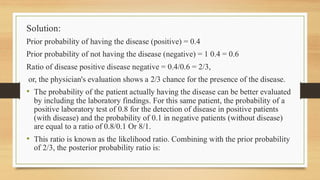
Solution:
Prior probability of having the disease (positive) = 0.4
Prior probability of not having the disease (negative) = 1 0.4 = 0.6
Ratio of disease positive disease negative = 0.4/0.6 = 2/3,
or, the physician's evaluation shows a 2/3 chance for the presence of the disease.
• The probability of the patient actually having the disease can be better evaluated
by including the laboratory findings. For this same patient, the probability of a
positive laboratory test of 0.8 for the detection of disease in positive patients
(with disease) and the probability of 0.1 in negative patients (without disease)
are equal to a ratio of 0.8/0.1 Or 8/1.
• This ratio is known as the likelihood ratio. Combining with the prior probability
of 2/3, the posterior probability ratio is:
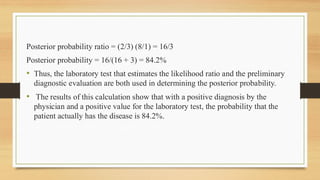
Posterior probability ratio = (2/3) (8/1) = 16/3
Posterior probability = 16/(16 + 3) = 84.2%
• Thus, the laboratory test that estimates the likelihood ratio and the preliminary
diagnostic evaluation are both used in determining the posterior probability.
• The results of this calculation show that with a positive diagnosis by the
physician and a positive value for the laboratory test, the probability that the
patient actually has the disease is 84.2%.
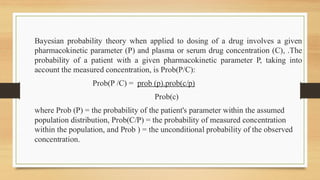
Bayesian probability theory when applied to dosing of a drug involves a given
pharmacokinetic parameter (P) and plasma or serum drug concentration (C), .The
probability of a patient with a given pharmacokinetic parameter P, taking into
account the measured concentration, is Prob(P/C):
Prob(P /C) = prob (p).prob(c/p)
Prob(c)
where Prob (P) = the probability of the patient's parameter within the assumed
population distribution, Prob(C/P) = the probability of measured concentration
within the population, and Prob ) = the unconditional probability of the observed
concentration.
EXAMPLE
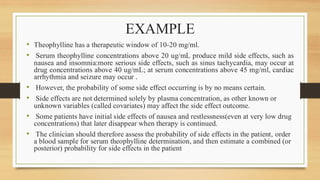
• Theophylline has a therapeutic window of 10-20 mg/ml.
• Serum theophylline concentrations above 20 ug/mL produce mild side effects, such as
nausea and insomnia:more serious side effects, such as sinus tachycardia, may occur at
drug concentrations above 40 ug/mL; at serum concentrations above 45 mg/ml, cardiac
arrhythmia and seizure may occur .
• However, the probability of some side effect occurring is by no means certain.
• Side effects are not determined solely by plasma concentration, as other known or
unknown variables (called covariates) may affect the side effect outcome.
• Some patients have initial side effects of nausea and restlessness(even at very low drug
concentrations) that later disappear when therapy is continued.
• The clinician should therefore assess the probability of side effects in the patient, order
a blood sample for serum theophylline determination, and then estimate a combined (or
posterior) probability for side effects in the patient
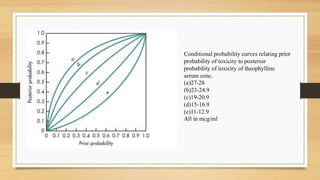
Conditional probability curves relating prior
probability of toxicity to posterior
probability of toxicity of theophylline
serum conc.
(a)27-28
(b)23-24.9
(c)19-20.9
(d)15-16.9
(e)11-12.9
All in mcg/ml
• The probability of initial (prior) estimation of side effects is plotted on the x axis, and
the final (posterior) probability of side effects is plotted on the y axis for various serum
theophylline concentrations.
• For example, a patient was placed on theophylline and the physician estimated the
chance of side effects to be 40%, but therapeutic drug monitoring showed a
theophylline Level of 27 ug/ml.
• A vertical line of prior probability at 0.4 intersects curve a at about 0.78 or 78%. Hence,
the Bayesian probability of having side effects is 78% taking both the laboratory and
physician assessments into consideration.
• The curves for various theophylline concentrations are called conditional probability
curves.
• Bayesian theory does not replace clinical judgment, but it provides a quantitative tool
for incorporating subjective judgment (human) with objective (laboratory assay) in
making risk decisions.When complex decisions involving several variables are
involved, this objective tool can be very useful
• Bayesian probability is used to improve forecasting in medicine. One example is
its use in the diagnosis of healed myocardial infarction (HMI) from a 12-lead
electrocardiogram (ECG) by artificial neural networks using the Bayesian
concept.Bayesian results were comparable to those of an experienced electro
cardiographer (Haden et al, 1996).
• In pharmacokinetics, Bayesian theory is applied to "feed-forward neural
networks" for gentamicin concentration predictions (Smith andBrier, 1996). A
brief literature search of Bayesian applications revealed over 400 therapeutic
applications.
• Bayesian parameter estimations were most frequently used for drugs with
narrow therapeutic ranges, such as the therapeutic applications between 1992 to
1996.
• Bayesian parameter estimationaminoglycosides, cyclosporin, digoxin,
anticonvulsants (especially phenytoin),lithium, and theophylline.
• The technique has now been extended to cytotoxic drugs. factor VIII, and
warfarin.
• Bayesian methods have also been used to limit the number of samples required
in more conventional pharmacokinetic studies with new drugs.
• The main disadvantage of Bayesian methods is the subjective selection of prior
probability. Therefore, it is not considered to be unbiased by many statisticians
for drug approval purposes.
Thank you
ganapathigreat@gmail.com

Bayesian theory with examples and formuls.pdf

  • 1.
  • 2.
    Bayesian theory • Bayesiantheory was originally developed to improve accuracy by combining subjective prediction with improvement from newly collected data. • In the diagnosis of disease, the physician may make a preliminary diagnosis based on symptoms and physical examination. • Later, the results of laboratory tests are received.The clinician then makes a new diagnostic forecast based on both sets of information. • Bayesian theory provides a method to weigh the prior information (eg.physical diagnosis) and new information (eg, results from laboratory tests) to estimate a new probability for predicting the disease.
  • 3.
    • In developinga drug dosage regimen, assess the patient's medical history and then use average or population pharmacokinetic parameters appropriate for the patient condition to calculate the initial dose. • After the initial dose, plasma or serum drug concentrations are obtained from the patient that provide new information to assess the adequacy of the dosage. • The dosing approach of combining old information with new involves a "feedback" process and is, to some degree, inherent in many dosing methods involving some parameter readjustment when new serum drug concentrations become known. • The advantage of the Bayesian approach is the improvement in estimating the patient's pharmacokinetic parameters.
  • 4.
    EXAMPLE After diagnosing apatient, the physician gave the patient a probability of 0.4 of having a disease. The physician then ordered a clinical laboratory test. A positive laboratory test value had a probability of 0,8 of positively identifying the disease in patients with the disease (true positive) and a probability of 0.1 of positive identification of the disease in subjects without the disease (False positive). From the prior information (physicians diagnosis) and current patient specific data (laboratory test), what is the posterior probability of the patient having the disease using the Bayesian method?
  • 5.
    Solution: Prior probability ofhaving the disease (positive) = 0.4 Prior probability of not having the disease (negative) = 1 0.4 = 0.6 Ratio of disease positive disease negative = 0.4/0.6 = 2/3, or, the physician's evaluation shows a 2/3 chance for the presence of the disease. • The probability of the patient actually having the disease can be better evaluated by including the laboratory findings. For this same patient, the probability of a positive laboratory test of 0.8 for the detection of disease in positive patients (with disease) and the probability of 0.1 in negative patients (without disease) are equal to a ratio of 0.8/0.1 Or 8/1. • This ratio is known as the likelihood ratio. Combining with the prior probability of 2/3, the posterior probability ratio is:
  • 6.
    Posterior probability ratio= (2/3) (8/1) = 16/3 Posterior probability = 16/(16 + 3) = 84.2% • Thus, the laboratory test that estimates the likelihood ratio and the preliminary diagnostic evaluation are both used in determining the posterior probability. • The results of this calculation show that with a positive diagnosis by the physician and a positive value for the laboratory test, the probability that the patient actually has the disease is 84.2%.
  • 7.
    Bayesian probability theorywhen applied to dosing of a drug involves a given pharmacokinetic parameter (P) and plasma or serum drug concentration (C), .The probability of a patient with a given pharmacokinetic parameter P, taking into account the measured concentration, is Prob(P/C): Prob(P /C) = prob (p).prob(c/p) Prob(c) where Prob (P) = the probability of the patient's parameter within the assumed population distribution, Prob(C/P) = the probability of measured concentration within the population, and Prob ) = the unconditional probability of the observed concentration.
  • 8.
    EXAMPLE • Theophylline hasa therapeutic window of 10-20 mg/ml. • Serum theophylline concentrations above 20 ug/mL produce mild side effects, such as nausea and insomnia:more serious side effects, such as sinus tachycardia, may occur at drug concentrations above 40 ug/mL; at serum concentrations above 45 mg/ml, cardiac arrhythmia and seizure may occur . • However, the probability of some side effect occurring is by no means certain. • Side effects are not determined solely by plasma concentration, as other known or unknown variables (called covariates) may affect the side effect outcome. • Some patients have initial side effects of nausea and restlessness(even at very low drug concentrations) that later disappear when therapy is continued. • The clinician should therefore assess the probability of side effects in the patient, order a blood sample for serum theophylline determination, and then estimate a combined (or posterior) probability for side effects in the patient
  • 9.
    Conditional probability curvesrelating prior probability of toxicity to posterior probability of toxicity of theophylline serum conc. (a)27-28 (b)23-24.9 (c)19-20.9 (d)15-16.9 (e)11-12.9 All in mcg/ml
  • 10.
    • The probabilityof initial (prior) estimation of side effects is plotted on the x axis, and the final (posterior) probability of side effects is plotted on the y axis for various serum theophylline concentrations. • For example, a patient was placed on theophylline and the physician estimated the chance of side effects to be 40%, but therapeutic drug monitoring showed a theophylline Level of 27 ug/ml. • A vertical line of prior probability at 0.4 intersects curve a at about 0.78 or 78%. Hence, the Bayesian probability of having side effects is 78% taking both the laboratory and physician assessments into consideration. • The curves for various theophylline concentrations are called conditional probability curves. • Bayesian theory does not replace clinical judgment, but it provides a quantitative tool for incorporating subjective judgment (human) with objective (laboratory assay) in making risk decisions.When complex decisions involving several variables are involved, this objective tool can be very useful
  • 11.
    • Bayesian probabilityis used to improve forecasting in medicine. One example is its use in the diagnosis of healed myocardial infarction (HMI) from a 12-lead electrocardiogram (ECG) by artificial neural networks using the Bayesian concept.Bayesian results were comparable to those of an experienced electro cardiographer (Haden et al, 1996). • In pharmacokinetics, Bayesian theory is applied to "feed-forward neural networks" for gentamicin concentration predictions (Smith andBrier, 1996). A brief literature search of Bayesian applications revealed over 400 therapeutic applications. • Bayesian parameter estimations were most frequently used for drugs with narrow therapeutic ranges, such as the therapeutic applications between 1992 to 1996.
  • 12.
    • Bayesian parameterestimationaminoglycosides, cyclosporin, digoxin, anticonvulsants (especially phenytoin),lithium, and theophylline. • The technique has now been extended to cytotoxic drugs. factor VIII, and warfarin. • Bayesian methods have also been used to limit the number of samples required in more conventional pharmacokinetic studies with new drugs. • The main disadvantage of Bayesian methods is the subjective selection of prior probability. Therefore, it is not considered to be unbiased by many statisticians for drug approval purposes.

  • 13.