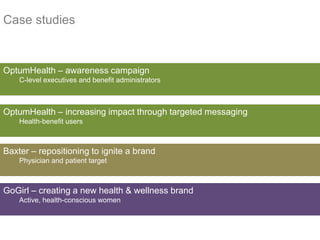
Baxter – repositioning to ignite a brand
Physician and patient target
OptumHealth – awareness campaign
C-level executives and benefit administrators
GoGirl – creating a new health & wellness brand
Active, health-conscious women
OptumHealth – increasing impact through targeted messaging
Health-benefit users
Case studies
Awareness campaign
Opportunities to position OptumHealth Financial Services as
an expert in financial health products and complementing
benefit packages were explored through a broad scope
“awareness” campaign aimed to create comfort around the
OHFS brand and to make adoption of OHFS products easy.
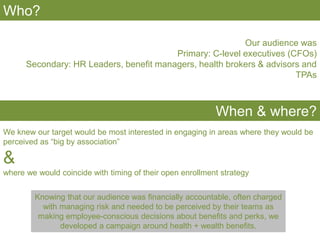
Who?
Our audience was
Primary: C-level executives (CFOs)
Secondary: HR Leaders, benefit managers, health brokers & advisors and
TPAs
When & where?
We knew our target would be most interested in engaging in areas where they would be
perceived as “big by association”
&
where we would coincide with timing of their open enrollment strategy
Knowing that our audience was financially accountable, often charged
with managing risk and needed to be perceived by their teams as
making employee-conscious decisions about benefits and perks, we
developed a campaign around health + wealth benefits.
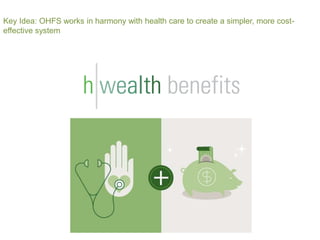
Key Idea: OHFS works in harmony with health care to create a simpler, more cost-
effective system
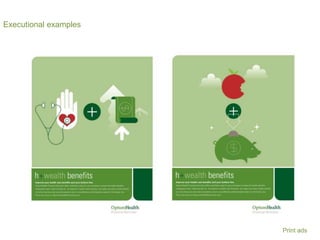
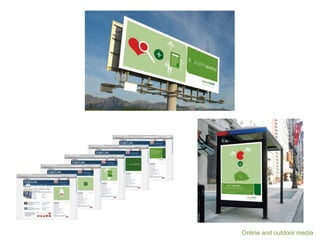
Executional examples
Print ads
Online and outdoor media
Increasing impact through targeted messaging
Healthcare Spending Accounts (HSAs)* have grown in
importance for both companies and consumers. Yet many
consumers don’t fully understand the benefits of an HSA and
subsequently fail to adequately fund them
*A health savings account (HSA) is a tax-advantaged medical savings account available to taxpayers in the US who are enrolled in a High Deductable Health
Plan (HDHP). The funds contributed to the account are not subject to federal income tax at the time of deposit. Source: Wikipedia
Our challenge was to increase
OptumHealth HSA deposits, with special
emphasis on customers who have not
made any contributions to their HSAs
and those aged 55+
Key to increasing deposits: understanding HSAs
serve different roles for different people
In reviewing the research, we discovered that HSAs are actually
fulfilling different needs for different customers. For example, some
customers see their HSA as an investment and prefer to let their HSA
grow. While others see HSAs as a bank account that they can draw
on to pay for medical expenses as they occur.
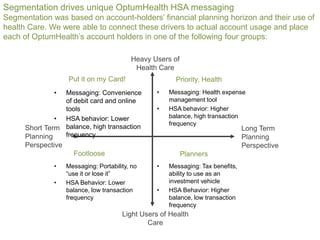
Segmentation drives unique OptumHealth HSA messaging
Segmentation was based on account-holders’ financial planning horizon and their use of
health Care. We were able to connect these drivers to actual account usage and place
each of OptumHealth’s account holders in one of the following four groups:
Light Users of Health
Care
Heavy Users of
Health Care
Short Term
Planning
Perspective
Long Term
Planning
Perspective
• Messaging: Convenience
of debit card and online
tools
• HSA behavior: Lower
balance, high transaction
frequency
• Messaging: Portability, no
“use it or lose it”
• HSA Behavior: Lower
balance, low transaction
frequency
• Messaging: Tax benefits,
ability to use as an
investment vehicle
• HSA Behavior: Higher
balance, low transaction
frequency
• Messaging: Health expense
management tool
• HSA behavior: Higher
balance, high transaction
frequency
Put it on my Card! Priority, Health
Footloose Planners
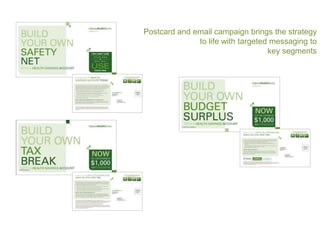
Postcard and email campaign brings the strategy
to life with targeted messaging to
key segments
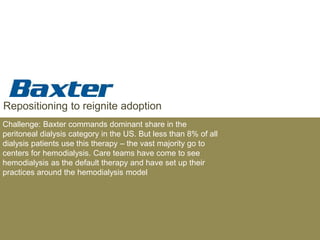
Repositioning to reignite adoption
Challenge: Baxter commands dominant share in the
peritoneal dialysis category in the US. But less than 8% of all
dialysis patients use this therapy – the vast majority go to
centers for hemodialysis. Care teams have come to see
hemodialysis as the default therapy and have set up their
practices around the hemodialysis model
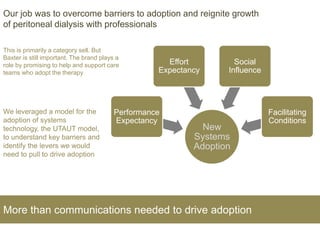
New
Systems
Adoption
Performance
Expectancy
Effort
Expectancy
Social
Influence
Facilitating
Conditions
This is primarily a category sell. But
Baxter is still important. The brand plays a
role by promising to help and support care
teams who adopt the therapy
More than communications needed to drive adoption
Our job was to overcome barriers to adoption and reignite growth
of peritoneal dialysis with professionals
We leveraged a model for the
adoption of systems
technology, the UTAUT model,
to understand key barriers and
identify the levers we would
need to pull to drive adoption
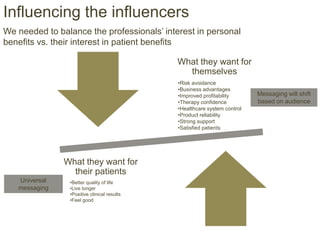
Influencing the influencers
We needed to balance the professionals’ interest in personal
benefits vs. their interest in patient benefits
What they want for
themselves
What they want for
their patients
•Risk avoidance
•Business advantages
•Improved profitability
•Therapy confidence
•Healthcare system control
•Product reliability
•Strong support
•Satisfied patients
•Better quality of life
•Live longer
•Positive clinical results
•Feel good
Messaging will shift
based on audience
Universal
messaging
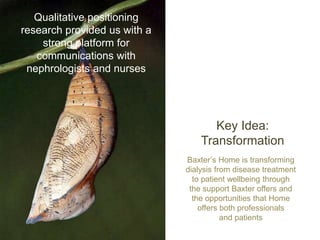
Key Idea:
Transformation
Qualitative positioning
research provided us with a
strong platform for
communications with
nephrologists and nurses
Baxter’s Home is transforming
dialysis from disease treatment
to patient wellbeing through
the support Baxter offers and
the opportunities that Home
offers both professionals
and patients
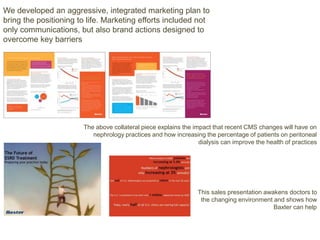
We developed an aggressive, integrated marketing plan to
bring the positioning to life. Marketing efforts included not
only communications, but also brand actions designed to
overcome key barriers
The above collateral piece explains the impact that recent CMS changes will have on
nephrology practices and how increasing the percentage of patients on peritoneal
dialysis can improve the health of practices
This sales presentation awakens doctors to
the changing environment and shows how
Baxter can help
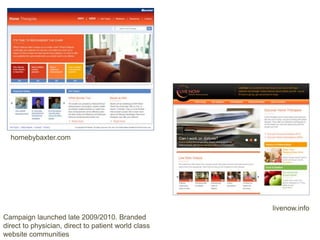
Campaign launched late 2009/2010. Branded
direct to physician, direct to patient world class
website communities
homebybaxter.com
livenow.info
To engage patients directly and help them understand the PD option, RMG
worked intensively with Baxter to develop a branded consumer movement called
Live Now.
The name connotes optimism and energy, and the warm, upbeat color palette
and active design elements reinforce the message.
The brand soft-launched in October 2010 and complements the physician-
targeted effort, Home by Baxter.
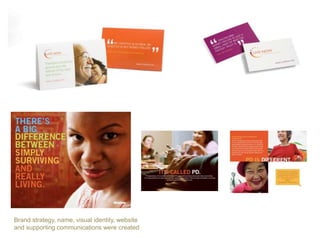
Brand strategy, name, visual identity, website
and supporting communications were created
Creating a new health & wellness brand
Challenge: F.U.D. Or feminine urinary device. How do you
introduce and generate widespread acceptance and adoption
of this handy little device that lets ladies pee while standing
up?
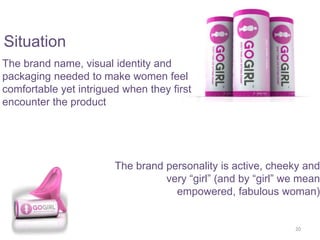
The brand name, visual identity and
packaging needed to make women feel
comfortable yet intrigued when they first
encounter the product
The brand personality is active, cheeky and
very “girl” (and by “girl” we mean
empowered, fabulous woman)
20
Situation
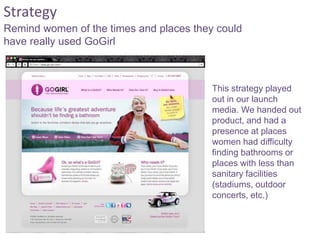
This strategy played
out in our launch
media. We handed out
product, and had a
presence at places
women had difficulty
finding bathrooms or
places with less than
sanitary facilities
(stadiums, outdoor
concerts, etc.)
Remind women of the times and places they could
have really used GoGirl
Strategy
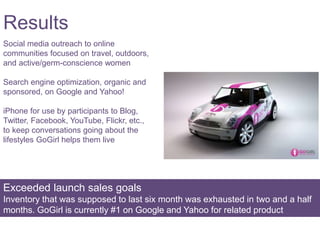
Social media outreach to online
communities focused on travel, outdoors,
and active/germ-conscience women
Search engine optimization, organic and
sponsored, on Google and Yahoo!
iPhone for use by participants to Blog,
Twitter, Facebook, YouTube, Flickr, etc.,
to keep conversations going about the
lifestyles GoGirl helps them live
Exceeded launch sales goals
Inventory that was supposed to last six month was exhausted in two and a half
months. GoGirl is currently #1 on Google and Yahoo for related product
searches
Results

Baxter, OH, OH and GoGirl

  • 1.
    Baxter – repositioningto ignite a brand Physician and patient target OptumHealth – awareness campaign C-level executives and benefit administrators GoGirl – creating a new health & wellness brand Active, health-conscious women OptumHealth – increasing impact through targeted messaging Health-benefit users Case studies
  • 2.
    Awareness campaign Opportunities toposition OptumHealth Financial Services as an expert in financial health products and complementing benefit packages were explored through a broad scope “awareness” campaign aimed to create comfort around the OHFS brand and to make adoption of OHFS products easy.
  • 3.
    Who? Our audience was Primary:C-level executives (CFOs) Secondary: HR Leaders, benefit managers, health brokers & advisors and TPAs When & where? We knew our target would be most interested in engaging in areas where they would be perceived as “big by association” & where we would coincide with timing of their open enrollment strategy Knowing that our audience was financially accountable, often charged with managing risk and needed to be perceived by their teams as making employee-conscious decisions about benefits and perks, we developed a campaign around health + wealth benefits.
  • 4.
    Key Idea: OHFSworks in harmony with health care to create a simpler, more cost- effective system
  • 5.
  • 6.
  • 7.
    Increasing impact throughtargeted messaging Healthcare Spending Accounts (HSAs)* have grown in importance for both companies and consumers. Yet many consumers don’t fully understand the benefits of an HSA and subsequently fail to adequately fund them *A health savings account (HSA) is a tax-advantaged medical savings account available to taxpayers in the US who are enrolled in a High Deductable Health Plan (HDHP). The funds contributed to the account are not subject to federal income tax at the time of deposit. Source: Wikipedia
  • 8.
    Our challenge wasto increase OptumHealth HSA deposits, with special emphasis on customers who have not made any contributions to their HSAs and those aged 55+ Key to increasing deposits: understanding HSAs serve different roles for different people In reviewing the research, we discovered that HSAs are actually fulfilling different needs for different customers. For example, some customers see their HSA as an investment and prefer to let their HSA grow. While others see HSAs as a bank account that they can draw on to pay for medical expenses as they occur.
  • 9.
    Segmentation drives uniqueOptumHealth HSA messaging Segmentation was based on account-holders’ financial planning horizon and their use of health Care. We were able to connect these drivers to actual account usage and place each of OptumHealth’s account holders in one of the following four groups: Light Users of Health Care Heavy Users of Health Care Short Term Planning Perspective Long Term Planning Perspective • Messaging: Convenience of debit card and online tools • HSA behavior: Lower balance, high transaction frequency • Messaging: Portability, no “use it or lose it” • HSA Behavior: Lower balance, low transaction frequency • Messaging: Tax benefits, ability to use as an investment vehicle • HSA Behavior: Higher balance, low transaction frequency • Messaging: Health expense management tool • HSA behavior: Higher balance, high transaction frequency Put it on my Card! Priority, Health Footloose Planners
  • 10.
    Postcard and emailcampaign brings the strategy to life with targeted messaging to key segments
  • 11.
    Repositioning to reigniteadoption Challenge: Baxter commands dominant share in the peritoneal dialysis category in the US. But less than 8% of all dialysis patients use this therapy – the vast majority go to centers for hemodialysis. Care teams have come to see hemodialysis as the default therapy and have set up their practices around the hemodialysis model
  • 12.
    New Systems Adoption Performance Expectancy Effort Expectancy Social Influence Facilitating Conditions This is primarilya category sell. But Baxter is still important. The brand plays a role by promising to help and support care teams who adopt the therapy More than communications needed to drive adoption Our job was to overcome barriers to adoption and reignite growth of peritoneal dialysis with professionals We leveraged a model for the adoption of systems technology, the UTAUT model, to understand key barriers and identify the levers we would need to pull to drive adoption
  • 13.
    Influencing the influencers Weneeded to balance the professionals’ interest in personal benefits vs. their interest in patient benefits What they want for themselves What they want for their patients •Risk avoidance •Business advantages •Improved profitability •Therapy confidence •Healthcare system control •Product reliability •Strong support •Satisfied patients •Better quality of life •Live longer •Positive clinical results •Feel good Messaging will shift based on audience Universal messaging
  • 14.
    Key Idea: Transformation Qualitative positioning researchprovided us with a strong platform for communications with nephrologists and nurses Baxter’s Home is transforming dialysis from disease treatment to patient wellbeing through the support Baxter offers and the opportunities that Home offers both professionals and patients
  • 15.
    We developed anaggressive, integrated marketing plan to bring the positioning to life. Marketing efforts included not only communications, but also brand actions designed to overcome key barriers The above collateral piece explains the impact that recent CMS changes will have on nephrology practices and how increasing the percentage of patients on peritoneal dialysis can improve the health of practices This sales presentation awakens doctors to the changing environment and shows how Baxter can help
  • 16.
    Campaign launched late2009/2010. Branded direct to physician, direct to patient world class website communities homebybaxter.com livenow.info
  • 17.
    To engage patientsdirectly and help them understand the PD option, RMG worked intensively with Baxter to develop a branded consumer movement called Live Now. The name connotes optimism and energy, and the warm, upbeat color palette and active design elements reinforce the message. The brand soft-launched in October 2010 and complements the physician- targeted effort, Home by Baxter.
  • 18.
    Brand strategy, name,visual identity, website and supporting communications were created
  • 19.
    Creating a newhealth & wellness brand Challenge: F.U.D. Or feminine urinary device. How do you introduce and generate widespread acceptance and adoption of this handy little device that lets ladies pee while standing up?
  • 20.
    The brand name,visual identity and packaging needed to make women feel comfortable yet intrigued when they first encounter the product The brand personality is active, cheeky and very “girl” (and by “girl” we mean empowered, fabulous woman) 20 Situation
  • 21.
    This strategy played outin our launch media. We handed out product, and had a presence at places women had difficulty finding bathrooms or places with less than sanitary facilities (stadiums, outdoor concerts, etc.) Remind women of the times and places they could have really used GoGirl Strategy
  • 22.
    Social media outreachto online communities focused on travel, outdoors, and active/germ-conscience women Search engine optimization, organic and sponsored, on Google and Yahoo! iPhone for use by participants to Blog, Twitter, Facebook, YouTube, Flickr, etc., to keep conversations going about the lifestyles GoGirl helps them live Exceeded launch sales goals Inventory that was supposed to last six month was exhausted in two and a half months. GoGirl is currently #1 on Google and Yahoo for related product searches Results