Submitted to: Submitted by:
Er.Deepesh Namdev Name: Aveen Meena
HOD cum Asso. Prof. Roll no.:10EGKEC011
(E&C, EE Department)
DEPARTMENT OF ELECTRONICS & COMMUNICATION ENGG.
Gurukul Institute of Engineering & Technology, Kota
Contents
 INTRODUCTION
 PRINCIPLE OF OPERATION
 TRANSMITTER
 RECEIVER
 IMPLEMENTAION
 ADVANTAGES
 DISADVANTAGES
 CONCLUSION
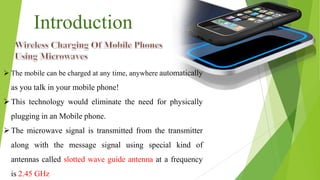
Introduction
 The mobile can be charged at any time, anywhere automatically
as you talk in your mobile phone!
This technology would eliminate the need for physically
plugging in an Mobile phone.
The microwave signal is transmitted from the transmitter
along with the message signal using special kind of
antennas called slotted wave guide antenna at a frequency
is 2.45 GHz
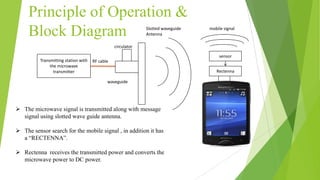
Principle of Operation &
Block Diagram
Transmitting station with
the microwave
transmitter
sensor
Rectenna
RF cable
circulator
waveguide
Slotted waveguide
Antenna
mobile signal
 The microwave signal is transmitted along with message
signal using slotted wave guide antenna.
 The sensor search for the mobile signal , in addition it has
a “RECTENNA”.
 Rectenna receives the transmitted power and converts the
microwave power to DC power.
TRANSMITTER
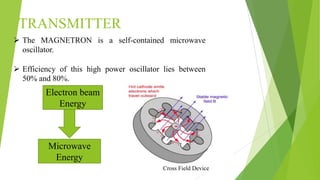
 The MAGNETRON is a self-contained microwave
oscillator.
 Efficiency of this high power oscillator lies between
50% and 80%.
Electron beam
Energy
Microwave
Energy
Cross Field Device
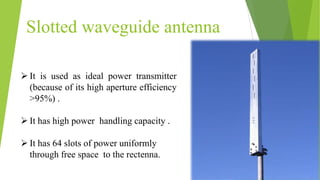
Slotted waveguide antenna
 It is used as ideal power transmitter
(because of its high aperture efficiency
>95%) .
 It has high power handling capacity .
 It has 64 slots of power uniformly
through free space to the rectenna.
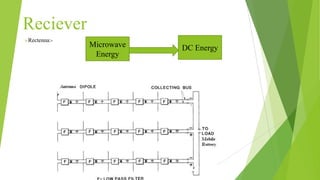
Reciever
Rectenna:-
Microwave
Energy
DC Energy
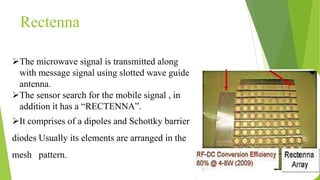
The microwave signal is transmitted along
with message signal using slotted wave guide
antenna.
The sensor search for the mobile signal , in
addition it has a “RECTENNA”.
It comprises of a dipoles and Schottky barrier
diodes Usually its elements are arranged in the
mesh pattern.
Rectenna
Implementation
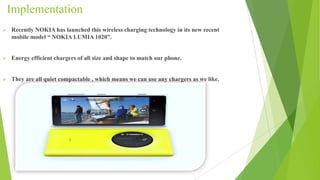
 Recently NOKIA has launched this wireless charging technology in its new recent
mobile model “ NOKIA LUMIA 1020”.
 Energy efficient chargers of all size and shape to match our phone.
 They are all quiet compactable , which means we can use any chargers as we like.
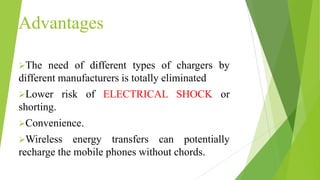
Advantages
The need of different types of chargers by
different manufacturers is totally eliminated
Lower risk of ELECTRICAL SHOCK or
shorting.
Convenience.
Wireless energy transfers can potentially
recharge the mobile phones without chords.
Disadvantages
Wireless transmission of the energy causes some
drastic effects to human body, because of its
radiation
Process is of high cost.
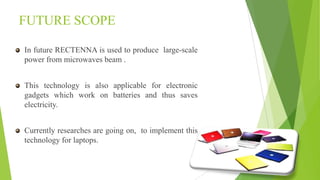
FUTURE SCOPE
In future RECTENNA is used to produce large-scale
power from microwaves beam .
This technology is also applicable for electronic
gadgets which work on batteries and thus saves
electricity.
Currently researches are going on, to implement this
technology for laptops.
Conclusion
 Thus this paper successfully demonstrates a
method of using the power of microwave to
charge mobile phones without use of wired
chargers.
Wireless charging of mobile phones by using microwaves

Wireless charging of mobile phones by using microwaves

  • 1.
    Submitted to: Submittedby: Er.Deepesh Namdev Name: Aveen Meena HOD cum Asso. Prof. Roll no.:10EGKEC011 (E&C, EE Department) DEPARTMENT OF ELECTRONICS & COMMUNICATION ENGG. Gurukul Institute of Engineering & Technology, Kota
  • 2.
    Contents  INTRODUCTION  PRINCIPLEOF OPERATION  TRANSMITTER  RECEIVER  IMPLEMENTAION  ADVANTAGES  DISADVANTAGES  CONCLUSION
  • 3.
    Introduction  The mobilecan be charged at any time, anywhere automatically as you talk in your mobile phone! This technology would eliminate the need for physically plugging in an Mobile phone. The microwave signal is transmitted from the transmitter along with the message signal using special kind of antennas called slotted wave guide antenna at a frequency is 2.45 GHz
  • 4.
    Principle of Operation& Block Diagram Transmitting station with the microwave transmitter sensor Rectenna RF cable circulator waveguide Slotted waveguide Antenna mobile signal  The microwave signal is transmitted along with message signal using slotted wave guide antenna.  The sensor search for the mobile signal , in addition it has a “RECTENNA”.  Rectenna receives the transmitted power and converts the microwave power to DC power.
  • 5.
    TRANSMITTER  The MAGNETRONis a self-contained microwave oscillator.  Efficiency of this high power oscillator lies between 50% and 80%. Electron beam Energy Microwave Energy Cross Field Device
  • 6.
    Slotted waveguide antenna It is used as ideal power transmitter (because of its high aperture efficiency >95%) .  It has high power handling capacity .  It has 64 slots of power uniformly through free space to the rectenna.
  • 7.
  • 8.
    The microwave signalis transmitted along with message signal using slotted wave guide antenna. The sensor search for the mobile signal , in addition it has a “RECTENNA”. It comprises of a dipoles and Schottky barrier diodes Usually its elements are arranged in the mesh pattern. Rectenna
  • 9.
    Implementation  Recently NOKIAhas launched this wireless charging technology in its new recent mobile model “ NOKIA LUMIA 1020”.  Energy efficient chargers of all size and shape to match our phone.  They are all quiet compactable , which means we can use any chargers as we like.
  • 10.
    Advantages The need ofdifferent types of chargers by different manufacturers is totally eliminated Lower risk of ELECTRICAL SHOCK or shorting. Convenience. Wireless energy transfers can potentially recharge the mobile phones without chords.
  • 11.
    Disadvantages Wireless transmission ofthe energy causes some drastic effects to human body, because of its radiation Process is of high cost.
  • 12.
    FUTURE SCOPE In futureRECTENNA is used to produce large-scale power from microwaves beam . This technology is also applicable for electronic gadgets which work on batteries and thus saves electricity. Currently researches are going on, to implement this technology for laptops.
  • 13.
    Conclusion  Thus thispaper successfully demonstrates a method of using the power of microwave to charge mobile phones without use of wired chargers.