z
BASKETBALL
P.E 204 Physical Activities Towards
Health – Fitness 2
Prepared by: Alberto B. Rosete
z
Chapter III
 A. History of the Game
 B. Development of the Game
 C. Facilities and equipment
 D. Terminology
 E. Officiating Officials
z HISTORY OF THE GAME
 History Basketball was invented during the school year of
1891-92 at Springfield College in Springfield, Massachusetts.
Dr. James A. Naismith conceived the idea of attaching peach
baskets at opposite ends of the gym on the track that encircled
the playing floor. This is where the height of 10 feet for the
basket was arrived at. Basketball derives its name from the
original ball and basket used in the first games. The game was
introduced in YMCA’s across America and also to foreign
countries. Basketball became part of the Olympic Games in
1936.
z
 Under those first rules, a single point was scored for a made basket. The first game
would have a final score of 1-0.
 The game of basketball grew very rapidly, with college teams forming leagues within
the first decade of the game’s invention. Naismith himself would become a college
coach for the game, joining the University of Kansas in 1898. He would amass a
win/loss record of 55-60.
 This means James Naismith, the inventor of basketball, is also the only coach in
Kansas history to have a losing record.
z
How Basketball Was Able to Storm the World
 Basketball was introduced to the rest of the world due to efforts
from the US Army and the YMCA. In 1893, the first
international basketball match was organized. Members took
the game to India, Japan, Persia, and China as well.
 In 1895, the first recorded basketball game between two
college teams was organized. The University of Minnesota
A&M faced Hamline University under 9-on-9 rules, winning the
game 9-3. In 1896, the first collegiate 5-on-5 game was played
between Iowa and the University of Chicago, with Chicago
winning 15-12.
z
 By 1898, professional leagues were forming, as were collegiate
leagues. Six teams took part in the first professional basketball
league, but the league was disbanded in 1904. Between then and
World War I, small championships were created and some teams
played for money against challengers. This includes the original
Celtics basketball team.
 By 1900, most major colleges were fielding a basketball team. In
1905, formal collegiate rules were introduced for basketball and in
1909, the NCAA would take over the game for good. The first NCAA
DI tournament would be held in 1939.
z
The Formation of FIBA
 In the first decades of basketball, it was growing as a sport, but
had no real international organization. It took several petitions by
basketball supporters to have basketball included as an Olympic
demonstration sport in 1904.
 That all changed on June 18, 1932 when FIBA was first formed.
The work of FIBA on the international game would help to make
basketball become an Olympic sport in 1936, which was won by
the US National Team.
 Naismith would live long enough to get to see the sport that he
had invented become a recognized Olympic sport.
z
The Evolution of the Game
A Chronological Look At The Major Refinements
 Dr. Naismith, with all of his imaginative planning, could not have
dreamed his "Peach Basket" game would develop into the world's
greatest indoor sport. Although the original 13 rules have been
expanded to over 100, the spirit and principles of the original rules are
still in effect in today. Major rule changes over the years addressed the
number of players, the court boundaries, dribbling, and the elimination
of the center jump after made baskets. In the mid 1930's inter-sectional
competition led to a standardization of rules throughout the country.
z
Team Size
 Originally, there was no set rule on the number of
players. The idea was that the game could be played by
any number of players. However, that did not work out.
After experimenting with teams up to 50 players, early
games were primarily played by nine players on each
side - the reason being that 18 students showed up
for Naismith's class. In 1897 five players became
the mandatory team size.
z
Substitutions
 Initially, players were not allowed to re-enter the game.
The rule was changed in 1920 to allow a player to re-
enter the game one time. In 1934, the rule was
expanded to allow players to re-enter the game twice,
and, in 1945 the rule was finally changed to permit
players to return to the game an unlimited number of
times.
z
Baskets
 Originally, the game was played with peach baskets or 18” square
boxes hung from the balconies of the running tracks of most indoor
facilities. At this time the basket height was established at 10 feet,
which still stands today. Obviously, the peach baskets and boxes
slowed the game down since the ball had to be retrieved after every
goal either by someone on the running track or by ladder. The peach
baskets were replaced first by heavy woven wire rims in 1892. Then,
a year later, in 1893 cast iron rims were used. Open ended nylon nets
were approved for use in 1912. This was a major milestone for
basketball since the free falling ball after a made basket dramatically
increased tempo and scoring of the game.
z
Backboards
 Wire mesh backboards were introduced in 1895 to prevent
spectators in the balconies from interfering with play. Wood replaced
the easily dented wire mesh backboards in 1904, and plate glass
backboard usage was approved in 1909. Backboards were mounted
flat against walls. In 1916 to prevent players from running up the
walls for easy lay-ups, a two foot gap was between the backboard
and the endline was required. In 1939 this gap was increased from
2 feet to the present 4 feet to allow for more movement underneath
the basket.
z
The Ball
 The first basketball games were played with soccer balls. However, they proved to
be unsuitable for dribbling and ball handling. The first manufactured basketballs
were produced in 1894 by a bicycle manufacturing company. In the late 1890's
Spalding took over as the official ball maker. In 1905 the choice of basketballs
was left up to the teams. Because of their inability to maintain their shape and their
laces, these early brown leather basketballs were hard to dribble. In 1929
basketballs were re-designed for more bounce and with concealed laces which
eliminated erratic bounces. The balls were bigger, lighter and easier to handle.
In 1942 molded basketballs that maintained a constant shape and size replaced
the stitched balls. In 1967 the American Basketball Association (ABA) played with
a red, white and blue basketball. Today, the WNBA and FIBA use contrasting
panels. The men's ball is 30" in circumference and the smaller women's ball is 29"
in circumference.
z
Scoring
 Originally, a successful goal was counted as one point, and one
point was also given to a team anytime three consecutive fouls
were called on the opponent. Free throws were first introduced in
1894. Both a made field goal and a made free throw were
counted as one goal. In 1896, rules were changed to count a
made field goal as two points. In 1961 the short lived American
Basketball League played with the three point shot. In 1967, the
three point shot was introduced into International basketball by
FIBA. The three point shot was adopted by the National
Basketball Association (NBA) in 1977 and by the National
Collegiate Athletic Association (NCAA) in 1980.
z
Timing
 The first games were played in two fifteen minute halves. Shortly later
this was increased to two 20-minutes halves. There was no provision
for extending the game if the score was tied. In fact, the first game
ever played ended in a 2-2 tie. However, once leagues started to be
formed, ties needed to be broken. The first tie breakers were "sudden
death" with the first team to score a point, either a field goal or free
throw, winning the game. Thus, games were decided without one
team having a single ball possession. In the 1960's, in order to
provide each team with an equal chance, Sudden Death was
replaced by overtime periods.
z
Shot Clock
 In 1954 the NBA instituted a 24-second shot clock. This was another
milestone for basketball since it eliminated the common stalling
tactics that were being deployed, sometimes as early as the third
period, by teams' ahead in the game because there was no way for
the team behind to catch up other than to foul. The shot
clock curtailed the end of game fouling and ensuing parade of free
throws which made for a dull game. A 30-second shot clock was
deployed internationally by FIBA in 1956, and in 1985, after a USC
vs UCLA game and a Missouri vs Kansas game where players
actually sat down during the game. The NCAA 45-second shot
clock was further reduced to 35 seconds in 1993. Women have used
a 30-second shot clock since going to a full court game in 1971.
z
Fouls
 Fouls were assessed for using a fist, traveling and physical contact
(holding, pushing, tripping, or striking of an opponent). When a player
committed two fouls they were disqualified until a goal was
scored. For any flagrant fouls, just as today, players were disqualified
for the whole game. When a team committed three consecutive fouls,
without the opponent committing a foul, the opponent was awarded a
goal - the predecessor to today's bonus rules. In 1911, player fouls for
disqualification was increased from two to four, and increased again in
1945 to five fouls. In 1922, traveling or running with the ball was
changed to a violation and no longer considered a foul.
z
Free throws
 When free throws were introduced in 1894 the free throw line was
established at 21 feet from the basket. Anyone could shoot the free
throws. This resulted in teams deploying specialized free throw
shooters. A year later, in 1895, the free throw line was moved closer,
to a distance of fifteen feet from the basket. In 1924, the free throw
rule was amended which required the player who was fouled to shoot
the free throws.
z
Basketball Facilities and Equipment
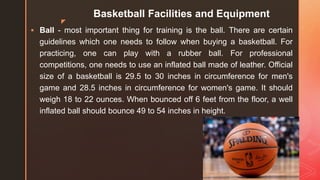
 Ball - most important thing for training is the ball. There are certain
guidelines which one needs to follow when buying a basketball. For
practicing, one can play with a rubber ball. For professional
competitions, one needs to use an inflated ball made of leather. Official
size of a basketball is 29.5 to 30 inches in circumference for men's
game and 28.5 inches in circumference for women's game. It should
weigh 18 to 22 ounces. When bounced off 6 feet from the floor, a well
inflated ball should bounce 49 to 54 inches in height.
z
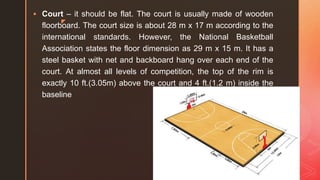
 Court – it should be flat. The court is usually made of wooden
floorboard. The court size is about 28 m x 17 m according to the
international standards. However, the National Basketball
Association states the floor dimension as 29 m x 15 m. It has a
steel basket with net and backboard hang over each end of the
court. At almost all levels of competition, the top of the rim is
exactly 10 ft.(3.05m) above the court and 4 ft.(1.2 m) inside the
baseline
z
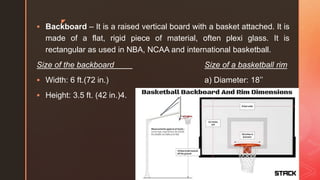
 Backboard – It is a raised vertical board with a basket attached. It is
made of a flat, rigid piece of material, often plexi glass. It is
rectangular as used in NBA, NCAA and international basketball.
Size of the backboard Size of a basketball rim
 Width: 6 ft.(72 in.) a) Diameter: 18’’
 Height: 3.5 ft. (42 in.)4.
z
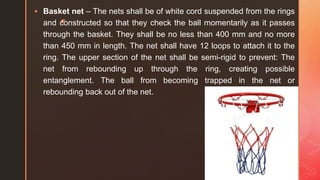
 Basket net – The nets shall be of white cord suspended from the rings
and constructed so that they check the ball momentarily as it passes
through the basket. They shall be no less than 400 mm and no more
than 450 mm in length. The net shall have 12 loops to attach it to the
ring. The upper section of the net shall be semi-rigid to prevent: The
net from rebounding up through the ring, creating possible
entanglement. The ball from becoming trapped in the net or
rebounding back out of the net.
z
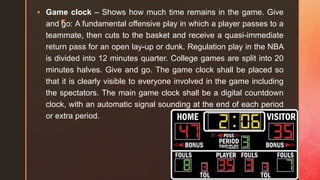
 Game clock – Shows how much time remains in the game. Give
and go: A fundamental offensive play in which a player passes to a
teammate, then cuts to the basket and receive a quasi-immediate
return pass for an open lay-up or dunk. Regulation play in the NBA
is divided into 12 minutes quarter. College games are split into 20
minutes halves. Give and go. The game clock shall be placed so
that it is clearly visible to everyone involved in the game including
the spectators. The main game clock shall be a digital countdown
clock, with an automatic signal sounding at the end of each period
or extra period.
z
The signal shall sound as soon as the display shows zeros (0:00).The
game clocks shall be synchronized and display the playing time
remaining throughout the game. At least during the last 60 seconds of
each period or extra period, the playing time remaining shall be
indicated to the one-tenth (1/10) of a second. If the main game clock is
placed above the center of the playing court, there shall be a
synchronized duplicate game clock at each end of the playing court high
enough so that it can be seen by everyone involved in the game
including the spectators. Each duplicate game clock shall indicate both
the score and the playing time remaining. A whistle-controlled time
system used by the officials to stop the game clock may be used
provided that this system is used in all games of a given competition.
z
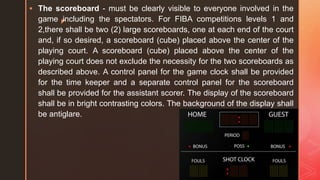
 The scoreboard - must be clearly visible to everyone involved in the
game including the spectators. For FIBA competitions levels 1 and
2,there shall be two (2) large scoreboards, one at each end of the court
and, if so desired, a scoreboard (cube) placed above the center of the
playing court. A scoreboard (cube) placed above the center of the
playing court does not exclude the necessity for the two scoreboards as
described above. A control panel for the game clock shall be provided
for the time keeper and a separate control panel for the scoreboard
shall be provided for the assistant scorer. The display of the scoreboard
shall be in bright contrasting colors. The background of the display shall
be antiglare.
z
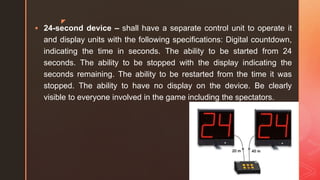
 24-second device – shall have a separate control unit to operate it
and display units with the following specifications: Digital countdown,
indicating the time in seconds. The ability to be started from 24
seconds. The ability to be stopped with the display indicating the
seconds remaining. The ability to be restarted from the time it was
stopped. The ability to have no display on the device. Be clearly
visible to everyone involved in the game including the spectators.
z
Terminology
1.Baseline – the end line
2. Boxing out – a term used to designate a player’s position under the backboard that prevents an
opposing player from achieving a good rebounding position.
3. Carrying – In a carry, your hand makes contact with the bottom of the ball, then flips the ball over
in the act of dribbling.
4. Charging – personal contact against the body of an opponent by a player with the ball.
5. Cut – a quick offensive move by a player trying to get free for a pass.
6. Denial Defense – aggressive individual defense where the defensive player works hard to keep
the offensive player from receiving a pass.
7. Double Dribble – when one person dribbles, stops and picks up the ball and starts to dribble again
or dribble with two hands simultaneously.
8. Dribble – the process of bringing the ball down the floor or moving the ball from place to place
using the finger pads to tap the ball.
9. Drive – an aggressive move toward the basket by a player with the ball.
10. Fake (Feint) – using a deceptive move with the ball to pull the defensive player out of position.
z
11. Fast break – moving the ball quickly down the court in order to score before the
defense can set up.
12. Field Goal - a basket scored from the field, worth two points, unless outside the three
point line.
13. Free throw – the privilege given a player to score one point by an unhindered throw
for a goal from within the free-throw circle and behind the free throw line.
14. Lay-up – a shot where a player releases the ball close to the basket while continuing
to run off one foot.
15. Pick – a special type of screen where a player stands so the defensive player slides
to make contact, freeing an offensive teammate for a shot, drive, or pass.
16. Pivot – takes place when a player who is holding the ball steps once or more than
once in any direction with the same foot. The other foot, called the pivot foot, is kept at
its point of contact with the floor.
17. Press – a team’s attempt to take the ball away from their opponent before they can
set up their offense.
z
18. Rebound – when a shot bounces off the backboard or basket and is pulled down
by a player.
19. Team’s Back Court – the part of the court containing the opponent’s basket.
20. Team’s Front Court – the part of the court containing the team’s own basket.
21. Telegraphing the Pass – indicating where you are going to pass by looking or
signaling.
22. Throw-in – a method of putting the ball in play from out of bounds.
23. Traveling – when a player in possession of the ball within bounds progresses
illegally in any direction.
24. Violation – an infraction of the rules resulting in a throw-in from out of bounds for
the opponents.
z
OFFICIATING OFFICIALS IN BASKETBALL
Referees
 Referees are the main officials of the game. They are the ones who are actually
responsible for enforcing rules and regulations and calling fouls and violations. The
number of referees officiating a game depends on the level of play. In NBA, a crew
chief and two referees are assigned to conduct a game and there official uniform is
gray shirt and black pant. In international basketball or NCAA game, it can be either
one referee and one umpire or one referee and two umpires officiate a game. They
wear typical black and white stripped shirts and black pants.
Lead Referee
 Lead referee (also known as crew chief in NBA) is the in charge of the game.
Normally, all two or three referees are independent in terms of making their
decisions but in case of a dispute, it’s the lead referee whose verdict is considered
final.
z
Scorers
 Scorer play supportive role in the game of the basketball. There can be one or two
scorers in a game depending on the rules of the league and their job is to write
down the stats relevant to the game. They keep a running summary of points
scored, notify field goals and free throws made and missed. They also record the
fouls called on each player and informs a referee if sixth fouls is called against a
player (to eject him from game). Also notes the timeouts and let the referee knows
if all timeouts have been used up by a team.
Timers
 Timer assists referee in recording time. Generally, two timers are appointed by the
league. One is official timer who operates the game clock and the other is shot
clock operator who operates 24 second clock. Official timer alerts referee when
each half is going to start and stops the clock when any kind of interruption occurs
during a game (fouls, out of bounds, timeouts etc) while shot clock timer informs
referee when a player takes 24 or more seconds to shoot a ball (keeping the ball in
possession for 24 seconds or more is a violation).
z
REFERENCES:
 https://www.lths.net/cms/lib/IL01904810/Centricity/domain/165/u
nits/Basketball.pdf
 https://www.ballersguide.net/basketball-for-beginners/history-of-
basketball/
 https://hooptactics.net/premium/basketballbasics/bb8rulesevoluti
on.php
 https://www.allaboutbasketball.us/basketball-wiki/officials-in-
basketball-game.html

Basketball

  • 1.
    z BASKETBALL P.E 204 PhysicalActivities Towards Health – Fitness 2 Prepared by: Alberto B. Rosete
  • 2.
    z Chapter III  A.History of the Game  B. Development of the Game  C. Facilities and equipment  D. Terminology  E. Officiating Officials
  • 3.
    z HISTORY OFTHE GAME  History Basketball was invented during the school year of 1891-92 at Springfield College in Springfield, Massachusetts. Dr. James A. Naismith conceived the idea of attaching peach baskets at opposite ends of the gym on the track that encircled the playing floor. This is where the height of 10 feet for the basket was arrived at. Basketball derives its name from the original ball and basket used in the first games. The game was introduced in YMCA’s across America and also to foreign countries. Basketball became part of the Olympic Games in 1936.
  • 4.
    z  Under thosefirst rules, a single point was scored for a made basket. The first game would have a final score of 1-0.  The game of basketball grew very rapidly, with college teams forming leagues within the first decade of the game’s invention. Naismith himself would become a college coach for the game, joining the University of Kansas in 1898. He would amass a win/loss record of 55-60.  This means James Naismith, the inventor of basketball, is also the only coach in Kansas history to have a losing record.
  • 5.
    z How Basketball WasAble to Storm the World  Basketball was introduced to the rest of the world due to efforts from the US Army and the YMCA. In 1893, the first international basketball match was organized. Members took the game to India, Japan, Persia, and China as well.  In 1895, the first recorded basketball game between two college teams was organized. The University of Minnesota A&M faced Hamline University under 9-on-9 rules, winning the game 9-3. In 1896, the first collegiate 5-on-5 game was played between Iowa and the University of Chicago, with Chicago winning 15-12.
  • 6.
    z  By 1898,professional leagues were forming, as were collegiate leagues. Six teams took part in the first professional basketball league, but the league was disbanded in 1904. Between then and World War I, small championships were created and some teams played for money against challengers. This includes the original Celtics basketball team.  By 1900, most major colleges were fielding a basketball team. In 1905, formal collegiate rules were introduced for basketball and in 1909, the NCAA would take over the game for good. The first NCAA DI tournament would be held in 1939.
  • 7.
    z The Formation ofFIBA  In the first decades of basketball, it was growing as a sport, but had no real international organization. It took several petitions by basketball supporters to have basketball included as an Olympic demonstration sport in 1904.  That all changed on June 18, 1932 when FIBA was first formed. The work of FIBA on the international game would help to make basketball become an Olympic sport in 1936, which was won by the US National Team.  Naismith would live long enough to get to see the sport that he had invented become a recognized Olympic sport.
  • 8.
    z The Evolution ofthe Game A Chronological Look At The Major Refinements  Dr. Naismith, with all of his imaginative planning, could not have dreamed his "Peach Basket" game would develop into the world's greatest indoor sport. Although the original 13 rules have been expanded to over 100, the spirit and principles of the original rules are still in effect in today. Major rule changes over the years addressed the number of players, the court boundaries, dribbling, and the elimination of the center jump after made baskets. In the mid 1930's inter-sectional competition led to a standardization of rules throughout the country.
  • 9.
    z Team Size  Originally,there was no set rule on the number of players. The idea was that the game could be played by any number of players. However, that did not work out. After experimenting with teams up to 50 players, early games were primarily played by nine players on each side - the reason being that 18 students showed up for Naismith's class. In 1897 five players became the mandatory team size.
  • 10.
    z Substitutions  Initially, playerswere not allowed to re-enter the game. The rule was changed in 1920 to allow a player to re- enter the game one time. In 1934, the rule was expanded to allow players to re-enter the game twice, and, in 1945 the rule was finally changed to permit players to return to the game an unlimited number of times.
  • 11.
    z Baskets  Originally, thegame was played with peach baskets or 18” square boxes hung from the balconies of the running tracks of most indoor facilities. At this time the basket height was established at 10 feet, which still stands today. Obviously, the peach baskets and boxes slowed the game down since the ball had to be retrieved after every goal either by someone on the running track or by ladder. The peach baskets were replaced first by heavy woven wire rims in 1892. Then, a year later, in 1893 cast iron rims were used. Open ended nylon nets were approved for use in 1912. This was a major milestone for basketball since the free falling ball after a made basket dramatically increased tempo and scoring of the game.
  • 12.
    z Backboards  Wire meshbackboards were introduced in 1895 to prevent spectators in the balconies from interfering with play. Wood replaced the easily dented wire mesh backboards in 1904, and plate glass backboard usage was approved in 1909. Backboards were mounted flat against walls. In 1916 to prevent players from running up the walls for easy lay-ups, a two foot gap was between the backboard and the endline was required. In 1939 this gap was increased from 2 feet to the present 4 feet to allow for more movement underneath the basket.
  • 13.
    z The Ball  Thefirst basketball games were played with soccer balls. However, they proved to be unsuitable for dribbling and ball handling. The first manufactured basketballs were produced in 1894 by a bicycle manufacturing company. In the late 1890's Spalding took over as the official ball maker. In 1905 the choice of basketballs was left up to the teams. Because of their inability to maintain their shape and their laces, these early brown leather basketballs were hard to dribble. In 1929 basketballs were re-designed for more bounce and with concealed laces which eliminated erratic bounces. The balls were bigger, lighter and easier to handle. In 1942 molded basketballs that maintained a constant shape and size replaced the stitched balls. In 1967 the American Basketball Association (ABA) played with a red, white and blue basketball. Today, the WNBA and FIBA use contrasting panels. The men's ball is 30" in circumference and the smaller women's ball is 29" in circumference.
  • 14.
    z Scoring  Originally, asuccessful goal was counted as one point, and one point was also given to a team anytime three consecutive fouls were called on the opponent. Free throws were first introduced in 1894. Both a made field goal and a made free throw were counted as one goal. In 1896, rules were changed to count a made field goal as two points. In 1961 the short lived American Basketball League played with the three point shot. In 1967, the three point shot was introduced into International basketball by FIBA. The three point shot was adopted by the National Basketball Association (NBA) in 1977 and by the National Collegiate Athletic Association (NCAA) in 1980.
  • 15.
    z Timing  The firstgames were played in two fifteen minute halves. Shortly later this was increased to two 20-minutes halves. There was no provision for extending the game if the score was tied. In fact, the first game ever played ended in a 2-2 tie. However, once leagues started to be formed, ties needed to be broken. The first tie breakers were "sudden death" with the first team to score a point, either a field goal or free throw, winning the game. Thus, games were decided without one team having a single ball possession. In the 1960's, in order to provide each team with an equal chance, Sudden Death was replaced by overtime periods.
  • 16.
    z Shot Clock  In1954 the NBA instituted a 24-second shot clock. This was another milestone for basketball since it eliminated the common stalling tactics that were being deployed, sometimes as early as the third period, by teams' ahead in the game because there was no way for the team behind to catch up other than to foul. The shot clock curtailed the end of game fouling and ensuing parade of free throws which made for a dull game. A 30-second shot clock was deployed internationally by FIBA in 1956, and in 1985, after a USC vs UCLA game and a Missouri vs Kansas game where players actually sat down during the game. The NCAA 45-second shot clock was further reduced to 35 seconds in 1993. Women have used a 30-second shot clock since going to a full court game in 1971.
  • 17.
    z Fouls  Fouls wereassessed for using a fist, traveling and physical contact (holding, pushing, tripping, or striking of an opponent). When a player committed two fouls they were disqualified until a goal was scored. For any flagrant fouls, just as today, players were disqualified for the whole game. When a team committed three consecutive fouls, without the opponent committing a foul, the opponent was awarded a goal - the predecessor to today's bonus rules. In 1911, player fouls for disqualification was increased from two to four, and increased again in 1945 to five fouls. In 1922, traveling or running with the ball was changed to a violation and no longer considered a foul.
  • 18.
    z Free throws  Whenfree throws were introduced in 1894 the free throw line was established at 21 feet from the basket. Anyone could shoot the free throws. This resulted in teams deploying specialized free throw shooters. A year later, in 1895, the free throw line was moved closer, to a distance of fifteen feet from the basket. In 1924, the free throw rule was amended which required the player who was fouled to shoot the free throws.
  • 19.
    z Basketball Facilities andEquipment  Ball - most important thing for training is the ball. There are certain guidelines which one needs to follow when buying a basketball. For practicing, one can play with a rubber ball. For professional competitions, one needs to use an inflated ball made of leather. Official size of a basketball is 29.5 to 30 inches in circumference for men's game and 28.5 inches in circumference for women's game. It should weigh 18 to 22 ounces. When bounced off 6 feet from the floor, a well inflated ball should bounce 49 to 54 inches in height.
  • 20.
    z  Court –it should be flat. The court is usually made of wooden floorboard. The court size is about 28 m x 17 m according to the international standards. However, the National Basketball Association states the floor dimension as 29 m x 15 m. It has a steel basket with net and backboard hang over each end of the court. At almost all levels of competition, the top of the rim is exactly 10 ft.(3.05m) above the court and 4 ft.(1.2 m) inside the baseline
  • 21.
    z  Backboard –It is a raised vertical board with a basket attached. It is made of a flat, rigid piece of material, often plexi glass. It is rectangular as used in NBA, NCAA and international basketball. Size of the backboard Size of a basketball rim  Width: 6 ft.(72 in.) a) Diameter: 18’’  Height: 3.5 ft. (42 in.)4.
  • 22.
    z  Basket net– The nets shall be of white cord suspended from the rings and constructed so that they check the ball momentarily as it passes through the basket. They shall be no less than 400 mm and no more than 450 mm in length. The net shall have 12 loops to attach it to the ring. The upper section of the net shall be semi-rigid to prevent: The net from rebounding up through the ring, creating possible entanglement. The ball from becoming trapped in the net or rebounding back out of the net.
  • 23.
    z  Game clock– Shows how much time remains in the game. Give and go: A fundamental offensive play in which a player passes to a teammate, then cuts to the basket and receive a quasi-immediate return pass for an open lay-up or dunk. Regulation play in the NBA is divided into 12 minutes quarter. College games are split into 20 minutes halves. Give and go. The game clock shall be placed so that it is clearly visible to everyone involved in the game including the spectators. The main game clock shall be a digital countdown clock, with an automatic signal sounding at the end of each period or extra period.
  • 24.
    z The signal shallsound as soon as the display shows zeros (0:00).The game clocks shall be synchronized and display the playing time remaining throughout the game. At least during the last 60 seconds of each period or extra period, the playing time remaining shall be indicated to the one-tenth (1/10) of a second. If the main game clock is placed above the center of the playing court, there shall be a synchronized duplicate game clock at each end of the playing court high enough so that it can be seen by everyone involved in the game including the spectators. Each duplicate game clock shall indicate both the score and the playing time remaining. A whistle-controlled time system used by the officials to stop the game clock may be used provided that this system is used in all games of a given competition.
  • 25.
    z  The scoreboard- must be clearly visible to everyone involved in the game including the spectators. For FIBA competitions levels 1 and 2,there shall be two (2) large scoreboards, one at each end of the court and, if so desired, a scoreboard (cube) placed above the center of the playing court. A scoreboard (cube) placed above the center of the playing court does not exclude the necessity for the two scoreboards as described above. A control panel for the game clock shall be provided for the time keeper and a separate control panel for the scoreboard shall be provided for the assistant scorer. The display of the scoreboard shall be in bright contrasting colors. The background of the display shall be antiglare.
  • 26.
    z  24-second device– shall have a separate control unit to operate it and display units with the following specifications: Digital countdown, indicating the time in seconds. The ability to be started from 24 seconds. The ability to be stopped with the display indicating the seconds remaining. The ability to be restarted from the time it was stopped. The ability to have no display on the device. Be clearly visible to everyone involved in the game including the spectators.
  • 27.
    z Terminology 1.Baseline – theend line 2. Boxing out – a term used to designate a player’s position under the backboard that prevents an opposing player from achieving a good rebounding position. 3. Carrying – In a carry, your hand makes contact with the bottom of the ball, then flips the ball over in the act of dribbling. 4. Charging – personal contact against the body of an opponent by a player with the ball. 5. Cut – a quick offensive move by a player trying to get free for a pass. 6. Denial Defense – aggressive individual defense where the defensive player works hard to keep the offensive player from receiving a pass. 7. Double Dribble – when one person dribbles, stops and picks up the ball and starts to dribble again or dribble with two hands simultaneously. 8. Dribble – the process of bringing the ball down the floor or moving the ball from place to place using the finger pads to tap the ball. 9. Drive – an aggressive move toward the basket by a player with the ball. 10. Fake (Feint) – using a deceptive move with the ball to pull the defensive player out of position.
  • 28.
    z 11. Fast break– moving the ball quickly down the court in order to score before the defense can set up. 12. Field Goal - a basket scored from the field, worth two points, unless outside the three point line. 13. Free throw – the privilege given a player to score one point by an unhindered throw for a goal from within the free-throw circle and behind the free throw line. 14. Lay-up – a shot where a player releases the ball close to the basket while continuing to run off one foot. 15. Pick – a special type of screen where a player stands so the defensive player slides to make contact, freeing an offensive teammate for a shot, drive, or pass. 16. Pivot – takes place when a player who is holding the ball steps once or more than once in any direction with the same foot. The other foot, called the pivot foot, is kept at its point of contact with the floor. 17. Press – a team’s attempt to take the ball away from their opponent before they can set up their offense.
  • 29.
    z 18. Rebound –when a shot bounces off the backboard or basket and is pulled down by a player. 19. Team’s Back Court – the part of the court containing the opponent’s basket. 20. Team’s Front Court – the part of the court containing the team’s own basket. 21. Telegraphing the Pass – indicating where you are going to pass by looking or signaling. 22. Throw-in – a method of putting the ball in play from out of bounds. 23. Traveling – when a player in possession of the ball within bounds progresses illegally in any direction. 24. Violation – an infraction of the rules resulting in a throw-in from out of bounds for the opponents.
  • 30.
    z OFFICIATING OFFICIALS INBASKETBALL Referees  Referees are the main officials of the game. They are the ones who are actually responsible for enforcing rules and regulations and calling fouls and violations. The number of referees officiating a game depends on the level of play. In NBA, a crew chief and two referees are assigned to conduct a game and there official uniform is gray shirt and black pant. In international basketball or NCAA game, it can be either one referee and one umpire or one referee and two umpires officiate a game. They wear typical black and white stripped shirts and black pants. Lead Referee  Lead referee (also known as crew chief in NBA) is the in charge of the game. Normally, all two or three referees are independent in terms of making their decisions but in case of a dispute, it’s the lead referee whose verdict is considered final.
  • 31.
    z Scorers  Scorer playsupportive role in the game of the basketball. There can be one or two scorers in a game depending on the rules of the league and their job is to write down the stats relevant to the game. They keep a running summary of points scored, notify field goals and free throws made and missed. They also record the fouls called on each player and informs a referee if sixth fouls is called against a player (to eject him from game). Also notes the timeouts and let the referee knows if all timeouts have been used up by a team. Timers  Timer assists referee in recording time. Generally, two timers are appointed by the league. One is official timer who operates the game clock and the other is shot clock operator who operates 24 second clock. Official timer alerts referee when each half is going to start and stops the clock when any kind of interruption occurs during a game (fouls, out of bounds, timeouts etc) while shot clock timer informs referee when a player takes 24 or more seconds to shoot a ball (keeping the ball in possession for 24 seconds or more is a violation).
  • 32.
    z REFERENCES:  https://www.lths.net/cms/lib/IL01904810/Centricity/domain/165/u nits/Basketball.pdf  https://www.ballersguide.net/basketball-for-beginners/history-of- basketball/ https://hooptactics.net/premium/basketballbasics/bb8rulesevoluti on.php  https://www.allaboutbasketball.us/basketball-wiki/officials-in- basketball-game.html