2-1
Advanced Inorganic Chemistry:
Components of Matter
Session 1b
Copyright ©The McGraw-Hill Companies, Inc. Permission required for reproduction or display.
2-2
Session 1b: The Components of Matter
2.1 Elements, Compounds, and Mixtures: An Atomic Overview
2.2 The Observations That Led to an Atomic View of Matter
2.3 Dalton’s Atomic Theory
2.4 The Observations That Led to the Nuclear Atom Model
2.5 The Atomic Theory Today
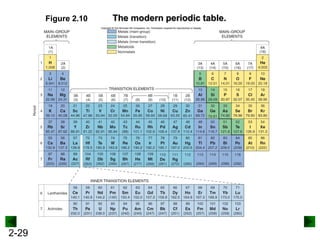
2.6 Elements: A First Look at the Periodic Table
2.7 Compounds: Introduction to Bonding
2.8 Compounds: Formulas, Names, and Masses
2.9 Classification of Mixtures
2-3
What is Inorganic Chemistry?
• Inorganic chemistry is concerned with the properties and behavior
of inorganic compounds (principally of mineral, not biological,
origin).
• This field covers all chemical compounds except the myriad organic
compounds (compounds containing C-H bonds). The distinction
between the two disciplines is far from absolute, and there is much
overlap, most importantly in the sub-discipline of organometallic
chemistry,
• The study of chemical compounds containing bonds between
carbon and a metal (an element that readily loses electrons
to form cations and has metallic bonds between metal
atoms).
2-4
Definitions for Components of Matter
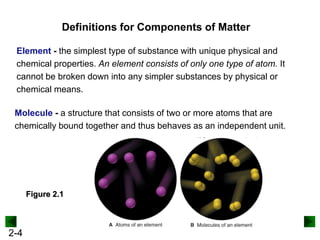
Element - the simplest type of substance with unique physical and
chemical properties. An element consists of only one type of atom. It
cannot be broken down into any simpler substances by physical or
chemical means.
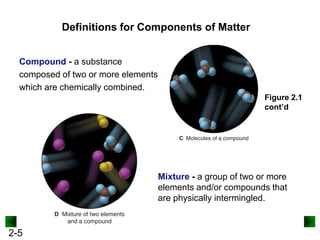
Molecule - a structure that consists of two or more atoms that are
chemically bound together and thus behaves as an independent unit.
Figure 2.1
2-5
Compound - a substance
composed of two or more elements
which are chemically combined.
Mixture - a group of two or more
elements and/or compounds that
are physically intermingled.
Definitions for Components of Matter
Figure 2.1
cont’d
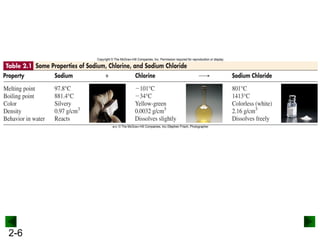
2-6
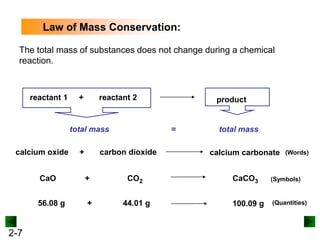
2-7
The total mass of substances does not change during a chemical
reaction.
reactant 1 + reactant 2 product
total mass total mass
=
calcium oxide + carbon dioxide calcium carbonate
CaO + CO2 CaCO3
56.08 g + 44.01 g 100.09 g
Law of Mass Conservation:
(Symbols)
(Words)
(Quantities)
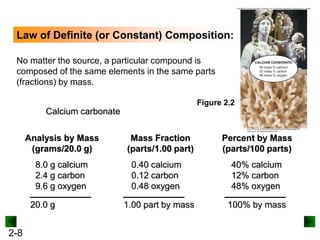
2-8
No matter the source, a particular compound is
composed of the same elements in the same parts
(fractions) by mass.
Calcium carbonate
Analysis by Mass
(grams/20.0 g)
Mass Fraction
(parts/1.00 part)
Percent by Mass
(parts/100 parts)
8.0 g calcium
2.4 g carbon
9.6 g oxygen
20.0 g
40% calcium
12% carbon
48% oxygen
100% by mass
0.40 calcium
0.12 carbon
0.48 oxygen
1.00 part by mass
Law of Definite (or Constant) Composition:
Figure 2.2
2-9
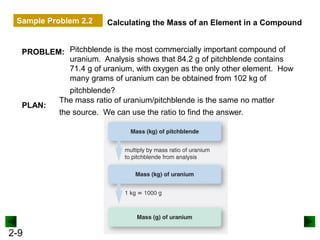
Calculating the Mass of an Element in a Compound
PROBLEM: Pitchblende is the most commercially important compound of
uranium. Analysis shows that 84.2 g of pitchblende contains
71.4 g of uranium, with oxygen as the only other element. How
many grams of uranium can be obtained from 102 kg of
pitchblende?
PLAN:
The mass ratio of uranium/pitchblende is the same no matter
the source. We can use the ratio to find the answer.
Sample Problem 2.2
2-10
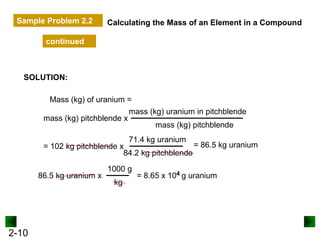
Calculating the Mass of an Element in a Compound
SOLUTION:
= 86.5 kg uranium
= 102 kg pitchblende x
mass (kg) pitchblende x
mass (kg) uranium in pitchblende
mass (kg) pitchblende
71.4 kg uranium
84.2 kg pitchblende
Mass (kg) of uranium =
86.5 kg uranium x
1000 g
kg
= 8.65 x 10⁴ g uranium
Sample Problem 2.2
continued
2-11
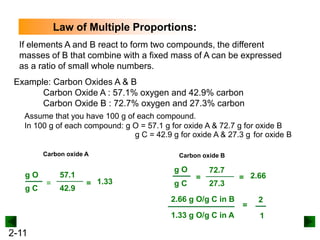
If elements A and B react to form two compounds, the different
masses of B that combine with a fixed mass of A can be expressed
as a ratio of small whole numbers.
Example: Carbon Oxides A & B
Carbon Oxide A : 57.1% oxygen and 42.9% carbon
Carbon Oxide B : 72.7% oxygen and 27.3% carbon
Assume that you have 100 g of each compound.
In 100 g of each compound: g O = 57.1 g for oxide A & 72.7 g for oxide B
g C = 42.9 g for oxide A & 27.3 g for oxide B
=
g O
g C
72.7
27.3
= 2.66
2.66 g O/g C in B
1.33 g O/g C in A
2
1
=
Law of Multiple Proportions:
Carbon oxide B
g O
g C
=
57.1
42.9
= 1.33
Carbon oxide A
2-12
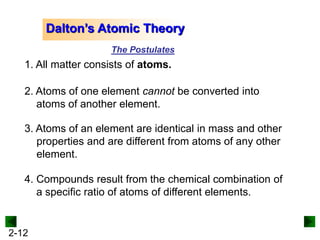
Dalton’s Atomic Theory
1. All matter consists of atoms.
2. Atoms of one element cannot be converted into
atoms of another element.
3. Atoms of an element are identical in mass and other
properties and are different from atoms of any other
element.
4. Compounds result from the chemical combination of
a specific ratio of atoms of different elements.
The Postulates
2-13
Dalton’s Atomic Theory
explains the mass laws
Mass conservation
Atoms cannot be created or destroyed
or converted into other types of atoms.
postulate 1
postulate 2
Since every atom has a fixed mass,
during a chemical reaction atoms are combined
differently and therefore there is no mass change
overall.
postulate 3
2-14
Dalton’s Atomic Theory
explains the mass laws
Definite composition
Atoms are combined in compounds in
specific ratios
and each atom has a specific mass.
So each element has a fixed fraction of the total mass
in a compound.
postulate 3
postulate 4
2-15
Dalton’s Atomic Theory
explains the mass laws
Multiple proportions
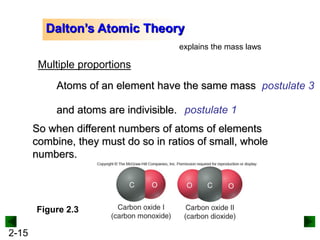
Atoms of an element have the same mass
and atoms are indivisible.
So when different numbers of atoms of elements
combine, they must do so in ratios of small, whole
numbers.
postulate 3
postulate 1
Figure 2.3
2-16
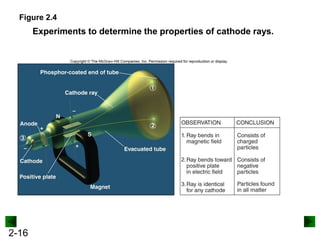
Figure 2.4
Experiments to determine the properties of cathode rays.
2-17
Let’s watch the video on the
cathode ray
2-18
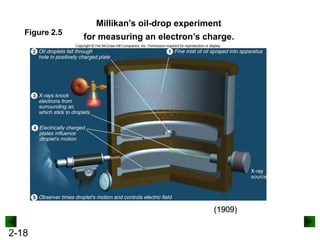
Figure 2.5
Millikan’s oil-drop experiment
for measuring an electron’s charge.
(1909)
2-19
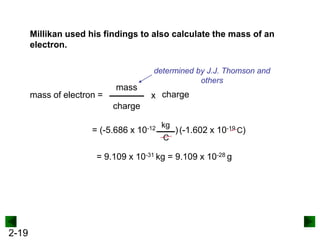
Millikan used his findings to also calculate the mass of an
electron.
mass of electron =
mass
charge
x charge
= (-5.686 x 10⁻¹² )(-1.602 x 10⁻¹⁹ C)
determined by J.J. Thomson and
others
= 9.109 x 10⁻³¹ kg = 9.109 x 10⁻²⁸ g
kg
C
2-20
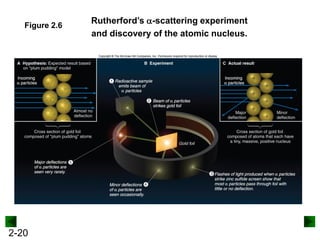
Figure 2.6
Rutherford’s a-scattering experiment
and discovery of the atomic nucleus.
2-21
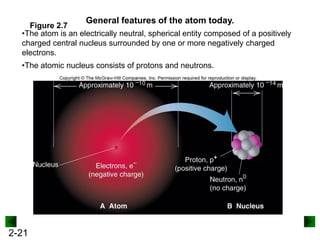
Figure 2.7
General features of the atom today.
•The atom is an electrically neutral, spherical entity composed of a positively
charged central nucleus surrounded by one or more negatively charged
electrons.
•The atomic nucleus consists of protons and neutrons.
2-22
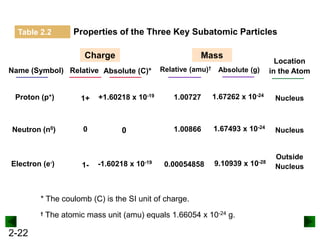
Properties of the Three Key Subatomic Particles
Charge Mass
Relative
1+
0
1-
Absolute (C)*
+1.60218 x 10⁻¹⁹
0
-1.60218 x 10⁻¹⁹
Relative (amu)†
1.00727
1.00866
0.00054858
Absolute (g)
1.67262 x 10⁻²⁴
1.67493 x 10⁻²⁴
9.10939 x 10⁻²⁸
Location
in the Atom
Nucleus
Outside
Nucleus
Nucleus
Name (Symbol)
Electron (e-)
Neutron (n0)
Proton (p+)
Table 2.2
* The coulomb (C) is the SI unit of charge.
† The atomic mass unit (amu) equals 1.66054 x 10⁻²⁴ g.
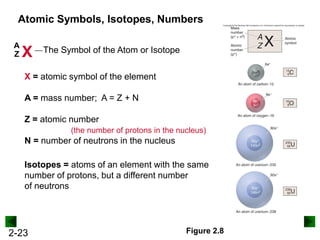
2-23 Figure 2.8
Atomic Symbols, Isotopes, Numbers
X = atomic symbol of the element
A = mass number; A = Z + N
Isotopes = atoms of an element with the same
number of protons, but a different number
of neutrons
A
Z
Z = atomic number
(the number of protons in the nucleus)
N = number of neutrons in the nucleus
X The Symbol of the Atom or Isotope
2-24
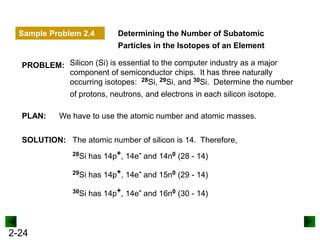
Determining the Number of Subatomic
Particles in the Isotopes of an Element
PROBLEM: Silicon (Si) is essential to the computer industry as a major
component of semiconductor chips. It has three naturally
occurring isotopes: 28Si, 29Si, and 30Si. Determine the number
of protons, neutrons, and electrons in each silicon isotope.
PLAN: We have to use the atomic number and atomic masses.
SOLUTION: The atomic number of silicon is 14. Therefore,
28Si has 14p+, 14e- and 14n0 (28 - 14)
29Si has 14p+, 14e- and 15n0 (29 - 14)
30Si has 14p+, 14e- and 16n0 (30 - 14)
Sample Problem 2.4
2-25
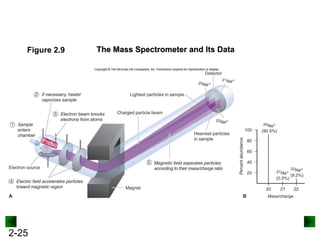
Figure 2.9 The Mass Spectrometer and Its Data
2-26
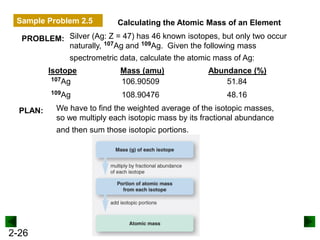
Calculating the Atomic Mass of an Element
PLAN: We have to find the weighted average of the isotopic masses,
so we multiply each isotopic mass by its fractional abundance
and then sum those isotopic portions.
PROBLEM: Silver (Ag: Z = 47) has 46 known isotopes, but only two occur
naturally, 107Ag and 109Ag. Given the following mass
spectrometric data, calculate the atomic mass of Ag:
Isotope Mass (amu) Abundance (%)
107Ag
109Ag
106.90509
108.90476
51.84
48.16
Sample Problem 2.5
2-27
Calculating the Atomic Mass of an Element
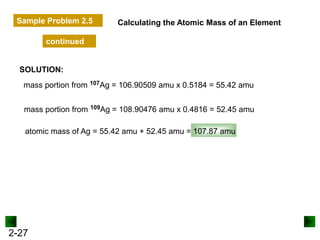
SOLUTION:
mass portion from 107Ag = 106.90509 amu x 0.5184 = 55.42 amu
mass portion from 109Ag = 108.90476 amu x 0.4816 = 52.45 amu
atomic mass of Ag = 55.42 amu + 52.45 amu = 107.87 amu
Sample Problem 2.5
continued
2-28
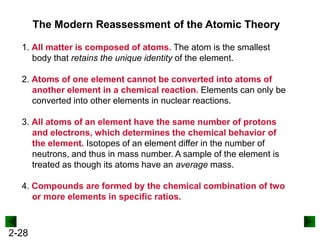
The Modern Reassessment of the Atomic Theory
1. All matter is composed of atoms. The atom is the smallest
body that retains the unique identity of the element.
2. Atoms of one element cannot be converted into atoms of
another element in a chemical reaction. Elements can only be
converted into other elements in nuclear reactions.
3. All atoms of an element have the same number of protons
and electrons, which determines the chemical behavior of
the element. Isotopes of an element differ in the number of
neutrons, and thus in mass number. A sample of the element is
treated as though its atoms have an average mass.
4. Compounds are formed by the chemical combination of two
or more elements in specific ratios.
2-29
Figure 2.10 The modern periodic table.
2-30
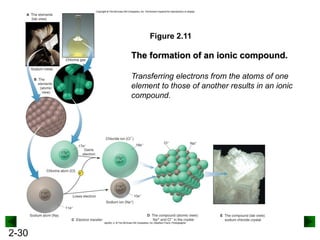
Figure 2.11
The formation of an ionic compound.
Transferring electrons from the atoms of one
element to those of another results in an ionic
compound.
2-31
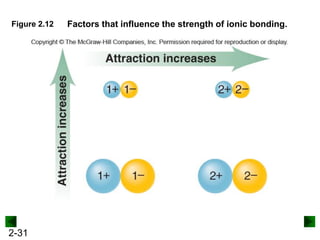
Figure 2.12 Factors that influence the strength of ionic bonding.
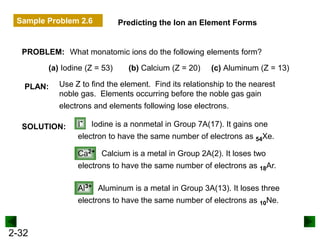
2-32
Ca2+ Calcium is a metal in Group 2A(2). It loses two
electrons to have the same number of electrons as 18Ar.
Predicting the Ion an Element Forms
PROBLEM: What monatomic ions do the following elements form?
PLAN: Use Z to find the element. Find its relationship to the nearest
noble gas. Elements occurring before the noble gas gain
electrons and elements following lose electrons.
SOLUTION:
(a) Iodine (Z = 53) (b) Calcium (Z = 20) (c) Aluminum (Z = 13)
I- Iodine is a nonmetal in Group 7A(17). It gains one
electron to have the same number of electrons as 54Xe.
Al3+ Aluminum is a metal in Group 3A(13). It loses three
electrons to have the same number of electrons as 10Ne.
Sample Problem 2.6
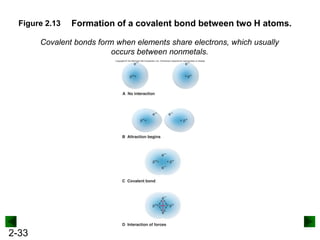
2-33
Formation of a covalent bond between two H atoms.
Figure 2.13
Covalent bonds form when elements share electrons, which usually
occurs between nonmetals.
2-34
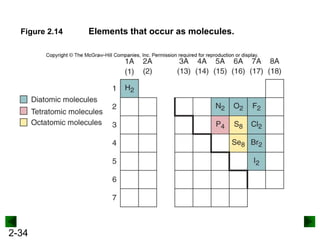
Figure 2.14 Elements that occur as molecules.
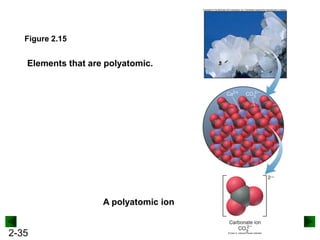
2-35
A polyatomic ion
Figure 2.15
Elements that are polyatomic.
2-36
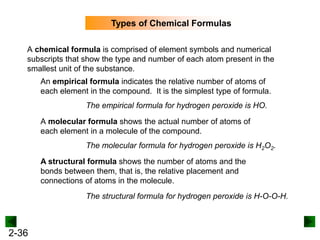
Types of Chemical Formulas
An empirical formula indicates the relative number of atoms of
each element in the compound. It is the simplest type of formula.
A molecular formula shows the actual number of atoms of
each element in a molecule of the compound.
A structural formula shows the number of atoms and the
bonds between them, that is, the relative placement and
connections of atoms in the molecule.
A chemical formula is comprised of element symbols and numerical
subscripts that show the type and number of each atom present in the
smallest unit of the substance.
The empirical formula for hydrogen peroxide is HO.
The molecular formula for hydrogen peroxide is H2O2.
The structural formula for hydrogen peroxide is H-O-O-H.
2-37
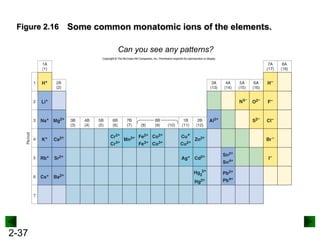
Figure 2.16 Some common monatomic ions of the elements.
Can you see any patterns?
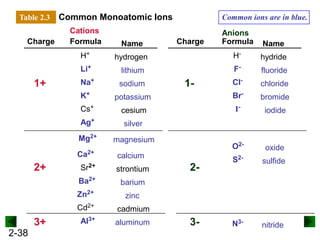
2-38
Common Monoatomic Ions
Table 2.3
H-
hydride
Na+
sodium
H+
hydrogen
Li+
lithium fluoride
F-
Cs+
cesium
K+
potassium
Ag+
silver
chloride
Cl-
bromide
Br-
iodide
I-
Mg2+
magnesium
Sr2+
strontium
Ca2+
calcium
Zn2+
zinc
Ba2+
barium
Cd2+
cadmium
Al3+
aluminum
1+
2+
3+
Cations
Charge Formula Name
Anions
Charge Formula Name
1-
2-
3-
oxide
O2-
sulfide
S2-
nitride
N3-
Common ions are in blue.
2-39
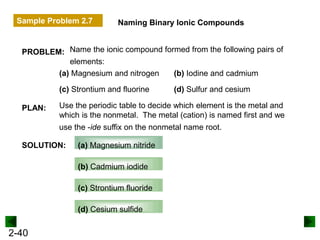
Naming binary ionic compounds
The name of the cation is the same as the name of the metal.
Many metal names end in -ium.
The name of the anion takes the root of the nonmetal name
and adds the suffix -ide.
Calcium and bromine form calcium bromide.
The name of the cation is written first, followed by that of the anion.
2-40
Naming Binary Ionic Compounds
PROBLEM: Name the ionic compound formed from the following pairs of
elements:
PLAN:
(a) Magnesium and nitrogen
SOLUTION:
Use the periodic table to decide which element is the metal and
which is the nonmetal. The metal (cation) is named first and we
use the -ide suffix on the nonmetal name root.
(b) Iodine and cadmium
(c) Strontium and fluorine (d) Sulfur and cesium
(a) Magnesium nitride
(b) Cadmium iodide
(c) Strontium fluoride
(d) Cesium sulfide
Sample Problem 2.7
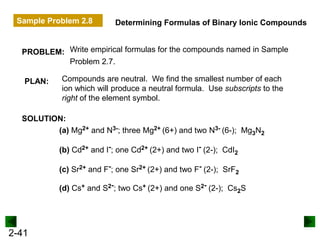
2-41
Determining Formulas of Binary Ionic Compounds
PROBLEM: Write empirical formulas for the compounds named in Sample
Problem 2.7.
PLAN:
SOLUTION:
Compounds are neutral. We find the smallest number of each
ion which will produce a neutral formula. Use subscripts to the
right of the element symbol.
(a) Mg2+ and N3-; three Mg2+ (6+) and two N3- (6-); Mg3N2
(b) Cd2+ and I-; one Cd2+ (2+) and two I- (2-); CdI2
(c) Sr2+ and F-; one Sr2+ (2+) and two F- (2-); SrF2
(d) Cs+ and S2-; two Cs+ (2+) and one S2- (2-); Cs2S
Sample Problem 2.8
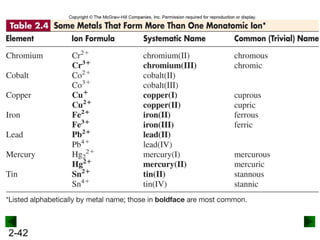
2-42
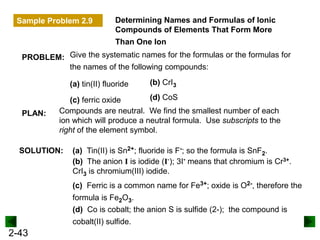
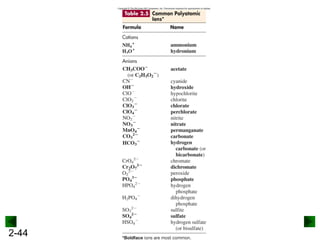
2-43
Determining Names and Formulas of Ionic
Compounds of Elements That Form More
Than One Ion
PLAN:
SOLUTION:
Compounds are neutral. We find the smallest number of each
ion which will produce a neutral formula. Use subscripts to the
right of the element symbol.
PROBLEM: Give the systematic names for the formulas or the formulas for
the names of the following compounds:
(a) tin(II) fluoride (b) CrI3
(c) ferric oxide (d) CoS
(a) Tin(II) is Sn2+; fluoride is F-; so the formula is SnF2.
(b) The anion I is iodide (I-); 3I- means that chromium is Cr3+.
CrI3 is chromium(III) iodide.
(c) Ferric is a common name for Fe3+; oxide is O2-, therefore the
formula is Fe2O3.
(d) Co is cobalt; the anion S is sulfide (2-); the compound is
cobalt(II) sulfide.
Sample Problem 2.9
2-44
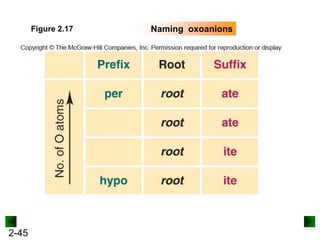
2-45
Naming oxoanions
Figure 2.17
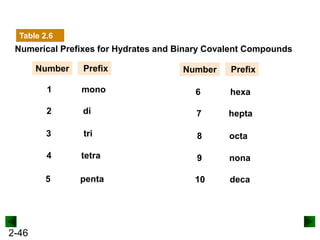
2-46
Numerical Prefixes for Hydrates and Binary Covalent Compounds
Number Prefix Number Prefix
1 mono
2 di
3 tri
4 tetra
5 penta
6 hexa
7 hepta
8 octa
9 nona
10 deca
Table 2.6
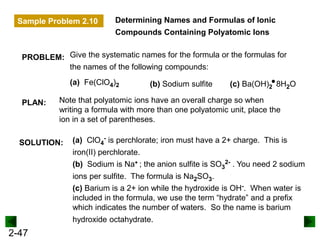
2-47
Determining Names and Formulas of Ionic
Compounds Containing Polyatomic Ions
PLAN:
SOLUTION:
Note that polyatomic ions have an overall charge so when
writing a formula with more than one polyatomic unit, place the
ion in a set of parentheses.
PROBLEM: Give the systematic names for the formula or the formulas for
the names of the following compounds:
(a) Fe(ClO4)2 (b) Sodium sulfite
(a) ClO4
- is perchlorate; iron must have a 2+ charge. This is
iron(II) perchlorate.
(b) Sodium is Na+ ; the anion sulfite is SO3
2- . You need 2 sodium
ions per sulfite. The formula is Na2SO3.
(c) Barium is a 2+ ion while the hydroxide is OH-. When water is
included in the formula, we use the term “hydrate” and a prefix
which indicates the number of waters. So the name is barium
hydroxide octahydrate.
(c) Ba(OH)2 8H2O
Sample Problem 2.10
2-48
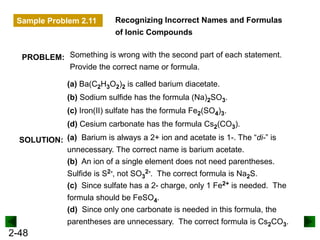
Recognizing Incorrect Names and Formulas
of Ionic Compounds
SOLUTION:
PROBLEM: Something is wrong with the second part of each statement.
Provide the correct name or formula.
(a) Ba(C2H3O2)2 is called barium diacetate.
(b) Sodium sulfide has the formula (Na)2SO3.
(a) Barium is always a 2+ ion and acetate is 1-. The “di-” is
unnecessary. The correct name is barium acetate.
(b) An ion of a single element does not need parentheses.
Sulfide is S2-, not SO3
2-. The correct formula is Na2S.
(c) Since sulfate has a 2- charge, only 1 Fe2+ is needed. The
formula should be FeSO4.
(d) Since only one carbonate is needed in this formula, the
parentheses are unnecessary. The correct formula is Cs2CO3.
(c) Iron(II) sulfate has the formula Fe2(SO4)3.
(d) Cesium carbonate has the formula Cs2(CO3).
Sample Problem 2.11
2-49
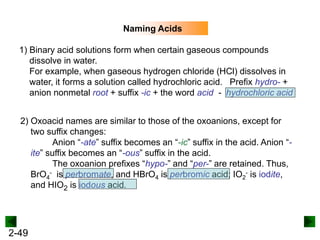
Naming Acids
1) Binary acid solutions form when certain gaseous compounds
dissolve in water.
For example, when gaseous hydrogen chloride (HCl) dissolves in
water, it forms a solution called hydrochloric acid. Prefix hydro- +
anion nonmetal root + suffix -ic + the word acid - hydrochloric acid
2) Oxoacid names are similar to those of the oxoanions, except for
two suffix changes:
Anion “-ate” suffix becomes an “-ic” suffix in the acid. Anion “-
ite” suffix becomes an “-ous” suffix in the acid.
The oxoanion prefixes “hypo-” and “per-” are retained. Thus,
BrO4
- is perbromate, and HBrO4 is perbromic acid; IO2
- is iodite,
and HIO2 is iodous acid.
2-50
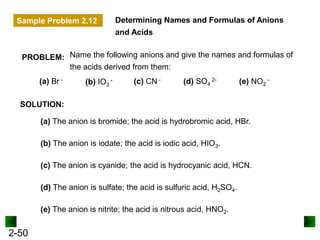
Determining Names and Formulas of Anions
and Acids
SOLUTION:
PROBLEM: Name the following anions and give the names and formulas of
the acids derived from them:
(a) Br -
(b) IO3
- (c) CN - (d) SO4
2- (e) NO2
-
(a) The anion is bromide; the acid is hydrobromic acid, HBr.
(b) The anion is iodate; the acid is iodic acid, HIO3.
(c) The anion is cyanide; the acid is hydrocyanic acid, HCN.
(d) The anion is sulfate; the acid is sulfuric acid, H2SO4.
(e) The anion is nitrite; the acid is nitrous acid, HNO2.
Sample Problem 2.12
2-51
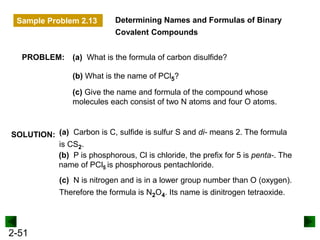
Determining Names and Formulas of Binary
Covalent Compounds
SOLUTION:
PROBLEM: (a) What is the formula of carbon disulfide?
(c) Give the name and formula of the compound whose
molecules each consist of two N atoms and four O atoms.
(b) What is the name of PCl5?
(a) Carbon is C, sulfide is sulfur S and di- means 2. The formula
is CS2.
(b) P is phosphorous, Cl is chloride, the prefix for 5 is penta-. The
name of PCl5 is phosphorous pentachloride.
(c) N is nitrogen and is in a lower group number than O (oxygen).
Therefore the formula is N2O4. Its name is dinitrogen tetraoxide.
Sample Problem 2.13
2-52
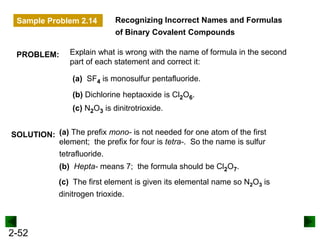
Recognizing Incorrect Names and Formulas
of Binary Covalent Compounds
SOLUTION:
(a) SF4 is monosulfur pentafluoride.
(c) N2O3 is dinitrotrioxide.
(b) Dichlorine heptaoxide is Cl2O6.
(a) The prefix mono- is not needed for one atom of the first
element; the prefix for four is tetra-. So the name is sulfur
tetrafluoride.
(b) Hepta- means 7; the formula should be Cl2O7.
(c) The first element is given its elemental name so N2O3 is
dinitrogen trioxide.
PROBLEM: Explain what is wrong with the name of formula in the second
part of each statement and correct it:
Sample Problem 2.14
2-53
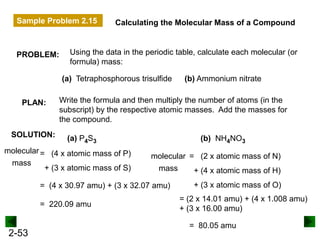
Calculating the Molecular Mass of a Compound
SOLUTION:
(a) Tetraphosphorous trisulfide (b) Ammonium nitrate
PROBLEM: Using the data in the periodic table, calculate each molecular (or
formula) mass:
PLAN: Write the formula and then multiply the number of atoms (in the
subscript) by the respective atomic masses. Add the masses for
the compound.
(a) P4S3
molecular
mass
= (4 x atomic mass of P)
+ (3 x atomic mass of S)
= (4 x 30.97 amu) + (3 x 32.07 amu)
= 220.09 amu
(b) NH4NO3
molecular
mass
= (2 x atomic mass of N)
+ (4 x atomic mass of H)
+ (3 x atomic mass of O)
= (2 x 14.01 amu) + (4 x 1.008 amu)
+ (3 x 16.00 amu)
= 80.05 amu
Sample Problem 2.15
2-54
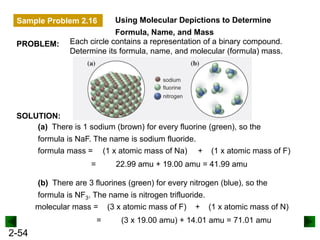
Using Molecular Depictions to Determine
Formula, Name, and Mass
PROBLEM: Each circle contains a representation of a binary compound.
Determine its formula, name, and molecular (formula) mass.
SOLUTION:
(a) There is 1 sodium (brown) for every fluorine (green), so the
formula is NaF. The name is sodium fluoride.
formula mass = (1 x atomic mass of Na) (1 x atomic mass of F)
+
(b) There are 3 fluorines (green) for every nitrogen (blue), so the
formula is NF3. The name is nitrogen trifluoride.
molecular mass = (3 x atomic mass of F) (1 x atomic mass of N)
+
= 22.99 amu + 19.00 amu = 41.99 amu
= (3 x 19.00 amu) + 14.01 amu = 71.01 amu
Sample Problem 2.16
2-55
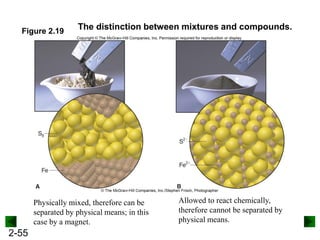
Figure 2.19
The distinction between mixtures and compounds.
Physically mixed, therefore can be
separated by physical means; in this
case by a magnet.
Allowed to react chemically,
therefore cannot be separated by
physical means.
2-56
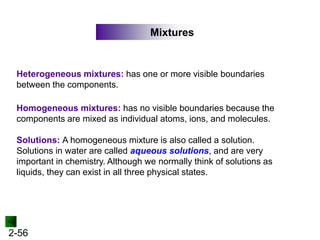
Mixtures
Heterogeneous mixtures: has one or more visible boundaries
between the components.
Homogeneous mixtures: has no visible boundaries because the
components are mixed as individual atoms, ions, and molecules.
Solutions: A homogeneous mixture is also called a solution.
Solutions in water are called aqueous solutions, and are very
important in chemistry. Although we normally think of solutions as
liquids, they can exist in all three physical states.
2-57
End of Session.
Do you have questions?

Components of Matter

  • 1.
    2-1 Advanced Inorganic Chemistry: Componentsof Matter Session 1b Copyright ©The McGraw-Hill Companies, Inc. Permission required for reproduction or display.
  • 2.
    2-2 Session 1b: TheComponents of Matter 2.1 Elements, Compounds, and Mixtures: An Atomic Overview 2.2 The Observations That Led to an Atomic View of Matter 2.3 Dalton’s Atomic Theory 2.4 The Observations That Led to the Nuclear Atom Model 2.5 The Atomic Theory Today 2.6 Elements: A First Look at the Periodic Table 2.7 Compounds: Introduction to Bonding 2.8 Compounds: Formulas, Names, and Masses 2.9 Classification of Mixtures
  • 3.
    2-3 What is InorganicChemistry? • Inorganic chemistry is concerned with the properties and behavior of inorganic compounds (principally of mineral, not biological, origin). • This field covers all chemical compounds except the myriad organic compounds (compounds containing C-H bonds). The distinction between the two disciplines is far from absolute, and there is much overlap, most importantly in the sub-discipline of organometallic chemistry, • The study of chemical compounds containing bonds between carbon and a metal (an element that readily loses electrons to form cations and has metallic bonds between metal atoms).
  • 4.
    2-4 Definitions for Componentsof Matter Element - the simplest type of substance with unique physical and chemical properties. An element consists of only one type of atom. It cannot be broken down into any simpler substances by physical or chemical means. Molecule - a structure that consists of two or more atoms that are chemically bound together and thus behaves as an independent unit. Figure 2.1
  • 5.
    2-5 Compound - asubstance composed of two or more elements which are chemically combined. Mixture - a group of two or more elements and/or compounds that are physically intermingled. Definitions for Components of Matter Figure 2.1 cont’d
  • 6.
  • 7.
    2-7 The total massof substances does not change during a chemical reaction. reactant 1 + reactant 2 product total mass total mass = calcium oxide + carbon dioxide calcium carbonate CaO + CO2 CaCO3 56.08 g + 44.01 g 100.09 g Law of Mass Conservation: (Symbols) (Words) (Quantities)
  • 8.
    2-8 No matter thesource, a particular compound is composed of the same elements in the same parts (fractions) by mass. Calcium carbonate Analysis by Mass (grams/20.0 g) Mass Fraction (parts/1.00 part) Percent by Mass (parts/100 parts) 8.0 g calcium 2.4 g carbon 9.6 g oxygen 20.0 g 40% calcium 12% carbon 48% oxygen 100% by mass 0.40 calcium 0.12 carbon 0.48 oxygen 1.00 part by mass Law of Definite (or Constant) Composition: Figure 2.2
  • 9.
    2-9 Calculating the Massof an Element in a Compound PROBLEM: Pitchblende is the most commercially important compound of uranium. Analysis shows that 84.2 g of pitchblende contains 71.4 g of uranium, with oxygen as the only other element. How many grams of uranium can be obtained from 102 kg of pitchblende? PLAN: The mass ratio of uranium/pitchblende is the same no matter the source. We can use the ratio to find the answer. Sample Problem 2.2
  • 10.
    2-10 Calculating the Massof an Element in a Compound SOLUTION: = 86.5 kg uranium = 102 kg pitchblende x mass (kg) pitchblende x mass (kg) uranium in pitchblende mass (kg) pitchblende 71.4 kg uranium 84.2 kg pitchblende Mass (kg) of uranium = 86.5 kg uranium x 1000 g kg = 8.65 x 10⁴ g uranium Sample Problem 2.2 continued
  • 11.
    2-11 If elements Aand B react to form two compounds, the different masses of B that combine with a fixed mass of A can be expressed as a ratio of small whole numbers. Example: Carbon Oxides A & B Carbon Oxide A : 57.1% oxygen and 42.9% carbon Carbon Oxide B : 72.7% oxygen and 27.3% carbon Assume that you have 100 g of each compound. In 100 g of each compound: g O = 57.1 g for oxide A & 72.7 g for oxide B g C = 42.9 g for oxide A & 27.3 g for oxide B = g O g C 72.7 27.3 = 2.66 2.66 g O/g C in B 1.33 g O/g C in A 2 1 = Law of Multiple Proportions: Carbon oxide B g O g C = 57.1 42.9 = 1.33 Carbon oxide A
  • 12.
    2-12 Dalton’s Atomic Theory 1.All matter consists of atoms. 2. Atoms of one element cannot be converted into atoms of another element. 3. Atoms of an element are identical in mass and other properties and are different from atoms of any other element. 4. Compounds result from the chemical combination of a specific ratio of atoms of different elements. The Postulates
  • 13.
    2-13 Dalton’s Atomic Theory explainsthe mass laws Mass conservation Atoms cannot be created or destroyed or converted into other types of atoms. postulate 1 postulate 2 Since every atom has a fixed mass, during a chemical reaction atoms are combined differently and therefore there is no mass change overall. postulate 3
  • 14.
    2-14 Dalton’s Atomic Theory explainsthe mass laws Definite composition Atoms are combined in compounds in specific ratios and each atom has a specific mass. So each element has a fixed fraction of the total mass in a compound. postulate 3 postulate 4
  • 15.
    2-15 Dalton’s Atomic Theory explainsthe mass laws Multiple proportions Atoms of an element have the same mass and atoms are indivisible. So when different numbers of atoms of elements combine, they must do so in ratios of small, whole numbers. postulate 3 postulate 1 Figure 2.3
  • 16.
    2-16 Figure 2.4 Experiments todetermine the properties of cathode rays.
  • 17.
    2-17 Let’s watch thevideo on the cathode ray
  • 18.
    2-18 Figure 2.5 Millikan’s oil-dropexperiment for measuring an electron’s charge. (1909)
  • 19.
    2-19 Millikan used hisfindings to also calculate the mass of an electron. mass of electron = mass charge x charge = (-5.686 x 10⁻¹² )(-1.602 x 10⁻¹⁹ C) determined by J.J. Thomson and others = 9.109 x 10⁻³¹ kg = 9.109 x 10⁻²⁸ g kg C
  • 20.
    2-20 Figure 2.6 Rutherford’s a-scatteringexperiment and discovery of the atomic nucleus.
  • 21.
    2-21 Figure 2.7 General featuresof the atom today. •The atom is an electrically neutral, spherical entity composed of a positively charged central nucleus surrounded by one or more negatively charged electrons. •The atomic nucleus consists of protons and neutrons.
  • 22.
    2-22 Properties of theThree Key Subatomic Particles Charge Mass Relative 1+ 0 1- Absolute (C)* +1.60218 x 10⁻¹⁹ 0 -1.60218 x 10⁻¹⁹ Relative (amu)† 1.00727 1.00866 0.00054858 Absolute (g) 1.67262 x 10⁻²⁴ 1.67493 x 10⁻²⁴ 9.10939 x 10⁻²⁸ Location in the Atom Nucleus Outside Nucleus Nucleus Name (Symbol) Electron (e-) Neutron (n0) Proton (p+) Table 2.2 * The coulomb (C) is the SI unit of charge. † The atomic mass unit (amu) equals 1.66054 x 10⁻²⁴ g.
  • 23.
    2-23 Figure 2.8 AtomicSymbols, Isotopes, Numbers X = atomic symbol of the element A = mass number; A = Z + N Isotopes = atoms of an element with the same number of protons, but a different number of neutrons A Z Z = atomic number (the number of protons in the nucleus) N = number of neutrons in the nucleus X The Symbol of the Atom or Isotope
  • 24.
    2-24 Determining the Numberof Subatomic Particles in the Isotopes of an Element PROBLEM: Silicon (Si) is essential to the computer industry as a major component of semiconductor chips. It has three naturally occurring isotopes: 28Si, 29Si, and 30Si. Determine the number of protons, neutrons, and electrons in each silicon isotope. PLAN: We have to use the atomic number and atomic masses. SOLUTION: The atomic number of silicon is 14. Therefore, 28Si has 14p+, 14e- and 14n0 (28 - 14) 29Si has 14p+, 14e- and 15n0 (29 - 14) 30Si has 14p+, 14e- and 16n0 (30 - 14) Sample Problem 2.4
  • 25.
    2-25 Figure 2.9 TheMass Spectrometer and Its Data
  • 26.
    2-26 Calculating the AtomicMass of an Element PLAN: We have to find the weighted average of the isotopic masses, so we multiply each isotopic mass by its fractional abundance and then sum those isotopic portions. PROBLEM: Silver (Ag: Z = 47) has 46 known isotopes, but only two occur naturally, 107Ag and 109Ag. Given the following mass spectrometric data, calculate the atomic mass of Ag: Isotope Mass (amu) Abundance (%) 107Ag 109Ag 106.90509 108.90476 51.84 48.16 Sample Problem 2.5
  • 27.
    2-27 Calculating the AtomicMass of an Element SOLUTION: mass portion from 107Ag = 106.90509 amu x 0.5184 = 55.42 amu mass portion from 109Ag = 108.90476 amu x 0.4816 = 52.45 amu atomic mass of Ag = 55.42 amu + 52.45 amu = 107.87 amu Sample Problem 2.5 continued
  • 28.
    2-28 The Modern Reassessmentof the Atomic Theory 1. All matter is composed of atoms. The atom is the smallest body that retains the unique identity of the element. 2. Atoms of one element cannot be converted into atoms of another element in a chemical reaction. Elements can only be converted into other elements in nuclear reactions. 3. All atoms of an element have the same number of protons and electrons, which determines the chemical behavior of the element. Isotopes of an element differ in the number of neutrons, and thus in mass number. A sample of the element is treated as though its atoms have an average mass. 4. Compounds are formed by the chemical combination of two or more elements in specific ratios.
  • 29.
    2-29 Figure 2.10 Themodern periodic table.
  • 30.
    2-30 Figure 2.11 The formationof an ionic compound. Transferring electrons from the atoms of one element to those of another results in an ionic compound.
  • 31.
    2-31 Figure 2.12 Factorsthat influence the strength of ionic bonding.
  • 32.
    2-32 Ca2+ Calcium isa metal in Group 2A(2). It loses two electrons to have the same number of electrons as 18Ar. Predicting the Ion an Element Forms PROBLEM: What monatomic ions do the following elements form? PLAN: Use Z to find the element. Find its relationship to the nearest noble gas. Elements occurring before the noble gas gain electrons and elements following lose electrons. SOLUTION: (a) Iodine (Z = 53) (b) Calcium (Z = 20) (c) Aluminum (Z = 13) I- Iodine is a nonmetal in Group 7A(17). It gains one electron to have the same number of electrons as 54Xe. Al3+ Aluminum is a metal in Group 3A(13). It loses three electrons to have the same number of electrons as 10Ne. Sample Problem 2.6
  • 33.
    2-33 Formation of acovalent bond between two H atoms. Figure 2.13 Covalent bonds form when elements share electrons, which usually occurs between nonmetals.
  • 34.
    2-34 Figure 2.14 Elementsthat occur as molecules.
  • 35.
    2-35 A polyatomic ion Figure2.15 Elements that are polyatomic.
  • 36.
    2-36 Types of ChemicalFormulas An empirical formula indicates the relative number of atoms of each element in the compound. It is the simplest type of formula. A molecular formula shows the actual number of atoms of each element in a molecule of the compound. A structural formula shows the number of atoms and the bonds between them, that is, the relative placement and connections of atoms in the molecule. A chemical formula is comprised of element symbols and numerical subscripts that show the type and number of each atom present in the smallest unit of the substance. The empirical formula for hydrogen peroxide is HO. The molecular formula for hydrogen peroxide is H2O2. The structural formula for hydrogen peroxide is H-O-O-H.
  • 37.
    2-37 Figure 2.16 Somecommon monatomic ions of the elements. Can you see any patterns?
  • 38.
    2-38 Common Monoatomic Ions Table2.3 H- hydride Na+ sodium H+ hydrogen Li+ lithium fluoride F- Cs+ cesium K+ potassium Ag+ silver chloride Cl- bromide Br- iodide I- Mg2+ magnesium Sr2+ strontium Ca2+ calcium Zn2+ zinc Ba2+ barium Cd2+ cadmium Al3+ aluminum 1+ 2+ 3+ Cations Charge Formula Name Anions Charge Formula Name 1- 2- 3- oxide O2- sulfide S2- nitride N3- Common ions are in blue.
  • 39.
    2-39 Naming binary ioniccompounds The name of the cation is the same as the name of the metal. Many metal names end in -ium. The name of the anion takes the root of the nonmetal name and adds the suffix -ide. Calcium and bromine form calcium bromide. The name of the cation is written first, followed by that of the anion.
  • 40.
    2-40 Naming Binary IonicCompounds PROBLEM: Name the ionic compound formed from the following pairs of elements: PLAN: (a) Magnesium and nitrogen SOLUTION: Use the periodic table to decide which element is the metal and which is the nonmetal. The metal (cation) is named first and we use the -ide suffix on the nonmetal name root. (b) Iodine and cadmium (c) Strontium and fluorine (d) Sulfur and cesium (a) Magnesium nitride (b) Cadmium iodide (c) Strontium fluoride (d) Cesium sulfide Sample Problem 2.7
  • 41.
    2-41 Determining Formulas ofBinary Ionic Compounds PROBLEM: Write empirical formulas for the compounds named in Sample Problem 2.7. PLAN: SOLUTION: Compounds are neutral. We find the smallest number of each ion which will produce a neutral formula. Use subscripts to the right of the element symbol. (a) Mg2+ and N3-; three Mg2+ (6+) and two N3- (6-); Mg3N2 (b) Cd2+ and I-; one Cd2+ (2+) and two I- (2-); CdI2 (c) Sr2+ and F-; one Sr2+ (2+) and two F- (2-); SrF2 (d) Cs+ and S2-; two Cs+ (2+) and one S2- (2-); Cs2S Sample Problem 2.8
  • 42.
  • 43.
    2-43 Determining Names andFormulas of Ionic Compounds of Elements That Form More Than One Ion PLAN: SOLUTION: Compounds are neutral. We find the smallest number of each ion which will produce a neutral formula. Use subscripts to the right of the element symbol. PROBLEM: Give the systematic names for the formulas or the formulas for the names of the following compounds: (a) tin(II) fluoride (b) CrI3 (c) ferric oxide (d) CoS (a) Tin(II) is Sn2+; fluoride is F-; so the formula is SnF2. (b) The anion I is iodide (I-); 3I- means that chromium is Cr3+. CrI3 is chromium(III) iodide. (c) Ferric is a common name for Fe3+; oxide is O2-, therefore the formula is Fe2O3. (d) Co is cobalt; the anion S is sulfide (2-); the compound is cobalt(II) sulfide. Sample Problem 2.9
  • 44.
  • 45.
  • 46.
    2-46 Numerical Prefixes forHydrates and Binary Covalent Compounds Number Prefix Number Prefix 1 mono 2 di 3 tri 4 tetra 5 penta 6 hexa 7 hepta 8 octa 9 nona 10 deca Table 2.6
  • 47.
    2-47 Determining Names andFormulas of Ionic Compounds Containing Polyatomic Ions PLAN: SOLUTION: Note that polyatomic ions have an overall charge so when writing a formula with more than one polyatomic unit, place the ion in a set of parentheses. PROBLEM: Give the systematic names for the formula or the formulas for the names of the following compounds: (a) Fe(ClO4)2 (b) Sodium sulfite (a) ClO4 - is perchlorate; iron must have a 2+ charge. This is iron(II) perchlorate. (b) Sodium is Na+ ; the anion sulfite is SO3 2- . You need 2 sodium ions per sulfite. The formula is Na2SO3. (c) Barium is a 2+ ion while the hydroxide is OH-. When water is included in the formula, we use the term “hydrate” and a prefix which indicates the number of waters. So the name is barium hydroxide octahydrate. (c) Ba(OH)2 8H2O Sample Problem 2.10
  • 48.
    2-48 Recognizing Incorrect Namesand Formulas of Ionic Compounds SOLUTION: PROBLEM: Something is wrong with the second part of each statement. Provide the correct name or formula. (a) Ba(C2H3O2)2 is called barium diacetate. (b) Sodium sulfide has the formula (Na)2SO3. (a) Barium is always a 2+ ion and acetate is 1-. The “di-” is unnecessary. The correct name is barium acetate. (b) An ion of a single element does not need parentheses. Sulfide is S2-, not SO3 2-. The correct formula is Na2S. (c) Since sulfate has a 2- charge, only 1 Fe2+ is needed. The formula should be FeSO4. (d) Since only one carbonate is needed in this formula, the parentheses are unnecessary. The correct formula is Cs2CO3. (c) Iron(II) sulfate has the formula Fe2(SO4)3. (d) Cesium carbonate has the formula Cs2(CO3). Sample Problem 2.11
  • 49.
    2-49 Naming Acids 1) Binaryacid solutions form when certain gaseous compounds dissolve in water. For example, when gaseous hydrogen chloride (HCl) dissolves in water, it forms a solution called hydrochloric acid. Prefix hydro- + anion nonmetal root + suffix -ic + the word acid - hydrochloric acid 2) Oxoacid names are similar to those of the oxoanions, except for two suffix changes: Anion “-ate” suffix becomes an “-ic” suffix in the acid. Anion “- ite” suffix becomes an “-ous” suffix in the acid. The oxoanion prefixes “hypo-” and “per-” are retained. Thus, BrO4 - is perbromate, and HBrO4 is perbromic acid; IO2 - is iodite, and HIO2 is iodous acid.
  • 50.
    2-50 Determining Names andFormulas of Anions and Acids SOLUTION: PROBLEM: Name the following anions and give the names and formulas of the acids derived from them: (a) Br - (b) IO3 - (c) CN - (d) SO4 2- (e) NO2 - (a) The anion is bromide; the acid is hydrobromic acid, HBr. (b) The anion is iodate; the acid is iodic acid, HIO3. (c) The anion is cyanide; the acid is hydrocyanic acid, HCN. (d) The anion is sulfate; the acid is sulfuric acid, H2SO4. (e) The anion is nitrite; the acid is nitrous acid, HNO2. Sample Problem 2.12
  • 51.
    2-51 Determining Names andFormulas of Binary Covalent Compounds SOLUTION: PROBLEM: (a) What is the formula of carbon disulfide? (c) Give the name and formula of the compound whose molecules each consist of two N atoms and four O atoms. (b) What is the name of PCl5? (a) Carbon is C, sulfide is sulfur S and di- means 2. The formula is CS2. (b) P is phosphorous, Cl is chloride, the prefix for 5 is penta-. The name of PCl5 is phosphorous pentachloride. (c) N is nitrogen and is in a lower group number than O (oxygen). Therefore the formula is N2O4. Its name is dinitrogen tetraoxide. Sample Problem 2.13
  • 52.
    2-52 Recognizing Incorrect Namesand Formulas of Binary Covalent Compounds SOLUTION: (a) SF4 is monosulfur pentafluoride. (c) N2O3 is dinitrotrioxide. (b) Dichlorine heptaoxide is Cl2O6. (a) The prefix mono- is not needed for one atom of the first element; the prefix for four is tetra-. So the name is sulfur tetrafluoride. (b) Hepta- means 7; the formula should be Cl2O7. (c) The first element is given its elemental name so N2O3 is dinitrogen trioxide. PROBLEM: Explain what is wrong with the name of formula in the second part of each statement and correct it: Sample Problem 2.14
  • 53.
    2-53 Calculating the MolecularMass of a Compound SOLUTION: (a) Tetraphosphorous trisulfide (b) Ammonium nitrate PROBLEM: Using the data in the periodic table, calculate each molecular (or formula) mass: PLAN: Write the formula and then multiply the number of atoms (in the subscript) by the respective atomic masses. Add the masses for the compound. (a) P4S3 molecular mass = (4 x atomic mass of P) + (3 x atomic mass of S) = (4 x 30.97 amu) + (3 x 32.07 amu) = 220.09 amu (b) NH4NO3 molecular mass = (2 x atomic mass of N) + (4 x atomic mass of H) + (3 x atomic mass of O) = (2 x 14.01 amu) + (4 x 1.008 amu) + (3 x 16.00 amu) = 80.05 amu Sample Problem 2.15
  • 54.
    2-54 Using Molecular Depictionsto Determine Formula, Name, and Mass PROBLEM: Each circle contains a representation of a binary compound. Determine its formula, name, and molecular (formula) mass. SOLUTION: (a) There is 1 sodium (brown) for every fluorine (green), so the formula is NaF. The name is sodium fluoride. formula mass = (1 x atomic mass of Na) (1 x atomic mass of F) + (b) There are 3 fluorines (green) for every nitrogen (blue), so the formula is NF3. The name is nitrogen trifluoride. molecular mass = (3 x atomic mass of F) (1 x atomic mass of N) + = 22.99 amu + 19.00 amu = 41.99 amu = (3 x 19.00 amu) + 14.01 amu = 71.01 amu Sample Problem 2.16
  • 55.
    2-55 Figure 2.19 The distinctionbetween mixtures and compounds. Physically mixed, therefore can be separated by physical means; in this case by a magnet. Allowed to react chemically, therefore cannot be separated by physical means.
  • 56.
    2-56 Mixtures Heterogeneous mixtures: hasone or more visible boundaries between the components. Homogeneous mixtures: has no visible boundaries because the components are mixed as individual atoms, ions, and molecules. Solutions: A homogeneous mixture is also called a solution. Solutions in water are called aqueous solutions, and are very important in chemistry. Although we normally think of solutions as liquids, they can exist in all three physical states.
  • 57.
    2-57 End of Session. Doyou have questions?