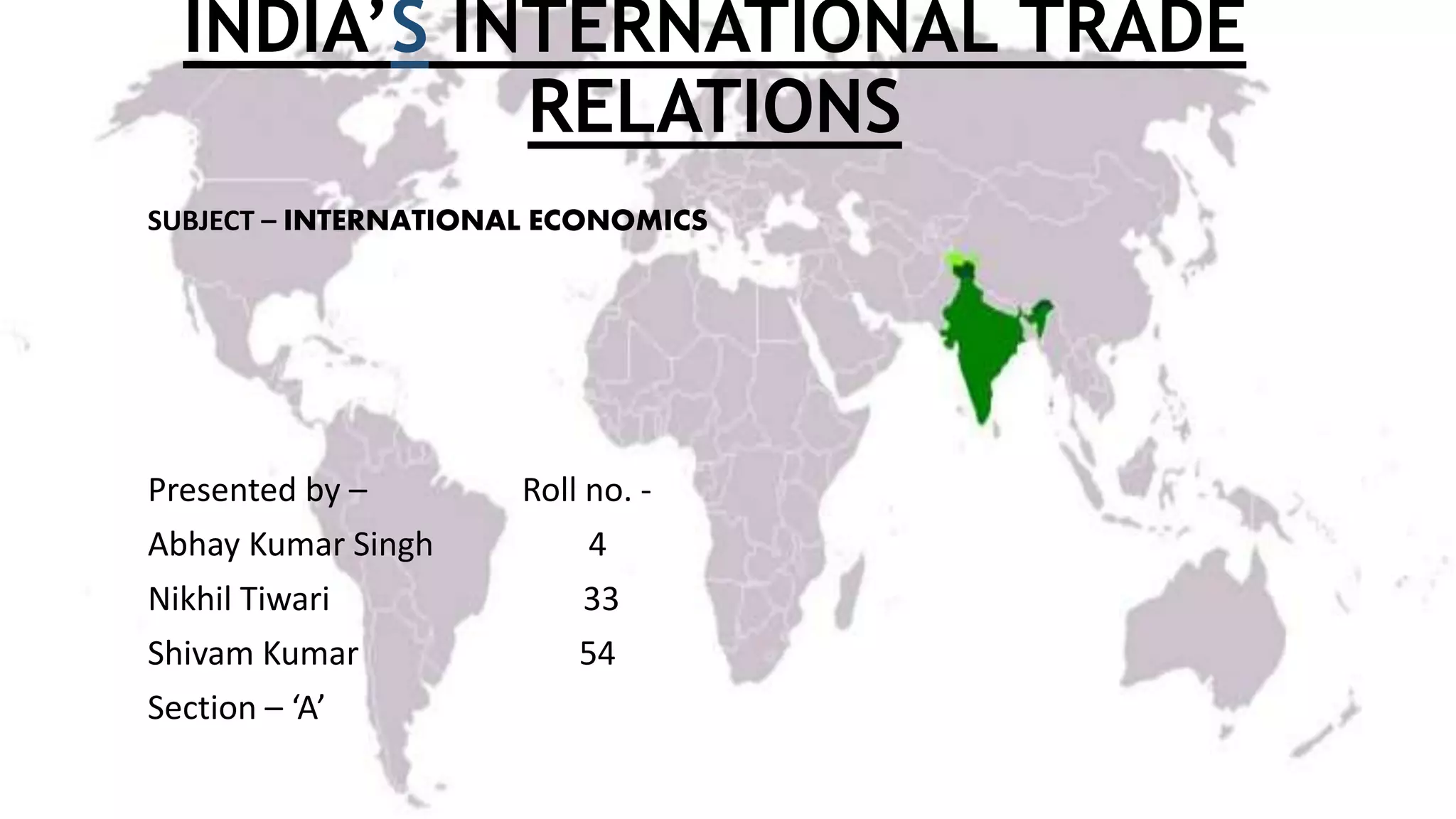
INDIA’S INTERNATIONAL TRADE
RELATIONS
SUBJECT – INTERNATIONAL ECONOMICS
Presented by – Roll no. -
Abhay Kumar Singh 4
Nikhil Tiwari 33
Shivam Kumar 54
Section – ‘A’
International Trade
International Trade is exchange of capital , goods , services
across international borders or territories. In most countries,
it represents a significant share of gross domestic product
(GDP). While international trade has been present throughout
much of history (see Silk Road, Amber Road), its economic,
social, and political importance has been on the rise in recent
centuries.
Importance of International Trade
• Without international trade, nations would be limited to the
goods and services produced within their own borders.
• International trade is the backbone of our modern, commercial
world, as producers in various nations try to profit from an
expanded market, rather than be limited to selling within their
own borders. There are many reasons that trade across national
borders occurs, including lower production costs in one region
versus another, specialized industries, lack or surplus of natural
resources and consumer tastes.
Risks in international trade
• Buyer insolvency (purchaser cannot pay)
• Non-acceptance (buyer rejects goods as different from the agreed upon
specifications)
• Credit risk (allowing the buyer to take possession of goods prior to payment)
• Regulatory risk (e.g., a change in rules that prevents the transaction)
• Intervention (governmental action to prevent a transaction being completed)
• Political risk (change in leadership interfering with transactions or prices) and
War and other uncontrollable events.
• In addition, international trade also faces the risk of unfavorable exchange rate
movements.
Trade In India
Trade and commerce have been the backbone of the Indian economy right
from ancient times. Textiles and spices were the first products to be
exported by India. The Indian trade scenario evolved gradually after the
country’s independence in 1947. From the 1950s to the late 1980s, the
country followed socialist policies, resulting in protectionism and India has
cordial trade relations with almost every nation in the world barring a few.
One thing after the 1990’s that India has excelled in is maintaining peaceful
relations with other countries which in turn help foreign trade. India has
strong trade allies in the form of USA, UK, UAE, Australia and many
moreeavy regulations on foreign companies conducting trade with India.
India Trade: Imports
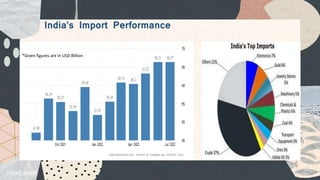
India’s major imports comprise of crude oil machinery, military products,
fertilizers, chemicals, gems, antiques and artworks. Imported goods are
divided into the following categories:
 Freely importable items: For these items, no import license is required. They
can be freely imported by an individual or a firm.
 Canalized items: These items can only be imported by public sector firms.
For example petroleum products fall under this category.
 Prohibited items: Items such as unprocessed ivory, animal rennet and
tallow fat cannot be exported to India.
India’s Import Performance
*Given figures are in USD Billion
India Trade: Exports
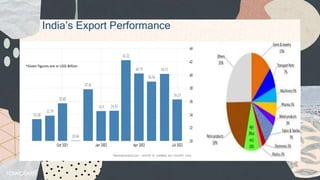
 Indian exports comprise mainly of engineering and textile
products, precious stones, petroleum products, jewelry, sugar,
steel,chemicals, zinc and leather products. Most of the exported
goods are exempt from export duties.
 India also exports services to several countries, primarily to the US.
In fact, India is among the world’s largest exporters of services
related to information and communication technology (ICT). It is
also the key destination for business process outsourcing (BPO).
India’s Export Performance
*Given figures are in USD Billion
EXIM Bank
• Set up by an act of parliament in September 1981
• Wholly owned by Government of India
• Commenced operations in march, 1982
• Established “for providing financial assistance to exporters and
importers, and for functioning as the principal financial institution
for coordinating the working of institutions engaged in financing
export and import of goods and services with a view to promoting
the trade practices.
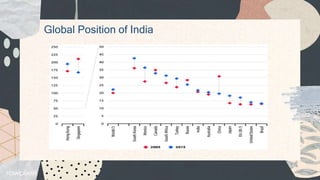
Global Position of India
.
THANK YOU

IE PPT SEC -A (4,33,54).pptx

  • 1.
    INDIA’S INTERNATIONAL TRADE RELATIONS SUBJECT– INTERNATIONAL ECONOMICS Presented by – Roll no. - Abhay Kumar Singh 4 Nikhil Tiwari 33 Shivam Kumar 54 Section – ‘A’
  • 2.
    International Trade International Tradeis exchange of capital , goods , services across international borders or territories. In most countries, it represents a significant share of gross domestic product (GDP). While international trade has been present throughout much of history (see Silk Road, Amber Road), its economic, social, and political importance has been on the rise in recent centuries.
  • 3.
    Importance of InternationalTrade • Without international trade, nations would be limited to the goods and services produced within their own borders. • International trade is the backbone of our modern, commercial world, as producers in various nations try to profit from an expanded market, rather than be limited to selling within their own borders. There are many reasons that trade across national borders occurs, including lower production costs in one region versus another, specialized industries, lack or surplus of natural resources and consumer tastes.
  • 4.
    Risks in internationaltrade • Buyer insolvency (purchaser cannot pay) • Non-acceptance (buyer rejects goods as different from the agreed upon specifications) • Credit risk (allowing the buyer to take possession of goods prior to payment) • Regulatory risk (e.g., a change in rules that prevents the transaction) • Intervention (governmental action to prevent a transaction being completed) • Political risk (change in leadership interfering with transactions or prices) and War and other uncontrollable events. • In addition, international trade also faces the risk of unfavorable exchange rate movements.
  • 5.
    Trade In India Tradeand commerce have been the backbone of the Indian economy right from ancient times. Textiles and spices were the first products to be exported by India. The Indian trade scenario evolved gradually after the country’s independence in 1947. From the 1950s to the late 1980s, the country followed socialist policies, resulting in protectionism and India has cordial trade relations with almost every nation in the world barring a few. One thing after the 1990’s that India has excelled in is maintaining peaceful relations with other countries which in turn help foreign trade. India has strong trade allies in the form of USA, UK, UAE, Australia and many moreeavy regulations on foreign companies conducting trade with India.
  • 6.
    India Trade: Imports India’smajor imports comprise of crude oil machinery, military products, fertilizers, chemicals, gems, antiques and artworks. Imported goods are divided into the following categories:  Freely importable items: For these items, no import license is required. They can be freely imported by an individual or a firm.  Canalized items: These items can only be imported by public sector firms. For example petroleum products fall under this category.  Prohibited items: Items such as unprocessed ivory, animal rennet and tallow fat cannot be exported to India.
  • 7.
    India’s Import Performance *Givenfigures are in USD Billion
  • 8.
    India Trade: Exports Indian exports comprise mainly of engineering and textile products, precious stones, petroleum products, jewelry, sugar, steel,chemicals, zinc and leather products. Most of the exported goods are exempt from export duties.  India also exports services to several countries, primarily to the US. In fact, India is among the world’s largest exporters of services related to information and communication technology (ICT). It is also the key destination for business process outsourcing (BPO).
  • 9.
    India’s Export Performance *Givenfigures are in USD Billion
  • 10.
    EXIM Bank • Setup by an act of parliament in September 1981 • Wholly owned by Government of India • Commenced operations in march, 1982 • Established “for providing financial assistance to exporters and importers, and for functioning as the principal financial institution for coordinating the working of institutions engaged in financing export and import of goods and services with a view to promoting the trade practices.
  • 11.
  • 12.