BASILAN
PROVINCE
GEOGRAPHY
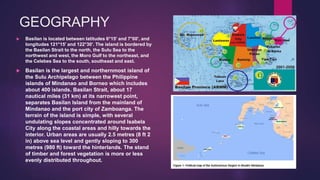
 Basilan is located between latitudes 6°15' and 7°00', and
longitudes 121°15' and 122°30'. The island is bordered by
the Basilan Strait to the north, the Sulu Sea to the
northwest and west, the Moro Gulf to the northeast, and
the Celebes Sea to the south, southeast and east.
 Basilan is the largest and northernmost island of
the Sulu Archipelago between the Philippine
islands of Mindanao and Borneo which includes
about 400 islands. Basilan Strait, about 17
nautical miles (31 km) at its narrowest point,
separates Basilan Island from the mainland of
Mindanao and the port city of Zamboanga. The
terrain of the island is simple, with several
undulating slopes concentrated around Isabela
City along the coastal areas and hilly towards the
interior. Urban areas are usually 2.5 metres (8 ft 2
in) above sea level and gently sloping to 300
metres (980 ft) toward the hinterlands. The stand
of timber and forest vegetation is more or less
evenly distributed throughout.
History of Basilan
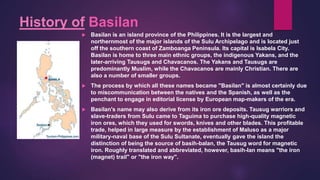
 Basilan is an island province of the Philippines. It is the largest and
northernmost of the major islands of the Sulu Archipelago and is located just
off the southern coast of Zamboanga Peninsula. Its capital is Isabela City.
Basilan is home to three main ethnic groups, the indigenous Yakans, and the
later-arriving Tausugs and Chavacanos. The Yakans and Tausugs are
predominantly Muslim, while the Chavacanos are mainly Christian. There are
also a number of smaller groups.
 The process by which all these names became "Basilan" is almost certainly due
to miscommunication between the natives and the Spanish, as well as the
penchant to engage in editorial license by European map-makers of the era.
 Basilan's name may also derive from its iron ore deposits. Tausug warriors and
slave-traders from Sulu came to Taguima to purchase high-quality magnetic
iron ores, which they used for swords, knives and other blades. This profitable
trade, helped in large measure by the establishment of Maluso as a major
military-naval base of the Sulu Sultanate, eventually gave the island the
distinction of being the source of basih-balan, the Tausug word for magnetic
iron. Roughly translated and abbreviated, however, basih-lan means "the iron
(magnet) trail" or "the iron way".
RELIGION
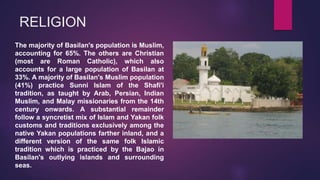
The majority of Basilan's population is Muslim,
accounting for 65%. The others are Christian
(most are Roman Catholic), which also
accounts for a large population of Basilan at
33%. A majority of Basilan's Muslim population
(41%) practice Sunni Islam of the Shafi'i
tradition, as taught by Arab, Persian, Indian
Muslim, and Malay missionaries from the 14th
century onwards. A substantial remainder
follow a syncretist mix of Islam and Yakan folk
customs and traditions exclusively among the
native Yakan populations farther inland, and a
different version of the same folk Islamic
tradition which is practiced by the Bajao in
Basilan's outlying islands and surrounding
seas.
LANGUAGE
Zamboangueño Chavacano is the lingua franca of Basilan, understood and spoken by
nearly 80% of the residents, both Christian and Muslim. Basilan has the biggest
concentration of Zamboangueño speakers in the Philippines outside of Zamboanga City.
A number of Muslim speakers of Zamboangueño Chavacano are Spanish mestizos.
Tausug is also widely spoken, especially among the Muslim tribes, and is spoken and
understood by approximately 70% of Basilan's population. Cebuano/Bisaya is a preferred
third tongue among the Christian tribes and even by Muslim tribes because of the mass
influx of Cebuano settlers to Mindanao, especially with the Tau Sūg since Bahasa Sūg is
a Visayan language and is spoken and understood by approximately 60% of residents.
Yakan, the acknowledged native dialect of Basilan, is used primarily by Yakans, although
it is also spoken and understood by about 15%-20% of the non-Yakan residents. A lesser
percentage can speak or understand Samal/Banguingui, Iranon, Ilocano and Ilonggo,
which are mostly confined to members of their respective tribes.
ECONOMY
 Agriculture is the main source of economic livelihood. Basilan's major
products include coconut (primarily copra), rubber, coffee, black pepper, and
African palm oil. Other crops are palay, corn, cacao and cassava.
 The Sulu and Celebes Seas provide fish such as tuna, mackerel, and
sardines. Most of these are processed in canning factories in nearby
Zamboanga City, General Santos City (the Philippines' tuna capital), and
Navotas.[citation needed] The island's waters also produce grouper, squid,
octopus, and marlin, while fishponds supply milkfish, prawn and shrimp. In
addition, seaweed is cultivated along some coastal areas.
 The island of Omosmarata in Tuburan (now Mohammad Ajul) is listed among
only 15 sites in the Philippines with commercially viable ocean thermal
energy potential. The Philippines' ocean thermal resource area is 1000 square
kilometers, based on the archipelagic nature of the country. Based on a study
conducted by the Philippines Department of Energy, the potential capacity for
this resource is estimated to be 265 million megawatts.
INFRASTRUCTURE
 National Power Corporation diesel-powered barge located at Brgy. Tabuk, Isabela
City, and two mini-hydroelectric plants located in Kumalarang, Isabela City and
Balagtasan, Lamitan City. A total of 62 sitios, in 42 barangays spread out in 6
municipalities still do not have access to electricity. Only about 38% of Barangays are
sufficiently powered for modern needs, and most of these are located in the cities of
Isabela and Lamitan, and Maluso Municipality.
 National roads (concrete, asphalt, gravel) total 131.92 kilometres (81.97 mi), while
there are 795.8 kilometres (494.5 mi) of local roads. There are 13 municipal and local
ports, three of which have roll-on/roll-off capability, and at least ten private airstrips
servicing small aircraft. Among the major bridges are the Marcos Bridge of Isabela
City and the recently inaugurated Matarling Bridge (built through USAID funding)
between Isabela City and Lantawan.
 There are 394 Barangay Health Workers and four private hospitals: the Juan S. Alano
Memorial Hospital (formerly Basilan Hospital), Infante Hospital, Basilan Community
Hospital, all in Isabela City, and the Dr. Jose Ma. Torres Hospital in Lamitan City.
There are also four government-run hospitals: Basilan General Hospital and Isabela
City Infirmary, both located in Isabela City, the Lamitan District Hospital in Lamitan
City, and the Sumisip District Hospital in Luuk-Bait, Sumisip Municipality.
FESTIVALS
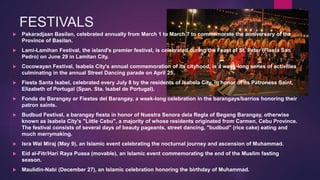
 Pakaradjaan Basilan, celebrated annually from March 1 to March 7 to commemorate the anniversary of the
Province of Basilan.
 Lami-Lamihan Festival, the island's premier festival, is celebrated during the Feast of St. Peter (Fiesta San
Pedro) on June 29 in Lamitan City.
 Cocowayan Festival, Isabela City's annual commemoration of its cityhood, is a week-long series of activities
culminating in the annual Street Dancing parade on April 25.
 Fiesta Santa Isabel, celebrated every July 8 by the residents of Isabela City, in honor of its Patroness Saint,
Elizabeth of Portugal (Span. Sta. Isabel de Portugal).
 Fonda de Barangay or Fiestas del Barangay, a week-long celebration in the barangays/barrios honoring their
patron saints.
 Budbud Festival, a barangay fiesta in honor of Nuestra Senora dela Regla of Begang Barangay, otherwise
known as Isabela City's "Little Cebu", a majority of whose residents originated from Carmen, Cebu Province.
The festival consists of several days of beauty pageants, street dancing, "budbud" (rice cake) eating and
much merrymaking.
 Isra Wal Miraj (May 9), an Islamic event celebrating the nocturnal journey and ascension of Muhammad.
 Eid al-Fitr/Hari Raya Puasa (movable), an Islamic event commemorating the end of the Muslim fasting
season.
 Maulidin-Nabi (December 27), an Islamic celebration honoring the birthday of Muhammad.
•Province: Basilan
•Region: ARMM (Autonomous Region of Muslim Minanao)
•Capital: Isabela City
•Coordinates: 6.4296° N, 121.9870° E
•Religion: Muslim, Christian(Majority is Roman Catholic)
•People: Chavacano, Cebuano, Tagalog
•Language: Zamboangueño Chavacano, Cebuano, Tausug,
Samal/Banguingui, Iranon,Yakan, Ilocano and Ilonggo
•Climate: Type 4
•Highest Pt.: Basilan Island (Basilan National Park)
•Festivals: Pakaradjaan Basilan, Lami-Lamihan Festival, Cocowayan
Festival, Budbud Festival, Fiesta Santa Isabel, Fiesta Santa Isabel, Isra Wal
Wal Miraj, Eid al-Fitr/Hari Raya Puasa, Maulidin-Nabi
•Trademarks: Malamawi Beach, Malamawi Island, Plaza Rizal, Kaum Purnah
Mosque, Cabunbata Falls, Tenusa Island, The Wine Cellar, Pusuac Spring
Park, Calugusan Beach, Palm Beach, Cathedral of St Elizabeth of Portugal,
Kalun's Park, Sumagdang Beach

Basilan province

  • 1.
  • 2.
    GEOGRAPHY  Basilan islocated between latitudes 6°15' and 7°00', and longitudes 121°15' and 122°30'. The island is bordered by the Basilan Strait to the north, the Sulu Sea to the northwest and west, the Moro Gulf to the northeast, and the Celebes Sea to the south, southeast and east.  Basilan is the largest and northernmost island of the Sulu Archipelago between the Philippine islands of Mindanao and Borneo which includes about 400 islands. Basilan Strait, about 17 nautical miles (31 km) at its narrowest point, separates Basilan Island from the mainland of Mindanao and the port city of Zamboanga. The terrain of the island is simple, with several undulating slopes concentrated around Isabela City along the coastal areas and hilly towards the interior. Urban areas are usually 2.5 metres (8 ft 2 in) above sea level and gently sloping to 300 metres (980 ft) toward the hinterlands. The stand of timber and forest vegetation is more or less evenly distributed throughout.
  • 3.
    History of Basilan Basilan is an island province of the Philippines. It is the largest and northernmost of the major islands of the Sulu Archipelago and is located just off the southern coast of Zamboanga Peninsula. Its capital is Isabela City. Basilan is home to three main ethnic groups, the indigenous Yakans, and the later-arriving Tausugs and Chavacanos. The Yakans and Tausugs are predominantly Muslim, while the Chavacanos are mainly Christian. There are also a number of smaller groups.  The process by which all these names became "Basilan" is almost certainly due to miscommunication between the natives and the Spanish, as well as the penchant to engage in editorial license by European map-makers of the era.  Basilan's name may also derive from its iron ore deposits. Tausug warriors and slave-traders from Sulu came to Taguima to purchase high-quality magnetic iron ores, which they used for swords, knives and other blades. This profitable trade, helped in large measure by the establishment of Maluso as a major military-naval base of the Sulu Sultanate, eventually gave the island the distinction of being the source of basih-balan, the Tausug word for magnetic iron. Roughly translated and abbreviated, however, basih-lan means "the iron (magnet) trail" or "the iron way".
  • 4.
    RELIGION The majority ofBasilan's population is Muslim, accounting for 65%. The others are Christian (most are Roman Catholic), which also accounts for a large population of Basilan at 33%. A majority of Basilan's Muslim population (41%) practice Sunni Islam of the Shafi'i tradition, as taught by Arab, Persian, Indian Muslim, and Malay missionaries from the 14th century onwards. A substantial remainder follow a syncretist mix of Islam and Yakan folk customs and traditions exclusively among the native Yakan populations farther inland, and a different version of the same folk Islamic tradition which is practiced by the Bajao in Basilan's outlying islands and surrounding seas.
  • 5.
    LANGUAGE Zamboangueño Chavacano isthe lingua franca of Basilan, understood and spoken by nearly 80% of the residents, both Christian and Muslim. Basilan has the biggest concentration of Zamboangueño speakers in the Philippines outside of Zamboanga City. A number of Muslim speakers of Zamboangueño Chavacano are Spanish mestizos. Tausug is also widely spoken, especially among the Muslim tribes, and is spoken and understood by approximately 70% of Basilan's population. Cebuano/Bisaya is a preferred third tongue among the Christian tribes and even by Muslim tribes because of the mass influx of Cebuano settlers to Mindanao, especially with the Tau Sūg since Bahasa Sūg is a Visayan language and is spoken and understood by approximately 60% of residents. Yakan, the acknowledged native dialect of Basilan, is used primarily by Yakans, although it is also spoken and understood by about 15%-20% of the non-Yakan residents. A lesser percentage can speak or understand Samal/Banguingui, Iranon, Ilocano and Ilonggo, which are mostly confined to members of their respective tribes.
  • 6.
    ECONOMY  Agriculture isthe main source of economic livelihood. Basilan's major products include coconut (primarily copra), rubber, coffee, black pepper, and African palm oil. Other crops are palay, corn, cacao and cassava.  The Sulu and Celebes Seas provide fish such as tuna, mackerel, and sardines. Most of these are processed in canning factories in nearby Zamboanga City, General Santos City (the Philippines' tuna capital), and Navotas.[citation needed] The island's waters also produce grouper, squid, octopus, and marlin, while fishponds supply milkfish, prawn and shrimp. In addition, seaweed is cultivated along some coastal areas.  The island of Omosmarata in Tuburan (now Mohammad Ajul) is listed among only 15 sites in the Philippines with commercially viable ocean thermal energy potential. The Philippines' ocean thermal resource area is 1000 square kilometers, based on the archipelagic nature of the country. Based on a study conducted by the Philippines Department of Energy, the potential capacity for this resource is estimated to be 265 million megawatts.
  • 7.
    INFRASTRUCTURE  National PowerCorporation diesel-powered barge located at Brgy. Tabuk, Isabela City, and two mini-hydroelectric plants located in Kumalarang, Isabela City and Balagtasan, Lamitan City. A total of 62 sitios, in 42 barangays spread out in 6 municipalities still do not have access to electricity. Only about 38% of Barangays are sufficiently powered for modern needs, and most of these are located in the cities of Isabela and Lamitan, and Maluso Municipality.  National roads (concrete, asphalt, gravel) total 131.92 kilometres (81.97 mi), while there are 795.8 kilometres (494.5 mi) of local roads. There are 13 municipal and local ports, three of which have roll-on/roll-off capability, and at least ten private airstrips servicing small aircraft. Among the major bridges are the Marcos Bridge of Isabela City and the recently inaugurated Matarling Bridge (built through USAID funding) between Isabela City and Lantawan.  There are 394 Barangay Health Workers and four private hospitals: the Juan S. Alano Memorial Hospital (formerly Basilan Hospital), Infante Hospital, Basilan Community Hospital, all in Isabela City, and the Dr. Jose Ma. Torres Hospital in Lamitan City. There are also four government-run hospitals: Basilan General Hospital and Isabela City Infirmary, both located in Isabela City, the Lamitan District Hospital in Lamitan City, and the Sumisip District Hospital in Luuk-Bait, Sumisip Municipality.
  • 8.
    FESTIVALS  Pakaradjaan Basilan,celebrated annually from March 1 to March 7 to commemorate the anniversary of the Province of Basilan.  Lami-Lamihan Festival, the island's premier festival, is celebrated during the Feast of St. Peter (Fiesta San Pedro) on June 29 in Lamitan City.  Cocowayan Festival, Isabela City's annual commemoration of its cityhood, is a week-long series of activities culminating in the annual Street Dancing parade on April 25.  Fiesta Santa Isabel, celebrated every July 8 by the residents of Isabela City, in honor of its Patroness Saint, Elizabeth of Portugal (Span. Sta. Isabel de Portugal).  Fonda de Barangay or Fiestas del Barangay, a week-long celebration in the barangays/barrios honoring their patron saints.  Budbud Festival, a barangay fiesta in honor of Nuestra Senora dela Regla of Begang Barangay, otherwise known as Isabela City's "Little Cebu", a majority of whose residents originated from Carmen, Cebu Province. The festival consists of several days of beauty pageants, street dancing, "budbud" (rice cake) eating and much merrymaking.  Isra Wal Miraj (May 9), an Islamic event celebrating the nocturnal journey and ascension of Muhammad.  Eid al-Fitr/Hari Raya Puasa (movable), an Islamic event commemorating the end of the Muslim fasting season.  Maulidin-Nabi (December 27), an Islamic celebration honoring the birthday of Muhammad.
  • 9.
    •Province: Basilan •Region: ARMM(Autonomous Region of Muslim Minanao) •Capital: Isabela City •Coordinates: 6.4296° N, 121.9870° E •Religion: Muslim, Christian(Majority is Roman Catholic) •People: Chavacano, Cebuano, Tagalog •Language: Zamboangueño Chavacano, Cebuano, Tausug, Samal/Banguingui, Iranon,Yakan, Ilocano and Ilonggo •Climate: Type 4 •Highest Pt.: Basilan Island (Basilan National Park) •Festivals: Pakaradjaan Basilan, Lami-Lamihan Festival, Cocowayan Festival, Budbud Festival, Fiesta Santa Isabel, Fiesta Santa Isabel, Isra Wal Wal Miraj, Eid al-Fitr/Hari Raya Puasa, Maulidin-Nabi •Trademarks: Malamawi Beach, Malamawi Island, Plaza Rizal, Kaum Purnah Mosque, Cabunbata Falls, Tenusa Island, The Wine Cellar, Pusuac Spring Park, Calugusan Beach, Palm Beach, Cathedral of St Elizabeth of Portugal, Kalun's Park, Sumagdang Beach