Prof. Francis Quilantang
Far Eastern University
Department of Communication
Communication Models
Basic Communication Models
 Linear
 Interactive
 Transactional
Linear Model
 Also called TRANSMISSION MODEL, communication is
transmitted in a straightforward manner from a sender to a
receiver.
 Harold Lasswell
 - described communication as a linear or one way process, in
which one person acts on another person.
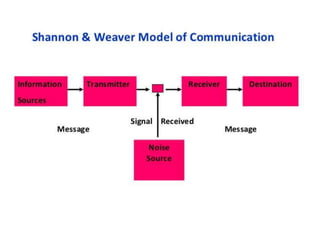
 Claude Shannon & Warren Weaver
 -refined Laswell’s model by adding the concept of noise.
 Noise-is anything that interferes with the intended meaning of
communication.
Interactive Models
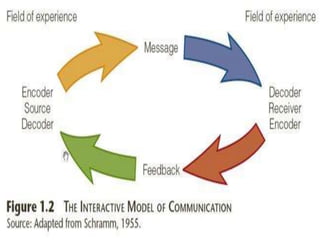
 (also known as CONVERGENCE MODEL) deals with exchange
of ideas and messages taking place both ways from sender to
receiver and vice-versa. The communication process take place
between humans or machines in both verbal or non-verbal way.
 Wilbur Schramm
 -depicted feedback as a second message.
 - pointed out that communication create and interpret messages
within personal fields of experiences.
Transactional Models
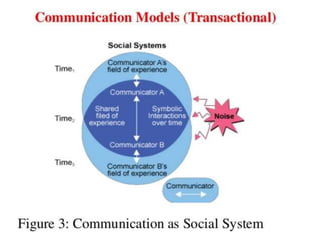
 is the exchange of messages between sender and receiver
where each take turns to send or receive messages. Here, both
"sender" and "receiver" are known as "communicators" and
their role reverses each time in the communication process as
both processes of sending and receiving occurs at the same
time.
 The communicators can be humans or machines but humans
are taken as communicators in this article to analyze general
communication between humans. The model is mostly used for
interpersonal communication and is also called circular model
of communication
Basic_Communication_Models.pptx

Basic_Communication_Models.pptx

  • 1.
    Prof. Francis Quilantang FarEastern University Department of Communication Communication Models
  • 2.
    Basic Communication Models Linear  Interactive  Transactional
  • 3.
    Linear Model  Alsocalled TRANSMISSION MODEL, communication is transmitted in a straightforward manner from a sender to a receiver.  Harold Lasswell  - described communication as a linear or one way process, in which one person acts on another person.  Claude Shannon & Warren Weaver  -refined Laswell’s model by adding the concept of noise.  Noise-is anything that interferes with the intended meaning of communication.
  • 5.
    Interactive Models  (alsoknown as CONVERGENCE MODEL) deals with exchange of ideas and messages taking place both ways from sender to receiver and vice-versa. The communication process take place between humans or machines in both verbal or non-verbal way.  Wilbur Schramm  -depicted feedback as a second message.  - pointed out that communication create and interpret messages within personal fields of experiences.
  • 7.
    Transactional Models  isthe exchange of messages between sender and receiver where each take turns to send or receive messages. Here, both "sender" and "receiver" are known as "communicators" and their role reverses each time in the communication process as both processes of sending and receiving occurs at the same time.  The communicators can be humans or machines but humans are taken as communicators in this article to analyze general communication between humans. The model is mostly used for interpersonal communication and is also called circular model of communication