Dr.V.Malathi, Associate Professor in Biochemistry,Ethiraj College
for Women, Chennai-8
r DNA Technology-
Methodology
Dr.V.Malathi, Associate Professor in Biochemistry,Ethiraj College
for Women, Chennai-8
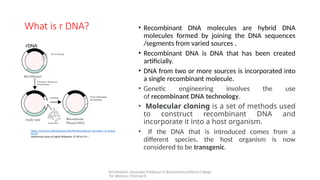
What is r DNA? • Recombinant DNA molecules are hybrid DNA
molecules formed by joining the DNA sequences
/segments from varied sources .
• Recombinant DNA is DNA that has been created
artificially.
• DNA from two or more sources is incorporated into
a single recombinant molecule.
• Genetic engineering involves the use
of recombinant DNA technology.
• Molecular cloning is a set of methods used
to construct recombinant DNA and
incorporate it into a host organism.
• If the DNA that is introduced comes from a
different species, the host organism is now
considered to be transgenic.
rDNA
https://commons.wikimedia.org/wiki/File:Recombinant_formation_of_plasmi
ds.svg
Minestrone Soup at English Wikipedia, CC BY-SA 3.0 <
Dr.V.Malathi, Associate Professor in Biochemistry,Ethiraj College
for Women, Chennai-8
https://courses.lumenlearning.com/microbiology/chapter/microbes-and-the-tools-of-genetic-engineering/
OpenStax Microbiology. Provided by: OpenStax CNX. Located at: http://cnx.org/contents/e42bd376-624b-4c0f-972f-e0c57998e765@4.2. License: CC BY: Attribution.
Dr.V.Malathi, Associate Professor in Biochemistry,Ethiraj College
for Women, Chennai-8
Applications
• Recombinant DNA (rDNA) is widely used in biotechnology,
medicine and research
• Recombinant DNA technology has been used to produce
various human proteins in microorganisms
• Examples of products of recombinant DNA technology in
medicine and research include:
• human recombinant insulin, growth hormone, blood clotting
factors, hepatitis B vaccine, diagnosis of HIV infection.
• Examples of products of recombinant DNA technology in
agriculture include:
• herbicide-resistant crops, and insect-resistant crops.
Dr.V.Malathi, Associate Professor in Biochemistry,Ethiraj College
for Women, Chennai-8
Purified insulin protein is critical to the treatment of diabetes.
Prior to ~1980, insulin for clinical use was isolated from human cadavers or from slaughtered animals such as pigs.
Human-derived insulin generally had better pharmacological properties, but was in limited supply and carried risks of disease
transmission.
By cloning the human insulin gene and expressing it in E. coli, large quantities of insulin identical to the human hormone could
be produced in fermenters, safely and efficiently.
Production of recombinant insulin also allows specialized variants of the protein to be produced: for example, by changing a
few amino acids, longer-acting forms of the hormone can be made.
The active insulin hormone contains two peptide fragments of 21 and 30 amino acids, respectively.
Today, essentially all insulin is produced from recombinant sources , i.e. human genes and their derivatives expressed in
bacteria or yeast.
https://bio.libretexts.org/Bookshelves/Genetics/Book%3A_Online_Open_Genetics_(Nickle_and_Barrette-Ng)/08%3A_Techniques_of_Molec
ular_Genetics/8.05%3A_Cloning_DNA_-_Plasmid_Vectors
Dr. Todd Nickle and Isabelle Barrette-Ng (Mount Royal University) The content on this page is licensed under CC SA 3.0
Dr.V.Malathi, Associate Professor in Biochemistry,Ethiraj College
for Women, Chennai-8
What are steps in r DNA Technology?
• The principle of recombinant DNA technology involves four
steps.
1. Gene Cloning and Development of Recombinant DNA
2. Transfer of Vector into the Host
3. Selection of Transformed Cells and
4. Transcription and Translation of Inserted Gene.
Dr.V.Malathi, Associate Professor in Biochemistry,Ethiraj College
for Women, Chennai-8
What are cloning Vectors ?
• Cloning vectors are vehicles that are used to introduce foreign DNA
into host cells.
• where that DNA can be reproduced (cloned) in large quantities.
• Examples of cloning vectors are
• plasmids, cosmids, bacterial artificial chromosomes (BACs), and yeast
artificial chromosomes (YACs).
Dr.V.Malathi, Associate Professor in Biochemistry,Ethiraj College
for Women, Chennai-8
What are Tools of r DNA Technology?
• Recombinant DNA requires 3 key molecular tools:
1.Cutting DNA at specific sites – most often performed by enzymes called Restriction
Endonucleases (restriction enzymes).
• Restriction enzymes often make staggered cuts at specific 4, 6, or 8-bp palindromic
sequences in duplex DNA, leaving characteristic “sticky ends” that can anneal to each other
via hydrogen bonding between complementary bases on the single-stranded overhangs.
2.Ligating DNA fragments with an enzyme called DNA Ligase .
• DNA ligase, creates covalent phosphodiester bonds between any two DNA fragments that
have been cut by the same restriction enzyme, or have the same compatible “sticky ends”.
3.A “vector”, such as a Plasmid , that can be used to insert a new segment of DNA
via restriction enzyme cutting and ligation. The plasmid containing the inserted
DNA segment will replicate in host cells.
Dr.V.Malathi, Associate Professor in Biochemistry,Ethiraj College
for Women, Chennai-8
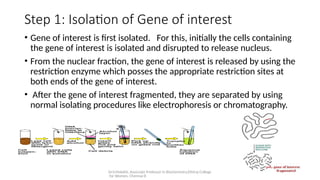
Step 1: Isolation of Gene of interest
• Gene of interest is first isolated. For this, initially the cells containing
the gene of interest is isolated and disrupted to release nucleus.
• From the nuclear fraction, the gene of interest is released by using the
restriction enzyme which posses the appropriate restriction sites at
both ends of the gene of interest.
• After the gene of interest fragmented, they are separated by using
normal isolating procedures like electrophoresis or chromatography.
Dr.V.Malathi, Associate Professor in Biochemistry,Ethiraj College
for Women, Chennai-8
Step 2 : Selection of suitable Vector
• The function of the vector is to enable the foreign genes to get introduced into
and become established within the host cell.
• Naturally occurring DNA molecules that satisfy the basic requirements for a
vector are plasmids and the genomes of bacteriophages and eukaryotic viruses.
• They are further classified as cloning and expression vectors depending on the
stage of genetic engineering at which these vectors are used
• Many bacteria contain extra-chromosomal DNA elements called plasmids.
These are usually small (a few 1000 bp), circular, double stranded molecules
that replicate independently of the chromosome and can be present in high
copy numbers within a cell.
• Plasmids can be used as Cloning Vectors
Dr.V.Malathi, Associate Professor in Biochemistry,Ethiraj College
for Women, Chennai-8
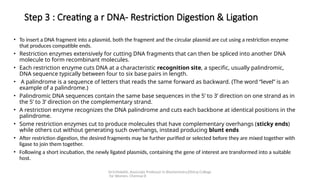
Step 3 : Creating a r DNA- Restriction Digestion & Ligation
• To insert a DNA fragment into a plasmid, both the fragment and the circular plasmid are cut using a restriction enzyme
that produces compatible ends.
• Restriction enzymes extensively for cutting DNA fragments that can then be spliced into another DNA
molecule to form recombinant molecules.
• Each restriction enzyme cuts DNA at a characteristic recognition site, a specific, usually palindromic,
DNA sequence typically between four to six base pairs in length.
• A palindrome is a sequence of letters that reads the same forward as backward. (The word “level” is an
example of a palindrome.)
• Palindromic DNA sequences contain the same base sequences in the 5ʹ to 3ʹ direction on one strand as in
the 5ʹ to 3ʹ direction on the complementary strand.
• A restriction enzyme recognizes the DNA palindrome and cuts each backbone at identical positions in the
palindrome.
• Some restriction enzymes cut to produce molecules that have complementary overhangs (sticky ends)
while others cut without generating such overhangs, instead producing blunt ends
• After restriction digestion, the desired fragments may be further purified or selected before they are mixed together with
ligase to join them together.
• Following a short incubation, the newly ligated plasmids, containing the gene of interest are transformed into a suitable
host.
Dr.V.Malathi, Associate Professor in Biochemistry,Ethiraj College
for Women, Chennai-8
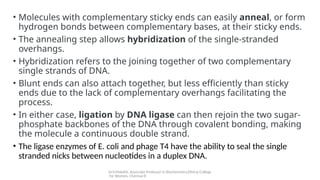
• Molecules with complementary sticky ends can easily anneal, or form
hydrogen bonds between complementary bases, at their sticky ends.
• The annealing step allows hybridization of the single-stranded
overhangs.
• Hybridization refers to the joining together of two complementary
single strands of DNA.
• Blunt ends can also attach together, but less efficiently than sticky
ends due to the lack of complementary overhangs facilitating the
process.
• In either case, ligation by DNA ligase can then rejoin the two sugar-
phosphate backbones of the DNA through covalent bonding, making
the molecule a continuous double strand.
• The ligase enzymes of E. coli and phage T4 have the ability to seal the single
stranded nicks between nucleotides in a duplex DNA.
Dr.V.Malathi, Associate Professor in Biochemistry,Ethiraj College
for Women, Chennai-8
Content of Biological Principles at https://sites.gatech.edu/bioprinciples is licensed under a Creative Commons Attribution-NonCommercial-
ShareAlike 3.0 Unported License.
Dr.V.Malathi, Associate Professor in Biochemistry,Ethiraj College
for Women, Chennai-8
Step 4: Transformation in to host
https://geneticeducation.co.in/gene-transfer-techniques-horizontal-
vertical-physical-and-chemical/
• Transformation is
accomplished by
mixing the ligated DNA
with host cells e.g., E.
coli cells that have
been specially
prepared (i.e.
made competent) to
uptake DNA.
• Competent cells can be
made by exposure to
compounds such as
CaCl2 or to electrical
fields
(electroporation).
Dr.V.Malathi, Associate Professor in Biochemistry,Ethiraj College
for Women, Chennai-8
Step 5: Selection of Transformed cells
• Only a small fraction of cells that are mixed with DNA will actually be
transformed,
Directional selection
• The phenotypes conferred by the cloned genes on the host are used
as markers of selection.
• All useful vector molecules carry a selectable genetic marker or have
a genetically selectable property.
• Plasmid vectors generally possess drug resistance or nutritional
markers and in phage vectors the plaque formation itself is the
selectable property
Dr.V.Malathi, Associate Professor in Biochemistry,Ethiraj College
for Women, Chennai-8
Insertional inactivation
• The technique depends upon homologous recombination between DNA
cloned and the host genome.
• If the cloned sequence lacks both promoter and sequences encoding
essential regions of the carboxyl terminus of the protein, recombination
with homologous genomic sequences will cause gene disruption and
produce a mutant genotype.
• On the other hand, if the cloned fragment contains appropriate
transcriptional and translational signals, homologous recombination will
result in synthesis of a functional mRNA transcript, and no mutant
phenotype will be observed
Dr.V.Malathi, Associate Professor in Biochemistry,Ethiraj College
for Women, Chennai-8
Step 6 :Expression of cloned genes
• An expression vector, otherwise known as an expression construct,
• It is usually a plasmid or virus designed for gene expression in cells.
• The vector is used to introduce a specific gene into a target cell
• It can control the cell's mechanism for protein synthesis to produce
the protein encoded by the gene.
• Therefore in addition to the gene of interest, these expression
constructs also contain regulatory elements like enhancers and
promoters so that efficient transcription of the gene of interest
occurs.
Dr.V.Malathi, Associate Professor in Biochemistry,Ethiraj College
for Women, Chennai-8
Dr.V.Malathi, Associate Professor in Biochemistry,Ethiraj College
for Women,Chennai-8
www.youtube.com
Dr.V.Malathi, Associate Professor in Biochemistry,Ethiraj College
for Women, Chennai-8
Step 7 : Collection & Purification of
Recombinant proteins
• As the recombinant proteins are produced by the cloned genes, they start
accumulating.
• The next task is to collect and purify the specific gene product i.e., the requisite
protein.
• This is not an easy job since many a times the recombinant protein is foreign to
the host cell which possesses an enzyme machinery to degrade the outside
proteins.
Dr.V.Malathi, Associate Professor in Biochemistry,Ethiraj College
for Women, Chennai-8
• The yield of production of recombinant proteins is efficient if they are
quickly exported and secreted into the environment (surrounding
medium).
• Further, the recovery and purification of foreign proteins is easier from
the exported proteins.
• Serious efforts have been made to develop methods for increasing the
export of recombinant proteins.
• Some of the species of the bacterium, Bacillus subtilis normally secrete
large quantities of extracellular proteins. A short DNA sequence, called
signal sequence from such species is introduced into other B. subtilis.
• These bacteria produce recombinant DNA tagged with signal peptide,
which promotes export and secretion. The signal peptide can be removed
after purification of foreign protein.
Dr.V.Malathi, Associate Professor in Biochemistry,Ethiraj College
for Women, Chennai-8
References
• https://bio.libretexts.org/Bookshelves/Introductory_and_General_Bio
logy/Book%3A_Biology_(Kimball)/11%3A_Genomics/11.01%3A_Reco
mbinant_DNA_and_Gene_Cloning
• https://courses.lumenlearning.com/microbiology/chapter/microbes-a
nd-the-tools-of-genetic-engineering/
• https://opentextbc.ca/biology/chapter/10-1-cloning-and-genetic-engi
neering/#:~:text=A%20plasmid%20(also%20called%20a,insert%20a%
20desired%20DNA%20fragment
.
• https://bioprinciples.biosci.gatech.edu/module-5-integrative-health/0
1-recombinant-dna/

Basic steps to Create Recombinant DNA - r DNA methodologyTechnology

  • 1.
    Dr.V.Malathi, Associate Professorin Biochemistry,Ethiraj College for Women, Chennai-8 r DNA Technology- Methodology
  • 2.
    Dr.V.Malathi, Associate Professorin Biochemistry,Ethiraj College for Women, Chennai-8 What is r DNA? • Recombinant DNA molecules are hybrid DNA molecules formed by joining the DNA sequences /segments from varied sources . • Recombinant DNA is DNA that has been created artificially. • DNA from two or more sources is incorporated into a single recombinant molecule. • Genetic engineering involves the use of recombinant DNA technology. • Molecular cloning is a set of methods used to construct recombinant DNA and incorporate it into a host organism. • If the DNA that is introduced comes from a different species, the host organism is now considered to be transgenic. rDNA https://commons.wikimedia.org/wiki/File:Recombinant_formation_of_plasmi ds.svg Minestrone Soup at English Wikipedia, CC BY-SA 3.0 <
  • 3.
    Dr.V.Malathi, Associate Professorin Biochemistry,Ethiraj College for Women, Chennai-8 https://courses.lumenlearning.com/microbiology/chapter/microbes-and-the-tools-of-genetic-engineering/ OpenStax Microbiology. Provided by: OpenStax CNX. Located at: http://cnx.org/contents/e42bd376-624b-4c0f-972f-e0c57998e765@4.2. License: CC BY: Attribution.
  • 4.
    Dr.V.Malathi, Associate Professorin Biochemistry,Ethiraj College for Women, Chennai-8 Applications • Recombinant DNA (rDNA) is widely used in biotechnology, medicine and research • Recombinant DNA technology has been used to produce various human proteins in microorganisms • Examples of products of recombinant DNA technology in medicine and research include: • human recombinant insulin, growth hormone, blood clotting factors, hepatitis B vaccine, diagnosis of HIV infection. • Examples of products of recombinant DNA technology in agriculture include: • herbicide-resistant crops, and insect-resistant crops.
  • 5.
    Dr.V.Malathi, Associate Professorin Biochemistry,Ethiraj College for Women, Chennai-8 Purified insulin protein is critical to the treatment of diabetes. Prior to ~1980, insulin for clinical use was isolated from human cadavers or from slaughtered animals such as pigs. Human-derived insulin generally had better pharmacological properties, but was in limited supply and carried risks of disease transmission. By cloning the human insulin gene and expressing it in E. coli, large quantities of insulin identical to the human hormone could be produced in fermenters, safely and efficiently. Production of recombinant insulin also allows specialized variants of the protein to be produced: for example, by changing a few amino acids, longer-acting forms of the hormone can be made. The active insulin hormone contains two peptide fragments of 21 and 30 amino acids, respectively. Today, essentially all insulin is produced from recombinant sources , i.e. human genes and their derivatives expressed in bacteria or yeast. https://bio.libretexts.org/Bookshelves/Genetics/Book%3A_Online_Open_Genetics_(Nickle_and_Barrette-Ng)/08%3A_Techniques_of_Molec ular_Genetics/8.05%3A_Cloning_DNA_-_Plasmid_Vectors Dr. Todd Nickle and Isabelle Barrette-Ng (Mount Royal University) The content on this page is licensed under CC SA 3.0
  • 6.
    Dr.V.Malathi, Associate Professorin Biochemistry,Ethiraj College for Women, Chennai-8 What are steps in r DNA Technology? • The principle of recombinant DNA technology involves four steps. 1. Gene Cloning and Development of Recombinant DNA 2. Transfer of Vector into the Host 3. Selection of Transformed Cells and 4. Transcription and Translation of Inserted Gene.
  • 7.
    Dr.V.Malathi, Associate Professorin Biochemistry,Ethiraj College for Women, Chennai-8 What are cloning Vectors ? • Cloning vectors are vehicles that are used to introduce foreign DNA into host cells. • where that DNA can be reproduced (cloned) in large quantities. • Examples of cloning vectors are • plasmids, cosmids, bacterial artificial chromosomes (BACs), and yeast artificial chromosomes (YACs).
  • 8.
    Dr.V.Malathi, Associate Professorin Biochemistry,Ethiraj College for Women, Chennai-8 What are Tools of r DNA Technology? • Recombinant DNA requires 3 key molecular tools: 1.Cutting DNA at specific sites – most often performed by enzymes called Restriction Endonucleases (restriction enzymes). • Restriction enzymes often make staggered cuts at specific 4, 6, or 8-bp palindromic sequences in duplex DNA, leaving characteristic “sticky ends” that can anneal to each other via hydrogen bonding between complementary bases on the single-stranded overhangs. 2.Ligating DNA fragments with an enzyme called DNA Ligase . • DNA ligase, creates covalent phosphodiester bonds between any two DNA fragments that have been cut by the same restriction enzyme, or have the same compatible “sticky ends”. 3.A “vector”, such as a Plasmid , that can be used to insert a new segment of DNA via restriction enzyme cutting and ligation. The plasmid containing the inserted DNA segment will replicate in host cells.
  • 9.
    Dr.V.Malathi, Associate Professorin Biochemistry,Ethiraj College for Women, Chennai-8 Step 1: Isolation of Gene of interest • Gene of interest is first isolated. For this, initially the cells containing the gene of interest is isolated and disrupted to release nucleus. • From the nuclear fraction, the gene of interest is released by using the restriction enzyme which posses the appropriate restriction sites at both ends of the gene of interest. • After the gene of interest fragmented, they are separated by using normal isolating procedures like electrophoresis or chromatography.
  • 10.
    Dr.V.Malathi, Associate Professorin Biochemistry,Ethiraj College for Women, Chennai-8 Step 2 : Selection of suitable Vector • The function of the vector is to enable the foreign genes to get introduced into and become established within the host cell. • Naturally occurring DNA molecules that satisfy the basic requirements for a vector are plasmids and the genomes of bacteriophages and eukaryotic viruses. • They are further classified as cloning and expression vectors depending on the stage of genetic engineering at which these vectors are used • Many bacteria contain extra-chromosomal DNA elements called plasmids. These are usually small (a few 1000 bp), circular, double stranded molecules that replicate independently of the chromosome and can be present in high copy numbers within a cell. • Plasmids can be used as Cloning Vectors
  • 11.
    Dr.V.Malathi, Associate Professorin Biochemistry,Ethiraj College for Women, Chennai-8 Step 3 : Creating a r DNA- Restriction Digestion & Ligation • To insert a DNA fragment into a plasmid, both the fragment and the circular plasmid are cut using a restriction enzyme that produces compatible ends. • Restriction enzymes extensively for cutting DNA fragments that can then be spliced into another DNA molecule to form recombinant molecules. • Each restriction enzyme cuts DNA at a characteristic recognition site, a specific, usually palindromic, DNA sequence typically between four to six base pairs in length. • A palindrome is a sequence of letters that reads the same forward as backward. (The word “level” is an example of a palindrome.) • Palindromic DNA sequences contain the same base sequences in the 5ʹ to 3ʹ direction on one strand as in the 5ʹ to 3ʹ direction on the complementary strand. • A restriction enzyme recognizes the DNA palindrome and cuts each backbone at identical positions in the palindrome. • Some restriction enzymes cut to produce molecules that have complementary overhangs (sticky ends) while others cut without generating such overhangs, instead producing blunt ends • After restriction digestion, the desired fragments may be further purified or selected before they are mixed together with ligase to join them together. • Following a short incubation, the newly ligated plasmids, containing the gene of interest are transformed into a suitable host.
  • 12.
    Dr.V.Malathi, Associate Professorin Biochemistry,Ethiraj College for Women, Chennai-8 • Molecules with complementary sticky ends can easily anneal, or form hydrogen bonds between complementary bases, at their sticky ends. • The annealing step allows hybridization of the single-stranded overhangs. • Hybridization refers to the joining together of two complementary single strands of DNA. • Blunt ends can also attach together, but less efficiently than sticky ends due to the lack of complementary overhangs facilitating the process. • In either case, ligation by DNA ligase can then rejoin the two sugar- phosphate backbones of the DNA through covalent bonding, making the molecule a continuous double strand. • The ligase enzymes of E. coli and phage T4 have the ability to seal the single stranded nicks between nucleotides in a duplex DNA.
  • 13.
    Dr.V.Malathi, Associate Professorin Biochemistry,Ethiraj College for Women, Chennai-8 Content of Biological Principles at https://sites.gatech.edu/bioprinciples is licensed under a Creative Commons Attribution-NonCommercial- ShareAlike 3.0 Unported License.
  • 14.
    Dr.V.Malathi, Associate Professorin Biochemistry,Ethiraj College for Women, Chennai-8 Step 4: Transformation in to host https://geneticeducation.co.in/gene-transfer-techniques-horizontal- vertical-physical-and-chemical/ • Transformation is accomplished by mixing the ligated DNA with host cells e.g., E. coli cells that have been specially prepared (i.e. made competent) to uptake DNA. • Competent cells can be made by exposure to compounds such as CaCl2 or to electrical fields (electroporation).
  • 15.
    Dr.V.Malathi, Associate Professorin Biochemistry,Ethiraj College for Women, Chennai-8 Step 5: Selection of Transformed cells • Only a small fraction of cells that are mixed with DNA will actually be transformed, Directional selection • The phenotypes conferred by the cloned genes on the host are used as markers of selection. • All useful vector molecules carry a selectable genetic marker or have a genetically selectable property. • Plasmid vectors generally possess drug resistance or nutritional markers and in phage vectors the plaque formation itself is the selectable property
  • 16.
    Dr.V.Malathi, Associate Professorin Biochemistry,Ethiraj College for Women, Chennai-8 Insertional inactivation • The technique depends upon homologous recombination between DNA cloned and the host genome. • If the cloned sequence lacks both promoter and sequences encoding essential regions of the carboxyl terminus of the protein, recombination with homologous genomic sequences will cause gene disruption and produce a mutant genotype. • On the other hand, if the cloned fragment contains appropriate transcriptional and translational signals, homologous recombination will result in synthesis of a functional mRNA transcript, and no mutant phenotype will be observed
  • 17.
    Dr.V.Malathi, Associate Professorin Biochemistry,Ethiraj College for Women, Chennai-8 Step 6 :Expression of cloned genes • An expression vector, otherwise known as an expression construct, • It is usually a plasmid or virus designed for gene expression in cells. • The vector is used to introduce a specific gene into a target cell • It can control the cell's mechanism for protein synthesis to produce the protein encoded by the gene. • Therefore in addition to the gene of interest, these expression constructs also contain regulatory elements like enhancers and promoters so that efficient transcription of the gene of interest occurs.
  • 18.
    Dr.V.Malathi, Associate Professorin Biochemistry,Ethiraj College for Women, Chennai-8
  • 19.
    Dr.V.Malathi, Associate Professorin Biochemistry,Ethiraj College for Women,Chennai-8 www.youtube.com
  • 20.
    Dr.V.Malathi, Associate Professorin Biochemistry,Ethiraj College for Women, Chennai-8 Step 7 : Collection & Purification of Recombinant proteins • As the recombinant proteins are produced by the cloned genes, they start accumulating. • The next task is to collect and purify the specific gene product i.e., the requisite protein. • This is not an easy job since many a times the recombinant protein is foreign to the host cell which possesses an enzyme machinery to degrade the outside proteins.
  • 21.
    Dr.V.Malathi, Associate Professorin Biochemistry,Ethiraj College for Women, Chennai-8 • The yield of production of recombinant proteins is efficient if they are quickly exported and secreted into the environment (surrounding medium). • Further, the recovery and purification of foreign proteins is easier from the exported proteins. • Serious efforts have been made to develop methods for increasing the export of recombinant proteins. • Some of the species of the bacterium, Bacillus subtilis normally secrete large quantities of extracellular proteins. A short DNA sequence, called signal sequence from such species is introduced into other B. subtilis. • These bacteria produce recombinant DNA tagged with signal peptide, which promotes export and secretion. The signal peptide can be removed after purification of foreign protein.
  • 22.
    Dr.V.Malathi, Associate Professorin Biochemistry,Ethiraj College for Women, Chennai-8 References • https://bio.libretexts.org/Bookshelves/Introductory_and_General_Bio logy/Book%3A_Biology_(Kimball)/11%3A_Genomics/11.01%3A_Reco mbinant_DNA_and_Gene_Cloning • https://courses.lumenlearning.com/microbiology/chapter/microbes-a nd-the-tools-of-genetic-engineering/ • https://opentextbc.ca/biology/chapter/10-1-cloning-and-genetic-engi neering/#:~:text=A%20plasmid%20(also%20called%20a,insert%20a% 20desired%20DNA%20fragment . • https://bioprinciples.biosci.gatech.edu/module-5-integrative-health/0 1-recombinant-dna/