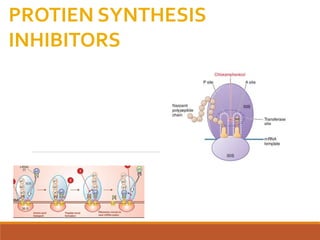
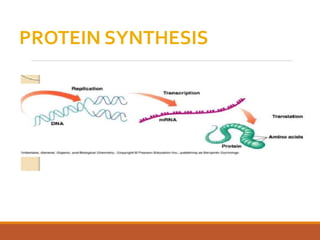
PROTIEN SYNTHESIS
INHIBITORS
CONTENT
 Protein synthesis
 Introduction of Protein synthesis inhibitors
 Pharmacology ofTetracycline
 Pharmacology of choramphenicol
 Pharmacology of Macrolides
Protein synthesis
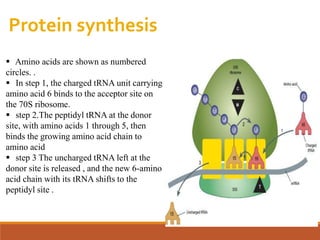
 Amino acids are shown as numbered
circles. .
 In step 1, the charged tRNA unit carrying
amino acid 6 binds to the acceptor site on
the 70S ribosome.
 step 2.The peptidyl tRNA at the donor
site, with amino acids 1 through 5, then
binds the growing amino acid chain to
amino acid
 step 3 The uncharged tRNA left at the
donor site is released , and the new 6-amino
acid chain with its tRNA shifts to the
peptidyl site .
PROTEIN SYNTHESIS
PROTEIN SYNTHESIS INHIBITOR
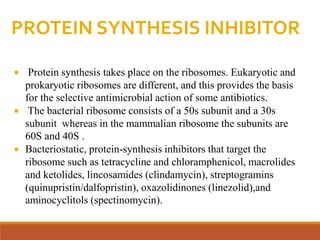
 Protein synthesis takes place on the ribosomes. Eukaryotic and
prokaryotic ribosomes are different, and this provides the basis
for the selective antimicrobial action of some antibiotics.
 The bacterial ribosome consists of a 50s subunit and a 30s
subunit whereas in the mammalian ribosome the subunits are
60S and 40S .
 Bacteriostatic, protein-synthesis inhibitors that target the
ribosome such as tetracycline and chloramphenicol, macrolides
and ketolides, lincosamides (clindamycin), streptogramins
(quinupristin/dalfopristin), oxazolidinones (linezolid),and
aminocyclitols (spectinomycin).
TETRACYCLINE
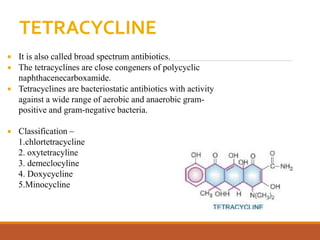
 It is also called broad spectrum antibiotics.
 The tetracyclines are close congeners of polycyclic
naphthacenecarboxamide.
 Tetracyclines are bacteriostatic antibiotics with activity
against a wide range of aerobic and anaerobic gram-
positive and gram-negative bacteria.
 Classification –
1.chlortetracycline
2. oxytetracyline
3. demeclocyline
4. Doxycycline
5.Minocycline
Mode of action
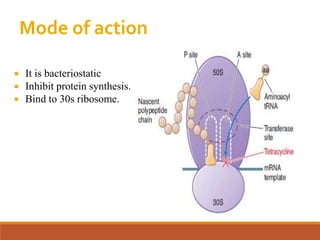
 It is bacteriostatic
 Inhibit protein synthesis.
 Bind to 30s ribosome.
PHARMACOKINETICS
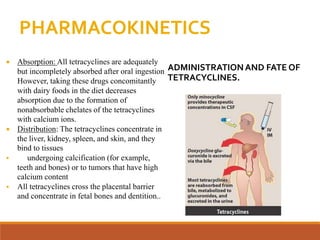
 Absorption: All tetracyclines are adequately
but incompletely absorbed after oral ingestion
However, taking these drugs concomitantly
with dairy foods in the diet decreases
absorption due to the formation of
nonabsorbable chelates of the tetracyclines
with calcium ions.
 Distribution: The tetracyclines concentrate in
the liver, kidney, spleen, and skin, and they
bind to tissues
 undergoing calcification (for example,
teeth and bones) or to tumors that have high
calcium content
 All tetracyclines cross the placental barrier
and concentrate in fetal bones and dentition..
ADMINISTRATIONAND FATE OF
TETRACYCLINES.
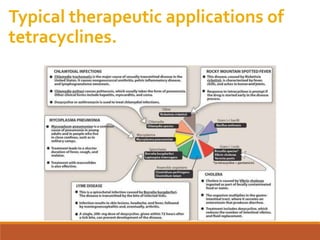
Typical therapeutic applications of
tetracyclines.
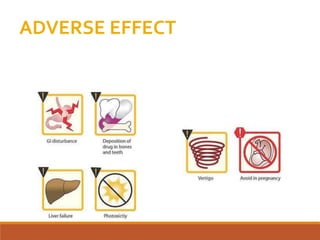
ADVERSE EFFECT
Resistance toTetracycline
 Resistance is primarily plasmid mediated and often inducible.
The three main resistance mechanisms are
 Decreased accumulation of tetracycline as a result of either
decreased antibiotic influx or acquisition of an energy-
dependent efflux pathway;
 Production of a ribosomal protection protein that displaces
tetracycline from its target, a “protection” that also may occur
by mutation.
 Enzymatic inactivation of tetracyclines.
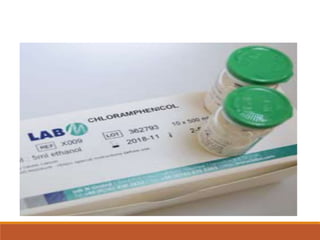
Chloramphenicol
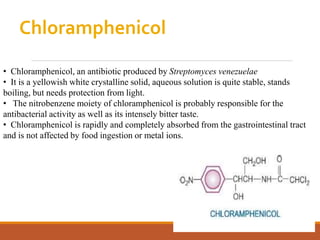
• Chloramphenicol, an antibiotic produced by Streptomyces venezuelae
• It is a yellowish white crystalline solid, aqueous solution is quite stable, stands
boiling, but needs protection from light.
• The nitrobenzene moiety of chloramphenicol is probably responsible for the
antibacterial activity as well as its intensely bitter taste.
• Chloramphenicol is rapidly and completely absorbed from the gastrointestinal tract
and is not affected by food ingestion or metal ions.
Mode of action
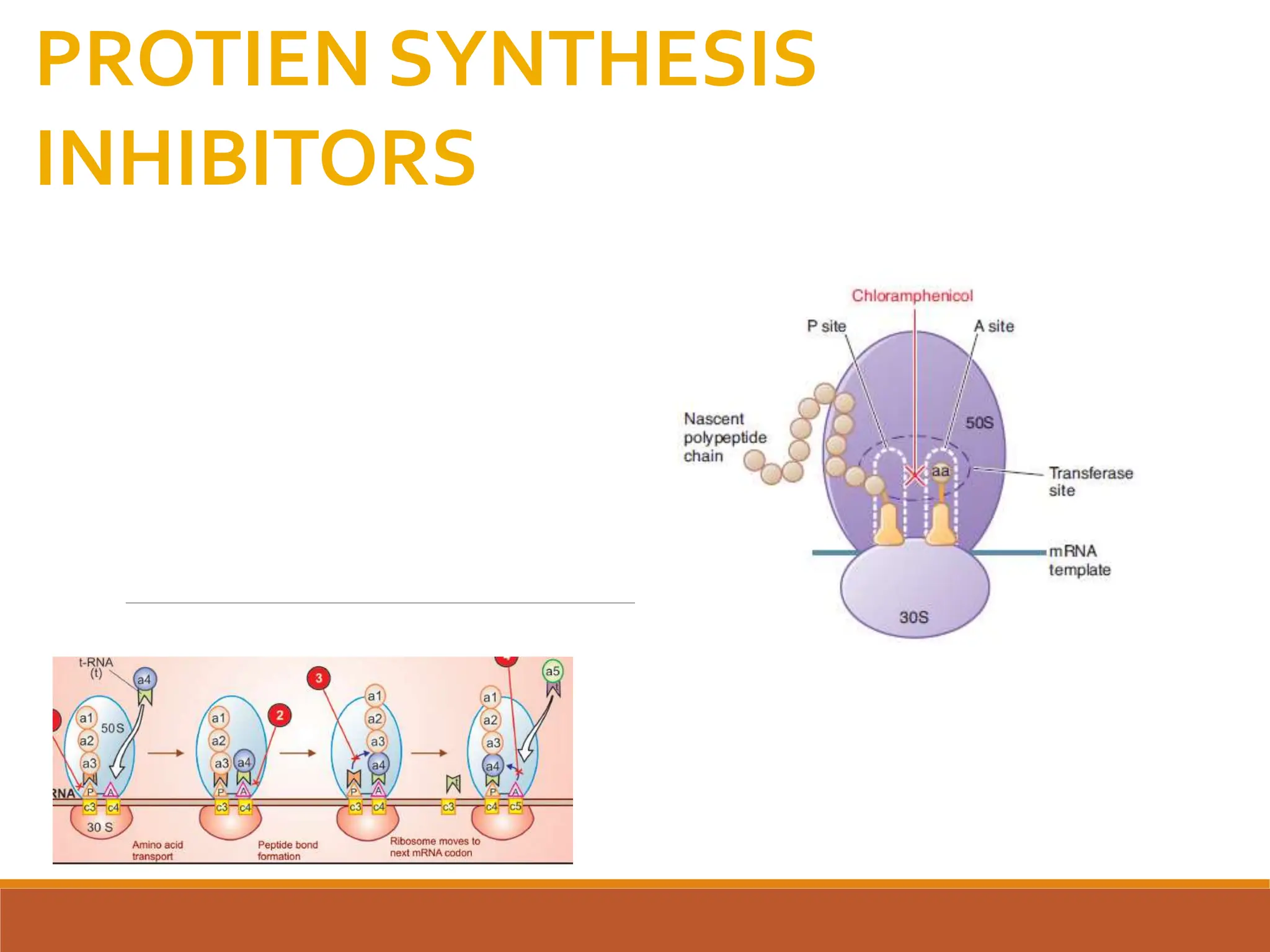
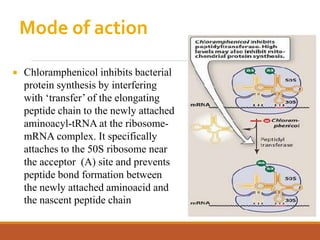
 Chloramphenicol inhibits bacterial
protein synthesis by interfering
with ‘transfer’ of the elongating
peptide chain to the newly attached
aminoacyl-tRNA at the ribosome-
mRNA complex. It specifically
attaches to the 50S ribosome near
the acceptor (A) site and prevents
peptide bond formation between
the newly attached aminoacid and
the nascent peptide chain
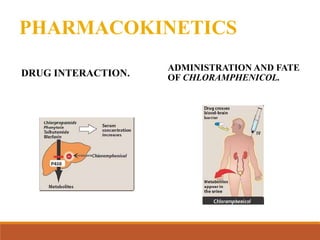
PHARMACOKINETICS
DRUG INTERACTION.
ADMINISTRATION AND FATE
OF CHLORAMPHENICOL.
Resistance to Chloramphenicol.
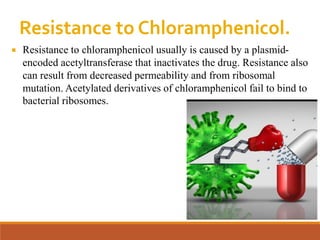
 Resistance to chloramphenicol usually is caused by a plasmid-
encoded acetyltransferase that inactivates the drug. Resistance also
can result from decreased permeability and from ribosomal
mutation. Acetylated derivatives of chloramphenicol fail to bind to
bacterial ribosomes.
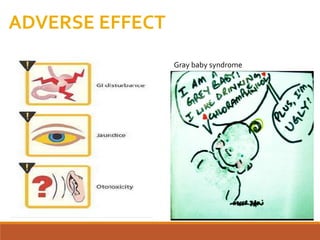
ADVERSE EFFECT
Gray baby syndrome
CLINICAL USE
 Chloramphenicol is used topically in the treatment of eye
infections because of its broad spectrum and its penetration of
ocular tissues and the aqueous humor. It is ineffective for
chlamydial infections.
 Chloramphenicol remains a major treatment of typhoid and
paratyphoid fever in developing countries.
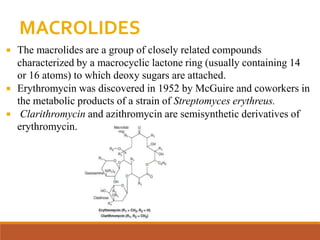
MACROLIDES
 The macrolides are a group of closely related compounds
characterized by a macrocyclic lactone ring (usually containing 14
or 16 atoms) to which deoxy sugars are attached.
 Erythromycin was discovered in 1952 by McGuire and coworkers in
the metabolic products of a strain of Streptomyces erythreus.
 Clarithromycin and azithromycin are semisynthetic derivatives of
erythromycin.
Antimicrobial Activity.
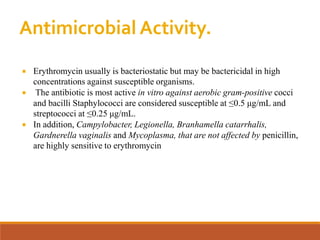
 Erythromycin usually is bacteriostatic but may be bactericidal in high
concentrations against susceptible organisms.
 The antibiotic is most active in vitro against aerobic gram-positive cocci
and bacilli Staphylococci are considered susceptible at ≤0.5 μg/mL and
streptococci at ≤0.25 μg/mL.
 In addition, Campylobacter, Legionella, Branhamella catarrhalis,
Gardnerella vaginalis and Mycoplasma, that are not affected by penicillin,
are highly sensitive to erythromycin
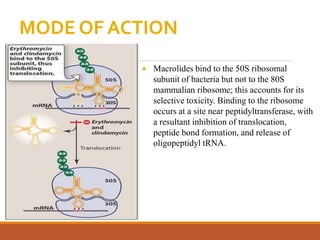
MODE OF ACTION
 Macrolides bind to the 50S ribosomal
subunit of bacteria but not to the 80S
mammalian ribosome; this accounts for its
selective toxicity. Binding to the ribosome
occurs at a site near peptidyltransferase, with
a resultant inhibition of translocation,
peptide bond formation, and release of
oligopeptidyl tRNA.
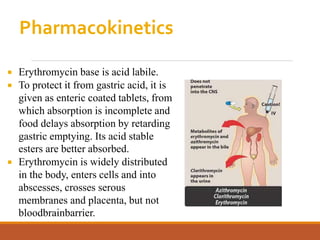
Pharmacokinetics
 Erythromycin base is acid labile.
 To protect it from gastric acid, it is
given as enteric coated tablets, from
which absorption is incomplete and
food delays absorption by retarding
gastric emptying. Its acid stable
esters are better absorbed.
 Erythromycin is widely distributed
in the body, enters cells and into
abscesses, crosses serous
membranes and placenta, but not
bloodbrainbarrier.
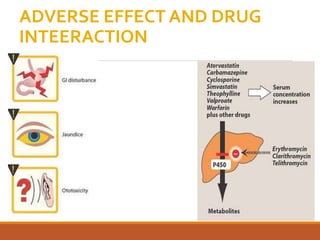
ADVERSE EFFECT AND DRUG
INTEERACTION

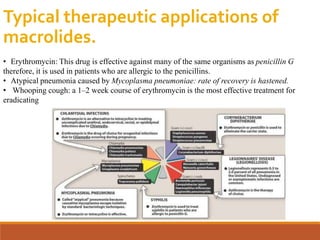
Typical therapeutic applications of
macrolides.
• Erythromycin: This drug is effective against many of the same organisms as penicillin G
therefore, it is used in patients who are allergic to the penicillins.
• Atypical pneumonia caused by Mycoplasma pneumoniae: rate of recovery is hastened.
• Whooping cough: a 1–2 week course of erythromycin is the most effective treatment for
eradicating
REFERENCES
 1. The pharmacological basis of therapeutics – Goodman & Gillman’s
12th edition page no. 1521-1545.
 2. Basic and clinical pharmacology by katzung B. G 12th edition page
no. 810-845.
 3. K.D Tripathi , Essential of medical pharmacology 7th edition page
no. 733
 4. Lippincott’s Illustrated review , Pharmacology 4th edition page no.
596-613.
 5. Modern Pharmacology with clinical applications Charles R. Craig
Robert E. Stitzel 5th edition page no. 550-556

Basic Knowledge about Protein Synthesis Inhibitors.ppt

  • 1.
  • 2.
    CONTENT  Protein synthesis Introduction of Protein synthesis inhibitors  Pharmacology ofTetracycline  Pharmacology of choramphenicol  Pharmacology of Macrolides
  • 3.
    Protein synthesis  Aminoacids are shown as numbered circles. .  In step 1, the charged tRNA unit carrying amino acid 6 binds to the acceptor site on the 70S ribosome.  step 2.The peptidyl tRNA at the donor site, with amino acids 1 through 5, then binds the growing amino acid chain to amino acid  step 3 The uncharged tRNA left at the donor site is released , and the new 6-amino acid chain with its tRNA shifts to the peptidyl site .
  • 4.
  • 5.
    PROTEIN SYNTHESIS INHIBITOR Protein synthesis takes place on the ribosomes. Eukaryotic and prokaryotic ribosomes are different, and this provides the basis for the selective antimicrobial action of some antibiotics.  The bacterial ribosome consists of a 50s subunit and a 30s subunit whereas in the mammalian ribosome the subunits are 60S and 40S .  Bacteriostatic, protein-synthesis inhibitors that target the ribosome such as tetracycline and chloramphenicol, macrolides and ketolides, lincosamides (clindamycin), streptogramins (quinupristin/dalfopristin), oxazolidinones (linezolid),and aminocyclitols (spectinomycin).
  • 6.
    TETRACYCLINE  It isalso called broad spectrum antibiotics.  The tetracyclines are close congeners of polycyclic naphthacenecarboxamide.  Tetracyclines are bacteriostatic antibiotics with activity against a wide range of aerobic and anaerobic gram- positive and gram-negative bacteria.  Classification – 1.chlortetracycline 2. oxytetracyline 3. demeclocyline 4. Doxycycline 5.Minocycline
  • 7.
    Mode of action It is bacteriostatic  Inhibit protein synthesis.  Bind to 30s ribosome.
  • 8.
    PHARMACOKINETICS  Absorption: Alltetracyclines are adequately but incompletely absorbed after oral ingestion However, taking these drugs concomitantly with dairy foods in the diet decreases absorption due to the formation of nonabsorbable chelates of the tetracyclines with calcium ions.  Distribution: The tetracyclines concentrate in the liver, kidney, spleen, and skin, and they bind to tissues  undergoing calcification (for example, teeth and bones) or to tumors that have high calcium content  All tetracyclines cross the placental barrier and concentrate in fetal bones and dentition.. ADMINISTRATIONAND FATE OF TETRACYCLINES.
  • 9.
  • 10.
  • 11.
    Resistance toTetracycline  Resistanceis primarily plasmid mediated and often inducible. The three main resistance mechanisms are  Decreased accumulation of tetracycline as a result of either decreased antibiotic influx or acquisition of an energy- dependent efflux pathway;  Production of a ribosomal protection protein that displaces tetracycline from its target, a “protection” that also may occur by mutation.  Enzymatic inactivation of tetracyclines.
  • 12.
    Chloramphenicol • Chloramphenicol, anantibiotic produced by Streptomyces venezuelae • It is a yellowish white crystalline solid, aqueous solution is quite stable, stands boiling, but needs protection from light. • The nitrobenzene moiety of chloramphenicol is probably responsible for the antibacterial activity as well as its intensely bitter taste. • Chloramphenicol is rapidly and completely absorbed from the gastrointestinal tract and is not affected by food ingestion or metal ions.
  • 13.
    Mode of action Chloramphenicol inhibits bacterial protein synthesis by interfering with ‘transfer’ of the elongating peptide chain to the newly attached aminoacyl-tRNA at the ribosome- mRNA complex. It specifically attaches to the 50S ribosome near the acceptor (A) site and prevents peptide bond formation between the newly attached aminoacid and the nascent peptide chain
  • 14.
  • 15.
    Resistance to Chloramphenicol. Resistance to chloramphenicol usually is caused by a plasmid- encoded acetyltransferase that inactivates the drug. Resistance also can result from decreased permeability and from ribosomal mutation. Acetylated derivatives of chloramphenicol fail to bind to bacterial ribosomes.
  • 16.
  • 17.
    CLINICAL USE  Chloramphenicolis used topically in the treatment of eye infections because of its broad spectrum and its penetration of ocular tissues and the aqueous humor. It is ineffective for chlamydial infections.  Chloramphenicol remains a major treatment of typhoid and paratyphoid fever in developing countries.
  • 19.
    MACROLIDES  The macrolidesare a group of closely related compounds characterized by a macrocyclic lactone ring (usually containing 14 or 16 atoms) to which deoxy sugars are attached.  Erythromycin was discovered in 1952 by McGuire and coworkers in the metabolic products of a strain of Streptomyces erythreus.  Clarithromycin and azithromycin are semisynthetic derivatives of erythromycin.
  • 20.
    Antimicrobial Activity.  Erythromycinusually is bacteriostatic but may be bactericidal in high concentrations against susceptible organisms.  The antibiotic is most active in vitro against aerobic gram-positive cocci and bacilli Staphylococci are considered susceptible at ≤0.5 μg/mL and streptococci at ≤0.25 μg/mL.  In addition, Campylobacter, Legionella, Branhamella catarrhalis, Gardnerella vaginalis and Mycoplasma, that are not affected by penicillin, are highly sensitive to erythromycin
  • 21.
    MODE OF ACTION Macrolides bind to the 50S ribosomal subunit of bacteria but not to the 80S mammalian ribosome; this accounts for its selective toxicity. Binding to the ribosome occurs at a site near peptidyltransferase, with a resultant inhibition of translocation, peptide bond formation, and release of oligopeptidyl tRNA.
  • 22.
    Pharmacokinetics  Erythromycin baseis acid labile.  To protect it from gastric acid, it is given as enteric coated tablets, from which absorption is incomplete and food delays absorption by retarding gastric emptying. Its acid stable esters are better absorbed.  Erythromycin is widely distributed in the body, enters cells and into abscesses, crosses serous membranes and placenta, but not bloodbrainbarrier.
  • 23.
    ADVERSE EFFECT ANDDRUG INTEERACTION 
  • 24.
    Typical therapeutic applicationsof macrolides. • Erythromycin: This drug is effective against many of the same organisms as penicillin G therefore, it is used in patients who are allergic to the penicillins. • Atypical pneumonia caused by Mycoplasma pneumoniae: rate of recovery is hastened. • Whooping cough: a 1–2 week course of erythromycin is the most effective treatment for eradicating
  • 25.
    REFERENCES  1. Thepharmacological basis of therapeutics – Goodman & Gillman’s 12th edition page no. 1521-1545.  2. Basic and clinical pharmacology by katzung B. G 12th edition page no. 810-845.  3. K.D Tripathi , Essential of medical pharmacology 7th edition page no. 733  4. Lippincott’s Illustrated review , Pharmacology 4th edition page no. 596-613.  5. Modern Pharmacology with clinical applications Charles R. Craig Robert E. Stitzel 5th edition page no. 550-556