Introduction to Bioenergetics
•Study of the transformation of energy in living organisms.
• Explains how cells obtain and use energy to perform work.
2.
Forms of Energyin Biological Systems
• Chemical energy (bonds in molecules)
• Mechanical energy (muscle contraction)
• Electrical energy (nerve impulses)
• Heat energy
3.
The Laws ofThermodynamics
• First Law: Energy can neither be created nor destroyed, only
transformed.
• Second Law: Every energy transfer increases the entropy of the
universe.
4.
Free Energy andBiological Work
• Gibbs free energy (G): Determines if a reaction is spontaneous.
• ΔG < 0: Exergonic reaction (energy released)
• ΔG > 0: Endergonic reaction (energy required)
5.
ATP: The EnergyCurrency
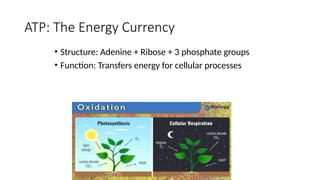
• Structure: Adenine + Ribose + 3 phosphate groups
• Function: Transfers energy for cellular processes
6.
Bioenergetics of CellularRespiration
• Stages: Glycolysis, Krebs cycle, Electron transport chain
• Net ATP production: ~36-38 ATP per glucose molecule
7.
Elaborate the oxidation,reduction reaction
Biological oxidation reaction
• In bioenergetics, oxidation is a crucial process where
molecules lose electrons, often accompanied by the
release of energy.
• This electron loss typically involves the transfer of
electrons from one molecule to another, facilitating the
generation of ATP (adenosine triphosphate) and the
production of energy in cellular respiration.
• Oxidation reactions are pivotal in breaking down organic
molecules to generate the energy needed for cellular
functions.
8.
Example
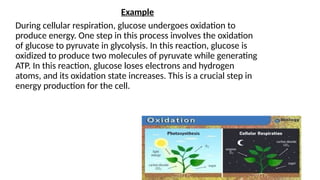
During cellular respiration,glucose undergoes oxidation to
produce energy. One step in this process involves the oxidation
of glucose to pyruvate in glycolysis. In this reaction, glucose is
oxidized to produce two molecules of pyruvate while generating
ATP. In this reaction, glucose loses electrons and hydrogen
atoms, and its oxidation state increases. This is a crucial step in
energy production for the cell.
9.
Biological reduction reaction
•Reduction in the field of bioenergetics refers to a chemical reaction
where a molecule gains electrons or hydrogen, resulting in a decrease
in its oxidation state.
• This process often involves the removal of oxygen or the addition of
hydrogen to a compound.
• Reduction reactions are essential in biological systems, playing a key
role in processes like photosynthesis and energy production within
cells during respiration.
10.
Example
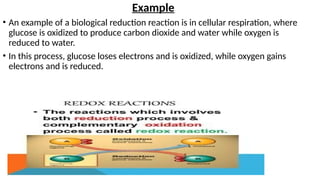
• An exampleof a biological reduction reaction is in cellular respiration, where
glucose is oxidized to produce carbon dioxide and water while oxygen is
reduced to water.
• In this process, glucose loses electrons and is oxidized, while oxygen gains
electrons and is reduced.