Unit-10
Lecture Outline
-Difference between metal and non-metal
-Occurrence of Metal
-Definitions: Metal, non-metal, Metalloid, Minerals, ores,
gangue, flux, slag, alloy, amalgam etc.
BY
Ram Darash Pandey( Assistant Professor)
Amrit Campus, T.U.
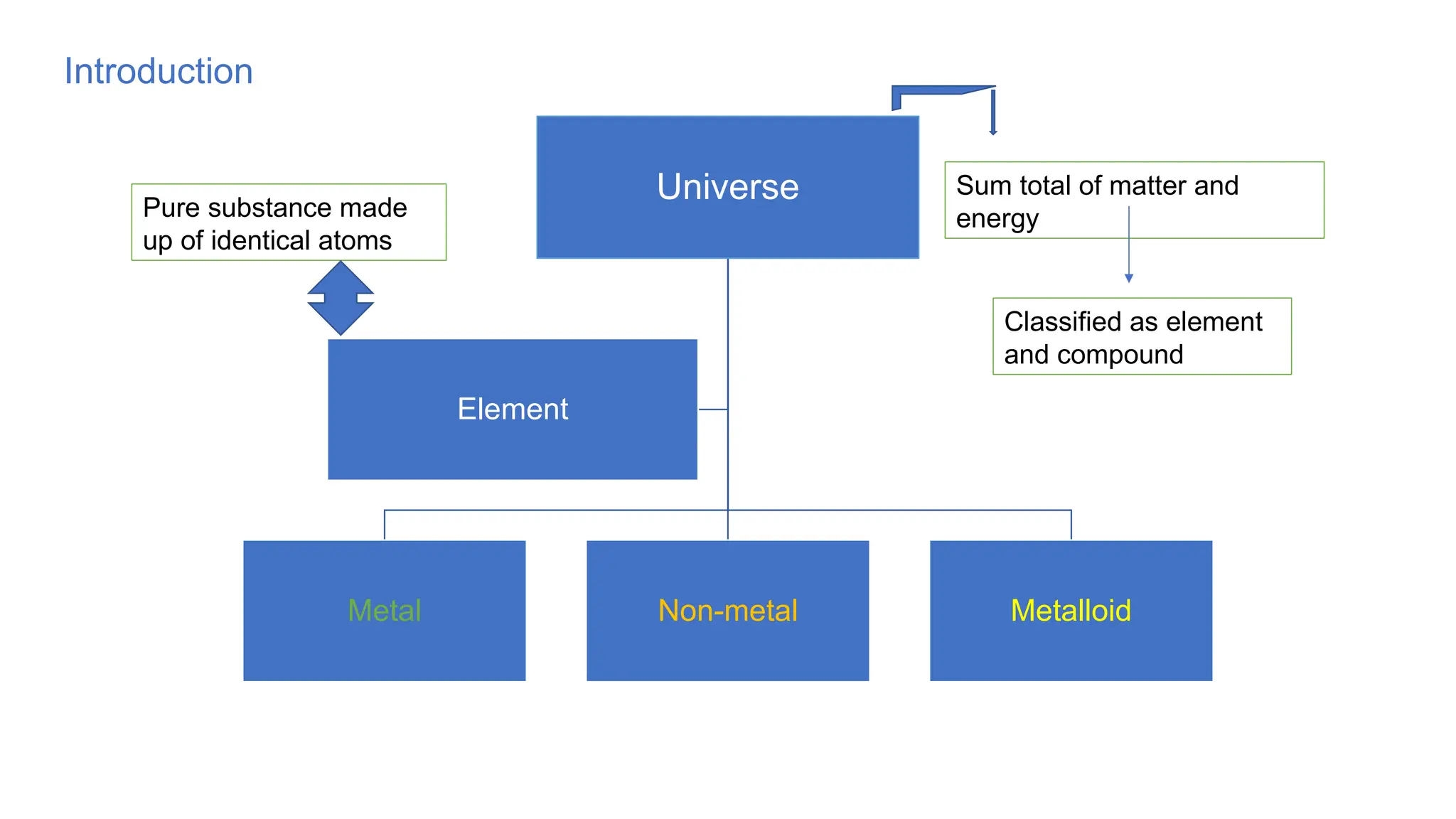
Universe
Metal Non-metal Metalloid
Element
Sum total of matter and
energy
Pure substance made
up of identical atoms
Classified as element
and compound
Introduction
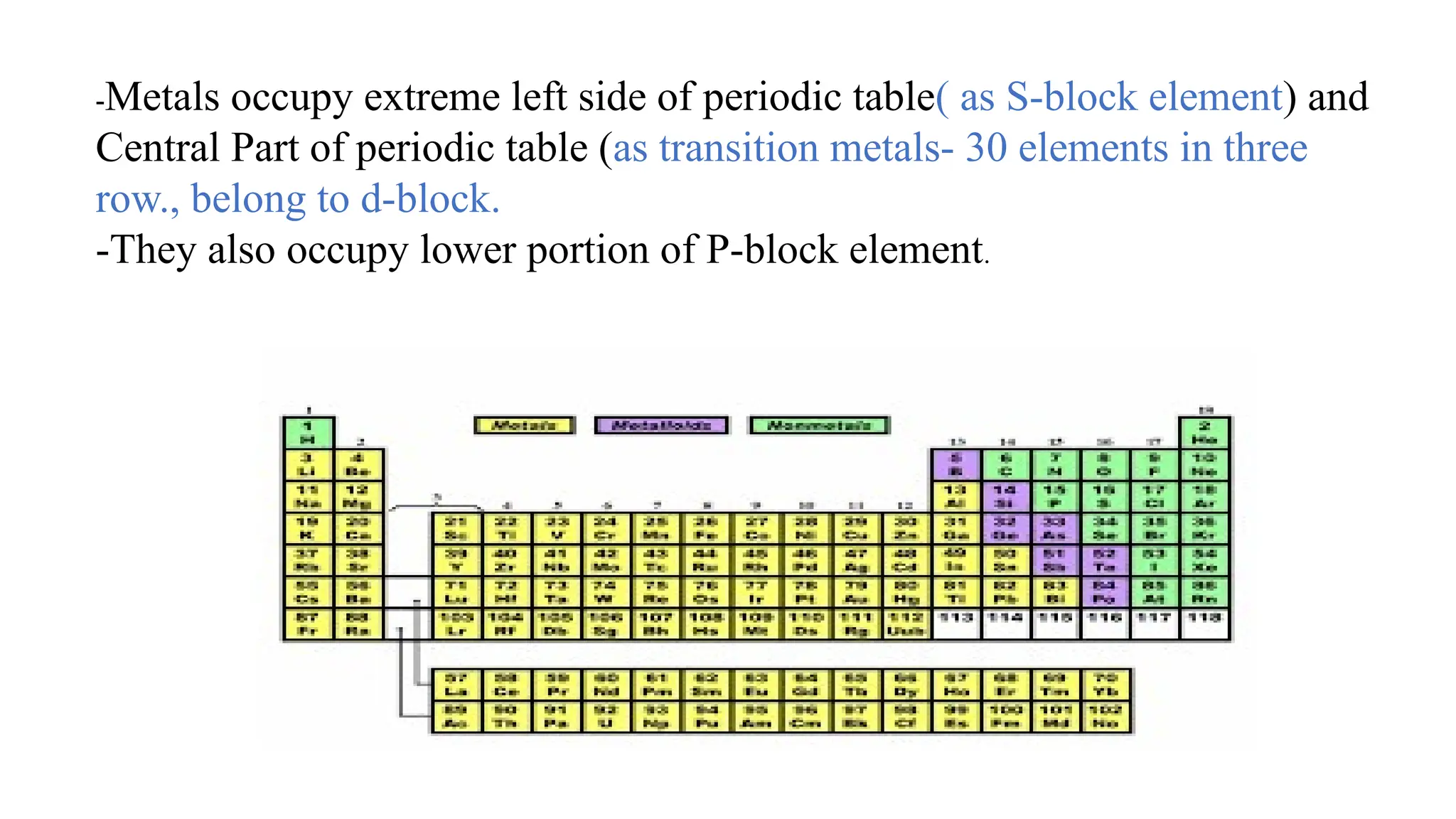
-Metals occupy extreme left side of periodic table( as S-block element) and
Central Part of periodic table (as transition metals- 30 elements in three
row., belong to d-block.
-They also occupy lower portion of P-block element.
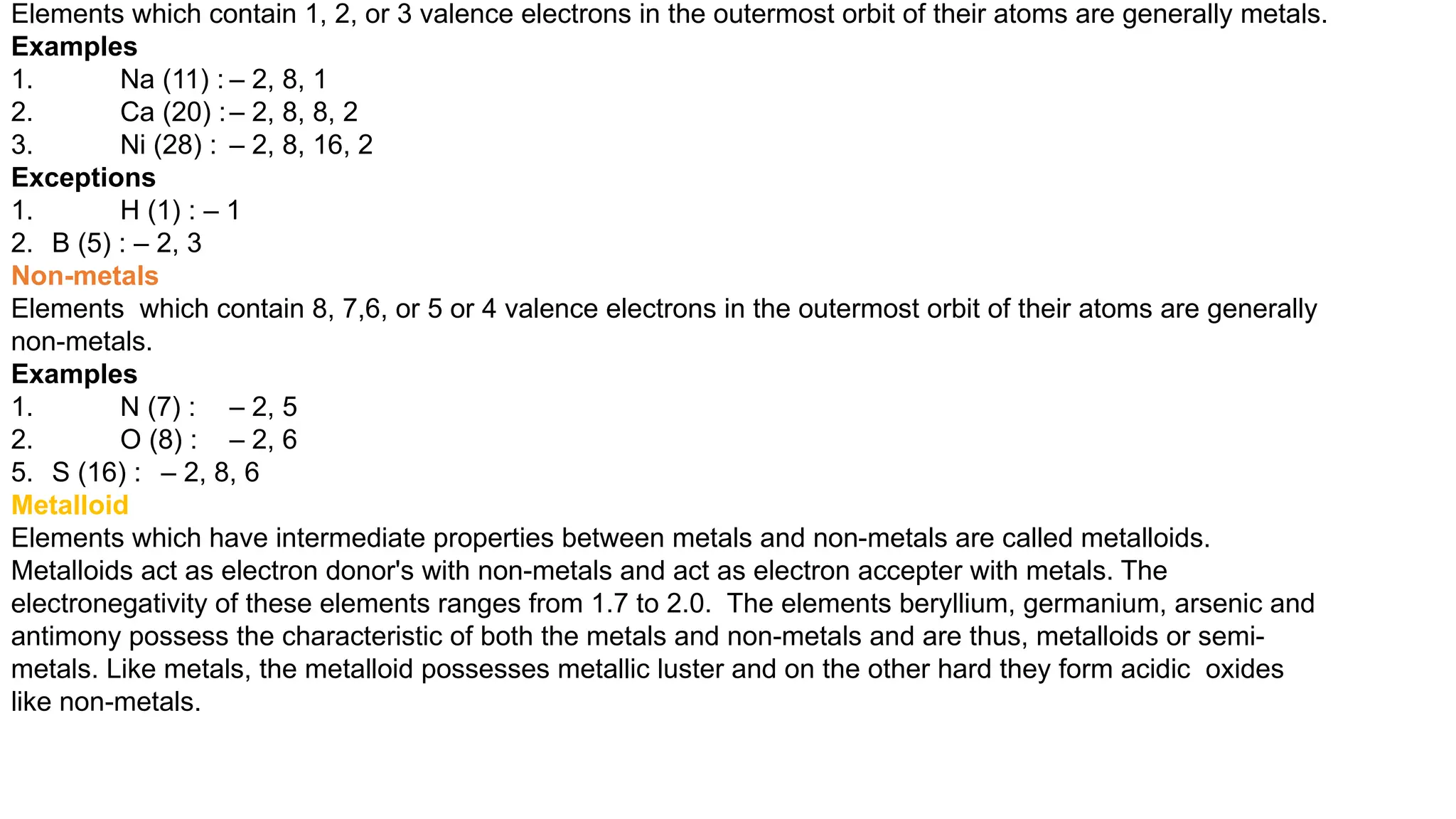
Elements which contain 1, 2, or 3 valence electrons in the outermost orbit of their atoms are generally metals.
Examples
1. Na (11) : – 2, 8, 1
2. Ca (20) :– 2, 8, 8, 2
3. Ni (28) : – 2, 8, 16, 2
Exceptions
1. H (1) : – 1
2. B (5) : – 2, 3
Non-metals
Elements which contain 8, 7,6, or 5 or 4 valence electrons in the outermost orbit of their atoms are generally
non-metals.
Examples
1. N (7) : – 2, 5
2. O (8) : – 2, 6
5. S (16) : – 2, 8, 6
Metalloid
Elements which have intermediate properties between metals and non-metals are called metalloids.
Metalloids act as electron donor's with non-metals and act as electron accepter with metals. The
electronegativity of these elements ranges from 1.7 to 2.0. The elements beryllium, germanium, arsenic and
antimony possess the characteristic of both the metals and non-metals and are thus, metalloids or semi-
metals. Like metals, the metalloid possesses metallic luster and on the other hard they form acidic oxides
like non-metals.
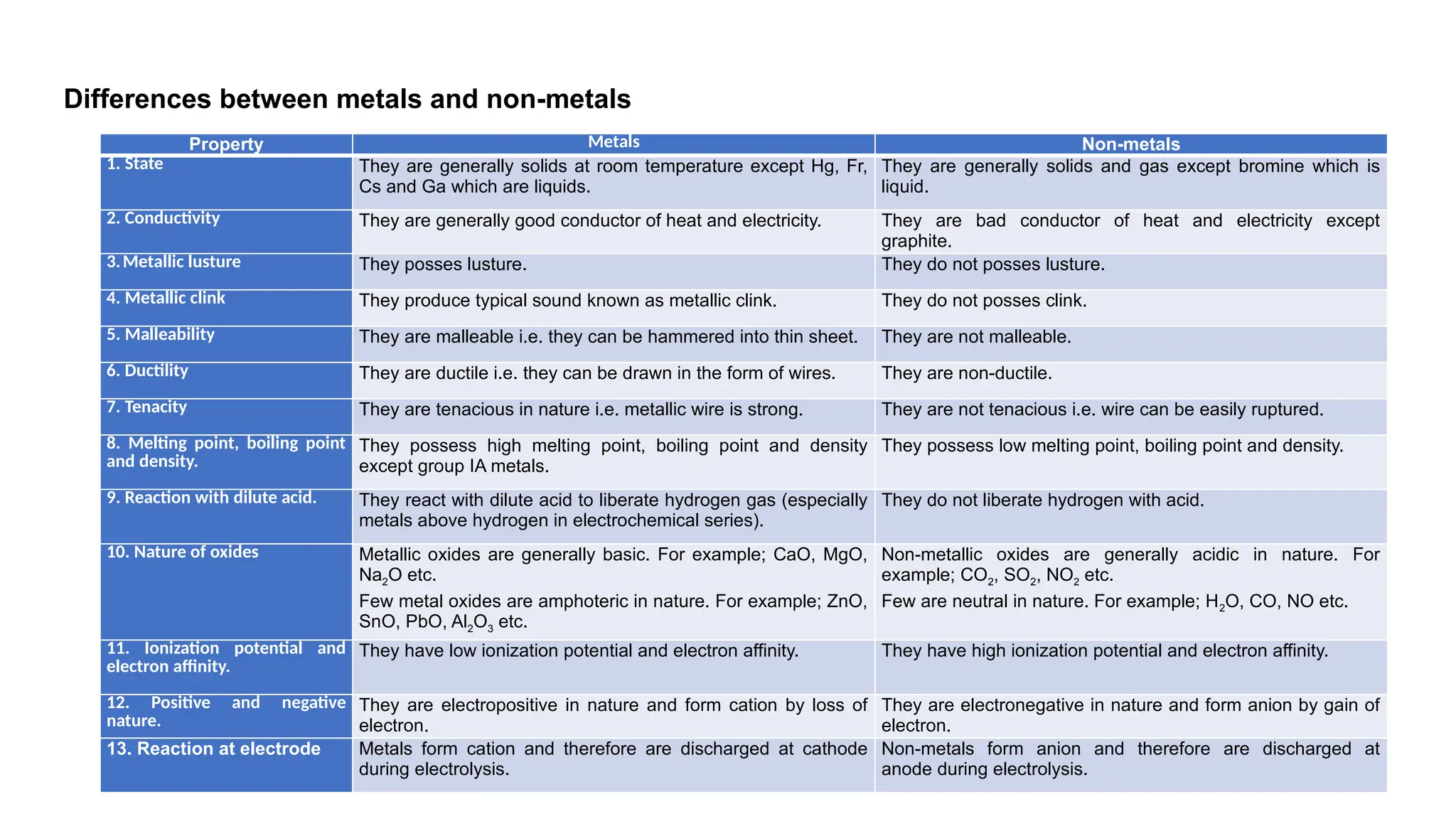
Differences between metals and non-metals
Property Metals Non-metals
1. State They are generally solids at room temperature except Hg, Fr,
Cs and Ga which are liquids.
They are generally solids and gas except bromine which is
liquid.
2. Conductivity They are generally good conductor of heat and electricity. They are bad conductor of heat and electricity except
graphite.
3.Metallic lusture They posses lusture. They do not posses lusture.
4. Metallic clink They produce typical sound known as metallic clink. They do not posses clink.
5. Malleability They are malleable i.e. they can be hammered into thin sheet. They are not malleable.
6. Ductility They are ductile i.e. they can be drawn in the form of wires. They are non-ductile.
7. Tenacity They are tenacious in nature i.e. metallic wire is strong. They are not tenacious i.e. wire can be easily ruptured.
8. Melting point, boiling point
and density.
They possess high melting point, boiling point and density
except group IA metals.
They possess low melting point, boiling point and density.
9. Reaction with dilute acid. They react with dilute acid to liberate hydrogen gas (especially
metals above hydrogen in electrochemical series).
They do not liberate hydrogen with acid.
10. Nature of oxides Metallic oxides are generally basic. For example; CaO, MgO,
Na2O etc.
Few metal oxides are amphoteric in nature. For example; ZnO,
SnO, PbO, Al2O3 etc.
Non-metallic oxides are generally acidic in nature. For
example; CO2, SO2, NO2 etc.
Few are neutral in nature. For example; H2O, CO, NO etc.
11. Ionization potential and
electron affinity.
They have low ionization potential and electron affinity. They have high ionization potential and electron affinity.
12. Positive and negative
nature.
They are electropositive in nature and form cation by loss of
electron.
They are electronegative in nature and form anion by gain of
electron.
13. Reaction at electrode Metals form cation and therefore are discharged at cathode
during electrolysis.
Non-metals form anion and therefore are discharged at
anode during electrolysis.
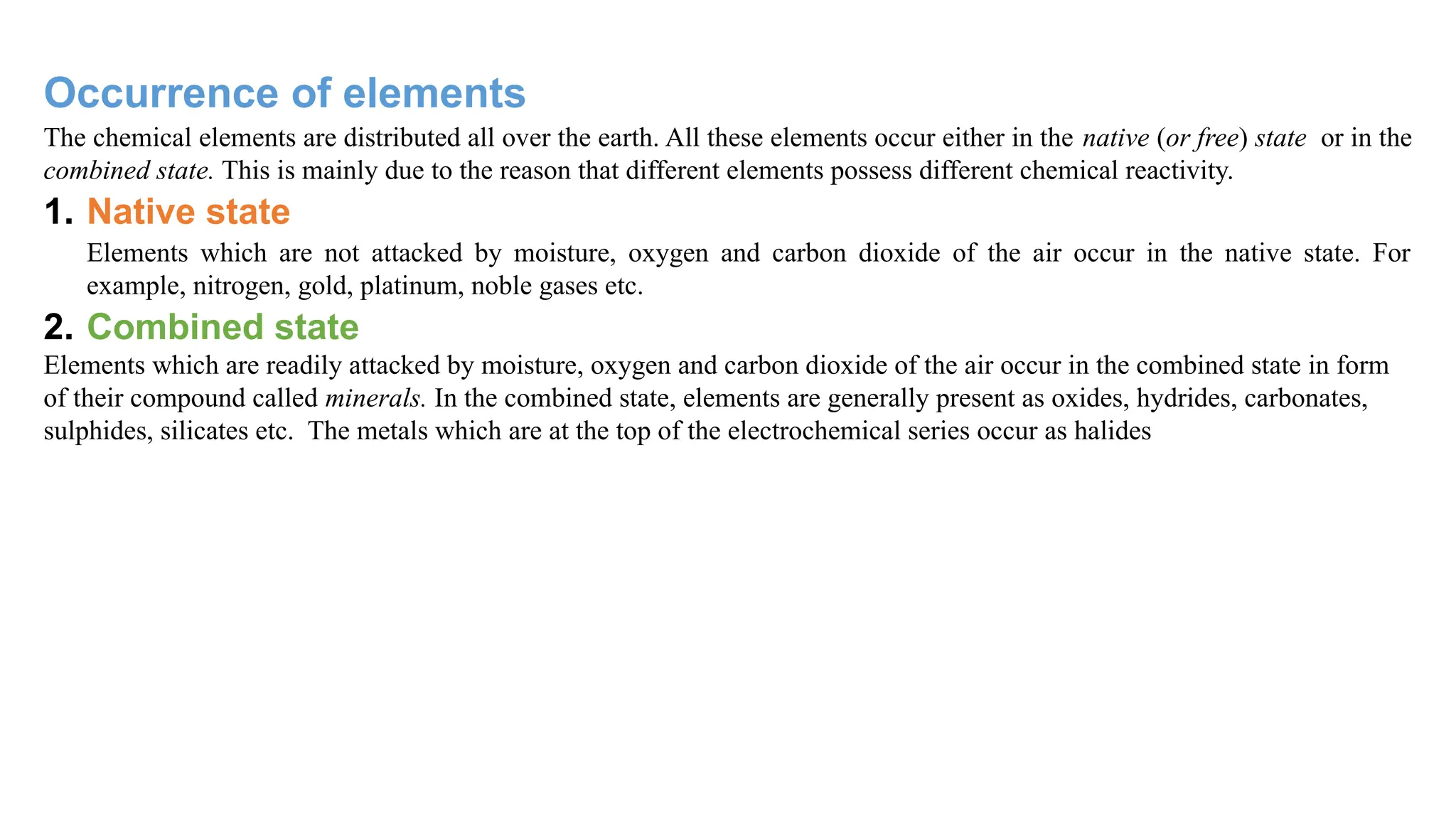
Occurrence of elements
The chemical elements are distributed all over the earth. All these elements occur either in the native (or free) state or in the
combined state. This is mainly due to the reason that different elements possess different chemical reactivity.
1. Native state
Elements which are not attacked by moisture, oxygen and carbon dioxide of the air occur in the native state. For
example, nitrogen, gold, platinum, noble gases etc.
2. Combined state
Elements which are readily attacked by moisture, oxygen and carbon dioxide of the air occur in the combined state in form
of their compound called minerals. In the combined state, elements are generally present as oxides, hydrides, carbonates,
sulphides, silicates etc. The metals which are at the top of the electrochemical series occur as halides
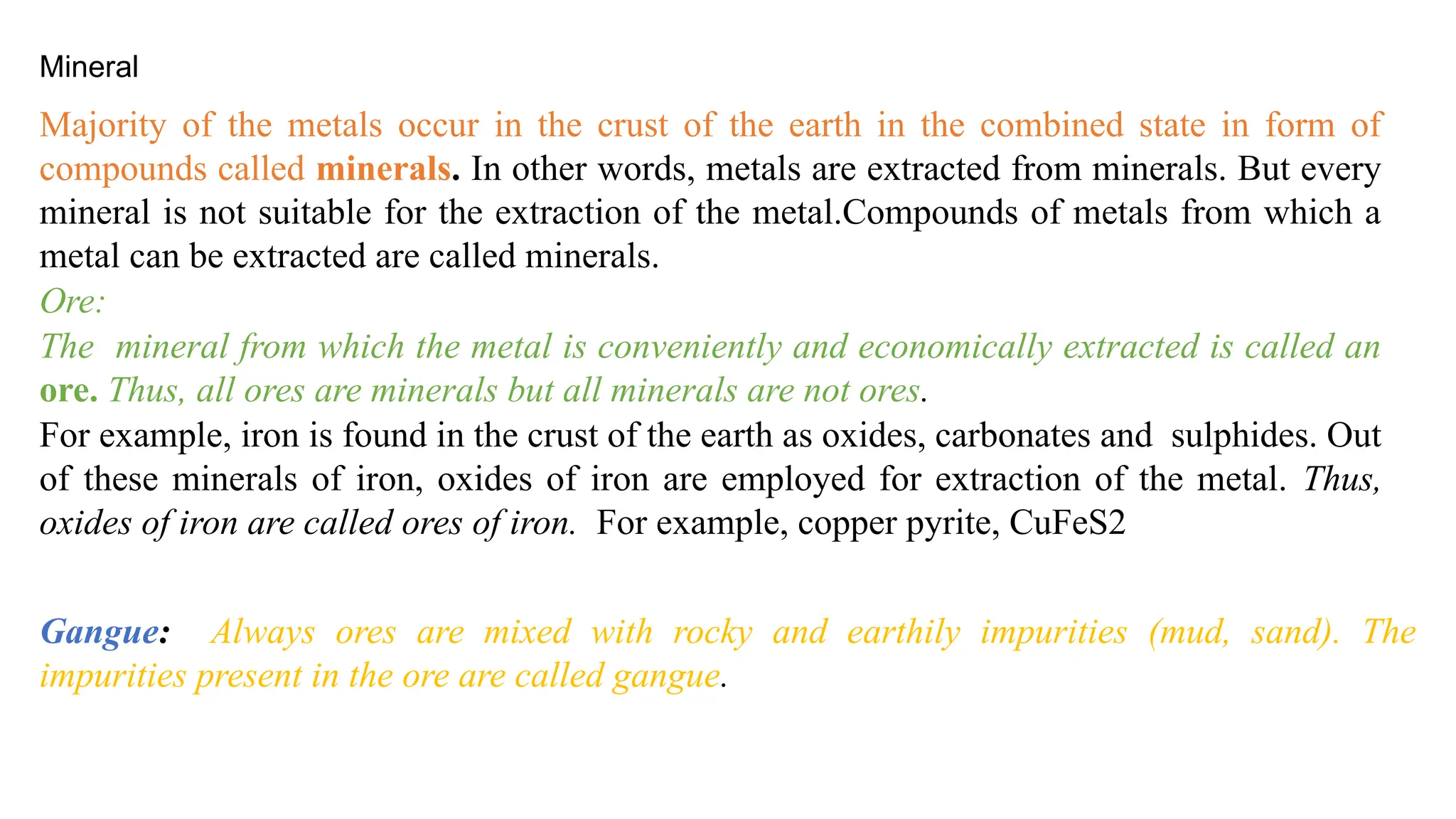
Majority of the metals occur in the crust of the earth in the combined state in form of
compounds called minerals. In other words, metals are extracted from minerals. But every
mineral is not suitable for the extraction of the metal.Compounds of metals from which a
metal can be extracted are called minerals.
Ore:
The mineral from which the metal is conveniently and economically extracted is called an
ore. Thus, all ores are minerals but all minerals are not ores.
For example, iron is found in the crust of the earth as oxides, carbonates and sulphides. Out
of these minerals of iron, oxides of iron are employed for extraction of the metal. Thus,
oxides of iron are called ores of iron. For example, copper pyrite, CuFeS2
Gangue: Always ores are mixed with rocky and earthily impurities (mud, sand). The
impurities present in the ore are called gangue.
Mineral
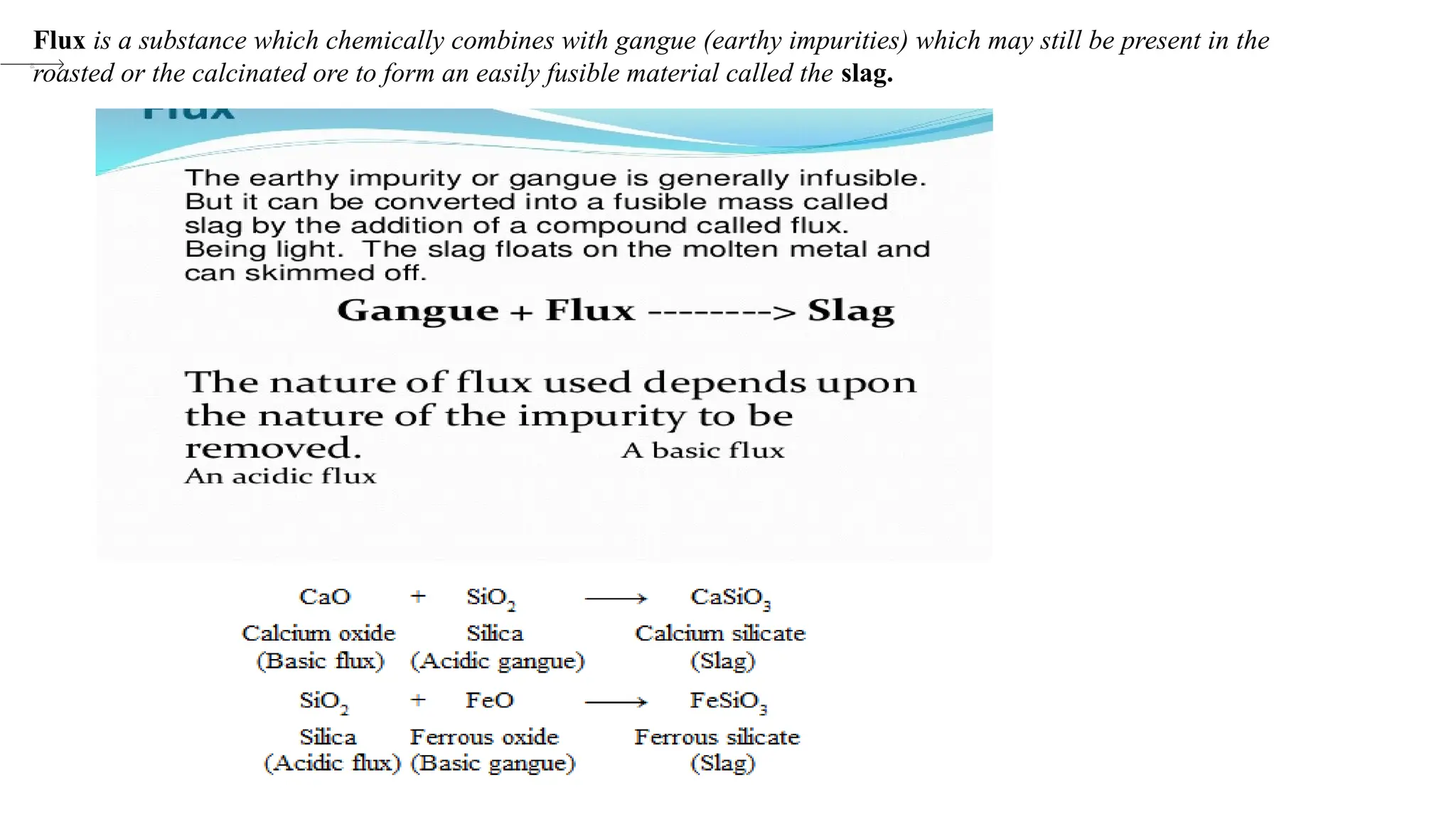
Flux is a substance which chemically combines with gangue (earthy impurities) which may still be present in the
roasted or the calcinated ore to form an easily fusible material called the slag.
Alloys and Amalgams
An alloy is a solid solution of a metal with other element(s). The other elements may be a metal or non-metal
(usually carbon, phosphorous, hydrogen, Nitrogen, silicon, Boron)
For example, Brass is an alloy of two metals, Cu and Zn. Steel is an alloy of metal with non-metal, iron and
carbon.
An alloy possesses metallic properties. Alloys are generally prepared to get a product possessing desirable
properties which the constituent elements do not have. But the properties of alloy mainly depends on the chemical
nature of the two elements concerned (such as electronegativity), and on the relative sizes of the metal atoms and
added atoms.
Classification: Depending on the presence or absence of Fe as one component of alloys, alloys have been
classified in to two categories:
(i) Ferrous Alloys: Alloys which contain iron as one of the constituents are called ferrous alloys. e.g. Steel (Fe +
C), Ferrochrome (Fe + Cr)
(ii) Non–Ferrous alloys: Alloys which do not contain iron as one of the constituents are called non
ferrous alloys. e.g. Brass (Cu + Zn), Bronze (Cu + Sn) etc.
Amalgams:
A homogenous mixture of a metal with mercury is called amalgam. It is also defined as an alloy containing
mercury as one of the constituents.
Most of the metals dissolve in liquid mercury to form amalgam.
But Fe, Co and Ni do not form amalgam. e.g. Sodium amalgam, silver amalgam, tin amalgam, zinc amalgam
etc.
Amalgams are excellent reducing agent for organic compound. Amalgam reacts slowly than the pure metal

General introduction on metal , fundametal terms

  • 1.
    Unit-10 Lecture Outline -Difference betweenmetal and non-metal -Occurrence of Metal -Definitions: Metal, non-metal, Metalloid, Minerals, ores, gangue, flux, slag, alloy, amalgam etc. BY Ram Darash Pandey( Assistant Professor) Amrit Campus, T.U.
  • 2.
    Universe Metal Non-metal Metalloid Element Sumtotal of matter and energy Pure substance made up of identical atoms Classified as element and compound Introduction
  • 3.
    -Metals occupy extremeleft side of periodic table( as S-block element) and Central Part of periodic table (as transition metals- 30 elements in three row., belong to d-block. -They also occupy lower portion of P-block element.
  • 4.
    Elements which contain1, 2, or 3 valence electrons in the outermost orbit of their atoms are generally metals. Examples 1. Na (11) : – 2, 8, 1 2. Ca (20) :– 2, 8, 8, 2 3. Ni (28) : – 2, 8, 16, 2 Exceptions 1. H (1) : – 1 2. B (5) : – 2, 3 Non-metals Elements which contain 8, 7,6, or 5 or 4 valence electrons in the outermost orbit of their atoms are generally non-metals. Examples 1. N (7) : – 2, 5 2. O (8) : – 2, 6 5. S (16) : – 2, 8, 6 Metalloid Elements which have intermediate properties between metals and non-metals are called metalloids. Metalloids act as electron donor's with non-metals and act as electron accepter with metals. The electronegativity of these elements ranges from 1.7 to 2.0. The elements beryllium, germanium, arsenic and antimony possess the characteristic of both the metals and non-metals and are thus, metalloids or semi- metals. Like metals, the metalloid possesses metallic luster and on the other hard they form acidic oxides like non-metals.
  • 5.
    Differences between metalsand non-metals Property Metals Non-metals 1. State They are generally solids at room temperature except Hg, Fr, Cs and Ga which are liquids. They are generally solids and gas except bromine which is liquid. 2. Conductivity They are generally good conductor of heat and electricity. They are bad conductor of heat and electricity except graphite. 3.Metallic lusture They posses lusture. They do not posses lusture. 4. Metallic clink They produce typical sound known as metallic clink. They do not posses clink. 5. Malleability They are malleable i.e. they can be hammered into thin sheet. They are not malleable. 6. Ductility They are ductile i.e. they can be drawn in the form of wires. They are non-ductile. 7. Tenacity They are tenacious in nature i.e. metallic wire is strong. They are not tenacious i.e. wire can be easily ruptured. 8. Melting point, boiling point and density. They possess high melting point, boiling point and density except group IA metals. They possess low melting point, boiling point and density. 9. Reaction with dilute acid. They react with dilute acid to liberate hydrogen gas (especially metals above hydrogen in electrochemical series). They do not liberate hydrogen with acid. 10. Nature of oxides Metallic oxides are generally basic. For example; CaO, MgO, Na2O etc. Few metal oxides are amphoteric in nature. For example; ZnO, SnO, PbO, Al2O3 etc. Non-metallic oxides are generally acidic in nature. For example; CO2, SO2, NO2 etc. Few are neutral in nature. For example; H2O, CO, NO etc. 11. Ionization potential and electron affinity. They have low ionization potential and electron affinity. They have high ionization potential and electron affinity. 12. Positive and negative nature. They are electropositive in nature and form cation by loss of electron. They are electronegative in nature and form anion by gain of electron. 13. Reaction at electrode Metals form cation and therefore are discharged at cathode during electrolysis. Non-metals form anion and therefore are discharged at anode during electrolysis.
  • 6.
    Occurrence of elements Thechemical elements are distributed all over the earth. All these elements occur either in the native (or free) state or in the combined state. This is mainly due to the reason that different elements possess different chemical reactivity. 1. Native state Elements which are not attacked by moisture, oxygen and carbon dioxide of the air occur in the native state. For example, nitrogen, gold, platinum, noble gases etc. 2. Combined state Elements which are readily attacked by moisture, oxygen and carbon dioxide of the air occur in the combined state in form of their compound called minerals. In the combined state, elements are generally present as oxides, hydrides, carbonates, sulphides, silicates etc. The metals which are at the top of the electrochemical series occur as halides
  • 7.
    Majority of themetals occur in the crust of the earth in the combined state in form of compounds called minerals. In other words, metals are extracted from minerals. But every mineral is not suitable for the extraction of the metal.Compounds of metals from which a metal can be extracted are called minerals. Ore: The mineral from which the metal is conveniently and economically extracted is called an ore. Thus, all ores are minerals but all minerals are not ores. For example, iron is found in the crust of the earth as oxides, carbonates and sulphides. Out of these minerals of iron, oxides of iron are employed for extraction of the metal. Thus, oxides of iron are called ores of iron. For example, copper pyrite, CuFeS2 Gangue: Always ores are mixed with rocky and earthily impurities (mud, sand). The impurities present in the ore are called gangue. Mineral
  • 8.
    Flux is asubstance which chemically combines with gangue (earthy impurities) which may still be present in the roasted or the calcinated ore to form an easily fusible material called the slag.
  • 9.
    Alloys and Amalgams Analloy is a solid solution of a metal with other element(s). The other elements may be a metal or non-metal (usually carbon, phosphorous, hydrogen, Nitrogen, silicon, Boron) For example, Brass is an alloy of two metals, Cu and Zn. Steel is an alloy of metal with non-metal, iron and carbon. An alloy possesses metallic properties. Alloys are generally prepared to get a product possessing desirable properties which the constituent elements do not have. But the properties of alloy mainly depends on the chemical nature of the two elements concerned (such as electronegativity), and on the relative sizes of the metal atoms and added atoms. Classification: Depending on the presence or absence of Fe as one component of alloys, alloys have been classified in to two categories: (i) Ferrous Alloys: Alloys which contain iron as one of the constituents are called ferrous alloys. e.g. Steel (Fe + C), Ferrochrome (Fe + Cr) (ii) Non–Ferrous alloys: Alloys which do not contain iron as one of the constituents are called non ferrous alloys. e.g. Brass (Cu + Zn), Bronze (Cu + Sn) etc.
  • 10.
    Amalgams: A homogenous mixtureof a metal with mercury is called amalgam. It is also defined as an alloy containing mercury as one of the constituents. Most of the metals dissolve in liquid mercury to form amalgam. But Fe, Co and Ni do not form amalgam. e.g. Sodium amalgam, silver amalgam, tin amalgam, zinc amalgam etc. Amalgams are excellent reducing agent for organic compound. Amalgam reacts slowly than the pure metal