Welcome
Presented by
Jannatul Ferdus
Trainer
Web Application .NET
Outline
 Introduction to .C#
 Introduction to .NET & IDE
 C# console application
1. Basic concept in C#
2. write program in C#
Learning Outcome
.NET and C#
 .NET Platform
Web-based applications can be
distributed to a variety of devices
and desktops
 C#
developed specifically for .NET
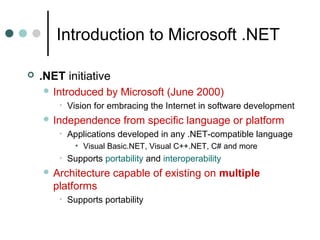
Introduction to Microsoft .NET
 .NET initiative
 Introduced by Microsoft (June 2000)
• Vision for embracing the Internet in software development
 Independence from specific language or platform
• Applications developed in any .NET-compatible language
• Visual Basic.NET, Visual C++.NET, C# and more
• Supports portability and interoperability
 Architecture capable of existing on multiple
platforms
• Supports portability
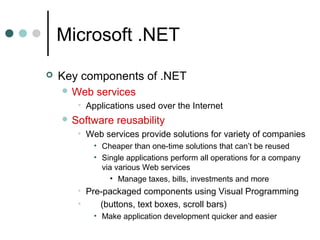
Microsoft .NET
 Key components of .NET
 Web services
• Applications used over the Internet
 Software reusability
• Web services provide solutions for variety of companies
• Cheaper than one-time solutions that can’t be reused
• Single applications perform all operations for a company
via various Web services
• Manage taxes, bills, investments and more
• Pre-packaged components using Visual Programming
• (buttons, text boxes, scroll bars)
• Make application development quicker and easier
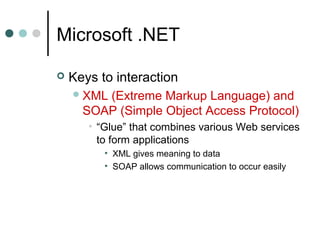
Microsoft .NET
 Keys to interaction
XML (Extreme Markup Language) and
SOAP (Simple Object Access Protocol)
• “Glue” that combines various Web services
to form applications
• XML gives meaning to data
• SOAP allows communication to occur easily
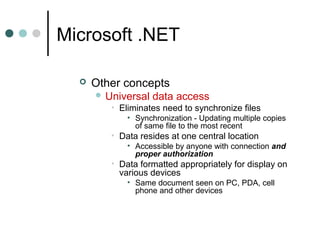
Microsoft .NET
 Other concepts
 Universal data access
• Eliminates need to synchronize files
• Synchronization - Updating multiple copies
of same file to the most recent
• Data resides at one central location
• Accessible by anyone with connection and
proper authorization
• Data formatted appropriately for display on
various devices
• Same document seen on PC, PDA, cell
phone and other devices
.NET Framework and the
Common Language
Runtime
 .NET Framework
 Heart of .NET strategy
• Manages and executes applications and Web services
• Provides security, memory management and other
programming capabilities
 Includes Framework Class Library (FCL)
• Pre-packaged classes ready for reuse
• Used by any .NET language
 Details contained in Common Language Specification
(CLS)
• Submitted to European Computer Manufacturers Association
to make the framework easily converted to other platforms
 Executes programs by Common Language Runtime (CLR)
.NET and C#
 .NET platform
 Web-based applications can be distributed to variety of
devices and desktops
 C#
 Developed specifically for .NET
 Enable programmers to migrate from C/C++ and Java easily
 Event-driven, fully OO, visual programming language
 Has IDE
 Process of rapidly creating an application using an IDE is
called Rapid Application Development (RAD)
C#
 Language interoperability
 Can interact with software components written in
different languages or with old packaged software
written in C/C++
 Can interact via internet, using industry
standards (SOAP and XML)
 Simple Object Access Protocol - Helps to share
program “chunks” over the internet
 Accommodates a new style of programming in
which applications are created from building
blocks available over internet (reusability)
C# and the .NET IDE
 Console applications
No visual components
(buttons, text boxes, etc.)
Only text output
Two types
• MS-DOS prompt -Used in Windows 95/98/ME
• Command prompt -Used in Windows 2000/NT/XP
Home work
 Write a program to write factorial with n
numbers.
 Take a digit as an input and show the reversed
digit as output.
Thank you
Q/A

Basic C# and .net

  • 1.
  • 2.
  • 3.
    Outline  Introduction to.C#  Introduction to .NET & IDE  C# console application
  • 4.
    1. Basic conceptin C# 2. write program in C# Learning Outcome
  • 5.
    .NET and C# .NET Platform Web-based applications can be distributed to a variety of devices and desktops  C# developed specifically for .NET
  • 6.
    Introduction to Microsoft.NET  .NET initiative  Introduced by Microsoft (June 2000) • Vision for embracing the Internet in software development  Independence from specific language or platform • Applications developed in any .NET-compatible language • Visual Basic.NET, Visual C++.NET, C# and more • Supports portability and interoperability  Architecture capable of existing on multiple platforms • Supports portability
  • 7.
    Microsoft .NET  Keycomponents of .NET  Web services • Applications used over the Internet  Software reusability • Web services provide solutions for variety of companies • Cheaper than one-time solutions that can’t be reused • Single applications perform all operations for a company via various Web services • Manage taxes, bills, investments and more • Pre-packaged components using Visual Programming • (buttons, text boxes, scroll bars) • Make application development quicker and easier
  • 8.
    Microsoft .NET  Keysto interaction XML (Extreme Markup Language) and SOAP (Simple Object Access Protocol) • “Glue” that combines various Web services to form applications • XML gives meaning to data • SOAP allows communication to occur easily
  • 9.
    Microsoft .NET  Otherconcepts  Universal data access • Eliminates need to synchronize files • Synchronization - Updating multiple copies of same file to the most recent • Data resides at one central location • Accessible by anyone with connection and proper authorization • Data formatted appropriately for display on various devices • Same document seen on PC, PDA, cell phone and other devices
  • 10.
    .NET Framework andthe Common Language Runtime  .NET Framework  Heart of .NET strategy • Manages and executes applications and Web services • Provides security, memory management and other programming capabilities  Includes Framework Class Library (FCL) • Pre-packaged classes ready for reuse • Used by any .NET language  Details contained in Common Language Specification (CLS) • Submitted to European Computer Manufacturers Association to make the framework easily converted to other platforms  Executes programs by Common Language Runtime (CLR)
  • 11.
    .NET and C# .NET platform  Web-based applications can be distributed to variety of devices and desktops  C#  Developed specifically for .NET  Enable programmers to migrate from C/C++ and Java easily  Event-driven, fully OO, visual programming language  Has IDE  Process of rapidly creating an application using an IDE is called Rapid Application Development (RAD)
  • 12.
    C#  Language interoperability Can interact with software components written in different languages or with old packaged software written in C/C++  Can interact via internet, using industry standards (SOAP and XML)  Simple Object Access Protocol - Helps to share program “chunks” over the internet  Accommodates a new style of programming in which applications are created from building blocks available over internet (reusability)
  • 13.
    C# and the.NET IDE  Console applications No visual components (buttons, text boxes, etc.) Only text output Two types • MS-DOS prompt -Used in Windows 95/98/ME • Command prompt -Used in Windows 2000/NT/XP
  • 14.
    Home work  Writea program to write factorial with n numbers.  Take a digit as an input and show the reversed digit as output.
  • 15.
  • 16.