Automotive Basics
Presenter:
Michael Gray, Co-Author of Auto Upkeep
This presentation is available at www.AutoUpkeep.com/presentations.
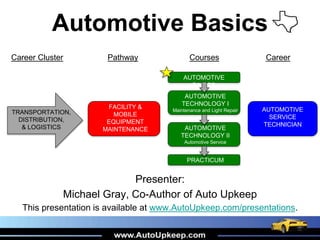
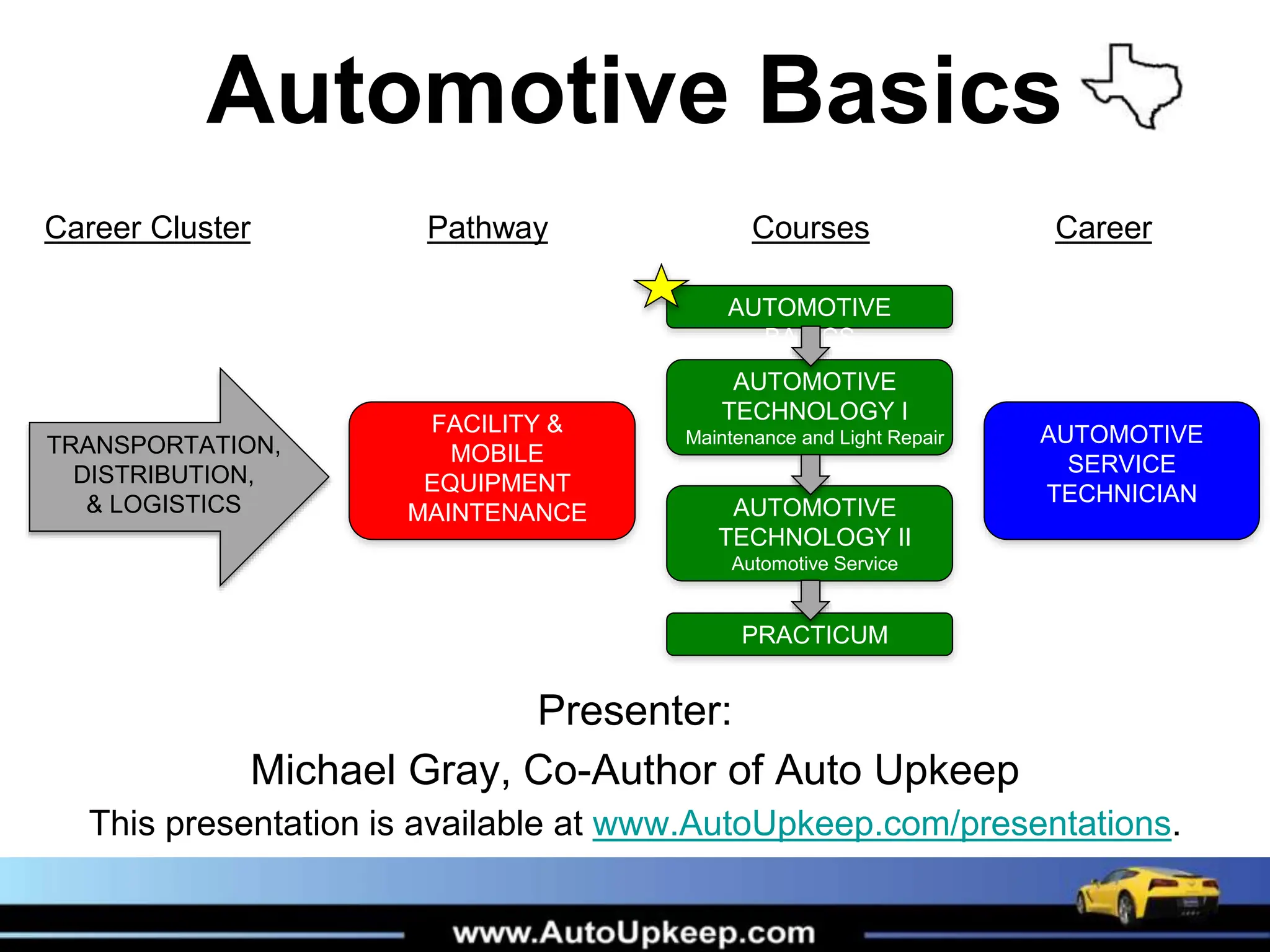
TRANSPORTATION,
DISTRIBUTION,
& LOGISTICS
FACILITY &
MOBILE
EQUIPMENT
MAINTENANCE
Career Cluster Pathway Courses Career
AUTOMOTIVE
BASICS
AUTOMOTIVE
TECHNOLOGY I
Maintenance and Light Repair
AUTOMOTIVE
TECHNOLOGY II
Automotive Service
PRACTICUM
AUTOMOTIVE
SERVICE
TECHNICIAN
Download this Presentation
Essential Questions
• What are the requirements for Automotive Basics (Texas
§130.447).
• What curricular materials are available?
• How does Automotive Basics fit within a complete
Automotive Service Technology training program?
• What are the essential units in Automotive Basics?
• What will each student know and be able to do at the
completion of Automotive Basics (Texas Essential
Knowledge and Skills - TEKS)?
• How does Automotive Basics fit within the ASE
Education Foundation (formerly NATEF) Model?
1. What do your beginning students know when they
first enter your program?
2. How do you teach this new generation of students
the fundamentals of Automotive Technology?
A Few Questions to Think About…
What does your first course
look like now?
• Discussion…
Automotive Basics – Course Description
“Automotive Basics includes knowledge of the basic automotive
systems and the theory and principles of the components that
make up each system and how to service these systems.
Automotive Basics includes applicable safety and environmental
rules and regulations. In Automotive Basics, students will gain
knowledge and skills in the repair, maintenance, and servicing of
vehicle systems. This study allows students to reinforce, apply,
and transfer academic knowledge and skills to a variety of
interesting and relevant activities, problems, and settings. The
focus of this course is to teach safety, tool identification, proper
tool use, and employability.”
Source: http://ritter.tea.state.tx.us/rules/tac/chapter130/ch130p.html
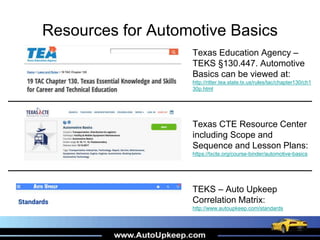
Resources for Automotive Basics
Texas Education Agency –
TEKS §130.447. Automotive
Basics can be viewed at:
http://ritter.tea.state.tx.us/rules/tac/chapter130/ch1
30p.html
Texas CTE Resource Center
including Scope and
Sequence and Lesson Plans:
https://txcte.org/course-binder/automotive-basics
TEKS – Auto Upkeep
Correlation Matrix:
http://www.autoupkeep.com/standards
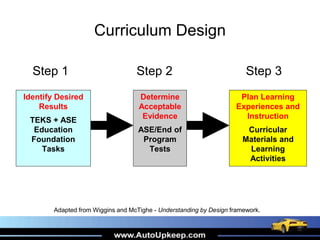
Curriculum Design
Identify Desired
Results
TEKS + ASE
Education
Foundation
Tasks
Determine
Acceptable
Evidence
ASE/End of
Program
Tests
Plan Learning
Experiences and
Instruction
Curricular
Materials and
Learning
Activities
Adapted from Wiggins and McTighe - Understanding by Design framework.
Step 1 Step 2 Step 3
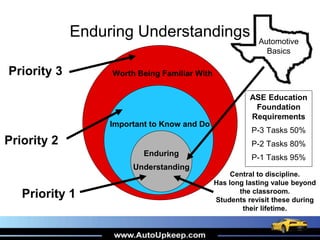
Enduring Understandings
Worth Being Familiar With
Important to Know and Do
Enduring
Understanding
Priority 1
Central to discipline.
Has long lasting value beyond
the classroom.
Students revisit these during
their lifetime.
Adapted from Wiggins and McTighe - Understanding by Design framework.
Priority 2
Priority 3
ASE Education
Foundation
Requirements
P-3 Tasks 50%
P-2 Tasks 80%
P-1 Tasks 95%
Automotive
Basics
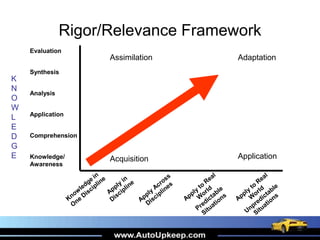
Rigor/Relevance Framework
K
N
O
W
L
E
D
G
E
APPLICATION
Evaluation
Synthesis
Analysis
Application
Comprehension
Knowledge/
Awareness
Application
Adaptation
Assimilation
Acquisition
Adapted from International Center for
Leadership in Education
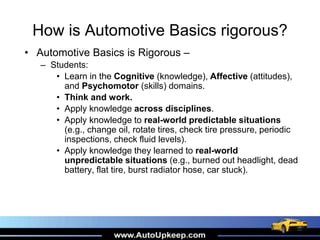
How is Automotive Basics rigorous?
• Automotive Basics is Rigorous –
– Students:
• Learn in the Cognitive (knowledge), Affective (attitudes),
and Psychomotor (skills) domains.
• Think and work.
• Apply knowledge across disciplines.
• Apply knowledge to real-world predictable situations
(e.g., change oil, rotate tires, check tire pressure, periodic
inspections, check fluid levels).
• Apply knowledge they learned to real-world
unpredictable situations (e.g., burned out headlight, dead
battery, flat tire, burst radiator hose, car stuck).
The Future is Bright for Automotive Basics
• Did you know…
– 80% of vehicles need
service, fluids, or
replacement parts
(Car Care Council, 2017)
– 11.6 years old is the
average age of cars
and trucks in the USA
(IHS Markit, 2016)
References:
HIS Markit. (2016). Vehicles Getting Older: Average Age of Light Cars and Trucks in U.S. Rises Again in 2016 to 11.6 Years, IHS Markit Says. [Press Release].
Retrieved from http://news.ihsmarkit.com/press-release/automotive/vehicles-getting-older-average-age-light-cars-and-trucks-us-rises-again-201
Car Care Council. (2017). Community Car Care Events Show Most Vehicles Need Service. [Press release]. Retrieved from http://media.carcare.org/2017-07-11-
Community-Car-Care-Events-Show-Most-Vehicles-Need-Service
Common Vehicle on the Road Today
Is Over 11 Years Old
Has 139,000+ Miles
Needs Service
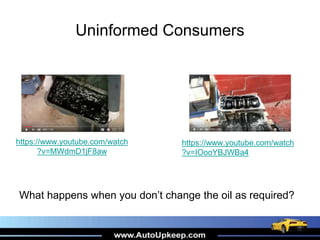
Uninformed Consumers
https://www.youtube.com/watch
?v=MWdmD1jF8aw
https://www.youtube.com/watch
?v=IOooYBJWBa4
What happens when you don’t change the oil as required?
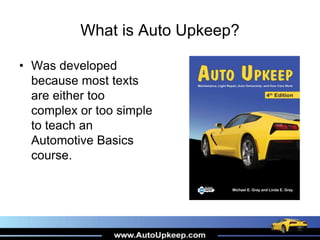
What is Auto Upkeep?
• Was developed
because most texts
are either too
complex or too simple
to teach an
Automotive Basics
course.
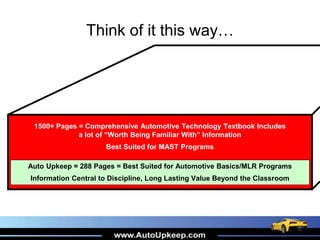
Think of it this way…
1500+ Pages = Comprehensive Automotive Technology Textbook Includes
a lot of “Worth Being Familiar With” Information
Best Suited for MAST Programs
Auto Upkeep = 288 Pages = Best Suited for Automotive Basics/MLR Programs
Information Central to Discipline, Long Lasting Value Beyond the Classroom
What’s special about Auto Upkeep?
• Short, concise chapters
• 12 point font – Easy-to-Read
• 3 Levels of headings when necessary
• A figure, picture, or graph accompanies almost every
block of text
• Helpful emphasis blocks – Tech Tips, Price Guides, Web
Links, Servicing, Trouble Guides, Activities, Q & A’s,
Career Paths, Calculations
• Videos, Apps, QR Codes, and Google Assistant Apps to
extend learning online
• Reviewed by young adults and technical reviewers
• Extensive effort was put on book layout
• Hands-on and Internet-based activities (40 activities in
all)
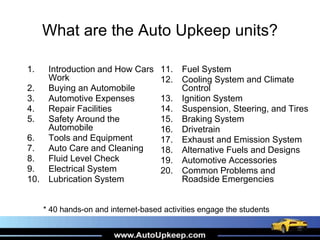
What are the Auto Upkeep units?
1. Introduction and How Cars
Work
2. Buying an Automobile
3. Automotive Expenses
4. Repair Facilities
5. Safety Around the
Automobile
6. Tools and Equipment
7. Auto Care and Cleaning
8. Fluid Level Check
9. Electrical System
10. Lubrication System
11. Fuel System
12. Cooling System and Climate
Control
13. Ignition System
14. Suspension, Steering, and Tires
15. Braking System
16. Drivetrain
17. Exhaust and Emission System
18. Alternative Fuels and Designs
19. Automotive Accessories
20. Common Problems and
Roadside Emergencies
* 40 hands-on and internet-based activities engage the students
How is Auto Upkeep commonly
delivered?
• Auto Upkeep was designed to have a balance
between in-class and hands-on instruction.
– Commonly two days a week are in-class and three
days a week are in the automotive lab.
– Curriculum is flexible for you to adjust it to fit your
specific situation.
What will each student know and be able
to do at the completion of Auto Upkeep?
• Automotive Basics TEKS – 100%
• Competencies – Over 200
• Over 60% of ASE Education Foundation Maintenance
and Light Repair (MLR) Tasks – making it an ideal first
course.
» www.AutoUpkeep.com/standards/
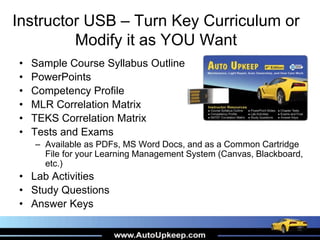
Instructor USB – Turn Key Curriculum or
Modify it as YOU Want
• Sample Course Syllabus Outline
• PowerPoints
• Competency Profile
• MLR Correlation Matrix
• TEKS Correlation Matrix
• Tests and Exams
– Available as PDFs, MS Word Docs, and as a Common Cartridge
File for your Learning Management System (Canvas, Blackboard,
etc.)
• Lab Activities
• Study Questions
• Answer Keys
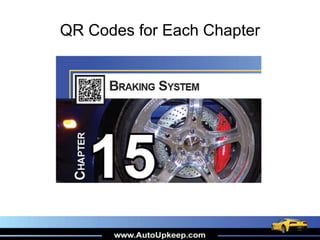
QR Codes for Each Chapter
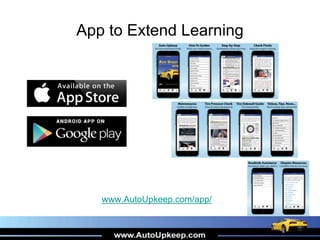
App to Extend Learning
www.AutoUpkeep.com/app/
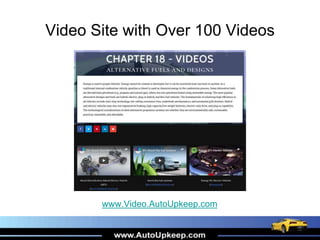
Video Site with Over 100 Videos
www.Video.AutoUpkeep.com
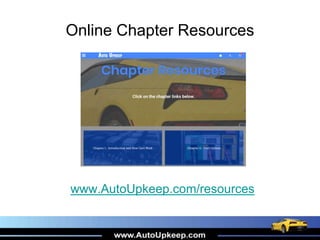
Online Chapter Resources
www.AutoUpkeep.com/resources
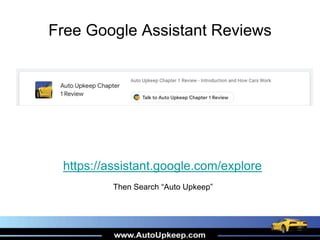
Free Google Assistant Reviews
https://assistant.google.com/explore
Then Search “Auto Upkeep”
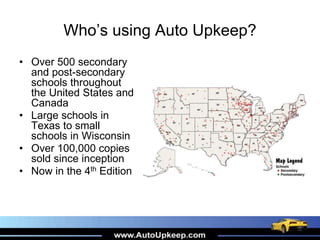
Who’s using Auto Upkeep?
• Over 500 secondary
and post-secondary
schools throughout
the United States and
Canada
• Large schools in
Texas to small
schools in Wisconsin
• Over 100,000 copies
sold since inception
• Now in the 4th Edition
How does Auto Upkeep, ASE
Education Foundation’s MLR Tasks,
and Automotive Basics fit together?
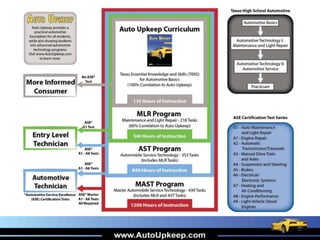
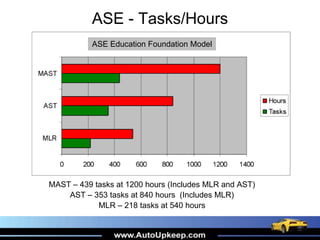
ASE - Tasks/Hours
MAST – 439 tasks at 1200 hours (Includes MLR and AST)
AST – 353 tasks at 840 hours (Includes MLR)
MLR – 218 tasks at 540 hours
ASE Education Foundation Model
What is a Task?
• “A task is a psychomotor or cognitive entry-level
learning activity consisting of one or more
measureable steps accomplished through an
instructor presentation, demonstration,
visualization or a student application.”
» Obtained from the ASE Education Foundation - http://aseeducation.org/resources
– It should be noted that each task is not dedicated an
hour allotment…some tasks take longer than others.
ASE Education Foundation
Assumptions
• “Individual courses of study will differ across
automobile technician training programs”
• “Development of appropriate learning delivery
systems and tests which monitor student
progress will be the responsibility of the
individual training program”
» Obtained from the ASE Education Foundation - http://aseeducation.org/resources
Basically…
• TEKS lists the required knowledge and skills.
• The ASE Education Foundation provides the
required tasks and hours.
• YOU provide the program course structure,
curriculum, and student materials.
Questions?
To Get Free eBook Access
Sign-Up on the Sign-In Sheet and I will email you
an eBook access code.
Contact Information
Michael Gray
Rolling Hills Publishing
800-918-READ
www.RollingHillsPublishing.com
www.AutoUpkeep.com
Email: info@autoupkeep.com
LinkedIn – www.LinkedIn.com/in/MichaelEGray
Twitter – www.Twitter.com/AutoUpkeep
Videos – www.Video.AutoUpkeep.com
YouTube – www.YouTube.com/AutoUpkeep
Facebook – www.Facebook.com/AutoUpkeep

Basic Automotive Course, Theory, Principles and System

  • 1.
    Automotive Basics Presenter: Michael Gray,Co-Author of Auto Upkeep This presentation is available at www.AutoUpkeep.com/presentations. TRANSPORTATION, DISTRIBUTION, & LOGISTICS FACILITY & MOBILE EQUIPMENT MAINTENANCE Career Cluster Pathway Courses Career AUTOMOTIVE BASICS AUTOMOTIVE TECHNOLOGY I Maintenance and Light Repair AUTOMOTIVE TECHNOLOGY II Automotive Service PRACTICUM AUTOMOTIVE SERVICE TECHNICIAN
  • 2.
  • 3.
    Essential Questions • Whatare the requirements for Automotive Basics (Texas §130.447). • What curricular materials are available? • How does Automotive Basics fit within a complete Automotive Service Technology training program? • What are the essential units in Automotive Basics? • What will each student know and be able to do at the completion of Automotive Basics (Texas Essential Knowledge and Skills - TEKS)? • How does Automotive Basics fit within the ASE Education Foundation (formerly NATEF) Model?
  • 4.
    1. What doyour beginning students know when they first enter your program? 2. How do you teach this new generation of students the fundamentals of Automotive Technology? A Few Questions to Think About…
  • 5.
    What does yourfirst course look like now? • Discussion…
  • 6.
    Automotive Basics –Course Description “Automotive Basics includes knowledge of the basic automotive systems and the theory and principles of the components that make up each system and how to service these systems. Automotive Basics includes applicable safety and environmental rules and regulations. In Automotive Basics, students will gain knowledge and skills in the repair, maintenance, and servicing of vehicle systems. This study allows students to reinforce, apply, and transfer academic knowledge and skills to a variety of interesting and relevant activities, problems, and settings. The focus of this course is to teach safety, tool identification, proper tool use, and employability.” Source: http://ritter.tea.state.tx.us/rules/tac/chapter130/ch130p.html
  • 7.
    Resources for AutomotiveBasics Texas Education Agency – TEKS §130.447. Automotive Basics can be viewed at: http://ritter.tea.state.tx.us/rules/tac/chapter130/ch1 30p.html Texas CTE Resource Center including Scope and Sequence and Lesson Plans: https://txcte.org/course-binder/automotive-basics TEKS – Auto Upkeep Correlation Matrix: http://www.autoupkeep.com/standards
  • 8.
    Curriculum Design Identify Desired Results TEKS+ ASE Education Foundation Tasks Determine Acceptable Evidence ASE/End of Program Tests Plan Learning Experiences and Instruction Curricular Materials and Learning Activities Adapted from Wiggins and McTighe - Understanding by Design framework. Step 1 Step 2 Step 3
  • 9.
    Enduring Understandings Worth BeingFamiliar With Important to Know and Do Enduring Understanding Priority 1 Central to discipline. Has long lasting value beyond the classroom. Students revisit these during their lifetime. Adapted from Wiggins and McTighe - Understanding by Design framework. Priority 2 Priority 3 ASE Education Foundation Requirements P-3 Tasks 50% P-2 Tasks 80% P-1 Tasks 95% Automotive Basics
  • 10.
  • 11.
    How is AutomotiveBasics rigorous? • Automotive Basics is Rigorous – – Students: • Learn in the Cognitive (knowledge), Affective (attitudes), and Psychomotor (skills) domains. • Think and work. • Apply knowledge across disciplines. • Apply knowledge to real-world predictable situations (e.g., change oil, rotate tires, check tire pressure, periodic inspections, check fluid levels). • Apply knowledge they learned to real-world unpredictable situations (e.g., burned out headlight, dead battery, flat tire, burst radiator hose, car stuck).
  • 12.
    The Future isBright for Automotive Basics • Did you know… – 80% of vehicles need service, fluids, or replacement parts (Car Care Council, 2017) – 11.6 years old is the average age of cars and trucks in the USA (IHS Markit, 2016) References: HIS Markit. (2016). Vehicles Getting Older: Average Age of Light Cars and Trucks in U.S. Rises Again in 2016 to 11.6 Years, IHS Markit Says. [Press Release]. Retrieved from http://news.ihsmarkit.com/press-release/automotive/vehicles-getting-older-average-age-light-cars-and-trucks-us-rises-again-201 Car Care Council. (2017). Community Car Care Events Show Most Vehicles Need Service. [Press release]. Retrieved from http://media.carcare.org/2017-07-11- Community-Car-Care-Events-Show-Most-Vehicles-Need-Service Common Vehicle on the Road Today Is Over 11 Years Old Has 139,000+ Miles Needs Service
  • 13.
  • 14.
    What is AutoUpkeep? • Was developed because most texts are either too complex or too simple to teach an Automotive Basics course.
  • 15.
    Think of itthis way… 1500+ Pages = Comprehensive Automotive Technology Textbook Includes a lot of “Worth Being Familiar With” Information Best Suited for MAST Programs Auto Upkeep = 288 Pages = Best Suited for Automotive Basics/MLR Programs Information Central to Discipline, Long Lasting Value Beyond the Classroom
  • 16.
    What’s special aboutAuto Upkeep? • Short, concise chapters • 12 point font – Easy-to-Read • 3 Levels of headings when necessary • A figure, picture, or graph accompanies almost every block of text • Helpful emphasis blocks – Tech Tips, Price Guides, Web Links, Servicing, Trouble Guides, Activities, Q & A’s, Career Paths, Calculations • Videos, Apps, QR Codes, and Google Assistant Apps to extend learning online • Reviewed by young adults and technical reviewers • Extensive effort was put on book layout • Hands-on and Internet-based activities (40 activities in all)
  • 17.
    What are theAuto Upkeep units? 1. Introduction and How Cars Work 2. Buying an Automobile 3. Automotive Expenses 4. Repair Facilities 5. Safety Around the Automobile 6. Tools and Equipment 7. Auto Care and Cleaning 8. Fluid Level Check 9. Electrical System 10. Lubrication System 11. Fuel System 12. Cooling System and Climate Control 13. Ignition System 14. Suspension, Steering, and Tires 15. Braking System 16. Drivetrain 17. Exhaust and Emission System 18. Alternative Fuels and Designs 19. Automotive Accessories 20. Common Problems and Roadside Emergencies * 40 hands-on and internet-based activities engage the students
  • 18.
    How is AutoUpkeep commonly delivered? • Auto Upkeep was designed to have a balance between in-class and hands-on instruction. – Commonly two days a week are in-class and three days a week are in the automotive lab. – Curriculum is flexible for you to adjust it to fit your specific situation.
  • 19.
    What will eachstudent know and be able to do at the completion of Auto Upkeep? • Automotive Basics TEKS – 100% • Competencies – Over 200 • Over 60% of ASE Education Foundation Maintenance and Light Repair (MLR) Tasks – making it an ideal first course. » www.AutoUpkeep.com/standards/
  • 20.
    Instructor USB –Turn Key Curriculum or Modify it as YOU Want • Sample Course Syllabus Outline • PowerPoints • Competency Profile • MLR Correlation Matrix • TEKS Correlation Matrix • Tests and Exams – Available as PDFs, MS Word Docs, and as a Common Cartridge File for your Learning Management System (Canvas, Blackboard, etc.) • Lab Activities • Study Questions • Answer Keys
  • 21.
    QR Codes forEach Chapter
  • 22.
    App to ExtendLearning www.AutoUpkeep.com/app/
  • 23.
    Video Site withOver 100 Videos www.Video.AutoUpkeep.com
  • 24.
  • 25.
    Free Google AssistantReviews https://assistant.google.com/explore Then Search “Auto Upkeep”
  • 26.
    Who’s using AutoUpkeep? • Over 500 secondary and post-secondary schools throughout the United States and Canada • Large schools in Texas to small schools in Wisconsin • Over 100,000 copies sold since inception • Now in the 4th Edition
  • 27.
    How does AutoUpkeep, ASE Education Foundation’s MLR Tasks, and Automotive Basics fit together?
  • 29.
    ASE - Tasks/Hours MAST– 439 tasks at 1200 hours (Includes MLR and AST) AST – 353 tasks at 840 hours (Includes MLR) MLR – 218 tasks at 540 hours ASE Education Foundation Model
  • 30.
    What is aTask? • “A task is a psychomotor or cognitive entry-level learning activity consisting of one or more measureable steps accomplished through an instructor presentation, demonstration, visualization or a student application.” » Obtained from the ASE Education Foundation - http://aseeducation.org/resources – It should be noted that each task is not dedicated an hour allotment…some tasks take longer than others.
  • 31.
    ASE Education Foundation Assumptions •“Individual courses of study will differ across automobile technician training programs” • “Development of appropriate learning delivery systems and tests which monitor student progress will be the responsibility of the individual training program” » Obtained from the ASE Education Foundation - http://aseeducation.org/resources
  • 32.
    Basically… • TEKS liststhe required knowledge and skills. • The ASE Education Foundation provides the required tasks and hours. • YOU provide the program course structure, curriculum, and student materials.
  • 33.
  • 34.
    To Get FreeeBook Access Sign-Up on the Sign-In Sheet and I will email you an eBook access code.
  • 35.
    Contact Information Michael Gray RollingHills Publishing 800-918-READ www.RollingHillsPublishing.com www.AutoUpkeep.com Email: info@autoupkeep.com LinkedIn – www.LinkedIn.com/in/MichaelEGray Twitter – www.Twitter.com/AutoUpkeep Videos – www.Video.AutoUpkeep.com YouTube – www.YouTube.com/AutoUpkeep Facebook – www.Facebook.com/AutoUpkeep