M
A
T
S
U
O
B
A
S
H
Ō
Travel, Poetry, Awareness
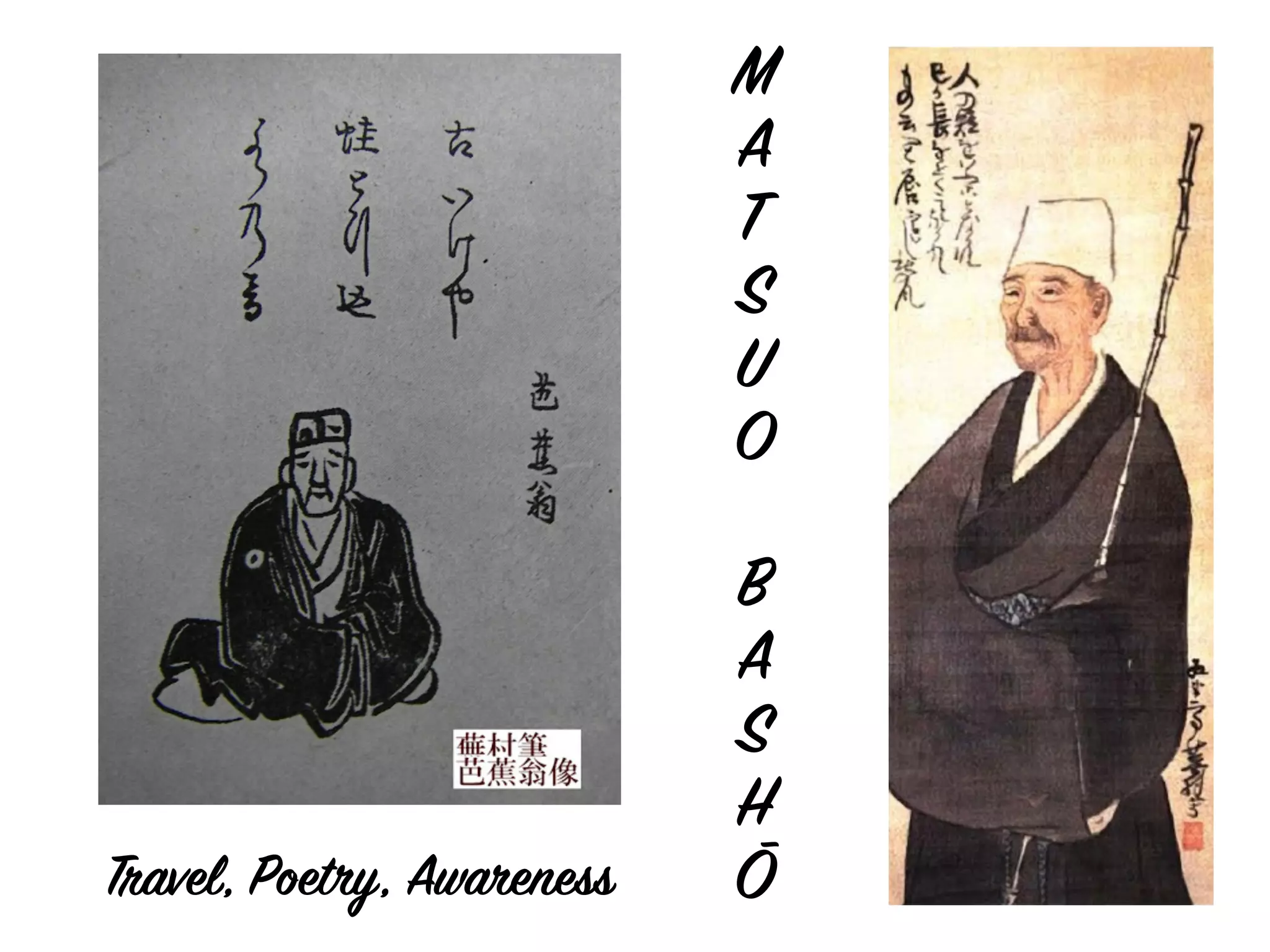
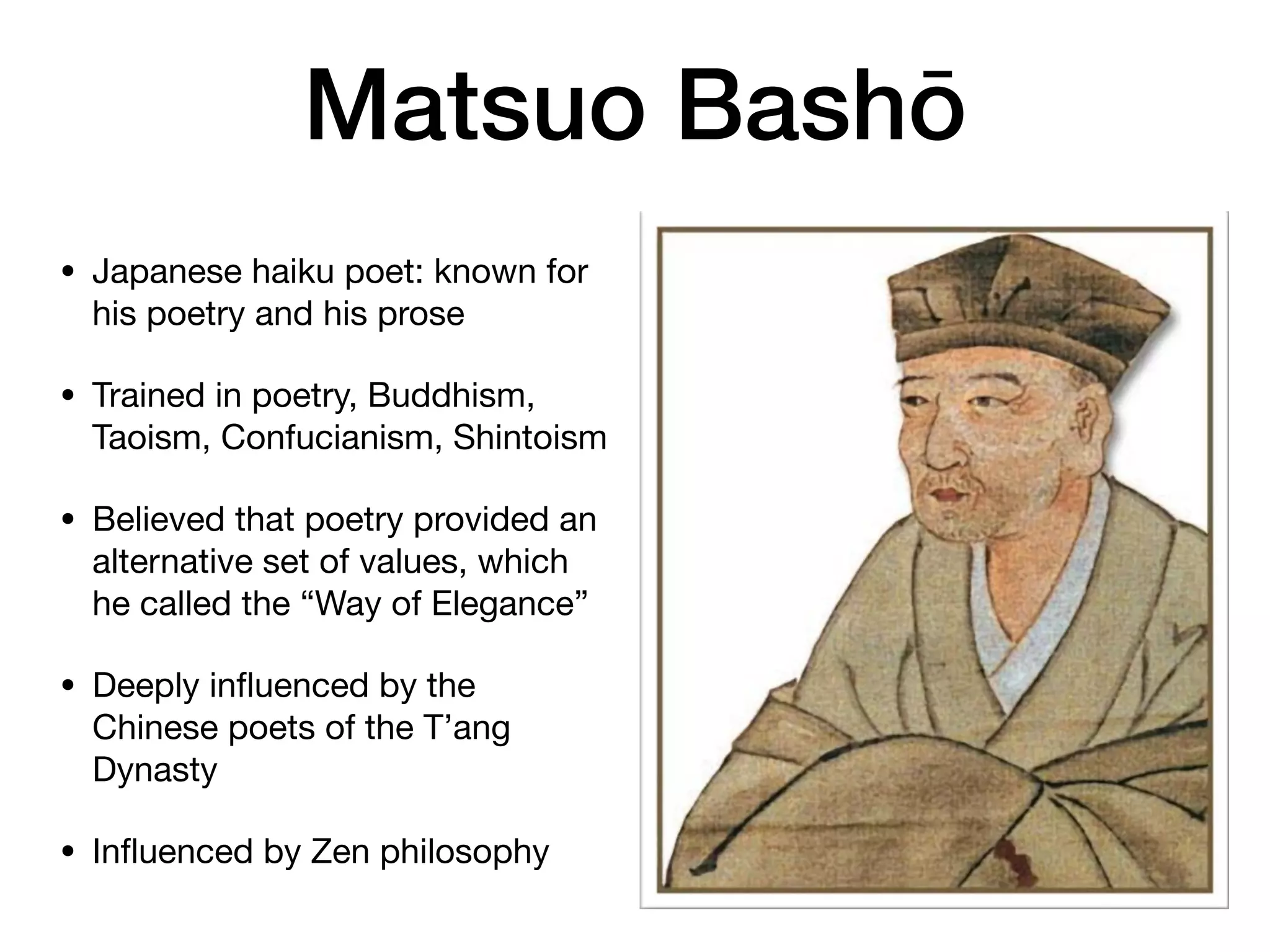
Matsuo Bashō
• Japanese haiku poet: known for
his poetry and his prose

• Trained in poetry, Buddhism,
Taoism, Confucianism, Shintoism

• Believed that poetry provided an
alternative set of values, which
he called the “Way of Elegance”

• Deeply influenced by the
Chinese poets of the T’ang
Dynasty

• Influenced by Zen philosophy
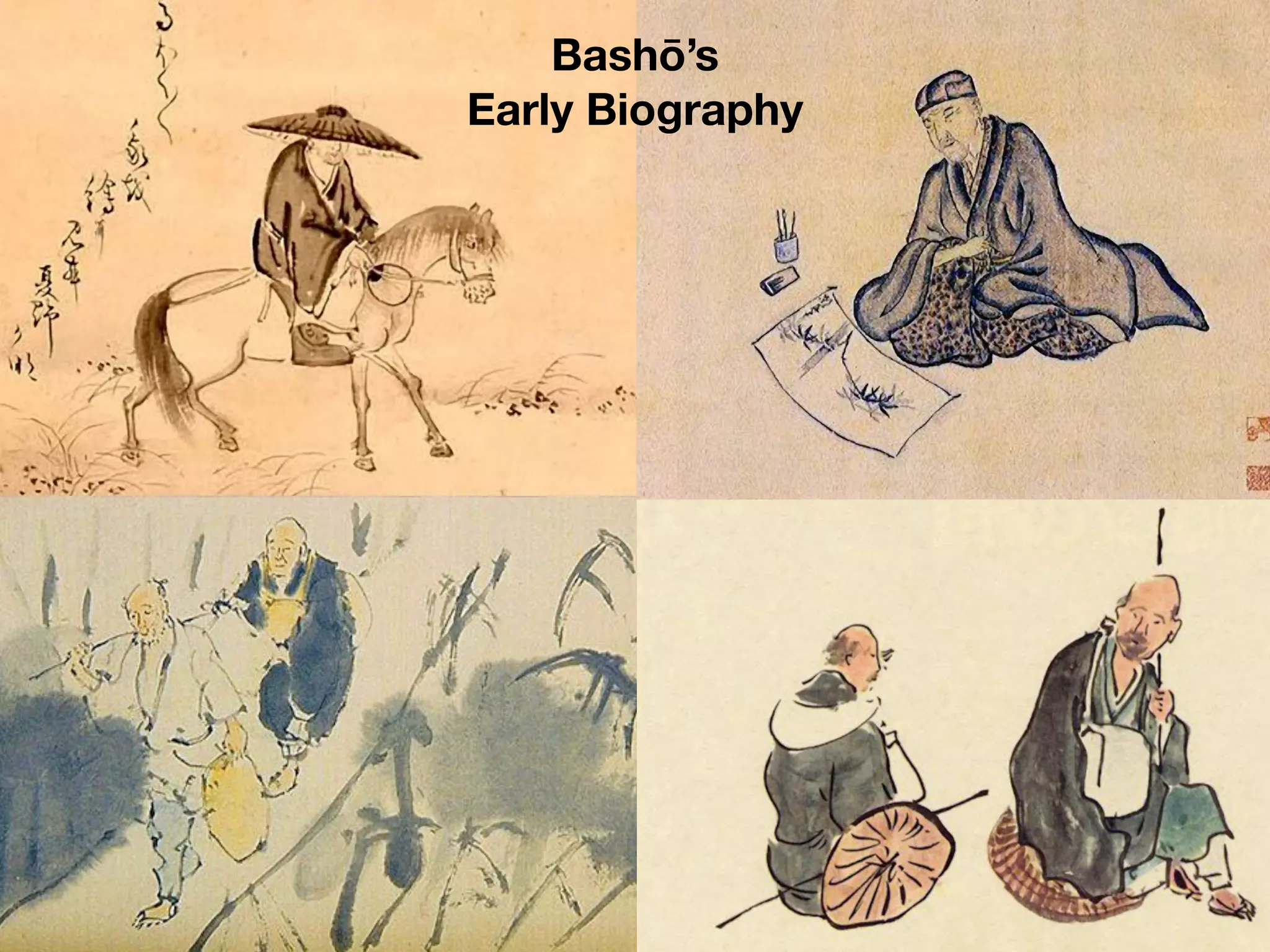
Bashō’s
Early Biography
Bashō Tree
I planted in my garden

A stock of Bashō tree, 

And hated at once

The shooting bush-clovers.

The tree does bear flowers, but
unlike other flowers, there is
nothing gay about them. The big
trunk of the tree is untouched by
the axe, for it is utterly useless
as building wood. I love the tree,
however, for its very
uselessness . . . I sit underneath
it, and enjoy the wind and rain
that blow against it.

“
Why a life of travel
and wayfaring?
• To spread the word of his poetic
style and philosophy and gain new
disciples

• To journey into nature; to fuse with
the natural world

• To journey into history and tradition;
to fuse with the ancient past

• To gain spiritual enlightenment; to
liberate the self from attachments

• To embody the nature of the
universe Basho Meets Two Travelers
by Tsukioka Yoshitoshi
Bashō’s Travel Journals
• Journal of Bleached Bones in a Field (Nozarashi kiko). First travel
journal (published in 1687; travels in 1685)

• Kashima Journal (published in 1687, the same year as his second,
short trip, this time to see the autumn moon at Kashima Shrine.)
Second travel journal

• Knapsack Notebook (Oino kobumi). Third journal, concerns a
lengthy trip west from Edo from November 1687 to May 1688.

• Sarashina Journal (Sarashina nikki). The fourth journal, he traveled
to the village of Sarashina to view the autumn moon.

• The Narrow Road to the Deep North (Oku no hosomichi). The
fifth journey and journal, from which arises one of the great prose
works of Japanese literature.
The Narrow Road to the Deep North
(Oku no hosomichi)
Published in 1702. Written based on his journey in the late spring of 1689.
Oku no hosomichi
“oku” means “within” and
“farthest” or “dead-end”
place

hosomichi means “path”
or “narrow road”; the no is
prepositional

The term oku refers to the
northern “back-country”
of the main Japanese
island of Honshu, and it
also means “deep” in the
sense of interior, such as
the depths of a mountain
and spiritual depths.
Other translations:
The Narrow Road to the Deep North
The Narrow Road to the Interior
Oku no hosomichi
meaning "Narrow road
to the interior”
Bashō’s Journey
Bashō&Sora Artist: Yosa Buson
Most of the things I had brought for my journey
turned out to be impediments, and I had
thrown them away. However, I still carried my
paper robe, my straw raincoat, ink stone,
brush, paper, lunch box, and other things on
my back—quite a load for me. More and more
my legs grew weaker and my body lost
strength. Making wretched progress, with
knees trembling, I carried on as best I could,
but I was utterly weary.
Travel & Attachments
“
Bitten by fleas and lice,

I slept in a bed,

A horse urinating all the time

Close to my pillow.

What the gate-keeper had told me turned out to be true. The mountains
were so thickly covered with foliage and the air underneath was so hushed
that I felt as if I were groping my way in the dead of night. There was not
even the cry of a single bird to be heard, and the wind seemed to breathe
out black soot through every rift in the hanging clouds. I pushed my way
through thick undergrowth of bamboo, crossing many streams and
stumbling over many rocks, till at last I arrived at the village of Mogami
after much shedding of cold sweat. My guide congratulated me by saying
that I was indeed fortunate to have crossed the mountains in safety, for
accidents of some sort had always happened on his past trips. I thanked
him sincerely and parted from him. However, fear lingered in my mind
some time after that. (page 120-121)

Challenges of the Wayfaring Life
“
Suffering&Enlightenment
Fleas, lice,

a horse pissing

by my bed.

Bitten by fleas and lice,

I slept in a bed,

A horse urinating all the time

Close to my pillow.
Plagued by fleas and lice

I hear a horse stalling

What a place to sleep!
A monk asked a Zen Master, “How can I avoid the summer’s heat
and the winter’s cold?” “Go where there is no heat in summer or
cold in winter.” “Where is that?” asked the monk. “When it is hot,
sweat; when it is cold, shiver,” replied the master.
Zen Koan
Exhausted
seeking an inn:
wisteria flowers.
Bashō
The whole mountain was made of massive rocks thrown
together and covered with age-old pines and oaks. The
stony ground itself bore the color of eternity, paved with
velvety moss. The doors of the shrines built on the rocks
were firmly barred and there was no sound to be heard.
As I moved on all fours from rock to rock, bowing
reverently at each shrine, I felt the purifying power of this
holy environment pervading my whole being.
Page 122-123


In the utter silence

Of a temple,

A cicada's voice alone

Penetrates the rocks.
“
Environment and Enlightenment
Sick on my journey,
only my dreams will wander
these desolate moors
Bashō’s
Death Poem

Basho travel poetry awareness

  • 1.
  • 2.
    Matsuo Bashō • Japanesehaiku poet: known for his poetry and his prose • Trained in poetry, Buddhism, Taoism, Confucianism, Shintoism • Believed that poetry provided an alternative set of values, which he called the “Way of Elegance” • Deeply influenced by the Chinese poets of the T’ang Dynasty • Influenced by Zen philosophy
  • 3.
  • 4.
    Bashō Tree I plantedin my garden A stock of Bashō tree, And hated at once The shooting bush-clovers. The tree does bear flowers, but unlike other flowers, there is nothing gay about them. The big trunk of the tree is untouched by the axe, for it is utterly useless as building wood. I love the tree, however, for its very uselessness . . . I sit underneath it, and enjoy the wind and rain that blow against it. “
  • 6.
    Why a lifeof travel and wayfaring? • To spread the word of his poetic style and philosophy and gain new disciples • To journey into nature; to fuse with the natural world • To journey into history and tradition; to fuse with the ancient past • To gain spiritual enlightenment; to liberate the self from attachments • To embody the nature of the universe Basho Meets Two Travelers by Tsukioka Yoshitoshi
  • 7.
    Bashō’s Travel Journals •Journal of Bleached Bones in a Field (Nozarashi kiko). First travel journal (published in 1687; travels in 1685) • Kashima Journal (published in 1687, the same year as his second, short trip, this time to see the autumn moon at Kashima Shrine.) Second travel journal • Knapsack Notebook (Oino kobumi). Third journal, concerns a lengthy trip west from Edo from November 1687 to May 1688. • Sarashina Journal (Sarashina nikki). The fourth journal, he traveled to the village of Sarashina to view the autumn moon. • The Narrow Road to the Deep North (Oku no hosomichi). The fifth journey and journal, from which arises one of the great prose works of Japanese literature.
  • 8.
    The Narrow Roadto the Deep North (Oku no hosomichi) Published in 1702. Written based on his journey in the late spring of 1689.
  • 9.
    Oku no hosomichi “oku”means “within” and “farthest” or “dead-end” place hosomichi means “path” or “narrow road”; the no is prepositional The term oku refers to the northern “back-country” of the main Japanese island of Honshu, and it also means “deep” in the sense of interior, such as the depths of a mountain and spiritual depths. Other translations: The Narrow Road to the Deep North The Narrow Road to the Interior Oku no hosomichi meaning "Narrow road to the interior”
  • 10.
  • 11.
  • 12.
    Most of thethings I had brought for my journey turned out to be impediments, and I had thrown them away. However, I still carried my paper robe, my straw raincoat, ink stone, brush, paper, lunch box, and other things on my back—quite a load for me. More and more my legs grew weaker and my body lost strength. Making wretched progress, with knees trembling, I carried on as best I could, but I was utterly weary. Travel & Attachments “
  • 13.
    Bitten by fleasand lice, I slept in a bed, A horse urinating all the time Close to my pillow. What the gate-keeper had told me turned out to be true. The mountains were so thickly covered with foliage and the air underneath was so hushed that I felt as if I were groping my way in the dead of night. There was not even the cry of a single bird to be heard, and the wind seemed to breathe out black soot through every rift in the hanging clouds. I pushed my way through thick undergrowth of bamboo, crossing many streams and stumbling over many rocks, till at last I arrived at the village of Mogami after much shedding of cold sweat. My guide congratulated me by saying that I was indeed fortunate to have crossed the mountains in safety, for accidents of some sort had always happened on his past trips. I thanked him sincerely and parted from him. However, fear lingered in my mind some time after that. (page 120-121) Challenges of the Wayfaring Life “
  • 14.
    Suffering&Enlightenment Fleas, lice, a horsepissing by my bed. Bitten by fleas and lice, I slept in a bed, A horse urinating all the time Close to my pillow. Plagued by fleas and lice I hear a horse stalling What a place to sleep! A monk asked a Zen Master, “How can I avoid the summer’s heat and the winter’s cold?” “Go where there is no heat in summer or cold in winter.” “Where is that?” asked the monk. “When it is hot, sweat; when it is cold, shiver,” replied the master. Zen Koan
  • 15.
  • 16.
    The whole mountainwas made of massive rocks thrown together and covered with age-old pines and oaks. The stony ground itself bore the color of eternity, paved with velvety moss. The doors of the shrines built on the rocks were firmly barred and there was no sound to be heard. As I moved on all fours from rock to rock, bowing reverently at each shrine, I felt the purifying power of this holy environment pervading my whole being. Page 122-123 
 In the utter silence
 Of a temple,
 A cicada's voice alone
 Penetrates the rocks. “ Environment and Enlightenment
  • 17.
    Sick on myjourney, only my dreams will wander these desolate moors Bashō’s Death Poem