By:-
Shreeja Guha
Shaikh Aliya
Namrata
Renuka
Aditi
Technical Seminar Report on
Guided by: Mr.
What is Base Isolation
Study of Earthquake
Introduction
Effects of Earthquake
Base Isolation
Principle of Base Isolation
Isolation Components
Elastomeric Isolators
Sliding Isolators
Base Isolators in real building
Applications
Conclusions
What is Base
Isolation?The term isolation refers to reduced interaction
between structure and the ground.
When the seismic isolation system is located under the
structure, it is referred as “base isolation”.
To know the detail of Base Isolation first of all we
need to know what is seismic waves.
Lets Start
Earthquake
An Earthquake is the result of a sudden release of
energy in the Earth’s crust that creates seismic
waves.
Introduction
 Earthquake by itself, is not a disaster, it is natural phenomenon
result from ground movement, sometimes violent.
 These produce surface waves, which cause vibration of the
ground and structures standing on top.
 Depending on the characteristics of these vibrations, the ground
may develop cracks, fissures and settlements.
Here we can see that major part of India is prone to Earthquake, that’s
why need of Base Isolation is in high demand to meet the crisis.
 The possible risk of loss of life adds a very serious dimension to
seismic design, putting a moral responsibility on structural
engineers.
 In recent times, many new systems have been developed, either
to reduce the earthquake forces acting on the structure or to
absorb a part of seismic energy.
 One of the most widely implemented and accepted seismic
protection systems is Base Isolation.
Introduction…
Effects of
Earthquake
Base Isolation
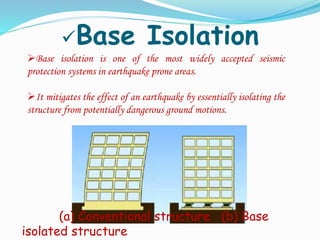
Base isolation is one of the most widely accepted seismic
protection systems in earthquake prone areas.
It mitigates the effect of an earthquake by essentially isolating the
structure from potentially dangerous ground motions.
(a) Conventional structure (b) Base
isolated structure
BASE ISOLATION…
 Seismic isolation is a design strategy, which uncouples the
structure for the damaging effects of the ground motion.
 The other purpose of an isolation system is to provide an
additional means of energy dissipation, thereby reducing the
transmitted acceleration into the superstructure.
 The decoupling allows the building to behave more flexibly
which improves its response to an earthquake.
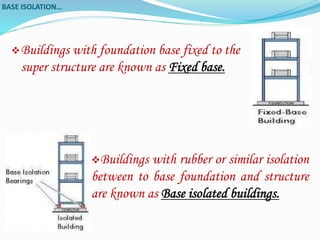
Buildings with foundation base fixed to the
super structure are known as Fixed base.
Buildings with rubber or similar isolation
between to base foundation and structure
are known as Base isolated buildings.
BASE ISOLATION…
Principle of Base
Isolation
 The fundamental principle of base isolation is to modify the
response of the building so that the ground can move below the
building without transmitting these motions into the building.
 For this type of structure, when the ground beneath the structure
moves there will be zero acceleration induced in the structure and
the relative displacement between the structure and ground will
be equal to the ground displacement.
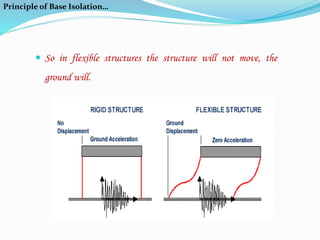
 So in flexible structures the structure will not move, the
ground will.
Principle of Base Isolation…
Isolation
Components
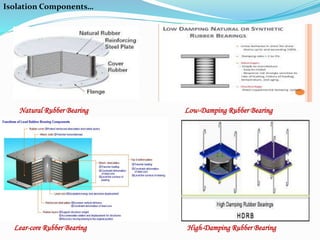
 Elastomeric Isolators
 Natural Rubber Bearings
 Low-Damping Rubber Bearings
 Lead-Rubber Bearings
 High-Damping Rubber Bearings
 Sliding Isolators
 Resilient Friction System
 Friction Pendulum System
Elastomeric
IsolatorsThese are formed of horizontal layers of natural
or synthetic rubber in thin layers bonded
between steel plates.
Isolation Components…
Natural Rubber Bearing Low-Damping Rubber Bearing
Lear-core Rubber Bearing High-Damping Rubber Bearing
Isolation Components…
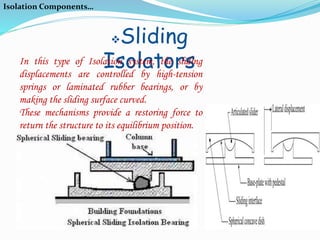
Sliding
IsolatorsIn this type of Isolation system, the sliding
displacements are controlled by high-tension
springs or laminated rubber bearings, or by
making the sliding surface curved.
These mechanisms provide a restoring force to
return the structure to its equilibrium position.
Isolation Components…
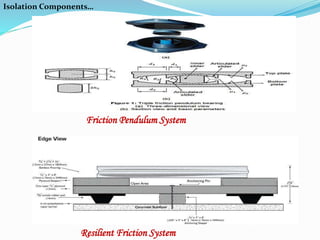
Friction Pendulum System
Resilient Friction System
Isolation Components…
 In India, base isolation technique was first demonstrated after
the 1993 Killari (Maharashtra) Earthquake.
 Two single storey buildings in newly relocated Killari town
were built with rubber base isolators resting on hard ground.
 After the 2001 Bhuj (Gujarat) earthquake, the four-storey Bhuj
Hospital building was built with base isolation technique.
 All were brick masonry buildings with concrete roof.
Base Isolation in Real
Building
Applications
 Base isolation provides an alternative to the conventional,
fixed base design of structures.
 Base Isolation minimizes the need for strengthening measures
of adding shear walls, frames, and bracing by reducing the
earthquake forces imparted to the building.
 Base isolation had the effect of reducing the earthquake force
demands on the superstructure to 30% of the demands for a
fixed-base structure.
Conclusion
 Seismic base isolation method has proved to be a reliable method of
earthquake resistant Design.
 The success of this method is largely attributed to the development of
isolation devices and proper planning.
 Adaptable isolation systems are required to be effective during a wide
range of seismic events.
 Efforts are required to find the solutions for the situations like near
fault regions where wide variety of earthquake motions may occur.
Any
Queries???
Thank you

Base isolation Engineering

  • 2.
  • 3.
    What is BaseIsolation Study of Earthquake Introduction Effects of Earthquake Base Isolation Principle of Base Isolation Isolation Components Elastomeric Isolators Sliding Isolators Base Isolators in real building Applications Conclusions
  • 4.
    What is Base Isolation?Theterm isolation refers to reduced interaction between structure and the ground. When the seismic isolation system is located under the structure, it is referred as “base isolation”. To know the detail of Base Isolation first of all we need to know what is seismic waves. Lets Start
  • 5.
    Earthquake An Earthquake isthe result of a sudden release of energy in the Earth’s crust that creates seismic waves.
  • 6.
    Introduction  Earthquake byitself, is not a disaster, it is natural phenomenon result from ground movement, sometimes violent.  These produce surface waves, which cause vibration of the ground and structures standing on top.  Depending on the characteristics of these vibrations, the ground may develop cracks, fissures and settlements.
  • 7.
    Here we cansee that major part of India is prone to Earthquake, that’s why need of Base Isolation is in high demand to meet the crisis.
  • 8.
     The possiblerisk of loss of life adds a very serious dimension to seismic design, putting a moral responsibility on structural engineers.  In recent times, many new systems have been developed, either to reduce the earthquake forces acting on the structure or to absorb a part of seismic energy.  One of the most widely implemented and accepted seismic protection systems is Base Isolation. Introduction…
  • 9.
  • 10.
    Base Isolation Base isolationis one of the most widely accepted seismic protection systems in earthquake prone areas. It mitigates the effect of an earthquake by essentially isolating the structure from potentially dangerous ground motions. (a) Conventional structure (b) Base isolated structure
  • 11.
    BASE ISOLATION…  Seismicisolation is a design strategy, which uncouples the structure for the damaging effects of the ground motion.  The other purpose of an isolation system is to provide an additional means of energy dissipation, thereby reducing the transmitted acceleration into the superstructure.  The decoupling allows the building to behave more flexibly which improves its response to an earthquake.
  • 12.
    Buildings with foundationbase fixed to the super structure are known as Fixed base. Buildings with rubber or similar isolation between to base foundation and structure are known as Base isolated buildings. BASE ISOLATION…
  • 13.
    Principle of Base Isolation The fundamental principle of base isolation is to modify the response of the building so that the ground can move below the building without transmitting these motions into the building.  For this type of structure, when the ground beneath the structure moves there will be zero acceleration induced in the structure and the relative displacement between the structure and ground will be equal to the ground displacement.
  • 14.
     So inflexible structures the structure will not move, the ground will. Principle of Base Isolation…
  • 15.
    Isolation Components  Elastomeric Isolators Natural Rubber Bearings  Low-Damping Rubber Bearings  Lead-Rubber Bearings  High-Damping Rubber Bearings  Sliding Isolators  Resilient Friction System  Friction Pendulum System
  • 16.
    Elastomeric IsolatorsThese are formedof horizontal layers of natural or synthetic rubber in thin layers bonded between steel plates. Isolation Components…
  • 17.
    Natural Rubber BearingLow-Damping Rubber Bearing Lear-core Rubber Bearing High-Damping Rubber Bearing Isolation Components…
  • 18.
    Sliding IsolatorsIn this typeof Isolation system, the sliding displacements are controlled by high-tension springs or laminated rubber bearings, or by making the sliding surface curved. These mechanisms provide a restoring force to return the structure to its equilibrium position. Isolation Components…
  • 19.
    Friction Pendulum System ResilientFriction System Isolation Components…
  • 20.
     In India,base isolation technique was first demonstrated after the 1993 Killari (Maharashtra) Earthquake.  Two single storey buildings in newly relocated Killari town were built with rubber base isolators resting on hard ground.  After the 2001 Bhuj (Gujarat) earthquake, the four-storey Bhuj Hospital building was built with base isolation technique.  All were brick masonry buildings with concrete roof. Base Isolation in Real Building
  • 21.
    Applications  Base isolationprovides an alternative to the conventional, fixed base design of structures.  Base Isolation minimizes the need for strengthening measures of adding shear walls, frames, and bracing by reducing the earthquake forces imparted to the building.  Base isolation had the effect of reducing the earthquake force demands on the superstructure to 30% of the demands for a fixed-base structure.
  • 22.
    Conclusion  Seismic baseisolation method has proved to be a reliable method of earthquake resistant Design.  The success of this method is largely attributed to the development of isolation devices and proper planning.  Adaptable isolation systems are required to be effective during a wide range of seismic events.  Efforts are required to find the solutions for the situations like near fault regions where wide variety of earthquake motions may occur.
  • 23.