Click to edit Master title style
1 1
Acknowledgement
• We would like to thank my supervisor Dr. Shobha Ram, Assistant
Professor & Head of Department of Civil Engineering, School of
Engineering, Gautam Buddha University for his keen interest, constant
guidance, encouragement and support which helped us in carrying out
the present work.
• We extend our deep sense of gratitude to co supervisor Dr. Anju Agarwal,
Department of Civil Engineering, Gautam Buddha University for his
invaluable guidance, inspiration and continuous help, as a valuable asset
for the successful completion of our project. This project would not have
been possible without a timely response from him. We acknowledge our
gratitude to our university. Finally, we have no words to express our
appreciation and gratitude for the unbound love and affection from our
parents. Heartiest thanks for their continual emotional and financial
support; they have always remained our source of encouragement. We
would like to thank our friends who were always there when we needed.
• Above all, we would like to thank almighty God, the source of all positive
energy, for bestowing us the spirit of writing. We also thank all those who
are involved directly or indirectly in helping us whenever we needed.
Click to edit Master title style
3
CONTENTS
3
• INTRODUCTION
• BASE ISOLATION
• PRINCIPLE OF BASE ISOLATION
• WORKING
• RESPONSE OF BASE ISOLATIOON BUILDING VERSUS FIXED BASE
RESPONSE
• LOCATIONS OF BASE ISOLATIONS IN BUILDING
• TYPES OF BASE ISOLATION TECHNIQUES
• BENEFITS OF BASE ISOLATION
• IS IT AN ECONOMIC SOLUTION?
• REAL LIFE APPLICATIONS
• CONCLUSION
Click to edit Master title style
4
INTRODUCTION
• Earthquake by itself, is not a disaster, it is
natural phenomenon result from ground
movement, sometimes violent.
• These produce surface waves, which cause
vibration of the ground and structures
standing on top.
• Depending on the characteristics of these
vibrations, the ground may develop cracks,
fissures and settlements
4
Click to edit Master title style
5
INTRODUCTION
5
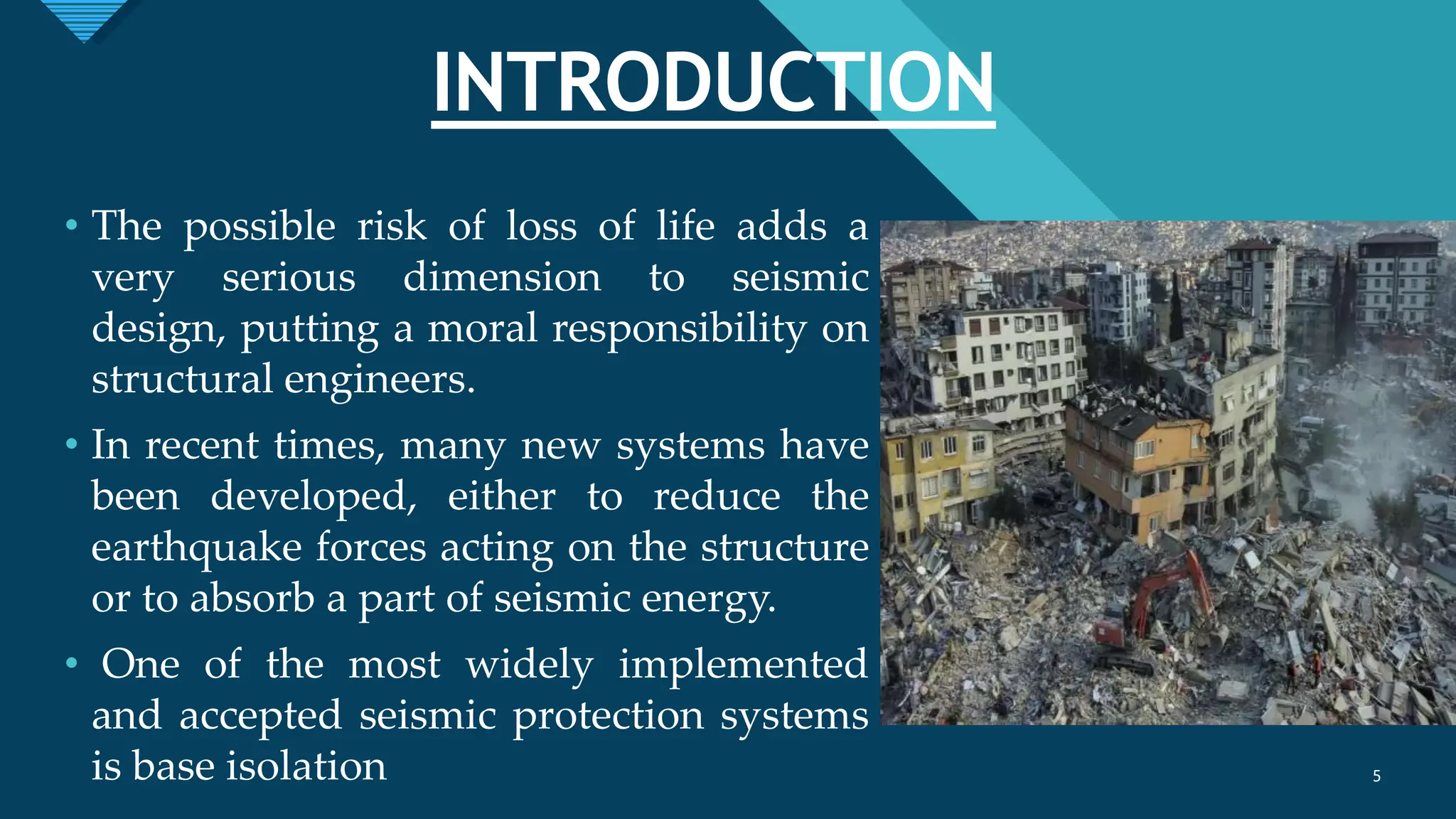
• The possible risk of loss of life adds a
very serious dimension to seismic
design, putting a moral responsibility on
structural engineers.
• In recent times, many new systems have
been developed, either to reduce the
earthquake forces acting on the structure
or to absorb a part of seismic energy.
• One of the most widely implemented
and accepted seismic protection systems
is base isolation
Click to edit Master title style
6 6
Tuned Mass Damper
Energy Dissipation
Base Isolation
Active Isolation
Semi Active Isolation
Semi Active Mass
Damping
Active Mass
Damping
Active Bracing
Adaptive Control
Earthquake Protective Systems
Passive Protective
Systems
Hybrid Protective
Systems
Active Protective
Systems
Click to edit Master title style
7
BASE ISOLATION
• What is Base Isolation?
• It is a system that may be defined as a flexible or sliding interface
positioned between a structure and its foundation, for the
purpose of decoupling the horizontal motions of the ground from
the horizontal motions of the structure, thereby reducing
earthquake damage to the structure and its contents.
• Base isolation system absorbs and deflects the energy released
from the earthquake before it is transferred to the structure
7
Click to edit Master title style
8 8
BASE ISOLATION
• The term isolation refers to reduced interaction between structure and
the ground.
• Since the seismic isolation system is located under the structure, it is
referred as ‘Base isolation’.
• Base isolation is a passive control system meaning thereby that it does
not require any external force or energy for its activation.
• The base isolators used in this system mitigate the effect of an
earthquake by decoupling the components of the buildings from direct
contact with the ground essentially isolating the structure from
potentially dangerous ground motions.
• The base-isolation techniques prove to be very effective for the seismic
protection of new framed buildings as well as for the seismic
retrofitting of existing ones.
Click to edit Master title style
9 9
Click to edit Master title style
10
PRINCIPLE OF BASE ISOLATION
10
• The concept of separating the structure from the ground to avoid
earthquake damage is quite simple to grasp. After all, in an
earthquake the ground moves and it is this ground movement which
causes most of the damage to structures. An airplane flying over an
earthquake is not affected.
• So, the principle is simple. Separate the structure from the ground.
The ground will move but the building will not move.
Click to edit Master title style
11
WORKING
11
Click to edit Master title style
12
RESPONSE OF BASE ISOLATED BUILDINGS
VERSUS FIXED BASE RESPONSE
12
Click to edit Master title style
13
13
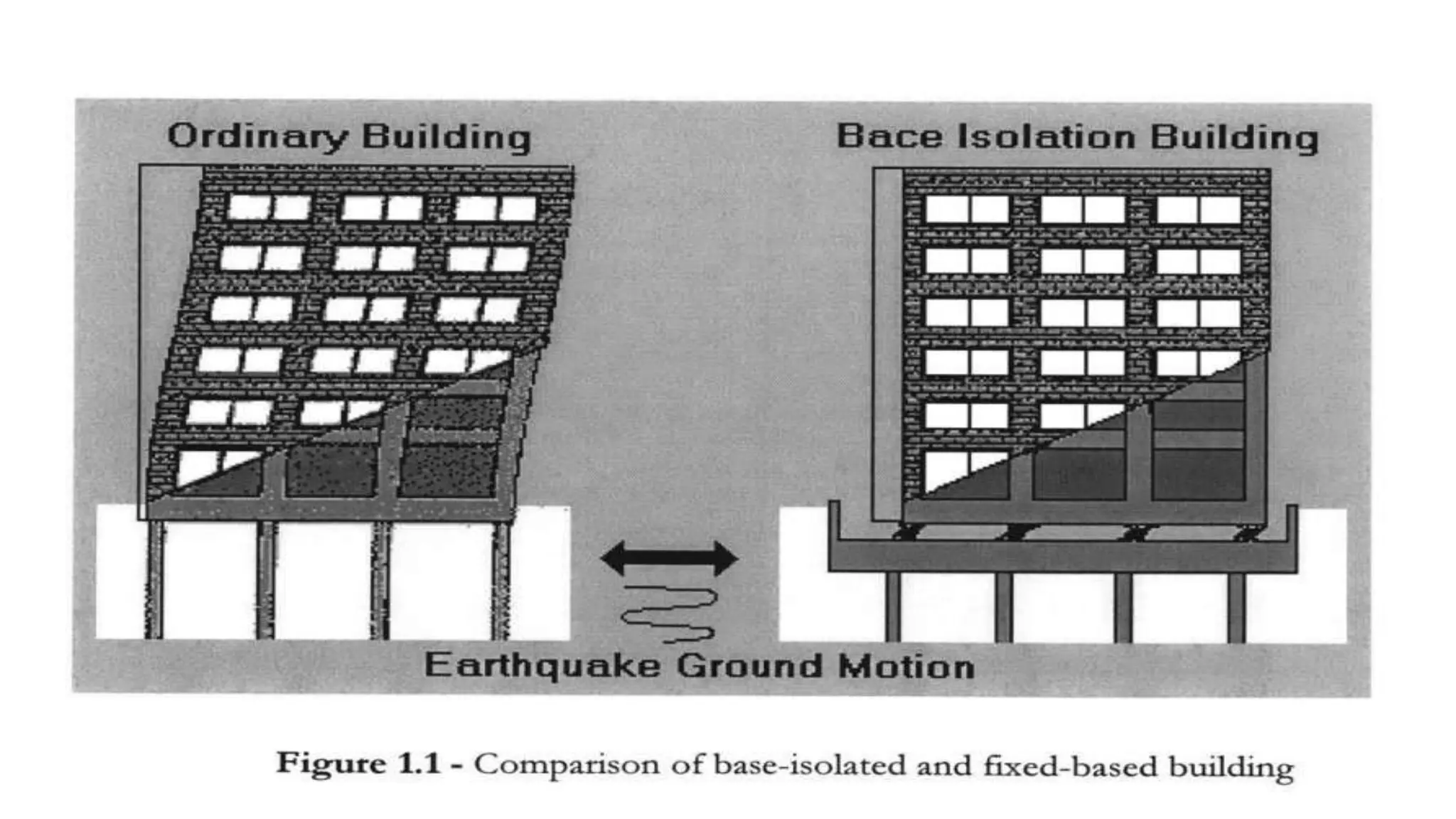
•When the earthquake is affected on fixed base
structure at that time structure is not defending
against earthquake.
•But in base isolated structure when earthquake is
affected on the structure building is defending
against earthquake very well.
•In fixed structure, structure is moves with ground
motion.
•In isolated structure, structure is not moves with
ground motion. But isolation bearing is moves with
ground motion. So we can say the structure is safe
Click to edit Master title style
14
LOCATIONS OF BASE ISOLATIONS IN
BUILDING
14
• Generally, the isolators are installed at the top or bottom or
mid-height of the building basements columns and the walls.
• The placement of base isolators must be done in such a way
that the building must be able to move horizontally relative to
the below ground.
Click to edit Master title style
15
Types of Base Isolation Techniques
15
1. Roller and Ball Bearings
• This type of isolation technique is mainly implemented to
resist service movements and damping. As the name
suggests, use of cylindrical rollers and balls is done for the
isolation
Click to edit Master title style
16
16
2. Sliding Bearing
• It includes a sliding mechanism with a
predefined coefficient of friction. The
mechanism results in reduction of the forces
and acceleration that are transferred to the
structure.
3. Springs
• The springs isolation mechanism is not very
popular in structural engineering as it
facilitates the movement in both vertical and
horizontal directions. This increases service
deflections.
Click to edit Master title style
17
17
4. Elastomeric Rubber bearings
• This is the most widely used base isolator.
isolator. The bearing structure consists of
horizontal layers of neoprene or natural
rubber sandwiched between mild steel
plates, moulded as one unit. Steel plates
are responsible for preventing rubber
layers from bulging.
• Any type of movement in vertical
deformation is resisted and is granted in
the horizontal direction by these bearings.
bearings. These types of bearings have
wide application in large span bridges and
and buildings.
Click to edit Master title style
18
BENEFITS OF BASE ISOLATION
18
• Reduced the seismic demand of
structure, thereby reducing the cost
of structure.
• Less displacement during the
earthquake.
• Improves safety of structure.
• Reduced damages caused during the
structure
Click to edit Master title style
19
IS IT AN ECONOMIC SOLUTION?
19
• Base isolation allows for a reduction in structural elements of the
building with less ductile detailing needed
• Widely held misconception is that seismic isolation is expensive
• E.g. Union House built in Auckland in 1983 with base isolation
produced an estimated 7% cost saving in the total construction cost of
$6.6million which included a construction time saving of 3 months due
to the structural form requiring less seismic force, ductility demands
and structural deformations
• As a general rule the inclusion of all aspects of seismic isolation in a
new structure will add no more than 3% to total construction cost and
considerably less when assessed against the benefits of isolation
Click to edit Master title style
20
20
• Seismic isolation devices require no maintenance during the life of the
building
• Following any significant event they should be inspected to ensure
bolts and load plates are still in place.
• Devices do not need replacing after an earthquake unless the event
was in excess of their design specification in which case removal of
some devices for testing is recommended.
• Because the building is protected from major damage, repair costs
following an earthquake will be lower to non-existent
Click to edit Master title style
21
REAL LIFE APPLICATIONS
21
1). Tomb-of-Cyrus, Iran.
World's first base isolated structure.
Click to edit Master title style
22
22
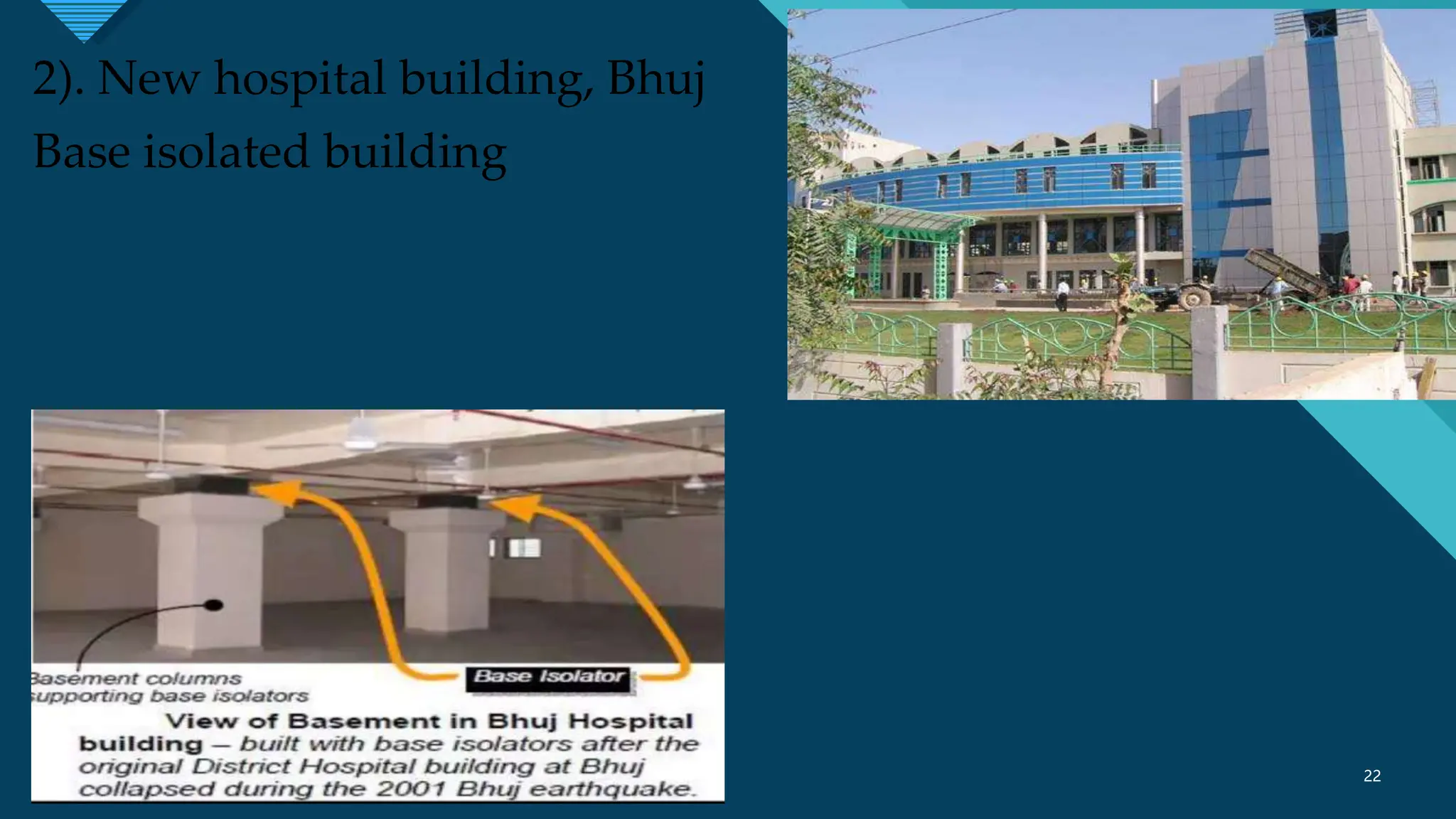
2). New hospital building, Bhuj
Base isolated building
Click to edit Master title style
23
CONCLUSION
23
• We can use base isolation technique to construct the earthquake
resistant building.
• Proper materials and design should be selected to get the best
result.
• The safety of people should be the main aim.

Base isolation method System for Multi storey Building

  • 1.
    Click to editMaster title style 1 1
  • 2.
    Acknowledgement • We wouldlike to thank my supervisor Dr. Shobha Ram, Assistant Professor & Head of Department of Civil Engineering, School of Engineering, Gautam Buddha University for his keen interest, constant guidance, encouragement and support which helped us in carrying out the present work. • We extend our deep sense of gratitude to co supervisor Dr. Anju Agarwal, Department of Civil Engineering, Gautam Buddha University for his invaluable guidance, inspiration and continuous help, as a valuable asset for the successful completion of our project. This project would not have been possible without a timely response from him. We acknowledge our gratitude to our university. Finally, we have no words to express our appreciation and gratitude for the unbound love and affection from our parents. Heartiest thanks for their continual emotional and financial support; they have always remained our source of encouragement. We would like to thank our friends who were always there when we needed. • Above all, we would like to thank almighty God, the source of all positive energy, for bestowing us the spirit of writing. We also thank all those who are involved directly or indirectly in helping us whenever we needed.
  • 3.
    Click to editMaster title style 3 CONTENTS 3 • INTRODUCTION • BASE ISOLATION • PRINCIPLE OF BASE ISOLATION • WORKING • RESPONSE OF BASE ISOLATIOON BUILDING VERSUS FIXED BASE RESPONSE • LOCATIONS OF BASE ISOLATIONS IN BUILDING • TYPES OF BASE ISOLATION TECHNIQUES • BENEFITS OF BASE ISOLATION • IS IT AN ECONOMIC SOLUTION? • REAL LIFE APPLICATIONS • CONCLUSION
  • 4.
    Click to editMaster title style 4 INTRODUCTION • Earthquake by itself, is not a disaster, it is natural phenomenon result from ground movement, sometimes violent. • These produce surface waves, which cause vibration of the ground and structures standing on top. • Depending on the characteristics of these vibrations, the ground may develop cracks, fissures and settlements 4
  • 5.
    Click to editMaster title style 5 INTRODUCTION 5 • The possible risk of loss of life adds a very serious dimension to seismic design, putting a moral responsibility on structural engineers. • In recent times, many new systems have been developed, either to reduce the earthquake forces acting on the structure or to absorb a part of seismic energy. • One of the most widely implemented and accepted seismic protection systems is base isolation
  • 6.
    Click to editMaster title style 6 6 Tuned Mass Damper Energy Dissipation Base Isolation Active Isolation Semi Active Isolation Semi Active Mass Damping Active Mass Damping Active Bracing Adaptive Control Earthquake Protective Systems Passive Protective Systems Hybrid Protective Systems Active Protective Systems
  • 7.
    Click to editMaster title style 7 BASE ISOLATION • What is Base Isolation? • It is a system that may be defined as a flexible or sliding interface positioned between a structure and its foundation, for the purpose of decoupling the horizontal motions of the ground from the horizontal motions of the structure, thereby reducing earthquake damage to the structure and its contents. • Base isolation system absorbs and deflects the energy released from the earthquake before it is transferred to the structure 7
  • 8.
    Click to editMaster title style 8 8 BASE ISOLATION • The term isolation refers to reduced interaction between structure and the ground. • Since the seismic isolation system is located under the structure, it is referred as ‘Base isolation’. • Base isolation is a passive control system meaning thereby that it does not require any external force or energy for its activation. • The base isolators used in this system mitigate the effect of an earthquake by decoupling the components of the buildings from direct contact with the ground essentially isolating the structure from potentially dangerous ground motions. • The base-isolation techniques prove to be very effective for the seismic protection of new framed buildings as well as for the seismic retrofitting of existing ones.
  • 9.
    Click to editMaster title style 9 9
  • 10.
    Click to editMaster title style 10 PRINCIPLE OF BASE ISOLATION 10 • The concept of separating the structure from the ground to avoid earthquake damage is quite simple to grasp. After all, in an earthquake the ground moves and it is this ground movement which causes most of the damage to structures. An airplane flying over an earthquake is not affected. • So, the principle is simple. Separate the structure from the ground. The ground will move but the building will not move.
  • 11.
    Click to editMaster title style 11 WORKING 11
  • 12.
    Click to editMaster title style 12 RESPONSE OF BASE ISOLATED BUILDINGS VERSUS FIXED BASE RESPONSE 12
  • 13.
    Click to editMaster title style 13 13 •When the earthquake is affected on fixed base structure at that time structure is not defending against earthquake. •But in base isolated structure when earthquake is affected on the structure building is defending against earthquake very well. •In fixed structure, structure is moves with ground motion. •In isolated structure, structure is not moves with ground motion. But isolation bearing is moves with ground motion. So we can say the structure is safe
  • 14.
    Click to editMaster title style 14 LOCATIONS OF BASE ISOLATIONS IN BUILDING 14 • Generally, the isolators are installed at the top or bottom or mid-height of the building basements columns and the walls. • The placement of base isolators must be done in such a way that the building must be able to move horizontally relative to the below ground.
  • 15.
    Click to editMaster title style 15 Types of Base Isolation Techniques 15 1. Roller and Ball Bearings • This type of isolation technique is mainly implemented to resist service movements and damping. As the name suggests, use of cylindrical rollers and balls is done for the isolation
  • 16.
    Click to editMaster title style 16 16 2. Sliding Bearing • It includes a sliding mechanism with a predefined coefficient of friction. The mechanism results in reduction of the forces and acceleration that are transferred to the structure. 3. Springs • The springs isolation mechanism is not very popular in structural engineering as it facilitates the movement in both vertical and horizontal directions. This increases service deflections.
  • 17.
    Click to editMaster title style 17 17 4. Elastomeric Rubber bearings • This is the most widely used base isolator. isolator. The bearing structure consists of horizontal layers of neoprene or natural rubber sandwiched between mild steel plates, moulded as one unit. Steel plates are responsible for preventing rubber layers from bulging. • Any type of movement in vertical deformation is resisted and is granted in the horizontal direction by these bearings. bearings. These types of bearings have wide application in large span bridges and and buildings.
  • 18.
    Click to editMaster title style 18 BENEFITS OF BASE ISOLATION 18 • Reduced the seismic demand of structure, thereby reducing the cost of structure. • Less displacement during the earthquake. • Improves safety of structure. • Reduced damages caused during the structure
  • 19.
    Click to editMaster title style 19 IS IT AN ECONOMIC SOLUTION? 19 • Base isolation allows for a reduction in structural elements of the building with less ductile detailing needed • Widely held misconception is that seismic isolation is expensive • E.g. Union House built in Auckland in 1983 with base isolation produced an estimated 7% cost saving in the total construction cost of $6.6million which included a construction time saving of 3 months due to the structural form requiring less seismic force, ductility demands and structural deformations • As a general rule the inclusion of all aspects of seismic isolation in a new structure will add no more than 3% to total construction cost and considerably less when assessed against the benefits of isolation
  • 20.
    Click to editMaster title style 20 20 • Seismic isolation devices require no maintenance during the life of the building • Following any significant event they should be inspected to ensure bolts and load plates are still in place. • Devices do not need replacing after an earthquake unless the event was in excess of their design specification in which case removal of some devices for testing is recommended. • Because the building is protected from major damage, repair costs following an earthquake will be lower to non-existent
  • 21.
    Click to editMaster title style 21 REAL LIFE APPLICATIONS 21 1). Tomb-of-Cyrus, Iran. World's first base isolated structure.
  • 22.
    Click to editMaster title style 22 22 2). New hospital building, Bhuj Base isolated building
  • 23.
    Click to editMaster title style 23 CONCLUSION 23 • We can use base isolation technique to construct the earthquake resistant building. • Proper materials and design should be selected to get the best result. • The safety of people should be the main aim.