
UNIVERSIDAD NACIONAL PEDRO
     F A C U L T A D D E MGALLO U M A N A
                 RUÍZ E D I C I N A H


BARTONELOSIS


                                             2011

         ARBOLEDA DÍAZ OSCAR

          BECERRA SILVA FRANK

        CARRASCO HERRERA DENIS

        MENDOZA HERNÁNDEZ ALEX

         PISCOYA TENORIO JORGE

           TINEO TINEO DENNY


                Dra. ROSA GONZÁLES LLONTOP
BATONELOSIS
SIGNS AND SYMPTOMS
Clinical      symptoms of        bartonellosis are         pleomorphic and
some endemic areaspatients may be asymptomatic. The               two classic
presentations are acute and the chronic phase, corresponding to the
two cells invaded by bacteria (red blood cells and endothelial cells).
ACUTE PHASE
The most common findings are:
    Fever (usually    notsustained but     with    temperatures no   higher
      than 39 ° C)
    Pallor
    Malaise
    Hepatomegaly
    Jaundice
    Lymphadenopathy
    Splenomegaly
This phase     is    characterized      by severe     hemolytic anemia and
immunosuppression. The      mortality     rate of    patients   not receiving
treatment is over 40% and can reach 90% if associated with opportunistic
infections by enterobacteria such as Salmonella spp.
CHRONIC PHASE
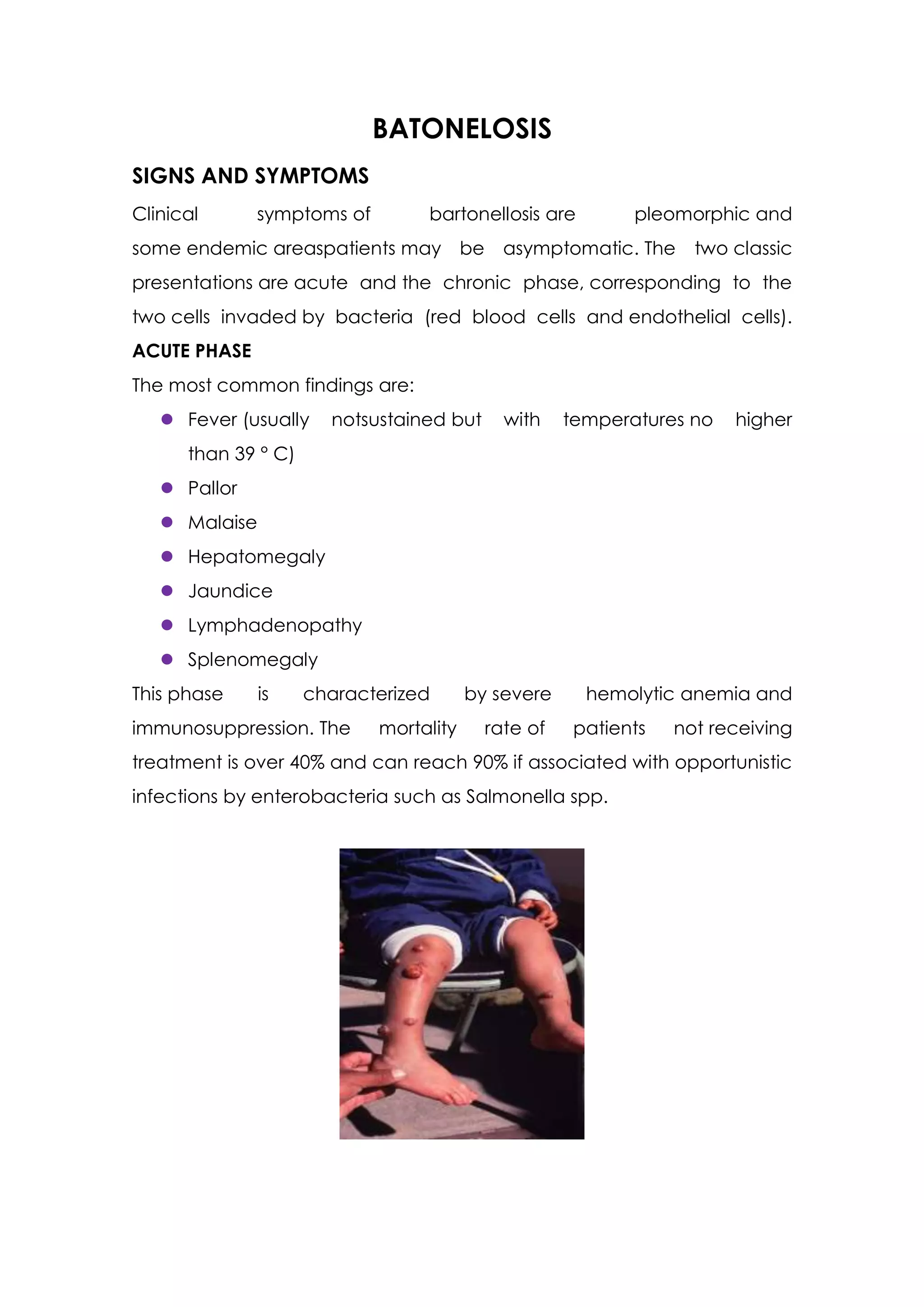
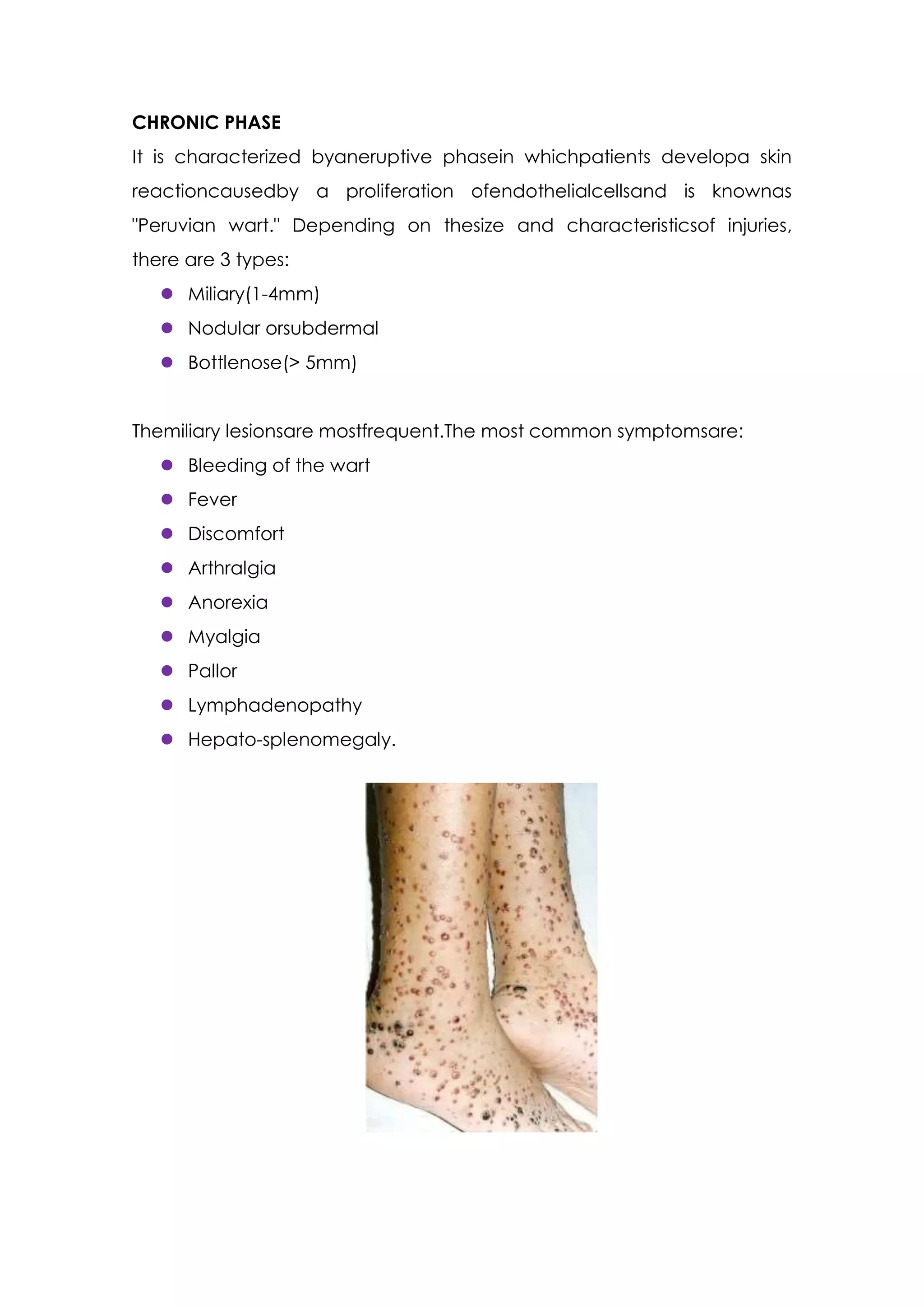
It is characterized byaneruptive phasein whichpatients developa skin
reactioncausedby a proliferation ofendothelialcellsand is knownas
"Peruvian wart." Depending on thesize and characteristicsof injuries,
there are 3 types:
    Miliary(1-4mm)
    Nodular orsubdermal
    Bottlenose(> 5mm)


Themiliary lesionsare mostfrequent.The most common symptomsare:
    Bleeding of the wart
    Fever
    Discomfort
    Arthralgia
    Anorexia
    Myalgia
    Pallor
    Lymphadenopathy
    Hepato-splenomegaly.
EPIDEMIOLOGY

Carrion's disease is found only in Peru, Ecuador, and Colombia. It is
endemic in some areas of Peru and is caused by infection with the
bacterium Bartonella bacilliformis and transmitted by sandflies of genus
Lutzomyia.

Various investigations in Ancash, Cuzco, Amazonas, Cajamarca, etc.
have demonstrated for the first time the existence of the disease in new
altitudes (> 3,000-m), the onset of Oroya fever and Peruvian wart in new
areas of the High Forest of Cajamarca, demonstrated the existence of
native disorder in the severe forms.


DIAGNOSTIC
Asan intracellular parasiteBartonellain the firststage of infectionit can
beobserved    withinthe   red   blood    cellsaffectedbyslidesand   special
stainsasRomanosky, GiemsaorWright inthe early days ofbacillaryformand
then thecocidea. The patientsshow a markedseveremacrocyticanemia,
and a remarkablehypocromica            hematócrito 16decreased.
Asuspected       case   ofbartonellosiseverythingyoutake         ablood      sample
tosmear andthickat the first visitand second andthird sampleat 12 and24
hoursrespectively, ifnecessary.

Theroutinediagnostic                   procedurefor                   confirmation
ofbartonellosiscasesitisthe     examination         ofbloodsmearsandthickand
canbe complemented byserology, bloodand/or mielocultivo.

SerologicalproceduresIFI,ELISA and WesternBlotare very specificand
sensitive   inthe     testphasehistopathologicalverrucosais          essential,    its
reactionpatternis       quitesuggestive      ofthe        disease,endothelialcell
proliferationandnew        formation      ofblood        vesselsat     the     level
ofpapillarydermis(a        whitehead)lattice        (a     papule)and          even
thesubcutaneous(nodular) are highly reliablediagnostic referenceinthese
tissuesstained      withWarthin-Starry    stain   also     can       observe      the
intracelularmente.


Bothperipheral blood(more easily) in the first phaseas thewarty lesionson
the    secondBartonellacan          be      isolatedby       meansof         special
cropscharacterized bysemisolid agarwithrabbit bloodat temperatures
of25 to 28 degreesCelsius.
TREATMENT

Bartonella bacilliformis is a bacteria sensitive to many antibiotics. As the
majority   of   β-lactam    antibiotics,    aminoglycosides,    macrolides,
doxycycline and rifampin; its high susceptibility to penicillin G and
relative resistance to cephalothin is shared with other species of
bartonelia.


IN THE ACUTE PHASE: It has been used with success penicillin G,
chloramphenicol,       tetracyclines       various   and       erythromycin.
Chloramphenicol, which is used in the acute stage by the frequent
complication salmonelosica, is dosed at a rate of 50 mg/kg/day until
fever referred and continues with half the dose until completing 10 to 14
days


IN THE ERUPTIVE PHASE: Comes using rifampin oral, 10 mg/kg/day for 14
to 21 days, as well as the ciprofloxacin. In cases with poor response has
been used successfully erythromycin, azithromycin and ciprofloxacin in
the severe injuries, combinations of ciprofloxacin or rifampicin with
azithromycin, with good results. In addition, it is reported the use of
sultamicillin 25 mg/kg/day by mouth for 10 days.
CASE REPORT
Male 26 years old, born in Lima where you live5 Carhuaz years, lowered.
30 days ago musculoskeletal pain referred to the lower back and legs,
pale progressive dyspnea, abdominal pain, headache, prostration,
fever, jaundice and dark urine.

Read at the Hospital of Yungay with ciprofloxacin for three days and
then transferred to Huaraz for myeloproliferative 12/03/98. He noted
drowsiness, pale skin, fever, jaundice and mucous membranes,
petechiae      on    the   arms,     chest,   the       soft    palate   and
hepatosplenomegalysubcrépitoslungand painful.

The evolution makes severe epistaxis, edema of lower limbs and the
sacrum, right pleuroparenquimal syndrome, hepatosplenomegaly, and
ascites (ultrasound), serum albumin, systolic posterior pericardial effusion
in the lower limit of normal (echocardiography).

HIV, direct Coombs negative LE cells. The study was conducted3/14/98
peripheral blood hematological shows a mild anemia, bartonellosis
coccobacillary 28% of myeloid reaction and severe thrombocytopenia,
bone marrow cell hyper, erythroidand megakaryocytic hyperplasia,
normal maturation (citofagocitosis reactive histiocytosis of red blood
cells , normoblasts, leukocytes and platelets ending in acute hemolytic
anemia and thrombocytopenia, peripheral bartonellosis was treated
with blood transfusions (three units), ceftriaxone, chloramphenicol and
dexamethasone. The top and left 10 days later 03/27/98 came to control
the clinic:.

This   case    was   asymptomatic    diagnosis     of   acute    bartonellosis
complicated by severe thrombocytopenia, anasarca and jaundice
syndrome.
Bartonelosis

Bartonelosis

  • 1.
    UNIVERSIDAD NACIONAL PEDRO F A C U L T A D D E MGALLO U M A N A RUÍZ E D I C I N A H BARTONELOSIS 2011 ARBOLEDA DÍAZ OSCAR BECERRA SILVA FRANK CARRASCO HERRERA DENIS MENDOZA HERNÁNDEZ ALEX PISCOYA TENORIO JORGE TINEO TINEO DENNY Dra. ROSA GONZÁLES LLONTOP
  • 2.
    BATONELOSIS SIGNS AND SYMPTOMS Clinical symptoms of bartonellosis are pleomorphic and some endemic areaspatients may be asymptomatic. The two classic presentations are acute and the chronic phase, corresponding to the two cells invaded by bacteria (red blood cells and endothelial cells). ACUTE PHASE The most common findings are:  Fever (usually notsustained but with temperatures no higher than 39 ° C)  Pallor  Malaise  Hepatomegaly  Jaundice  Lymphadenopathy  Splenomegaly This phase is characterized by severe hemolytic anemia and immunosuppression. The mortality rate of patients not receiving treatment is over 40% and can reach 90% if associated with opportunistic infections by enterobacteria such as Salmonella spp.
  • 3.
    CHRONIC PHASE It ischaracterized byaneruptive phasein whichpatients developa skin reactioncausedby a proliferation ofendothelialcellsand is knownas "Peruvian wart." Depending on thesize and characteristicsof injuries, there are 3 types:  Miliary(1-4mm)  Nodular orsubdermal  Bottlenose(> 5mm) Themiliary lesionsare mostfrequent.The most common symptomsare:  Bleeding of the wart  Fever  Discomfort  Arthralgia  Anorexia  Myalgia  Pallor  Lymphadenopathy  Hepato-splenomegaly.
  • 4.
    EPIDEMIOLOGY Carrion's disease isfound only in Peru, Ecuador, and Colombia. It is endemic in some areas of Peru and is caused by infection with the bacterium Bartonella bacilliformis and transmitted by sandflies of genus Lutzomyia. Various investigations in Ancash, Cuzco, Amazonas, Cajamarca, etc. have demonstrated for the first time the existence of the disease in new altitudes (> 3,000-m), the onset of Oroya fever and Peruvian wart in new areas of the High Forest of Cajamarca, demonstrated the existence of native disorder in the severe forms. DIAGNOSTIC Asan intracellular parasiteBartonellain the firststage of infectionit can beobserved withinthe red blood cellsaffectedbyslidesand special stainsasRomanosky, GiemsaorWright inthe early days ofbacillaryformand then thecocidea. The patientsshow a markedseveremacrocyticanemia, and a remarkablehypocromica hematócrito 16decreased.
  • 5.
    Asuspected case ofbartonellosiseverythingyoutake ablood sample tosmear andthickat the first visitand second andthird sampleat 12 and24 hoursrespectively, ifnecessary. Theroutinediagnostic procedurefor confirmation ofbartonellosiscasesitisthe examination ofbloodsmearsandthickand canbe complemented byserology, bloodand/or mielocultivo. SerologicalproceduresIFI,ELISA and WesternBlotare very specificand sensitive inthe testphasehistopathologicalverrucosais essential, its reactionpatternis quitesuggestive ofthe disease,endothelialcell proliferationandnew formation ofblood vesselsat the level ofpapillarydermis(a whitehead)lattice (a papule)and even thesubcutaneous(nodular) are highly reliablediagnostic referenceinthese tissuesstained withWarthin-Starry stain also can observe the intracelularmente. Bothperipheral blood(more easily) in the first phaseas thewarty lesionson the secondBartonellacan be isolatedby meansof special cropscharacterized bysemisolid agarwithrabbit bloodat temperatures of25 to 28 degreesCelsius.
  • 6.
    TREATMENT Bartonella bacilliformis isa bacteria sensitive to many antibiotics. As the majority of β-lactam antibiotics, aminoglycosides, macrolides, doxycycline and rifampin; its high susceptibility to penicillin G and relative resistance to cephalothin is shared with other species of bartonelia. IN THE ACUTE PHASE: It has been used with success penicillin G, chloramphenicol, tetracyclines various and erythromycin. Chloramphenicol, which is used in the acute stage by the frequent complication salmonelosica, is dosed at a rate of 50 mg/kg/day until fever referred and continues with half the dose until completing 10 to 14 days IN THE ERUPTIVE PHASE: Comes using rifampin oral, 10 mg/kg/day for 14 to 21 days, as well as the ciprofloxacin. In cases with poor response has been used successfully erythromycin, azithromycin and ciprofloxacin in the severe injuries, combinations of ciprofloxacin or rifampicin with azithromycin, with good results. In addition, it is reported the use of sultamicillin 25 mg/kg/day by mouth for 10 days.
  • 7.
    CASE REPORT Male 26years old, born in Lima where you live5 Carhuaz years, lowered. 30 days ago musculoskeletal pain referred to the lower back and legs, pale progressive dyspnea, abdominal pain, headache, prostration, fever, jaundice and dark urine. Read at the Hospital of Yungay with ciprofloxacin for three days and then transferred to Huaraz for myeloproliferative 12/03/98. He noted drowsiness, pale skin, fever, jaundice and mucous membranes, petechiae on the arms, chest, the soft palate and hepatosplenomegalysubcrépitoslungand painful. The evolution makes severe epistaxis, edema of lower limbs and the sacrum, right pleuroparenquimal syndrome, hepatosplenomegaly, and ascites (ultrasound), serum albumin, systolic posterior pericardial effusion in the lower limit of normal (echocardiography). HIV, direct Coombs negative LE cells. The study was conducted3/14/98 peripheral blood hematological shows a mild anemia, bartonellosis coccobacillary 28% of myeloid reaction and severe thrombocytopenia, bone marrow cell hyper, erythroidand megakaryocytic hyperplasia, normal maturation (citofagocitosis reactive histiocytosis of red blood cells , normoblasts, leukocytes and platelets ending in acute hemolytic anemia and thrombocytopenia, peripheral bartonellosis was treated with blood transfusions (three units), ceftriaxone, chloramphenicol and dexamethasone. The top and left 10 days later 03/27/98 came to control the clinic:. This case was asymptomatic diagnosis of acute bartonellosis complicated by severe thrombocytopenia, anasarca and jaundice syndrome.