Barriers to Customer Activation:A case study from MTN UgandaM. Yasmina McCarty, MMU ManagerJune 2011, Singapore
AgendaProject backgroundCustomer journey frameworkResearch resultsNon users – barriers to activationActive users – areas of satisfaction / dissatisfactionInactive users – what  caused inactivityConclusions
Project background: MTN UgandaMTN Uganda launched their product “Mobile Money” in 2009Format: E-wallet service on STKServices offered: Money transfer, airtime topup, bill pay (water, cable TV), school feesRegistration process: Registration is a 2 step process 1) ID + application form submitted to agent or field agent 2) application vetted by back office and then account activated Today MTN Uganda boasts one of the largest mobile money subscriber base with 1.5 million registered usersMTN wanted to drive customer activation, both continuing to sign up new customers as well as encourage existing customers to be more active on the platformMMU worked with MTN to identify optimal marketing strategies for customer activation by better understanding customer segments
Project background: Research objectivesMTN Uganda & MMU commissioned Synovate to conduct qualitative research to:Identify high potential segments of nonusers to be activated Determine non users barriers to trialIdentify knowledge gaps which discourage trial & areas of distrust which may limit useIdentify the areas of dissatisfaction and satisfaction for usersPlatform -  reliability, ease of use, and priceUsage experience - agent, user interface, and customer careIdentify what limits inactive / lapsed users from being active on the platformIdentify formal/informal competitors that consumers prefer over MTN Mobile Money and understand the value propositionResearch was followed by action planning to implement findings
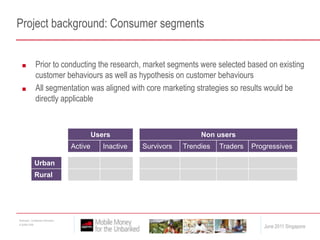
Project background: Consumer segmentsPrior to conducting the research, market segments were selected based on existing customer behaviours as well as hypothesis on customer behaviours
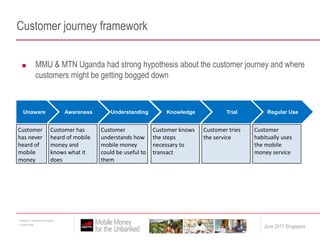
All segmentation was aligned with core marketing strategies so results would be directly applicableCustomer journey frameworkMMU & MTN Uganda had strong hypothesis about the customer journey and where customers might be getting bogged downUnawareAwarenessUnderstandingKnowledgeTrialRegular UseCustomer has heard of mobile money and knows what it does	Customer understands how mobile money could be useful to themCustomer knows the steps necessary to transact Customer has never heard of mobile moneyCustomer tries the serviceCustomer habitually uses the mobile money service
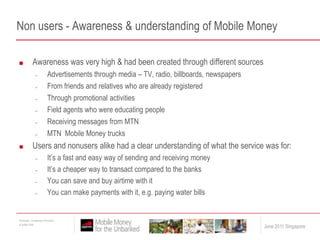
Non users - Awareness & understanding of Mobile MoneyAwareness was very high & had been created through different sourcesAdvertisements through media – TV, radio, billboards, newspapersFrom friends and relatives who are already registered Through promotional activitiesField agents who were educating peopleReceiving messages from MTNMTN  Mobile Money trucksUsers and nonusers alike had a clear understanding of what the service was for:It’s a fast and easy way of sending and receiving moneyIt’s a cheaper way to transact compared to the banksYou can save and buy airtime with itYou can make payments with it, e.g. paying water bills
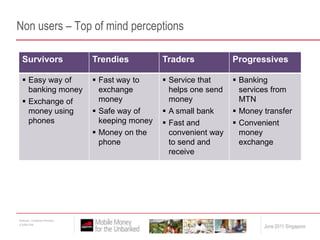
Non users – Top of mind perceptions
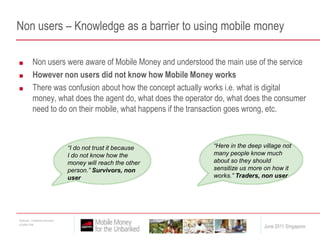
Non users – Knowledge as a barrier to using mobile moneyNon users were aware of Mobile Money and understood the main use of the serviceHowever non users did not know how Mobile Money worksThere was confusion about how the concept actually works i.e. what is digital money, what does the agent do, what does the operator do, what does the consumer need to do on their mobile, what happens if the transaction goes wrong, etc.“Here in the deep village not many people know much about so they should sensitize us more on how it works.” Traders, non user“I do not trust it because I do not know how the money will reach the other person.” Survivors, non user
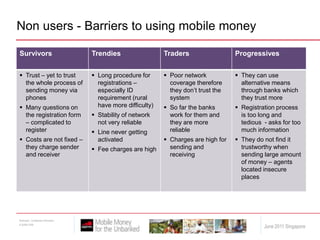
Non users - Barriers to using mobile money
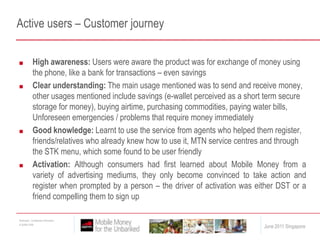
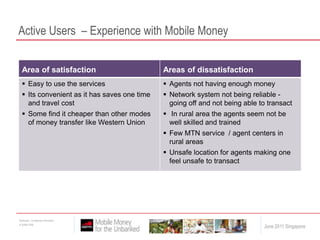
Active users – Customer journeyHigh awareness: Users were aware the product was for exchange of money using the phone, like a bank for transactions – even savingsClear understanding: The main usage mentioned was to send and receive money, other usages mentioned include savings (e-wallet perceived as a short term secure storage for money), buying airtime, purchasing commodities, paying water bills, Unforeseen emergencies / problems that require money immediatelyGood knowledge: Learnt to use the service from agents who helped them register, friends/relatives who already knew how to use it, MTN service centres and through the STK menu, which some found to be user friendlyActivation: Although consumers had first learned about Mobile Money from a variety of advertising mediums, they only become convinced to take action and register when prompted by a person – the driver of activation was either DST or a friend compelling them to sign up
Active Users  – Experience with Mobile Money
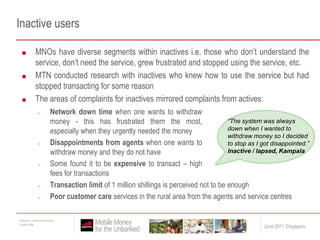
Inactive usersMNOs have diverse segments within inactives i.e. those who don’t understand the service, don’t need the service, grew frustrated and stopped using the service, etc. MTN conducted research with inactives who knew how to use the service but had stopped transacting for some reasonThe areas of complaints for inactives mirrored complaints from actives:Network down time when one wants to withdraw money - this has frustrated them the most, especially when they urgently needed the money
Disappointments from agents when one wants to withdraw money and they do not have
Some found it to be expensive to transact – high fees for transactions“The system was always down when I wanted to withdraw money so I decided to stop as I got disappointed.” Inactive / lapsed, KampalaTransaction limit of 1 million shillings is perceived not to be enough
Poor customer care services in the rural area from the agents and service centresAlternatives to Mobile Money – Non users
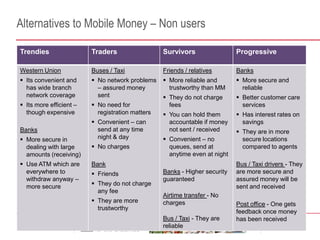
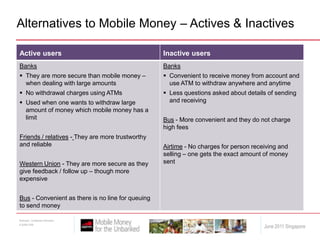
Alternatives to Mobile Money – Actives & Inactives
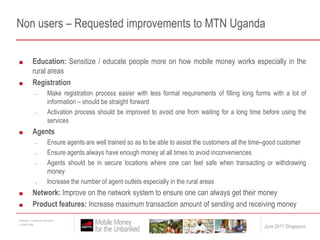
Non users – Requested improvements to MTN UgandaEducation: Sensitize / educate people more on how mobile money works especially in the rural areasRegistrationMake registration process easier with less formal requirements of filling long forms with a lot of information – should be straight forwardActivation process should be improved to avoid one from waiting for a long time before using the servicesAgentsEnsure agents are well trained so as to be able to assist the customers all the time–good customerEnsure agents always have enough money at all times to avoid inconveniencesAgents should be in secure locations where one can feel safe when transacting or withdrawing moneyIncrease the number of agent outlets especially in the rural areasNetwork: Improve on the network system to ensure one can always get their moneyProduct features: Increase maximum transaction amount of sending and receiving money
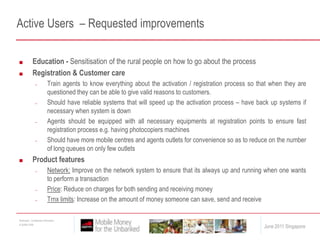
Active Users  – Requested improvementsEducation - Sensitisation of the rural people on how to go about the process Registration & Customer careTrain agents to know everything about the activation / registration process so that when they are questioned they can be able to give valid reasons to customers.Should have reliable systems that will speed up the activation process – have back up systems if necessary when system is downAgents should be equipped with all necessary equipments at registration points to ensure fast registration process e.g. having photocopiers machinesShould have more mobile centres and agents outlets for convenience so as to reduce on the number of long queues on only few outletsProduct featuresNetwork: Improve on the network system to ensure that its always up and running when one wants to perform a transactionPrice: Reduce on charges for both sending and receiving moneyTrnx limits: Increase on the amount of money someone can save, send and receive
Conclusions – Barriers to activationFor non users, there was high awareness, good understanding but a clear gap in knowledge levels on how Mobile Money works which kept them from registering for Mobile MoneyAdditionally, there were specific barriers to activation which varied by segmentFor users and inactives, there was common complaints that required urgent attentionNetwork down timeAgent illiquidityCustomer care These issues created negative word-of-mouth for non users and if left unaddressed, could lead active users to becoming inactive

Barriers to Customer Activation: A case study from MTN Uganda

  • 1.
    Barriers to CustomerActivation:A case study from MTN UgandaM. Yasmina McCarty, MMU ManagerJune 2011, Singapore
  • 2.
    AgendaProject backgroundCustomer journeyframeworkResearch resultsNon users – barriers to activationActive users – areas of satisfaction / dissatisfactionInactive users – what caused inactivityConclusions
  • 3.
    Project background: MTNUgandaMTN Uganda launched their product “Mobile Money” in 2009Format: E-wallet service on STKServices offered: Money transfer, airtime topup, bill pay (water, cable TV), school feesRegistration process: Registration is a 2 step process 1) ID + application form submitted to agent or field agent 2) application vetted by back office and then account activated Today MTN Uganda boasts one of the largest mobile money subscriber base with 1.5 million registered usersMTN wanted to drive customer activation, both continuing to sign up new customers as well as encourage existing customers to be more active on the platformMMU worked with MTN to identify optimal marketing strategies for customer activation by better understanding customer segments
  • 4.
    Project background: ResearchobjectivesMTN Uganda & MMU commissioned Synovate to conduct qualitative research to:Identify high potential segments of nonusers to be activated Determine non users barriers to trialIdentify knowledge gaps which discourage trial & areas of distrust which may limit useIdentify the areas of dissatisfaction and satisfaction for usersPlatform - reliability, ease of use, and priceUsage experience - agent, user interface, and customer careIdentify what limits inactive / lapsed users from being active on the platformIdentify formal/informal competitors that consumers prefer over MTN Mobile Money and understand the value propositionResearch was followed by action planning to implement findings
  • 5.
    Project background: ConsumersegmentsPrior to conducting the research, market segments were selected based on existing customer behaviours as well as hypothesis on customer behaviours
  • 6.
    All segmentation wasaligned with core marketing strategies so results would be directly applicableCustomer journey frameworkMMU & MTN Uganda had strong hypothesis about the customer journey and where customers might be getting bogged downUnawareAwarenessUnderstandingKnowledgeTrialRegular UseCustomer has heard of mobile money and knows what it does Customer understands how mobile money could be useful to themCustomer knows the steps necessary to transact Customer has never heard of mobile moneyCustomer tries the serviceCustomer habitually uses the mobile money service
  • 7.
    Non users -Awareness & understanding of Mobile MoneyAwareness was very high & had been created through different sourcesAdvertisements through media – TV, radio, billboards, newspapersFrom friends and relatives who are already registered Through promotional activitiesField agents who were educating peopleReceiving messages from MTNMTN Mobile Money trucksUsers and nonusers alike had a clear understanding of what the service was for:It’s a fast and easy way of sending and receiving moneyIt’s a cheaper way to transact compared to the banksYou can save and buy airtime with itYou can make payments with it, e.g. paying water bills
  • 8.
    Non users –Top of mind perceptions
  • 9.
    Non users –Knowledge as a barrier to using mobile moneyNon users were aware of Mobile Money and understood the main use of the serviceHowever non users did not know how Mobile Money worksThere was confusion about how the concept actually works i.e. what is digital money, what does the agent do, what does the operator do, what does the consumer need to do on their mobile, what happens if the transaction goes wrong, etc.“Here in the deep village not many people know much about so they should sensitize us more on how it works.” Traders, non user“I do not trust it because I do not know how the money will reach the other person.” Survivors, non user
  • 10.
    Non users -Barriers to using mobile money
  • 11.
    Active users –Customer journeyHigh awareness: Users were aware the product was for exchange of money using the phone, like a bank for transactions – even savingsClear understanding: The main usage mentioned was to send and receive money, other usages mentioned include savings (e-wallet perceived as a short term secure storage for money), buying airtime, purchasing commodities, paying water bills, Unforeseen emergencies / problems that require money immediatelyGood knowledge: Learnt to use the service from agents who helped them register, friends/relatives who already knew how to use it, MTN service centres and through the STK menu, which some found to be user friendlyActivation: Although consumers had first learned about Mobile Money from a variety of advertising mediums, they only become convinced to take action and register when prompted by a person – the driver of activation was either DST or a friend compelling them to sign up
  • 12.
    Active Users – Experience with Mobile Money
  • 13.
    Inactive usersMNOs havediverse segments within inactives i.e. those who don’t understand the service, don’t need the service, grew frustrated and stopped using the service, etc. MTN conducted research with inactives who knew how to use the service but had stopped transacting for some reasonThe areas of complaints for inactives mirrored complaints from actives:Network down time when one wants to withdraw money - this has frustrated them the most, especially when they urgently needed the money
  • 14.
    Disappointments from agentswhen one wants to withdraw money and they do not have
  • 15.
    Some found itto be expensive to transact – high fees for transactions“The system was always down when I wanted to withdraw money so I decided to stop as I got disappointed.” Inactive / lapsed, KampalaTransaction limit of 1 million shillings is perceived not to be enough
  • 16.
    Poor customer careservices in the rural area from the agents and service centresAlternatives to Mobile Money – Non users
  • 17.
    Alternatives to MobileMoney – Actives & Inactives
  • 18.
    Non users –Requested improvements to MTN UgandaEducation: Sensitize / educate people more on how mobile money works especially in the rural areasRegistrationMake registration process easier with less formal requirements of filling long forms with a lot of information – should be straight forwardActivation process should be improved to avoid one from waiting for a long time before using the servicesAgentsEnsure agents are well trained so as to be able to assist the customers all the time–good customerEnsure agents always have enough money at all times to avoid inconveniencesAgents should be in secure locations where one can feel safe when transacting or withdrawing moneyIncrease the number of agent outlets especially in the rural areasNetwork: Improve on the network system to ensure one can always get their moneyProduct features: Increase maximum transaction amount of sending and receiving money
  • 19.
    Active Users – Requested improvementsEducation - Sensitisation of the rural people on how to go about the process Registration & Customer careTrain agents to know everything about the activation / registration process so that when they are questioned they can be able to give valid reasons to customers.Should have reliable systems that will speed up the activation process – have back up systems if necessary when system is downAgents should be equipped with all necessary equipments at registration points to ensure fast registration process e.g. having photocopiers machinesShould have more mobile centres and agents outlets for convenience so as to reduce on the number of long queues on only few outletsProduct featuresNetwork: Improve on the network system to ensure that its always up and running when one wants to perform a transactionPrice: Reduce on charges for both sending and receiving moneyTrnx limits: Increase on the amount of money someone can save, send and receive
  • 20.
    Conclusions – Barriersto activationFor non users, there was high awareness, good understanding but a clear gap in knowledge levels on how Mobile Money works which kept them from registering for Mobile MoneyAdditionally, there were specific barriers to activation which varied by segmentFor users and inactives, there was common complaints that required urgent attentionNetwork down timeAgent illiquidityCustomer care These issues created negative word-of-mouth for non users and if left unaddressed, could lead active users to becoming inactive

Editor's Notes

  • #7 What we have seen with mobile money is that the customer journey is complicated. The customer begins of course completely unaware – they have never heard about your specific mobile money product and in most cases have never heard of the mobile money concept. I think most of us will be able to remember when we first heard about mobile money and just how complex a concept it was to grasp. We have heard some stories from the field that explaining mobile money to someone can take up to 30 minutes. As we go through the customer journey, we see there are really three critical steps before the consumer becomes comfortable with mobile money.The first is awareness, where the customer hears the name of your program, but more importantly comes to understand what is mobile money and what does it do.Following this, the consumer needs to actually understand why mobile money is relevant for them. In what way can mobile money be useful to them.And finally the consumer needs to understand how mobile money actually works. And specifically what are the steps necessary to transact. Once the consumer know what is mobile money, what does it do, why is it useful and how does it work, they are ready to try the product. And through a few positive trials, they will become convinced the value of the service and become a regular user of the service.
  • #9 Mobile money is associated with sending and receiving money very fast through the use of a phone – its clear most people are aware of the main function of what mobile money is all about (including non users). However, it came out strongly from the progressives that it is more like a banking service than what MTN has advertised.
  • #11 Trendies: The key reason that trendies are not using mobile money is because of the long registration process and fact that one needs an ID to register which some do not haveTraders: For traders the key reason coming out is the fact that they see the system is not reliable, when one needs to receive money and system is down they are not able to get their money – they do not trust the system yetSurvivors: They still have trust issues of how the system works and therefore yet to be convinced on how to trust their money to be sent via mobile phones Progressive: They find the registration process to long and some see the mobile money performing banking services yet they prefer using the banks as they are more reliable and trustworthy. Mention of the location of agents being in insecure places was strongly perceived as a system that one cannot trust or feel safe
  • #14 The research showed that these inactives had stopped using the service due to one really terrible experience or from mounting frustrations