KYC:HowLowGo?CanYouAndrew ZerzanMMU Working GroupOctober 2010, Kuala Lumpur
OverviewWhat is KYC? Who came up with this stuff? Specific ObligationsRelevance to Mobile MoneyChallenge: Are we asking too much?Solution by the World BankInterview with a Champion: Maybelle Santos, Smart Money (PH)Tools by MMU: AML Risk Methodology
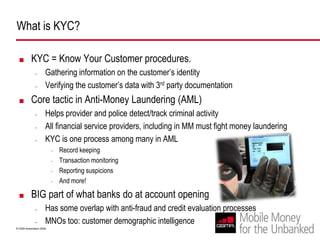
What is KYC? KYC = Know Your Customer procedures. Gathering information on the customer’s identityVerifying the customer’s data with 3rd party documentationCore tactic in Anti-Money Laundering (AML)Helps provider and police detect/track criminal activityAll financial service providers, including in MM must fight money launderingKYC is one process among many in AMLRecord keepingTransaction monitoringReporting suspicionsAnd more! BIG part of what banks do at account openingHas some overlap with anti-fraud and credit evaluation processesMNOs too: customer demographic intelligence
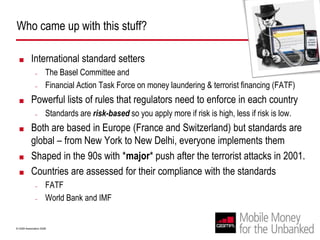
Who came up with this stuff?International standard setters The Basel Committee and Financial Action Task Force on money laundering & terrorist financing (FATF) Powerful lists of rules that regulators need to enforce in each countryStandards are risk-basedso you apply more if risk is high, less if risk is low.Both are based in Europe (France and Switzerland) but standards are global – from New York to New Delhi, everyone implements themShaped in the 90s with *major* push after the terrorist attacks in 2001. Countries are assessed for their compliance with the standardsFATF World Bank and IMF
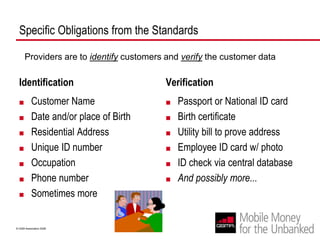
Specific Obligations from the StandardsProviders are to identify customers and verify the customer dataIdentificationVerificationCustomer NameDate and/or place of BirthResidential AddressUnique ID numberOccupationPhone numberSometimes morePassport or National ID cardBirth certificate Utility bill to prove addressEmployee ID card w/ photoID check via central databaseAnd possibly more...
Relevance to Mobile MoneyMobile money providers are subject to do KYC processesEven if partnered with a bankAccount openingCash-in/outTraining of agent retailers to ask the right questions, get the right documents and record it allBiggest regulatory barrier to acquiring new customers?
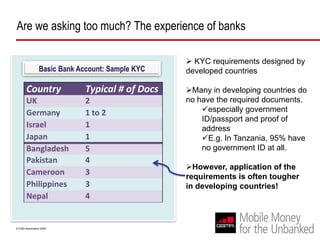
Are we asking too much? The experience of banks KYC requirements designed by developed countries
Many in developing countries do no have the required documents.
especially government ID/passport and proof of address
E.g. In Tanzania, 95% have no government ID at all.
However, application of the requirements is often tougher in developing countries! Basic Bank Account: Sample KYC
Are we asking too much? (2)Huge numbers of people are excluded from the financial system because of cost but also KYCCan’t prove address because no utility bills – don’t have electricity!No ID card – government may not issue except to wealthy for travel on passportsNo photo ID – the poorest often do not hold jobs that require employee photo ID or can afford school where student ID is requiredNo birth records – many poor are born in unregistered homes, not a hospital with recordsKYC is not intended to exclude people from financial services, it is intended to detect and scare away criminal money launderersAre there ways to reduce criminal risk without reducing access?
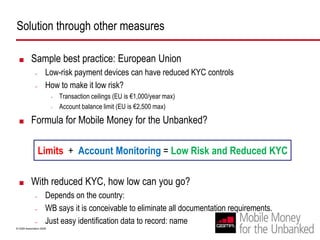
Solution through other measuresKYC just one tool to combat crimeAre we forgetting the others?Account monitoring?Limits ?Can these be used to reduce KYC? World Bank research says Yes! Criminals want to launder huge amounts of money undetected.Limits on accounts/transactions/frequency force a criminal to move money through multiple accounts – ExpensiveMonitoring systems flag suspicious money movements (i.e. Several accounts in same area in same time period loaded up completely and then transferred out) – detectable

KYC - How long can you go?

  • 1.
    KYC:HowLowGo?CanYouAndrew ZerzanMMU WorkingGroupOctober 2010, Kuala Lumpur
  • 2.
    OverviewWhat is KYC?Who came up with this stuff? Specific ObligationsRelevance to Mobile MoneyChallenge: Are we asking too much?Solution by the World BankInterview with a Champion: Maybelle Santos, Smart Money (PH)Tools by MMU: AML Risk Methodology
  • 3.
    What is KYC?KYC = Know Your Customer procedures. Gathering information on the customer’s identityVerifying the customer’s data with 3rd party documentationCore tactic in Anti-Money Laundering (AML)Helps provider and police detect/track criminal activityAll financial service providers, including in MM must fight money launderingKYC is one process among many in AMLRecord keepingTransaction monitoringReporting suspicionsAnd more! BIG part of what banks do at account openingHas some overlap with anti-fraud and credit evaluation processesMNOs too: customer demographic intelligence
  • 4.
    Who came upwith this stuff?International standard setters The Basel Committee and Financial Action Task Force on money laundering & terrorist financing (FATF) Powerful lists of rules that regulators need to enforce in each countryStandards are risk-basedso you apply more if risk is high, less if risk is low.Both are based in Europe (France and Switzerland) but standards are global – from New York to New Delhi, everyone implements themShaped in the 90s with *major* push after the terrorist attacks in 2001. Countries are assessed for their compliance with the standardsFATF World Bank and IMF
  • 5.
    Specific Obligations fromthe StandardsProviders are to identify customers and verify the customer dataIdentificationVerificationCustomer NameDate and/or place of BirthResidential AddressUnique ID numberOccupationPhone numberSometimes morePassport or National ID cardBirth certificate Utility bill to prove addressEmployee ID card w/ photoID check via central databaseAnd possibly more...
  • 6.
    Relevance to MobileMoneyMobile money providers are subject to do KYC processesEven if partnered with a bankAccount openingCash-in/outTraining of agent retailers to ask the right questions, get the right documents and record it allBiggest regulatory barrier to acquiring new customers?
  • 7.
    Are we askingtoo much? The experience of banks KYC requirements designed by developed countries
  • 8.
    Many in developingcountries do no have the required documents.
  • 9.
  • 10.
    E.g. In Tanzania,95% have no government ID at all.
  • 11.
    However, application ofthe requirements is often tougher in developing countries! Basic Bank Account: Sample KYC
  • 12.
    Are we askingtoo much? (2)Huge numbers of people are excluded from the financial system because of cost but also KYCCan’t prove address because no utility bills – don’t have electricity!No ID card – government may not issue except to wealthy for travel on passportsNo photo ID – the poorest often do not hold jobs that require employee photo ID or can afford school where student ID is requiredNo birth records – many poor are born in unregistered homes, not a hospital with recordsKYC is not intended to exclude people from financial services, it is intended to detect and scare away criminal money launderersAre there ways to reduce criminal risk without reducing access?
  • 13.
    Solution through othermeasuresKYC just one tool to combat crimeAre we forgetting the others?Account monitoring?Limits ?Can these be used to reduce KYC? World Bank research says Yes! Criminals want to launder huge amounts of money undetected.Limits on accounts/transactions/frequency force a criminal to move money through multiple accounts – ExpensiveMonitoring systems flag suspicious money movements (i.e. Several accounts in same area in same time period loaded up completely and then transferred out) – detectable