Barings Bank
Treasury & Risk
Management
Roll No: 103
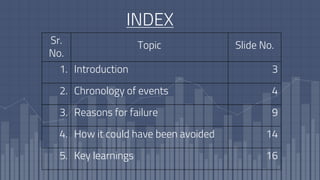
Sr.
No.
Topic Slide No.
1. Introduction 3
2. Chronology of events 4
3. Reasons for failure 9
4. How it could have been avoided 14
5. Key learnings 16
INDEX
INTRODUCTION
▫ The Bank was founded in 1762 by Sir Francis Baring
▫ Barings was among the largest and most stable banks
▫ However, thanks to unauthorized speculation in futures contracts
and other speculative dealings, it ceased operations on Feb 26, 1995
▫ The direct cause was its inability to meet its cash requirements
following those unauthorized trades
3
Chronology of events
▫ In the early 90s, Barings decided to get into the expanding
futures/options business in Asia
▫ They would look to open a Singapore office for trading on the SIMEX.
▫ Leeson requested to set-up the accounting and settlement
functions there and direct trading floor operations
▫ His request was granted and initially, he could only execute trades
on behalf of clients and the Tokyo office for "arbitrage" purposes
4
Chronology of events
▫ After a good deal of success, he was allowed to pursue an official
trading license on the SIMEX.
▫ He was then given some freedom to place orders on his own but at
the same time continued to supervise accounting & settlements
▫ In July 1992, a new Barings employee suffered a small loss on
Leeson’s watch. Leeson did not want to tarnish his reputation, so he
hid the loss in an error account.
5
Chronology of events
▫ Leeson attempted to make back the loss through speculative
trading, but this led to even bigger losses
▫ Instead of initiating simultaneous trades to exploit small differences
in pricing between the two markets, he held his contracts, hoping to
make a larger profit by betting on directional moves of the
underlying index
6
Chronology of events
▫ Leeson took out a short-term, highly leveraged bet on the Nikkei
index in Japan
▫ At the same time, a severe earthquake in Kobe, Japan sent the index
plummeting, and his loss was so huge that he could no longer hide it
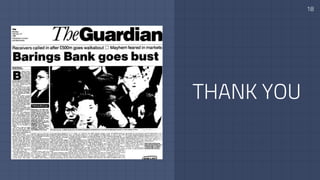
▫ Barings, a 233-year old bank, collapsed overnight and was bought
by ING for £1
7
Chronology of events
8
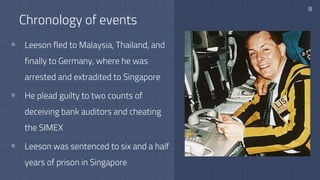
▫ Leeson fled to Malaysia, Thailand, and
finally to Germany, where he was
arrested and extradited to Singapore
▫ He plead guilty to two counts of
deceiving bank auditors and cheating
the SIMEX
▫ Leeson was sentenced to six and a half
years of prison in Singapore
Reasons for Failure
There were a number of reasons why the bank failed
I. Operational risks that the bank failed to keep in check
▫ People risk: Incompetency or wrong posting of personnel as well as
misuse of power like Leeson
▫ Process-related risks: Possibilities of errors in information
processing, data transmission, data retrieval, and inaccuracy of
result or output.
9
Reasons for Failure
▫ Internal fraud: Losses from fraud inside a financial institution
can stem from misappropriation of assets, forgery, compliance
etc.
▫ Other operational risks such as accounting and financial
disclosure risk, natural hazard and environmental risk; fraud
and embezzlement risk and legal risk
10
Reasons for Failure
II. Top Management’s failure to control the situation
▫ Incompetence and negligence of the people at the forefront
▫ People who didn’t have the direct or requisite experience to look
after that particular part of the organisation (Barings Securities)
were put in the senior positions
▫ Superiors didn’t ask questions because they didn’t understand the
business itself
11
Reasons for Failure
III. Market risk - Risk reports were
misrepresentations as Leeson was
in charge of both back and front
office
▫ This meant that he was in charge of
the trading as well as settling the
trades
12
Reasons for Failure
▫ Credit risk - When the Barings London office used to send the funds
for margin requirements of their clients in the SIMEX, lending money
to these clients to trade at the exchange
▫ Leeson kept on asking for more and more funds, while increasingly
less and less clients seemed to be closing their positions
13
How it could have been avoided
A few steps that could have been taken to avoid such a situation:
▫ Segregation of front and back office – Would have effectively
reduced the kind of activities that Leeson was involved in
▫ Involvement of senior management – It seemed that the
management were satisfied with the short term profit, they were
unaware of important activities of the company
14
How it could have been avoided
▫ Tougher poor control procedure – One of the main reasons as to
why this entire debacle happened was because the management
were not accountable to certain activities
▫ Increased supervision – Management did not step in and were
mostly unaware of the activities that Leeson was involved in
▫ Adequate capital - The institution was in funding risk due to
enormous unhedging position
15
Key learnings
Keeping in mind the case study, a few learnings which should be
adopted:
▫ Management teams have a duty to understand fully the business
they manage
▫ Responsibility for each business activity has to be clearly established
and communicated
16
Key learnings
▫ Clear segregation of duties is fundamental to any effective control
system
▫ Relevant internal controls, including independent risk management,
have to be established for all business activities
▫ Top management and audit committee have to ensure that
significant weaknesses, identified to them by internal audit are
resolved quickly
17
18
THANK YOU

Barings bank

  • 1.
    Barings Bank Treasury &Risk Management Roll No: 103
  • 2.
    Sr. No. Topic Slide No. 1.Introduction 3 2. Chronology of events 4 3. Reasons for failure 9 4. How it could have been avoided 14 5. Key learnings 16 INDEX
  • 3.
    INTRODUCTION ▫ The Bankwas founded in 1762 by Sir Francis Baring ▫ Barings was among the largest and most stable banks ▫ However, thanks to unauthorized speculation in futures contracts and other speculative dealings, it ceased operations on Feb 26, 1995 ▫ The direct cause was its inability to meet its cash requirements following those unauthorized trades 3
  • 4.
    Chronology of events ▫In the early 90s, Barings decided to get into the expanding futures/options business in Asia ▫ They would look to open a Singapore office for trading on the SIMEX. ▫ Leeson requested to set-up the accounting and settlement functions there and direct trading floor operations ▫ His request was granted and initially, he could only execute trades on behalf of clients and the Tokyo office for "arbitrage" purposes 4
  • 5.
    Chronology of events ▫After a good deal of success, he was allowed to pursue an official trading license on the SIMEX. ▫ He was then given some freedom to place orders on his own but at the same time continued to supervise accounting & settlements ▫ In July 1992, a new Barings employee suffered a small loss on Leeson’s watch. Leeson did not want to tarnish his reputation, so he hid the loss in an error account. 5
  • 6.
    Chronology of events ▫Leeson attempted to make back the loss through speculative trading, but this led to even bigger losses ▫ Instead of initiating simultaneous trades to exploit small differences in pricing between the two markets, he held his contracts, hoping to make a larger profit by betting on directional moves of the underlying index 6
  • 7.
    Chronology of events ▫Leeson took out a short-term, highly leveraged bet on the Nikkei index in Japan ▫ At the same time, a severe earthquake in Kobe, Japan sent the index plummeting, and his loss was so huge that he could no longer hide it ▫ Barings, a 233-year old bank, collapsed overnight and was bought by ING for £1 7
  • 8.
    Chronology of events 8 ▫Leeson fled to Malaysia, Thailand, and finally to Germany, where he was arrested and extradited to Singapore ▫ He plead guilty to two counts of deceiving bank auditors and cheating the SIMEX ▫ Leeson was sentenced to six and a half years of prison in Singapore
  • 9.
    Reasons for Failure Therewere a number of reasons why the bank failed I. Operational risks that the bank failed to keep in check ▫ People risk: Incompetency or wrong posting of personnel as well as misuse of power like Leeson ▫ Process-related risks: Possibilities of errors in information processing, data transmission, data retrieval, and inaccuracy of result or output. 9
  • 10.
    Reasons for Failure ▫Internal fraud: Losses from fraud inside a financial institution can stem from misappropriation of assets, forgery, compliance etc. ▫ Other operational risks such as accounting and financial disclosure risk, natural hazard and environmental risk; fraud and embezzlement risk and legal risk 10
  • 11.
    Reasons for Failure II.Top Management’s failure to control the situation ▫ Incompetence and negligence of the people at the forefront ▫ People who didn’t have the direct or requisite experience to look after that particular part of the organisation (Barings Securities) were put in the senior positions ▫ Superiors didn’t ask questions because they didn’t understand the business itself 11
  • 12.
    Reasons for Failure III.Market risk - Risk reports were misrepresentations as Leeson was in charge of both back and front office ▫ This meant that he was in charge of the trading as well as settling the trades 12
  • 13.
    Reasons for Failure ▫Credit risk - When the Barings London office used to send the funds for margin requirements of their clients in the SIMEX, lending money to these clients to trade at the exchange ▫ Leeson kept on asking for more and more funds, while increasingly less and less clients seemed to be closing their positions 13
  • 14.
    How it couldhave been avoided A few steps that could have been taken to avoid such a situation: ▫ Segregation of front and back office – Would have effectively reduced the kind of activities that Leeson was involved in ▫ Involvement of senior management – It seemed that the management were satisfied with the short term profit, they were unaware of important activities of the company 14
  • 15.
    How it couldhave been avoided ▫ Tougher poor control procedure – One of the main reasons as to why this entire debacle happened was because the management were not accountable to certain activities ▫ Increased supervision – Management did not step in and were mostly unaware of the activities that Leeson was involved in ▫ Adequate capital - The institution was in funding risk due to enormous unhedging position 15
  • 16.
    Key learnings Keeping inmind the case study, a few learnings which should be adopted: ▫ Management teams have a duty to understand fully the business they manage ▫ Responsibility for each business activity has to be clearly established and communicated 16
  • 17.
    Key learnings ▫ Clearsegregation of duties is fundamental to any effective control system ▫ Relevant internal controls, including independent risk management, have to be established for all business activities ▫ Top management and audit committee have to ensure that significant weaknesses, identified to them by internal audit are resolved quickly 17
  • 18.