WHY WE NEED TO GET
SAVVY ABOUT
BLOCKCHAIN
Origins | Building Blocks|
Potential Scope for Industry
Involvement | Cross Industry
Use Cases
Chris Stanley
Digital Evangelist |
Photographer | Free Thinker
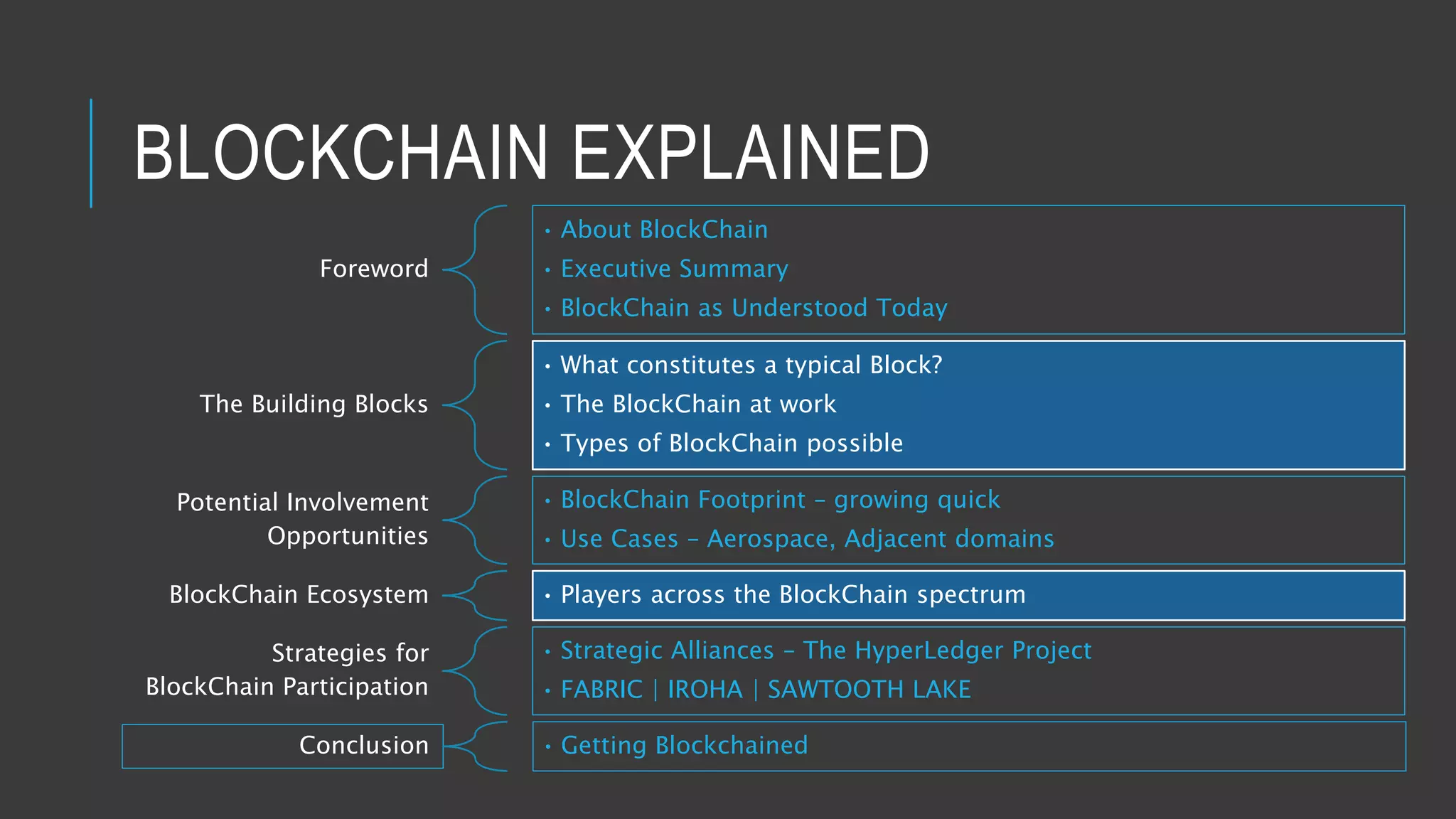
BLOCKCHAIN EXPLAINED
Foreword
• About BlockChain
• Executive Summary
• BlockChain as Understood Today
The Building Blocks
• What constitutes a typical Block?
• The BlockChain at work
• Types of BlockChain possible
Potential Involvement
Opportunities
• BlockChain Footprint – growing quick
• Use Cases – Aerospace, Adjacent domains
BlockChain Ecosystem • Players across the BlockChain spectrum
Strategies for
BlockChain Participation
• Strategic Alliances – The HyperLedger Project
• FABRIC | IROHA | SAWTOOTH LAKE
Conclusion • Getting Blockchained
FOREWORD
 About BlockChain
 Executive Summary
ABOUT BLOCKCHAIN
 Much has already been said and written about the humble beginnings of
BlockChain from the days of the dark web, let’s suffice to know that…
“ The first Block Chain (Originally), was conceptualized by Satoshi Nakamoto in 2008
and implemented the following year as a core component of the digital currency bitcoin,
where it serves as the public ledger for all transactions. Through the use of a peer-to-
peer network and a distributed timestamping server, a blockchain database is managed
autonomously. The invention of the blockchain for bitcoin made it the first digital
currency to solve the double spending problem, without the use of a trusted authority or
central server. The bitcoin design has been the inspiration for other applications.”
Wikipedia
 It was born from the need to have a decentralized system of record, and a
distributed, autonomous authorization entity
 A secure, transaction record, that can ensure immediate fraud detection
and prevent misuse
EXECUTIVE SUMMARY
 This is an attempt to demystify the BlockChain concept and its potential to
develop solutions for, and adapt to, the different Business Scenarios (read
Challenges) that traditional technology apps and business processes are
grappling with
 Any new Technology or Innovative Idea has to go through the paces to be
widely accepted and adopted across business domains; this deck contains
some of the challenges and opportunities which present themselves as on
date, as Use Cases
 With little or no background to the Bitcoin or the BlockChain ecosystem,
one could begin development of applications using the APKs and SDKs which
are available in multiple development spheres – some find mention in this
deck as well
 Most important for any technology to go mainstream is its ability to
respond to business needs in a fair, transparent manner and with minimum
geek intervention, while being able to track both actions and value – The
BLOCKCHAIN AS UNDERSTOOD
TODAY
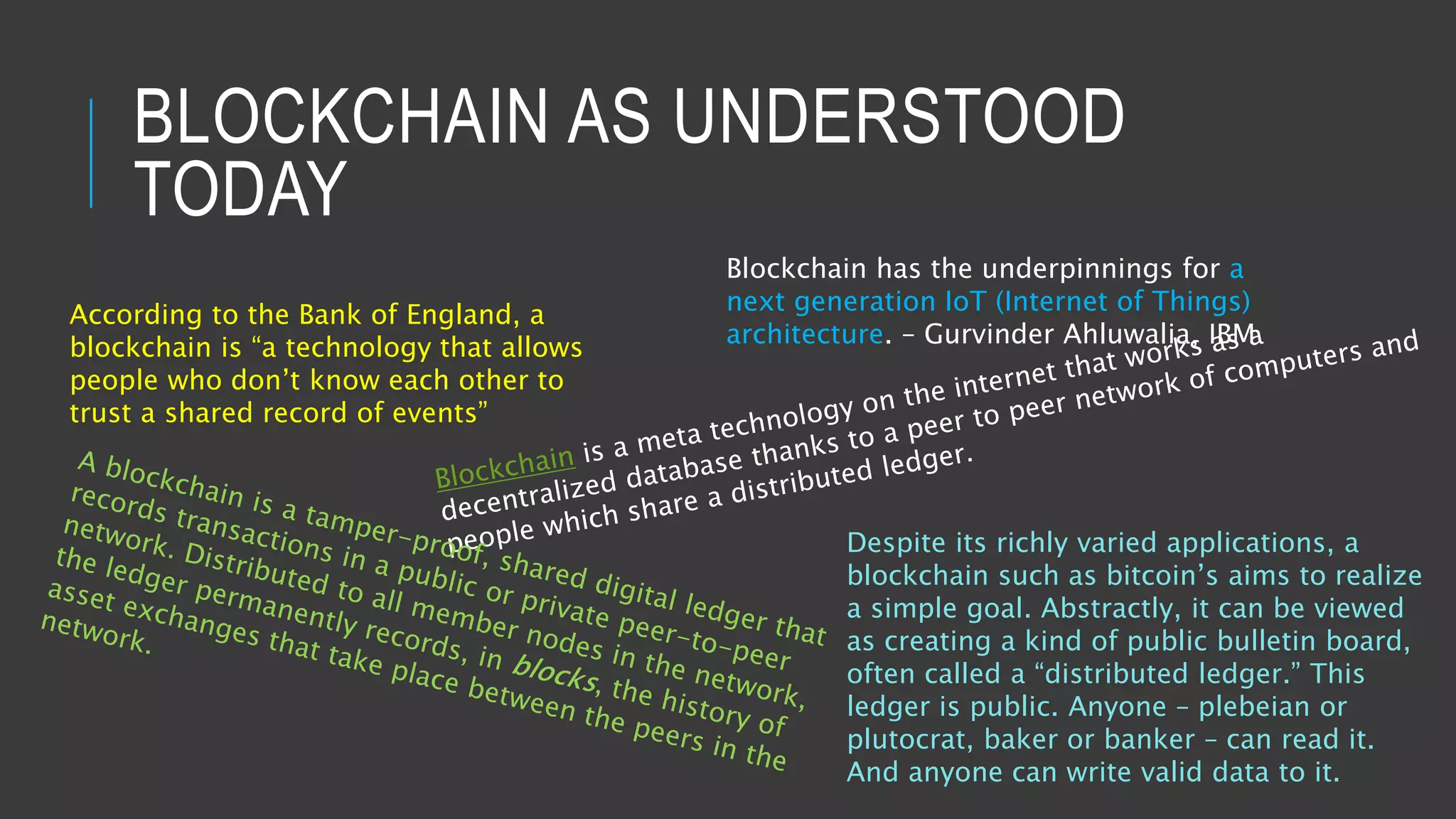
According to the Bank of England, a
blockchain is “a technology that allows
people who don’t know each other to
trust a shared record of events”
Blockchain has the underpinnings for a
next generation IoT (Internet of Things)
architecture. – Gurvinder Ahluwalia, IBM
Despite its richly varied applications, a
blockchain such as bitcoin’s aims to realize
a simple goal. Abstractly, it can be viewed
as creating a kind of public bulletin board,
often called a “distributed ledger.” This
ledger is public. Anyone – plebeian or
plutocrat, baker or banker – can read it.
And anyone can write valid data to it.
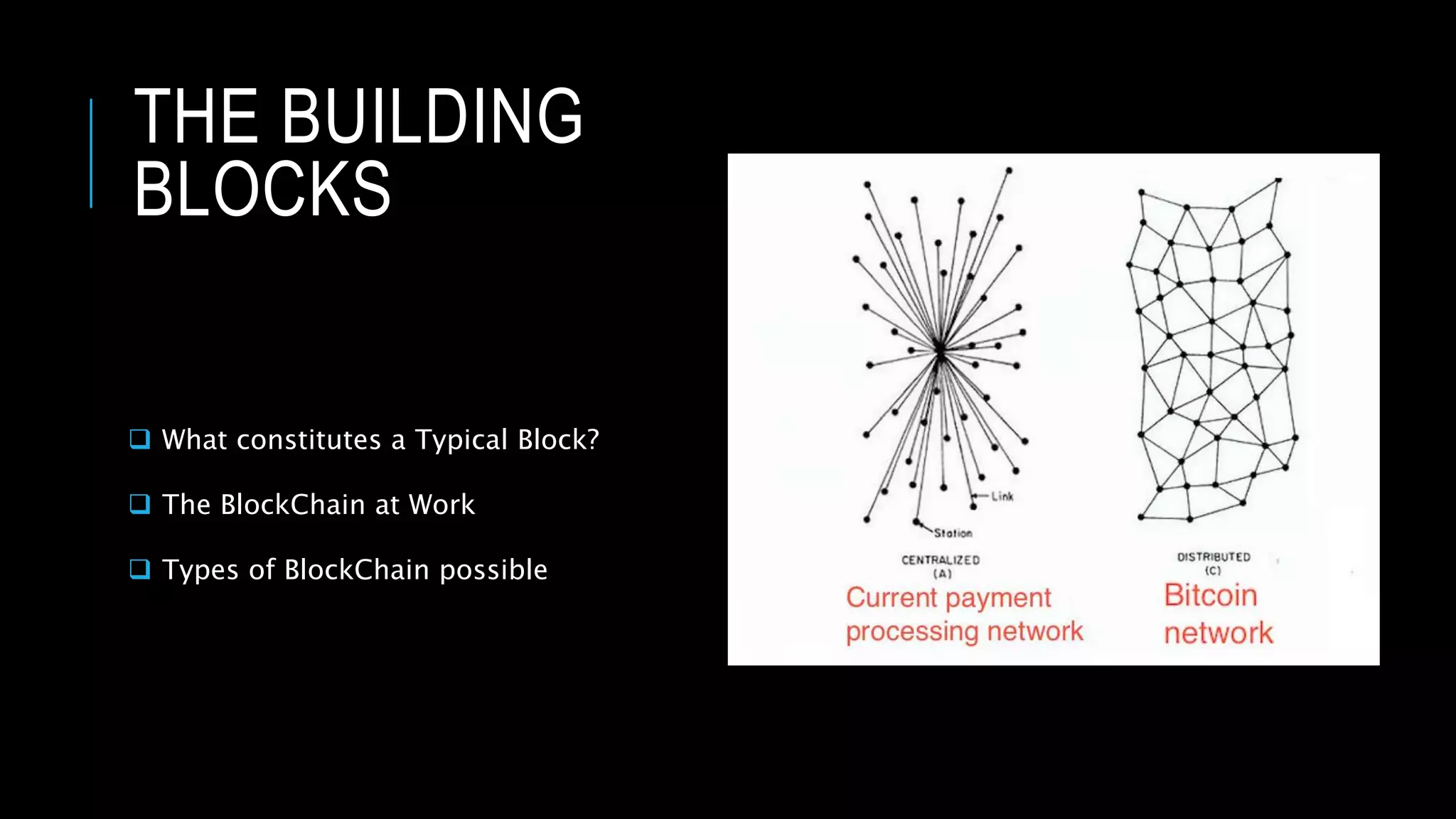
THE BUILDING
BLOCKS
 What constitutes a Typical Block?
 The BlockChain at Work
 Types of BlockChain possible
THE TYPICAL BLOCKS IN
BLOCKCHAIN
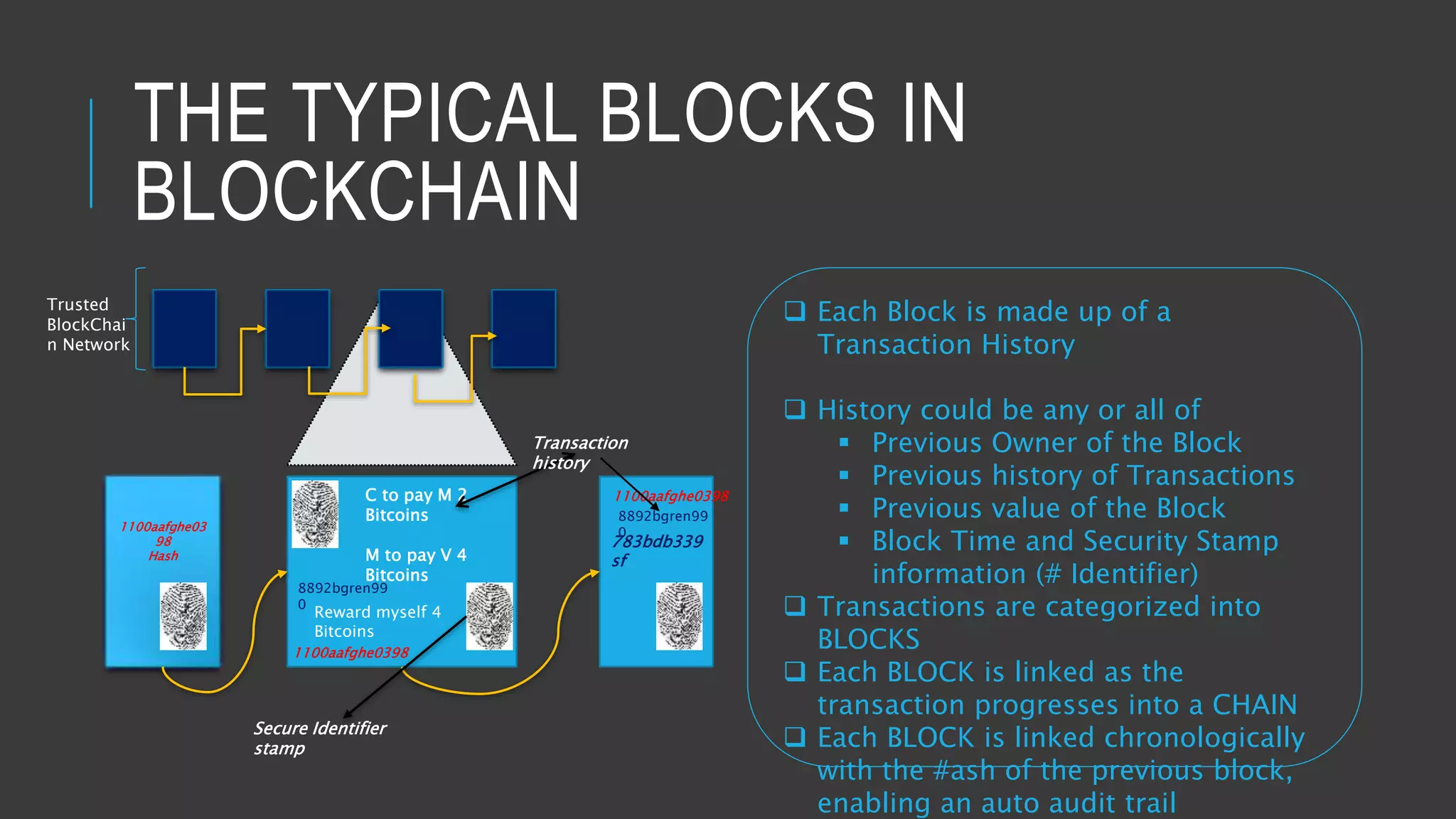
 Each Block is made up of a
Transaction History
 History could be any or all of
 Previous Owner of the Block
 Previous history of Transactions
 Previous value of the Block
 Block Time and Security Stamp
information (# Identifier)
 Transactions are categorized into
BLOCKS
 Each BLOCK is linked as the
transaction progresses into a CHAIN
 Each BLOCK is linked chronologically
with the #ash of the previous block,
enabling an auto audit trail
783bdb339
sf
Yada
yada
1100aafghe03
98
Hash
C to pay M 2
Bitcoins
M to pay V 4
Bitcoins
Reward myself 4
Bitcoins
Secure Identifier
stamp
Transaction
history
Trusted
BlockChai
n Network
1100aafghe0398
1100aafghe0398
8892bgren99
0
8892bgren99
0
THE BLOCKCHAIN
AT WORK
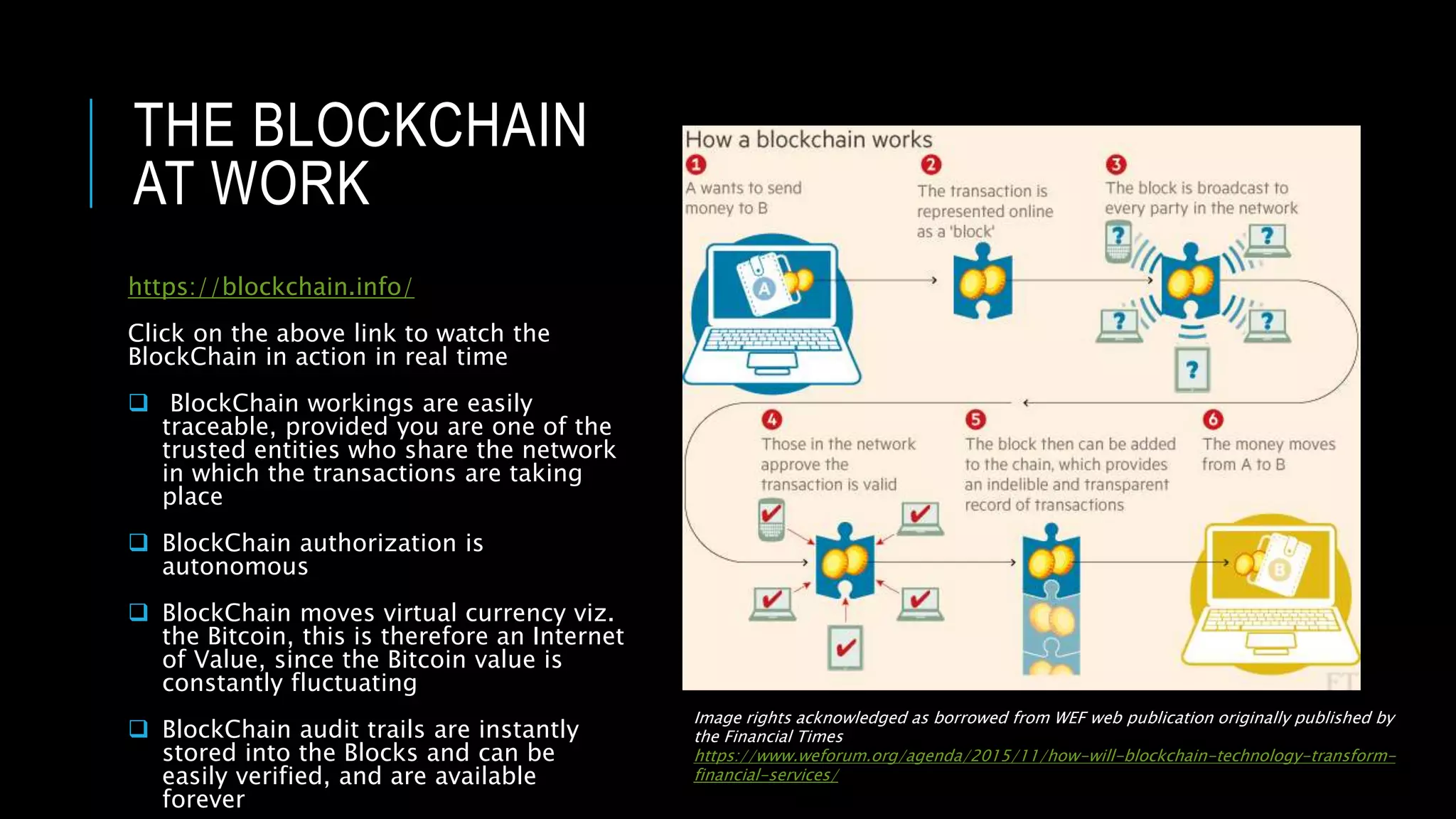
https://blockchain.info/
Click on the above link to watch the
BlockChain in action in real time
 BlockChain workings are easily
traceable, provided you are one of the
trusted entities who share the network
in which the transactions are taking
place
 BlockChain authorization is
autonomous
 BlockChain moves virtual currency viz.
the Bitcoin, this is therefore an Internet
of Value, since the Bitcoin value is
constantly fluctuating
 BlockChain audit trails are instantly
stored into the Blocks and can be
easily verified, and are available
forever
Image rights acknowledged as borrowed from WEF web publication originally published by
the Financial Times
https://www.weforum.org/agenda/2015/11/how-will-blockchain-technology-transform-
financial-services/
TYPES OF BLOCKCHAIN POSSIBLE
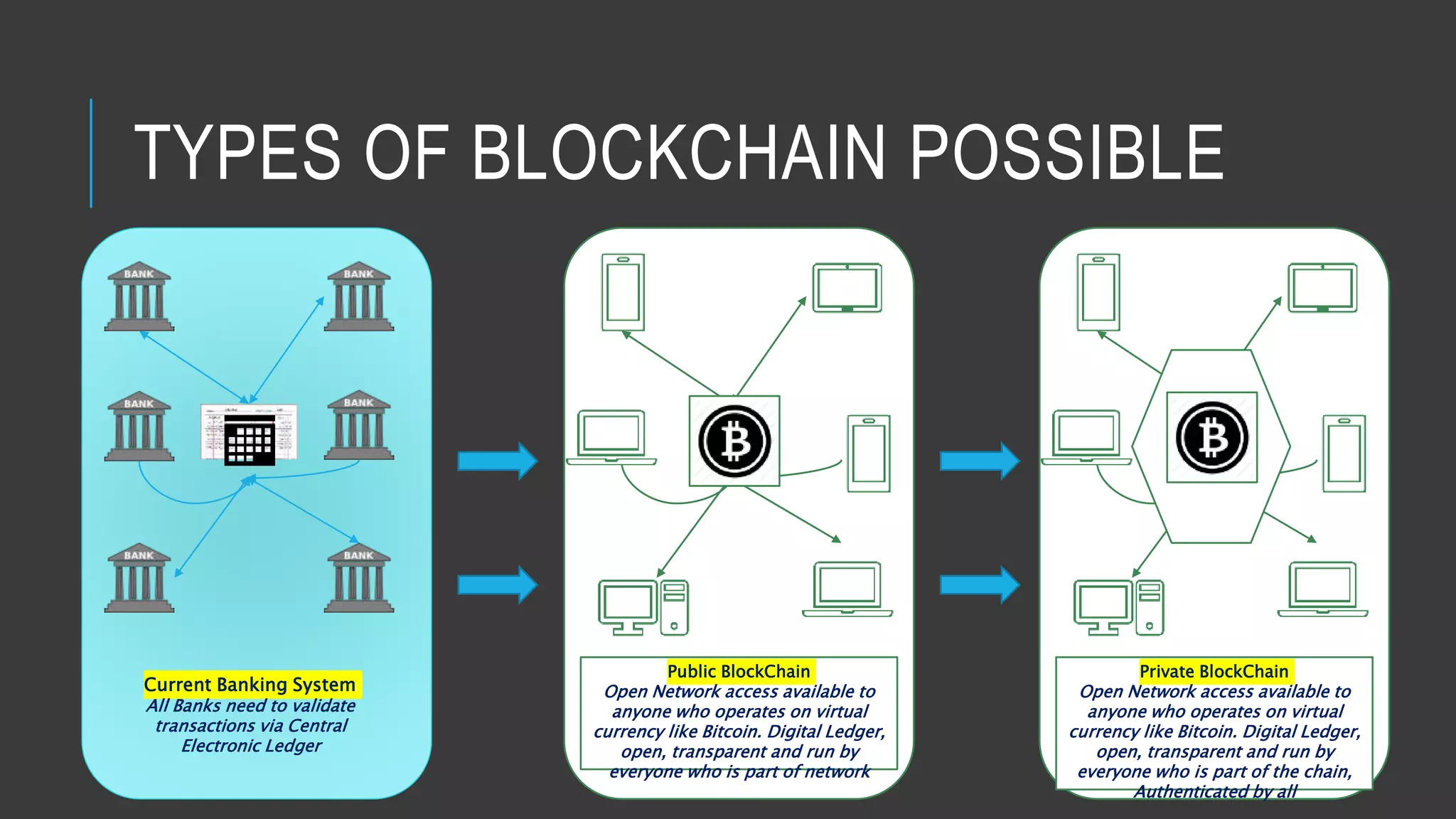
Current Banking System
All Banks need to validate
transactions via Central
Electronic Ledger
Public BlockChain
Open Network access available to
anyone who operates on virtual
currency like Bitcoin. Digital Ledger,
open, transparent and run by
everyone who is part of network
Private BlockChain
Open Network access available to
anyone who operates on virtual
currency like Bitcoin. Digital Ledger,
open, transparent and run by
everyone who is part of the chain,
Authenticated by all
POTENTIAL
INVOLVEMENT
OPPORTUNITI
ES
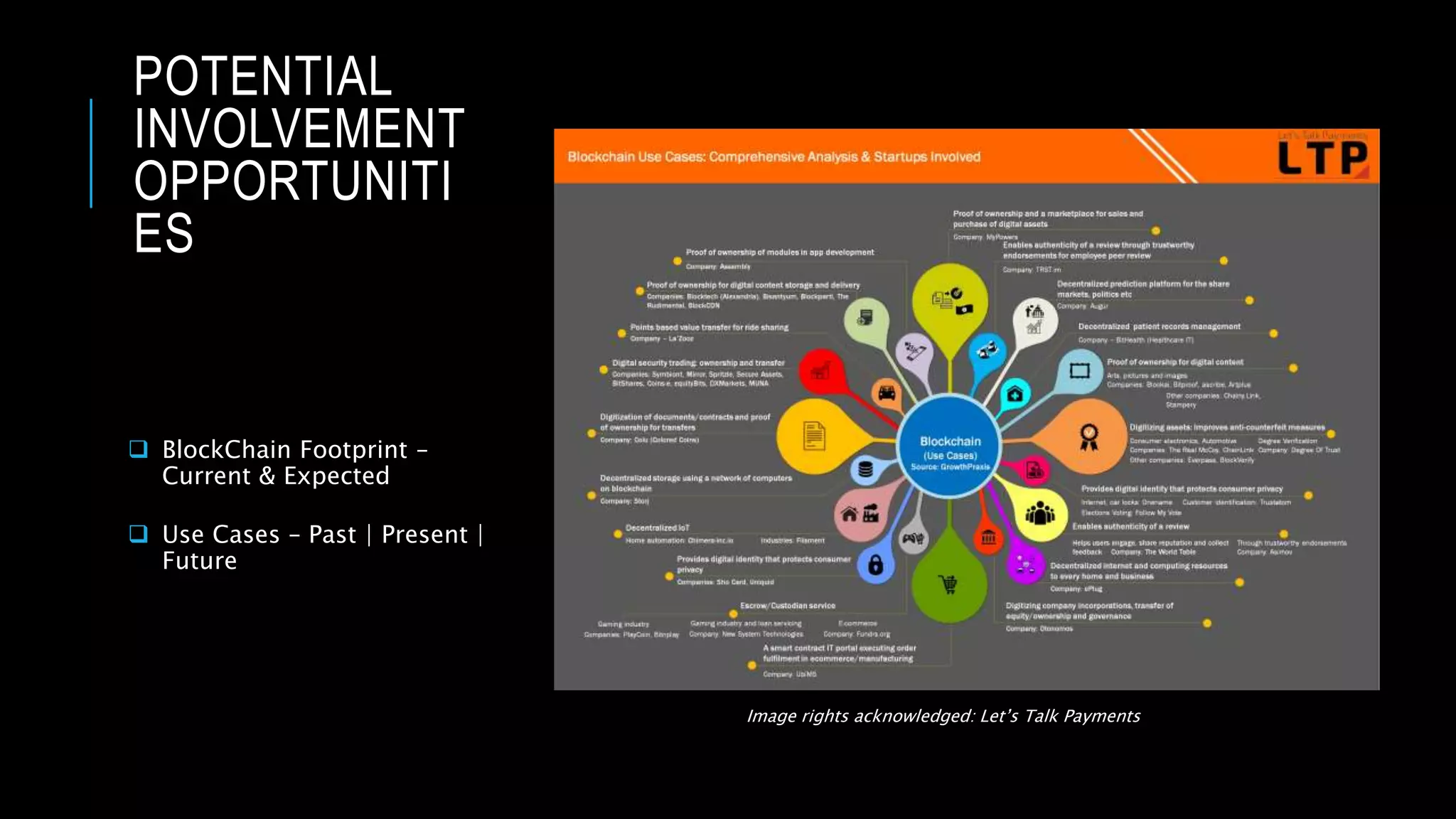
 BlockChain Footprint –
Current & Expected
 Use Cases – Past | Present |
Future
Image rights acknowledged: Let’s Talk Payments
BLOCKCHAIN FOOTPRINT…
GROWING QUICK
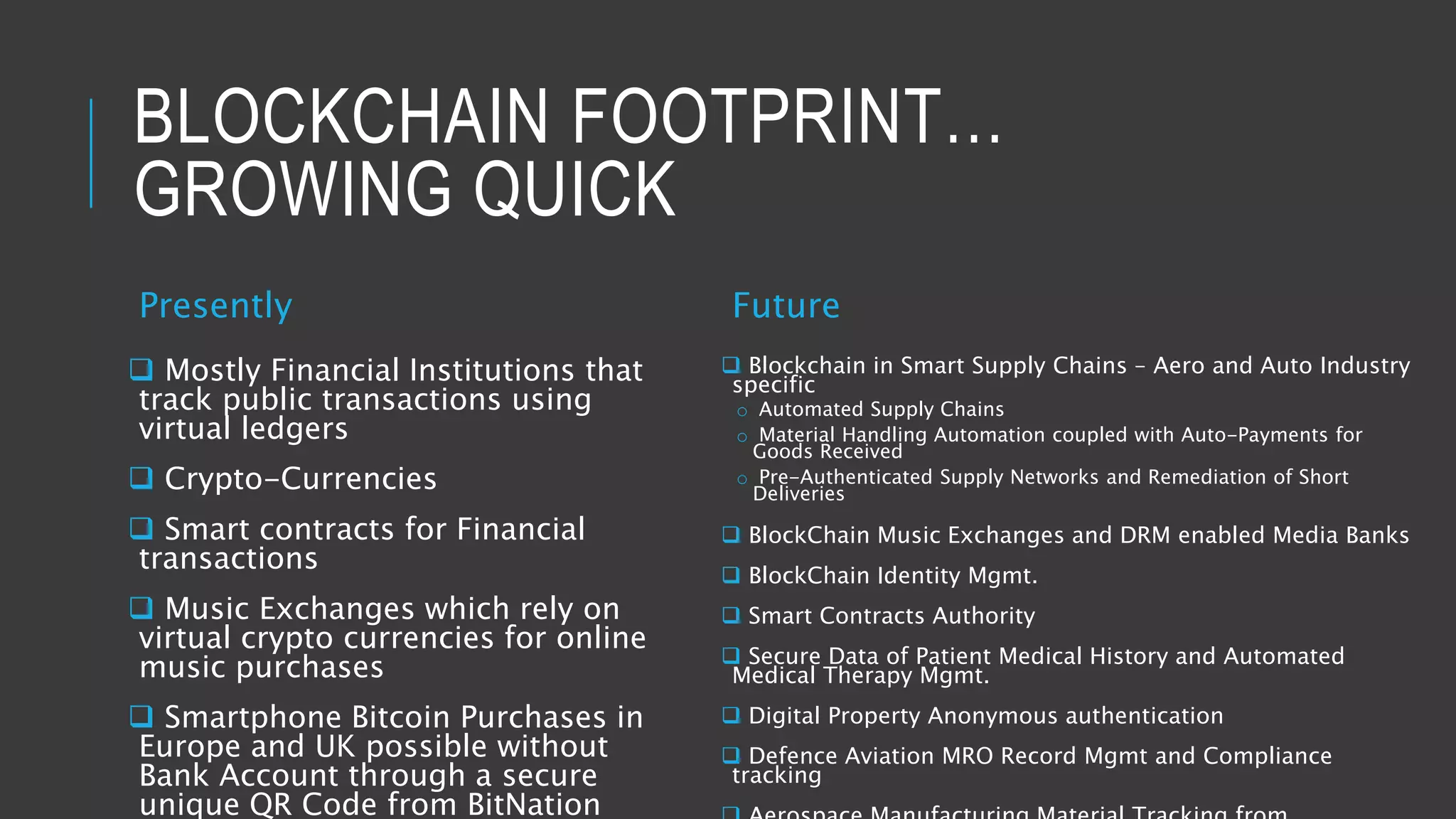
Presently
 Mostly Financial Institutions that
track public transactions using
virtual ledgers
 Crypto-Currencies
 Smart contracts for Financial
transactions
 Music Exchanges which rely on
virtual crypto currencies for online
music purchases
 Smartphone Bitcoin Purchases in
Europe and UK possible without
Bank Account through a secure
unique QR Code from BitNation
Future
 Blockchain in Smart Supply Chains – Aero and Auto Industry
specific
o Automated Supply Chains
o Material Handling Automation coupled with Auto-Payments for
Goods Received
o Pre-Authenticated Supply Networks and Remediation of Short
Deliveries
 BlockChain Music Exchanges and DRM enabled Media Banks
 BlockChain Identity Mgmt.
 Smart Contracts Authority
 Secure Data of Patient Medical History and Automated
Medical Therapy Mgmt.
 Digital Property Anonymous authentication
 Defence Aviation MRO Record Mgmt and Compliance
tracking
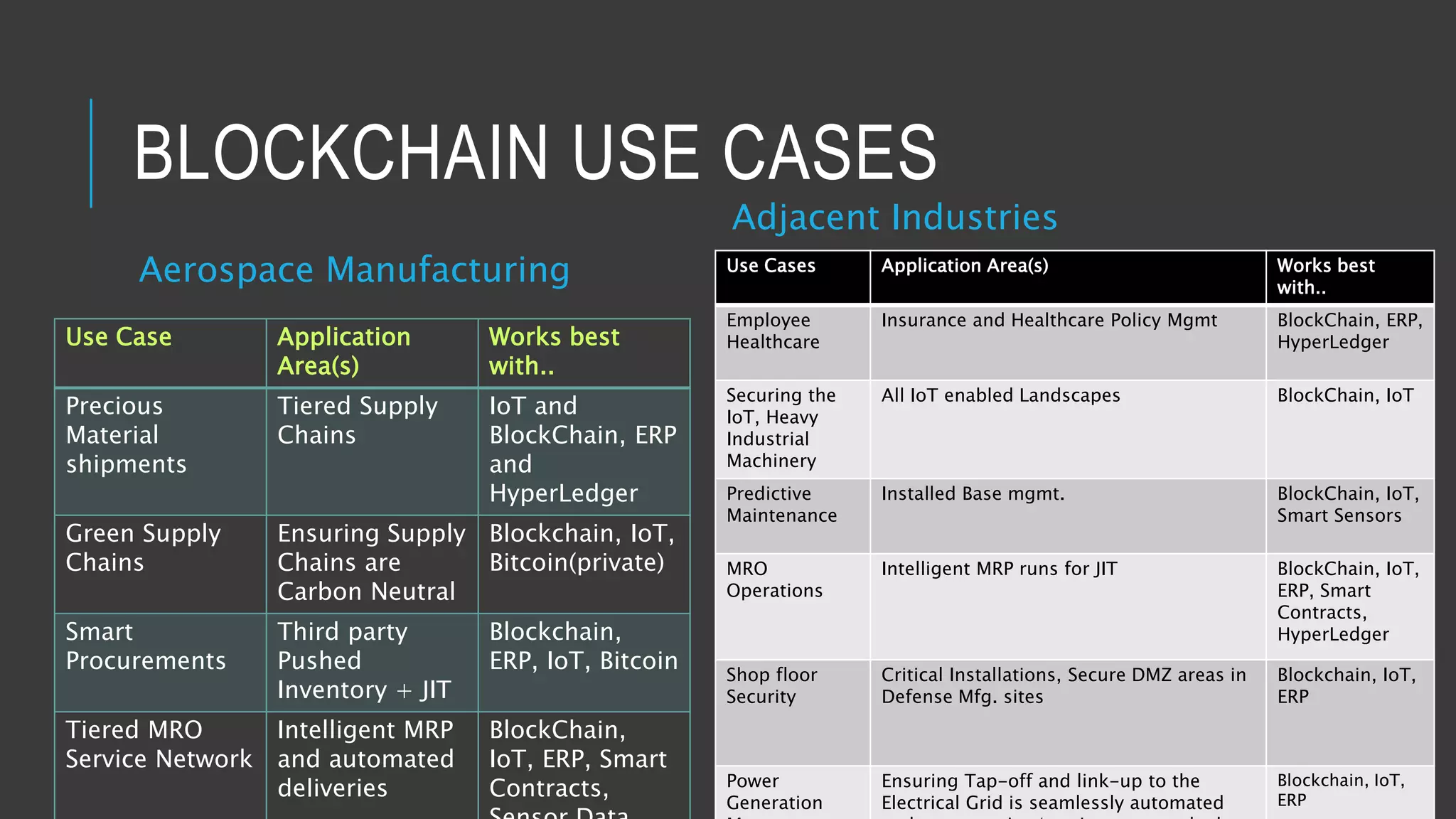
BLOCKCHAIN USE CASES
Aerospace Manufacturing
Use Case Application
Area(s)
Works best
with..
Precious
Material
shipments
Tiered Supply
Chains
IoT and
BlockChain, ERP
and
HyperLedger
Green Supply
Chains
Ensuring Supply
Chains are
Carbon Neutral
Blockchain, IoT,
Bitcoin(private)
Smart
Procurements
Third party
Pushed
Inventory + JIT
Blockchain,
ERP, IoT, Bitcoin
Tiered MRO
Service Network
Intelligent MRP
and automated
deliveries
BlockChain,
IoT, ERP, Smart
Contracts,
Adjacent Industries
Use Cases Application Area(s) Works best
with..
Employee
Healthcare
Insurance and Healthcare Policy Mgmt BlockChain, ERP,
HyperLedger
Securing the
IoT, Heavy
Industrial
Machinery
All IoT enabled Landscapes BlockChain, IoT
Predictive
Maintenance
Installed Base mgmt. BlockChain, IoT,
Smart Sensors
MRO
Operations
Intelligent MRP runs for JIT BlockChain, IoT,
ERP, Smart
Contracts,
HyperLedger
Shop floor
Security
Critical Installations, Secure DMZ areas in
Defense Mfg. sites
Blockchain, IoT,
ERP
Power
Generation
Ensuring Tap-off and link-up to the
Electrical Grid is seamlessly automated
Blockchain, IoT,
ERP
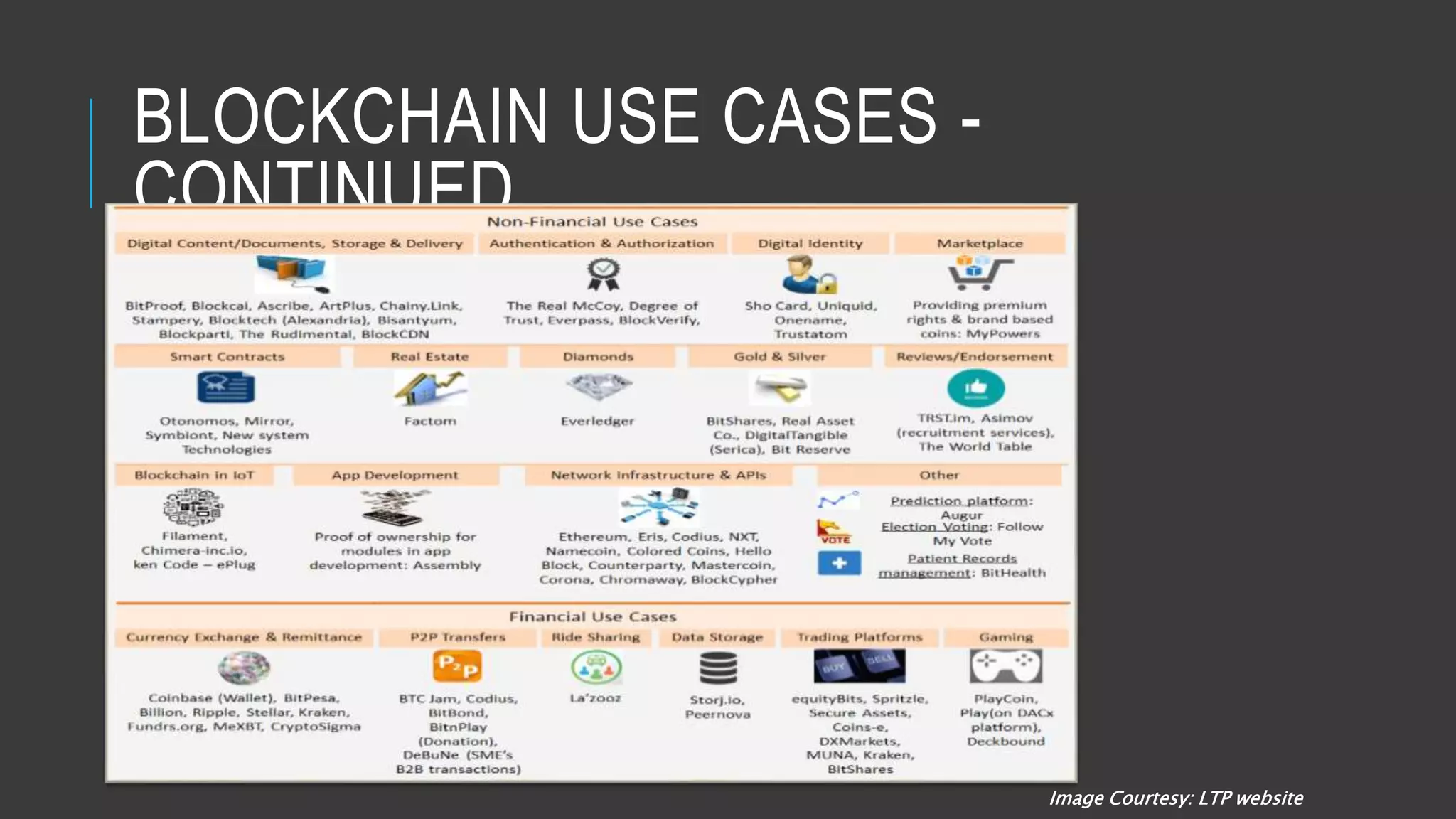
BLOCKCHAIN USE CASES -
CONTINUED
Image Courtesy: LTP website
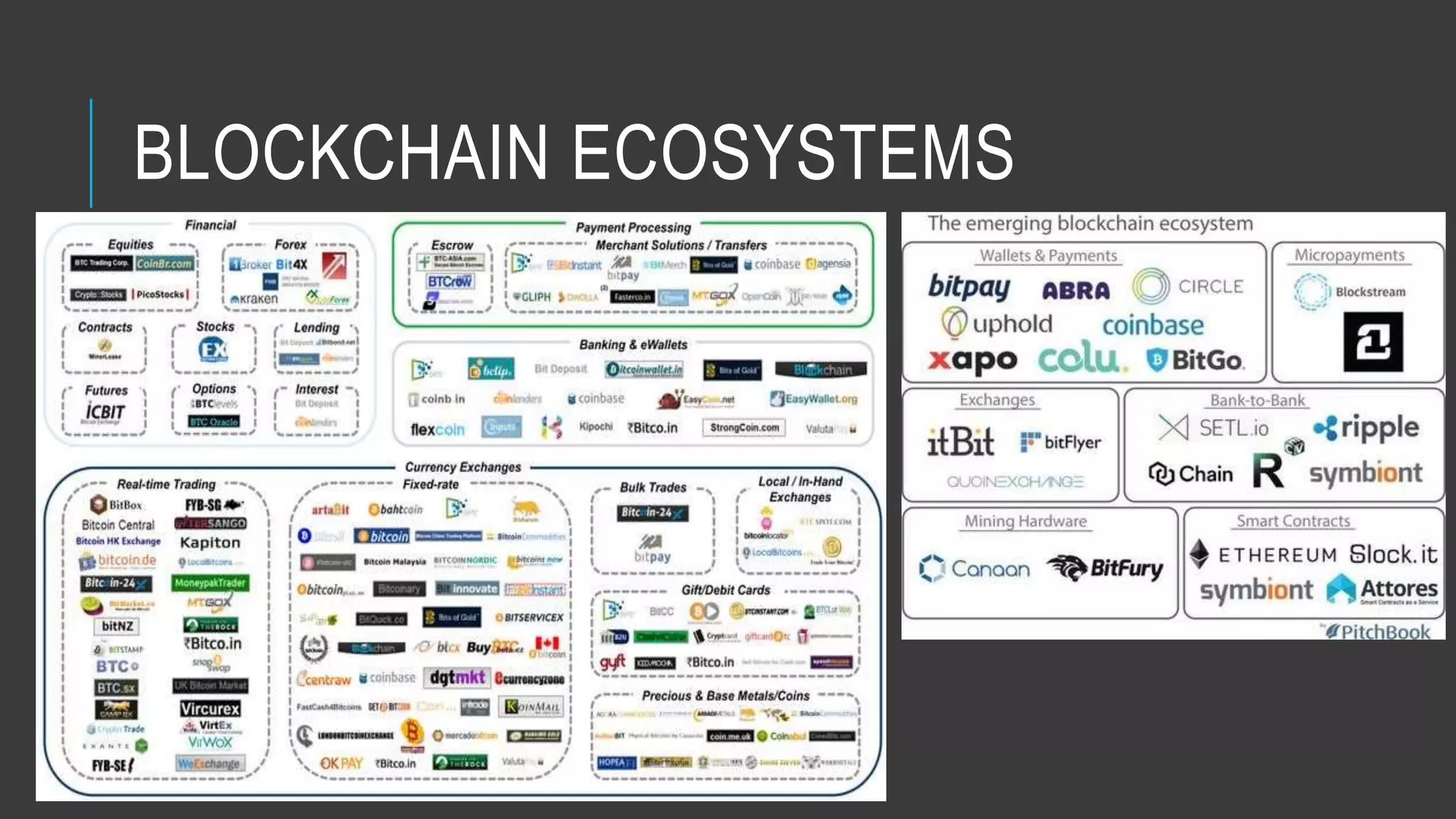
BLOCKCHAIN ECOSYSTEMS
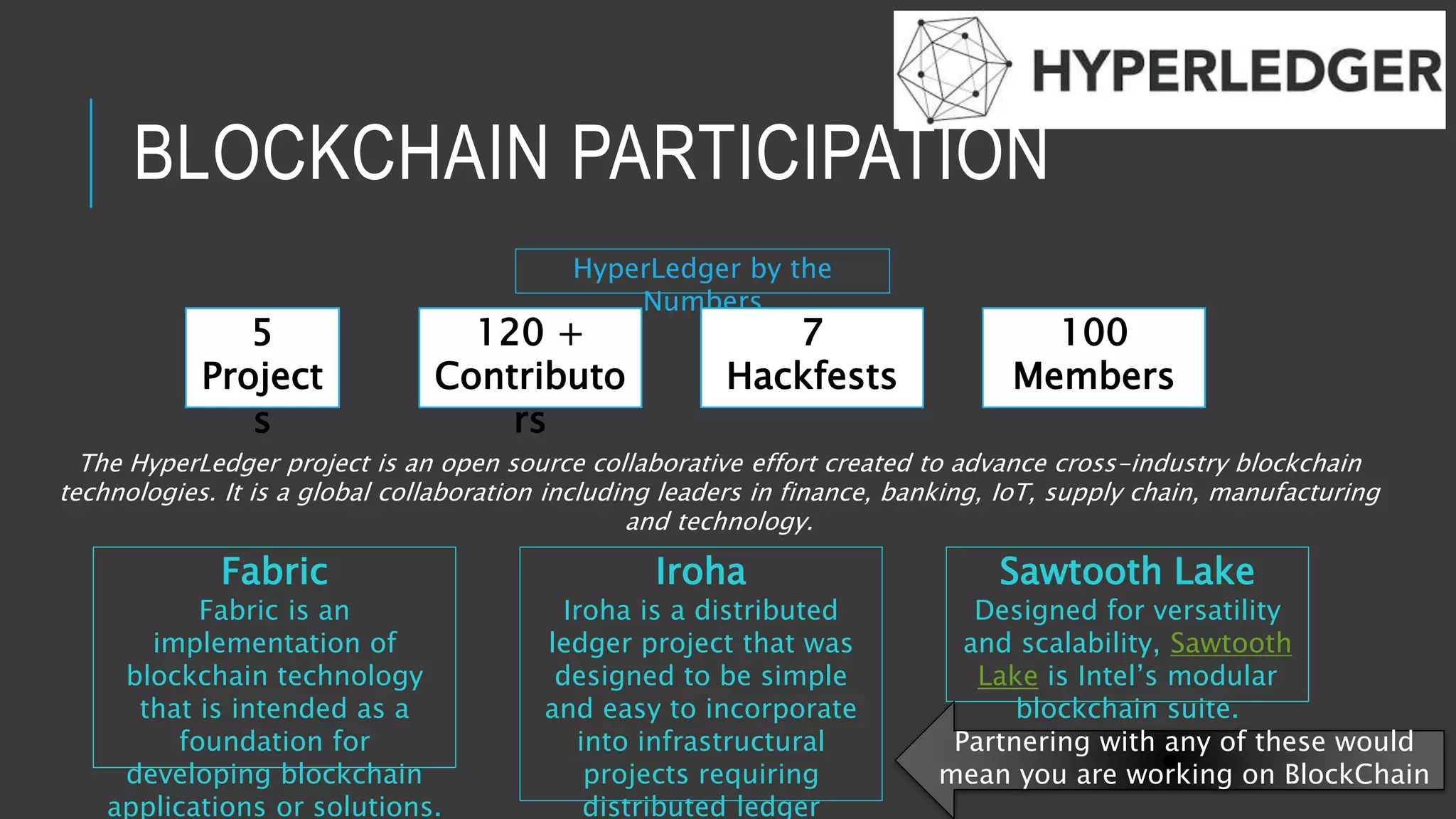
BLOCKCHAIN PARTICIPATION
HyperLedger by the
Numbers
5
Project
s
120 +
Contributo
rs
7
Hackfests
100
Members
The HyperLedger project is an open source collaborative effort created to advance cross-industry blockchain
technologies. It is a global collaboration including leaders in finance, banking, IoT, supply chain, manufacturing
and technology.
Fabric
Fabric is an
implementation of
blockchain technology
that is intended as a
foundation for
developing blockchain
applications or solutions.
Iroha
Iroha is a distributed
ledger project that was
designed to be simple
and easy to incorporate
into infrastructural
projects requiring
distributed ledger
Sawtooth Lake
Designed for versatility
and scalability, Sawtooth
Lake is Intel’s modular
blockchain suite.
Partnering with any of these would
mean you are working on BlockChain
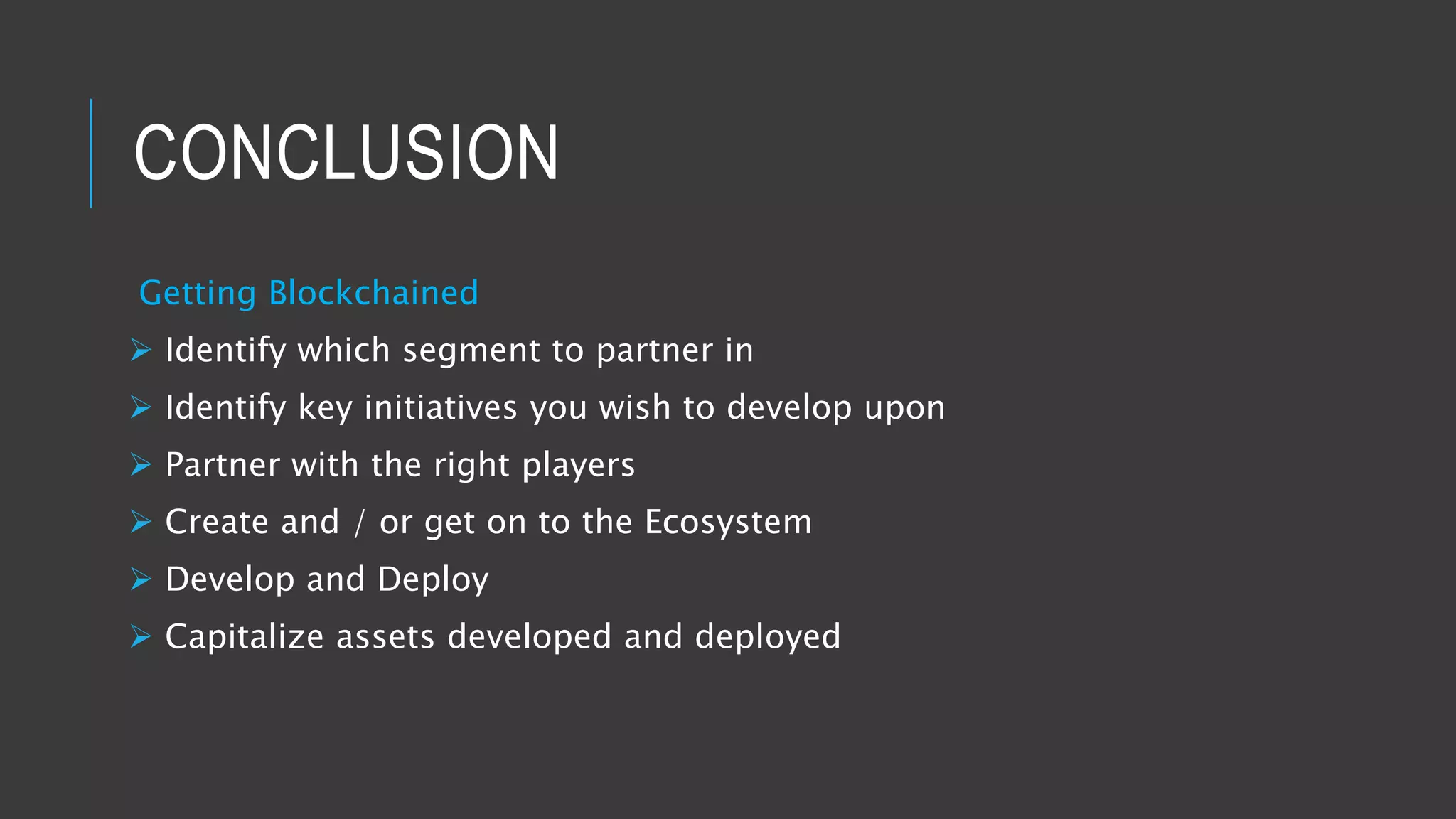
CONCLUSION
Getting Blockchained
 Identify which segment to partner in
 Identify key initiatives you wish to develop upon
 Partner with the right players
 Create and / or get on to the Ecosystem
 Develop and Deploy
 Capitalize assets developed and deployed

Why we need to get savvy about blockchain

  • 1.
    WHY WE NEEDTO GET SAVVY ABOUT BLOCKCHAIN Origins | Building Blocks| Potential Scope for Industry Involvement | Cross Industry Use Cases Chris Stanley Digital Evangelist | Photographer | Free Thinker
  • 2.
    BLOCKCHAIN EXPLAINED Foreword • AboutBlockChain • Executive Summary • BlockChain as Understood Today The Building Blocks • What constitutes a typical Block? • The BlockChain at work • Types of BlockChain possible Potential Involvement Opportunities • BlockChain Footprint – growing quick • Use Cases – Aerospace, Adjacent domains BlockChain Ecosystem • Players across the BlockChain spectrum Strategies for BlockChain Participation • Strategic Alliances – The HyperLedger Project • FABRIC | IROHA | SAWTOOTH LAKE Conclusion • Getting Blockchained
  • 3.
  • 4.
    ABOUT BLOCKCHAIN  Muchhas already been said and written about the humble beginnings of BlockChain from the days of the dark web, let’s suffice to know that… “ The first Block Chain (Originally), was conceptualized by Satoshi Nakamoto in 2008 and implemented the following year as a core component of the digital currency bitcoin, where it serves as the public ledger for all transactions. Through the use of a peer-to- peer network and a distributed timestamping server, a blockchain database is managed autonomously. The invention of the blockchain for bitcoin made it the first digital currency to solve the double spending problem, without the use of a trusted authority or central server. The bitcoin design has been the inspiration for other applications.” Wikipedia  It was born from the need to have a decentralized system of record, and a distributed, autonomous authorization entity  A secure, transaction record, that can ensure immediate fraud detection and prevent misuse
  • 5.
    EXECUTIVE SUMMARY  Thisis an attempt to demystify the BlockChain concept and its potential to develop solutions for, and adapt to, the different Business Scenarios (read Challenges) that traditional technology apps and business processes are grappling with  Any new Technology or Innovative Idea has to go through the paces to be widely accepted and adopted across business domains; this deck contains some of the challenges and opportunities which present themselves as on date, as Use Cases  With little or no background to the Bitcoin or the BlockChain ecosystem, one could begin development of applications using the APKs and SDKs which are available in multiple development spheres – some find mention in this deck as well  Most important for any technology to go mainstream is its ability to respond to business needs in a fair, transparent manner and with minimum geek intervention, while being able to track both actions and value – The
  • 6.
    BLOCKCHAIN AS UNDERSTOOD TODAY Accordingto the Bank of England, a blockchain is “a technology that allows people who don’t know each other to trust a shared record of events” Blockchain has the underpinnings for a next generation IoT (Internet of Things) architecture. – Gurvinder Ahluwalia, IBM Despite its richly varied applications, a blockchain such as bitcoin’s aims to realize a simple goal. Abstractly, it can be viewed as creating a kind of public bulletin board, often called a “distributed ledger.” This ledger is public. Anyone – plebeian or plutocrat, baker or banker – can read it. And anyone can write valid data to it.
  • 7.
    THE BUILDING BLOCKS  Whatconstitutes a Typical Block?  The BlockChain at Work  Types of BlockChain possible
  • 8.
    THE TYPICAL BLOCKSIN BLOCKCHAIN  Each Block is made up of a Transaction History  History could be any or all of  Previous Owner of the Block  Previous history of Transactions  Previous value of the Block  Block Time and Security Stamp information (# Identifier)  Transactions are categorized into BLOCKS  Each BLOCK is linked as the transaction progresses into a CHAIN  Each BLOCK is linked chronologically with the #ash of the previous block, enabling an auto audit trail 783bdb339 sf Yada yada 1100aafghe03 98 Hash C to pay M 2 Bitcoins M to pay V 4 Bitcoins Reward myself 4 Bitcoins Secure Identifier stamp Transaction history Trusted BlockChai n Network 1100aafghe0398 1100aafghe0398 8892bgren99 0 8892bgren99 0
  • 9.
    THE BLOCKCHAIN AT WORK https://blockchain.info/ Clickon the above link to watch the BlockChain in action in real time  BlockChain workings are easily traceable, provided you are one of the trusted entities who share the network in which the transactions are taking place  BlockChain authorization is autonomous  BlockChain moves virtual currency viz. the Bitcoin, this is therefore an Internet of Value, since the Bitcoin value is constantly fluctuating  BlockChain audit trails are instantly stored into the Blocks and can be easily verified, and are available forever Image rights acknowledged as borrowed from WEF web publication originally published by the Financial Times https://www.weforum.org/agenda/2015/11/how-will-blockchain-technology-transform- financial-services/
  • 10.
    TYPES OF BLOCKCHAINPOSSIBLE Current Banking System All Banks need to validate transactions via Central Electronic Ledger Public BlockChain Open Network access available to anyone who operates on virtual currency like Bitcoin. Digital Ledger, open, transparent and run by everyone who is part of network Private BlockChain Open Network access available to anyone who operates on virtual currency like Bitcoin. Digital Ledger, open, transparent and run by everyone who is part of the chain, Authenticated by all
  • 11.
    POTENTIAL INVOLVEMENT OPPORTUNITI ES  BlockChain Footprint– Current & Expected  Use Cases – Past | Present | Future Image rights acknowledged: Let’s Talk Payments
  • 12.
    BLOCKCHAIN FOOTPRINT… GROWING QUICK Presently Mostly Financial Institutions that track public transactions using virtual ledgers  Crypto-Currencies  Smart contracts for Financial transactions  Music Exchanges which rely on virtual crypto currencies for online music purchases  Smartphone Bitcoin Purchases in Europe and UK possible without Bank Account through a secure unique QR Code from BitNation Future  Blockchain in Smart Supply Chains – Aero and Auto Industry specific o Automated Supply Chains o Material Handling Automation coupled with Auto-Payments for Goods Received o Pre-Authenticated Supply Networks and Remediation of Short Deliveries  BlockChain Music Exchanges and DRM enabled Media Banks  BlockChain Identity Mgmt.  Smart Contracts Authority  Secure Data of Patient Medical History and Automated Medical Therapy Mgmt.  Digital Property Anonymous authentication  Defence Aviation MRO Record Mgmt and Compliance tracking
  • 13.
    BLOCKCHAIN USE CASES AerospaceManufacturing Use Case Application Area(s) Works best with.. Precious Material shipments Tiered Supply Chains IoT and BlockChain, ERP and HyperLedger Green Supply Chains Ensuring Supply Chains are Carbon Neutral Blockchain, IoT, Bitcoin(private) Smart Procurements Third party Pushed Inventory + JIT Blockchain, ERP, IoT, Bitcoin Tiered MRO Service Network Intelligent MRP and automated deliveries BlockChain, IoT, ERP, Smart Contracts, Adjacent Industries Use Cases Application Area(s) Works best with.. Employee Healthcare Insurance and Healthcare Policy Mgmt BlockChain, ERP, HyperLedger Securing the IoT, Heavy Industrial Machinery All IoT enabled Landscapes BlockChain, IoT Predictive Maintenance Installed Base mgmt. BlockChain, IoT, Smart Sensors MRO Operations Intelligent MRP runs for JIT BlockChain, IoT, ERP, Smart Contracts, HyperLedger Shop floor Security Critical Installations, Secure DMZ areas in Defense Mfg. sites Blockchain, IoT, ERP Power Generation Ensuring Tap-off and link-up to the Electrical Grid is seamlessly automated Blockchain, IoT, ERP
  • 14.
    BLOCKCHAIN USE CASES- CONTINUED Image Courtesy: LTP website
  • 15.
  • 16.
    BLOCKCHAIN PARTICIPATION HyperLedger bythe Numbers 5 Project s 120 + Contributo rs 7 Hackfests 100 Members The HyperLedger project is an open source collaborative effort created to advance cross-industry blockchain technologies. It is a global collaboration including leaders in finance, banking, IoT, supply chain, manufacturing and technology. Fabric Fabric is an implementation of blockchain technology that is intended as a foundation for developing blockchain applications or solutions. Iroha Iroha is a distributed ledger project that was designed to be simple and easy to incorporate into infrastructural projects requiring distributed ledger Sawtooth Lake Designed for versatility and scalability, Sawtooth Lake is Intel’s modular blockchain suite. Partnering with any of these would mean you are working on BlockChain
  • 17.
    CONCLUSION Getting Blockchained  Identifywhich segment to partner in  Identify key initiatives you wish to develop upon  Partner with the right players  Create and / or get on to the Ecosystem  Develop and Deploy  Capitalize assets developed and deployed