Group members:
G1415626 Ma Yun
G1410813 Zhang Zuodong
 1. Company Background
 2. Problems And Issues
 3. Case Analysis
 4. Recommendations
Contents
 Tiffany company was founded in New York in 1837 by Charles Lewis.
 Tiffany company was an internationally renowned retailer, designer,
manufacturer, and distributor of luxury goods.
 Tiffany and company is a jeweler and special retailing offering an extensive
selection of jewelry, timepiece, china, crystal, silverware and other accessories.
 From 1986 to 1993, Tiffany opened several flagship retail stores in London,
Munich, Zurich, Hong Kong, Taipei, Singapore, Frankfurt, Toronto, Korea and
Japan.
Company Background

Products of Tiffany

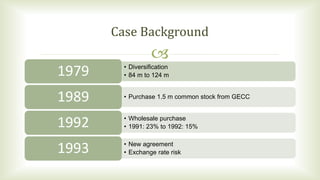
• Diversification
• 84 m to 124 m1979
• Purchase 1.5 m common stock from GECC1989
• Wholesale purchase
• 1991: 23% to 1992: 15%1992
• New agreement
• Exchange rate risk1993
Case Background

Facing Exchange Rate Risks
Problems and Issues
 In 1993 July, the new retailing agreement made by Tiffany & Co. Japan's with
Mitsukoshi Ltd. With greater control over retail sales in its Japanese operations,
Tiffany looked forward to long-run improvement in its performance in Japan despite
continuing weak local economic conditions.
 However, Tiffany was now also faced with risks of exchange rate fluctuations between
time of purchase from Tiffany and time of cash settlement that were previously borne
by Mitsukoshi.
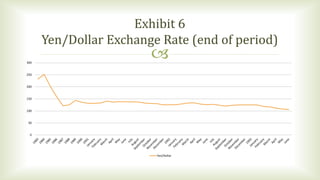
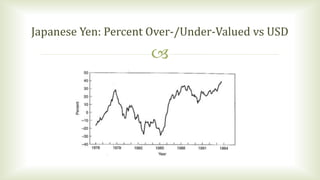
 Historical data warned Tiffany that the yen/dollar exchange rate could be quite
volatile on a year-to-year and even month-to-month basis (exhibit 6). Although a
continued strengthening of the yen against the dollar was observed from 1983 to
1993, there was evidence that the yen was overvalued against the dollar in 1993, and
thus a distinct probability that the yen may eventually crash suddenly (exhibit 7).
Why Tiffany Faced This Issues?

Exhibit 6
Yen/Dollar Exchange Rate (end of period)
0
50
100
150
200
250
300
Yen/Dollar

Japanese Yen: Percent Over-/Under-Valued vs USD
 1. Transaction exposure: The restructuring of Tiffany's Japanese operations requires Tiffany to
repurchase its inventory which will significantly decrease its net income. As it can be seen in exhibit 1,
Tiffany is said to repurchase its inventory for $115 million in 1993.
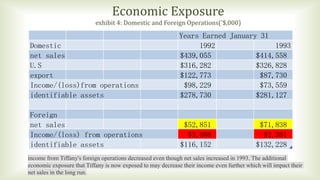
 2. Economic exposure:Tiffany is now exposed to foreign exchange rate risk. Tiffany has to bear the
risk of any exchange-rate fluctuations that will take place when it assumes the responsibility for
establishing yen retail price, holding inventory in Japan for sale, managing and funding local advertising
and publicity programs and controlling local Japanese management.This may or may not decrease
Tiffany's sales and income from their foreign operations(exhibit 4).
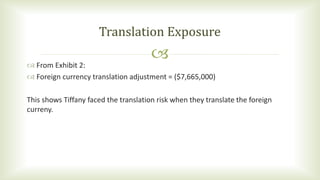
 3. Translation exposure: The accounting for translation gains and losses is governed by the
statement of financial accounting standards. Under this accounting method, all foreign assets and
liabilities are translate at the exchange rate prevailing on the banlance sheet date(exhibit 2).
What exchange rate exposures Tiffany faced?
 exhibit 1: consolidated income statement ($000)
 1993 Product return for Japan realignment= ($115,000)
 1992 Product return for Japan realignment= 0
 1993 Net Income/Loss= ($31,513)
 1992 Net Income/Loss= $6,992
 However, Tiffany only managed to repurchase $52.5 million of inventory in July
1993 and Mitsukoshi agreed to accept a deferred payment on $25 million of
this repurchased inventory, which was to be repaid in yen on a quarterly bases
with interest of 6% per annum over the next 4.5 years. The remaining $62.5
million inventory will be repurchased throughout the period ending February
28, 1998 and payment for this warehouse will be made in yen.
Transaction Exposure

Economic Exposure
exhibit 4: Domestic and Foreign Operations('$,000)
Years Earned January 31
Domestic 1992 1993
net sales $439,055 $414,558
U.S $316,282 $326,828
export $122,773 $87,730
Income/(loss)from operations $98,229 $73,559
identifiable assets $278,730 $281,127
Foreign
net sales $52,851 $71,838
Income/(loss) from operations $3,888 $2,381
identifiable assets $116,152 $132,228
income from Tiffany's foreign operations decreased even though net sales increased in 1993. The additional
economic exposure that Tiffany is now exposed to may decrease their income even further which will impact their
net sales in the long run.
 From Exhibit 2:
 Foreign currency translation adjustment = ($7,665,000)
This shows Tiffany faced the translation risk when they translate the foreign
curreny.
Translation Exposure

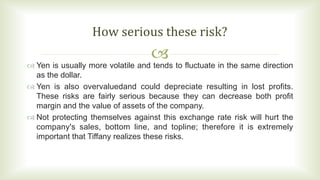
 Yen is usually more volatile and tends to fluctuate in the same direction
as the dollar.
 Yen is also overvaluedand could depreciate resulting in lost profits.
These risks are fairly serious because they can decrease both profit
margin and the value of assets of the company.
 Not protecting themselves against this exchange rate risk will hurt the
company's sales, bottom line, and topline; therefore it is extremely
important that Tiffany realizes these risks.
How serious these risk?
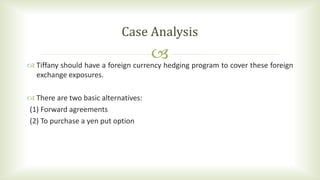
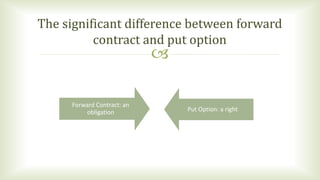
 Tiffany should have a foreign currency hedging program to cover these foreign
exchange exposures.
 There are two basic alternatives:
(1) Forward agreements
(2) To purchase a yen put option
Case Analysis

Forward Contract: an
obligation Put Option: a right
The significant difference between forward
contract and put option
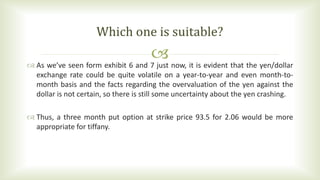
 As we’ve seen form exhibit 6 and 7 just now, it is evident that the yen/dollar
exchange rate could be quite volatile on a year-to-year and even month-to-
month basis and the facts regarding the overvaluation of the yen against the
dollar is not certain, so there is still some uncertainty about the yen crashing.
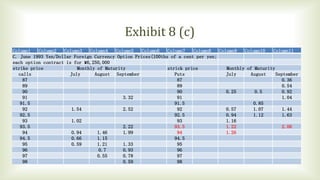
 Thus, a three month put option at strike price 93.5 for 2.06 would be more
appropriate for tiffany.
Which one is suitable?

Exhibit 8 (c)
Column1 Column2 Column3 Column4 Column5 Column6 Column7 Column8 Column9 Column10 Column11
C. June 1993 Yen/Dollar Foreign Currency Option Prices(100ths of a cent per yen;
each option contract is for ¥6,250,000
strike price Monthly of Maturity strick price Monthly of Maturity
calls July August September Puts July August September
87 87 0.36
89 89 0.54
90 90 0.25 0.5 0.92
91 3.32 91 1.04
91.5 91.5 0.85
92 1.54 2.52 92 0.57 1.07 1.44
92.5 92.5 0.94 1.12 1.63
93 1.02 93 1.16
93.5 2.22 93.5 1.22 2.06
94 0.94 1.46 1.99 94 1.26
94.5 0.66 1.15 94.5
95 0.59 1.21 1.33 95
96 0.7 0.93 96
97 0.55 0.78 97
98 0.59 98
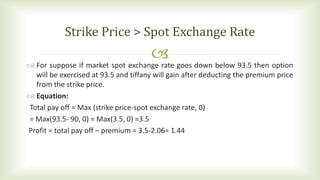
 For suppose if market spot exchange rate goes down below 93.5 then option
will be exercised at 93.5 and tiffany will gain after deducting the premium price
from the strike price.
 Equation:
Total pay off = Max (strike price-spot exchange rate, 0)
= Max(93.5- 90, 0) = Max(3.5, 0) =3.5
Profit = total pay off – premium = 3.5-2.06= 1.44
Strike Price > Spot Exchange Rate
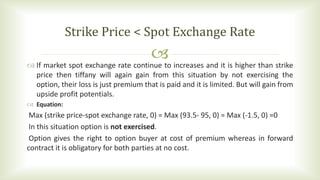
 If market spot exchange rate continue to increases and it is higher than strike
price then tiffany will again gain from this situation by not exercising the
option, their loss is just premium that is paid and it is limited. But will gain from
upside profit potentials.
 Equation:
Max (strike price-spot exchange rate, 0) = Max (93.5- 95, 0) = Max (-1.5, 0) =0
In this situation option is not exercised.
Option gives the right to option buyer at cost of premium whereas in forward
contract it is obligatory for both parties at no cost.
Strike Price < Spot Exchange Rate

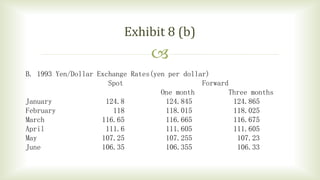
Exhibit 8 (b)
B. 1993 Yen/Dollar Exchange Rates(yen per dollar)
Spot Forward
One month Three months
January 124.8 124.845 124.865
February 118 118.015 118.025
March 116.65 116.665 116.675
April 111.6 111.605 111.605
May 107.25 107.255 107.23
June 106.35 106.355 106.33
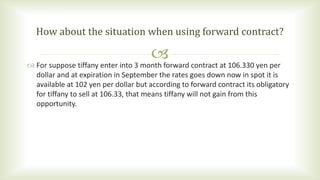
 For suppose tiffany enter into 3 month forward contract at 106.330 yen per
dollar and at expiration in September the rates goes down now in spot it is
available at 102 yen per dollar but according to forward contract its obligatory
for tiffany to sell at 106.33, that means tiffany will not gain from this
opportunity.
How about the situation when using forward contract?
 1. Using the put option to hedge the exchange rate risks that Tiffany faced.
 2. In japan, there is a special organization, Keiretsu, which is a large group of
corporations that have strong affiliation with a powerful bank. Usually, the
multinational firms within a Keiretsu possess a stronger liquidity position.
Therefore, Tiffany can decrease its exchange rate risks via participating this
kind of organization.
More details: <The Foreign Exchange Exposure of Japanese Multinational
Corporations> by Jia He and Lilian K. NG.
Recommendations

Thank you all for listening

tiffany case study

  • 1.
    Group members: G1415626 MaYun G1410813 Zhang Zuodong
  • 2.
     1. CompanyBackground  2. Problems And Issues  3. Case Analysis  4. Recommendations Contents
  • 3.
     Tiffany companywas founded in New York in 1837 by Charles Lewis.  Tiffany company was an internationally renowned retailer, designer, manufacturer, and distributor of luxury goods.  Tiffany and company is a jeweler and special retailing offering an extensive selection of jewelry, timepiece, china, crystal, silverware and other accessories.  From 1986 to 1993, Tiffany opened several flagship retail stores in London, Munich, Zurich, Hong Kong, Taipei, Singapore, Frankfurt, Toronto, Korea and Japan. Company Background
  • 4.
  • 5.
     • Diversification • 84m to 124 m1979 • Purchase 1.5 m common stock from GECC1989 • Wholesale purchase • 1991: 23% to 1992: 15%1992 • New agreement • Exchange rate risk1993 Case Background
  • 6.
     Facing Exchange RateRisks Problems and Issues
  • 7.
     In 1993July, the new retailing agreement made by Tiffany & Co. Japan's with Mitsukoshi Ltd. With greater control over retail sales in its Japanese operations, Tiffany looked forward to long-run improvement in its performance in Japan despite continuing weak local economic conditions.  However, Tiffany was now also faced with risks of exchange rate fluctuations between time of purchase from Tiffany and time of cash settlement that were previously borne by Mitsukoshi.  Historical data warned Tiffany that the yen/dollar exchange rate could be quite volatile on a year-to-year and even month-to-month basis (exhibit 6). Although a continued strengthening of the yen against the dollar was observed from 1983 to 1993, there was evidence that the yen was overvalued against the dollar in 1993, and thus a distinct probability that the yen may eventually crash suddenly (exhibit 7). Why Tiffany Faced This Issues?
  • 8.
     Exhibit 6 Yen/Dollar ExchangeRate (end of period) 0 50 100 150 200 250 300 Yen/Dollar
  • 9.
     Japanese Yen: PercentOver-/Under-Valued vs USD
  • 10.
     1. Transactionexposure: The restructuring of Tiffany's Japanese operations requires Tiffany to repurchase its inventory which will significantly decrease its net income. As it can be seen in exhibit 1, Tiffany is said to repurchase its inventory for $115 million in 1993.  2. Economic exposure:Tiffany is now exposed to foreign exchange rate risk. Tiffany has to bear the risk of any exchange-rate fluctuations that will take place when it assumes the responsibility for establishing yen retail price, holding inventory in Japan for sale, managing and funding local advertising and publicity programs and controlling local Japanese management.This may or may not decrease Tiffany's sales and income from their foreign operations(exhibit 4).  3. Translation exposure: The accounting for translation gains and losses is governed by the statement of financial accounting standards. Under this accounting method, all foreign assets and liabilities are translate at the exchange rate prevailing on the banlance sheet date(exhibit 2). What exchange rate exposures Tiffany faced?
  • 11.
     exhibit 1:consolidated income statement ($000)  1993 Product return for Japan realignment= ($115,000)  1992 Product return for Japan realignment= 0  1993 Net Income/Loss= ($31,513)  1992 Net Income/Loss= $6,992  However, Tiffany only managed to repurchase $52.5 million of inventory in July 1993 and Mitsukoshi agreed to accept a deferred payment on $25 million of this repurchased inventory, which was to be repaid in yen on a quarterly bases with interest of 6% per annum over the next 4.5 years. The remaining $62.5 million inventory will be repurchased throughout the period ending February 28, 1998 and payment for this warehouse will be made in yen. Transaction Exposure
  • 12.
     Economic Exposure exhibit 4:Domestic and Foreign Operations('$,000) Years Earned January 31 Domestic 1992 1993 net sales $439,055 $414,558 U.S $316,282 $326,828 export $122,773 $87,730 Income/(loss)from operations $98,229 $73,559 identifiable assets $278,730 $281,127 Foreign net sales $52,851 $71,838 Income/(loss) from operations $3,888 $2,381 identifiable assets $116,152 $132,228 income from Tiffany's foreign operations decreased even though net sales increased in 1993. The additional economic exposure that Tiffany is now exposed to may decrease their income even further which will impact their net sales in the long run.
  • 13.
     From Exhibit2:  Foreign currency translation adjustment = ($7,665,000) This shows Tiffany faced the translation risk when they translate the foreign curreny. Translation Exposure
  • 14.
      Yen isusually more volatile and tends to fluctuate in the same direction as the dollar.  Yen is also overvaluedand could depreciate resulting in lost profits. These risks are fairly serious because they can decrease both profit margin and the value of assets of the company.  Not protecting themselves against this exchange rate risk will hurt the company's sales, bottom line, and topline; therefore it is extremely important that Tiffany realizes these risks. How serious these risk?
  • 15.
     Tiffany shouldhave a foreign currency hedging program to cover these foreign exchange exposures.  There are two basic alternatives: (1) Forward agreements (2) To purchase a yen put option Case Analysis
  • 16.
     Forward Contract: an obligationPut Option: a right The significant difference between forward contract and put option
  • 17.
     As we’veseen form exhibit 6 and 7 just now, it is evident that the yen/dollar exchange rate could be quite volatile on a year-to-year and even month-to- month basis and the facts regarding the overvaluation of the yen against the dollar is not certain, so there is still some uncertainty about the yen crashing.  Thus, a three month put option at strike price 93.5 for 2.06 would be more appropriate for tiffany. Which one is suitable?
  • 18.
     Exhibit 8 (c) Column1Column2 Column3 Column4 Column5 Column6 Column7 Column8 Column9 Column10 Column11 C. June 1993 Yen/Dollar Foreign Currency Option Prices(100ths of a cent per yen; each option contract is for ¥6,250,000 strike price Monthly of Maturity strick price Monthly of Maturity calls July August September Puts July August September 87 87 0.36 89 89 0.54 90 90 0.25 0.5 0.92 91 3.32 91 1.04 91.5 91.5 0.85 92 1.54 2.52 92 0.57 1.07 1.44 92.5 92.5 0.94 1.12 1.63 93 1.02 93 1.16 93.5 2.22 93.5 1.22 2.06 94 0.94 1.46 1.99 94 1.26 94.5 0.66 1.15 94.5 95 0.59 1.21 1.33 95 96 0.7 0.93 96 97 0.55 0.78 97 98 0.59 98
  • 19.
     For supposeif market spot exchange rate goes down below 93.5 then option will be exercised at 93.5 and tiffany will gain after deducting the premium price from the strike price.  Equation: Total pay off = Max (strike price-spot exchange rate, 0) = Max(93.5- 90, 0) = Max(3.5, 0) =3.5 Profit = total pay off – premium = 3.5-2.06= 1.44 Strike Price > Spot Exchange Rate
  • 20.
     If marketspot exchange rate continue to increases and it is higher than strike price then tiffany will again gain from this situation by not exercising the option, their loss is just premium that is paid and it is limited. But will gain from upside profit potentials.  Equation: Max (strike price-spot exchange rate, 0) = Max (93.5- 95, 0) = Max (-1.5, 0) =0 In this situation option is not exercised. Option gives the right to option buyer at cost of premium whereas in forward contract it is obligatory for both parties at no cost. Strike Price < Spot Exchange Rate
  • 21.
     Exhibit 8 (b) B.1993 Yen/Dollar Exchange Rates(yen per dollar) Spot Forward One month Three months January 124.8 124.845 124.865 February 118 118.015 118.025 March 116.65 116.665 116.675 April 111.6 111.605 111.605 May 107.25 107.255 107.23 June 106.35 106.355 106.33
  • 22.
     For supposetiffany enter into 3 month forward contract at 106.330 yen per dollar and at expiration in September the rates goes down now in spot it is available at 102 yen per dollar but according to forward contract its obligatory for tiffany to sell at 106.33, that means tiffany will not gain from this opportunity. How about the situation when using forward contract?
  • 23.
     1. Usingthe put option to hedge the exchange rate risks that Tiffany faced.  2. In japan, there is a special organization, Keiretsu, which is a large group of corporations that have strong affiliation with a powerful bank. Usually, the multinational firms within a Keiretsu possess a stronger liquidity position. Therefore, Tiffany can decrease its exchange rate risks via participating this kind of organization. More details: <The Foreign Exchange Exposure of Japanese Multinational Corporations> by Jia He and Lilian K. NG. Recommendations
  • 24.
     Thank you allfor listening