Bangladesh Water “PaCT”
Partnership for Cleaner Textile
Program Overview
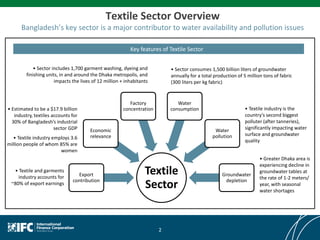
Textile Sector Overview
Bangladesh’s key sector is a major contributor to water availability and pollution issues
2
Textile
Sector
Export
contribution
Economic
relevance
Factory
concentration
Water
consumption
Water
pollution
Groundwater
depletion
• Estimated to be a $17.9 billion
industry, textiles accounts for
30% of Bangladesh’s industrial
sector GDP
• Textile industry employs 3.6
million people of whom 85% are
women
• Textile and garments
industry accounts for
~80% of export earnings
• Sector includes 1,700 garment washing, dyeing and
finishing units, in and around the Dhaka metropolis, and
impacts the lives of 12 million + inhabitants
• Textile industry is the
country’s second biggest
polluter (after tanneries),
significantly impacting water
surface and groundwater
quality
• Sector consumes 1,500 billion liters of groundwater
annually for a total production of 5 million tons of fabric
(300 liters per kg fabric)
• Greater Dhaka area is
experiencing decline in
groundwater tables at
the rate of 1-2 meters/
year, with seasonal
water shortages
Key features of Textile Sector
PaCT Objectives
Program aims at transformation of the textile sector through positive social, environmental
and economic impact creation
3
REDUCTION IN ENERGY
CONSUMPTION AND
GHG EMISSIONS –
150,000MT
• Lack of awareness around
optimal operations and
maintenance practices lead
to significant energy
wastage
• Estimates suggest
adoption of low-cost/ no-
cost cleaner production
measures by the sector’s
1,700 wet processing units
will result in savings of 600
thousand MWH of
electricity and 1.3 billion m3
of gas
REDUCTION OF WATER
USAGE – 25MCM
• Textile sector’s overall
water usage is highly
inefficient, using on average
300 liters of water per kg
fabric
• Best practice water usage
is estimated at ~50 liters of
water per kg fabric
• Substantial water savings
are possible through
adoption of low-cost/ no-
cost cleaner production
measures, as well as water
treatment/ reuse and new
WDF technologies
REDUCTION OF
WASTEWATER USE/
QUALITY
IMPROVEMENT –
[Target TBD]
• Textile sector is a
significant contributor to
surface water pollution
• Inadequate/ improper
effluent treatment are
contaminating agricultural
land, reducing local crop
yields1 and increasing costs
of water treatment for
potable requirements2
IMPROVEMENT TO
OHS/ WASH
CONDITIONS
• Lack of capacity, low
attention to
occupational health and
safety, and limited
access to sanitation
facilities lead to
significant health risks
for workers
• Improvement of
WASH facilities can
avoid water-borne
illnesses and worker
absenteeism
Goals of PaCT Program
Investment Facilitation: US$50 million
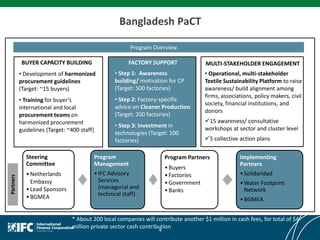
Bangladesh PaCT
4
Rationale for water-use efficiency in rice cultivationProgram Overview
• Development of harmonized
procurement guidelines
(Target: ~15 buyers)
• Training for buyer’s
international and local
procurement teams on
harmonized procurement
guidelines (Target: ~400 staff)
• Step 1: Awareness
building/ motivation for CP
(Target: 500 factories)
• Step 2: Factory-specific
advice on Cleaner Production
(Target: 200 factories)
• Step 3: Investment in
technologies (Target: 100
factories)
• Operational, multi-stakeholder
Textile Sustainability Platform to raise
awareness/ build alignment among
firms, associations, policy makers, civil
society, financial institutions, and
donors
15 awareness/ consultative
workshops at sector and cluster level
5 collective action plans
BUYER CAPACITY BUILDING FACTORY SUPPORT MULTI-STAKEHOLDER ENGAGEMENT
Steering
Committee
•Netherlands
Embassy
•Lead Sponsors
•BGMEA
Program
Management
•IFC Advisory
Services
(managerial and
technical staff)
Program Partners
•Buyers
•Factories
•Government
•Banks
Implementing
Partners
•Solidaridad
•Water Footprint
Network
•BGMEA
Partners
* About 200 local companies will contribute another $1 million in cash fees, for total of $4
million private sector cash contribution
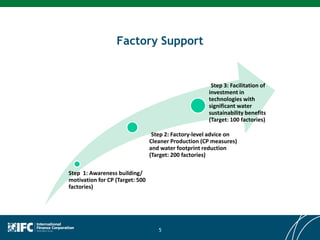
Factory Support
5
Step 1: Awareness building/
motivation for CP (Target: 500
factories)P (Target: 500 factories)
Step 2: Factory-level advice on
Cleaner Production (CP measures)
and water footprint reduction
(Target: 200 factories)
Step 3: Facilitation of
investment in
technologies with
significant water
sustainability benefits
(Target: 100 factories)
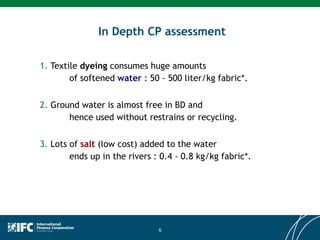
6
1. Textile dyeing consumes huge amounts
of softened water : 50 - 500 liter/kg fabric*.
2. Ground water is almost free in BD and
hence used without restrains or recycling.
3. Lots of salt (low cost) added to the water
ends up in the rivers : 0.4 - 0.8 kg/kg fabric*.
In Depth CP assessment
7
• Good factory
• Good attitude towards improving resource efficiency
• Many good practices in place
• Many opportunities to improve
In Depth CP Assessment
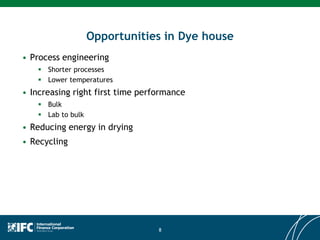
Opportunities in Dye house
8
• Process engineering
 Shorter processes
 Lower temperatures
• Increasing right first time performance
 Bulk
 Lab to bulk
• Reducing energy in drying
• Recycling
9
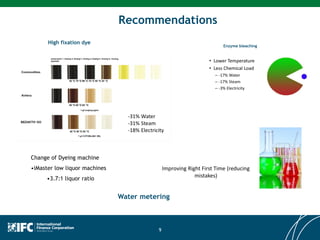
High fixation dye
Enzyme bleaching
Recommendations
Change of Dyeing machine
•iMaster low liquor machines
•3.7:1 liquor ratio
Water metering
10
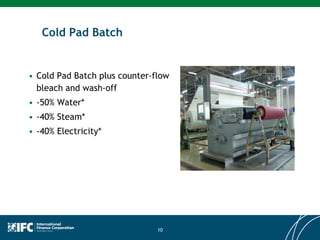
• Cold Pad Batch plus counter-flow
bleach and wash-off
• -50% Water*
• -40% Steam*
• -40% Electricity*
Cold Pad Batch
Opportunities in finishing
11
• Profile moisture content of all pre-dry fabrics
• Reduce pre-dry moisture
 Mangles approx 30,000 Euro
 Saving approx 30% of energy requirement
• Avoid over-drying
 Moisture meters on all stenters
 Saving further 5% of energy requirement
• Heat recovery from stenters
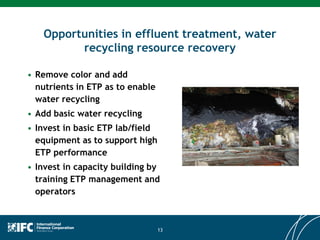
Opportunities in effluent treatment, water
recycling resource recovery
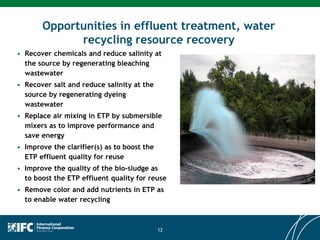
• Recover chemicals and reduce salinity at
the source by regenerating bleaching
wastewater
• Recover salt and reduce salinity at the
source by regenerating dyeing
wastewater
• Replace air mixing in ETP by submersible
mixers as to improve performance and
save energy
• Improve the clarifier(s) as to boost the
ETP effluent quality for reuse
• Improve the quality of the bio-sludge as
to boost the ETP effluent quality for reuse
• Remove color and add nutrients in ETP as
to enable water recycling
12
Opportunities in effluent treatment, water
recycling resource recovery
• Remove color and add
nutrients in ETP as to enable
water recycling
• Add basic water recycling
• Invest in basic ETP lab/field
equipment as to support high
ETP performance
• Invest in capacity building by
training ETP management and
operators
13
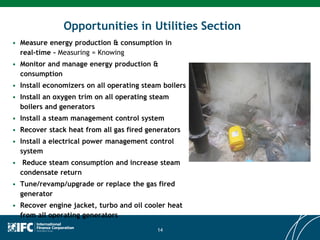
Opportunities in Utilities Section
• Measure energy production & consumption in
real-time - Measuring = Knowing
• Monitor and manage energy production &
consumption
• Install economizers on all operating steam boilers
• Install an oxygen trim on all operating steam
boilers and generators
• Install a steam management control system
• Recover stack heat from all gas fired generators
• Install a electrical power management control
system
• Reduce steam consumption and increase steam
condensate return
• Tune/revamp/upgrade or replace the gas fired
generator
• Recover engine jacket, turbo and oil cooler heat
from all operating generators
14
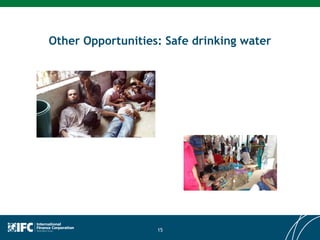
Other Opportunities: Safe drinking water
15
Conclusions
• Customer use cases
• Right pricing
• Messaging to customer
• Pre and post implementation services
• Language and local office
16

Bangladesh water-pact---overview

  • 1.
    Bangladesh Water “PaCT” Partnershipfor Cleaner Textile Program Overview
  • 2.
    Textile Sector Overview Bangladesh’skey sector is a major contributor to water availability and pollution issues 2 Textile Sector Export contribution Economic relevance Factory concentration Water consumption Water pollution Groundwater depletion • Estimated to be a $17.9 billion industry, textiles accounts for 30% of Bangladesh’s industrial sector GDP • Textile industry employs 3.6 million people of whom 85% are women • Textile and garments industry accounts for ~80% of export earnings • Sector includes 1,700 garment washing, dyeing and finishing units, in and around the Dhaka metropolis, and impacts the lives of 12 million + inhabitants • Textile industry is the country’s second biggest polluter (after tanneries), significantly impacting water surface and groundwater quality • Sector consumes 1,500 billion liters of groundwater annually for a total production of 5 million tons of fabric (300 liters per kg fabric) • Greater Dhaka area is experiencing decline in groundwater tables at the rate of 1-2 meters/ year, with seasonal water shortages Key features of Textile Sector
  • 3.
    PaCT Objectives Program aimsat transformation of the textile sector through positive social, environmental and economic impact creation 3 REDUCTION IN ENERGY CONSUMPTION AND GHG EMISSIONS – 150,000MT • Lack of awareness around optimal operations and maintenance practices lead to significant energy wastage • Estimates suggest adoption of low-cost/ no- cost cleaner production measures by the sector’s 1,700 wet processing units will result in savings of 600 thousand MWH of electricity and 1.3 billion m3 of gas REDUCTION OF WATER USAGE – 25MCM • Textile sector’s overall water usage is highly inefficient, using on average 300 liters of water per kg fabric • Best practice water usage is estimated at ~50 liters of water per kg fabric • Substantial water savings are possible through adoption of low-cost/ no- cost cleaner production measures, as well as water treatment/ reuse and new WDF technologies REDUCTION OF WASTEWATER USE/ QUALITY IMPROVEMENT – [Target TBD] • Textile sector is a significant contributor to surface water pollution • Inadequate/ improper effluent treatment are contaminating agricultural land, reducing local crop yields1 and increasing costs of water treatment for potable requirements2 IMPROVEMENT TO OHS/ WASH CONDITIONS • Lack of capacity, low attention to occupational health and safety, and limited access to sanitation facilities lead to significant health risks for workers • Improvement of WASH facilities can avoid water-borne illnesses and worker absenteeism Goals of PaCT Program Investment Facilitation: US$50 million
  • 4.
    Bangladesh PaCT 4 Rationale forwater-use efficiency in rice cultivationProgram Overview • Development of harmonized procurement guidelines (Target: ~15 buyers) • Training for buyer’s international and local procurement teams on harmonized procurement guidelines (Target: ~400 staff) • Step 1: Awareness building/ motivation for CP (Target: 500 factories) • Step 2: Factory-specific advice on Cleaner Production (Target: 200 factories) • Step 3: Investment in technologies (Target: 100 factories) • Operational, multi-stakeholder Textile Sustainability Platform to raise awareness/ build alignment among firms, associations, policy makers, civil society, financial institutions, and donors 15 awareness/ consultative workshops at sector and cluster level 5 collective action plans BUYER CAPACITY BUILDING FACTORY SUPPORT MULTI-STAKEHOLDER ENGAGEMENT Steering Committee •Netherlands Embassy •Lead Sponsors •BGMEA Program Management •IFC Advisory Services (managerial and technical staff) Program Partners •Buyers •Factories •Government •Banks Implementing Partners •Solidaridad •Water Footprint Network •BGMEA Partners * About 200 local companies will contribute another $1 million in cash fees, for total of $4 million private sector cash contribution
  • 5.
    Factory Support 5 Step 1:Awareness building/ motivation for CP (Target: 500 factories)P (Target: 500 factories) Step 2: Factory-level advice on Cleaner Production (CP measures) and water footprint reduction (Target: 200 factories) Step 3: Facilitation of investment in technologies with significant water sustainability benefits (Target: 100 factories)
  • 6.
    6 1. Textile dyeingconsumes huge amounts of softened water : 50 - 500 liter/kg fabric*. 2. Ground water is almost free in BD and hence used without restrains or recycling. 3. Lots of salt (low cost) added to the water ends up in the rivers : 0.4 - 0.8 kg/kg fabric*. In Depth CP assessment
  • 7.
    7 • Good factory •Good attitude towards improving resource efficiency • Many good practices in place • Many opportunities to improve In Depth CP Assessment
  • 8.
    Opportunities in Dyehouse 8 • Process engineering  Shorter processes  Lower temperatures • Increasing right first time performance  Bulk  Lab to bulk • Reducing energy in drying • Recycling
  • 9.
    9 High fixation dye Enzymebleaching Recommendations Change of Dyeing machine •iMaster low liquor machines •3.7:1 liquor ratio Water metering
  • 10.
    10 • Cold PadBatch plus counter-flow bleach and wash-off • -50% Water* • -40% Steam* • -40% Electricity* Cold Pad Batch
  • 11.
    Opportunities in finishing 11 •Profile moisture content of all pre-dry fabrics • Reduce pre-dry moisture  Mangles approx 30,000 Euro  Saving approx 30% of energy requirement • Avoid over-drying  Moisture meters on all stenters  Saving further 5% of energy requirement • Heat recovery from stenters
  • 12.
    Opportunities in effluenttreatment, water recycling resource recovery • Recover chemicals and reduce salinity at the source by regenerating bleaching wastewater • Recover salt and reduce salinity at the source by regenerating dyeing wastewater • Replace air mixing in ETP by submersible mixers as to improve performance and save energy • Improve the clarifier(s) as to boost the ETP effluent quality for reuse • Improve the quality of the bio-sludge as to boost the ETP effluent quality for reuse • Remove color and add nutrients in ETP as to enable water recycling 12
  • 13.
    Opportunities in effluenttreatment, water recycling resource recovery • Remove color and add nutrients in ETP as to enable water recycling • Add basic water recycling • Invest in basic ETP lab/field equipment as to support high ETP performance • Invest in capacity building by training ETP management and operators 13
  • 14.
    Opportunities in UtilitiesSection • Measure energy production & consumption in real-time - Measuring = Knowing • Monitor and manage energy production & consumption • Install economizers on all operating steam boilers • Install an oxygen trim on all operating steam boilers and generators • Install a steam management control system • Recover stack heat from all gas fired generators • Install a electrical power management control system • Reduce steam consumption and increase steam condensate return • Tune/revamp/upgrade or replace the gas fired generator • Recover engine jacket, turbo and oil cooler heat from all operating generators 14
  • 15.
    Other Opportunities: Safedrinking water 15
  • 16.
    Conclusions • Customer usecases • Right pricing • Messaging to customer • Pre and post implementation services • Language and local office 16