
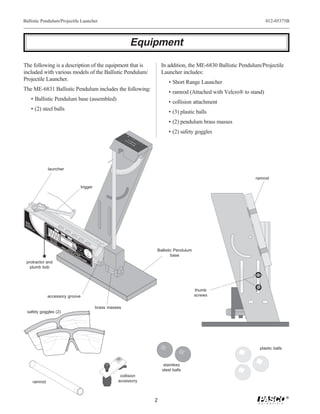



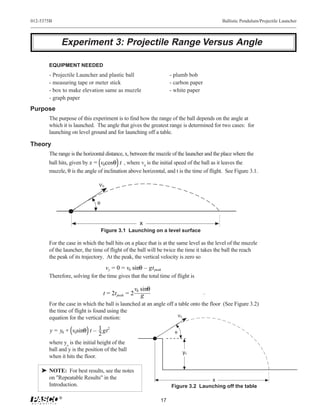






Includes
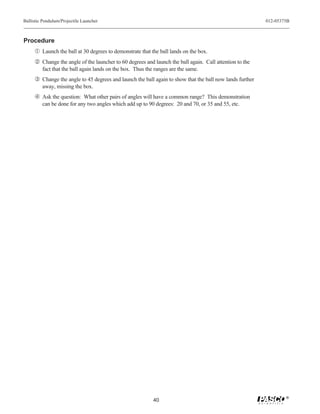
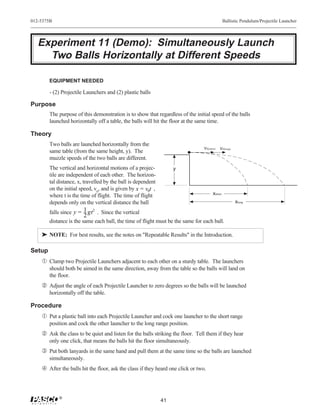
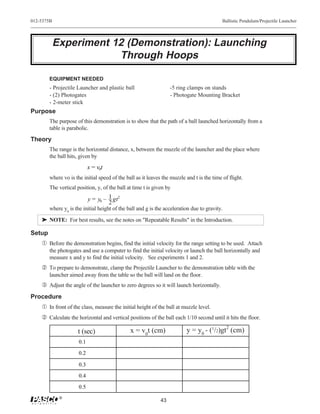
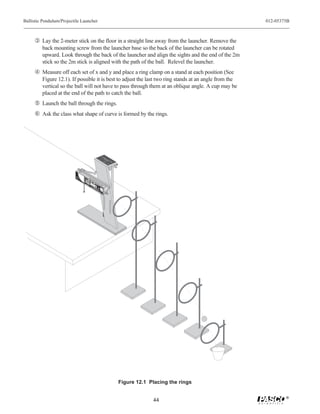
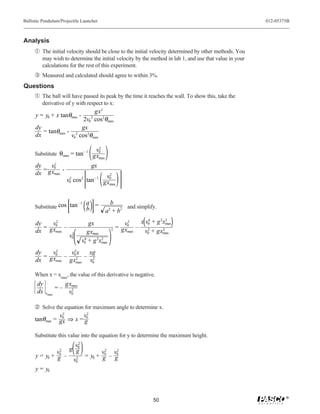
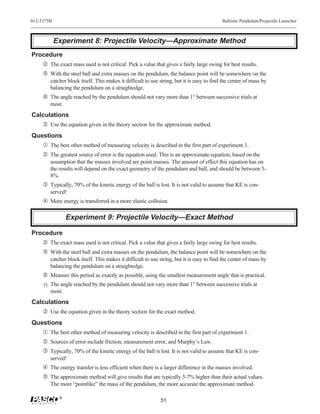
 Teacher's Notes
       and
                     Instruction Manual and                                                                                                                  012-05375B
                                                                                                                                                                2/99
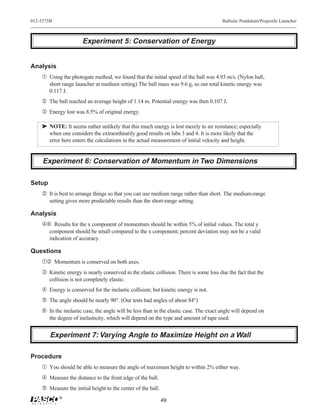
      Typical
Experiment Results   Experiment Guide for the
                     PASCO scientific Model
                     ME-6830/ME-6831


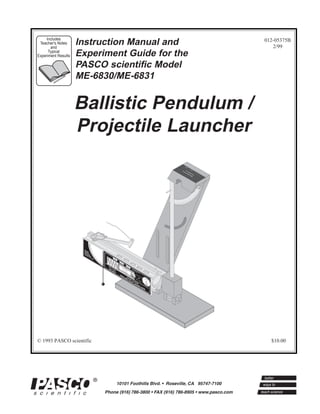
                     Ballistic Pendulum /
                     Projectile Launcher

                                                                                                                                                BA ME-
                                                                                                                                                  LL 68
                                                                                                                                                    IST 31
                                                                                                                                                       IC
                             98
                              7


                      W
                        E
                      SA AR
                                  6


                      GLFE
                      W ASTY
                                      5


                       HE SE
                          N S
                                          4


                            IN
                               US                                     LO
                                              3


                                                                     RA NG
                                  E.                                    NG
                                                  2                        E

                                                      1                        ME
                                                                               RADIU
                                                                                  NG M
                                                          0                         E

                                                                                            SH
                                                                                            RA OR
                                                                                              NGT
                                                                                DO CAU
                                                                                 C
                                                                                 D AU T
                                                                                              E
                                                              ME               DO O N TIO
                                                                                   N O IO
                                                                                                    Ye
                                                                                                       llo
                                                                                 W OT N!
                                                                                                    In w
                                                                -6                DN T L N!
                                                                                    OW LO
                                                                                                      di
                                                                                                         ca Ban
                                                                   80                BA OO
                                                                                      N   O
                                                                                                           te
                                                                                                              s Rd in
                                                                                        TH KK
                                                                                                                 an W
                                                                       0                 RR
                                                                                          EE
                                                                                                                    ge in
                                                                                                                      .  do
                                                                                                                            w
                                                                                             L!                Us
                                                                               PR                                   e
                                                                                                                        25
                                                                                    O                                           m
                                                                                         JESHO      ba
                                                                                                              m
                                                                                                                                    Lau
                                                                                           CT RT       lls                              nch

                                                                                              IL RA        O
                                                                                                             NL
                                                                                                E NG            Y!
                                                                                                  LA E                              Po
                                                                                                                                       si
                                                                                                                                     of tion
                                                                                                     UN                                 Bal
                                                                                                                                            l
                                                                                                           CH
                                                                                                                 E                  R


© 1993 PASCO scientific                                                                                                                                        $10.00
012-05375B                                                                                                        Ballistic Pendulum/Projectile Launcher


                                                  Table of Contents


                 Section                                                                                                        Page
                 Copyright, Warranty, and Equipment Return ................................................... ii
                 Introduction ...................................................................................................... 1
                 Equipment ......................................................................................................... 2
                 General Operation Of The Projectile Launcher ................................................ 3
                 Theory of operation for Ballistic Pendulum ..................................................... 4
                 Installation Of The Optional Photogate Bracket .............................................. 6
                 Installing the 2-Dimensional Collision Attachment ......................................... 7
                 Expectations For The Projectile Launcher ....................................................... 7
                 Expectations for the Ballistic Pendulum .......................................................... 7
                 Experiments
                 1. Projectile Motion ........................................................................................ 9
                 2. Projectile Motion Using Photogates ......................................................... 13
                 3. Projectile Range versus Angle .................................................................. 17
                 4. Projectile Path ........................................................................................... 21
                 5. Conservation of Energy ............................................................................ 25
                 6. Conservation of Momentum in Two Dimensions .................................... 29
                 7. Varying Angle to Maximize Height on a Wall......................................... 33
                 8. Ballistic Pendulum approximate method .................................................. 35
                 9. Ballistic Pendulum exact method ............................................................. 37
                 10. Demo: Do 30⋅ and 60⋅ Give Same Range? ........................................... 39
                 11. Demo: Simultaneously Shoot Two Balls
                         Horizontally at Different Speeds ........................................................ 41
                 12. Demo: Shoot through Hoops ................................................................. 43
                 13. Demo: Elastic / Inelastic Collisions ...................................................... 45
                 Teachers Guide ............................................................................................... 46
                 Technical Support ............................................................................ Back Cover


             ®                                                             i
Ballistic Pendulum/Projectile Launcher                                                                                 012-05375B


               Copyright, Warranty and Equipment Return

                                         Please—Feel free to duplicate this manual
                                         subject to the copyright restrictions below.


Copyright Notice                                                      Equipment Return
The PASCO scientific 012-05375 manual is copyrighted                  Should the product have to be returned to PASCO
and all rights reserved. However, permission is granted to            scientific, for whatever reason, notify PASCO scientific
non-profit educational institutions for reproduction of any           by letter, phone, or fax BEFORE returning the product.
part of the Ballistic Pendulum/Projectile Launcher                    Upon notification, the return authorization and shipping
manual providing the reproductions are used only for                  instructions will be promptly issued.
their laboratories and are not sold for profit. Reproduction
under any other circumstances, without the written                       ® NOTE: NO EQUIPMENT WILL BE
consent of PASCO scientific, is prohibited.                              ACCEPTED FOR RETURN WITHOUT AN
                                                                         AUTHORIZATION.
Limited Warranty
                                                                      When returning equipment for repair, the units must be
PASCO scientific warrants the product to be free from                 packed properly. Carriers will not accept responsibility
defects in materials and workmanship for a period of one              for damage caused by improper packing. To be certain
year from the date of shipment to the customer. PASCO                 the unit will not be damaged in shipment, observe the
will repair or replace, at its option, any part of the product        following rules:
which is deemed to be defective in material or workman-
ship. The warranty does not cover damage to the product               Œ The carton must be strong enough for the item
caused by abuse or improper use. Determination of                        shipped.
whether a product failure is the result of a manufacturing             Make certain there is at least two inches of packing
defect or improper use by the customer shall be made                     material between any point on the apparatus and the
solely by PASCO scientific. Responsibility for the return                inside walls of the carton.
of equipment for warranty repair belongs to the customer.
Equipment must be properly packed to prevent damage                   Ž Make certain that the packing material can not shift in
and shipped postage or freight prepaid. (Damage caused                   the box, or become compressed, thus letting the
by improper packing of the equipment for return ship-                     instrument come in contact with the edge of the box.
ment will not be covered by the warranty.) Shipping costs
for returning the equipment, after repair, will be paid by
PASCO scientific.                                                        Address:      PASCO scientific
                                                                                       10101 Foothills Blvd.
                                                                                       Roseville, CA 95747-7100
                                                                         Phone:        (916) 786-3800
                                                                         FAX:          (916) 786-8905
                                                                         email:        techsupp@pasco.com


Credits
Author: Ann Hanks and Eric Ayers


                                                                 ii                                                              ®
012-05375B                                                                                 Ballistic Pendulum/Projectile Launcher


                                               Introduction

The PASCO ME-6830/ME-6831 Ballistic Pendulum/                       ® IMPORTANT: Experimental results can be
Projectile Launcher (BPPL) has been designed for                    further improved by making sure that the ball does
projectile experiments and demonstrations as well as the            not stick to the blue vibration damping ring prior to
classic Ballistic Pendulum experiments. The only                    being launched. This is particularly critical for the
additional equipment required is a C-clamp for clamping             long range setting and for launching angles above
the launcher to a table. The features of the Ballistic              30°. To assure the ball does not stick to the ring,
Pendulum/Projectile Launcher include:                               push it gently with a pencil from the back of the barrel.
• LAUNCH AT ANY ANGLE: Balls can be                              • BARREL SIGHTS AND SAFETY PRECAU-
  launched at any angle from zero to 90 degrees mea-               TIONS: The sights for aiming the Projectile
  sured from the horizontal. The angle is easily ad-               Launcher can be viewed from the back of the launcher
  justed using thumb screws. The built-in protractor               by looking through the back end of the barrel.
  and plumb-bob on the side of the launcher give a con-
  venient and accurate way of determining the angle of              ®WARNING: Never look down the front of the
  inclination.                                                      barrel because it may be loaded. To see if the ball is in
• THREE RANGE SETTINGS: There are three                             the barrel and to check whether the Projectile Launcher
  ranges from which to choose. For the Short Range                  is cocked, look at the slots in the side of the barrel.
  Projectile Launcher these three ranges are approxi-               The yellow indicator seen through the side slot
  mately 1.2 meters, 3 meters, and 5 meters, when the               indicates the position of the piston. The ball can also
  angle is 45 degrees. For the Long Range Demonstra-                be seen through these slots when it is in the piston.
  tion Projectile Launcher, the three ranges are approxi-
  mately 2.5 meters, 5 meters, and 8 meters. The differ-         • COMPUTER COMPATIBLE: Photogates can be at-
  ence between these two versions of the Projectile                tached with the ME-6821 Photogate Mounting Bracket
  Launcher is the strength of the spring. The long range           to connect the Projectile Launcher to a computer for mea-
  version is intended for large classroom demonstra-               suring the muzzle speed. Also, a photogate at the muzzle
  tions and should not be used with the Ballistic Pendu-           and an ME-6810 Time-of-Flight Accessory can be used
  lum base.                                                        to time the flight of the ball.
• FIXED ELEVATION INDEPENDENT OF                                 • COMPACT STORAGE: The Projectile Launcher
  ANGLE: The Projectile Launcher pivots at the                     stores away in a small space. The ramrod attaches to
  muzzle end so the elevation of the ball as it leaves the         the Projectile Launcher with Velcro® and the
  barrel does not change as the angle is varied. The               launcher can be turned vertically so it takes up the
  base has three sets of slots. The top curved slot is             minimum amount of space on the shelf.
  used when it is desired to change the angle and the            • RELIABLE BALL-CATCHER MECHANISM:
  center two slots are used when it is desired to shoot            The sensitive spring-loaded barb-type catch on the
  horizontally only. The bottom mounting holes are for             pendulum will catch balls with a large range of mo-
  use with the Ballistic Pendulum experiment.                      menta. In addition, the ball is held in line with the
• REPEATABLE RESULTS: There is no spin on the                      pendulum rod for best accuracy.
  ball since the piston keeps the ball from rubbing on           • REMOVABLE PENDULUM: All moving parts of
  the walls as it travels up the barrel. The sturdy base           the pendulum may be removed so that the mass and
  can be secured to a table with a C- clamp (not in-               the center of mass can be easily determined. In addi-
  cluded) so there is very little recoil. The trigger is           tion, the pendulum can be reversed to compare the ef-
  pulled with a string to minimize any misalignment                fects of inelastic and elastic collisions.
  caused by other methods of trigger release.
                                                                 • VARIABLE-MASS PENDULUM: Masses can be
                                                                   added to the bottom of the pendulum so that meaning-
                                                                   ful measurements can be taken with either heavy or
                                                                   lightweight balls, over a wide range of velocities.
             ®
                                                             1
Ballistic Pendulum/Projectile Launcher                                                                                                                                                                   012-05375B


                                                                                                                                             Equipment

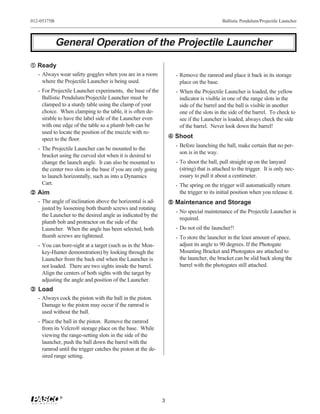
The following is a description of the equipment that is                                                                                                   In addition, the ME-6830 Ballistic Pendulum/Projectile
included with various models of the Ballistic Pendulum/                                                                                                   Launcher includes:
Projectile Launcher.
                                                                                                                                                             • Short Range Launcher
The ME-6831 Ballistic Pendulum includes the following:
                                                                                                                                                             • ramrod (Attached with Velcro® to stand)
        • Ballistic Pendulum base (assembled)
                                                                                                                                                             • collision attachment
        • (2) steel balls
                                                                                                                                                             • (3) plastic balls
                                                                                                                                                             • (2) pendulum brass masses
                                                                                                                                                             • (2) safety goggles
                                                                                                                                         BA ME-
                                                                                                                                           LL 68
                                                                                                                                             IST 31
                                                                                                                                                IC


                                         launcher

                                                                                                                                                                                                   ramrod

                                                                                                    trigger
        98
         7


 W
   E
 SA AR
             6


 GLFE
 W ASTY
                 5


  HE SE
     N S
                     4


       IN
          US                                      LO
                         3


                                                 RA NG
             E.                                     NG
                             2                         E

                                 1                         ME
                                                           RADIU
                                                              NG M
                                     0                          E

                                                                        SH
                                                                        RA OR
                                                                          NGT
                                                            DO CAU
                                                             C
                                                             D AU T
                                                                          E
                                          ME               DO O N TIO
                                                               N O IO
                                                                                Ye
                                                                                   llo
                                                             W OT N!
                                                                                In w
                                            -6                DN T L N!
                                                                OW LO
                                                                                  di
                                                                                     ca Ban
                                               80                BA OO
                                                                  N   O
                                                                                       te d
                                                                                         s R in
                                                                    TH KK
                                                                                            an W
                                                   0                 RR
                                                                      EE
                                                                                              ge indo
                                                                                                .     w
                                                                         L!               Us
                                                           PR                                  e
                                                                                                   25
                                                                O                                         m
                                                                     JESHO
                                                                       CT RT
                                                                          IL RA
                                                                                ba
                                                                                   lls
                                                                                       O
                                                                                          m


                                                                                         NL
                                                                                                              La
                                                                                                                  un
                                                                                                                    ch                                Ballistic Pendulum
                                                                            E NG            Y!
                                                                              LA E
                                                                                 UN
                                                                                                              Po
                                                                                                                 s
                                                                                                               of ition
                                                                                                                  Ba
                                                                                                                     ll
                                                                                                                                                              base
                                                                                       CH
                                                                                             E                R
  protractor and
    plumb bob


                                                                                                                                                                           thumb
                                         accessory groove                                                                                                                  screws

                                                                                                                          brass masses
   safety goggles (2)


                                                                                                                                                                                                     plastic balls


                                                                                                                                                           stainless
                                                                                                                                                          steel balls
                                                                                                                                     collision
          ramrod                                                                                                                    accessory


                                                                                                                                                                                                                     ®
                                                                                                                                                      2
012-05375B                                                                                 Ballistic Pendulum/Projectile Launcher


             General Operation of the Projectile Launcher

Œ Ready
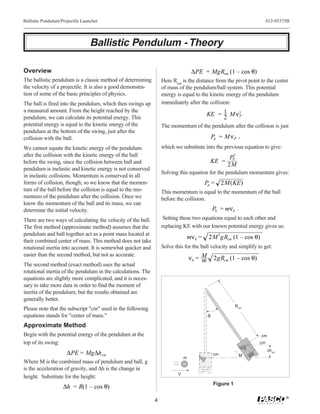
   - Always wear safety goggles when you are in a room              - Remove the ramrod and place it back in its storage
     where the Projectile Launcher is being used.                     place on the base.
   - For Projectile Launcher experiments, the base of the           - When the Projectile Launcher is loaded, the yellow
     Ballistic Pendulum/Projectile Launcher must be                   indicator is visible in one of the range slots in the
     clamped to a sturdy table using the clamp of your                side of the barrel and the ball is visible in another
     choice. When clamping to the table, it is often de-              one of the slots in the side of the barrel. To check to
     sirable to have the label side of the Launcher even              see if the Launcher is loaded, always check the side
     with one edge of the table so a plumb bob can be                 of the barrel. Never look down the barrel!
     used to locate the position of the muzzle with re-
     spect to the floor.                                           Shoot
                                                                    - Before launching the ball, make certain that no per-
   - The Projectile Launcher can be mounted to the
                                                                      son is in the way.
     bracket using the curved slot when it is desired to
     change the launch angle. It can also be mounted to             - To shoot the ball, pull straight up on the lanyard
     the center two slots in the base if you are only going           (string) that is attached to the trigger. It is only nec-
     to launch horizontally, such as into a Dynamics                  essary to pull it about a centimeter.
     Cart.                                                          - The spring on the trigger will automatically return
 Aim                                                                 the trigger to its initial position when you release it.
   - The angle of inclination above the horizontal is ad-          Maintenance and Storage
     justed by loosening both thumb screws and rotating
                                                                    - No special maintenance of the Projectile Launcher is
     the Launcher to the desired angle as indicated by the
                                                                      required.
     plumb bob and protractor on the side of the
     Launcher. When the angle has been selected, both               - Do not oil the launcher!!
     thumb screws are tightened.                                    - To store the launcher in the least amount of space,
   - You can bore-sight at a target (such as in the Mon-              adjust its angle to 90 degrees. If the Photogate
     key-Hunter demonstration) by looking through the                 Mounting Bracket and Photogates are attached to
     Launcher from the back end when the Launcher is                  the launcher, the bracket can be slid back along the
     not loaded. There are two sights inside the barrel.              barrel with the photogates still attached.
     Align the centers of both sights with the target by
     adjusting the angle and position of the Launcher.
Ž Load
   - Always cock the piston with the ball in the piston.
     Damage to the piston may occur if the ramrod is
     used without the ball.
   - Place the ball in the piston. Remove the ramrod
     from its Velcro® storage place on the base. While
     viewing the range-setting slots in the side of the
     launcher, push the ball down the barrel with the
     ramrod until the trigger catches the piston at the de-
     sired range setting.


             ®
                                                              3
Ballistic Pendulum/Projectile Launcher                                                                                   012-05375B


                                  Ballistic Pendulum - Theory

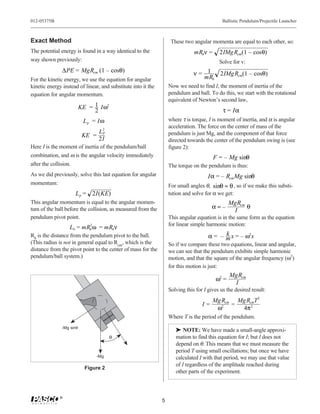
Overview                                                                           ∆PE = MgRcm (1 – cos θ)
The ballistic pendulum is a classic method of determining         Here Rcm is the distance from the pivot point to the center
the velocity of a projectile. It is also a good demonstra-        of mass of the pendulum/ball system. This potential
tion of some of the basic principles of physics.                  energy is equal to the kinetic energy of the pendulum
The ball is fired into the pendulum, which then swings up         immediately after the collision:
a measured amount. From the height reached by the
                                                                                           KE = 1 M ν 2
                                                                                                      P
pendulum, we can calculate its potential energy. This                                           2
potential energy is equal to the kinetic energy of the            The momentum of the pendulum after the collision is just
pendulum at the bottom of the swing, just after the
collision with the ball.                                                                       Pp = M ν P ,
We cannot equate the kinetic energy of the pendulum               which we substitute into the previous equation to give:
after the collision with the kinetic energy of the ball                                                2
                                                                                                      PP
before the swing, since the collision between ball and                                      KE =
                                                                                                     2M
pendulum is inelastic and kinetic energy is not conserved
                                                                  Solving this equation for the pendulum momentum gives:
in inelastic collisions. Momentum is conserved in all
forms of collision, though; so we know that the momen-                                     Pp = 2M(KE)
tum of the ball before the collision is equal to the mo-          This momentum is equal to the momentum of the ball
mentum of the pendulum after the collision. Once we               before the collision:
know the momentum of the ball and its mass, we can
determine the initial velocity.                                                                Pb = mν b .
There are two ways of calculating the velocity of the ball.        Setting these two equations equal to each other and
The first method (approximate method) assumes that the            replacing KE with our known potential energy gives us:
pendulum and ball together act as a point mass located at
                                                                                  mν b =    2M 2gRcm (1 – cos θ)
their combined center of mass. This method does not take
rotational inertia into account. It is somewhat quicker and       Solve this for the ball velocity and simplify to get:
easier than the second method, but not as accurate.
                                                                                  νb = M
                                                                                       m        2gRcm (1 – cos θ)
The second method (exact method) uses the actual
rotational inertia of the pendulum in the calculations. The
equations are slightly more complicated, and it is neces-
sary to take more data in order to find the moment of
inertia of the pendulum; but the results obtained are
generally better.
                                                                                                          Rcm
Please note that the subscript "cm" used in the following
equations stands for "center of mass."                                                     θ
Approximate Method
Begin with the potential energy of the pendulum at the                                                              cm
top of its swing:                                                                                                   cm
                                                                                                                         ∆hcm
                      ∆PE = Mg∆h cm                                                            cm          M
                                                                              m
Where M is the combined mass of pendulum and ball, g
is the acceleration of gravity, and ∆h is the change in
                                                                          V
height. Substitute for the height:
                                                                                               Figure 1
                    ∆h = R(1 – cos θ)
                                                                                                                                 ®
                                                              4
012-05375B                                                                                   Ballistic Pendulum/Projectile Launcher


Exact Method                                                        These two angular momenta are equal to each other, so:
The potential energy is found in a way identical to the                        mRbν =      2IMg Rcm(1 – cosθ)
way shown previously:                                                                      Solve for v:
               ∆PE = MgRcm (1 – cosθ)                                          ν= 1  2IMg Rcm(1 – cosθ)
For the kinetic energy, we use the equation for angular                          mRb
kinetic energy instead of linear, and substitute into it the       Now we need to find I, the moment of inertia of the
equation for angular momentum.                                     pendulum and ball. To do this, we start with the rotational
                                                                   equivalent of Newton’s second law,
                          KE = 1 Iω2
                               2                                                             τ = Iα
                           L p = Iω                                where τ is torque, I is moment of inertia, and α is angular
                                                                   acceleration. The force on the center of mass of the
                                  L2
                                   P                               pendulum is just Mg, and the component of that force
                           KE =
                                  2I                               directed towards the center of the pendulum swing is (see
Here I is the moment of inertia of the pendulum/ball               figure 2):
combination, and ω is the angular velocity immediately                                  F = – Mg sinθ
after the collision.                                               The torque on the pendulum is thus:
As we did previously, solve this last equation for angular                            Iα = – Rcm Mg sinθ
momentum:                                                          For small angles θ, sinθ ≈ θ , so if we make this substi-
                       L p = 2I(KE)                                tution and solve for α we get:
This angular momentum is equal to the angular momen-                                            MgRcm
tum of the ball before the collision, as measured from the                              α≈–           θ
                                                                                                 I
pendulum pivot point.                                              This angular equation is in the same form as the equation
                                                                   for linear simple harmonic motion:
                   Lb = mRb ω = mRbν
                          2


Rb is the distance from the pendulum pivot to the ball.                                     k
                                                                                      α = – m x = – ω2x
(This radius is not in general equal to Rcm, which is the          So if we compare these two equations, linear and angular,
distance from the pivot point to the center of mass for the        we can see that the pendulum exhibits simple harmonic
pendulum/ball system.)                                             motion, and that the square of the angular frequency (ω2)
                                                                   for this motion is just:
                                                                                                MgRcm
                                                                                         ω2 =
                                                                                                 I
                                                                   Solving this for I gives us the desired result:
                                                                                        Mg Rcm Mg RcmT 2
                                                                                   I=         =
                                                                                         ω2     4π 2
                                                                   Where T is the period of the pendulum.
               -Mg sinθ
                                                                      ® NOTE: We have made a small-angle approxi-
                                       θ                              mation to find this equation for I; but I does not
                                                                      depend on θ. This means that we must measure the
                                                                      period T using small oscillations; but once we have
                                -Mg                                   calculated I with that period, we may use that value
                                                                      of I regardless of the amplitude reached during
                            Figure 2
                                                                      other parts of the experiment.


              ®
                                                               5
Ballistic Pendulum/Projectile Launcher                                                                              012-05375B


                   Installing the Photogate Mounting Bracket

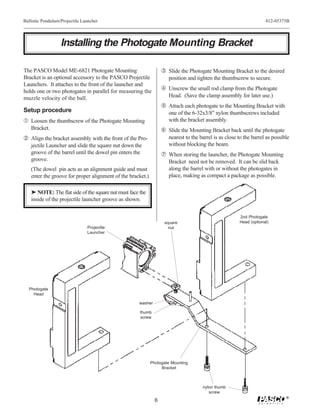
The PASCO Model ME-6821 Photogate Mounting                        Ž Slide the Photogate Mounting Bracket to the desired
Bracket is an optional accessory to the PASCO Projectile             position and tighten the thumbscrew to secure.
Launchers. It attaches to the front of the launcher and
holds one or two photogates in parallel for measuring the          Unscrew the small rod clamp from the Photogate
muzzle velocity of the ball.                                         Head. (Save the clamp assembly for later use.)
                                                                   Attach each photogate to the Mounting Bracket with
Setup procedure                                                      one of the 6-32x3/8" nylon thumbscrews included
Œ Loosen the thumbscrew of the Photogate Mounting                    with the bracket assembly.
   Bracket.                                                       ‘ Slide the Mounting Bracket back until the photogate
 Align the bracket assembly with the front of the Pro-              nearest to the barrel is as close to the barrel as possible
   jectile Launcher and slide the square nut down the                without blocking the beam.
   groove of the barrel until the dowel pin enters the            ’ When storing the launcher, the Photogate Mounting
   groove.                                                           Bracket need not be removed. It can be slid back
   (The dowel pin acts as an alignment guide and must                along the barrel with or without the photogates in
   enter the groove for proper alignment of the bracket.)            place, making as compact a package as possible.

   ® NOTE: The flat side of the square nut must face the
   inside of the projectile launcher groove as shown.


                                                                                                       2nd Photogate
                                                                   square                              Head (optional)
                                Projectile                           nut
                                Launcher


  Photogate
    Head

                                                    washer

                                                     thumb
                                                     screw


                                                            Photogate Mounting
                                                                 Bracket


                                                                                     nylon thumb
                                                                                        screw
                                                                                                                              ®
                                                              6
012-05375B                                                                                 Ballistic Pendulum/Projectile Launcher


      Installing the 2-Dimensional Collision Attachment

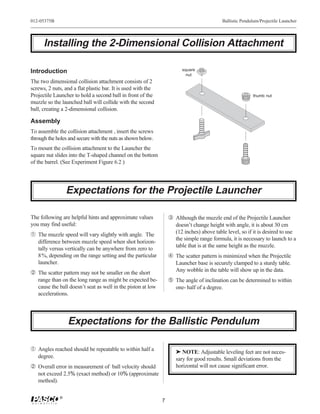
Introduction                                                            square
                                                                          nut
The two dimensional collision attachment consists of 2
screws, 2 nuts, and a flat plastic bar. It is used with the
Projectile Launcher to hold a second ball in front of the                                                 thumb nut
muzzle so the launched ball will collide with the second
ball, creating a 2-dimensional collision.

Assembly
To assemble the collision attachment , insert the screws
through the holes and secure with the nuts as shown below.
To mount the collision attachment to the Launcher the
square nut slides into the T-shaped channel on the bottom
of the barrel. (See Experiment Figure 6.2 )


                 Expectations for the Projectile Launcher

The following are helpful hints and approximate values            Ž Although the muzzle end of the Projectile Launcher
you may find useful:                                                 doesn’t change height with angle, it is about 30 cm
Œ The muzzle speed will vary slightly with angle. The                (12 inches) above table level, so if it is desired to use
                                                                     the simple range formula, it is necessary to launch to a
   difference between muzzle speed when shot horizon-
                                                                     table that is at the same height as the muzzle.
   tally versus vertically can be anywhere from zero to
   8%, depending on the range setting and the particular           The scatter pattern is minimized when the Projectile
   launcher.                                                         Launcher base is securely clamped to a sturdy table.
 The scatter pattern may not be smaller on the short                Any wobble in the table will show up in the data.
   range than on the long range as might be expected be-           The angle of inclination can be determined to within
   cause the ball doesn’t seat as well in the piston at low          one- half of a degree.
   accelerations.


                 Expectations for the Ballistic Pendulum

Œ Angles reached should be repeatable to within half a               ® NOTE: Adjustable leveling feet are not neces-
   degree.                                                           sary for good results. Small deviations from the
 Overall error in measurement of ball velocity should               horizontal will not cause significant error.
   not exceed 2.5% (exact method) or 10% (approximate
   method).

             ®
                                                              7
Ballistic Pendulum/Projectile Launcher       012-05375B


                                                     ®
                                         8
012-5375B                                                                                   Ballistic Pendulum/Projectile Launcher


        Experiment 1: Projectile Motion

        EQUIPMENT NEEDED:
        - Projectile Launcher and plastic ball
        - Plumb bob
        - meter stick
        - carbon paper
        - white paper
Purpose
        The purpose of this experiment is to predict and verify the range of a ball launched at an angle.
        The initial velocity of the ball is determined by launching it horizontally and measuring the range
        and the height of the launcher.
Theory
        To predict where a ball will land on the floor when it is launched off a table at some angle above
        the horizontal, it is necessary to first determine the initial speed (muzzle velocity) of the ball. This
        can be determined by launching the ball horizontally off the table and measuring the vertical and
        horizontal distances through which the ball travels. Then the initial velocity can be used to
        calculate where the ball will land when the ball is launched at an angle.

    ® NOTE: For best results, see the notes on "Repeatable Results" in the Introduction.

        HORIZONTAL INITIAL VELOCITY:
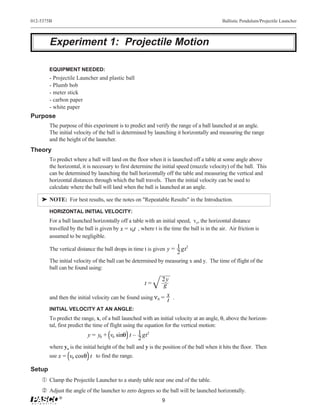
        For a ball launched horizontally off a table with an initial speed, vo, the horizontal distance
        travelled by the ball is given by x = v0t , where t is the time the ball is in the air. Air friction is
        assumed to be negligible.

        The vertical distance the ball drops in time t is given y = 1 gt2
                                                                      2
        The initial velocity of the ball can be determined by measuring x and y. The time of flight of the
        ball can be found using:

                                                               2y
                                                      t=       g
        and then the initial velocity can be found using ν 0 = x .
                                                               t
        INITIAL VELOCITY AT AN ANGLE:
        To predict the range, x, of a ball launched with an initial velocity at an angle, θ, above the horizon-
        tal, first predict the time of flight using the equation for the vertical motion:
                          y = y0 + v0 sinθ t – 1 gt2
                                               2
        where yo is the initial height of the ball and y is the position of the ball when it hits the floor. Then
        use x = v0 cosθ t to find the range.

Setup
    Œ Clamp the Projectile Launcher to a sturdy table near one end of the table.
     Adjust the angle of the launcher to zero degrees so the ball will be launched horizontally.
            ®
                                                               9
Ballistic Pendulum/Projectile Launcher                                                                        012-05375B


Procedure

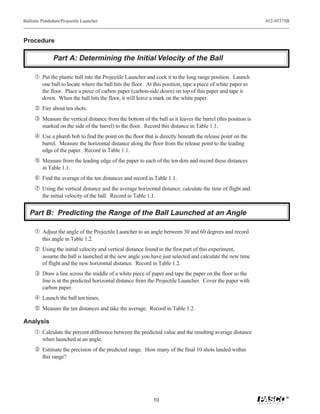
               Part A: Determining the Initial Velocity of the Ball

     Œ Put the plastic ball into the Projectile Launcher and cock it to the long range position. Launch
         one ball to locate where the ball hits the floor. At this position, tape a piece of white paper to
         the floor. Place a piece of carbon paper (carbon-side down) on top of this paper and tape it
         down. When the ball hits the floor, it will leave a mark on the white paper.
      Fire about ten shots.
     Ž Measure the vertical distance from the bottom of the ball as it leaves the barrel (this position is
         marked on the side of the barrel) to the floor. Record this distance in Table 1.1.
      Use a plumb bob to find the point on the floor that is directly beneath the release point on the
         barrel. Measure the horizontal distance along the floor from the release point to the leading
         edge of the paper. Record in Table 1.1.
      Measure from the leading edge of the paper to each of the ten dots and record these distances
         in Table 1.1.
     ‘ Find the average of the ten distances and record in Table 1.1.
     ’ Using the vertical distance and the average horizontal distance, calculate the time of flight and
         the initial velocity of the ball. Record in Table 1.1.


   Part B: Predicting the Range of the Ball Launched at an Angle

     Œ Adjust the angle of the Projectile Launcher to an angle between 30 and 60 degrees and record
         this angle in Table 1.2.
      Using the initial velocity and vertical distance found in the first part of this experiment,
         assume the ball is launched at the new angle you have just selected and calculate the new time
         of flight and the new horizontal distance. Record in Table 1.2.
     Ž Draw a line across the middle of a white piece of paper and tape the paper on the floor so the
         line is at the predicted horizontal distance from the Projectile Launcher. Cover the paper with
         carbon paper.
      Launch the ball ten times.
      Measure the ten distances and take the average. Record in Table 1.2.

Analysis
     Œ Calculate the percent difference between the predicted value and the resulting average distance
         when launched at an angle.
      Estimate the precision of the predicted range. How many of the final 10 shots landed within
         this range?


                                                                                                                      ®
                                                              10
012-5375B                                                                        Ballistic Pendulum/Projectile Launcher


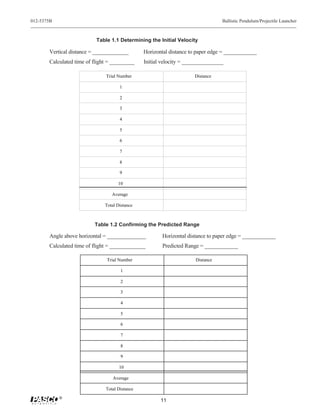
                           Table 1.1 Determining the Initial Velocity

       Vertical distance = _____________        Horizontal distance to paper edge = ____________
       Calculated time of flight = _________    Initial velocity = _______________

                               Trial Number                          Distance

                                      1

                                      2

                                      3

                                      4

                                      5

                                      6

                                      7

                                      8

                                      9

                                     10

                                  Average

                               Total Distance


                          Table 1.2 Confirming the Predicted Range

       Angle above horizontal = ______________         Horizontal distance to paper edge = ____________
       Calculated time of flight = _____________        Predicted Range = ____________

                                Trial Number                          Distance

                                      1

                                      2

                                      3

                                      4

                                      5

                                      6

                                      7

                                      8

                                      9

                                      10

                                  Average

                               Total Distance
            ®
                                                       11
Ballistic Pendulum/Projectile Launcher        012-05375B


                                                      ®
                                         12
012-5375B                                                                                  Ballistic Pendulum/Projectile Launcher


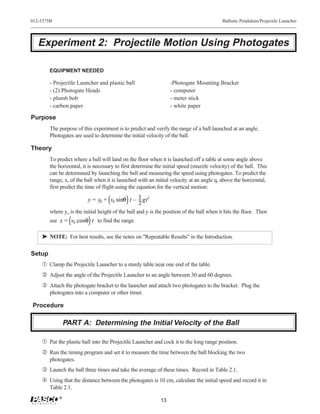
   Experiment 2: Projectile Motion Using Photogates

        EQUIPMENT NEEDED

        - Projectile Launcher and plastic ball                    -Photogate Mounting Bracket
        - (2) Photogate Heads                                     - computer
        - plumb bob                                               - meter stick
        - carbon paper                                            - white paper

Purpose
        The purpose of this experiment is to predict and verify the range of a ball launched at an angle.
        Photogates are used to determine the initial velocity of the ball.

Theory
        To predict where a ball will land on the floor when it is launched off a table at some angle above
        the horizontal, it is necessary to first determine the initial speed (muzzle velocity) of the ball. This
        can be determined by launching the ball and measuring the speed using photogates. To predict the
        range, x, of the ball when it is launched with an initial velocity at an angle q, above the horizontal,
        first predict the time of flight using the equation for the vertical motion:

                          y = y0 + v0 sinθ t – 1 gt2
                                               2
        where yo is the initial height of the ball and y is the position of the ball when it hits the floor. Then
        use x = v0 cosθ t to find the range.

    ® NOTE: For best results, see the notes on "Repeatable Results" in the Introduction.

Setup
    Œ Clamp the Projectile Launcher to a sturdy table near one end of the table.
     Adjust the angle of the Projectile Launcher to an angle between 30 and 60 degrees.
    Ž Attach the photogate bracket to the launcher and attach two photogates to the bracket. Plug the
        photogates into a computer or other timer.

Procedure

                PART A: Determining the Initial Velocity of the Ball

    Œ Put the plastic ball into the Projectile Launcher and cock it to the long range position.
     Run the timing program and set it to measure the time between the ball blocking the two
        photogates.
    Ž Launch the ball three times and take the average of these times. Record in Table 2.1.
     Using that the distance between the photogates is 10 cm, calculate the initial speed and record it in
        Table 2.1.
            ®
                                                             13
Ballistic Pendulum/Projectile Launcher                                                                     012-05375B


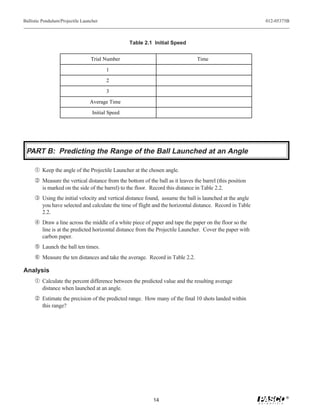
                                                   Table 2.1 Initial Speed


                                  Trial Number                                   Time

                                         1

                                         2

                                         3
                                  Average Time

                                   Initial Speed


 PART B: Predicting the Range of the Ball Launched at an Angle

     Œ Keep the angle of the Projectile Launcher at the chosen angle.
      Measure the vertical distance from the bottom of the ball as it leaves the barrel (this position
         is marked on the side of the barrel) to the floor. Record this distance in Table 2.2.
     Ž Using the initial velocity and vertical distance found, assume the ball is launched at the angle
         you have selected and calculate the time of flight and the horizontal distance. Record in Table
         2.2.
      Draw a line across the middle of a white piece of paper and tape the paper on the floor so the
         line is at the predicted horizontal distance from the Projectile Launcher. Cover the paper with
         carbon paper.
      Launch the ball ten times.
     ‘ Measure the ten distances and take the average. Record in Table 2.2.

Analysis
     Œ Calculate the percent difference between the predicted value and the resulting average
         distance when launched at an angle.
      Estimate the precision of the predicted range. How many of the final 10 shots landed within
         this range?


                                                                                                                   ®
                                                             14
012-5375B                                                                   Ballistic Pendulum/Projectile Launcher


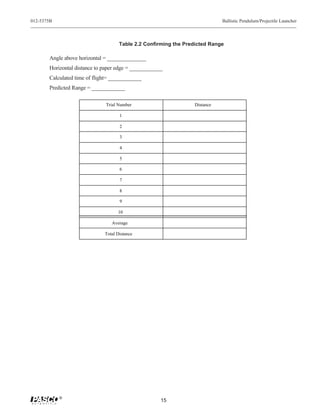
                                     Table 2.2 Confirming the Predicted Range

       Angle above horizontal = ______________
       Horizontal distance to paper edge = ____________
       Calculated time of flight= ____________
       Predicted Range = ____________

                              Trial Number                       Distance

                                     1

                                     2

                                     3

                                     4

                                     5

                                     6

                                     7

                                     8

                                     9

                                    10

                                 Average

                              Total Distance


            ®
                                                      15
Ballistic Pendulum/Projectile Launcher        012-05375B


                                                      ®
                                         16
012-5375B                                                                                 Ballistic Pendulum/Projectile Launcher


            Experiment 3: Projectile Range Versus Angle

       EQUIPMENT NEEDED
       - Projectile Launcher and plastic ball                      - plumb bob
       - measuring tape or meter stick                             - carbon paper
       - box to make elevation same as muzzle                      - white paper
       - graph paper
Purpose
       The purpose of this experiment is to find how the range of the ball depends on the angle at
       which it is launched. The angle that gives the greatest range is determined for two cases: for
       launching on level ground and for launching off a table.

Theory
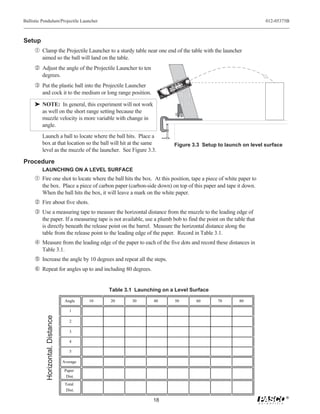
       The range is the horizontal distance, x, between the muzzle of the launcher and the place where the
       ball hits, given by x = v0cosθ t , where v0 is the initial speed of the ball as it leaves the
       muzzle, θ is the angle of inclination above horizontal, and t is the time of flight. See Figure 3.1.

                               ν0

                              θ


                                                      x
                                  Figure 3.1 Launching on a level surface

       For the case in which the ball hits on a place that is at the same level as the level of the muzzle
       of the launcher, the time of flight of the ball will be twice the time it takes the ball the reach
       the peak of its trajectory. At the peak, the vertical velocity is zero so
                                    vy = 0 = v0 sinθ – gt peak
       Therefore, solving for the time gives that the total time of flight is

                                                    v0 sinθ
                                  t = 2t peak = 2                                   .
                                                       g
       For the case in which the ball is launched at an angle off a table onto the floor (See Figure 3.2)
       the time of flight is found using the
       equation for the vertical motion:                           ν0

        y = y0 + v0sinθ t – 1 gt2                                    θ
                            2
       where yo is the initial height of the
       ball and y is the position of the ball
                                                                         y0
       when it hits the floor.

    ® NOTE: For best results, see the notes
      on "Repeatable Results" in the                                              x
      Introduction.                                                Figure 3.2 Launching off the table

            ®
                                                              17
Ballistic Pendulum/Projectile Launcher                                                                                                                                                                                                    012-05375B


Setup
     Œ Clamp the Projectile Launcher to a sturdy table near one end of the table with the launcher
         aimed so the ball will land on the table.
      Adjust the angle of the Projectile Launcher to ten
         degrees.
                                                                                                                                                                                                              nch
                                                                                                                                                                                  ow
                                                                                                                                                                                                          Lau
                                                                                                                                                                              Wind
                                                                                                                                                                         d in
                                                                                                                                                                             ge.
                                                                                                                                                                   w BanRan
                                                                                                                                                                                            mm


     Ž Put the plastic ball into the Projectile Launcher
                                                                                                                                                              Yello ates
                                                                                                                                                                                      5                            ition
                                                                                                                                                               Indic
                                                                                                                                                                                  e 2                           Pos Ball
                                                                                                                                                        RT
                                                                                                                                                    SHO GE
                                                                                                                                                                             Us                                  of
                                                                                                                                                     RAN                                                  !
                                                                                                                                                                                                     LY
                                                                                                                                        IUM                                                     ON
                                                                                                                                     MED GE                                               lls
                                                                                                                                      RAN                                            ba
                                                                                                                                                         ! !

                                                                                                                                                                               ER
                                                                                                                             G                      TION
                                                                                                                          LON GE                CAU ION K
                                                                                                                                                  UT LOOK !               E
                                                                                                                                                                        NG NCH
                                                                                                                          RAN                  CA NOT LOO REL.
                                                                                                                                                     T       EL
                                                                                                                                                DO BARR
                                                                                                                                                 NO BAR
                                                                                                                                                                    T RA U
                                                                                                                                              DOWNTHE
                                                                                                                                                   N
                                                                                                                                               DOW
                                                                                                                                              DO
                                                                                                                                                                  OR   LA
                                                                                                                                                             SH          LE
                                                                                                                                                                  CTI
                                                                                                                                                       OJE
                                                                                                                                                  PR


         and cock it to the medium or long range position.


                                                                         90
                                                                              80
                                                                                                                                   6800


                                                                                   70
                                                                                        60
                                                                                             50
                                                                                                                            ME-
                                                                                                  40                  0
                                                                                                       30   20   10


                                                                           R
                                                                       WEA TY S
                                                                          FE      E.
                                                                       SA ASSE US
                                                                             IN
                                                                        GL N
                                                                         WHE


     ® NOTE: In general, this experiment will not work
       as well on the short range setting because the
       muzzle velocity is more variable with change in
       angle.
         Launch a ball to locate where the ball hits. Place a
         box at that location so the ball will hit at the same                                                                      Figure 3.3 Setup to launch on level surface
         level as the muzzle of the launcher. See Figure 3.3.

Procedure
         LAUNCHING ON A LEVEL SURFACE
     Œ Fire one shot to locate where the ball hits the box. At this position, tape a piece of white paper to
         the box. Place a piece of carbon paper (carbon-side down) on top of this paper and tape it down.
         When the ball hits the box, it will leave a mark on the white paper.
      Fire about five shots.
     Ž Use a measuring tape to measure the horizontal distance from the muzzle to the leading edge of
         the paper. If a measuring tape is not available, use a plumb bob to find the point on the table that
         is directly beneath the release point on the barrel. Measure the horizontal distance along the
         table from the release point to the leading edge of the paper. Record in Table 3.1.
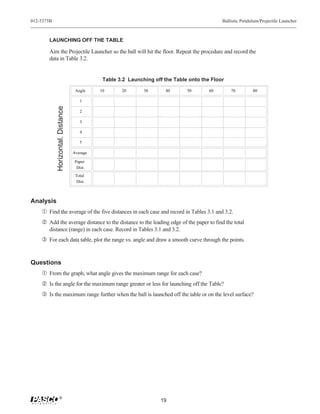
      Measure from the leading edge of the paper to each of the five dots and record these distances in
         Table 3.1.
      Increase the angle by 10 degrees and repeat all the steps.
     ‘ Repeat for angles up to and including 80 degrees.


                                                 Table 3.1 Launching on a Level Surface

                                   Angle    10   20      30       40                                                                  50                                                                                   60   70   80

                                      1
           Horizontal. Distance


                                      2

                                      3

                                      4

                                      5

                                  Average

                                   Paper
                                    Dist.
                                   Total
                                   Dist.
                                                                                                                                                                                                                                                  ®
                                                                 18
012-5375B                                                                                    Ballistic Pendulum/Projectile Launcher


       LAUNCHING OFF THE TABLE

       Aim the Projectile Launcher so the ball will hit the floor. Repeat the procedure and record the
       data in Table 3.2.


                                              Table 3.2 Launching off the Table onto the Floor

                                    Angle    10      20       30       40      50       60       70         80

                                       1
            Horizontal. Distance


                                       2

                                       3

                                       4

                                       5

                                   Average

                                    Paper
                                     Dist.
                                    Total
                                    Dist.


Analysis
    Œ Find the average of the five distances in each case and record in Tables 3.1 and 3.2.
     Add the average distance to the distance to the leading edge of the paper to find the total
       distance (range) in each case. Record in Tables 3.1 and 3.2.
    Ž For each data table, plot the range vs. angle and draw a smooth curve through the points.


Questions
    Œ From the graph, what angle gives the maximum range for each case?
     Is the angle for the maximum range greater or less for launching off the Table?
    Ž Is the maximum range further when the ball is launched off the table or on the level surface?


                  ®
                                                                    19
Ballistic Pendulum/Projectile Launcher        012-05375B


                                                      ®
                                         20
012-5375B                                                                                                                                                                           Ballistic Pendulum/Projectile Launcher


                        Experiment 4: Projectile Path

       EQUIPMENT NEEDED
       - Projectile Launcher and plastic ball              - measuring tape or meter stick
       - carbon paper                                      - white paper
       - movable vertical target board (Must reach from floor to muzzle)
       - graph paper
Purpose
       The purpose of this experiment is to find how the vertical distance the ball drops is related to the
       horizontal distance the ball travels when the ball is launched horizontally from a table.
Theory
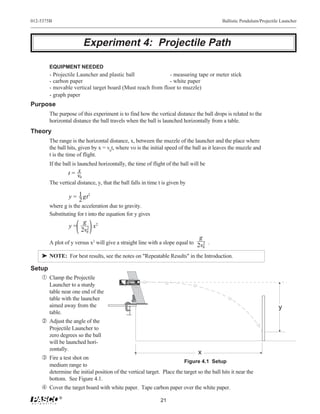
       The range is the horizontal distance, x, between the muzzle of the launcher and the place where
       the ball hits, given by x = v0t, where vo is the initial speed of the ball as it leaves the muzzle and
       t is the time of flight.
       If the ball is launched horizontally, the time of flight of the ball will be
                   x
                t= v
                    0
       The vertical distance, y, that the ball falls in time t is given by

                y = 1 gt2
                    2
       where g is the acceleration due to gravity.
       Substituting for t into the equation for y gives
                       g     2
                y=       2 x
                      2v0
                                                                                                                                                                           g
       A plot of y versus x2 will give a straight line with a slope equal to 2v 2 .
                                                                               0

    ® NOTE: For best results, see the notes on "Repeatable Results" in the Introduction.

Setup
   Œ Clamp the Projectile
                                                90


                                                                                            LONG    MEDIUM      SHORT   Yellow Band in Window
                                                                                            RANGE   RANGE       RANGE   Indicates Range.
                                                                                                                                                      Launch
                                                80


                                                                                                                                 Use 25 mm
                                                 70


                                                                                                        CAUTION!
                                                                                                       CAUTION!
                                                                                                                                                      Position
                                                                                                     DO NOT LOOK
                                                                                                       DO NOT LOOK
                                                      60


                                                                                                                                                       of Ball


       Launcher to a sturdy
                                                                                                    DOWN BARREL!
                                                                                                     DOWN THE BARREL.
                                                           50


                                                                                                                                 b a l l s O N LY !
                                                                40
                                         WEAR                        30
                                         SAFETY                           20
                                         GLASSES                               10   0                          SHORT RANGE
                                         WHEN IN USE.                                   ME-6800     PROJECTILE LAUNCHER


       table near one end of the
       table with the launcher
       aimed away from the                                                                                                                                                                                      y
       table.
     Adjust the angle of the
       Projectile Launcher to
       zero degrees so the ball
       will be launched hori-
       zontally.
                                                                                                                                                                           x
    Ž Fire a test shot on
                                                                                                                                                                      Figure 4.1 Setup
       medium range to
       determine the initial position of the vertical target. Place the target so the ball hits it near the
       bottom. See Figure 4.1.
     Cover the target board with white paper. Tape carbon paper over the white paper.
            ®
                                                                                                                                                                 21
Ballistic Pendulum/Projectile Launcher                                                                     012-05375B


Procedure
     Œ Measure the vertical height from the floor to the muzzle and record in Table 4.1. Mark this
         height on the target.
      Measure the horizontal distance from the muzzle of the Projectile Launcher to the target and
         record in Table 4.1.
     Ž Launch the ball.
      Move the target about 10 to 20 cm closer to the launcher.
      Repeat Steps 2 through 4 until the height of the ball when it strikes the target is about 10 to
         20 cm below the height of the muzzle.
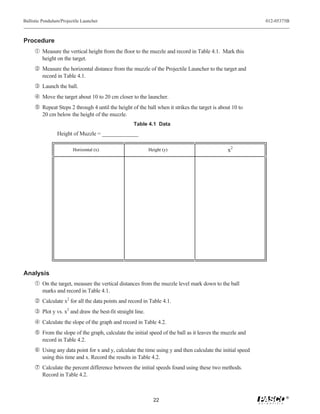
                                                   Table 4.1 Data
                 Height of Muzzle = _____________

                         Horizontal (x)                     Height (y)                        x2


Analysis
     Œ On the target, measure the vertical distances from the muzzle level mark down to the ball
         marks and record in Table 4.1.
      Calculate x2 for all the data points and record in Table 4.1.
     Ž Plot y vs. x2 and draw the best-fit straight line.
      Calculate the slope of the graph and record in Table 4.2.
      From the slope of the graph, calculate the initial speed of the ball as it leaves the muzzle and
         record in Table 4.2.
     ‘ Using any data point for x and y, calculate the time using y and then calculate the initial speed
         using this time and x. Record the results in Table 4.2.
     ’ Calculate the percent difference between the initial speeds found using these two methods.
         Record in Table 4.2.


                                                                                                                   ®
                                                              22
012-5375B                                                                           Ballistic Pendulum/Projectile Launcher


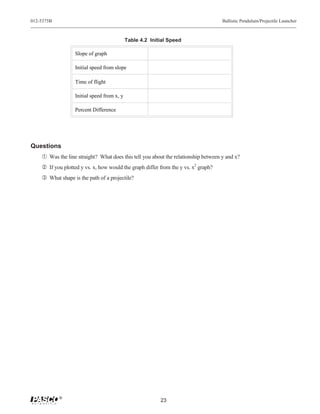
                                            Table 4.2 Initial Speed

                  Slope of graph

                  Initial speed from slope

                  Time of flight

                  Initial speed from x, y

                  Percent Difference


Questions
    Œ Was the line straight? What does this tell you about the relationship between y and x?
     If you plotted y vs. x, how would the graph differ from the y vs. x2 graph?
    Ž What shape is the path of a projectile?


            ®
                                                          23
Ballistic Pendulum/Projectile Launcher        012-05375B


                                                      ®
                                         24
012-5375B                                                                                Ballistic Pendulum/Projectile Launcher


             Experiment 5: Conservation of Energy

        EQUIPMENT NEEDED
        - Projectile Launcher and plastic ball           - plumb bob
        - measuring tape or meter stick                  - white paper
        - carbon paper
        - (optional) 2 Photogate Heads and Photogate Mounting Bracket
Purpose
        The purpose of this experiment is to show that the kinetic energy of a ball launched straight up is
        transformed into potential energy.
Theory
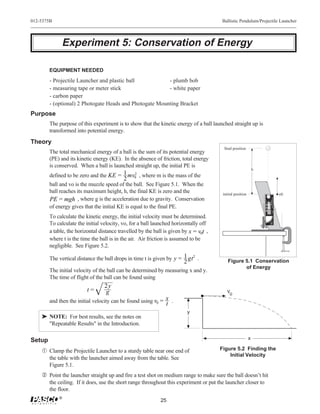
                                                                                          final position
        The total mechanical energy of a ball is the sum of its potential energy
        (PE) and its kinetic energy (KE). In the absence of friction, total energy
        is conserved. When a ball is launched straight up, the initial PE is
                                                                                                                h
        defined to be zero and the KE = 1 mv0 , where m is the mass of the
                                            2
                                           2
        ball and vo is the muzzle speed of the ball. See Figure 5.1. When the
        ball reaches its maximum height, h, the final KE is zero and the                 initial position                                                                                                                                     ν0


                                                                                                                                                                         Position
                                                                                                                                             Launch


                                                                                                                                                                          of Ball
        PE = mgh , where g is the acceleration due to gravity. Conservation


                                                                                                                                                                                                                        PROJECTILE LAUNCHER
                                                                                                                                                                             b a l l s O N LY !
                                                                                                                                                      Use 25 mm
                                                                                                                    Yellow Band in Window


                                                                                                                                                                                                          SHORT RANGE
                                                                                                                    Indicates Range.
                                                                                                                    RANGE
                                                                                                                    SHORT


                                                                                                                                                               DOWN BARREL!
        of energy gives that the initial KE is equal to the final PE.


                                                                                                                                                                 DO NOT LOOK
                                                                                                                                                              DOWNTHE BARREL.
                                                                                                                                                                 CAUTION!
                                                                                                                                                               DO NOT LOOK
                                                                                                                                                                  CAUTION!
                                                                                                                    MEDIUM
                                                                                                                    RANGE
                                                                                                                    RANGE
                                                                                                                    LONG


                                                                                                                                                                                                                          ME-6800
        To calculate the kinetic energy, the initial velocity must be determined.


                                                                                                                                                                                                            10 0
                                                                                                                                                                                                         20
                                                                                                                                                                                                    30
                                                                                                                                                                                            40
                                                                                                                                                                            50


                                                                                                                                                                                                  WHEN IN USE.
                                                                                                                                                                    60


        To calculate the initial velocity, vo, for a ball launched horizontally off
                                                                                                                                                          70
                                                                                                                    90                      80


                                                                                                                                                                                                  GLASSES
                                                                                                                                                                                                  SAFETY
                                                                                                                                                                                                  WEAR
        a table, the horizontal distance travelled by the ball is given by x = v0t ,
        where t is the time the ball is in the air. Air friction is assumed to be
        negligible. See Figure 5.2.

        The vertical distance the ball drops in time t is given by y = 1 gt 2 .             Figure 5.1 Conservation
                                                                        2
                                                                                                   of Energy
        The initial velocity of the ball can be determined by measuring x and y.
        The time of flight of the ball can be found using
                                  2y
                          t=      g                                                        ν0
        and then the initial velocity can be found using v0 = x .
                                                              t
                                                                            y
    ® NOTE: For best results, see the notes on
      "Repeatable Results" in the Introduction.

Setup                                                                                                       x

    Œ Clamp the Projectile Launcher to a sturdy table near one end of                   Figure 5.2 Finding the
                                                                                            Initial Velocity
        the table with the launcher aimed away from the table. See
        Figure 5.1.
     Point the launcher straight up and fire a test shot on medium range to make sure the ball doesn’t hit
        the ceiling. If it does, use the short range throughout this experiment or put the launcher closer to
        the floor.
            ®
                                                             25
Ballistic Pendulum/Projectile Launcher                                                                        012-05375B


     Ž Adjust the angle of the Projectile Launcher to zero degrees so the ball will be launched horizon-
         tally.

Procedure

               PART I: Determining the Initial Velocity of the Ball
                            (without photogates)

     Œ Put the plastic ball into the Projectile Launcher and cock it to the medium range position. Fire
         one shot to locate where the ball hits the floor. At this position, tape a piece of white paper to
         the floor. Place a piece of carbon paper (carbon-side down) on top of this paper and tape it
         down. When the ball hits the floor, it will leave a mark on the white paper.
      Fire about ten shots.
     Ž Measure the vertical distance from the bottom of the ball as it leaves the barrel (this position is
         marked on the side of the barrel) to the floor. Record this distance in Table 5.1.
      Use a plumb bob to find the point on the floor that is directly beneath the release point on the
         barrel. Measure the horizontal distance along the floor from the release point to the leading edge
         of the paper. Record in Table 5.1.
      Measure from the leading edge of the paper to each of the ten dots and record these distances in
         Table 5.1.
     ‘ Find the average of the ten distances and record in Table 5.1.
     ’ Using the vertical distance and the average horizontal distance, calculate the time of flight and
         the initial velocity of the ball. Record in Table 5.1.


    Alternate Method for Determining the Initial Velocity of the Ball
                         (using photogates)

     Œ Attach the photogate bracket to the launcher and attach two photogates to the bracket. Plug the
         photogates into a computer or other timer.
      Adjust the angle of the Projectile Launcher to 90 degrees (straight up).
     Ž Put the plastic ball into the Projectile Launcher and cock it to the long range position.
      Run the timing program and set it to measure the time between the ball blocking the two
         photogates.
      Launch the ball three times and take the average of these times. Record in Table 5.2.
     ‘ Assuming that the distance between the photogates is 10 cm, calculate the initial speed and
         record it in Table 5.2.


                                                                                                                      ®
                                                              26
012-5375B                                                                            Ballistic Pendulum/Projectile Launcher


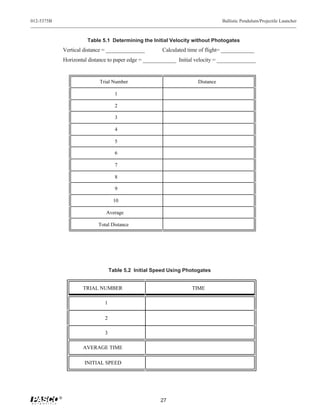
                          Table 5.1 Determining the Initial Velocity without Photogates
                Vertical distance = ______________         Calculated time of flight= ____________
                Horizontal distance to paper edge = ____________ Initial velocity = ______________


                               Trial Number                               Distance

                                        1

                                        2

                                        3

                                        4

                                        5

                                        6

                                        7

                                        8

                                        9

                                       10

                                  Average

                               Total Distance


                                      Table 5.2 Initial Speed Using Photogates


                        TRIAL NUMBER                                   TIME

                                  1

                                  2

                                  3

                        AVERAGE TIME

                         INITIAL SPEED


            ®
                                                          27
Ballistic Pendulum/Projectile Launcher                                                                    012-05375B


Measuring the Height
     Œ Adjust the angle of the launcher to 90 degrees (straight up).
      Launch the ball on the medium range setting several times and measure the maximum height
         attained by the ball. Record in Table 5.3.
     Ž Determine the mass of the ball and record in Table 5.3.

Analysis
     Œ Calculate the initial kinetic energy and record in Table 5.3.
      Calculate the final potential energy and record in Table 5.3.
     Ž Calculate the percent difference between the initial and final energies and record in Table 5.3.


                                               Table 5.3 Results


                      Maximuim Height of Ball

                      Mass of Ball

                      Initial Kinetic Energy

                      Final Potential Energy

                      Percent Difference


Questions
     Œ How does friction affect the result for the kinetic energy?
      How does friction affect the result for the potential energy?


                                                                                                                  ®
                                                           28
012-5375B                                                                                Ballistic Pendulum/Projectile Launcher


   Experiment 6: Conservation of Momentum In Two Dimensions


       EQUIPMENT NEEDED
       - Projectile Launcher and 2 plastic balls                 - plumb bob
       - meter stick                                             - protractor
       - butcher paper                                           - tape to make collision inelastic
       - stand to hold ball                                      - carbon paper

Purpose
       The purpose of this experiment is to show that the momentum is conserved in two dimensions
       for elastic and inelastic collisions.

Theory
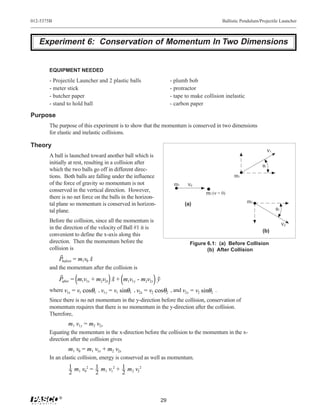
                                                                                                                  ν1
       A ball is launched toward another ball which is
       initially at rest, resulting in a collision after
                                                                                                             θ1
       which the two balls go off in different direc-
       tions. Both balls are falling under the influence                                       m1
       of the force of gravity so momentum is not                 m1     ν0
       conserved in the vertical direction. However,                             m2 (ν = 0)
       there is no net force on the balls in the horizon-
       tal plane so momentum is conserved in horizon-                  (a)                            m2
       tal plane.                                                                                                      θ2

       Before the collision, since all the momentum is
                                                                                                                            ν2
       in the direction of the velocity of Ball #1 it is
                                                                                                             (b)
       convenient to define the x-axis along this
       direction. Then the momentum before the                            Figure 6.1: (a) Before Collision
       collision is                                                              (b) After Collision
            Pbefore = m1v0 x
       and the momentum after the collision is

            Pafter = m1v1x + m2v2x x + m1v1y - m2v2y y
       where v1x = v1 cosθ1 , v1y = v1 sinθ1 , v2x = v2 cosθ2 , and v2y = v2 sinθ2 .
       Since there is no net momentum in the y-direction before the collision, conservation of
       momentum requires that there is no momentum in the y-direction after the collision.
       Therefore,
                m1 v1y = m2 v2y
       Equating the momentum in the x-direction before the collision to the momentum in the x-
       direction after the collision gives
                m1 v0 = m1 v1x + m2 v2x
       In an elastic collision, energy is conserved as well as momentum.
                1 m v2= 1 m v2+ 1 m v2
                2 1 0 2 1 1 2 2 2


            ®
                                                            29
Ballistic Pendulum/Projectile Launcher                                                                                                                       012-05375B


         Also, when energy is conserved, the paths of two balls (of equal mass) after the collision will be
         at right angles to each other.

     ® NOTE: For best results, see the notes on "Repeatable Results" in the Introduction.

Setup
     Œ Clamp the Projectile Launcher to a sturdy table
         near one end of the table with the launcher aimed
         inward toward the table.
      Adjust the angle of the Projectile Launcher to zero
         degrees so the ball will be launched horizontally
         onto the table. Fire a test shot on the short range
         setting to make sure the ball lands on the table.
     Ž Cover the table with butcher paper. The paper
         must extend to the base of the launcher.
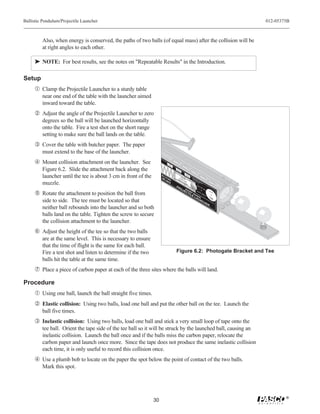
      Mount collision attachment on the launcher. See                       LO
                                                                            RA NG
                                                                               NG
                                                                                  E


         Figure 6.2. Slide the attachment back along the                              ME
                                                                                      RADIU
                                                                                         NG M
                                                                                           E

                                                                                                    SH


         launcher until the tee is about 3 cm in front of the        ME                DO
                                                                                         CC
                                                                                       DO AAU
                                                                                      DO DN UTION
                                                                                           O T
                                                                                         W NOTION
                                                                                            O     !
                                                                                                    RA OR
                                                                                                      NGT
                                                                                                          E
                                                                                                              Ye
                                                                                                                 ll
                                                                                                              In ow
                                                                       -6                 WN T L !
                                                                                           NT L
                                                                                                                dic B
                                                                                                                    ate an
                                                                          80                 B OO O                    s Rd in


         muzzle.                                                              0
                                                                                      PR
                                                                                             HEA OK
                                                                                               BR K
                                                                                                AR RE
                                                                                                    RE
                                                                                                       L
                                                                                                       L. !
                                                                                                                         Us
                                                                                                                           an W
                                                                                                                             ge in


                                                                                                                              e
                                                                                                                               .  do
                                                                                                                                     w


                                                                                                                                  25
                                                                                           O       SH                                    m
                                                                                                                                             m
                                                                                                JE
      Rotate the attachment to position the ball from
                                                                                                        O   ba                                   La
                                                                                                    CT RT      lls                                   un
                                                                                                                                                       ch
                                                                                                      IL RA        O
                                                                                                                     NL
                                                                                                        E NG            Y!
                                                                                                          LA E                                   Po
                                                                                                                                                    s
                                                                                                                                                  of ition
                                                                                                             UN
         side to side. The tee must be located so that
                                                                                                                                                     Ba
                                                                                                                                                        ll
                                                                                                                   CH
                                                                                                                         E                       R
         neither ball rebounds into the launcher and so both
         balls land on the table. Tighten the screw to secure
         the collision attachment to the launcher.
     ‘ Adjust the height of the tee so that the two balls
         are at the same level. This is necessary to ensure
         that the time of flight is the same for each ball.
         Fire a test shot and listen to determine if the two                          Figure 6.2: Photogate Bracket and Tee
         balls hit the table at the same time.
     ’ Place a piece of carbon paper at each of the three sites where the balls will land.

Procedure
     Œ Using one ball, launch the ball straight five times.
      Elastic collision: Using two balls, load one ball and put the other ball on the tee. Launch the
         ball five times.
     Ž Inelastic collision: Using two balls, load one ball and stick a very small loop of tape onto the
         tee ball. Orient the tape side of the tee ball so it will be struck by the launched ball, causing an
         inelastic collision. Launch the ball once and if the balls miss the carbon paper, relocate the
         carbon paper and launch once more. Since the tape does not produce the same inelastic collision
         each time, it is only useful to record this collision once.
      Use a plumb bob to locate on the paper the spot below the point of contact of the two balls.
         Mark this spot.


                                                                                                                                                                     ®
                                                                30
012-5375B                                                                              Ballistic Pendulum/Projectile Launcher


Analysis
    Œ Draw lines from the point-of-contact spot to the centers of the groups of dots. There will be
       five lines.
     Measure the lengths of all five lines and record on the paper. Since the time of flight is the
       same for all paths, these lengths are proportional to the corresponding horizontal velocities.
       Since the masses are also the same, these lengths are also proportional to the corresponding
       momentum of each ball.
    Ž Measure the angles from the center line to each of the outer four lines and record on the paper.
       PERFORM THE FOLLOWING THREE STEPS FOR THE ELASTIC COLLISION
       AND THEN REPEAT THESE THREE STEPS FOR THE INELASTIC COLLISION:
     For the x-direction, check that the momentum before equals the momentum after the collision.
       To do this, use the lengths for the momentums and calculate the x-components using the
       angles. Record the results in Tables 6.1 and 6.2.

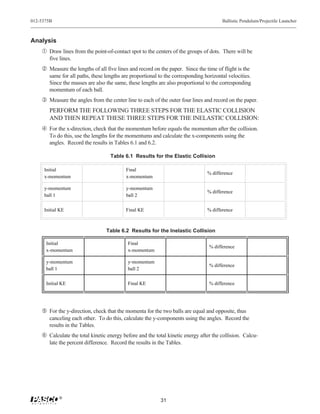
                                   Table 6.1 Results for the Elastic Collision

     Initial                               Final
                                                                                % difference
     x-momentum                            x-momentum

     y-momentum                            y-momentum
                                                                                % difference
     ball 1                                ball 2

     Initial KE                            Final KE                             % difference


                                 Table 6.2 Results for the Inelastic Collision

      Initial                              Final
                                                                                 % difference
      x-momentum                           x-momentum

      y-momentum                           y-momentum
                                                                                 % difference
      ball 1                               ball 2


      Initial KE                           Final KE                              % difference


     For the y-direction, check that the momenta for the two balls are equal and opposite, thus
       canceling each other. To do this, calculate the y-components using the angles. Record the
       results in the Tables.
    ‘ Calculate the total kinetic energy before and the total kinetic energy after the collision. Calcu-
       late the percent difference. Record the results in the Tables.


            ®
                                                           31
Ballistic Pendulum/Projectile Launcher                                                                        012-05375B


Questions
     Œ Was momentum conserved in the x-direction for each type of collision?
      Was momentum conserved in the y-direction for each type of collision?
     Ž Was energy conserved for the elastic collision?
      Was energy conserved for the inelastic collision?
      For the elastic collision, was the angle between the paths of the balls after the collision equal to
         90 degrees as expected?
     ‘ For the inelastic collision, what was the angle between the paths of the balls after the collision?
         Why is it less than 90º?


                                                                                                                      ®
                                                            32
012-5375B                                                                                                                                                                                                                 Ballistic Pendulum/Projectile Launcher


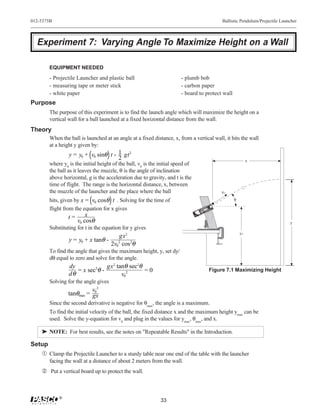
  Experiment 7: Varying Angle To Maximize Height on a Wall

        EQUIPMENT NEEDED
        - Projectile Launcher and plastic ball                          - plumb bob
        - measuring tape or meter stick                                 - carbon paper
        - white paper                                                   - board to protect wall
Purpose
        The purpose of this experiment is to find the launch angle which will maximize the height on a
        vertical wall for a ball launched at a fixed horizontal distance from the wall.
Theory
        When the ball is launched at an angle at a fixed distance, x, from a vertical wall, it hits the wall
        at a height y given by:
                 y = y0 + v0 sinθ t - 1 gt2
                                      2                                                                                                                                                                                                 x
        where y0 is the initial height of the ball, v0 is the initial speed of
        the ball as it leaves the muzzle, θ is the angle of inclination
        above horizontal, g is the acceleration due to gravity, and t is the
        time of flight. The range is the horizontal distance, x, between
        the muzzle of the launcher and the place where the ball                                                                                                                                                           ν0

        hits, given by x = v0 cosθ t . Solving for the time of                                                                                                                                                                 θ
                                                                                                                                                                                                                 h
                                                                                                                                                                                                            Launc


        flight from the equation for x gives
                                                                                                                                                                           in Window
                                                                                                                                                                       Band                                          on
                                                                                                                                                                                           mm
                                                                                                                                                                          Range.                               Positi
                                                                                                                                                                Yellow es                                          Ball
                                                                                                                                                                                       5                        of
                                                                                                                                                           T
                                                                                                                                                                 Indicat
                                                                                                                                                                                   e 2
                                                                                                                                                       SHOR E
                                                                                                                                                                             Us
                                                                                                                                                        RANG                                            !
                                                                                                                                                                                                   LY
                                                                                                                                            M                                                 ON
                                                                                                                                       MEDIU E                                          lls
                                                                                                                                        RANG                                       ba
                                                                                                                                                       ION! !
                                                                                                                                                      TION K !
                                                                                                                        LONG E
                                                                                                                        RANG
                                                                                                                                                   CAUT LOO
                                                                                                                                                  CAU LOOK    REL            E    ER
                                                                                                                                                     NOT
                                                                                                                                                  DONOT THE
                                                                                                                                                 DO DOWN
                                                                                                                                                     N BAR
                                                                                                                                                                          NG   CH
                                                                                                                                                                      T RA UN
                                                                                                                                                 DOW
                                                                                                                                                                    OR E LA
                                                                                                                                                                SH
                                                                                                                                                                     TIL
                                                                                                                                                                EC
                                                                                                                                                          OJ
                                                                                                                                                     PR
                                                                                  9


                        x
                                                                                    8


                                                                                                                                    00
                                                                                                                                 -68
                                                                                        7


                                                                                            6
                                                                                                5
                                                                                                                          ME
                                                                                                    4               0
                                                                                                        3   2   1


                 t=
                                                                                   AR
                                                                                 WE ETY S    .
                                                                                 SAF SSE USE
                                                                                        IN
                                                                                  GLAEN


                    v0 cosθ
                                                                                   WH


                                                                                                                                                                                                                                                            y
        Substituting for t in the equation for y gives
                                                                                                                                                                                                                                   y0
                                         gx2
                 y = y0 + x tanθ -
                                      2v02 cos2θ
        To find the angle that gives the maximum height, y, set dy/
        dθ equal to zero and solve for the angle.
                 dy             gx2 tanθ sec2θ
                    = x sec2θ -                =0                                                                                                                                        Figure 7.1 Maximizing Height
                 dθ                   v02
        Solving for the angle gives
                           v02
                 tanθmax = gx
        Since the second derivative is negative for θmax, the angle is a maximum.
        To find the initial velocity of the ball, the fixed distance x and the maximum height ymax can be
        used. Solve the y-equation for v0 and plug in the values for ymax, θmax, and x.

    ® NOTE: For best results, see the notes on "Repeatable Results" in the Introduction.

Setup
   Œ Clamp the Projectile Launcher to a sturdy table near one end of the table with the launcher
        facing the wall at a distance of about 2 meters from the wall.
     Put a vertical board up to protect the wall.


            ®
                                                              33
Ballistic Pendulum/Projectile Launcher                                                                     012-05375B


     Ž Test fire the ball (on the long range setting) a few times to find approximately what angle gives
         the maximum height on the wall. (NOTE: In general, this experiment will not work as well on
         the short range setting because the muzzle velocity is more variable with change in angle.)
      Tape a piece of white paper to the board in the region where the ball is hitting. Then cover the
         white paper with a piece of carbon paper.

Procedure
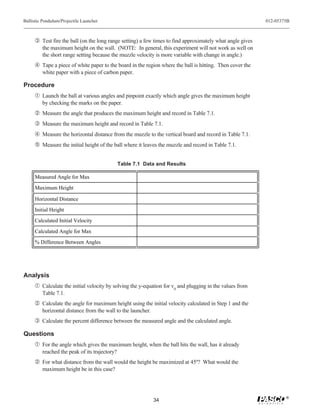
     Œ Launch the ball at various angles and pinpoint exactly which angle gives the maximum height
         by checking the marks on the paper.
      Measure the angle that produces the maximum height and record in Table 7.1.
     Ž Measure the maximum height and record in Table 7.1.
      Measure the horizontal distance from the muzzle to the vertical board and record in Table 7.1.
      Measure the initial height of the ball where it leaves the muzzle and record in Table 7.1.


                                               Table 7.1 Data and Results

     Measured Angle for Max

     Maximum Height

     Horizontal Distance
     Initial Height
     Calculated Initial Velocity

     Calculated Angle for Max
     % Difference Between Angles


Analysis
     Œ Calculate the initial velocity by solving the y-equation for v0 and plugging in the values from
         Table 7.1.
      Calculate the angle for maximum height using the initial velocity calculated in Step 1 and the
         horizontal distance from the wall to the launcher.
     Ž Calculate the percent difference between the measured angle and the calculated angle.

Questions
     Œ For the angle which gives the maximum height, when the ball hits the wall, has it already
         reached the peak of its trajectory?
      For what distance from the wall would the height be maximized at 45º? What would the
         maximum height be in this case?


                                                                                                                   ®
                                                              34
012-5375B                                                                               Ballistic Pendulum/Projectile Launcher


 Experiment 8: Projectile Velocity—Approximate Method

       EQUIPMENT NEEDED:
       - launcher                                               - Steel ball
       - C-clamp (optional)                                     - Mass balance
       - string

Purpose:
       The muzzle velocity of the projectile launcher is determined by launching the ball into the pendu-
       lum and observing the angle to which the pendulum swings.
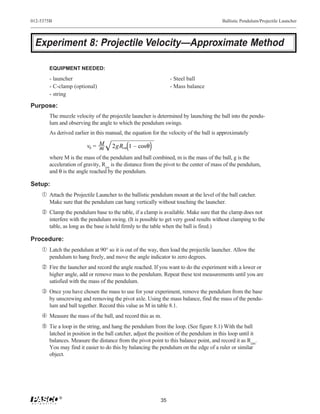
       As derived earlier in this manual, the equation for the velocity of the ball is approximately

                        vb = M
                             m      2gRcm 1 – cosθ
       where M is the mass of the pendulum and ball combined, m is the mass of the ball, g is the
       acceleration of gravity, Rcm is the distance from the pivot to the center of mass of the pendulum,
       and θ is the angle reached by the pendulum.

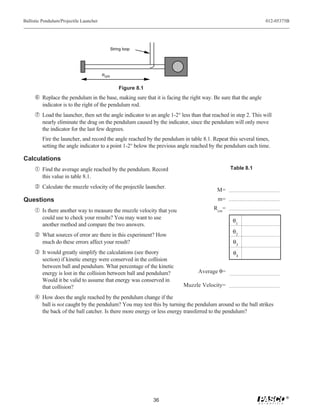
Setup:
    Œ Attach the Projectile Launcher to the ballistic pendulum mount at the level of the ball catcher.
       Make sure that the pendulum can hang vertically without touching the launcher.
     Clamp the pendulum base to the table, if a clamp is available. Make sure that the clamp does not
       interfere with the pendulum swing. (It is possible to get very good results without clamping to the
       table, as long as the base is held firmly to the table when the ball is fired.)

Procedure:
    Œ Latch the pendulum at 90° so it is out of the way, then load the projectile launcher. Allow the
       pendulum to hang freely, and move the angle indicator to zero degrees.
     Fire the launcher and record the angle reached. If you want to do the experiment with a lower or
       higher angle, add or remove mass to the pendulum. Repeat these test measurements until you are
       satisfied with the mass of the pendulum.
    Ž Once you have chosen the mass to use for your experiment, remove the pendulum from the base
       by unscrewing and removing the pivot axle. Using the mass balance, find the mass of the pendu-
       lum and ball together. Record this value as M in table 8.1.
     Measure the mass of the ball, and record this as m.
     Tie a loop in the string, and hang the pendulum from the loop. (See figure 8.1) With the ball
       latched in position in the ball catcher, adjust the position of the pendulum in this loop until it
       balances. Measure the distance from the pivot point to this balance point, and record it as Rcm.
       You may find it easier to do this by balancing the pendulum on the edge of a ruler or similar
       object.


            ®
                                                           35
Ballistic Pendulum/Projectile Launcher                                                                          012-05375B


                                                String loop


                                         R cm


                                                    Figure 8.1
     ‘ Replace the pendulum in the base, making sure that it is facing the right way. Be sure that the angle
         indicator is to the right of the pendulum rod.
     ’ Load the launcher, then set the angle indicator to an angle 1-2° less than that reached in step 2. This will
         nearly eliminate the drag on the pendulum caused by the indicator, since the pendulum will only move
         the indicator for the last few degrees.
         Fire the launcher, and record the angle reached by the pendulum in table 8.1. Repeat this several times,
         setting the angle indicator to a point 1-2° below the previous angle reached by the pendulum each time.

Calculations
     Œ Find the average angle reached by the pendulum. Record                                  Table 8.1
         this value in table 8.1.
      Calculate the muzzle velocity of the projectile launcher.                         M=
Questions                                                                                m=
     Œ Is there another way to measure the muzzle velocity that you                     Rcm=
         could use to check your results? You may want to use
                                                                                                θ1
         another method and compare the two answers.
                                                                                                θ2
      What sources of error are there in this experiment? How
         much do these errors affect your result?                                                θ3
     Ž It would greatly simplify the calculations (see theory                                    θ4
         section) if kinetic energy were conserved in the collision
         between ball and pendulum. What percentage of the kinetic
         energy is lost in the collision between ball and pendulum?             Average θ=
         Would it be valid to assume that energy was conserved in
         that collision?                                                  Muzzle Velocity=

      How does the angle reached by the pendulum change if the
         ball is not caught by the pendulum? You may test this by turning the pendulum around so the ball strikes
         the back of the ball catcher. Is there more energy or less energy transferred to the pendulum?


                                                                                                                        ®
                                                                 36
012-5375B                                                                               Ballistic Pendulum/Projectile Launcher


            Experiment 9: Projectile Velocity—Exact Method

        EQUIPMENT NEEDED:
        - Projectile Launcher and steel ball                     - C-clamp (optional)
        - Mass Balance                                           - string
        - ruler                                                  - stopwatch
Purpose:
        The muzzle velocity of the projectile launcher is determined by launching the ball into the pendu-
        lum and observing the angle to which the pendulum swings.
        The exact equation for ball velocity, as derived earlier in this manual, is
                         v= 1         2IMg Rcm 1 – cosθ
                           mRb
        where M is the mass of the pendulum and ball combined, m is the mass of the ball, g is the
        acceleration of gravity, Rcm is the distance from the pivot to the center of mass of the pendulum, Rb
        is the distance from the pivot to the ball, θ is the angle reached by the pendulum, and I is the
        moment of inertia of the pendulum with the ball in the catcher.
        The value of I can be found by measuring the period of small oscillations of the pendulum and ball
        and using the equation
                              MgRcmT 2
                         I=
                               4π 2
        where T is the period.
Setup:
   Œ Attach the projectile launcher to the ballistic pendulum mount at the level of the ball catcher.
        Make sure that the pendulum can hang vertically without touching the launcher.
      Clamp the pendulum base to the table, if a clamp is available. Make sure that the clamp does not
        interfere with the pendulum swing. (It is possible to get very good results without clamping to the
        table, as long as the base is held firmly to the table when the ball is fired.)

Procedure:
     Œ Latch the pendulum at 90° so it is out of the way, then load the projectile launcher. Allow the
        pendulum to hang freely, and move the angle indicator to zero degrees.
      Fire the launcher and record the angle reached. If you want to do the experiment with a lower or
        higher angle, add or remove mass to the pendulum. Repeat these test measurements until you are
        satisfied with the mass of the pendulum.
     Ž Once you have chosen the mass to use for your experiment, remove the pendulum from the base
        by unscrewing and removing the pivot axle. Using the mass balance, find the mass of the pendu-
        lum and ball together. Record this value as M in table 9.1.
      Measure the mass of the ball, and record this as m.
      Tie a loop in the string, and hang the pendulum from the loop. (See figure 9.1) With the ball
        latched in position in the ball catcher, adjust the position of the pendulum in this loop until it
        balances. Measure the distance from the pivot point to this balance point, and record it as Rcm. You
        may find it easier to do this by balancing the pendulum on the edge of a ruler or similar object.
     ‘ Measure the distance between the pivot point and the center of the ball. Record this as Rb.
             ®
                                                            37
Ballistic Pendulum/Projectile Launcher                                                                           012-05375B


     ’ Replace the pendulum in the base, making sure that it is                                String loop
           facing the right way. Be sure that the angle indicator is to the
           right of the pendulum rod.
     “ Remove the launcher so that the pendulum can swing freely.                       R cm
           With the ball in the pendulum, give it an initial displacement
                                                                                         Rb
           of 5° or less. Using the stopwatch, time how long it takes to
           go through at least ten oscillations. Divide this time by the                         Figure 9.1
           number of oscillations, and record your result as T in table
           9.1.
     ” Calculate the value of I, and record it in table 9.1.
     • Load the launcher, then set the angle indicator to an angle 1-2° less than that reached in step
           2. This will nearly eliminate the drag on the pendulum caused by the indicator, since the
           pendulum will only move the indicator for the last few degrees.
      11   Fire the launcher, and record the angle reached by the pendulum in table 8.1. Repeat this
           several times, setting the angle indicator to a point 1-2° below the previous angle reached by
           the pendulum each time.

Calculations
     Œ Find the average angle reached by the pendulum. Record this value in table 8.1.
      Calculate the muzzle velocity of the projectile launcher.
                                                                                                     Table 9.1
Questions
                                                                                                 M=
     Œ Is there another way to measure the muzzle velocity that
                                                                                                 m=
           you could use to check your results? You may want to use
           another method and compare the two answers.                                         Rcm=
      What sources of error are there in this experiment? How                                  Rb=
           much do these errors affect your result?                                               T=
     Ž It would greatly simplify the calculations (see theory                                      I=
           section) if kinetic energy were conserved in the collision
           between ball and pendulum. What percentage of the                                             θ1
           kinetic energy is lost in the collision between ball and
                                                                                                         θ2
           pendulum? Would it be valid to assume that energy was
           conserved in that collision?                                                                  θ3
      Does increasing the pendulum mass increase or decrease                                            θ4
           the efficiency of the energy transfer in the collision? Try it.
      Experiment 8 uses an approximate equation for velocity:
                                                                                    Average θ=
                    vb = M
                         m      2gRcm 1 – cosθ                                Muzzle Velocity=

           What is the value of velocity when you use this equation? Is there a significant difference
           between these two calculated values? What factors would increase the difference between
           these two results? How would you build a ballistic pendulum so that the approximate
           equation gave better results?


                                                                                                                         ®
                                                                38
012-5375B                                                                                                                                                                                                      Ballistic Pendulum/Projectile Launcher


   Experiment 10 (Demo): Do 30° and 60° Give the Same Range?

       EQUIPMENT NEEDED
       - Projectile Launcher and steel ball
       - box to make elevation same as muzzle
Purpose
       The purpose of this demonstration is to show that the range of a ball launched at 30⋅ is the
       same as one launched at 60⋅ if the ball is launched on a level surface.
Theory
       The range is the horizontal distance, x, between the muzzle of the launcher and the place
       where the ball hits, given by x = v0 cosθ t where v0 is the initial speed of the ball as it
       leaves the muzzle, θ is the angle of inclination above horizontal, and t is the time of flight.
       If the ball hits on a place that is at the same level as the level of the muzzle of the launcher, the
       time of flight of the ball will be twice the time it takes the ball the reach the peak of its trajec-
       tory:
                                  v0 sinθ
                t = 2t peak = 2      g
       where g is the acceleration due to gravity.
       Substituting for t into the equation for x gives
                     2v0 sinθcos θ
                       2
                x=         g
       and using a trigonometry identity gives
                       2
                     2v0 sin2θ                                                                                                                                                                   nch


                x=
                                                                                                                                                                                             Lau
                                                                                                                                                                     dow
                                                                                                                                                                  Win
                                                                                                                                                             d in
                                                                                                                                                                 ge.
                                                                                                                                                       w BanRan
                                                                                                                                                 Yellocate
                                                                                                                                                           s
                                                                                                                                                                            5   mm                    itio
                                                                                                                                                                                                           n


                         g
                                                                                                                                                                                                   Pos Ball
                                                                                                                                                  Indi
                                                                                                                                                                        e 2
                                                                                                                                            RT
                                                                                                                                        SHO GE
                                                                                                                                                                 Us                                 of
                                                                                                                                         RAN                                                 !
                                                                                                                                                                                        LY
                                                                                                                          DIU
                                                                                                                              M                                                    ON
                                                                                                                        ME GE                                                lls
                                                                                                                         RAN                                            ba
                                                                                                                                           N!
                                                                                                                                        TIO N!
                                                                                                                G
                                                                                                                                    CAU IO K
                                                                                                                                      UT LOOK !                                                        R
                                                                                                                                                                                                 HE
                                                                                                             LON GE
                                                                                                             RAN                   CA NOT LOO REL.
                                                                                                                                         T     EL                                  E
                                                                                                                                    DO BARR
                                                                                                                                     NO BAR
                                                                                                                                  DOWNTHE
                                                                                                                                       N                          RA
                                                                                                                                                                           NG
                                                                                                                                                                            U          NC
                                                                                                                                   DOW
                                                                                                                                  DO
                                                                                                                                                 SH
                                                                                                                                                      ORT E              LA
                                                                                                                                                           IL
                                                                                                                                                     CT


       The ranges for the angles 30º and 60⋅ are                                                                                      PR
                                                                                                                                           OJE
                                                            90
                                                                 80


                                                                                                                      6800
                                                                      70


                                                                           60
                                                                                50
                                                                                                               ME-
                                                                                     40                  0
                                                                                          30   20   10


                                                              R
                                                          WEA TY S


       the same since
                                                             FE      E.
                                                          SA ASSE US
                                                                IN
                                                           GL N
                                                            WHE


                sin(60º) = sin(120º).

    ® NOTE: For best results, see the notes
      on "Repeatable Results" in the
      Introduction.
                                                                                                                                                     Figure 10.1 Setup to launch on level surface
Setup
   Œ Clamp the Projectile Launcher to a
       sturdy table near one end of the table with the launcher aimed so the ball will land on the table.
     Adjust the angle of the Projectile Launcher to 30 degrees.
    Ž Put the steel ball into the Projectile Launcher and cock it to the medium or long range position.

    ® NOTE: In general, this experiment will not work as well on the short range setting because
      the muzzle velocity is more variable with change in angle.)

     Launch a ball to locate where the ball hits. Place an inverted box at that location so the ball
       will hit at the same level as the muzzle of the launcher. See Figure 10.1.


            ®
                                                                                                             39
Ballistic Pendulum/Projectile Launcher                                                                    012-05375B


Procedure
     Œ Launch the ball at 30 degrees to demonstrate that the ball lands on the box.
      Change the angle of the launcher to 60 degrees and launch the ball again. Call attention to the
         fact that the ball again lands on the box. Thus the ranges are the same.
     Ž Change the angle to 45 degrees and launch the ball again to show that the ball now lands further
         away, missing the box.
      Ask the question: What other pairs of angles will have a common range? This demonstration
         can be done for any two angles which add up to 90 degrees: 20 and 70, or 35 and 55, etc.


                                                                                                                  ®
                                                            40
012-5375B                                                                                      Ballistic Pendulum/Projectile Launcher


   Experiment 11 (Demo): Simultaneously Launch
     Two Balls Horizontally at Different Speeds

        EQUIPMENT NEEDED

        - (2) Projectile Launchers and (2) plastic balls

Purpose
        The purpose of this demonstration is to show that regardless of the initial speed of the balls
        launched horizontally off a table, the balls will hit the floor at the same time.

Theory
        Two balls are launched horizontally from the
                                                                                 ν0(short) ν0(long)
        same table (from the same height, y). The
        muzzle speeds of the two balls are different.
        The vertical and horizontal motions of a projec-           y
        tile are independent of each other. The horizon-
        tal distance, x, travelled by the ball is dependent
        on the initial speed, v0, and is given by x = v0t ,
        where t is the time of flight. The time of flight                             xshort
        depends only on the vertical distance the ball                                                xlong

        falls since y = 1 gt 2 . Since the vertical
                        2
        distance is the same each ball, the time of flight must be the same for each ball.

    ® NOTE: For best results, see the notes on "Repeatable Results" in the Introduction.

Setup
    Œ Clamp two Projectile Launchers adjacent to each other on a sturdy table. The launchers
        should both be aimed in the same direction, away from the table so the balls will land on
        the floor.
     Adjust the angle of each Projectile Launcher to zero degrees so the balls will be launched
        horizontally off the table.

Procedure
    Œ Put a plastic ball into each Projectile Launcher and cock one launcher to the short range
        position and cock the other launcher to the long range position.
     Ask the class to be quiet and listen for the balls striking the floor. Tell them if they hear
        only one click, that means the balls hit the floor simultaneously.
    Ž Put both lanyards in the same hand and pull them at the same time so the balls are launched
        simultaneously.
     After the balls hit the floor, ask the class if they heard one click or two.


            ®
                                                              41
Ballistic Pendulum/Projectile Launcher        012-05375B


                                                      ®
                                         42
012-5375B                                                                                   Ballistic Pendulum/Projectile Launcher


            Experiment 12 (Demonstration): Launching
                        Through Hoops

        EQUIPMENT NEEDED
        - Projectile Launcher and plastic ball                     -5 ring clamps on stands
        - (2) Photogates                                           - Photogate Mounting Bracket
        - 2-meter stick
Purpose
        The purpose of this demonstration is to show that the path of a ball launched horizontally from a
        table is parabolic.
Theory
        The range is the horizontal distance, x, between the muzzle of the launcher and the place where
        the ball hits, given by
                            x = v0t
        where vo is the initial speed of the ball as it leaves the muzzle and t is the time of flight.
        The vertical position, y, of the ball at time t is given by

                            y = y0 – 1 gt2
                                     2
        where y0 is the initial height of the ball and g is the acceleration due to gravity.
    ® NOTE: For best results, see the notes on "Repeatable Results" in the Introduction.

Setup
    Œ Before the demonstration begins, find the initial velocity for the range setting to be used. Attach
        the photogates and use a computer to find the initial velocity or launch the ball horizontally and
        measure x and y to find the initial velocity. See experiments 1 and 2.
     To prepare to demonstrate, clamp the Projectile Launcher to the demonstration table with the
        launcher aimed away from the table so the ball will land on the floor.
    Ž Adjust the angle of the launcher to zero degrees so it will launch horizontally.
Procedure
    Œ In front of the class, measure the initial height of the ball at muzzle level.
     Calculate the horizontal and vertical positions of the ball each 1/10 second until it hits the floor.

                     t (sec)                   x = v0t (cm)               y = y0 - (1/2)gt2 (cm)
                      0.1

                      0.2

                      0.3
                      0.4

                      0.5
             ®
                                                              43
Ballistic Pendulum/Projectile Launcher                                                                                                                                                                    012-05375B


     Ž Lay the 2-meter stick on the floor in a straight line away from the launcher. Remove the
         back mounting screw from the launcher base so the back of the launcher can be rotated
         upward. Look through the back of the launcher and align the sights and the end of the 2m
         stick so the 2m stick is aligned with the path of the ball. Relevel the launcher.
      Measure off each set of x and y and place a ring clamp on a stand at each position (See
         Figure 12.1). If possible it is best to adjust the last two ring stands at an angle from the
         vertical so the ball will not have to pass through them at an oblique angle. A cup may be
         placed at the end of the path to catch the ball.
      Launch the ball through the rings.
     ‘ Ask the class what shape of curve is formed by the rings.
                                                                                                                                                  UM
                                                                                                                                                                  31 UL
                                                                                                                                                               -68 END
                                                                                                                                                            ME IC P
                                                                                                                                                          L IST
                                                                                                                                                                    L
                                                                                                                                                                     BA
                                   9
                                   8
                                    7


                           W
                             EA
                           SA R
                                       6


                           GLAFE
                                 TY
                                           5


                           W SS
                            HE ES
                               N
                                               4


                                  IN
                                     US                                    LO
                                                   3


                                                                          RA NG
                                        E.                                   NG
                                                       2                        E

                                                           1                        ME
                                                                                    RADIU
                                                                                       NG M
                                                               0                         E

                                                                                                 SH
                                                                                                 RA OR
                                                                                                   NGT
                                                                                     DO CAUT
                                                                                      CA
                                                                                      DO UT
                                                                                                    E
                                                                   ME               DO NO ION            Yell

                                                                                      W NOTION!
                                                                                                         Indiow
                                                                     -6                DO T LO !
                                                                                                                 Ban
                                                                                                              cate
                                                                                         N LO
                                                                        80                WN
                                                                                          BA OK
                                                                                                                      d
                                                                                                                   s Ranin
                                                                                             TH OK
                                                                                                                         Win
                                                                            0                 RR
                                                                                               E EL
                                                                                                                        ge. dow

                                                                                                    !                Us
                                                                                    PR                                       e
                                                                                                                                 25
                                                                                         O                                            m
                                                                                              JESHO      ba
                                                                                                                    m
                                                                                                                                              Lau
                                                                                                CT RT       lls
                                                                                                                                                 nch

                                                                                                   IL RA        O
                                                                                                                  N LY
                                                                                                     E NG              !                      Pos
                                                                                                       LA E                                    of ition
                                                                                                                                                  Bal
                                                                                                          UN                                          l

                                                                                                                CH
                                                                                                                      E                   R


                                                                                                                                                                          Figure 12.1 Placing the rings

                                                                                                                                                                                                                  ®
                                                                                                                                                                                       44
012-5375B                                                                                Ballistic Pendulum/Projectile Launcher


   Experiment 13: (Demonstration): Elastic and In-
                 elastic Collisions

       EQUIPMENT NEEDED:
       - Projectile Launcher
       - plastic or steel ball
       - Ballistic Pendulum

Purpose
       The purpose of this demonstration is to show the difference in kinetic energy transfer between an
       elastic and an inelastic collision.

Theory
       The amount of kinetic energy transferred between colliding objects depends on the elasticity of
       the collision. By reversing the pendulum so that the ball bounces off instead of catching, it is
       possible to demonstrate this effect.

Procedure
    Œ Fire the ball into the pendulum and record the angle reached.
     Remove the pendulum, and reinstall it in the reversed position (ball opening away from launcher)
    Ž Fire the same ball at the same launcher setting and note the angle reached. The collision between
       ball and pendulum is not perfectly elastic, so kinetic energy is still not conserved. However, the
       collision is more nearly elastic than the completely inelastic collision in step 1, so there will be a
       greater transfer of kinetic energy.


            ®
                                                            45
Ballistic Pendulum/Projectile Launcher                                                                    012-05375B


                                            Teachers Guide

                                Experiment 1: Projectile Motion

Procedure

     ® NOTE: For best results, make sure that the projectile launcher is clamped securely to a
       firm table. Any movement of the gun will result in inconsistent data.

     A) The muzzle velocity of the gun tested for this manual was 6.5 m/s (Short range launcher at
        maximum setting, nylon ball)
     B) To find the range at the chosen angle, it is necessary to solve the quadratic equation given in
        the theory section. You may wish for the students to do this, or you may provide them with
        the solution:

                        v0sinθ +   (v0sinθ)2 + 2g( y0-y)
                   t=                   g

Analysis
     Œ The difference depended on the angle at which the gun was fired. The following table gives
         typical results:

                        Angle            Predicted Range          Actual Range      Percent Error
                          30                   5.22                   5.19               0.57%
                          45                   5.30                   5.16               2.64%
                          60                   4.35                   4.23               2.87%
                          39                   5.39                   5.31               1.48%


     ® NOTE: The maximum angle is not 45° in this case, nor is the range at 60° equal to that at
       30°. This is because the initial height of the ball is not the same as that of the impact point.
       The maximum range for this setup (with the launcher 1.15 m above ground level) was
       calculated to be 39°, and this was experimentally verified as well.

      Answers will vary depending on the method of estimating the precision. The primary source
         of error is in ignoring the effect of air resistance.


             Experiment 2: Projectile Motion Using Photogates


     ® NOTE: Other than the method of determining initial velocity, this experiment and
       experiment 1 are equivalent.


                                                                                                                  ®
                                                                 46
012-5375B                                                                                               Ballistic Pendulum/Projectile Launcher


                                        Experiment 3: Projectile Range Versus Angle

Procedure
       Launching off a level surface:

                            4.5

                                4

                            3.5

                                3
                Range (m)


                            2.5

                                2

                            1.5

                                1

                            0.5

                                0
                                    0     10   20   30      40      50       60        70   80    90
                                                         Angle (degrees)

       Launching off a table:


                                6


                                5


                                4
            Range (m)


                                3


                                2


                                1


                                0
                                    0     10   20   30      40      50       60        70    80    90
                                                           Angle (degrees)


    ® NOTE: The curves shown are for the calculated ranges in each case. The data points are the
      actual measured ranges.

Questions:
    Œ On a level surface, the maximum range is at 45°. For a non-level surface, the angle of maximum
       range depends on the initial height of the projectile. For our experimental setup, with an initial
       height of 1.15 m, the maximum range is at 40°. (Theoretical value 39°)
     The angle of maximum range decreases with table height.
    Ž The maximum distance increases with table height.

                            ®
                                                                                  47
Ballistic Pendulum/Projectile Launcher                                                                 012-05375B


                                       Experiment 4: Projectile Path


Analysis
     Œ Alternately, measure your distances from the ground up.
     Ž Vertical distances measured from the ground up for this graph. The intercept is the height of
         the launcher above ground when done this way.

                       0.3


                      0.25
                ( )


                       0.2


                      0.15


                       0.1


                      0.05       f(x) = -1.181345E-1*x + 2.609457E-1
                                 R^2 = 9.997926E-1

                         0
                             0   0.2    0.4      0.6   0.8   1      1.2   1.4     1.6   1.8   2
                                              Horizontal Distance Squared (m^2)


      The slope (measuring from the ground) is -0.118 for this test. (Measuring down from the
         initial height will give the same value, only positive.) In either case, the slope is
                                  g
                                    2
                                 2v0
      The slope calculated here gives us an initial velocity of 6.44 m/s. This compares favorably
         with the velocity calculated in experiments 1 and 2.
     ‘’ Results will vary with this method: the point of the exercise is that individual measure-
         ments are not as accurate as a large number of measurements and a curve fit.

Questions
     Œ Yes. This tells us that y is a function of x2.
      A plot of y versus x would be parabolic instead of linear.
     Ž The projectile moves in a parabolic curve. (neglecting air friction)


                                                                                                               ®
                                                                           48
012-5375B                                                                               Ballistic Pendulum/Projectile Launcher


                       Experiment 5: Conservation of Energy


Analysis
    Œ Using the photogate method, we found that the initial speed of the ball was 4.93 m/s. (Nylon ball,
        short range launcher at medium setting) The ball mass was 9.6 g, so our total kinetic energy was
        0.117 J.
     The ball reached an average height of 1.14 m. Potential energy was then 0.107 J.
    Ž Energy lost was 8.5% of original energy.

    ® NOTE: It seems rather unlikely that this much energy is lost merely to air resistance; especially
      when one considers the extraordinarily good results on labs 3 and 4. It is more likely that the
      error here enters the calculations in the actual measurement of initial velocity and height.


     Experiment 6: Conservation of Momentum in Two Dimensions

Setup
     It is best to arrange things so that you can use medium range rather than short. The medium-range
        setting gives more predictable results than the short-range setting.

Analysis
    ‘ Results for the x component of momentum should be within 5% of initial values. The total y
        component should be small compared to the x component; percent deviation may not be a valid
        indication of accuracy.

Questions
    Œ Momentum is conserved on both axes.
    Ž Kinetic energy is nearly conserved in the elastic collision. There is some loss due the fact that the
        collision is not completely elastic.
     Energy is conserved for the inelastic collision; but kinetic energy is not.
     The angle should be nearly 90°. (Our tests had angles of about 84°)
    ‘ In the inelastic case, the angle will be less than in the elastic case. The exact angle will depend on
        the degree of inelasticity, which will depend on the type and amount of tape used.


        Experiment 7: Varying Angle to Maximize Height on a Wall

Procedure
    Œ You should be able to measure the angle of maximum height to within 2% either way.
     Measure the distance to the front edge of the ball.
     Measure the initial height to the center of the ball.
            ®
                                                              49
Ballistic Pendulum/Projectile Launcher                                                                   012-05375B


Analysis
     Œ The initial velocity should be close to the initial velocity determined by other methods. You
         may wish to determine the initial velocity by the method in lab 1, and use that value in your
         calculations for the rest of this experiment.
     Ž Measured and calculated should agree to within 3%.
Questions
     Œ The ball will have passed its peak by the time it reaches the wall. To show this, take the
         derivative of y with respect to x:
                             gx2
      y = y0 + x tanθmax -
                         2v0 cos2θmax
                                    2

      dy                gx
         = tanθmax - 2
      dx            v0 cos2θmax

                                        v2
     Substitute θmax = tan– 1 gx0
                                max

      dy    v2                      gx
         = gx0 -
      dx     max
                                        v2
                        v0 cos2 tan– 1 gx0
                         2
                                         max


                        –1 a                  b
     Substitute cos tan    b
                             =                      and simplify.
                                             a + b2
                                               2


      dy    v2                     gx                      2
                                                          v0   x v0 + g 2xmax
                                                                   4       2

         = gx0 –                                   2   = gx – 2          2
      dx     max
                          2        gxmax                   max   v0 + gxmax
                         v0
                                v0 + g 2xmax
                                 4       2


      dy    v2    v 2x xg
         = gx0 – 02 – 2
      dx     max gxmax v0

     When x = xmax, the value of this derivative is negative.
       dy               gxmax
                   =–     2
       dx   xmax         v0

      Solve the equation for maximum angle to determine x.
                2          2
               v0        v0
     tanθmax = gx ⇒ x = g

     Substitute this value into the equation for y to determine the maximum height.
                       2
                     v0
                2
               v0  g g           2
                                v0 v02
      y = y0 + g –   2   = y0 + g – g
                    v0
      y = y0


                                                                                                                 ®
                                                                     50
012-5375B                                                                                    Ballistic Pendulum/Projectile Launcher


            Experiment 8: Projectile Velocity—Approximate Method
Procedure
    The exact mass used is not critical. Pick a value that gives a fairly large swing for best results.
    With the steel ball and extra masses on the pendulum, the balance point will be somewhere on the
          catcher block itself. This makes it difficult to use string, but it is easy to find the center of mass by
          balancing the pendulum on a straightedge.
     “ The angle reached by the pendulum should not vary more than 1° between successive trials at
          most.
Calculations
    Use the equation given in the theory section for the approximate method.
Questions
   Œ The best other method of measuring velocity is described in the first part of experiment 1.
      The greatest source of error is the equation used. This is an approximate equation, based on the
          assumption that the masses involved are point masses. The amount of effect this equation has on
          the results will depend on the exact geometry of the pendulum and ball, and should be between 5-
          8%.
     Ž Typically, 70% of the kinetic energy of the ball is lost. It is not valid to assume that KE is con-
          served!
      More energy is transferred in a more elastic collision.

                  Experiment 9: Projectile Velocity—Exact Method

Procedure
    The exact mass used is not critical. Pick a value that gives a fairly large swing for best results.
    With the steel ball and extra masses on the pendulum, the balance point will be somewhere on the
          catcher block itself. This makes it difficult to use string, but it is easy to find the center of mass by
          balancing the pendulum on a straightedge.
     “ Measure this period as exactly as possible, using the smallest measurement angle that is practical.
     11   The angle reached by the pendulum should not vary more than 1° between successive trials at
          most.
Calculations
    Use the equation given in the theory section for the exact method.
Questions
   Œ The best other method of measuring velocity is described in the first part of experiment 1.
    Sources of error include friction, measurement error, and Murphy’s Law.
   Ž Typically, 70% of the kinetic energy of the ball is lost. It is not valid to assume that KE is con-
          served!
      The energy transfer is less efficient when there is a larger difference in the masses involved.
      The approximate method will give results that are typically 5-7% higher than their actual values.
          The more “pointlike” the mass of the pendulum, the more accurate the approximate method.

              ®
                                                               51
Ballistic Pendulum/Projectile Launcher        012-05375B


                                                      ®
                                         52
012-5375B                                                                            Ballistic Pendulum/Projectile Launcher


                                      Technical Support

Feedback                                                      Contacting Technical Support
If you have any comments about the product or manual,         Before you call the PASCO Technical Support staff, it
please let us know. If you have any suggestions on            would be helpful to prepare the following information:
alternate experiments or find a problem in the manual,
please tell us. PASCO appreciates any customer                ® If your problem is with the PASCO apparatus, note:
feedback. Your input helps us evaluate and improve our           - Title and model number (usually listed on the
product.                                                          label);
To Reach PASCO                                                   - Approximate age of apparatus;
For technical support, call us at 1-800-772-8700                 - A detailed description of the problem/sequence of
(toll-free within the U.S.) or (916) 786-3800.                    events (in case you can’t call PASCO right away,
                                                                  you won’t lose valuable data);
fax:    (916) 786-3292
e-mail: techsupp@pasco.com                                       - If possible, have the apparatus within reach when
                                                                  calling to facilitate description of individual parts.
web:    www.pasco.com
                                                              ® If your problem relates to the instruction manual,
                                                                 note:
                                                                 - Part number and revision (listed by month and
                                                                  year on the front cover);
                                                                 - Have the manual at hand to discuss your
                                                                  questions.


            ®
                                                         53
Balistik pendulum

Balistik pendulum

  • 1.
    Includes Teacher's Notes and Instruction Manual and 012-05375B 2/99 Typical Experiment Results Experiment Guide for the PASCO scientific Model ME-6830/ME-6831 Ballistic Pendulum / Projectile Launcher BA ME- LL 68 IST 31 IC 98 7 W E SA AR 6 GLFE W ASTY 5 HE SE N S 4 IN US LO 3 RA NG E. NG 2 E 1 ME RADIU NG M 0 E SH RA OR NGT DO CAU C D AU T E ME DO O N TIO N O IO Ye llo W OT N! In w -6 DN T L N! OW LO di ca Ban 80 BA OO N O te s Rd in TH KK an W 0 RR EE ge in . do w L! Us PR e 25 O m JESHO ba m Lau CT RT lls nch IL RA O NL E NG Y! LA E Po si of tion UN Bal l CH E R © 1993 PASCO scientific $10.00
  • 3.
    012-05375B Ballistic Pendulum/Projectile Launcher Table of Contents Section Page Copyright, Warranty, and Equipment Return ................................................... ii Introduction ...................................................................................................... 1 Equipment ......................................................................................................... 2 General Operation Of The Projectile Launcher ................................................ 3 Theory of operation for Ballistic Pendulum ..................................................... 4 Installation Of The Optional Photogate Bracket .............................................. 6 Installing the 2-Dimensional Collision Attachment ......................................... 7 Expectations For The Projectile Launcher ....................................................... 7 Expectations for the Ballistic Pendulum .......................................................... 7 Experiments 1. Projectile Motion ........................................................................................ 9 2. Projectile Motion Using Photogates ......................................................... 13 3. Projectile Range versus Angle .................................................................. 17 4. Projectile Path ........................................................................................... 21 5. Conservation of Energy ............................................................................ 25 6. Conservation of Momentum in Two Dimensions .................................... 29 7. Varying Angle to Maximize Height on a Wall......................................... 33 8. Ballistic Pendulum approximate method .................................................. 35 9. Ballistic Pendulum exact method ............................................................. 37 10. Demo: Do 30⋅ and 60⋅ Give Same Range? ........................................... 39 11. Demo: Simultaneously Shoot Two Balls Horizontally at Different Speeds ........................................................ 41 12. Demo: Shoot through Hoops ................................................................. 43 13. Demo: Elastic / Inelastic Collisions ...................................................... 45 Teachers Guide ............................................................................................... 46 Technical Support ............................................................................ Back Cover ® i
  • 4.
    Ballistic Pendulum/Projectile Launcher 012-05375B Copyright, Warranty and Equipment Return Please—Feel free to duplicate this manual subject to the copyright restrictions below. Copyright Notice Equipment Return The PASCO scientific 012-05375 manual is copyrighted Should the product have to be returned to PASCO and all rights reserved. However, permission is granted to scientific, for whatever reason, notify PASCO scientific non-profit educational institutions for reproduction of any by letter, phone, or fax BEFORE returning the product. part of the Ballistic Pendulum/Projectile Launcher Upon notification, the return authorization and shipping manual providing the reproductions are used only for instructions will be promptly issued. their laboratories and are not sold for profit. Reproduction under any other circumstances, without the written ® NOTE: NO EQUIPMENT WILL BE consent of PASCO scientific, is prohibited. ACCEPTED FOR RETURN WITHOUT AN AUTHORIZATION. Limited Warranty When returning equipment for repair, the units must be PASCO scientific warrants the product to be free from packed properly. Carriers will not accept responsibility defects in materials and workmanship for a period of one for damage caused by improper packing. To be certain year from the date of shipment to the customer. PASCO the unit will not be damaged in shipment, observe the will repair or replace, at its option, any part of the product following rules: which is deemed to be defective in material or workman- ship. The warranty does not cover damage to the product Œ The carton must be strong enough for the item caused by abuse or improper use. Determination of shipped. whether a product failure is the result of a manufacturing  Make certain there is at least two inches of packing defect or improper use by the customer shall be made material between any point on the apparatus and the solely by PASCO scientific. Responsibility for the return inside walls of the carton. of equipment for warranty repair belongs to the customer. Equipment must be properly packed to prevent damage Ž Make certain that the packing material can not shift in and shipped postage or freight prepaid. (Damage caused the box, or become compressed, thus letting the by improper packing of the equipment for return ship- instrument come in contact with the edge of the box. ment will not be covered by the warranty.) Shipping costs for returning the equipment, after repair, will be paid by PASCO scientific. Address: PASCO scientific 10101 Foothills Blvd. Roseville, CA 95747-7100 Phone: (916) 786-3800 FAX: (916) 786-8905 email: techsupp@pasco.com Credits Author: Ann Hanks and Eric Ayers ii ®
  • 5.
    012-05375B Ballistic Pendulum/Projectile Launcher Introduction The PASCO ME-6830/ME-6831 Ballistic Pendulum/ ® IMPORTANT: Experimental results can be Projectile Launcher (BPPL) has been designed for further improved by making sure that the ball does projectile experiments and demonstrations as well as the not stick to the blue vibration damping ring prior to classic Ballistic Pendulum experiments. The only being launched. This is particularly critical for the additional equipment required is a C-clamp for clamping long range setting and for launching angles above the launcher to a table. The features of the Ballistic 30°. To assure the ball does not stick to the ring, Pendulum/Projectile Launcher include: push it gently with a pencil from the back of the barrel. • LAUNCH AT ANY ANGLE: Balls can be • BARREL SIGHTS AND SAFETY PRECAU- launched at any angle from zero to 90 degrees mea- TIONS: The sights for aiming the Projectile sured from the horizontal. The angle is easily ad- Launcher can be viewed from the back of the launcher justed using thumb screws. The built-in protractor by looking through the back end of the barrel. and plumb-bob on the side of the launcher give a con- venient and accurate way of determining the angle of ®WARNING: Never look down the front of the inclination. barrel because it may be loaded. To see if the ball is in • THREE RANGE SETTINGS: There are three the barrel and to check whether the Projectile Launcher ranges from which to choose. For the Short Range is cocked, look at the slots in the side of the barrel. Projectile Launcher these three ranges are approxi- The yellow indicator seen through the side slot mately 1.2 meters, 3 meters, and 5 meters, when the indicates the position of the piston. The ball can also angle is 45 degrees. For the Long Range Demonstra- be seen through these slots when it is in the piston. tion Projectile Launcher, the three ranges are approxi- mately 2.5 meters, 5 meters, and 8 meters. The differ- • COMPUTER COMPATIBLE: Photogates can be at- ence between these two versions of the Projectile tached with the ME-6821 Photogate Mounting Bracket Launcher is the strength of the spring. The long range to connect the Projectile Launcher to a computer for mea- version is intended for large classroom demonstra- suring the muzzle speed. Also, a photogate at the muzzle tions and should not be used with the Ballistic Pendu- and an ME-6810 Time-of-Flight Accessory can be used lum base. to time the flight of the ball. • FIXED ELEVATION INDEPENDENT OF • COMPACT STORAGE: The Projectile Launcher ANGLE: The Projectile Launcher pivots at the stores away in a small space. The ramrod attaches to muzzle end so the elevation of the ball as it leaves the the Projectile Launcher with Velcro® and the barrel does not change as the angle is varied. The launcher can be turned vertically so it takes up the base has three sets of slots. The top curved slot is minimum amount of space on the shelf. used when it is desired to change the angle and the • RELIABLE BALL-CATCHER MECHANISM: center two slots are used when it is desired to shoot The sensitive spring-loaded barb-type catch on the horizontally only. The bottom mounting holes are for pendulum will catch balls with a large range of mo- use with the Ballistic Pendulum experiment. menta. In addition, the ball is held in line with the • REPEATABLE RESULTS: There is no spin on the pendulum rod for best accuracy. ball since the piston keeps the ball from rubbing on • REMOVABLE PENDULUM: All moving parts of the walls as it travels up the barrel. The sturdy base the pendulum may be removed so that the mass and can be secured to a table with a C- clamp (not in- the center of mass can be easily determined. In addi- cluded) so there is very little recoil. The trigger is tion, the pendulum can be reversed to compare the ef- pulled with a string to minimize any misalignment fects of inelastic and elastic collisions. caused by other methods of trigger release. • VARIABLE-MASS PENDULUM: Masses can be added to the bottom of the pendulum so that meaning- ful measurements can be taken with either heavy or lightweight balls, over a wide range of velocities. ® 1
  • 6.
    Ballistic Pendulum/Projectile Launcher 012-05375B Equipment The following is a description of the equipment that is In addition, the ME-6830 Ballistic Pendulum/Projectile included with various models of the Ballistic Pendulum/ Launcher includes: Projectile Launcher. • Short Range Launcher The ME-6831 Ballistic Pendulum includes the following: • ramrod (Attached with Velcro® to stand) • Ballistic Pendulum base (assembled) • collision attachment • (2) steel balls • (3) plastic balls • (2) pendulum brass masses • (2) safety goggles BA ME- LL 68 IST 31 IC launcher ramrod trigger 98 7 W E SA AR 6 GLFE W ASTY 5 HE SE N S 4 IN US LO 3 RA NG E. NG 2 E 1 ME RADIU NG M 0 E SH RA OR NGT DO CAU C D AU T E ME DO O N TIO N O IO Ye llo W OT N! In w -6 DN T L N! OW LO di ca Ban 80 BA OO N O te d s R in TH KK an W 0 RR EE ge indo . w L! Us PR e 25 O m JESHO CT RT IL RA ba lls O m NL La un ch Ballistic Pendulum E NG Y! LA E UN Po s of ition Ba ll base CH E R protractor and plumb bob thumb accessory groove screws brass masses safety goggles (2) plastic balls stainless steel balls collision ramrod accessory ® 2
  • 7.
    012-05375B Ballistic Pendulum/Projectile Launcher General Operation of the Projectile Launcher Œ Ready - Always wear safety goggles when you are in a room - Remove the ramrod and place it back in its storage where the Projectile Launcher is being used. place on the base. - For Projectile Launcher experiments, the base of the - When the Projectile Launcher is loaded, the yellow Ballistic Pendulum/Projectile Launcher must be indicator is visible in one of the range slots in the clamped to a sturdy table using the clamp of your side of the barrel and the ball is visible in another choice. When clamping to the table, it is often de- one of the slots in the side of the barrel. To check to sirable to have the label side of the Launcher even see if the Launcher is loaded, always check the side with one edge of the table so a plumb bob can be of the barrel. Never look down the barrel! used to locate the position of the muzzle with re- spect to the floor.  Shoot - Before launching the ball, make certain that no per- - The Projectile Launcher can be mounted to the son is in the way. bracket using the curved slot when it is desired to change the launch angle. It can also be mounted to - To shoot the ball, pull straight up on the lanyard the center two slots in the base if you are only going (string) that is attached to the trigger. It is only nec- to launch horizontally, such as into a Dynamics essary to pull it about a centimeter. Cart. - The spring on the trigger will automatically return  Aim the trigger to its initial position when you release it. - The angle of inclination above the horizontal is ad-  Maintenance and Storage justed by loosening both thumb screws and rotating - No special maintenance of the Projectile Launcher is the Launcher to the desired angle as indicated by the required. plumb bob and protractor on the side of the Launcher. When the angle has been selected, both - Do not oil the launcher!! thumb screws are tightened. - To store the launcher in the least amount of space, - You can bore-sight at a target (such as in the Mon- adjust its angle to 90 degrees. If the Photogate key-Hunter demonstration) by looking through the Mounting Bracket and Photogates are attached to Launcher from the back end when the Launcher is the launcher, the bracket can be slid back along the not loaded. There are two sights inside the barrel. barrel with the photogates still attached. Align the centers of both sights with the target by adjusting the angle and position of the Launcher. Ž Load - Always cock the piston with the ball in the piston. Damage to the piston may occur if the ramrod is used without the ball. - Place the ball in the piston. Remove the ramrod from its Velcro® storage place on the base. While viewing the range-setting slots in the side of the launcher, push the ball down the barrel with the ramrod until the trigger catches the piston at the de- sired range setting. ® 3
  • 8.
    Ballistic Pendulum/Projectile Launcher 012-05375B Ballistic Pendulum - Theory Overview ∆PE = MgRcm (1 – cos θ) The ballistic pendulum is a classic method of determining Here Rcm is the distance from the pivot point to the center the velocity of a projectile. It is also a good demonstra- of mass of the pendulum/ball system. This potential tion of some of the basic principles of physics. energy is equal to the kinetic energy of the pendulum The ball is fired into the pendulum, which then swings up immediately after the collision: a measured amount. From the height reached by the KE = 1 M ν 2 P pendulum, we can calculate its potential energy. This 2 potential energy is equal to the kinetic energy of the The momentum of the pendulum after the collision is just pendulum at the bottom of the swing, just after the collision with the ball. Pp = M ν P , We cannot equate the kinetic energy of the pendulum which we substitute into the previous equation to give: after the collision with the kinetic energy of the ball 2 PP before the swing, since the collision between ball and KE = 2M pendulum is inelastic and kinetic energy is not conserved Solving this equation for the pendulum momentum gives: in inelastic collisions. Momentum is conserved in all forms of collision, though; so we know that the momen- Pp = 2M(KE) tum of the ball before the collision is equal to the mo- This momentum is equal to the momentum of the ball mentum of the pendulum after the collision. Once we before the collision: know the momentum of the ball and its mass, we can determine the initial velocity. Pb = mν b . There are two ways of calculating the velocity of the ball. Setting these two equations equal to each other and The first method (approximate method) assumes that the replacing KE with our known potential energy gives us: pendulum and ball together act as a point mass located at mν b = 2M 2gRcm (1 – cos θ) their combined center of mass. This method does not take rotational inertia into account. It is somewhat quicker and Solve this for the ball velocity and simplify to get: easier than the second method, but not as accurate. νb = M m 2gRcm (1 – cos θ) The second method (exact method) uses the actual rotational inertia of the pendulum in the calculations. The equations are slightly more complicated, and it is neces- sary to take more data in order to find the moment of inertia of the pendulum; but the results obtained are generally better. Rcm Please note that the subscript "cm" used in the following equations stands for "center of mass." θ Approximate Method Begin with the potential energy of the pendulum at the cm top of its swing: cm ∆hcm ∆PE = Mg∆h cm cm M m Where M is the combined mass of pendulum and ball, g is the acceleration of gravity, and ∆h is the change in V height. Substitute for the height: Figure 1 ∆h = R(1 – cos θ) ® 4
  • 9.
    012-05375B Ballistic Pendulum/Projectile Launcher Exact Method These two angular momenta are equal to each other, so: The potential energy is found in a way identical to the mRbν = 2IMg Rcm(1 – cosθ) way shown previously: Solve for v: ∆PE = MgRcm (1 – cosθ) ν= 1 2IMg Rcm(1 – cosθ) For the kinetic energy, we use the equation for angular mRb kinetic energy instead of linear, and substitute into it the Now we need to find I, the moment of inertia of the equation for angular momentum. pendulum and ball. To do this, we start with the rotational equivalent of Newton’s second law, KE = 1 Iω2 2 τ = Iα L p = Iω where τ is torque, I is moment of inertia, and α is angular acceleration. The force on the center of mass of the L2 P pendulum is just Mg, and the component of that force KE = 2I directed towards the center of the pendulum swing is (see Here I is the moment of inertia of the pendulum/ball figure 2): combination, and ω is the angular velocity immediately F = – Mg sinθ after the collision. The torque on the pendulum is thus: As we did previously, solve this last equation for angular Iα = – Rcm Mg sinθ momentum: For small angles θ, sinθ ≈ θ , so if we make this substi- L p = 2I(KE) tution and solve for α we get: This angular momentum is equal to the angular momen- MgRcm tum of the ball before the collision, as measured from the α≈– θ I pendulum pivot point. This angular equation is in the same form as the equation for linear simple harmonic motion: Lb = mRb ω = mRbν 2 Rb is the distance from the pendulum pivot to the ball. k α = – m x = – ω2x (This radius is not in general equal to Rcm, which is the So if we compare these two equations, linear and angular, distance from the pivot point to the center of mass for the we can see that the pendulum exhibits simple harmonic pendulum/ball system.) motion, and that the square of the angular frequency (ω2) for this motion is just: MgRcm ω2 = I Solving this for I gives us the desired result: Mg Rcm Mg RcmT 2 I= = ω2 4π 2 Where T is the period of the pendulum. -Mg sinθ ® NOTE: We have made a small-angle approxi- θ mation to find this equation for I; but I does not depend on θ. This means that we must measure the period T using small oscillations; but once we have -Mg calculated I with that period, we may use that value of I regardless of the amplitude reached during Figure 2 other parts of the experiment. ® 5
  • 10.
    Ballistic Pendulum/Projectile Launcher 012-05375B Installing the Photogate Mounting Bracket The PASCO Model ME-6821 Photogate Mounting Ž Slide the Photogate Mounting Bracket to the desired Bracket is an optional accessory to the PASCO Projectile position and tighten the thumbscrew to secure. Launchers. It attaches to the front of the launcher and holds one or two photogates in parallel for measuring the  Unscrew the small rod clamp from the Photogate muzzle velocity of the ball. Head. (Save the clamp assembly for later use.)  Attach each photogate to the Mounting Bracket with Setup procedure one of the 6-32x3/8" nylon thumbscrews included Œ Loosen the thumbscrew of the Photogate Mounting with the bracket assembly. Bracket. ‘ Slide the Mounting Bracket back until the photogate  Align the bracket assembly with the front of the Pro- nearest to the barrel is as close to the barrel as possible jectile Launcher and slide the square nut down the without blocking the beam. groove of the barrel until the dowel pin enters the ’ When storing the launcher, the Photogate Mounting groove. Bracket need not be removed. It can be slid back (The dowel pin acts as an alignment guide and must along the barrel with or without the photogates in enter the groove for proper alignment of the bracket.) place, making as compact a package as possible. ® NOTE: The flat side of the square nut must face the inside of the projectile launcher groove as shown. 2nd Photogate square Head (optional) Projectile nut Launcher Photogate Head washer thumb screw Photogate Mounting Bracket nylon thumb screw ® 6
  • 11.
    012-05375B Ballistic Pendulum/Projectile Launcher Installing the 2-Dimensional Collision Attachment Introduction square nut The two dimensional collision attachment consists of 2 screws, 2 nuts, and a flat plastic bar. It is used with the Projectile Launcher to hold a second ball in front of the thumb nut muzzle so the launched ball will collide with the second ball, creating a 2-dimensional collision. Assembly To assemble the collision attachment , insert the screws through the holes and secure with the nuts as shown below. To mount the collision attachment to the Launcher the square nut slides into the T-shaped channel on the bottom of the barrel. (See Experiment Figure 6.2 ) Expectations for the Projectile Launcher The following are helpful hints and approximate values Ž Although the muzzle end of the Projectile Launcher you may find useful: doesn’t change height with angle, it is about 30 cm Œ The muzzle speed will vary slightly with angle. The (12 inches) above table level, so if it is desired to use the simple range formula, it is necessary to launch to a difference between muzzle speed when shot horizon- table that is at the same height as the muzzle. tally versus vertically can be anywhere from zero to 8%, depending on the range setting and the particular  The scatter pattern is minimized when the Projectile launcher. Launcher base is securely clamped to a sturdy table.  The scatter pattern may not be smaller on the short Any wobble in the table will show up in the data. range than on the long range as might be expected be-  The angle of inclination can be determined to within cause the ball doesn’t seat as well in the piston at low one- half of a degree. accelerations. Expectations for the Ballistic Pendulum Œ Angles reached should be repeatable to within half a ® NOTE: Adjustable leveling feet are not neces- degree. sary for good results. Small deviations from the  Overall error in measurement of ball velocity should horizontal will not cause significant error. not exceed 2.5% (exact method) or 10% (approximate method). ® 7
  • 12.
  • 13.
    012-5375B Ballistic Pendulum/Projectile Launcher Experiment 1: Projectile Motion EQUIPMENT NEEDED: - Projectile Launcher and plastic ball - Plumb bob - meter stick - carbon paper - white paper Purpose The purpose of this experiment is to predict and verify the range of a ball launched at an angle. The initial velocity of the ball is determined by launching it horizontally and measuring the range and the height of the launcher. Theory To predict where a ball will land on the floor when it is launched off a table at some angle above the horizontal, it is necessary to first determine the initial speed (muzzle velocity) of the ball. This can be determined by launching the ball horizontally off the table and measuring the vertical and horizontal distances through which the ball travels. Then the initial velocity can be used to calculate where the ball will land when the ball is launched at an angle. ® NOTE: For best results, see the notes on "Repeatable Results" in the Introduction. HORIZONTAL INITIAL VELOCITY: For a ball launched horizontally off a table with an initial speed, vo, the horizontal distance travelled by the ball is given by x = v0t , where t is the time the ball is in the air. Air friction is assumed to be negligible. The vertical distance the ball drops in time t is given y = 1 gt2 2 The initial velocity of the ball can be determined by measuring x and y. The time of flight of the ball can be found using: 2y t= g and then the initial velocity can be found using ν 0 = x . t INITIAL VELOCITY AT AN ANGLE: To predict the range, x, of a ball launched with an initial velocity at an angle, θ, above the horizon- tal, first predict the time of flight using the equation for the vertical motion: y = y0 + v0 sinθ t – 1 gt2 2 where yo is the initial height of the ball and y is the position of the ball when it hits the floor. Then use x = v0 cosθ t to find the range. Setup Œ Clamp the Projectile Launcher to a sturdy table near one end of the table.  Adjust the angle of the launcher to zero degrees so the ball will be launched horizontally. ® 9
  • 14.
    Ballistic Pendulum/Projectile Launcher 012-05375B Procedure Part A: Determining the Initial Velocity of the Ball Œ Put the plastic ball into the Projectile Launcher and cock it to the long range position. Launch one ball to locate where the ball hits the floor. At this position, tape a piece of white paper to the floor. Place a piece of carbon paper (carbon-side down) on top of this paper and tape it down. When the ball hits the floor, it will leave a mark on the white paper.  Fire about ten shots. Ž Measure the vertical distance from the bottom of the ball as it leaves the barrel (this position is marked on the side of the barrel) to the floor. Record this distance in Table 1.1.  Use a plumb bob to find the point on the floor that is directly beneath the release point on the barrel. Measure the horizontal distance along the floor from the release point to the leading edge of the paper. Record in Table 1.1.  Measure from the leading edge of the paper to each of the ten dots and record these distances in Table 1.1. ‘ Find the average of the ten distances and record in Table 1.1. ’ Using the vertical distance and the average horizontal distance, calculate the time of flight and the initial velocity of the ball. Record in Table 1.1. Part B: Predicting the Range of the Ball Launched at an Angle Œ Adjust the angle of the Projectile Launcher to an angle between 30 and 60 degrees and record this angle in Table 1.2.  Using the initial velocity and vertical distance found in the first part of this experiment, assume the ball is launched at the new angle you have just selected and calculate the new time of flight and the new horizontal distance. Record in Table 1.2. Ž Draw a line across the middle of a white piece of paper and tape the paper on the floor so the line is at the predicted horizontal distance from the Projectile Launcher. Cover the paper with carbon paper.  Launch the ball ten times.  Measure the ten distances and take the average. Record in Table 1.2. Analysis Œ Calculate the percent difference between the predicted value and the resulting average distance when launched at an angle.  Estimate the precision of the predicted range. How many of the final 10 shots landed within this range? ® 10
  • 15.
    012-5375B Ballistic Pendulum/Projectile Launcher Table 1.1 Determining the Initial Velocity Vertical distance = _____________ Horizontal distance to paper edge = ____________ Calculated time of flight = _________ Initial velocity = _______________ Trial Number Distance 1 2 3 4 5 6 7 8 9 10 Average Total Distance Table 1.2 Confirming the Predicted Range Angle above horizontal = ______________ Horizontal distance to paper edge = ____________ Calculated time of flight = _____________ Predicted Range = ____________ Trial Number Distance 1 2 3 4 5 6 7 8 9 10 Average Total Distance ® 11
  • 16.
  • 17.
    012-5375B Ballistic Pendulum/Projectile Launcher Experiment 2: Projectile Motion Using Photogates EQUIPMENT NEEDED - Projectile Launcher and plastic ball -Photogate Mounting Bracket - (2) Photogate Heads - computer - plumb bob - meter stick - carbon paper - white paper Purpose The purpose of this experiment is to predict and verify the range of a ball launched at an angle. Photogates are used to determine the initial velocity of the ball. Theory To predict where a ball will land on the floor when it is launched off a table at some angle above the horizontal, it is necessary to first determine the initial speed (muzzle velocity) of the ball. This can be determined by launching the ball and measuring the speed using photogates. To predict the range, x, of the ball when it is launched with an initial velocity at an angle q, above the horizontal, first predict the time of flight using the equation for the vertical motion: y = y0 + v0 sinθ t – 1 gt2 2 where yo is the initial height of the ball and y is the position of the ball when it hits the floor. Then use x = v0 cosθ t to find the range. ® NOTE: For best results, see the notes on "Repeatable Results" in the Introduction. Setup Œ Clamp the Projectile Launcher to a sturdy table near one end of the table.  Adjust the angle of the Projectile Launcher to an angle between 30 and 60 degrees. Ž Attach the photogate bracket to the launcher and attach two photogates to the bracket. Plug the photogates into a computer or other timer. Procedure PART A: Determining the Initial Velocity of the Ball Œ Put the plastic ball into the Projectile Launcher and cock it to the long range position.  Run the timing program and set it to measure the time between the ball blocking the two photogates. Ž Launch the ball three times and take the average of these times. Record in Table 2.1.  Using that the distance between the photogates is 10 cm, calculate the initial speed and record it in Table 2.1. ® 13
  • 18.
    Ballistic Pendulum/Projectile Launcher 012-05375B Table 2.1 Initial Speed Trial Number Time 1 2 3 Average Time Initial Speed PART B: Predicting the Range of the Ball Launched at an Angle Œ Keep the angle of the Projectile Launcher at the chosen angle.  Measure the vertical distance from the bottom of the ball as it leaves the barrel (this position is marked on the side of the barrel) to the floor. Record this distance in Table 2.2. Ž Using the initial velocity and vertical distance found, assume the ball is launched at the angle you have selected and calculate the time of flight and the horizontal distance. Record in Table 2.2.  Draw a line across the middle of a white piece of paper and tape the paper on the floor so the line is at the predicted horizontal distance from the Projectile Launcher. Cover the paper with carbon paper.  Launch the ball ten times. ‘ Measure the ten distances and take the average. Record in Table 2.2. Analysis Œ Calculate the percent difference between the predicted value and the resulting average distance when launched at an angle.  Estimate the precision of the predicted range. How many of the final 10 shots landed within this range? ® 14
  • 19.
    012-5375B Ballistic Pendulum/Projectile Launcher Table 2.2 Confirming the Predicted Range Angle above horizontal = ______________ Horizontal distance to paper edge = ____________ Calculated time of flight= ____________ Predicted Range = ____________ Trial Number Distance 1 2 3 4 5 6 7 8 9 10 Average Total Distance ® 15
  • 20.
  • 21.
    012-5375B Ballistic Pendulum/Projectile Launcher Experiment 3: Projectile Range Versus Angle EQUIPMENT NEEDED - Projectile Launcher and plastic ball - plumb bob - measuring tape or meter stick - carbon paper - box to make elevation same as muzzle - white paper - graph paper Purpose The purpose of this experiment is to find how the range of the ball depends on the angle at which it is launched. The angle that gives the greatest range is determined for two cases: for launching on level ground and for launching off a table. Theory The range is the horizontal distance, x, between the muzzle of the launcher and the place where the ball hits, given by x = v0cosθ t , where v0 is the initial speed of the ball as it leaves the muzzle, θ is the angle of inclination above horizontal, and t is the time of flight. See Figure 3.1. ν0 θ x Figure 3.1 Launching on a level surface For the case in which the ball hits on a place that is at the same level as the level of the muzzle of the launcher, the time of flight of the ball will be twice the time it takes the ball the reach the peak of its trajectory. At the peak, the vertical velocity is zero so vy = 0 = v0 sinθ – gt peak Therefore, solving for the time gives that the total time of flight is v0 sinθ t = 2t peak = 2 . g For the case in which the ball is launched at an angle off a table onto the floor (See Figure 3.2) the time of flight is found using the equation for the vertical motion: ν0 y = y0 + v0sinθ t – 1 gt2 θ 2 where yo is the initial height of the ball and y is the position of the ball y0 when it hits the floor. ® NOTE: For best results, see the notes on "Repeatable Results" in the x Introduction. Figure 3.2 Launching off the table ® 17
  • 22.
    Ballistic Pendulum/Projectile Launcher 012-05375B Setup Œ Clamp the Projectile Launcher to a sturdy table near one end of the table with the launcher aimed so the ball will land on the table.  Adjust the angle of the Projectile Launcher to ten degrees. nch ow Lau Wind d in ge. w BanRan mm Ž Put the plastic ball into the Projectile Launcher Yello ates 5 ition Indic e 2 Pos Ball RT SHO GE Us of RAN ! LY IUM ON MED GE lls RAN ba ! ! ER G TION LON GE CAU ION K UT LOOK ! E NG NCH RAN CA NOT LOO REL. T EL DO BARR NO BAR T RA U DOWNTHE N DOW DO OR LA SH LE CTI OJE PR and cock it to the medium or long range position. 90 80 6800 70 60 50 ME- 40 0 30 20 10 R WEA TY S FE E. SA ASSE US IN GL N WHE ® NOTE: In general, this experiment will not work as well on the short range setting because the muzzle velocity is more variable with change in angle. Launch a ball to locate where the ball hits. Place a box at that location so the ball will hit at the same Figure 3.3 Setup to launch on level surface level as the muzzle of the launcher. See Figure 3.3. Procedure LAUNCHING ON A LEVEL SURFACE Œ Fire one shot to locate where the ball hits the box. At this position, tape a piece of white paper to the box. Place a piece of carbon paper (carbon-side down) on top of this paper and tape it down. When the ball hits the box, it will leave a mark on the white paper.  Fire about five shots. Ž Use a measuring tape to measure the horizontal distance from the muzzle to the leading edge of the paper. If a measuring tape is not available, use a plumb bob to find the point on the table that is directly beneath the release point on the barrel. Measure the horizontal distance along the table from the release point to the leading edge of the paper. Record in Table 3.1.  Measure from the leading edge of the paper to each of the five dots and record these distances in Table 3.1.  Increase the angle by 10 degrees and repeat all the steps. ‘ Repeat for angles up to and including 80 degrees. Table 3.1 Launching on a Level Surface Angle 10 20 30 40 50 60 70 80 1 Horizontal. Distance 2 3 4 5 Average Paper Dist. Total Dist. ® 18
  • 23.
    012-5375B Ballistic Pendulum/Projectile Launcher LAUNCHING OFF THE TABLE Aim the Projectile Launcher so the ball will hit the floor. Repeat the procedure and record the data in Table 3.2. Table 3.2 Launching off the Table onto the Floor Angle 10 20 30 40 50 60 70 80 1 Horizontal. Distance 2 3 4 5 Average Paper Dist. Total Dist. Analysis Œ Find the average of the five distances in each case and record in Tables 3.1 and 3.2.  Add the average distance to the distance to the leading edge of the paper to find the total distance (range) in each case. Record in Tables 3.1 and 3.2. Ž For each data table, plot the range vs. angle and draw a smooth curve through the points. Questions Œ From the graph, what angle gives the maximum range for each case?  Is the angle for the maximum range greater or less for launching off the Table? Ž Is the maximum range further when the ball is launched off the table or on the level surface? ® 19
  • 24.
  • 25.
    012-5375B Ballistic Pendulum/Projectile Launcher Experiment 4: Projectile Path EQUIPMENT NEEDED - Projectile Launcher and plastic ball - measuring tape or meter stick - carbon paper - white paper - movable vertical target board (Must reach from floor to muzzle) - graph paper Purpose The purpose of this experiment is to find how the vertical distance the ball drops is related to the horizontal distance the ball travels when the ball is launched horizontally from a table. Theory The range is the horizontal distance, x, between the muzzle of the launcher and the place where the ball hits, given by x = v0t, where vo is the initial speed of the ball as it leaves the muzzle and t is the time of flight. If the ball is launched horizontally, the time of flight of the ball will be x t= v 0 The vertical distance, y, that the ball falls in time t is given by y = 1 gt2 2 where g is the acceleration due to gravity. Substituting for t into the equation for y gives g 2 y= 2 x 2v0 g A plot of y versus x2 will give a straight line with a slope equal to 2v 2 . 0 ® NOTE: For best results, see the notes on "Repeatable Results" in the Introduction. Setup Œ Clamp the Projectile 90 LONG MEDIUM SHORT Yellow Band in Window RANGE RANGE RANGE Indicates Range. Launch 80 Use 25 mm 70 CAUTION! CAUTION! Position DO NOT LOOK DO NOT LOOK 60 of Ball Launcher to a sturdy DOWN BARREL! DOWN THE BARREL. 50 b a l l s O N LY ! 40 WEAR 30 SAFETY 20 GLASSES 10 0 SHORT RANGE WHEN IN USE. ME-6800 PROJECTILE LAUNCHER table near one end of the table with the launcher aimed away from the y table.  Adjust the angle of the Projectile Launcher to zero degrees so the ball will be launched hori- zontally. x Ž Fire a test shot on Figure 4.1 Setup medium range to determine the initial position of the vertical target. Place the target so the ball hits it near the bottom. See Figure 4.1.  Cover the target board with white paper. Tape carbon paper over the white paper. ® 21
  • 26.
    Ballistic Pendulum/Projectile Launcher 012-05375B Procedure Œ Measure the vertical height from the floor to the muzzle and record in Table 4.1. Mark this height on the target.  Measure the horizontal distance from the muzzle of the Projectile Launcher to the target and record in Table 4.1. Ž Launch the ball.  Move the target about 10 to 20 cm closer to the launcher.  Repeat Steps 2 through 4 until the height of the ball when it strikes the target is about 10 to 20 cm below the height of the muzzle. Table 4.1 Data Height of Muzzle = _____________ Horizontal (x) Height (y) x2 Analysis Œ On the target, measure the vertical distances from the muzzle level mark down to the ball marks and record in Table 4.1.  Calculate x2 for all the data points and record in Table 4.1. Ž Plot y vs. x2 and draw the best-fit straight line.  Calculate the slope of the graph and record in Table 4.2.  From the slope of the graph, calculate the initial speed of the ball as it leaves the muzzle and record in Table 4.2. ‘ Using any data point for x and y, calculate the time using y and then calculate the initial speed using this time and x. Record the results in Table 4.2. ’ Calculate the percent difference between the initial speeds found using these two methods. Record in Table 4.2. ® 22
  • 27.
    012-5375B Ballistic Pendulum/Projectile Launcher Table 4.2 Initial Speed Slope of graph Initial speed from slope Time of flight Initial speed from x, y Percent Difference Questions Œ Was the line straight? What does this tell you about the relationship between y and x?  If you plotted y vs. x, how would the graph differ from the y vs. x2 graph? Ž What shape is the path of a projectile? ® 23
  • 28.
  • 29.
    012-5375B Ballistic Pendulum/Projectile Launcher Experiment 5: Conservation of Energy EQUIPMENT NEEDED - Projectile Launcher and plastic ball - plumb bob - measuring tape or meter stick - white paper - carbon paper - (optional) 2 Photogate Heads and Photogate Mounting Bracket Purpose The purpose of this experiment is to show that the kinetic energy of a ball launched straight up is transformed into potential energy. Theory final position The total mechanical energy of a ball is the sum of its potential energy (PE) and its kinetic energy (KE). In the absence of friction, total energy is conserved. When a ball is launched straight up, the initial PE is h defined to be zero and the KE = 1 mv0 , where m is the mass of the 2 2 ball and vo is the muzzle speed of the ball. See Figure 5.1. When the ball reaches its maximum height, h, the final KE is zero and the initial position ν0 Position Launch of Ball PE = mgh , where g is the acceleration due to gravity. Conservation PROJECTILE LAUNCHER b a l l s O N LY ! Use 25 mm Yellow Band in Window SHORT RANGE Indicates Range. RANGE SHORT DOWN BARREL! of energy gives that the initial KE is equal to the final PE. DO NOT LOOK DOWNTHE BARREL. CAUTION! DO NOT LOOK CAUTION! MEDIUM RANGE RANGE LONG ME-6800 To calculate the kinetic energy, the initial velocity must be determined. 10 0 20 30 40 50 WHEN IN USE. 60 To calculate the initial velocity, vo, for a ball launched horizontally off 70 90 80 GLASSES SAFETY WEAR a table, the horizontal distance travelled by the ball is given by x = v0t , where t is the time the ball is in the air. Air friction is assumed to be negligible. See Figure 5.2. The vertical distance the ball drops in time t is given by y = 1 gt 2 . Figure 5.1 Conservation 2 of Energy The initial velocity of the ball can be determined by measuring x and y. The time of flight of the ball can be found using 2y t= g ν0 and then the initial velocity can be found using v0 = x . t y ® NOTE: For best results, see the notes on "Repeatable Results" in the Introduction. Setup x Œ Clamp the Projectile Launcher to a sturdy table near one end of Figure 5.2 Finding the Initial Velocity the table with the launcher aimed away from the table. See Figure 5.1.  Point the launcher straight up and fire a test shot on medium range to make sure the ball doesn’t hit the ceiling. If it does, use the short range throughout this experiment or put the launcher closer to the floor. ® 25
  • 30.
    Ballistic Pendulum/Projectile Launcher 012-05375B Ž Adjust the angle of the Projectile Launcher to zero degrees so the ball will be launched horizon- tally. Procedure PART I: Determining the Initial Velocity of the Ball (without photogates) Œ Put the plastic ball into the Projectile Launcher and cock it to the medium range position. Fire one shot to locate where the ball hits the floor. At this position, tape a piece of white paper to the floor. Place a piece of carbon paper (carbon-side down) on top of this paper and tape it down. When the ball hits the floor, it will leave a mark on the white paper.  Fire about ten shots. Ž Measure the vertical distance from the bottom of the ball as it leaves the barrel (this position is marked on the side of the barrel) to the floor. Record this distance in Table 5.1.  Use a plumb bob to find the point on the floor that is directly beneath the release point on the barrel. Measure the horizontal distance along the floor from the release point to the leading edge of the paper. Record in Table 5.1.  Measure from the leading edge of the paper to each of the ten dots and record these distances in Table 5.1. ‘ Find the average of the ten distances and record in Table 5.1. ’ Using the vertical distance and the average horizontal distance, calculate the time of flight and the initial velocity of the ball. Record in Table 5.1. Alternate Method for Determining the Initial Velocity of the Ball (using photogates) Œ Attach the photogate bracket to the launcher and attach two photogates to the bracket. Plug the photogates into a computer or other timer.  Adjust the angle of the Projectile Launcher to 90 degrees (straight up). Ž Put the plastic ball into the Projectile Launcher and cock it to the long range position.  Run the timing program and set it to measure the time between the ball blocking the two photogates.  Launch the ball three times and take the average of these times. Record in Table 5.2. ‘ Assuming that the distance between the photogates is 10 cm, calculate the initial speed and record it in Table 5.2. ® 26
  • 31.
    012-5375B Ballistic Pendulum/Projectile Launcher Table 5.1 Determining the Initial Velocity without Photogates Vertical distance = ______________ Calculated time of flight= ____________ Horizontal distance to paper edge = ____________ Initial velocity = ______________ Trial Number Distance 1 2 3 4 5 6 7 8 9 10 Average Total Distance Table 5.2 Initial Speed Using Photogates TRIAL NUMBER TIME 1 2 3 AVERAGE TIME INITIAL SPEED ® 27
  • 32.
    Ballistic Pendulum/Projectile Launcher 012-05375B Measuring the Height Œ Adjust the angle of the launcher to 90 degrees (straight up).  Launch the ball on the medium range setting several times and measure the maximum height attained by the ball. Record in Table 5.3. Ž Determine the mass of the ball and record in Table 5.3. Analysis Œ Calculate the initial kinetic energy and record in Table 5.3.  Calculate the final potential energy and record in Table 5.3. Ž Calculate the percent difference between the initial and final energies and record in Table 5.3. Table 5.3 Results Maximuim Height of Ball Mass of Ball Initial Kinetic Energy Final Potential Energy Percent Difference Questions Œ How does friction affect the result for the kinetic energy?  How does friction affect the result for the potential energy? ® 28
  • 33.
    012-5375B Ballistic Pendulum/Projectile Launcher Experiment 6: Conservation of Momentum In Two Dimensions EQUIPMENT NEEDED - Projectile Launcher and 2 plastic balls - plumb bob - meter stick - protractor - butcher paper - tape to make collision inelastic - stand to hold ball - carbon paper Purpose The purpose of this experiment is to show that the momentum is conserved in two dimensions for elastic and inelastic collisions. Theory ν1 A ball is launched toward another ball which is initially at rest, resulting in a collision after θ1 which the two balls go off in different direc- tions. Both balls are falling under the influence m1 of the force of gravity so momentum is not m1 ν0 conserved in the vertical direction. However, m2 (ν = 0) there is no net force on the balls in the horizon- tal plane so momentum is conserved in horizon- (a) m2 tal plane. θ2 Before the collision, since all the momentum is ν2 in the direction of the velocity of Ball #1 it is (b) convenient to define the x-axis along this direction. Then the momentum before the Figure 6.1: (a) Before Collision collision is (b) After Collision Pbefore = m1v0 x and the momentum after the collision is Pafter = m1v1x + m2v2x x + m1v1y - m2v2y y where v1x = v1 cosθ1 , v1y = v1 sinθ1 , v2x = v2 cosθ2 , and v2y = v2 sinθ2 . Since there is no net momentum in the y-direction before the collision, conservation of momentum requires that there is no momentum in the y-direction after the collision. Therefore, m1 v1y = m2 v2y Equating the momentum in the x-direction before the collision to the momentum in the x- direction after the collision gives m1 v0 = m1 v1x + m2 v2x In an elastic collision, energy is conserved as well as momentum. 1 m v2= 1 m v2+ 1 m v2 2 1 0 2 1 1 2 2 2 ® 29
  • 34.
    Ballistic Pendulum/Projectile Launcher 012-05375B Also, when energy is conserved, the paths of two balls (of equal mass) after the collision will be at right angles to each other. ® NOTE: For best results, see the notes on "Repeatable Results" in the Introduction. Setup Œ Clamp the Projectile Launcher to a sturdy table near one end of the table with the launcher aimed inward toward the table.  Adjust the angle of the Projectile Launcher to zero degrees so the ball will be launched horizontally onto the table. Fire a test shot on the short range setting to make sure the ball lands on the table. Ž Cover the table with butcher paper. The paper must extend to the base of the launcher.  Mount collision attachment on the launcher. See LO RA NG NG E Figure 6.2. Slide the attachment back along the ME RADIU NG M E SH launcher until the tee is about 3 cm in front of the ME DO CC DO AAU DO DN UTION O T W NOTION O ! RA OR NGT E Ye ll In ow -6 WN T L ! NT L dic B ate an 80 B OO O s Rd in muzzle. 0 PR HEA OK BR K AR RE RE L L. ! Us an W ge in e . do w 25 O SH m m JE  Rotate the attachment to position the ball from O ba La CT RT lls un ch IL RA O NL E NG Y! LA E Po s of ition UN side to side. The tee must be located so that Ba ll CH E R neither ball rebounds into the launcher and so both balls land on the table. Tighten the screw to secure the collision attachment to the launcher. ‘ Adjust the height of the tee so that the two balls are at the same level. This is necessary to ensure that the time of flight is the same for each ball. Fire a test shot and listen to determine if the two Figure 6.2: Photogate Bracket and Tee balls hit the table at the same time. ’ Place a piece of carbon paper at each of the three sites where the balls will land. Procedure Œ Using one ball, launch the ball straight five times.  Elastic collision: Using two balls, load one ball and put the other ball on the tee. Launch the ball five times. Ž Inelastic collision: Using two balls, load one ball and stick a very small loop of tape onto the tee ball. Orient the tape side of the tee ball so it will be struck by the launched ball, causing an inelastic collision. Launch the ball once and if the balls miss the carbon paper, relocate the carbon paper and launch once more. Since the tape does not produce the same inelastic collision each time, it is only useful to record this collision once.  Use a plumb bob to locate on the paper the spot below the point of contact of the two balls. Mark this spot. ® 30
  • 35.
    012-5375B Ballistic Pendulum/Projectile Launcher Analysis Œ Draw lines from the point-of-contact spot to the centers of the groups of dots. There will be five lines.  Measure the lengths of all five lines and record on the paper. Since the time of flight is the same for all paths, these lengths are proportional to the corresponding horizontal velocities. Since the masses are also the same, these lengths are also proportional to the corresponding momentum of each ball. Ž Measure the angles from the center line to each of the outer four lines and record on the paper. PERFORM THE FOLLOWING THREE STEPS FOR THE ELASTIC COLLISION AND THEN REPEAT THESE THREE STEPS FOR THE INELASTIC COLLISION:  For the x-direction, check that the momentum before equals the momentum after the collision. To do this, use the lengths for the momentums and calculate the x-components using the angles. Record the results in Tables 6.1 and 6.2. Table 6.1 Results for the Elastic Collision Initial Final % difference x-momentum x-momentum y-momentum y-momentum % difference ball 1 ball 2 Initial KE Final KE % difference Table 6.2 Results for the Inelastic Collision Initial Final % difference x-momentum x-momentum y-momentum y-momentum % difference ball 1 ball 2 Initial KE Final KE % difference  For the y-direction, check that the momenta for the two balls are equal and opposite, thus canceling each other. To do this, calculate the y-components using the angles. Record the results in the Tables. ‘ Calculate the total kinetic energy before and the total kinetic energy after the collision. Calcu- late the percent difference. Record the results in the Tables. ® 31
  • 36.
    Ballistic Pendulum/Projectile Launcher 012-05375B Questions Œ Was momentum conserved in the x-direction for each type of collision?  Was momentum conserved in the y-direction for each type of collision? Ž Was energy conserved for the elastic collision?  Was energy conserved for the inelastic collision?  For the elastic collision, was the angle between the paths of the balls after the collision equal to 90 degrees as expected? ‘ For the inelastic collision, what was the angle between the paths of the balls after the collision? Why is it less than 90º? ® 32
  • 37.
    012-5375B Ballistic Pendulum/Projectile Launcher Experiment 7: Varying Angle To Maximize Height on a Wall EQUIPMENT NEEDED - Projectile Launcher and plastic ball - plumb bob - measuring tape or meter stick - carbon paper - white paper - board to protect wall Purpose The purpose of this experiment is to find the launch angle which will maximize the height on a vertical wall for a ball launched at a fixed horizontal distance from the wall. Theory When the ball is launched at an angle at a fixed distance, x, from a vertical wall, it hits the wall at a height y given by: y = y0 + v0 sinθ t - 1 gt2 2 x where y0 is the initial height of the ball, v0 is the initial speed of the ball as it leaves the muzzle, θ is the angle of inclination above horizontal, g is the acceleration due to gravity, and t is the time of flight. The range is the horizontal distance, x, between the muzzle of the launcher and the place where the ball ν0 hits, given by x = v0 cosθ t . Solving for the time of θ h Launc flight from the equation for x gives in Window Band on mm Range. Positi Yellow es Ball 5 of T Indicat e 2 SHOR E Us RANG ! LY M ON MEDIU E lls RANG ba ION! ! TION K ! LONG E RANG CAUT LOO CAU LOOK REL E ER NOT DONOT THE DO DOWN N BAR NG CH T RA UN DOW OR E LA SH TIL EC OJ PR 9 x 8 00 -68 7 6 5 ME 4 0 3 2 1 t= AR WE ETY S . SAF SSE USE IN GLAEN v0 cosθ WH y Substituting for t in the equation for y gives y0 gx2 y = y0 + x tanθ - 2v02 cos2θ To find the angle that gives the maximum height, y, set dy/ dθ equal to zero and solve for the angle. dy gx2 tanθ sec2θ = x sec2θ - =0 Figure 7.1 Maximizing Height dθ v02 Solving for the angle gives v02 tanθmax = gx Since the second derivative is negative for θmax, the angle is a maximum. To find the initial velocity of the ball, the fixed distance x and the maximum height ymax can be used. Solve the y-equation for v0 and plug in the values for ymax, θmax, and x. ® NOTE: For best results, see the notes on "Repeatable Results" in the Introduction. Setup Œ Clamp the Projectile Launcher to a sturdy table near one end of the table with the launcher facing the wall at a distance of about 2 meters from the wall.  Put a vertical board up to protect the wall. ® 33
  • 38.
    Ballistic Pendulum/Projectile Launcher 012-05375B Ž Test fire the ball (on the long range setting) a few times to find approximately what angle gives the maximum height on the wall. (NOTE: In general, this experiment will not work as well on the short range setting because the muzzle velocity is more variable with change in angle.)  Tape a piece of white paper to the board in the region where the ball is hitting. Then cover the white paper with a piece of carbon paper. Procedure Œ Launch the ball at various angles and pinpoint exactly which angle gives the maximum height by checking the marks on the paper.  Measure the angle that produces the maximum height and record in Table 7.1. Ž Measure the maximum height and record in Table 7.1.  Measure the horizontal distance from the muzzle to the vertical board and record in Table 7.1.  Measure the initial height of the ball where it leaves the muzzle and record in Table 7.1. Table 7.1 Data and Results Measured Angle for Max Maximum Height Horizontal Distance Initial Height Calculated Initial Velocity Calculated Angle for Max % Difference Between Angles Analysis Œ Calculate the initial velocity by solving the y-equation for v0 and plugging in the values from Table 7.1.  Calculate the angle for maximum height using the initial velocity calculated in Step 1 and the horizontal distance from the wall to the launcher. Ž Calculate the percent difference between the measured angle and the calculated angle. Questions Œ For the angle which gives the maximum height, when the ball hits the wall, has it already reached the peak of its trajectory?  For what distance from the wall would the height be maximized at 45º? What would the maximum height be in this case? ® 34
  • 39.
    012-5375B Ballistic Pendulum/Projectile Launcher Experiment 8: Projectile Velocity—Approximate Method EQUIPMENT NEEDED: - launcher - Steel ball - C-clamp (optional) - Mass balance - string Purpose: The muzzle velocity of the projectile launcher is determined by launching the ball into the pendu- lum and observing the angle to which the pendulum swings. As derived earlier in this manual, the equation for the velocity of the ball is approximately vb = M m 2gRcm 1 – cosθ where M is the mass of the pendulum and ball combined, m is the mass of the ball, g is the acceleration of gravity, Rcm is the distance from the pivot to the center of mass of the pendulum, and θ is the angle reached by the pendulum. Setup: Œ Attach the Projectile Launcher to the ballistic pendulum mount at the level of the ball catcher. Make sure that the pendulum can hang vertically without touching the launcher.  Clamp the pendulum base to the table, if a clamp is available. Make sure that the clamp does not interfere with the pendulum swing. (It is possible to get very good results without clamping to the table, as long as the base is held firmly to the table when the ball is fired.) Procedure: Œ Latch the pendulum at 90° so it is out of the way, then load the projectile launcher. Allow the pendulum to hang freely, and move the angle indicator to zero degrees.  Fire the launcher and record the angle reached. If you want to do the experiment with a lower or higher angle, add or remove mass to the pendulum. Repeat these test measurements until you are satisfied with the mass of the pendulum. Ž Once you have chosen the mass to use for your experiment, remove the pendulum from the base by unscrewing and removing the pivot axle. Using the mass balance, find the mass of the pendu- lum and ball together. Record this value as M in table 8.1.  Measure the mass of the ball, and record this as m.  Tie a loop in the string, and hang the pendulum from the loop. (See figure 8.1) With the ball latched in position in the ball catcher, adjust the position of the pendulum in this loop until it balances. Measure the distance from the pivot point to this balance point, and record it as Rcm. You may find it easier to do this by balancing the pendulum on the edge of a ruler or similar object. ® 35
  • 40.
    Ballistic Pendulum/Projectile Launcher 012-05375B String loop R cm Figure 8.1 ‘ Replace the pendulum in the base, making sure that it is facing the right way. Be sure that the angle indicator is to the right of the pendulum rod. ’ Load the launcher, then set the angle indicator to an angle 1-2° less than that reached in step 2. This will nearly eliminate the drag on the pendulum caused by the indicator, since the pendulum will only move the indicator for the last few degrees. Fire the launcher, and record the angle reached by the pendulum in table 8.1. Repeat this several times, setting the angle indicator to a point 1-2° below the previous angle reached by the pendulum each time. Calculations Œ Find the average angle reached by the pendulum. Record Table 8.1 this value in table 8.1.  Calculate the muzzle velocity of the projectile launcher. M= Questions m= Œ Is there another way to measure the muzzle velocity that you Rcm= could use to check your results? You may want to use θ1 another method and compare the two answers. θ2  What sources of error are there in this experiment? How much do these errors affect your result? θ3 Ž It would greatly simplify the calculations (see theory θ4 section) if kinetic energy were conserved in the collision between ball and pendulum. What percentage of the kinetic energy is lost in the collision between ball and pendulum? Average θ= Would it be valid to assume that energy was conserved in that collision? Muzzle Velocity=  How does the angle reached by the pendulum change if the ball is not caught by the pendulum? You may test this by turning the pendulum around so the ball strikes the back of the ball catcher. Is there more energy or less energy transferred to the pendulum? ® 36
  • 41.
    012-5375B Ballistic Pendulum/Projectile Launcher Experiment 9: Projectile Velocity—Exact Method EQUIPMENT NEEDED: - Projectile Launcher and steel ball - C-clamp (optional) - Mass Balance - string - ruler - stopwatch Purpose: The muzzle velocity of the projectile launcher is determined by launching the ball into the pendu- lum and observing the angle to which the pendulum swings. The exact equation for ball velocity, as derived earlier in this manual, is v= 1 2IMg Rcm 1 – cosθ mRb where M is the mass of the pendulum and ball combined, m is the mass of the ball, g is the acceleration of gravity, Rcm is the distance from the pivot to the center of mass of the pendulum, Rb is the distance from the pivot to the ball, θ is the angle reached by the pendulum, and I is the moment of inertia of the pendulum with the ball in the catcher. The value of I can be found by measuring the period of small oscillations of the pendulum and ball and using the equation MgRcmT 2 I= 4π 2 where T is the period. Setup: Œ Attach the projectile launcher to the ballistic pendulum mount at the level of the ball catcher. Make sure that the pendulum can hang vertically without touching the launcher.  Clamp the pendulum base to the table, if a clamp is available. Make sure that the clamp does not interfere with the pendulum swing. (It is possible to get very good results without clamping to the table, as long as the base is held firmly to the table when the ball is fired.) Procedure: Œ Latch the pendulum at 90° so it is out of the way, then load the projectile launcher. Allow the pendulum to hang freely, and move the angle indicator to zero degrees.  Fire the launcher and record the angle reached. If you want to do the experiment with a lower or higher angle, add or remove mass to the pendulum. Repeat these test measurements until you are satisfied with the mass of the pendulum. Ž Once you have chosen the mass to use for your experiment, remove the pendulum from the base by unscrewing and removing the pivot axle. Using the mass balance, find the mass of the pendu- lum and ball together. Record this value as M in table 9.1.  Measure the mass of the ball, and record this as m.  Tie a loop in the string, and hang the pendulum from the loop. (See figure 9.1) With the ball latched in position in the ball catcher, adjust the position of the pendulum in this loop until it balances. Measure the distance from the pivot point to this balance point, and record it as Rcm. You may find it easier to do this by balancing the pendulum on the edge of a ruler or similar object. ‘ Measure the distance between the pivot point and the center of the ball. Record this as Rb. ® 37
  • 42.
    Ballistic Pendulum/Projectile Launcher 012-05375B ’ Replace the pendulum in the base, making sure that it is String loop facing the right way. Be sure that the angle indicator is to the right of the pendulum rod. “ Remove the launcher so that the pendulum can swing freely. R cm With the ball in the pendulum, give it an initial displacement Rb of 5° or less. Using the stopwatch, time how long it takes to go through at least ten oscillations. Divide this time by the Figure 9.1 number of oscillations, and record your result as T in table 9.1. ” Calculate the value of I, and record it in table 9.1. • Load the launcher, then set the angle indicator to an angle 1-2° less than that reached in step 2. This will nearly eliminate the drag on the pendulum caused by the indicator, since the pendulum will only move the indicator for the last few degrees. 11 Fire the launcher, and record the angle reached by the pendulum in table 8.1. Repeat this several times, setting the angle indicator to a point 1-2° below the previous angle reached by the pendulum each time. Calculations Œ Find the average angle reached by the pendulum. Record this value in table 8.1.  Calculate the muzzle velocity of the projectile launcher. Table 9.1 Questions M= Œ Is there another way to measure the muzzle velocity that m= you could use to check your results? You may want to use another method and compare the two answers. Rcm=  What sources of error are there in this experiment? How Rb= much do these errors affect your result? T= Ž It would greatly simplify the calculations (see theory I= section) if kinetic energy were conserved in the collision between ball and pendulum. What percentage of the θ1 kinetic energy is lost in the collision between ball and θ2 pendulum? Would it be valid to assume that energy was conserved in that collision? θ3  Does increasing the pendulum mass increase or decrease θ4 the efficiency of the energy transfer in the collision? Try it.  Experiment 8 uses an approximate equation for velocity: Average θ= vb = M m 2gRcm 1 – cosθ Muzzle Velocity= What is the value of velocity when you use this equation? Is there a significant difference between these two calculated values? What factors would increase the difference between these two results? How would you build a ballistic pendulum so that the approximate equation gave better results? ® 38
  • 43.
    012-5375B Ballistic Pendulum/Projectile Launcher Experiment 10 (Demo): Do 30° and 60° Give the Same Range? EQUIPMENT NEEDED - Projectile Launcher and steel ball - box to make elevation same as muzzle Purpose The purpose of this demonstration is to show that the range of a ball launched at 30⋅ is the same as one launched at 60⋅ if the ball is launched on a level surface. Theory The range is the horizontal distance, x, between the muzzle of the launcher and the place where the ball hits, given by x = v0 cosθ t where v0 is the initial speed of the ball as it leaves the muzzle, θ is the angle of inclination above horizontal, and t is the time of flight. If the ball hits on a place that is at the same level as the level of the muzzle of the launcher, the time of flight of the ball will be twice the time it takes the ball the reach the peak of its trajec- tory: v0 sinθ t = 2t peak = 2 g where g is the acceleration due to gravity. Substituting for t into the equation for x gives 2v0 sinθcos θ 2 x= g and using a trigonometry identity gives 2 2v0 sin2θ nch x= Lau dow Win d in ge. w BanRan Yellocate s 5 mm itio n g Pos Ball Indi e 2 RT SHO GE Us of RAN ! LY DIU M ON ME GE lls RAN ba N! TIO N! G CAU IO K UT LOOK ! R HE LON GE RAN CA NOT LOO REL. T EL E DO BARR NO BAR DOWNTHE N RA NG U NC DOW DO SH ORT E LA IL CT The ranges for the angles 30º and 60⋅ are PR OJE 90 80 6800 70 60 50 ME- 40 0 30 20 10 R WEA TY S the same since FE E. SA ASSE US IN GL N WHE sin(60º) = sin(120º). ® NOTE: For best results, see the notes on "Repeatable Results" in the Introduction. Figure 10.1 Setup to launch on level surface Setup Œ Clamp the Projectile Launcher to a sturdy table near one end of the table with the launcher aimed so the ball will land on the table.  Adjust the angle of the Projectile Launcher to 30 degrees. Ž Put the steel ball into the Projectile Launcher and cock it to the medium or long range position. ® NOTE: In general, this experiment will not work as well on the short range setting because the muzzle velocity is more variable with change in angle.)  Launch a ball to locate where the ball hits. Place an inverted box at that location so the ball will hit at the same level as the muzzle of the launcher. See Figure 10.1. ® 39
  • 44.
    Ballistic Pendulum/Projectile Launcher 012-05375B Procedure Œ Launch the ball at 30 degrees to demonstrate that the ball lands on the box.  Change the angle of the launcher to 60 degrees and launch the ball again. Call attention to the fact that the ball again lands on the box. Thus the ranges are the same. Ž Change the angle to 45 degrees and launch the ball again to show that the ball now lands further away, missing the box.  Ask the question: What other pairs of angles will have a common range? This demonstration can be done for any two angles which add up to 90 degrees: 20 and 70, or 35 and 55, etc. ® 40
  • 45.
    012-5375B Ballistic Pendulum/Projectile Launcher Experiment 11 (Demo): Simultaneously Launch Two Balls Horizontally at Different Speeds EQUIPMENT NEEDED - (2) Projectile Launchers and (2) plastic balls Purpose The purpose of this demonstration is to show that regardless of the initial speed of the balls launched horizontally off a table, the balls will hit the floor at the same time. Theory Two balls are launched horizontally from the ν0(short) ν0(long) same table (from the same height, y). The muzzle speeds of the two balls are different. The vertical and horizontal motions of a projec- y tile are independent of each other. The horizon- tal distance, x, travelled by the ball is dependent on the initial speed, v0, and is given by x = v0t , where t is the time of flight. The time of flight xshort depends only on the vertical distance the ball xlong falls since y = 1 gt 2 . Since the vertical 2 distance is the same each ball, the time of flight must be the same for each ball. ® NOTE: For best results, see the notes on "Repeatable Results" in the Introduction. Setup Œ Clamp two Projectile Launchers adjacent to each other on a sturdy table. The launchers should both be aimed in the same direction, away from the table so the balls will land on the floor.  Adjust the angle of each Projectile Launcher to zero degrees so the balls will be launched horizontally off the table. Procedure Œ Put a plastic ball into each Projectile Launcher and cock one launcher to the short range position and cock the other launcher to the long range position.  Ask the class to be quiet and listen for the balls striking the floor. Tell them if they hear only one click, that means the balls hit the floor simultaneously. Ž Put both lanyards in the same hand and pull them at the same time so the balls are launched simultaneously.  After the balls hit the floor, ask the class if they heard one click or two. ® 41
  • 46.
  • 47.
    012-5375B Ballistic Pendulum/Projectile Launcher Experiment 12 (Demonstration): Launching Through Hoops EQUIPMENT NEEDED - Projectile Launcher and plastic ball -5 ring clamps on stands - (2) Photogates - Photogate Mounting Bracket - 2-meter stick Purpose The purpose of this demonstration is to show that the path of a ball launched horizontally from a table is parabolic. Theory The range is the horizontal distance, x, between the muzzle of the launcher and the place where the ball hits, given by x = v0t where vo is the initial speed of the ball as it leaves the muzzle and t is the time of flight. The vertical position, y, of the ball at time t is given by y = y0 – 1 gt2 2 where y0 is the initial height of the ball and g is the acceleration due to gravity. ® NOTE: For best results, see the notes on "Repeatable Results" in the Introduction. Setup Œ Before the demonstration begins, find the initial velocity for the range setting to be used. Attach the photogates and use a computer to find the initial velocity or launch the ball horizontally and measure x and y to find the initial velocity. See experiments 1 and 2.  To prepare to demonstrate, clamp the Projectile Launcher to the demonstration table with the launcher aimed away from the table so the ball will land on the floor. Ž Adjust the angle of the launcher to zero degrees so it will launch horizontally. Procedure Œ In front of the class, measure the initial height of the ball at muzzle level.  Calculate the horizontal and vertical positions of the ball each 1/10 second until it hits the floor. t (sec) x = v0t (cm) y = y0 - (1/2)gt2 (cm) 0.1 0.2 0.3 0.4 0.5 ® 43
  • 48.
    Ballistic Pendulum/Projectile Launcher 012-05375B Ž Lay the 2-meter stick on the floor in a straight line away from the launcher. Remove the back mounting screw from the launcher base so the back of the launcher can be rotated upward. Look through the back of the launcher and align the sights and the end of the 2m stick so the 2m stick is aligned with the path of the ball. Relevel the launcher.  Measure off each set of x and y and place a ring clamp on a stand at each position (See Figure 12.1). If possible it is best to adjust the last two ring stands at an angle from the vertical so the ball will not have to pass through them at an oblique angle. A cup may be placed at the end of the path to catch the ball.  Launch the ball through the rings. ‘ Ask the class what shape of curve is formed by the rings. UM 31 UL -68 END ME IC P L IST L BA 9 8 7 W EA SA R 6 GLAFE TY 5 W SS HE ES N 4 IN US LO 3 RA NG E. NG 2 E 1 ME RADIU NG M 0 E SH RA OR NGT DO CAUT CA DO UT E ME DO NO ION Yell W NOTION! Indiow -6 DO T LO ! Ban cate N LO 80 WN BA OK d s Ranin TH OK Win 0 RR E EL ge. dow ! Us PR e 25 O m JESHO ba m Lau CT RT lls nch IL RA O N LY E NG ! Pos LA E of ition Bal UN l CH E R Figure 12.1 Placing the rings ® 44
  • 49.
    012-5375B Ballistic Pendulum/Projectile Launcher Experiment 13: (Demonstration): Elastic and In- elastic Collisions EQUIPMENT NEEDED: - Projectile Launcher - plastic or steel ball - Ballistic Pendulum Purpose The purpose of this demonstration is to show the difference in kinetic energy transfer between an elastic and an inelastic collision. Theory The amount of kinetic energy transferred between colliding objects depends on the elasticity of the collision. By reversing the pendulum so that the ball bounces off instead of catching, it is possible to demonstrate this effect. Procedure Œ Fire the ball into the pendulum and record the angle reached.  Remove the pendulum, and reinstall it in the reversed position (ball opening away from launcher) Ž Fire the same ball at the same launcher setting and note the angle reached. The collision between ball and pendulum is not perfectly elastic, so kinetic energy is still not conserved. However, the collision is more nearly elastic than the completely inelastic collision in step 1, so there will be a greater transfer of kinetic energy. ® 45
  • 50.
    Ballistic Pendulum/Projectile Launcher 012-05375B Teachers Guide Experiment 1: Projectile Motion Procedure ® NOTE: For best results, make sure that the projectile launcher is clamped securely to a firm table. Any movement of the gun will result in inconsistent data. A) The muzzle velocity of the gun tested for this manual was 6.5 m/s (Short range launcher at maximum setting, nylon ball) B) To find the range at the chosen angle, it is necessary to solve the quadratic equation given in the theory section. You may wish for the students to do this, or you may provide them with the solution: v0sinθ + (v0sinθ)2 + 2g( y0-y) t= g Analysis Œ The difference depended on the angle at which the gun was fired. The following table gives typical results: Angle Predicted Range Actual Range Percent Error 30 5.22 5.19 0.57% 45 5.30 5.16 2.64% 60 4.35 4.23 2.87% 39 5.39 5.31 1.48% ® NOTE: The maximum angle is not 45° in this case, nor is the range at 60° equal to that at 30°. This is because the initial height of the ball is not the same as that of the impact point. The maximum range for this setup (with the launcher 1.15 m above ground level) was calculated to be 39°, and this was experimentally verified as well.  Answers will vary depending on the method of estimating the precision. The primary source of error is in ignoring the effect of air resistance. Experiment 2: Projectile Motion Using Photogates ® NOTE: Other than the method of determining initial velocity, this experiment and experiment 1 are equivalent. ® 46
  • 51.
    012-5375B Ballistic Pendulum/Projectile Launcher Experiment 3: Projectile Range Versus Angle Procedure Launching off a level surface: 4.5 4 3.5 3 Range (m) 2.5 2 1.5 1 0.5 0 0 10 20 30 40 50 60 70 80 90 Angle (degrees) Launching off a table: 6 5 4 Range (m) 3 2 1 0 0 10 20 30 40 50 60 70 80 90 Angle (degrees) ® NOTE: The curves shown are for the calculated ranges in each case. The data points are the actual measured ranges. Questions: Œ On a level surface, the maximum range is at 45°. For a non-level surface, the angle of maximum range depends on the initial height of the projectile. For our experimental setup, with an initial height of 1.15 m, the maximum range is at 40°. (Theoretical value 39°)  The angle of maximum range decreases with table height. Ž The maximum distance increases with table height. ® 47
  • 52.
    Ballistic Pendulum/Projectile Launcher 012-05375B Experiment 4: Projectile Path Analysis Œ Alternately, measure your distances from the ground up. Ž Vertical distances measured from the ground up for this graph. The intercept is the height of the launcher above ground when done this way. 0.3 0.25 ( ) 0.2 0.15 0.1 0.05 f(x) = -1.181345E-1*x + 2.609457E-1 R^2 = 9.997926E-1 0 0 0.2 0.4 0.6 0.8 1 1.2 1.4 1.6 1.8 2 Horizontal Distance Squared (m^2)  The slope (measuring from the ground) is -0.118 for this test. (Measuring down from the initial height will give the same value, only positive.) In either case, the slope is g 2 2v0  The slope calculated here gives us an initial velocity of 6.44 m/s. This compares favorably with the velocity calculated in experiments 1 and 2. ‘’ Results will vary with this method: the point of the exercise is that individual measure- ments are not as accurate as a large number of measurements and a curve fit. Questions Œ Yes. This tells us that y is a function of x2.  A plot of y versus x would be parabolic instead of linear. Ž The projectile moves in a parabolic curve. (neglecting air friction) ® 48
  • 53.
    012-5375B Ballistic Pendulum/Projectile Launcher Experiment 5: Conservation of Energy Analysis Œ Using the photogate method, we found that the initial speed of the ball was 4.93 m/s. (Nylon ball, short range launcher at medium setting) The ball mass was 9.6 g, so our total kinetic energy was 0.117 J.  The ball reached an average height of 1.14 m. Potential energy was then 0.107 J. Ž Energy lost was 8.5% of original energy. ® NOTE: It seems rather unlikely that this much energy is lost merely to air resistance; especially when one considers the extraordinarily good results on labs 3 and 4. It is more likely that the error here enters the calculations in the actual measurement of initial velocity and height. Experiment 6: Conservation of Momentum in Two Dimensions Setup  It is best to arrange things so that you can use medium range rather than short. The medium-range setting gives more predictable results than the short-range setting. Analysis ‘ Results for the x component of momentum should be within 5% of initial values. The total y component should be small compared to the x component; percent deviation may not be a valid indication of accuracy. Questions Œ Momentum is conserved on both axes. Ž Kinetic energy is nearly conserved in the elastic collision. There is some loss due the fact that the collision is not completely elastic.  Energy is conserved for the inelastic collision; but kinetic energy is not.  The angle should be nearly 90°. (Our tests had angles of about 84°) ‘ In the inelastic case, the angle will be less than in the elastic case. The exact angle will depend on the degree of inelasticity, which will depend on the type and amount of tape used. Experiment 7: Varying Angle to Maximize Height on a Wall Procedure Œ You should be able to measure the angle of maximum height to within 2% either way.  Measure the distance to the front edge of the ball.  Measure the initial height to the center of the ball. ® 49
  • 54.
    Ballistic Pendulum/Projectile Launcher 012-05375B Analysis Œ The initial velocity should be close to the initial velocity determined by other methods. You may wish to determine the initial velocity by the method in lab 1, and use that value in your calculations for the rest of this experiment. Ž Measured and calculated should agree to within 3%. Questions Œ The ball will have passed its peak by the time it reaches the wall. To show this, take the derivative of y with respect to x: gx2 y = y0 + x tanθmax - 2v0 cos2θmax 2 dy gx = tanθmax - 2 dx v0 cos2θmax v2 Substitute θmax = tan– 1 gx0 max dy v2 gx = gx0 - dx max v2 v0 cos2 tan– 1 gx0 2 max –1 a b Substitute cos tan b = and simplify. a + b2 2 dy v2 gx 2 v0 x v0 + g 2xmax 4 2 = gx0 – 2 = gx – 2 2 dx max 2 gxmax max v0 + gxmax v0 v0 + g 2xmax 4 2 dy v2 v 2x xg = gx0 – 02 – 2 dx max gxmax v0 When x = xmax, the value of this derivative is negative. dy gxmax =– 2 dx xmax v0  Solve the equation for maximum angle to determine x. 2 2 v0 v0 tanθmax = gx ⇒ x = g Substitute this value into the equation for y to determine the maximum height. 2 v0 2 v0 g g 2 v0 v02 y = y0 + g – 2 = y0 + g – g v0 y = y0 ® 50
  • 55.
    012-5375B Ballistic Pendulum/Projectile Launcher Experiment 8: Projectile Velocity—Approximate Method Procedure  The exact mass used is not critical. Pick a value that gives a fairly large swing for best results.  With the steel ball and extra masses on the pendulum, the balance point will be somewhere on the catcher block itself. This makes it difficult to use string, but it is easy to find the center of mass by balancing the pendulum on a straightedge. “ The angle reached by the pendulum should not vary more than 1° between successive trials at most. Calculations  Use the equation given in the theory section for the approximate method. Questions Œ The best other method of measuring velocity is described in the first part of experiment 1.  The greatest source of error is the equation used. This is an approximate equation, based on the assumption that the masses involved are point masses. The amount of effect this equation has on the results will depend on the exact geometry of the pendulum and ball, and should be between 5- 8%. Ž Typically, 70% of the kinetic energy of the ball is lost. It is not valid to assume that KE is con- served!  More energy is transferred in a more elastic collision. Experiment 9: Projectile Velocity—Exact Method Procedure  The exact mass used is not critical. Pick a value that gives a fairly large swing for best results.  With the steel ball and extra masses on the pendulum, the balance point will be somewhere on the catcher block itself. This makes it difficult to use string, but it is easy to find the center of mass by balancing the pendulum on a straightedge. “ Measure this period as exactly as possible, using the smallest measurement angle that is practical. 11 The angle reached by the pendulum should not vary more than 1° between successive trials at most. Calculations  Use the equation given in the theory section for the exact method. Questions Œ The best other method of measuring velocity is described in the first part of experiment 1.  Sources of error include friction, measurement error, and Murphy’s Law. Ž Typically, 70% of the kinetic energy of the ball is lost. It is not valid to assume that KE is con- served!  The energy transfer is less efficient when there is a larger difference in the masses involved.  The approximate method will give results that are typically 5-7% higher than their actual values. The more “pointlike” the mass of the pendulum, the more accurate the approximate method. ® 51
  • 56.
  • 57.
    012-5375B Ballistic Pendulum/Projectile Launcher Technical Support Feedback Contacting Technical Support If you have any comments about the product or manual, Before you call the PASCO Technical Support staff, it please let us know. If you have any suggestions on would be helpful to prepare the following information: alternate experiments or find a problem in the manual, please tell us. PASCO appreciates any customer ® If your problem is with the PASCO apparatus, note: feedback. Your input helps us evaluate and improve our - Title and model number (usually listed on the product. label); To Reach PASCO - Approximate age of apparatus; For technical support, call us at 1-800-772-8700 - A detailed description of the problem/sequence of (toll-free within the U.S.) or (916) 786-3800. events (in case you can’t call PASCO right away, you won’t lose valuable data); fax: (916) 786-3292 e-mail: techsupp@pasco.com - If possible, have the apparatus within reach when calling to facilitate description of individual parts. web: www.pasco.com ® If your problem relates to the instruction manual, note: - Part number and revision (listed by month and year on the front cover); - Have the manual at hand to discuss your questions. ® 53