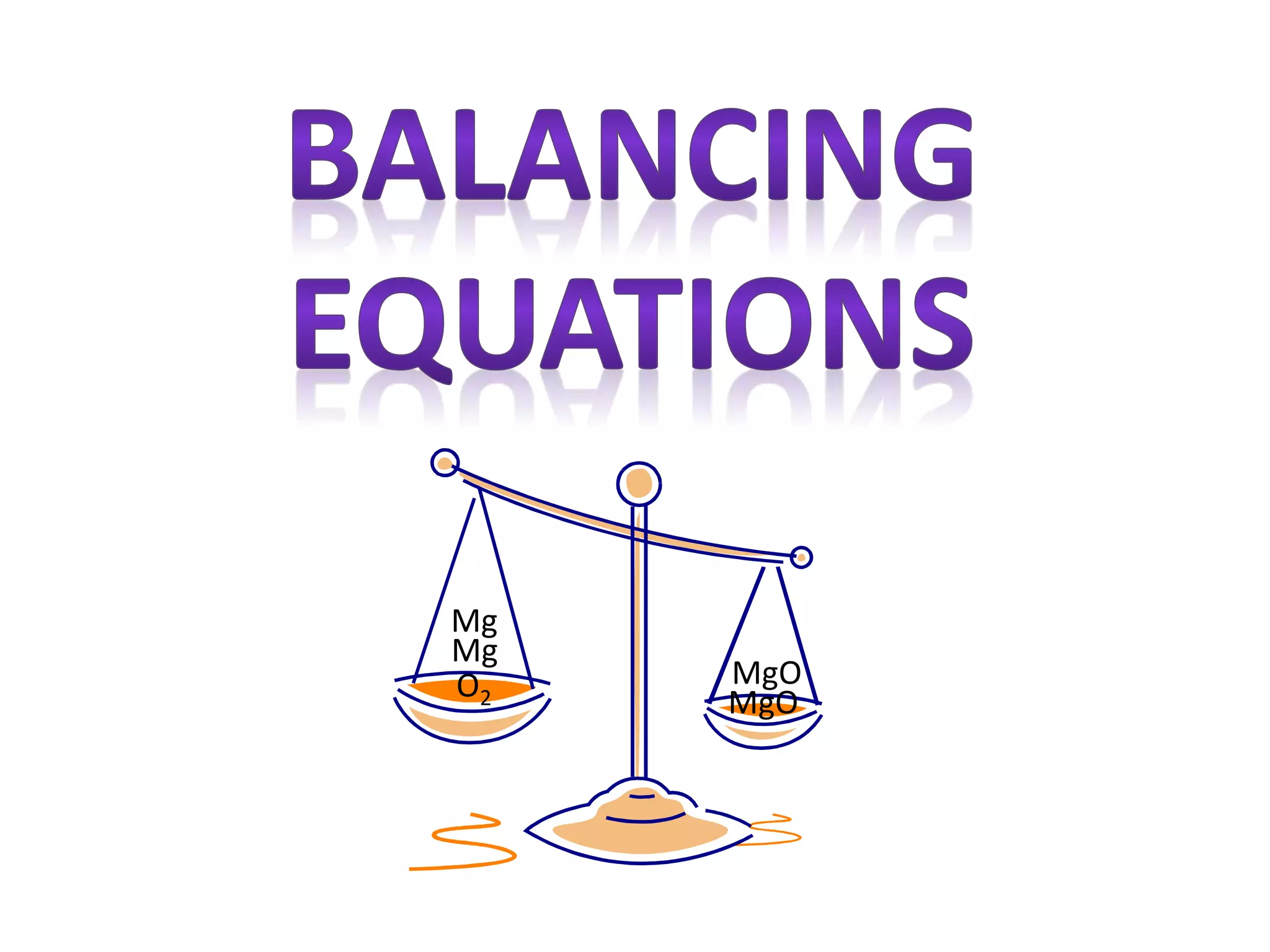
Mg
Mg
O2 MgO
MgO
Example: Formation of Lead bromide
During chemical change:
– A new compound (with different properties
from the reactants) is formed
– Energy is absorbed or given off
– Very difficult to reverse
Lead (II) Bromide
Lead Bromine
Energy
A chemical reaction involves the combination of two or more
reactants to give products
Lead (II) Bromide
Lead Bromine
Chemical change is usually observed during a chemical reaction
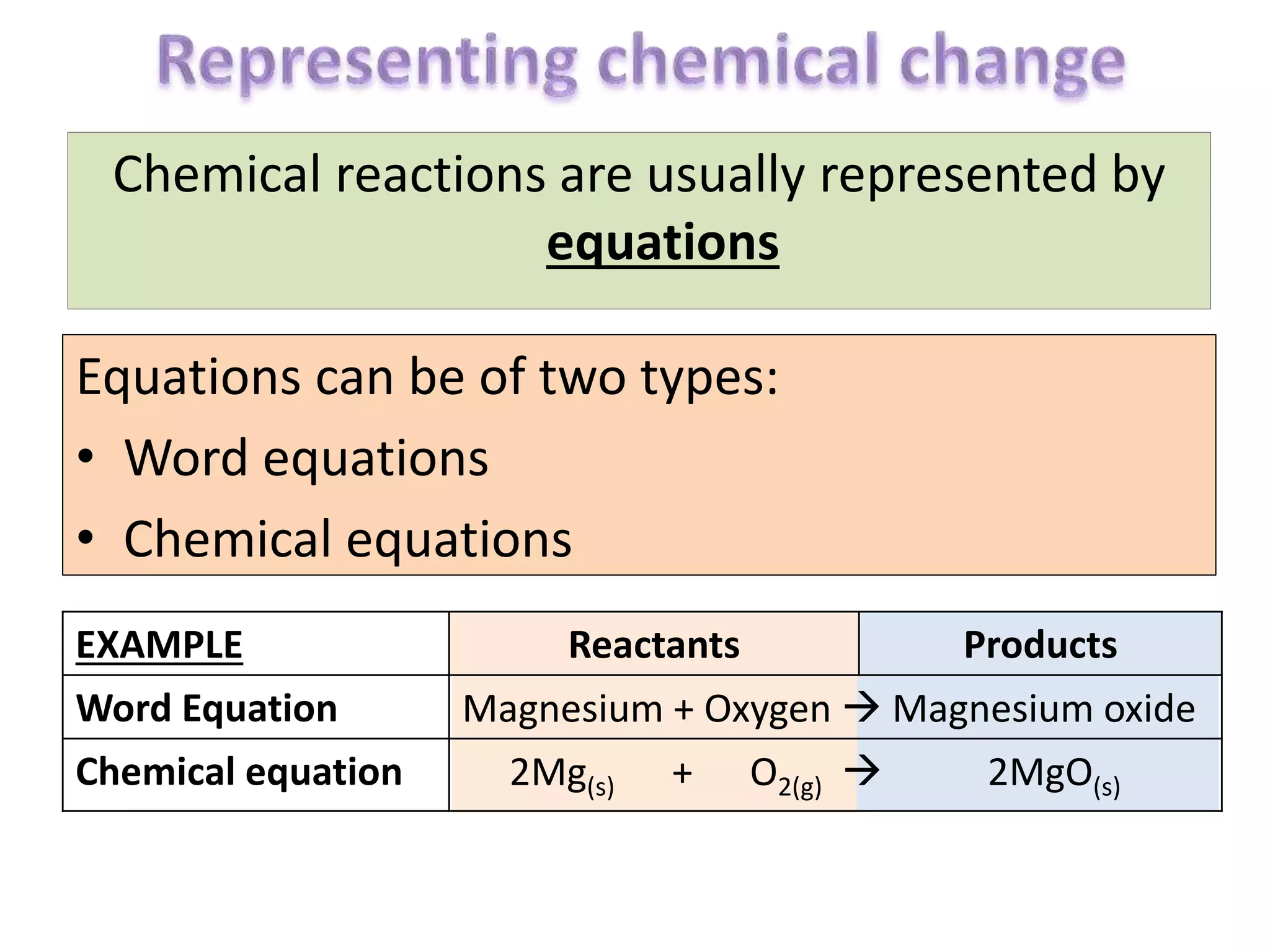
Chemical reactions are usually represented by
equations
EXAMPLE Reactants Products
Word Equation Magnesium + Oxygen  Magnesium oxide
Chemical equation 2Mg(s) + O2(g)  2MgO(s)
Equations can be of two types:
• Word equations
• Chemical equations
Chemical equations are a short form of word
equations
They consist of the:
– Chemical formulas of the reactants
– Chemical formulas of the products
separated by an arrow.
Mg + S  MgS
Pb + Br2  PbBr2
• Iron + Sulphur  Iron (II) sulphide
• Magnesium oxide + water  Magnesium hydroxide
• Hydrochloric acid + Sodium hydroxide  Sodium
chloride + Water
• Ammonia + Water  Ammonium hydroxide
There are some substances which when put in
equations, must be written with a small 2 next
to them. These are:
- Hydrogen: H2
- Oxygen: O2
- Nitrogen: N2
- Group 7: F2, Cl2, Br2, I2
This is because in nature they exist
• Magnesium + bromine  Magnesium bromide
• Calcium + fluorine  Calcium fluoride
• Hydrogen + Sulphur  Hydrogen sulphide
• Magnesium + water (steam)  Magnesium oxide + hydrogen
Mg
Mg
O2 MgO
MgO
sodium + chlorine  sodium chloride
Na + Cl2  NaCl
Does the equation seem right to you?
The above equation is not good enough!!
It is UNBALANCED
Na
Na
Cl
Cl
Cl
2 atoms of chlorine
1 atom of sodium
1 ion of chlorine
1 ion of sodium
For an equation to be balanced the number of atoms
on the right hand side must be equivalent to the
number of atoms of the right hand side
Na
Na
Cl
Cl
Cl
2 atoms of chlorine
2 atom of sodium
2 ion of chlorine
2 ions of sodium
Na
Na Cl
Equations are balanced by adding numbers in front of
the chemical symbols
2Na + Cl2  2NaCl
Try These!!!!
• Na + O2 → Na2O
• H2 + O2  H2O
• Al + Br2  AlBr3
• H2SO4 + NaOH  Na2SO4 + H2O
• sdNaOH + Pb(NO3)2  Pb(OH)2 + NaNO3
• Al(OH)3 + HBr → AlBr3 + H2O
Try these
• Calcium carbonate + hydrochloric acid  calcium chloride + water + carbon dioxide
• Hydrochloric acid + zinc  zinc chloride + hydrogen
• Iron + oxygen  Iron (III) oxide
• Potassium + bromine  potassium bromide
• Potassium hydroxide + sulfuric acid  potassium sulfate + water
• Lithium + water  lithium hydroxide + hydrogen
• State symbols should be included in the
equation.
• The state symbols are:
(s) = Solid
(l) = liquid
(g) = gas
(aq) = aqueous (dissolved in solution)
E.g. Na(s) + Cl2(g)  2NaCl(s)
• Solids
– All metals except Hg (mercury)
– Some non-metals: S, C, P, I2, B
• Liquids
– Water, ethanol (C2H5OH), Br2, Hg
• Gases
– Hydrogen, oxygen, nitrogen, carbon dioxide, carbon monoxide,
helium, chlorine, fluorine
• Aqueous
– Generally all ionic compounds are aqueous (including metal + radical)
–All acids e.g. HCl, HNO3, H2SO4, H3PO4, H2CO3, CH3COOH
Sodium + water  Sodium hydroxide + Hydrogen
Hydrochloric acid + iron (II) carbonate  Iron (II) chloride + carbon
dioxide + water
Magnesium + Oxygen  Magnesium oxide
Sulfuric acid + copper (II) oxide  Copper (II) sulfate + water

Balancing Equations.pptx

  • 1.
  • 2.
    Example: Formation ofLead bromide During chemical change: – A new compound (with different properties from the reactants) is formed – Energy is absorbed or given off – Very difficult to reverse Lead (II) Bromide Lead Bromine Energy
  • 3.
    A chemical reactioninvolves the combination of two or more reactants to give products Lead (II) Bromide Lead Bromine Chemical change is usually observed during a chemical reaction
  • 4.
    Chemical reactions areusually represented by equations EXAMPLE Reactants Products Word Equation Magnesium + Oxygen  Magnesium oxide Chemical equation 2Mg(s) + O2(g)  2MgO(s) Equations can be of two types: • Word equations • Chemical equations
  • 5.
    Chemical equations area short form of word equations They consist of the: – Chemical formulas of the reactants – Chemical formulas of the products separated by an arrow. Mg + S  MgS Pb + Br2  PbBr2
  • 6.
    • Iron +Sulphur  Iron (II) sulphide • Magnesium oxide + water  Magnesium hydroxide • Hydrochloric acid + Sodium hydroxide  Sodium chloride + Water • Ammonia + Water  Ammonium hydroxide
  • 7.
    There are somesubstances which when put in equations, must be written with a small 2 next to them. These are: - Hydrogen: H2 - Oxygen: O2 - Nitrogen: N2 - Group 7: F2, Cl2, Br2, I2 This is because in nature they exist
  • 8.
    • Magnesium +bromine  Magnesium bromide • Calcium + fluorine  Calcium fluoride • Hydrogen + Sulphur  Hydrogen sulphide • Magnesium + water (steam)  Magnesium oxide + hydrogen
  • 9.
  • 10.
    sodium + chlorine sodium chloride Na + Cl2  NaCl Does the equation seem right to you? The above equation is not good enough!! It is UNBALANCED Na Na Cl Cl Cl 2 atoms of chlorine 1 atom of sodium 1 ion of chlorine 1 ion of sodium
  • 11.
    For an equationto be balanced the number of atoms on the right hand side must be equivalent to the number of atoms of the right hand side Na Na Cl Cl Cl 2 atoms of chlorine 2 atom of sodium 2 ion of chlorine 2 ions of sodium Na Na Cl Equations are balanced by adding numbers in front of the chemical symbols 2Na + Cl2  2NaCl
  • 12.
    Try These!!!! • Na+ O2 → Na2O • H2 + O2  H2O • Al + Br2  AlBr3 • H2SO4 + NaOH  Na2SO4 + H2O • sdNaOH + Pb(NO3)2  Pb(OH)2 + NaNO3 • Al(OH)3 + HBr → AlBr3 + H2O
  • 14.
    Try these • Calciumcarbonate + hydrochloric acid  calcium chloride + water + carbon dioxide • Hydrochloric acid + zinc  zinc chloride + hydrogen • Iron + oxygen  Iron (III) oxide • Potassium + bromine  potassium bromide • Potassium hydroxide + sulfuric acid  potassium sulfate + water • Lithium + water  lithium hydroxide + hydrogen
  • 15.
    • State symbolsshould be included in the equation. • The state symbols are: (s) = Solid (l) = liquid (g) = gas (aq) = aqueous (dissolved in solution) E.g. Na(s) + Cl2(g)  2NaCl(s)
  • 16.
    • Solids – Allmetals except Hg (mercury) – Some non-metals: S, C, P, I2, B • Liquids – Water, ethanol (C2H5OH), Br2, Hg • Gases – Hydrogen, oxygen, nitrogen, carbon dioxide, carbon monoxide, helium, chlorine, fluorine • Aqueous – Generally all ionic compounds are aqueous (including metal + radical) –All acids e.g. HCl, HNO3, H2SO4, H3PO4, H2CO3, CH3COOH
  • 17.
    Sodium + water Sodium hydroxide + Hydrogen Hydrochloric acid + iron (II) carbonate  Iron (II) chloride + carbon dioxide + water Magnesium + Oxygen  Magnesium oxide Sulfuric acid + copper (II) oxide  Copper (II) sulfate + water