Badminton
Morris County School of Technology
Physical Education Dept.
What is Badminton
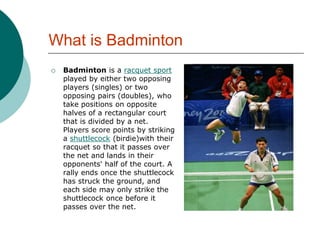
 Badminton is a racquet sport
played by either two opposing
players (singles) or two
opposing pairs (doubles), who
take positions on opposite
halves of a rectangular court
that is divided by a net.
Players score points by striking
a shuttlecock (birdie)with their
racquet so that it passes over
the net and lands in their
opponents' half of the court. A
rally ends once the shuttlecock
has struck the ground, and
each side may only strike the
shuttlecock once before it
passes over the net.
The Shuttlecock
 The shuttlecock (or Birdie) is a feathered projectile whose
unique aerodynamic properties cause it to fly differently
from the balls used in most racquet sports
 The feathers create much higher drag, causing the
shuttlecock to decelerate more rapidly than a ball.
 Shuttlecocks have a much higher top speed, when
compared to other racquet sports.
 Because shuttlecock flight is affected by wind, competitive
badminton is played indoors.
 Badminton is also played outdoors as a casual recreational
activity, often as a garden or beach game.
History and Development
 The beginnings of
Badminton can be traced
to mid-18th century
British India, where it was
created by British military
officers.
 Being particularly popular
in the British garrison
town Poona (now Pune),
the game also came to be
known as Poona.
 This game was taken by
retired officers back to
England where it
developed and rules were
set out.
History Continued
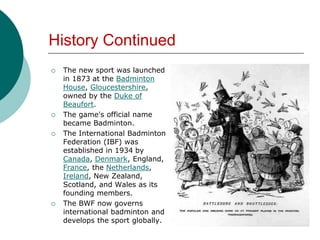
 The new sport was launched
in 1873 at the Badminton
House, Gloucestershire,
owned by the Duke of
Beaufort.
 The game's official name
became Badminton.
 The International Badminton
Federation (IBF) was
established in 1934 by
Canada, Denmark, England,
France, the Netherlands,
Ireland, New Zealand,
Scotland, and Wales as its
founding members.
 The BWF now governs
international badminton and
develops the sport globally.
Scoring System
 A match consists of the
best of 3 games of 21.
 Every time there is a
serve a point is scored.
 The side winning the rally
adds a point to it’s score.
 Each game must be won
by a 2 point advantage.
 At 29 all – the team to
score the 30th point will
win.
 A side winning a game
will serve in the next
game.
Singles Play
 At the beginning of a game (0-0), and
when the servers score is even, the server
will serve from the right service court.
When the servers score is odd, the server
serves from the left service court.
 If the server wins a rally, the server scores
a point and serves again from the alternate
service court.
 If the receiver wins a rally, they score a
point and serve from the appropriate
service court – left if their score is odd, and
right if their score is even.
Doubles Play
 In doubles, if the serving side wins a rally, the same
player continues to serve, but s/he changes service courts
so that s/he serves to each opponent in turn.
 The opponents remain in their service court until they win
a rally.
 If the opponents win the rally and their new score is even,
the player in the right service court serves; if odd, the
player in the left service court serves.
 The players' service courts are determined by their
positions at the start of the previous rally, not by where
they were standing at the end of the rally.
 A consequence of this system is that, each time a side
regains the service, the server will be the player who did
not serve last time.
Details
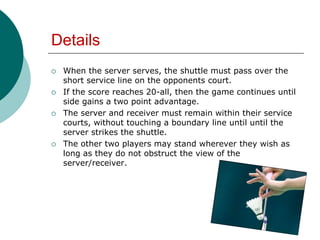
 When the server serves, the shuttle must pass over the
short service line on the opponents court.
 If the score reaches 20-all, then the game continues until
side gains a two point advantage.
 The server and receiver must remain within their service
courts, without touching a boundary line until until the
server strikes the shuttle.
 The other two players may stand wherever they wish as
long as they do not obstruct the view of the
server/receiver.
Faults
 Players win a rally if their opponents commit a fault.
 The most common fault in badminton is when
players fail to return the suttlecock so that it passes
over the net and lands inside the opponents court.
 Neither the server or receiver may lift a foot until
the suttlecock has been struck by the server.
 The server must hit the base or cork of the
suttlecock.
 Each side may only hit the suttlecock once before it
passes back over the net.
 It is also a fault if the suttlecock hits the ceiling.
Let
 If a let is called, the
rally is stopped and
replayed with no
change in score.
 Lets may occur when
there is an unexpected
disturbance.
EX. – a shuttle landing on
your court which was hit
from an adjacent court.
Equipment Needed to Play
 Racket
 Shuttlecock
(Birdie)
 Net
 Badminton Court
 Athletic Clothing
 Athletic Footwear
Badminton Court Dimensions

Badminton_ppt.ppt

  • 1.
    Badminton Morris County Schoolof Technology Physical Education Dept.
  • 2.
    What is Badminton Badminton is a racquet sport played by either two opposing players (singles) or two opposing pairs (doubles), who take positions on opposite halves of a rectangular court that is divided by a net. Players score points by striking a shuttlecock (birdie)with their racquet so that it passes over the net and lands in their opponents' half of the court. A rally ends once the shuttlecock has struck the ground, and each side may only strike the shuttlecock once before it passes over the net.
  • 3.
    The Shuttlecock  Theshuttlecock (or Birdie) is a feathered projectile whose unique aerodynamic properties cause it to fly differently from the balls used in most racquet sports  The feathers create much higher drag, causing the shuttlecock to decelerate more rapidly than a ball.  Shuttlecocks have a much higher top speed, when compared to other racquet sports.  Because shuttlecock flight is affected by wind, competitive badminton is played indoors.  Badminton is also played outdoors as a casual recreational activity, often as a garden or beach game.
  • 4.
    History and Development The beginnings of Badminton can be traced to mid-18th century British India, where it was created by British military officers.  Being particularly popular in the British garrison town Poona (now Pune), the game also came to be known as Poona.  This game was taken by retired officers back to England where it developed and rules were set out.
  • 5.
    History Continued  Thenew sport was launched in 1873 at the Badminton House, Gloucestershire, owned by the Duke of Beaufort.  The game's official name became Badminton.  The International Badminton Federation (IBF) was established in 1934 by Canada, Denmark, England, France, the Netherlands, Ireland, New Zealand, Scotland, and Wales as its founding members.  The BWF now governs international badminton and develops the sport globally.
  • 6.
    Scoring System  Amatch consists of the best of 3 games of 21.  Every time there is a serve a point is scored.  The side winning the rally adds a point to it’s score.  Each game must be won by a 2 point advantage.  At 29 all – the team to score the 30th point will win.  A side winning a game will serve in the next game.
  • 7.
    Singles Play  Atthe beginning of a game (0-0), and when the servers score is even, the server will serve from the right service court. When the servers score is odd, the server serves from the left service court.  If the server wins a rally, the server scores a point and serves again from the alternate service court.  If the receiver wins a rally, they score a point and serve from the appropriate service court – left if their score is odd, and right if their score is even.
  • 8.
    Doubles Play  Indoubles, if the serving side wins a rally, the same player continues to serve, but s/he changes service courts so that s/he serves to each opponent in turn.  The opponents remain in their service court until they win a rally.  If the opponents win the rally and their new score is even, the player in the right service court serves; if odd, the player in the left service court serves.  The players' service courts are determined by their positions at the start of the previous rally, not by where they were standing at the end of the rally.  A consequence of this system is that, each time a side regains the service, the server will be the player who did not serve last time.
  • 9.
    Details  When theserver serves, the shuttle must pass over the short service line on the opponents court.  If the score reaches 20-all, then the game continues until side gains a two point advantage.  The server and receiver must remain within their service courts, without touching a boundary line until until the server strikes the shuttle.  The other two players may stand wherever they wish as long as they do not obstruct the view of the server/receiver.
  • 10.
    Faults  Players wina rally if their opponents commit a fault.  The most common fault in badminton is when players fail to return the suttlecock so that it passes over the net and lands inside the opponents court.  Neither the server or receiver may lift a foot until the suttlecock has been struck by the server.  The server must hit the base or cork of the suttlecock.  Each side may only hit the suttlecock once before it passes back over the net.  It is also a fault if the suttlecock hits the ceiling.
  • 11.
    Let  If alet is called, the rally is stopped and replayed with no change in score.  Lets may occur when there is an unexpected disturbance. EX. – a shuttle landing on your court which was hit from an adjacent court.
  • 12.
    Equipment Needed toPlay  Racket  Shuttlecock (Birdie)  Net  Badminton Court  Athletic Clothing  Athletic Footwear
  • 13.