DIAGNOSIS OF BACTERIAL VAGINOSIS
Prof. Aboubakr Elnashar
ABOUBAKR ELNASHAR
1.pH of discharge: 5.7
A low pH virtually excludes BV. An elevated pH is the
most sensitive but least specific as an increase can
also associated with menstruation, recent sexual
intercourse, or infection with T. vaginalis
ABOUBAKR ELNASHAR
2.Whiff test (amine test).
Addition of 10% KOH to a sample of vaginal
discharge: fishy odor.
PPV: 90%
specificity of 70%
ABOUBAKR ELNASHAR
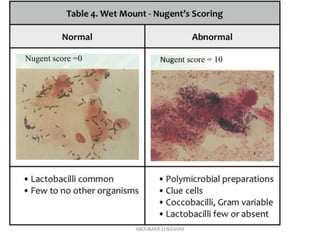
3.Wet film:
drop of vaginal secretion & drop of saline:
clue cells: epithelial cells covered by coccobacilli,
borders are indistinct
No WBC.
The single most sensitive & specific
operator dependent.
Debris & degenerated cells ±mistaken for clue cells
lactobacilli may adhere to epithelial cells in low
numbers.
ABOUBAKR ELNASHAR
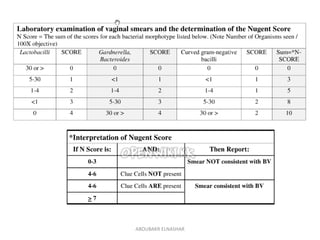
4. Gram stain:
Gr. Variable c.bacilli
no WBC
no lactobacilli
Scoring systems which weight numbers of
lactobacilli & numbers of G vaginalis & Mobiluncus.
simple & objective method.
90% sensitivity, highly sensitive & specific
cost & need for microscopist.
ABOUBAKR ELNASHAR
ABOUBAKR ELNASHAR
ABOUBAKR ELNASHAR
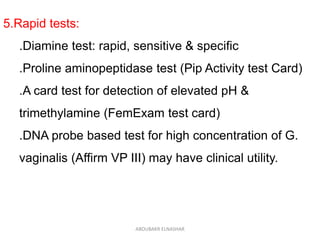
5.Rapid tests:
.Diamine test: rapid, sensitive & specific
.Proline aminopeptidase test (Pip Activity test Card)
.A card test for detection of elevated pH &
trimethylamine (FemExam test card)
.DNA probe based test for high concentration of G.
vaginalis (Affirm VP III) may have clinical utility.
ABOUBAKR ELNASHAR
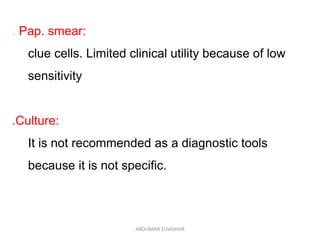
. Pap. smear:
clue cells. Limited clinical utility because of low
sensitivity
.Culture:
It is not recommended as a diagnostic tools
because it is not specific.
ABOUBAKR ELNASHAR
Amsel’s criteria
3 of the following:
.Homogenous discharge.
.pH> 4.5.
. Amine test.
.Clue cells.
Gram stain alone
corresponds well to Amsel’s criteria & to the presence
of the associated bacteria.
ABOUBAKR ELNASHAR

Bacterial vaginosis diagnosis

  • 1.
    DIAGNOSIS OF BACTERIALVAGINOSIS Prof. Aboubakr Elnashar ABOUBAKR ELNASHAR
  • 2.
    1.pH of discharge:5.7 A low pH virtually excludes BV. An elevated pH is the most sensitive but least specific as an increase can also associated with menstruation, recent sexual intercourse, or infection with T. vaginalis ABOUBAKR ELNASHAR
  • 3.
    2.Whiff test (aminetest). Addition of 10% KOH to a sample of vaginal discharge: fishy odor. PPV: 90% specificity of 70% ABOUBAKR ELNASHAR
  • 4.
    3.Wet film: drop ofvaginal secretion & drop of saline: clue cells: epithelial cells covered by coccobacilli, borders are indistinct No WBC. The single most sensitive & specific operator dependent. Debris & degenerated cells ±mistaken for clue cells lactobacilli may adhere to epithelial cells in low numbers. ABOUBAKR ELNASHAR
  • 5.
    4. Gram stain: Gr.Variable c.bacilli no WBC no lactobacilli Scoring systems which weight numbers of lactobacilli & numbers of G vaginalis & Mobiluncus. simple & objective method. 90% sensitivity, highly sensitive & specific cost & need for microscopist. ABOUBAKR ELNASHAR
  • 6.
  • 7.
  • 8.
    5.Rapid tests: .Diamine test:rapid, sensitive & specific .Proline aminopeptidase test (Pip Activity test Card) .A card test for detection of elevated pH & trimethylamine (FemExam test card) .DNA probe based test for high concentration of G. vaginalis (Affirm VP III) may have clinical utility. ABOUBAKR ELNASHAR
  • 9.
    . Pap. smear: cluecells. Limited clinical utility because of low sensitivity .Culture: It is not recommended as a diagnostic tools because it is not specific. ABOUBAKR ELNASHAR
  • 10.
    Amsel’s criteria 3 ofthe following: .Homogenous discharge. .pH> 4.5. . Amine test. .Clue cells. Gram stain alone corresponds well to Amsel’s criteria & to the presence of the associated bacteria. ABOUBAKR ELNASHAR