Back-Propagation
C.Eben Exceline,
AP/AI&DS,
Excel Engineering
College
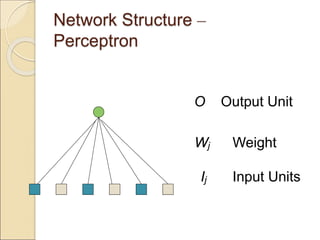
Network Structure –
Perceptron
O Output Unit
Wj Weight
Ij Input Units
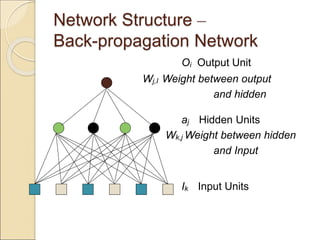
Network Structure –
Back-propagation Network
Oi Output Unit
Wj,I Weight between output
and hidden
aj Hidden Units
Wk,j Weight between hidden
and Input
Ik Input Units
Learning Rule
 Measure error (sum of mean square
error)
 Reduce that error
◦ By appropriately adjusting each of the
weights in the network
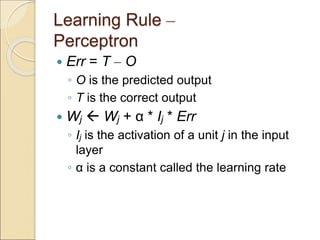
Learning Rule –
Perceptron
 Err = T – O
◦ O is the predicted output
◦ T is the correct output
 Wj  Wj + α * Ij * Err
◦ Ij is the activation of a unit j in the input
layer
◦ α is a constant called the learning rate
Learning Rule –
Back-propagation Network
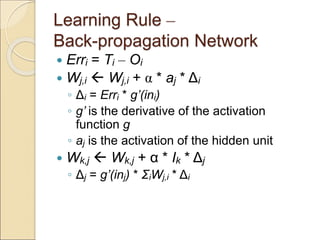
 Erri = Ti – Oi
 Wj,i  Wj,i + α * aj * Δi
◦ Δi = Erri * g’(ini)
◦ g’ is the derivative of the activation
function g
◦ aj is the activation of the hidden unit
 Wk,j  Wk,j + α * Ik * Δj
◦ Δj = g’(inj) * ΣiWj,i * Δi
Learning Rule –
Back-propagation Network
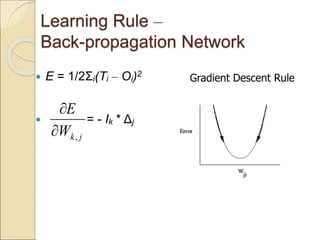
 E = 1/2Σi(Ti – Oi)2
 = - Ik * Δj
j
k
W
E
,


Gradient Descent Rule
Why a hidden layer?
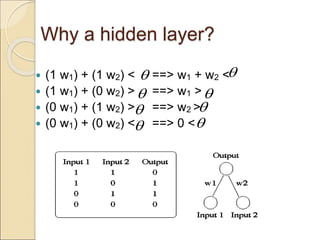
 (1 w1) + (1 w2) < ==> w1 + w2 <
 (1 w1) + (0 w2) > ==> w1 >
 (0 w1) + (1 w2) > ==> w2 >
 (0 w1) + (0 w2) < ==> 0 <



 



Why a hidden layer? (cont.)
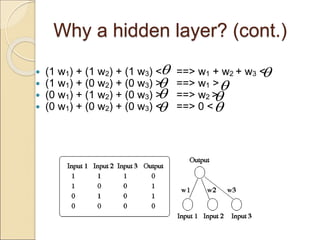
 (1 w1) + (1 w2) + (1 w3) < ==> w1 + w2 + w3 <
 (1 w1) + (0 w2) + (0 w3) > ==> w1 >
 (0 w1) + (1 w2) + (0 w3) > ==> w2 >
 (0 w1) + (0 w2) + (0 w3) < ==> 0 <








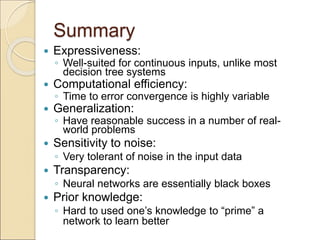
Summary
 Expressiveness:
◦ Well-suited for continuous inputs, unlike most
decision tree systems
 Computational efficiency:
◦ Time to error convergence is highly variable
 Generalization:
◦ Have reasonable success in a number of real-
world problems
 Sensitivity to noise:
◦ Very tolerant of noise in the input data
 Transparency:
◦ Neural networks are essentially black boxes
 Prior knowledge:
◦ Hard to used one’s knowledge to “prime” a
network to learn better
Conclusions (cont.)

Backpropagation Algorithm forward and backward pass

  • 1.
  • 2.
    Network Structure – Perceptron OOutput Unit Wj Weight Ij Input Units
  • 3.
    Network Structure – Back-propagationNetwork Oi Output Unit Wj,I Weight between output and hidden aj Hidden Units Wk,j Weight between hidden and Input Ik Input Units
  • 4.
    Learning Rule  Measureerror (sum of mean square error)  Reduce that error ◦ By appropriately adjusting each of the weights in the network
  • 5.
    Learning Rule – Perceptron Err = T – O ◦ O is the predicted output ◦ T is the correct output  Wj  Wj + α * Ij * Err ◦ Ij is the activation of a unit j in the input layer ◦ α is a constant called the learning rate
  • 6.
    Learning Rule – Back-propagationNetwork  Erri = Ti – Oi  Wj,i  Wj,i + α * aj * Δi ◦ Δi = Erri * g’(ini) ◦ g’ is the derivative of the activation function g ◦ aj is the activation of the hidden unit  Wk,j  Wk,j + α * Ik * Δj ◦ Δj = g’(inj) * ΣiWj,i * Δi
  • 7.
    Learning Rule – Back-propagationNetwork  E = 1/2Σi(Ti – Oi)2  = - Ik * Δj j k W E ,   Gradient Descent Rule
  • 8.
    Why a hiddenlayer?  (1 w1) + (1 w2) < ==> w1 + w2 <  (1 w1) + (0 w2) > ==> w1 >  (0 w1) + (1 w2) > ==> w2 >  (0 w1) + (0 w2) < ==> 0 <        
  • 9.
    Why a hiddenlayer? (cont.)  (1 w1) + (1 w2) + (1 w3) < ==> w1 + w2 + w3 <  (1 w1) + (0 w2) + (0 w3) > ==> w1 >  (0 w1) + (1 w2) + (0 w3) > ==> w2 >  (0 w1) + (0 w2) + (0 w3) < ==> 0 <        
  • 10.
    Summary  Expressiveness: ◦ Well-suitedfor continuous inputs, unlike most decision tree systems  Computational efficiency: ◦ Time to error convergence is highly variable  Generalization: ◦ Have reasonable success in a number of real- world problems  Sensitivity to noise: ◦ Very tolerant of noise in the input data  Transparency: ◦ Neural networks are essentially black boxes  Prior knowledge: ◦ Hard to used one’s knowledge to “prime” a network to learn better
  • 11.