Research Workshop
Calit2, November 7, 2007
Alexander Gruler, Sabine Rittmann
Technische Universitaet Muenchen, Germany
Joint work with Ingolf H. Krueger, Matthew Arrott, Barry Demchak,
Vina Ermagan, Emilia Farcas, Claudiu Farcas, Massimiliano Menarini
CSE Department – Calit2
University of California, San Diego
Representative Rich Services Papers
• M. Arrott, B. Demchak, V. Ermagan, C. Farcas, E. Farcas, I. H. Krüger,
and M. Menarini, “Rich Services: The Integration Piece of the SOA Puzzle
,” in Proceedings of the IEEE International Conference on Web Services
(ICWS), Salt Lake City, Utah, USA. Jul. 2007.
• B. Demchak, C. Farcas, E. Farcas, and I. H. Krüger, “
The Treasure Map for Rich Services,” in Proceedings of the 2007 IEEE
International Conference on Information Reuse and Integration (IRI), Las
Vegas, USA. IEEE, Aug. 2007.
Motivation
• Dramatic increase in distribution and complexity of software
systems
– Business/Enterprise Systems
– Technical/Embedded Systems
• Shift from stand-alone to networked systems
• Internet and Wireless Networks
– key enabling technologies for advanced services
• Convergence between business and technical systems:
– Telecommunication/Networking
– Embedded Systems
Overview
• Background and Motivation
• State of the Art and Challenges of SOA Integration
• Rich Services
• Examples: Chat, Next-Generation Ocean Observatories, Rich Feeds
• Deployment Strategies for Rich Services using ESB Technology
• Summary and Outlook
Web Services – State of the Art
• Several W3C standards backed by industry
– separation of concerns (HTTP/SOAP),
– data marshaling (XML),
– interface descriptions (WSDL)
• Service composition, Semantic web
– Active research with results such as OWL-S
• Business workflows
– Several approaches such as BPEL, WSCL, WS-CDL
Web Services – State of the Art
• Addressing cross-cutting concerns
– Separate step through UDDI, WS-Security, etc
• Enterprise Service Bus technologies for deployment
– Message-oriented middleware (MOM)
– Flexible plug-in architecture
– Rich set of data adapters/connectors for rapid connections
• Transition from logical architecture to ESB implementation is
still ad-hoc
Challenges
• Address crosscutting architectural concerns
– such as policy management, governance, and authentication
• Still maintain a lean implementation and deployment flavor?
• Horizontal: interplay at the same logical or deployment level of
– application services
– the corresponding crosscutting concerns
• Vertical: hierarchical decomposition into sub-services
– the environment is shielded through encapsulation from
– their structural and behavioral complexity
– the form of their composition
Rich Services – Why/What?
“To boldly go where
no service has gone before”.
• an extension of the service notion, based on an architectural pattern
• Dynamic adaptation
– new services can be introduced at runtime
– no need to change or adapt the implementation of existing services
• Manage the complexity of a system-of-systems
– decomposing into primary and crosscutting concerns
– providing flexible encapsulation for these concerns
– generating a model that can easily be leveraged into a deployment
• Workflow management
– Service choreography at the infrastructure or application level
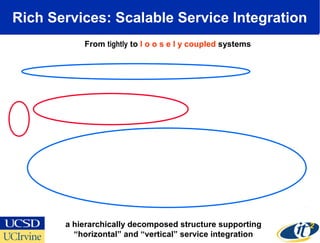
Rich Services: Scalable Service Integration
From tightly to l o o s e l y coupled systems
a hierarchically decomposed structure supporting
“horizontal” and “vertical” service integration
Rich Services – Core
• Main entities of the architecture
– Service/Data Connector - interaction between the Rich Service and its
environment
– the Messenger and the Router/Interceptor - communication
infrastructure
– Rich Services - encapsulate various application and infrastructure
functionalities
• Rich Application Services
– interface directly with the Messenger
– provide core application functionality
• Rich Infrastructure Services
– interface directly with the Router/Interceptor
– provide infrastructure and crosscutting functionality
– Examples: policy monitoring/enforcement, encryption, authentication
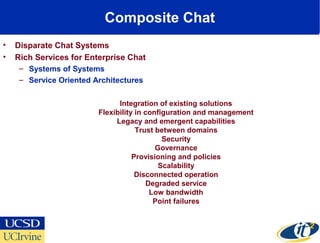
Composite Chat
• Disparate Chat Systems
• Rich Services for Enterprise Chat
– Systems of Systems
– Service Oriented Architectures
Integration of existing solutions
Flexibility in configuration and management
Legacy and emergent capabilities
Trust between domains
Security
Governance
Provisioning and policies
Scalability
Disconnected operation
Degraded service
Low bandwidth
Point failures
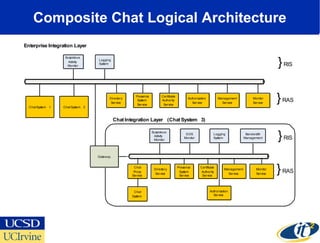
Composite Chat Logical Architecture
ChatSystem 1
Enterprise Integration Layer
Chat Integration Layer (Chat System 3)
ChatSystem 2
Directory
Service
Presence
System
Service
Authorization
Service
Monitor
Service
Logging
System
Suspicious
Activity
Monitor
Chat
Proxy
Service
Bandwidth
Management
Logging
System
Gateway
Monitor
Service
Management
Service
Presence
System
Service
Directory
Service
DOS
Monitor
Suspicious
Activity
Monitor
Chat
System
Certificate
Authority
Service
Certificate
Authority
Service
Management
Service
Authorization
Service
}RIS
}RAS
}RIS
}RAS
Rich Services – Development Process
Example: Trading System
Ocean Observatory example
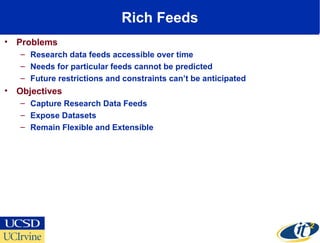
Rich Feeds
• Problems
– Research data feeds accessible over time
– Needs for particular feeds cannot be predicted
– Future restrictions and constraints can’t be anticipated
• Objectives
– Capture Research Data Feeds
– Expose Datasets
– Remain Flexible and Extensible
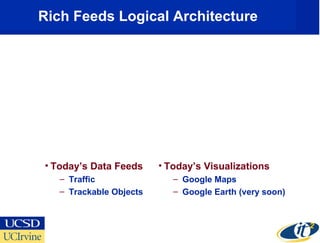
Rich Feeds Logical Architecture
• Today’s Data Feeds
– Traffic
– Trackable Objects
• Today’s Visualizations
– Google Maps
– Google Earth (very soon)
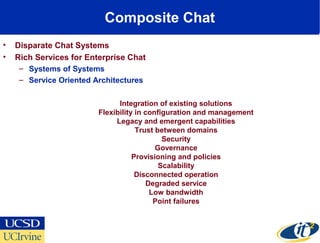
Composite Chat
• Disparate Chat Systems
• Rich Services for Enterprise Chat
– Systems of Systems
– Service Oriented Architectures
Integration of existing solutions
Flexibility in configuration and management
Legacy and emergent capabilities
Trust between domains
Security
Governance
Provisioning and policies
Scalability
Disconnected operation
Degraded service
Low bandwidth
Point failures
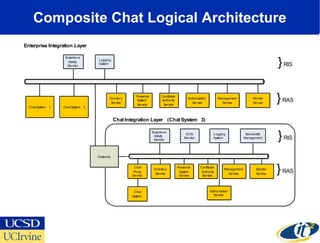
Composite Chat Logical Architecture
ChatSystem 1
Enterprise Integration Layer
Chat Integration Layer (Chat System 3)
ChatSystem 2
Directory
Service
Presence
System
Service
Authorization
Service
Monitor
Service
Logging
System
Suspicious
Activity
Monitor
Chat
Proxy
Service
Bandwidth
Management
Logging
System
Gateway
Monitor
Service
Management
Service
Presence
System
Service
Directory
Service
DOS
Monitor
Suspicious
Activity
Monitor
Chat
System
Certificate
Authority
Service
Certificate
Authority
Service
Management
Service
Authorization
Service
}RIS
}RAS
}RIS
}RAS
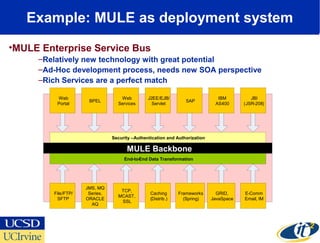
Example: MULE as deployment system
•MULE Enterprise Service Bus
–Relatively new technology with great potential
–Ad-Hoc development process, needs new SOA perspective
–Rich Services are a perfect match
Security –Authentication and Authorization
MULE Backbone
End-to-End Data Transformation
Web
Portal
BPEL
Web
Services
J2EE/EJB/
Servlet
SAP
IBM
AS400
JBI
(JSR-208)
File/FTP/
SFTP
JMS, MQ
Series,
ORACLE
AQ
TCP,
MCAST,
SSL
Caching
(Distrib.)
Frameworks
(Spring)
GRID,
JavaSpace
E-Comm
Email, IM
Service/Data
Connector
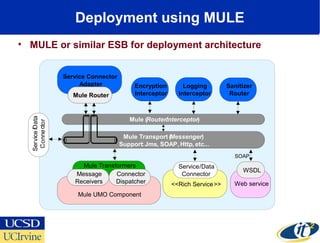
Deployment using MULE
• MULE or similar ESB for deployment architecture
Service Connector
Adapter
Mule Router
Encryption
Interceptor
Logging
Interceptor
Sanitizer
Router
Mule UMO Component
Mule Transformers
Message
Receivers
Connector
Dispatcher <<Rich Service>>
Service/Data
Connector
Web service
WSDL
SOAP
Mule Transport (Messenger)
Support:Jms, SOAP, Http, etc...
Mule (Router/Interceptor)

Ucsd tum workshop bd

  • 1.
    Research Workshop Calit2, November7, 2007 Alexander Gruler, Sabine Rittmann Technische Universitaet Muenchen, Germany Joint work with Ingolf H. Krueger, Matthew Arrott, Barry Demchak, Vina Ermagan, Emilia Farcas, Claudiu Farcas, Massimiliano Menarini CSE Department – Calit2 University of California, San Diego
  • 2.
    Representative Rich ServicesPapers • M. Arrott, B. Demchak, V. Ermagan, C. Farcas, E. Farcas, I. H. Krüger, and M. Menarini, “Rich Services: The Integration Piece of the SOA Puzzle ,” in Proceedings of the IEEE International Conference on Web Services (ICWS), Salt Lake City, Utah, USA. Jul. 2007. • B. Demchak, C. Farcas, E. Farcas, and I. H. Krüger, “ The Treasure Map for Rich Services,” in Proceedings of the 2007 IEEE International Conference on Information Reuse and Integration (IRI), Las Vegas, USA. IEEE, Aug. 2007.
  • 3.
    Motivation • Dramatic increasein distribution and complexity of software systems – Business/Enterprise Systems – Technical/Embedded Systems • Shift from stand-alone to networked systems • Internet and Wireless Networks – key enabling technologies for advanced services • Convergence between business and technical systems: – Telecommunication/Networking – Embedded Systems
  • 4.
    Overview • Background andMotivation • State of the Art and Challenges of SOA Integration • Rich Services • Examples: Chat, Next-Generation Ocean Observatories, Rich Feeds • Deployment Strategies for Rich Services using ESB Technology • Summary and Outlook
  • 5.
    Web Services –State of the Art • Several W3C standards backed by industry – separation of concerns (HTTP/SOAP), – data marshaling (XML), – interface descriptions (WSDL) • Service composition, Semantic web – Active research with results such as OWL-S • Business workflows – Several approaches such as BPEL, WSCL, WS-CDL
  • 6.
    Web Services –State of the Art • Addressing cross-cutting concerns – Separate step through UDDI, WS-Security, etc • Enterprise Service Bus technologies for deployment – Message-oriented middleware (MOM) – Flexible plug-in architecture – Rich set of data adapters/connectors for rapid connections • Transition from logical architecture to ESB implementation is still ad-hoc
  • 7.
    Challenges • Address crosscuttingarchitectural concerns – such as policy management, governance, and authentication • Still maintain a lean implementation and deployment flavor? • Horizontal: interplay at the same logical or deployment level of – application services – the corresponding crosscutting concerns • Vertical: hierarchical decomposition into sub-services – the environment is shielded through encapsulation from – their structural and behavioral complexity – the form of their composition
  • 8.
    Rich Services –Why/What? “To boldly go where no service has gone before”. • an extension of the service notion, based on an architectural pattern • Dynamic adaptation – new services can be introduced at runtime – no need to change or adapt the implementation of existing services • Manage the complexity of a system-of-systems – decomposing into primary and crosscutting concerns – providing flexible encapsulation for these concerns – generating a model that can easily be leveraged into a deployment • Workflow management – Service choreography at the infrastructure or application level
  • 9.
    Rich Services: ScalableService Integration From tightly to l o o s e l y coupled systems a hierarchically decomposed structure supporting “horizontal” and “vertical” service integration
  • 10.
    Rich Services –Core • Main entities of the architecture – Service/Data Connector - interaction between the Rich Service and its environment – the Messenger and the Router/Interceptor - communication infrastructure – Rich Services - encapsulate various application and infrastructure functionalities • Rich Application Services – interface directly with the Messenger – provide core application functionality • Rich Infrastructure Services – interface directly with the Router/Interceptor – provide infrastructure and crosscutting functionality – Examples: policy monitoring/enforcement, encryption, authentication
  • 11.
    Composite Chat • DisparateChat Systems • Rich Services for Enterprise Chat – Systems of Systems – Service Oriented Architectures Integration of existing solutions Flexibility in configuration and management Legacy and emergent capabilities Trust between domains Security Governance Provisioning and policies Scalability Disconnected operation Degraded service Low bandwidth Point failures
  • 12.
    Composite Chat LogicalArchitecture ChatSystem 1 Enterprise Integration Layer Chat Integration Layer (Chat System 3) ChatSystem 2 Directory Service Presence System Service Authorization Service Monitor Service Logging System Suspicious Activity Monitor Chat Proxy Service Bandwidth Management Logging System Gateway Monitor Service Management Service Presence System Service Directory Service DOS Monitor Suspicious Activity Monitor Chat System Certificate Authority Service Certificate Authority Service Management Service Authorization Service }RIS }RAS }RIS }RAS
  • 13.
    Rich Services –Development Process
  • 14.
  • 15.
  • 16.
    Rich Feeds • Problems –Research data feeds accessible over time – Needs for particular feeds cannot be predicted – Future restrictions and constraints can’t be anticipated • Objectives – Capture Research Data Feeds – Expose Datasets – Remain Flexible and Extensible
  • 17.
    Rich Feeds LogicalArchitecture • Today’s Data Feeds – Traffic – Trackable Objects • Today’s Visualizations – Google Maps – Google Earth (very soon)
  • 18.
    Composite Chat • DisparateChat Systems • Rich Services for Enterprise Chat – Systems of Systems – Service Oriented Architectures Integration of existing solutions Flexibility in configuration and management Legacy and emergent capabilities Trust between domains Security Governance Provisioning and policies Scalability Disconnected operation Degraded service Low bandwidth Point failures
  • 19.
    Composite Chat LogicalArchitecture ChatSystem 1 Enterprise Integration Layer Chat Integration Layer (Chat System 3) ChatSystem 2 Directory Service Presence System Service Authorization Service Monitor Service Logging System Suspicious Activity Monitor Chat Proxy Service Bandwidth Management Logging System Gateway Monitor Service Management Service Presence System Service Directory Service DOS Monitor Suspicious Activity Monitor Chat System Certificate Authority Service Certificate Authority Service Management Service Authorization Service }RIS }RAS }RIS }RAS
  • 20.
    Example: MULE asdeployment system •MULE Enterprise Service Bus –Relatively new technology with great potential –Ad-Hoc development process, needs new SOA perspective –Rich Services are a perfect match Security –Authentication and Authorization MULE Backbone End-to-End Data Transformation Web Portal BPEL Web Services J2EE/EJB/ Servlet SAP IBM AS400 JBI (JSR-208) File/FTP/ SFTP JMS, MQ Series, ORACLE AQ TCP, MCAST, SSL Caching (Distrib.) Frameworks (Spring) GRID, JavaSpace E-Comm Email, IM
  • 21.
    Service/Data Connector Deployment using MULE •MULE or similar ESB for deployment architecture Service Connector Adapter Mule Router Encryption Interceptor Logging Interceptor Sanitizer Router Mule UMO Component Mule Transformers Message Receivers Connector Dispatcher <<Rich Service>> Service/Data Connector Web service WSDL SOAP Mule Transport (Messenger) Support:Jms, SOAP, Http, etc... Mule (Router/Interceptor)

Editor's Notes

  • #4 &amp;lt;number&amp;gt;
  • #5 &amp;lt;number&amp;gt;