Welcome to 3OP’s
Back-to-School Night with
Ms. Olivia Pasquariello in room #224
About Ms Olivia…
I love my vocation as a teacher
I love to read, share stories & ideas with my students
I take my role as your child’s educator very seriously. I want the very best
emotionally, socially & academically for each & every child under my care
I come from a very loving, close-knit family
I got married over the summer holidays!
I am a vegetarian & yogi in training
I believe the world is a beautiful place & the world is both fragile &
fascinating. We must learn to appreciate the diversity of all cultures, as well
as treat our planet Earth with greater care
I firmly believe in being kind, loving, hard-working & living life fully with
great integrity
3OP’s
Classroom Creed…
I believe in…
• Active Participation, rather than passive learning
• Problem solving- Think outside the box
• Adhering to classroom agreements
• Positive Behavior and making the right choices
• Putting material in context- Why is it important to learn this material?
• Making connections to content, this will foster a deeper sense of learning
and applying knowledge
• Individual Responsibility- class room jobs
• Time Management- Using time wisely
Overall, I strive to make 3OP a place where it is a positive, fun, safe,
productive, engaging and encouraging learning environment!
Subjects
Math
Social Studies
Science
Reader’s Workshop
Writer’s Workshop
Spelling
Everyday
Mathematics
About EM:
• Research-based program adopted from the University of Chicago
• Each unit lasts for approximately 3-4 weeks
• 60 minutes a day average spent on math instruction
Philosophy:
• Build fact power through daily oral practice, conceptual activities, and games
• Link mathematics to everyday situations
• Includes hands-on activities and explorations
• Encourage use and sharing of multiple strategies
Resources:
1) Math Journals (SMJ)
2) Home Links (HL)
3) Student Reference Book (SRB)
Gr. 3 Goal:
• MULTIPLICATION must be committed to memory

www.multiplication.com or multiflow (app)
Look for shapes & patterns in real life
Have your child measure ingredients for a recipe you are making
Ask your child to explain the math skills he/she has been working on
When helping your child with homework or school assignments, ask
him/her to explain how they got an answer
Find math games online together!
Play board games that involve numbers & patterns
Ask your child to count change or estimate the total cost at the
grocery store
Compare: Which is tallest? heaviest? longest? smallest? hottest?
How to help your
child in math…
Social Studies
• Based on AERO (American Education Reaches Out) Standards
• Program: TCI (Teachers Curriculum Institute)
• Focus: Dubai and the UAE (culture, government, language, celebrations,
national dress, food, flag, landmarks)
• Students will develop an understanding of social studies concepts through:
o utilizing primary sources (maps/graphs/images)
o acting out key events through role-play
o discussing complex issues
o asking and answering critical thinking questions
o creating projects
Science
• Based on the Next Generation Science Standards (NGSS)
• Four areas of study at each grade level focused on fostering student
inquiry and developing problem solving skills using scientific
investigations and engineering design
• Grade 3 studies: life cycles and traits, interdependent relationships in
ecosystems, weather and climate, forces and interactions
• Students will develop an understanding of science concepts through:
• Wondering
• Investigating
• Questioning
• Collecting and analyzing data
WORDS THEIR WAY-
SPELLING
We will be using a program called “Words Their Way.” This
type of word investigation using word sorts to look
critically at spelling patterns.
The third grade team will differentiate based on ability
Reading & Writing
Workshops
• Research-based program from Columbia University
• 4 Units of Study (various genres) in year (minimum)
• Each unit lasts for approximately 6-8 weeks
• 40 minutes average per day spent on writing as well as 40 mins. daily
reading instruction:
o Structure: Mini-lesson followed by individual/group conferencing
(based on students’ needs)
o Content: Writing & reading strategies are taught that will help students
move independently through the writing process at their own pace.
o Objective: Instil love for reading & writing!
Practice 3 different ways to
read with your child @
home
a. Independent Reading (child reads independently, parents may
ask a few comprehension questions)
b. Shared Reading (parent and child read in an interactive way,
child reads some, parents reads some, discussing together along
the way…)
c. Parent Reading (parent makes a conscious effort to talk
openly about what he/she reading…”I read____ in the paper and
was surprised to learn that…or “I read some reports for work
last night and they almost put me to sleep.” This helps children
know that reading is part of our everyday lives and we read for
different reasons. Having parents model this is very important.)
More tips to help your
child with reading…
Help your child find appropriate word & reading games online/ipad
Read mysteries together with your child and try to figure out the clues together
Movie version coming out? Read the book together first
Set aside a time and place for your child to read- like a comfy chair & reading
light in a quiet place
Visit the school library often
Encourage your child to write- thank you notes, emails, journals, stories, letters,
etc;
Ask your child questions about what he/she is reading, such as: What is the story
about? Who are the important characters? Where does the story take place? Why do
you think the character made that choice? Why do you think that happened? Would
you recommend this book? etc;
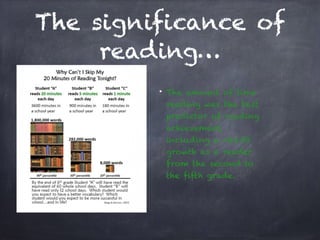
The significance of
reading…
• The amount of time
reading was the best
predictor of reading
achievement,
including a child’s
growth as a reader
from the second to
the fifth grade.
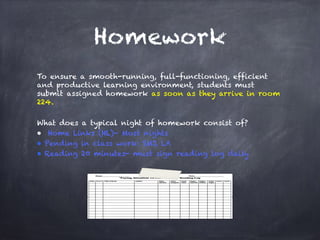
Homework
To ensure a smooth-running, full-functioning, efficient
and productive learning environment, students must
submit assigned homework as soon as they arrive in room
224.
What does a typical night of homework consist of?
• Home Links (HL)- Most nights
• Pending in class work: SMJ, LA
• Reading 20 minutes- must sign reading log daily
Healthy Eating
Healthy Snacks/Lunches:
● critical to your children’s energy levels and mental performance
● healthy snacks/lunches include: whole wheat breads, fruit, vegetables,
chicken, tuna, yogurt, cheese, etc.
● remember this is a NUT-FREE class; absolutely no nuts allowed
Birthdays:
● If you choose to bring in a treat, please be sure that it is something small.
Regular sized donuts, cupcakes, burgers, pizza etc. are just too big,
contain too much sugar or are generally unhealthy.
● Please think carefully about the treat you choose to share and check with
your child’s teacher before bringing the treat to school.
● It would be even better if you could think of a small way your child
could celebrate their special day without sharing food!
House-keeping
Kindly remember to:
✓ Sign your child’s passport every night
✓ Check the folder for any important papers/news
✓ Inform me about any absences (past or future)
✓ Send a water bottle and snack to school with your child
✓ Put your child’s name on personal items (jacket, lunch box, water
bottle) - use a permanent marker
✓ Encourage your child to read every night and ensure it is recorded
in the reading log
✓ Visit our class blog each Thursday or Friday
✓ Subscribe to 3OP’s blog
✓ Keep the lines of communication open
Behavior Chart
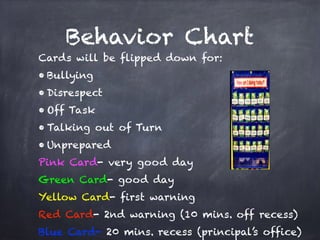
Cards will be flipped down for:
• Bullying
• Disrespect
• Off Task
• Talking out of Turn
• Unprepared
Pink Card- very good day
Green Card- good day
Yellow Card- first warning
Red Card- 2nd warning (10 mins. off recess)
Blue Card- 20 mins. recess (principal’s office)
ES Device Policy
The ES Device Policy gives you the option of allowing your child to bring a device that they
are already familiar with at home to use as part of their learning at school; sending a device
with your child to school when asked is optional. (Smart phones are not an acceptable device,
at this time.)
Your child will only be asked to bring a device to school on occasion for specific learning
purposes.
School provided devices will still be available for students who do not have their own. All
students will be expected to follow DAA’s User Policy.
Students will be responsible for their own device, although teachers will assist with reasonable
precautions.
Percentages &
Grading
All assessments and student work address a variety of different
standards which have been taught throughout the unit.
In order for you to better understand the correlation between your
child’s assessments and their report card results in math, social studies
and science, you will find a standards-based grading sheet attached to
the assessments, instead of percents, marks or grades. This will indicate
if your child is performing below, at, or above a specific standard,
based on their assessment performance.
This format creates an opportunity for students to focus more
specifically on their areas of strength, and areas for improvement,
instead of a mark, grade, or percent.
Contact Info
◆Write a note in the passport (remind your
son/daughter to show it to me in the
morning!)
◆Send me an email:
o.pasquariello_daa@gemsedu.com
◆Speak to me in the foyer after school
◆ Schedule a conference
◆If you’re not receiving my emails, please
inform me
WE ARE LOOKING
FOR…
Someone who is… eager, flexible,
enjoys planning activities, such as
arts & crafts, & likes to work with
kids!
Do you fit this description? If so, we
need you!
HOMEROOM PARENT NEEDED!
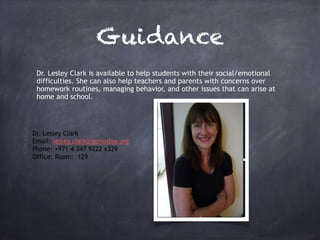
Guidance
• Dr. Lesley Clark is available to help students with their social/emotional
difficulties. She can also help teachers and parents with concerns over
homework routines, managing behavior, and other issues that can arise at
home and school.
Dr. Lesley Clark
Email: lesley.clark@gemsdaa.org
Phone: +971 4 347 9222 x329
Office: Room: 129
Respond to your
child’s letter!
If you haven’t done so already,
respond to your child’s message!
You can find the response page
stapled to your child’s message!
Can you guess which portrait is
belongs to your son/daughter?

Back to School 2015

  • 1.
    Welcome to 3OP’s Back-to-SchoolNight with Ms. Olivia Pasquariello in room #224
  • 2.
    About Ms Olivia… Ilove my vocation as a teacher I love to read, share stories & ideas with my students I take my role as your child’s educator very seriously. I want the very best emotionally, socially & academically for each & every child under my care I come from a very loving, close-knit family I got married over the summer holidays! I am a vegetarian & yogi in training I believe the world is a beautiful place & the world is both fragile & fascinating. We must learn to appreciate the diversity of all cultures, as well as treat our planet Earth with greater care I firmly believe in being kind, loving, hard-working & living life fully with great integrity
  • 3.
    3OP’s Classroom Creed… I believein… • Active Participation, rather than passive learning • Problem solving- Think outside the box • Adhering to classroom agreements • Positive Behavior and making the right choices • Putting material in context- Why is it important to learn this material? • Making connections to content, this will foster a deeper sense of learning and applying knowledge • Individual Responsibility- class room jobs • Time Management- Using time wisely Overall, I strive to make 3OP a place where it is a positive, fun, safe, productive, engaging and encouraging learning environment!
  • 4.
  • 5.
    Everyday Mathematics About EM: • Research-basedprogram adopted from the University of Chicago • Each unit lasts for approximately 3-4 weeks • 60 minutes a day average spent on math instruction Philosophy: • Build fact power through daily oral practice, conceptual activities, and games • Link mathematics to everyday situations • Includes hands-on activities and explorations • Encourage use and sharing of multiple strategies Resources: 1) Math Journals (SMJ) 2) Home Links (HL) 3) Student Reference Book (SRB) Gr. 3 Goal: • MULTIPLICATION must be committed to memory
 www.multiplication.com or multiflow (app)
  • 6.
    Look for shapes& patterns in real life Have your child measure ingredients for a recipe you are making Ask your child to explain the math skills he/she has been working on When helping your child with homework or school assignments, ask him/her to explain how they got an answer Find math games online together! Play board games that involve numbers & patterns Ask your child to count change or estimate the total cost at the grocery store Compare: Which is tallest? heaviest? longest? smallest? hottest? How to help your child in math…
  • 7.
    Social Studies • Basedon AERO (American Education Reaches Out) Standards • Program: TCI (Teachers Curriculum Institute) • Focus: Dubai and the UAE (culture, government, language, celebrations, national dress, food, flag, landmarks) • Students will develop an understanding of social studies concepts through: o utilizing primary sources (maps/graphs/images) o acting out key events through role-play o discussing complex issues o asking and answering critical thinking questions o creating projects
  • 8.
    Science • Based onthe Next Generation Science Standards (NGSS) • Four areas of study at each grade level focused on fostering student inquiry and developing problem solving skills using scientific investigations and engineering design • Grade 3 studies: life cycles and traits, interdependent relationships in ecosystems, weather and climate, forces and interactions • Students will develop an understanding of science concepts through: • Wondering • Investigating • Questioning • Collecting and analyzing data
  • 9.
    WORDS THEIR WAY- SPELLING Wewill be using a program called “Words Their Way.” This type of word investigation using word sorts to look critically at spelling patterns. The third grade team will differentiate based on ability
  • 10.
    Reading & Writing Workshops •Research-based program from Columbia University • 4 Units of Study (various genres) in year (minimum) • Each unit lasts for approximately 6-8 weeks • 40 minutes average per day spent on writing as well as 40 mins. daily reading instruction: o Structure: Mini-lesson followed by individual/group conferencing (based on students’ needs) o Content: Writing & reading strategies are taught that will help students move independently through the writing process at their own pace. o Objective: Instil love for reading & writing!
  • 11.
    Practice 3 differentways to read with your child @ home a. Independent Reading (child reads independently, parents may ask a few comprehension questions) b. Shared Reading (parent and child read in an interactive way, child reads some, parents reads some, discussing together along the way…) c. Parent Reading (parent makes a conscious effort to talk openly about what he/she reading…”I read____ in the paper and was surprised to learn that…or “I read some reports for work last night and they almost put me to sleep.” This helps children know that reading is part of our everyday lives and we read for different reasons. Having parents model this is very important.)
  • 12.
    More tips tohelp your child with reading… Help your child find appropriate word & reading games online/ipad Read mysteries together with your child and try to figure out the clues together Movie version coming out? Read the book together first Set aside a time and place for your child to read- like a comfy chair & reading light in a quiet place Visit the school library often Encourage your child to write- thank you notes, emails, journals, stories, letters, etc; Ask your child questions about what he/she is reading, such as: What is the story about? Who are the important characters? Where does the story take place? Why do you think the character made that choice? Why do you think that happened? Would you recommend this book? etc;
  • 13.
    The significance of reading… •The amount of time reading was the best predictor of reading achievement, including a child’s growth as a reader from the second to the fifth grade.
  • 14.
    Homework To ensure asmooth-running, full-functioning, efficient and productive learning environment, students must submit assigned homework as soon as they arrive in room 224. What does a typical night of homework consist of? • Home Links (HL)- Most nights • Pending in class work: SMJ, LA • Reading 20 minutes- must sign reading log daily
  • 15.
    Healthy Eating Healthy Snacks/Lunches: ●critical to your children’s energy levels and mental performance ● healthy snacks/lunches include: whole wheat breads, fruit, vegetables, chicken, tuna, yogurt, cheese, etc. ● remember this is a NUT-FREE class; absolutely no nuts allowed Birthdays: ● If you choose to bring in a treat, please be sure that it is something small. Regular sized donuts, cupcakes, burgers, pizza etc. are just too big, contain too much sugar or are generally unhealthy. ● Please think carefully about the treat you choose to share and check with your child’s teacher before bringing the treat to school. ● It would be even better if you could think of a small way your child could celebrate their special day without sharing food!
  • 16.
    House-keeping Kindly remember to: ✓Sign your child’s passport every night ✓ Check the folder for any important papers/news ✓ Inform me about any absences (past or future) ✓ Send a water bottle and snack to school with your child ✓ Put your child’s name on personal items (jacket, lunch box, water bottle) - use a permanent marker ✓ Encourage your child to read every night and ensure it is recorded in the reading log ✓ Visit our class blog each Thursday or Friday ✓ Subscribe to 3OP’s blog ✓ Keep the lines of communication open
  • 17.
    Behavior Chart Cards willbe flipped down for: • Bullying • Disrespect • Off Task • Talking out of Turn • Unprepared Pink Card- very good day Green Card- good day Yellow Card- first warning Red Card- 2nd warning (10 mins. off recess) Blue Card- 20 mins. recess (principal’s office)
  • 18.
    ES Device Policy TheES Device Policy gives you the option of allowing your child to bring a device that they are already familiar with at home to use as part of their learning at school; sending a device with your child to school when asked is optional. (Smart phones are not an acceptable device, at this time.) Your child will only be asked to bring a device to school on occasion for specific learning purposes. School provided devices will still be available for students who do not have their own. All students will be expected to follow DAA’s User Policy. Students will be responsible for their own device, although teachers will assist with reasonable precautions.
  • 19.
    Percentages & Grading All assessmentsand student work address a variety of different standards which have been taught throughout the unit. In order for you to better understand the correlation between your child’s assessments and their report card results in math, social studies and science, you will find a standards-based grading sheet attached to the assessments, instead of percents, marks or grades. This will indicate if your child is performing below, at, or above a specific standard, based on their assessment performance. This format creates an opportunity for students to focus more specifically on their areas of strength, and areas for improvement, instead of a mark, grade, or percent.
  • 20.
    Contact Info ◆Write anote in the passport (remind your son/daughter to show it to me in the morning!) ◆Send me an email: o.pasquariello_daa@gemsedu.com ◆Speak to me in the foyer after school ◆ Schedule a conference ◆If you’re not receiving my emails, please inform me
  • 21.
    WE ARE LOOKING FOR… Someonewho is… eager, flexible, enjoys planning activities, such as arts & crafts, & likes to work with kids! Do you fit this description? If so, we need you! HOMEROOM PARENT NEEDED!
  • 22.
    Guidance • Dr. LesleyClark is available to help students with their social/emotional difficulties. She can also help teachers and parents with concerns over homework routines, managing behavior, and other issues that can arise at home and school. Dr. Lesley Clark Email: lesley.clark@gemsdaa.org Phone: +971 4 347 9222 x329 Office: Room: 129
  • 23.
    Respond to your child’sletter! If you haven’t done so already, respond to your child’s message! You can find the response page stapled to your child’s message! Can you guess which portrait is belongs to your son/daughter?