Done By :
Lara Smadi 0098614
Ola Alulaimi 0096810
Esra’a Hourani 0095360
Supervised:
Dr.Nabeel Alkurdi
First and foremost to ALLAH we thank you for the
strength that kept us standing and for the hope that
kept us believing that this affiliation would be
possible and more interesting. And all the lessons we
have learned, and yet to com.
We would like to express our gratitude to Dr. Nabeel
For his expert guidance, encouragement and valuable
suggestion at every step.
The completion of any project brings with it a sense of
satisfaction, But it is never complete without thanking
those people who made it possible and constant
support has crowned our efforts with success
(Arch.Huda Alnajar ,Arch Rula Alasir )
We whole heartedly thank Indoor and Ali baba
for the kindness and patience they have given us.
We are extremely happy to acknowledge and express
our gratitude to our processors at the University of
Jordan for their constant support and encouragement.
Acknowledgement
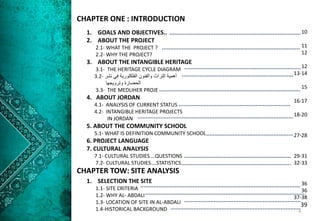
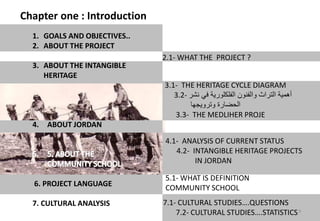
1. GOALS AND OBJECTIVES..
2. ABOUT THE PROJECT
2.1- WHAT THE PROJECT ?
2.2- WHY THE PROJECT?
3. ABOUT THE INTANGIBLE HERITAGE
3.1- THE HERITAGE CYCLE DIAGRAM
‫نشر‬ ‫في‬ ‫الفلكلورية‬ ‫والفنون‬ ‫التراث‬ ‫أهمية‬3.2-
‫وترويجها‬ ‫الحضارة‬
3.3- THE MEDLIHER PROJE
4. ABOUT JORDAN
4.1- ANALYSIS OF CURRENT STATUS
4.2- INTANGIBLE HERITAGE PROJECTS
IN JORDAN
5. ABOUT THE COMMUNITY SCHOOL
5.1- WHAT IS DEFINITION COMMUNITY SCHOOL
6. PROJECT LANGUAGE
7. CULTURAL ANALYSIS
7.1- CULTURAL STUDIES….QUESTIONS
7.2- CULTURAL STUDIES….STATISTICS
CHAPTER ONE : INTRODUCTION
CHAPTER TOW: SITE ANALYSIS
1. SELECTION THE SITE
1.1- SITE CRITERIA
1.2- WHY AL- ABDALI
1.3- LOCATION OF SITE IN AL-ABDALI
1.4-HISTORICAL BACKGROUND
10
11
12
12
13-14
15
16-17
18-20
27-28
29-31
32-33
36
36
37-38
39
4
2. STUDYING MACRO SCALE
2.1SITE APPROACH
2.2- MAIN STREET
2.3- LAND USE
2.4- SOLID AND VOID
2.5- LAND MARKS
2.5.1- AL- ABDALI PROJECT
2.6- FACILITIES
2.6.1 FACILITIES
3. STUDYING MICRO SCALE
3.1- THE SITE
3.2- SECTIONS
3.3- ENVIRONMENTAL CONDITIONS
3.4- public transportation
3.5- NOISE
3.6- DENSITY OF RESIDENTIAL CLUSTERS
3.7- SKY LINE
3.8- BUILDING TYPOLOGY
3.9- VIEW
4. CULTURAL STUDIES THE SITE
4.1-AL-ABDALI POPULATION
5. SITE CONCLUSIONS
CHAPTER THREE: CASE STUDIES
40
41
43
44
45
46
47-48
48
49
50
51-52
53
54
55-56
57
58-59
60
61
62-66
67-96
5
CHAPTER THREE: CASE STUDIES
1. IDEA :
1.1- THE HERITAGE SCHOOL/ NEWAN
1.2- THE HERITAGE SCHOOL/ INDIAN
1.3-TENT MARGELH ( ‫خيمة‬‫المرجلة‬ )
2. CONCEPTUAL :
2.1- UMM EL- FAHEM MUSEUM FOR
CONTEMPORARY
2.2- ATRISCO HERITAGE ACADEMY
3. FUNCTIONAL :
3.1- CULTURE AND ART CENTER
3.2- SWOPE MUSIC SCHOOL AND
PERFORMING ARTS CENTER
4. PROGRAM :
4.1- SOUTH KOREA'S NATIONAL INTANGIBLE
CULTURAL HERITAGE
5. FORMAL
5.1- COMMUNITY CENTER /CHAIN
Chapter four: program
Chapter five : concept
1. Scenario
1.1- Function
1.2- Users
1.3- Goals
69
70
71
72-77
78-81
82-68
78-89
90-93
94-96
97-114
115-129
117
118
1196
Chapter sex : Sustainability Research
1. SUSTAINABILITY RESEARCH
1. INTRODUCTION
2. PRINCIPLES OF SUSTAINABLE DESIGN
3. MATERIAL FLOW IN THE BUILDING
ECOSYSTEM
4. SUSTAINABLE DESIGN METHODS
References
2. DESIGN PRECEPT
3. CONCEPT
4. CONCLUSION
4.1- ZONING
4.2- LAYERING
4.3- conceptual sketches
5. SCHMATIC DESIGN
130-139
132
133-136
137
138-139
140
120-121
122-123
124
125
126-127
128-129
7
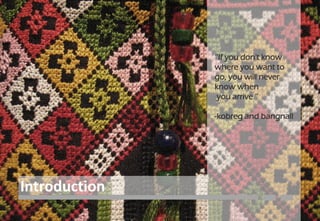
Introduction
8
‘’If you don't know
where you want to
go, you will never
know when
you arrive ‘’
-kobreg and bangnall
3.1- THE HERITAGE CYCLE DIAGRAM
‫نشر‬ ‫في‬ ‫الفلكلورية‬ ‫والفنون‬ ‫التراث‬ ‫أهمية‬3.2-
‫وترويجها‬ ‫الحضارة‬
3.3- THE MEDLIHER PROJE
2.1- WHAT THE PROJECT ?
1. GOALS AND OBJECTIVES..
2. ABOUT THE PROJECT
3. ABOUT THE INTANGIBLE
HERITAGE
4. ABOUT JORDAN
6. PROJECT LANGUAGE
7. CULTURAL ANALYSIS
Chapter one : Introduction
4.1- ANALYSIS OF CURRENT STATUS
4.2- INTANGIBLE HERITAGE PROJECTS
IN JORDAN
5.1- WHAT IS DEFINITION
COMMUNITY SCHOOL
7.1- CULTURAL STUDIES….QUESTIONS
7.2- CULTURAL STUDIES….STATISTICS9
Goals and objectives..
Goals
 Local
to design a unique project , aims to provide multiple facilities that attract visitors , regard they are interested and
educated and provide traditional habits society .
• Regional
Giving Jordan its own character and the exchange of cultures and traditions with Arab countries
• international
Give a clear vision about the traditions and customs of Jordan and teach those who wish to in one place
Why the project ?
More than 60% of the population lives in the metropolis of Amman, concentrating the culture of Jordan
in that city. Jordanian pop culture is heavily influenced by the "West". European and American music,
movies, fashion and other forms of entertainment are popular among Jordan's people. Clubbing and
partying culture is present in Amman, especially in the Western half of the city. A small minority of
youth, mostly the rich in West Amman, exhibit counter-culture traits like face piercings and tattoos.
English is widely understood and even spoken in lieu of Jordanian Levantine among Jordanians in the
upper class and upper middle class
10
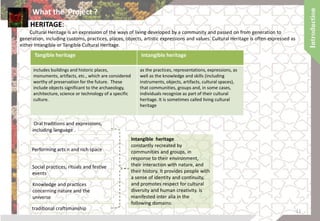
HERITAGE:
Cultural Heritage is an expression of the ways of living developed by a community and passed on from generation to
generation, including customs, practices, places, objects, artistic expressions and values. Cultural Heritage is often expressed as
either Intangible or Tangible Cultural Heritage.
Tangible heritage Intangible heritage
includes buildings and historic places,
monuments, artifacts, etc., which are considered
worthy of preservation for the future. These
include objects significant to the archaeology,
architecture, science or technology of a specific
culture.
as the practices, representations, expressions, as
well as the knowledge and skills (including
instruments, objects, artifacts, cultural spaces),
that communities, groups and, in some cases,
individuals recognize as part of their cultural
heritage. It is sometimes called living cultural
heritage
Intangible heritage
constantly recreated by
communities and groups, in
response to their environment,
their interaction with nature, and
their history. It provides people with
a sense of identity and continuity,
and promotes respect for cultural
diversity and human creativity. is
manifested inter alia in the
following domains:
Oral traditions and expressions,
including language .
Performing arts n and rich space
Social practices, rituals and festive
events
Knowledge and practices
concerning nature and the
universe
traditional craftsmanship
What the Project ?
11
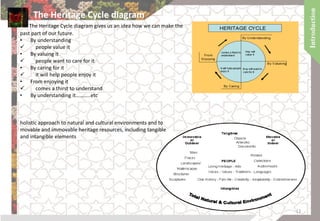
The Heritage Cycle diagram
The Heritage Cycle diagram gives us an idea how we can make the
past part of our future.
• By understanding
 people value it
• By valuing it
 people want to care for it
• By caring for it
 it will help people enjoy it
• From enjoying it
 comes a thirst to understand
• By understanding it………..etc
holistic approach to natural and cultural environments and to
movable and immovable heritage resources, including tangible
and intangible elements
12
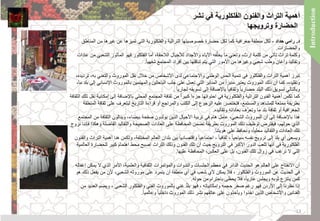
‫في‬ ‫الفلكلورية‬ ‫والفنون‬ ‫التراث‬ ‫أهمية‬‫نشر‬
‫الحضارة‬‫وترويجها‬
‫د‬.‫حداد‬ ‫رامي‬-‫المناطق‬ ‫من‬ ‫غيرها‬ ‫عن‬ ‫تميزها‬ ‫التي‬ ‫والفلكلورية‬ ‫التراثية‬ ‫خصوصيتها‬ ‫حضارة‬ ‫لكل‬ ‫كما‬ ‫جغرافية‬ ‫منطقة‬ ‫لكل‬
‫والحضارات‬.
‫عادات‬ ‫من‬ ‫الشعبي‬ ‫المأثور‬ ‫فهو‬ ‫الفلكلور‬ ‫أما‬ ،‫الالحقة‬ ‫لألجيال‬ ‫واألجداد‬ ‫اآلباء‬ ‫فه‬ّ‫ل‬‫يخ‬ ‫ما‬ ‫وتعني‬ ،‫إرث‬ ‫كلمة‬ ‫من‬ ‫تأتي‬ ‫تراث‬ ‫وكلمة‬
‫شفهيا‬ ‫المجتمع‬ ‫أفراد‬ ‫بين‬ ‫تناقلها‬ ‫يتم‬ ‫التي‬ ‫األمور‬ ‫من‬ ‫وغيرها‬ ‫شعبي‬ ‫وطب‬ ‫وأغان‬ ‫وتقاليد‬.
،‫ترديده‬ ،‫به‬ ‫والتغني‬ ‫الموروث‬ ‫نقل‬ ‫خالل‬ ‫من‬ ‫األشخاص‬ ‫لدى‬ ‫واالجتماعي‬ ‫الوطني‬ ‫الحس‬ ‫تنمية‬ ‫في‬ ‫والفلكلور‬ ‫التراث‬ ‫أهمية‬ ‫تبرز‬
،‫ما‬ ‫بلد‬ ‫إلى‬ ‫اإلنساني‬ ‫بالموروث‬ ‫والمهتمين‬ ‫الباحثين‬ ‫جلب‬ ‫على‬ ‫تعمل‬ ‫التي‬ ‫المنابر‬ ‫من‬ ‫منبرا‬ ‫يعتبر‬ ‫الموروث‬ ‫ذلك‬ ‫أن‬ ‫كما‬ ،‫وتقليده‬
‫تجاريا‬ ‫تسويقه‬ ‫إلى‬ ‫باإلضافة‬ ‫وثقافيا‬ ‫حضاريا‬ ‫البلد‬ ‫ذلك‬ ‫تسويق‬ ‫وبالتالي‬.
‫الثقا‬ ‫تلك‬ ‫نقل‬ ‫إمكانية‬ ‫إلى‬ ‫باإلضافة‬ ‫المحلي‬ ‫المجتمع‬ ‫ثقافة‬ ‫من‬ ‫كبيرا‬ ‫جزءا‬ ‫احتوائها‬ ‫في‬ ‫والفلكلورية‬ ‫التراثية‬ ‫الفنون‬ ‫أهمية‬ ‫تكمن‬ ‫كما‬‫فة‬
‫المنطقة‬ ‫ثقافة‬ ‫على‬ ‫ليتعرف‬ ‫التاريخ‬ ‫قراءة‬ ‫أو‬ ‫والمراجع‬ ‫الكتب‬ ‫إلى‬ ‫الرجوع‬ ‫عليه‬ ‫فتختصر‬ ،‫والمستمع‬ ‫للمشاهد‬ ‫ممتعة‬ ‫بطريقة‬
‫وتقاليده‬ ‫بعاداته‬ ‫وتعرُف‬ ‫ما‬ ‫بلد‬ ‫ثقافة‬ ‫أو‬ ‫الجغرافية‬.
‫المجتمع‬ ‫من‬ ‫الثقافة‬ ‫وينالون‬ ،‫بيضاء‬ ‫صفحة‬ ‫يولدون‬ ‫الذين‬ ‫األجيال‬ ‫تربية‬ ‫في‬ ‫هام‬ ‫عامل‬ ،‫الشعبي‬ ‫الموروث‬ ‫أن‬ ‫إلى‬ ‫باإلضافة‬ ‫هذا‬
‫نروج‬ ‫فإننا‬ ‫وهكذا‬ ‫الفاضلة‬ ‫والتقاليد‬ ‫الصحيحة‬ ‫العادات‬ ‫على‬ ‫المحافظة‬ ‫تضمن‬ ‫بطريقة‬ ‫الموروث‬ ‫ذلك‬ ‫توظيف‬ ‫فيفترض‬ ،‫حولهم‬ ‫الذي‬
‫هويتنا‬ ‫على‬ ‫ونحافظ‬ ،‫محليا‬ ‫والتقاليد‬ ‫العادات‬ ‫تلك‬.
‫والفنو‬ ‫التراث‬ ‫أهمية‬ ‫هنا‬ ‫وتكمن‬ ،‫المختلفة‬ ‫العالم‬ ‫بلدان‬ ‫بين‬ ‫واقتصاديا‬ ‫اجتماعيا‬ ، ‫ثقافيا‬ ، ‫سياحيا‬ ‫نفسه‬ ‫ترويج‬ ‫إلى‬ ‫بلد‬ ‫أي‬ ‫ويسعى‬‫ن‬
‫العالمية‬ ‫للحضارة‬ ‫كبير‬ ‫اهتمام‬ ‫محط‬ ‫اصبح‬ ‫التراث‬ ‫وذلك‬ ‫الفنون‬ ‫تلك‬ ‫أن‬ ‫حيث‬ ‫الترويج‬ ‫في‬ ‫األكبر‬ ‫الدور‬ ‫تلعب‬ ‫أنها‬ ‫في‬ ‫الفلكلورية‬
‫عليها‬ ‫المحافظة‬ ،‫العكس‬ ‫على‬ ‫بل‬ ،‫الفنون‬ ‫تلك‬ ‫زوال‬ ‫في‬ ‫ترغب‬ ‫ال‬ ‫التي‬.
‫إغفاله‬ ‫يمكن‬ ‫ال‬ ‫الذي‬ ‫األمر‬ ،‫والعلمية‬ ‫الثقافية‬ ‫والمؤتمرات‬ ‫والندوات‬ ‫الجلسات‬ ‫معظم‬ ‫في‬ ‫الدائر‬ ‫الحديث‬ ‫هو‬ ‫العالم‬ ‫على‬ ‫االنفتاح‬ ‫أن‬
‫هو‬ ‫ذلك‬ ‫يفعل‬ ‫من‬ ‫ألن‬ ،‫الشعبي‬ ‫موروثه‬ ‫على‬ ‫يتمرد‬ ‫أن‬ ‫منطقة‬ ‫أي‬ ‫في‬ ‫شعب‬ ‫ألي‬ ‫يمكن‬ ‫فال‬ ، ‫والفلكلور‬ ‫الموروث‬ ‫عن‬ ‫الحديث‬ ‫في‬
‫حوله‬ ‫من‬ ‫باحترام‬ ‫يحظى‬ ‫فال‬ ،‫عاريا‬ ‫ويجلس‬ ‫ثوبه‬ ‫ينتزع‬ ‫كمن‬.
‫من‬ ‫العديد‬ ‫ويضم‬ ، ‫الشعبي‬ ‫والفلكلور‬ ‫الفني‬ ‫بالموروث‬ ‫غني‬ ٌ‫د‬‫بل‬ ‫فهو‬ ، ‫وإمكانياته‬ ‫حجمه‬ ‫صغر‬ ‫رغم‬ ‫فهو‬ ‫األردن‬ ‫إلى‬ ‫نظرنا‬ ‫إذا‬
‫وعالميا‬ ‫داخليا‬ ‫الموروث‬ ‫ذلك‬ ‫نشر‬ ‫عاتقهم‬ ‫على‬ ‫ويأخذون‬ ‫اخذوا‬ ‫الذين‬ ‫واألشخاص‬ ‫الفنانين‬.
13
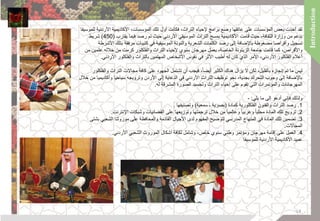
‫للموسيقا‬ ‫األردنية‬ ‫األكاديمية‬ ،‫المؤسسات‬ ‫تلك‬ ‫أول‬ ‫فكانت‬ ،‫التراث‬ ‫إلحياء‬ ‫برامج‬ ‫وضع‬ ‫عاتقها‬ ‫على‬ ‫المؤسسات‬ ‫بعض‬ ‫أخذت‬ ‫لقد‬
‫يقارب‬ ‫فيما‬ ‫رصد‬ ‫تم‬ ‫حيث‬ ‫األردني‬ ‫الموسيقي‬ ‫التراث‬ ‫بمسح‬ ‫األكاديمية‬ ‫قامت‬ ‫حيث‬ ،‫الثقافة‬ ‫وزارة‬ ‫من‬ ‫بدعم‬(450)‫شريط‬
‫األشرطة‬ ‫بتلك‬ ‫مرفقة‬ ‫كتيبات‬ ‫في‬ ‫الموسيقية‬ ‫والنوتة‬ ‫الشعرية‬ ‫الكلمات‬ ‫رصد‬ ‫إلى‬ ‫باإلضافة‬ ‫مضغوطة‬ ‫وأقراصا‬ ‫تسجيل‬
‫من‬ ‫علمين‬ ‫خالله‬ ‫من‬ ‫كرمت‬ ‫والفلكلور‬ ‫التراث‬ ‫إلحياء‬ ‫سنوي‬ ‫مهرجان‬ ‫بعمل‬ ،‫الخاصة‬ ‫الزيتونة‬ ‫جامعة‬ ‫قامت‬ ‫كما‬ ،‫واألقراص‬
‫األردني‬ ‫والفلكلور‬ ‫بالتراث‬ ‫المهتمين‬ ‫األشخاص‬ ‫نفوس‬ ‫في‬ ‫األثر‬ ‫أطيب‬ ‫له‬ ‫كان‬ ‫الذي‬ ‫األمر‬ ،‫األردني‬ ‫الفلكلور‬ ‫أعالم‬.
‫ليس‬‫والفلكلور‬ ‫التراث‬ ‫مجاالت‬ ‫كافة‬ ‫على‬ ‫الجهود‬ ‫تشتمل‬ ‫أن‬ ‫فيجب‬ ،‫أيضا‬ ‫الكثير‬ ‫هناك‬ ‫يزال‬ ‫ال‬ ‫لكن‬ ،‫بالقليل‬ ‫إنجازه‬ ‫تم‬ ‫ما‬
‫خالل‬ ‫من‬ ‫وأكاديميا‬ ‫سياحيا‬ ‫وترويجه‬ ‫األردن‬ ‫إلى‬ ‫الدعاية‬ ‫في‬ ‫األردني‬ ‫التراث‬ ‫توظيف‬ ‫نحو‬ ،‫بجدية‬ ‫التحرك‬ ‫وجوب‬ ‫إلى‬ ‫باإلضافة‬
‫له‬ ‫المشرقة‬ ‫الصورة‬ ‫وتجسيد‬ ‫التراث‬ ‫إحياء‬ ‫على‬ ‫تقوم‬ ‫التي‬ ‫والمؤتمرات‬ ‫المهرجانات‬.
‫ولذلك‬‫يلي‬ ‫ما‬ ‫إلى‬ ‫أدعو‬ ‫فإني‬:-
1.‫كمادة‬ ‫الفلكلورية‬ ‫والفنون‬ ‫التراث‬ ‫رصد‬(‫سمعية‬ ‫ـ‬ ‫بصرية‬)‫وتصنيفها‬.
2.‫اإلنترنت‬ ‫وشبكات‬ ‫الفضائيات‬ ‫على‬ ‫وتوزيعها‬ ‫ترجمتها‬ ‫خالل‬ ‫من‬ ‫وعالميا‬ ‫وعربيا‬ ‫محليا‬ ‫المادة‬ ‫تلك‬ ‫ترويج‬.
3.‫بشتى‬ ‫الشعبي‬ ‫موروثنا‬ ‫على‬ ‫والمحافظة‬ ‫القادمة‬ ‫األجيال‬ ‫لدى‬ ‫المفهوم‬ ‫لتوضيح‬ ‫المدرسي‬ ‫المنهاج‬ ‫في‬ ‫المادة‬ ‫تلك‬ ‫تضمين‬
‫المجاالت‬.
4.‫الشعبي‬ ‫الموروث‬ ‫أشكال‬ ‫لكافة‬ ‫وشامل‬ ،‫خاص‬ ‫سنوي‬ ‫وطني‬ ‫ومؤتمر‬ ‫مهرجان‬ ‫إقامة‬ ‫على‬ ‫العمل‬‫األردني‬.
‫للموسيقا‬ ‫األردنية‬ ‫األكاديمية‬ ‫عميد‬
14
The MedLiHer project
The MedLiHer project aims at enhancing institutional capacities in Egypt, Jordan, Lebanon and the Syrian Arab
Republic to facilitate their effective participation in the international mechanisms established by the Convention for
the Safeguarding of the Intangible Cultural Heritage, as well as to support the elaboration of specific safeguarding
measures with the participation of communities and groups concerned in each of them.
Mediterranean Living Heritage Project (MedLiHer)
in Madaba Governorate
A number of positive results of (MedLiHer) project have been accomplished both at the district level, Madaba, and the
state level, the Hashemite Kingdom of Jordan. These achievements can be summed up as follows:
1. Training 18 researchers on “Community-Based Inventorying of ICH”. These trainers received the best training possible
from heritage experts, and experts in ICH Convention/2003
2. Developing preliminary national heritage inventory making, and gathering information, documents, and images
related to 38 heritage elements
3. Training heritage staff at the Ministry of Culture and members of JO NATCOM Division on nominating files for ICH
Representative List, and urgent safeguarding preserving lists.
4. Creating an ICH website that is set to be launched at the beginning of next year.
5. Identifying the threatened elements of heritage and those that need support.
6. Creating an ICH national database.A template was developed for the purpose of the project and inventory-making
was made in line with that.
7. Creating a good ICH media awareness. Mass media covered the first workshop for training researchers and the
second workshop of staff training. Moreover, a number of activities related to the project will take place such as a
photo exhibition, TV film on Madaba heritage showing a traditional Jordanian wedding, carpet making (i.e. sadoo)
and Arabic coffee.
15
Weaknesses
•Absence of a national umbrella for managing
tangible and intangible heritage at present
•Preservation of heritage comes at the minor rank
in the national economy.
•Insufficient financial resources.
•Unavailability of national qualified personnel.
•Low level of awareness in general, interest in
heritage is almost restricted to academia and
researchers.
Strengths
•Jordan has a huge amount of heritage resources.
•Royal directives to preserve
• National agenda and Action plans of governments.
•Culture diversity in Jordan
•Jordan's approval of a number of international
cultural agreements.
•Availability of communication networks at national,
regional and international levels.
Analysis of current status
to give an overview of the current situation of Jordan‘s Intangible Cultural Heritage
List of ICH in need of urgent safeguarding
1) Traditional music and musical instruments in Jordan
2) The tribal jurisprudence and tribunals in Jordan
3) The popular isophony of the Bedouin and rural areas in Jordan
4) Traditional medicine and traditional healers in Jordan
5) The folkloric poetry of Jordan
16
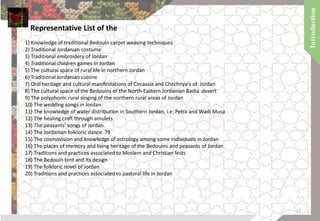
Representative List of the
1) Knowledge of traditional Bedouin carpet weaving techniques
2) Traditional Jordanian costume
3) Traditional embroidery of Jordan
4) Traditional children games in Jordan
5) The cultural space of rural life in northern Jordan
6) Traditional Jordanian cuisine
7) Oral heritage and cultural manifestations of Circassia and Chechnya's of Jordan
8) The cultural space of the Bedouins of the North-Eastern Jordanian Badia desert
9) The polyphonic rural singing of the northern rural areas of Jordan
10) The wedding songs in Jordan
11) The knowledge of water distribution in Southern Jordan, i.e. Petra and Wadi Musa
12) The healing craft through amulets
13) The peasants' songs of Jordan.
14) The Jordanian folkloric dance 79
15) The cosmovision and knowledge of astrology among some individuals in Jordan
16) The places of memory and living heritage of the Bedouins and peasants of Jordan
17) Traditions and practices associated to Moslem and Christian fests
18) The Bedouin tent and its design
19) The folkloric novel of Jordan
20) Traditions and practices associated to pastoral life in Jordan
17
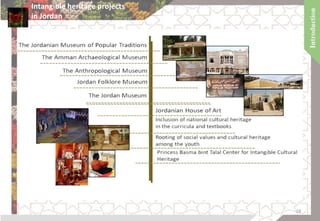
Intangible heritage projects
in Jordan
18
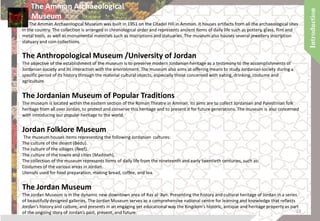
The Amman Archaeological
Museum
The Amman Archaeological Museum was built in 1951 on the Citadel Hill in Amman. It houses artifacts from all the archaeological sites
in the country. The collection is arranged in chronological order and represents ancient items of daily life such as pottery, glass, flint and
metal tools, as well as monumental materials such as inscriptions and statuaries. The museum also houses several jewellery inscription
statuary and coin collections.
The Anthropological Museum /University of Jordan
The objective of the establishment of the museum is to preserve modern Jordanian heritage as a testimony to the accomplishments of
Jordanian society and its interaction with the environment. The museum also aims at offering means to study Jordanian society during a
specific period of its history through the material cultural objects, especially those concerned with eating, drinking, costume and
agriculture.
The Jordanian Museum of Popular Traditions
The museum is located within the eastern section of the Roman Theatre in Amman. Its aims are to collect Jordanian and Palestinian folk
heritage from all over Jordan, to protect and conserve this heritage and to present it for future generations. The museum is also concerned
with introducing our popular heritage to the world.
Jordan Folklore Museum
The museum houses items representing the following Jordanian cultures:
The culture of the desert (Bedu).
The culture of the villages (Reef).
The culture of the towns and cities (Madineh).
The collection of the museum represents items of daily life from the nineteenth and early twentieth centuries, such as:
Costumes of the various areas in Jordan.
Utensils used for food preparation, making bread, coffee, and tea.
The Jordan Museum
The Jordan Museum is in the dynamic new downtown area of Ras al-‘Ayn. Presenting the history and cultural heritage of Jordan in a series
of beautifully designed galleries, The Jordan Museum serves as a comprehensive national centre for learning and knowledge that reflects
Jordan’s history and culture, and presents in an engaging yet educational way the Kingdom’s historic, antique and heritage property as part
of the ongoing story of Jordan’s past, present, and future. 19
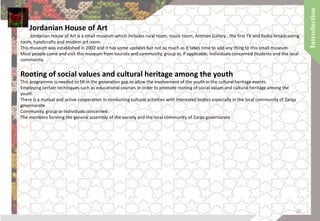
Jordanian House of Art
Jordanian House of Art is a small museum which includes rural room, music room, Amman Gallery , the first TV and Radio broadcasting
room, handicrafts and modern art room.
This museum was established in 2002 and it has some updates but not so much as it takes time to add any thing to this small museum.
Most people come and visit this museum from tourists and community, group or, if applicable, individuals concerned Students and the local
community.
Rooting of social values and cultural heritage among the youth
This programme is needed to fill in the generation gap to allow the involvement of the youth in the cultural heritage events.
Employing certain techniques such as educational courses in order to promote rooting of social values and cultural heritage among the
youth.
There is a mutual and active cooperation in conducting cultural activities with interested bodies especially in the local community of Zarqa
governorate.
Community, group or individuals concerned:
The members forming the general assembly of the society and the local community of Zarqa governorate.
20
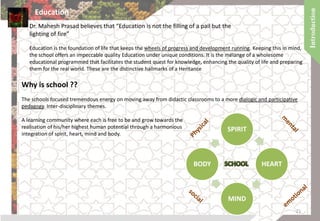
Dr. Mahesh Prasad believes that “Education is not the filling of a pail but the
lighting of fire”
Education is the foundation of life that keeps the wheels of progress and development running. Keeping this in mind,
the school offers an impeccable quality Education under unique conditions. It is the mélange of a wholesome
educational programmed that facilitates the student quest for knowledge, enhancing the quality of life and preparing
them for the real world. These are the distinctive hallmarks of a Heritance
Why is school ??
The schools focused tremendous energy on moving away from didactic classrooms to a more dialogic and participative
pedagogy. Inter-disciplinary themes.
A learning community where each is free to be and grow towards the
realisation of his/her highest human potential through a harmonious
integration of spirit, heart, mind and body.
SPIRIT
HEART
MIND
BODY
Education
21
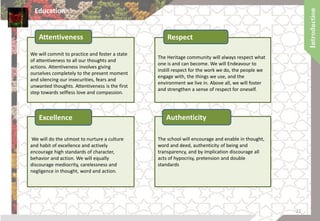
We will commit to practice and foster a state
of attentiveness to all our thoughts and
actions. Attentiveness involves giving
ourselves completely to the present moment
and silencing our insecurities, fears and
unwanted thoughts. Attentiveness is the first
step towards selfless love and compassion.
Attentiveness
The Heritage community will always respect what
one is and can become. We will Endeavour to
instill respect for the work we do, the people we
engage with, the things we use, and the
environment we live in. Above all, we will foster
and strengthen a sense of respect for oneself.
Respect
We will do the utmost to nurture a culture
and habit of excellence and actively
encourage high standards of character,
behavior and action. We will equally
discourage mediocrity, carelessness and
negligence in thought, word and action.
Excellence
The school will encourage and enable in thought,
word and deed, authenticity of being and
transparency, and by implication discourage all
acts of hypocrisy, pretension and double
standards
Authenticity
Education
22
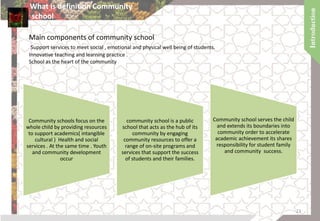
What is definition Community
school
Community schools focus on the
whole child by providing resources
to support academics( intangible
cultural ) Health and social
services . At the same time . Youth
and community development
occur
community school is a public
school that acts as the hub of its
community by engaging
community resources to offer a
range of on-site programs and
services that support the success
of students and their families.
Community school serves the child
and extends its boundaries into
community order to accelerate
academic achievement its shares
responsibility for student family
and community success.
Main components of community school
Support services to meet social , emotional and physical well being of students.
Innovative teaching and learning practice .
School as the heart of the community
23
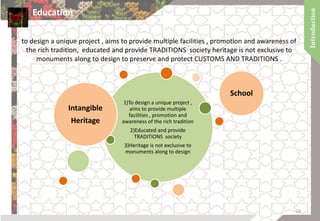
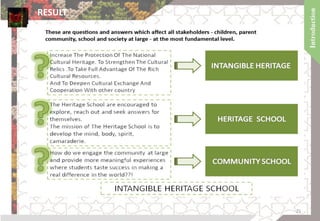
to design a unique project , aims to provide multiple facilities , promotion and awareness of
the rich tradition, educated and provide TRADITIONS society heritage is not exclusive to
monuments along to design to preserve and protect CUSTOMS AND TRADITIONS .
1)To design a unique project ,
aims to provide multiple
facilities , promotion and
awareness of the rich tradition
2)Educated and provide
TRADITIONS society
3)Heritage is not exclusive to
monuments along to design
Intangible
Heritage
School
Education
24
RESULT
25
RESULT
26
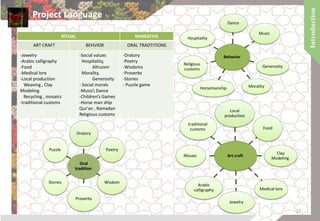
Behavior
Dance
Music
Generosity
MoralityHorsemanship
Religious
customs
Hospitality
Art craft
Local
production
Food
Clay
Modeling
Medical lore
Jewelry
Arabic
calligraphy
Mosaic
traditional
customs
Oral
tradition
Oratory
Poetry
Wisdom
Proverbs
Stories
Puzzle
RITUAL NARRATIVE
ART CRAFT BEHVIOR ORAL TRADTITIONS
-Jewelry
-Arabic calligraphy
-Food
-Medical lore
-Local production
Weaving , Clay
Modeling
Recycling , mosaics
-traditional customs
-Social values
Hospitality,
Altruism
Morality,
Generosity
- Social morals
-Music Dance
-Children’s Games
-Horse man ship
Qur'an , Ramadan
Religious customs
-Oratory
-Poetry
-Wisdoms
-Proverbs
-Stories
- Puzzle game
Project Language
27
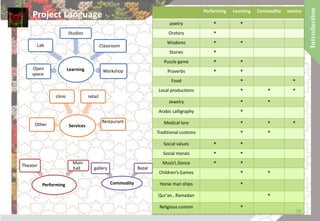
LearningOpen
space
Lab
Studios
Classroom
Workshop
ServicesOther
clinic retail
Restaurant
Commodity
gallery Bazar
Performing
Theater
Main
hall
Performing Learning Commodity service
poetry * *
Oratory *
Wisdoms * *
Stories *
Puzzle game * *
Proverbs * *
Food * *
Local productions * * *
Jewelry * *
Arabic calligraphy *
Medical lore * * *
Traditional customs * *
Social values * *
Social morals * *
Music Dance * *
Children’s Games * *
Horse man ships *
Qur'an , Ramadan *
Religious custom *
Project Language
28
Cultural Analysis
29
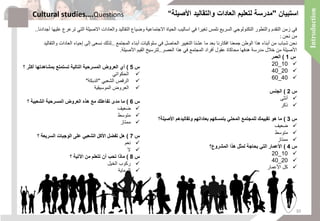
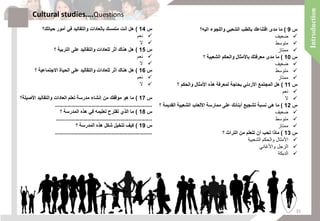
‫استبيان‬"‫األصيلة‬ ‫والتقاليد‬ ‫العادات‬ ‫لتعليم‬ ‫مدرسة‬"
‫علي‬ ‫ترعرع‬ ‫التي‬ ‫االصيلة‬ ‫والعادات‬ ‫التقاليد‬ ‫وضياع‬ ‫االجتماعية‬ ‫الحياة‬ ‫اساليب‬ ‫في‬ ‫تغيرا‬ ‫نلمس‬ ‫السريع‬ ‫التكنولوجي‬ ‫والتطور‬ ‫التقدم‬ ‫زمن‬ ‫في‬‫ها‬‫أجدادنا‬..
‫نحن‬ ‫من‬:
‫المجتمع‬ ‫أبناء‬ ‫سلوكيات‬ ‫في‬ ‫الحاصل‬ ‫التغيير‬ ‫عشنا‬ ‫ما‬ ‫بعد‬ ‫افكارنا‬ ‫جمعنا‬ ‫الوطن‬ ‫هذا‬ ‫أبناء‬ ‫من‬ ‫شباب‬ ‫نحن‬..‫والتقاليد‬ ‫العادات‬ ‫إحياء‬ ‫إلى‬ ‫نسعى‬ ‫لذلك‬
‫العصر‬ ‫هذا‬ ‫في‬ ‫المجتمع‬ ‫أفراد‬ ‫عقول‬ ‫محاكاة‬ ‫هدفها‬ ‫مدرسة‬ ‫خالل‬ ‫من‬ ‫األصيلة‬..‫األصيلة‬ ‫القيم‬ ‫لترسيخ‬.
‫س‬1)‫العمر‬
10_20
20_40
40_60
‫س‬2)‫الجنس‬
‫أنثى‬
‫ذكر‬
‫س‬3)‫األصيلة؟‬ ‫وتقاليدهم‬ ‫بعاداتهم‬ ‫بتمسكهم‬ ‫المحلي‬ ‫للمجتمع‬ ‫تقييمك‬ ‫هو‬ ‫ما‬
‫ضعيف‬
‫متوسط‬
‫ممتاز‬
‫س‬4)‫المشروع؟‬ ‫هذا‬ ‫لمثل‬ ‫بحاجة‬ ‫التي‬ ‫األعمار‬
10_20
20_40
‫األعمار‬ ‫كل‬
‫س‬5)‫؟‬ ‫أكثر‬ ‫بمشاهدتها‬ ‫تستمتع‬ ‫التالية‬ ‫المسرحية‬ ‫العروض‬ ‫أي‬
‫الحكواتي‬
‫الشعبي‬ ‫الرقص‬"‫الدبكة‬"
‫الموسيقية‬ ‫العروض‬
‫س‬6)‫؟‬ ‫الشعبية‬ ‫المسرحية‬ ‫العروض‬ ‫هذه‬ ‫مع‬ ‫تفاعلك‬ ‫مدى‬ ‫ما‬
‫ضعيف‬
‫متوسط‬
‫ممتاز‬
‫س‬7)‫؟‬ ‫السريعة‬ ‫الوجبات‬ ‫على‬ ‫الشعبي‬ ‫األكل‬ ‫تفضل‬ ‫هل‬
‫نعم‬
‫ال‬
‫س‬8)‫؟‬ ‫اآلتية‬ ‫من‬ ‫تتعلم‬ ‫أن‬ ‫تحب‬ ‫ماذا‬
‫الخيل‬ ‫ركوب‬
‫الرماية‬
Cultural studies….Questions
30
‫س‬9)‫اليه؟‬ ‫واللجوء‬ ‫الشعبي‬ ‫بالطب‬ ‫اقتناعك‬ ‫مدى‬ ‫ما‬
‫ضعيف‬
‫متوسط‬
‫ممتاز‬
‫س‬10)‫؟‬ ‫الشعبية‬ ‫والحكم‬ ‫باألمثال‬ ‫معرفتك‬ ‫مدى‬ ‫ما‬
‫ضعيف‬
‫متوسط‬
‫ممتاز‬
‫س‬11)‫؟‬ ‫والحكم‬ ‫األمثال‬ ‫هذه‬ ‫لمعرفة‬ ‫بحاجة‬ ‫األردني‬ ‫المجتمع‬ ‫هل‬
‫نعم‬
‫ال‬
‫س‬12)‫؟‬ ‫القديمة‬ ‫الشعبية‬ ‫األلعاب‬ ‫ممارسة‬ ‫على‬ ‫أبنائك‬ ‫تشجيع‬ ‫نسبة‬ ‫هي‬ ‫ما‬
‫ضعيف‬
‫متوسط‬
‫ممتاز‬
‫س‬13)‫؟‬ ‫التراث‬ ‫من‬ ‫تتعلم‬ ‫أن‬ ‫تحب‬ ‫ماذا‬
‫الشعبية‬ ‫والحكم‬ ‫األمثال‬
‫واألغاني‬ ‫الزجل‬
‫الدبكة‬
‫س‬14)‫حياتك؟‬ ‫أمور‬ ‫في‬ ‫والتقاليد‬ ‫بالعادات‬ ‫متمسك‬ ‫أنت‬ ‫هل‬
‫نعم‬
‫ال‬
‫س‬15)‫؟‬ ‫التربية‬ ‫على‬ ‫والتقاليد‬ ‫للعادات‬ ‫أثر‬ ‫هناك‬ ‫هل‬
‫نعم‬
‫ال‬
‫س‬16)‫؟‬ ‫االجتماعية‬ ‫الحياة‬ ‫على‬ ‫والتقاليد‬ ‫للعادات‬ ‫أثر‬ ‫هناك‬ ‫هل‬
‫نعم‬
‫ال‬
‫س‬17)‫األصيلة‬ ‫والتقاليد‬ ‫العادات‬ ‫تعلم‬ ‫مدرسة‬ ‫إنشاء‬ ‫من‬ ‫موقفك‬ ‫هو‬ ‫ما‬‫؟‬
……………………………………………………………..
‫س‬18)‫المدرسة‬ ‫هذه‬ ‫في‬ ‫تعليمه‬ ‫تقترح‬ ‫الذي‬ ‫ما‬‫؟‬
……..……………………………………………………..
‫س‬19)‫المدرسة‬ ‫هذه‬ ‫شكل‬ ‫تتخيل‬ ‫كيف‬‫؟‬
……..………………………………………………………
Cultural studies….Questions
31
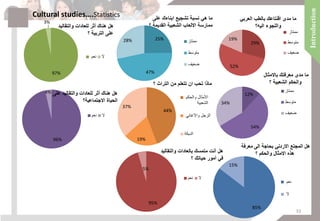
17%
69%
14%
‫العمر‬
10_20
20-40
40-60
34%
66%
‫الجنس‬
‫ذكر‬
‫أنثى‬
5%
68%
27%
‫بتمسكه‬ ‫المحلي‬ ‫للمجتمع‬ ‫تقيمك‬ ‫هو‬ ‫ما‬
‫بعاداتهم‬‫؟‬ ‫االصيلة‬ ‫وتقاليدهم‬
‫ممتاز‬
‫متوسط‬
‫ضعيف‬
27%
11%62%
‫بحاجة‬ ‫التي‬ ‫االعمار‬‫لمثل‬
‫؟‬ ‫المشروع‬ ‫هذا‬
20-Oct
20-40
‫األعمار‬ ‫كل‬
29%
51%
20%
‫هذه‬ ‫مع‬ ‫تفاعلك‬ ‫مدى‬ ‫ما‬‫العروض‬
‫المسرحية‬‫؟‬ ‫الشعبية‬
‫ممتاز‬
‫متوسط‬
‫ضعيف‬
67%
33%
‫؟‬ ‫السريعة‬ ‫الوجبات‬ ‫على‬ ‫الشعبي‬ ‫األكل‬ ‫تفضل‬ ‫هل‬
‫نعم‬
‫ال‬
66%
34%
‫؟‬ ‫اآلتيه‬ ‫من‬ ‫تتعلم‬ ‫أن‬ ‫تحب‬ ‫ماذا‬
‫الخيل‬ ‫ركوب‬
‫الرماية‬
Cultural studies….Statistics
32
29%
52%
19%
‫العربي‬ ‫بالطب‬ ‫اقنتاعك‬ ‫مدى‬ ‫ما‬
‫واللجوء‬‫اليه؟‬
‫ممتاز‬
‫متوسط‬
‫ضعيف‬
12%
54%
34%
‫باالمثال‬ ‫معرفتك‬ ‫مدى‬ ‫ما‬
‫والحكم‬‫؟‬ ‫الشعبية‬
‫ممتاز‬
‫متوسط‬
‫ضعيف‬
85%
15%
‫الى‬ ‫بحاجة‬ ‫االردني‬ ‫المجتع‬ ‫هل‬‫معرفة‬
‫؟‬ ‫والحكم‬ ‫االمثال‬ ‫هذه‬
‫نعم‬
‫ال‬
25%
47%
28%
‫على‬ ‫ابناءك‬ ‫تشجيع‬ ‫نسبة‬ ‫هي‬ ‫ما‬
‫ممارسة‬‫؟‬ ‫القديمة‬ ‫الشعبية‬ ‫االلعاب‬
‫ممتاز‬
‫متوسط‬
‫ضعيف‬
44%
19%
37%
‫؟‬ ‫التراث‬ ‫من‬ ‫تتعلم‬ ‫ان‬ ‫تحب‬ ‫ماذا‬
‫والحكم‬ ‫األمثال‬
‫الشعبية‬
‫واألغاني‬ ‫الزجل‬
‫الدبكة‬
95%
5%
‫والتقاليد‬ ‫بالعادات‬ ‫متمسك‬ ‫أنت‬ ‫هل‬
‫؟‬ ‫حياتك‬ ‫أمور‬ ‫في‬
‫نعم‬ ‫ال‬
97%
3%
‫والتقاليد‬ ‫للعادات‬ ‫أثر‬ ‫هناك‬ ‫هل‬
‫؟‬ ‫التربية‬ ‫على‬
‫نعم‬ ‫ال‬
96%
4% ‫على‬ ‫والتقاليد‬ ‫للعادات‬ ‫أثر‬ ‫هناك‬ ‫هل‬
‫االجتماعية؟‬ ‫الحياة‬
‫نعم‬ ‫ال‬
Cultural studies….Statistics
33
What does a building
allow to happen, rather
than what does it
represent……since the
site is the container of
that building , the site is
the main force to obey.
Site Analysis
34
Chapter tow: site analysis
1. SELETION THE SITE
1.1- SITE CRITERIA
1.2- WHY AL- ABDALI
1.3- LOCATION OF SITE IN AL-ABDALI
1.4-HISTORICAL BACKGROUND
2. STUDYING MACRO SCALE
2.1SITE APPROACH
2.2- MAIN STREET
2.3- LAND USE
2.4- SOLID AND VOID
2.5- LAND MARKS
2.5.1- AL- ABDALI PROJECT
2.6- FACILITIES
2.6.1 FACILITIES
3.6- DENSITY OF RESIDENTIAL CLUSTERS
3.7- SKY LINE
3.8- BUILDING TYPOLOGY
3.9- VIEW
3. STUDYING MICRO SCALE
3.1- THE SITE
3.2- SECTIONS
3.3- ENVIRONMENTAL CONDITIONS
3.4- STREET
3.5- NOISE
4. CULTURAL STUDIES THE SITE
4.1-AL-ABDALI POPULATION
5. SITE CONCLUSIONS
35
The following criteria were considered while
determining our project`s site . According the site was
choose
 Accessibility
 Visual quality
 Social value
 Mental value
 Political core
 Neutral social core
 In the core of the city
 Demographic trend
Site selection
Located in the central of Amman city making it accessible
by large group of people
Located in economic area which is going through
development stage
Great opportunity for social and heritage development
and awareness
Land mark in the context and social value
Why Al- Abdali
The Earliest Urban Sprawl Began Form The Center Of
Amman Including Al-abdali As A Part Of It . However , There
Is A Future Development For Al-abdali Region So It Can
Contain Both The Historical Image Of Amman Also The
Future Image .
In Addition It`s Located In The Center Of Amman So It`s Easy
To Be Reached By Different Type Of People .
Adding To That Al-abdali Is The Biggest Heritage Core In
Amman , As The Project Has A Tradition Aim So It Help Us To
Be In He Heart Of The Event.
Site criteria
36
Location of site in Al-Abdali
In the Jordanian capital
Amman the
site is located
JORDAN
AMMAN
The site is located on one of
the zones of the most
developing area in Amman,
this zone is called Al abdali
Capital: Amman
Total area : 97.740
Highest point: Jabal ram 1,734 m
Water :329 km2
Density : 69 per km2
Coast line: 26km2
Lowest point : dead sea – 408 m
JORDAN
Al Shmeisani
Al madeneh
Jabal al hussein
Al Luweibdeh
AL ABDALI
Abdali region has a special
geographical importance, and its
considered the center of Amman
capital.
Organizational boundaries for al Abdali
EAST :
NORTH :
WEST :
SOUTH :
Tareq and Jubaiha region .
Basman and al madeneh region .
Tlal al ali, khalda andum al summaq region .
zahran region . 37
Location
MACRO
The site is located on one of
the zones of the most developing area in Amman,
this zone is called Al Abdali
38
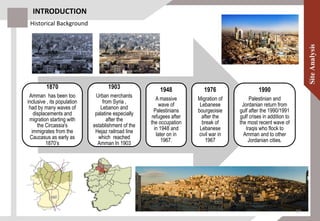
INTRODUCTION
1870
Amman has been too
inclusive , its population
had by many waves of
displacements and
migration starting with
the Circassia's
immigrates from the
Caucasus as early as
1870’s
1903
Urban merchants
from Syria ,
Lebanon and
palatine especially
after the
establishment of the
Hejaz railroad line
which reached
Amman In 1903
1948
A massive
wave of
Palestinians
refugees after
the occupation
in 1948 and
later on in
1967.
1976
Migration of
Lebanese
bourgeoisie
after the
break of
Lebanese
civil war in
1967
1990
Palestinian and
Jordanian return from
gulf after the 1990/1991
gulf crises in addition to
the most recent wave of
Iraqis who flock to
Amman and to other
Jordanian cities.
Historical Background
39
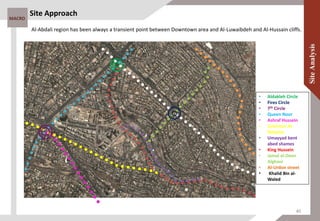
MACRO
Site Approach
• Aldakleh Circle
• Fires Circle
• 7th Circle
• Queen Noor
• Ashraf Hussein
• Suleiman Al-
Nabulse
• Umayyad bent
abed shames
• King Hussein
• Jamal al-Deen
Alghani
• Al-Urdon street
• Khalid Bin al-
Waled
Al-Abdali region has been always a transient point between Downtown area and Al-Luwaibdeh and Al-Hussain cliffs.
40
Main street (30m)
Main street (15m)
Main street (10m)
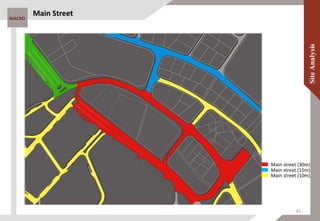
Main Street
MACRO
41
MACRO
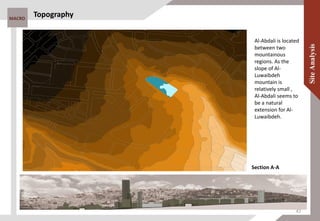
Topography
Section A-A
Al-Abdali is located
between two
mountainous
regions. As the
slope of Al-
Luwaibdeh
mountain is
relatively small ,
Al-Abdali seems to
be a natural
extension for Al-
Luwaibdeh.
42
MACRO
Land Use
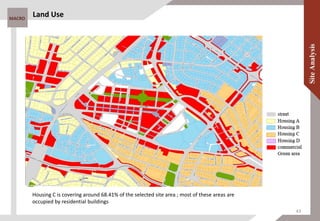
Housing C is covering around 68.41% of the selected site area ; most of these areas are
occupied by residential buildings
43
MACRO Solid And Void
Solid
Void
Al.Abdali project
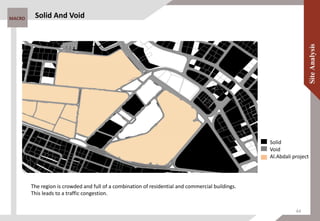
The region is crowded and full of a combination of residential and commercial buildings.
This leads to a traffic congestion.
44
MACRO
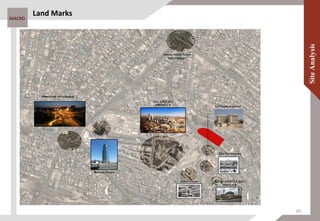
Land Marks
45
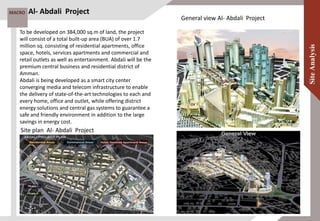
To be developed on 384,000 sq.m of land, the project
will consist of a total built-up area (BUA) of over 1.7
million sq. consisting of residential apartments, office
space, hotels, services apartments and commercial and
retail outlets as well as entertainment. Abdali will be the
premium central business and residential district of
Amman.
Abdali is being developed as a smart city center
converging media and telecom infrastructure to enable
the delivery of state-of-the-art technologies to each and
every home, office and outlet, while offering district
energy solutions and central gas systems to guarantee a
safe and friendly environment in addition to the large
savings in energy cost.
Al- Abdali Project
Site plan Al- Abdali Project
General view Al- Abdali Project
MACRO
46
MACRO
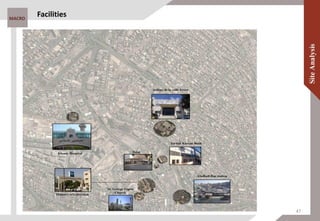
Facilities
47
MACRO
Facilities
ABDULLAH I MOSQUE
The King Abdullah I Mosque in Amman, Jordan was
built between 1982 and 1989. It is capped by a
magnificent blue mosaic dome beneath which 3,000
Muslims may offer prayer.
COLLEGE DE LA SALLE
College De La Salle - Frères is a private school in
Amman, Jordan. Established in 1950, and it is part
of the Institute of the Brothers of the Christian
Schools, also known as Lasallian Brothers,
established by Saint John Baptist de La Salle who
lived in the 17th century and was canonized as a
saint on May 15, 1900. In 1950, Pope Pius XII
declared him to be the Special Patron of All
Teachers of Youth in the Catholic Church. The
Institute now conducts educational work in 80
different countries including La Sallian schools and
universities in Asia, Europe, North America, South
America and Oceania. It is considered as the
biggest school in the world as it has more than 148
branches all over the globe.
It is considered as one of the most prestigious
schools in the Kingdom and the region, and one of
the biggest in Jordan; occupying an area of more
than 30000 square meters.
PARLIAMENT OF JORDAN
The Parliament of Jordan is the bicameral Jordanian
national assembly: "Majlis al-Umma". Established by
the 1952 Constitution, the legislature consists of two
houses: the House of Senate ("Majlis al-Aayan") and
the House of Representatives ("Majlis al-Nuwab").
The House of Senate has 60 members, all of whom
are directly appointed by the King, while the House
of Representatives has 150 elected members, with
nine seats reserved for Christians, three are for
Circassian and Chechen minorities, and fifteen for
women.[2] The Constitution ensures that the Senate
cannot be more than half the size of the House of
Representatives. The members of both houses serve
for four-year terms.[3]
48
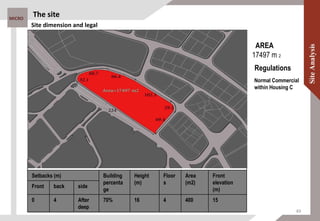
Setbacks (m) Building
percenta
ge
Height
(m)
Floor
s
Area
(m2)
Front
elevation
(m)
Front back side
0 4 After
deep
70% 16 4 400 15
MICRO
Normal Commercial
within Housing C
The site
Site dimension and legal
Regulations
AREA
17497 m 2
49
MICRO
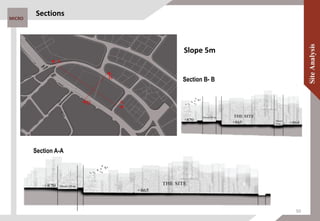
Sections
Section A-A
Section B- B
Slope 5m
50
MICRO
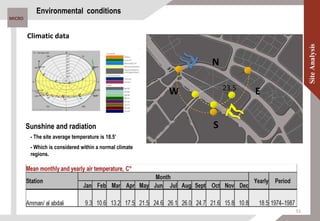
Climatic data
N
EW
S
23.5
- The site average temperature is 18.5’
- Which is considered within a normal climate
regions.
Environmental conditions
Sunshine and radiation
51
MICRO
Environmental conditions
MJ/m²dayhours/day
Maximum hours Real hours Radiation
°C
Extreme max Mean max Mean
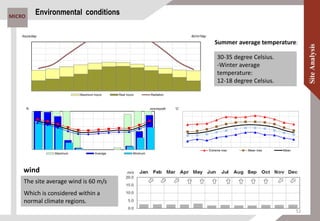
The site average wind is 60 m/s
Which is considered within a
normal climate regions.
30-35 degree Celsius.
-Winter average
temperature:
12-18 degree Celsius.
mm/month%
Maximum Average Minimum
Summer average temperature:
wind
52
MICRO
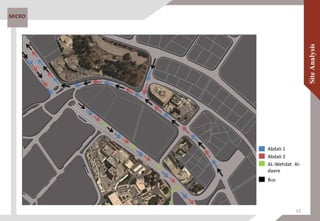
Abdali 1
Abdali 2
AL-Wehdat Al-
daere
Bus
53
MICRO
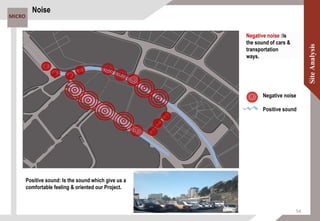
Negative noise :Is
the sound of cars &
transportation
ways.
Positive sound: Is the sound which give us a
comfortable feeling & oriented our Project.
Negative noise
Positive sound
Noise
54
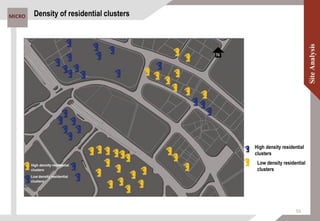
MICRO Density of residential clusters
High density residential
clusters
Low density residential
clusters
55
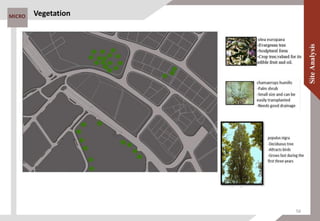
MICRO Vegetation
56
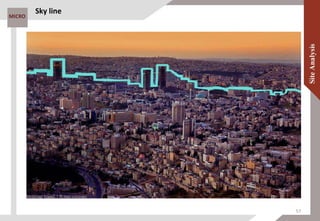
MICRO
Sky line
57
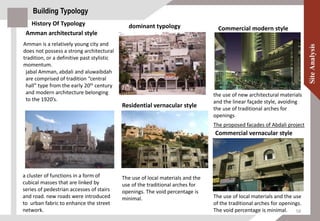
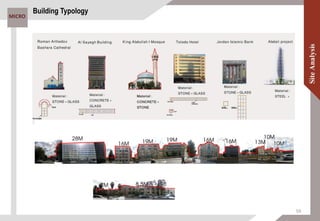
Building Typology
a cluster of functions in a form of
cubical masses that are linked by
series of pedestrian accesses of stairs
and road. new roads were introduced
to urban fabric to enhance the street
network.
History Of Typology dominant typology
Amman is a relatively young city and
does not possess a strong architectural
tradition, or a definitive past stylistic
momentum.
Amman architectural style
jabal Amman, abdali and aluwaibdah
are comprised of tradition “central
hall” type from the early 20th century
and modern architecture belonging
to the 1920’s.
Commercial modern style
The proposed facades of Abdali project
the use of new architectural materials
and the linear façade style, avoiding
the use of traditional arches for
openings
Commercial vernacular style
The use of local materials and the use
of the traditional arches for openings.
The void percentage is minimal.
The use of local materials and the
use of the traditional arches for
openings. The void percentage is
minimal.
Residential vernacular style
58
Building Typology
MICRO
59
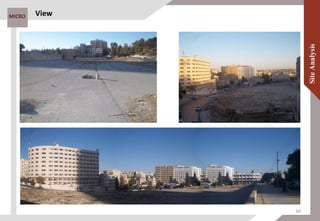
MICROMICRO View
60
MICRO
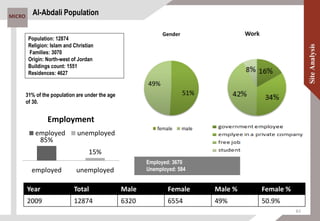
Al-Abdali Population
31% of the population are under the age
of 30.
Population: 12874
Religion: Islam and Christian
Families: 3070
Origin: North-west of Jordan
Buildings count: 1551
Residences: 4627
Female %Male %FemaleMaleTotalYear
50.9%49%65546320128742009
51%
49%
Gender
female male
Employed: 3670
Unemployed: 584
85%
15%
employed unemployed
Employment
employed unemployed
Work
61
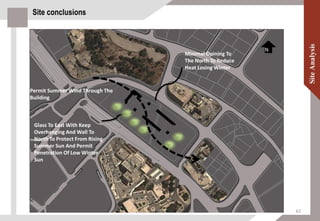
Site conclusions
Minimal Opining To
The North To Reduce
Heat Losing Winter
Glass To East With Keep
Overhanging And Wall To
North To Protect From Rising
Summer Sun And Permit
Penetration Of Low Winter
Sun
N
Permit Summer Wind Through The
Building
62
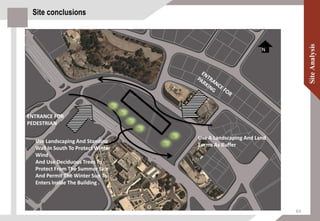
Site conclusions
Use Landscaping And Standing
Wall In South To Protect Winter
Wind .
And Use Deciduous Trees To
Protect From The Summer Sun
And Permit The Winter Sun To
Enters Inside The Building .
Use A Landscaping And Land
Forms As Buffer
ENTRANCE FOR
PEDESTRIAN
N
63
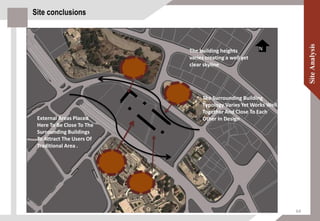
Site conclusions
External Areas Placed
Here To Be Close To The
Surrounding Buildings
To Attract The Users Of
Traditional Area .
NThe building heights
varies creating a well yet
clear skyline
The Surrounding Building
Typology Varies Yet Works Well
Together And Close To Each
Other In Design
64
Site conclusions
65
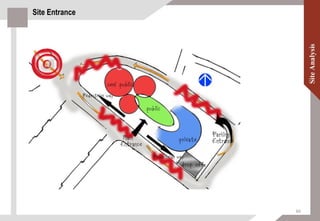
Site Entrance
66
Case Studies
“It has been said that
something as small as
the flutter of a
butterfly's wing can
ultimately cause a
typhoon halfway
around the world “-
Chaos Theory
67
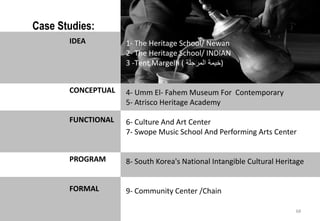
Case Studies:
1- The Heritage School/ Newan
2- The Heritage School/ INDIAN
3 -Tent Margelh ( ‫خيمة‬‫المرجلة‬ )
4- Umm El- Fahem Museum For Contemporary
5- Atrisco Heritage Academy
6- Culture And Art Center
7- Swope Music School And Performing Arts Center
8- South Korea's National Intangible Cultural Heritage
9- Community Center /Chain
IDEA
CONCEPTUAL
FUNCTIONAL
PROGRAM
FORMAL
68
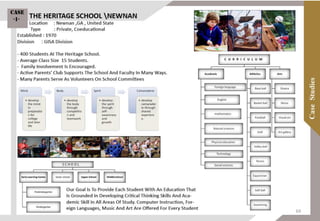
Case
-1-
69
Case
-2-
70
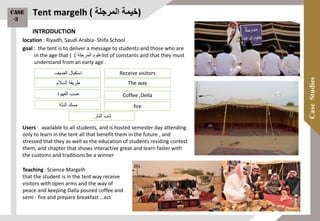
Tent margelh ( ‫خيمة‬‫المرجلة‬ )
location : Riyadh, Saudi Arabia- Shifa School
goal : the tent is to deliver a message to students and those who are
in the age that ( ‫علوم‬‫المرجلة‬) list of constants and that they must
understand from an early age .
Users : available to all students, and is hosted semester day attending
only to learn in the tent all that benefit them in the future , and
stressed that they as well as the education of students residing contest
them, and chapter that shows interactive great and learn faster with
the customs and traditions be a winner
Teaching : Science Margelh
that the student is in the tent way receive
visitors with open arms and the way of
peace and keeping Dalla poured coffee and
semi - fire and prepare breakfast …ect
‫الضيف‬ ‫استقبال‬
‫السالم‬ ‫طريقة‬
‫مسك‬‫الدلة‬
‫القهوة‬ ‫صب‬
‫النار‬ ‫شب‬
Receive visitors
The way
fire
Coffee ,Della
INTRODUCTION
Case
-3
71
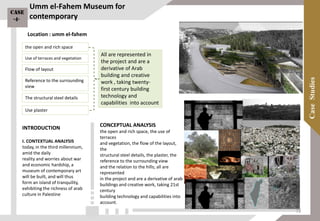
Umm el-Fahem Museum for
contemporary
INTRODUCTION
I. CONTEXTUAL ANALYSIS
today, in the third millennium,
amid the daily
reality and worries about war
and economic hardship, a
museum of contemporary art
will be built, and will thus
form an island of tranquility,
exhibiting the richness of arab
culture in Palestine
CONCEPTUAL ANALYSIS
the open and rich space, the use of
terraces
and vegetation, the flow of the layout,
the
structural steel details, the plaster, the
reference to the surrounding view
and the relation to the hills; all are
represented
in the project and are a derivative of arab
buildings and creative work, taking 21st
century
building technology and capabilities into
account.
All are represented in
the project and are a
derivative of Arab
building and creative
work , taking twenty-
first century building
technology and
capabilities into account
the open and rich space
Use of terraces and vegetation
Flow of layout
Reference to the surrounding
view
The structural steel details
Use plaster
Location : umm el-fahem
Case
-4-
72
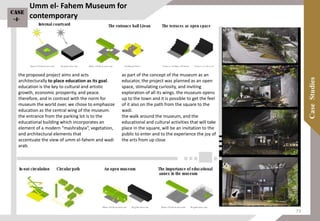
the proposed project aims and acts
architecturally to place education as its goal.
education is the key to cultural and artistic
growth, economic prosperity, and peace.
therefore, and in contrast with the norm for
museum the world over, we chose to emphasize
education as the central wing of the museum.
the entrance from the parking lot is to the
educational building which incorporates an
element of a modern “mashrabyia”, vegetation,
and architectural elements that
accentuate the view of umm el-fahem and wadi
arab.
as part of the concept of the museum as an
educator, the project was planned as an open
space, stimulating curiosity, and inviting
exploration of all its wings. the museum opens
up to the town and it is possible to get the feel
of it also on the path from the square to the
wadi.
the walk around the museum, and the
educational and cultural activities that will take
place in the square, will be an invitation to the
public to enter and to the experience the joy of
the arts from up close
Umm el- Fahem Museum for
contemporaryCase
-4-
73
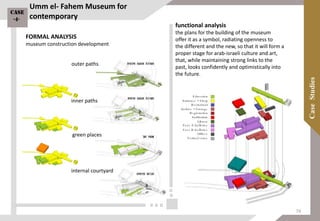
FORMAL ANALYSIS
museum construction development
internal courtyard
outer paths
inner paths
green places
functional analysis
the plans for the building of the museum
offer it as a symbol, radiating openness to
the different and the new, so that it will form a
proper stage for arab-israeli culture and art,
that, while maintaining strong links to the
past, looks confidently and optimistically into
the future.
Umm el- Fahem Museum for
contemporary
Case
-4-
74
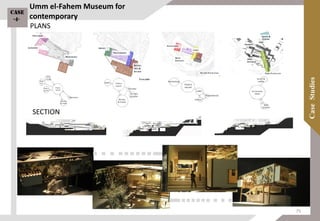
PLANS
SECTION
Umm el-Fahem Museum for
contemporary
Case
-4-
75
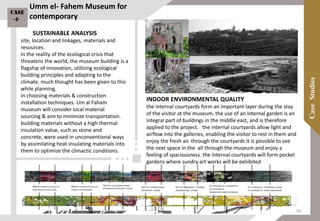
SUSTAINABLE ANALYSIS
site, location and linkages, materials and
resources.
in the reality of the ecological crisis that
threatens the world, the museum building is a
flagship of innovation, utilizing ecological
building principles and adapting to the
climate. much thought has been given to this
while planning.
in choosing materials & construction
installation techniques. Um al Faham
museum will consider local material
sourcing & aim to minimize transportation.
building materials without a high thermal
insulation value, such as stone and
concrete, were used in unconventional ways
by assimilating heat insulating materials into
them to optimize the climactic conditions.
INDOOR ENVIRONMENTAL QUALITY
the internal courtyards form an important layer during the stay
of the visitor at the museum. the use of an internal garden is an
integral part of buildings in the middle east, and is therefore
applied to the project. the internal courtyards allow light and
airflow into the galleries, enabling the visitor to rest in them and
enjoy the fresh air. through the courtyards it is possible to see
the next space in the all through the museum and enjoy a
feeling of spaciousness. the internal courtyards will form pocket
gardens where sundry art works will be exhibited
Umm el- Fahem Museum for
contemporary
Case
-4-
76
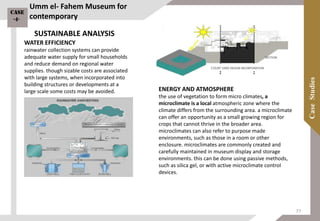
ENERGY AND ATMOSPHERE
the use of vegetation to form micro climates, a
microclimate is a local atmospheric zone where the
climate differs from the surrounding area. a microclimate
can offer an opportunity as a small growing region for
crops that cannot thrive in the broader area.
microclimates can also refer to purpose made
environments, such as those in a room or other
enclosure. microclimates are commonly created and
carefully maintained in museum display and storage
environments. this can be done using passive methods,
such as silica gel, or with active microclimate control
devices.
WATER EFFICIENCY
rainwater collection systems can provide
adequate water supply for small households
and reduce demand on regional water
supplies. though sizable costs are associated
with large systems, when incorporated into
building structures or developments at a
large scale some costs may be avoided.
Umm el- Fahem Museum for
contemporary
SUSTAINABLE ANALYSIS
Case
-4-
77
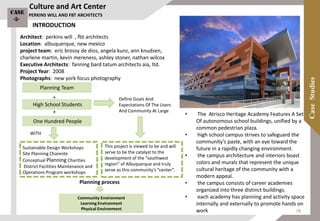
Culture and Art Center
Architect: perkins will , fbt architects
Location: albuquerque, new mexico
project team: eric brossy de dios, angela kunz, ann knudsen,
charlene martin, kevin mereness, ashley stoner, nathan wilcox
Executive Architects: fanning bard tatum architects aia, ltd.
Project Year: 2008
Photographs: new york focus photography
One Hundred People
Planning Team
High School Students
+
+
Define Goals And
Expectations Of The Users
And Community At Large
This project is viewed to be and will
serve to be the catalyst to the
development of the “southwest
region” of Albuquerque and truly
serve as this community’s “center”.
Sustainable Design Workshops
Site Planning Charente
Conceptual Planning Charities
District Facilities Maintenance and
Operations Program workshops
WITH
Community Environment
Learning Environment
Physical Environment
Planning process
PERKINS WILL AND FBT ARCHITECTS
• The Atrisco Heritage Academy Features A Set
Of autonomous school buildings, unified by a
common pedestrian plaza.
• high school campus strives to safeguard the
community’s paste, with an eye toward the
future in a rapidly changing environment.
• the campus architecture and interiors boast
colors and murals that represent the unique
cultural heritage of the community with a
modern appeal.
• the campus consists of career academies
organized into three distinct buildings.
• each academy has planning and activity space
internally and externally to promote hands on
work
Case
-5-
INTRODUCTION
78
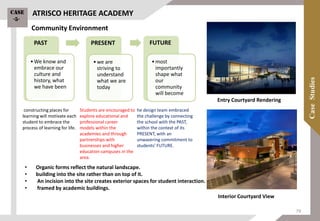
Community Environment
PAST
•We know and
embrace our
culture and
history, what
we have been
PRESENT
•we are
striving to
understand
what we are
today
FUTURE
•most
importantly
shape what
our
community
will become
constructing places for
learning will motivate each
student to embrace the
process of learning for life.
Students are encouraged to
explore educational and
professional career
models within the
academies and through
partnerships with
businesses and higher
education campuses in the
area.
he design team embraced
the challenge by connecting
the school with the PAST,
within the context of its
PRESENT, with an
unwavering commitment to
students’ FUTURE.
• Organic forms reflect the natural landscape.
• building into the site rather than on top of it.
• An incision into the site creates exterior spaces for student interaction.
• framed by academic buildings.
Interior Courtyard View
Entry Courtyard Rendering
ATRISCO HERITAGE ACADEMYCase
-5-
79
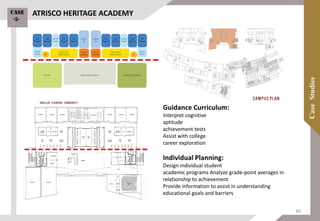
Guidance Curriculum:
Interpret cognitive
aptitude
achievement tests
Assist with college
career exploration
Individual Planning:
Design individual student
academic programs Analyze grade-point averages in
relationship to achievement
Provide information to assist in understanding
educational goals and barriers
ATRISCO HERITAGE ACADEMYCase
-5-
80
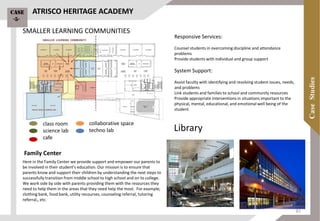
class room
science lab
cafe
Here in the Family Center we provide support and empower our parents to
be involved in their student’s education. Our mission is to ensure that
parents know and support their children by understanding the next steps to
successfully transition from middle school to high school and on to college.
We work side by side with parents providing them with the resources they
need to help them in the areas that they need help the most. For example;
clothing bank, food bank, utility recourses, counseling referral, tutoring
referral,, etc.
Family Center
Responsive Services:
Counsel students in overcoming discipline and attendance
problems
Provide students with individual and group support
System Support:
Assist faculty with identifying and resolving student issues, needs,
and problems
Link students and families to school and community resources
Provide appropriate interventions in situations important to the
physical, mental, educational, and emotional well being of the
student.
collaborative space
techno lab
SMALLER LEARNING COMMUNITIES
Library
ATRISCO HERITAGE ACADEMYCase
-5-
81
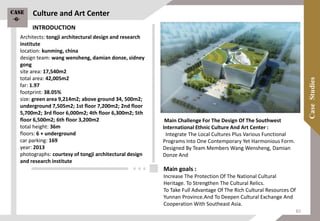
Culture and Art Center
Architects: tongji architectural design and research
institute
location: kunming, china
design team: wang wensheng, damian donze, sidney
gong
site area: 17,540m2
total area: 42,005m2
far: 1.97
footprint: 38.05%
size: green area 9,214m2; above ground 34, 500m2;
underground 7,505m2; 1st floor 7,200m2; 2nd floor
5,700m2; 3rd floor 6,000m2; 4th floor 6,300m2; 5th
floor 6,500m2; 6th floor 3,200m2
total height: 36m
floors: 6 + underground
car parking: 169
year: 2013
photographs: courtesy of tongji architectural design
and research institute
Main Challenge For The Design Of The Southwest
International Ethnic Culture And Art Center :
Integrate The Local Cultures Plus Various Functional
Programs Into One Contemporary Yet Harmonious Form.
Designed By Team Members Wang Wensheng, Damian
Donze And
Main goals :
Increase The Protection Of The National Cultural
Heritage. To Strengthen The Cultural Relics.
To Take Full Advantage Of The Rich Cultural Resources Of
Yunnan Province.And To Deepen Cultural Exchange And
Cooperation With Southeast Asia.
INTRODUCTION
Case
-6-
82
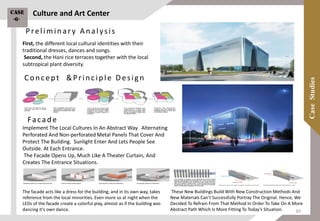
First, the different local cultural identities with their
traditional dresses, dances and songs.
Second, the Hani rice terraces together with the local
subtropical plant diversity.
These New Buildings Build With New Construction Methods And
New Materials Can’t Successfully Portray The Original. Hence, We
Decided To Refrain From That Method In Order To Take On A More
Abstract Path Which Is More Fitting To Today’s Situation.
Facade
Implement The Local Cultures In An Abstract Way. Alternating
Perforated And Non-perforated Metal Panels That Cover And
Protect The Building. Sunlight Enter And Lets People See
Outside. At Each Entrance.
The Facade Opens Up, Much Like A Theater Curtain, And
Creates The Entrance Situations.
The facade acts like a dress for the building, and in its own way, takes
reference from the local minorities. Even more so at night when the
LEDs of the facade create a colorful play, almost as if the building was
dancing it’s own dance.
Preliminary Analysis
Concept &Principle Design
Culture and Art CenterCase
-6-
83
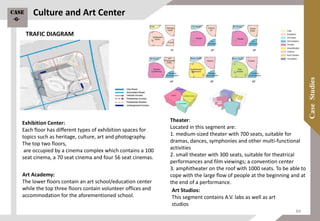
TRAFIC DIAGRAM
Exhibition Center:
Each floor has different types of exhibition spaces for
topics such as heritage, culture, art and photography.
The top two floors,
are occupied by a cinema complex which contains a 100
seat cinema, a 70 seat cinema and four 56 seat cinemas.
Art Academy:
The lower floors contain an art school/education center
while the top three floors contain volunteer offices and
accommodation for the aforementioned school.
Theater:
Located in this segment are:
1. medium-sized theater with 700 seats, suitable for
dramas, dances, symphonies and other multi-functional
activities
2. small theater with 300 seats, suitable for theatrical
performances and film viewings; a convention center
3. amphitheater on the roof with 1000 seats. To be able to
cope with the large flow of people at the beginning and at
the end of a performance.
Art Studios:
This segment contains A.V. labs as well as art
studios
Culture and Art CenterCase
-6-
84
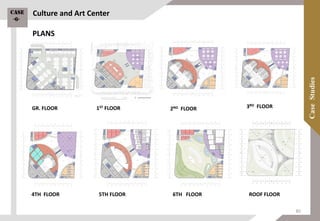
1ST FLOOR 2ND FLOORGR. FLOOR 3RD FLOOR
4TH FLOOR 6TH FLOOR5TH FLOOR ROOF FLOOR
Culture and Art Center
PLANS
Case
-6-
85
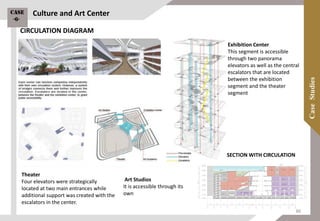
CIRCULATION DIAGRAM
SECTION WITH CIRCULATION
Theater
Four elevators were strategically
located at two main entrances while
additional support was created with the
escalators in the center.
Exhibition Center
This segment is accessible
through two panorama
elevators as well as the central
escalators that are located
between the exhibition
segment and the theater
segment
Art Studios
It is accessible through its
own
Culture and Art CenterCase
-6-
86
Swope Music School and Performing
Arts Center
Site size: 155,400 sq. ft.
Total construction cost: $29,200,000
Rowne: Department of General Services of the
Commonwealth of Pennsylvania
Occupant: West Chester University, College of Visual and
Performing Arts, School of Music
Architect: MGA Partners
Massing
Case
-7-
INTRODUCTION
87
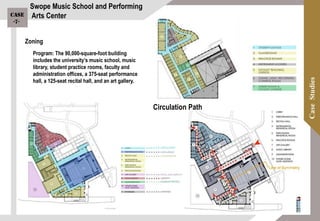
Zoning
Program: The 90,000-square-foot building
includes the university’s music school, music
library, student practice rooms, faculty and
administration offices, a 375-seat performance
hall, a 125-seat recital hall, and an art gallery.
Circulation Path
Swope Music School and Performing
Arts CenterCase
-7-
88
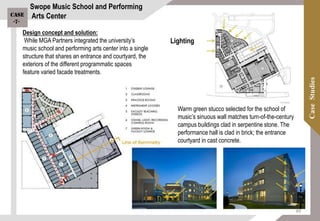
Design concept and solution:
While MGA Partners integrated the university’s
music school and performing arts center into a single
structure that shares an entrance and courtyard, the
exteriors of the different programmatic spaces
feature varied facade treatments.
Swope Music School and Performing
Arts Center
Lighting
Warm green stucco selected for the school of
music’s sinuous wall matches turn-of-the-century
campus buildings clad in serpentine stone. The
performance hall is clad in brick; the entrance
courtyard in cast concrete.
Case
-7-
89
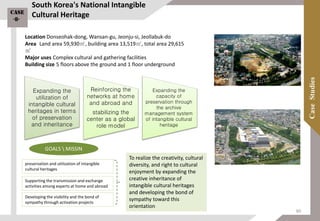
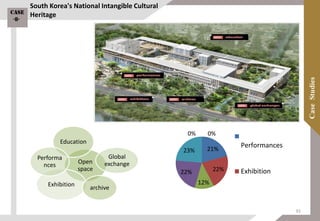
South Korea's National Intangible
Cultural Heritage
Location Donseohak-dong, Wansan-gu, Jeonju-si, Jeollabuk-do
Area Land area 59,930㎡, building area 13,519㎡, total area 29,615
㎡
Major uses Complex cultural and gathering facilities
Building size 5 floors above the ground and 1 floor underground
Expanding the
utilization of
intangible cultural
heritages in terms
of preservation
and inheritance
Reinforcing the
networks at home
and abroad and
stabilizing the
center as a global
role model
Expanding the
capacity of
preservation through
the archive
management system
of intangible cultural
heritage
To realize the creativity, cultural
diversity, and right to cultural
enjoyment by expanding the
creative inheritance of
intangible cultural heritages
and developing the bond of
sympathy toward this
orientation
preservation and utilization of intangible
cultural heritages
Supporting the transmission and exchange
activities among experts at home and abroad
Developing the visibility and the bond of
sympathy through activation projects
GOALS  MISSIN
Case
-8-
90
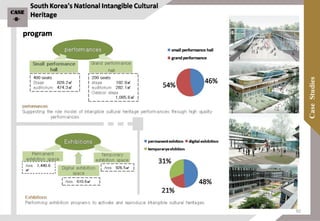
Open
space
Education
Global
exchange
Exhibition
Performa
nces
archive
21%
22%
12%
22%
23%
0% 0%
Performances
Exhibition
South Korea's National Intangible Cultural
HeritageCase
-8-
91
92
93
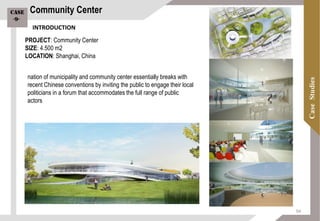
PROJECT: Community Center
SIZE: 4.500 m2
LOCATION: Shanghai, China
nation of municipality and community center essentially breaks with
recent Chinese conventions by inviting the public to engage their local
politicians in a forum that accommodates the full range of public
actors
Community CenterCase
-9-
INTRODUCTION
94
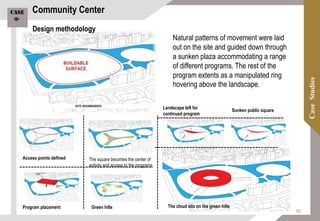
Access points defined The square becomes the center of
activity and access to the programs
Landscape left for
continued program
Sunken public square
Program placement Green hills The cloud sits on the green hills
Design methodology
Natural patterns of movement were laid
out on the site and guided down through
a sunken plaza accommodating a range
of different programs. The rest of the
program extents as a manipulated ring
hovering above the landscape.
Community CenterCase
-9-
95
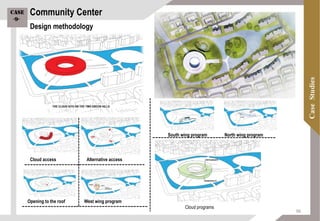
Cloud access Alternative access
Opening to the roof West wing program
South wing program North wing program
Cloud programs
Design methodology
Community CenterCase
-9-
96
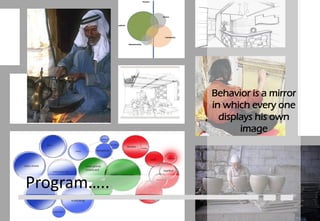
Program…..
Behavior is a mirror
in which every one
displays his own
image
97
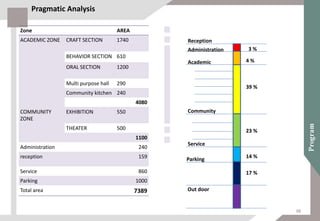
Pragmatic Analysis
Zone AREA
ACADEMIC ZONE CRAFT SECTION 1740
BEHAVIOR SECTION 610
ORAL SECTION 1200
Multi purpose hall 290
Community kitchen 240
4080
COMMUNITY
ZONE
EXHIBITION 550
THEATER 500
1100
Administration 240
reception 159
Service 860
Parking 1000
Total area 7389
Reception
Academic
Community
Service
Parking
Administration
4 %
3 %
39 %
23 %
14 %
17 %
Out door
98
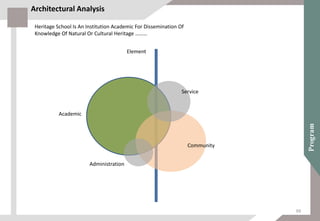
Architectural Analysis
Heritage School Is An Institution Academic For Dissemination Of
Knowledge Of Natural Or Cultural Heritage ………
Element
Academic
Community
Service
Administration
99
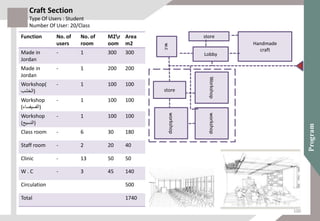
Craft Section
Type Of Users : Student
Number Of User: 20/Class
Handmade
craft
store
w.c
Workshop
store
workshop
workshop
Lobby
Function No. of
users
No. of
room
M2r
oom
Area
m2
Made in
Jordan
- 1 300 300
Made in
Jordan
- 1 200 200
Workshop(
‫)الخشب‬
- 1 100 100
Workshop
(‫)الفسيفساء‬
- 1 100 100
Workshop
(‫)النسيج‬
- 1 100 100
Class room - 6 30 180
Staff room - 2 20 40
Clinic - 13 50 50
W . C - 3 45 140
Circulation 500
Total 1740
100
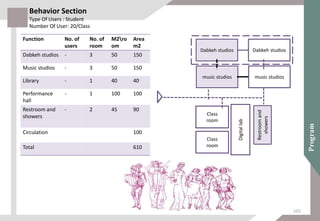
Function No. of
users
No. of
room
M2ro
om
Area
m2
Dabkeh studios - 3 50 150
Music studios - 3 50 150
Library - 1 40 40
Performance
hall
- 1 100 100
Restroom and
showers
- 2 45 90
Circulation 100
Total 610
Behavior Section
Type Of Users : Student
Number Of User: 20/Class
Digitallab
Class
room
Class
room
Dabkeh studios
music studios
Restroomand
showers
Dabkeh studios
music studios
101
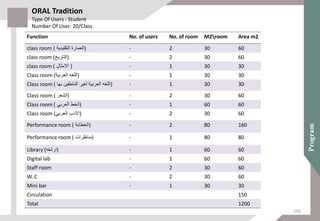
Function No. of users No. of room M2room Area m2
class room ( ‫التقليدية‬ ‫)العمارة‬ - 2 30 60
class room (‫)التاريخ‬ - 2 30 60
class room (‫االمثال‬) - 1 30 30
Class room (‫العربية‬ ‫)اللغه‬ - 1 30 30
Class room ( ‫بها‬ ‫الناطقين‬ ‫لغير‬ ‫العربية‬ ‫)اللغه‬ - 1 30 30
Class room ( ‫)الشعر‬ - 2 30 60
Class room ( ‫العربي‬ ‫)الخط‬ - 1 60 60
Class room (‫العربي‬ ‫)االدب‬ - 2 30 60
Performance room ( ‫)الخطابة‬ - 2 80 160
Performance room ( ‫)مناظرات‬ - 1 80 80
Library (‫)ارشفه‬ - 1 60 60
Digital lab - 1 60 60
Staff room - 2 30 60
W. C - 2 30 60
Mini bar - 1 30 30
Circulation 150
Total 1200
ORAL Tradition
Type Of Users : Student
Number Of User: 20/Class
102
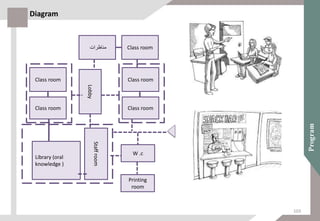
Printing
room
Lobby
Library (oral
knowledge )
Class room
Class room
Staffroom
W .c
Class room
Class room
Class room‫مناظرات‬
Diagram
103
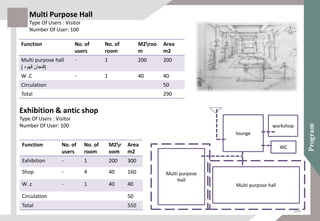
lounge
Multi purpose hall
workshop
WC
Multi purpose
Hall
Function No. of
users
No. of
room
M2roo
m
Area
m2
Multi purpose hall
( ‫قهوه‬ ‫)فنجان‬
- 1 200 200
W .C - 1 40 40
Circulation 50
Total 290
Multi Purpose Hall
Type Of Users : Visitor
Number Of User: 100
Function No. of
users
No. of
room
M2r
oom
Area
m2
Exhibition - 1 200 300
Shop - 4 40 160
W .c - 1 40 40
Circulation 50
Total 550
Exhibition & antic shop
Type Of Users : Visitor
Number Of User: 100
104
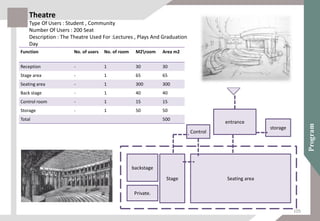
entrance
Seating area
Control
storage
Stage
backstage
Private.
Function No. of users No. of room M2room Area m2
Reception - 1 30 30
Stage area - 1 65 65
Seating area - 1 300 300
Back stage - 1 40 40
Control room - 1 15 15
Storage - 1 50 50
Total 500
Theatre
Type Of Users : Student , Community
Number Of Users : 200 Seat
Description : The Theatre Used For :Lectures , Plays And Graduation
Day
105
Function No. of users No. of room M2room Area m2
Cooking area - 1 100 100
Dinning area - 1 80 80
Staff room - 1 20 20
Storage - 1 40 40
Total 240
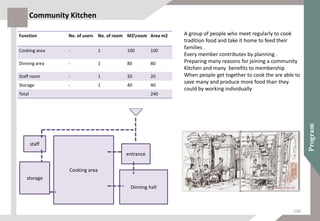
Community Kitchen
A group of people who meet regularly to cook
tradition food and take it home to feed their
families .
Every member contributes by planning .
Preparing many reasons for joining a community
Kitchen and many benefits to membership
When people get together to cook the are able to
save many and produce more food than they
could by working individually
Cooking area
storage
staff
Dinning hall
entrance
106
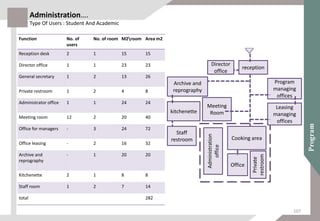
Administration….
Type Of Users : Student And Academic
Function No. of
users
No. of room M2room Area m2
Reception desk 2 1 15 15
Director office 1 1 23 23
General secretary 1 2 13 26
Private restroom 1 2 4 8
Administrator office 1 1 24 24
Meeting room 12 2 20 40
Office for managers - 3 24 72
Office leasing - 2 16 32
Archive and
reprography
- 1 20 20
Kitchenette 2 1 8 8
Staff room 1 2 7 14
total 282
Office
Cooking area
Meeting
Room
reception
Leasing
managing
offices
Program
managing
offices
Administration
office
Private
restroom
Director
office
Archive and
reprography
kitchenette
Staff
restroom
107
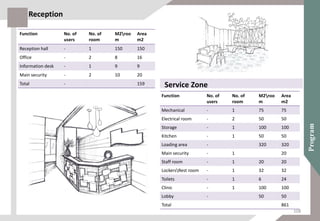
Function No. of
users
No. of
room
M2roo
m
Area
m2
Reception hall - 1 150 150
Office - 2 8 16
Information desk - 1 9 9
Main security - 2 10 20
Total - 159
Reception
Function No. of
users
No. of
room
M2roo
m
Area
m2
Mechanical - 1 75 75
Electrical room - 2 50 50
Storage - 1 100 100
Kitchen - 1 50 50
Loading area - 320 320
Main security - 1 20
Staff room - 1 20 20
LockersRest room - 1 32 32
Toilets - 1 6 24
Clinic - 1 100 100
Lobby - 50 50
Total 861
Service Zone
108
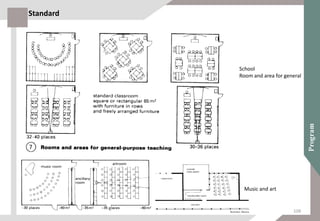
School
Room and area for general
Music and art
Standard
109
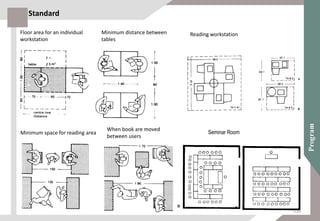
Floor area for an individual
workstation
Minimum distance between
tables
Minimum space for reading area
When book are moved
between users
Reading workstation
Seminar Room
Standard
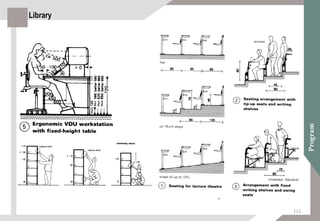
110
Library
111
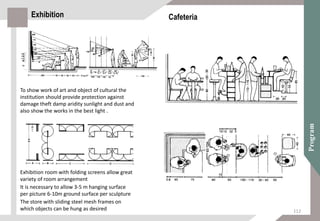
To show work of art and object of cultural the
institution should provide protection against
damage theft damp aridity sunlight and dust and
also show the works in the best light .
The store with sliding steel mesh frames on
which objects can be hung as desired
Exhibition room with folding screens allow great
variety of room arrangement
It is necessary to allow 3-5 m hanging surface
per picture 6-10m ground surface per sculpture
Exhibition Cafeteria
112
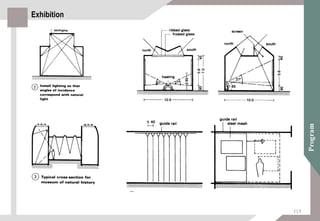
Exhibition
113
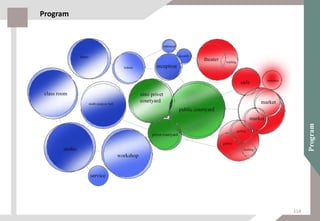
Program
114
Case StudiesConceptual
‘’Heritage represents
humankind’s legacy
from the past, an
irreplaceable source of
life and inspiration for
present and future
generations’’
115
CHAPTER FIVE : CONCEPT
1. Scenario
2. DESIGN PRECEPT
3. CONCEPT
4. CONCLUSION
5. SCHMATIC DESIGN
1.1- Function
1.2- Users
1.3- Goals
4.1- ZONING
4.2- LAYERING
116
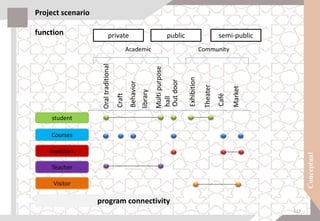
student
Courses
Investors
Craft
Oraltraditional
Behavior
Academic
library
Multipurpose
hall
Exhibition
Theater
Outdoor
Community
Café
Market
Teacher
Visitor
public semi-publicprivate
program connectivity
Project scenario
function
117
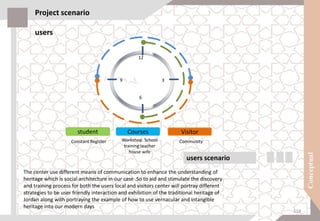
student Courses Visitor
12
3
6
9
Workshop. School
training teacher
house wife
Constant Register Community
users scenario
The center use different means of communication to enhance the understanding of
heritage which is social architecture in our case .So to aid and stimulate the discovery
and training process for both the users local and visitors center will portray different
strategies to be user friendly interaction and exhibition of the traditional heritage of
Jordan along with portraying the example of how to use vernacular and intangible
heritage into our modern days
Project scenario
users
118
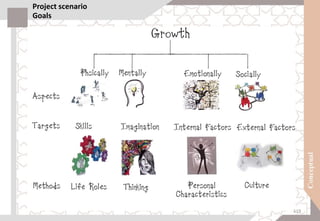
Goals
Project scenario
119
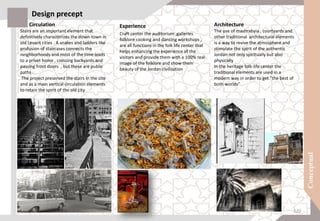
Circulation
Stairs are an important element that
definitively characterizes the down-town in
old Levant cities . A snakes and ladders like
profusion of staircases connects the
neighborhoods and most of the time leads
to a privet home , crossing backyards and
passing front doors , but these are public
paths .
The project preserved the stairs in the site
and as a main vertical circulation elements
to retain the spirit of the old city
Design precept
Experience
Craft center the auditorium ,galleries
folklore cooking and dancing workshops ,
are all functions in the folk life center that
helps enhancing the experience of the
visitors and provide them with a 100% real
image of the folklore and show them
beauty of the Jordan civilization
Architecture
The use of mashrabyia , courtyards and
other traditional architectural elements
is a way to revive the atmosphere and
stimulate the spirit of the authentic
Jordan not only spiritually but also
physically
In the heritage folk-life center the
traditional elements are used in a
modern way in order to get “the best of
both worlds”
120
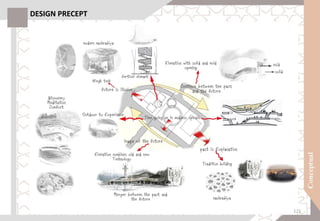
DESIGN PRECEPT
121
122
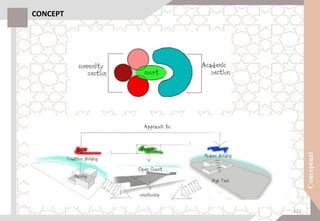
CONCEPT
123
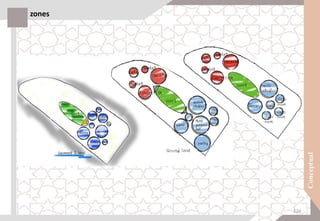
zones
124
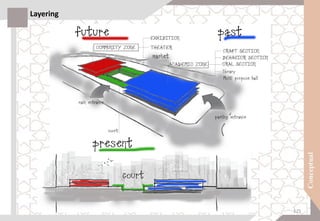
Layering
125
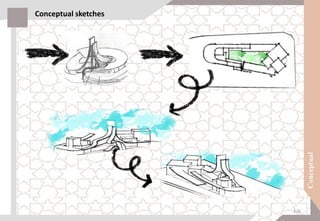
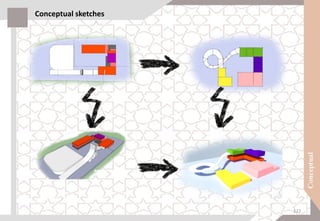
Conceptual sketches
126
Conceptual sketches
127
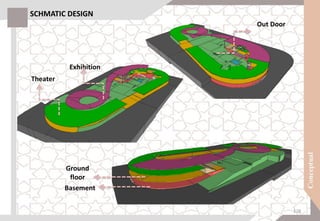
SCHMATIC DESIGN
Theater
Exhibition
Out Door
Basement
Ground
floor
128
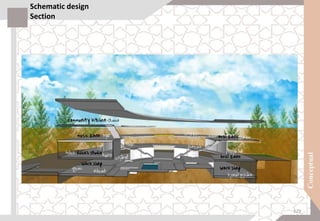
Schematic design
Section
129
130130
Sustainability Research…
130
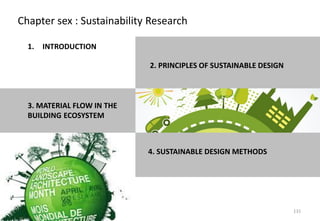
Chapter sex : Sustainability Research
1. INTRODUCTION
3. MATERIAL FLOW IN THE
BUILDING ECOSYSTEM
2. PRINCIPLES OF SUSTAINABLE DESIGN
4. SUSTAINABLE DESIGN METHODS
131
Sustainability Research
Introduction
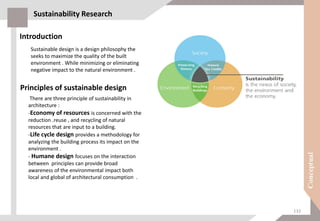
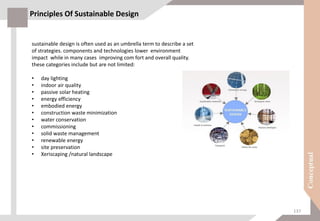
Sustainable design is a design philosophy the
seeks to maximize the quality of the built
environment . While minimizing or eliminating
negative impact to the natural environment .
There are three principle of sustainability in
architecture :
-Economy of resources is concerned with the
reduction .reuse , and recycling of natural
resources that are input to a building.
-Life cycle design provides a methodology for
analyzing the building process its impact on the
environment .
- Humane design focuses on the interaction
between principles can provide broad
awareness of the environmental impact both
local and global of architectural consumption .
Principles of sustainable design
132
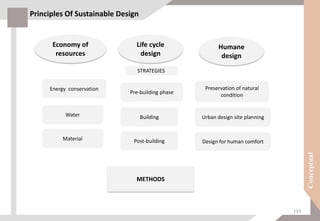
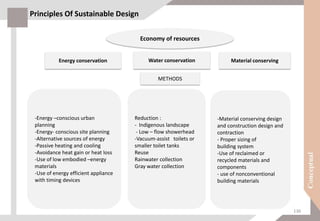
Economy of
resources
Life cycle
design
Humane
design
Energy conservation
Water
Material
Pre-building phase
Building
Post-building
Urban design site planning
Design for human comfort
Preservation of natural
condition
METHODS
STRATEGIES
Principles Of Sustainable Design
133
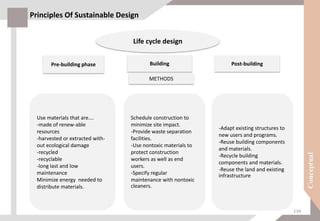
Life cycle design
Use materials that are….
-made of renew-able
resources
-harvested or extracted with-
out ecological damage
-recycled
-recyclable
-long last and low
maintenance
Minimize energy needed to
distribute materials.
METHODS
Schedule construction to
minimize site impact.
-Provide waste separation
facilities.
-Use nontoxic materials to
protect construction
workers as well as end
users.
-Specify regular
maintenance with nontoxic
cleaners.
-Adapt existing structures to
new users and programs.
-Reuse building components
and materials.
-Recycle building
components and materials.
-Reuse the land and existing
infrastructure
Building Post-buildingPre-building phase
Principles Of Sustainable Design
134
Human design
-Understand the impact of
design on nature
-Respect topographical
contours
-Do not disturb the water
table
-Preserve existing flora and
fauna
METHODS
-Avoid pollution contribution
-Promote mixed –use
development
-Create pedestrian pockets
-Provide for Human –powered
transportation .
-Integrate design with public
transportation .
-Provide thermal visual and
acoustic comfort .
-Provide visual connection to
exterior.
-Provide operable windows .
-Provide clean fresh air.
-Accommodate persons with
differing physical abilities.
-Use non-toxic non-outgassing
materials.
Urban Design site planning Design for Human ComfortPreservation of Nat`l
Conditions
Principles Of Sustainable Design
135
Principles Of Sustainable Design
Economy of resources
-Energy –conscious urban
planning
-Energy- conscious site planning
-Alternative sources of energy
-Passive heating and cooling
-Avoidance heat gain or heat loss
-Use of low embodied –energy
materials
-Use of energy efficient appliance
with timing devices
METHODS
Reduction :
- Indigenous landscape
- Low – flow showerhead
-Vacuum-assist toilets or
smaller toilet tanks
Reuse
Rainwater collection
Gray water collection
-Material conserving design
and construction design and
contraction
- Proper sizing of
building system
-Use of reclaimed or
recycled materials and
components
- use of nonconventional
building materials
Water conservation Material conservingEnergy conservation
136
Principles Of Sustainable Design
sustainable design is often used as an umbrella term to describe a set
of strategies. components and technologies lower environment
impact while in many cases improving com fort and overall quality.
these categories include but are not limited:
• day lighting
• indoor air quality
• passive solar heating
• energy efficiency
• embodied energy
• construction waste minimization
• water conservation
• commissioning
• solid waste management
• renewable energy
• site preservation
• Xeriscaping /natural landscape
137
Material flow in the building
ecosystem
Building Materials
Energy
Water
Consumet Goods
Solar Radiation
Wind
Rain
Used Materials
Combustion Byproducts
Gray water sewage
Recycleable Materials
Wasted Head
Polluted Air
Ground water
Upstream DownstreamBuilding
138
Takhtabush System The Malqaf Courtyard System Offset Corridor
System
Thermal Solar
System
The Photovoltaic
System
Green Roof System
Sustainable Design Methods
139
Reference
Web:
http://www.ich.gov.jo/index.php/ar/2012-12-06-12-35-20/2012-12-06-12-
39-48
http://www.unesco.org/culture/ich/index.php?pg=00318
http://www.ich.gov.jo/index.php/ar/
http://www.unesco.org/culture/ich/doc/src/07950-EN.pdf
http://www.archdaily.com/162807/atrisco-heritage-academy-perkinswill-
and-fbt-architects/
http://www.archdaily.com/415939/southwest-international-ethnic-culture-
and-art-center-winning-proposal-tongji-architectural-design-and-research-
institute/
140
Books:
Phaidon Atlas For Contemporary
Encarta Encyclopedia
Greater Amman Municipality
141
Don't Judge a book by it's cover
141

Back to future (thesis)

  • 1.
    Done By : LaraSmadi 0098614 Ola Alulaimi 0096810 Esra’a Hourani 0095360 Supervised: Dr.Nabeel Alkurdi
  • 2.
    First and foremostto ALLAH we thank you for the strength that kept us standing and for the hope that kept us believing that this affiliation would be possible and more interesting. And all the lessons we have learned, and yet to com. We would like to express our gratitude to Dr. Nabeel For his expert guidance, encouragement and valuable suggestion at every step. The completion of any project brings with it a sense of satisfaction, But it is never complete without thanking those people who made it possible and constant support has crowned our efforts with success (Arch.Huda Alnajar ,Arch Rula Alasir ) We whole heartedly thank Indoor and Ali baba for the kindness and patience they have given us. We are extremely happy to acknowledge and express our gratitude to our processors at the University of Jordan for their constant support and encouragement. Acknowledgement
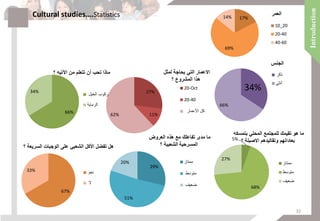
  • 4.
    1. GOALS ANDOBJECTIVES.. 2. ABOUT THE PROJECT 2.1- WHAT THE PROJECT ? 2.2- WHY THE PROJECT? 3. ABOUT THE INTANGIBLE HERITAGE 3.1- THE HERITAGE CYCLE DIAGRAM ‫نشر‬ ‫في‬ ‫الفلكلورية‬ ‫والفنون‬ ‫التراث‬ ‫أهمية‬3.2- ‫وترويجها‬ ‫الحضارة‬ 3.3- THE MEDLIHER PROJE 4. ABOUT JORDAN 4.1- ANALYSIS OF CURRENT STATUS 4.2- INTANGIBLE HERITAGE PROJECTS IN JORDAN 5. ABOUT THE COMMUNITY SCHOOL 5.1- WHAT IS DEFINITION COMMUNITY SCHOOL 6. PROJECT LANGUAGE 7. CULTURAL ANALYSIS 7.1- CULTURAL STUDIES….QUESTIONS 7.2- CULTURAL STUDIES….STATISTICS CHAPTER ONE : INTRODUCTION CHAPTER TOW: SITE ANALYSIS 1. SELECTION THE SITE 1.1- SITE CRITERIA 1.2- WHY AL- ABDALI 1.3- LOCATION OF SITE IN AL-ABDALI 1.4-HISTORICAL BACKGROUND 10 11 12 12 13-14 15 16-17 18-20 27-28 29-31 32-33 36 36 37-38 39 4
  • 5.
    2. STUDYING MACROSCALE 2.1SITE APPROACH 2.2- MAIN STREET 2.3- LAND USE 2.4- SOLID AND VOID 2.5- LAND MARKS 2.5.1- AL- ABDALI PROJECT 2.6- FACILITIES 2.6.1 FACILITIES 3. STUDYING MICRO SCALE 3.1- THE SITE 3.2- SECTIONS 3.3- ENVIRONMENTAL CONDITIONS 3.4- public transportation 3.5- NOISE 3.6- DENSITY OF RESIDENTIAL CLUSTERS 3.7- SKY LINE 3.8- BUILDING TYPOLOGY 3.9- VIEW 4. CULTURAL STUDIES THE SITE 4.1-AL-ABDALI POPULATION 5. SITE CONCLUSIONS CHAPTER THREE: CASE STUDIES 40 41 43 44 45 46 47-48 48 49 50 51-52 53 54 55-56 57 58-59 60 61 62-66 67-96 5
  • 6.
    CHAPTER THREE: CASESTUDIES 1. IDEA : 1.1- THE HERITAGE SCHOOL/ NEWAN 1.2- THE HERITAGE SCHOOL/ INDIAN 1.3-TENT MARGELH ( ‫خيمة‬‫المرجلة‬ ) 2. CONCEPTUAL : 2.1- UMM EL- FAHEM MUSEUM FOR CONTEMPORARY 2.2- ATRISCO HERITAGE ACADEMY 3. FUNCTIONAL : 3.1- CULTURE AND ART CENTER 3.2- SWOPE MUSIC SCHOOL AND PERFORMING ARTS CENTER 4. PROGRAM : 4.1- SOUTH KOREA'S NATIONAL INTANGIBLE CULTURAL HERITAGE 5. FORMAL 5.1- COMMUNITY CENTER /CHAIN Chapter four: program Chapter five : concept 1. Scenario 1.1- Function 1.2- Users 1.3- Goals 69 70 71 72-77 78-81 82-68 78-89 90-93 94-96 97-114 115-129 117 118 1196
  • 7.
    Chapter sex :Sustainability Research 1. SUSTAINABILITY RESEARCH 1. INTRODUCTION 2. PRINCIPLES OF SUSTAINABLE DESIGN 3. MATERIAL FLOW IN THE BUILDING ECOSYSTEM 4. SUSTAINABLE DESIGN METHODS References 2. DESIGN PRECEPT 3. CONCEPT 4. CONCLUSION 4.1- ZONING 4.2- LAYERING 4.3- conceptual sketches 5. SCHMATIC DESIGN 130-139 132 133-136 137 138-139 140 120-121 122-123 124 125 126-127 128-129 7
  • 8.
    Introduction 8 ‘’If you don'tknow where you want to go, you will never know when you arrive ‘’ -kobreg and bangnall
  • 9.
    3.1- THE HERITAGECYCLE DIAGRAM ‫نشر‬ ‫في‬ ‫الفلكلورية‬ ‫والفنون‬ ‫التراث‬ ‫أهمية‬3.2- ‫وترويجها‬ ‫الحضارة‬ 3.3- THE MEDLIHER PROJE 2.1- WHAT THE PROJECT ? 1. GOALS AND OBJECTIVES.. 2. ABOUT THE PROJECT 3. ABOUT THE INTANGIBLE HERITAGE 4. ABOUT JORDAN 6. PROJECT LANGUAGE 7. CULTURAL ANALYSIS Chapter one : Introduction 4.1- ANALYSIS OF CURRENT STATUS 4.2- INTANGIBLE HERITAGE PROJECTS IN JORDAN 5.1- WHAT IS DEFINITION COMMUNITY SCHOOL 7.1- CULTURAL STUDIES….QUESTIONS 7.2- CULTURAL STUDIES….STATISTICS9
  • 10.
    Goals and objectives.. Goals Local to design a unique project , aims to provide multiple facilities that attract visitors , regard they are interested and educated and provide traditional habits society . • Regional Giving Jordan its own character and the exchange of cultures and traditions with Arab countries • international Give a clear vision about the traditions and customs of Jordan and teach those who wish to in one place Why the project ? More than 60% of the population lives in the metropolis of Amman, concentrating the culture of Jordan in that city. Jordanian pop culture is heavily influenced by the "West". European and American music, movies, fashion and other forms of entertainment are popular among Jordan's people. Clubbing and partying culture is present in Amman, especially in the Western half of the city. A small minority of youth, mostly the rich in West Amman, exhibit counter-culture traits like face piercings and tattoos. English is widely understood and even spoken in lieu of Jordanian Levantine among Jordanians in the upper class and upper middle class 10
  • 11.
    HERITAGE: Cultural Heritage isan expression of the ways of living developed by a community and passed on from generation to generation, including customs, practices, places, objects, artistic expressions and values. Cultural Heritage is often expressed as either Intangible or Tangible Cultural Heritage. Tangible heritage Intangible heritage includes buildings and historic places, monuments, artifacts, etc., which are considered worthy of preservation for the future. These include objects significant to the archaeology, architecture, science or technology of a specific culture. as the practices, representations, expressions, as well as the knowledge and skills (including instruments, objects, artifacts, cultural spaces), that communities, groups and, in some cases, individuals recognize as part of their cultural heritage. It is sometimes called living cultural heritage Intangible heritage constantly recreated by communities and groups, in response to their environment, their interaction with nature, and their history. It provides people with a sense of identity and continuity, and promotes respect for cultural diversity and human creativity. is manifested inter alia in the following domains: Oral traditions and expressions, including language . Performing arts n and rich space Social practices, rituals and festive events Knowledge and practices concerning nature and the universe traditional craftsmanship What the Project ? 11
  • 12.
    The Heritage Cyclediagram The Heritage Cycle diagram gives us an idea how we can make the past part of our future. • By understanding  people value it • By valuing it  people want to care for it • By caring for it  it will help people enjoy it • From enjoying it  comes a thirst to understand • By understanding it………..etc holistic approach to natural and cultural environments and to movable and immovable heritage resources, including tangible and intangible elements 12
  • 13.
    ‫في‬ ‫الفلكلورية‬ ‫والفنون‬‫التراث‬ ‫أهمية‬‫نشر‬ ‫الحضارة‬‫وترويجها‬ ‫د‬.‫حداد‬ ‫رامي‬-‫المناطق‬ ‫من‬ ‫غيرها‬ ‫عن‬ ‫تميزها‬ ‫التي‬ ‫والفلكلورية‬ ‫التراثية‬ ‫خصوصيتها‬ ‫حضارة‬ ‫لكل‬ ‫كما‬ ‫جغرافية‬ ‫منطقة‬ ‫لكل‬ ‫والحضارات‬. ‫عادات‬ ‫من‬ ‫الشعبي‬ ‫المأثور‬ ‫فهو‬ ‫الفلكلور‬ ‫أما‬ ،‫الالحقة‬ ‫لألجيال‬ ‫واألجداد‬ ‫اآلباء‬ ‫فه‬ّ‫ل‬‫يخ‬ ‫ما‬ ‫وتعني‬ ،‫إرث‬ ‫كلمة‬ ‫من‬ ‫تأتي‬ ‫تراث‬ ‫وكلمة‬ ‫شفهيا‬ ‫المجتمع‬ ‫أفراد‬ ‫بين‬ ‫تناقلها‬ ‫يتم‬ ‫التي‬ ‫األمور‬ ‫من‬ ‫وغيرها‬ ‫شعبي‬ ‫وطب‬ ‫وأغان‬ ‫وتقاليد‬. ،‫ترديده‬ ،‫به‬ ‫والتغني‬ ‫الموروث‬ ‫نقل‬ ‫خالل‬ ‫من‬ ‫األشخاص‬ ‫لدى‬ ‫واالجتماعي‬ ‫الوطني‬ ‫الحس‬ ‫تنمية‬ ‫في‬ ‫والفلكلور‬ ‫التراث‬ ‫أهمية‬ ‫تبرز‬ ،‫ما‬ ‫بلد‬ ‫إلى‬ ‫اإلنساني‬ ‫بالموروث‬ ‫والمهتمين‬ ‫الباحثين‬ ‫جلب‬ ‫على‬ ‫تعمل‬ ‫التي‬ ‫المنابر‬ ‫من‬ ‫منبرا‬ ‫يعتبر‬ ‫الموروث‬ ‫ذلك‬ ‫أن‬ ‫كما‬ ،‫وتقليده‬ ‫تجاريا‬ ‫تسويقه‬ ‫إلى‬ ‫باإلضافة‬ ‫وثقافيا‬ ‫حضاريا‬ ‫البلد‬ ‫ذلك‬ ‫تسويق‬ ‫وبالتالي‬. ‫الثقا‬ ‫تلك‬ ‫نقل‬ ‫إمكانية‬ ‫إلى‬ ‫باإلضافة‬ ‫المحلي‬ ‫المجتمع‬ ‫ثقافة‬ ‫من‬ ‫كبيرا‬ ‫جزءا‬ ‫احتوائها‬ ‫في‬ ‫والفلكلورية‬ ‫التراثية‬ ‫الفنون‬ ‫أهمية‬ ‫تكمن‬ ‫كما‬‫فة‬ ‫المنطقة‬ ‫ثقافة‬ ‫على‬ ‫ليتعرف‬ ‫التاريخ‬ ‫قراءة‬ ‫أو‬ ‫والمراجع‬ ‫الكتب‬ ‫إلى‬ ‫الرجوع‬ ‫عليه‬ ‫فتختصر‬ ،‫والمستمع‬ ‫للمشاهد‬ ‫ممتعة‬ ‫بطريقة‬ ‫وتقاليده‬ ‫بعاداته‬ ‫وتعرُف‬ ‫ما‬ ‫بلد‬ ‫ثقافة‬ ‫أو‬ ‫الجغرافية‬. ‫المجتمع‬ ‫من‬ ‫الثقافة‬ ‫وينالون‬ ،‫بيضاء‬ ‫صفحة‬ ‫يولدون‬ ‫الذين‬ ‫األجيال‬ ‫تربية‬ ‫في‬ ‫هام‬ ‫عامل‬ ،‫الشعبي‬ ‫الموروث‬ ‫أن‬ ‫إلى‬ ‫باإلضافة‬ ‫هذا‬ ‫نروج‬ ‫فإننا‬ ‫وهكذا‬ ‫الفاضلة‬ ‫والتقاليد‬ ‫الصحيحة‬ ‫العادات‬ ‫على‬ ‫المحافظة‬ ‫تضمن‬ ‫بطريقة‬ ‫الموروث‬ ‫ذلك‬ ‫توظيف‬ ‫فيفترض‬ ،‫حولهم‬ ‫الذي‬ ‫هويتنا‬ ‫على‬ ‫ونحافظ‬ ،‫محليا‬ ‫والتقاليد‬ ‫العادات‬ ‫تلك‬. ‫والفنو‬ ‫التراث‬ ‫أهمية‬ ‫هنا‬ ‫وتكمن‬ ،‫المختلفة‬ ‫العالم‬ ‫بلدان‬ ‫بين‬ ‫واقتصاديا‬ ‫اجتماعيا‬ ، ‫ثقافيا‬ ، ‫سياحيا‬ ‫نفسه‬ ‫ترويج‬ ‫إلى‬ ‫بلد‬ ‫أي‬ ‫ويسعى‬‫ن‬ ‫العالمية‬ ‫للحضارة‬ ‫كبير‬ ‫اهتمام‬ ‫محط‬ ‫اصبح‬ ‫التراث‬ ‫وذلك‬ ‫الفنون‬ ‫تلك‬ ‫أن‬ ‫حيث‬ ‫الترويج‬ ‫في‬ ‫األكبر‬ ‫الدور‬ ‫تلعب‬ ‫أنها‬ ‫في‬ ‫الفلكلورية‬ ‫عليها‬ ‫المحافظة‬ ،‫العكس‬ ‫على‬ ‫بل‬ ،‫الفنون‬ ‫تلك‬ ‫زوال‬ ‫في‬ ‫ترغب‬ ‫ال‬ ‫التي‬. ‫إغفاله‬ ‫يمكن‬ ‫ال‬ ‫الذي‬ ‫األمر‬ ،‫والعلمية‬ ‫الثقافية‬ ‫والمؤتمرات‬ ‫والندوات‬ ‫الجلسات‬ ‫معظم‬ ‫في‬ ‫الدائر‬ ‫الحديث‬ ‫هو‬ ‫العالم‬ ‫على‬ ‫االنفتاح‬ ‫أن‬ ‫هو‬ ‫ذلك‬ ‫يفعل‬ ‫من‬ ‫ألن‬ ،‫الشعبي‬ ‫موروثه‬ ‫على‬ ‫يتمرد‬ ‫أن‬ ‫منطقة‬ ‫أي‬ ‫في‬ ‫شعب‬ ‫ألي‬ ‫يمكن‬ ‫فال‬ ، ‫والفلكلور‬ ‫الموروث‬ ‫عن‬ ‫الحديث‬ ‫في‬ ‫حوله‬ ‫من‬ ‫باحترام‬ ‫يحظى‬ ‫فال‬ ،‫عاريا‬ ‫ويجلس‬ ‫ثوبه‬ ‫ينتزع‬ ‫كمن‬. ‫من‬ ‫العديد‬ ‫ويضم‬ ، ‫الشعبي‬ ‫والفلكلور‬ ‫الفني‬ ‫بالموروث‬ ‫غني‬ ٌ‫د‬‫بل‬ ‫فهو‬ ، ‫وإمكانياته‬ ‫حجمه‬ ‫صغر‬ ‫رغم‬ ‫فهو‬ ‫األردن‬ ‫إلى‬ ‫نظرنا‬ ‫إذا‬ ‫وعالميا‬ ‫داخليا‬ ‫الموروث‬ ‫ذلك‬ ‫نشر‬ ‫عاتقهم‬ ‫على‬ ‫ويأخذون‬ ‫اخذوا‬ ‫الذين‬ ‫واألشخاص‬ ‫الفنانين‬. 13
  • 14.
    ‫للموسيقا‬ ‫األردنية‬ ‫األكاديمية‬،‫المؤسسات‬ ‫تلك‬ ‫أول‬ ‫فكانت‬ ،‫التراث‬ ‫إلحياء‬ ‫برامج‬ ‫وضع‬ ‫عاتقها‬ ‫على‬ ‫المؤسسات‬ ‫بعض‬ ‫أخذت‬ ‫لقد‬ ‫يقارب‬ ‫فيما‬ ‫رصد‬ ‫تم‬ ‫حيث‬ ‫األردني‬ ‫الموسيقي‬ ‫التراث‬ ‫بمسح‬ ‫األكاديمية‬ ‫قامت‬ ‫حيث‬ ،‫الثقافة‬ ‫وزارة‬ ‫من‬ ‫بدعم‬(450)‫شريط‬ ‫األشرطة‬ ‫بتلك‬ ‫مرفقة‬ ‫كتيبات‬ ‫في‬ ‫الموسيقية‬ ‫والنوتة‬ ‫الشعرية‬ ‫الكلمات‬ ‫رصد‬ ‫إلى‬ ‫باإلضافة‬ ‫مضغوطة‬ ‫وأقراصا‬ ‫تسجيل‬ ‫من‬ ‫علمين‬ ‫خالله‬ ‫من‬ ‫كرمت‬ ‫والفلكلور‬ ‫التراث‬ ‫إلحياء‬ ‫سنوي‬ ‫مهرجان‬ ‫بعمل‬ ،‫الخاصة‬ ‫الزيتونة‬ ‫جامعة‬ ‫قامت‬ ‫كما‬ ،‫واألقراص‬ ‫األردني‬ ‫والفلكلور‬ ‫بالتراث‬ ‫المهتمين‬ ‫األشخاص‬ ‫نفوس‬ ‫في‬ ‫األثر‬ ‫أطيب‬ ‫له‬ ‫كان‬ ‫الذي‬ ‫األمر‬ ،‫األردني‬ ‫الفلكلور‬ ‫أعالم‬. ‫ليس‬‫والفلكلور‬ ‫التراث‬ ‫مجاالت‬ ‫كافة‬ ‫على‬ ‫الجهود‬ ‫تشتمل‬ ‫أن‬ ‫فيجب‬ ،‫أيضا‬ ‫الكثير‬ ‫هناك‬ ‫يزال‬ ‫ال‬ ‫لكن‬ ،‫بالقليل‬ ‫إنجازه‬ ‫تم‬ ‫ما‬ ‫خالل‬ ‫من‬ ‫وأكاديميا‬ ‫سياحيا‬ ‫وترويجه‬ ‫األردن‬ ‫إلى‬ ‫الدعاية‬ ‫في‬ ‫األردني‬ ‫التراث‬ ‫توظيف‬ ‫نحو‬ ،‫بجدية‬ ‫التحرك‬ ‫وجوب‬ ‫إلى‬ ‫باإلضافة‬ ‫له‬ ‫المشرقة‬ ‫الصورة‬ ‫وتجسيد‬ ‫التراث‬ ‫إحياء‬ ‫على‬ ‫تقوم‬ ‫التي‬ ‫والمؤتمرات‬ ‫المهرجانات‬. ‫ولذلك‬‫يلي‬ ‫ما‬ ‫إلى‬ ‫أدعو‬ ‫فإني‬:- 1.‫كمادة‬ ‫الفلكلورية‬ ‫والفنون‬ ‫التراث‬ ‫رصد‬(‫سمعية‬ ‫ـ‬ ‫بصرية‬)‫وتصنيفها‬. 2.‫اإلنترنت‬ ‫وشبكات‬ ‫الفضائيات‬ ‫على‬ ‫وتوزيعها‬ ‫ترجمتها‬ ‫خالل‬ ‫من‬ ‫وعالميا‬ ‫وعربيا‬ ‫محليا‬ ‫المادة‬ ‫تلك‬ ‫ترويج‬. 3.‫بشتى‬ ‫الشعبي‬ ‫موروثنا‬ ‫على‬ ‫والمحافظة‬ ‫القادمة‬ ‫األجيال‬ ‫لدى‬ ‫المفهوم‬ ‫لتوضيح‬ ‫المدرسي‬ ‫المنهاج‬ ‫في‬ ‫المادة‬ ‫تلك‬ ‫تضمين‬ ‫المجاالت‬. 4.‫الشعبي‬ ‫الموروث‬ ‫أشكال‬ ‫لكافة‬ ‫وشامل‬ ،‫خاص‬ ‫سنوي‬ ‫وطني‬ ‫ومؤتمر‬ ‫مهرجان‬ ‫إقامة‬ ‫على‬ ‫العمل‬‫األردني‬. ‫للموسيقا‬ ‫األردنية‬ ‫األكاديمية‬ ‫عميد‬ 14
  • 15.
    The MedLiHer project TheMedLiHer project aims at enhancing institutional capacities in Egypt, Jordan, Lebanon and the Syrian Arab Republic to facilitate their effective participation in the international mechanisms established by the Convention for the Safeguarding of the Intangible Cultural Heritage, as well as to support the elaboration of specific safeguarding measures with the participation of communities and groups concerned in each of them. Mediterranean Living Heritage Project (MedLiHer) in Madaba Governorate A number of positive results of (MedLiHer) project have been accomplished both at the district level, Madaba, and the state level, the Hashemite Kingdom of Jordan. These achievements can be summed up as follows: 1. Training 18 researchers on “Community-Based Inventorying of ICH”. These trainers received the best training possible from heritage experts, and experts in ICH Convention/2003 2. Developing preliminary national heritage inventory making, and gathering information, documents, and images related to 38 heritage elements 3. Training heritage staff at the Ministry of Culture and members of JO NATCOM Division on nominating files for ICH Representative List, and urgent safeguarding preserving lists. 4. Creating an ICH website that is set to be launched at the beginning of next year. 5. Identifying the threatened elements of heritage and those that need support. 6. Creating an ICH national database.A template was developed for the purpose of the project and inventory-making was made in line with that. 7. Creating a good ICH media awareness. Mass media covered the first workshop for training researchers and the second workshop of staff training. Moreover, a number of activities related to the project will take place such as a photo exhibition, TV film on Madaba heritage showing a traditional Jordanian wedding, carpet making (i.e. sadoo) and Arabic coffee. 15
  • 16.
    Weaknesses •Absence of anational umbrella for managing tangible and intangible heritage at present •Preservation of heritage comes at the minor rank in the national economy. •Insufficient financial resources. •Unavailability of national qualified personnel. •Unavailability of national qualified personnel. •Low level of awareness in general, interest in heritage is almost restricted to academia and researchers. Strengths •Jordan has a huge amount of heritage resources. •Royal directives to preserve • National agenda and Action plans of governments. •Culture diversity in Jordan •Jordan's approval of a number of international cultural agreements. •Availability of communication networks at national, regional and international levels. Analysis of current status to give an overview of the current situation of Jordan‘s Intangible Cultural Heritage List of ICH in need of urgent safeguarding 1) Traditional music and musical instruments in Jordan 2) The tribal jurisprudence and tribunals in Jordan 3) The popular isophony of the Bedouin and rural areas in Jordan 4) Traditional medicine and traditional healers in Jordan 5) The folkloric poetry of Jordan 16
  • 17.
    Representative List ofthe 1) Knowledge of traditional Bedouin carpet weaving techniques 2) Traditional Jordanian costume 3) Traditional embroidery of Jordan 4) Traditional children games in Jordan 5) The cultural space of rural life in northern Jordan 6) Traditional Jordanian cuisine 7) Oral heritage and cultural manifestations of Circassia and Chechnya's of Jordan 8) The cultural space of the Bedouins of the North-Eastern Jordanian Badia desert 9) The polyphonic rural singing of the northern rural areas of Jordan 10) The wedding songs in Jordan 11) The knowledge of water distribution in Southern Jordan, i.e. Petra and Wadi Musa 12) The healing craft through amulets 13) The peasants' songs of Jordan. 14) The Jordanian folkloric dance 79 15) The cosmovision and knowledge of astrology among some individuals in Jordan 16) The places of memory and living heritage of the Bedouins and peasants of Jordan 17) Traditions and practices associated to Moslem and Christian fests 18) The Bedouin tent and its design 19) The folkloric novel of Jordan 20) Traditions and practices associated to pastoral life in Jordan 17
  • 18.
  • 19.
    The Amman Archaeological Museum TheAmman Archaeological Museum was built in 1951 on the Citadel Hill in Amman. It houses artifacts from all the archaeological sites in the country. The collection is arranged in chronological order and represents ancient items of daily life such as pottery, glass, flint and metal tools, as well as monumental materials such as inscriptions and statuaries. The museum also houses several jewellery inscription statuary and coin collections. The Anthropological Museum /University of Jordan The objective of the establishment of the museum is to preserve modern Jordanian heritage as a testimony to the accomplishments of Jordanian society and its interaction with the environment. The museum also aims at offering means to study Jordanian society during a specific period of its history through the material cultural objects, especially those concerned with eating, drinking, costume and agriculture. The Jordanian Museum of Popular Traditions The museum is located within the eastern section of the Roman Theatre in Amman. Its aims are to collect Jordanian and Palestinian folk heritage from all over Jordan, to protect and conserve this heritage and to present it for future generations. The museum is also concerned with introducing our popular heritage to the world. Jordan Folklore Museum The museum houses items representing the following Jordanian cultures: The culture of the desert (Bedu). The culture of the villages (Reef). The culture of the towns and cities (Madineh). The collection of the museum represents items of daily life from the nineteenth and early twentieth centuries, such as: Costumes of the various areas in Jordan. Utensils used for food preparation, making bread, coffee, and tea. The Jordan Museum The Jordan Museum is in the dynamic new downtown area of Ras al-‘Ayn. Presenting the history and cultural heritage of Jordan in a series of beautifully designed galleries, The Jordan Museum serves as a comprehensive national centre for learning and knowledge that reflects Jordan’s history and culture, and presents in an engaging yet educational way the Kingdom’s historic, antique and heritage property as part of the ongoing story of Jordan’s past, present, and future. 19
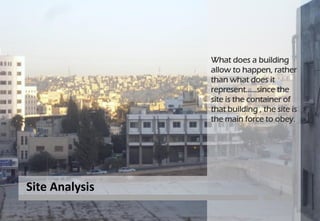
  • 20.
    Jordanian House ofArt Jordanian House of Art is a small museum which includes rural room, music room, Amman Gallery , the first TV and Radio broadcasting room, handicrafts and modern art room. This museum was established in 2002 and it has some updates but not so much as it takes time to add any thing to this small museum. Most people come and visit this museum from tourists and community, group or, if applicable, individuals concerned Students and the local community. Rooting of social values and cultural heritage among the youth This programme is needed to fill in the generation gap to allow the involvement of the youth in the cultural heritage events. Employing certain techniques such as educational courses in order to promote rooting of social values and cultural heritage among the youth. There is a mutual and active cooperation in conducting cultural activities with interested bodies especially in the local community of Zarqa governorate. Community, group or individuals concerned: The members forming the general assembly of the society and the local community of Zarqa governorate. 20
  • 21.
    Dr. Mahesh Prasadbelieves that “Education is not the filling of a pail but the lighting of fire” Education is the foundation of life that keeps the wheels of progress and development running. Keeping this in mind, the school offers an impeccable quality Education under unique conditions. It is the mélange of a wholesome educational programmed that facilitates the student quest for knowledge, enhancing the quality of life and preparing them for the real world. These are the distinctive hallmarks of a Heritance Why is school ?? The schools focused tremendous energy on moving away from didactic classrooms to a more dialogic and participative pedagogy. Inter-disciplinary themes. A learning community where each is free to be and grow towards the realisation of his/her highest human potential through a harmonious integration of spirit, heart, mind and body. SPIRIT HEART MIND BODY Education 21
  • 22.
    We will committo practice and foster a state of attentiveness to all our thoughts and actions. Attentiveness involves giving ourselves completely to the present moment and silencing our insecurities, fears and unwanted thoughts. Attentiveness is the first step towards selfless love and compassion. Attentiveness The Heritage community will always respect what one is and can become. We will Endeavour to instill respect for the work we do, the people we engage with, the things we use, and the environment we live in. Above all, we will foster and strengthen a sense of respect for oneself. Respect We will do the utmost to nurture a culture and habit of excellence and actively encourage high standards of character, behavior and action. We will equally discourage mediocrity, carelessness and negligence in thought, word and action. Excellence The school will encourage and enable in thought, word and deed, authenticity of being and transparency, and by implication discourage all acts of hypocrisy, pretension and double standards Authenticity Education 22
  • 23.
    What is definitionCommunity school Community schools focus on the whole child by providing resources to support academics( intangible cultural ) Health and social services . At the same time . Youth and community development occur community school is a public school that acts as the hub of its community by engaging community resources to offer a range of on-site programs and services that support the success of students and their families. Community school serves the child and extends its boundaries into community order to accelerate academic achievement its shares responsibility for student family and community success. Main components of community school Support services to meet social , emotional and physical well being of students. Innovative teaching and learning practice . School as the heart of the community 23
  • 24.
    to design aunique project , aims to provide multiple facilities , promotion and awareness of the rich tradition, educated and provide TRADITIONS society heritage is not exclusive to monuments along to design to preserve and protect CUSTOMS AND TRADITIONS . 1)To design a unique project , aims to provide multiple facilities , promotion and awareness of the rich tradition 2)Educated and provide TRADITIONS society 3)Heritage is not exclusive to monuments along to design Intangible Heritage School Education 24
  • 25.
  • 26.
  • 27.
    Behavior Dance Music Generosity MoralityHorsemanship Religious customs Hospitality Art craft Local production Food Clay Modeling Medical lore Jewelry Arabic calligraphy Mosaic traditional customs Oral tradition Oratory Poetry Wisdom Proverbs Stories Puzzle RITUALNARRATIVE ART CRAFT BEHVIOR ORAL TRADTITIONS -Jewelry -Arabic calligraphy -Food -Medical lore -Local production Weaving , Clay Modeling Recycling , mosaics -traditional customs -Social values Hospitality, Altruism Morality, Generosity - Social morals -Music Dance -Children’s Games -Horse man ship Qur'an , Ramadan Religious customs -Oratory -Poetry -Wisdoms -Proverbs -Stories - Puzzle game Project Language 27
  • 28.
    LearningOpen space Lab Studios Classroom Workshop ServicesOther clinic retail Restaurant Commodity gallery Bazar Performing Theater Main hall PerformingLearning Commodity service poetry * * Oratory * Wisdoms * * Stories * Puzzle game * * Proverbs * * Food * * Local productions * * * Jewelry * * Arabic calligraphy * Medical lore * * * Traditional customs * * Social values * * Social morals * * Music Dance * * Children’s Games * * Horse man ships * Qur'an , Ramadan * Religious custom * Project Language 28
  • 29.
  • 30.
    ‫استبيان‬"‫األصيلة‬ ‫والتقاليد‬ ‫العادات‬‫لتعليم‬ ‫مدرسة‬" ‫علي‬ ‫ترعرع‬ ‫التي‬ ‫االصيلة‬ ‫والعادات‬ ‫التقاليد‬ ‫وضياع‬ ‫االجتماعية‬ ‫الحياة‬ ‫اساليب‬ ‫في‬ ‫تغيرا‬ ‫نلمس‬ ‫السريع‬ ‫التكنولوجي‬ ‫والتطور‬ ‫التقدم‬ ‫زمن‬ ‫في‬‫ها‬‫أجدادنا‬.. ‫نحن‬ ‫من‬: ‫المجتمع‬ ‫أبناء‬ ‫سلوكيات‬ ‫في‬ ‫الحاصل‬ ‫التغيير‬ ‫عشنا‬ ‫ما‬ ‫بعد‬ ‫افكارنا‬ ‫جمعنا‬ ‫الوطن‬ ‫هذا‬ ‫أبناء‬ ‫من‬ ‫شباب‬ ‫نحن‬..‫والتقاليد‬ ‫العادات‬ ‫إحياء‬ ‫إلى‬ ‫نسعى‬ ‫لذلك‬ ‫العصر‬ ‫هذا‬ ‫في‬ ‫المجتمع‬ ‫أفراد‬ ‫عقول‬ ‫محاكاة‬ ‫هدفها‬ ‫مدرسة‬ ‫خالل‬ ‫من‬ ‫األصيلة‬..‫األصيلة‬ ‫القيم‬ ‫لترسيخ‬. ‫س‬1)‫العمر‬ 10_20 20_40 40_60 ‫س‬2)‫الجنس‬ ‫أنثى‬ ‫ذكر‬ ‫س‬3)‫األصيلة؟‬ ‫وتقاليدهم‬ ‫بعاداتهم‬ ‫بتمسكهم‬ ‫المحلي‬ ‫للمجتمع‬ ‫تقييمك‬ ‫هو‬ ‫ما‬ ‫ضعيف‬ ‫متوسط‬ ‫ممتاز‬ ‫س‬4)‫المشروع؟‬ ‫هذا‬ ‫لمثل‬ ‫بحاجة‬ ‫التي‬ ‫األعمار‬ 10_20 20_40 ‫األعمار‬ ‫كل‬ ‫س‬5)‫؟‬ ‫أكثر‬ ‫بمشاهدتها‬ ‫تستمتع‬ ‫التالية‬ ‫المسرحية‬ ‫العروض‬ ‫أي‬ ‫الحكواتي‬ ‫الشعبي‬ ‫الرقص‬"‫الدبكة‬" ‫الموسيقية‬ ‫العروض‬ ‫س‬6)‫؟‬ ‫الشعبية‬ ‫المسرحية‬ ‫العروض‬ ‫هذه‬ ‫مع‬ ‫تفاعلك‬ ‫مدى‬ ‫ما‬ ‫ضعيف‬ ‫متوسط‬ ‫ممتاز‬ ‫س‬7)‫؟‬ ‫السريعة‬ ‫الوجبات‬ ‫على‬ ‫الشعبي‬ ‫األكل‬ ‫تفضل‬ ‫هل‬ ‫نعم‬ ‫ال‬ ‫س‬8)‫؟‬ ‫اآلتية‬ ‫من‬ ‫تتعلم‬ ‫أن‬ ‫تحب‬ ‫ماذا‬ ‫الخيل‬ ‫ركوب‬ ‫الرماية‬ Cultural studies….Questions 30
  • 31.
    ‫س‬9)‫اليه؟‬ ‫واللجوء‬ ‫الشعبي‬‫بالطب‬ ‫اقتناعك‬ ‫مدى‬ ‫ما‬ ‫ضعيف‬ ‫متوسط‬ ‫ممتاز‬ ‫س‬10)‫؟‬ ‫الشعبية‬ ‫والحكم‬ ‫باألمثال‬ ‫معرفتك‬ ‫مدى‬ ‫ما‬ ‫ضعيف‬ ‫متوسط‬ ‫ممتاز‬ ‫س‬11)‫؟‬ ‫والحكم‬ ‫األمثال‬ ‫هذه‬ ‫لمعرفة‬ ‫بحاجة‬ ‫األردني‬ ‫المجتمع‬ ‫هل‬ ‫نعم‬ ‫ال‬ ‫س‬12)‫؟‬ ‫القديمة‬ ‫الشعبية‬ ‫األلعاب‬ ‫ممارسة‬ ‫على‬ ‫أبنائك‬ ‫تشجيع‬ ‫نسبة‬ ‫هي‬ ‫ما‬ ‫ضعيف‬ ‫متوسط‬ ‫ممتاز‬ ‫س‬13)‫؟‬ ‫التراث‬ ‫من‬ ‫تتعلم‬ ‫أن‬ ‫تحب‬ ‫ماذا‬ ‫الشعبية‬ ‫والحكم‬ ‫األمثال‬ ‫واألغاني‬ ‫الزجل‬ ‫الدبكة‬ ‫س‬14)‫حياتك؟‬ ‫أمور‬ ‫في‬ ‫والتقاليد‬ ‫بالعادات‬ ‫متمسك‬ ‫أنت‬ ‫هل‬ ‫نعم‬ ‫ال‬ ‫س‬15)‫؟‬ ‫التربية‬ ‫على‬ ‫والتقاليد‬ ‫للعادات‬ ‫أثر‬ ‫هناك‬ ‫هل‬ ‫نعم‬ ‫ال‬ ‫س‬16)‫؟‬ ‫االجتماعية‬ ‫الحياة‬ ‫على‬ ‫والتقاليد‬ ‫للعادات‬ ‫أثر‬ ‫هناك‬ ‫هل‬ ‫نعم‬ ‫ال‬ ‫س‬17)‫األصيلة‬ ‫والتقاليد‬ ‫العادات‬ ‫تعلم‬ ‫مدرسة‬ ‫إنشاء‬ ‫من‬ ‫موقفك‬ ‫هو‬ ‫ما‬‫؟‬ …………………………………………………………….. ‫س‬18)‫المدرسة‬ ‫هذه‬ ‫في‬ ‫تعليمه‬ ‫تقترح‬ ‫الذي‬ ‫ما‬‫؟‬ ……..…………………………………………………….. ‫س‬19)‫المدرسة‬ ‫هذه‬ ‫شكل‬ ‫تتخيل‬ ‫كيف‬‫؟‬ ……..……………………………………………………… Cultural studies….Questions 31
  • 32.
    17% 69% 14% ‫العمر‬ 10_20 20-40 40-60 34% 66% ‫الجنس‬ ‫ذكر‬ ‫أنثى‬ 5% 68% 27% ‫بتمسكه‬ ‫المحلي‬ ‫للمجتمع‬‫تقيمك‬ ‫هو‬ ‫ما‬ ‫بعاداتهم‬‫؟‬ ‫االصيلة‬ ‫وتقاليدهم‬ ‫ممتاز‬ ‫متوسط‬ ‫ضعيف‬ 27% 11%62% ‫بحاجة‬ ‫التي‬ ‫االعمار‬‫لمثل‬ ‫؟‬ ‫المشروع‬ ‫هذا‬ 20-Oct 20-40 ‫األعمار‬ ‫كل‬ 29% 51% 20% ‫هذه‬ ‫مع‬ ‫تفاعلك‬ ‫مدى‬ ‫ما‬‫العروض‬ ‫المسرحية‬‫؟‬ ‫الشعبية‬ ‫ممتاز‬ ‫متوسط‬ ‫ضعيف‬ 67% 33% ‫؟‬ ‫السريعة‬ ‫الوجبات‬ ‫على‬ ‫الشعبي‬ ‫األكل‬ ‫تفضل‬ ‫هل‬ ‫نعم‬ ‫ال‬ 66% 34% ‫؟‬ ‫اآلتيه‬ ‫من‬ ‫تتعلم‬ ‫أن‬ ‫تحب‬ ‫ماذا‬ ‫الخيل‬ ‫ركوب‬ ‫الرماية‬ Cultural studies….Statistics 32
  • 33.
    29% 52% 19% ‫العربي‬ ‫بالطب‬ ‫اقنتاعك‬‫مدى‬ ‫ما‬ ‫واللجوء‬‫اليه؟‬ ‫ممتاز‬ ‫متوسط‬ ‫ضعيف‬ 12% 54% 34% ‫باالمثال‬ ‫معرفتك‬ ‫مدى‬ ‫ما‬ ‫والحكم‬‫؟‬ ‫الشعبية‬ ‫ممتاز‬ ‫متوسط‬ ‫ضعيف‬ 85% 15% ‫الى‬ ‫بحاجة‬ ‫االردني‬ ‫المجتع‬ ‫هل‬‫معرفة‬ ‫؟‬ ‫والحكم‬ ‫االمثال‬ ‫هذه‬ ‫نعم‬ ‫ال‬ 25% 47% 28% ‫على‬ ‫ابناءك‬ ‫تشجيع‬ ‫نسبة‬ ‫هي‬ ‫ما‬ ‫ممارسة‬‫؟‬ ‫القديمة‬ ‫الشعبية‬ ‫االلعاب‬ ‫ممتاز‬ ‫متوسط‬ ‫ضعيف‬ 44% 19% 37% ‫؟‬ ‫التراث‬ ‫من‬ ‫تتعلم‬ ‫ان‬ ‫تحب‬ ‫ماذا‬ ‫والحكم‬ ‫األمثال‬ ‫الشعبية‬ ‫واألغاني‬ ‫الزجل‬ ‫الدبكة‬ 95% 5% ‫والتقاليد‬ ‫بالعادات‬ ‫متمسك‬ ‫أنت‬ ‫هل‬ ‫؟‬ ‫حياتك‬ ‫أمور‬ ‫في‬ ‫نعم‬ ‫ال‬ 97% 3% ‫والتقاليد‬ ‫للعادات‬ ‫أثر‬ ‫هناك‬ ‫هل‬ ‫؟‬ ‫التربية‬ ‫على‬ ‫نعم‬ ‫ال‬ 96% 4% ‫على‬ ‫والتقاليد‬ ‫للعادات‬ ‫أثر‬ ‫هناك‬ ‫هل‬ ‫االجتماعية؟‬ ‫الحياة‬ ‫نعم‬ ‫ال‬ Cultural studies….Statistics 33
  • 34.
    What does abuilding allow to happen, rather than what does it represent……since the site is the container of that building , the site is the main force to obey. Site Analysis 34
  • 35.
    Chapter tow: siteanalysis 1. SELETION THE SITE 1.1- SITE CRITERIA 1.2- WHY AL- ABDALI 1.3- LOCATION OF SITE IN AL-ABDALI 1.4-HISTORICAL BACKGROUND 2. STUDYING MACRO SCALE 2.1SITE APPROACH 2.2- MAIN STREET 2.3- LAND USE 2.4- SOLID AND VOID 2.5- LAND MARKS 2.5.1- AL- ABDALI PROJECT 2.6- FACILITIES 2.6.1 FACILITIES 3.6- DENSITY OF RESIDENTIAL CLUSTERS 3.7- SKY LINE 3.8- BUILDING TYPOLOGY 3.9- VIEW 3. STUDYING MICRO SCALE 3.1- THE SITE 3.2- SECTIONS 3.3- ENVIRONMENTAL CONDITIONS 3.4- STREET 3.5- NOISE 4. CULTURAL STUDIES THE SITE 4.1-AL-ABDALI POPULATION 5. SITE CONCLUSIONS 35
  • 36.
    The following criteriawere considered while determining our project`s site . According the site was choose  Accessibility  Visual quality  Social value  Mental value  Political core  Neutral social core  In the core of the city  Demographic trend Site selection Located in the central of Amman city making it accessible by large group of people Located in economic area which is going through development stage Great opportunity for social and heritage development and awareness Land mark in the context and social value Why Al- Abdali The Earliest Urban Sprawl Began Form The Center Of Amman Including Al-abdali As A Part Of It . However , There Is A Future Development For Al-abdali Region So It Can Contain Both The Historical Image Of Amman Also The Future Image . In Addition It`s Located In The Center Of Amman So It`s Easy To Be Reached By Different Type Of People . Adding To That Al-abdali Is The Biggest Heritage Core In Amman , As The Project Has A Tradition Aim So It Help Us To Be In He Heart Of The Event. Site criteria 36
  • 37.
    Location of sitein Al-Abdali In the Jordanian capital Amman the site is located JORDAN AMMAN The site is located on one of the zones of the most developing area in Amman, this zone is called Al abdali Capital: Amman Total area : 97.740 Highest point: Jabal ram 1,734 m Water :329 km2 Density : 69 per km2 Coast line: 26km2 Lowest point : dead sea – 408 m JORDAN Al Shmeisani Al madeneh Jabal al hussein Al Luweibdeh AL ABDALI Abdali region has a special geographical importance, and its considered the center of Amman capital. Organizational boundaries for al Abdali EAST : NORTH : WEST : SOUTH : Tareq and Jubaiha region . Basman and al madeneh region . Tlal al ali, khalda andum al summaq region . zahran region . 37
  • 38.
    Location MACRO The site islocated on one of the zones of the most developing area in Amman, this zone is called Al Abdali 38
  • 39.
    INTRODUCTION 1870 Amman has beentoo inclusive , its population had by many waves of displacements and migration starting with the Circassia's immigrates from the Caucasus as early as 1870’s 1903 Urban merchants from Syria , Lebanon and palatine especially after the establishment of the Hejaz railroad line which reached Amman In 1903 1948 A massive wave of Palestinians refugees after the occupation in 1948 and later on in 1967. 1976 Migration of Lebanese bourgeoisie after the break of Lebanese civil war in 1967 1990 Palestinian and Jordanian return from gulf after the 1990/1991 gulf crises in addition to the most recent wave of Iraqis who flock to Amman and to other Jordanian cities. Historical Background 39
  • 40.
    MACRO Site Approach • AldaklehCircle • Fires Circle • 7th Circle • Queen Noor • Ashraf Hussein • Suleiman Al- Nabulse • Umayyad bent abed shames • King Hussein • Jamal al-Deen Alghani • Al-Urdon street • Khalid Bin al- Waled Al-Abdali region has been always a transient point between Downtown area and Al-Luwaibdeh and Al-Hussain cliffs. 40
  • 41.
    Main street (30m) Mainstreet (15m) Main street (10m) Main Street MACRO 41
  • 42.
    MACRO Topography Section A-A Al-Abdali islocated between two mountainous regions. As the slope of Al- Luwaibdeh mountain is relatively small , Al-Abdali seems to be a natural extension for Al- Luwaibdeh. 42
  • 43.
    MACRO Land Use Housing Cis covering around 68.41% of the selected site area ; most of these areas are occupied by residential buildings 43
  • 44.
    MACRO Solid AndVoid Solid Void Al.Abdali project The region is crowded and full of a combination of residential and commercial buildings. This leads to a traffic congestion. 44
  • 45.
  • 46.
    To be developedon 384,000 sq.m of land, the project will consist of a total built-up area (BUA) of over 1.7 million sq. consisting of residential apartments, office space, hotels, services apartments and commercial and retail outlets as well as entertainment. Abdali will be the premium central business and residential district of Amman. Abdali is being developed as a smart city center converging media and telecom infrastructure to enable the delivery of state-of-the-art technologies to each and every home, office and outlet, while offering district energy solutions and central gas systems to guarantee a safe and friendly environment in addition to the large savings in energy cost. Al- Abdali Project Site plan Al- Abdali Project General view Al- Abdali Project MACRO 46
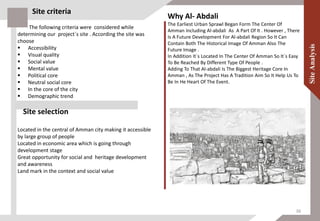
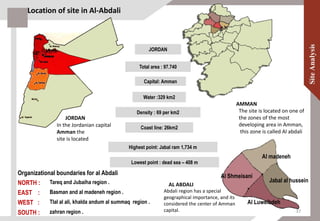
  • 47.
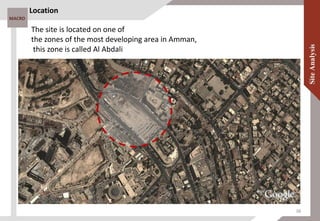
  • 48.
    MACRO Facilities ABDULLAH I MOSQUE TheKing Abdullah I Mosque in Amman, Jordan was built between 1982 and 1989. It is capped by a magnificent blue mosaic dome beneath which 3,000 Muslims may offer prayer. COLLEGE DE LA SALLE College De La Salle - Frères is a private school in Amman, Jordan. Established in 1950, and it is part of the Institute of the Brothers of the Christian Schools, also known as Lasallian Brothers, established by Saint John Baptist de La Salle who lived in the 17th century and was canonized as a saint on May 15, 1900. In 1950, Pope Pius XII declared him to be the Special Patron of All Teachers of Youth in the Catholic Church. The Institute now conducts educational work in 80 different countries including La Sallian schools and universities in Asia, Europe, North America, South America and Oceania. It is considered as the biggest school in the world as it has more than 148 branches all over the globe. It is considered as one of the most prestigious schools in the Kingdom and the region, and one of the biggest in Jordan; occupying an area of more than 30000 square meters. PARLIAMENT OF JORDAN The Parliament of Jordan is the bicameral Jordanian national assembly: "Majlis al-Umma". Established by the 1952 Constitution, the legislature consists of two houses: the House of Senate ("Majlis al-Aayan") and the House of Representatives ("Majlis al-Nuwab"). The House of Senate has 60 members, all of whom are directly appointed by the King, while the House of Representatives has 150 elected members, with nine seats reserved for Christians, three are for Circassian and Chechen minorities, and fifteen for women.[2] The Constitution ensures that the Senate cannot be more than half the size of the House of Representatives. The members of both houses serve for four-year terms.[3] 48
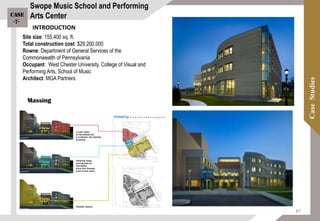
  • 49.
    Setbacks (m) Building percenta ge Height (m) Floor s Area (m2) Front elevation (m) Frontback side 0 4 After deep 70% 16 4 400 15 MICRO Normal Commercial within Housing C The site Site dimension and legal Regulations AREA 17497 m 2 49
  • 50.
  • 51.
    MICRO Climatic data N EW S 23.5 - Thesite average temperature is 18.5’ - Which is considered within a normal climate regions. Environmental conditions Sunshine and radiation 51
  • 52.
    MICRO Environmental conditions MJ/m²dayhours/day Maximum hoursReal hours Radiation °C Extreme max Mean max Mean The site average wind is 60 m/s Which is considered within a normal climate regions. 30-35 degree Celsius. -Winter average temperature: 12-18 degree Celsius. mm/month% Maximum Average Minimum Summer average temperature: wind 52
  • 53.
  • 54.
    MICRO Negative noise :Is thesound of cars & transportation ways. Positive sound: Is the sound which give us a comfortable feeling & oriented our Project. Negative noise Positive sound Noise 54
  • 55.
    MICRO Density ofresidential clusters High density residential clusters Low density residential clusters 55
  • 56.
  • 57.
  • 58.
    Building Typology a clusterof functions in a form of cubical masses that are linked by series of pedestrian accesses of stairs and road. new roads were introduced to urban fabric to enhance the street network. History Of Typology dominant typology Amman is a relatively young city and does not possess a strong architectural tradition, or a definitive past stylistic momentum. Amman architectural style jabal Amman, abdali and aluwaibdah are comprised of tradition “central hall” type from the early 20th century and modern architecture belonging to the 1920’s. Commercial modern style The proposed facades of Abdali project the use of new architectural materials and the linear façade style, avoiding the use of traditional arches for openings Commercial vernacular style The use of local materials and the use of the traditional arches for openings. The void percentage is minimal. The use of local materials and the use of the traditional arches for openings. The void percentage is minimal. Residential vernacular style 58
  • 59.
  • 60.
  • 61.
    MICRO Al-Abdali Population 31% ofthe population are under the age of 30. Population: 12874 Religion: Islam and Christian Families: 3070 Origin: North-west of Jordan Buildings count: 1551 Residences: 4627 Female %Male %FemaleMaleTotalYear 50.9%49%65546320128742009 51% 49% Gender female male Employed: 3670 Unemployed: 584 85% 15% employed unemployed Employment employed unemployed Work 61
  • 62.
    Site conclusions Minimal OpiningTo The North To Reduce Heat Losing Winter Glass To East With Keep Overhanging And Wall To North To Protect From Rising Summer Sun And Permit Penetration Of Low Winter Sun N Permit Summer Wind Through The Building 62
  • 63.
    Site conclusions Use LandscapingAnd Standing Wall In South To Protect Winter Wind . And Use Deciduous Trees To Protect From The Summer Sun And Permit The Winter Sun To Enters Inside The Building . Use A Landscaping And Land Forms As Buffer ENTRANCE FOR PEDESTRIAN N 63
  • 64.
    Site conclusions External AreasPlaced Here To Be Close To The Surrounding Buildings To Attract The Users Of Traditional Area . NThe building heights varies creating a well yet clear skyline The Surrounding Building Typology Varies Yet Works Well Together And Close To Each Other In Design 64
  • 65.
  • 66.
  • 67.
    Case Studies “It hasbeen said that something as small as the flutter of a butterfly's wing can ultimately cause a typhoon halfway around the world “- Chaos Theory 67
  • 68.
    Case Studies: 1- TheHeritage School/ Newan 2- The Heritage School/ INDIAN 3 -Tent Margelh ( ‫خيمة‬‫المرجلة‬ ) 4- Umm El- Fahem Museum For Contemporary 5- Atrisco Heritage Academy 6- Culture And Art Center 7- Swope Music School And Performing Arts Center 8- South Korea's National Intangible Cultural Heritage 9- Community Center /Chain IDEA CONCEPTUAL FUNCTIONAL PROGRAM FORMAL 68
  • 69.
  • 70.
  • 71.
    Tent margelh (‫خيمة‬‫المرجلة‬ ) location : Riyadh, Saudi Arabia- Shifa School goal : the tent is to deliver a message to students and those who are in the age that ( ‫علوم‬‫المرجلة‬) list of constants and that they must understand from an early age . Users : available to all students, and is hosted semester day attending only to learn in the tent all that benefit them in the future , and stressed that they as well as the education of students residing contest them, and chapter that shows interactive great and learn faster with the customs and traditions be a winner Teaching : Science Margelh that the student is in the tent way receive visitors with open arms and the way of peace and keeping Dalla poured coffee and semi - fire and prepare breakfast …ect ‫الضيف‬ ‫استقبال‬ ‫السالم‬ ‫طريقة‬ ‫مسك‬‫الدلة‬ ‫القهوة‬ ‫صب‬ ‫النار‬ ‫شب‬ Receive visitors The way fire Coffee ,Della INTRODUCTION Case -3 71
  • 72.
    Umm el-Fahem Museumfor contemporary INTRODUCTION I. CONTEXTUAL ANALYSIS today, in the third millennium, amid the daily reality and worries about war and economic hardship, a museum of contemporary art will be built, and will thus form an island of tranquility, exhibiting the richness of arab culture in Palestine CONCEPTUAL ANALYSIS the open and rich space, the use of terraces and vegetation, the flow of the layout, the structural steel details, the plaster, the reference to the surrounding view and the relation to the hills; all are represented in the project and are a derivative of arab buildings and creative work, taking 21st century building technology and capabilities into account. All are represented in the project and are a derivative of Arab building and creative work , taking twenty- first century building technology and capabilities into account the open and rich space Use of terraces and vegetation Flow of layout Reference to the surrounding view The structural steel details Use plaster Location : umm el-fahem Case -4- 72
  • 73.
    the proposed projectaims and acts architecturally to place education as its goal. education is the key to cultural and artistic growth, economic prosperity, and peace. therefore, and in contrast with the norm for museum the world over, we chose to emphasize education as the central wing of the museum. the entrance from the parking lot is to the educational building which incorporates an element of a modern “mashrabyia”, vegetation, and architectural elements that accentuate the view of umm el-fahem and wadi arab. as part of the concept of the museum as an educator, the project was planned as an open space, stimulating curiosity, and inviting exploration of all its wings. the museum opens up to the town and it is possible to get the feel of it also on the path from the square to the wadi. the walk around the museum, and the educational and cultural activities that will take place in the square, will be an invitation to the public to enter and to the experience the joy of the arts from up close Umm el- Fahem Museum for contemporaryCase -4- 73
  • 74.
    FORMAL ANALYSIS museum constructiondevelopment internal courtyard outer paths inner paths green places functional analysis the plans for the building of the museum offer it as a symbol, radiating openness to the different and the new, so that it will form a proper stage for arab-israeli culture and art, that, while maintaining strong links to the past, looks confidently and optimistically into the future. Umm el- Fahem Museum for contemporary Case -4- 74
  • 75.
    PLANS SECTION Umm el-Fahem Museumfor contemporary Case -4- 75
  • 76.
    SUSTAINABLE ANALYSIS site, locationand linkages, materials and resources. in the reality of the ecological crisis that threatens the world, the museum building is a flagship of innovation, utilizing ecological building principles and adapting to the climate. much thought has been given to this while planning. in choosing materials & construction installation techniques. Um al Faham museum will consider local material sourcing & aim to minimize transportation. building materials without a high thermal insulation value, such as stone and concrete, were used in unconventional ways by assimilating heat insulating materials into them to optimize the climactic conditions. INDOOR ENVIRONMENTAL QUALITY the internal courtyards form an important layer during the stay of the visitor at the museum. the use of an internal garden is an integral part of buildings in the middle east, and is therefore applied to the project. the internal courtyards allow light and airflow into the galleries, enabling the visitor to rest in them and enjoy the fresh air. through the courtyards it is possible to see the next space in the all through the museum and enjoy a feeling of spaciousness. the internal courtyards will form pocket gardens where sundry art works will be exhibited Umm el- Fahem Museum for contemporary Case -4- 76
  • 77.
    ENERGY AND ATMOSPHERE theuse of vegetation to form micro climates, a microclimate is a local atmospheric zone where the climate differs from the surrounding area. a microclimate can offer an opportunity as a small growing region for crops that cannot thrive in the broader area. microclimates can also refer to purpose made environments, such as those in a room or other enclosure. microclimates are commonly created and carefully maintained in museum display and storage environments. this can be done using passive methods, such as silica gel, or with active microclimate control devices. WATER EFFICIENCY rainwater collection systems can provide adequate water supply for small households and reduce demand on regional water supplies. though sizable costs are associated with large systems, when incorporated into building structures or developments at a large scale some costs may be avoided. Umm el- Fahem Museum for contemporary SUSTAINABLE ANALYSIS Case -4- 77
  • 78.
    Culture and ArtCenter Architect: perkins will , fbt architects Location: albuquerque, new mexico project team: eric brossy de dios, angela kunz, ann knudsen, charlene martin, kevin mereness, ashley stoner, nathan wilcox Executive Architects: fanning bard tatum architects aia, ltd. Project Year: 2008 Photographs: new york focus photography One Hundred People Planning Team High School Students + + Define Goals And Expectations Of The Users And Community At Large This project is viewed to be and will serve to be the catalyst to the development of the “southwest region” of Albuquerque and truly serve as this community’s “center”. Sustainable Design Workshops Site Planning Charente Conceptual Planning Charities District Facilities Maintenance and Operations Program workshops WITH Community Environment Learning Environment Physical Environment Planning process PERKINS WILL AND FBT ARCHITECTS • The Atrisco Heritage Academy Features A Set Of autonomous school buildings, unified by a common pedestrian plaza. • high school campus strives to safeguard the community’s paste, with an eye toward the future in a rapidly changing environment. • the campus architecture and interiors boast colors and murals that represent the unique cultural heritage of the community with a modern appeal. • the campus consists of career academies organized into three distinct buildings. • each academy has planning and activity space internally and externally to promote hands on work Case -5- INTRODUCTION 78
  • 79.
    Community Environment PAST •We knowand embrace our culture and history, what we have been PRESENT •we are striving to understand what we are today FUTURE •most importantly shape what our community will become constructing places for learning will motivate each student to embrace the process of learning for life. Students are encouraged to explore educational and professional career models within the academies and through partnerships with businesses and higher education campuses in the area. he design team embraced the challenge by connecting the school with the PAST, within the context of its PRESENT, with an unwavering commitment to students’ FUTURE. • Organic forms reflect the natural landscape. • building into the site rather than on top of it. • An incision into the site creates exterior spaces for student interaction. • framed by academic buildings. Interior Courtyard View Entry Courtyard Rendering ATRISCO HERITAGE ACADEMYCase -5- 79
  • 80.
    Guidance Curriculum: Interpret cognitive aptitude achievementtests Assist with college career exploration Individual Planning: Design individual student academic programs Analyze grade-point averages in relationship to achievement Provide information to assist in understanding educational goals and barriers ATRISCO HERITAGE ACADEMYCase -5- 80
  • 81.
    class room science lab cafe Herein the Family Center we provide support and empower our parents to be involved in their student’s education. Our mission is to ensure that parents know and support their children by understanding the next steps to successfully transition from middle school to high school and on to college. We work side by side with parents providing them with the resources they need to help them in the areas that they need help the most. For example; clothing bank, food bank, utility recourses, counseling referral, tutoring referral,, etc. Family Center Responsive Services: Counsel students in overcoming discipline and attendance problems Provide students with individual and group support System Support: Assist faculty with identifying and resolving student issues, needs, and problems Link students and families to school and community resources Provide appropriate interventions in situations important to the physical, mental, educational, and emotional well being of the student. collaborative space techno lab SMALLER LEARNING COMMUNITIES Library ATRISCO HERITAGE ACADEMYCase -5- 81
  • 82.
    Culture and ArtCenter Architects: tongji architectural design and research institute location: kunming, china design team: wang wensheng, damian donze, sidney gong site area: 17,540m2 total area: 42,005m2 far: 1.97 footprint: 38.05% size: green area 9,214m2; above ground 34, 500m2; underground 7,505m2; 1st floor 7,200m2; 2nd floor 5,700m2; 3rd floor 6,000m2; 4th floor 6,300m2; 5th floor 6,500m2; 6th floor 3,200m2 total height: 36m floors: 6 + underground car parking: 169 year: 2013 photographs: courtesy of tongji architectural design and research institute Main Challenge For The Design Of The Southwest International Ethnic Culture And Art Center : Integrate The Local Cultures Plus Various Functional Programs Into One Contemporary Yet Harmonious Form. Designed By Team Members Wang Wensheng, Damian Donze And Main goals : Increase The Protection Of The National Cultural Heritage. To Strengthen The Cultural Relics. To Take Full Advantage Of The Rich Cultural Resources Of Yunnan Province.And To Deepen Cultural Exchange And Cooperation With Southeast Asia. INTRODUCTION Case -6- 82
  • 83.
    First, the differentlocal cultural identities with their traditional dresses, dances and songs. Second, the Hani rice terraces together with the local subtropical plant diversity. These New Buildings Build With New Construction Methods And New Materials Can’t Successfully Portray The Original. Hence, We Decided To Refrain From That Method In Order To Take On A More Abstract Path Which Is More Fitting To Today’s Situation. Facade Implement The Local Cultures In An Abstract Way. Alternating Perforated And Non-perforated Metal Panels That Cover And Protect The Building. Sunlight Enter And Lets People See Outside. At Each Entrance. The Facade Opens Up, Much Like A Theater Curtain, And Creates The Entrance Situations. The facade acts like a dress for the building, and in its own way, takes reference from the local minorities. Even more so at night when the LEDs of the facade create a colorful play, almost as if the building was dancing it’s own dance. Preliminary Analysis Concept &Principle Design Culture and Art CenterCase -6- 83
  • 84.
    TRAFIC DIAGRAM Exhibition Center: Eachfloor has different types of exhibition spaces for topics such as heritage, culture, art and photography. The top two floors, are occupied by a cinema complex which contains a 100 seat cinema, a 70 seat cinema and four 56 seat cinemas. Art Academy: The lower floors contain an art school/education center while the top three floors contain volunteer offices and accommodation for the aforementioned school. Theater: Located in this segment are: 1. medium-sized theater with 700 seats, suitable for dramas, dances, symphonies and other multi-functional activities 2. small theater with 300 seats, suitable for theatrical performances and film viewings; a convention center 3. amphitheater on the roof with 1000 seats. To be able to cope with the large flow of people at the beginning and at the end of a performance. Art Studios: This segment contains A.V. labs as well as art studios Culture and Art CenterCase -6- 84
  • 85.
    1ST FLOOR 2NDFLOORGR. FLOOR 3RD FLOOR 4TH FLOOR 6TH FLOOR5TH FLOOR ROOF FLOOR Culture and Art Center PLANS Case -6- 85
  • 86.
    CIRCULATION DIAGRAM SECTION WITHCIRCULATION Theater Four elevators were strategically located at two main entrances while additional support was created with the escalators in the center. Exhibition Center This segment is accessible through two panorama elevators as well as the central escalators that are located between the exhibition segment and the theater segment Art Studios It is accessible through its own Culture and Art CenterCase -6- 86
  • 87.
    Swope Music Schooland Performing Arts Center Site size: 155,400 sq. ft. Total construction cost: $29,200,000 Rowne: Department of General Services of the Commonwealth of Pennsylvania Occupant: West Chester University, College of Visual and Performing Arts, School of Music Architect: MGA Partners Massing Case -7- INTRODUCTION 87
  • 88.
    Zoning Program: The 90,000-square-footbuilding includes the university’s music school, music library, student practice rooms, faculty and administration offices, a 375-seat performance hall, a 125-seat recital hall, and an art gallery. Circulation Path Swope Music School and Performing Arts CenterCase -7- 88
  • 89.
    Design concept andsolution: While MGA Partners integrated the university’s music school and performing arts center into a single structure that shares an entrance and courtyard, the exteriors of the different programmatic spaces feature varied facade treatments. Swope Music School and Performing Arts Center Lighting Warm green stucco selected for the school of music’s sinuous wall matches turn-of-the-century campus buildings clad in serpentine stone. The performance hall is clad in brick; the entrance courtyard in cast concrete. Case -7- 89
  • 90.
    South Korea's NationalIntangible Cultural Heritage Location Donseohak-dong, Wansan-gu, Jeonju-si, Jeollabuk-do Area Land area 59,930㎡, building area 13,519㎡, total area 29,615 ㎡ Major uses Complex cultural and gathering facilities Building size 5 floors above the ground and 1 floor underground Expanding the utilization of intangible cultural heritages in terms of preservation and inheritance Reinforcing the networks at home and abroad and stabilizing the center as a global role model Expanding the capacity of preservation through the archive management system of intangible cultural heritage To realize the creativity, cultural diversity, and right to cultural enjoyment by expanding the creative inheritance of intangible cultural heritages and developing the bond of sympathy toward this orientation preservation and utilization of intangible cultural heritages Supporting the transmission and exchange activities among experts at home and abroad Developing the visibility and the bond of sympathy through activation projects GOALS MISSIN Case -8- 90
  • 91.
  • 92.
  • 93.
  • 94.
    PROJECT: Community Center SIZE:4.500 m2 LOCATION: Shanghai, China nation of municipality and community center essentially breaks with recent Chinese conventions by inviting the public to engage their local politicians in a forum that accommodates the full range of public actors Community CenterCase -9- INTRODUCTION 94
  • 95.
    Access points definedThe square becomes the center of activity and access to the programs Landscape left for continued program Sunken public square Program placement Green hills The cloud sits on the green hills Design methodology Natural patterns of movement were laid out on the site and guided down through a sunken plaza accommodating a range of different programs. The rest of the program extents as a manipulated ring hovering above the landscape. Community CenterCase -9- 95
  • 96.
    Cloud access Alternativeaccess Opening to the roof West wing program South wing program North wing program Cloud programs Design methodology Community CenterCase -9- 96
  • 97.
    Program….. Behavior is amirror in which every one displays his own image 97
  • 98.
    Pragmatic Analysis Zone AREA ACADEMICZONE CRAFT SECTION 1740 BEHAVIOR SECTION 610 ORAL SECTION 1200 Multi purpose hall 290 Community kitchen 240 4080 COMMUNITY ZONE EXHIBITION 550 THEATER 500 1100 Administration 240 reception 159 Service 860 Parking 1000 Total area 7389 Reception Academic Community Service Parking Administration 4 % 3 % 39 % 23 % 14 % 17 % Out door 98
  • 99.
    Architectural Analysis Heritage SchoolIs An Institution Academic For Dissemination Of Knowledge Of Natural Or Cultural Heritage ……… Element Academic Community Service Administration 99
  • 100.
    Craft Section Type OfUsers : Student Number Of User: 20/Class Handmade craft store w.c Workshop store workshop workshop Lobby Function No. of users No. of room M2r oom Area m2 Made in Jordan - 1 300 300 Made in Jordan - 1 200 200 Workshop( ‫)الخشب‬ - 1 100 100 Workshop (‫)الفسيفساء‬ - 1 100 100 Workshop (‫)النسيج‬ - 1 100 100 Class room - 6 30 180 Staff room - 2 20 40 Clinic - 13 50 50 W . C - 3 45 140 Circulation 500 Total 1740 100
  • 101.
    Function No. of users No.of room M2ro om Area m2 Dabkeh studios - 3 50 150 Music studios - 3 50 150 Library - 1 40 40 Performance hall - 1 100 100 Restroom and showers - 2 45 90 Circulation 100 Total 610 Behavior Section Type Of Users : Student Number Of User: 20/Class Digitallab Class room Class room Dabkeh studios music studios Restroomand showers Dabkeh studios music studios 101
  • 102.
    Function No. ofusers No. of room M2room Area m2 class room ( ‫التقليدية‬ ‫)العمارة‬ - 2 30 60 class room (‫)التاريخ‬ - 2 30 60 class room (‫االمثال‬) - 1 30 30 Class room (‫العربية‬ ‫)اللغه‬ - 1 30 30 Class room ( ‫بها‬ ‫الناطقين‬ ‫لغير‬ ‫العربية‬ ‫)اللغه‬ - 1 30 30 Class room ( ‫)الشعر‬ - 2 30 60 Class room ( ‫العربي‬ ‫)الخط‬ - 1 60 60 Class room (‫العربي‬ ‫)االدب‬ - 2 30 60 Performance room ( ‫)الخطابة‬ - 2 80 160 Performance room ( ‫)مناظرات‬ - 1 80 80 Library (‫)ارشفه‬ - 1 60 60 Digital lab - 1 60 60 Staff room - 2 30 60 W. C - 2 30 60 Mini bar - 1 30 30 Circulation 150 Total 1200 ORAL Tradition Type Of Users : Student Number Of User: 20/Class 102
  • 103.
    Printing room Lobby Library (oral knowledge ) Classroom Class room Staffroom W .c Class room Class room Class room‫مناظرات‬ Diagram 103
  • 104.
    lounge Multi purpose hall workshop WC Multipurpose Hall Function No. of users No. of room M2roo m Area m2 Multi purpose hall ( ‫قهوه‬ ‫)فنجان‬ - 1 200 200 W .C - 1 40 40 Circulation 50 Total 290 Multi Purpose Hall Type Of Users : Visitor Number Of User: 100 Function No. of users No. of room M2r oom Area m2 Exhibition - 1 200 300 Shop - 4 40 160 W .c - 1 40 40 Circulation 50 Total 550 Exhibition & antic shop Type Of Users : Visitor Number Of User: 100 104
  • 105.
    entrance Seating area Control storage Stage backstage Private. Function No.of users No. of room M2room Area m2 Reception - 1 30 30 Stage area - 1 65 65 Seating area - 1 300 300 Back stage - 1 40 40 Control room - 1 15 15 Storage - 1 50 50 Total 500 Theatre Type Of Users : Student , Community Number Of Users : 200 Seat Description : The Theatre Used For :Lectures , Plays And Graduation Day 105
  • 106.
    Function No. ofusers No. of room M2room Area m2 Cooking area - 1 100 100 Dinning area - 1 80 80 Staff room - 1 20 20 Storage - 1 40 40 Total 240 Community Kitchen A group of people who meet regularly to cook tradition food and take it home to feed their families . Every member contributes by planning . Preparing many reasons for joining a community Kitchen and many benefits to membership When people get together to cook the are able to save many and produce more food than they could by working individually Cooking area storage staff Dinning hall entrance 106
  • 107.
    Administration…. Type Of Users: Student And Academic Function No. of users No. of room M2room Area m2 Reception desk 2 1 15 15 Director office 1 1 23 23 General secretary 1 2 13 26 Private restroom 1 2 4 8 Administrator office 1 1 24 24 Meeting room 12 2 20 40 Office for managers - 3 24 72 Office leasing - 2 16 32 Archive and reprography - 1 20 20 Kitchenette 2 1 8 8 Staff room 1 2 7 14 total 282 Office Cooking area Meeting Room reception Leasing managing offices Program managing offices Administration office Private restroom Director office Archive and reprography kitchenette Staff restroom 107
  • 108.
    Function No. of users No.of room M2roo m Area m2 Reception hall - 1 150 150 Office - 2 8 16 Information desk - 1 9 9 Main security - 2 10 20 Total - 159 Reception Function No. of users No. of room M2roo m Area m2 Mechanical - 1 75 75 Electrical room - 2 50 50 Storage - 1 100 100 Kitchen - 1 50 50 Loading area - 320 320 Main security - 1 20 Staff room - 1 20 20 LockersRest room - 1 32 32 Toilets - 1 6 24 Clinic - 1 100 100 Lobby - 50 50 Total 861 Service Zone 108
  • 109.
    School Room and areafor general Music and art Standard 109
  • 110.
    Floor area foran individual workstation Minimum distance between tables Minimum space for reading area When book are moved between users Reading workstation Seminar Room Standard 110
  • 111.
  • 112.
    To show workof art and object of cultural the institution should provide protection against damage theft damp aridity sunlight and dust and also show the works in the best light . The store with sliding steel mesh frames on which objects can be hung as desired Exhibition room with folding screens allow great variety of room arrangement It is necessary to allow 3-5 m hanging surface per picture 6-10m ground surface per sculpture Exhibition Cafeteria 112
  • 113.
  • 114.
  • 115.
    Case StudiesConceptual ‘’Heritage represents humankind’slegacy from the past, an irreplaceable source of life and inspiration for present and future generations’’ 115
  • 116.
    CHAPTER FIVE :CONCEPT 1. Scenario 2. DESIGN PRECEPT 3. CONCEPT 4. CONCLUSION 5. SCHMATIC DESIGN 1.1- Function 1.2- Users 1.3- Goals 4.1- ZONING 4.2- LAYERING 116
  • 117.
  • 118.
    student Courses Visitor 12 3 6 9 Workshop.School training teacher house wife Constant Register Community users scenario The center use different means of communication to enhance the understanding of heritage which is social architecture in our case .So to aid and stimulate the discovery and training process for both the users local and visitors center will portray different strategies to be user friendly interaction and exhibition of the traditional heritage of Jordan along with portraying the example of how to use vernacular and intangible heritage into our modern days Project scenario users 118
  • 119.
  • 120.
    Circulation Stairs are animportant element that definitively characterizes the down-town in old Levant cities . A snakes and ladders like profusion of staircases connects the neighborhoods and most of the time leads to a privet home , crossing backyards and passing front doors , but these are public paths . The project preserved the stairs in the site and as a main vertical circulation elements to retain the spirit of the old city Design precept Experience Craft center the auditorium ,galleries folklore cooking and dancing workshops , are all functions in the folk life center that helps enhancing the experience of the visitors and provide them with a 100% real image of the folklore and show them beauty of the Jordan civilization Architecture The use of mashrabyia , courtyards and other traditional architectural elements is a way to revive the atmosphere and stimulate the spirit of the authentic Jordan not only spiritually but also physically In the heritage folk-life center the traditional elements are used in a modern way in order to get “the best of both worlds” 120
  • 121.
  • 122.
  • 123.
  • 124.
  • 125.
  • 126.
  • 127.
  • 128.
  • 129.
  • 130.
  • 131.
    Chapter sex :Sustainability Research 1. INTRODUCTION 3. MATERIAL FLOW IN THE BUILDING ECOSYSTEM 2. PRINCIPLES OF SUSTAINABLE DESIGN 4. SUSTAINABLE DESIGN METHODS 131
  • 132.
    Sustainability Research Introduction Sustainable designis a design philosophy the seeks to maximize the quality of the built environment . While minimizing or eliminating negative impact to the natural environment . There are three principle of sustainability in architecture : -Economy of resources is concerned with the reduction .reuse , and recycling of natural resources that are input to a building. -Life cycle design provides a methodology for analyzing the building process its impact on the environment . - Humane design focuses on the interaction between principles can provide broad awareness of the environmental impact both local and global of architectural consumption . Principles of sustainable design 132
  • 133.
    Economy of resources Life cycle design Humane design Energyconservation Water Material Pre-building phase Building Post-building Urban design site planning Design for human comfort Preservation of natural condition METHODS STRATEGIES Principles Of Sustainable Design 133
  • 134.
    Life cycle design Usematerials that are…. -made of renew-able resources -harvested or extracted with- out ecological damage -recycled -recyclable -long last and low maintenance Minimize energy needed to distribute materials. METHODS Schedule construction to minimize site impact. -Provide waste separation facilities. -Use nontoxic materials to protect construction workers as well as end users. -Specify regular maintenance with nontoxic cleaners. -Adapt existing structures to new users and programs. -Reuse building components and materials. -Recycle building components and materials. -Reuse the land and existing infrastructure Building Post-buildingPre-building phase Principles Of Sustainable Design 134
  • 135.
    Human design -Understand theimpact of design on nature -Respect topographical contours -Do not disturb the water table -Preserve existing flora and fauna METHODS -Avoid pollution contribution -Promote mixed –use development -Create pedestrian pockets -Provide for Human –powered transportation . -Integrate design with public transportation . -Provide thermal visual and acoustic comfort . -Provide visual connection to exterior. -Provide operable windows . -Provide clean fresh air. -Accommodate persons with differing physical abilities. -Use non-toxic non-outgassing materials. Urban Design site planning Design for Human ComfortPreservation of Nat`l Conditions Principles Of Sustainable Design 135
  • 136.
    Principles Of SustainableDesign Economy of resources -Energy –conscious urban planning -Energy- conscious site planning -Alternative sources of energy -Passive heating and cooling -Avoidance heat gain or heat loss -Use of low embodied –energy materials -Use of energy efficient appliance with timing devices METHODS Reduction : - Indigenous landscape - Low – flow showerhead -Vacuum-assist toilets or smaller toilet tanks Reuse Rainwater collection Gray water collection -Material conserving design and construction design and contraction - Proper sizing of building system -Use of reclaimed or recycled materials and components - use of nonconventional building materials Water conservation Material conservingEnergy conservation 136
  • 137.
    Principles Of SustainableDesign sustainable design is often used as an umbrella term to describe a set of strategies. components and technologies lower environment impact while in many cases improving com fort and overall quality. these categories include but are not limited: • day lighting • indoor air quality • passive solar heating • energy efficiency • embodied energy • construction waste minimization • water conservation • commissioning • solid waste management • renewable energy • site preservation • Xeriscaping /natural landscape 137
  • 138.
    Material flow inthe building ecosystem Building Materials Energy Water Consumet Goods Solar Radiation Wind Rain Used Materials Combustion Byproducts Gray water sewage Recycleable Materials Wasted Head Polluted Air Ground water Upstream DownstreamBuilding 138
  • 139.
    Takhtabush System TheMalqaf Courtyard System Offset Corridor System Thermal Solar System The Photovoltaic System Green Roof System Sustainable Design Methods 139
  • 140.
  • 141.
    141 Don't Judge abook by it's cover 141