Supervision /
Prof. Khalil Nasher
Assoc. Prof. Saif Al-Qubati
Eng. Ashraf Abbasi
Eng. Amna Al-Azani
Programming an
archaeological
cultural center
project
Student Work /
Ahmed Al , Namo's
Thesis graduation project to obtain a
bachelor's degree in architecture
engineering
For the year (2022-2023)
Gifting Acknowledgements
The Messenger of Allah, peace be upon him, said,"
Whoever does not thank people does not thank him"
Thanks in the beginning to God Almighty who helped me
to complete this work which I hope from God to win
your admiration and benefit to all
Words of thanks may not be enough for those who
sacrificed their time and comfort and with all the
precious so that this lofty edifice continues to give
He gave everything he could carry the trust so he was
worthy of it No matter how much we talk our words
about loyalty and thanks will be abandoned I ask God to
bless him with health and wellness and long life
I extend my thanks and appreciation to everyone who
took my hand to what benefits me and to everyone who
taught me honestly
I extend my thanks and appreciation to everyone who
helped me in completing this research
Supervision /Prof. Khalil Nasher
Prof. Saif Al-Qubati
Eng. Ashraf Abbasi
Eng. Amna Al-Azani
To those who are unmatched in the
universe, to those whose righteousness
God has commanded us, to those who
have done so much and given what
cannot be returned, to you these precious
words my mother and father, I dedicate
this research to you, as you have been my
best supporter throughout my academic
career.
To all the friends of the roads, rough and
easy, dark and bright, I dedicate this
research as I offer this dedication as an
expression of my gratitude for their
presence in my life.
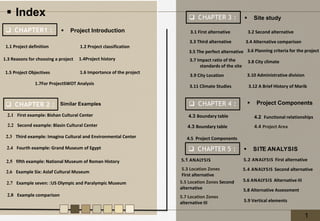
1.1 Project definition
1.3 Reasons for choosing a project
1.5 Project Objectives
1.2 Project classification
1.6 Importance of the project
1.7For ProjectSWOT Analysis
1.4Project history
▪ Project Introduction
❑ CHAPTER :
1
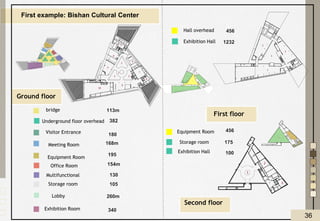
2.1 First example: Bishan Cultural Center
2.2 Second example: Blasin Cultural Center
2.3 Third example: Imagina Cultural and Environmental Center
2.4 Fourth example: Grand Museum of Egypt
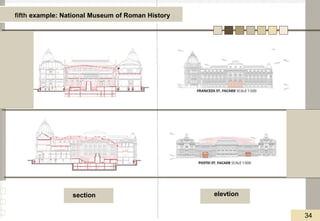
2.5 fifth example: National Museum of Roman History
2.7 Example seven: :US Olympic and Paralympic Museum
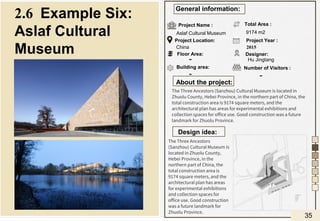
2.6 Example Six: Aslaf Cultural Museum
Similar Examples
❑ CHAPTER 2 :
3.1 First alternative 3.2 Second alternative
3.3 Third alternative 3.4 Alternative comparison
3.5 The perfect alternative 3.6 Planning criteria for the project
3.7 Impact ratio of the
standards of the site
3.8 City climate
3.9 City Location 3.10 Administrative division
3.11 Climate Studies 3.12 A Brief History of Marib
▪ Site study
❑ CHAPTER 3 :
▪ Project Components
❑ CHAPTER 4 :
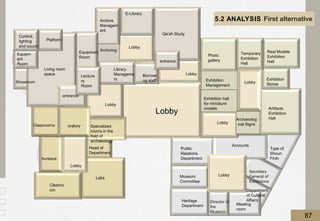
5.2 ANALYSIS First alternative
4.3 Boundary table 4.4 Project Area
4.2 Functional relationships
4.5 Project Components
❑ CHAPTER 5 : ▪ SITE ANALYSIS
5.1 ANALYSIS
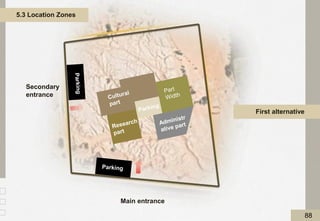
5.3 Location Zones
First alternative
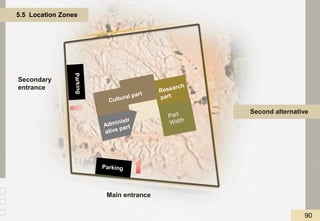
5.5 Location Zones Second
alternative
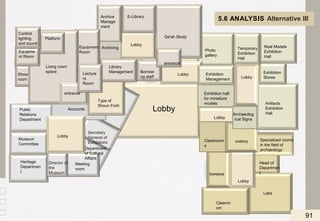
5.6 ANALYSIS Alternative III
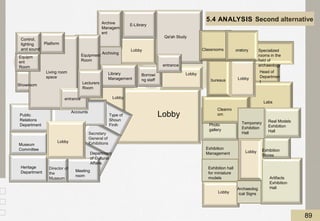
5.4 ANALYSIS Second alternative
4.3 Boundary table
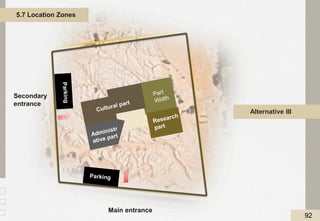
5.7 Location Zones
alternative III
5.8 Alternative Assessment
5.9 Vertical elements
▪ Index
2.8 Example comparison
1
2
Part One: Project
Introduction
1.1 Project definition
1.3 Reasons for
choosing a project
1.5Project Objectives
1.2 Project classification
1.6 Importance of the
project
For ProjectSWOT 1.7
Analysis
1.4Project history
CHAPTER1
❑ Introduction:
• It is a project that aims to revive, restore and use
historical and cultural monuments within the
framework of a modern cultural center. This project
involves the preservation of archaeological sites
and historic buildings and the restoration of some
measure of the original condition of those
monuments
• The Archaeological Cultural Center is seen as a
cultural gathering point where visitors can enjoy
historical exhibits, attend cultural and artistic
events, and learn more about local and
international history and heritage.
• Archaeological Cultural Center Project:
3
• The project is a multifunctional cultural center, providing
a space for art shows, art exhibitions and educational
content related to history and ancient civilizations. The
cultural center is also used for cultural and artistic
conferences, seminars and workshops.
• In addition, the project aims to encourage cultural
tourism and promote interest in cultural heritage.
Through the use of modern and interactive technology,
the Archaeological Cultural Center allows visitors to
immerse themselves in a unique educational and
entertainment experience.
• Overall, the Archaeological Cultural Center project aims to
preserve, document and present cultural heritage to the
public in an innovative and exciting way. The project
contributes to enhancing cultural and heritage
awareness, deepening mutual understanding between
cultures and cultural enrichment derived from the
integration of cultural assets in one place.
1.1
Reason for choosing the project:
1. Rich culture and history: Yemen has a rich cultural history spanning
thousands of years. By establishing an archaeological museum, you
can contribute to the preservation of Yemen's cultural heritage and
make it available to local audiences and international visitors.
2. Conservation of archaeological holdings: Yemen's cultural heritage
is threatened by multiple factors, such as wars and conflicts. By
establishing an archaeological museum, you can contribute to the
protection and preservation of precious objects for future
generations.
3. Education and awareness: The Antiquities Museum can be a center
for education and awareness about Yemeni cultural heritage and
history. Educational tours and demonstrations can be organized for
visitors to promote awareness and deep understanding of Yemeni
heritage.
4. Tourism Development: The Archaeological Museum can contribute
to the promotion of cultural tourism in Yemen, contributing to job
opportunities and economic development of the local community.
5. Investing in the future: The establishment of an archaeological
museum in Yemen is an opportunity to invest in the future and
promote cultural and tourism development in the country. By
participating in this project, you can contribute to the promotion of
national identity and promote interest in culture and history.
There are several categories under which an
archaeological cultural center project can fall, such
as:
Tourism and Recreation:
Projects operating in the tourism and
entertainment sector, including
Cultural monuments that display archaeological
monuments, to fall into this category.
Culture and Arts:
Projects of culture and arts centers aimed at
preserving heritage can be classified
Cultural and promotion of culture and the arts,
including archaeological cultural projects, in this
category.
Cultural Heritage and Trade:
In this category, projects aimed at heritage
preservation can be categorized.
cultural and its promotion, such as projects of
archaeological cultural centers and others.
Project classification
according to IBC:
4
1.3
1.2
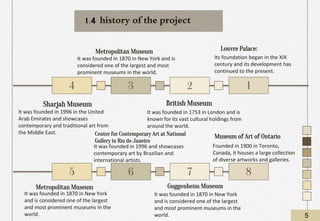
Louvre Palace:
Its foundation began in the XIX
century and its development has
continued to the present.
Sharjah Museum
It was founded in 1996 in the United
Arab Emirates and showcases
contemporary and traditional art from
the Middle East.
Metropolitan Museum
It was founded in 1870 in New York and is
considered one of the largest and most
prominent museums in the world.
British Museum
It was founded in 1753 in London and is
known for its vast cultural holdings from
around the world.
4 2
3 1
5 7
6 8
Metropolitan Museum
It was founded in 1870 in New York
and is considered one of the largest
and most prominent museums in the
world.
Center for Contemporary Art at National
Gallery in Rio de Janeiro
It was founded in 1996 and showcases
contemporary art by Brazilian and
international artists.
Guggenheim Museum
It was founded in 1870 in New York
and is considered one of the largest
and most prominent museums in the
world.
Museum of Art of Ontario
Founded in 1900 in Toronto,
Canada, it houses a large collection
of diverse artworks and galleries.
history of the project
5
1.4
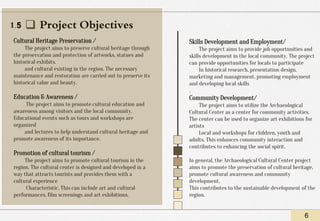
❑ Project Objectives
Cultural Heritage Preservation /
The project aims to preserve cultural heritage through
the preservation and protection of artworks, statues and
historical exhibits.
and cultural existing in the region. The necessary
maintenance and restoration are carried out to preserve its
historical value and beauty.
Education & Awareness /
The project aims to promote cultural education and
awareness among visitors and the local community.
Educational events such as tours and workshops are
organized
and lectures to help understand cultural heritage and
promote awareness of its importance.
Promotion of cultural tourism /
The project aims to promote cultural tourism in the
region. The cultural center is designed and developed in a
way that attracts tourists and provides them with a
cultural experience
Characteristic. This can include art and cultural
performances, film screenings and art exhibitions.
6
Skills Development and Employment/
The project aims to provide job opportunities and
skills development in the local community. The project
can provide opportunities for locals to participate
In historical research, presentation design,
marketing and management, promoting employment
and developing local skills
.
Community Development/
The project aims to utilize the Archaeological
Cultural Center as a center for community activities.
The center can be used to organize art exhibitions for
artists
Local and workshops for children, youth and
adults. This enhances community interaction and
contributes to enhancing the social spirit.
In general, the Archaeological Cultural Center project
aims to promote the preservation of cultural heritage,
promote cultural awareness and community
development.
This contributes to the sustainable development of the
region.
1.5
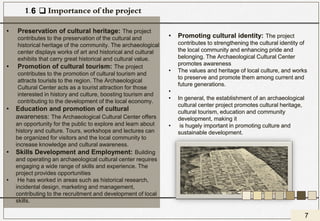
❑ Importance of the project
• Preservation of cultural heritage: The project
contributes to the preservation of the cultural and
historical heritage of the community. The archaeological
center displays works of art and historical and cultural
exhibits that carry great historical and cultural value.
• Promotion of cultural tourism: The project
contributes to the promotion of cultural tourism and
attracts tourists to the region. The Archaeological
Cultural Center acts as a tourist attraction for those
interested in history and culture, boosting tourism and
contributing to the development of the local economy.
• Education and promotion of cultural
awareness: The Archaeological Cultural Center offers
an opportunity for the public to explore and learn about
history and culture. Tours, workshops and lectures can
be organized for visitors and the local community to
increase knowledge and cultural awareness.
• Skills Development and Employment: Building
and operating an archaeological cultural center requires
engaging a wide range of skills and experience. The
project provides opportunities
• He has worked in areas such as historical research,
incidental design, marketing and management,
contributing to the recruitment and development of local
skills.
• Promoting cultural identity: The project
contributes to strengthening the cultural identity of
the local community and enhancing pride and
belonging. The Archaeological Cultural Center
promotes awareness
• The values and heritage of local culture, and works
to preserve and promote them among current and
future generations.
•
• In general, the establishment of an archaeological
cultural center project promotes cultural heritage,
cultural tourism, education and community
development, making it
• is hugely important in promoting culture and
sustainable development.
1.6
7
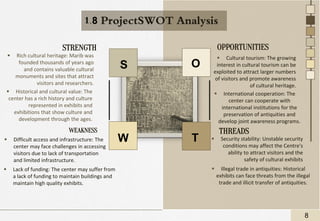
▪ Rich cultural heritage: Marib was
founded thousands of years ago
and contains valuable cultural
monuments and sites that attract
visitors and researchers.
STRENGTH
S
W T
O
▪ Historical and cultural value: The
center has a rich history and culture
represented in exhibits and
exhibitions that show culture and
development through the ages.
WEAKNESS
▪ Difficult access and infrastructure: The
center may face challenges in accessing
visitors due to lack of transportation
and limited infrastructure.
▪ Lack of funding: The center may suffer from
a lack of funding to maintain buildings and
maintain high quality exhibits.
OPPORTUNITIES
THREADS
▪ Security stability: Unstable security
conditions may affect the Centre's
ability to attract visitors and the
safety of cultural exhibits
▪ Illegal trade in antiquities: Historical
exhibits can face threats from the illegal
trade and illicit transfer of antiquities.
▪ Cultural tourism: The growing
interest in cultural tourism can be
exploited to attract larger numbers
of visitors and promote awareness
of cultural heritage.
▪ International cooperation: The
center can cooperate with
international institutions for the
preservation of antiquities and
develop joint awareness programs.
ProjectSWOT Analysis
1.8
8
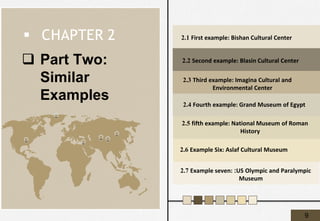
❑ Part Two:
Similar
Examples
2.1 First example: Bishan Cultural Center
2.2 Second example: Blasin Cultural Center
▪ CHAPTER 2
2.3 Third example: Imagina Cultural and
Environmental Center
2.4 Fourth example: Grand Museum of Egypt
2.5 fifth example: National Museum of Roman
History
2.7 Example seven: :US Olympic and Paralympic
Museum
2.6 Example Six: Aslaf Cultural Museum
9
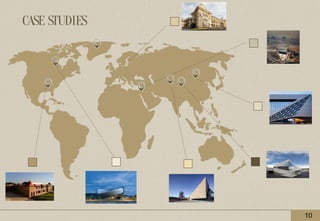
CASE STUDIES
10
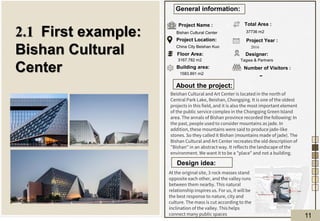
About the project:
Design idea:
General information:
Project Name :
Project Location:
Floor Area:
Building area:
Total Area :
Designer:
Project Year :
Number of Visitors :
Bishan Cultural Center
China City Beishan Kuo
1583.891 m2
37736 m2
Tagwa & Partners
2016
-
3167.782 m2
2.1 First example:
Bishan Cultural
Center
Beishan Cultural and Art Center is located in the north of
Central Park Lake, Beishan, Chongqing. It is one of the oldest
projects in this field, and it is also the most important element
of the public service complex in the Chongqing Green Island
area. The annals of Bishan province recorded the following: In
the past, people used to consider mountains as jade. In
addition, these mountains were said to produce jade-like
stones. So they called it Bishan (mountains made of jade). The
Bishan Cultural and Art Center recreates the old description of
"Bishan" in an abstract way. It reflects the landscape of the
environment. We want it to be a "place" and not a building.
At the original site, 3 rock masses stand
opposite each other, and the valley runs
between them nearby. This natural
relationship inspires us. For us, it will be
the best response to nature, city and
culture. The mass is cut according to the
inclination of the valley. This helps
connect many public spaces 11
‫ذ‬
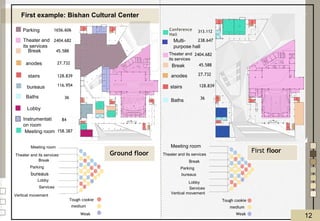
Tough cookie
Parking
Theater and
its services
Break
bureaus
Meeting room
Instrumentati
on room
Lobby
Baths
stairs
anodes
medium
Weak
Break
Conference
Hall
Baths
stairs
anodes
Theater and
its services
Multi-
purpose hall
1656.606
2404.682
45.588
27.732
128.839
116.954
36
158.387
84
313.112
128.839
27.732
45.588
2404.682
238.647
36
Theater and its services
Break
Parking
bureaus
Lobby
Vertical movement
Services
Meeting room
Ground floor First floor
Tough cookie
medium
Weak
Theater and its services
Break
Parking
bureaus
Lobby
Vertical movement
Services
Meeting room
First example: Bishan Cultural Center
12
‫ذ‬
Break
Conference
Hall
Baths
stairs
anodes
Theater and
its services
Multi-
purpose hall
313.112
128.839
27.732
45.588
2404.682
238.647
36
Third floor
Tough cookie
medium
Weak
Theater and its services
Break
Parking
bureaus
Lobby
Vertical movement
Services
Meeting room
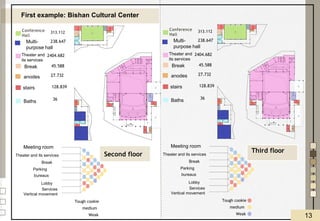
First example: Bishan Cultural Center
Break
Conference
Hall
Baths
stairs
anodes
Theater and
its services
Multi-
purpose hall
313.112
128.839
27.732
45.588
2404.682
238.647
36
Second floor
Tough cookie
medium
Weak
Theater and its services
Break
Parking
bureaus
Lobby
Vertical movement
Services
Meeting room
13
section elevtion
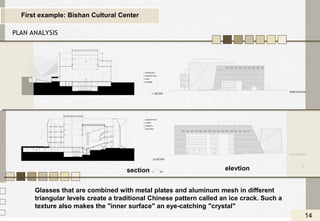
Glasses that are combined with metal plates and aluminum mesh in different
triangular levels create a traditional Chinese pattern called an ice crack. Such a
texture also makes the "inner surface" an eye-catching "crystal"
PLAN ANALYSIS
First example: Bishan Cultural Center
14
About the project:
Design idea:
General information:
Project Name :
Project Location:
Floor Area:
Building area:
Total Area :
Designer:
Project Year :
Number of Visitors :
Blasin Cultural Center
China Xingyong City
1572.285 m2
6356.11 m2
Li tao
2016
-
3106.782 m2
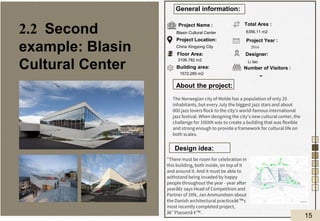
The Norwegian city of Molde has a population of only 25
inhabitants, but every July the biggest jazz stars and about
000 jazz lovers flock to the city's world-famous international
jazz festival. When designing the city's new cultural center, the
challenge for 100XN was to create a building that was flexible
and strong enough to provide a framework for cultural life on
both scales.
2.2 Second
example: Blasin
Cultural Center
"There must be room for celebration in
this building, both inside, on top of it
and around it. And it must be able to
withstand being invaded by happy
people throughout the year - year after
year―
, says Head of Competition and
Partner of 3XN, Jan Ammundsen about
the Danish architectural practice’s
most recently completed project,
‘Plassenâ €™.
15
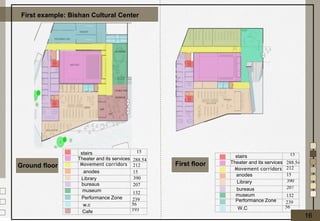
stairs
Theater and its services 288.54
w.c
anodes
Movement corridors
Library
Cafe
Performance Zone
museum
bureaus
212
15
390
207
132
239
56
193
15
stairs
Theater and its services 288.54
W.C
anodes
Movement corridors
Library
Performance Zone
museum
bureaus
212
15
390
207
132
239
56
15
Ground floor First floor
First example: Bishan Cultural Center
16
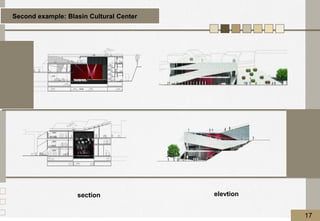
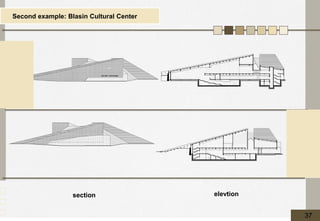
Second example: Blasin Cultural Center
section elevtion
17
About the project:
Design idea:
General information:
Project Name :
Project Location:
Floor Area:
Building area:
Total Area :
Designer:
Project Year :
Number of Visitors :
Cultural and Environmental
Center Imagina
Mexico Leon city
1583.891 m2
7397.245 m2
TIB Arquitectos
2016
-
3167.782 m2
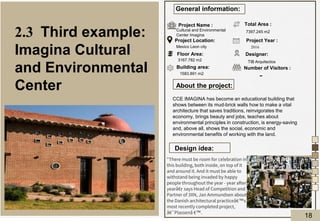
CCE IMAGINA has become an educational building that
shows between its mud-brick walls how to make a vital
architecture that saves traditions, reinvigorates the
economy, brings beauty and jobs, teaches about
environmental principles in construction, is energy-saving
and, above all, shows the social, economic and
environmental benefits of working with the land.
2.3 Third example:
Imagina Cultural
and Environmental
Center
"There must be room for celebration in
this building, both inside, on top of it
and around it. And it must be able to
withstand being invaded by happy
people throughout the year - year after
year―
, says Head of Competition and
Partner of 3XN, Jan Ammundsen about
the Danish architectural practice’s
most recently completed project,
‘Plassenâ €™.
18
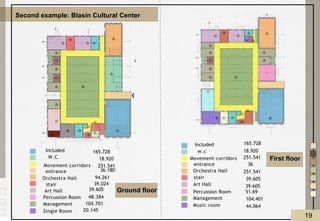
165.728
18.920
251.541
36.180
94.261
39.024
39.605
48.384
104.701
20.145
18.920
165.728
251.541
104.401
44.064
51.69
39.605
39.605
251.541
36
w.c
Included
entrance
Movement corridors
Orchestra Hall
stair
Percussion Room
Management
Music room
Art Hall
stair
Art Hall
Single Room
W.C
Included
entrance
Movement corridors
Orchestra Hall
Percussion Room
Management
Ground floor
First floor
Second example: Blasin Cultural Center
19
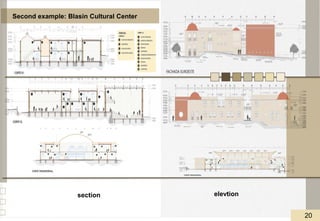
Second example: Blasin Cultural Center
section elevtion
20
About the project:
Design idea:
General information:
Project Name :
Project Location:
Floor Area:
Building area:
Total Area :
Designer:
Project Year :
Number of Visitors :
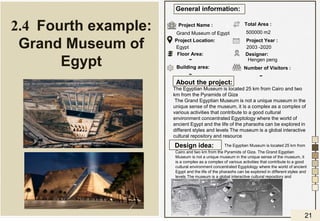
Grand Museum of Egypt
Egypt
500000 m2
Hengen peng
2003 -2020
-
The Egyptian Museum is located 25 km from Cairo and two
km from the Pyramids of Giza
The Grand Egyptian Museum is not a unique museum in the
unique sense of the museum, it is a complex as a complex of
various activities that contribute to a good cultural
environment concentrated Egyptology where the world of
ancient Egypt and the life of the pharaohs can be explored in
different styles and levels The museum is a global interactive
cultural repository and resource
2.4 Fourth example:
Grand Museum of
Egypt
Cairo and two km from the Pyramids of Giza. The Grand Egyptian
Museum is not a unique museum in the unique sense of the museum, it
is a complex as a complex of various activities that contribute to a good
cultural environment concentrated Egyptology where the world of ancient
Egypt and the life of the pharaohs can be explored in different styles and
levels The museum is a global interactive cultural repository and
resource
The Egyptian Museum is located 25 km from
-
-
21
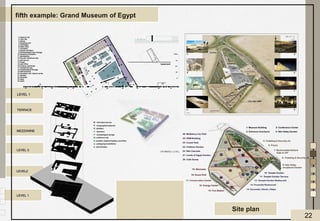
fifth example: Grand Museum of Egypt
Site plan
22
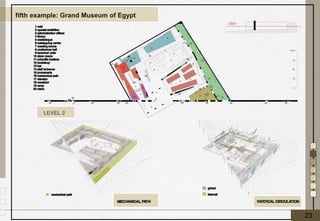
fifth example: Grand Museum of Egypt
23
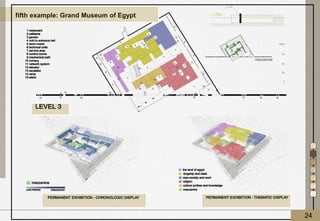
fifth example: Grand Museum of Egypt
24
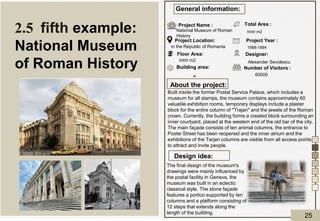
About the project:
Design idea:
General information:
Project Name :
Project Location:
Floor Area:
Building area:
Total Area :
Designer:
Project Year :
Number of Visitors :
National Museum of Roman
History
in the Republic of Romania
8000 m2
Alexander Sevolescu
1988-1894
60000
8000 m2
Built inside the former Postal Service Palace, which includes a
museum for all stamps, the museum contains approximately 60
valuable exhibition rooms, temporary displays include a plaster
block for the entire column of "Trajan" and the jewels of the Roman
crown. Currently, the building forms a created block surrounding an
inner courtyard, placed at the western end of the old bar of the city.
The main façade consists of ten animal columns, the entrance to
Postei Street has been reopened and the inner atrium and the
exhibitions of the Tarjan columns are visible from all access points
to attract and invite people.
The final design of the museum's
drawings were mainly influenced by
the postal facility in Geneva, the
museum was built in an eclectic
classical style. The stone façade
features a portico supported by ten
columns and a platform consisting of
12 steps that extends along the
length of the building.
2.5 fifth example:
National Museum
of Roman History
-
25
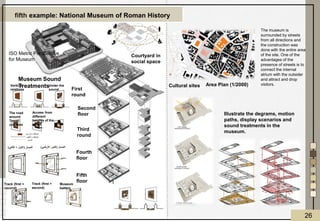
The museum is
surrounded by streets
from all directions and
the construction was
done with the entire area
of the site. One of the
advantages of the
presence of streets is to
connect the internal
atrium with the outsider
and attract and drop
visitors.
Area Plan (1/2000)
Cultural sites
Illustrate the degrams, motion
paths, display scenarios and
sound treatments in the
museum.
Courtyard in
social space
First
round
Second
floor
Third
round
Fifth
floor
Fourth
floor
Museum
battery
Track (first +
second)
Track (first +
second)
‫المسار‬
(
‫االول‬
+
‫الثاني‬
) ‫المسار‬
(
‫االرضي‬ ‫الدور‬
)
ISO Metric Perspective
for Museum
Museum Sound
TreatmentsUnder the
sound
Vertical
relations
The road
around
Togan
columns
Access from
different
heights of the
street
‫الراسيه‬ ‫العالقات‬
‫االفقيه‬ ‫العالقات‬
‫المسار‬
fifth example: National Museum of Roman History
26
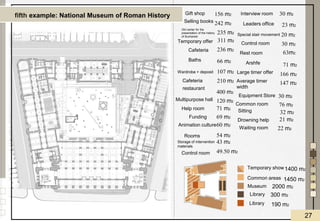
Temporary show
Common areas
Museum
Library
Library
1400 m2
1450 m2
2000 m2
300 m2
190 m2
Gift shop
Selling books
Old center for the
presentation of the history
of Bucharest
Temporary offer
Cafeteria
Baths
Wardrobe + deposit
Cafeteria
restaurant
Multipurpose hall
Help room
Funding
Animation culture
Rooms
Storage of intervention
materials
Control room
Interview room
Leaders office
Special stair movement
Control room
Rest room
Arshfe
Large timer offer
Average timer
width
Equipment Store
Common room
Sitting
Drowning help
Waiting room
156 m2
242 m2
235 m2
311 m2
236 m2
66 m2
107 m2
210 m2
400 m2
120 m2
71 m2
69 m2
60 m2
54 m2
43 m2
49.50 m2
30 m2
23 m2
20 m2
30 m2
63m2
71 m2
166 m2
147 m2
30 m2
76 m2
32 m2
21 m2
22 m2
fifth example: National Museum of Roman History
27
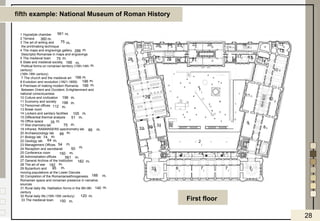
1 Hypostyle chamber
2 Terrace
3 The art of writing and
the printmaking technique
4 The maps and engravings gallery.
Descriptio Romaniae in maps and engravings
5 The medieval town
6 State and medieval society.
Political forms on romanian territory (10th-14th
century)
(16th-18th century)
7 The church and the medieval art
8 Evolution and revolution (1821-1859)
9 Premises of making modern Romania.
Between Orient and Occident. Enlightenment and
national consciousness
10 Culture and civilization
11 Economy and society
12 Personnel offices
13 Break room
14 Lockers and sanitary facilities
15 Differential thermal analysis
16 Office space
17 Wet chemistry lab
19 Infrared, RAMANSERS spectrometry lab
20 Archaeozoology lab
21 Biology lab
22 Geology lab
23 Management Offices
24 Reception and secretariat
25 Conference room
26 Administration offices
27 General Archive of the Institution
28 The art of war
29 Byzantium and
moving populations at the Lower Danube
30 Completion of the Romaniansethnogenesis.
Romanian space and romanian presence in narrative
sources
31 Rural daily life. Habitation forms in the 8th-9th
century
32 Rural daily life (10th-15th century)
33 The medieval town
30 31
32
2
7 7 7
3 4 5
1
6
8
9
10
11
10
12
13
15
16
17
20
21
22
23
24
27 25
28
26
29
33
561
360
75
286
75
166
166
196
166
196
196
112
105
51
35
75
86
88
74
64
54
50
150
561
182
182
95
188
140
120
150
m2
m2
m2
m2
m2
m2
m2
m2
m2
m2
m2
m2
m2
m2
m2
m2
m2
m2
m2
m2
m2
m2
m2
m2
m2
m2
m2
m2
m2
m2
m2
m2
First floor
fifth example: National Museum of Roman History
28
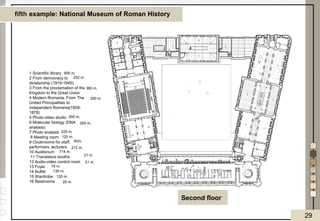
1 Scientific library
2 From democracy to
dictatorship (1919-1945)
3 From the proclamation of the
Kingdom to the Great Union
4 Modern Romania. From The
United Principalities to
independent Romania(1859-
1878)
5 Photo-video studio
6 Molecular biology (DNA
analysis)
7 Photo analysis
8 Meeting room
9 Cloakrooms for staff,
performers, lecturers
10 Auditorium
11 Translators booths
12 Audio-video control room
13 Foyer
14 Buffet
15 Wardrobe
16 Restrooms
600 m2
360 m2
202 m2
250 m2
200 m2
220 m2
120 m2
50m2
212 m2
714 m2
21 m2
21 m2
130 m2
120 m2
25 m2
75 m2
200 m2
Second floor
fifth example: National Museum of Roman History
29
22
13
3
4
2
1
5
20
18
17
6
16
12
15
14
12
11
21
10
9 8
7
20
19
18
1
1
2 3 4 5
7
8
9
9
9
10
fifth example: National Museum of Roman History
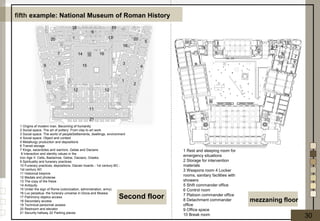
1 Rest and sleeping room for
emergency situations
2 Storage for intervention
materials
3 Weapons room 4 Locker
rooms, sanitary facilities with
showers
5 Shift commander office
6 Control room
7 Platoon commander office
8 Detachment commander
office
9 Office space
10 Break room
1 Origins of modern man. Becoming of humanity
2 Social space. The art of pottery. From clay to art work
3 Social space. The world of peopleSettlements, dwellings, environment
4 Social space. Object and context
5 Metallurgy production and depositions
6 Transit storage
7 Kings, sacerdotes and warriors. Getae and Dacians
8 Interaction and identity values in the
Iron Age II: Celts, Bastarnoe, Getoe, Dacians, Greeks
9 Spirituality and funerary practices
10 Funerary practices, depositions, Dacian hoards - 1st century BC -
1st century AD
11 Historical treqmre
12 Medals and pholerae
13 The copy of the frieze
14 Antiquity
15 Under the sign of Rome (colonization, administration, army)
16 Lux perpetua- the funerary universe in Docia and Moesia
17 Patrimony objetcs access
18 Secondary access
19 Technical personnel aceess
20 Restroom and elevator
21 Security hallway 22 Parking places
30
Second floor mezzaning floor
2
1 3 4 5 6 7
8
9 10
2
8
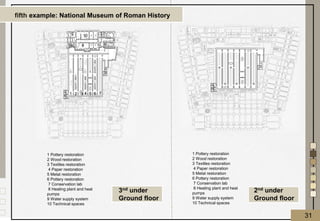
1 Pottery restoration
2 Wood restoration
3 Textiles restoration
4 Paper restoration
5 Metal restoration
6 Pottery restoration
7 Conservation lab
8 Heating plant and heat
pumps
9 Water supply system
10 Technical spaces
1 Pottery restoration
2 Wood restoration
3 Textiles restoration
4 Paper restoration
5 Metal restoration
6 Pottery restoration
7 Conservation lab
8 Heating plant and heat
pumps
9 Water supply system
10 Technical spaces
fifth example: National Museum of Roman History
31
2nd under
Ground floor
3nd under
Ground floor
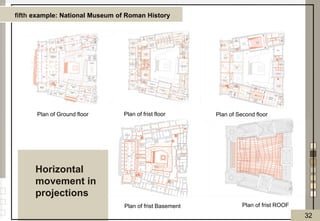
Plan of frist floor Plan of Second floor
Plan of Ground floor
Plan of frist Basement Plan of frist ROOF
Horizontal
movement in
projections
fifth example: National Museum of Roman History
32
fifth example: National Museum of Roman History
General information:
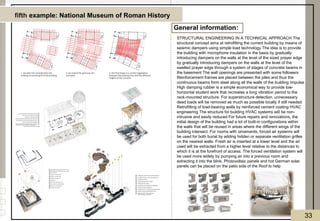
STRUCTURAL ENGINEERING IN A TECHNICAL APPROACH The
structural concept aims at retrofitting the current building by means of
seismic dampers using simple load technology The idea is to provide
the building with microphone insulation in the basis by gradually
introducing dampers on the walls at the level of the sized prayer edge
by gradually introducing dampers on the walls at the level of the
swelled prayer edge through a system of stages of concrete beams in
the basement The wall openings are presented with some followers
Reinforcement frames are placed between the piles and thus the
continuous beams form steel along all the walls of the building Impulse
High damping rubber is a simple economical way to provide low-
horizontal student work that recreates a long vibration period to the
rack-mounted structure. For superstructure detection, unnecessary
dead loads will be removed as much as possible locally if still needed
Retrofitting of load-bearing walls by reinforced cement coating HVAC
engineering The structure for building HVAC systems will be non-
intrusive and easily reduced For future repairs and renovations, the
initial design of the building had a lot of built-in configurations within
the walls that will be reused in areas where the different wings of the
building intersect. For rooms with ornaments, forced air systems will
be used for both burial by adding hidden or separate ventilation grilles
on the nearest walls. Fresh air is inserted at a lower level and the air
used will be extracted from a higher level relative to the distances to
which it is at the forefront of access. The forced ventilation system will
be used more widely by pumping air into a previous room and
extracting it into the blink. Photovoltaic panels and hot German solar
panels can be placed on the patio side of the Roof to help
33
section elevtion
fifth example: National Museum of Roman History
34
About the project:
Design idea:
General information:
Project Name :
Project Location:
Floor Area:
Building area:
Total Area :
Designer:
Project Year :
Number of Visitors :
Aslaf Cultural Museum
China
9174 m2
Hu Jingtang
2015
-
The Three Ancestors (Sanzhou) Cultural Museum is located in
Zhuolu County, Hebei Province, in the northern part of China, the
total construction area is 9174 square meters, and the
architectural plan has areas for experimental exhibitions and
collection spaces for office use. Good construction was a future
landmark for Zhuolu Province.
2.6 Example Six:
Aslaf Cultural
Museum
The Three Ancestors
(Sanzhou) Cultural Museum is
located in Zhuolu County,
Hebei Province, in the
northern part of China, the
total construction area is
9174 square meters, and the
architectural plan has areas
for experimental exhibitions
and collection spaces for
office use. Good construction
was a future landmark for
Zhuolu Province.
-
-
35
Exhibition Hall
Equipment Room
Storage room
Hall overhead
Exhibition Hall
bridge
Visitor Entrance
Meeting Room
Equipment Room
Office Room
Multifunctional
Storage room
Lobby
Exhibition Room
Underground floor overhead
Ground floor
First floor
First example: Bishan Cultural Center
Second floor
36
Second example: Blasin Cultural Center
section elevtion
37
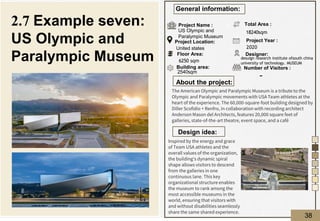
About the project:
Design idea:
General information:
Project Name :
Project Location:
Floor Area:
Building area:
Total Area :
Designer:
Project Year :
Number of Visitors :
US Olympic and
Paralympic Museum
United states
18240sqm
desuign research institute ofsouth china
university of technology. MUSEUM
2020
-
The American Olympic and Paralympic Museum is a tribute to the
Olympic and Paralympic movements with USA Team athletes at the
heart of the experience. The 60,000-square-foot building designed by
Diller Scofidio + Renfro, in collaboration with recording architect
Anderson Mason del Architects, features 20,000 square feet of
galleries, state-of-the-art theatre, event space, and a café
2.7 Example seven:
US Olympic and
Paralympic Museum
Inspired by the energy and grace
of Team USA athletes and the
overall values of the organization,
the building's dynamic spiral
shape allows visitors to descend
from the galleries in one
continuous lane. This key
organizational structure enables
the museum to rank among the
most accessible museums in the
world, ensuring that visitors with
and without disabilities seamlessly
share the same shared experience.
6250 sqm
2540sqm
38
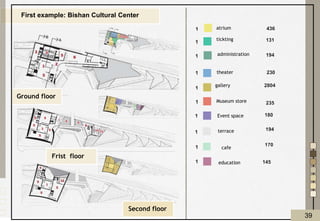
atrium
tickting
administration
theater
gallery
Museum store
Event space
terrace
cafe
education
Ground floor
First example: Bishan Cultural Center
Frist floor
Second floor
39
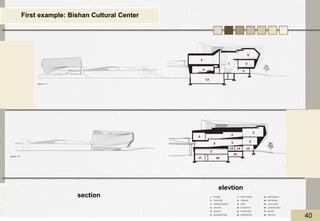
section
elevtion
First example: Bishan Cultural Center
40
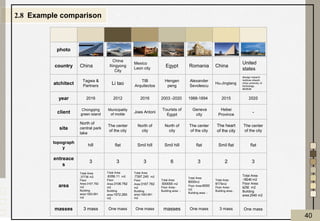
2.8 Example comparison
40
photo
country China
China
Xingyong
City
Mexico
Leon city
Egypt Romania China
United
states
atchitect
Tagwa &
Partners
Li tao
TIB
Arquitectos
Hengen
peng
Alexander
Sevolescu
Hu-Jingtang
desuign research
institute ofsouth
china university of
technology.
MUSEUM
year 2016 2012 2016 2003 -2020 1988-1894 2015 2020
client
Chongqing
green island
Municipality
of molde
Joes Antoni
Tourists of
Egypt
Geneva
city
Hebei
Province
-
site
North of
central park
lake
The center
of the city
North of
city
North of
city
The center
of the city
The heart
of the city
The center
of the city
topograph
y
hill flat Smil hill Smil hill flat Smil flat flat
entreace
s
3 3 3 6 3 2 3
area
Total Area
:37736 m2
Floor
Area:3167.782
m2
Building
area:1583.891
m2
Total Area
:6356.11 m2
Floor
Area:3106.782
m2
Building
area:1572.285
m2
Total Area
:7397.245 m2
Floor
Area:3167.782
m2
Building
area:1583.891
m2
Total Area
:500000 m2
Floor Area:-
Building area: -
Total Area
8000m2
Floor Area:8000
m2
Building area: -
Total Area
9174m2
Floor Area:-
Building area:-
Total Area
:18240 m2
Floor Area:
6250 m2
Building
area:2540 m2
masses 3 mass One mass One mass masses One mass 3 mass One mass
❑ Site study
3.1 First alternative
▪ CHAPTER 3
3.2 Second alternative
3.3 Third alternative
3.4 Alternative comparison
3.5 The perfect alternative
3.6 Planning criteria for the
project
3.7 Impact ratio of the
standards of the site:
3.8 City climate
3.9 City Location
3.10 Climate Studies
3.11 A Brief History
of Marib
41
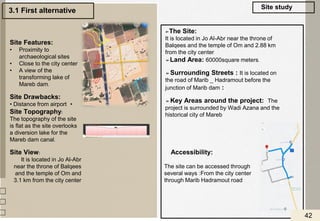
3.1 First alternative
Accessibility:
The site can be accessed through
several ways :From the city center
through Marib Hadramout road
➢The Site:
It is located in Jo Al-Abr near the throne of
Balqees and the temple of Om and 2.88 km
from the city center
➢Land Area: 60000square meters.
➢Surrounding Streets : It is located on
the road of Marib _ Hadramout before the
junction of Marib dam :
➢Key Areas around the project: The
project is surrounded by Wadi Azana and the
historical city of Mareb
Site Features:
• Proximity to
archaeological sites
• Close to the city center
• A view of the
transforming lake of
Mareb dam.
Site Drawbacks:
•
• Distance from airport
Site Topography:
The topography of the site
is flat as the site overlooks
a diversion lake for the
Mareb dam canal.
Site View:
It is located in Jo Al-Abr
near the throne of Balqees
and the temple of Om and
3.1 km from the city center
Site study
42
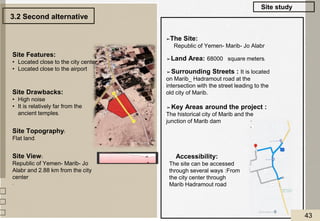
Accessibility:
The site can be accessed
through several ways :From
the city center through
Marib Hadramout road
➢The Site:
Republic of Yemen- Marib- Jo Alabr
➢Land Area: 68000 square meters.
➢Surrounding Streets : It is located
on Marib_ Hadramout road at the
intersection with the street leading to the
old city of Marib.
➢Key Areas around the project :
The historical city of Marib and the
junction of Marib dam
Site Features:
• Located close to the city center
• Located close to the airport
Site Drawbacks:
• High noise
• It is relatively far from the
ancient temples.
Site Topography:
Flat land.
Site View:
Republic of Yemen- Marib- Jo
Alabr and 2.88 km from the city
center
.
3.2 Second alternative
Site study
43
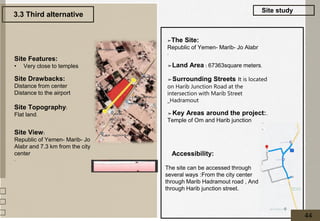
Accessibility:
The site can be accessed through
several ways :From the city center
through Marib Hadramout road , And
through Harib junction street.
➢The Site:
Republic of Yemen- Marib- Jo Alabr
.
➢Land Area : 67363square meters.
➢Surrounding Streets It is located
on Harib Junction Road at the
intersection with Marib Street
_Hadramout
➢Key Areas around the project:.
Temple of Om and Harib junction
Site Features:
• Very close to temples
Site Drawbacks:
Distance from center
Distance to the airport
Site Topography:
Flat land.
Site View:
Republic of Yemen- Marib- Jo
Alabr and 7.3 km from the city
center
.
3.3 Third alternative
Site study
44
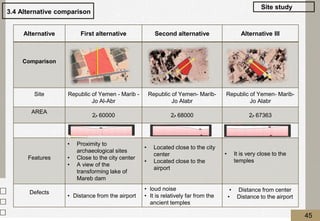
Alternative First alternative Second alternative Alternative III
Comparison
Site Republic of Yemen - Marib -
Jo Al-Abr
Republic of Yemen- Marib-
Jo Alabr
Republic of Yemen- Marib-
Jo Alabr
AREA
60000
‫م‬
2 68000
‫م‬
2 67363
‫م‬
2
Features
• Proximity to
archaeological sites
• Close to the city center
• A view of the
transforming lake of
Mareb dam
• Located close to the city
center
• Located close to the
airport
• It is very close to the
temples
Defects
• Distance from the airport
• loud noise
• It is relatively far from the
ancient temples
• Distance from center
• Distance to the airport
3.4 Alternative comparison
Site study
45
3.4 Alternative comparison
Site study
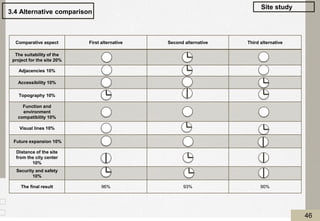
Comparative aspect First alternative Second alternative Third alternative
The suitability of the
project for the site 20%
Adjacencies 10%
Accessibility 10%
Topography 10%
Function and
environment
compatibility 10%
Visual lines 10%
Future expansion 10%
Distance of the site
from the city center
10%
Security and safety
10%
The final result 96% 93% 90%
46
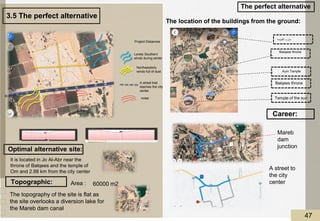
60000 m2
The perfect alternative
Lovely Southern
winds during winter
Project Distances
noise
A street that
reaches the city
center
Northwesterly
winds full of dust
Optimal alternative site:
It is located in Jo Al-Abr near the
throne of Balqees and the temple of
Om and 2.88 km from the city center
Topographic:
The topography of the site is flat as
the site overlooks a diversion lake for
the Mareb dam canal
Area :
The location of the buildings from the ground:
‫القديمه‬ ‫مارب‬
Aum Temple
Balqees throne
Temple of the sun
Career:
A street to
the city
center
Mareb
dam
junction
Balqees throne
3.5 The perfect alternative
47
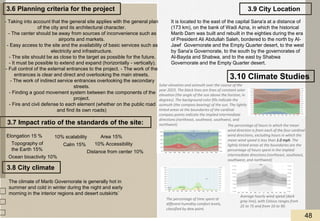
3.6 Planning criteria for the project
- Taking into account that the general site applies with the general plan
of the city and its architectural character.
- The center should be away from sources of inconvenience such as
airports and markets.
- Easy access to the site and the availability of basic services such as
electricity and infrastructure.
- The site should be as close to the target as possible for the future.
- It must be possible to extend and expand (horizontally - vertically).
- Full control of the external entrances to the project. - The work of the
entrances is clear and direct and overlooking the main streets.
- The work of indirect service entrances overlooking the secondary
streets.
- Finding a good movement system between the components of the
project.
- Fire and civil defense to each element (whether on the public road
and find its own roads)
Area 15%
3.8 City climate
The climate of Marib Governorate is generally hot in
summer and cold in winter during the night and early
morning in the interior regions and desert outskirts`
3.7 Impact ratio of the standards of the site:
3.9 City Location
It is located to the east of the capital Sana'a at a distance of
(173 km), on the bank of Wadi Azna, in which the historical
Marib Dam was built and rebuilt in the eighties during the era
of President Ali Abdullah Saleh, bordered to the north by Al-
Jawf Governorate and the Empty Quarter desert, to the west
by Sana'a Governorate, to the south by the governorates of
Al-Bayda and Shabwa, and to the east by Shabwa
Governorate and the Empty Quarter desert.
10% scalability
Elongation 15 %
Topography of
the Earth 15%
10% Accessibility
Distance from center 10%
Calm 15%
Ocean bioactivity 10%
3.10 Climate Studies
48
Solar elevation and azimuth over the course of the
year 2023. The black lines are lines of constant solar
elevation (the angle of the sun above the horizon, in
degrees). The background color fills indicate the
azimuth (the compass bearing) of the sun. The lightly
tinted areas at the boundaries of the cardinal
compass points indicate the implied intermediate
directions (northeast, southeast, southwest, and
northwest) The percentage of hours in which the mean
wind direction is from each of the four cardinal
wind directions, excluding hours in which the
mean wind speed is less than 1.0 mph. The
lightly tinted areas at the boundaries are the
percentage of hours spent in the implied
intermediate directions (northeast, southeast,
southwest, and northwest)
Average hourly wind speed (dark
gray line), with Celsius ranges from
25 to 75 and from 10 to 90.
The percentage of time spent at
different humidity comfort levels,
classified by dew point.
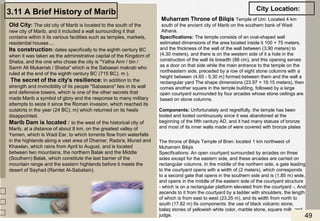
3.11 A Brief History of Marib
Old City: The old city of Marib is located to the south of the
new city of Marib, and it included a wall surrounding it that
contains within it its various facilities such as temples, markets,
residential houses ...
Its construction: dates specifically to the eighth century BC
when it was taken as the administrative capital of the Kingdom of
Sheba, and the one who chose the city is "Yatha Amr / bin /
Samh Ali Mukarrab / Sheba" which is the Sabaean makrab who
ruled at the end of the eighth century BC (715 BC). m ).
The secret of the city's resilience: In addition to the
strength and invincibility of its people "Sabaeans" lies in its wall
and defensive towers, which is one of the other secrets that
made Marib a symbol of glory and the response to many military
attempts to seize it since the Roman invasion, which reached its
outskirts in the year (24 BC). m) which returned on its heels
disappointed.
Marib Dam is located : to the west of the historical city of
Marib, at a distance of about 8 km, on the greatest valley of
Yemen, which is Wadi Ear, to which torrents flow from waterfalls
in the highlands along a vast area of Dhamar, Rada'a, Murad and
Khawlan, which rains from April to August, and is located
between two mountains, the northern Balak and the Middle
(Southern) Balak, which constitute the last barrier of the
mountain range and the eastern highlands before it meets the
desert of Sayhad (Ramlet Al-Sabatain).
City Location:
Muharram Throne of Bilqis Temple of Um: Located 4 km
south of the ancient city of Marib on the southern bank of Wadi
Athana.
Specifications: The temple consists of an oval-shaped wall
estimated dimensions of the area located inside it 100 × 75 meters,
and the thickness of the wall of the wall between (3.90 meters) to
(4.30 meters), and there is on the western side of it a hole in the
construction of the wall its breadth (88 cm), and this opening serves
as a door on that side while the main entrance to the temple on the
northeastern side, preceded by a row of eight stone columns with a
height between (4.65 - 5.30 m) formed between them and the wall a
rectangular yard The shape dimensions (23.97 × 19.15 meters), then
comes another square in the temple building, followed by a large
open courtyard surrounded by four arcades whose stone ceilings are
based on stone columns.
Components: Unfortunately and regretfully, the temple has been
looted and looted continuously since it was abandoned at the
beginning of the fifth century AD, and it had many statues of bronze
and most of its inner walls made of were covered with bronze plates
The throne of Bilqis Temple of Bran: located 1 km northwest of
Muharram Bilqis
Specifications: An open courtyard surrounded by arcades on three
sides except for the eastern side, and these arcades are carried on
rectangular columns. In the middle of the northern side, a gate leading
to the courtyard opens with a width of (2 meters), which corresponds
to a second gate that opens in the southern side and is (1.85 m) wide,
and opens in the middle of the eastern side of the courtyard structure
- which is on a rectangular platform elevated from the courtyard -. And
ascends to it from the courtyard by a ladder with shoulders, the length
of which is from east to west (23.25 m), and its width from north to
south (17.82 m) Its components: the use of black volcanic stone,
balaq stones of yellowish white color, marble stone, square milk, and
judge. 49
❑ Project
Components
▪ CHAPTER 4
50
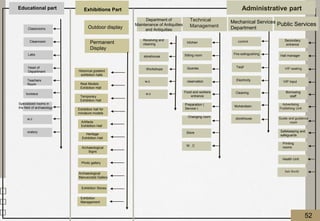
4.1 Project Components:
4.2 Functional relationships
4.3 Boundary table
4.4 Project Area
4.5 Project Components
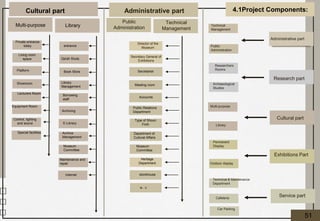
4.1Project Components:
Administrative part
Research part
Cultural part
Exhibitions Part
Service part
Technical
Management
Public
Administration
Researchers
Rooms
Archaeological
Studies
Multi-purpose
Library
Permanent
Display
Outdoor display
Technical & Maintenance
Department
Cafeteria
Car Parking
Director of the
Museum
Administrative part
Technical
Management
Public
Administration
Secretary General of
Exhibitions
Secretarial
Meeting room
Accounts
Public Relations
Department
Type of Shoun
Finih
Department of
Cultural Affairs
Museum
Committee
Heritage
Department
storehouse
w . c
Library
Multi-purpose
Cultural part
entrance
Qa'ah Study
Book Store
Library
Management
Borrowing
staff
Archiving
E-Library
Archive
Management
Museum
Committee
Maintenance and
repair
Internet
Private entrance
lobby
Living room
space
Platform
Showroom
Lecturers Room
Equipment Room
Control, lighting
and sound
Special facilities
51
Historical gradient
exhibition halls
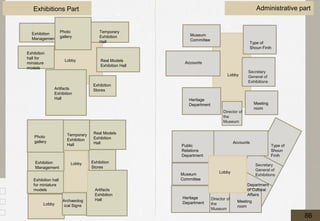
Exhibitions Part
Permanent
Display
Outdoor display
Real Models
Exhibition Hall
Temporary
Exhibition Hall
Exhibition hall for
miniature models
Artifacts
Exhibition Hall
Heritage
Exhibition Hall
Archaeological
Signs
Photo gallery
Archaeological
Manuscripts Gallery
Exhibition Stores
Exhibition
Management
Educational part
Classrooms
Cleanroom
Labs
Head of
Department
Teachers
Room
bureaus
Specialized rooms in
the field of archaeology
w.c
oratory
Administrative part
Public Services
Technical
Management
Mechanical Services
Department
Secondary
entrance
Hall manager
VIP seating
VIP Input
Borrowing
staff
Advertising
Publishing Unit
Guide and guidance
room
Safekeeping and
safeguards
Printing
rooms
Health Unit
Safe Booth
control
Fire extinguishing
Taqif
Electricity
Cleaning
Muhandsen
storehouse
Receiving and
cleaning
storehouse
Workshops
kitchen
Sitting room
Queries
reservation
Food and workers
entrance
Preparation (
Service )
Changing room
Store
W . C
w.c
Department of
Maintenance of Antiquities
and Antiquities
w.c
52
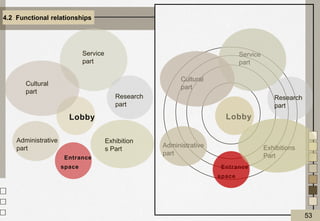
4.2 Functional relationships
Lobby
Administrative
part
Research
part
Cultural
part
Exhibitions
Part
Service
part
Lobby
Entrance
space
Exhibition
s Part
Administrative
part
Cultural
part
Service
part
Research
part
Entrance
space
53
Lobby
Lobby
Artifacts
Exhibition
Hall
Exhibition
hall for
miniature
models
Photo
gallery
Archaeological
Manuscripts
Gallery
Exhibition
Stores
Exhibition
Management
Archaeolog
ical Signs
Real Models
Exhibition
Hall
Temporary
Exhibition Hall
Lobby
Artifacts
Exhibition
Hall
Exhibition
hall for
miniature
models
Photo
gallery
Exhibition
Stores
Exhibition
Management
Archaeolog
ical Signs
Real Models
Exhibition
Hall
Temporary
Exhibition Hall
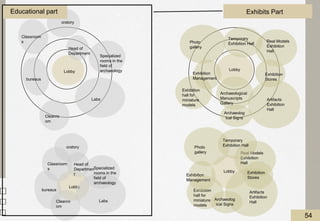
Labs
Cleanro
om
Head of
Department
bureaus
Specialized
rooms in the
field of
archaeology
oratory
Classroom
s
Lobby
Labs
Cleanro
om
Head of
Departmen
t
bureaus
Specialized
rooms in the
field of
archaeology
oratory
Classroom
s
Exhibits Part
Educational part
54
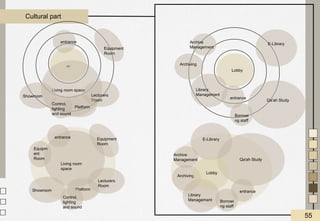
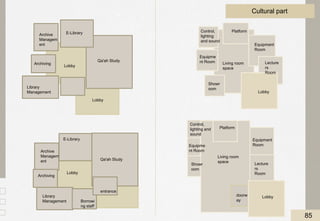
Cultural part
Qa'ah Study
entrance
Library
Management Borrowi
ng staff
Archiving
E-Library
Archive
Management
Lobby
Platform
Showroom
Lecturers
Room
Equipment
Room
Equipm
ent
Room
Equipment
Room
Lobby
‫بهو‬
entrance
entrance
Living room
space
Living room space
Lecturers
Room
Showroom
Control,
lighting
and sound
Control,
lighting
and sound
Platform
E-Library
Qa'ah Study
entrance
Borrowi
ng staff
Library
Management
Archiving
Archive
Management
55
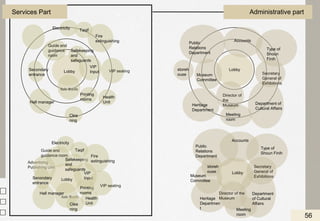
Administrative part
Lobby
Lobby
Director of
the
Museum
Heritage
Department
storeh
ouse Museum
Committee
Department of
Cultural Affairs
Type of
Shoun
Finih
Public
Relations
Department
Accounts
Meeting
room
Secretary
General of
Exhibitions
Museum
Committee
storeh
ouse
Public
Relations
Department
Accounts
Type of
Shoun Finih
Secretary
General of
Exhibitions
Department
of Cultural
Affairs
Meeting
room
Director of the
Museum
Heritage
Departmen
t
Lobby
Safe Booth
Health
Unit
Printing
rooms
Safekeeping
and
safeguards
Advertising
Publishing Unit
VIP
Input VIP seating
Hall manager
Guide and
guidance
room
Secondary
entrance
Fire
extinguishing
Electricity
Taqif
Clea
ning
Lobby
Safe Booth Health
Unit
Printing
rooms
Safekeeping
and
safeguards
VIP
Input
VIP seating
Hall manager
Guide and
guidance room
Secondary
entrance
Fire
extinguishing
Electricity
Taqif
Clea
ning
Services Part
56
Museum
Committee
storeh
ouse
Public
Relations
Department
Accounts
Type of
Shoun Finih
Secretary
General of
Exhibitions
Department
of Cultural
Affairs
Meeting
room
Director of
the
Museum
Heritage
Department
Lobby
Lobby
Artifacts
Exhibition
Hall
Exhibition hall
for miniature
models
Photo
gallery
Exhibition
Stores
Exhibition
Manageme
nt
Archaeolog
ical Signs
Real Models
Exhibition
Hall
Temporary
Exhibition Hall
Lobby
Labs
Cleanro
om
Head of
Department
bureaus
Specialized
rooms in the
field of
archaeology
oratory
Classrooms
Qa'ah Study
entrance
Library
Manageme
nt
Borrowi
ng staff
Archiving
E-Library
Archive
Managem
ent
Lobby
Platform
Showroom
Lecturers
Room
Equipment
Room
Equipm
ent
Room
entrance
Living room
space
Control,
lighting
and sound
Lobby
Lobby
Lobby
Lobby
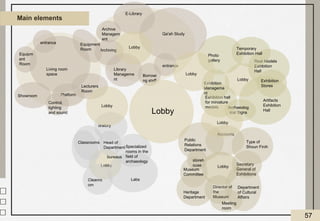
Main elements
57
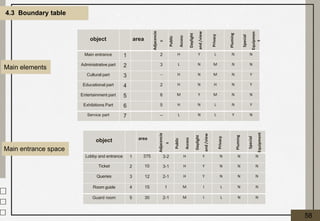
4.3 Boundary table
object area
Adjacencie
s
Public
Access
Daylight
and
/view
Privacy
Pluming
Special
Equipment
Lobby and entrance 1 375 3-2 H Y N N N
Ticket 2 10 3-1 H Y N N N
Queries 3 12 2-1 H Y N N N
Room guide 4 15 1 M I L N N
Guard room 5 30 2-1 M I L N N
object area
Adjacencie
s
Public
Access
Daylight
and
/view
Privacy
Pluming
Special
Equipmen
t
Main entrance 1 2 H Y L N N
Administrative part 2 3 L N M N N
Cultural part 3 -- H N M N Y
Educational part 4 2 H N H N Y
Entertainment part 5 6 M Y M N N
Exhibitions Part 6 5 H N L N Y
Service part 7 -- L N L Y N
Main elements
Main entrance space
58
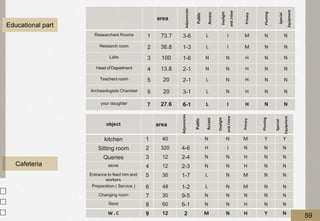
Educational part
area
Adjacencies
Public
Access
Daylight
and
/view
Privacy
Pluming
Special
Equipment
Researchers Rooms 1 73.7 3-6 L I M N N
Research room 2 36.8 1-3 L I M N N
Labs 3 100 1-6 N N H N N
Head of Department 4 13.8 2-1 N N H N N
Teachers room 5 20 2-1 L N H N N
Archaeologists Chamber 6 20 3-1 L N H N N
your daughter 7 27.6 6-1 L I H N N
object area
Adjacencies
Public
Access
Daylight
and
/view
Privacy
Pluming
Special
Equipment
kitchen 1 40 N N M Y Y
Sitting room 2 320 4-6 H I N N N
Queries 3 12 2-4 N N H N N
stone 4 12 2-3 N N H N N
Entrance to feed him and
workers
5 30 1-7 L N M N N
Preparation ( Service ) 6 48 1-2 L N M N N
Changing room 7 30 9-5 N N N N N
Store 8 60 6-1 N N H N N
W . C 9 12 2 M N H Y N
Cafeteria
59
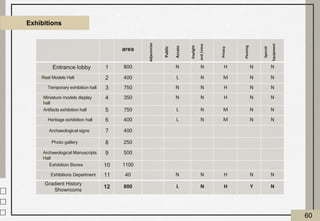
Exhibitions
area
Adjacencies
Public
Access
Daylight
and
/view
Privacy
Pluming
Special
Equipment
Entrance lobby 1 800 N N H N N
Real Models Hall 2 400 L N M N N
Temporary exhibition hall 3 750 N N H N N
Miniature models display
hall
4 350 N N H N N
Artifacts exhibition hall 5 750 L N M N N
Heritage exhibition hall 6 400 L N M N N
Archaeological signs 7 400
Photo gallery 8 250
Archaeological Manuscripts
Hall
9 500
Exhibition Stores 10 1100
Exhibitions Department 11 40 N N H N N
Gradient History
Showrooms
12 800 L N H Y N
60
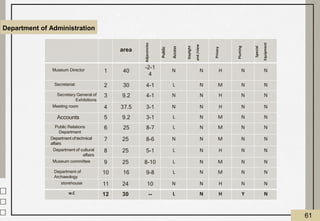
Department of Administration
area
Adjacencies
Public
Access
Daylight
and
/view
Privacy
Pluming
Special
Equipment
Museum Director 1 40
-2-1
4
N N H N N
Secretariat 2 30 4-1 L N M N N
Secretary General of
Exhibitions
3 9.2 4-1 N N H N N
Meeting room 4 37.5 3-1 N N H N N
Accounts 5 9.2 3-1 L N M N N
Public Relations
Department
6 25 8-7 L N M N N
Department of technical
affairs
7 25 8-6 N N M N N
Department of cultural
affairs
8 25 5-1 L N H N N
Museum committee 9 25 8-10 L N M N N
Department of
Archaeology
10 16 9-8 L N M N N
storehouse 11 24 10 N N H N N
w.C 12 30 -- L N H Y N
61
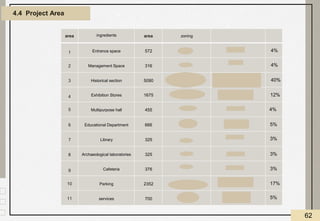
4.4 Project Area
area ingredients area zoning
1 Entrance space 572
2 Management Space 316
3 Historical section 5090
4 Exhibition Stores 1675
5 Multipurpose hall 455
6 Educational Department 666
7 Library 325
8 Archaeological laboratories 325
9 Cafeteria 376
10 Parking 2352
11 services 700
62
4%
4%
40%
12%
4%
5%
3%
3%
3%
17%
5%
Project Area
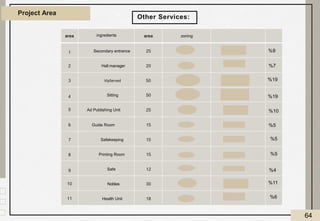
area ingredients area zoning
1 Secondary entrance 25
2 Hall manager 20
3 VipServed 50
4 Sitting 50
5 Ad Publishing Unit 25
6 Guide Room 15
7 Safekeeping 15
8 Printing Room 15
9 Safe 12
10 Nobles 30
11 Health Unit 18
Other Services:
9
%
7
%
19
%
11
%
6
%
19
%
10
%
5
%
4
%
5
%
5
%
64
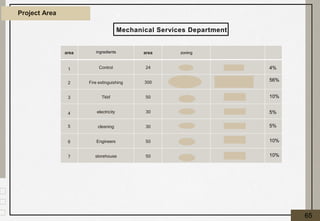
Project Area
area ingredients area zoning
1 Control 24
2 Fire extinguishing 300
3 Tkbf 50
4 electricity 30
5 cleaning 30
6 Engineers 50
7 storehouse 50
Mechanical Services Department
4%
56%
10%
5%
5%
10%
10%
65
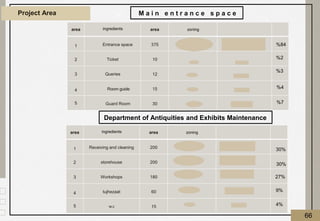
Project Area
area ingredients area zoning
1 Receiving and cleaning 200
2 storehouse 200
3 Workshops 180
4 tujhezaat 60
5 w.c 15
area ingredients area zoning
1 Entrance space 375
2 Ticket 10
3 Queries 12
4 Room guide 15
5 Guard Room 30
M a i n e n t r a n c e s p a c e
Department of Antiquities and Exhibits Maintenance
84
%
2
%
3
%
4
%
7
%
30%
30%
27%
9%
4%
66
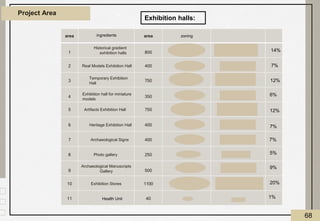
Project Area
area ingredients area zoning
1
Historical gradient
exhibition halls 800
2 Real Models Exhibition Hall 400
3
Temporary Exhibition
Hall
750
4
Exhibition hall for miniature
models
350
5 Artifacts Exhibition Hall 750
6 Heritage Exhibition Hall 400
7 Archaeological Signs 400
8 Photo gallery 250
9
Archaeological Manuscripts
Gallery 500
10 Exhibition Stores 1100
11 Health Unit 40
Exhibition halls:
14%
7%
12%
6%
12%
7%
7%
5%
9%
20%
1%
68
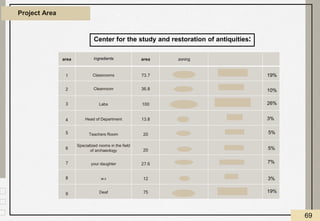
Project Area
area ingredients area zoning
1 Classrooms 73.7
2 Cleanroom 36.8
3 Labs 100
4 Head of Department 13.8
5 Teachers Room 20
6
Specialized rooms in the field
of archaeology 20
7 your daughter 27.6
8 w.c 12
9 Deaf 75
Center for the study and restoration of antiquities:
19%
3%
7%
5%
5%
3%
26%
10%
19%
69
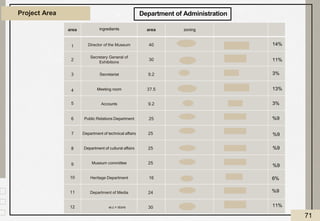
Project Area
area ingredients area zoning
1 Director of the Museum 40
2
Secretary General of
Exhibitions
30
3 Secretariat 9.2
4 Meeting room 37.5
5 Accounts 9.2
6 Public Relations Department 25
7 Department of technical affairs 25
8 Department of cultural affairs 25
9 Museum committee 25
10 Heritage Department 16
11 Department of Media 24
12 w.c + store 30
Department of Administration
14%
11%
3%
13%
3%
9
%
9
%
9
%
9
%
6%
9
%
11%
71
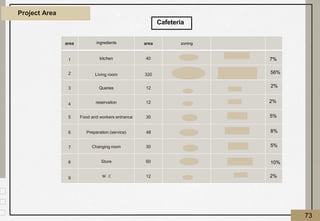
Project Area
area ingredients area zoning
1 kitchen 40
2 Living room 320
3 Queries 12
4 reservation 12
5 Food and workers entrance 30
6 Preparation (service) 48
7 Changing room 30
8 Store 60
9 W . C 12
Cafeteria
7%
56%
2%
2%
5%
8%
5%
10%
2%
73
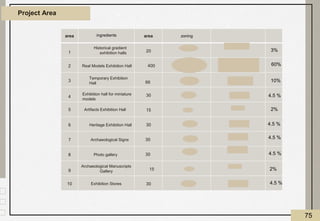
Project Area
area ingredients area zoning
1
Historical gradient
exhibition halls 20
2 Real Models Exhibition Hall 400
3
Temporary Exhibition
Hall 66
4
Exhibition hall for miniature
models
30
5 Artifacts Exhibition Hall 15
6 Heritage Exhibition Hall 30
7 Archaeological Signs 30
8 Photo gallery 30
9
Archaeological Manuscripts
Gallery 15
10 Exhibition Stores 30
2%
2%
4.5 %
10%
60%
3%
75
4.5 %
4.5 %
4.5 %
4.5 %
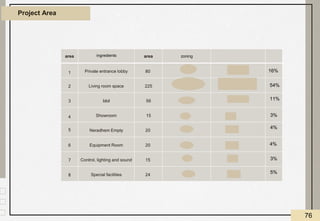
Project Area
area ingredients area zoning
1 Private entrance lobby 80
2 Living room space 225
3 Idol 56
4 Showroom 15
5 Neradhem Empty 20
6 Equipment Room 20
7 Control, lighting and sound 15
8 Special facilities 24
16%
54%
11%
3%
4%
4%
3%
5%
76
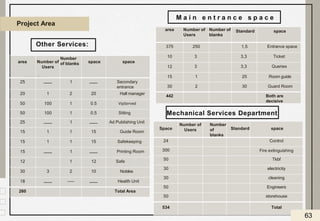
‫ﻟﺴﯿﺎتار‬ ‫ا‬‫ﻣﻮاﻗﻒ‬
area Number of
Users
Number of
blanks
Standard space
375 250 1,5 Entrance space
10 3 3,3 Ticket
12 3 3,3 Queries
15 1 25 Room guide
30 2 30 Guard Room
442 Both are
decisive
area Number of
Users
Number
of blanks space space
25 ‫ـــــــــ‬ 1 ‫ـــــــــ‬ Secondary
entrance
20 1 2 20 Hall manager
50 100 1 0.5 VipServed
50 100 1 0.5 Sitting
25 ‫ـــــــــ‬ 1 ‫ـــــــــ‬ Ad Publishing Unit
15 1 1 15 Guide Room
15 1 1 15 Safekeeping
15 ‫ـــــــــ‬ 1 ‫ـــــــــ‬ Printing Room
12 1 12 Safe
30 3 2 10 Nobles
18 ‫ـــــــــ‬ ----- ‫ـــــــــ‬ Health Unit
260 Total Area
Space
Number of
Users
Number
of
blanks
Standard space
24 Control
300 Fire extinguishing
50 Tkbf
30 electricity
30 cleaning
50 Engineers
50 storehouse
534 Total
M a i n e n t r a n c e s p a c e
Mechanical Services Department
Other Services:
Project Area
63
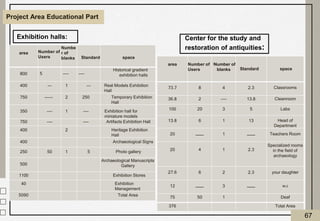
Project Area Educational Part
‫ﻟﺴﯿﺎتار‬ ‫ا‬‫ﻣﻮاﻗﻒ‬
area Number of
Users
Numbe
r of
blanks Standard space
800 5 ---- ----
Historical gradient
exhibition halls
400 --- 1 --- Real Models Exhibition
Hall
750 ------ 2 250 Temporary Exhibition
Hall
350 ---- 1 ---- Exhibition hall for
miniature models
750 ---- ---- Artifacts Exhibition Hall
400 2 Heritage Exhibition
Hall
400 Archaeological Signs
250 50 1 5 Photo gallery
500
Archaeological Manuscripts
Gallery
1100 Exhibition Stores
40 Exhibition
Management
5090 Total Area
Exhibition halls:
area Number of
Users
‫ا‬Number of
blanks Standard space
73.7 8 4 2.3 Classrooms
36.8 2 ---- 13.8 Cleanroom
100 20 3 5 Labs
13.8 6 1 13 Head of
Department
20 ‫ـــــــــ‬ 1 ‫ـــــــــ‬ Teachers Room
20 4 1 2.3
Specialized rooms
in the field of
archaeology
27.6 6 2 2.3 your daughter
12 ‫ـــــــــ‬ 3 ‫ـــــــــ‬ w.c
75 50 1 Deaf
376 Total Area
Center for the study and
restoration of antiquities:
67
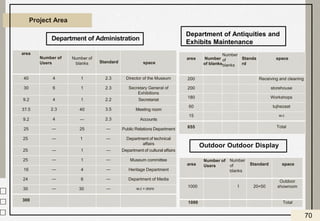
Project Area
area Number
of blanks
Number
of
blanks
Standa
rd
space
200 Receiving and cleaning
200 storehouse
180 Workshops
60 tujhezaat
15 w.c
655 Total
area
Number of
Users
Number of
blanks Standard space
40 4 1 2.3 Director of the Museum
30 6 1 2.3 Secretary General of
Exhibitions
9.2 4 1 2.2 Secretariat
37.5 2.3 40 3.5 Meeting room
9.2 4 --- 2.3 Accounts
25 --- 25 --- Public Relations Department
25 --- 1 --- Department of technical
affairs
25 --- 1 --- Department of cultural affairs
25 --- 1 --- Museum committee
16 --- 4 --- Heritage Department
24 --- 6 --- Department of Media
30 --- 30 --- w.c + store
300
Department of Administration
area
Number of
Users
Number
of
blanks
Standard space
1000 1 20×50
Outdoor
showroom
1000 Total
Outdoor Outdoor Display
Department of Antiquities and
Exhibits Maintenance
70
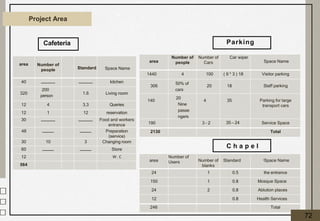
Project Area
area
Number of
people
Number of
Cars
Car wiper
Space Name
1440 4 100 ( 6 * 3 ) 18 Visitor parking
306
50% of
cars
20 18 Staff parking
140
20
Nine
passe
ngers
4 35 Parking for large
transport cars
190 3 - 2 35 – 24 Service Space
2130 Total
area
Number of
Users Number of
blanks
Standard ‫ا‬Space Name
24 1 0.5 the entrance
150 1 0.8 Mosque Space
24 2 0.8 Ablution places
12 0.8 Health Services
246 Total
C h a p e l
area Number of
people Standard Space Name
40 ‫ــــــــــــــــ‬ ‫ــــــــــــــــ‬ kitchen
320
200
person
1.6 Living room
12 4 3,3 Queries
12 1 12 reservation
30 ‫ــــــــــــــــ‬ ‫ــــــــــــــــ‬ Food and workers
entrance
48 ‫ـــــــــــــ‬ ‫ـــــــــــــ‬ Preparation
(service)
30 10 3 Changing room
60 ‫ـــــــــــــ‬ ‫ـــــــــــــ‬ Store
12 W . C
564
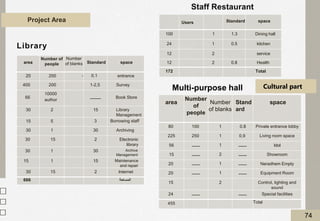
Cafeteria Parking
72
Project Area
area
Number of
people
Number
of blanks Standard space
20 200 - 0.1 entrance
400 200 1-2,5 Survey
66
10000
author
‫ــــــــــــ‬ Book Store
30 2 15 Library
Management
15 5 3 Borrowing staff
30 1 30 Archiving
30 15 2 Electronic
library
30 1 30 Archive
Management
15 1 15 Maintenance
and repair
30 15 2 Internet
666 ‫اﻟﻣﺳﺎﺣﺔ‬
area
Number
of
people
Number
of blanks
Stand
ard
space
80 100 1 0.8 Private entrance lobby
225 250 1 0,9 Living room space
56 ‫ـــــــــ‬ 1 ‫ـــــــــ‬ Idol
15 ‫ـــــــــ‬ 2 ‫ـــــــــ‬ Showroom
20 ‫ـــــــــ‬ 1 ‫ـــــــــ‬ Neradhem Empty
20 ‫ـــــــــ‬ 1 ‫ـــــــــ‬ Equipment Room
15 2 Control, lighting and
sound
24 ‫ـــــــــ‬ ‫ـــــــــ‬ Special facilities
455 Total
‫ﻟﻣﺳﺎﺣﺔ‬ ‫ا‬
‫دد‬ ‫ﻋ‬
Users Standard space
100 1 1.3 Dining hall
24 1 0.5 kitchen
12 2 service
12 2 0.8 Health
172 Total
Library
Staff Restaurant
Multi-purpose hall Cultural part
74
▪ CHAPTER 4
4.5 Project
Components
77
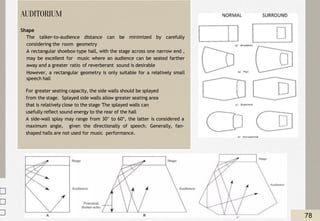
Shape
The talker-to-audience distance can be minimized by carefully
considering the room geometry
A rectangular shoebox-type hall, with the stage across one narrow end ,
may be excellent for music where an audience can be seated farther
away and a greater ratio of reverberant sound is desirable
However, a rectangular geometry is only suitable for a relatively small
speech hall
For greater seating capacity, the side walls should be splayed
from the stage. Splayed side walls allow greater seating area
that is relatively close to the stage The splayed walls can
usefully reflect sound energy to the rear of the hall
A side-wall splay may range from 30° to 60°, the latter is considered a
maximum angle, given the directionally of speech. Generally, fan-
shaped halls are not used for music performance.
AUDITORIUM
78
Types of seating arrangements
Different types of seats and their sizes
AUDITORIUM
LIBRARIES
79
. Display Modes
The display modes of sculptures in an exhibition hall are primarily
independent, single-line, multiline, and mixed displays.
Independent display
Independent display refers to the installation of a single large sculpture or
multiple small sculpture exhibits in a centralized form in the center of an
exhibition hall. In such an arrangement, all surfaces of the exhibits can be
viewed from 0° to 360° around the exhibits. The independent display layout
and viewing flow are shown in Figure 1a
Single-line display
Single-line display refers to the arrangement of sculptures with similar size in
a straight line, generally along one side wall of a room. The viewing flow is
consistent along the direction of the showcase, and only a certain
characteristic surface of the sculptures is generally exhibited to the visitors.
The single-line display layout and viewing flow are shown in Figure 1b.
Multiline display
A multiline display can be regarded as an extension of the single-line
display. The sculpture exhibits are arranged in two parallel lines or arranged
along three side walls. The viewing flow is along the side walls; usually, only
the front and part of the flanks of the sculptures can be viewed. The display
layout and viewing flow are shown in Figure 1c.
Mixed display
Mixed display is a combination of independent and multiline displays. Large
or symbolic sculpture exhibits are placed at the center of the exhibition hall
to highlight the theme. Simultaneously, relatively minor exhibits are
arranged along the surrounding walls to form a linear display layout. The
spatial relationship between the exhibits is relatively free. The display layout
and viewing flow are shown in Figure 1d
GALLERIES
80
Types of seating arrangements
Different types of seats and their sizes
AUDITORIUM
LIBRARIES
81
DRAWING STUDIOS
AUDITORIUM
82
PEOPLE WITH SPECIAL NEEDS
PARKING
83
84
❑ SITE ANALYSIS
▪ CHAPTER 5
5.1 ANALYSIS
5.2 ANALYSIS First
alternative
5.3 Location Zones First alternative
5.4 ANALYSIS Second alternative
5.5 Location Zones Second alternative
5.7 Location Zones alternative III
5.6 ANALYSIS Alternative III
5.8 Alternative Assessment
5.9 Vertical elements
Cultural part
Qa'ah Study
entrance
Archiving
E-Library
Lobby
‫بهو‬
Library
Management Borrowi
ng staff
Archive
Managem
ent
Lobby
Lobby
Qa'ah Study
E-Library
Archive
Managem
ent
Archiving
Library
Management
Lecture
rs
Room
Equipment
Room
Living room
space
Showr
oom
Platform
Equipme
nt Room
Lobby
Control,
lighting and
sound
doorw
ay
Lobby
Lecture
rs
Room
Equipment
Room
Platform
Control,
lighting
and sound
Equipme
nt Room
Showr
oom
Living room
space
85
Museum
Committee
Public
Relations
Department
Accounts
Type of
Shoun
Finih
Secretary
General of
Exhibitions
Department
of Cultural
Affairs
Meeting
room
Director of
the
Museum
Heritage
Department
Lobby
Administrative part
Lobby
Artifacts
Exhibition
Hall
Exhibition hall
for miniature
models
Photo
gallery
Exhibition
Stores
Archaeolog
ical Signs
Real Models
Exhibition
Hall
Exhibition
Management
Temporary
Exhibition
Hall
Lobby
Exhibitions Part
Lobby
Accounts
Museum
Committee
Heritage
Department
Director of
the
Museum
Meeting
room
Secretary
General of
Exhibitions
Type of
Shoun Finih
Real Models
Exhibition Hall
Exhibition
Stores
Artifacts
Exhibition
Hall
Exhibition
hall for
miniature
models
Exhibition
Management
Temporary
Exhibition
Hall
Photo
gallery
Lobby
86
5.2 ANALYSIS First alternative
Museum
Committee
Public
Relations
Department
Accounts
Type of
Shoun
Finih
Secretary
General of
Exhibitions
Showroom
Department
of Cultural
Affairs
Meeting
room
Director of
the
Museum
Heritage
Department
Lobby
Lobby
Artifacts
Exhibition
Hall
Exhibition hall
for miniature
models
Photo
gallery
Exhibition
Stores
Archaeolog
ical Signs
Real Models
Exhibition
Hall
Lobby
Labs
Cleanro
om
Head of
Department
bureaus
Specialized
rooms in the
field of
archaeology
oratory
Classrooms
Qa'ah Study
entrance
Archiving
E-Library
Archive
Managem
ent
Lobby
Platform
Lecture
rs
Room
Equipment
Room
Equipm
ent
Room
entrance
Living room
space
Exhibition
Management
Temporary
Exhibition
Hall
Lobby
Lobby
Lobby
Lobby
Library
Manageme
nt
Borrowi
ng staff
Control,
lighting
and sound
87
Main entrance
Secondary
entrance
First alternative
5.3 Location Zones
88
Museum
Committee
Public
Relations
Department
Accounts
Type of
Shoun
Finih
Secretary
General of
Exhibitions
Showroom
Department
of Cultural
Affairs
Meeting
room
Director of
the
Museum
Heritage
Department
Lobby
Lobby
Artifacts
Exhibition
Hall
Exhibition hall
for miniature
models
Photo
gallery
Exhibition
Stores
Archaeolog
ical Signs
Real Models
Exhibition
Hall
Lobby
Labs
Cleanro
om
Head of
Departmen
t
bureaus
Specialized
rooms in the
field of
archaeology
oratory
Classrooms
Qa'ah Study
entrance
Archiving
E-Library
Archive
Managem
ent
Lobby
Platform
Lecturers
Room
Equipment
Room
Equipm
ent
Room
entrance
Living room
space
Exhibition
Management
Temporary
Exhibition
Hall
Lobby
Lobby
Lobby
Library
Management
Borrowi
ng staff
Control,
lighting
and sound
Lobby
89
5.4 ANALYSIS Second alternative
Main entrance
Secondary
entrance
Second alternative
5.5 Location Zones
90
5.6 ANALYSIS Alternative III
Museum
Committee
Public
Relations
Department
Accounts
Type of
Shoun Finih
Secretary
General of
Exhibitions
Show
room
Department
of Cultural
Affairs
Meeting
room
Director of
the
Museum
Heritage
Departmen
t
Lobby
Lobby
Artifacts
Exhibition
Hall
Exhibition hall
for miniature
models
Photo
gallery
Exhibition
Stores
Archaeolog
ical Signs
Real Models
Exhibition
Hall
Lobby
Labs
Cleanro
om
Head of
Departmen
t
bureaus
Specialized rooms
in the field of
archaeology
oratory
Classroom
s
Qa'ah Study
entrance
Archiving
E-Library
Archive
Manage
ment
Lobby
Platform
Lecture
rs
Room
Equipment
Room
Equipme
nt Room
entrance
Living room
space
Exhibition
Management
Temporary
Exhibition
Hall
Lobby
Lobby
Lobby
Library
Management Borrowi
ng staff
Control,
lighting
and sound
91
5.7 Location Zones
Main entrance
Secondary
entrance
Alternative III
92
Alternative III
Second
alternative
First
alternative
Comparison
Confirmation of
building blocks
1
Interconnection of the
parts of the building
2
Best mass organization
3
Non-overlapping
functions
4
Building orientation
5
Future expansion of
the project
6
Clarify the entrance
7
17
20
27
Total
93
5.8 Alternative Assessment
94
5.9 Vertical elements
DONE
THANKS!
95
Do you have any questions?
+967776446609
‫الناموس‬ ‫احمد‬
Ah._n_

متطلب لنيل درجة البكالوريس نهائي برمجة.pdf

  • 1.
    Supervision / Prof. KhalilNasher Assoc. Prof. Saif Al-Qubati Eng. Ashraf Abbasi Eng. Amna Al-Azani Programming an archaeological cultural center project Student Work / Ahmed Al , Namo's Thesis graduation project to obtain a bachelor's degree in architecture engineering For the year (2022-2023)
  • 2.
    Gifting Acknowledgements The Messengerof Allah, peace be upon him, said," Whoever does not thank people does not thank him" Thanks in the beginning to God Almighty who helped me to complete this work which I hope from God to win your admiration and benefit to all Words of thanks may not be enough for those who sacrificed their time and comfort and with all the precious so that this lofty edifice continues to give He gave everything he could carry the trust so he was worthy of it No matter how much we talk our words about loyalty and thanks will be abandoned I ask God to bless him with health and wellness and long life I extend my thanks and appreciation to everyone who took my hand to what benefits me and to everyone who taught me honestly I extend my thanks and appreciation to everyone who helped me in completing this research Supervision /Prof. Khalil Nasher Prof. Saif Al-Qubati Eng. Ashraf Abbasi Eng. Amna Al-Azani To those who are unmatched in the universe, to those whose righteousness God has commanded us, to those who have done so much and given what cannot be returned, to you these precious words my mother and father, I dedicate this research to you, as you have been my best supporter throughout my academic career. To all the friends of the roads, rough and easy, dark and bright, I dedicate this research as I offer this dedication as an expression of my gratitude for their presence in my life.
  • 3.
    1.1 Project definition 1.3Reasons for choosing a project 1.5 Project Objectives 1.2 Project classification 1.6 Importance of the project 1.7For ProjectSWOT Analysis 1.4Project history ▪ Project Introduction ❑ CHAPTER : 1 2.1 First example: Bishan Cultural Center 2.2 Second example: Blasin Cultural Center 2.3 Third example: Imagina Cultural and Environmental Center 2.4 Fourth example: Grand Museum of Egypt 2.5 fifth example: National Museum of Roman History 2.7 Example seven: :US Olympic and Paralympic Museum 2.6 Example Six: Aslaf Cultural Museum Similar Examples ❑ CHAPTER 2 : 3.1 First alternative 3.2 Second alternative 3.3 Third alternative 3.4 Alternative comparison 3.5 The perfect alternative 3.6 Planning criteria for the project 3.7 Impact ratio of the standards of the site 3.8 City climate 3.9 City Location 3.10 Administrative division 3.11 Climate Studies 3.12 A Brief History of Marib ▪ Site study ❑ CHAPTER 3 : ▪ Project Components ❑ CHAPTER 4 : 5.2 ANALYSIS First alternative 4.3 Boundary table 4.4 Project Area 4.2 Functional relationships 4.5 Project Components ❑ CHAPTER 5 : ▪ SITE ANALYSIS 5.1 ANALYSIS 5.3 Location Zones First alternative 5.5 Location Zones Second alternative 5.6 ANALYSIS Alternative III 5.4 ANALYSIS Second alternative 4.3 Boundary table 5.7 Location Zones alternative III 5.8 Alternative Assessment 5.9 Vertical elements ▪ Index 2.8 Example comparison 1
  • 4.
    2 Part One: Project Introduction 1.1Project definition 1.3 Reasons for choosing a project 1.5Project Objectives 1.2 Project classification 1.6 Importance of the project For ProjectSWOT 1.7 Analysis 1.4Project history CHAPTER1
  • 5.
    ❑ Introduction: • Itis a project that aims to revive, restore and use historical and cultural monuments within the framework of a modern cultural center. This project involves the preservation of archaeological sites and historic buildings and the restoration of some measure of the original condition of those monuments • The Archaeological Cultural Center is seen as a cultural gathering point where visitors can enjoy historical exhibits, attend cultural and artistic events, and learn more about local and international history and heritage. • Archaeological Cultural Center Project: 3 • The project is a multifunctional cultural center, providing a space for art shows, art exhibitions and educational content related to history and ancient civilizations. The cultural center is also used for cultural and artistic conferences, seminars and workshops. • In addition, the project aims to encourage cultural tourism and promote interest in cultural heritage. Through the use of modern and interactive technology, the Archaeological Cultural Center allows visitors to immerse themselves in a unique educational and entertainment experience. • Overall, the Archaeological Cultural Center project aims to preserve, document and present cultural heritage to the public in an innovative and exciting way. The project contributes to enhancing cultural and heritage awareness, deepening mutual understanding between cultures and cultural enrichment derived from the integration of cultural assets in one place. 1.1
  • 6.
    Reason for choosingthe project: 1. Rich culture and history: Yemen has a rich cultural history spanning thousands of years. By establishing an archaeological museum, you can contribute to the preservation of Yemen's cultural heritage and make it available to local audiences and international visitors. 2. Conservation of archaeological holdings: Yemen's cultural heritage is threatened by multiple factors, such as wars and conflicts. By establishing an archaeological museum, you can contribute to the protection and preservation of precious objects for future generations. 3. Education and awareness: The Antiquities Museum can be a center for education and awareness about Yemeni cultural heritage and history. Educational tours and demonstrations can be organized for visitors to promote awareness and deep understanding of Yemeni heritage. 4. Tourism Development: The Archaeological Museum can contribute to the promotion of cultural tourism in Yemen, contributing to job opportunities and economic development of the local community. 5. Investing in the future: The establishment of an archaeological museum in Yemen is an opportunity to invest in the future and promote cultural and tourism development in the country. By participating in this project, you can contribute to the promotion of national identity and promote interest in culture and history. There are several categories under which an archaeological cultural center project can fall, such as: Tourism and Recreation: Projects operating in the tourism and entertainment sector, including Cultural monuments that display archaeological monuments, to fall into this category. Culture and Arts: Projects of culture and arts centers aimed at preserving heritage can be classified Cultural and promotion of culture and the arts, including archaeological cultural projects, in this category. Cultural Heritage and Trade: In this category, projects aimed at heritage preservation can be categorized. cultural and its promotion, such as projects of archaeological cultural centers and others. Project classification according to IBC: 4 1.3 1.2
  • 7.
    Louvre Palace: Its foundationbegan in the XIX century and its development has continued to the present. Sharjah Museum It was founded in 1996 in the United Arab Emirates and showcases contemporary and traditional art from the Middle East. Metropolitan Museum It was founded in 1870 in New York and is considered one of the largest and most prominent museums in the world. British Museum It was founded in 1753 in London and is known for its vast cultural holdings from around the world. 4 2 3 1 5 7 6 8 Metropolitan Museum It was founded in 1870 in New York and is considered one of the largest and most prominent museums in the world. Center for Contemporary Art at National Gallery in Rio de Janeiro It was founded in 1996 and showcases contemporary art by Brazilian and international artists. Guggenheim Museum It was founded in 1870 in New York and is considered one of the largest and most prominent museums in the world. Museum of Art of Ontario Founded in 1900 in Toronto, Canada, it houses a large collection of diverse artworks and galleries. history of the project 5 1.4
  • 8.
    ❑ Project Objectives CulturalHeritage Preservation / The project aims to preserve cultural heritage through the preservation and protection of artworks, statues and historical exhibits. and cultural existing in the region. The necessary maintenance and restoration are carried out to preserve its historical value and beauty. Education & Awareness / The project aims to promote cultural education and awareness among visitors and the local community. Educational events such as tours and workshops are organized and lectures to help understand cultural heritage and promote awareness of its importance. Promotion of cultural tourism / The project aims to promote cultural tourism in the region. The cultural center is designed and developed in a way that attracts tourists and provides them with a cultural experience Characteristic. This can include art and cultural performances, film screenings and art exhibitions. 6 Skills Development and Employment/ The project aims to provide job opportunities and skills development in the local community. The project can provide opportunities for locals to participate In historical research, presentation design, marketing and management, promoting employment and developing local skills . Community Development/ The project aims to utilize the Archaeological Cultural Center as a center for community activities. The center can be used to organize art exhibitions for artists Local and workshops for children, youth and adults. This enhances community interaction and contributes to enhancing the social spirit. In general, the Archaeological Cultural Center project aims to promote the preservation of cultural heritage, promote cultural awareness and community development. This contributes to the sustainable development of the region. 1.5
  • 9.
    ❑ Importance ofthe project • Preservation of cultural heritage: The project contributes to the preservation of the cultural and historical heritage of the community. The archaeological center displays works of art and historical and cultural exhibits that carry great historical and cultural value. • Promotion of cultural tourism: The project contributes to the promotion of cultural tourism and attracts tourists to the region. The Archaeological Cultural Center acts as a tourist attraction for those interested in history and culture, boosting tourism and contributing to the development of the local economy. • Education and promotion of cultural awareness: The Archaeological Cultural Center offers an opportunity for the public to explore and learn about history and culture. Tours, workshops and lectures can be organized for visitors and the local community to increase knowledge and cultural awareness. • Skills Development and Employment: Building and operating an archaeological cultural center requires engaging a wide range of skills and experience. The project provides opportunities • He has worked in areas such as historical research, incidental design, marketing and management, contributing to the recruitment and development of local skills. • Promoting cultural identity: The project contributes to strengthening the cultural identity of the local community and enhancing pride and belonging. The Archaeological Cultural Center promotes awareness • The values and heritage of local culture, and works to preserve and promote them among current and future generations. • • In general, the establishment of an archaeological cultural center project promotes cultural heritage, cultural tourism, education and community development, making it • is hugely important in promoting culture and sustainable development. 1.6 7
  • 10.
    ▪ Rich culturalheritage: Marib was founded thousands of years ago and contains valuable cultural monuments and sites that attract visitors and researchers. STRENGTH S W T O ▪ Historical and cultural value: The center has a rich history and culture represented in exhibits and exhibitions that show culture and development through the ages. WEAKNESS ▪ Difficult access and infrastructure: The center may face challenges in accessing visitors due to lack of transportation and limited infrastructure. ▪ Lack of funding: The center may suffer from a lack of funding to maintain buildings and maintain high quality exhibits. OPPORTUNITIES THREADS ▪ Security stability: Unstable security conditions may affect the Centre's ability to attract visitors and the safety of cultural exhibits ▪ Illegal trade in antiquities: Historical exhibits can face threats from the illegal trade and illicit transfer of antiquities. ▪ Cultural tourism: The growing interest in cultural tourism can be exploited to attract larger numbers of visitors and promote awareness of cultural heritage. ▪ International cooperation: The center can cooperate with international institutions for the preservation of antiquities and develop joint awareness programs. ProjectSWOT Analysis 1.8 8
  • 11.
    ❑ Part Two: Similar Examples 2.1First example: Bishan Cultural Center 2.2 Second example: Blasin Cultural Center ▪ CHAPTER 2 2.3 Third example: Imagina Cultural and Environmental Center 2.4 Fourth example: Grand Museum of Egypt 2.5 fifth example: National Museum of Roman History 2.7 Example seven: :US Olympic and Paralympic Museum 2.6 Example Six: Aslaf Cultural Museum 9
  • 12.
  • 13.
    About the project: Designidea: General information: Project Name : Project Location: Floor Area: Building area: Total Area : Designer: Project Year : Number of Visitors : Bishan Cultural Center China City Beishan Kuo 1583.891 m2 37736 m2 Tagwa & Partners 2016 - 3167.782 m2 2.1 First example: Bishan Cultural Center Beishan Cultural and Art Center is located in the north of Central Park Lake, Beishan, Chongqing. It is one of the oldest projects in this field, and it is also the most important element of the public service complex in the Chongqing Green Island area. The annals of Bishan province recorded the following: In the past, people used to consider mountains as jade. In addition, these mountains were said to produce jade-like stones. So they called it Bishan (mountains made of jade). The Bishan Cultural and Art Center recreates the old description of "Bishan" in an abstract way. It reflects the landscape of the environment. We want it to be a "place" and not a building. At the original site, 3 rock masses stand opposite each other, and the valley runs between them nearby. This natural relationship inspires us. For us, it will be the best response to nature, city and culture. The mass is cut according to the inclination of the valley. This helps connect many public spaces 11
  • 14.
    ‫ذ‬ Tough cookie Parking Theater and itsservices Break bureaus Meeting room Instrumentati on room Lobby Baths stairs anodes medium Weak Break Conference Hall Baths stairs anodes Theater and its services Multi- purpose hall 1656.606 2404.682 45.588 27.732 128.839 116.954 36 158.387 84 313.112 128.839 27.732 45.588 2404.682 238.647 36 Theater and its services Break Parking bureaus Lobby Vertical movement Services Meeting room Ground floor First floor Tough cookie medium Weak Theater and its services Break Parking bureaus Lobby Vertical movement Services Meeting room First example: Bishan Cultural Center 12
  • 15.
    ‫ذ‬ Break Conference Hall Baths stairs anodes Theater and its services Multi- purposehall 313.112 128.839 27.732 45.588 2404.682 238.647 36 Third floor Tough cookie medium Weak Theater and its services Break Parking bureaus Lobby Vertical movement Services Meeting room First example: Bishan Cultural Center Break Conference Hall Baths stairs anodes Theater and its services Multi- purpose hall 313.112 128.839 27.732 45.588 2404.682 238.647 36 Second floor Tough cookie medium Weak Theater and its services Break Parking bureaus Lobby Vertical movement Services Meeting room 13
  • 16.
    section elevtion Glasses thatare combined with metal plates and aluminum mesh in different triangular levels create a traditional Chinese pattern called an ice crack. Such a texture also makes the "inner surface" an eye-catching "crystal" PLAN ANALYSIS First example: Bishan Cultural Center 14
  • 17.
    About the project: Designidea: General information: Project Name : Project Location: Floor Area: Building area: Total Area : Designer: Project Year : Number of Visitors : Blasin Cultural Center China Xingyong City 1572.285 m2 6356.11 m2 Li tao 2016 - 3106.782 m2 The Norwegian city of Molde has a population of only 25 inhabitants, but every July the biggest jazz stars and about 000 jazz lovers flock to the city's world-famous international jazz festival. When designing the city's new cultural center, the challenge for 100XN was to create a building that was flexible and strong enough to provide a framework for cultural life on both scales. 2.2 Second example: Blasin Cultural Center "There must be room for celebration in this building, both inside, on top of it and around it. And it must be able to withstand being invaded by happy people throughout the year - year after year― , says Head of Competition and Partner of 3XN, Jan Ammundsen about the Danish architectural practice’s most recently completed project, ‘Plassenâ €™. 15
  • 18.
    stairs Theater and itsservices 288.54 w.c anodes Movement corridors Library Cafe Performance Zone museum bureaus 212 15 390 207 132 239 56 193 15 stairs Theater and its services 288.54 W.C anodes Movement corridors Library Performance Zone museum bureaus 212 15 390 207 132 239 56 15 Ground floor First floor First example: Bishan Cultural Center 16
  • 19.
    Second example: BlasinCultural Center section elevtion 17
  • 20.
    About the project: Designidea: General information: Project Name : Project Location: Floor Area: Building area: Total Area : Designer: Project Year : Number of Visitors : Cultural and Environmental Center Imagina Mexico Leon city 1583.891 m2 7397.245 m2 TIB Arquitectos 2016 - 3167.782 m2 CCE IMAGINA has become an educational building that shows between its mud-brick walls how to make a vital architecture that saves traditions, reinvigorates the economy, brings beauty and jobs, teaches about environmental principles in construction, is energy-saving and, above all, shows the social, economic and environmental benefits of working with the land. 2.3 Third example: Imagina Cultural and Environmental Center "There must be room for celebration in this building, both inside, on top of it and around it. And it must be able to withstand being invaded by happy people throughout the year - year after year― , says Head of Competition and Partner of 3XN, Jan Ammundsen about the Danish architectural practice’s most recently completed project, ‘Plassenâ €™. 18
  • 21.
    165.728 18.920 251.541 36.180 94.261 39.024 39.605 48.384 104.701 20.145 18.920 165.728 251.541 104.401 44.064 51.69 39.605 39.605 251.541 36 w.c Included entrance Movement corridors Orchestra Hall stair PercussionRoom Management Music room Art Hall stair Art Hall Single Room W.C Included entrance Movement corridors Orchestra Hall Percussion Room Management Ground floor First floor Second example: Blasin Cultural Center 19
  • 22.
    Second example: BlasinCultural Center section elevtion 20
  • 23.
    About the project: Designidea: General information: Project Name : Project Location: Floor Area: Building area: Total Area : Designer: Project Year : Number of Visitors : Grand Museum of Egypt Egypt 500000 m2 Hengen peng 2003 -2020 - The Egyptian Museum is located 25 km from Cairo and two km from the Pyramids of Giza The Grand Egyptian Museum is not a unique museum in the unique sense of the museum, it is a complex as a complex of various activities that contribute to a good cultural environment concentrated Egyptology where the world of ancient Egypt and the life of the pharaohs can be explored in different styles and levels The museum is a global interactive cultural repository and resource 2.4 Fourth example: Grand Museum of Egypt Cairo and two km from the Pyramids of Giza. The Grand Egyptian Museum is not a unique museum in the unique sense of the museum, it is a complex as a complex of various activities that contribute to a good cultural environment concentrated Egyptology where the world of ancient Egypt and the life of the pharaohs can be explored in different styles and levels The museum is a global interactive cultural repository and resource The Egyptian Museum is located 25 km from - - 21
  • 24.
    fifth example: GrandMuseum of Egypt Site plan 22
  • 25.
    fifth example: GrandMuseum of Egypt 23
  • 26.
    fifth example: GrandMuseum of Egypt 24
  • 27.
    About the project: Designidea: General information: Project Name : Project Location: Floor Area: Building area: Total Area : Designer: Project Year : Number of Visitors : National Museum of Roman History in the Republic of Romania 8000 m2 Alexander Sevolescu 1988-1894 60000 8000 m2 Built inside the former Postal Service Palace, which includes a museum for all stamps, the museum contains approximately 60 valuable exhibition rooms, temporary displays include a plaster block for the entire column of "Trajan" and the jewels of the Roman crown. Currently, the building forms a created block surrounding an inner courtyard, placed at the western end of the old bar of the city. The main façade consists of ten animal columns, the entrance to Postei Street has been reopened and the inner atrium and the exhibitions of the Tarjan columns are visible from all access points to attract and invite people. The final design of the museum's drawings were mainly influenced by the postal facility in Geneva, the museum was built in an eclectic classical style. The stone façade features a portico supported by ten columns and a platform consisting of 12 steps that extends along the length of the building. 2.5 fifth example: National Museum of Roman History - 25
  • 28.
    The museum is surroundedby streets from all directions and the construction was done with the entire area of the site. One of the advantages of the presence of streets is to connect the internal atrium with the outsider and attract and drop visitors. Area Plan (1/2000) Cultural sites Illustrate the degrams, motion paths, display scenarios and sound treatments in the museum. Courtyard in social space First round Second floor Third round Fifth floor Fourth floor Museum battery Track (first + second) Track (first + second) ‫المسار‬ ( ‫االول‬ + ‫الثاني‬ ) ‫المسار‬ ( ‫االرضي‬ ‫الدور‬ ) ISO Metric Perspective for Museum Museum Sound TreatmentsUnder the sound Vertical relations The road around Togan columns Access from different heights of the street ‫الراسيه‬ ‫العالقات‬ ‫االفقيه‬ ‫العالقات‬ ‫المسار‬ fifth example: National Museum of Roman History 26
  • 29.
    Temporary show Common areas Museum Library Library 1400m2 1450 m2 2000 m2 300 m2 190 m2 Gift shop Selling books Old center for the presentation of the history of Bucharest Temporary offer Cafeteria Baths Wardrobe + deposit Cafeteria restaurant Multipurpose hall Help room Funding Animation culture Rooms Storage of intervention materials Control room Interview room Leaders office Special stair movement Control room Rest room Arshfe Large timer offer Average timer width Equipment Store Common room Sitting Drowning help Waiting room 156 m2 242 m2 235 m2 311 m2 236 m2 66 m2 107 m2 210 m2 400 m2 120 m2 71 m2 69 m2 60 m2 54 m2 43 m2 49.50 m2 30 m2 23 m2 20 m2 30 m2 63m2 71 m2 166 m2 147 m2 30 m2 76 m2 32 m2 21 m2 22 m2 fifth example: National Museum of Roman History 27
  • 30.
    1 Hypostyle chamber 2Terrace 3 The art of writing and the printmaking technique 4 The maps and engravings gallery. Descriptio Romaniae in maps and engravings 5 The medieval town 6 State and medieval society. Political forms on romanian territory (10th-14th century) (16th-18th century) 7 The church and the medieval art 8 Evolution and revolution (1821-1859) 9 Premises of making modern Romania. Between Orient and Occident. Enlightenment and national consciousness 10 Culture and civilization 11 Economy and society 12 Personnel offices 13 Break room 14 Lockers and sanitary facilities 15 Differential thermal analysis 16 Office space 17 Wet chemistry lab 19 Infrared, RAMANSERS spectrometry lab 20 Archaeozoology lab 21 Biology lab 22 Geology lab 23 Management Offices 24 Reception and secretariat 25 Conference room 26 Administration offices 27 General Archive of the Institution 28 The art of war 29 Byzantium and moving populations at the Lower Danube 30 Completion of the Romaniansethnogenesis. Romanian space and romanian presence in narrative sources 31 Rural daily life. Habitation forms in the 8th-9th century 32 Rural daily life (10th-15th century) 33 The medieval town 30 31 32 2 7 7 7 3 4 5 1 6 8 9 10 11 10 12 13 15 16 17 20 21 22 23 24 27 25 28 26 29 33 561 360 75 286 75 166 166 196 166 196 196 112 105 51 35 75 86 88 74 64 54 50 150 561 182 182 95 188 140 120 150 m2 m2 m2 m2 m2 m2 m2 m2 m2 m2 m2 m2 m2 m2 m2 m2 m2 m2 m2 m2 m2 m2 m2 m2 m2 m2 m2 m2 m2 m2 m2 m2 First floor fifth example: National Museum of Roman History 28
  • 31.
    1 Scientific library 2From democracy to dictatorship (1919-1945) 3 From the proclamation of the Kingdom to the Great Union 4 Modern Romania. From The United Principalities to independent Romania(1859- 1878) 5 Photo-video studio 6 Molecular biology (DNA analysis) 7 Photo analysis 8 Meeting room 9 Cloakrooms for staff, performers, lecturers 10 Auditorium 11 Translators booths 12 Audio-video control room 13 Foyer 14 Buffet 15 Wardrobe 16 Restrooms 600 m2 360 m2 202 m2 250 m2 200 m2 220 m2 120 m2 50m2 212 m2 714 m2 21 m2 21 m2 130 m2 120 m2 25 m2 75 m2 200 m2 Second floor fifth example: National Museum of Roman History 29
  • 32.
    22 13 3 4 2 1 5 20 18 17 6 16 12 15 14 12 11 21 10 9 8 7 20 19 18 1 1 2 34 5 7 8 9 9 9 10 fifth example: National Museum of Roman History 1 Rest and sleeping room for emergency situations 2 Storage for intervention materials 3 Weapons room 4 Locker rooms, sanitary facilities with showers 5 Shift commander office 6 Control room 7 Platoon commander office 8 Detachment commander office 9 Office space 10 Break room 1 Origins of modern man. Becoming of humanity 2 Social space. The art of pottery. From clay to art work 3 Social space. The world of peopleSettlements, dwellings, environment 4 Social space. Object and context 5 Metallurgy production and depositions 6 Transit storage 7 Kings, sacerdotes and warriors. Getae and Dacians 8 Interaction and identity values in the Iron Age II: Celts, Bastarnoe, Getoe, Dacians, Greeks 9 Spirituality and funerary practices 10 Funerary practices, depositions, Dacian hoards - 1st century BC - 1st century AD 11 Historical treqmre 12 Medals and pholerae 13 The copy of the frieze 14 Antiquity 15 Under the sign of Rome (colonization, administration, army) 16 Lux perpetua- the funerary universe in Docia and Moesia 17 Patrimony objetcs access 18 Secondary access 19 Technical personnel aceess 20 Restroom and elevator 21 Security hallway 22 Parking places 30 Second floor mezzaning floor
  • 33.
    2 1 3 45 6 7 8 9 10 2 8 1 Pottery restoration 2 Wood restoration 3 Textiles restoration 4 Paper restoration 5 Metal restoration 6 Pottery restoration 7 Conservation lab 8 Heating plant and heat pumps 9 Water supply system 10 Technical spaces 1 Pottery restoration 2 Wood restoration 3 Textiles restoration 4 Paper restoration 5 Metal restoration 6 Pottery restoration 7 Conservation lab 8 Heating plant and heat pumps 9 Water supply system 10 Technical spaces fifth example: National Museum of Roman History 31 2nd under Ground floor 3nd under Ground floor
  • 34.
    Plan of fristfloor Plan of Second floor Plan of Ground floor Plan of frist Basement Plan of frist ROOF Horizontal movement in projections fifth example: National Museum of Roman History 32
  • 35.
    fifth example: NationalMuseum of Roman History General information: STRUCTURAL ENGINEERING IN A TECHNICAL APPROACH The structural concept aims at retrofitting the current building by means of seismic dampers using simple load technology The idea is to provide the building with microphone insulation in the basis by gradually introducing dampers on the walls at the level of the sized prayer edge by gradually introducing dampers on the walls at the level of the swelled prayer edge through a system of stages of concrete beams in the basement The wall openings are presented with some followers Reinforcement frames are placed between the piles and thus the continuous beams form steel along all the walls of the building Impulse High damping rubber is a simple economical way to provide low- horizontal student work that recreates a long vibration period to the rack-mounted structure. For superstructure detection, unnecessary dead loads will be removed as much as possible locally if still needed Retrofitting of load-bearing walls by reinforced cement coating HVAC engineering The structure for building HVAC systems will be non- intrusive and easily reduced For future repairs and renovations, the initial design of the building had a lot of built-in configurations within the walls that will be reused in areas where the different wings of the building intersect. For rooms with ornaments, forced air systems will be used for both burial by adding hidden or separate ventilation grilles on the nearest walls. Fresh air is inserted at a lower level and the air used will be extracted from a higher level relative to the distances to which it is at the forefront of access. The forced ventilation system will be used more widely by pumping air into a previous room and extracting it into the blink. Photovoltaic panels and hot German solar panels can be placed on the patio side of the Roof to help 33
  • 36.
    section elevtion fifth example:National Museum of Roman History 34
  • 37.
    About the project: Designidea: General information: Project Name : Project Location: Floor Area: Building area: Total Area : Designer: Project Year : Number of Visitors : Aslaf Cultural Museum China 9174 m2 Hu Jingtang 2015 - The Three Ancestors (Sanzhou) Cultural Museum is located in Zhuolu County, Hebei Province, in the northern part of China, the total construction area is 9174 square meters, and the architectural plan has areas for experimental exhibitions and collection spaces for office use. Good construction was a future landmark for Zhuolu Province. 2.6 Example Six: Aslaf Cultural Museum The Three Ancestors (Sanzhou) Cultural Museum is located in Zhuolu County, Hebei Province, in the northern part of China, the total construction area is 9174 square meters, and the architectural plan has areas for experimental exhibitions and collection spaces for office use. Good construction was a future landmark for Zhuolu Province. - - 35
  • 38.
    Exhibition Hall Equipment Room Storageroom Hall overhead Exhibition Hall bridge Visitor Entrance Meeting Room Equipment Room Office Room Multifunctional Storage room Lobby Exhibition Room Underground floor overhead Ground floor First floor First example: Bishan Cultural Center Second floor 36
  • 39.
    Second example: BlasinCultural Center section elevtion 37
  • 40.
    About the project: Designidea: General information: Project Name : Project Location: Floor Area: Building area: Total Area : Designer: Project Year : Number of Visitors : US Olympic and Paralympic Museum United states 18240sqm desuign research institute ofsouth china university of technology. MUSEUM 2020 - The American Olympic and Paralympic Museum is a tribute to the Olympic and Paralympic movements with USA Team athletes at the heart of the experience. The 60,000-square-foot building designed by Diller Scofidio + Renfro, in collaboration with recording architect Anderson Mason del Architects, features 20,000 square feet of galleries, state-of-the-art theatre, event space, and a café 2.7 Example seven: US Olympic and Paralympic Museum Inspired by the energy and grace of Team USA athletes and the overall values of the organization, the building's dynamic spiral shape allows visitors to descend from the galleries in one continuous lane. This key organizational structure enables the museum to rank among the most accessible museums in the world, ensuring that visitors with and without disabilities seamlessly share the same shared experience. 6250 sqm 2540sqm 38
  • 41.
    atrium tickting administration theater gallery Museum store Event space terrace cafe education Groundfloor First example: Bishan Cultural Center Frist floor Second floor 39
  • 42.
  • 43.
    2.8 Example comparison 40 photo countryChina China Xingyong City Mexico Leon city Egypt Romania China United states atchitect Tagwa & Partners Li tao TIB Arquitectos Hengen peng Alexander Sevolescu Hu-Jingtang desuign research institute ofsouth china university of technology. MUSEUM year 2016 2012 2016 2003 -2020 1988-1894 2015 2020 client Chongqing green island Municipality of molde Joes Antoni Tourists of Egypt Geneva city Hebei Province - site North of central park lake The center of the city North of city North of city The center of the city The heart of the city The center of the city topograph y hill flat Smil hill Smil hill flat Smil flat flat entreace s 3 3 3 6 3 2 3 area Total Area :37736 m2 Floor Area:3167.782 m2 Building area:1583.891 m2 Total Area :6356.11 m2 Floor Area:3106.782 m2 Building area:1572.285 m2 Total Area :7397.245 m2 Floor Area:3167.782 m2 Building area:1583.891 m2 Total Area :500000 m2 Floor Area:- Building area: - Total Area 8000m2 Floor Area:8000 m2 Building area: - Total Area 9174m2 Floor Area:- Building area:- Total Area :18240 m2 Floor Area: 6250 m2 Building area:2540 m2 masses 3 mass One mass One mass masses One mass 3 mass One mass
  • 44.
    ❑ Site study 3.1First alternative ▪ CHAPTER 3 3.2 Second alternative 3.3 Third alternative 3.4 Alternative comparison 3.5 The perfect alternative 3.6 Planning criteria for the project 3.7 Impact ratio of the standards of the site: 3.8 City climate 3.9 City Location 3.10 Climate Studies 3.11 A Brief History of Marib 41
  • 45.
    3.1 First alternative Accessibility: Thesite can be accessed through several ways :From the city center through Marib Hadramout road ➢The Site: It is located in Jo Al-Abr near the throne of Balqees and the temple of Om and 2.88 km from the city center ➢Land Area: 60000square meters. ➢Surrounding Streets : It is located on the road of Marib _ Hadramout before the junction of Marib dam : ➢Key Areas around the project: The project is surrounded by Wadi Azana and the historical city of Mareb Site Features: • Proximity to archaeological sites • Close to the city center • A view of the transforming lake of Mareb dam. Site Drawbacks: • • Distance from airport Site Topography: The topography of the site is flat as the site overlooks a diversion lake for the Mareb dam canal. Site View: It is located in Jo Al-Abr near the throne of Balqees and the temple of Om and 3.1 km from the city center Site study 42
  • 46.
    Accessibility: The site canbe accessed through several ways :From the city center through Marib Hadramout road ➢The Site: Republic of Yemen- Marib- Jo Alabr ➢Land Area: 68000 square meters. ➢Surrounding Streets : It is located on Marib_ Hadramout road at the intersection with the street leading to the old city of Marib. ➢Key Areas around the project : The historical city of Marib and the junction of Marib dam Site Features: • Located close to the city center • Located close to the airport Site Drawbacks: • High noise • It is relatively far from the ancient temples. Site Topography: Flat land. Site View: Republic of Yemen- Marib- Jo Alabr and 2.88 km from the city center . 3.2 Second alternative Site study 43
  • 47.
    Accessibility: The site canbe accessed through several ways :From the city center through Marib Hadramout road , And through Harib junction street. ➢The Site: Republic of Yemen- Marib- Jo Alabr . ➢Land Area : 67363square meters. ➢Surrounding Streets It is located on Harib Junction Road at the intersection with Marib Street _Hadramout ➢Key Areas around the project:. Temple of Om and Harib junction Site Features: • Very close to temples Site Drawbacks: Distance from center Distance to the airport Site Topography: Flat land. Site View: Republic of Yemen- Marib- Jo Alabr and 7.3 km from the city center . 3.3 Third alternative Site study 44
  • 48.
    Alternative First alternativeSecond alternative Alternative III Comparison Site Republic of Yemen - Marib - Jo Al-Abr Republic of Yemen- Marib- Jo Alabr Republic of Yemen- Marib- Jo Alabr AREA 60000 ‫م‬ 2 68000 ‫م‬ 2 67363 ‫م‬ 2 Features • Proximity to archaeological sites • Close to the city center • A view of the transforming lake of Mareb dam • Located close to the city center • Located close to the airport • It is very close to the temples Defects • Distance from the airport • loud noise • It is relatively far from the ancient temples • Distance from center • Distance to the airport 3.4 Alternative comparison Site study 45
  • 49.
    3.4 Alternative comparison Sitestudy Comparative aspect First alternative Second alternative Third alternative The suitability of the project for the site 20% Adjacencies 10% Accessibility 10% Topography 10% Function and environment compatibility 10% Visual lines 10% Future expansion 10% Distance of the site from the city center 10% Security and safety 10% The final result 96% 93% 90% 46
  • 50.
    60000 m2 The perfectalternative Lovely Southern winds during winter Project Distances noise A street that reaches the city center Northwesterly winds full of dust Optimal alternative site: It is located in Jo Al-Abr near the throne of Balqees and the temple of Om and 2.88 km from the city center Topographic: The topography of the site is flat as the site overlooks a diversion lake for the Mareb dam canal Area : The location of the buildings from the ground: ‫القديمه‬ ‫مارب‬ Aum Temple Balqees throne Temple of the sun Career: A street to the city center Mareb dam junction Balqees throne 3.5 The perfect alternative 47
  • 51.
    3.6 Planning criteriafor the project - Taking into account that the general site applies with the general plan of the city and its architectural character. - The center should be away from sources of inconvenience such as airports and markets. - Easy access to the site and the availability of basic services such as electricity and infrastructure. - The site should be as close to the target as possible for the future. - It must be possible to extend and expand (horizontally - vertically). - Full control of the external entrances to the project. - The work of the entrances is clear and direct and overlooking the main streets. - The work of indirect service entrances overlooking the secondary streets. - Finding a good movement system between the components of the project. - Fire and civil defense to each element (whether on the public road and find its own roads) Area 15% 3.8 City climate The climate of Marib Governorate is generally hot in summer and cold in winter during the night and early morning in the interior regions and desert outskirts` 3.7 Impact ratio of the standards of the site: 3.9 City Location It is located to the east of the capital Sana'a at a distance of (173 km), on the bank of Wadi Azna, in which the historical Marib Dam was built and rebuilt in the eighties during the era of President Ali Abdullah Saleh, bordered to the north by Al- Jawf Governorate and the Empty Quarter desert, to the west by Sana'a Governorate, to the south by the governorates of Al-Bayda and Shabwa, and to the east by Shabwa Governorate and the Empty Quarter desert. 10% scalability Elongation 15 % Topography of the Earth 15% 10% Accessibility Distance from center 10% Calm 15% Ocean bioactivity 10% 3.10 Climate Studies 48 Solar elevation and azimuth over the course of the year 2023. The black lines are lines of constant solar elevation (the angle of the sun above the horizon, in degrees). The background color fills indicate the azimuth (the compass bearing) of the sun. The lightly tinted areas at the boundaries of the cardinal compass points indicate the implied intermediate directions (northeast, southeast, southwest, and northwest) The percentage of hours in which the mean wind direction is from each of the four cardinal wind directions, excluding hours in which the mean wind speed is less than 1.0 mph. The lightly tinted areas at the boundaries are the percentage of hours spent in the implied intermediate directions (northeast, southeast, southwest, and northwest) Average hourly wind speed (dark gray line), with Celsius ranges from 25 to 75 and from 10 to 90. The percentage of time spent at different humidity comfort levels, classified by dew point.
  • 52.
    3.11 A BriefHistory of Marib Old City: The old city of Marib is located to the south of the new city of Marib, and it included a wall surrounding it that contains within it its various facilities such as temples, markets, residential houses ... Its construction: dates specifically to the eighth century BC when it was taken as the administrative capital of the Kingdom of Sheba, and the one who chose the city is "Yatha Amr / bin / Samh Ali Mukarrab / Sheba" which is the Sabaean makrab who ruled at the end of the eighth century BC (715 BC). m ). The secret of the city's resilience: In addition to the strength and invincibility of its people "Sabaeans" lies in its wall and defensive towers, which is one of the other secrets that made Marib a symbol of glory and the response to many military attempts to seize it since the Roman invasion, which reached its outskirts in the year (24 BC). m) which returned on its heels disappointed. Marib Dam is located : to the west of the historical city of Marib, at a distance of about 8 km, on the greatest valley of Yemen, which is Wadi Ear, to which torrents flow from waterfalls in the highlands along a vast area of Dhamar, Rada'a, Murad and Khawlan, which rains from April to August, and is located between two mountains, the northern Balak and the Middle (Southern) Balak, which constitute the last barrier of the mountain range and the eastern highlands before it meets the desert of Sayhad (Ramlet Al-Sabatain). City Location: Muharram Throne of Bilqis Temple of Um: Located 4 km south of the ancient city of Marib on the southern bank of Wadi Athana. Specifications: The temple consists of an oval-shaped wall estimated dimensions of the area located inside it 100 × 75 meters, and the thickness of the wall of the wall between (3.90 meters) to (4.30 meters), and there is on the western side of it a hole in the construction of the wall its breadth (88 cm), and this opening serves as a door on that side while the main entrance to the temple on the northeastern side, preceded by a row of eight stone columns with a height between (4.65 - 5.30 m) formed between them and the wall a rectangular yard The shape dimensions (23.97 × 19.15 meters), then comes another square in the temple building, followed by a large open courtyard surrounded by four arcades whose stone ceilings are based on stone columns. Components: Unfortunately and regretfully, the temple has been looted and looted continuously since it was abandoned at the beginning of the fifth century AD, and it had many statues of bronze and most of its inner walls made of were covered with bronze plates The throne of Bilqis Temple of Bran: located 1 km northwest of Muharram Bilqis Specifications: An open courtyard surrounded by arcades on three sides except for the eastern side, and these arcades are carried on rectangular columns. In the middle of the northern side, a gate leading to the courtyard opens with a width of (2 meters), which corresponds to a second gate that opens in the southern side and is (1.85 m) wide, and opens in the middle of the eastern side of the courtyard structure - which is on a rectangular platform elevated from the courtyard -. And ascends to it from the courtyard by a ladder with shoulders, the length of which is from east to west (23.25 m), and its width from north to south (17.82 m) Its components: the use of black volcanic stone, balaq stones of yellowish white color, marble stone, square milk, and judge. 49
  • 53.
    ❑ Project Components ▪ CHAPTER4 50 4.1 Project Components: 4.2 Functional relationships 4.3 Boundary table 4.4 Project Area 4.5 Project Components
  • 54.
    4.1Project Components: Administrative part Researchpart Cultural part Exhibitions Part Service part Technical Management Public Administration Researchers Rooms Archaeological Studies Multi-purpose Library Permanent Display Outdoor display Technical & Maintenance Department Cafeteria Car Parking Director of the Museum Administrative part Technical Management Public Administration Secretary General of Exhibitions Secretarial Meeting room Accounts Public Relations Department Type of Shoun Finih Department of Cultural Affairs Museum Committee Heritage Department storehouse w . c Library Multi-purpose Cultural part entrance Qa'ah Study Book Store Library Management Borrowing staff Archiving E-Library Archive Management Museum Committee Maintenance and repair Internet Private entrance lobby Living room space Platform Showroom Lecturers Room Equipment Room Control, lighting and sound Special facilities 51
  • 55.
    Historical gradient exhibition halls ExhibitionsPart Permanent Display Outdoor display Real Models Exhibition Hall Temporary Exhibition Hall Exhibition hall for miniature models Artifacts Exhibition Hall Heritage Exhibition Hall Archaeological Signs Photo gallery Archaeological Manuscripts Gallery Exhibition Stores Exhibition Management Educational part Classrooms Cleanroom Labs Head of Department Teachers Room bureaus Specialized rooms in the field of archaeology w.c oratory Administrative part Public Services Technical Management Mechanical Services Department Secondary entrance Hall manager VIP seating VIP Input Borrowing staff Advertising Publishing Unit Guide and guidance room Safekeeping and safeguards Printing rooms Health Unit Safe Booth control Fire extinguishing Taqif Electricity Cleaning Muhandsen storehouse Receiving and cleaning storehouse Workshops kitchen Sitting room Queries reservation Food and workers entrance Preparation ( Service ) Changing room Store W . C w.c Department of Maintenance of Antiquities and Antiquities w.c 52
  • 56.
  • 57.
    Lobby Lobby Artifacts Exhibition Hall Exhibition hall for miniature models Photo gallery Archaeological Manuscripts Gallery Exhibition Stores Exhibition Management Archaeolog ical Signs RealModels Exhibition Hall Temporary Exhibition Hall Lobby Artifacts Exhibition Hall Exhibition hall for miniature models Photo gallery Exhibition Stores Exhibition Management Archaeolog ical Signs Real Models Exhibition Hall Temporary Exhibition Hall Labs Cleanro om Head of Department bureaus Specialized rooms in the field of archaeology oratory Classroom s Lobby Labs Cleanro om Head of Departmen t bureaus Specialized rooms in the field of archaeology oratory Classroom s Exhibits Part Educational part 54
  • 58.
    Cultural part Qa'ah Study entrance Library ManagementBorrowi ng staff Archiving E-Library Archive Management Lobby Platform Showroom Lecturers Room Equipment Room Equipm ent Room Equipment Room Lobby ‫بهو‬ entrance entrance Living room space Living room space Lecturers Room Showroom Control, lighting and sound Control, lighting and sound Platform E-Library Qa'ah Study entrance Borrowi ng staff Library Management Archiving Archive Management 55
  • 59.
    Administrative part Lobby Lobby Director of the Museum Heritage Department storeh ouseMuseum Committee Department of Cultural Affairs Type of Shoun Finih Public Relations Department Accounts Meeting room Secretary General of Exhibitions Museum Committee storeh ouse Public Relations Department Accounts Type of Shoun Finih Secretary General of Exhibitions Department of Cultural Affairs Meeting room Director of the Museum Heritage Departmen t Lobby Safe Booth Health Unit Printing rooms Safekeeping and safeguards Advertising Publishing Unit VIP Input VIP seating Hall manager Guide and guidance room Secondary entrance Fire extinguishing Electricity Taqif Clea ning Lobby Safe Booth Health Unit Printing rooms Safekeeping and safeguards VIP Input VIP seating Hall manager Guide and guidance room Secondary entrance Fire extinguishing Electricity Taqif Clea ning Services Part 56
  • 60.
    Museum Committee storeh ouse Public Relations Department Accounts Type of Shoun Finih Secretary Generalof Exhibitions Department of Cultural Affairs Meeting room Director of the Museum Heritage Department Lobby Lobby Artifacts Exhibition Hall Exhibition hall for miniature models Photo gallery Exhibition Stores Exhibition Manageme nt Archaeolog ical Signs Real Models Exhibition Hall Temporary Exhibition Hall Lobby Labs Cleanro om Head of Department bureaus Specialized rooms in the field of archaeology oratory Classrooms Qa'ah Study entrance Library Manageme nt Borrowi ng staff Archiving E-Library Archive Managem ent Lobby Platform Showroom Lecturers Room Equipment Room Equipm ent Room entrance Living room space Control, lighting and sound Lobby Lobby Lobby Lobby Main elements 57
  • 61.
    4.3 Boundary table objectarea Adjacencie s Public Access Daylight and /view Privacy Pluming Special Equipment Lobby and entrance 1 375 3-2 H Y N N N Ticket 2 10 3-1 H Y N N N Queries 3 12 2-1 H Y N N N Room guide 4 15 1 M I L N N Guard room 5 30 2-1 M I L N N object area Adjacencie s Public Access Daylight and /view Privacy Pluming Special Equipmen t Main entrance 1 2 H Y L N N Administrative part 2 3 L N M N N Cultural part 3 -- H N M N Y Educational part 4 2 H N H N Y Entertainment part 5 6 M Y M N N Exhibitions Part 6 5 H N L N Y Service part 7 -- L N L Y N Main elements Main entrance space 58
  • 62.
    Educational part area Adjacencies Public Access Daylight and /view Privacy Pluming Special Equipment Researchers Rooms1 73.7 3-6 L I M N N Research room 2 36.8 1-3 L I M N N Labs 3 100 1-6 N N H N N Head of Department 4 13.8 2-1 N N H N N Teachers room 5 20 2-1 L N H N N Archaeologists Chamber 6 20 3-1 L N H N N your daughter 7 27.6 6-1 L I H N N object area Adjacencies Public Access Daylight and /view Privacy Pluming Special Equipment kitchen 1 40 N N M Y Y Sitting room 2 320 4-6 H I N N N Queries 3 12 2-4 N N H N N stone 4 12 2-3 N N H N N Entrance to feed him and workers 5 30 1-7 L N M N N Preparation ( Service ) 6 48 1-2 L N M N N Changing room 7 30 9-5 N N N N N Store 8 60 6-1 N N H N N W . C 9 12 2 M N H Y N Cafeteria 59
  • 63.
    Exhibitions area Adjacencies Public Access Daylight and /view Privacy Pluming Special Equipment Entrance lobby 1800 N N H N N Real Models Hall 2 400 L N M N N Temporary exhibition hall 3 750 N N H N N Miniature models display hall 4 350 N N H N N Artifacts exhibition hall 5 750 L N M N N Heritage exhibition hall 6 400 L N M N N Archaeological signs 7 400 Photo gallery 8 250 Archaeological Manuscripts Hall 9 500 Exhibition Stores 10 1100 Exhibitions Department 11 40 N N H N N Gradient History Showrooms 12 800 L N H Y N 60
  • 64.
    Department of Administration area Adjacencies Public Access Daylight and /view Privacy Pluming Special Equipment MuseumDirector 1 40 -2-1 4 N N H N N Secretariat 2 30 4-1 L N M N N Secretary General of Exhibitions 3 9.2 4-1 N N H N N Meeting room 4 37.5 3-1 N N H N N Accounts 5 9.2 3-1 L N M N N Public Relations Department 6 25 8-7 L N M N N Department of technical affairs 7 25 8-6 N N M N N Department of cultural affairs 8 25 5-1 L N H N N Museum committee 9 25 8-10 L N M N N Department of Archaeology 10 16 9-8 L N M N N storehouse 11 24 10 N N H N N w.C 12 30 -- L N H Y N 61
  • 65.
    4.4 Project Area areaingredients area zoning 1 Entrance space 572 2 Management Space 316 3 Historical section 5090 4 Exhibition Stores 1675 5 Multipurpose hall 455 6 Educational Department 666 7 Library 325 8 Archaeological laboratories 325 9 Cafeteria 376 10 Parking 2352 11 services 700 62 4% 4% 40% 12% 4% 5% 3% 3% 3% 17% 5%
  • 66.
    Project Area area ingredientsarea zoning 1 Secondary entrance 25 2 Hall manager 20 3 VipServed 50 4 Sitting 50 5 Ad Publishing Unit 25 6 Guide Room 15 7 Safekeeping 15 8 Printing Room 15 9 Safe 12 10 Nobles 30 11 Health Unit 18 Other Services: 9 % 7 % 19 % 11 % 6 % 19 % 10 % 5 % 4 % 5 % 5 % 64
  • 67.
    Project Area area ingredientsarea zoning 1 Control 24 2 Fire extinguishing 300 3 Tkbf 50 4 electricity 30 5 cleaning 30 6 Engineers 50 7 storehouse 50 Mechanical Services Department 4% 56% 10% 5% 5% 10% 10% 65
  • 68.
    Project Area area ingredientsarea zoning 1 Receiving and cleaning 200 2 storehouse 200 3 Workshops 180 4 tujhezaat 60 5 w.c 15 area ingredients area zoning 1 Entrance space 375 2 Ticket 10 3 Queries 12 4 Room guide 15 5 Guard Room 30 M a i n e n t r a n c e s p a c e Department of Antiquities and Exhibits Maintenance 84 % 2 % 3 % 4 % 7 % 30% 30% 27% 9% 4% 66
  • 69.
    Project Area area ingredientsarea zoning 1 Historical gradient exhibition halls 800 2 Real Models Exhibition Hall 400 3 Temporary Exhibition Hall 750 4 Exhibition hall for miniature models 350 5 Artifacts Exhibition Hall 750 6 Heritage Exhibition Hall 400 7 Archaeological Signs 400 8 Photo gallery 250 9 Archaeological Manuscripts Gallery 500 10 Exhibition Stores 1100 11 Health Unit 40 Exhibition halls: 14% 7% 12% 6% 12% 7% 7% 5% 9% 20% 1% 68
  • 70.
    Project Area area ingredientsarea zoning 1 Classrooms 73.7 2 Cleanroom 36.8 3 Labs 100 4 Head of Department 13.8 5 Teachers Room 20 6 Specialized rooms in the field of archaeology 20 7 your daughter 27.6 8 w.c 12 9 Deaf 75 Center for the study and restoration of antiquities: 19% 3% 7% 5% 5% 3% 26% 10% 19% 69
  • 71.
    Project Area area ingredientsarea zoning 1 Director of the Museum 40 2 Secretary General of Exhibitions 30 3 Secretariat 9.2 4 Meeting room 37.5 5 Accounts 9.2 6 Public Relations Department 25 7 Department of technical affairs 25 8 Department of cultural affairs 25 9 Museum committee 25 10 Heritage Department 16 11 Department of Media 24 12 w.c + store 30 Department of Administration 14% 11% 3% 13% 3% 9 % 9 % 9 % 9 % 6% 9 % 11% 71
  • 72.
    Project Area area ingredientsarea zoning 1 kitchen 40 2 Living room 320 3 Queries 12 4 reservation 12 5 Food and workers entrance 30 6 Preparation (service) 48 7 Changing room 30 8 Store 60 9 W . C 12 Cafeteria 7% 56% 2% 2% 5% 8% 5% 10% 2% 73
  • 73.
    Project Area area ingredientsarea zoning 1 Historical gradient exhibition halls 20 2 Real Models Exhibition Hall 400 3 Temporary Exhibition Hall 66 4 Exhibition hall for miniature models 30 5 Artifacts Exhibition Hall 15 6 Heritage Exhibition Hall 30 7 Archaeological Signs 30 8 Photo gallery 30 9 Archaeological Manuscripts Gallery 15 10 Exhibition Stores 30 2% 2% 4.5 % 10% 60% 3% 75 4.5 % 4.5 % 4.5 % 4.5 %
  • 74.
    Project Area area ingredientsarea zoning 1 Private entrance lobby 80 2 Living room space 225 3 Idol 56 4 Showroom 15 5 Neradhem Empty 20 6 Equipment Room 20 7 Control, lighting and sound 15 8 Special facilities 24 16% 54% 11% 3% 4% 4% 3% 5% 76
  • 75.
    ‫ﻟﺴﯿﺎتار‬ ‫ا‬‫ﻣﻮاﻗﻒ‬ area Numberof Users Number of blanks Standard space 375 250 1,5 Entrance space 10 3 3,3 Ticket 12 3 3,3 Queries 15 1 25 Room guide 30 2 30 Guard Room 442 Both are decisive area Number of Users Number of blanks space space 25 ‫ـــــــــ‬ 1 ‫ـــــــــ‬ Secondary entrance 20 1 2 20 Hall manager 50 100 1 0.5 VipServed 50 100 1 0.5 Sitting 25 ‫ـــــــــ‬ 1 ‫ـــــــــ‬ Ad Publishing Unit 15 1 1 15 Guide Room 15 1 1 15 Safekeeping 15 ‫ـــــــــ‬ 1 ‫ـــــــــ‬ Printing Room 12 1 12 Safe 30 3 2 10 Nobles 18 ‫ـــــــــ‬ ----- ‫ـــــــــ‬ Health Unit 260 Total Area Space Number of Users Number of blanks Standard space 24 Control 300 Fire extinguishing 50 Tkbf 30 electricity 30 cleaning 50 Engineers 50 storehouse 534 Total M a i n e n t r a n c e s p a c e Mechanical Services Department Other Services: Project Area 63
  • 76.
    Project Area EducationalPart ‫ﻟﺴﯿﺎتار‬ ‫ا‬‫ﻣﻮاﻗﻒ‬ area Number of Users Numbe r of blanks Standard space 800 5 ---- ---- Historical gradient exhibition halls 400 --- 1 --- Real Models Exhibition Hall 750 ------ 2 250 Temporary Exhibition Hall 350 ---- 1 ---- Exhibition hall for miniature models 750 ---- ---- Artifacts Exhibition Hall 400 2 Heritage Exhibition Hall 400 Archaeological Signs 250 50 1 5 Photo gallery 500 Archaeological Manuscripts Gallery 1100 Exhibition Stores 40 Exhibition Management 5090 Total Area Exhibition halls: area Number of Users ‫ا‬Number of blanks Standard space 73.7 8 4 2.3 Classrooms 36.8 2 ---- 13.8 Cleanroom 100 20 3 5 Labs 13.8 6 1 13 Head of Department 20 ‫ـــــــــ‬ 1 ‫ـــــــــ‬ Teachers Room 20 4 1 2.3 Specialized rooms in the field of archaeology 27.6 6 2 2.3 your daughter 12 ‫ـــــــــ‬ 3 ‫ـــــــــ‬ w.c 75 50 1 Deaf 376 Total Area Center for the study and restoration of antiquities: 67
  • 77.
    Project Area area Number ofblanks Number of blanks Standa rd space 200 Receiving and cleaning 200 storehouse 180 Workshops 60 tujhezaat 15 w.c 655 Total area Number of Users Number of blanks Standard space 40 4 1 2.3 Director of the Museum 30 6 1 2.3 Secretary General of Exhibitions 9.2 4 1 2.2 Secretariat 37.5 2.3 40 3.5 Meeting room 9.2 4 --- 2.3 Accounts 25 --- 25 --- Public Relations Department 25 --- 1 --- Department of technical affairs 25 --- 1 --- Department of cultural affairs 25 --- 1 --- Museum committee 16 --- 4 --- Heritage Department 24 --- 6 --- Department of Media 30 --- 30 --- w.c + store 300 Department of Administration area Number of Users Number of blanks Standard space 1000 1 20×50 Outdoor showroom 1000 Total Outdoor Outdoor Display Department of Antiquities and Exhibits Maintenance 70
  • 78.
    Project Area area Number of people Numberof Cars Car wiper Space Name 1440 4 100 ( 6 * 3 ) 18 Visitor parking 306 50% of cars 20 18 Staff parking 140 20 Nine passe ngers 4 35 Parking for large transport cars 190 3 - 2 35 – 24 Service Space 2130 Total area Number of Users Number of blanks Standard ‫ا‬Space Name 24 1 0.5 the entrance 150 1 0.8 Mosque Space 24 2 0.8 Ablution places 12 0.8 Health Services 246 Total C h a p e l area Number of people Standard Space Name 40 ‫ــــــــــــــــ‬ ‫ــــــــــــــــ‬ kitchen 320 200 person 1.6 Living room 12 4 3,3 Queries 12 1 12 reservation 30 ‫ــــــــــــــــ‬ ‫ــــــــــــــــ‬ Food and workers entrance 48 ‫ـــــــــــــ‬ ‫ـــــــــــــ‬ Preparation (service) 30 10 3 Changing room 60 ‫ـــــــــــــ‬ ‫ـــــــــــــ‬ Store 12 W . C 564 Cafeteria Parking 72
  • 79.
    Project Area area Number of people Number ofblanks Standard space 20 200 - 0.1 entrance 400 200 1-2,5 Survey 66 10000 author ‫ــــــــــــ‬ Book Store 30 2 15 Library Management 15 5 3 Borrowing staff 30 1 30 Archiving 30 15 2 Electronic library 30 1 30 Archive Management 15 1 15 Maintenance and repair 30 15 2 Internet 666 ‫اﻟﻣﺳﺎﺣﺔ‬ area Number of people Number of blanks Stand ard space 80 100 1 0.8 Private entrance lobby 225 250 1 0,9 Living room space 56 ‫ـــــــــ‬ 1 ‫ـــــــــ‬ Idol 15 ‫ـــــــــ‬ 2 ‫ـــــــــ‬ Showroom 20 ‫ـــــــــ‬ 1 ‫ـــــــــ‬ Neradhem Empty 20 ‫ـــــــــ‬ 1 ‫ـــــــــ‬ Equipment Room 15 2 Control, lighting and sound 24 ‫ـــــــــ‬ ‫ـــــــــ‬ Special facilities 455 Total ‫ﻟﻣﺳﺎﺣﺔ‬ ‫ا‬ ‫دد‬ ‫ﻋ‬ Users Standard space 100 1 1.3 Dining hall 24 1 0.5 kitchen 12 2 service 12 2 0.8 Health 172 Total Library Staff Restaurant Multi-purpose hall Cultural part 74
  • 80.
    ▪ CHAPTER 4 4.5Project Components 77
  • 81.
    Shape The talker-to-audience distancecan be minimized by carefully considering the room geometry A rectangular shoebox-type hall, with the stage across one narrow end , may be excellent for music where an audience can be seated farther away and a greater ratio of reverberant sound is desirable However, a rectangular geometry is only suitable for a relatively small speech hall For greater seating capacity, the side walls should be splayed from the stage. Splayed side walls allow greater seating area that is relatively close to the stage The splayed walls can usefully reflect sound energy to the rear of the hall A side-wall splay may range from 30° to 60°, the latter is considered a maximum angle, given the directionally of speech. Generally, fan- shaped halls are not used for music performance. AUDITORIUM 78
  • 82.
    Types of seatingarrangements Different types of seats and their sizes AUDITORIUM LIBRARIES 79
  • 83.
    . Display Modes Thedisplay modes of sculptures in an exhibition hall are primarily independent, single-line, multiline, and mixed displays. Independent display Independent display refers to the installation of a single large sculpture or multiple small sculpture exhibits in a centralized form in the center of an exhibition hall. In such an arrangement, all surfaces of the exhibits can be viewed from 0° to 360° around the exhibits. The independent display layout and viewing flow are shown in Figure 1a Single-line display Single-line display refers to the arrangement of sculptures with similar size in a straight line, generally along one side wall of a room. The viewing flow is consistent along the direction of the showcase, and only a certain characteristic surface of the sculptures is generally exhibited to the visitors. The single-line display layout and viewing flow are shown in Figure 1b. Multiline display A multiline display can be regarded as an extension of the single-line display. The sculpture exhibits are arranged in two parallel lines or arranged along three side walls. The viewing flow is along the side walls; usually, only the front and part of the flanks of the sculptures can be viewed. The display layout and viewing flow are shown in Figure 1c. Mixed display Mixed display is a combination of independent and multiline displays. Large or symbolic sculpture exhibits are placed at the center of the exhibition hall to highlight the theme. Simultaneously, relatively minor exhibits are arranged along the surrounding walls to form a linear display layout. The spatial relationship between the exhibits is relatively free. The display layout and viewing flow are shown in Figure 1d GALLERIES 80
  • 84.
    Types of seatingarrangements Different types of seats and their sizes AUDITORIUM LIBRARIES 81
  • 85.
  • 86.
    PEOPLE WITH SPECIALNEEDS PARKING 83
  • 87.
    84 ❑ SITE ANALYSIS ▪CHAPTER 5 5.1 ANALYSIS 5.2 ANALYSIS First alternative 5.3 Location Zones First alternative 5.4 ANALYSIS Second alternative 5.5 Location Zones Second alternative 5.7 Location Zones alternative III 5.6 ANALYSIS Alternative III 5.8 Alternative Assessment 5.9 Vertical elements
  • 88.
    Cultural part Qa'ah Study entrance Archiving E-Library Lobby ‫بهو‬ Library ManagementBorrowi ng staff Archive Managem ent Lobby Lobby Qa'ah Study E-Library Archive Managem ent Archiving Library Management Lecture rs Room Equipment Room Living room space Showr oom Platform Equipme nt Room Lobby Control, lighting and sound doorw ay Lobby Lecture rs Room Equipment Room Platform Control, lighting and sound Equipme nt Room Showr oom Living room space 85
  • 89.
    Museum Committee Public Relations Department Accounts Type of Shoun Finih Secretary General of Exhibitions Department ofCultural Affairs Meeting room Director of the Museum Heritage Department Lobby Administrative part Lobby Artifacts Exhibition Hall Exhibition hall for miniature models Photo gallery Exhibition Stores Archaeolog ical Signs Real Models Exhibition Hall Exhibition Management Temporary Exhibition Hall Lobby Exhibitions Part Lobby Accounts Museum Committee Heritage Department Director of the Museum Meeting room Secretary General of Exhibitions Type of Shoun Finih Real Models Exhibition Hall Exhibition Stores Artifacts Exhibition Hall Exhibition hall for miniature models Exhibition Management Temporary Exhibition Hall Photo gallery Lobby 86
  • 90.
    5.2 ANALYSIS Firstalternative Museum Committee Public Relations Department Accounts Type of Shoun Finih Secretary General of Exhibitions Showroom Department of Cultural Affairs Meeting room Director of the Museum Heritage Department Lobby Lobby Artifacts Exhibition Hall Exhibition hall for miniature models Photo gallery Exhibition Stores Archaeolog ical Signs Real Models Exhibition Hall Lobby Labs Cleanro om Head of Department bureaus Specialized rooms in the field of archaeology oratory Classrooms Qa'ah Study entrance Archiving E-Library Archive Managem ent Lobby Platform Lecture rs Room Equipment Room Equipm ent Room entrance Living room space Exhibition Management Temporary Exhibition Hall Lobby Lobby Lobby Lobby Library Manageme nt Borrowi ng staff Control, lighting and sound 87
  • 91.
  • 92.
    Museum Committee Public Relations Department Accounts Type of Shoun Finih Secretary General of Exhibitions Showroom Department ofCultural Affairs Meeting room Director of the Museum Heritage Department Lobby Lobby Artifacts Exhibition Hall Exhibition hall for miniature models Photo gallery Exhibition Stores Archaeolog ical Signs Real Models Exhibition Hall Lobby Labs Cleanro om Head of Departmen t bureaus Specialized rooms in the field of archaeology oratory Classrooms Qa'ah Study entrance Archiving E-Library Archive Managem ent Lobby Platform Lecturers Room Equipment Room Equipm ent Room entrance Living room space Exhibition Management Temporary Exhibition Hall Lobby Lobby Lobby Library Management Borrowi ng staff Control, lighting and sound Lobby 89 5.4 ANALYSIS Second alternative
  • 93.
  • 94.
    5.6 ANALYSIS AlternativeIII Museum Committee Public Relations Department Accounts Type of Shoun Finih Secretary General of Exhibitions Show room Department of Cultural Affairs Meeting room Director of the Museum Heritage Departmen t Lobby Lobby Artifacts Exhibition Hall Exhibition hall for miniature models Photo gallery Exhibition Stores Archaeolog ical Signs Real Models Exhibition Hall Lobby Labs Cleanro om Head of Departmen t bureaus Specialized rooms in the field of archaeology oratory Classroom s Qa'ah Study entrance Archiving E-Library Archive Manage ment Lobby Platform Lecture rs Room Equipment Room Equipme nt Room entrance Living room space Exhibition Management Temporary Exhibition Hall Lobby Lobby Lobby Library Management Borrowi ng staff Control, lighting and sound 91
  • 95.
    5.7 Location Zones Mainentrance Secondary entrance Alternative III 92
  • 96.
    Alternative III Second alternative First alternative Comparison Confirmation of buildingblocks 1 Interconnection of the parts of the building 2 Best mass organization 3 Non-overlapping functions 4 Building orientation 5 Future expansion of the project 6 Clarify the entrance 7 17 20 27 Total 93 5.8 Alternative Assessment
  • 97.
  • 98.
    DONE THANKS! 95 Do you haveany questions? +967776446609 ‫الناموس‬ ‫احمد‬ Ah._n_