Updated: 11/12/2020 12:32PM Page 1 of 6
Suggested Improvements To BABOK v3
These are my findings from analyzing the Business Analysis Body Of Knowledge, version 3
(BABOK). These findings are presented in the form of, suggestions for improvement, potential
errors and omissions. They are the result of creating an object-oriented model of the structure
and information of the BABOK. This model captures 461 pages of the BABOK - from the
Business Analysis Key Concepts chapter through to the end of the Techniques To Tasks
Mapping chapter.
If you would like to learn about this model, an overview is described in my Analysis Of The
BABOK document, here.
Object-Oriented Analysis And Design
OOA/D is mentioned in one paragraph of the BABOK, section 10.15. This paragraph is
concerned with the data modeling technique. Quote from section 10.15 – ‘a logical or physical
class diagram would be used to support object-oriented software development’.
The primary component of Object-Oriented Analysis is the class diagram. Class diagrams are
extensions to the entity relationship diagram (ERD), intended to model requirements and design
options. Classes include operations (requirements) or methods (procedures). Class diagrams
allow encapsulation (grouping) of related requirements and can be used to identify relationships
(traceability) between requirements.
Figure 10.15.2: in the BABOK, shows a UML Class Diagram that is described as a data
modeling diagram. This class diagram is not just modeling data and relationships. It shows
operations attached to classes. If this is an analysis diagram, then these operations represent
functional requirements.
Recommendation:
Include an OOA/D technique that shows how class diagrams can be used to model and analyze
requirements.
Reference this technique whenever requirements are modeled or analyzed.
Remove class diagrams as a technique for data modeling (ERDs include the same data modeling
capabilities as class diagrams).
External Objects
Needs and Proposed Change are not marked as external, even though neither is produced by any
analysis task.
Recommendation:
In sections 3.1, 3.2, 4.1 and 6.1, indicate that business need is an external input.
In section 5.4 indicate that Proposed Change is an external input.
2.
Updated: 2020-11-12 Page2 of 6
Any Stakeholder
Any stakeholder may provide useful input to any task. Unless the BAOK intended to prohibit
stakeholders from contributing to certain tasks, then the Any Stakeholder role may be shown as a
contributor to all tasks. Thus, the Any Stakeholder role serves no purpose.
Recommendation:
Reword section ‘1.4.3.7 Stakeholders’ to state ‘The Stakeholders section is composed of a
generic list of stakeholders who are required to participate in performing that task or who will
take ownership of its output. The BABOK® Guide does not mandate that these roles be filled for
any given initiative, or that other roles may contribute to the task.’
Remove the ‘Any Stakeholder’ actor and only show stakeholders that are required to perform a
task, in the task stakeholders sections. (It is assumed that any stakeholder may contribute, if
desired.)
Stakeholder Requirement
There is no input or output artifact named Stakeholder Requirement. A stakeholder requirement
is represented by the generic Requirement artifact. The Business Objective artifact is identified
as an input artifact.
Recommendation:
Since Stakeholder Requirement is not an explicit output from the process, but Business Objective
is, in figure 5.1.2 of the BABOK, replace Stakeholder Requirements with Business Objectives to
show traceability between business requirements and business objectives.
Glossary
The BABOK glossary appears to be missing some useful analysis terms.
Recommendation:
Add the following terms to the BABOK glossary.
Analysis/Analyze
Business Analysis Performance Assessment
Business Rules Analysis
Change Assessment
Concept Modeling
Current state
Customer
Elicitation Activity Plan
Elicitation Result
Enterprise Limitation
Future State
Governance Approach
Implemented Solution
Influence
3.
Updated: 2020-11-12 Page3 of 6
Information Management Approach
Performance Objective
Potential Value
Proposed Change
Recommended Action
Recommended Solution
Risk Analysis Result
Solution Limitation
Solution Performance Analysis
Solution Performance Measure
Stakeholder Engagement
Stakeholder Engagement Approach
Synthesis/Synthesize
Trace Requirements Stakeholders
There are too many stakeholders involved with tracing requirements. (Only the regulator is not
listed.) In my experience, the only essential stakeholders are the business analyst (who does the
work), testers (who will need to derive test cases from the requirements) and the project manager
(who will adjust the project schedule accordingly). Anyone on the project may decide they wish
to view or contribute to traceability (but this is unusual).
Recommendation:
In section 5.1 Trace Requirements, show Tester and Project Manager as the only required
stakeholders.
Make Traceability An Output From Trace Requirements
The BABOK shows traced requirements to be attributes of Requirements and attributes of
Designs. Requirement Traceability may be thought of as an output from the Trace Requirements
task. In this manner Requirements and Design do not change, instead a trace object is created.
Figure 1: shows Traced Requirements as an output from the Trace Requirements task.
Figure 1: Traced Requirements Artifact
When a change occurs to a requirement, then the Traced Requirements artifact can be used to
determine the impacts of that change. I think this is a more elegant way to describe a change
assessment instead showing the whole requirement as an input.
4.
Updated: 2020-11-12 Page4 of 6
Recommendation:
Create an output from the Trace Requirement task (named Traced Requirements). This artifact
has the same elements, guidelines and tools and stakeholders as described in section 5.1 of the
BABOK. Show Traced Requirements as an input to Assess Requirement Changes, (BABOK
section 5.4).
Wrong Object Referenced
Traceability is documented in the Information Management Approach, not the Information
Management Approach.
Recommendation:
Replace business analysis approach with information management approach, in section 5.1.3.
Business Objective vs. Business Requirement
The following 3 definitions are taken from the BABOK glossary.
A goal is a state or condition that an organization is seeking to establish and maintain,
usually expressed qualitatively rather than quantitatively.
An objective is a measurable result to indicate that a business goal has been achieved.
A requirement is a representation of goals, objectives and outcomes that describe why a
change has been initiated and how success will be assessed.
Traditionally, a requirement is a measurable, unambiguous, time-boxed specification of a need
(or want). A requirement does not include a description of ‘why’ the change is needed. The
reason why can be derived by traversing the requirement traceability back to the business need
(or goal).
Recommendation:
Modify the definitions for business requirement and business objective, so that a requirement
includes measurable results and an objective includes the reason why the change is needed.
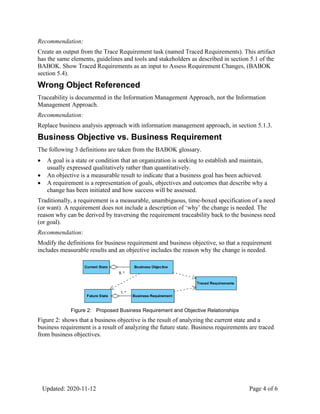
Figure 2: Proposed Business Requirement and Objective Relationships
Figure 2: shows that a business objective is the result of analyzing the current state and a
business requirement is a result of analyzing the future state. Business requirements are traced
from business objectives.
5.
Updated: 2020-11-12 Page5 of 6
Design Artifact
The Design artifact is only used where the Requirement artifact is used. The design artifact tasks
are named Assess Requirement Changes, Approve Requirements, Maintain Requirements, and
Trace Requirements (all show both Requirement and Design as inputs or outputs).
Designs are not shown as an input to Define Design Options. This is confusing, because it is not
obvious how Designs are related to Design Options. (I assume that there is no direct relationship
between a Design and a Design Option.)
Similarly, the Requirement and the Design Change Assessments are only used by the Assess
Requirement Change task. None of these tasks make a clear distinction between which elements
are design, and which are requirements.
The tasks descriptions using the Design and for the Design Change Assessment do not
distinguish between requirement and design elements, so these do not need to change.
Recommendation:
Combine the Requirement and Design artifacts (also Requirement and Design Change
Assessments) into a single artifact named Requirement (also Requirement Change Assessment).
Indicate that these artifacts include design components.
Alternatively, clearly show how Design and Design Option artifacts are related.
♦
Change Assessment
A Change Assessment is defined as ‘the recommendation to approve, modify, or deny a
proposed change to requirements.’
A Change Assessment is derived from a Proposed Change, by the Assess Requirement Changes
task, but it is not used as an input anywhere in the BABOK. Therefore it is not clear how the
Change Assessment impacts the requirements for the project.
Recommendation:
In section 5.4, add the result of the Proposed Change proposal as an element of the Change
Assessment.
In section 7.1.3, show the Change Assessment as an input to the specify and model requirements
task.
Risk analysis Result
Defined as ‘an understanding of the risks associated with achieving the future state, and the
mitigation strategies which will be used to prevent those risks, reduce the impact of the risk, or
reduce the likelihood of the risk occurring’. It appears that the BA is identifying and mitigating
project risks.
Recommendation:
6.
Updated: 2020-11-12 Page6 of 6
Explain the difference between a Risk Analysis Result and a Risk, and how they are related.
Define Future State
The Figure 6.2.1 shows Constraint as a guideline, but it is not described in section 6.2.
Recommendation:
Add Business Constraint as a guideline and tool to Section 6.2.5. Or identify the difference
between a Constraint and a Business Constraint in the glossary.