Promotion of a Universal Language of speech
                www.babilu.org
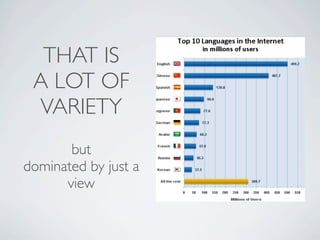
ABOUT 6.8 BILLION PEOPLE
communicate in over 6,809 different languages
THAT IS
 A LOT OF
 VARIETY
       but
dominated by just a
      view
BUT WHAT DOES THIS MEAN
   FOR OUR ECONOMY?
A ACADEMIC BACKED
             RESEARCH WORK
• reckoning   economical considerations of language

• was   initiated and conducted by the author (2007-2010)

• within
       the MBA Program of the Vienna University of
 Technology and the Vienna University of Economics and
 Business with the specialization on Entrepreneurship &
 Innovation.

• supervised and guided by Professor Nikolaus Franke, the
 director of the Institute for Entrepreneurship and Innovation
THE FOLLOWING FINDINGS
      GOT EXPOSED
Direct communication ability is a key to
     social and economic benefit
DIRECT COMMUNICATION
               ABILITY
•   Because language effects economic variables, earning and trade and
    economic processes effects language dynamics.

•   Despite the different language choices, preferences, suggested solutions or
    national language policy and regardless of the involved method, model or
    approach almost all research work share one common conclusion:

•   Direct communication abilities have higher economic benefits than involved
    costs and thereby an international auxiliary language would be of great benefit
    to the world. It is the desired, aimed, suggested, constructed, etc. solution, which
    is the focus and centre of discussion.

•   The question is now on the topic of “how” and “which” and not any
    more on “weather” to establish a language for global direct communication
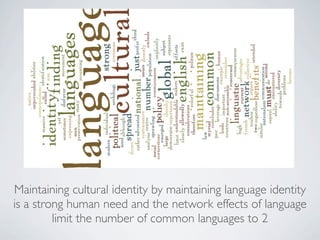
Maintaining cultural identity by maintaining language identity
is a strong human need and the network effects of language
         limit the number of common languages to 2
COLLECTIVE CULTURAL
                 CAPITAL
•   Although we have seen a very strong individual movement towards direct
    communication abilities and the benefits sprawling from this ability, the current
    centre of language policy is not on how to leverage this benefits, but rather on
    the preservation of cultural and linguistic diversity.

•   Why?

•   As language embeds cultural identification, sometimes being called “collective
    cultural capital” it became a very important subject for national, cultural and
    political identity.

•   Remember the French Toubon Law and the similar global discussions about the
    importance of linguistic issues to “modern” nationalism as cornerstone of the
    emerged national consciousness.
COLLECTIVE CULTURAL
                CAPITAL

•   These cultural considerations and some encountered Global English aversions
    are so high, that many Language Policy makers are just concerned with the
    spread of English and the allowedly massive political consequences of this
    spread.

•   Archibugi for example, who advocated the social advantages of DC therefore
    argues that “democratic politics must be in Esperanto” because he concludes
    that “cosmopolitans would prefer an impoverished but directly understandable
    language to a myriad of more colorful yet non-accessible languages” thereby
    clearly expressing his disfavor to Global English.
A COMMON TONGUE MUST
    BE SECOND TO THE NATIVE
•   Continuative further finding and analysis
    implicitly says that the problems of mounting
    and maintaining a language network are so
    large that, regardless of population size and
    number of languages, only two common
    languages can exist between any pair of
    countries.

•   This leads to the finding: A
    intended common language
    MUST be second and
    maximal third to the native
    language!
The future development of English as a global
language might be less straightforward than had
           been commonly assumed
ENGLISH AS LINGUA FRANCA

•   English is the current dominant candidate for
    an Universal Medium of Speech but without
    a cooperative environment and goal-oriented
    process English will not be globally adopted.

•   De Swaan declared the current changes to
    our global language system as a “blind
    process” and the “unintended consequences
    of a myriad of individual decisions (and non-
    decisions, resignation and compliance)” which
    selected Global English as the currently
    dominating language.
ENGLISH: A LINGUA FRANCA
       WITH CLEAR LIMITS
•   The importance and significance is undoubted, but the adoption of Global
    English is not an explicit one and

•   not accompanied within an committed process and

•   not within an goal oriented process and

•   not within an cooperative environment and

•   not continuously self-expanding

•   It is based on the current dominance and significance of English and on
    individual and unintended choices and is predicted to only have a potential of
    reaching a certain global literacy rate.
A entrepreneurial endeavour conveying a
 Universal Medium of Speech must be
             established
UNIVERSAL MEDIUM OF
             SPEECH


• We want to introduce an adopted terminology for such a
 global and universal language to distinguish from the legacy
 and to put the emphasis on the global ability to directly
 communicate regardless of the solution

• We   call this: An Universal Medium of Speech
THE BABILU VENTURE

• Based on the findings it is clearly not a language we are
 missing, but a commitment of adopting one with a
 preceding cognition and admission of the explicit need!

• Therefore we suggest a language and country independent,
 diversified venture with the chief aim of promoting such
 a Universal Medium of Speech!

• We   call our aim: The BABILU VENTURE
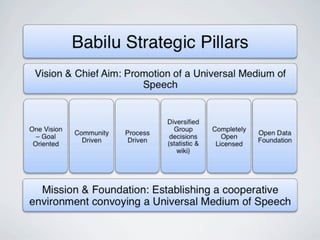
BABILU VISION

• The vision and
 foundation of the
 Babilu Venture is the
 establishment of a
 cooperative
 environment
 conveying a Universal
 Medium of Speech!
BABILU MISSION


• Establishing
             a
 philanthropic
 organization with the
 chief aim of promoting
 a Universal Medium of
 Speech.
GET INVOLVED!
PARTICIPATE!

• We have started a financing effort to raise money to be able
 to bring the Babilu idea to live.

• And   we are looking for:

   • professional  Investors or foundations with a significant
       funding potential enabling a first round of financing

   • talented   and dedicated contributors

• Don’t   forget we are at very early stage!
COPYRIGHT
•   Although the intention of this project is to use an open licence,
    for right now this does not apply!

•   The content and programs on this site are protected by
    copyright. All rights are reserved.

•   Parts of this presentation may contain images, texts or sounds
    that are subject to copyright of third parties.The copyright notices
    in these cases are noted in appropriate places. Information on this
    website, including text, images and sound, may not, unless
    expressly stated otherwise, reproduced, transferred, distributed or
    stored without the written permission of the publisher. This
    applies equally to all of us created templates. Modifications of the
    contents of this website and all it contains templates are expressly
    prohibited.

Babilu Venture

  • 1.
    Promotion of aUniversal Language of speech www.babilu.org
  • 2.
    ABOUT 6.8 BILLIONPEOPLE communicate in over 6,809 different languages
  • 3.
    THAT IS ALOT OF VARIETY but dominated by just a view
  • 4.
    BUT WHAT DOESTHIS MEAN FOR OUR ECONOMY?
  • 5.
    A ACADEMIC BACKED RESEARCH WORK • reckoning economical considerations of language • was initiated and conducted by the author (2007-2010) • within the MBA Program of the Vienna University of Technology and the Vienna University of Economics and Business with the specialization on Entrepreneurship & Innovation. • supervised and guided by Professor Nikolaus Franke, the director of the Institute for Entrepreneurship and Innovation
  • 6.
  • 7.
    Direct communication abilityis a key to social and economic benefit
  • 8.
    DIRECT COMMUNICATION ABILITY • Because language effects economic variables, earning and trade and economic processes effects language dynamics. • Despite the different language choices, preferences, suggested solutions or national language policy and regardless of the involved method, model or approach almost all research work share one common conclusion: • Direct communication abilities have higher economic benefits than involved costs and thereby an international auxiliary language would be of great benefit to the world. It is the desired, aimed, suggested, constructed, etc. solution, which is the focus and centre of discussion. • The question is now on the topic of “how” and “which” and not any more on “weather” to establish a language for global direct communication
  • 9.
    Maintaining cultural identityby maintaining language identity is a strong human need and the network effects of language limit the number of common languages to 2
  • 10.
    COLLECTIVE CULTURAL CAPITAL • Although we have seen a very strong individual movement towards direct communication abilities and the benefits sprawling from this ability, the current centre of language policy is not on how to leverage this benefits, but rather on the preservation of cultural and linguistic diversity. • Why? • As language embeds cultural identification, sometimes being called “collective cultural capital” it became a very important subject for national, cultural and political identity. • Remember the French Toubon Law and the similar global discussions about the importance of linguistic issues to “modern” nationalism as cornerstone of the emerged national consciousness.
  • 11.
    COLLECTIVE CULTURAL CAPITAL • These cultural considerations and some encountered Global English aversions are so high, that many Language Policy makers are just concerned with the spread of English and the allowedly massive political consequences of this spread. • Archibugi for example, who advocated the social advantages of DC therefore argues that “democratic politics must be in Esperanto” because he concludes that “cosmopolitans would prefer an impoverished but directly understandable language to a myriad of more colorful yet non-accessible languages” thereby clearly expressing his disfavor to Global English.
  • 12.
    A COMMON TONGUEMUST BE SECOND TO THE NATIVE • Continuative further finding and analysis implicitly says that the problems of mounting and maintaining a language network are so large that, regardless of population size and number of languages, only two common languages can exist between any pair of countries. • This leads to the finding: A intended common language MUST be second and maximal third to the native language!
  • 13.
    The future developmentof English as a global language might be less straightforward than had been commonly assumed
  • 14.
    ENGLISH AS LINGUAFRANCA • English is the current dominant candidate for an Universal Medium of Speech but without a cooperative environment and goal-oriented process English will not be globally adopted. • De Swaan declared the current changes to our global language system as a “blind process” and the “unintended consequences of a myriad of individual decisions (and non- decisions, resignation and compliance)” which selected Global English as the currently dominating language.
  • 15.
    ENGLISH: A LINGUAFRANCA WITH CLEAR LIMITS • The importance and significance is undoubted, but the adoption of Global English is not an explicit one and • not accompanied within an committed process and • not within an goal oriented process and • not within an cooperative environment and • not continuously self-expanding • It is based on the current dominance and significance of English and on individual and unintended choices and is predicted to only have a potential of reaching a certain global literacy rate.
  • 16.
    A entrepreneurial endeavourconveying a Universal Medium of Speech must be established
  • 17.
    UNIVERSAL MEDIUM OF SPEECH • We want to introduce an adopted terminology for such a global and universal language to distinguish from the legacy and to put the emphasis on the global ability to directly communicate regardless of the solution • We call this: An Universal Medium of Speech
  • 18.
    THE BABILU VENTURE •Based on the findings it is clearly not a language we are missing, but a commitment of adopting one with a preceding cognition and admission of the explicit need! • Therefore we suggest a language and country independent, diversified venture with the chief aim of promoting such a Universal Medium of Speech! • We call our aim: The BABILU VENTURE
  • 19.
    BABILU VISION • Thevision and foundation of the Babilu Venture is the establishment of a cooperative environment conveying a Universal Medium of Speech!
  • 20.
    BABILU MISSION • Establishing a philanthropic organization with the chief aim of promoting a Universal Medium of Speech.
  • 22.
  • 23.
    PARTICIPATE! • We havestarted a financing effort to raise money to be able to bring the Babilu idea to live. • And we are looking for: • professional Investors or foundations with a significant funding potential enabling a first round of financing • talented and dedicated contributors • Don’t forget we are at very early stage!
  • 24.
    COPYRIGHT • Although the intention of this project is to use an open licence, for right now this does not apply! • The content and programs on this site are protected by copyright. All rights are reserved. • Parts of this presentation may contain images, texts or sounds that are subject to copyright of third parties.The copyright notices in these cases are noted in appropriate places. Information on this website, including text, images and sound, may not, unless expressly stated otherwise, reproduced, transferred, distributed or stored without the written permission of the publisher. This applies equally to all of us created templates. Modifications of the contents of this website and all it contains templates are expressly prohibited.