BABAJANYAN MAKSIM
11-5
198 High School
William Saroyan was born on August 31,William Saroyan was born on August 31,
1908 in Fresno, California to Armenak1908 in Fresno, California to Armenak
and Takoohi Saroyan, Armenianand Takoohi Saroyan, Armenian
immigrants fromimmigrants from BitlisBitlis, Ottoman Empire., Ottoman Empire.
His father came to New York in 1905 andHis father came to New York in 1905 and
started preaching in Armenian Apostolicstarted preaching in Armenian Apostolic
Churches. In 1921 Saroyan attended theChurches. In 1921 Saroyan attended the
Technical School in order to learn to type.Technical School in order to learn to type.
At the age of three, after his father'sAt the age of three, after his father's
death, Saroyan, along with his brotherdeath, Saroyan, along with his brother
and sister, was placed in an orphanage inand sister, was placed in an orphanage in
Oakland, California. He later went on toOakland, California. He later went on to
describe his experience in the orphanagedescribe his experience in the orphanage
in his writings. Five years later, the familyin his writings. Five years later, the family
reunited in Fresno, where his mother,reunited in Fresno, where his mother,
Takoohi, had already secured work at aTakoohi, had already secured work at a
cannery. He continued his education oncannery. He continued his education on
his own, supporting himself with jobs,his own, supporting himself with jobs,
such as working as an office manager forsuch as working as an office manager for
the San Francisco Telegraph Company.the San Francisco Telegraph Company.

 Saroyan decided to become a
writer after his mother showed
him some of his father's
writings. A few of his early
short articles were published in
Overland Monthly. His first
stories appeared in the 1930s.
Among these was "The Broken
Wheel", written under the name
Sirak Goryan and published in
the Armenian journal Hairenik in
1933. Many of Saroyan's stories
were based on his childhood
experiences among the
Armenian-American fruit
growers of the San Joaquin
Valley or dealt with the root
lessness of the immigrant. The
short story collection My Name
is Aram (1940), an international
bestseller, was about a young
boy and the colorful characters
of his immigrant family. It has
been translated into many
languages. . In 1942 he was
posted to London in as a part of
a film unit and narrowly
avoided a court martial, when
his novel The Adventures of
Wesley Jackson (1946) turned out
to be pacifist.

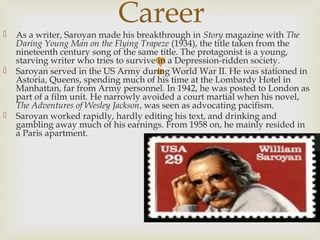
 As a writer, Saroyan made his breakthrough in Story magazine with The
Daring Young Man on the Flying Trapeze (1934), the title taken from the
nineteenth century song of the same title. The protagonist is a young,
starving writer who tries to survive in a Depression-ridden society.
 Saroyan served in the US Army during World War II. He was stationed in
Astoria, Queens, spending much of his time at the Lombardy Hotel in
Manhattan, far from Army personnel. In 1942, he was posted to London as
part of a film unit. He narrowly avoided a court martial when his novel,
The Adventures of Wesley Jackson, was seen as advocating pacifism.
 Saroyan worked rapidly, hardly editing his text, and drinking and
gambling away much of his earnings. From 1958 on, he mainly resided in
a Paris apartment.
Career
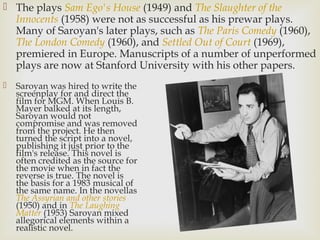
 Saroyan was hired to write the
screenplay for and direct the
film for MGM. When Louis B.
Mayer balked at its length,
Saroyan would not
compromise and was removed
from the project. He then
turned the script into a novel,
publishing it just prior to the
film's release. This novel is
often credited as the source for
the movie when in fact the
reverse is true. The novel is
the basis for a 1983 musical of
the same name. In the novellas
The Assyrian and other stories
(1950) and in The Laughing
Matter (1953) Saroyan mixed
allegorical elements within a
realistic novel.
 The plays Sam Ego's House (1949) and The Slaughter of the
Innocents (1958) were not as successful as his prewar plays.
Many of Saroyan's later plays, such as The Paris Comedy (1960),
The London Comedy (1960), and Settled Out of Court (1969),
premiered in Europe. Manuscripts of a number of unperformed
plays are now at Stanford University with his other papers.

Books
 The Daring Young Man on the
Flying Trapeze (1935)
 Inhale and Exhale (1936)
 Three Times Three (1936)
 Little Children (1937)
 The Trouble With Tigers (1938)
 Love Here Is My Hat (1938)
 My Name Is Aram (1940)
 The Human Comedy (1943)
 The Adventures of Wesley
Jackson (1946)
 Rock Wagram (1951)
 Tracy's Tiger (1952)
 The Bicycle Rider in Beverly
Hills (1952)
 The Laughing Matter (1953)
 Love (1955)
 Mama I Love You (1956)
 Papa You're Crazy (1957)
 Here Comes, There Goes, You
Know Who (1962)
 Gaston (1962)
 One Day in the Afternoon of the
World (1964)
 The Man with the Heart in the
Highlands and other stories (1968)
 Days of Life and Death and Escape
to the Moon (1970)
 Places Where I've Done Time 1972
(original printing possibly 1957)
 Chance Meetings (1978)
 Obituaries (1979)
 Births (1983)
 My name is Saroyan (1983)
 Madness in the Family (1988)
 Boys and Girls Together (1995)


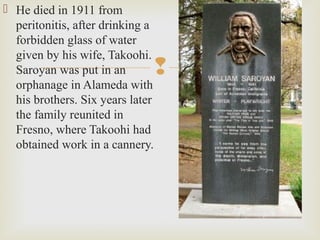
 He died in 1911 from
peritonitis, after drinking a
forbidden glass of water
given by his wife, Takoohi.
Saroyan was put in an
orphanage in Alameda with
his brothers. Six years later
the family reunited in
Fresno, where Takoohi had
obtained work in a cannery.

Babajanyan maksim

  • 1.
  • 2.
    William Saroyan wasborn on August 31,William Saroyan was born on August 31, 1908 in Fresno, California to Armenak1908 in Fresno, California to Armenak and Takoohi Saroyan, Armenianand Takoohi Saroyan, Armenian immigrants fromimmigrants from BitlisBitlis, Ottoman Empire., Ottoman Empire. His father came to New York in 1905 andHis father came to New York in 1905 and started preaching in Armenian Apostolicstarted preaching in Armenian Apostolic Churches. In 1921 Saroyan attended theChurches. In 1921 Saroyan attended the Technical School in order to learn to type.Technical School in order to learn to type. At the age of three, after his father'sAt the age of three, after his father's death, Saroyan, along with his brotherdeath, Saroyan, along with his brother and sister, was placed in an orphanage inand sister, was placed in an orphanage in Oakland, California. He later went on toOakland, California. He later went on to describe his experience in the orphanagedescribe his experience in the orphanage in his writings. Five years later, the familyin his writings. Five years later, the family reunited in Fresno, where his mother,reunited in Fresno, where his mother, Takoohi, had already secured work at aTakoohi, had already secured work at a cannery. He continued his education oncannery. He continued his education on his own, supporting himself with jobs,his own, supporting himself with jobs, such as working as an office manager forsuch as working as an office manager for the San Francisco Telegraph Company.the San Francisco Telegraph Company.
  • 3.
      Saroyan decidedto become a writer after his mother showed him some of his father's writings. A few of his early short articles were published in Overland Monthly. His first stories appeared in the 1930s. Among these was "The Broken Wheel", written under the name Sirak Goryan and published in the Armenian journal Hairenik in 1933. Many of Saroyan's stories were based on his childhood experiences among the Armenian-American fruit growers of the San Joaquin Valley or dealt with the root lessness of the immigrant. The short story collection My Name is Aram (1940), an international bestseller, was about a young boy and the colorful characters of his immigrant family. It has been translated into many languages. . In 1942 he was posted to London in as a part of a film unit and narrowly avoided a court martial, when his novel The Adventures of Wesley Jackson (1946) turned out to be pacifist.
  • 4.
      As awriter, Saroyan made his breakthrough in Story magazine with The Daring Young Man on the Flying Trapeze (1934), the title taken from the nineteenth century song of the same title. The protagonist is a young, starving writer who tries to survive in a Depression-ridden society.  Saroyan served in the US Army during World War II. He was stationed in Astoria, Queens, spending much of his time at the Lombardy Hotel in Manhattan, far from Army personnel. In 1942, he was posted to London as part of a film unit. He narrowly avoided a court martial when his novel, The Adventures of Wesley Jackson, was seen as advocating pacifism.  Saroyan worked rapidly, hardly editing his text, and drinking and gambling away much of his earnings. From 1958 on, he mainly resided in a Paris apartment. Career
  • 5.
     Saroyan washired to write the screenplay for and direct the film for MGM. When Louis B. Mayer balked at its length, Saroyan would not compromise and was removed from the project. He then turned the script into a novel, publishing it just prior to the film's release. This novel is often credited as the source for the movie when in fact the reverse is true. The novel is the basis for a 1983 musical of the same name. In the novellas The Assyrian and other stories (1950) and in The Laughing Matter (1953) Saroyan mixed allegorical elements within a realistic novel.  The plays Sam Ego's House (1949) and The Slaughter of the Innocents (1958) were not as successful as his prewar plays. Many of Saroyan's later plays, such as The Paris Comedy (1960), The London Comedy (1960), and Settled Out of Court (1969), premiered in Europe. Manuscripts of a number of unperformed plays are now at Stanford University with his other papers.
  • 6.
     Books  The DaringYoung Man on the Flying Trapeze (1935)  Inhale and Exhale (1936)  Three Times Three (1936)  Little Children (1937)  The Trouble With Tigers (1938)  Love Here Is My Hat (1938)  My Name Is Aram (1940)  The Human Comedy (1943)  The Adventures of Wesley Jackson (1946)  Rock Wagram (1951)  Tracy's Tiger (1952)  The Bicycle Rider in Beverly Hills (1952)  The Laughing Matter (1953)  Love (1955)  Mama I Love You (1956)  Papa You're Crazy (1957)  Here Comes, There Goes, You Know Who (1962)  Gaston (1962)  One Day in the Afternoon of the World (1964)  The Man with the Heart in the Highlands and other stories (1968)  Days of Life and Death and Escape to the Moon (1970)  Places Where I've Done Time 1972 (original printing possibly 1957)  Chance Meetings (1978)  Obituaries (1979)  Births (1983)  My name is Saroyan (1983)  Madness in the Family (1988)  Boys and Girls Together (1995)
  • 7.
  • 8.
      He diedin 1911 from peritonitis, after drinking a forbidden glass of water given by his wife, Takoohi. Saroyan was put in an orphanage in Alameda with his brothers. Six years later the family reunited in Fresno, where Takoohi had obtained work in a cannery.