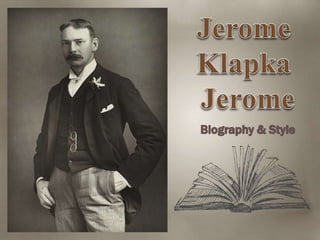
Jerome Klapka Jerome (1859 –1927)
He was an English writer and humourist.
The son of an ironmonger, a ruined
businessman, Jerome was born at Walsall
in Staffordshire.
Jerome's childhood was very difficult as his
parents were falling into financial ruin and
it left its mark on him.
He could not finish school because his father
died in 1871 and the boy had to begin
working to support his family.
With the help of his father’s old friend he got
the place of a clerk in the London Railway
Office and received two pounds a week.
Office work did not interest Jerome and he
took up teaching, journalism and acting.
His first literary success was a one-act
comedy that was performed in the Globe
Theatre.
Novels:
 Idle Thoughts of an Idle Fellow (1886)
 Three Men in a Boat (To Say Nothing of the Dog)
(1889)
 Diary of a Pilgrimage (1891)
 Second Thoughts of an Idle Fellow (1898)
 Three Men on the Bummel (a.k.a. Three Men on
Wheels) (1900)
 Paul Kelver, a novel (1902)
 All Roads Lead to Calvary (1919)
Short stories :
The Haunted Mill
The New Utopia
The Dancing Partner
Evergreens
Silhouettes
The Skeleton
The Snake
The Woman of the
Saeter
Christmas Eve in the
Blue Chamber
Jerome’s writing is much more magazine-
style, quick and efficient.
His works is characterized by the garrulous
style of genial wit and wisdom
Jerome gives picturesque and vivid
descriptions created with the colourful
metaphors and different similes.
He shows us a developing situation as if he
had no prior knowledge of the
consequences; when they emerge we
recognize the funny side for ourselves.
Jerome K. Jerome’s writing style is
characterized by
Satire
Droll and straight-faced style – he
does not laugh at his own humour
Self-mockery, and embarrassing
truths we can all relate to.
His vivid style and his humour which is
generally expressed in laughter-
provoking situations. So the humour is
often based on:
Exaggerations
Incongruity
Misunderstandings
Incongruity – opposition to the order
of things – provides humour by
placing a normal action or remark in
the wrong context and, in Jerome’s
style, in an understated way.

Jerome K. Jerome.

  • 2.
    Jerome Klapka Jerome(1859 –1927) He was an English writer and humourist. The son of an ironmonger, a ruined businessman, Jerome was born at Walsall in Staffordshire. Jerome's childhood was very difficult as his parents were falling into financial ruin and it left its mark on him.
  • 3.
    He could notfinish school because his father died in 1871 and the boy had to begin working to support his family. With the help of his father’s old friend he got the place of a clerk in the London Railway Office and received two pounds a week. Office work did not interest Jerome and he took up teaching, journalism and acting. His first literary success was a one-act comedy that was performed in the Globe Theatre.
  • 4.
    Novels:  Idle Thoughtsof an Idle Fellow (1886)  Three Men in a Boat (To Say Nothing of the Dog) (1889)  Diary of a Pilgrimage (1891)  Second Thoughts of an Idle Fellow (1898)  Three Men on the Bummel (a.k.a. Three Men on Wheels) (1900)  Paul Kelver, a novel (1902)  All Roads Lead to Calvary (1919)
  • 5.
    Short stories : TheHaunted Mill The New Utopia The Dancing Partner Evergreens Silhouettes The Skeleton The Snake The Woman of the Saeter Christmas Eve in the Blue Chamber
  • 6.
    Jerome’s writing ismuch more magazine- style, quick and efficient. His works is characterized by the garrulous style of genial wit and wisdom Jerome gives picturesque and vivid descriptions created with the colourful metaphors and different similes. He shows us a developing situation as if he had no prior knowledge of the consequences; when they emerge we recognize the funny side for ourselves.
  • 7.
    Jerome K. Jerome’swriting style is characterized by Satire Droll and straight-faced style – he does not laugh at his own humour Self-mockery, and embarrassing truths we can all relate to.
  • 8.
    His vivid styleand his humour which is generally expressed in laughter- provoking situations. So the humour is often based on: Exaggerations Incongruity Misunderstandings
  • 9.
    Incongruity – oppositionto the order of things – provides humour by placing a normal action or remark in the wrong context and, in Jerome’s style, in an understated way.