Dental Implant
Restoration
Principles and Procedures
Stuart H. Jacobs
Brian C. O’Connell
London, Berlin, Chicago,Tokyo, Barcelona, Beijing, Istanbul, Milan,
Moscow, New Delhi, Paris, Prague, São Paulo, Seoul and Warsaw
V
Contents
Contents
1 Introduction 1
Basic structure of an implant assembly 5
Theory of osseointegration 7
Factors influencing osseointegration of implants 8
Economics of implant dentistry 15
PART I
2 Patient Education 19
Patient consent 25
3 Diagnosis 27
Age of the patient 29
Medical history 29
Medical history: overview 32
Extraoral examination 32
Intraoral examination 34
4 ImplantTreatment Planning 51
Study casts 53
Diagnostic waxup 53
Number of implants 55
Position of implants 60
Selection of implants 62
Surgical site development 72
Surgical guide construction 79
5 RestorativeTreatment Planning 83
Provisional restorations 85
Comparison of cement and screws as retainers for prostheses 95
Occlusal schemes for implant restorations 97
Abutment types 98
6 Instruments and Components 109
Drivers 111
Provisional healing abutments 113
Screws 116
7 Overdentures 119
Mandibular overdenture 122
Assessment of patients for overdentures 122
Clinical procedures for overdentures 122
Overdenture attachments 126
8 Immediate Loading of Implants 133
Multiple implants 135
Single implants 140
VI
Contents
PART II
9 Single-tooth Restoration Using a DirectTechnique with a Preparable Abutment 143
Materials and components 145
Procedure 145
10 Single-tooth Restoration Using an IndirectTechnique with a Preparable Abutment 155
Materials and components 157
Procedure 157
11 Cemented Single-tooth Restoration Using a UCLA Abutment 169
Materials and components 171
Procedure 171
12 Screw-retained Single Restoration Using a Conical Abutment 183
Material and components required 185
Procedure 185
13 Single-unit Alternative ImpressionTechnique Using
Transfer Copings (Closed-trayTechnique) 197
Procedure 199
14 Multi-unit Restoration Using a DirectTechnique
with Preparable Abutments (Metal or Ceramic) 205
Materials and components 207
Procedure 207
15 Multi-unit Restoration Using an IndirectTechnique
with Preparable Abutments (Metal or Ceramic) 217
Materials and components 219
Procedure 219
16 Multi-unit Restoration Using UCLA Abutments 231
Materials and components 233
Procedure 233
17 Multi-unit Restoration Using Conical Abutments 245
Material and components required 247
Procedure 247
18 Multi-unit Restoration Alternative ImpressionTechnique
UsingTransfer Copings (Closed-trayTechnique) 259
19 Troubleshooting 267
Screw loosening 269
Porcelain or acrylic resin fracture of the superstructure 271
Tilted teeth 272
Screw fracture 272
Speech 273
Aesthetics 273
Maintenance after treatment 274
References and Index 275
VII
Acknowledgements
Acknowledgements
The authors would like to thank Dee McLean for her invaluable assistance creating the wonderful line
drawings, and Robyn Pierce and Lisa Adams for providing some of the component drawings.
There have been many dental colleagues who have provided us with invaluable advice and al-
lowed us to show some of their cases. We are particularly indebted to Spencer Woolfe, Frank Hous-
ton, PJ Byrne, James Invest, Pranay Sharma, Ali Parvizi, Michael O’Sullivan, Johnny Fearon, Seamus
Sharkey, Maire Brennan,Tom Canning, Maurice Fitzgerald, Padraig McAuliffe, Rebecca Carville, Nicky
Mahon, Roberto Cochetto and Par-Olav Ostman.
We are grateful to Dr Richard Lazarra for agreeing to write a foreword for this book and to Biomet
3i for their assistance with technical information.
Finally this book is dedicated to our families, Jane, Adam, Emily, Anne, Ailis, Ellen, and Brendan,
without whose incredible patience, understanding and tolerance we would not have been able to
complete this project.
Stuart H. Jacobs
Brian C. O’Connell
VIII
Foreword
Foreword
The purpose of this book is to give the dental practitioner, undergraduate and postgraduate student a
basic understanding of implant dentistry and to provide an outline of the planning that is required to
produce a successful aesthetic and functional result.
The scope of the text encompasses a general overview of the theory of osseointegration, the
knowledge required to diagnose a patient for implant treatment and to plan a case.This includes the
important interactions with surgical colleagues and laboratories. Much of the text consists of a practi-
cal guide for simple implant restorations using techniques that are currently available and commonly
used.
The bibliography provided will allow the reader to further investigate the literature and to widen
his knowledge. Implant dentistry is continually evolving and I feel that this book is a good starting
point and serves as a foundation for all practitioners and students.
Sincerely,
Richard Lazzara
PART I
Diagnosis and
Treatment Planning
Introduction
11
12
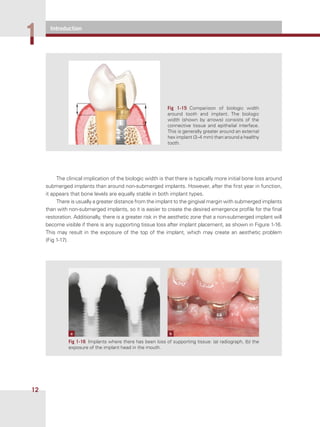
The clinical implication of the biologic width is that there is typically more initial bone loss around
submerged implants than around non-submerged implants. However, after the first year in function,
it appears that bone levels are equally stable in both implant types.
There is usually a greater distance from the implant to the gingival margin with submerged implants
than with non-submerged implants, so it is easier to create the desired emergence profile for the final
restoration. Additionally, there is a greater risk in the aesthetic zone that a non-submerged implant will
become visible if there is any supporting tissue loss after implant placement, as shown in Figure 1-16.
This may result in the exposure of the top of the implant, which may create an aesthetic problem
(Fig 1-17).
Fig  1-15 Comparison of biologic width
around tooth and implant. The biologic
width (shown by arrows) consists of the
connective tissue and epithelial interface.
This is generally greater around an external
hex implant (3–4 mm) than around a healthy
tooth.
Fig 1-16 Implants where there has been loss of supporting tissue: (a) radiograph, (b) the
exposure of the implant head in the mouth.
a b
Factors influencing osseointegration of implants
11
13
Platform switching
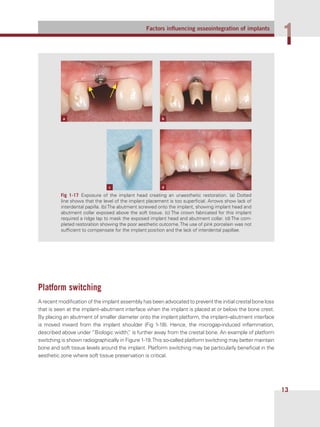
A recent modification of the implant assembly has been advocated to prevent the initial crestal bone loss
that is seen at the implant–abutment interface when the implant is placed at or below the bone crest.
By placing an abutment of smaller diameter onto the implant platform, the implant–abutment interface
is moved inward from the implant shoulder (Fig 1-18). Hence, the microgap-induced inflammation,
described above under “Biologic width,” is further away from the crestal bone. An example of platform
switching is shown radiographically in Figure 1-19.This so-called platform switching may better maintain
bone and soft tissue levels around the implant. Platform switching may be particularly beneficial in the
aesthetic zone where soft tissue preservation is critical.
Fig  1-17 Exposure of the implant head creating an unaesthetic restoration. (a) Dotted
line shows that the level of the implant placement is too superficial. Arrows show lack of
interdental papilla. (b)The abutment screwed onto the implant, showing implant head and
abutment collar exposed above the soft tissue. (c) The crown fabricated for this implant
required a ridge lap to mask the exposed implant head and abutment collar. (d) The com-
pleted restoration showing the poor aesthetic outcome.The use of pink porcelain was not
sufficient to compensate for the implant position and the lack of interdental papillae.
a b
dc
Restorative Treatment Planning
55
94
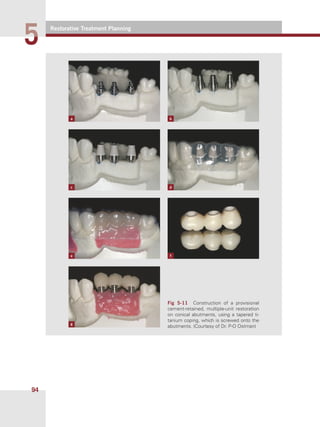
Fig  5-11    Construction of a provisional
cement-retained, multiple-unit restoration
on conical abutments, using a tapered ti-
tanium coping, which is screwed onto the
abutments. (Courtesy of Dr. P-O Ostman)
a b
dc
g
e f
Comparison of cement and screws as retainers for prostheses
55
95
Comparison of cement and screws as retainers
for prostheses
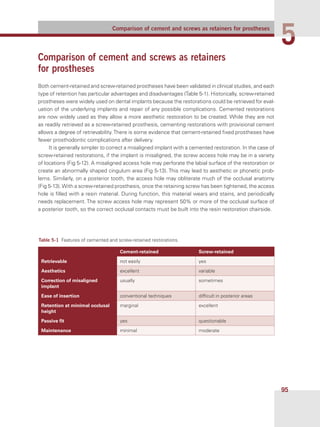
Both cement-retained and screw-retained prostheses have been validated in clinical studies, and each
type of retention has particular advantages and disadvantages (Table 5-1). Historically, screw-retained
prostheses were widely used on dental implants because the restorations could be retrieved for eval-
uation of the underlying implants and repair of any possible complications. Cemented restorations
are now widely used as they allow a more aesthetic restoration to be created. While they are not
as readily retrieved as a screw-retained prosthesis, cementing restorations with provisional cement
allows a degree of retrievability.There is some evidence that cement-retained fixed prostheses have
fewer prosthodontic complications after delivery.
It is generally simpler to correct a misaligned implant with a cemented restoration. In the case of
screw-retained restorations, if the implant is misaligned, the screw access hole may be in a variety
of locations (Fig 5-12). A misaligned access hole may perforate the labial surface of the restoration or
create an abnormally shaped cingulum area (Fig 5-13). This may lead to aesthetic or phonetic prob-
lems. Similarly, on a posterior tooth, the access hole may obliterate much of the occlusal anatomy
(Fig 5-13).With a screw-retained prosthesis, once the retaining screw has been tightened, the access
hole is filled with a resin material. During function, this material wears and stains, and periodically
needs replacement. The screw access hole may represent 50% or more of the occlusal surface of
a posterior tooth, so the correct occlusal contacts must be built into the resin restoration chairside.
Cement-retained Screw-retained
retrievable not easily yes
aesthetics excellent variable
Correction of misaligned
implant
usually sometimes
ease of insertion conventional techniques difficult in posterior areas
retention at minimal occlusal
height
marginal excellent
passive fit yes questionable
Maintenance minimal moderate
Table 5-1  Features of cemented and screw-retained restorations.
Single-tooth Restoration Using a Direct Technique with a Preparable Abutment
99
146
external internal
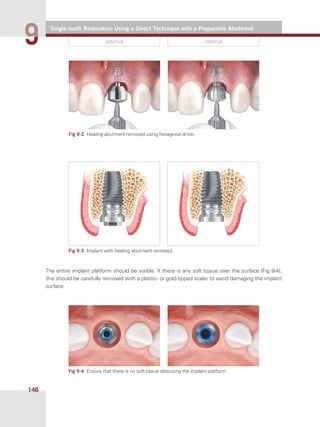
The entire implant platform should be visible. If there is any soft tissue over the surface (Fig 9-4),
this should be carefully removed with a plastic- or gold-tipped scaler to avoid damaging the implant
surface.
Fig 9-3  Implant with healing abutment removed.
Fig 9-4  Ensure that there is no soft tissue obscuring the implant platform.
Fig 9-2  Healing abutment removed using hexagonal driver.
Procedure
99
147
external internal
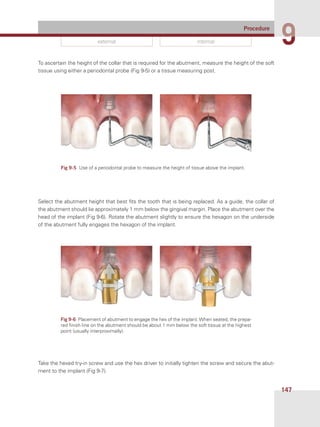
To ascertain the height of the collar that is required for the abutment, measure the height of the soft
tissue using either a periodontal probe (Fig 9-5) or a tissue measuring post.
Select the abutment height that best fits the tooth that is being replaced. As a guide, the collar of
the abutment should lie approximately 1 mm below the gingival margin. Place the abutment over the
head of the implant (Fig 9-6). Rotate the abutment slightly to ensure the hexagon on the underside
of the abutment fully engages the hexagon of the implant.
Take the hexed try-in screw and use the hex driver to initially tighten the screw and secure the abut-
ment to the implant (Fig 9-7).
Fig 9-5  Use of a periodontal probe to measure the height of tissue above the implant.
Fig 9-6  Placement of abutment to engage the hex of the implant.When seated, the prepa-
red finish line on the abutment should be about 1 mm below the soft tissue at the highest
point (usually interproximally).

B8842

  • 1.
    Dental Implant Restoration Principles andProcedures Stuart H. Jacobs Brian C. O’Connell London, Berlin, Chicago,Tokyo, Barcelona, Beijing, Istanbul, Milan, Moscow, New Delhi, Paris, Prague, São Paulo, Seoul and Warsaw
  • 3.
    V Contents Contents 1 Introduction 1 Basicstructure of an implant assembly 5 Theory of osseointegration 7 Factors influencing osseointegration of implants 8 Economics of implant dentistry 15 PART I 2 Patient Education 19 Patient consent 25 3 Diagnosis 27 Age of the patient 29 Medical history 29 Medical history: overview 32 Extraoral examination 32 Intraoral examination 34 4 ImplantTreatment Planning 51 Study casts 53 Diagnostic waxup 53 Number of implants 55 Position of implants 60 Selection of implants 62 Surgical site development 72 Surgical guide construction 79 5 RestorativeTreatment Planning 83 Provisional restorations 85 Comparison of cement and screws as retainers for prostheses 95 Occlusal schemes for implant restorations 97 Abutment types 98 6 Instruments and Components 109 Drivers 111 Provisional healing abutments 113 Screws 116 7 Overdentures 119 Mandibular overdenture 122 Assessment of patients for overdentures 122 Clinical procedures for overdentures 122 Overdenture attachments 126 8 Immediate Loading of Implants 133 Multiple implants 135 Single implants 140
  • 4.
    VI Contents PART II 9 Single-toothRestoration Using a DirectTechnique with a Preparable Abutment 143 Materials and components 145 Procedure 145 10 Single-tooth Restoration Using an IndirectTechnique with a Preparable Abutment 155 Materials and components 157 Procedure 157 11 Cemented Single-tooth Restoration Using a UCLA Abutment 169 Materials and components 171 Procedure 171 12 Screw-retained Single Restoration Using a Conical Abutment 183 Material and components required 185 Procedure 185 13 Single-unit Alternative ImpressionTechnique Using Transfer Copings (Closed-trayTechnique) 197 Procedure 199 14 Multi-unit Restoration Using a DirectTechnique with Preparable Abutments (Metal or Ceramic) 205 Materials and components 207 Procedure 207 15 Multi-unit Restoration Using an IndirectTechnique with Preparable Abutments (Metal or Ceramic) 217 Materials and components 219 Procedure 219 16 Multi-unit Restoration Using UCLA Abutments 231 Materials and components 233 Procedure 233 17 Multi-unit Restoration Using Conical Abutments 245 Material and components required 247 Procedure 247 18 Multi-unit Restoration Alternative ImpressionTechnique UsingTransfer Copings (Closed-trayTechnique) 259 19 Troubleshooting 267 Screw loosening 269 Porcelain or acrylic resin fracture of the superstructure 271 Tilted teeth 272 Screw fracture 272 Speech 273 Aesthetics 273 Maintenance after treatment 274 References and Index 275
  • 5.
    VII Acknowledgements Acknowledgements The authors wouldlike to thank Dee McLean for her invaluable assistance creating the wonderful line drawings, and Robyn Pierce and Lisa Adams for providing some of the component drawings. There have been many dental colleagues who have provided us with invaluable advice and al- lowed us to show some of their cases. We are particularly indebted to Spencer Woolfe, Frank Hous- ton, PJ Byrne, James Invest, Pranay Sharma, Ali Parvizi, Michael O’Sullivan, Johnny Fearon, Seamus Sharkey, Maire Brennan,Tom Canning, Maurice Fitzgerald, Padraig McAuliffe, Rebecca Carville, Nicky Mahon, Roberto Cochetto and Par-Olav Ostman. We are grateful to Dr Richard Lazarra for agreeing to write a foreword for this book and to Biomet 3i for their assistance with technical information. Finally this book is dedicated to our families, Jane, Adam, Emily, Anne, Ailis, Ellen, and Brendan, without whose incredible patience, understanding and tolerance we would not have been able to complete this project. Stuart H. Jacobs Brian C. O’Connell
  • 6.
    VIII Foreword Foreword The purpose ofthis book is to give the dental practitioner, undergraduate and postgraduate student a basic understanding of implant dentistry and to provide an outline of the planning that is required to produce a successful aesthetic and functional result. The scope of the text encompasses a general overview of the theory of osseointegration, the knowledge required to diagnose a patient for implant treatment and to plan a case.This includes the important interactions with surgical colleagues and laboratories. Much of the text consists of a practi- cal guide for simple implant restorations using techniques that are currently available and commonly used. The bibliography provided will allow the reader to further investigate the literature and to widen his knowledge. Implant dentistry is continually evolving and I feel that this book is a good starting point and serves as a foundation for all practitioners and students. Sincerely, Richard Lazzara
  • 7.
  • 8.
    Introduction 11 12 The clinical implicationof the biologic width is that there is typically more initial bone loss around submerged implants than around non-submerged implants. However, after the first year in function, it appears that bone levels are equally stable in both implant types. There is usually a greater distance from the implant to the gingival margin with submerged implants than with non-submerged implants, so it is easier to create the desired emergence profile for the final restoration. Additionally, there is a greater risk in the aesthetic zone that a non-submerged implant will become visible if there is any supporting tissue loss after implant placement, as shown in Figure 1-16. This may result in the exposure of the top of the implant, which may create an aesthetic problem (Fig 1-17). Fig  1-15 Comparison of biologic width around tooth and implant. The biologic width (shown by arrows) consists of the connective tissue and epithelial interface. This is generally greater around an external hex implant (3–4 mm) than around a healthy tooth. Fig 1-16 Implants where there has been loss of supporting tissue: (a) radiograph, (b) the exposure of the implant head in the mouth. a b
  • 9.
    Factors influencing osseointegrationof implants 11 13 Platform switching A recent modification of the implant assembly has been advocated to prevent the initial crestal bone loss that is seen at the implant–abutment interface when the implant is placed at or below the bone crest. By placing an abutment of smaller diameter onto the implant platform, the implant–abutment interface is moved inward from the implant shoulder (Fig 1-18). Hence, the microgap-induced inflammation, described above under “Biologic width,” is further away from the crestal bone. An example of platform switching is shown radiographically in Figure 1-19.This so-called platform switching may better maintain bone and soft tissue levels around the implant. Platform switching may be particularly beneficial in the aesthetic zone where soft tissue preservation is critical. Fig  1-17 Exposure of the implant head creating an unaesthetic restoration. (a) Dotted line shows that the level of the implant placement is too superficial. Arrows show lack of interdental papilla. (b)The abutment screwed onto the implant, showing implant head and abutment collar exposed above the soft tissue. (c) The crown fabricated for this implant required a ridge lap to mask the exposed implant head and abutment collar. (d) The com- pleted restoration showing the poor aesthetic outcome.The use of pink porcelain was not sufficient to compensate for the implant position and the lack of interdental papillae. a b dc
  • 10.
    Restorative Treatment Planning 55 94 Fig 5-11    Construction of a provisional cement-retained, multiple-unit restoration on conical abutments, using a tapered ti- tanium coping, which is screwed onto the abutments. (Courtesy of Dr. P-O Ostman) a b dc g e f
  • 11.
    Comparison of cementand screws as retainers for prostheses 55 95 Comparison of cement and screws as retainers for prostheses Both cement-retained and screw-retained prostheses have been validated in clinical studies, and each type of retention has particular advantages and disadvantages (Table 5-1). Historically, screw-retained prostheses were widely used on dental implants because the restorations could be retrieved for eval- uation of the underlying implants and repair of any possible complications. Cemented restorations are now widely used as they allow a more aesthetic restoration to be created. While they are not as readily retrieved as a screw-retained prosthesis, cementing restorations with provisional cement allows a degree of retrievability.There is some evidence that cement-retained fixed prostheses have fewer prosthodontic complications after delivery. It is generally simpler to correct a misaligned implant with a cemented restoration. In the case of screw-retained restorations, if the implant is misaligned, the screw access hole may be in a variety of locations (Fig 5-12). A misaligned access hole may perforate the labial surface of the restoration or create an abnormally shaped cingulum area (Fig 5-13). This may lead to aesthetic or phonetic prob- lems. Similarly, on a posterior tooth, the access hole may obliterate much of the occlusal anatomy (Fig 5-13).With a screw-retained prosthesis, once the retaining screw has been tightened, the access hole is filled with a resin material. During function, this material wears and stains, and periodically needs replacement. The screw access hole may represent 50% or more of the occlusal surface of a posterior tooth, so the correct occlusal contacts must be built into the resin restoration chairside. Cement-retained Screw-retained retrievable not easily yes aesthetics excellent variable Correction of misaligned implant usually sometimes ease of insertion conventional techniques difficult in posterior areas retention at minimal occlusal height marginal excellent passive fit yes questionable Maintenance minimal moderate Table 5-1  Features of cemented and screw-retained restorations.
  • 12.
    Single-tooth Restoration Usinga Direct Technique with a Preparable Abutment 99 146 external internal The entire implant platform should be visible. If there is any soft tissue over the surface (Fig 9-4), this should be carefully removed with a plastic- or gold-tipped scaler to avoid damaging the implant surface. Fig 9-3  Implant with healing abutment removed. Fig 9-4  Ensure that there is no soft tissue obscuring the implant platform. Fig 9-2  Healing abutment removed using hexagonal driver.
  • 13.
    Procedure 99 147 external internal To ascertainthe height of the collar that is required for the abutment, measure the height of the soft tissue using either a periodontal probe (Fig 9-5) or a tissue measuring post. Select the abutment height that best fits the tooth that is being replaced. As a guide, the collar of the abutment should lie approximately 1 mm below the gingival margin. Place the abutment over the head of the implant (Fig 9-6). Rotate the abutment slightly to ensure the hexagon on the underside of the abutment fully engages the hexagon of the implant. Take the hexed try-in screw and use the hex driver to initially tighten the screw and secure the abut- ment to the implant (Fig 9-7). Fig 9-5  Use of a periodontal probe to measure the height of tissue above the implant. Fig 9-6  Placement of abutment to engage the hex of the implant.When seated, the prepa- red finish line on the abutment should be about 1 mm below the soft tissue at the highest point (usually interproximally).