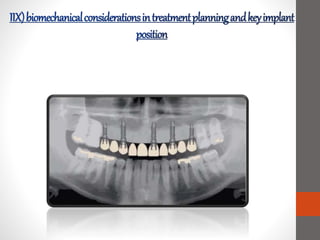
I) Introduction to biomechanics
1) Biomechanics comprises of all kinds of interactions between
tissues and forces acting on them.
It’s the response of the biologic tissues to the applied loads.
>>>Dental implants function to transfer load to surrounding
biological tissues.
2) Thus the primary functional design objective >>>
a- to dissipate and distribute the biting forces
b- and deliver them safely to interfacial tissues over the long
term.
so , ...
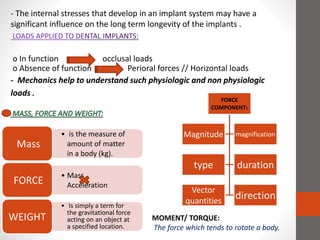
- The internal stresses that develop in an implant system may have a
significant influence on the long term longevity of the implants .
o In function occlusal loads
o Absence of function Perioral forces // Horizontal loads
- Mechanics help to understand such physiologic and non physiologic
loads .
• is the measure of
amount of matter
in a body (kg).
Mass
• Mass
AccelerationFORCE
• Is simply a term for
the gravitational force
acting on an object at
a specified location.
WEIGHT
FORCE
COMPONENTS
Magnitude magnification
type duration
Vector
quantities
direction
MOMENT/ TORQUE:
The force which tends to rotate a body.
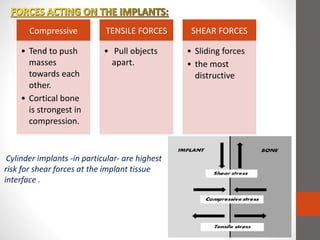
Compressive
• Tend to push
masses
towards each
other.
• Cortical bone
is strongest in
compression.
TENSILE FORCES
• Pull objects
apart.
SHEAR FORCES
• Sliding forces
• the most
distructive
Cylinder implants -in particular- are highest
risk for shear forces at the implant tissue
interface .
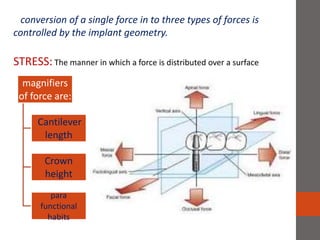
conversion of a single force in to three types of forces is
controlled by the implant geometry.
STRESS: The manner in which a force is distributed over a surface
magnifiers
of force are:
Cantilever
length
Crown
height
para
functional
habits
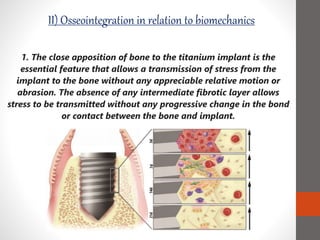
1. The close apposition of bone to the titanium implant is the
essential feature that allows a transmission of stress from the
implant to the bone without any appreciable relative motion or
abrasion. The absence of any intermediate fibrotic layer allows
stress to be transmitted without any progressive change in the bond
or contact between the bone and implant.
II) Osseointegration in relation to biomechanics
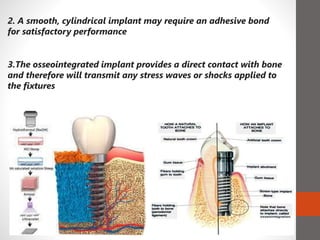
2. A smooth, cylindrical implant may require an adhesive bond
for satisfactory performance
3.The osseointegrated implant provides a direct contact with bone
and therefore will transmit any stress waves or shocks applied to
the fixtures
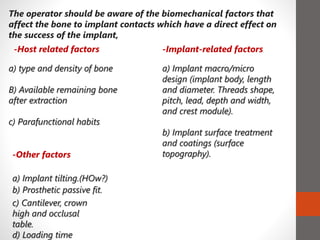
The operator should be aware of the biomechanical factors that
affect the bone to implant contacts which have a direct effect on
the success of the implant,
a) type and density of bone
B) Available remaining bone
after extraction
c) Parafunctional habits
-Other factors
a) Implant tilting.(HOw?)
b) Prosthetic passive fit.
a) Implant macro/micro
design (implant body, length
and diameter. Threads shape,
pitch, lead, depth and width,
and crest module).
b) Implant surface treatment
and coatings (surface
topography).
c) Cantilever, crown
high and occlusal
table.
d) Loading time
-Implant-related factors-Host related factors
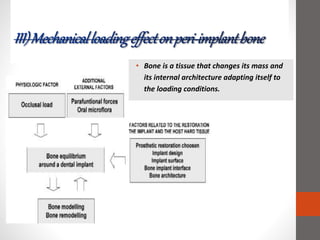
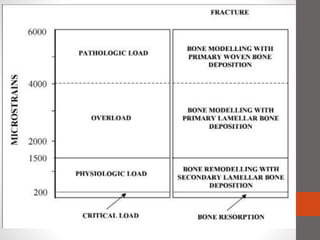
• Bone is a tissue that changes its mass and
its internal architecture adapting itself to
the loading conditions.
• Bone remodeling oral implantology
Success and longevity of dental implants?
Relationship between *implant components
*surroundin g oral tissues
• peri-implant bone remodeling begins:
1-implant is exposed to oral cavity in second stage surgery
2-when the abutment is placed immediately after implant
placement
• Decrease in bone volume is inevitable
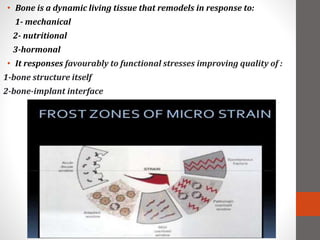
• Bone is a dynamic living tissue that remodels in response to:
1- mechanical
2- nutritional
3-hormonal
• It responses favourably to functional stresses improving quality of :
1-bone structure itself
2-bone-implant interface
>>
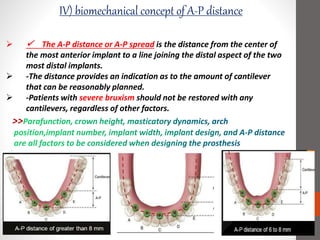
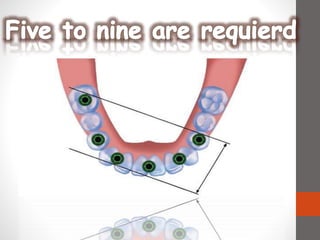
IV) biomechanical concept of A-P distance
 The A-P distance or A-P spread is the distance from the center of
the most anterior implant to a line joining the distal aspect of the two
most distal implants.
 -The distance provides an indication as to the amount of cantilever
that can be reasonably planned.
 -Patients with severe bruxism should not be restored with any
cantilevers, regardless of other factors.
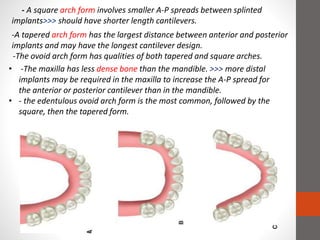
-The ovoid arch form has qualities of both tapered and square arches.
• -The maxilla has less dense bone than the mandible. more distal
implants may be required in the maxilla to increase the A-P spread for
the anterior or posterior cantilever than in the mandible.
• - the edentulous ovoid arch form is the most common, followed by the
square, then the tapered form.
- A square arch form involves smaller A-P spreads between splinted
implants should have shorter length cantilevers.
-A tapered arch form has the largest distance between anterior and posterior
implants and may have the longest cantilever design.
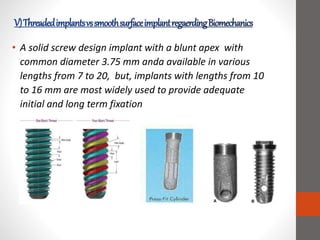
• A solid screw design implant with a blunt apex with
common diameter 3.75 mm anda available in various
lengths from 7 to 20, but, implants with lengths from 10
to 16 mm are most widely used to provide adequate
initial and long term fixation
**Asolidscrewpermitspreparationandplacementofthe
implantindensecorticalboneaswellasfinetrabecularbone
(thesurgerymaybeeasilymodifiedtoaccommodateboth
extremes).
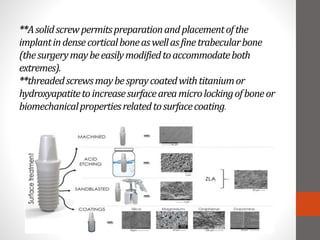
**threadedscrewsmaybespraycoatedwithtitaniumor
hydroxyapatitetoincreasesurfaceareamicrolockingofboneor
biomechanicalpropertiesrelatedtosurfacecoating.
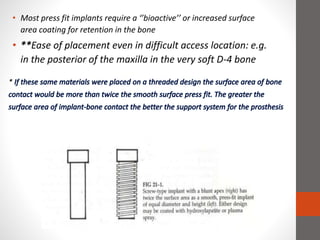
• Most press fit implants require a ‘’bioactive’’ or increased surface
area coating for retention in the bone
• **Ease of placement even in difficult access location: e.g.
in the posterior of the maxilla in the very soft D-4 bone
*
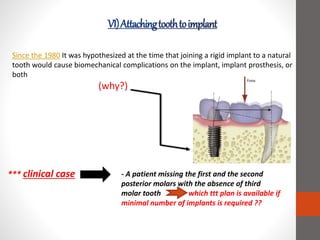
Since the 1980 It was hypothesized at the time that joining a rigid implant to a natural
tooth would cause biomechanical complications on the implant, implant prosthesis, or
both
(why?)
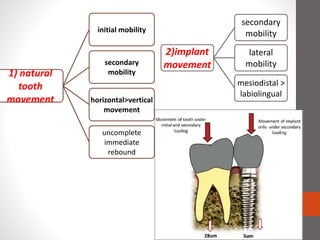
*** clinical case - A patient missing the first and the second
posterior molars with the absence of third
molar tooth which ttt plan is available if
minimal number of implants is required ??
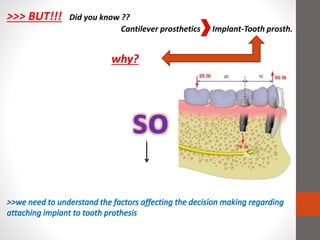
>>> BUT!!! Did you know ??
Cantilever prosthetics Implant-Tooth prosth.
why?
so
2)implant
movement
secondary
mobility
lateral
mobility
mesiodistal >
labiolingual
1) natural
tooth
movement
initial mobility
secondary
mobility
horizontal>vertical
movement
uncomplete
immediate
rebound
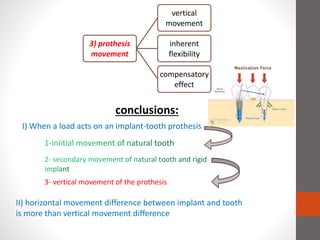
conclusions:
I) When a load acts on an implant-tooth prothesis
3- vertical movement of the prothesis
II) horizontal movement difference between implant and tooth
is more than vertical movement difference
3) prothesis
movement
vertical
movement
inherent
flexibility
compensatory
effect
when no onther treatment options are available an implant tooth prothesis can be
the treatment of choice
guidelines affecting the decision making
1) no lateral forces on the prothesis
2) no clinical mobility of the abutment teeth
3) modification of occlusion minimum initial forces on the
implant
4) avoid using anterior abutments why?
5) when there is clinical mobility of the abutments
options??
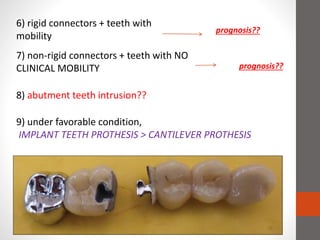
6) rigid connectors + teeth with
mobility
prognosis??
7) non-rigid connectors + teeth with NO
CLINICAL MOBILITY prognosis??
8) abutment teeth intrusion??
9) under favorable condition,
IMPLANT TEETH PROTHESIS > CANTILEVER PROTHESIS
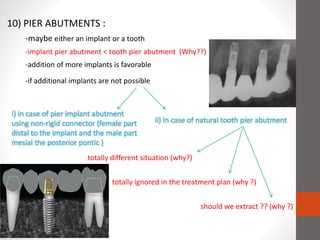
10) PIER ABUTMENTS :
-maybe either an implant or a tooth
-implant pier abutment < tooth pier abutment (Why??)
-addition of more implants is favorable
-if additional implants are not possible
i) in case of pier implant abutment
using non-rigid connector (female part
distal to the implant and the male part
mesial the posterior pontic )
ii) in case of natural tooth pier abutment
totally different situation (why?)
totally ignored in the treatment plan (why ?)
should we extract ?? (why ?)
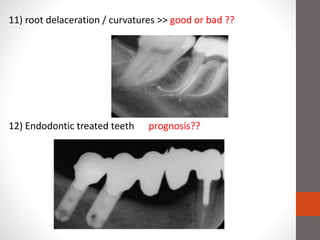
12) Endodontic treated teeth prognosis??
11) root delaceration / curvatures >> good or bad ??
I] Screw Loosening
Loosening of abutment screw is one of the most common mechanical
complications breaking the integrity between the implant and abutment.
 Etiology
  A) External Force Factors.
 these forces may be called joint-separating forces when related to
screw loosening.
 When the external joint-separating forces are greater than the
force holding the screws together (called clamping forces), the
screw will become loose.
kkkkmkjnk
VII) Biomechanical Complications
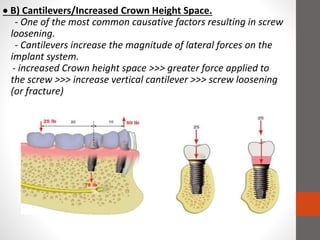
 B) Cantilevers/Increased Crown Height Space.
- One of the most common causative factors resulting in screw
loosening.
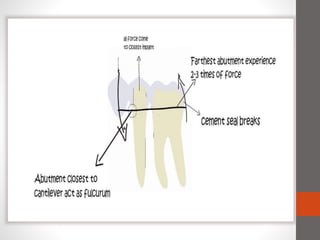
- Cantilevers increase the magnitude of lateral forces on the
implant system.
- increased Crown height space >>> greater force applied to
the screw >>> increase vertical cantilever >>> screw loosening
(or fracture)
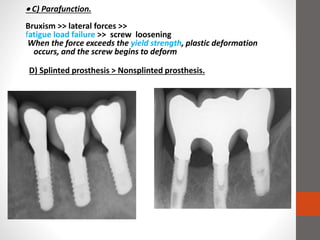
 C) Parafunction.
Bruxism >> lateral forces >>
fatigue load failure >> screw loosening
When the force exceeds the yield strength, plastic deformation
occurs, and the screw begins to deform
D) Splinted prosthesis > Nonsplinted prosthesis.
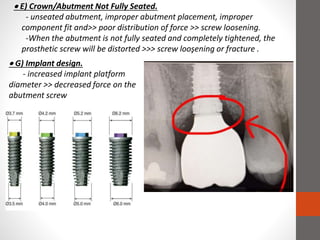
 E) Crown/Abutment Not Fully Seated.
- unseated abutment, improper abutment placement, improper
component fit and>> poor distribution of force >> screw loosening.
-When the abutment is not fully seated and completely tightened, the
prosthetic screw will be distorted >>> screw looşening or fracture .
 G) Implant design.
- increased implant platform
diameter >> decreased force on the
abutment screw
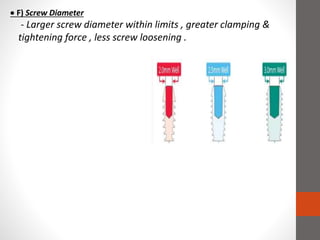
 F) Screw Diameter
- Larger screw diameter within limits , greater clamping &
tightening force , less screw loosening .
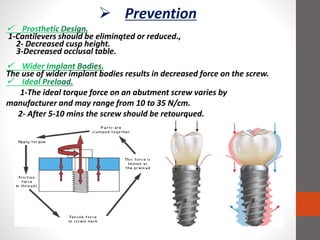
1-Cantilevers should be eliminąted or reduced.,
2- Decreased cusp height.
3-Decreased occlusal table.
The use of wider implant bodies results in decreased force on the screw.
 Prevention
1-The ideal torque force on an abutment screw varies by
manufacturer and may range from 10 to 35 N/cm.
2- After 5-10 mins the screw should be retourqued.
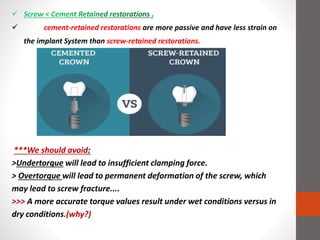
 cement-retained restorations are more passive and have less strain on
the implant System than screw-retained restorations.
***We should avoid:
>Undertorque will lead to insufficient clamping force.
> Overtorque will lead to permanent deformation of the screw, which
may lead to screw fracture....
>>> A more accurate torque values result under wet conditions versus in
dry conditions.(why?)
II] Fractured Implant
3-The endurance limit or fatigue strength : it is the highest
stress that a material can withstand due to repeated fatigue
cycles .
- A titanium alloy implant is preferably used.
- Parafunctional habits treated with occlusal guards, narrow
Occlusal tables, no lateral contacts.
dramatically increases when force conditions are greater.
1-Static load (one load cycle) failures: cause the stress in the material to
exceed its ultimate strength afterone load application.
2-Fatigue load failures: occur if the material is subjected to
lower loads but repeated cycles of that load.
III] Early Loading Failure
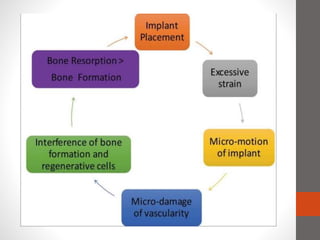
- Early implant failure from biomechanical overload as high
as 40%, has been reported in the softest bone types.
- The cause of early loading failure is usually excessive stress
on the bone-implant interface.
-In some cases , Crowns were attached to the healed
implants with excessive premature occlusal contact offer
greater risk factor for early implant failure than the
distructive effects of bacterial plaque.
>>> Early loading failure is directly
related to the amount of force applied to the
prosthesis.
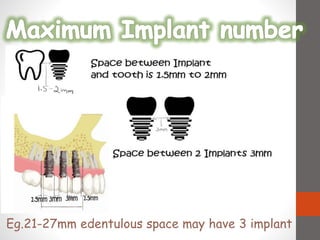
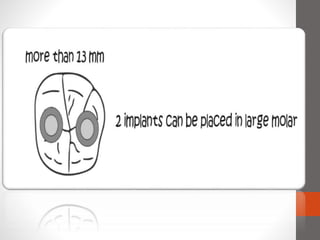
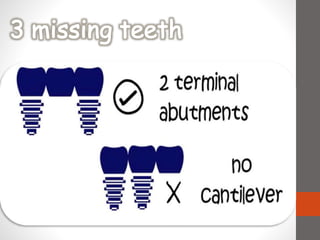
Eg.21-27mm edentulous space may have 3 implant
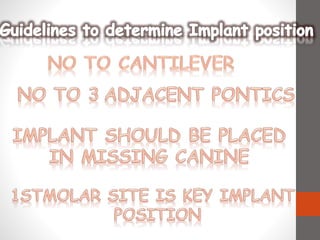
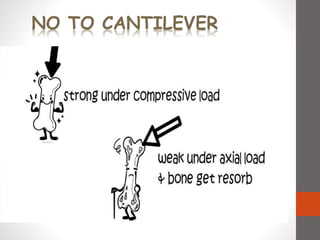
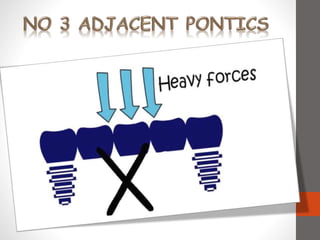
NO TO CANTILEVER
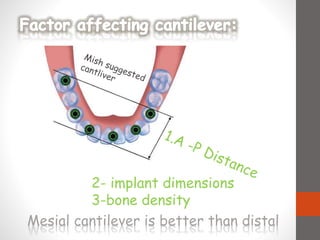
2- implant dimensions
3-bone density
Mesial cantilever is better than distal
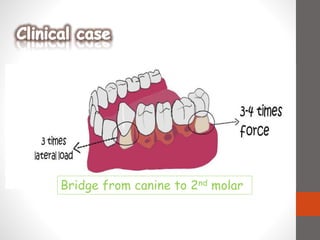
Bridge from canine to 2nd molar
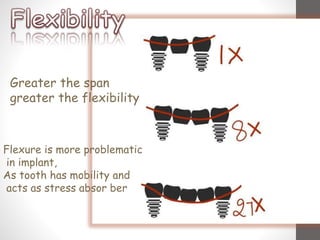
Greater the span
greater the flexibility
Flexure is more problematic
in implant,
As tooth has mobility and
acts as stress absor ber
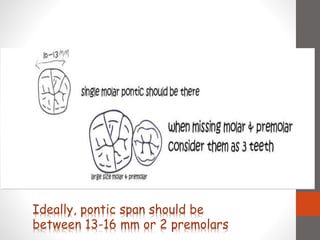
Ideally, pontic span should be
between 13-16 mm or 2 premolars
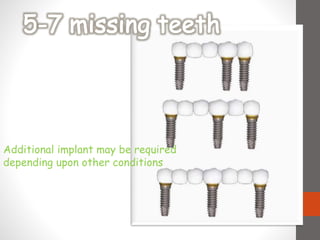
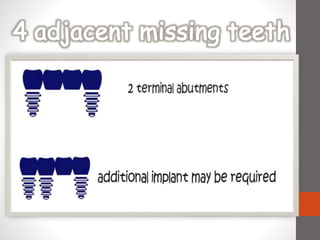
Additional implant may be required
depending upon other conditions
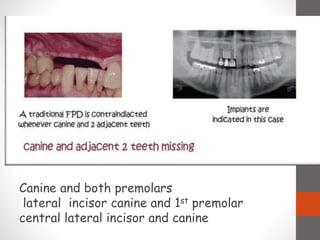
Canine and both premolars
lateral incisor canine and 1st premolar
central lateral incisor and canine
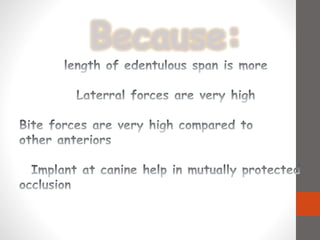
Because:
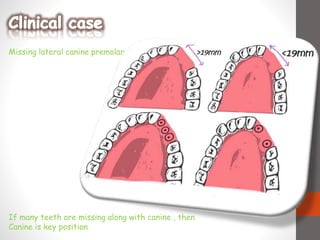
Missing lateral canine premolar
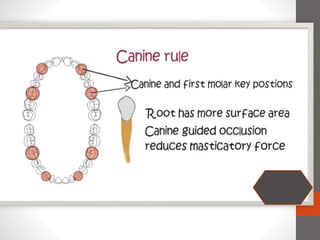
If many teeth are missing along with canine , then
Canine is key position
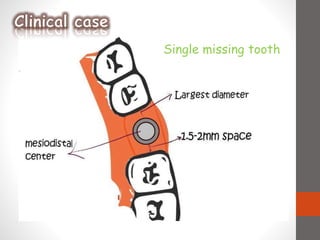
Single missing tooth
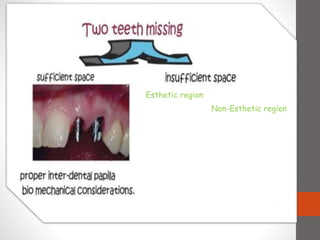
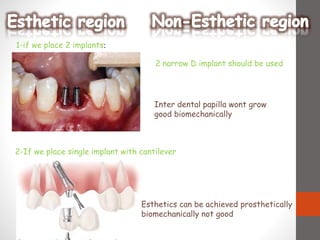
Esthetic region
Non-Esthetic region
1-if we place 2 implants:
2-If we place single implant with cantilever
Esthetics can be achieved prosthetically
biomechanically not good
2 narrow D implant should be used
Inter dental papilla wont grow
good biomechanically
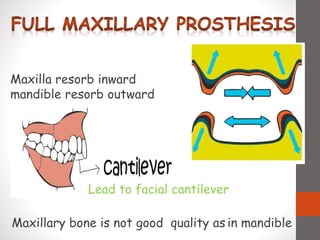
Maxilla resorb inward
mandible resorb outward
Lead to facial cantilever
Maxillary bone is not good quality as in mandible
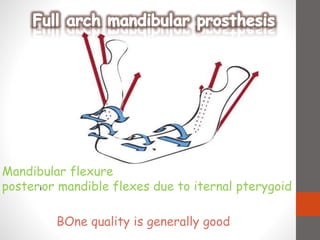
Mandibular flexure
posterior mandible flexes due to iternal pterygoid
BOne quality is generally good
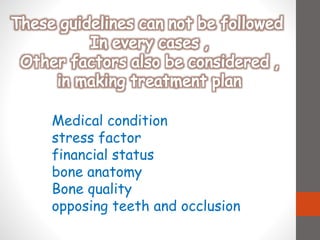
Medical condition
stress factor
financial status
bone anatomy
Bone quality
opposing teeth and occlusion
Presentation1