Bone and Cartilage regeneration with cells
and tissue engineering products
Enric Càceres
Chair Orthopaedics
Universitat Autònoma de Barcelona
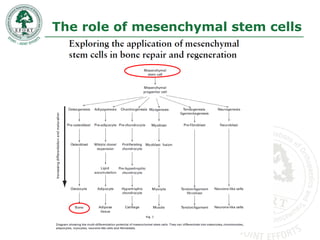
The role of mesenchymal stem cells
• Management of large bone defects and cartilage
loss continues to be a challenge
• Urist 1970 discovers Bone Morphogenetic Protein
• Autologous or allogeneic MSCs can be expanded
and then may be loaded in the variety of scaffolds
The role of mesenchymal stem cells
MSCs Origin
•Bone marrow
•Adipose tissue (including fat pad from knee)
•Periostium
•Synovium
•Artery walls
The role of mesenchymal stem cells
XCEL-MT-10-02
• Lumbar fusion in degenerative surgery:
Autologous iliac graft  Gold standard
– Local complications
– Limited amount of material
No union 5-35% (depending condition)
• Alternatives:
• BMP
• Mesenchyme Stem Cells
XCEL-MT-10-02
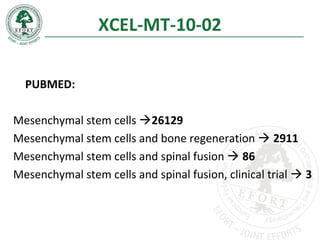
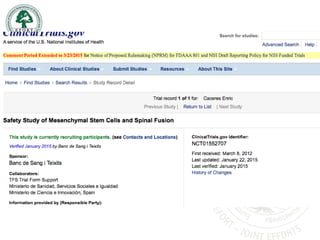
PUBMED:
Mesenchymal stem cells 26129
Mesenchymal stem cells and bone regeneration  2911
Mesenchymal stem cells and spinal fusion  86
Mesenchymal stem cells and spinal fusion, clinical trial  3
XCEL-MT-10-02
Biomaterials. 2008 Oct;29(29):3973-82. doi: 10.1016/j.biomaterials.2008.06.026.
Epub 2008 Jul 18.
The clinical use of enriched bone marrow stem cells combined with porous
beta-tricalcium phosphate in posterior spinal fusion.
Gan Y, Dai K, Zhang P, Tang T, Zhu Z, Lu J.
Department of Orthopaedics, Shanghai Ninth People's Hospital, Shanghai Jiaotong
University School of Medicine, Shanghai, People's Republic of China.
41 patients / 95% posterolateral fusion
XCEL-MT-10-02
Zhonghua Wai Ke Za Zhi. 2008 Apr 1;46(7):493-6.
Clinical study of lumbar fusion by hybrid construct of stem cells
technique and biodegradable material.
[Article in Chinese]
Zhang P, Gan YK, Tang J, Hao YQ, Wang Y, Sun YH, Zhu ZA, Dai KR.
Department of Orthopaedics, Shanghai Ninth People's Hospital, School of Medicine of
Shanghai Jiaotong University, Shanghai 200011, China.
Bone marrow mesenchyme stem cells hybridized with
beta-tri calcium phosphate 93% fusion
Autologous iliac crest bone graft 96% fusion
11
Title: "Ex Vivo" Expanded Autologous Bone Marrow
Mesenchymal Stem Cells Fixed in Allogenic
Human Bone Tissue for Spinal Fusion in Spine
Degenerative Disease (XCEL-MT-OSTEO-ALPHA)”
Target: Degenerative Spondylolisthesis L4-L5 degrees I-II
of Meyerding
Product: XCEL-MT-OSTEO-ALPHA
Promotion: BST (Banc de Sang i Teixits)
Source: Agencia Nacional del medicamento
XCEL-MT-10-02
XCEL-MT-10-02
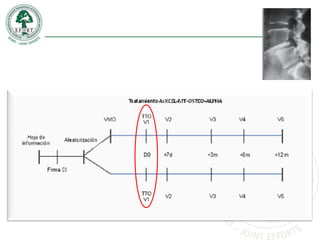
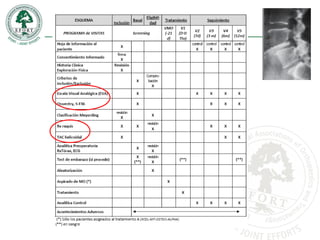
Design: Phase I/II, prospective, open (blind assessment),
randomized, parallel, only one dose and multicentric
Centres / IP: Vall d’Hebron, Hosp Germans Trias i Pujol, Hosp del
Mar, Hosp St Pau, ICATME-Dexeus
Objectives: 1st: To evaluate viability and safety of the product
Second: Assess efficacy through image (CT and XR
evaluation of fusion status at 6 and 12m) and clinical
assessment( VAS, Oswestry, SF-36)
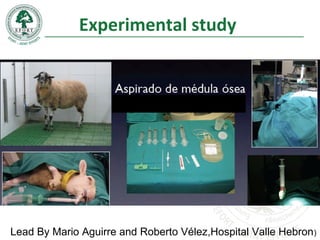
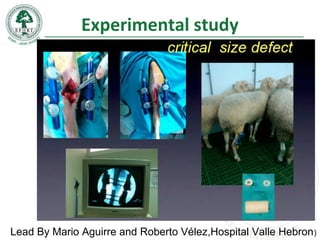
Experimental study
Lead By Mario Aguirre and Roberto Vélez,Hospital Valle Hebron)
Experimental study
Lead By Mario Aguirre and Roberto Vélez,Hospital Valle Hebron)
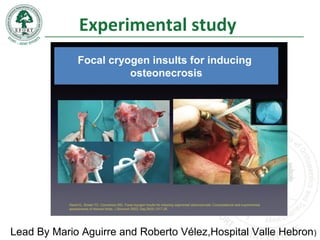
Experimental study
Focal cryogen insults for inducing
osteonecrosis
Lead By Mario Aguirre and Roberto Vélez,Hospital Valle Hebron)
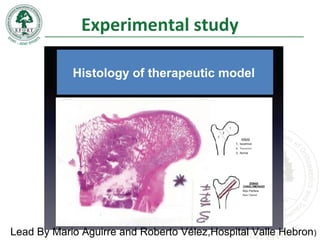
Experimental study
Histology of therapeutic model
Lead By Mario Aguirre and Roberto Vélez,Hospital Valle Hebron)
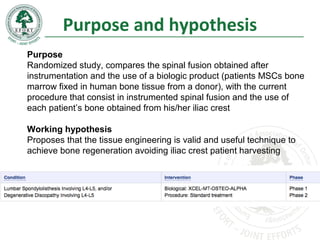
Purpose and hypothesis
Purpose
Randomized study, compares the spinal fusion obtained after
instrumentation and the use of a biologic product (patients MSCs bone
marrow fixed in human bone tissue from a donor), with the current
procedure that consist in instrumented spinal fusion and the use of
each patient’s bone obtained from his/her iliac crest
Working hypothesis
Proposes that the tissue engineering is valid and useful technique to
achieve bone regeneration avoiding iliac crest patient harvesting
18
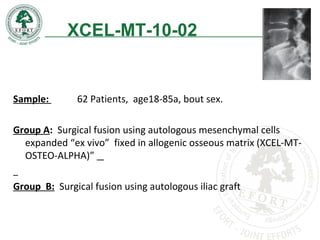
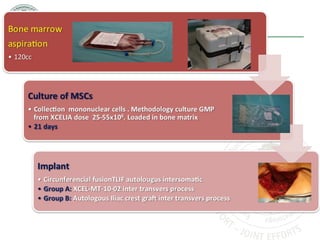
Sample: 62 Patients, age18-85a, bout sex.
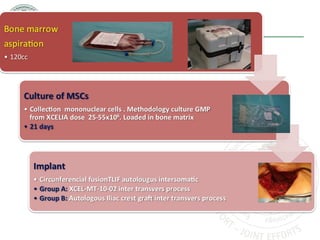
Group A: Surgical fusion using autologous mesenchymal cells
expanded “ex vivo” fixed in allogenic osseous matrix (XCEL-MT-
OSTEO-ALPHA)”
Group B: Surgical fusion using autologous iliac graft
XCEL-MT-10-02
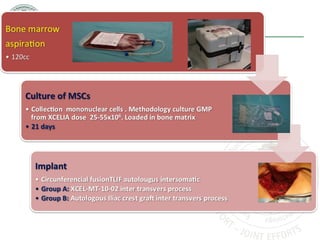
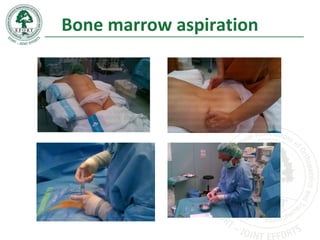
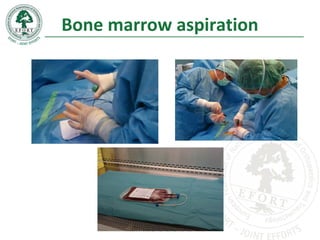
• Extracción
Bone marrow aspiration
• Extracción
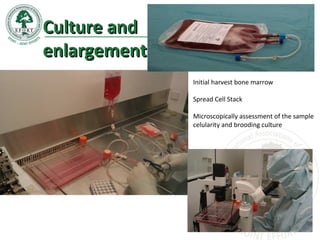
Initial harvest bone marrow
Spread Cell Stack
Microscopically assessment of the sample
celularity and brooding culture
Culture andCulture and
enlargementenlargement
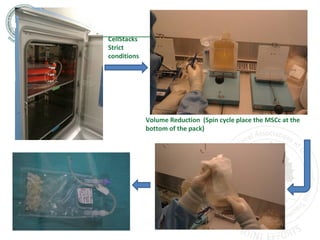
Volume Reduction (Spin cycle place the MSCc at the
bottom of the pack)
CellStacks
Strict
conditions
Cèl-lules mesenquimals, previes a la colonització
• Extracción
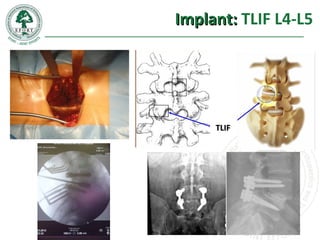
Implant:Implant: TLIF L4-L5
TLIFTLIF
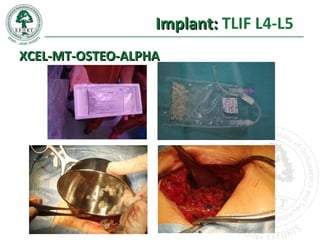
Implant:Implant: TLIF L4-L5
XCEL-MT-OSTEO-ALPHAXCEL-MT-OSTEO-ALPHA
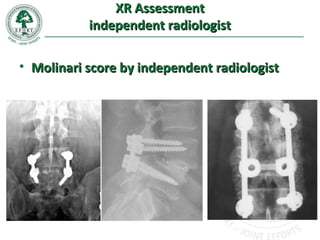
XR AssessmentXR Assessment
independent radiologistindependent radiologist
• Molinari score by independent radiologistMolinari score by independent radiologist
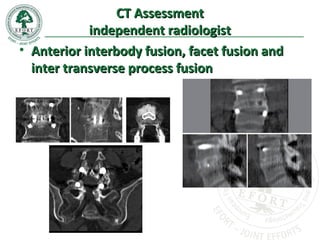
CT AssessmentCT Assessment
independent radiologistindependent radiologist
• Anterior interbody fusion, facet fusion andAnterior interbody fusion, facet fusion and
inter transverse process fusioninter transverse process fusion
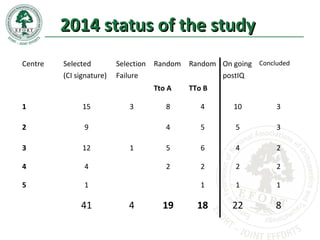
2014 status of the study2014 status of the study
Centre Selected
(CI signature)
Selection
Failure
Random Random On going
postIQ
Concluded
Tto A TTo B
1 15 3 8 4 10 3
2 2 9 4 5 5 3
3 3 12 1 5 6 4 2
4 4 4 2 2 2 2
5 5 1 1 1 1
41 4 19 18 22 8
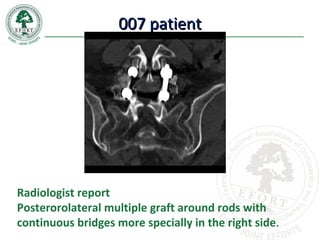
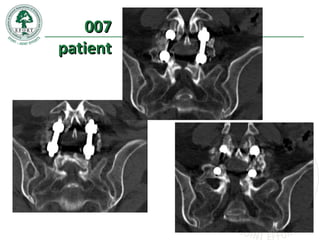
007 patient007 patient
Radiologist report
Posterorolateral multiple graft around rods with
continuous bridges more specially in the right side.
007007
patientpatient
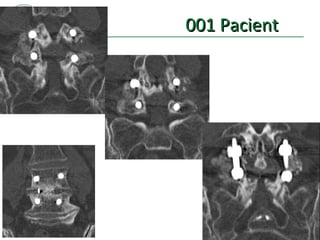
001 Pacient001 Pacient
BCN Trials
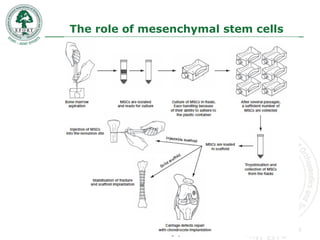
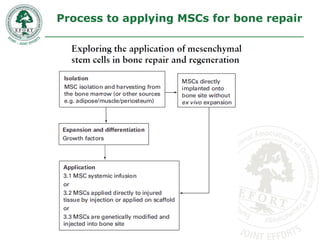
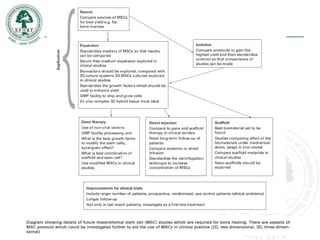
Process to applying MSCs for bone repair
MSCs directly
implanted without ex vivo
expansion
BCN Experience
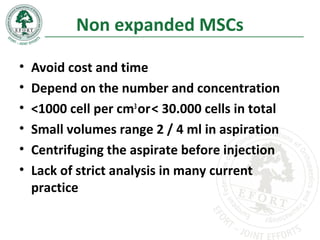
Non expanded MSCs
• Avoid cost and time
• Depend on the number and concentration
• <1000 cell per cm3
or< 30.000 cells in total
• Small volumes range 2 / 4 ml in aspiration
• Centrifuging the aspirate before injection
• Lack of strict analysis in many current
practice
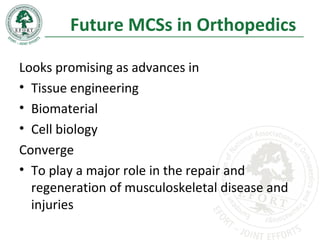
Future MCSs in Orthopedics
Looks promising as advances in
• Tissue engineering
• Biomaterial
• Cell biology
Converge
• To play a major role in the repair and
regeneration of musculoskeletal disease and
injuries

Bone and Cartilage regeneration with cells and tissue engineering products - Dr. Enric Cáceres - B-Debate 17/02/2015

  • 1.
    Bone and Cartilageregeneration with cells and tissue engineering products Enric Càceres Chair Orthopaedics Universitat Autònoma de Barcelona
  • 2.
    The role ofmesenchymal stem cells • Management of large bone defects and cartilage loss continues to be a challenge • Urist 1970 discovers Bone Morphogenetic Protein • Autologous or allogeneic MSCs can be expanded and then may be loaded in the variety of scaffolds
  • 3.
    The role ofmesenchymal stem cells MSCs Origin •Bone marrow •Adipose tissue (including fat pad from knee) •Periostium •Synovium •Artery walls
  • 4.
    The role ofmesenchymal stem cells
  • 5.
    The role ofmesenchymal stem cells
  • 6.
    XCEL-MT-10-02 • Lumbar fusionin degenerative surgery: Autologous iliac graft  Gold standard – Local complications – Limited amount of material No union 5-35% (depending condition) • Alternatives: • BMP • Mesenchyme Stem Cells
  • 7.
    XCEL-MT-10-02 PUBMED: Mesenchymal stem cells26129 Mesenchymal stem cells and bone regeneration  2911 Mesenchymal stem cells and spinal fusion  86 Mesenchymal stem cells and spinal fusion, clinical trial  3
  • 8.
    XCEL-MT-10-02 Biomaterials. 2008 Oct;29(29):3973-82.doi: 10.1016/j.biomaterials.2008.06.026. Epub 2008 Jul 18. The clinical use of enriched bone marrow stem cells combined with porous beta-tricalcium phosphate in posterior spinal fusion. Gan Y, Dai K, Zhang P, Tang T, Zhu Z, Lu J. Department of Orthopaedics, Shanghai Ninth People's Hospital, Shanghai Jiaotong University School of Medicine, Shanghai, People's Republic of China. 41 patients / 95% posterolateral fusion
  • 9.
    XCEL-MT-10-02 Zhonghua Wai KeZa Zhi. 2008 Apr 1;46(7):493-6. Clinical study of lumbar fusion by hybrid construct of stem cells technique and biodegradable material. [Article in Chinese] Zhang P, Gan YK, Tang J, Hao YQ, Wang Y, Sun YH, Zhu ZA, Dai KR. Department of Orthopaedics, Shanghai Ninth People's Hospital, School of Medicine of Shanghai Jiaotong University, Shanghai 200011, China. Bone marrow mesenchyme stem cells hybridized with beta-tri calcium phosphate 93% fusion Autologous iliac crest bone graft 96% fusion
  • 11.
    11 Title: "Ex Vivo"Expanded Autologous Bone Marrow Mesenchymal Stem Cells Fixed in Allogenic Human Bone Tissue for Spinal Fusion in Spine Degenerative Disease (XCEL-MT-OSTEO-ALPHA)” Target: Degenerative Spondylolisthesis L4-L5 degrees I-II of Meyerding Product: XCEL-MT-OSTEO-ALPHA Promotion: BST (Banc de Sang i Teixits) Source: Agencia Nacional del medicamento XCEL-MT-10-02
  • 12.
    XCEL-MT-10-02 Design: Phase I/II,prospective, open (blind assessment), randomized, parallel, only one dose and multicentric Centres / IP: Vall d’Hebron, Hosp Germans Trias i Pujol, Hosp del Mar, Hosp St Pau, ICATME-Dexeus Objectives: 1st: To evaluate viability and safety of the product Second: Assess efficacy through image (CT and XR evaluation of fusion status at 6 and 12m) and clinical assessment( VAS, Oswestry, SF-36)
  • 13.
    Experimental study Lead ByMario Aguirre and Roberto Vélez,Hospital Valle Hebron)
  • 14.
    Experimental study Lead ByMario Aguirre and Roberto Vélez,Hospital Valle Hebron)
  • 15.
    Experimental study Focal cryogeninsults for inducing osteonecrosis Lead By Mario Aguirre and Roberto Vélez,Hospital Valle Hebron)
  • 16.
    Experimental study Histology oftherapeutic model Lead By Mario Aguirre and Roberto Vélez,Hospital Valle Hebron)
  • 17.
    Purpose and hypothesis Purpose Randomizedstudy, compares the spinal fusion obtained after instrumentation and the use of a biologic product (patients MSCs bone marrow fixed in human bone tissue from a donor), with the current procedure that consist in instrumented spinal fusion and the use of each patient’s bone obtained from his/her iliac crest Working hypothesis Proposes that the tissue engineering is valid and useful technique to achieve bone regeneration avoiding iliac crest patient harvesting
  • 18.
    18 Sample: 62 Patients,age18-85a, bout sex. Group A: Surgical fusion using autologous mesenchymal cells expanded “ex vivo” fixed in allogenic osseous matrix (XCEL-MT- OSTEO-ALPHA)” Group B: Surgical fusion using autologous iliac graft XCEL-MT-10-02
  • 21.
  • 22.
  • 23.
  • 24.
  • 25.
    Initial harvest bonemarrow Spread Cell Stack Microscopically assessment of the sample celularity and brooding culture Culture andCulture and enlargementenlargement
  • 26.
    Volume Reduction (Spincycle place the MSCc at the bottom of the pack) CellStacks Strict conditions Cèl-lules mesenquimals, previes a la colonització
  • 27.
  • 28.
  • 29.
  • 30.
    XR AssessmentXR Assessment independentradiologistindependent radiologist • Molinari score by independent radiologistMolinari score by independent radiologist
  • 31.
    CT AssessmentCT Assessment independentradiologistindependent radiologist • Anterior interbody fusion, facet fusion andAnterior interbody fusion, facet fusion and inter transverse process fusioninter transverse process fusion
  • 32.
    2014 status ofthe study2014 status of the study Centre Selected (CI signature) Selection Failure Random Random On going postIQ Concluded Tto A TTo B 1 15 3 8 4 10 3 2 2 9 4 5 5 3 3 3 12 1 5 6 4 2 4 4 4 2 2 2 2 5 5 1 1 1 1 41 4 19 18 22 8
  • 33.
    007 patient007 patient Radiologistreport Posterorolateral multiple graft around rods with continuous bridges more specially in the right side.
  • 34.
  • 35.
  • 36.
  • 37.
    Process to applyingMSCs for bone repair
  • 38.
    MSCs directly implanted withoutex vivo expansion BCN Experience
  • 39.
    Non expanded MSCs •Avoid cost and time • Depend on the number and concentration • <1000 cell per cm3 or< 30.000 cells in total • Small volumes range 2 / 4 ml in aspiration • Centrifuging the aspirate before injection • Lack of strict analysis in many current practice
  • 41.
    Future MCSs inOrthopedics Looks promising as advances in • Tissue engineering • Biomaterial • Cell biology Converge • To play a major role in the repair and regeneration of musculoskeletal disease and injuries